PRESENTED BY:
KARISHMA SIROHI(21)
ARUN SINGLA(22)
KIRANJOT(23)
Elasticity of demand measures the degree of change in
demand of a commodity in response to a change of the
commodity, or change in the income of the consumer or
change in the price of related goods.
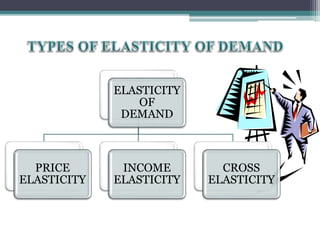
ELASTICITY
OF
DEMAND
PRICE
ELASTICITY
INCOME
ELASTICITY
CROSS
ELASTICITY
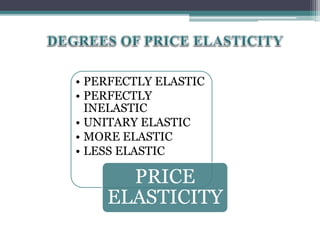
• PERFECTLY ELASTIC
• PERFECTLY
INELASTIC
• UNITARY ELASTIC
• MORE ELASTIC
• LESS ELASTIC
PRICE
ELASTICITY
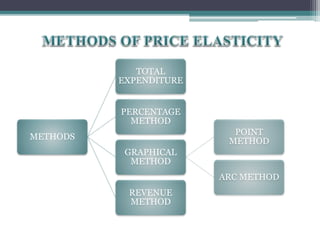
METHODS
TOTAL
EXPENDITURE
PERCENTAGE
METHOD
GRAPHICAL
METHOD
POINT
METHOD
ARC METHOD
REVENUE
METHOD
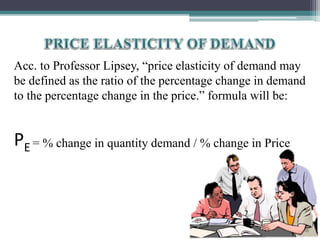
Acc. to Professor Lipsey, “price elasticity of demand may
be defined as the ratio of the percentage change in demand
to the percentage change in the price.” formula will be:
PE = % change in quantity demand / % change in Price
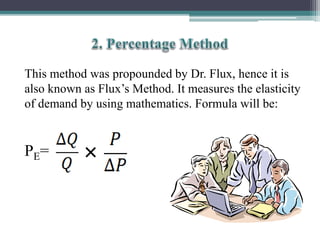
This method was propounded by Dr. Flux, hence it is
also known as Flux’s Method. It measures the elasticity
of demand by using mathematics. Formula will be:
PE= ×
This method of measuring elasticity of demand was
evolved by Dr. Marshall. This is also known as the
Unity Method. According to this method, there can be
three measures:
1. Greater than Unity; E>1
2. Equal to Unity; E=1
3. Less than Unity; E<1
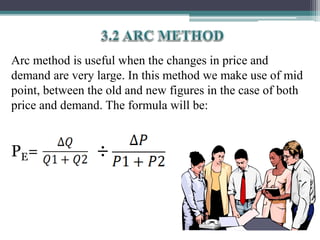
Arc method is useful when the changes in price and
demand are very large. In this method we make use of mid
point, between the old and new figures in the case of both
price and demand. The formula will be:
PE= ÷
This method was found by Dr. Marshall is used to find out the
elasticity of demand at a particular point on a demand curve. The
formula will be:
E= Lower sector of demand curve/ upper sector of the curve
If,
1. Lower sector>upper sector; E>1
2. Lower sector= upper sector; E=1
3. Lower sector<upper sector; E<1
1. Nature of the commodity
2. Substitute
3. Variety of uses
4. Range of prices
5. Habits
6. Proportion of the income spend on the commodity
7. Time factor
8. Joint demand
9. Durability of goods
10.Budget position
11.Fashion
12.Classes of buyers
Price elasticity of demand can also be measured with the
help of average and marginal revenue with using the
following formula:
E=A/A-M
A= average revenue
M= marginal revenue
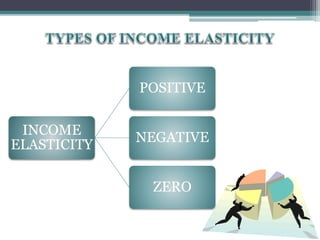
INCOME
ELASTICITY
POSITIVE
NEGATIVE
ZERO
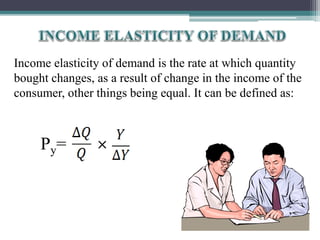
Income elasticity of demand is the rate at which quantity
bought changes, as a result of change in the income of the
consumer, other things being equal. It can be defined as:
Py= ×
INCOME
ELASTICITY
• EY=1
• EY>1
• EY<1
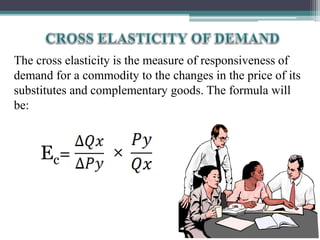
The cross elasticity is the measure of responsiveness of
demand for a commodity to the changes in the price of its
substitutes and complementary goods. The formula will
be:
Ec= ×
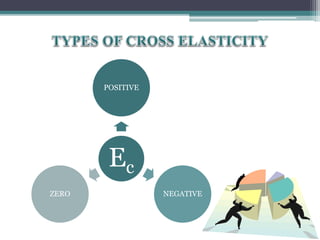
Ec
POSITIVE
NEGATIVEZERO
Elasticity of demand

Elasticity of demand

  • 1.
  • 2.
    Elasticity of demandmeasures the degree of change in demand of a commodity in response to a change of the commodity, or change in the income of the consumer or change in the price of related goods.
  • 3.
  • 4.
    • PERFECTLY ELASTIC •PERFECTLY INELASTIC • UNITARY ELASTIC • MORE ELASTIC • LESS ELASTIC PRICE ELASTICITY
  • 5.
  • 6.
    Acc. to ProfessorLipsey, “price elasticity of demand may be defined as the ratio of the percentage change in demand to the percentage change in the price.” formula will be: PE = % change in quantity demand / % change in Price
  • 7.
    This method waspropounded by Dr. Flux, hence it is also known as Flux’s Method. It measures the elasticity of demand by using mathematics. Formula will be: PE= ×
  • 8.
    This method ofmeasuring elasticity of demand was evolved by Dr. Marshall. This is also known as the Unity Method. According to this method, there can be three measures: 1. Greater than Unity; E>1 2. Equal to Unity; E=1 3. Less than Unity; E<1
  • 9.
    Arc method isuseful when the changes in price and demand are very large. In this method we make use of mid point, between the old and new figures in the case of both price and demand. The formula will be: PE= ÷
  • 10.
    This method wasfound by Dr. Marshall is used to find out the elasticity of demand at a particular point on a demand curve. The formula will be: E= Lower sector of demand curve/ upper sector of the curve If, 1. Lower sector>upper sector; E>1 2. Lower sector= upper sector; E=1 3. Lower sector<upper sector; E<1
  • 11.
    1. Nature ofthe commodity 2. Substitute 3. Variety of uses 4. Range of prices 5. Habits 6. Proportion of the income spend on the commodity 7. Time factor 8. Joint demand 9. Durability of goods 10.Budget position 11.Fashion 12.Classes of buyers
  • 12.
    Price elasticity ofdemand can also be measured with the help of average and marginal revenue with using the following formula: E=A/A-M A= average revenue M= marginal revenue
  • 13.
  • 14.
    Income elasticity ofdemand is the rate at which quantity bought changes, as a result of change in the income of the consumer, other things being equal. It can be defined as: Py= ×
  • 15.
  • 16.
    The cross elasticityis the measure of responsiveness of demand for a commodity to the changes in the price of its substitutes and complementary goods. The formula will be: Ec= ×
  • 17.