SEMINAR
SPECIAL AND GENERAL THEORY OF RELATIVITY IN
NUTSHELL
DEPARTMENT OF PHYSICS, IIT KHARAGPUR
PRESENTED BY: SHUBHAM PATEL
17PH40035
EVERYTHING IS
RELATIVE !
Nothing Absolute !
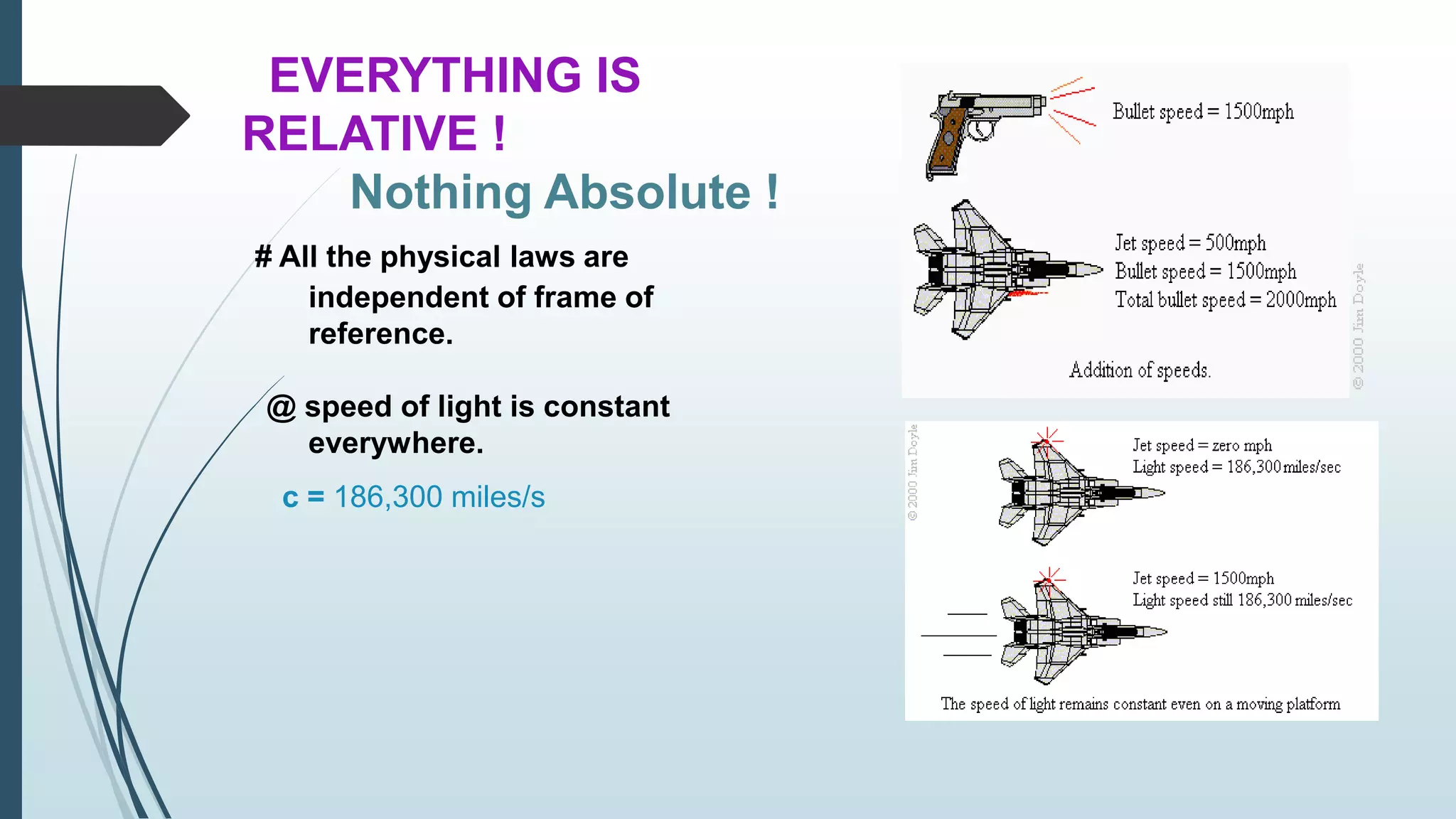
# All the physical laws are
independent of frame of
reference.
@ speed of light is constant
everywhere.
c = 186,300 miles/s
Proofs of prior Statements
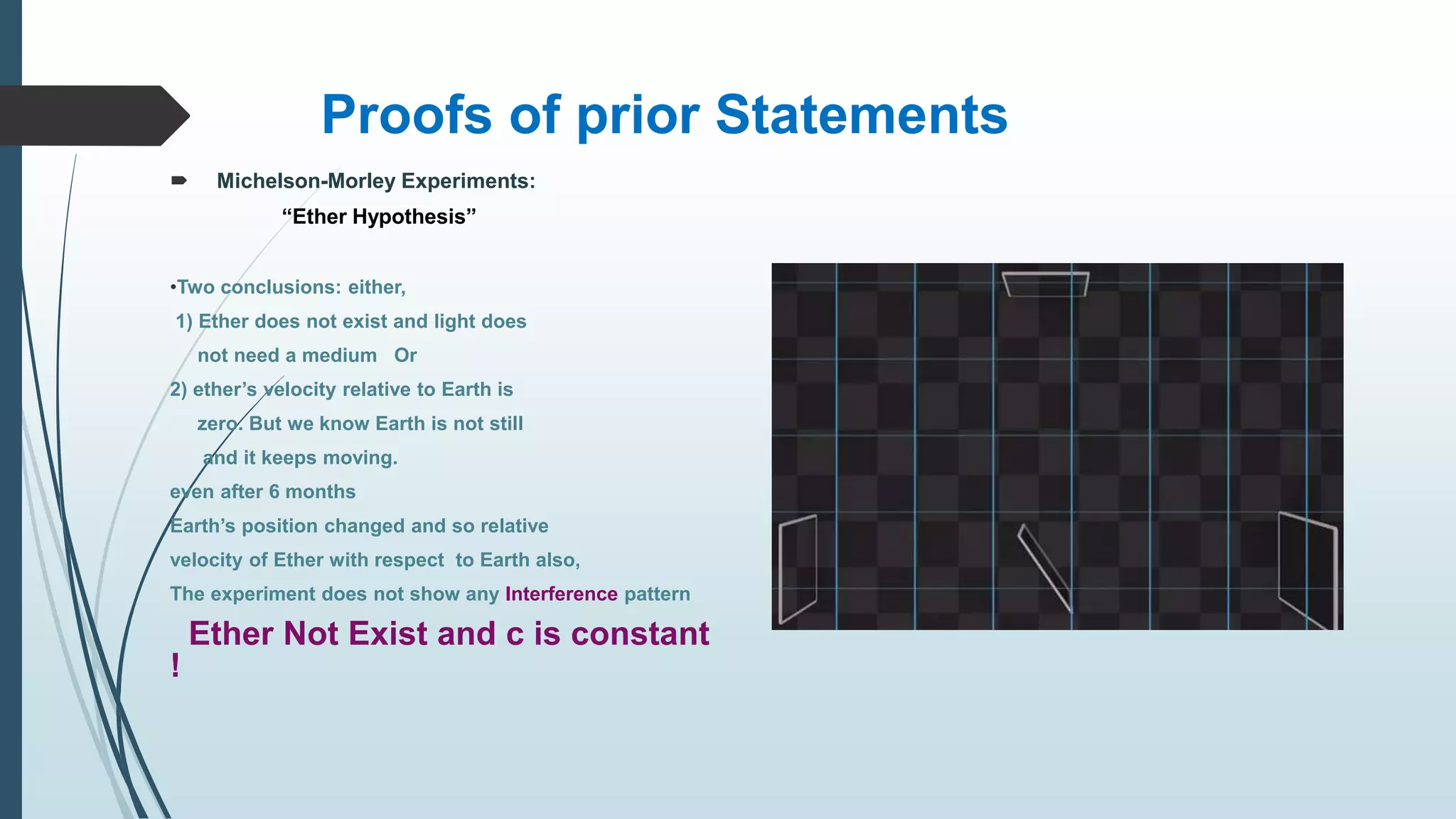
 Michelson-Morley Experiments:
“Ether Hypothesis”
•Two conclusions: either,
1) Ether does not exist and light does
not need a medium Or
2) ether’s velocity relative to Earth is
zero. But we know Earth is not still
and it keeps moving.
even after 6 months
Earth’s position changed and so relative
velocity of Ether with respect to Earth also,
The experiment does not show any Interference pattern
Ether Not Exist and c is constant
!
Consequences of STR
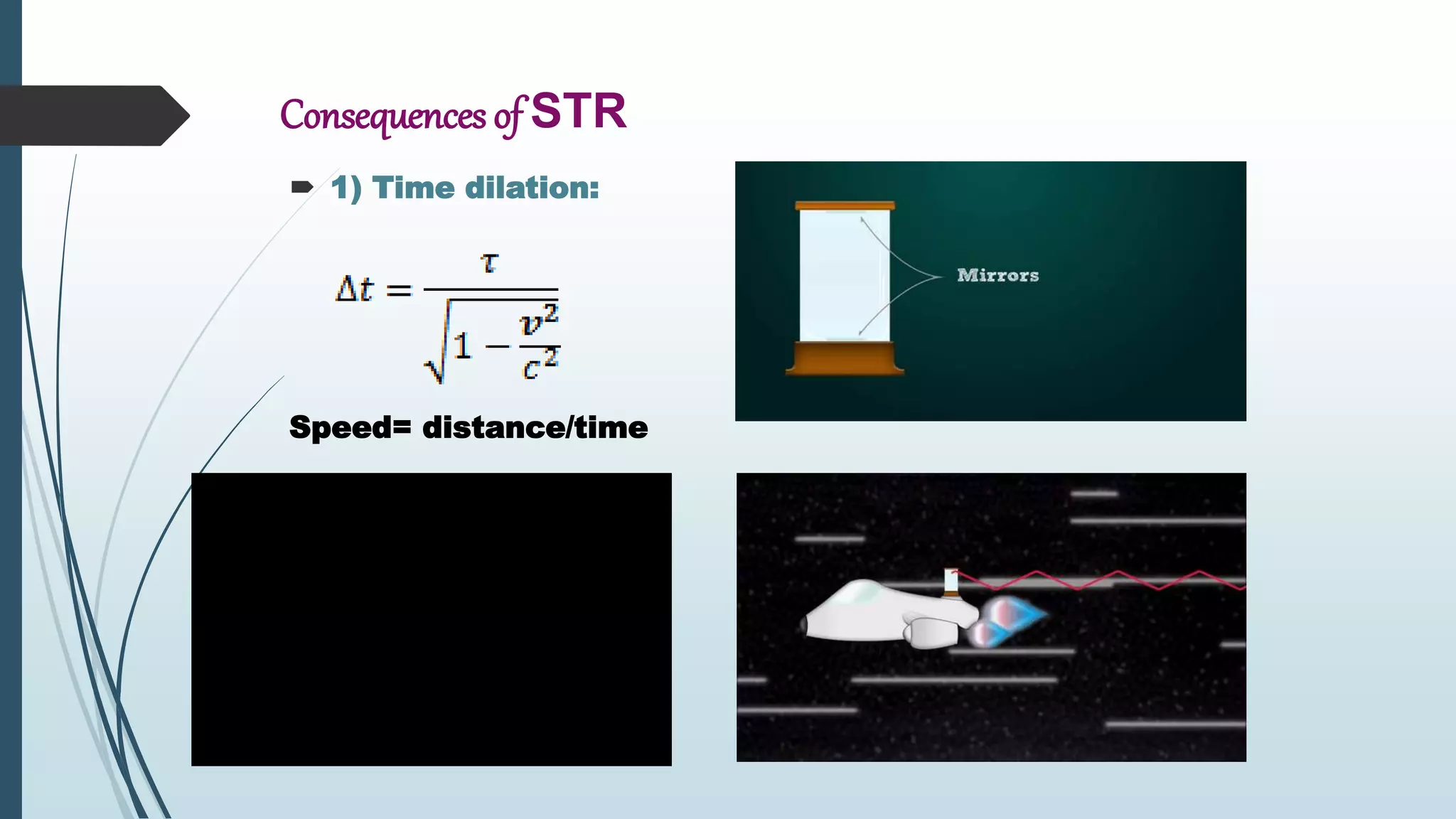
 1) Time dilation:
Speed= distance/time
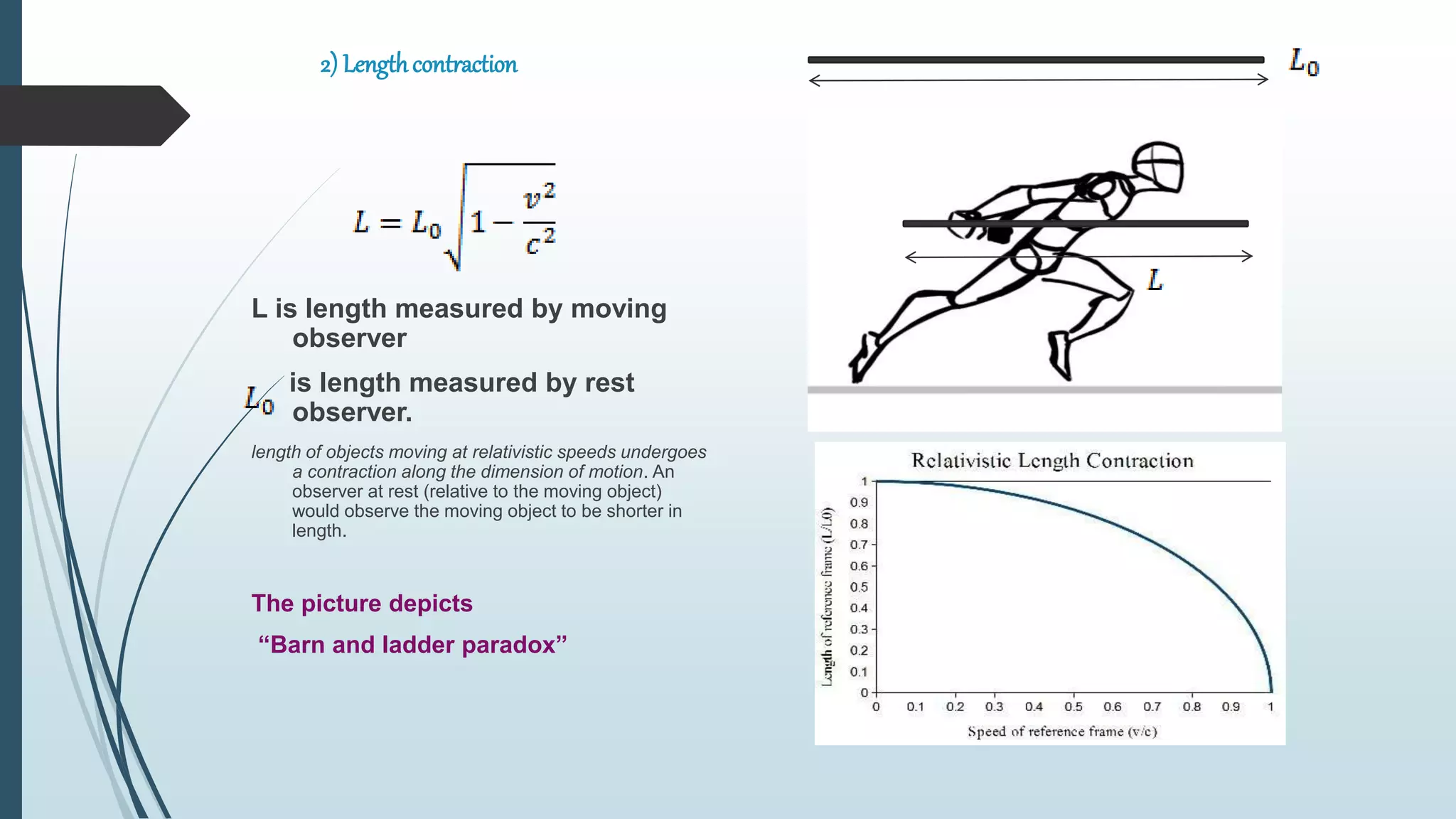
2) Lengthcontraction
L is length measured by moving
observer
is length measured by rest
observer.
length of objects moving at relativistic speeds undergoes
a contraction along the dimension of motion. An
observer at rest (relative to the moving object)
would observe the moving object to be shorter in
length.
The picture depicts
“Barn and ladder paradox”
3) Relativityof Simultaneity:
 If two events are simultaneous in one frame of reference, they are generally not
simultaneous in another.
 A conclude:
 B conclude:
Two ships A and B pass by rest observer with equal but opposite velocities. Rest observer
fires explosives at points X1 and x2 simultaneously from his point of view.
Twin paradox
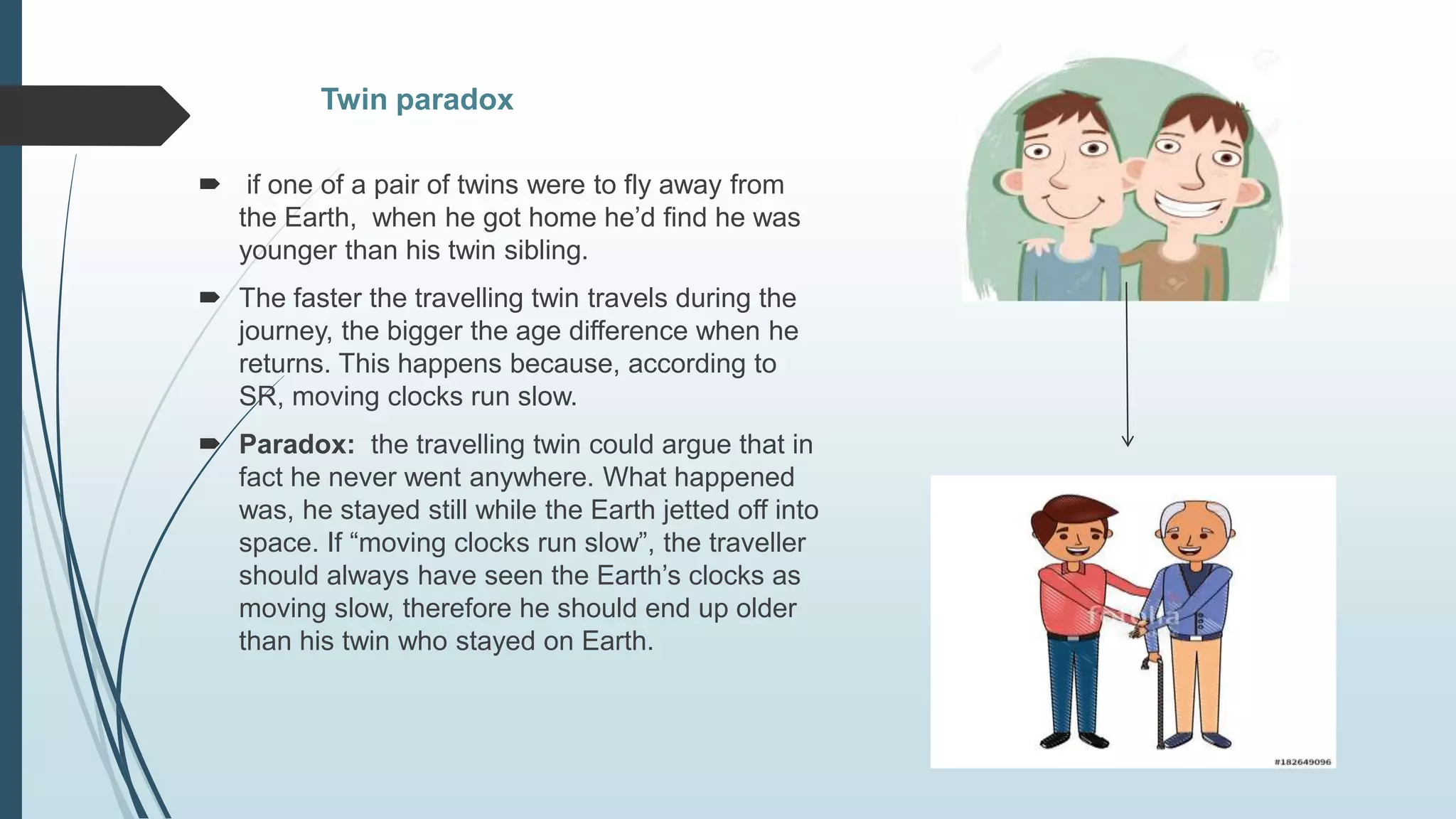
 if one of a pair of twins were to fly away from
the Earth, when he got home he’d find he was
younger than his twin sibling.
 The faster the travelling twin travels during the
journey, the bigger the age difference when he
returns. This happens because, according to
SR, moving clocks run slow.
 Paradox: the travelling twin could argue that in
fact he never went anywhere. What happened
was, he stayed still while the Earth jetted off into
space. If “moving clocks run slow”, the traveller
should always have seen the Earth’s clocks as
moving slow, therefore he should end up older
than his twin who stayed on Earth.
Variation of mass with velocity
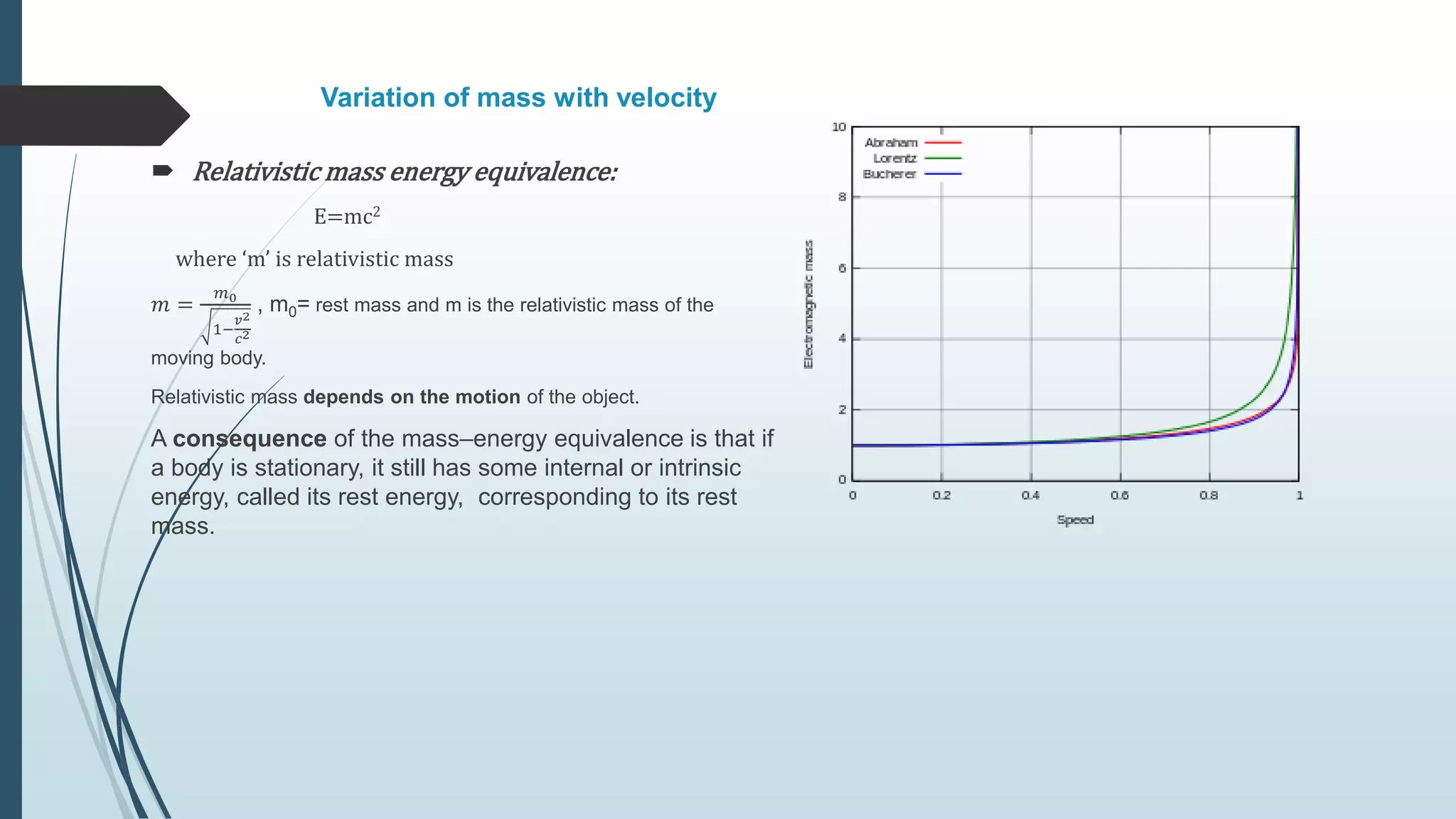
 Relativistic mass energy equivalence:
E=mc2
where ‘m’ is relativistic mass
𝑚 =
𝑚0
1−
𝑣2
𝑐2
, m0= rest mass and m is the relativistic mass of the
moving body.
Relativistic mass depends on the motion of the object.
A consequence of the mass–energy equivalence is that if
a body is stationary, it still has some internal or intrinsic
energy, called its rest energy, corresponding to its rest
mass.
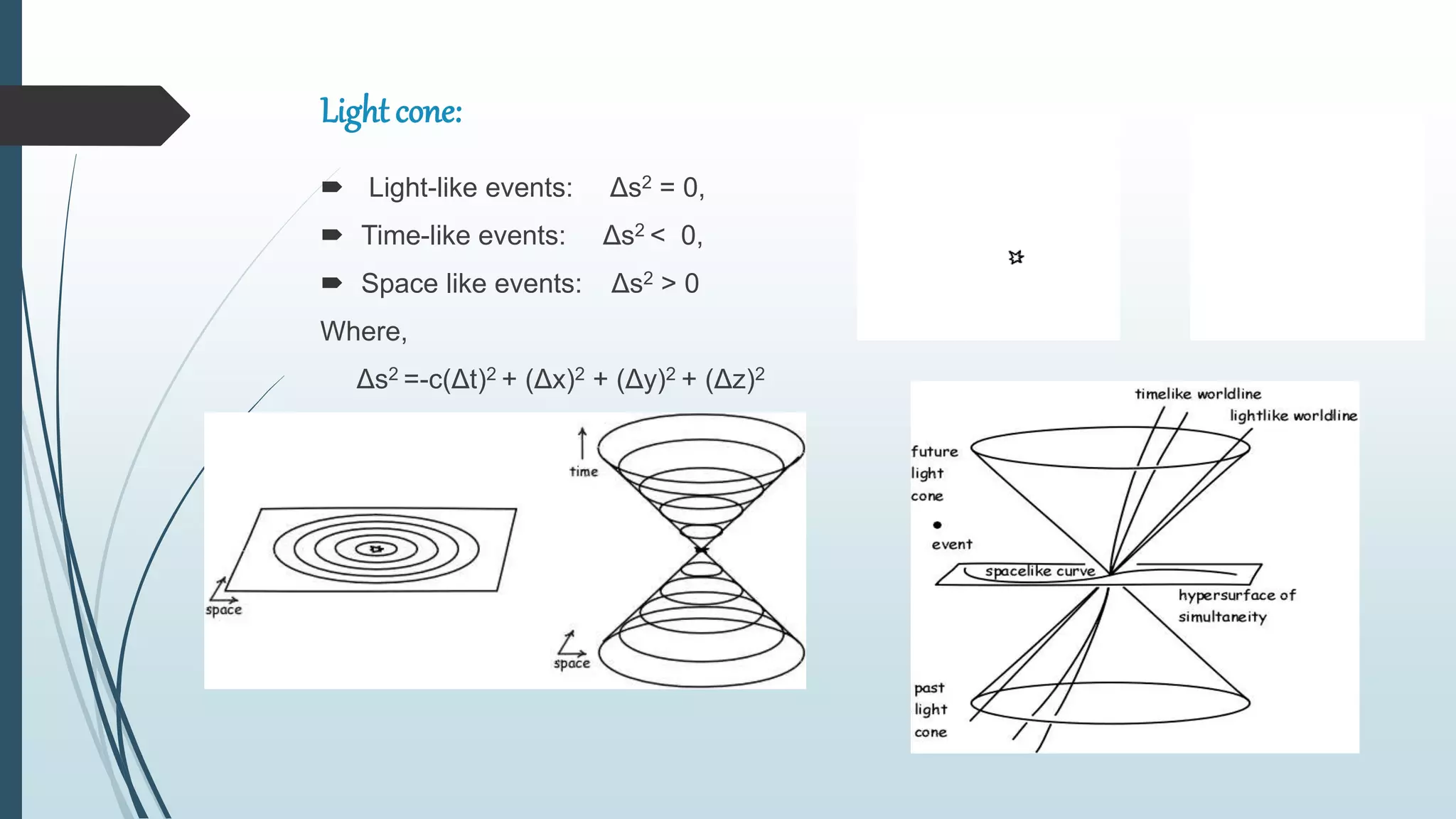
Light cone:
 Light-like events: Δs2 = 0,
 Time-like events: Δs2 < 0,
 Space like events: Δs2 > 0
Where,
Δs2 =-c(Δt)2 + (Δx)2 + (Δy)2 + (Δz)2
General theory of Relativity:
 GRAVITY:
“warping of space-time”
Newton’s Gravitation:
 Newtonian gravitational force is instantaneous
G = 6.674×10⁻¹¹ N·kg–2·m2.
Where c is considered infinity.
Equivalence principle:
 All feel the same acceleration. the acceleration of bodies towards the
center of the Earth at a rate of 1g (g = 9.81m/s2) is equivalent to the
acceleration of an inertially moving body that would be observed on a
rocket in free space being accelerated at a rate of 1g.
ain = agr
Clocks in Gravitational Field:
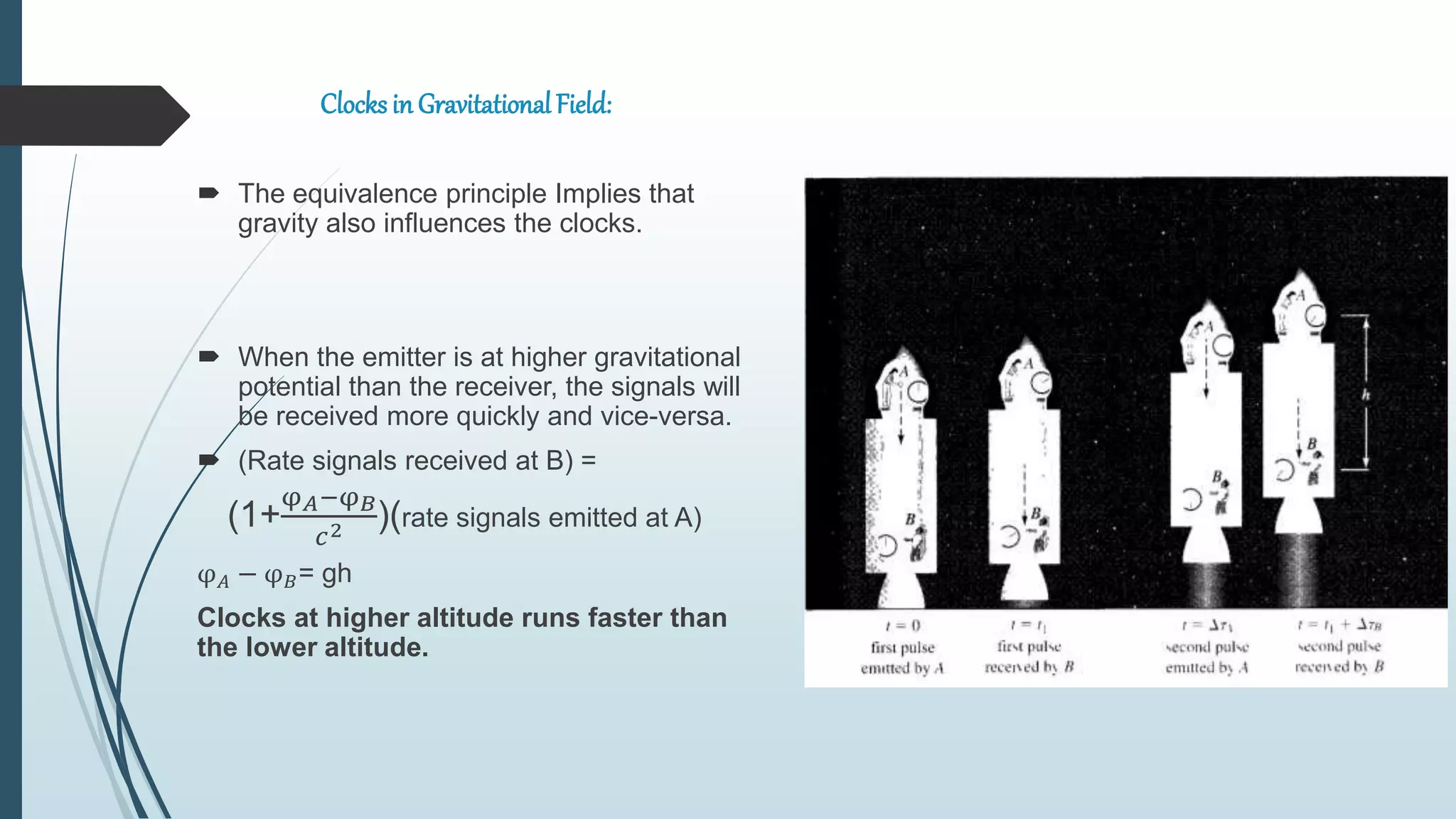
 The equivalence principle Implies that
gravity also influences the clocks.
 When the emitter is at higher gravitational
potential than the receiver, the signals will
be received more quickly and vice-versa.
 (Rate signals received at B) =
(1+
φ 𝐴−φ 𝐵
𝑐2 )(rate signals emitted at A)
φ 𝐴 − φ 𝐵= gh
Clocks at higher altitude runs faster than
the lower altitude.
Gravitational time dilation:
 A common equation used to determine gravitational time dilation is derived from the Schwarzschild
metric, which describes space-time in the vicinity of a non-rotating massive spherically
symmetric object. The equation is,
𝑡0 = 𝑡𝑓 1 −
2𝐺𝑀
𝑟𝑐2 = 𝑡0 = 𝑡𝑓 1 −
𝑟𝑠
𝑐2
t0 is the proper time between events A and B for a slow-ticking observer within the gravitational field,
tf is the coordinate time between events A and B for a fast-ticking observer at an arbitrarily large
distance from the massive object (this assumes the fast-ticking observer is using Schwarzschild
coordinates, a coordinate system where a clock at infinite distance from the massive sphere would tick
at one second per second of coordinate time, while closer clocks would tick at less than that rate),
Example The heart of human being is a kind of clock. As measured by a clock on ground floor, a heart
will beat more times on the top floor in a given interval of time than the heart of a similar person on the
ground floor.
For a 30m height building 1 +
(9.8𝑚/𝑠2)(30𝑚)
(3x10⁸ 𝑚/𝑠2)
which differs from unity only by a few parts(~1.00000098)
which means a negligible effect. A few microsecond in 100 years.
Gravity attracts light:
 “Equivalence principle implies that a light ray must fall in the same way in
gravitational field with the same acceleration as the other objects.”
Bending of space-time and light:
 Gravity warps the space-time and even light. Gravity is attraction but Attraction
due Curved space-time.
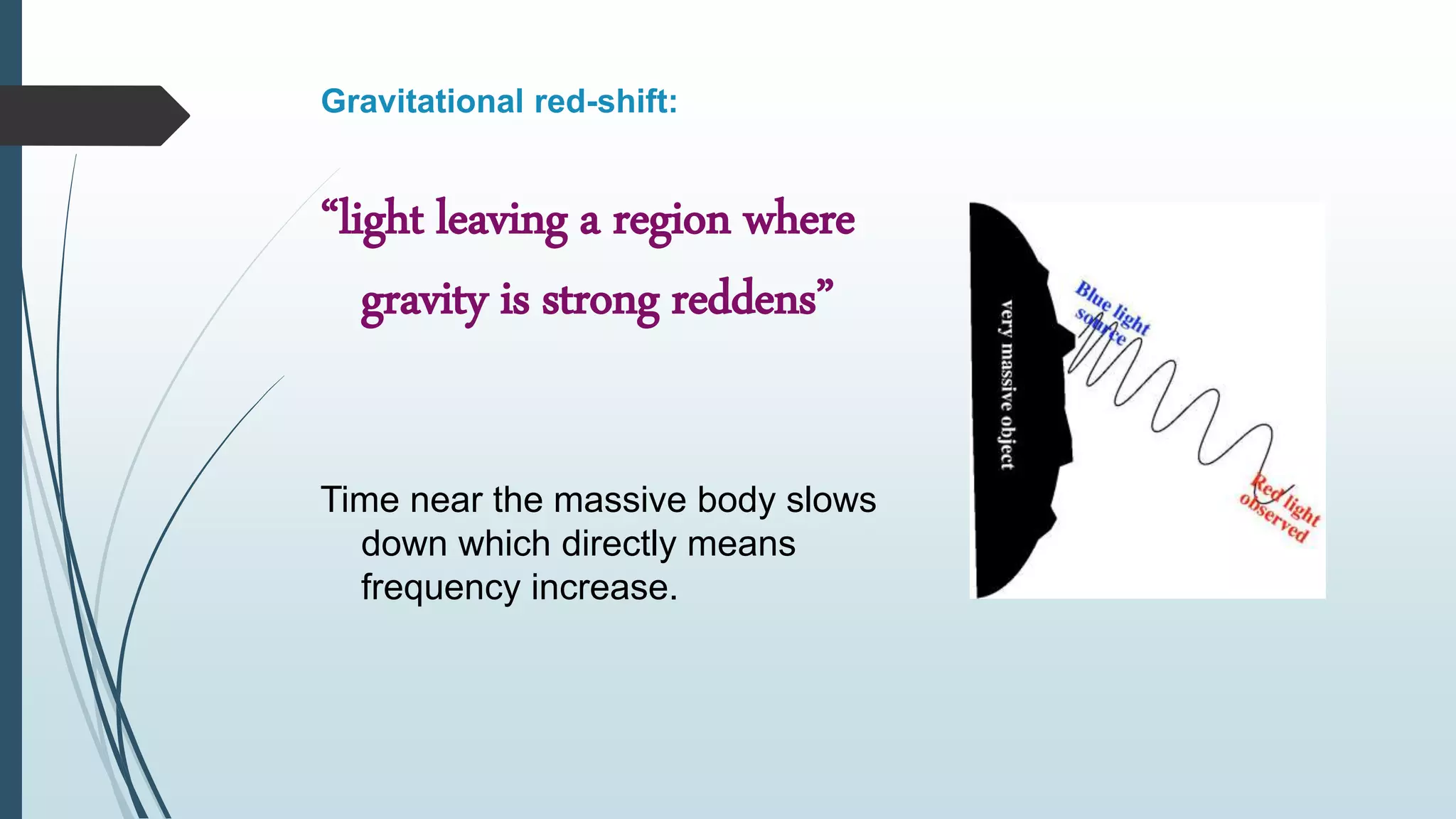
Gravitational red-shift:
“light leaving a region where
gravity is strong reddens”
Time near the massive body slows
down which directly means
frequency increase.
Black-hole:
 Highly massive but compact object from which even light cannot
escape, that’s why it is called “Black”.
 Event Horizon:
“Once check-in, no check out”
Heaviest object in the universe:
 Galaxy NGC 1277: One of the biggest central
supermassive black holes ever found in its
center(1.7×10¹⁰ M☉ (17 billion solar masses))
Tests of general relativity:
 1) Precession of the perihelion of Mercury:
As seen from Earth the precession of Mercury’s
orbit is measured to be 5600 seconds of arc
per century (one second of arc= 1/3600
degrees). But actually it is 5557 seconds of
arc per century as Earth is not an inertial
frame of reference.
Discrepancy of 43 seconds of arc per
century.
Resolved by GTR !
2) Light bending
 Observations during the eclipse and after
half an year later.
 Eddington first observed this effect in
1919 during a solar eclipse.
 Eddington’s telegram to Einstein
announcing the observation of the bending
of light by a gravitational force as
predicted by the General Theory of
Relativity.
References:
 https://www.quora.com/What-is-a-black-hole-How-can-we-understand-it
 https://www.quora.com/topic/General-Relativity
 https://theory.uwinnipeg.ca/
 https://www.youtub
 e.com/watch?v=xIOEaqPHOJo
 https://www.youtube.com/watch?v=R7V3koyL7Mc
 https://www.quora.com/topic/Gravitational-Waves-4
 https://en.wikipedia.org/wiki/PSR_J0737-3039
 ttps://www.pitt.edu/~jdnorton/teaching/HPS_0410/chapters/spacetime/
 https://www.quora.com/What-is-a-light-cone
 https://hepweb.ucsd.edu/ph110b/110b_notes/node46.html
 https://www.youtube.com/watch?v=wteiuxyqtoM
 https://www.youtube.com/watch?v=TgH9KXEQ0YU
 https://www.quora.com/What-is-the-purpose-of-Einsteins-theory-of-relativity
 https://www.youtube.com/watch?v=k6gd3bQLiFc
 https://www.quora.com/What-is-the-twin-paradox-and-how-does-it-work#ans30171532
 https://www.youtube.com/watch?v=k6gd3bQLiFc
 http://iontrap.umd.edu/wp-content/uploads/2016/01/WudkaGR-7.pdf
Thank you allfor your kindattention
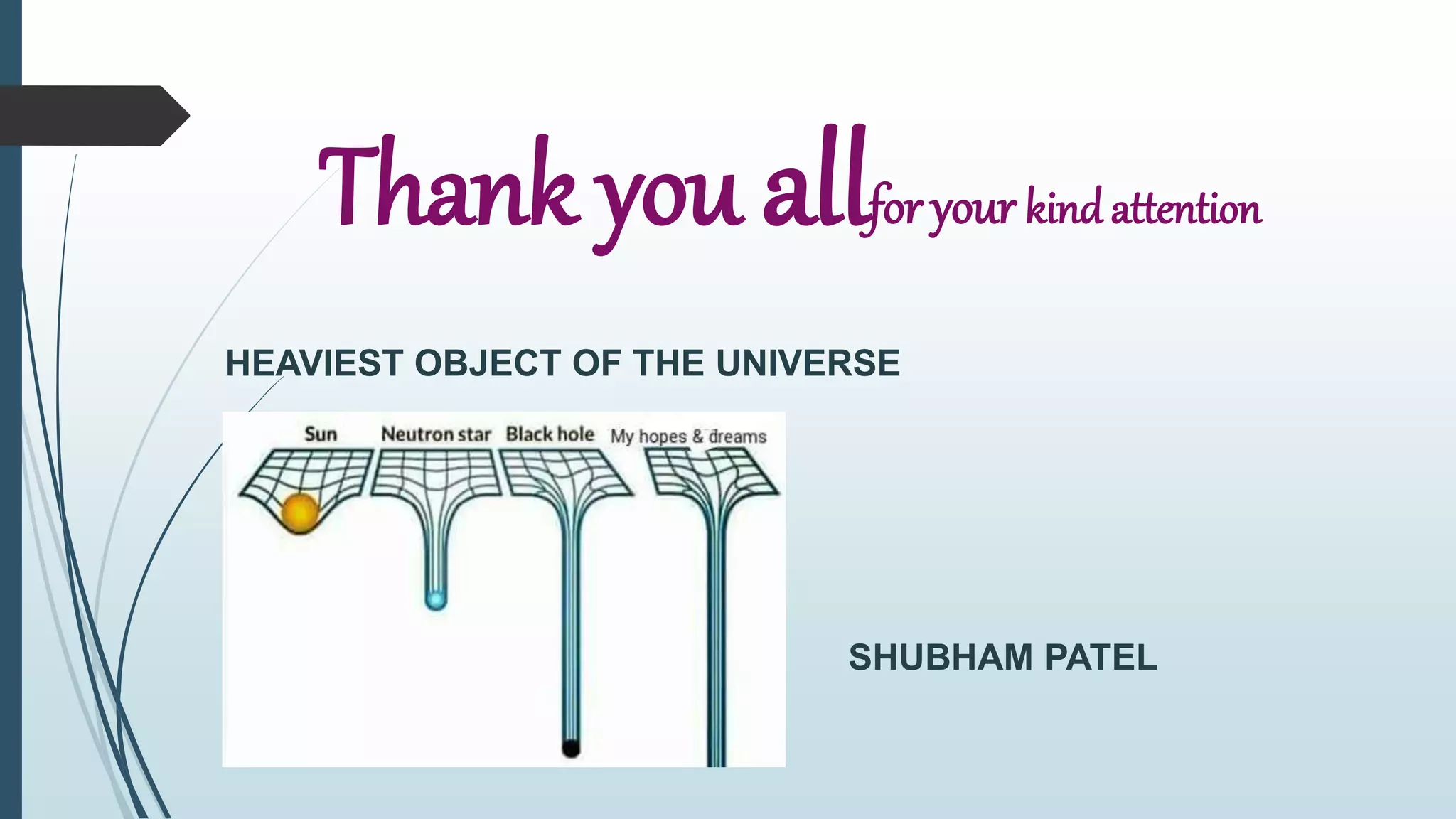
HEAVIEST OBJECT OF THE UNIVERSE
SHUBHAM PATEL
(17PH40035)

Special and General theory of Relativity Einstein

  • 1.
    SEMINAR SPECIAL AND GENERALTHEORY OF RELATIVITY IN NUTSHELL DEPARTMENT OF PHYSICS, IIT KHARAGPUR PRESENTED BY: SHUBHAM PATEL 17PH40035
  • 2.
    EVERYTHING IS RELATIVE ! NothingAbsolute ! # All the physical laws are independent of frame of reference. @ speed of light is constant everywhere. c = 186,300 miles/s
  • 3.
    Proofs of priorStatements  Michelson-Morley Experiments: “Ether Hypothesis” •Two conclusions: either, 1) Ether does not exist and light does not need a medium Or 2) ether’s velocity relative to Earth is zero. But we know Earth is not still and it keeps moving. even after 6 months Earth’s position changed and so relative velocity of Ether with respect to Earth also, The experiment does not show any Interference pattern Ether Not Exist and c is constant !
  • 4.
    Consequences of STR 1) Time dilation: Speed= distance/time
  • 5.
    2) Lengthcontraction L islength measured by moving observer is length measured by rest observer. length of objects moving at relativistic speeds undergoes a contraction along the dimension of motion. An observer at rest (relative to the moving object) would observe the moving object to be shorter in length. The picture depicts “Barn and ladder paradox”
  • 6.
    3) Relativityof Simultaneity: If two events are simultaneous in one frame of reference, they are generally not simultaneous in another.  A conclude:  B conclude: Two ships A and B pass by rest observer with equal but opposite velocities. Rest observer fires explosives at points X1 and x2 simultaneously from his point of view.
  • 7.
    Twin paradox  ifone of a pair of twins were to fly away from the Earth, when he got home he’d find he was younger than his twin sibling.  The faster the travelling twin travels during the journey, the bigger the age difference when he returns. This happens because, according to SR, moving clocks run slow.  Paradox: the travelling twin could argue that in fact he never went anywhere. What happened was, he stayed still while the Earth jetted off into space. If “moving clocks run slow”, the traveller should always have seen the Earth’s clocks as moving slow, therefore he should end up older than his twin who stayed on Earth.
  • 8.
    Variation of masswith velocity  Relativistic mass energy equivalence: E=mc2 where ‘m’ is relativistic mass 𝑚 = 𝑚0 1− 𝑣2 𝑐2 , m0= rest mass and m is the relativistic mass of the moving body. Relativistic mass depends on the motion of the object. A consequence of the mass–energy equivalence is that if a body is stationary, it still has some internal or intrinsic energy, called its rest energy, corresponding to its rest mass.
  • 9.
    Light cone:  Light-likeevents: Δs2 = 0,  Time-like events: Δs2 < 0,  Space like events: Δs2 > 0 Where, Δs2 =-c(Δt)2 + (Δx)2 + (Δy)2 + (Δz)2
  • 10.
    General theory ofRelativity:  GRAVITY: “warping of space-time”
  • 11.
    Newton’s Gravitation:  Newtoniangravitational force is instantaneous G = 6.674×10⁻¹¹ N·kg–2·m2. Where c is considered infinity.
  • 12.
    Equivalence principle:  Allfeel the same acceleration. the acceleration of bodies towards the center of the Earth at a rate of 1g (g = 9.81m/s2) is equivalent to the acceleration of an inertially moving body that would be observed on a rocket in free space being accelerated at a rate of 1g. ain = agr
  • 13.
    Clocks in GravitationalField:  The equivalence principle Implies that gravity also influences the clocks.  When the emitter is at higher gravitational potential than the receiver, the signals will be received more quickly and vice-versa.  (Rate signals received at B) = (1+ φ 𝐴−φ 𝐵 𝑐2 )(rate signals emitted at A) φ 𝐴 − φ 𝐵= gh Clocks at higher altitude runs faster than the lower altitude.
  • 14.
    Gravitational time dilation: A common equation used to determine gravitational time dilation is derived from the Schwarzschild metric, which describes space-time in the vicinity of a non-rotating massive spherically symmetric object. The equation is, 𝑡0 = 𝑡𝑓 1 − 2𝐺𝑀 𝑟𝑐2 = 𝑡0 = 𝑡𝑓 1 − 𝑟𝑠 𝑐2 t0 is the proper time between events A and B for a slow-ticking observer within the gravitational field, tf is the coordinate time between events A and B for a fast-ticking observer at an arbitrarily large distance from the massive object (this assumes the fast-ticking observer is using Schwarzschild coordinates, a coordinate system where a clock at infinite distance from the massive sphere would tick at one second per second of coordinate time, while closer clocks would tick at less than that rate), Example The heart of human being is a kind of clock. As measured by a clock on ground floor, a heart will beat more times on the top floor in a given interval of time than the heart of a similar person on the ground floor. For a 30m height building 1 + (9.8𝑚/𝑠2)(30𝑚) (3x10⁸ 𝑚/𝑠2) which differs from unity only by a few parts(~1.00000098) which means a negligible effect. A few microsecond in 100 years.
  • 15.
    Gravity attracts light: “Equivalence principle implies that a light ray must fall in the same way in gravitational field with the same acceleration as the other objects.”
  • 16.
    Bending of space-timeand light:  Gravity warps the space-time and even light. Gravity is attraction but Attraction due Curved space-time.
  • 17.
    Gravitational red-shift: “light leavinga region where gravity is strong reddens” Time near the massive body slows down which directly means frequency increase.
  • 18.
    Black-hole:  Highly massivebut compact object from which even light cannot escape, that’s why it is called “Black”.  Event Horizon: “Once check-in, no check out”
  • 19.
    Heaviest object inthe universe:  Galaxy NGC 1277: One of the biggest central supermassive black holes ever found in its center(1.7×10¹⁰ M☉ (17 billion solar masses))
  • 20.
    Tests of generalrelativity:  1) Precession of the perihelion of Mercury: As seen from Earth the precession of Mercury’s orbit is measured to be 5600 seconds of arc per century (one second of arc= 1/3600 degrees). But actually it is 5557 seconds of arc per century as Earth is not an inertial frame of reference. Discrepancy of 43 seconds of arc per century. Resolved by GTR !
  • 21.
    2) Light bending Observations during the eclipse and after half an year later.  Eddington first observed this effect in 1919 during a solar eclipse.  Eddington’s telegram to Einstein announcing the observation of the bending of light by a gravitational force as predicted by the General Theory of Relativity.
  • 22.
    References:  https://www.quora.com/What-is-a-black-hole-How-can-we-understand-it  https://www.quora.com/topic/General-Relativity https://theory.uwinnipeg.ca/  https://www.youtub  e.com/watch?v=xIOEaqPHOJo  https://www.youtube.com/watch?v=R7V3koyL7Mc  https://www.quora.com/topic/Gravitational-Waves-4  https://en.wikipedia.org/wiki/PSR_J0737-3039  ttps://www.pitt.edu/~jdnorton/teaching/HPS_0410/chapters/spacetime/  https://www.quora.com/What-is-a-light-cone  https://hepweb.ucsd.edu/ph110b/110b_notes/node46.html  https://www.youtube.com/watch?v=wteiuxyqtoM  https://www.youtube.com/watch?v=TgH9KXEQ0YU  https://www.quora.com/What-is-the-purpose-of-Einsteins-theory-of-relativity  https://www.youtube.com/watch?v=k6gd3bQLiFc  https://www.quora.com/What-is-the-twin-paradox-and-how-does-it-work#ans30171532  https://www.youtube.com/watch?v=k6gd3bQLiFc  http://iontrap.umd.edu/wp-content/uploads/2016/01/WudkaGR-7.pdf
  • 23.
    Thank you allforyour kindattention HEAVIEST OBJECT OF THE UNIVERSE SHUBHAM PATEL (17PH40035)