Thursday, January 31, 2013
 Silently sit down in your
                            
                              Crocodile
  seat and complete the
  warm-up as soon as you      Hippopotamus
  enter the room.             Ostrich
 What are four different     Falcon
  animals that you think
  may live in or around the   Baboons
  Nile River?                 Ibis
                              Jackal
Homework
            
1.Current Event 18 due
  tomorrow:
  Friday, February 1 st.
Agenda for Today
         
1.Assessments for people
  who are less than level 16.
2.Go over the map of Egypt
3.Geography of the Nile
  notes
Essential Question
           
What would a social
 scientist from each of the
 five themes of social
 studies learn about Egypt?
Learning Target
           
I can…
 Show how the Nile River
  creates an environment that
  promotes civilization in
  Egypt.
 Explain why the Nile River is
  so important to life in Egypt.
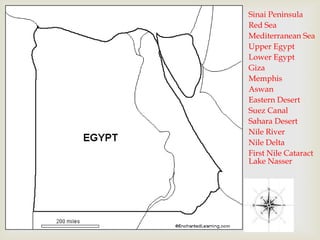
Sinai Peninsula
Red Sea
Mediterranean Sea
Upper Egypt
Lower Egypt
Giza
Memphis
Aswan
Eastern Desert
Suez Canal
Sahara Desert
Nile River
Nile Delta
First Nile Cataract
Lake Nasser
Why is Egypt called the
      Gift of the Nile?
                          
 The Nile River provides for Egypt in the following
  ways:
     Fertile soil
     Water for drinking, cooking, and watering crops
     Transportation
     River plants and animals
Egypt From Space
       
How did the Nile make land in
     the middle of a desert fertile?
                  
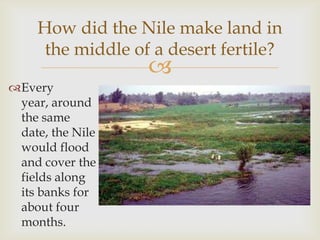
Every
 year, around
 the same
 date, the Nile
 would flood
 and cover the
 fields along
 its banks for
 about four
 months.
sediment
                    
 All rivers contain
  something called
  sediment.
 Sediment is
  decaying organic
  material that
  floats in the
  water.
sediment
                        
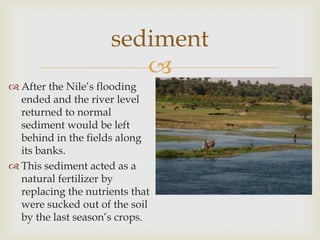
 After the Nile’s flooding
  ended and the river level
  returned to normal
  sediment would be left
  behind in the fields along
  its banks.
 This sediment acted as a
  natural fertilizer by
  replacing the nutrients that
  were sucked out of the soil
  by the last season’s crops.
How did the Egyptians move
  the water from the river?
                         
 They use irrigation
  canals to get the water
  from the river to their
  crops.
 To help with lifting the
  water they used a
  machine called a
  shadoof.
Transportation
                    
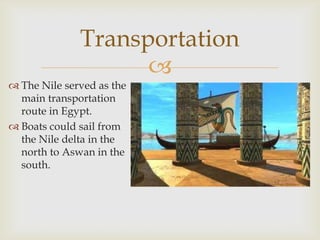
 The Nile served as the
  main transportation
  route in Egypt.
 Boats could sail from
  the Nile delta in the
  north to Aswan in the
  south.
Why couldn’t they sail
further south than Aswan?
               
The southern part of the Nile
 contains six cataracts that
 prevent boats from sailing past
 them.
What are cataracts?
             
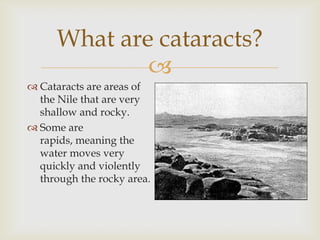
 Cataracts are areas of
  the Nile that are very
  shallow and rocky.
 Some are
  rapids, meaning the
  water moves very
  quickly and violently
  through the rocky area.
Cataracts
Exactly
where are
they
located?
River Plants
              
The most
 important plant
 that the Nile
 provided to
 Egypt was
 papyrus.
The First Paper
                 
 The plant used to make the first paper is also called
  papyrus. To make the paper, the inner stalks of the
  plant were cut into narrow strips. The strips were
  cut to the same length and placed side by side by
  side in one layer. Another layer of strips was placed
  crosswise on top to form a sheet. Papyrus makers
  wet the sheet, pressed it flat, and dried it in the sun.
  Sap from the plant glued the strips together. Pasted
  side by side, the sheets formed a long strip that could
  be rolled up.
Papyrus

  
What are some animals that
can be found near the Nile?
                 
 Crocodile
 Hippopotamus
 Ostrich
 Falcon
 Baboons
 Ibis
 Jackal
Assessment
              
On a sheet of lined
 paper, completely answer the
 following questions:
 1. Why did civilization first develop in
    the area that we call Egypt?
 2. Why was the Nile River so
    important to life in Egypt?

Nile geography

  • 1.
    Thursday, January 31,2013  Silently sit down in your  Crocodile seat and complete the warm-up as soon as you Hippopotamus enter the room. Ostrich  What are four different Falcon animals that you think may live in or around the Baboons Nile River? Ibis Jackal
  • 2.
    Homework  1.Current Event 18 due tomorrow: Friday, February 1 st.
  • 3.
    Agenda for Today  1.Assessments for people who are less than level 16. 2.Go over the map of Egypt 3.Geography of the Nile notes
  • 4.
    Essential Question  What would a social scientist from each of the five themes of social studies learn about Egypt?
  • 5.
    Learning Target  I can… Show how the Nile River creates an environment that promotes civilization in Egypt. Explain why the Nile River is so important to life in Egypt.
  • 6.
    Sinai Peninsula Red Sea MediterraneanSea Upper Egypt Lower Egypt Giza Memphis Aswan Eastern Desert Suez Canal Sahara Desert Nile River Nile Delta First Nile Cataract Lake Nasser
  • 7.
    Why is Egyptcalled the Gift of the Nile?   The Nile River provides for Egypt in the following ways:  Fertile soil  Water for drinking, cooking, and watering crops  Transportation  River plants and animals
  • 8.
  • 9.
    How did theNile make land in the middle of a desert fertile?  Every year, around the same date, the Nile would flood and cover the fields along its banks for about four months.
  • 10.
    sediment   All rivers contain something called sediment.  Sediment is decaying organic material that floats in the water.
  • 11.
    sediment   After the Nile’s flooding ended and the river level returned to normal sediment would be left behind in the fields along its banks.  This sediment acted as a natural fertilizer by replacing the nutrients that were sucked out of the soil by the last season’s crops.
  • 12.
    How did theEgyptians move the water from the river?   They use irrigation canals to get the water from the river to their crops.  To help with lifting the water they used a machine called a shadoof.
  • 13.
    Transportation   The Nile served as the main transportation route in Egypt.  Boats could sail from the Nile delta in the north to Aswan in the south.
  • 14.
    Why couldn’t theysail further south than Aswan?  The southern part of the Nile contains six cataracts that prevent boats from sailing past them.
  • 15.
    What are cataracts?   Cataracts are areas of the Nile that are very shallow and rocky.  Some are rapids, meaning the water moves very quickly and violently through the rocky area.
  • 16.
  • 17.
    River Plants  The most important plant that the Nile provided to Egypt was papyrus.
  • 18.
    The First Paper   The plant used to make the first paper is also called papyrus. To make the paper, the inner stalks of the plant were cut into narrow strips. The strips were cut to the same length and placed side by side by side in one layer. Another layer of strips was placed crosswise on top to form a sheet. Papyrus makers wet the sheet, pressed it flat, and dried it in the sun. Sap from the plant glued the strips together. Pasted side by side, the sheets formed a long strip that could be rolled up.
  • 19.
  • 20.
    What are someanimals that can be found near the Nile?   Crocodile  Hippopotamus  Ostrich  Falcon  Baboons  Ibis  Jackal
  • 21.
    Assessment  On a sheet of lined paper, completely answer the following questions: 1. Why did civilization first develop in the area that we call Egypt? 2. Why was the Nile River so important to life in Egypt?