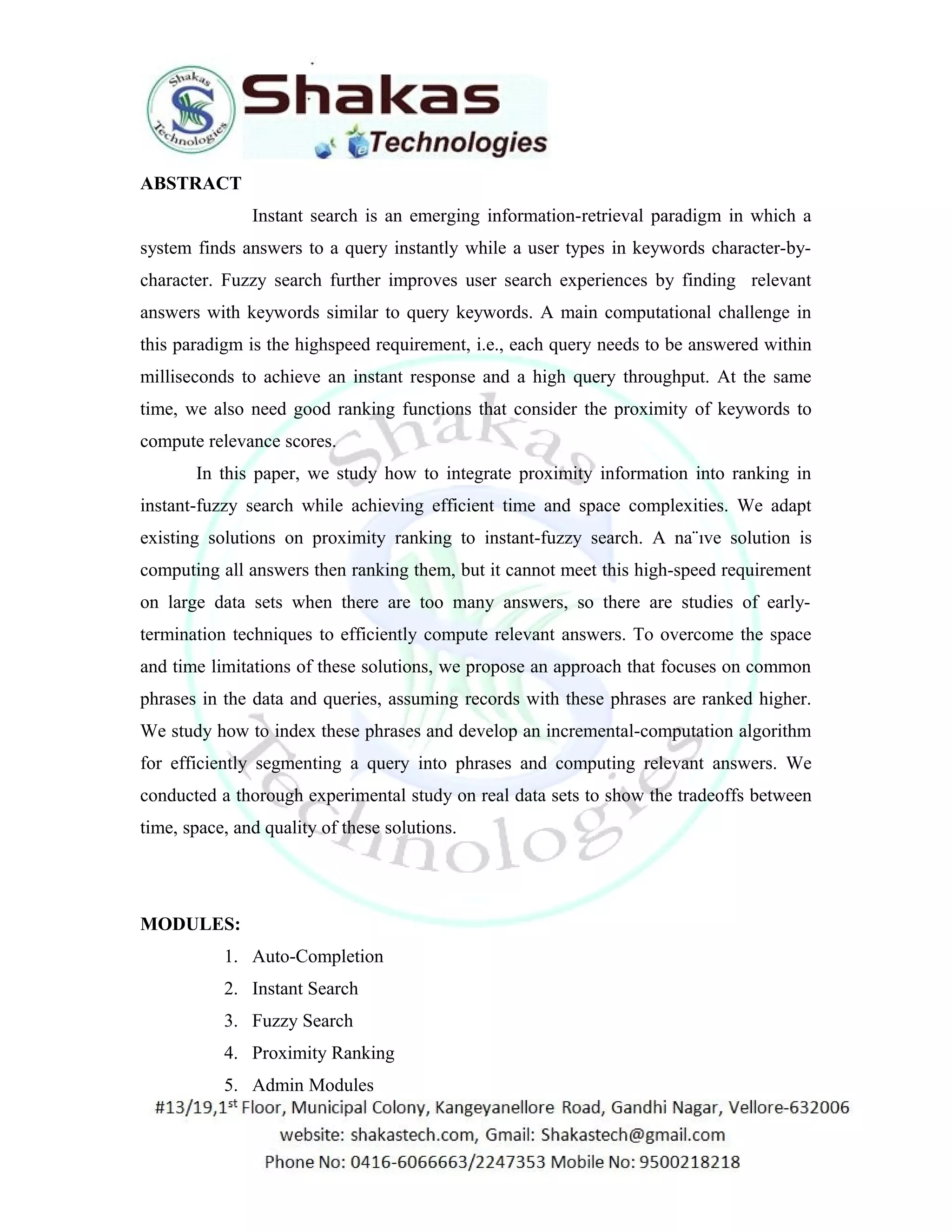
ABSTRACT 
Instant search is an emerging information-retrieval paradigm in which a 
system finds answers to a query instantly while a user types in keywords character-by-character. 
Fuzzy search further improves user search experiences by finding relevant 
answers with keywords similar to query keywords. A main computational challenge in 
this paradigm is the highspeed requirement, i.e., each query needs to be answered within 
milliseconds to achieve an instant response and a high query throughput. At the same 
time, we also need good ranking functions that consider the proximity of keywords to 
compute relevance scores. 
In this paper, we study how to integrate proximity information into ranking in 
instant-fuzzy search while achieving efficient time and space complexities. We adapt 
existing solutions on proximity ranking to instant-fuzzy search. A na¨ıve solution is 
computing all answers then ranking them, but it cannot meet this high-speed requirement 
on large data sets when there are too many answers, so there are studies of early-termination 
techniques to efficiently compute relevant answers. To overcome the space 
and time limitations of these solutions, we propose an approach that focuses on common 
phrases in the data and queries, assuming records with these phrases are ranked higher. 
We study how to index these phrases and develop an incremental-computation algorithm 
for efficiently segmenting a query into phrases and computing relevant answers. We 
conducted a thorough experimental study on real data sets to show the tradeoffs between 
time, space, and quality of these solutions. 
MODULES: 
1. Auto-Completion 
2. Instant Search 
3. Fuzzy Search 
4. Proximity Ranking 
5. Admin Modules
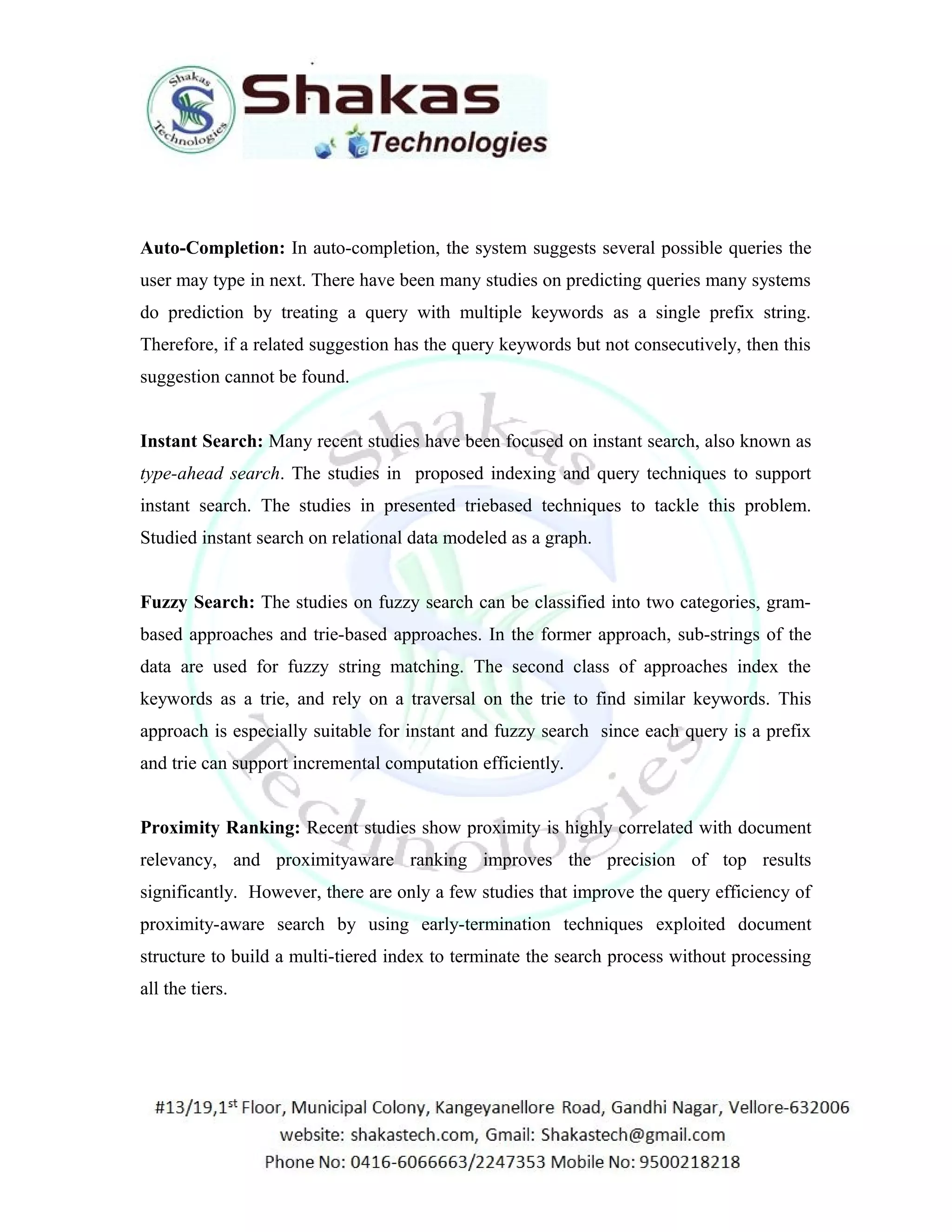
Auto-Completion: In auto-completion, the system suggests several possible queries the 
user may type in next. There have been many studies on predicting queries many systems 
do prediction by treating a query with multiple keywords as a single prefix string. 
Therefore, if a related suggestion has the query keywords but not consecutively, then this 
suggestion cannot be found. 
Instant Search: Many recent studies have been focused on instant search, also known as 
type-ahead search. The studies in proposed indexing and query techniques to support 
instant search. The studies in presented triebased techniques to tackle this problem. 
Studied instant search on relational data modeled as a graph. 
Fuzzy Search: The studies on fuzzy search can be classified into two categories, gram-based 
approaches and trie-based approaches. In the former approach, sub-strings of the 
data are used for fuzzy string matching. The second class of approaches index the 
keywords as a trie, and rely on a traversal on the trie to find similar keywords. This 
approach is especially suitable for instant and fuzzy search since each query is a prefix 
and trie can support incremental computation efficiently. 
Proximity Ranking: Recent studies show proximity is highly correlated with document 
relevancy, and proximityaware ranking improves the precision of top results 
significantly. However, there are only a few studies that improve the query efficiency of 
proximity-aware search by using early-termination techniques exploited document 
structure to build a multi-tiered index to terminate the search process without processing 
all the tiers.
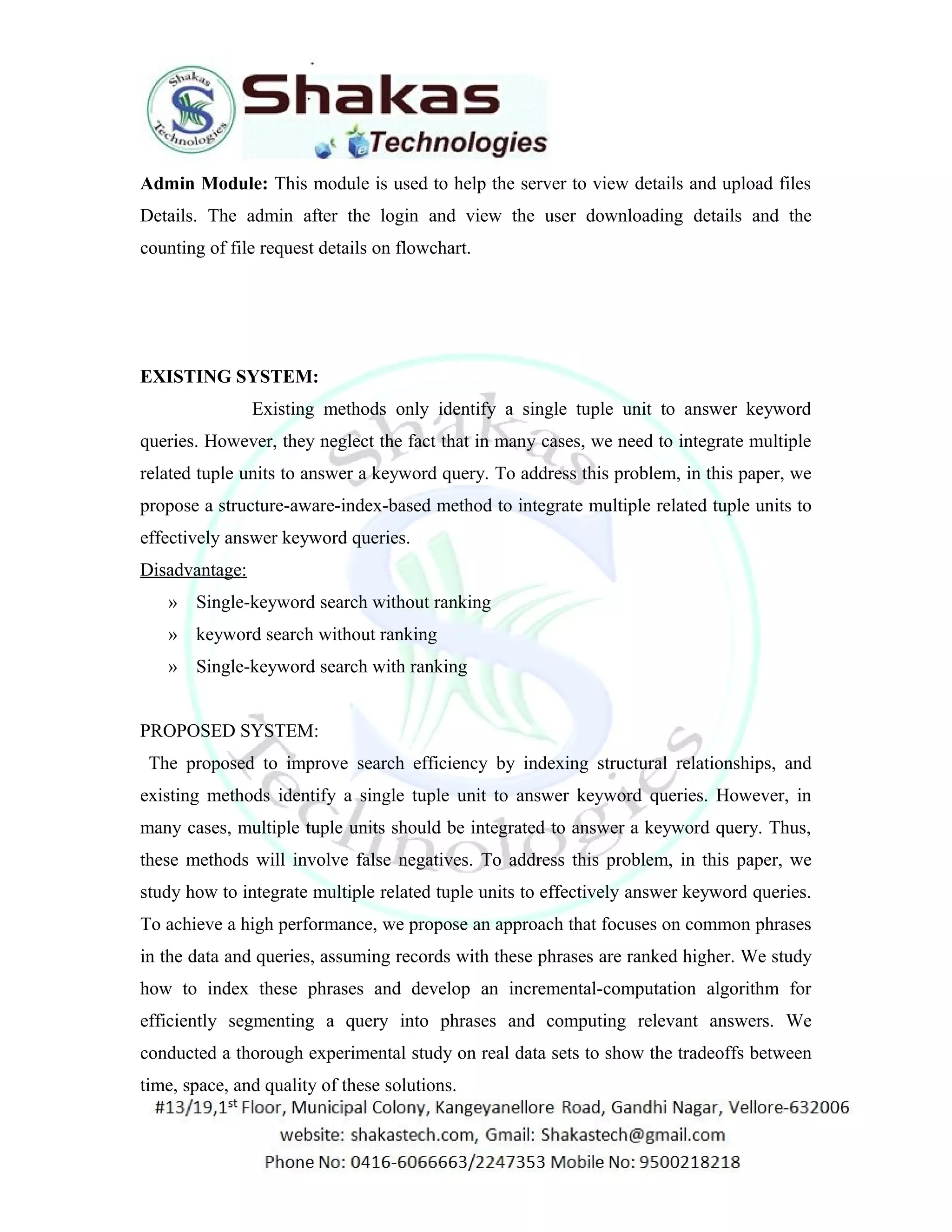
Admin Module: This module is used to help the server to view details and upload files 
Details. The admin after the login and view the user downloading details and the 
counting of file request details on flowchart. 
EXISTING SYSTEM: 
Existing methods only identify a single tuple unit to answer keyword 
queries. However, they neglect the fact that in many cases, we need to integrate multiple 
related tuple units to answer a keyword query. To address this problem, in this paper, we 
propose a structure-aware-index-based method to integrate multiple related tuple units to 
effectively answer keyword queries. 
Disadvantage: 
» Single-keyword search without ranking 
» keyword search without ranking 
» Single-keyword search with ranking 
PROPOSED SYSTEM: 
The proposed to improve search efficiency by indexing structural relationships, and 
existing methods identify a single tuple unit to answer keyword queries. However, in 
many cases, multiple tuple units should be integrated to answer a keyword query. Thus, 
these methods will involve false negatives. To address this problem, in this paper, we 
study how to integrate multiple related tuple units to effectively answer keyword queries. 
To achieve a high performance, we propose an approach that focuses on common phrases 
in the data and queries, assuming records with these phrases are ranked higher. We study 
how to index these phrases and develop an incremental-computation algorithm for 
efficiently segmenting a query into phrases and computing relevant answers. We 
conducted a thorough experimental study on real data sets to show the tradeoffs between 
time, space, and quality of these solutions.
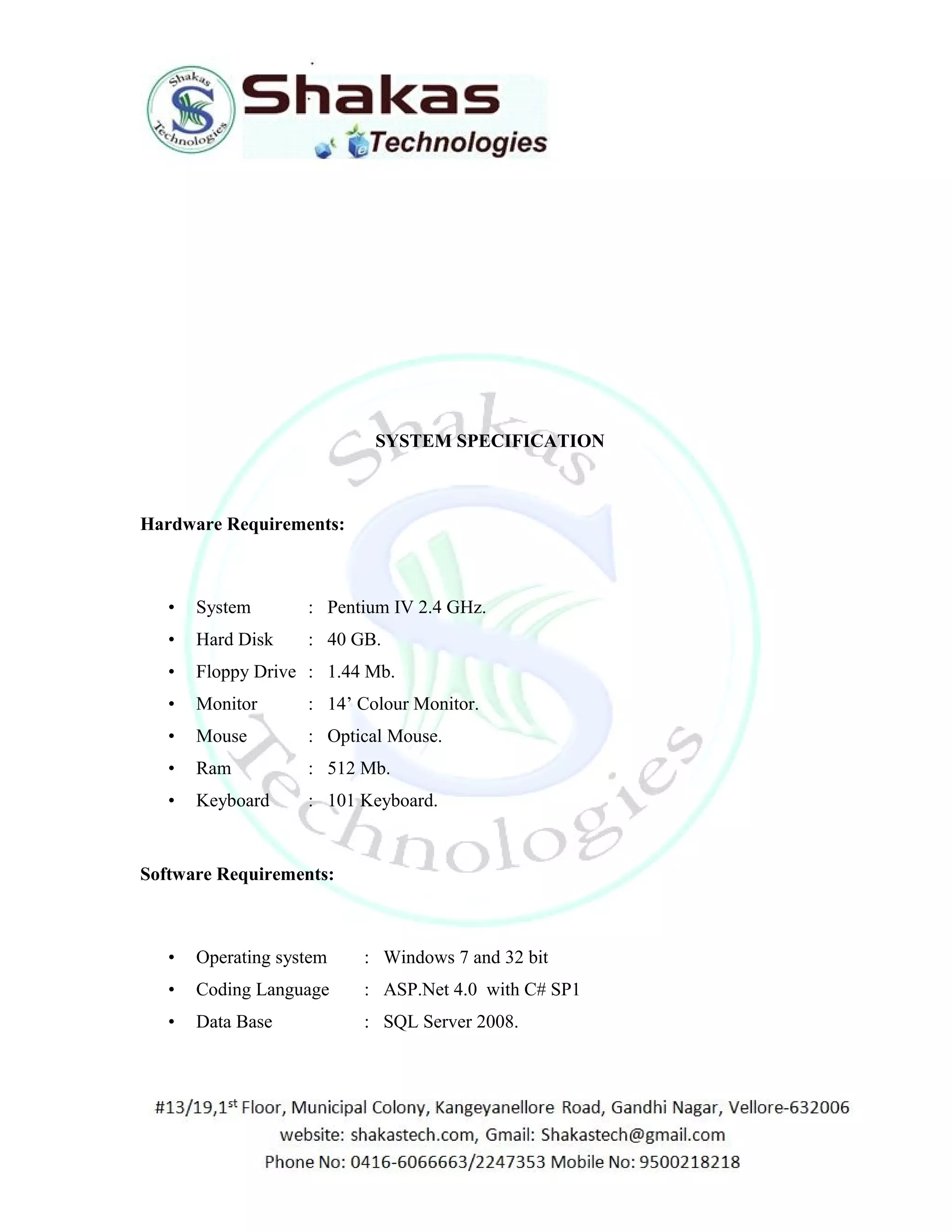
SYSTEM SPECIFICATION 
Hardware Requirements: 
• System : Pentium IV 2.4 GHz. 
• Hard Disk : 40 GB. 
• Floppy Drive : 1.44 Mb. 
• Monitor : 14’ Colour Monitor. 
• Mouse : Optical Mouse. 
• Ram : 512 Mb. 
• Keyboard : 101 Keyboard. 
Software Requirements: 
• Operating system : Windows 7 and 32 bit 
• Coding Language : ASP.Net 4.0 with C# SP1 
• Data Base : SQL Server 2008.
Efficient instant fuzzy search with proximity ranking

Efficient instant fuzzy search with proximity ranking

  • 1.
    ABSTRACT Instant searchis an emerging information-retrieval paradigm in which a system finds answers to a query instantly while a user types in keywords character-by-character. Fuzzy search further improves user search experiences by finding relevant answers with keywords similar to query keywords. A main computational challenge in this paradigm is the highspeed requirement, i.e., each query needs to be answered within milliseconds to achieve an instant response and a high query throughput. At the same time, we also need good ranking functions that consider the proximity of keywords to compute relevance scores. In this paper, we study how to integrate proximity information into ranking in instant-fuzzy search while achieving efficient time and space complexities. We adapt existing solutions on proximity ranking to instant-fuzzy search. A na¨ıve solution is computing all answers then ranking them, but it cannot meet this high-speed requirement on large data sets when there are too many answers, so there are studies of early-termination techniques to efficiently compute relevant answers. To overcome the space and time limitations of these solutions, we propose an approach that focuses on common phrases in the data and queries, assuming records with these phrases are ranked higher. We study how to index these phrases and develop an incremental-computation algorithm for efficiently segmenting a query into phrases and computing relevant answers. We conducted a thorough experimental study on real data sets to show the tradeoffs between time, space, and quality of these solutions. MODULES: 1. Auto-Completion 2. Instant Search 3. Fuzzy Search 4. Proximity Ranking 5. Admin Modules
  • 2.
    Auto-Completion: In auto-completion,the system suggests several possible queries the user may type in next. There have been many studies on predicting queries many systems do prediction by treating a query with multiple keywords as a single prefix string. Therefore, if a related suggestion has the query keywords but not consecutively, then this suggestion cannot be found. Instant Search: Many recent studies have been focused on instant search, also known as type-ahead search. The studies in proposed indexing and query techniques to support instant search. The studies in presented triebased techniques to tackle this problem. Studied instant search on relational data modeled as a graph. Fuzzy Search: The studies on fuzzy search can be classified into two categories, gram-based approaches and trie-based approaches. In the former approach, sub-strings of the data are used for fuzzy string matching. The second class of approaches index the keywords as a trie, and rely on a traversal on the trie to find similar keywords. This approach is especially suitable for instant and fuzzy search since each query is a prefix and trie can support incremental computation efficiently. Proximity Ranking: Recent studies show proximity is highly correlated with document relevancy, and proximityaware ranking improves the precision of top results significantly. However, there are only a few studies that improve the query efficiency of proximity-aware search by using early-termination techniques exploited document structure to build a multi-tiered index to terminate the search process without processing all the tiers.
  • 3.
    Admin Module: Thismodule is used to help the server to view details and upload files Details. The admin after the login and view the user downloading details and the counting of file request details on flowchart. EXISTING SYSTEM: Existing methods only identify a single tuple unit to answer keyword queries. However, they neglect the fact that in many cases, we need to integrate multiple related tuple units to answer a keyword query. To address this problem, in this paper, we propose a structure-aware-index-based method to integrate multiple related tuple units to effectively answer keyword queries. Disadvantage: » Single-keyword search without ranking » keyword search without ranking » Single-keyword search with ranking PROPOSED SYSTEM: The proposed to improve search efficiency by indexing structural relationships, and existing methods identify a single tuple unit to answer keyword queries. However, in many cases, multiple tuple units should be integrated to answer a keyword query. Thus, these methods will involve false negatives. To address this problem, in this paper, we study how to integrate multiple related tuple units to effectively answer keyword queries. To achieve a high performance, we propose an approach that focuses on common phrases in the data and queries, assuming records with these phrases are ranked higher. We study how to index these phrases and develop an incremental-computation algorithm for efficiently segmenting a query into phrases and computing relevant answers. We conducted a thorough experimental study on real data sets to show the tradeoffs between time, space, and quality of these solutions.
  • 4.
    SYSTEM SPECIFICATION HardwareRequirements: • System : Pentium IV 2.4 GHz. • Hard Disk : 40 GB. • Floppy Drive : 1.44 Mb. • Monitor : 14’ Colour Monitor. • Mouse : Optical Mouse. • Ram : 512 Mb. • Keyboard : 101 Keyboard. Software Requirements: • Operating system : Windows 7 and 32 bit • Coding Language : ASP.Net 4.0 with C# SP1 • Data Base : SQL Server 2008.