EFFECTS OF
REPRESENTATIONS
LO: To highlight the effects of media representations considering the
positive and negative impacts possible
INDEPENDENT
ENQUIRER
CREATIVETHINKER REFLECTIVE
LEARNER
TEAM WORKER SELF MANAGER EFFECTIVE
PARTICIPATOR
Feedback Autonomy Challenge Engagement
D1 – Effects of Media Representations
Each representation carries the values of the producer and shapes the opinions and beliefs of
the audience.
• Positive and negative effects:
• copycat behaviour (positive and negative)
• education and information
• socialisation
• Objectification.
• Stereotypes and archetypes.
• Impact on individuals, groups and society (changes in behaviour, attitudes).
• Reinforcement of an ideology (dominant, counter).
• Challenging dominant ideology.
Positive and Negative Effects
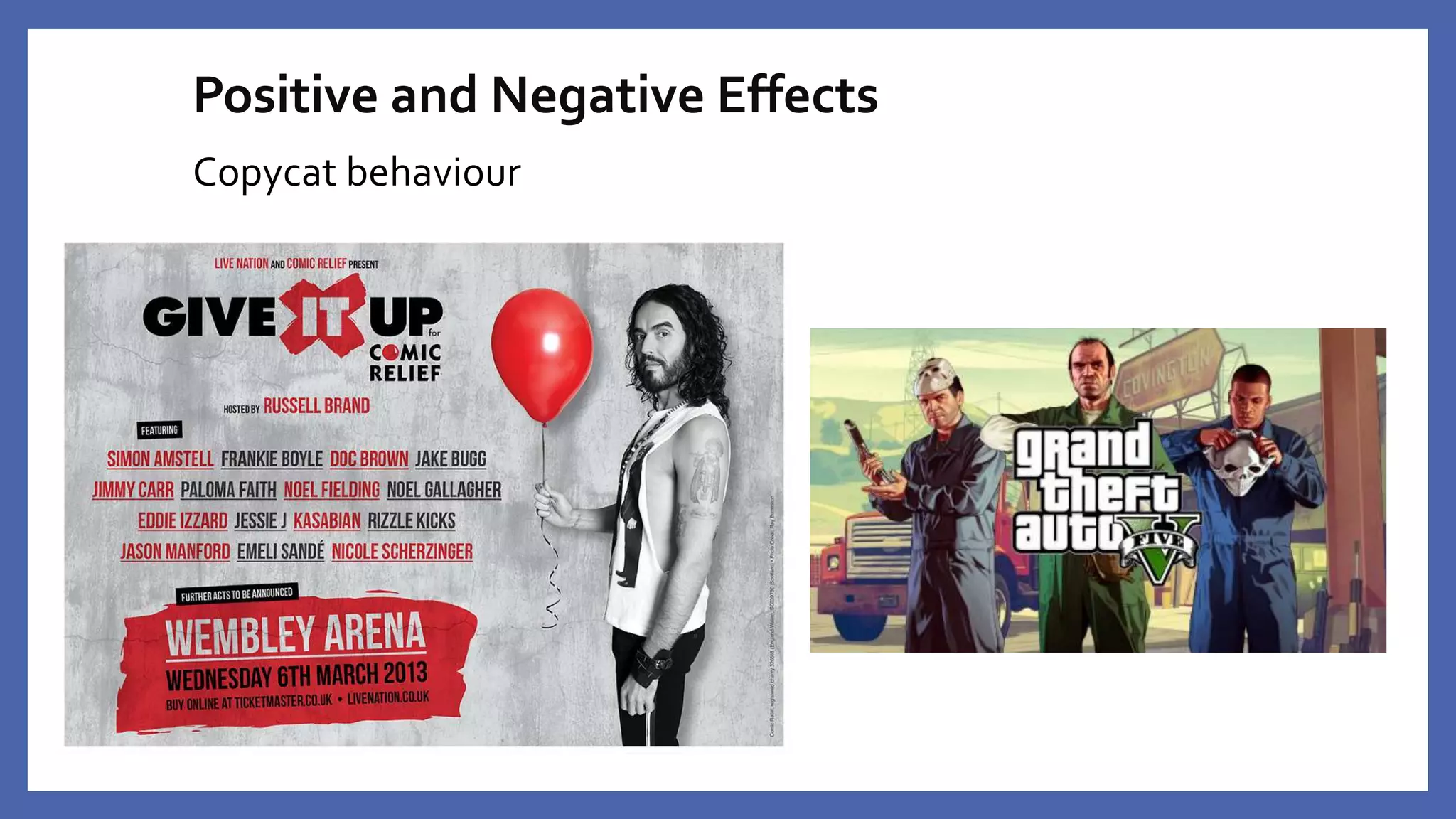
Copycat behaviour
Positive and Negative Effects
Copycat behaviour
Links to Hypodermic NeedleTheory /
Passive AudienceTheory
• The audience is directly affected by the
representations shown and accept them
• A passive audience who view violence or
other criminal behaviour in media could try to
use it as an excuse for their own.
https://www.theguardian.com/uk/2004/jul/29/
ukcrime.colinblackstock
Positive and Negative Effects
Education / Information
D1 – Positive and Negative Effects
Education / Information
Links to both Uses and GratificationTheory and Hypodermic Needle
(depending on whether the audience have actively sought out the media itself
and whether they receive it actively or passively.)
• Audiences can gain otherwise unseen insight
into unfamiliar topics
• Learn new things to pass on to others
• Sometimes information is misunderstood
/ misinterpreted
• The text could be viewed by an
inappropriate audience
INDEPENDENT
ENQUIRER
CREATIVETHINKER REFLECTIVE
LEARNER
TEAM WORKER SELF MANAGER EFFECTIVE
PARTICIPATOR
Feedback Autonomy Challenge Engagement
Positive and Negative Effects
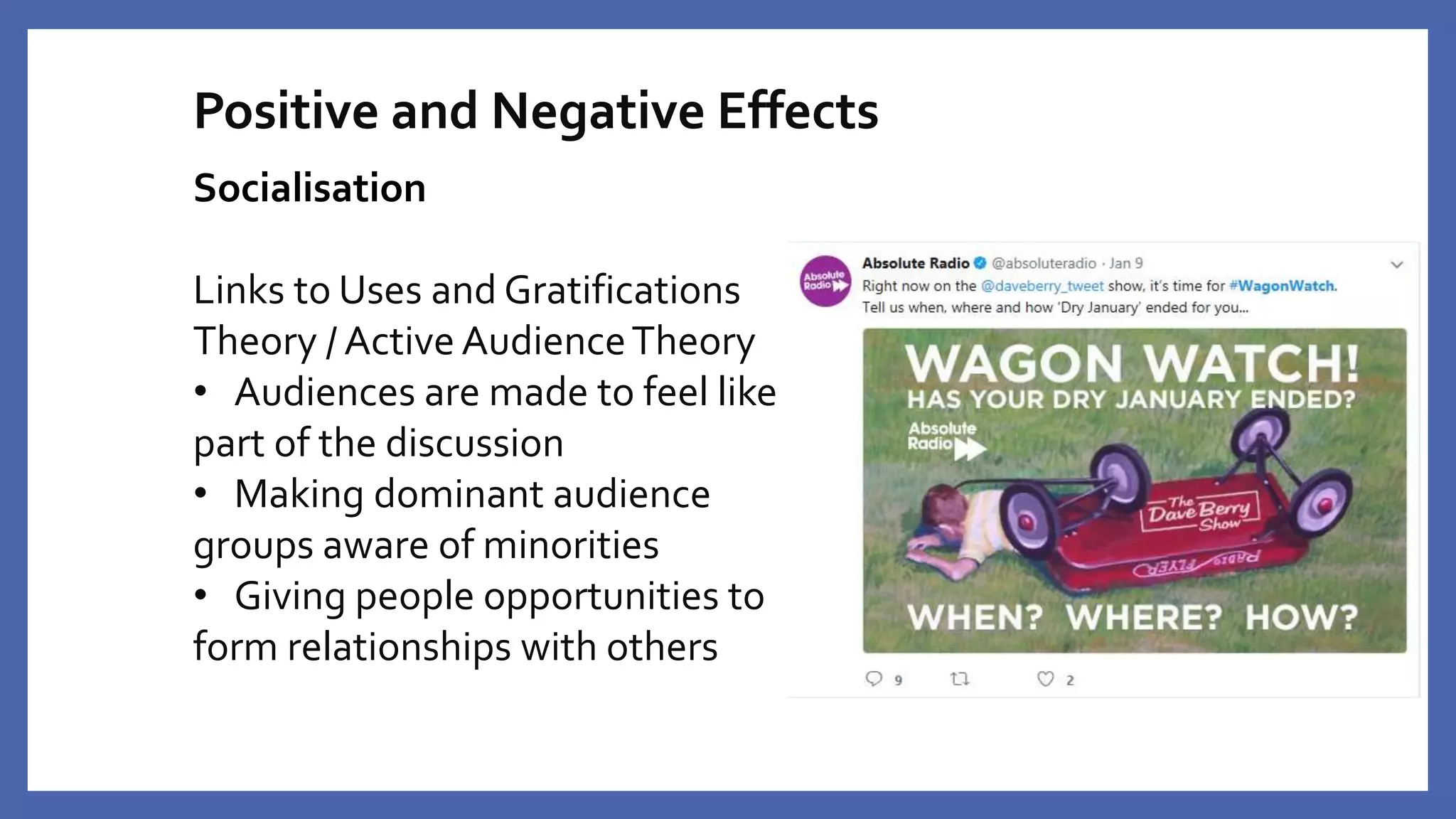
Socialisation
Positive and Negative Effects
Socialisation
Links to Uses and Gratifications
Theory / Active AudienceTheory
• Audiences are made to feel like
part of the discussion
• Making dominant audience
groups aware of minorities
• Giving people opportunities to
form relationships with others
Effects of Representations
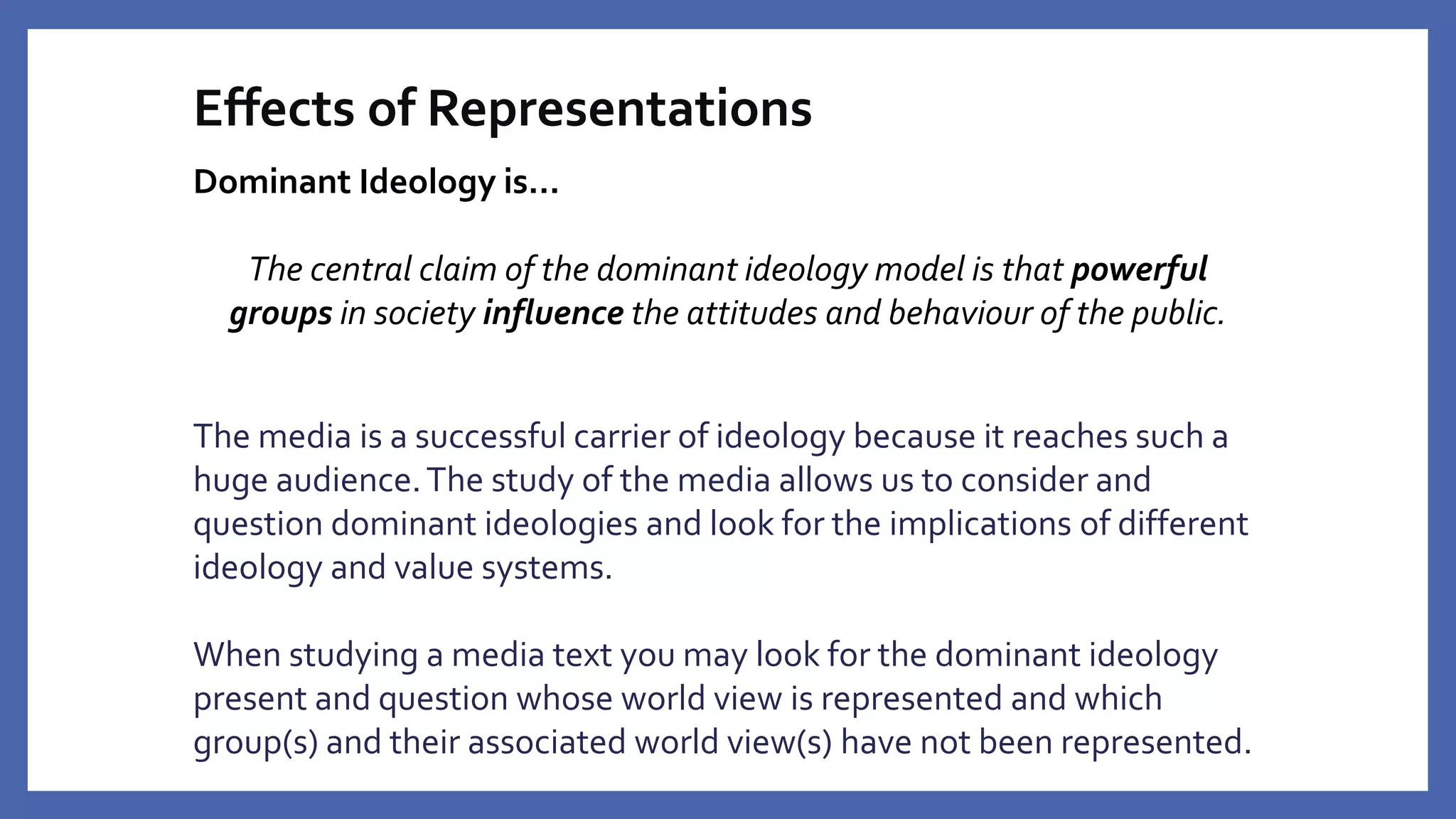
Media Representations can have a profound
impact on the attitudes and behaviour of the
audiences who view them
Individuals
….
Groups
…
Society
…
Effects of Representations
Dominant Ideology is…
The central claim of the dominant ideology model is that powerful
groups in society influence the attitudes and behaviour of the public.
The media is a successful carrier of ideology because it reaches such a
huge audience.The study of the media allows us to consider and
question dominant ideologies and look for the implications of different
ideology and value systems.
When studying a media text you may look for the dominant ideology
present and question whose world view is represented and which
group(s) and their associated world view(s) have not been represented.
Effects of Representations
Dominant Ideology is…
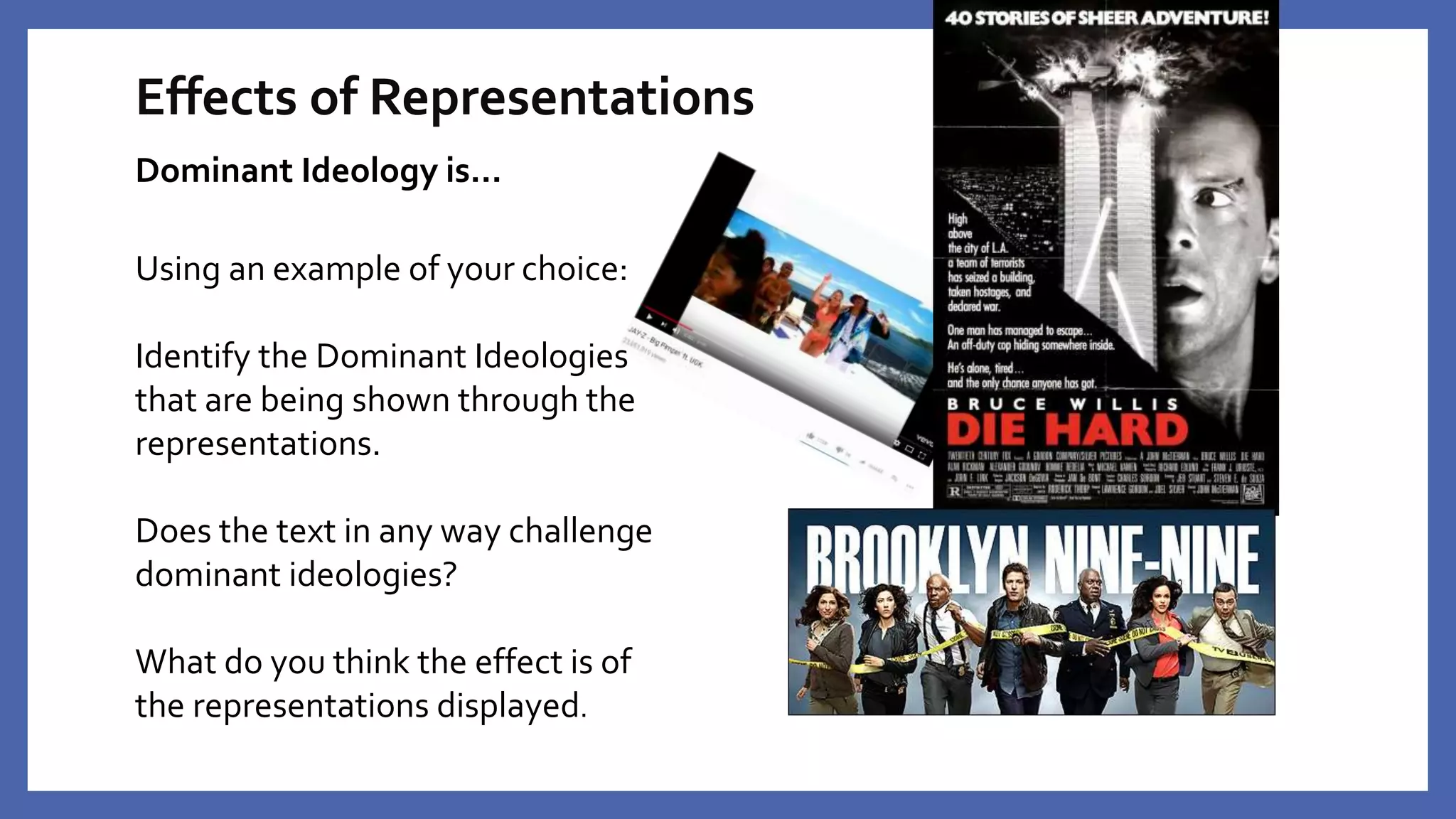
Using an example of your choice:
Identify the Dominant Ideologies
that are being shown through the
representations.
Does the text in any way challenge
dominant ideologies?
What do you think the effect is of
the representations displayed.
MediaTexts:
INDEPENDENT
ENQUIRER
CREATIVETHINKER REFLECTIVE
LEARNER
TEAM WORKER SELF MANAGER EFFECTIVE
PARTICIPATOR
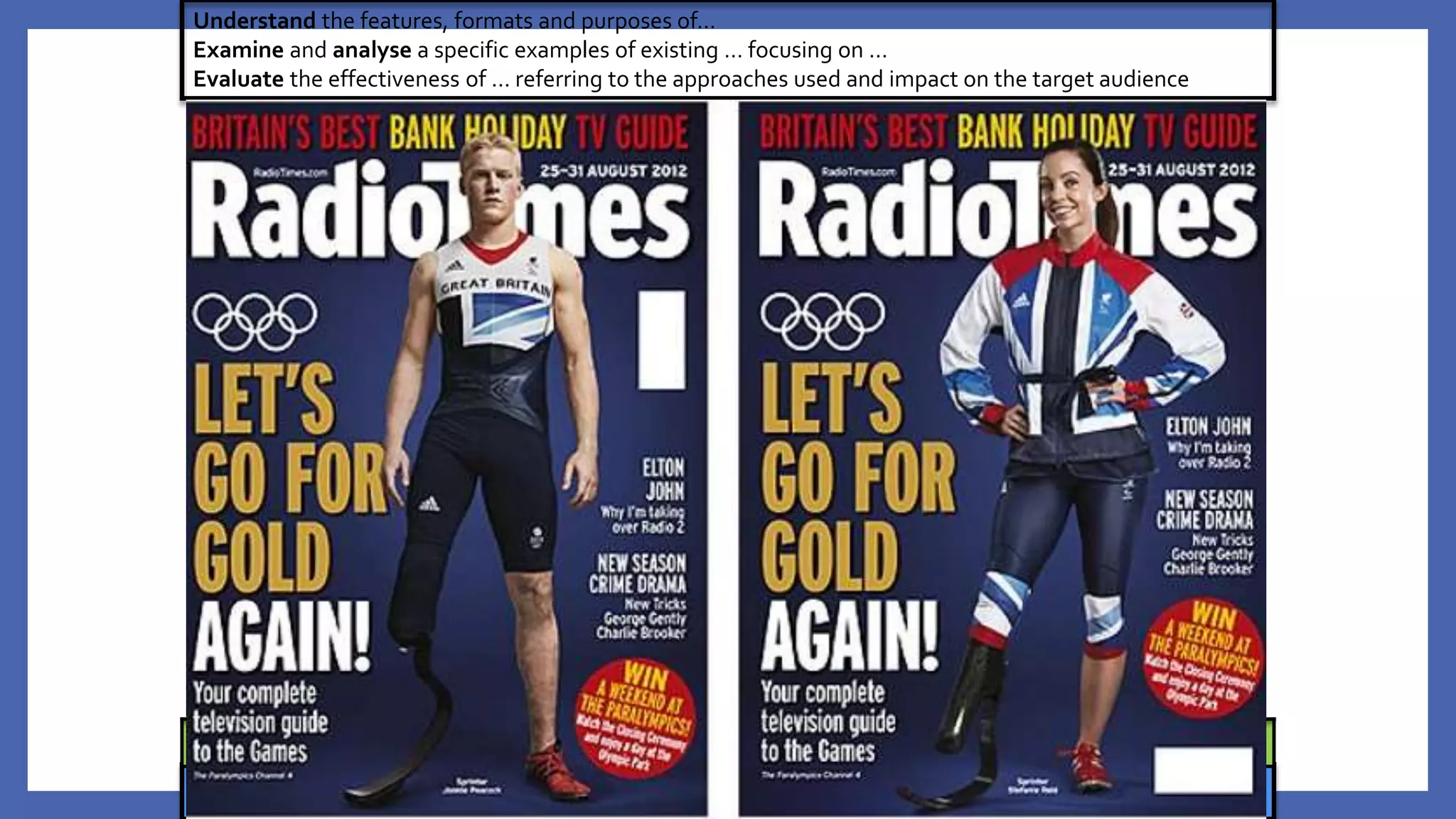
Understand the features, formats and purposes of…
Examine and analyse a specific examples of existing … focusing on …
Evaluate the effectiveness of … referring to the approaches used and impact on the target audience
Democracy Law Liberty Tolerance

Effects of Representations

  • 1.
    EFFECTS OF REPRESENTATIONS LO: Tohighlight the effects of media representations considering the positive and negative impacts possible
  • 2.
    INDEPENDENT ENQUIRER CREATIVETHINKER REFLECTIVE LEARNER TEAM WORKERSELF MANAGER EFFECTIVE PARTICIPATOR Feedback Autonomy Challenge Engagement D1 – Effects of Media Representations Each representation carries the values of the producer and shapes the opinions and beliefs of the audience. • Positive and negative effects: • copycat behaviour (positive and negative) • education and information • socialisation • Objectification. • Stereotypes and archetypes. • Impact on individuals, groups and society (changes in behaviour, attitudes). • Reinforcement of an ideology (dominant, counter). • Challenging dominant ideology.
  • 3.
    Positive and NegativeEffects Copycat behaviour
  • 4.
    Positive and NegativeEffects Copycat behaviour Links to Hypodermic NeedleTheory / Passive AudienceTheory • The audience is directly affected by the representations shown and accept them • A passive audience who view violence or other criminal behaviour in media could try to use it as an excuse for their own. https://www.theguardian.com/uk/2004/jul/29/ ukcrime.colinblackstock
  • 5.
    Positive and NegativeEffects Education / Information
  • 6.
    D1 – Positiveand Negative Effects Education / Information Links to both Uses and GratificationTheory and Hypodermic Needle (depending on whether the audience have actively sought out the media itself and whether they receive it actively or passively.) • Audiences can gain otherwise unseen insight into unfamiliar topics • Learn new things to pass on to others • Sometimes information is misunderstood / misinterpreted • The text could be viewed by an inappropriate audience
  • 7.
    INDEPENDENT ENQUIRER CREATIVETHINKER REFLECTIVE LEARNER TEAM WORKERSELF MANAGER EFFECTIVE PARTICIPATOR Feedback Autonomy Challenge Engagement Positive and Negative Effects Socialisation
  • 8.
    Positive and NegativeEffects Socialisation Links to Uses and Gratifications Theory / Active AudienceTheory • Audiences are made to feel like part of the discussion • Making dominant audience groups aware of minorities • Giving people opportunities to form relationships with others
  • 9.
    Effects of Representations MediaRepresentations can have a profound impact on the attitudes and behaviour of the audiences who view them Individuals …. Groups … Society …
  • 10.
    Effects of Representations DominantIdeology is… The central claim of the dominant ideology model is that powerful groups in society influence the attitudes and behaviour of the public. The media is a successful carrier of ideology because it reaches such a huge audience.The study of the media allows us to consider and question dominant ideologies and look for the implications of different ideology and value systems. When studying a media text you may look for the dominant ideology present and question whose world view is represented and which group(s) and their associated world view(s) have not been represented.
  • 11.
    Effects of Representations DominantIdeology is… Using an example of your choice: Identify the Dominant Ideologies that are being shown through the representations. Does the text in any way challenge dominant ideologies? What do you think the effect is of the representations displayed.
  • 12.
    MediaTexts: INDEPENDENT ENQUIRER CREATIVETHINKER REFLECTIVE LEARNER TEAM WORKERSELF MANAGER EFFECTIVE PARTICIPATOR Understand the features, formats and purposes of… Examine and analyse a specific examples of existing … focusing on … Evaluate the effectiveness of … referring to the approaches used and impact on the target audience Democracy Law Liberty Tolerance

Editor's Notes

  • #2 Are your classroom colors different than what you see in this template? That’s OK! Click on Design -> Variants (the down arrow) -> Pick the color scheme that works for you! Feel free to change any “You will…” and “I will…” statements to ensure they align with your classroom procedures and rules!