Learning experiences are like journeys. The
journey starts where the learning is now,
and ends when the learner is successful.
The end of the journey isn't knowing more,
it's doing more." —Julie Dirksen, Learning
Strategy and Design Consultant
Farah Amira Khan
ID:B3160B025
Tasmin Nahar Nishi
ID:B3160B004
Md.Tuhin parves
ID:B3160B005
Supervisor:
Mohammad Ali Rana
Lecturer
Army Institute of Business Administration,
Savar Cantonment
Contents
• Introduction
• Objectives of the study
• Organizational profile
• Review of literature
• Methodology
• Data analysis & major findings
• Recommendation & conclusion
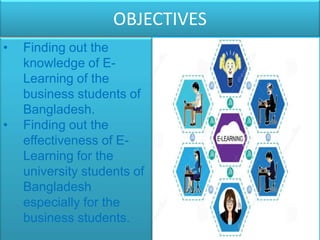
OBJECTIVES
• Finding out the
knowledge of E-
Learning of the
business students of
Bangladesh.
• Finding out the
effectiveness of E-
Learning for the
university students of
Bangladesh
especially for the
business students.
Organizational Profile
• Army Institute of Business
Administration, Savar
• Motto: Knowledge is power
• Type: Autonomous
• Established: 2015
• Address: Savar Cantonment, Dhaka,
Bangladesh
• BBA current students: 161
• MBA current student: 117
• Director: Brig Gen A.K.M Shawkat
Hasan ,psc (retd)
• Phone: 967-3400
• Undergraduate tuition and
fees: 6,25,000.00 BDT
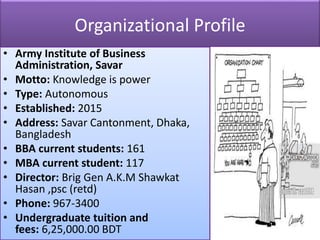
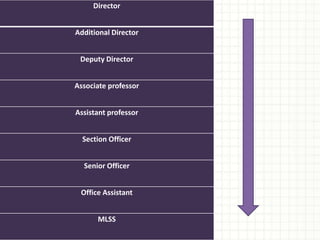
Director
Additional Director
Deputy Director
Associate professor
Assistant professor
Section Officer
Senior Officer
Office Assistant
MLSS
Review of literature
A wider discussion on the use of the term e-
learning can be found in Pollard and Hillage
(2001),
‘The delivery and administration of learning
opportunities and support via computer,
networked and web-based technology to help
individual performance and development.’
(Pollard and Hillage, 2001, 20)
Methodology
Population
• Army Institute of Business
Administration, Savar
Sample size
• 50 Students
Sources & Methods
-Primary
• Questionnaires
-Secondary
• websites, journals and other papers
Data Analyzing Tools and
Procedures
• Microsoft Excel Spreadsheet
• Graphs
Data Analysis & Major findings
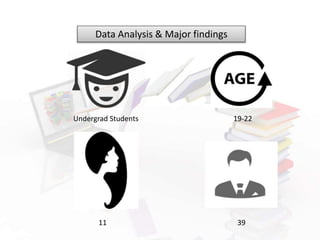
Undergrad Students 19-22
11 39
For the survey we used some question to know the result
1.E-Learning tools
2.E-Learning Platform
3.E-Learning techniques
4.Content structure
5.Usability
6.Faster Technology
7.Quick responsiveness
8.Learning quality
9.Time & Cost friendly
Data Analysis & Major findings(contd)
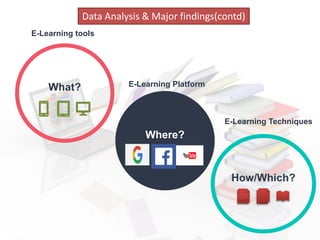
Where?
What?
How/Which?
E-Learning tools
E-Learning Platform
E-Learning Techniques
Data Analysis & Major findings(contd)
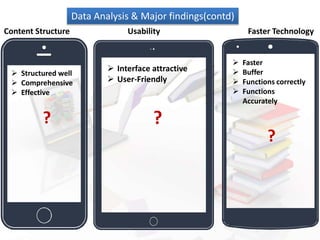
Content Structure Usability Faster Technology
 Structured well
 Comprehensive
 Effective
?
 Interface attractive
 User-Friendly
?
 Faster
 Buffer
 Functions correctly
 Functions
Accurately
?
Data Analysis & Major findings(contd)
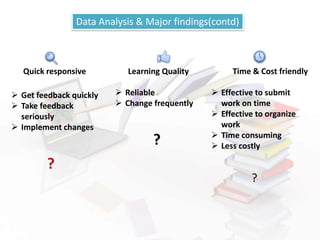
Quick responsive Learning Quality Time & Cost friendly
 Get feedback quickly
 Take feedback
seriously
 Implement changes
?
 Reliable
 Change frequently
?
 Effective to submit
work on time
 Effective to organize
work
 Time consuming
 Less costly
?
Data Analysis & Major findings(contd)
Graphical representation of the survey
0%
50%
100%
StronglyAgree
Disagree
StronglyAgree
Disagree
StronglyAgree
Disagree
StronglyAgree
Disagree
StronglyAgree
Disagree
StronglyAgree
Disagree
StronglyAgree
Disagree
StronglyAgree
Disagree
StronglyAgree
Disagree
StronglyAgree
Disagree
StronglyAgree
Disagree
StronglyAgree
Disagree
StronglyAgree
Disagree
StronglyAgree
Disagree
StronglyAgree
Disagree
StronglyAgree
Disagree
StronglyAgree
Disagree
StronglyAgree
Disagree
Question 1Question 2Question 3Question 4Question 5Question 6Question 7Question 8Question 9Question 10Question 11Question 12Question 13Question 14Question 15Question 16Question 17Question 18
Percentage
Percentage
Percentage Chart
0
5
10
15
20
25
30
35
40
45
50
StronglyAgree
Disagree
StronglyAgree
Disagree
StronglyAgree
Disagree
StronglyAgree
Disagree
StronglyAgree
Disagree
StronglyAgree
Disagree
StronglyAgree
Disagree
StronglyAgree
Disagree
StronglyAgree
Disagree
StronglyAgree
Disagree
StronglyAgree
Disagree
StronglyAgree
Disagree
StronglyAgree
Disagree
StronglyAgree
Disagree
StronglyAgree
Disagree
StronglyAgree
Disagree
StronglyAgree
Disagree
StronglyAgree
Disagree
Question 1Question 2Question 3Question 4Question 5Question 6Question 7Question 8Question 9Question 10Question 11Question 12Question 13Question 14Question 15Question 16Question 17Question 18
6
21
19
4
0
50
6
30
9
5
0
50
10
23
12
4
1
50
7
17
23
21
50
7
1918
5
1
50
8
16
14
7
5
50
9
20
14
34
50
5
17
9
18
1
50
4
1818
9
1
50
5
20
18
5
2
50
8
18
16
6
2
50
5
23
16
6
0
50
11
14
18
5
2
50
10
23
13
4
0
50
27
13
7
21
50
20
18
10
11
50
18
20
8
4
0
50
27
15
332
50
Frequency
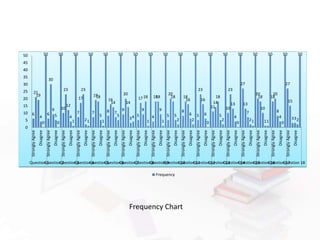
Frequency Chart
Major findings
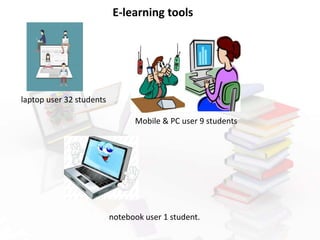
E-learning tools
laptop user 32 students
Mobile & PC user 9 students
notebook user 1 student.
E-learning Platform
36 of the students
prefer Google 6 students use FB and
youtube equally.
1 student use GS, Wikipedia
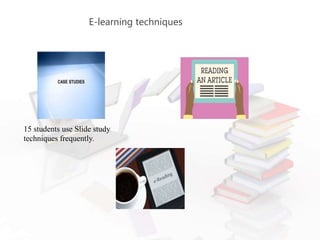
E-learning techniques
15 students use Slide study
techniques frequently.
• Usability: positive feedback
• Technology: positive and Negative feedback
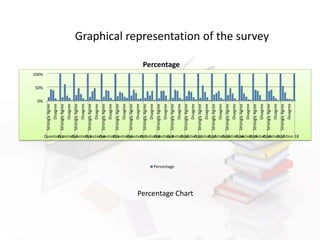
• Responsiveness: 46% of the students are agreed to that.
• Learning Quality: positive feedback
Recommendation
• Increase the number of students
• Increase the number of universities
• Should give more time on research
Students now a days have become highly
dependent on the e-learning system for their
academic purposes. They are now spending
more time on internet and this habit can help to
improve E-Learning.
Conclusion
Effectiveness of E-Learning for Business Students

Effectiveness of E-Learning for Business Students

Editor's Notes

  • #3 This template can be used as a starter file for presenting training materials in a group setting. Sections Right-click on a slide to add sections. Sections can help to organize your slides or facilitate collaboration between multiple authors. Notes Use the Notes section for delivery notes or to provide additional details for the audience. View these notes in Presentation View during your presentation. Keep in mind the font size (important for accessibility, visibility, videotaping, and online production) Coordinated colors Pay particular attention to the graphs, charts, and text boxes. Consider that attendees will print in black and white or grayscale. Run a test print to make sure your colors work when printed in pure black and white and grayscale. Graphics, tables, and graphs Keep it simple: If possible, use consistent, non-distracting styles and colors. Label all graphs and tables.
  • #8 Finding out the knowledge of E-Learning of the business students of Bangladesh. Finding out the effectiveness of E-Learning for the university students of Bangladesh especially for the