MD.TUHIN PARVES B3160B005
The body of laws that govern ordinary private matters, separate
from laws presiding over criminal, military, or political matters.
The civil law system is a codified system of law which is based
on detailed set of laws organized into codes. It takes its origins
from Roman law.
Introduction
When law courts interpret civil law, they do so with regard to these
codes.
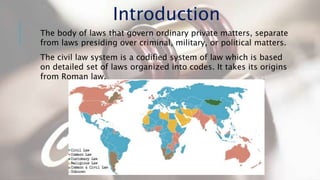
More than 80 countries, including Germany, France, Japan, and Russia,
operate with a civil law system.
A civil law system tends to be less adversarial than a common law
system, since the judges rely upon detailed legal codes rather than
interpreting tradition, precedent, and custom.
Judges under a civil law system have less flexibility than those under a
common law system.
 Judges in a common law system have the power to interpret the law,
whereas judges in a civil law system have the power only to apply the
law.
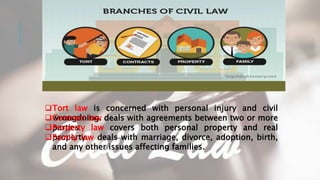
Tort law is concerned with personal injury and civil
wrongdoing.Contract law deals with agreements between two or more
partiesProperty law covers both personal property and real
property.Family law deals with marriage, divorce, adoption, birth,
and any other issues affecting families.
Civil Law

Civil Law

  • 1.
  • 2.
    The body oflaws that govern ordinary private matters, separate from laws presiding over criminal, military, or political matters. The civil law system is a codified system of law which is based on detailed set of laws organized into codes. It takes its origins from Roman law. Introduction
  • 3.
    When law courtsinterpret civil law, they do so with regard to these codes. More than 80 countries, including Germany, France, Japan, and Russia, operate with a civil law system. A civil law system tends to be less adversarial than a common law system, since the judges rely upon detailed legal codes rather than interpreting tradition, precedent, and custom. Judges under a civil law system have less flexibility than those under a common law system.  Judges in a common law system have the power to interpret the law, whereas judges in a civil law system have the power only to apply the law.
  • 4.
    Tort law isconcerned with personal injury and civil wrongdoing.Contract law deals with agreements between two or more partiesProperty law covers both personal property and real property.Family law deals with marriage, divorce, adoption, birth, and any other issues affecting families.