Effective Security Lifecycle
in DevOps
Pawel Krawczyk
Intro
● In application security since 90’s
– Worked for Motorola, Aon, Goldman-Sachs, HSBC
– OWASP, open-source https://github.com/kravietz
– Created https://webcookies.org/
● Contact me at pawel.krawczyk@hush.com
Three Riders of the Apocalypse
● Custom code exploits
● Framework and library exploits
● Infrastructure that allows all that
Self-defending web applications
4
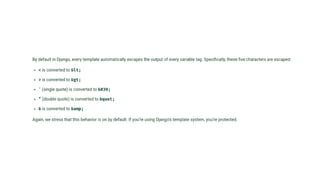
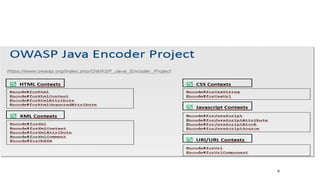
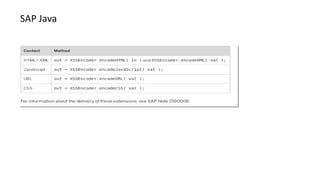
• Modern web application frameworks have powerful security features
− Template escaping and sanitization by design
− Database abstraction
− Session management
− Authentication
− Web security features
• Advantages
− They come for free
− They’re standard
− They’re thoroughly tested for QA and security audited
− Usually more robust than home-brewed ones
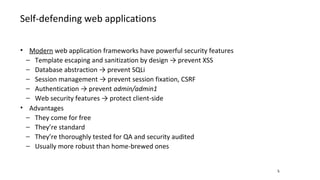
Self-defending web applications
5
• Modern web application frameworks have powerful security features
− Template escaping and sanitization by design → prevent XSS
− Database abstraction → prevent SQLi
− Session management → prevent session fixation, CSRF
− Authentication → prevent admin/admin1
− Web security features → protect client-side
• Advantages
− They come for free
− They’re standard
− They’re thoroughly tested for QA and security audited
− Usually more robust than home-brewed ones
Primary „do not repeat at home” areas
6
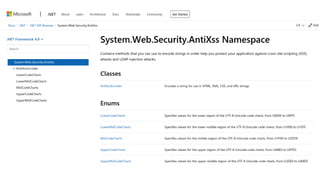
• Input validation, sanitization and escaping
• Cryptography
• Authentication, authorization
• A lot of libraries on GitHub
− Most are of poor quality!
− Many users != quality code
− Be very careful when using samples from StackOverflow!
9
SAP Java
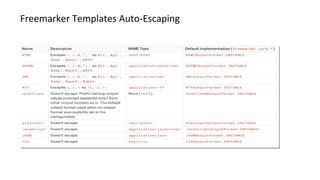
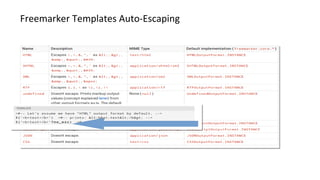
Freemarker Templates Auto-Escaping
13
Toxic dependencies
Libraries and Dependencies
14
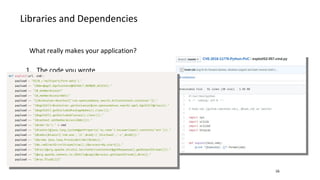
What really makes your application?
1. The code you wrote
●
“our code”, “custom code”
2. Platform API and standard libraries
●
Django, ASP.NET, DropWizard, JAX-WS, Node.js
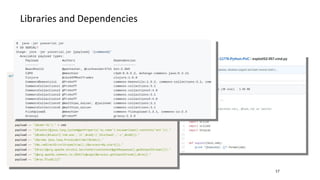
3. 3rd party libraries
●
Include a dozen, you’ll get hundreds – chain reaction
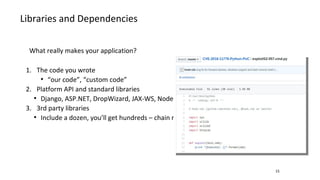
Libraries and Dependencies
15
What really makes your application?
1. The code you wrote
●
“our code”, “custom code”
2. Platform API and standard libraries
●
Django, ASP.NET, DropWizard, JAX-WS, Node.js
3. 3rd party libraries
●
Include a dozen, you’ll get hundreds – chain reaction
Libraries and Dependencies
16
What really makes your application?
1. The code you wrote
●
“our code”, “custom code”
2. Platform API and standard libraries
●
Django, ASP.NET, DropWizard, JAX-WS, Node.js
3. 3rd party libraries
●
Include a dozen, you’ll get hundreds – chain reaction
Libraries and Dependencies
17
What really makes your application?
1. The code you wrote
●
“our code”, “custom code”
2. Platform API and standard libraries
●
Django, ASP.NET, DropWizard, JAX-WS, Node.js
3. 3rd party libraries
●
Include a dozen, you’ll get hundreds – chain reaction
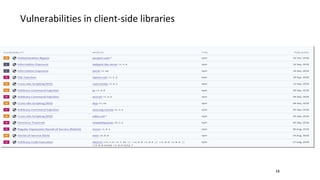
Vulnerabilities in client-side libraries
18
Dependency watchers
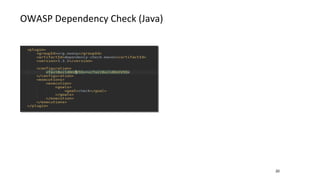
OWASP Dependency Check (Java)
20
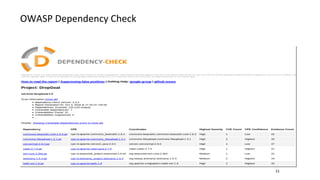
OWASP Dependency Check
21
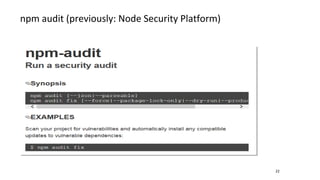
npm audit (previously: Node Security Platform)
22
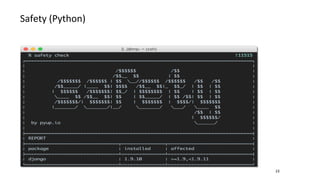
Safety (Python)
23
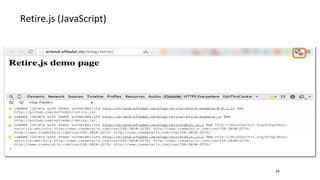
Retire.js (JavaScript)
24
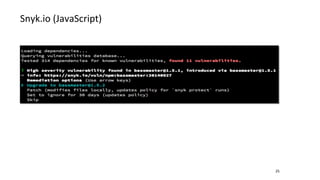
Snyk.io (JavaScript)
25
Keeping up to date
● Abandon the “n-1” nonsense
● Always upgrade libraries with security patches
– Even if they are not exploitable right now
● Prefer to install any bugfix updates
– If you hold, you only accumulate tech debt
– Twice the work when a security update comes
Custom code scanners
Security Scanners
28
• Huge market with very inconsistent quality and maturity
− Good salesmen with nearly useless products
− Mature products with too many bells-and-whistles
− Ancient scanning engines poorly handling modern code
− Expensive, but price unrelated to quality
• Key segments
− SAST („static application security testing”)
− DAST („dynamic”)
− IAST („interacive”)
− RASP (“run-time application self-protection”)
• Security scanner buyer’s guide
− Always evaluate scanner for specific project
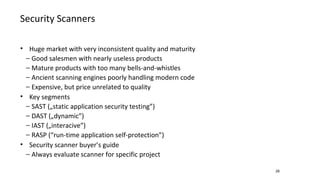
What various scanners see?
29
API #1 API #2
Nginx
Load balancer
SAML
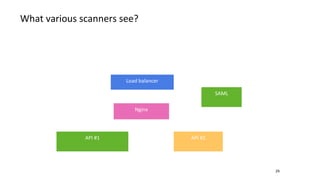
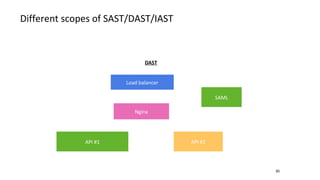
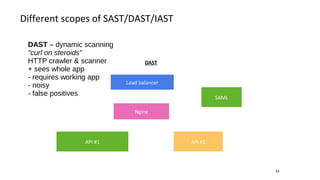
DAST
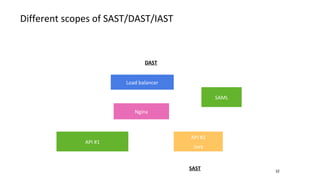
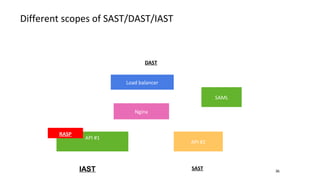
Different scopes of SAST/DAST/IAST
30
API #1 API #2
Nginx
Load balancer
SAML
DAST
Different scopes of SAST/DAST/IAST
31
API #1 API #2
Nginx
Load balancer
SAML
DAST – dynamic scanning
“curl on steroids”
HTTP crawler & scanner
+ sees whole app
- requires working app
- noisy
- false positives
SAST
DAST
Different scopes of SAST/DAST/IAST
32
API #1
API #2
Java
Nginx
Load balancer
SAML
SAST
DAST
Different scopes of SAST/DAST/IAST
33
API #1
API #2
Java
Nginx
Load balancer
SAML
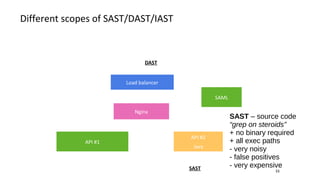
SAST – source code
“grep on steroids”
+ no binary required
+ all exec paths
- very noisy
- false positives
- very expensive
SAST
DAST
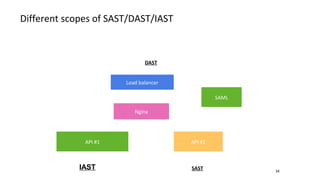
IAST
Different scopes of SAST/DAST/IAST
34
API #1 API #2
Nginx
Load balancer
SAML
SAST
DAST
IAST
Different scopes of SAST/DAST/IAST
35
API #1 API #2
Nginx
Load balancer
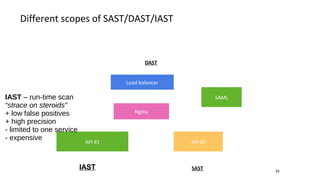
SAMLIAST – run-time scan
“strace on steroids”
+ low false positives
+ high precision
- limited to one service
- expensive
SAST
DAST
Different scopes of SAST/DAST/IAST
36
API #1
API #2
Nginx
Load balancer
SAML
RASP
IAST
SAST
DAST
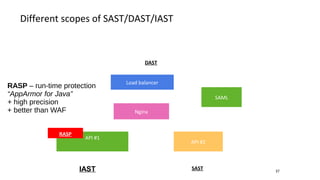
Different scopes of SAST/DAST/IAST
37
API #1
API #2
Nginx
Load balancer
SAML
RASP
IAST
RASP – run-time protection
“AppArmor for Java”
+ high precision
+ better than WAF
Scanners parade
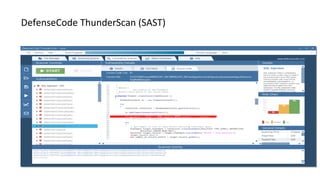
DefenseCode ThunderScan (SAST)
40
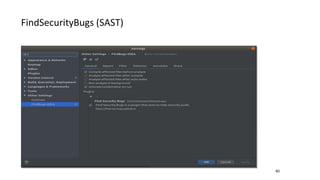
FindSecurityBugs (SAST)
41
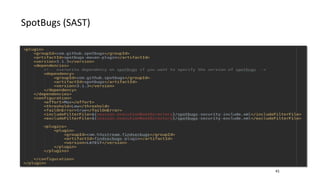
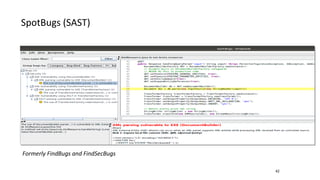
SpotBugs (SAST)
42
Formerly FindBugs and FindSecBugs
SpotBugs (SAST)
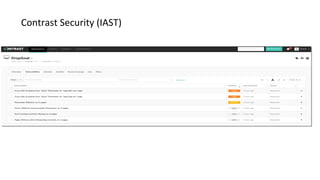
Contrast Security (IAST)
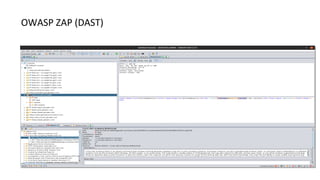
OWASP ZAP (DAST)
45
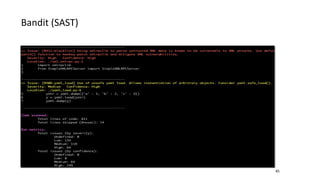
Bandit (SAST)
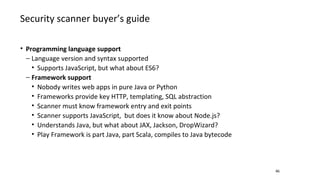
Security scanner buyer’s guide
46
• Programming language support
− Language version and syntax supported
• Supports JavaScript, but what about ES6?
− Framework support
• Nobody writes web apps in pure Java or Python
• Frameworks provide key HTTP, templating, SQL abstraction
• Scanner must know framework entry and exit points
• Scanner supports JavaScript, but does it know about Node.js?
• Understands Java, but what about JAX, Jackson, DropWizard?
• Play Framework is part Java, part Scala, compiles to Java bytecode
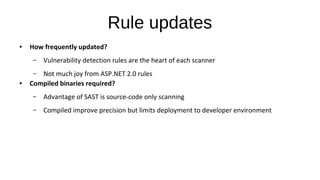
Rule updates
● How frequently updated?
– Vulnerability detection rules are the heart of each scanner
– Not much joy from ASP.NET 2.0 rules
● Compiled binaries required?
– Advantage of SAST is source-code only scanning
– Compiled improve precision but limits deployment to developer environment
48
Integration with build pipeline
● Inline scan vs dedicated scan server
● Headless (command line only) run vs GUI
● How much resources taken by the scanner?
● Some scanners require resource-intensive servers
● Integration with continuous integration tools (Jenkins plugins, API)
● Effectiveness of web crawling (DAST only, AngularJS apps)
Result analysis
● Precision of results
● Thousands of false positives render scanner useless
● Does it find actual vulnerabilities? (false sense of security)
● Can you rate and comment findings?
● Can you whitelist false positives or accepted risk?
● Can you report false positives to vendor?
● Does it integrate into IDE?
● Plugins for IntelliJ, Eclipse, Visual Studio?
 Systems unpatched for years
− “for security reasons we don’t install any security patches”
− “we’re not target”
 No OS-level hardening
− “for security reasons we keep all SUID binaries”
 Flat huge LANs
− “it’s been like this since 80’s”
 No host-level firewalls
− “our perimeter has three expensive firewalls”
 No intrusion detection
− “why would anyone run a SSH scan against us for weeks?”
Infrastructure horror
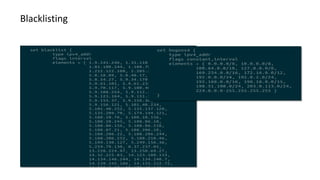
Blacklisting
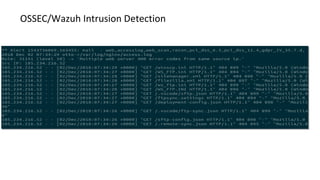
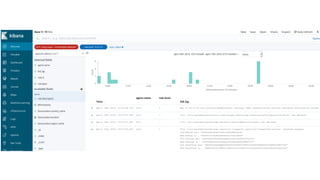
OSSEC/Wazuh Intrusion Detection
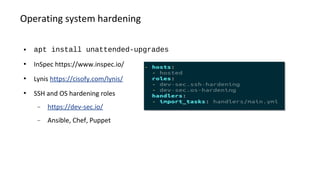
 apt install unattended-upgrades
 InSpec https://www.inspec.io/
 Lynis https://cisofy.com/lynis/
 SSH and OS hardening roles
− https://dev-sec.io/
− Ansible, Chef, Puppet
Operating system hardening
Questions
● pawel.krawczyk@hush.com
● Signal: +44 7879 180015
● Telegram, XMPP, SSB etc

Effective DevSecOps

  • 1.
    Effective Security Lifecycle inDevOps Pawel Krawczyk
  • 2.
    Intro ● In applicationsecurity since 90’s – Worked for Motorola, Aon, Goldman-Sachs, HSBC – OWASP, open-source https://github.com/kravietz – Created https://webcookies.org/ ● Contact me at pawel.krawczyk@hush.com
  • 3.
    Three Riders ofthe Apocalypse ● Custom code exploits ● Framework and library exploits ● Infrastructure that allows all that
  • 4.
    Self-defending web applications 4 •Modern web application frameworks have powerful security features − Template escaping and sanitization by design − Database abstraction − Session management − Authentication − Web security features • Advantages − They come for free − They’re standard − They’re thoroughly tested for QA and security audited − Usually more robust than home-brewed ones
  • 5.
    Self-defending web applications 5 •Modern web application frameworks have powerful security features − Template escaping and sanitization by design → prevent XSS − Database abstraction → prevent SQLi − Session management → prevent session fixation, CSRF − Authentication → prevent admin/admin1 − Web security features → protect client-side • Advantages − They come for free − They’re standard − They’re thoroughly tested for QA and security audited − Usually more robust than home-brewed ones
  • 6.
    Primary „do notrepeat at home” areas 6 • Input validation, sanitization and escaping • Cryptography • Authentication, authorization • A lot of libraries on GitHub − Most are of poor quality! − Many users != quality code − Be very careful when using samples from StackOverflow!
  • 9.
  • 10.
  • 11.
  • 12.
  • 13.
  • 14.
    Libraries and Dependencies 14 Whatreally makes your application? 1. The code you wrote ● “our code”, “custom code” 2. Platform API and standard libraries ● Django, ASP.NET, DropWizard, JAX-WS, Node.js 3. 3rd party libraries ● Include a dozen, you’ll get hundreds – chain reaction
  • 15.
    Libraries and Dependencies 15 Whatreally makes your application? 1. The code you wrote ● “our code”, “custom code” 2. Platform API and standard libraries ● Django, ASP.NET, DropWizard, JAX-WS, Node.js 3. 3rd party libraries ● Include a dozen, you’ll get hundreds – chain reaction
  • 16.
    Libraries and Dependencies 16 Whatreally makes your application? 1. The code you wrote ● “our code”, “custom code” 2. Platform API and standard libraries ● Django, ASP.NET, DropWizard, JAX-WS, Node.js 3. 3rd party libraries ● Include a dozen, you’ll get hundreds – chain reaction
  • 17.
    Libraries and Dependencies 17 Whatreally makes your application? 1. The code you wrote ● “our code”, “custom code” 2. Platform API and standard libraries ● Django, ASP.NET, DropWizard, JAX-WS, Node.js 3. 3rd party libraries ● Include a dozen, you’ll get hundreds – chain reaction
  • 18.
  • 19.
  • 20.
  • 21.
  • 22.
    npm audit (previously:Node Security Platform) 22
  • 23.
  • 24.
  • 25.
  • 26.
    Keeping up todate ● Abandon the “n-1” nonsense ● Always upgrade libraries with security patches – Even if they are not exploitable right now ● Prefer to install any bugfix updates – If you hold, you only accumulate tech debt – Twice the work when a security update comes
  • 27.
  • 28.
    Security Scanners 28 • Hugemarket with very inconsistent quality and maturity − Good salesmen with nearly useless products − Mature products with too many bells-and-whistles − Ancient scanning engines poorly handling modern code − Expensive, but price unrelated to quality • Key segments − SAST („static application security testing”) − DAST („dynamic”) − IAST („interacive”) − RASP (“run-time application self-protection”) • Security scanner buyer’s guide − Always evaluate scanner for specific project
  • 29.
    What various scannerssee? 29 API #1 API #2 Nginx Load balancer SAML
  • 30.
    DAST Different scopes ofSAST/DAST/IAST 30 API #1 API #2 Nginx Load balancer SAML
  • 31.
    DAST Different scopes ofSAST/DAST/IAST 31 API #1 API #2 Nginx Load balancer SAML DAST – dynamic scanning “curl on steroids” HTTP crawler & scanner + sees whole app - requires working app - noisy - false positives
  • 32.
    SAST DAST Different scopes ofSAST/DAST/IAST 32 API #1 API #2 Java Nginx Load balancer SAML
  • 33.
    SAST DAST Different scopes ofSAST/DAST/IAST 33 API #1 API #2 Java Nginx Load balancer SAML SAST – source code “grep on steroids” + no binary required + all exec paths - very noisy - false positives - very expensive
  • 34.
    SAST DAST IAST Different scopes ofSAST/DAST/IAST 34 API #1 API #2 Nginx Load balancer SAML
  • 35.
    SAST DAST IAST Different scopes ofSAST/DAST/IAST 35 API #1 API #2 Nginx Load balancer SAMLIAST – run-time scan “strace on steroids” + low false positives + high precision - limited to one service - expensive
  • 36.
    SAST DAST Different scopes ofSAST/DAST/IAST 36 API #1 API #2 Nginx Load balancer SAML RASP IAST
  • 37.
    SAST DAST Different scopes ofSAST/DAST/IAST 37 API #1 API #2 Nginx Load balancer SAML RASP IAST RASP – run-time protection “AppArmor for Java” + high precision + better than WAF
  • 38.
  • 39.
  • 40.
  • 41.
  • 42.
    42 Formerly FindBugs andFindSecBugs SpotBugs (SAST)
  • 43.
  • 44.
  • 45.
  • 46.
    Security scanner buyer’sguide 46 • Programming language support − Language version and syntax supported • Supports JavaScript, but what about ES6? − Framework support • Nobody writes web apps in pure Java or Python • Frameworks provide key HTTP, templating, SQL abstraction • Scanner must know framework entry and exit points • Scanner supports JavaScript, but does it know about Node.js? • Understands Java, but what about JAX, Jackson, DropWizard? • Play Framework is part Java, part Scala, compiles to Java bytecode
  • 47.
    Rule updates ● Howfrequently updated? – Vulnerability detection rules are the heart of each scanner – Not much joy from ASP.NET 2.0 rules ● Compiled binaries required? – Advantage of SAST is source-code only scanning – Compiled improve precision but limits deployment to developer environment
  • 48.
    48 Integration with buildpipeline ● Inline scan vs dedicated scan server ● Headless (command line only) run vs GUI ● How much resources taken by the scanner? ● Some scanners require resource-intensive servers ● Integration with continuous integration tools (Jenkins plugins, API) ● Effectiveness of web crawling (DAST only, AngularJS apps)
  • 49.
    Result analysis ● Precisionof results ● Thousands of false positives render scanner useless ● Does it find actual vulnerabilities? (false sense of security) ● Can you rate and comment findings? ● Can you whitelist false positives or accepted risk? ● Can you report false positives to vendor? ● Does it integrate into IDE? ● Plugins for IntelliJ, Eclipse, Visual Studio?
  • 50.
     Systems unpatchedfor years − “for security reasons we don’t install any security patches” − “we’re not target”  No OS-level hardening − “for security reasons we keep all SUID binaries”  Flat huge LANs − “it’s been like this since 80’s”  No host-level firewalls − “our perimeter has three expensive firewalls”  No intrusion detection − “why would anyone run a SSH scan against us for weeks?” Infrastructure horror
  • 51.
  • 52.
  • 54.
     apt installunattended-upgrades  InSpec https://www.inspec.io/  Lynis https://cisofy.com/lynis/  SSH and OS hardening roles − https://dev-sec.io/ − Ansible, Chef, Puppet Operating system hardening
  • 55.
    Questions ● pawel.krawczyk@hush.com ● Signal:+44 7879 180015 ● Telegram, XMPP, SSB etc