Narrative Perspective on
Curriculum
Eero Ropo
School of Education
Eeo Ropo 20.9.2013
2
Short Summary of the Presentation
• Curriculum is the most important document for school education
• In the Finnish curriculum system schools and teachers are
responsible in designing school based curricula and their own
pedagogical approaches and solutions
• Goals of education expressed in the curricula vary from abstract
(becoming a citizen and human being) to concrete (learning specific
skills)
• I will describe school learning as a narrative process.
• The very essence of learning is the (re)construction of meanings
• Pedagogy should focus more on enhancing meaning creation in
autobiographical, social and cultural levels.
• Identity has become an important concept in understanding human
action, teaching and learning - also in schools
Eeo Ropo 20.9.2013
3
Narrative Turn in Social Sciences and Education
”The narratives of the world are numberless. Narrative is first and
foremost a prodigious variety of genres, themselves distributed
amongst different substances – as though any material were fit to
receive man’s stories.
Able to be carried by articulated language, spoken or written, fixed or
moving images, gestures, and the ordered mixture of all these
substances; narrative is present in myth, legend, fable, tale, novella,
epic, history, tragedy, drama, comedy, mime, painting ... stained glass
windows, cinema, comics, news item, conversation.
Moreover, under this almost infinite diversity of forms, narrative is
present in every age, in every place, in every society; it begins with the
very history of mankind and there nowhere is nor has been a people
without narrative. All classes, all human groups, have their narratives ...
Caring nothing for the division between good and bad literature,
narrative is international, transhistorical, transcultural: it is simply there,
like life itself.” (Barthes, 1977: 79)
Eeo Ropo 20.9.2013
4
Narrative Theory in Education
• Bruner’s (1986) theory of self as a narrative is closely related to
Roland Barthes’ (1977) theorizing
• Jerome Bruner’s (born 1916) theory on paradigmatic and narrative
knowledge and thinking changed psychological and educational
conceptualizing of self and identity
• Self is a narrative, a story, constructed and reconstructed in a
situation (Bruner 1986, 1993)
• Autobiographical narratives were seen as major sources of finding
out about self and identity
Eeo Ropo 20.9.2013
5
Identity - Narratives of Me
• McAdams describes identity as a story or narrative
• It is expressed in stories I construct about me and my life,
• The process starts in early childhood from images we interpret
(faces around us) or stories we hear about ourselves
• Later on we reconstruct identity narratives throughout our whole
life (discourses with each other, life experiences, reinterpretation
of memories, etc.)
• What happens to us is not important, but what we think
happened is crucial to identity narratives (interpreted meanings)
Eeo Ropo 20.9.2013
6
Learning as a Narrative Process
• Phenomena -> Interpretation (Understanding)-> Experiences
(Reflection)-> Meanings -> Constructing meanings into stories (see
Yrjänäinen & Ropo 2013)
• Constructivist and socioconstructivist learning theories emphasize
that the knowledge a person creates is subjective and constructed
in the contexts and/or in social interaction with others
• From phenomenological point of view learning is a result of
interpreting our perceptions -> experiences that have
meanings(Husserl)
• Reflection and reflective thinking are processes in which we
deliberately reinterpret experiences from new perspectives and/or
subject positions and as a result construct new meanings or
reconstruct previous meanings
Eeo Ropo 20.9.2013
7
• Learning can be understood as a process in which we create
meanings and encode the meanings into long-term memory
• It is innate to human learning that we collect the meanings into a
more or less coherent storiesor narratives (plot, temporality, causal
relations etc.)
• It is important to realize that we do not construct meanings only
about phenomena, but concurrently about ourselves, our social
environment and community, and the contexts we live in
Eeo Ropo 20.9.2013
8
Narrative Nature of School Learning
• We argue with my colleague Sari Yrjänäinen in a recent article that
school learning is also narrative (Yrjänäinen & Ropo 2013)
• This idea applies to all school subjects
• Students create meanings and collect them to narratives concerning
the subject
• Teachers base their instruction on the narratives they have about the
subject
• Human knowledge is NOT objective, free from personal
interpretations, perspectives or positionings
• We create narratives that are contextual and situational and depend
on how we position ourselves in the learning and recall situations
Eeo Ropo 20.9.2013
9
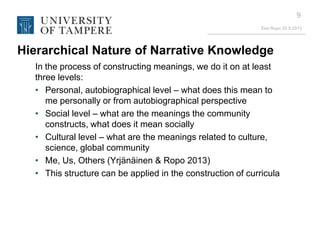
Hierarchical Nature of Narrative Knowledge
In the process of constructing meanings, we do it on at least
three levels:
• Personal, autobiographical level – what does this mean to
me personally or from autobiographical perspective
• Social level – what are the meanings the community
constructs, what does it mean socially
• Cultural level – what are the meanings related to culture,
science, global community
• Me, Us, Others (Yrjänäinen & Ropo 2013)
• This structure can be applied in the construction of curricula
Eeo Ropo 20.9.2013
10
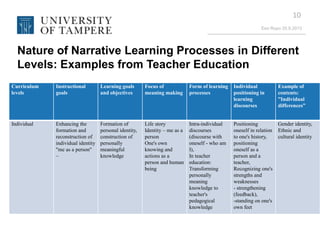
Nature of Narrative Learning Processes in Different
Levels: Examples from Teacher Education
Curriculum
levels
Instructional
goals
Learning goals
and objectives
Focus of
meaning making
Form of learning
processes
Individual
positioning in
learning
discourses
Example of
contents:
”Individual
differences”
Individual Enhancing the
formation and
reconstruction of
individual identity
"me as a person"
–
Formation of
personal identity,
construction of
personally
meaningful
knowledge
Life story
Identity – me as a
person
One's own
knowing and
actions as a
person and human
being
Intra-individual
discourses
(discourse with
oneself - who am
I),
In teacher
education:
Transforming
personally
meaning
knowledge to
teacher's
pedagogical
knowledge
Positioning
oneself in relation
to one's history,
positioning
oneself as a
person and a
teacher,
Recognizing one's
strengths and
weaknesses
- strengthening
(feedback),
-standing on one's
own feet
Gender identity,
Ethnic and
cultural identity
Eeo Ropo 20.9.2013
11
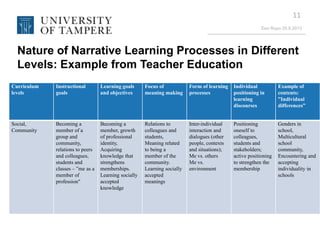
Nature of Narrative Learning Processes in Different
Levels: Example from Teacher Education
Curriculum
levels
Instructional
goals
Learning goals
and objectives
Focus of
meaning making
Form of learning
processes
Individual
positioning in
learning
discourses
Example of
contents:
”Individual
differences”
Social,
Community
Becoming a
member of a
group and
community,
relations to peers
and colleagues,
students and
classes – ”me as a
member of
profession"
Becoming a
member, growth
of professional
identity,
Acquiring
knowledge that
strengthens
memberships.
Learning socially
accepted
knowledge
Relations to
colleagues and
students,
Meaning related
to being a
member of the
community.
Learning socially
accepted
meanings
Inter-individual
interaction and
dialogues (other
people, contexts
and situations);
Me vs. others
Me vs.
environment
Positioning
oneself to
colleagues,
students and
stakeholders;
active positioning
to strengthen the
membership
Genders in
school,
Multicultural
school
community,
Encountering and
accepting
individuality in
schools
Eeo Ropo 20.9.2013
12
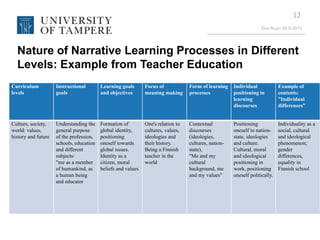
Nature of Narrative Learning Processes in Different
Levels: Example from Teacher Education
Curriculum
levels
Instructional
goals
Learning goals
and objectives
Focus of
meaning making
Form of learning
processes
Individual
positioning in
learning
discourses
Example of
contents:
”Individual
differences”
Culture, society,
world: values,
history and future
Understanding the
general purpose
of the profession,
schools, education
and different
subjects:
"me as a member
of humankind, as
a human being
and educator
Formation of
global identity,
positioning
oneself towards
global issues.
Identity as a
citizen, moral
beliefs and values
One's relation to
cultures, values,
ideologies and
their history.
Being a Finnish
teacher in the
world
Contextual
discourses
(ideologies,
cultures, nation-
state),
"Me and my
cultural
background, me
and my values"
Positioning
oneself to nation-
state, ideologies
and culture.
Cultural, moral
and ideological
positioning in
work, positioning
oneself politically.
Individuality as a
social, cultural
and ideological
phenomenon;
gender
differences,
equality in
Finnish school
Eeo Ropo 20.9.2013
13
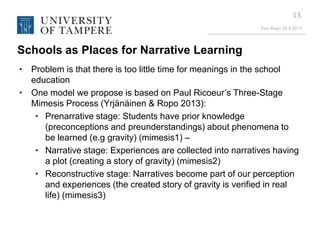
Schools as Places for Narrative Learning
• Problem is that there is too little time for meanings in the school
education
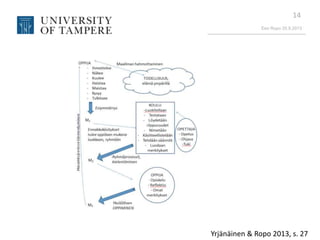
• One model we propose is based on Paul Ricoeur’s Three-Stage
Mimesis Process (Yrjänäinen & Ropo 2013):
• Prenarrative stage: Students have prior knowledge
(preconceptions and preunderstandings) about phenomena to
be learned (e.g gravity) (mimesis1) –
• Narrative stage: Experiences are collected into narratives having
a plot (creating a story of gravity) (mimesis2)
• Reconstructive stage: Narratives become part of our perception
and experiences (the created story of gravity is verified in real
life) (mimesis3)
Eeo Ropo 20.9.2013
14
Yrjänäinen & Ropo 2013, s. 27
Eeo Ropo 20.9.2013
15
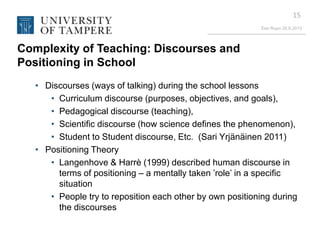
Complexity of Teaching: Discourses and
Positioning in School
• Discourses (ways of talking) during the school lessons
• Curriculum discourse (purposes, objectives, and goals),
• Pedagogical discourse (teaching),
• Scientific discourse (how science defines the phenomenon),
• Student to Student discourse, Etc. (Sari Yrjänäinen 2011)
• Positioning Theory
• Langenhove & Harrè (1999) described human discourse in
terms of positioning – a mentally taken ’role’ in a specific
situation
• People try to reposition each other by own positioning during
the discourses
Eeo Ropo 20.9.2013
16
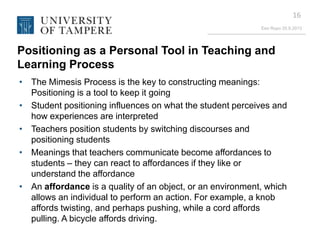
Positioning as a Personal Tool in Teaching and
Learning Process
• The Mimesis Process is the key to constructing meanings:
Positioning is a tool to keep it going
• Student positioning influences on what the student perceives and
how experiences are interpreted
• Teachers position students by switching discourses and
positioning students
• Meanings that teachers communicate become affordances to
students – they can react to affordances if they like or
understand the affordance
• An affordance is a quality of an object, or an environment, which
allows an individual to perform an action. For example, a knob
affords twisting, and perhaps pushing, while a cord affords
pulling. A bicycle affords driving.
Eeo Ropo 20.9.2013
17
• Teachers enhance construction of hierarchically different meanings
by using methods that position students to personal, social and
cultural meanings related to the curriculum topic
Eeo Ropo 20.9.2013
18
Conclusion
• Learning is a process that produces narrative knowledge
• We construct meanings and collect them to narratives concerning
me, us and the world
• Identity is a result of meaning making and narrative processes in
and outside school learning
• Identity influences on positioning and on what we perceive and
what information we receive
• Identity positioning relates on what kind of meanings we create
from received information and about ourselves as learners and
persons
Eeo Ropo 20.9.2013
19
• Narrative perspective on curriculum emphasizes the importance of
positioning in the learning process
• To enhance the construction of narrative knowledge needed in life
we propose designing a hierarchical curriculum in which we have
personal, social and cultural levels (me, us, others)
Eeo Ropo 20.9.2013
20
Thank you!
Yrjänäinen, S & Ropo, E. (2013) Narratiivisesta
opetuksesta narratiiviseen oppimiseen.
Teoksessa Ropo & Huttunen: Puheenvuoroja
narratiivisuudesta opetuksessa ja oppimisessa.
Tampere University Press. S. 17-46.

Narrative Perspective on Curriculum - Eero Ropo

  • 1.
  • 2.
    Eeo Ropo 20.9.2013 2 ShortSummary of the Presentation • Curriculum is the most important document for school education • In the Finnish curriculum system schools and teachers are responsible in designing school based curricula and their own pedagogical approaches and solutions • Goals of education expressed in the curricula vary from abstract (becoming a citizen and human being) to concrete (learning specific skills) • I will describe school learning as a narrative process. • The very essence of learning is the (re)construction of meanings • Pedagogy should focus more on enhancing meaning creation in autobiographical, social and cultural levels. • Identity has become an important concept in understanding human action, teaching and learning - also in schools
  • 3.
    Eeo Ropo 20.9.2013 3 NarrativeTurn in Social Sciences and Education ”The narratives of the world are numberless. Narrative is first and foremost a prodigious variety of genres, themselves distributed amongst different substances – as though any material were fit to receive man’s stories. Able to be carried by articulated language, spoken or written, fixed or moving images, gestures, and the ordered mixture of all these substances; narrative is present in myth, legend, fable, tale, novella, epic, history, tragedy, drama, comedy, mime, painting ... stained glass windows, cinema, comics, news item, conversation. Moreover, under this almost infinite diversity of forms, narrative is present in every age, in every place, in every society; it begins with the very history of mankind and there nowhere is nor has been a people without narrative. All classes, all human groups, have their narratives ... Caring nothing for the division between good and bad literature, narrative is international, transhistorical, transcultural: it is simply there, like life itself.” (Barthes, 1977: 79)
  • 4.
    Eeo Ropo 20.9.2013 4 NarrativeTheory in Education • Bruner’s (1986) theory of self as a narrative is closely related to Roland Barthes’ (1977) theorizing • Jerome Bruner’s (born 1916) theory on paradigmatic and narrative knowledge and thinking changed psychological and educational conceptualizing of self and identity • Self is a narrative, a story, constructed and reconstructed in a situation (Bruner 1986, 1993) • Autobiographical narratives were seen as major sources of finding out about self and identity
  • 5.
    Eeo Ropo 20.9.2013 5 Identity- Narratives of Me • McAdams describes identity as a story or narrative • It is expressed in stories I construct about me and my life, • The process starts in early childhood from images we interpret (faces around us) or stories we hear about ourselves • Later on we reconstruct identity narratives throughout our whole life (discourses with each other, life experiences, reinterpretation of memories, etc.) • What happens to us is not important, but what we think happened is crucial to identity narratives (interpreted meanings)
  • 6.
    Eeo Ropo 20.9.2013 6 Learningas a Narrative Process • Phenomena -> Interpretation (Understanding)-> Experiences (Reflection)-> Meanings -> Constructing meanings into stories (see Yrjänäinen & Ropo 2013) • Constructivist and socioconstructivist learning theories emphasize that the knowledge a person creates is subjective and constructed in the contexts and/or in social interaction with others • From phenomenological point of view learning is a result of interpreting our perceptions -> experiences that have meanings(Husserl) • Reflection and reflective thinking are processes in which we deliberately reinterpret experiences from new perspectives and/or subject positions and as a result construct new meanings or reconstruct previous meanings
  • 7.
    Eeo Ropo 20.9.2013 7 •Learning can be understood as a process in which we create meanings and encode the meanings into long-term memory • It is innate to human learning that we collect the meanings into a more or less coherent storiesor narratives (plot, temporality, causal relations etc.) • It is important to realize that we do not construct meanings only about phenomena, but concurrently about ourselves, our social environment and community, and the contexts we live in
  • 8.
    Eeo Ropo 20.9.2013 8 NarrativeNature of School Learning • We argue with my colleague Sari Yrjänäinen in a recent article that school learning is also narrative (Yrjänäinen & Ropo 2013) • This idea applies to all school subjects • Students create meanings and collect them to narratives concerning the subject • Teachers base their instruction on the narratives they have about the subject • Human knowledge is NOT objective, free from personal interpretations, perspectives or positionings • We create narratives that are contextual and situational and depend on how we position ourselves in the learning and recall situations
  • 9.
    Eeo Ropo 20.9.2013 9 HierarchicalNature of Narrative Knowledge In the process of constructing meanings, we do it on at least three levels: • Personal, autobiographical level – what does this mean to me personally or from autobiographical perspective • Social level – what are the meanings the community constructs, what does it mean socially • Cultural level – what are the meanings related to culture, science, global community • Me, Us, Others (Yrjänäinen & Ropo 2013) • This structure can be applied in the construction of curricula
  • 10.
    Eeo Ropo 20.9.2013 10 Natureof Narrative Learning Processes in Different Levels: Examples from Teacher Education Curriculum levels Instructional goals Learning goals and objectives Focus of meaning making Form of learning processes Individual positioning in learning discourses Example of contents: ”Individual differences” Individual Enhancing the formation and reconstruction of individual identity "me as a person" – Formation of personal identity, construction of personally meaningful knowledge Life story Identity – me as a person One's own knowing and actions as a person and human being Intra-individual discourses (discourse with oneself - who am I), In teacher education: Transforming personally meaning knowledge to teacher's pedagogical knowledge Positioning oneself in relation to one's history, positioning oneself as a person and a teacher, Recognizing one's strengths and weaknesses - strengthening (feedback), -standing on one's own feet Gender identity, Ethnic and cultural identity
  • 11.
    Eeo Ropo 20.9.2013 11 Natureof Narrative Learning Processes in Different Levels: Example from Teacher Education Curriculum levels Instructional goals Learning goals and objectives Focus of meaning making Form of learning processes Individual positioning in learning discourses Example of contents: ”Individual differences” Social, Community Becoming a member of a group and community, relations to peers and colleagues, students and classes – ”me as a member of profession" Becoming a member, growth of professional identity, Acquiring knowledge that strengthens memberships. Learning socially accepted knowledge Relations to colleagues and students, Meaning related to being a member of the community. Learning socially accepted meanings Inter-individual interaction and dialogues (other people, contexts and situations); Me vs. others Me vs. environment Positioning oneself to colleagues, students and stakeholders; active positioning to strengthen the membership Genders in school, Multicultural school community, Encountering and accepting individuality in schools
  • 12.
    Eeo Ropo 20.9.2013 12 Natureof Narrative Learning Processes in Different Levels: Example from Teacher Education Curriculum levels Instructional goals Learning goals and objectives Focus of meaning making Form of learning processes Individual positioning in learning discourses Example of contents: ”Individual differences” Culture, society, world: values, history and future Understanding the general purpose of the profession, schools, education and different subjects: "me as a member of humankind, as a human being and educator Formation of global identity, positioning oneself towards global issues. Identity as a citizen, moral beliefs and values One's relation to cultures, values, ideologies and their history. Being a Finnish teacher in the world Contextual discourses (ideologies, cultures, nation- state), "Me and my cultural background, me and my values" Positioning oneself to nation- state, ideologies and culture. Cultural, moral and ideological positioning in work, positioning oneself politically. Individuality as a social, cultural and ideological phenomenon; gender differences, equality in Finnish school
  • 13.
    Eeo Ropo 20.9.2013 13 Schoolsas Places for Narrative Learning • Problem is that there is too little time for meanings in the school education • One model we propose is based on Paul Ricoeur’s Three-Stage Mimesis Process (Yrjänäinen & Ropo 2013): • Prenarrative stage: Students have prior knowledge (preconceptions and preunderstandings) about phenomena to be learned (e.g gravity) (mimesis1) – • Narrative stage: Experiences are collected into narratives having a plot (creating a story of gravity) (mimesis2) • Reconstructive stage: Narratives become part of our perception and experiences (the created story of gravity is verified in real life) (mimesis3)
  • 14.
  • 15.
    Eeo Ropo 20.9.2013 15 Complexityof Teaching: Discourses and Positioning in School • Discourses (ways of talking) during the school lessons • Curriculum discourse (purposes, objectives, and goals), • Pedagogical discourse (teaching), • Scientific discourse (how science defines the phenomenon), • Student to Student discourse, Etc. (Sari Yrjänäinen 2011) • Positioning Theory • Langenhove & Harrè (1999) described human discourse in terms of positioning – a mentally taken ’role’ in a specific situation • People try to reposition each other by own positioning during the discourses
  • 16.
    Eeo Ropo 20.9.2013 16 Positioningas a Personal Tool in Teaching and Learning Process • The Mimesis Process is the key to constructing meanings: Positioning is a tool to keep it going • Student positioning influences on what the student perceives and how experiences are interpreted • Teachers position students by switching discourses and positioning students • Meanings that teachers communicate become affordances to students – they can react to affordances if they like or understand the affordance • An affordance is a quality of an object, or an environment, which allows an individual to perform an action. For example, a knob affords twisting, and perhaps pushing, while a cord affords pulling. A bicycle affords driving.
  • 17.
    Eeo Ropo 20.9.2013 17 •Teachers enhance construction of hierarchically different meanings by using methods that position students to personal, social and cultural meanings related to the curriculum topic
  • 18.
    Eeo Ropo 20.9.2013 18 Conclusion •Learning is a process that produces narrative knowledge • We construct meanings and collect them to narratives concerning me, us and the world • Identity is a result of meaning making and narrative processes in and outside school learning • Identity influences on positioning and on what we perceive and what information we receive • Identity positioning relates on what kind of meanings we create from received information and about ourselves as learners and persons
  • 19.
    Eeo Ropo 20.9.2013 19 •Narrative perspective on curriculum emphasizes the importance of positioning in the learning process • To enhance the construction of narrative knowledge needed in life we propose designing a hierarchical curriculum in which we have personal, social and cultural levels (me, us, others)
  • 20.
    Eeo Ropo 20.9.2013 20 Thankyou! Yrjänäinen, S & Ropo, E. (2013) Narratiivisesta opetuksesta narratiiviseen oppimiseen. Teoksessa Ropo & Huttunen: Puheenvuoroja narratiivisuudesta opetuksessa ja oppimisessa. Tampere University Press. S. 17-46.