16 BIT BINARY COUNTER
AND
DECADE COUNTER
OUTLINE
• 16-BIT COUNTER
• CIRCUIT DIAGRAM
• ADVANTAGES &
DISADVANTAGES
• DECADE COUNTER
• CIRCUIT DIAGRAM
• ADVANTAGES &
DISADVANTAGES
• APPLICATIONS
16 BIT BINARY COUNTER
• A 16-bit binary counter is a digital circuit or device that can count in binary from 0 to
65535 (2^16 - 1) using 16 binary digits or bits.
• Each bit represents a binary value of either 0 or 1.The counter is designed to
increment its value by 1 for each clock cycle.
• When the counter reaches its maximum value (65535), it resets back to 0 and starts
counting again. This is known as a modulo-65536 counter
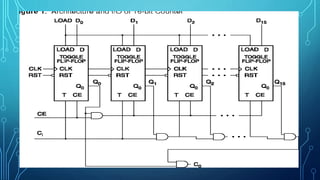
• The counter consists of 16 flip-flops, with each flip-flop representing a single bit.
These flip-flops store the binary values of each bit in the counter.
• At the beginning, all flip-flops are set to 0. This represents the initial count of 0.
• A clock signal is applied to the counter, which determines the timing of the count
operation. The counter increments its value on each rising edge of the clock signal.
ADVANTAGES:
• Increased Counting Range: The 16-bit counter can count from 0 to 2^16-1, which is a range of 65,536 unique
count values. This allows for a much larger counting range compared to counters with fewer bits.
• Fine Resolution: With 16 bits, the counter can provide a high level of resolution. It can accurately count and
represent a wide range of values, making it suitable for applications that require precise counting or timing
measurements.
• Reduced Frequency of Reset: With a larger counting range, the need to reset the counter frequently is
reduced. This can simplify the overall system design and reduce the number of control signals required.
• Support for Complex Operations: The increased bit width of a 16-bit counter allows for more complex
counting operations. It can be used to implement features like cascading multiple counters, generating
complex patterns or sequences, and performing arithmetic operations such as addition or subtraction.
DISADVANTAGES:
• Support for Complex Operations: The increased bit width of a 16-bit counter allows for more complex
counting operations. It can be used to implement features like cascading multiple counters, generating
complex patterns or sequences, and performing arithmetic operations such as addition or subtraction.
• Slower Operation: As the bit width increases, the propagation delays through the counter circuitry can also
increase. This can result in slower counting speeds or higher latency, which may not be desirable in
applications that require fast counting or timing operations.
• Increased Power Consumption: The increased complexity and larger number of components in a 16-bit
counter can lead to higher power consumption compared to counters with fewer bits. This may be a
concern in applications where power efficiency is crucial.
• Overkill for Simple Applications: In applications that require only a small counting range or do not
demand high resolution, a 16-bit counter may be excessive. Using a larger counter than necessary can lead
to wasted resources and increased system complexity without providing any tangible benefits.
DECADE COUNTER
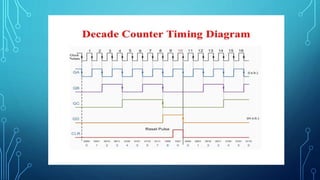
• A decade counter is a type of digital circuit that counts in decimal digits, hence the
name 'decade’.
• It is a counter that can count from 0 to 9 and reset to 0 again.
• The counter has ten states, with each state representing a decimal digit from 0 to 9.
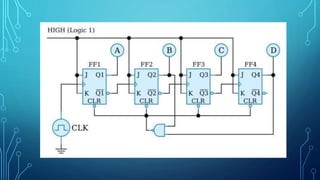
• An ordinary four-stage counter can be easily modified to a decade counter by adding
a NAND gate
• There are two types of decade counters: synchronous and asynchronous.
• Synchronous counters use a common clock signal to synchronize the flip-flops, while
asynchronous counters do not.
• Asynchronous counters are simpler but have limitations in terms of speed and
accuracy.
ADVANTAGES
• Simplicity: They can be built using basic logic gates and flip-flops, making them cost-
effective and easily integrated into electronic systems.
• Counting Range: A decade counter can count from 0 to 9, which makes it suitable
for applications requiring a limited number of states or events.
• Cascadability: Multiple decade counters can be cascaded together to create larger
counters with a higher counting range. This allows for more complex counting
patterns and larger divisions of frequency or time.
• Synchronization: Decade counters can be synchronized with external clock signals,
ensuring accurate and coordinated counting.
DISADVANTAGES
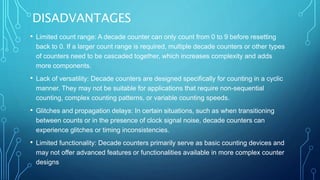
• Limited count range: A decade counter can only count from 0 to 9 before resetting
back to 0. If a larger count range is required, multiple decade counters or other types
of counters need to be cascaded together, which increases complexity and adds
more components.
• Lack of versatility: Decade counters are designed specifically for counting in a cyclic
manner. They may not be suitable for applications that require non-sequential
counting, complex counting patterns, or variable counting speeds.
• Glitches and propagation delays: In certain situations, such as when transitioning
between counts or in the presence of clock signal noise, decade counters can
experience glitches or timing inconsistencies.
• Limited functionality: Decade counters primarily serve as basic counting devices and
may not offer advanced features or functionalities available in more complex counter
designs
APPLICATIONS:
(DECADE COUNTER)
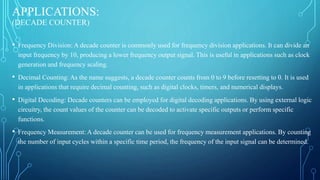
• Frequency Division: A decade counter is commonly used for frequency division applications. It can divide an
input frequency by 10, producing a lower frequency output signal. This is useful in applications such as clock
generation and frequency scaling.
• Decimal Counting: As the name suggests, a decade counter counts from 0 to 9 before resetting to 0. It is used
in applications that require decimal counting, such as digital clocks, timers, and numerical displays.
• Digital Decoding: Decade counters can be employed for digital decoding applications. By using external logic
circuitry, the count values of the counter can be decoded to activate specific outputs or perform specific
functions.
• Frequency Measurement: A decade counter can be used for frequency measurement applications. By counting
the number of input cycles within a specific time period, the frequency of the input signal can be determined.
APPLICATIONS:
(16-BIT COUNTER)
• Digital Signal Processing (DSP): In DSP applications, a 16-bit counter can be used for tasks such as
sampling, data conversion, and signal processing. It allows for precise measurements and calculations on
digital signals.
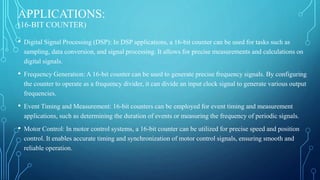
• Frequency Generation: A 16-bit counter can be used to generate precise frequency signals. By configuring
the counter to operate as a frequency divider, it can divide an input clock signal to generate various output
frequencies.
• Event Timing and Measurement: 16-bit counters can be employed for event timing and measurement
applications, such as determining the duration of events or measuring the frequency of periodic signals.
• Motor Control: In motor control systems, a 16-bit counter can be utilized for precise speed and position
control. It enables accurate timing and synchronization of motor control signals, ensuring smooth and
reliable operation.
THANK YOU !!!

eee ppt.pptx

  • 1.
    16 BIT BINARYCOUNTER AND DECADE COUNTER
  • 2.
    OUTLINE • 16-BIT COUNTER •CIRCUIT DIAGRAM • ADVANTAGES & DISADVANTAGES • DECADE COUNTER • CIRCUIT DIAGRAM • ADVANTAGES & DISADVANTAGES • APPLICATIONS
  • 3.
    16 BIT BINARYCOUNTER • A 16-bit binary counter is a digital circuit or device that can count in binary from 0 to 65535 (2^16 - 1) using 16 binary digits or bits. • Each bit represents a binary value of either 0 or 1.The counter is designed to increment its value by 1 for each clock cycle. • When the counter reaches its maximum value (65535), it resets back to 0 and starts counting again. This is known as a modulo-65536 counter • The counter consists of 16 flip-flops, with each flip-flop representing a single bit. These flip-flops store the binary values of each bit in the counter. • At the beginning, all flip-flops are set to 0. This represents the initial count of 0. • A clock signal is applied to the counter, which determines the timing of the count operation. The counter increments its value on each rising edge of the clock signal.
  • 5.
    ADVANTAGES: • Increased CountingRange: The 16-bit counter can count from 0 to 2^16-1, which is a range of 65,536 unique count values. This allows for a much larger counting range compared to counters with fewer bits. • Fine Resolution: With 16 bits, the counter can provide a high level of resolution. It can accurately count and represent a wide range of values, making it suitable for applications that require precise counting or timing measurements. • Reduced Frequency of Reset: With a larger counting range, the need to reset the counter frequently is reduced. This can simplify the overall system design and reduce the number of control signals required. • Support for Complex Operations: The increased bit width of a 16-bit counter allows for more complex counting operations. It can be used to implement features like cascading multiple counters, generating complex patterns or sequences, and performing arithmetic operations such as addition or subtraction.
  • 6.
    DISADVANTAGES: • Support forComplex Operations: The increased bit width of a 16-bit counter allows for more complex counting operations. It can be used to implement features like cascading multiple counters, generating complex patterns or sequences, and performing arithmetic operations such as addition or subtraction. • Slower Operation: As the bit width increases, the propagation delays through the counter circuitry can also increase. This can result in slower counting speeds or higher latency, which may not be desirable in applications that require fast counting or timing operations. • Increased Power Consumption: The increased complexity and larger number of components in a 16-bit counter can lead to higher power consumption compared to counters with fewer bits. This may be a concern in applications where power efficiency is crucial. • Overkill for Simple Applications: In applications that require only a small counting range or do not demand high resolution, a 16-bit counter may be excessive. Using a larger counter than necessary can lead to wasted resources and increased system complexity without providing any tangible benefits.
  • 7.
    DECADE COUNTER • Adecade counter is a type of digital circuit that counts in decimal digits, hence the name 'decade’. • It is a counter that can count from 0 to 9 and reset to 0 again. • The counter has ten states, with each state representing a decimal digit from 0 to 9. • An ordinary four-stage counter can be easily modified to a decade counter by adding a NAND gate • There are two types of decade counters: synchronous and asynchronous. • Synchronous counters use a common clock signal to synchronize the flip-flops, while asynchronous counters do not. • Asynchronous counters are simpler but have limitations in terms of speed and accuracy.
  • 10.
    ADVANTAGES • Simplicity: Theycan be built using basic logic gates and flip-flops, making them cost- effective and easily integrated into electronic systems. • Counting Range: A decade counter can count from 0 to 9, which makes it suitable for applications requiring a limited number of states or events. • Cascadability: Multiple decade counters can be cascaded together to create larger counters with a higher counting range. This allows for more complex counting patterns and larger divisions of frequency or time. • Synchronization: Decade counters can be synchronized with external clock signals, ensuring accurate and coordinated counting.
  • 11.
    DISADVANTAGES • Limited countrange: A decade counter can only count from 0 to 9 before resetting back to 0. If a larger count range is required, multiple decade counters or other types of counters need to be cascaded together, which increases complexity and adds more components. • Lack of versatility: Decade counters are designed specifically for counting in a cyclic manner. They may not be suitable for applications that require non-sequential counting, complex counting patterns, or variable counting speeds. • Glitches and propagation delays: In certain situations, such as when transitioning between counts or in the presence of clock signal noise, decade counters can experience glitches or timing inconsistencies. • Limited functionality: Decade counters primarily serve as basic counting devices and may not offer advanced features or functionalities available in more complex counter designs
  • 12.
    APPLICATIONS: (DECADE COUNTER) • FrequencyDivision: A decade counter is commonly used for frequency division applications. It can divide an input frequency by 10, producing a lower frequency output signal. This is useful in applications such as clock generation and frequency scaling. • Decimal Counting: As the name suggests, a decade counter counts from 0 to 9 before resetting to 0. It is used in applications that require decimal counting, such as digital clocks, timers, and numerical displays. • Digital Decoding: Decade counters can be employed for digital decoding applications. By using external logic circuitry, the count values of the counter can be decoded to activate specific outputs or perform specific functions. • Frequency Measurement: A decade counter can be used for frequency measurement applications. By counting the number of input cycles within a specific time period, the frequency of the input signal can be determined.
  • 13.
    APPLICATIONS: (16-BIT COUNTER) • DigitalSignal Processing (DSP): In DSP applications, a 16-bit counter can be used for tasks such as sampling, data conversion, and signal processing. It allows for precise measurements and calculations on digital signals. • Frequency Generation: A 16-bit counter can be used to generate precise frequency signals. By configuring the counter to operate as a frequency divider, it can divide an input clock signal to generate various output frequencies. • Event Timing and Measurement: 16-bit counters can be employed for event timing and measurement applications, such as determining the duration of events or measuring the frequency of periodic signals. • Motor Control: In motor control systems, a 16-bit counter can be utilized for precise speed and position control. It enables accurate timing and synchronization of motor control signals, ensuring smooth and reliable operation.
  • 14.