Educational System in MoldovaPresenter: Irina Cuzminih,Visiting Fulbright Scholarcuzminii@strose.edu
Where is Moldova?Moldova has an area of 13,067 square miles, making it slightly larger than Maryland. Population: ~3.5 millionSince 1989 – Romanian is official language (Russian)
Welcome to Chisinau  the capital of Republic of Moldova Founded in 1436 as a monastery villageLocated in the middle of the country, on the river BykNowadays the population of Chisinau is more than 700 000 inhabitantsOne of the greenest cities in Europe
Private and State Education2/3 of instruction is in Romanian
General Secondary SchoolLyceumAge from 15 to 17Age from 15 to 18Grades: 10th – 11thGrades: 10th – 12thDuration: 2 years Duration: 3 years Exams  General Studies CertificateBACALAUREAT Exams Bacalaureat DiplomaHigher Education
Non-university level post-secondary studies (technical/vocational type)Higher technical/vocational education is provided by colleges and consists of short-cycle specialized courses
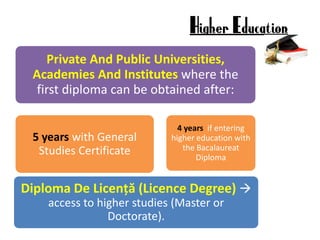
The duration of the study programme varies from two to three years, depending on the field of study. Higher EducationDiploma De Licenţă (Licence Degree)  access to higher studies (Master or Doctorate).
University level 2nd stage: Master studiesaim at consolidating the competencies acquired before
from 1 to 2 years after the Diplomă de LicenţăThe admission to this programme is done at the institution level. It requires the presentation and defense of a research thesis.
University level 3rd stage: Doctoral studiescomprises two stages: Doctor of Science and Doctor Habilitat. The title of Doctor of Science is awarded after three to four years of study and research activity. The public defense of an original research work is required.
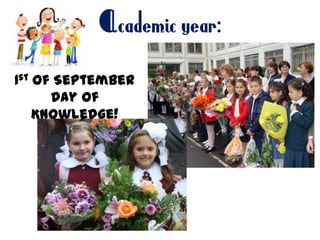
Doctor Habilitatis the highest scientific degree conferred in all fields. Candidates must normally hold a Doctor of Science Diploma to be able to apply to the programme. The degree is conferred after the public defense of a doctoral thesis presenting an original contribution in a particular field.Academic year: 1st of September Day of Knowledge!
Classes and Timetable
Grading SystemNumerical grading system from 1 to 10
Highest on scale: 10

Educational system in moldova

  • 1.
    Educational System inMoldovaPresenter: Irina Cuzminih,Visiting Fulbright Scholarcuzminii@strose.edu
  • 2.
    Where is Moldova?Moldovahas an area of 13,067 square miles, making it slightly larger than Maryland. Population: ~3.5 millionSince 1989 – Romanian is official language (Russian)
  • 3.
    Welcome to Chisinau the capital of Republic of Moldova Founded in 1436 as a monastery villageLocated in the middle of the country, on the river BykNowadays the population of Chisinau is more than 700 000 inhabitantsOne of the greenest cities in Europe
  • 4.
    Private and StateEducation2/3 of instruction is in Romanian
  • 5.
    General Secondary SchoolLyceumAgefrom 15 to 17Age from 15 to 18Grades: 10th – 11thGrades: 10th – 12thDuration: 2 years Duration: 3 years Exams  General Studies CertificateBACALAUREAT Exams Bacalaureat DiplomaHigher Education
  • 6.
    Non-university level post-secondarystudies (technical/vocational type)Higher technical/vocational education is provided by colleges and consists of short-cycle specialized courses
  • 7.
    The duration ofthe study programme varies from two to three years, depending on the field of study. Higher EducationDiploma De Licenţă (Licence Degree)  access to higher studies (Master or Doctorate).
  • 8.
    University level 2ndstage: Master studiesaim at consolidating the competencies acquired before
  • 9.
    from 1 to2 years after the Diplomă de LicenţăThe admission to this programme is done at the institution level. It requires the presentation and defense of a research thesis.
  • 10.
    University level 3rdstage: Doctoral studiescomprises two stages: Doctor of Science and Doctor Habilitat. The title of Doctor of Science is awarded after three to four years of study and research activity. The public defense of an original research work is required.
  • 11.
    Doctor Habilitatis thehighest scientific degree conferred in all fields. Candidates must normally hold a Doctor of Science Diploma to be able to apply to the programme. The degree is conferred after the public defense of a doctoral thesis presenting an original contribution in a particular field.Academic year: 1st of September Day of Knowledge!
  • 12.
  • 13.
  • 14.