ANNIEKHA U. PANGSAYAN
SECTION 1 SHORT TITLE
“GOVERNANCE OF BASIC EDUCATION
ACT OF 2001”
DEC 2023
SECTION 2 DECLARATION OF
POLICY
declared the policy of the State to protect and
promote the right of all citizens to quality basic
education
to make such education accessible to all by providing all
Filipino children a free and compulsory education in
the elementary level and free education in the high
school level.
Such education shall also include alternative learning
systems for out-of-school youth and adult learners. It shall
be the goal of basic education to provide them with the
skills, knowledge and values they need to become
caring
self-
reliant
Productive
Patriotic
citizens
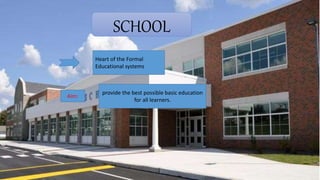
SCHOOL
Heart of the Formal
Educational systems
Aim:
provide the best possible basic education
for all learners.
GOVERNANCE OF BASIC
EDUCATION
Governance of basic education shall begin at the national level. It is at the regions,
divisions, schools and learning centers — herein referred to as the field offices —
where the policy and principle for the governance of basic education shall be
translated into programs, projects and services developed, adapted and offered to fit
local needs.
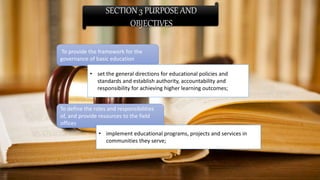
SECTION 3 PURPOSE AND
OBJECTIVES
To provide the framework for the
governance of basic education
• set the general directions for educational policies and
standards and establish authority, accountability and
responsibility for achieving higher learning outcomes;
To define the roles and responsibilities
of, and provide resources to the field
offices
• implement educational programs, projects and services in
communities they serve;
SECTION 3 PURPOSE AND OBJECTIVES
To make schools and learning centersthe most important vehicle for:
 teaching and learning of national values
 developingin the Filipinolearners love of country and pride in its rich
heritage;
To ensure that schools and learning centers receive the kind of
focused attention they deserve and that educational programs,
projects and services take into account the interests of all members
of the community;
To enable the schools and learning centers to reflect the values of
the community
SECTION 3 PURPOSE AND
OBJECTIVES
To encourage local initiatives for the improvement
of schools and learning centers
to provide the means by which these improvements may
be achieved and sustained
To establish schools and learning centers
as facilities where:
 schoolchildren are able to learn a range of core
competencies
 out-of-school youth and adult learners are provided
alternative learning programs and receive accreditation
for at least the equivalent of a high school education.
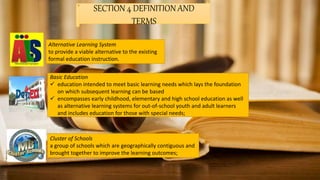
SECTION 4 DEFINITION AND
TERMS
Alternative Learning System
to provide a viable alternative to the existing
formal education instruction.
Basic Education
 education intended to meet basic learning needs which lays the foundation
on which subsequent learning can be based
 encompasses early childhood, elementary and high school education as well
as alternative learning systems for out-of-school youth and adult learners
and includes education for those with special needs;
Cluster of Schools
a group of schools which are geographically contiguous and
brought together to improve the learning outcomes;
SECTION 4 DEFINITION AND
TERMS
Formal Education
 systematic and deliberate process of hierarchically structured
and sequential learning corresponding to the general concept
of elementary and secondary level of schooling
Informal Education
 a lifelong process of learning by which every person acquires
and accumulates knowledge, skills, attitudes and insights from
daily experiences at home, at work, at play and from life itself;
Integrated Schools
 a school that offers a complete basic education in one school
site and has unified instructional programs;
SECTION 4 DEFINITION AND
TERMS
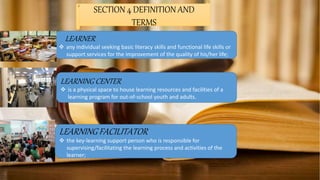
LEARNER
 any individual seeking basic literacy skills and functional life skills or
support services for the improvement of the quality of his/her life;
LEARNING CENTER
 is a physical space to house learning resources and facilities of a
learning program for out-of-school youth and adults.
LEARNING FACILITATOR
 the key-learning support person who is responsible for
supervising/facilitating the learning process and activities of the
learner;
SECTION 4 DEFINITION AND
TERMS
NON-FORMAL EDUCATION
 any organized, systematic educational activity carried outside the framework of
the formal system to provide selected types of learning to a segment of the
population;
QUALITY EDUCATION
 the appropriateness, relevance and excellence of the education given to meet the
needs and aspirations of an individual and society;
SCHOOL HEAD
 a person responsible for the administrative and instructional supervision of the
school or cluster of schools.
SCHOOL
 an educational institution, private and public, undertaking educational
operation with a specific age-group of pupils or students pursuing defined
studies at defined levels, receiving instruction from teachers
CHAPTER 1
Governance of BasicEducation
SHARED GOVERNANCE
A. A principle which recognizes that every unit in the education bureaucracy has:
 Particular role
 Task
 Responsibility
B. The process of democratic consultation shall be observed in the decision-making process
at appropriate levels
C. The principles of accountability and transparency shall be operationalized in the
performance of functions and responsibilities at all levels
D. The communication channels of field offices shall be strengthened to facilitate flow of
information and expand linkages with other government agencies, local government units
and nongovernmental organizations for effective governance
Sec. 6. Governance
DEPARTMENT
OF EDUCATION
Vested with AUTHORITY ACCOUNTABILITY RESPONSIBILITY
 for ensuring access to, promoting equity in, and improving the quality of basic
education
Sec. 7. Powers, Duties
and Functions
The Secretary of the Department of Education
shall exercise overall authority and supervision
over the operations of the Department.
A. NATIONAL LEVEL
In addition to his/her powers under existing laws, the Secretary of
Education shall have authority, accountability and responsibility for the
following:
 Formulating national
educational policies;
 Promulgating national
educational standards;
 Enhancing the employment status, professional
competence, welfare and working conditions of
all personnel of the Department
 Formulating a national
basic education plan;
 Undertaking national
educational research and
studies
 Monitoring and assessing
national learning outcomes;
 Enhancing the total development of learners
through local and national programs and/or
projects.
A. NATIONAL LEVEL
The Secretary of Education shall be assisted by not more than four (4) undersecretaries
and not more than four (4) assistant secretaries whose assignments, duties and
responsibilities shall be governed by law. There shall be at least one undersecretary
and one assistant secretary who shall be career executive service officers chosen from
among the staff of the Department.
B. REGIONAL LEVEL
Each regional office shall have a director, an assistant
director and an office staff for program promotion and
support, planning,administrative and fiscal services.
Consistent with the national educational policies, plans and standards, the regional
director shall have authority, accountability and responsibility for the following:
 Defining a regional educational policy framework which
reflects the values, needs and expectations of the communities
they serve
 Developing a regional basic education
plan
 Developing regional educational standards with a view
towards benchmarking for international competitiveness
 Monitoring, evaluating and assessing regional learning
outcomes
 Undertaking research projects and developing and managing regionwide projects which may
be funded through official development assistance and/or other funding agencies;
 Ensuring strict compliance with prescribed national criteria for the recruitment, selection and
training of all staff in the region and divisions
 Formulating, in coordination with the regional development council, the budget to support
the regional educational plan which shall take into account the educational plans of the
divisions and districts
 Determining the organization component of the divisions and districts and approving the
proposed staffing pattern of all employees in the divisions and districts
 Hiring, placing and evaluating all employees in the regional office, except for the position of
assistant director;
 Evaluating all schools division superintendents and assistant division superintendents in the
region
 Planning and managing the effective and efficient use of all personnel, physical and fiscal
resources of the regional office, including professional staff development
 Managing the database and management information system of the region
 Approving the establishment of public and private elementary and high schools and learning
centers
 Performing such other functions as may be assigned by proper authorities
C. DIVISION LEVEL
A division shall consist of:
a Province or City
Schools Division
Superintendent
At least one
one assistant schools division
superintendent
Office Staff
programs promotion, planning, administrative,
fiscal, legal, ancillary and other support services
Consistent with the national educational policies, plans and standards, the schools division superintendents
shall have authority, accountability and responsibility for the following:
• Developing and implementing division education development plans;
• Planning and managing the effective and efficient use of all personnel, physical and fiscal resources of the division,
including professional staff development;
• Hiring, placing and evaluating all division supervisors and schools district supervisors as well as all employees in the
division, both teaching and non-teaching personnel, including school heads, except for the assistant division
superintendent;
• Monitoring the utilization of funds provided by the national government and the local government units to the
schools and learning centers;
• Ensuring compliance of quality standards for basic education programs and for this purpose strengthening the role
of division supervisors as subject area specialists;
• Promoting awareness of and adherence by all schools and learning centers to accreditation standards prescribed by
the Secretary of Education;
• Supervising the operations of all public and private elementary, secondary and integrated schools, and learning
centers; and
• Performing such other functions as may be assigned by proper authorities.
D. SCHOOLS DISTRICT LEVEL
Upon the recommendation of the schools division superintendents, the regional director may
establish additional schools district within a schools division.
The schools district supervisor shall be responsible for:
Providing professional and instructional advice and support to the school
heads and teachers/facilitators of schools and learning centers in the
district or cluster thereof
Curricula supervision
Performing such other functions as may be assigned by proper authorities
E. SCHOOLS LEVEL
There shall be a school head for all public elementary schools and public high schools or a cluster thereof. The
establishment of integrated schools from existing public elementary and public high schools shall be encouraged.
The school head, who may be assisted by an assistant school head, shall be both an instructional leader and
administrative manager. The school head shall form a team with the school teachers/learning facilitators for
delivery of quality educational programs, projects and services. A core of non-teaching staff shall handle the
school’s administrative, fiscal and auxiliary services.
Consistent with the national educational policies, plans and standards, the school heads shall have authority, accountability
and responsibility for the following:
(1) Setting the mission, vision, goals and objectives of the school;
(2) Creating an environment within the school that is conducive to teaching and learning;
(3) Implementing the school curriculum and being accountable for higher learning outcomes;
(4) Developing the school education program and school improvement plan;
(5) Offering educational programs, projects and services which provide equitable opportunities for all learners in the
community;
(6) Introducing new and innovative modes of instruction to achieve higher learning outcomes;
(7) Administering and managing all personnel, physical and fiscal resources of the school;
(8) Recommending the staffing complement of the school based on its needs;
(9) Encouraging staff development;
(10) Establishing school and community networks and encouraging the active participation of teachers organizations, non-
academic personnel of public schools, and parents-teachers-community associations;
(11) Accepting donations, gifts, bequests and grants for the purpose of upgrading teachers’/learning facilitators’
competencies, improving and expanding school facilities and providing instructional materials and equipment. Such
donations or grants must be reported to the appropriate district supervisors and division superintendents; and
(12) Performing such other functions as may be assigned by proper authorities.
The Secretary of Education shall create a promotions board, at the appropriate levels, which shall formulate
and implement a system of promotion for schools division supervisors, schools district supervisors, and
school heads. Promotion of school heads shall be based on educational qualification, merit and
performance rather than on the number of teachers/learning facilitators and learners in the school.
The qualifications, salary grade, status of employment and welfare and benefits of school heads shall be the
same for public elementary, secondary and integrated schools.
No appointment to the positions of regional directors, assistant regional directors, schools division
superintendents and assistant schools division superintendents shall be made unless the appointee is a
career executive service officer who preferably shall have risen from the ranks.
CHAPTER 2
Transfer of Cultural Agencies
Sec. 8. Cultural Agencies. – The Komisyon ng Wikang Pilipino, National Historical Institute, Record Management and
Archives Office and the National Library shall now be administratively attached to the National Commission for Culture and
the Arts (NCCA) and no longer with the Department of Education. The program for school arts and culture shall remain part
of the school curriculum.
CHAPTER 3
Abolition of the Bureau of Physical Education and School Sports
Sec. 9. Abolition of BPESS. – All functions, programs and activities of the Department of Education related to sports
competition shall be transferred to the Philippine Sports Commission (PSC). The program for school sports and physical
fitness shall remain part of the basic education curriculum.
The Bureau of Physical Education and School Sports (BPESS) is hereby abolished. The personnel of the BPESS, presently
detailed with the PSC, are hereby transferred to the PSC without loss of rank, including the plantilla positions they occupy.
All other BPESS personnel shall be retained by the Department.
CHAPTER 4
Support and Assistance of Other Government Agencies
Sec. 10. The Secretary of Education and the Secretary of Budget and Management shall, within ninety (90) days from the
approval of this Act, jointly promulgate the guidelines on the allocation, distribution and utilization of resources provided by the
national government for the field offices, taking into consideration the uniqueness of the working conditions of the teaching
service.
The Secretary of the Department of Education shall ensure that resources appropriated for the field offices are adequate and
that resources for school personnel, school desks and textbooks and other instructional materials intended are allocated directly
and released immediately by the Department of Budget and Management to said offices.
Sec. 11. The Secretary of the Department of Education, subject to civil service laws and regulations, shall issue appropriate
personnel policy rules and regulations that will best meet the requirements of the teaching profession taking into consideration
the uniqueness of the working conditions of the teaching service.
Sec. 12. The Commission on Audit, in the issuance of audit rules and regulations that will govern the utilization of all resources as
well as the liquidation, recording and reporting thereof, shall take into account the different characteristics and distinct features
of the department’s field offices, its organizational set-up as well as the nature of the operations of schools and learning centers.
CHAPTER 5
Final Provisions
Sec. 13. Governance in the ARMM. – The Regional Education Secretary for the Autonomous Region in Muslim Mindanao (ARMM)
shall exercise similar governance authority over the divisions, districts, schools and learning centers in the region as may be
provided in the Organic Act without prejudice to the provisions of Republic Act No. 9054, entitled “An Act to Strengthen and
Expand the Organic Act for the Autonomous Region in Muslim Mindanao, Amending for the Purpose Republic Act No. 6734,
entitled ‘An Act Providing for the Autonomous Region in Muslim Mindanao, as amended.'”
Sec. 14. Rules and Regulations. – The Secretary of Education shall promulgate the implementing rules and regulations within
ninety (90) days after the approval of this Act: Provided, That, the Secretary of Education shall fully implement the principle of
shared governance within two (2) years after the approval of this Act.
Sec. 15. Separability Clause. – If for any reason, any portion or provision of this Act shall be declared unconstitutional, other parts
or provisions hereof which are not affected thereby shall continue to be in full force and effect.
Sec. 16. Repealing Clause. – All laws, decrees, executive orders, rules and regulations, part or parts thereof, inconsistent with the
provisions of this Act, are hereby repealed or modified accordingly.
Sec. 17. Effectivity Clause. – This Act shall take effect fifteen (15) days following its publication in at least two (2) newspapers of
general circulation.

Educational Laws ( republic act number 9151)

  • 1.
  • 2.
    SECTION 1 SHORTTITLE “GOVERNANCE OF BASIC EDUCATION ACT OF 2001”
  • 3.
    DEC 2023 SECTION 2DECLARATION OF POLICY declared the policy of the State to protect and promote the right of all citizens to quality basic education to make such education accessible to all by providing all Filipino children a free and compulsory education in the elementary level and free education in the high school level. Such education shall also include alternative learning systems for out-of-school youth and adult learners. It shall be the goal of basic education to provide them with the skills, knowledge and values they need to become caring self- reliant Productive Patriotic citizens
  • 4.
    SCHOOL Heart of theFormal Educational systems Aim: provide the best possible basic education for all learners.
  • 5.
    GOVERNANCE OF BASIC EDUCATION Governanceof basic education shall begin at the national level. It is at the regions, divisions, schools and learning centers — herein referred to as the field offices — where the policy and principle for the governance of basic education shall be translated into programs, projects and services developed, adapted and offered to fit local needs.
  • 6.
    SECTION 3 PURPOSEAND OBJECTIVES To provide the framework for the governance of basic education • set the general directions for educational policies and standards and establish authority, accountability and responsibility for achieving higher learning outcomes; To define the roles and responsibilities of, and provide resources to the field offices • implement educational programs, projects and services in communities they serve;
  • 7.
    SECTION 3 PURPOSEAND OBJECTIVES To make schools and learning centersthe most important vehicle for:  teaching and learning of national values  developingin the Filipinolearners love of country and pride in its rich heritage; To ensure that schools and learning centers receive the kind of focused attention they deserve and that educational programs, projects and services take into account the interests of all members of the community; To enable the schools and learning centers to reflect the values of the community
  • 8.
    SECTION 3 PURPOSEAND OBJECTIVES To encourage local initiatives for the improvement of schools and learning centers to provide the means by which these improvements may be achieved and sustained To establish schools and learning centers as facilities where:  schoolchildren are able to learn a range of core competencies  out-of-school youth and adult learners are provided alternative learning programs and receive accreditation for at least the equivalent of a high school education.
  • 9.
    SECTION 4 DEFINITIONAND TERMS Alternative Learning System to provide a viable alternative to the existing formal education instruction. Basic Education  education intended to meet basic learning needs which lays the foundation on which subsequent learning can be based  encompasses early childhood, elementary and high school education as well as alternative learning systems for out-of-school youth and adult learners and includes education for those with special needs; Cluster of Schools a group of schools which are geographically contiguous and brought together to improve the learning outcomes;
  • 10.
    SECTION 4 DEFINITIONAND TERMS Formal Education  systematic and deliberate process of hierarchically structured and sequential learning corresponding to the general concept of elementary and secondary level of schooling Informal Education  a lifelong process of learning by which every person acquires and accumulates knowledge, skills, attitudes and insights from daily experiences at home, at work, at play and from life itself; Integrated Schools  a school that offers a complete basic education in one school site and has unified instructional programs;
  • 11.
    SECTION 4 DEFINITIONAND TERMS LEARNER  any individual seeking basic literacy skills and functional life skills or support services for the improvement of the quality of his/her life; LEARNING CENTER  is a physical space to house learning resources and facilities of a learning program for out-of-school youth and adults. LEARNING FACILITATOR  the key-learning support person who is responsible for supervising/facilitating the learning process and activities of the learner;
  • 12.
    SECTION 4 DEFINITIONAND TERMS NON-FORMAL EDUCATION  any organized, systematic educational activity carried outside the framework of the formal system to provide selected types of learning to a segment of the population; QUALITY EDUCATION  the appropriateness, relevance and excellence of the education given to meet the needs and aspirations of an individual and society; SCHOOL HEAD  a person responsible for the administrative and instructional supervision of the school or cluster of schools. SCHOOL  an educational institution, private and public, undertaking educational operation with a specific age-group of pupils or students pursuing defined studies at defined levels, receiving instruction from teachers
  • 13.
    CHAPTER 1 Governance ofBasicEducation SHARED GOVERNANCE A. A principle which recognizes that every unit in the education bureaucracy has:  Particular role  Task  Responsibility B. The process of democratic consultation shall be observed in the decision-making process at appropriate levels C. The principles of accountability and transparency shall be operationalized in the performance of functions and responsibilities at all levels D. The communication channels of field offices shall be strengthened to facilitate flow of information and expand linkages with other government agencies, local government units and nongovernmental organizations for effective governance
  • 14.
    Sec. 6. Governance DEPARTMENT OFEDUCATION Vested with AUTHORITY ACCOUNTABILITY RESPONSIBILITY  for ensuring access to, promoting equity in, and improving the quality of basic education
  • 15.
    Sec. 7. Powers,Duties and Functions The Secretary of the Department of Education shall exercise overall authority and supervision over the operations of the Department.
  • 16.
    A. NATIONAL LEVEL Inaddition to his/her powers under existing laws, the Secretary of Education shall have authority, accountability and responsibility for the following:  Formulating national educational policies;  Promulgating national educational standards;  Enhancing the employment status, professional competence, welfare and working conditions of all personnel of the Department  Formulating a national basic education plan;  Undertaking national educational research and studies  Monitoring and assessing national learning outcomes;  Enhancing the total development of learners through local and national programs and/or projects.
  • 17.
    A. NATIONAL LEVEL TheSecretary of Education shall be assisted by not more than four (4) undersecretaries and not more than four (4) assistant secretaries whose assignments, duties and responsibilities shall be governed by law. There shall be at least one undersecretary and one assistant secretary who shall be career executive service officers chosen from among the staff of the Department.
  • 18.
    B. REGIONAL LEVEL Eachregional office shall have a director, an assistant director and an office staff for program promotion and support, planning,administrative and fiscal services.
  • 19.
    Consistent with thenational educational policies, plans and standards, the regional director shall have authority, accountability and responsibility for the following:  Defining a regional educational policy framework which reflects the values, needs and expectations of the communities they serve  Developing a regional basic education plan  Developing regional educational standards with a view towards benchmarking for international competitiveness  Monitoring, evaluating and assessing regional learning outcomes
  • 20.
     Undertaking researchprojects and developing and managing regionwide projects which may be funded through official development assistance and/or other funding agencies;  Ensuring strict compliance with prescribed national criteria for the recruitment, selection and training of all staff in the region and divisions  Formulating, in coordination with the regional development council, the budget to support the regional educational plan which shall take into account the educational plans of the divisions and districts  Determining the organization component of the divisions and districts and approving the proposed staffing pattern of all employees in the divisions and districts  Hiring, placing and evaluating all employees in the regional office, except for the position of assistant director;  Evaluating all schools division superintendents and assistant division superintendents in the region  Planning and managing the effective and efficient use of all personnel, physical and fiscal resources of the regional office, including professional staff development  Managing the database and management information system of the region  Approving the establishment of public and private elementary and high schools and learning centers  Performing such other functions as may be assigned by proper authorities
  • 21.
    C. DIVISION LEVEL Adivision shall consist of: a Province or City Schools Division Superintendent At least one one assistant schools division superintendent Office Staff programs promotion, planning, administrative, fiscal, legal, ancillary and other support services
  • 22.
    Consistent with thenational educational policies, plans and standards, the schools division superintendents shall have authority, accountability and responsibility for the following: • Developing and implementing division education development plans; • Planning and managing the effective and efficient use of all personnel, physical and fiscal resources of the division, including professional staff development; • Hiring, placing and evaluating all division supervisors and schools district supervisors as well as all employees in the division, both teaching and non-teaching personnel, including school heads, except for the assistant division superintendent; • Monitoring the utilization of funds provided by the national government and the local government units to the schools and learning centers; • Ensuring compliance of quality standards for basic education programs and for this purpose strengthening the role of division supervisors as subject area specialists; • Promoting awareness of and adherence by all schools and learning centers to accreditation standards prescribed by the Secretary of Education; • Supervising the operations of all public and private elementary, secondary and integrated schools, and learning centers; and • Performing such other functions as may be assigned by proper authorities.
  • 23.
    D. SCHOOLS DISTRICTLEVEL Upon the recommendation of the schools division superintendents, the regional director may establish additional schools district within a schools division. The schools district supervisor shall be responsible for: Providing professional and instructional advice and support to the school heads and teachers/facilitators of schools and learning centers in the district or cluster thereof Curricula supervision Performing such other functions as may be assigned by proper authorities
  • 24.
    E. SCHOOLS LEVEL Thereshall be a school head for all public elementary schools and public high schools or a cluster thereof. The establishment of integrated schools from existing public elementary and public high schools shall be encouraged. The school head, who may be assisted by an assistant school head, shall be both an instructional leader and administrative manager. The school head shall form a team with the school teachers/learning facilitators for delivery of quality educational programs, projects and services. A core of non-teaching staff shall handle the school’s administrative, fiscal and auxiliary services.
  • 25.
    Consistent with thenational educational policies, plans and standards, the school heads shall have authority, accountability and responsibility for the following: (1) Setting the mission, vision, goals and objectives of the school; (2) Creating an environment within the school that is conducive to teaching and learning; (3) Implementing the school curriculum and being accountable for higher learning outcomes; (4) Developing the school education program and school improvement plan; (5) Offering educational programs, projects and services which provide equitable opportunities for all learners in the community; (6) Introducing new and innovative modes of instruction to achieve higher learning outcomes; (7) Administering and managing all personnel, physical and fiscal resources of the school; (8) Recommending the staffing complement of the school based on its needs; (9) Encouraging staff development;
  • 26.
    (10) Establishing schooland community networks and encouraging the active participation of teachers organizations, non- academic personnel of public schools, and parents-teachers-community associations; (11) Accepting donations, gifts, bequests and grants for the purpose of upgrading teachers’/learning facilitators’ competencies, improving and expanding school facilities and providing instructional materials and equipment. Such donations or grants must be reported to the appropriate district supervisors and division superintendents; and (12) Performing such other functions as may be assigned by proper authorities.
  • 27.
    The Secretary ofEducation shall create a promotions board, at the appropriate levels, which shall formulate and implement a system of promotion for schools division supervisors, schools district supervisors, and school heads. Promotion of school heads shall be based on educational qualification, merit and performance rather than on the number of teachers/learning facilitators and learners in the school. The qualifications, salary grade, status of employment and welfare and benefits of school heads shall be the same for public elementary, secondary and integrated schools. No appointment to the positions of regional directors, assistant regional directors, schools division superintendents and assistant schools division superintendents shall be made unless the appointee is a career executive service officer who preferably shall have risen from the ranks.
  • 28.
    CHAPTER 2 Transfer ofCultural Agencies Sec. 8. Cultural Agencies. – The Komisyon ng Wikang Pilipino, National Historical Institute, Record Management and Archives Office and the National Library shall now be administratively attached to the National Commission for Culture and the Arts (NCCA) and no longer with the Department of Education. The program for school arts and culture shall remain part of the school curriculum. CHAPTER 3 Abolition of the Bureau of Physical Education and School Sports Sec. 9. Abolition of BPESS. – All functions, programs and activities of the Department of Education related to sports competition shall be transferred to the Philippine Sports Commission (PSC). The program for school sports and physical fitness shall remain part of the basic education curriculum. The Bureau of Physical Education and School Sports (BPESS) is hereby abolished. The personnel of the BPESS, presently detailed with the PSC, are hereby transferred to the PSC without loss of rank, including the plantilla positions they occupy. All other BPESS personnel shall be retained by the Department.
  • 29.
    CHAPTER 4 Support andAssistance of Other Government Agencies Sec. 10. The Secretary of Education and the Secretary of Budget and Management shall, within ninety (90) days from the approval of this Act, jointly promulgate the guidelines on the allocation, distribution and utilization of resources provided by the national government for the field offices, taking into consideration the uniqueness of the working conditions of the teaching service. The Secretary of the Department of Education shall ensure that resources appropriated for the field offices are adequate and that resources for school personnel, school desks and textbooks and other instructional materials intended are allocated directly and released immediately by the Department of Budget and Management to said offices. Sec. 11. The Secretary of the Department of Education, subject to civil service laws and regulations, shall issue appropriate personnel policy rules and regulations that will best meet the requirements of the teaching profession taking into consideration the uniqueness of the working conditions of the teaching service. Sec. 12. The Commission on Audit, in the issuance of audit rules and regulations that will govern the utilization of all resources as well as the liquidation, recording and reporting thereof, shall take into account the different characteristics and distinct features of the department’s field offices, its organizational set-up as well as the nature of the operations of schools and learning centers.
  • 30.
    CHAPTER 5 Final Provisions Sec.13. Governance in the ARMM. – The Regional Education Secretary for the Autonomous Region in Muslim Mindanao (ARMM) shall exercise similar governance authority over the divisions, districts, schools and learning centers in the region as may be provided in the Organic Act without prejudice to the provisions of Republic Act No. 9054, entitled “An Act to Strengthen and Expand the Organic Act for the Autonomous Region in Muslim Mindanao, Amending for the Purpose Republic Act No. 6734, entitled ‘An Act Providing for the Autonomous Region in Muslim Mindanao, as amended.'” Sec. 14. Rules and Regulations. – The Secretary of Education shall promulgate the implementing rules and regulations within ninety (90) days after the approval of this Act: Provided, That, the Secretary of Education shall fully implement the principle of shared governance within two (2) years after the approval of this Act. Sec. 15. Separability Clause. – If for any reason, any portion or provision of this Act shall be declared unconstitutional, other parts or provisions hereof which are not affected thereby shall continue to be in full force and effect. Sec. 16. Repealing Clause. – All laws, decrees, executive orders, rules and regulations, part or parts thereof, inconsistent with the provisions of this Act, are hereby repealed or modified accordingly. Sec. 17. Effectivity Clause. – This Act shall take effect fifteen (15) days following its publication in at least two (2) newspapers of general circulation.