GUESS THE PICTURE
to provide a viable alternative to the existing
formal education instruction
Alternative Learning
System
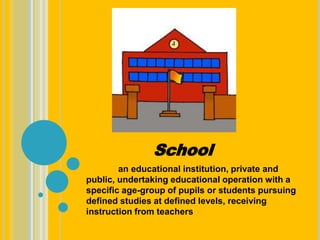
School
an educational institution, private and
public, undertaking educational operation with a
specific age-group of pupils or students pursuing
defined studies at defined levels, receiving
instruction from teachers
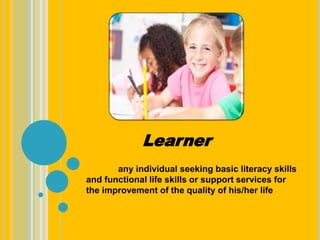
Learner
any individual seeking basic literacy skills
and functional life skills or support services for
the improvement of the quality of his/her life
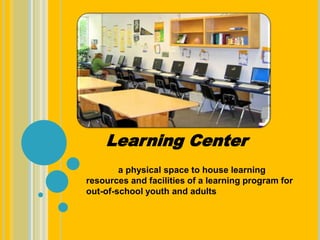
a physical space to house learning
resources and facilities of a learning program for
out-of-school youth and adults
Learning Center
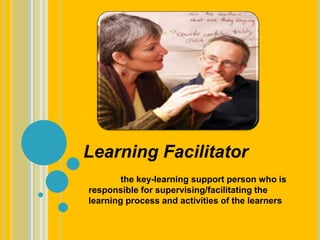
Learning Facilitator
the key-learning support person who is
responsible for supervising/facilitating the
learning process and activities of the learners
“Governance of Basic
Education Act of 2001.”
SEC. 2. DECLARATION OF POLICY.
declared the policy of the State to protect and
promote the right of all citizens to quality basic
education
such education accessible to all by providing all
Filipino children a free and compulsory
education
elementary level and free education in the high
school level
alternative learning systems for basic
education to provide them with the skills,
knowledge and values they need to become
making
in
include
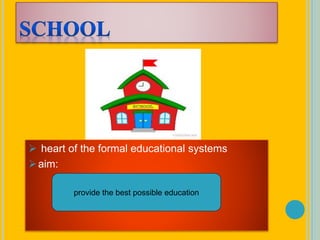
 heart of the formal educational systems
aim:
provide the best possible education
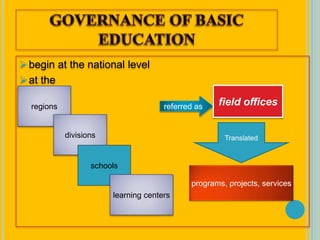
begin at the national level
at the
regions
divisions
schools
learning centers
referred as field offices
programs, projects, services
Translated
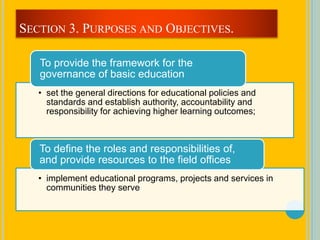
• set the general directions for educational policies and
standards and establish authority, accountability and
responsibility for achieving higher learning outcomes;
To provide the framework for the
governance of basic education
• implement educational programs, projects and services in
communities they serve
To define the roles and responsibilities of,
and provide resources to the field offices
SECTION 3. PURPOSES AND OBJECTIVES.
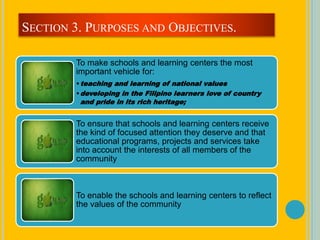
To make schools and learning centers the most
important vehicle for:
•teaching and learning of national values
•developing in the Filipino learners love of country
and pride in its rich heritage;
To ensure that schools and learning centers receive
the kind of focused attention they deserve and that
educational programs, projects and services take
into account the interests of all members of the
community
To enable the schools and learning centers to reflect
the values of the community
SECTION 3. PURPOSES AND OBJECTIVES.
To encourage local initiatives for the improvement
of schools and learning centers
• to provide the means by which these improvements may be
achieved and sustained
To establish schools and learning centers as
facilities where:
• school children are able to learn a range of core competencies
• out-of-school youth and adult learners are provided alternative
learning programs
SECTION 3. PURPOSES AND OBJECTIVES.
Alternative Learning System
• to provide a viable alternative to the existing formal education instruction
Basic Education
• education intended to meet basic learning needs which lays the foundation
on which subsequent learning can be based
• encompasses early childhood, elementary and high school education
as well as alternative learning systems for out-of-school youth and adult
learners and includes education for those with special needs
Cluster of Schools
• a group of schools which are geographically contiguous and brought
together to improve the learning outcomes
SECTION 4. DEFINITION OF TERMS
Formal Education
• systematic and deliberate process of hierarchically
structured and sequential learning corresponding to the
general concept of elementary and secondary level of
schooling
Information Education
• a lifelong process of learning by which every person
acquires and accumulates knowledge, skills, attitudes
and insights from daily experiences at home, at work, at
play and from life itself
Integrated Schools
• a school that offers a complete basic education in one
school site and has unified instructional programs
SECTION 4. DEFINITION OF TERMS
Learner
• any individual seeking basic literacy skills and
functional life skills or support services for the
improvement of the quality of his/her life
Learning Center
• a physical space to house learning resources
and facilities of a learning program for out-of-
school youth and adults
Learning Facilitator
• the key-learning support person who is
responsible for supervising/facilitating the
learning process and activities of the learners
SECTION 4. DEFINITION OF TERMS
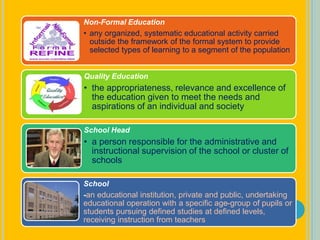
Non-Formal Education
• any organized, systematic educational activity carried
outside the framework of the formal system to provide
selected types of learning to a segment of the population
Quality Education
• the appropriateness, relevance and excellence of
the education given to meet the needs and
aspirations of an individual and society
School Head
• a person responsible for the administrative and
instructional supervision of the school or cluster of
schools
School
-an educational institution, private and public, undertaking
educational operation with a specific age-group of pupils or
students pursuing defined studies at defined levels,
receiving instruction from teachers
CHAPTER 1
GOVERNANCE OF BASIC
EDUCATION
A. A principle that recognizes every unit in the
education bureaucracy has:
1. Particular role
2. Task
3. Responsibility
inherent in the office and for which it is principally
accountable for outcomes
SHARED GOVERNANCE
B.
C.
D.
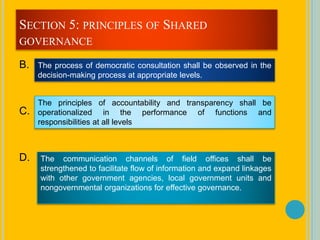
SECTION 5: PRINCIPLES OF SHARED
GOVERNANCE
The process of democratic consultation shall be observed in the
decision-making process at appropriate levels.
The principles of accountability and transparency shall be
operationalized in the performance of functions and
responsibilities at all levels
The communication channels of field offices shall be
strengthened to facilitate flow of information and expand linkages
with other government agencies, local government units and
nongovernmental organizations for effective governance.
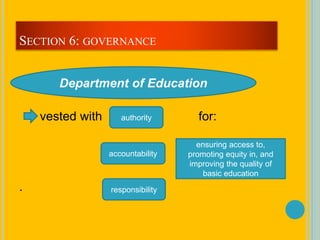
Department of Education, Culture and Sports
vested with for:
.
SECTION 6: GOVERNANCE
Department of Education
authority
accountability
responsibility
ensuring access to,
promoting equity in, and
improving the quality of
basic education
SECTION 7. POWERS, DUTIES AND FUNCTIONS
The Secretary of the Department of
Education shall exercise overall
authority and supervision over the
operations of the Department.
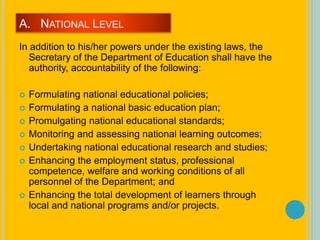
A. NATIONAL LEVEL
In addition to his/her powers under the existing laws, the
Secretary of the Department of Education shall have the
authority, accountability of the following:
 Formulating national educational policies;
 Formulating a national basic education plan;
 Promulgating national educational standards;
 Monitoring and assessing national learning outcomes;
 Undertaking national educational research and studies;
 Enhancing the employment status, professional
competence, welfare and working conditions of all
personnel of the Department; and
 Enhancing the total development of learners through
local and national programs and/or projects.
Secretary of the Department of Education
shall be assisted by not more than four (4)
undersecretaries and not more than four (4)
assistant secretaries whose assignments,
duties and responsibilities shall be
governed by law.
A. NATIONAL LEVEL
B. REGIONAL LEVEL
Each regional office shall have a director, an
assistant director and an office staff for
program promotion and support, planning,
administrative and fiscal services.
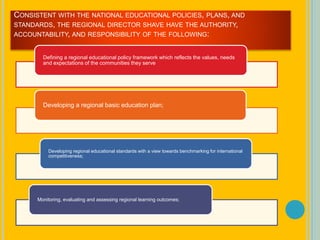
CONSISTENT WITH THE NATIONAL EDUCATIONAL POLICIES, PLANS, AND
STANDARDS, THE REGIONAL DIRECTOR SHAVE HAVE THE AUTHORITY,
ACCOUNTABILITY, AND RESPONSIBILITY OF THE FOLLOWING:
Defining a regional educational policy framework which reflects the values, needs
and expectations of the communities they serve
Developing a regional basic education plan;
Developing regional educational standards with a view towards benchmarking for international
competitiveness;
Monitoring, evaluating and assessing regional learning outcomes;
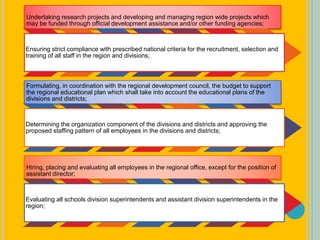
Undertaking research projects and developing and managing region wide projects which
may be funded through official development assistance and/or other funding agencies;
Ensuring strict compliance with prescribed national criteria for the recruitment, selection and
training of all staff in the region and divisions;
Formulating, in coordination with the regional development council, the budget to support
the regional educational plan which shall take into account the educational plans of the
divisions and districts;
Determining the organization component of the divisions and districts and approving the
proposed staffing pattern of all employees in the divisions and districts;
Hiring, placing and evaluating all employees in the regional office, except for the position of
assistant director;
Evaluating all schools division superintendents and assistant division superintendents in the
region;
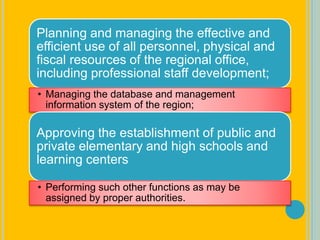
Planning and managing the effective and
efficient use of all personnel, physical and
fiscal resources of the regional office,
including professional staff development;
• Managing the database and management
information system of the region;
Approving the establishment of public and
private elementary and high schools and
learning centers
• Performing such other functions as may be
assigned by proper authorities.
C. DIVISION LEVEL
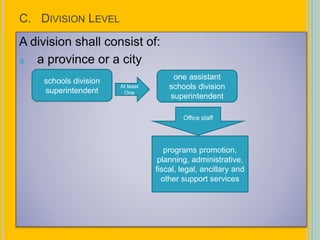
A division shall consist of:
a. a province or a city
schools division
superintendent
one assistant
schools division
superintendent
At least
One
Office staff
programs promotion,
planning, administrative,
fiscal, legal, ancillary and
other support services
C. DIVISION LEVEL
Consistent with the national educational policies,
plans and standards, the schools division
superintendents shall have authority, accountability
and responsibility for the following:
 Developing and implementing division education
development plans;
 Planning and managing the effective and efficient
use of all personnel, physical and fiscal resources
of the division, including professional staff
development;
 Hiring, placing and evaluating all division
supervisors and schools district supervisors as well
as all employees in the division, both teaching and
non-teaching personnel, including school heads,
except for the assistant division superintendent
C. DIVISION LEVEL
 Monitoring the utilization of funds provided
by the national government and the local
government units to the schools and
learning centers;
 Ensuring compliance of quality standards
for basic education programs and for this
purpose strengthening the role of division
supervisors as subject area specialists
C. DIVISION LEVEL
C. DIVISION LEVEL
 Promoting awareness of and adherence by all
schools and learning centers to accreditation
standards prescribed by the Secretary of
Education;
 Supervising the operations of all public and private
elementary, secondary and integrated schools, and
learning centers; and
 Performing such other functions as may be
assigned by proper authorities.
RECENT DEVELOPMENT IN
EDUCATION
ALS (Alternative Learning System)
A parallel learning system that provides a
viable alternative to the existing formal education
instruction. It encompasses both the non-formal
and informal sources of knowledge and skills.
REFERRENCE:
https://www.slideshare.net/juviehayo/republi
c-act-
9155?fbclid=IwAR054kjVXWZ13Ps3TR4fis
wghdm3FQYE0POVdgRzG-
VC18uiMs35pd_ZVl0
Thank you!
JOAN J. ANGELES
MAED-EM 2022

REPUBLIC ACT 9155 JoanJAngeles.pptx

  • 1.
    GUESS THE PICTURE toprovide a viable alternative to the existing formal education instruction Alternative Learning System
  • 2.
    School an educational institution,private and public, undertaking educational operation with a specific age-group of pupils or students pursuing defined studies at defined levels, receiving instruction from teachers
  • 3.
    Learner any individual seekingbasic literacy skills and functional life skills or support services for the improvement of the quality of his/her life
  • 4.
    a physical spaceto house learning resources and facilities of a learning program for out-of-school youth and adults Learning Center
  • 5.
    Learning Facilitator the key-learningsupport person who is responsible for supervising/facilitating the learning process and activities of the learners
  • 7.
  • 8.
    SEC. 2. DECLARATIONOF POLICY. declared the policy of the State to protect and promote the right of all citizens to quality basic education such education accessible to all by providing all Filipino children a free and compulsory education elementary level and free education in the high school level alternative learning systems for basic education to provide them with the skills, knowledge and values they need to become making in include
  • 9.
     heart ofthe formal educational systems aim: provide the best possible education
  • 10.
    begin at thenational level at the regions divisions schools learning centers referred as field offices programs, projects, services Translated
  • 11.
    • set thegeneral directions for educational policies and standards and establish authority, accountability and responsibility for achieving higher learning outcomes; To provide the framework for the governance of basic education • implement educational programs, projects and services in communities they serve To define the roles and responsibilities of, and provide resources to the field offices SECTION 3. PURPOSES AND OBJECTIVES.
  • 12.
    To make schoolsand learning centers the most important vehicle for: •teaching and learning of national values •developing in the Filipino learners love of country and pride in its rich heritage; To ensure that schools and learning centers receive the kind of focused attention they deserve and that educational programs, projects and services take into account the interests of all members of the community To enable the schools and learning centers to reflect the values of the community SECTION 3. PURPOSES AND OBJECTIVES.
  • 13.
    To encourage localinitiatives for the improvement of schools and learning centers • to provide the means by which these improvements may be achieved and sustained To establish schools and learning centers as facilities where: • school children are able to learn a range of core competencies • out-of-school youth and adult learners are provided alternative learning programs SECTION 3. PURPOSES AND OBJECTIVES.
  • 14.
    Alternative Learning System •to provide a viable alternative to the existing formal education instruction Basic Education • education intended to meet basic learning needs which lays the foundation on which subsequent learning can be based • encompasses early childhood, elementary and high school education as well as alternative learning systems for out-of-school youth and adult learners and includes education for those with special needs Cluster of Schools • a group of schools which are geographically contiguous and brought together to improve the learning outcomes SECTION 4. DEFINITION OF TERMS
  • 15.
    Formal Education • systematicand deliberate process of hierarchically structured and sequential learning corresponding to the general concept of elementary and secondary level of schooling Information Education • a lifelong process of learning by which every person acquires and accumulates knowledge, skills, attitudes and insights from daily experiences at home, at work, at play and from life itself Integrated Schools • a school that offers a complete basic education in one school site and has unified instructional programs SECTION 4. DEFINITION OF TERMS
  • 16.
    Learner • any individualseeking basic literacy skills and functional life skills or support services for the improvement of the quality of his/her life Learning Center • a physical space to house learning resources and facilities of a learning program for out-of- school youth and adults Learning Facilitator • the key-learning support person who is responsible for supervising/facilitating the learning process and activities of the learners SECTION 4. DEFINITION OF TERMS
  • 17.
    Non-Formal Education • anyorganized, systematic educational activity carried outside the framework of the formal system to provide selected types of learning to a segment of the population Quality Education • the appropriateness, relevance and excellence of the education given to meet the needs and aspirations of an individual and society School Head • a person responsible for the administrative and instructional supervision of the school or cluster of schools School -an educational institution, private and public, undertaking educational operation with a specific age-group of pupils or students pursuing defined studies at defined levels, receiving instruction from teachers
  • 18.
    CHAPTER 1 GOVERNANCE OFBASIC EDUCATION
  • 19.
    A. A principlethat recognizes every unit in the education bureaucracy has: 1. Particular role 2. Task 3. Responsibility inherent in the office and for which it is principally accountable for outcomes SHARED GOVERNANCE
  • 20.
    B. C. D. SECTION 5: PRINCIPLESOF SHARED GOVERNANCE The process of democratic consultation shall be observed in the decision-making process at appropriate levels. The principles of accountability and transparency shall be operationalized in the performance of functions and responsibilities at all levels The communication channels of field offices shall be strengthened to facilitate flow of information and expand linkages with other government agencies, local government units and nongovernmental organizations for effective governance.
  • 21.
    Department of Education,Culture and Sports vested with for: . SECTION 6: GOVERNANCE Department of Education authority accountability responsibility ensuring access to, promoting equity in, and improving the quality of basic education
  • 22.
    SECTION 7. POWERS,DUTIES AND FUNCTIONS The Secretary of the Department of Education shall exercise overall authority and supervision over the operations of the Department.
  • 23.
    A. NATIONAL LEVEL Inaddition to his/her powers under the existing laws, the Secretary of the Department of Education shall have the authority, accountability of the following:  Formulating national educational policies;  Formulating a national basic education plan;  Promulgating national educational standards;  Monitoring and assessing national learning outcomes;  Undertaking national educational research and studies;  Enhancing the employment status, professional competence, welfare and working conditions of all personnel of the Department; and  Enhancing the total development of learners through local and national programs and/or projects.
  • 24.
    Secretary of theDepartment of Education shall be assisted by not more than four (4) undersecretaries and not more than four (4) assistant secretaries whose assignments, duties and responsibilities shall be governed by law. A. NATIONAL LEVEL
  • 25.
    B. REGIONAL LEVEL Eachregional office shall have a director, an assistant director and an office staff for program promotion and support, planning, administrative and fiscal services.
  • 26.
    CONSISTENT WITH THENATIONAL EDUCATIONAL POLICIES, PLANS, AND STANDARDS, THE REGIONAL DIRECTOR SHAVE HAVE THE AUTHORITY, ACCOUNTABILITY, AND RESPONSIBILITY OF THE FOLLOWING: Defining a regional educational policy framework which reflects the values, needs and expectations of the communities they serve Developing a regional basic education plan; Developing regional educational standards with a view towards benchmarking for international competitiveness; Monitoring, evaluating and assessing regional learning outcomes;
  • 27.
    Undertaking research projectsand developing and managing region wide projects which may be funded through official development assistance and/or other funding agencies; Ensuring strict compliance with prescribed national criteria for the recruitment, selection and training of all staff in the region and divisions; Formulating, in coordination with the regional development council, the budget to support the regional educational plan which shall take into account the educational plans of the divisions and districts; Determining the organization component of the divisions and districts and approving the proposed staffing pattern of all employees in the divisions and districts; Hiring, placing and evaluating all employees in the regional office, except for the position of assistant director; Evaluating all schools division superintendents and assistant division superintendents in the region;
  • 28.
    Planning and managingthe effective and efficient use of all personnel, physical and fiscal resources of the regional office, including professional staff development; • Managing the database and management information system of the region; Approving the establishment of public and private elementary and high schools and learning centers • Performing such other functions as may be assigned by proper authorities.
  • 29.
    C. DIVISION LEVEL Adivision shall consist of: a. a province or a city schools division superintendent one assistant schools division superintendent At least One Office staff programs promotion, planning, administrative, fiscal, legal, ancillary and other support services
  • 30.
    C. DIVISION LEVEL Consistentwith the national educational policies, plans and standards, the schools division superintendents shall have authority, accountability and responsibility for the following:
  • 31.
     Developing andimplementing division education development plans;  Planning and managing the effective and efficient use of all personnel, physical and fiscal resources of the division, including professional staff development;  Hiring, placing and evaluating all division supervisors and schools district supervisors as well as all employees in the division, both teaching and non-teaching personnel, including school heads, except for the assistant division superintendent C. DIVISION LEVEL
  • 32.
     Monitoring theutilization of funds provided by the national government and the local government units to the schools and learning centers;  Ensuring compliance of quality standards for basic education programs and for this purpose strengthening the role of division supervisors as subject area specialists C. DIVISION LEVEL
  • 33.
    C. DIVISION LEVEL Promoting awareness of and adherence by all schools and learning centers to accreditation standards prescribed by the Secretary of Education;  Supervising the operations of all public and private elementary, secondary and integrated schools, and learning centers; and  Performing such other functions as may be assigned by proper authorities.
  • 34.
    RECENT DEVELOPMENT IN EDUCATION ALS(Alternative Learning System) A parallel learning system that provides a viable alternative to the existing formal education instruction. It encompasses both the non-formal and informal sources of knowledge and skills.
  • 35.
  • 36.
    Thank you! JOAN J.ANGELES MAED-EM 2022