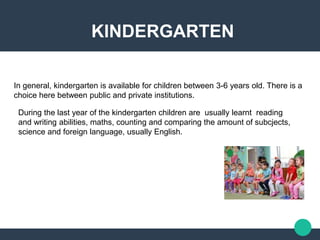
EDUCATIONAL SYSTEM IN POLAND
2018 -2020
ON BEHALF OF PROJECT „My culture, your
Culture, our culture”
COMPULSORY EDUCATION IN POLAND
LASTS FOR 12 YEARS; FROM 6 TO 18
The Polish education system is based on
three-tired principle: primary, secondary
and higher education
The Polish education system has faced
significant changes, Since 2016, including a
change in school entry age and in the
organisation of schools.
Compulsory general education will be shorter,
and tracking to general or vocational education
secondary schools will take place earlier. These
changes could have an impact on the inequality
of outcomes, costs and the situation of teachers.
STRUCTURE OF EDUCATIONAL SYSTEM
Kindergarten Children 3 to 7 Compulsary
At the age of 6
Public/not
public sector
Lasts 4
grades
Primary school Children 7 to
15
Compulsary Public/not
public sector
Lasts 8
grades
Secondary
school
Children 15 to
18 or 19 or 20
Compulsary
to the age of
18
Public/not
public sector
Lasts 3 or 4
or 5 grades
KINDERGARTEN
In general, kindergarten is available for children between 3-6 years old. There is a
choice here between public and private institutions.
During the last year of the kindergarten children are usually learnt reading
and writing abilities, maths, counting and comparing the amount of subcjects,
science and foreign language, usually English.
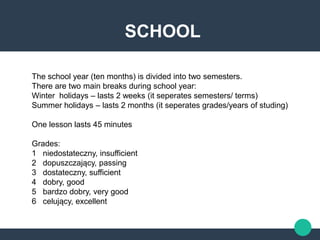
SCHOOL
The school year (ten months) is divided into two semesters.
There are two main breaks during school year:
Winter holidays – lasts 2 weeks (it seperates semesters/ terms)
Summer holidays – lasts 2 months (it seperates grades/years of studing)
One lesson lasts 45 minutes
Grades:
1 niedostateczny, insufficient
2 dopuszczający, passing
3 dostateczny, sufficient
4 dobry, good
5 bardzo dobry, very good
6 celujący, excellent
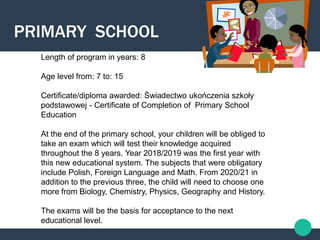
PRIMARY SCHOOL
Length of program in years: 8
Age level from: 7 to: 15
Certificate/diploma awarded: Świadectwo ukończenia szkoły
podstawowej - Certificate of Completion of Primary School
Education
At the end of the primary school, your children will be obliged to
take an exam which will test their knowledge acquired
throughout the 8 years. Year 2018/2019 was the first year with
this new educational system. The subjects that were obligatory
include Polish, Foreign Language and Math. From 2020/21 in
addition to the previous three, the child will need to choose one
more from Biology, Chemistry, Physics, Geography and History.
The exams will be the basis for acceptance to the next
educational level.
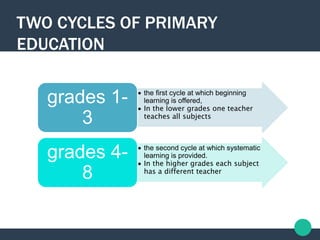
 the first cycle at which beginning
learning is offered,
 In the lower grades one teacher
teaches all subjects
grades 1-
3
 the second cycle at which systematic
learning is provided.
 In the higher grades each subject
has a different teacher
grades 4-
8
TWO CYCLES OF PRIMARY
EDUCATION
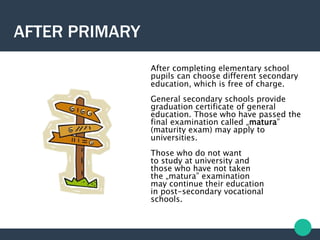
AFTER PRIMARY
After completing elementary school
pupils can choose different secondary
education, which is free of charge.
General secondary schools provide
graduation certificate of general
education. Those who have passed the
final examination called „matura”
(maturity exam) may apply to
universities.
Those who do not want
to study at university and
those who have not taken
the „matura” examination
may continue their education
in post-secondary vocational
schools.
BASIC VOCATIONAL SCHOOL
Length of program in years: 3
Age level from: 16 to: 18
Certificate/diploma awarded:
Świadectwo ukończenia szkoły
zasadniczej (Certificate of
Completion of Education in the Basic
Vocational School)
Lower Secondary
TECHNICAL SECONDARY SCHOOL
Length of program in years: 5
Age level from: 15 to: 20
Certificate/diploma awarded:
Świadectwo dojrzalości
technikum (Maturity
Certificate of the Technical
Secondary School) or
świadectwo ukończenia
technikum (Certificate of
Completion of Education in
the Technical Secondary
School)
GENERAL LYCEUM
Length of program in years: 4
Age level from: 15 to: 19
Certificate/diploma awarded: Świadectwo
dojrzalości liceum ogólnokształcącego
(Maturity Cetificate of the General Lyceum) or
świadectwo ukończenia liceum
ogólnokształcącego (Certificate of Completion
of Education in the General Lyceum)
SPECIALIZED LYCEUM
Length of program in years: 4
Age level from: 14 to: 19
Certificate/diploma awarded: Świadectwo
dojrzałości liceum profilowanego (Maturity
Certificate of the Specialized Lyceum) or
świadectwo ukończenia liceum profilowanego
(Certificate of Completion of Education in the
Specialized Lyceum
Post-secondary schools (szkoly policealne) predominantly
cater for students progressing from general upper
secondary schools, and programmes are typically 2 or 2.5
years in duration.
Students can choose post-secondary education. They are
trained as nurses, accountants, administrative personnel
for enterprises and hotels, computer specialists, librarians.
POST-SECONDARY SCHOOLS
After secondary school students can take
higher education.
There are various types of higher
education institutions in Poland:
universities,
polytechnics,
economic academies,
agricultural academies,
others.
Day studies in state higher PUBLIC
schools are free of charge.
HIGHER EDUCATION
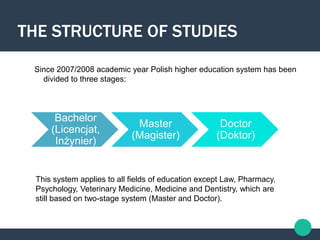
THE STRUCTURE OF STUDIES
Since 2007/2008 academic year Polish higher education system has been
divided to three stages:
This system applies to all fields of education except Law, Pharmacy,
Psychology, Veterinary Medicine, Medicine and Dentistry, which are
still based on two-stage system (Master and Doctor).
Bachelor
(Licencjat,
Inżynier)
Master
(Magister)
Doctor
(Doktor)
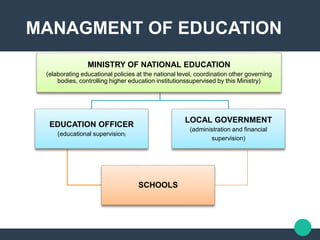
MINISTRY OF NATIONAL EDUCATION
(elaborating educational policies at the national level, coordination other governing
bodies, controlling higher education institutionssupervised by this Ministry)
EDUCATION OFFICER
(educational supervision)
SCHOOLS
LOCAL GOVERNMENT
(administration and financial
supervision)
MANAGMENT OF EDUCATION
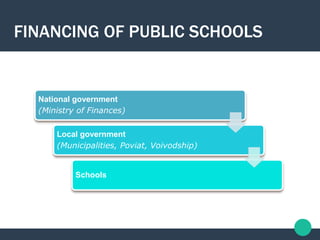
FINANCING OF PUBLIC SCHOOLS
National government
(Ministry of Finances)
Local government
(Municipalities, Poviat, Voivodship)
Schools
THIS PROJECT HAS BEEN FUNDED WITH SUPPORT FROM THE EUROPEAN
COMMISSION.
THIS PUBLICATION [COMMUNICATION] REFLECTS THE VIEWS ONLY OF THE
AUTHOR, AND THE COMMISSION CANNOT BE HELD RESPONSIBLE FOR
ANY USE WHICH MAY BE MADE OF THE INFORMATION CONTAINED THERE
IN.
THANK YOU FOR WATCHING

Educational system poland

  • 1.
    EDUCATIONAL SYSTEM INPOLAND 2018 -2020 ON BEHALF OF PROJECT „My culture, your Culture, our culture”
  • 2.
    COMPULSORY EDUCATION INPOLAND LASTS FOR 12 YEARS; FROM 6 TO 18 The Polish education system is based on three-tired principle: primary, secondary and higher education
  • 3.
    The Polish educationsystem has faced significant changes, Since 2016, including a change in school entry age and in the organisation of schools. Compulsory general education will be shorter, and tracking to general or vocational education secondary schools will take place earlier. These changes could have an impact on the inequality of outcomes, costs and the situation of teachers.
  • 4.
    STRUCTURE OF EDUCATIONALSYSTEM Kindergarten Children 3 to 7 Compulsary At the age of 6 Public/not public sector Lasts 4 grades Primary school Children 7 to 15 Compulsary Public/not public sector Lasts 8 grades Secondary school Children 15 to 18 or 19 or 20 Compulsary to the age of 18 Public/not public sector Lasts 3 or 4 or 5 grades
  • 5.
    KINDERGARTEN In general, kindergartenis available for children between 3-6 years old. There is a choice here between public and private institutions. During the last year of the kindergarten children are usually learnt reading and writing abilities, maths, counting and comparing the amount of subcjects, science and foreign language, usually English.
  • 6.
    SCHOOL The school year(ten months) is divided into two semesters. There are two main breaks during school year: Winter holidays – lasts 2 weeks (it seperates semesters/ terms) Summer holidays – lasts 2 months (it seperates grades/years of studing) One lesson lasts 45 minutes Grades: 1 niedostateczny, insufficient 2 dopuszczający, passing 3 dostateczny, sufficient 4 dobry, good 5 bardzo dobry, very good 6 celujący, excellent
  • 7.
    PRIMARY SCHOOL Length ofprogram in years: 8 Age level from: 7 to: 15 Certificate/diploma awarded: Świadectwo ukończenia szkoły podstawowej - Certificate of Completion of Primary School Education At the end of the primary school, your children will be obliged to take an exam which will test their knowledge acquired throughout the 8 years. Year 2018/2019 was the first year with this new educational system. The subjects that were obligatory include Polish, Foreign Language and Math. From 2020/21 in addition to the previous three, the child will need to choose one more from Biology, Chemistry, Physics, Geography and History. The exams will be the basis for acceptance to the next educational level.
  • 8.
     the firstcycle at which beginning learning is offered,  In the lower grades one teacher teaches all subjects grades 1- 3  the second cycle at which systematic learning is provided.  In the higher grades each subject has a different teacher grades 4- 8 TWO CYCLES OF PRIMARY EDUCATION
  • 9.
    AFTER PRIMARY After completingelementary school pupils can choose different secondary education, which is free of charge. General secondary schools provide graduation certificate of general education. Those who have passed the final examination called „matura” (maturity exam) may apply to universities. Those who do not want to study at university and those who have not taken the „matura” examination may continue their education in post-secondary vocational schools.
  • 10.
    BASIC VOCATIONAL SCHOOL Lengthof program in years: 3 Age level from: 16 to: 18 Certificate/diploma awarded: Świadectwo ukończenia szkoły zasadniczej (Certificate of Completion of Education in the Basic Vocational School) Lower Secondary
  • 11.
    TECHNICAL SECONDARY SCHOOL Lengthof program in years: 5 Age level from: 15 to: 20 Certificate/diploma awarded: Świadectwo dojrzalości technikum (Maturity Certificate of the Technical Secondary School) or świadectwo ukończenia technikum (Certificate of Completion of Education in the Technical Secondary School)
  • 12.
    GENERAL LYCEUM Length ofprogram in years: 4 Age level from: 15 to: 19 Certificate/diploma awarded: Świadectwo dojrzalości liceum ogólnokształcącego (Maturity Cetificate of the General Lyceum) or świadectwo ukończenia liceum ogólnokształcącego (Certificate of Completion of Education in the General Lyceum)
  • 13.
    SPECIALIZED LYCEUM Length ofprogram in years: 4 Age level from: 14 to: 19 Certificate/diploma awarded: Świadectwo dojrzałości liceum profilowanego (Maturity Certificate of the Specialized Lyceum) or świadectwo ukończenia liceum profilowanego (Certificate of Completion of Education in the Specialized Lyceum
  • 14.
    Post-secondary schools (szkolypolicealne) predominantly cater for students progressing from general upper secondary schools, and programmes are typically 2 or 2.5 years in duration. Students can choose post-secondary education. They are trained as nurses, accountants, administrative personnel for enterprises and hotels, computer specialists, librarians. POST-SECONDARY SCHOOLS
  • 15.
    After secondary schoolstudents can take higher education. There are various types of higher education institutions in Poland: universities, polytechnics, economic academies, agricultural academies, others. Day studies in state higher PUBLIC schools are free of charge. HIGHER EDUCATION
  • 16.
    THE STRUCTURE OFSTUDIES Since 2007/2008 academic year Polish higher education system has been divided to three stages: This system applies to all fields of education except Law, Pharmacy, Psychology, Veterinary Medicine, Medicine and Dentistry, which are still based on two-stage system (Master and Doctor). Bachelor (Licencjat, Inżynier) Master (Magister) Doctor (Doktor)
  • 17.
    MINISTRY OF NATIONALEDUCATION (elaborating educational policies at the national level, coordination other governing bodies, controlling higher education institutionssupervised by this Ministry) EDUCATION OFFICER (educational supervision) SCHOOLS LOCAL GOVERNMENT (administration and financial supervision) MANAGMENT OF EDUCATION
  • 18.
    FINANCING OF PUBLICSCHOOLS National government (Ministry of Finances) Local government (Municipalities, Poviat, Voivodship) Schools
  • 19.
    THIS PROJECT HASBEEN FUNDED WITH SUPPORT FROM THE EUROPEAN COMMISSION. THIS PUBLICATION [COMMUNICATION] REFLECTS THE VIEWS ONLY OF THE AUTHOR, AND THE COMMISSION CANNOT BE HELD RESPONSIBLE FOR ANY USE WHICH MAY BE MADE OF THE INFORMATION CONTAINED THERE IN.
  • 20.
    THANK YOU FORWATCHING