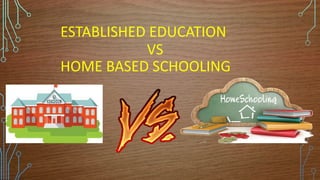
ESTABLISHED EDUCATION
VS
HOME BASED SCHOOLING
EDUCATION
• Education is the process of bringing desirable changes into
the behavior of human beings.
• It can also be defined as the “Process of imparting or
acquiring knowledge or habits through instruction or study
• Types
• Formal
• Non formal
• Informal
FORMAL EDUCATION
• Institutional activity.
• Chronologically graded hierarchically structured.
• Uniform.
• Subject oriented.
• Full time.
• Leads to certificates, diplomas, degrees
IN FORMAL
• Life long process.
• Individual learns from daily experiences.
• Individual learns from exposure to the environment at home,
at work, at play etc.
NON FORMAL EDUCATION IS:
• Flexible.
• Life environment and learner oriented.
• Diversified in content and method.
• Non-authoritarian
• Built on learner participation.
• It mobilizes local resources.
• It enriches human and environmental a potential.
HOMESCHOOLING
• Homeschooling, also known as home education is
the education of children at home
• For most of history and in different cultures, the education of
children at home by family members was a common practice
• Home education is usually conducted by a parent or tutor or
online teacher.
• Before the introduction of compulsory school attendance law,
most childhood education was done by families and local
communities
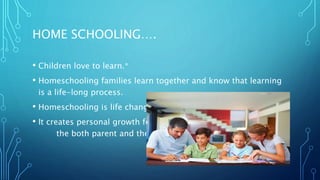
HOME SCHOOLING….
• Children love to learn.*
• Homeschooling families learn together and know that learning
is a life-long process.
• Homeschooling is life changing.
• It creates personal growth for
the both parent and the child
HOME SCHOOLING…
• For most of history and in different cultures, the education of
children at home by family members was a common practice.
• You see, whether it is the Quranic story of Prophet Musa ‫السالم‬ ‫عليه‬
learning from Khidr,
• Prophet Ibrahim building the ka’bah with his young son Ismail ‫عليهم‬
‫السالم‬,
• the incidents narrated in the Prophet’s ‫ﷺ‬see rah regarding his
attitude, behavior and lifestyle ethics towards children ranging in age
from infancy to age 10
• (e.g. the fact that the 10-year-old Anas bin Malik was left in his
MOTIVATIONS:
• Parents commonly cite following main motivations
for homeschooling their children: Some parents
homeschool in order to have greater control over
what and how their children are taught,
• to an individual child's aptitudes and abilities,
• to provide instruction from a
specific religious or moral position,
• to take advantage of the efficiency of one-to-one
instruction
• allow the child to spend more time on childhood
activities, socializing, and non-academic learning.
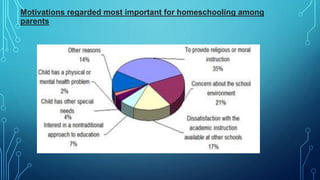
Motivations regarded most important for homeschooling among
parents
TEACHING METHODS
• Homeschools use a wide variety of methods and materials.
• Families choose different educational methods, which
represent a variety of educational philosophies.
• A Student's education may be customized to support his or her
learning level, style, and interests.
• It is not uncommon for a student to experience more than one
approach as the family discovers what works best for their
student.
• Some of the methods or learning environments used
include Classical education (including Trivium and Quadrivium)
INFORMAL LEARNING
• As a subset of homeschooling, informal learning happens outside of
the classroom, but has no traditional boundaries of education.
• Informal learning is an everyday form of learning through
participation and creation, in contrast with the traditional view of
teacher-centered learning.
• The term is often combined with non-formal learning, and self-
directed learning.
• Informal learning differs from traditional learning since there are no
expected objectives or outcomes.
• From the learner’s standpoint, the knowledge that they receive is not
intentional
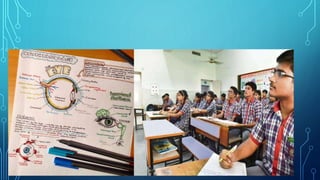
• ESTABLISHED EDUCATION
• Delivery of lecture using chalk and blackboard.
• Researches based upon published materials. E.g.
• Newspaper article, research paper, books, etc.
• Formation of group for combine studies.
• Education focused more on theory, less practical.
• Needed extensive time to do researches.
• Growing trend of education for better future.
• Computers and internet as new invention.
ESTABLISHED EDUCATION
• Delivery of lectures on PowerPoints; less use of whiteboards.
• Internet used for sharing lectures and materials.
• Less time on research. E.G. Wikipedia as a digital library
• Effective use of new innovation(laptops for PowerPoint, sound
• System for audio delivery, etc.)
• Social medias like msn, Facebook, Myspace used for forming
• Educational groups.
• Availability of online course ultimately reducing time.
• Colleges are famous for providing practical education
FUTURE OF EDUCATION
• Distance education trends
• Education and uses of social media
• Post Secondary
• Globalization
• Positives, Negatives
• Classroom in Future
FUTURE OF EDUCATION
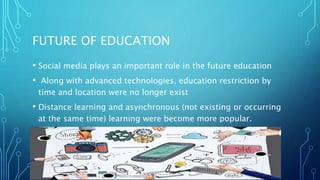
• Social media plays an important role in the future education
• Along with advanced technologies, education restriction by
time and location were no longer exist
• Distance learning and asynchronous (not existing or occurring
at the same time) learning were become more popular.
DISTANCE EDUCATION
• More courses, degrees, and universities are available for
distance-education
• ◦ The distinction between distance and local education is
disappearing
• The percentage of adult, female, and minority learners is
increasing
DISTANCE EDUCATION
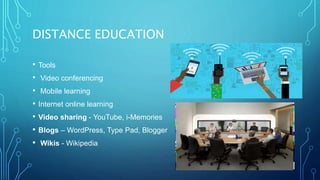
• Tools
• Video conferencing
• Mobile learning
• Internet online learning
• Video sharing - YouTube, i-Memories
• Blogs – WordPress, Type Pad, Blogger
• Wikis - Wikipedia
POST SECONDARY
• A reference to any education beyond high school. An example
of postsecondary is a college education.
• In 2006, changes for post secondary sector were called
• This revealed challenges for Post secondary were beyond financial resources
• Key Findings
• There is a lack of mechanisms
• High tuition costs
• Access to benefits are not distributed equally to Canadians
• Data tracking process are incomplete
POST SECONDARY
• Goals
• Life learning
• Affordable post secondary education
• Healthy citizenry
FUTURE OF CURRICULUM
THE SUBJECTS COMPRISING A COURSE OF STUDY IN A SCHOOL
OR COLLEGE.
• Virtual classes will allow students to access classes
• Students will be a community of smaller numbers . this will
• Support more adult and student connection
• Students will be engaged in learning groups
• Learning that matches their group will be with help of
• Technology
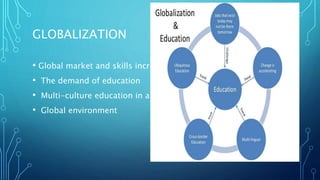
GLOBALIZATION
• Global market and skills increase
• The demand of education
• Multi-culture education in a
• Global environment
FUTURE EDUCATION TRENDS
• There will be increase in online courses.
• Teachers will deliver soft skills rather than academic/technical
expertise.
• All future courses might have internship.
• Computer courses might be a compulsory course in highschool.
• Courses might be 80 % practical and 20% theory .
• Social medias like YouTube, blogging, Facebook, etc. might
bealternate way for delivering lectures.
• Both teachers and students would work on new technologies
TECHNOLOGIES ON EDUCATION
• Smart phone applications according to the subject that will be taught
• Windows 7, Microsoft Words and new innovations to save time
• Hi-tech sound system, LCDs screen in a big lecture room to give
comfort in education
• Reference to Cyberspace as researches
• Blogging and social media used as showing knowledge
• Web seminars in order to strengthen communication
• Touch screen innovation to feel comfortable towards
gettingeducation
POSITIVES
• Saves time.
• Students would get enough subjective materials.
• Students will have quick adaptability on any working situation.
• Education will be focused upon practical world.
• Digital library will be interestingly filled up with videos, research
papers, etc. than traditional library
• There will be choice over extensive educational courses and fields
• Quality manpower would be produced in a long run.
NEGATIVES
• Student might get lower grades as online materials can be
• edited by anyone. E.g. Wikipedia’s content.
• Parents might not like their children sitting on their laptops or PC everyday
• Facebook, Myspace, etc. might distract student from subject materials.
• Student might lack discipline because parents when busy rely on
• school to make their children disciplined.
• Student’s will loose interest on reading real books, newspaper.
CHALLENGES
• Keeping in touch with each students will be stressful to teacher
• Guiding parents on behalf of their children’s online performance is
hard
• Moving forward to latest technology will be expensive.
• Learner’s might not get enough materials from teacher.
• Teacher might not know what their student’s like.
• It might be hard for an international student from Third World
Countries in North America to adapt into modern computing
learning.
FUTURE OF CLASSROOMS
• Colleges/universities will provide options for classroom
• online course depending on the course.
• Classroom would be equipped with computers,
• comfortable chairs and table as in Sheridan.
• Classroom will focus on new innovations, hands-on
experiments
• so students will gain experience for future
FUTURE OF CLASSROOMS
• Jobs.
• Online courses might be fully online or might be
• combination of class and online.
• If a class is missed by a student, materials will be
• Posted on institutional website.

Education

  • 2.
  • 3.
    EDUCATION • Education isthe process of bringing desirable changes into the behavior of human beings. • It can also be defined as the “Process of imparting or acquiring knowledge or habits through instruction or study • Types • Formal • Non formal • Informal
  • 4.
    FORMAL EDUCATION • Institutionalactivity. • Chronologically graded hierarchically structured. • Uniform. • Subject oriented. • Full time. • Leads to certificates, diplomas, degrees
  • 5.
    IN FORMAL • Lifelong process. • Individual learns from daily experiences. • Individual learns from exposure to the environment at home, at work, at play etc.
  • 6.
    NON FORMAL EDUCATIONIS: • Flexible. • Life environment and learner oriented. • Diversified in content and method. • Non-authoritarian • Built on learner participation. • It mobilizes local resources. • It enriches human and environmental a potential.
  • 7.
    HOMESCHOOLING • Homeschooling, alsoknown as home education is the education of children at home • For most of history and in different cultures, the education of children at home by family members was a common practice • Home education is usually conducted by a parent or tutor or online teacher. • Before the introduction of compulsory school attendance law, most childhood education was done by families and local communities
  • 8.
    HOME SCHOOLING…. • Childrenlove to learn.* • Homeschooling families learn together and know that learning is a life-long process. • Homeschooling is life changing. • It creates personal growth for the both parent and the child
  • 9.
    HOME SCHOOLING… • Formost of history and in different cultures, the education of children at home by family members was a common practice. • You see, whether it is the Quranic story of Prophet Musa ‫السالم‬ ‫عليه‬ learning from Khidr, • Prophet Ibrahim building the ka’bah with his young son Ismail ‫عليهم‬ ‫السالم‬, • the incidents narrated in the Prophet’s ‫ﷺ‬see rah regarding his attitude, behavior and lifestyle ethics towards children ranging in age from infancy to age 10 • (e.g. the fact that the 10-year-old Anas bin Malik was left in his
  • 10.
    MOTIVATIONS: • Parents commonlycite following main motivations for homeschooling their children: Some parents homeschool in order to have greater control over what and how their children are taught, • to an individual child's aptitudes and abilities, • to provide instruction from a specific religious or moral position, • to take advantage of the efficiency of one-to-one instruction • allow the child to spend more time on childhood activities, socializing, and non-academic learning.
  • 11.
    Motivations regarded mostimportant for homeschooling among parents
  • 12.
    TEACHING METHODS • Homeschoolsuse a wide variety of methods and materials. • Families choose different educational methods, which represent a variety of educational philosophies. • A Student's education may be customized to support his or her learning level, style, and interests. • It is not uncommon for a student to experience more than one approach as the family discovers what works best for their student. • Some of the methods or learning environments used include Classical education (including Trivium and Quadrivium)
  • 13.
    INFORMAL LEARNING • Asa subset of homeschooling, informal learning happens outside of the classroom, but has no traditional boundaries of education. • Informal learning is an everyday form of learning through participation and creation, in contrast with the traditional view of teacher-centered learning. • The term is often combined with non-formal learning, and self- directed learning. • Informal learning differs from traditional learning since there are no expected objectives or outcomes. • From the learner’s standpoint, the knowledge that they receive is not intentional
  • 14.
    • ESTABLISHED EDUCATION •Delivery of lecture using chalk and blackboard. • Researches based upon published materials. E.g. • Newspaper article, research paper, books, etc. • Formation of group for combine studies. • Education focused more on theory, less practical. • Needed extensive time to do researches. • Growing trend of education for better future. • Computers and internet as new invention.
  • 16.
    ESTABLISHED EDUCATION • Deliveryof lectures on PowerPoints; less use of whiteboards. • Internet used for sharing lectures and materials. • Less time on research. E.G. Wikipedia as a digital library • Effective use of new innovation(laptops for PowerPoint, sound • System for audio delivery, etc.) • Social medias like msn, Facebook, Myspace used for forming • Educational groups. • Availability of online course ultimately reducing time. • Colleges are famous for providing practical education
  • 17.
    FUTURE OF EDUCATION •Distance education trends • Education and uses of social media • Post Secondary • Globalization • Positives, Negatives • Classroom in Future
  • 18.
    FUTURE OF EDUCATION •Social media plays an important role in the future education • Along with advanced technologies, education restriction by time and location were no longer exist • Distance learning and asynchronous (not existing or occurring at the same time) learning were become more popular.
  • 19.
    DISTANCE EDUCATION • Morecourses, degrees, and universities are available for distance-education • ◦ The distinction between distance and local education is disappearing • The percentage of adult, female, and minority learners is increasing
  • 20.
    DISTANCE EDUCATION • Tools •Video conferencing • Mobile learning • Internet online learning • Video sharing - YouTube, i-Memories • Blogs – WordPress, Type Pad, Blogger • Wikis - Wikipedia
  • 21.
    POST SECONDARY • Areference to any education beyond high school. An example of postsecondary is a college education. • In 2006, changes for post secondary sector were called • This revealed challenges for Post secondary were beyond financial resources • Key Findings • There is a lack of mechanisms • High tuition costs • Access to benefits are not distributed equally to Canadians • Data tracking process are incomplete
  • 22.
    POST SECONDARY • Goals •Life learning • Affordable post secondary education • Healthy citizenry
  • 23.
    FUTURE OF CURRICULUM THESUBJECTS COMPRISING A COURSE OF STUDY IN A SCHOOL OR COLLEGE. • Virtual classes will allow students to access classes • Students will be a community of smaller numbers . this will • Support more adult and student connection • Students will be engaged in learning groups • Learning that matches their group will be with help of • Technology
  • 24.
    GLOBALIZATION • Global marketand skills increase • The demand of education • Multi-culture education in a • Global environment
  • 25.
    FUTURE EDUCATION TRENDS •There will be increase in online courses. • Teachers will deliver soft skills rather than academic/technical expertise. • All future courses might have internship. • Computer courses might be a compulsory course in highschool. • Courses might be 80 % practical and 20% theory . • Social medias like YouTube, blogging, Facebook, etc. might bealternate way for delivering lectures. • Both teachers and students would work on new technologies
  • 26.
    TECHNOLOGIES ON EDUCATION •Smart phone applications according to the subject that will be taught • Windows 7, Microsoft Words and new innovations to save time • Hi-tech sound system, LCDs screen in a big lecture room to give comfort in education • Reference to Cyberspace as researches • Blogging and social media used as showing knowledge • Web seminars in order to strengthen communication • Touch screen innovation to feel comfortable towards gettingeducation
  • 27.
    POSITIVES • Saves time. •Students would get enough subjective materials. • Students will have quick adaptability on any working situation. • Education will be focused upon practical world. • Digital library will be interestingly filled up with videos, research papers, etc. than traditional library • There will be choice over extensive educational courses and fields • Quality manpower would be produced in a long run.
  • 28.
    NEGATIVES • Student mightget lower grades as online materials can be • edited by anyone. E.g. Wikipedia’s content. • Parents might not like their children sitting on their laptops or PC everyday • Facebook, Myspace, etc. might distract student from subject materials. • Student might lack discipline because parents when busy rely on • school to make their children disciplined. • Student’s will loose interest on reading real books, newspaper.
  • 29.
    CHALLENGES • Keeping intouch with each students will be stressful to teacher • Guiding parents on behalf of their children’s online performance is hard • Moving forward to latest technology will be expensive. • Learner’s might not get enough materials from teacher. • Teacher might not know what their student’s like. • It might be hard for an international student from Third World Countries in North America to adapt into modern computing learning.
  • 30.
    FUTURE OF CLASSROOMS •Colleges/universities will provide options for classroom • online course depending on the course. • Classroom would be equipped with computers, • comfortable chairs and table as in Sheridan. • Classroom will focus on new innovations, hands-on experiments • so students will gain experience for future
  • 31.
    FUTURE OF CLASSROOMS •Jobs. • Online courses might be fully online or might be • combination of class and online. • If a class is missed by a student, materials will be • Posted on institutional website.