QSAR Inquiries, LLC
Immediate assessment method, The student centered classroom,
eLearning mechanisms- Dr. Robert D.Craig, Ph.D


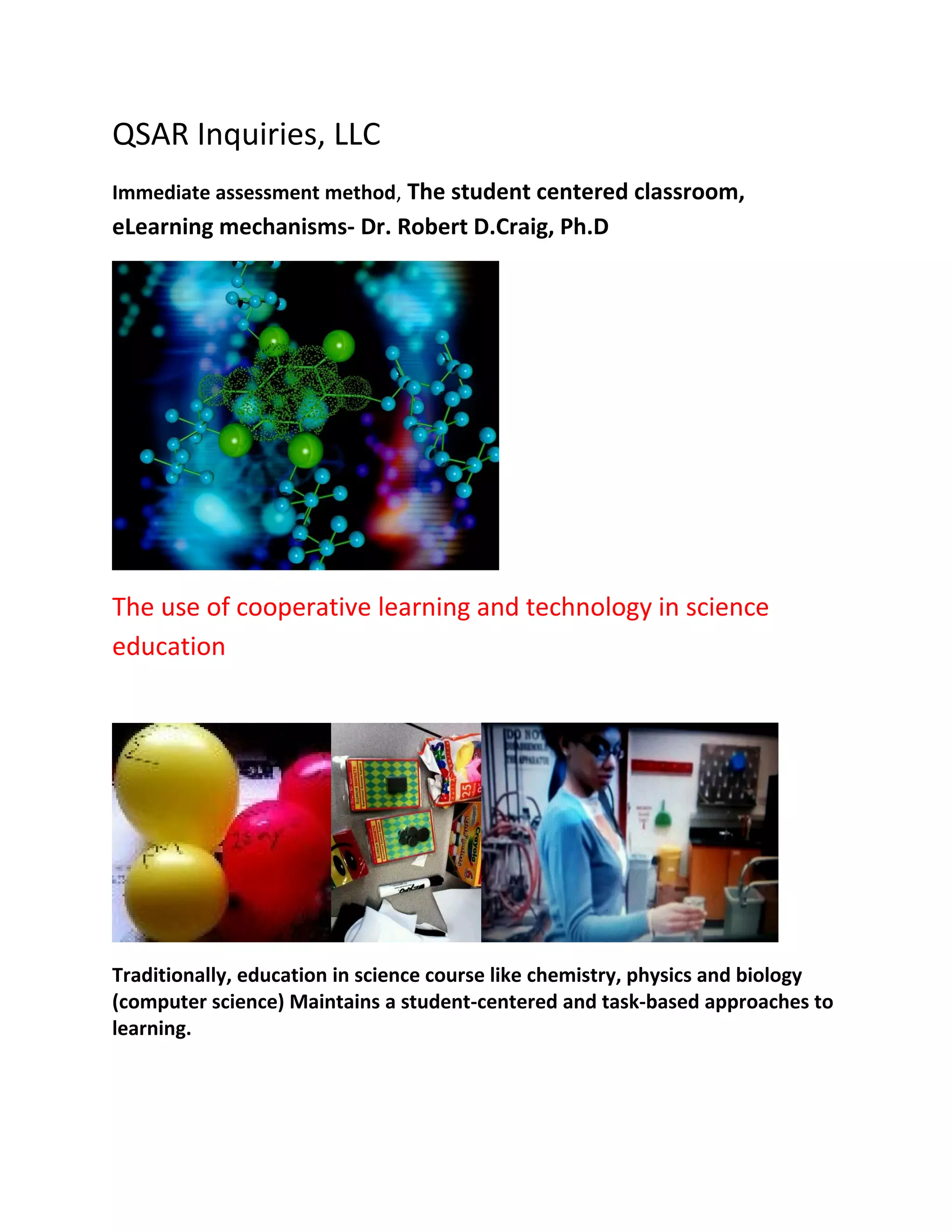
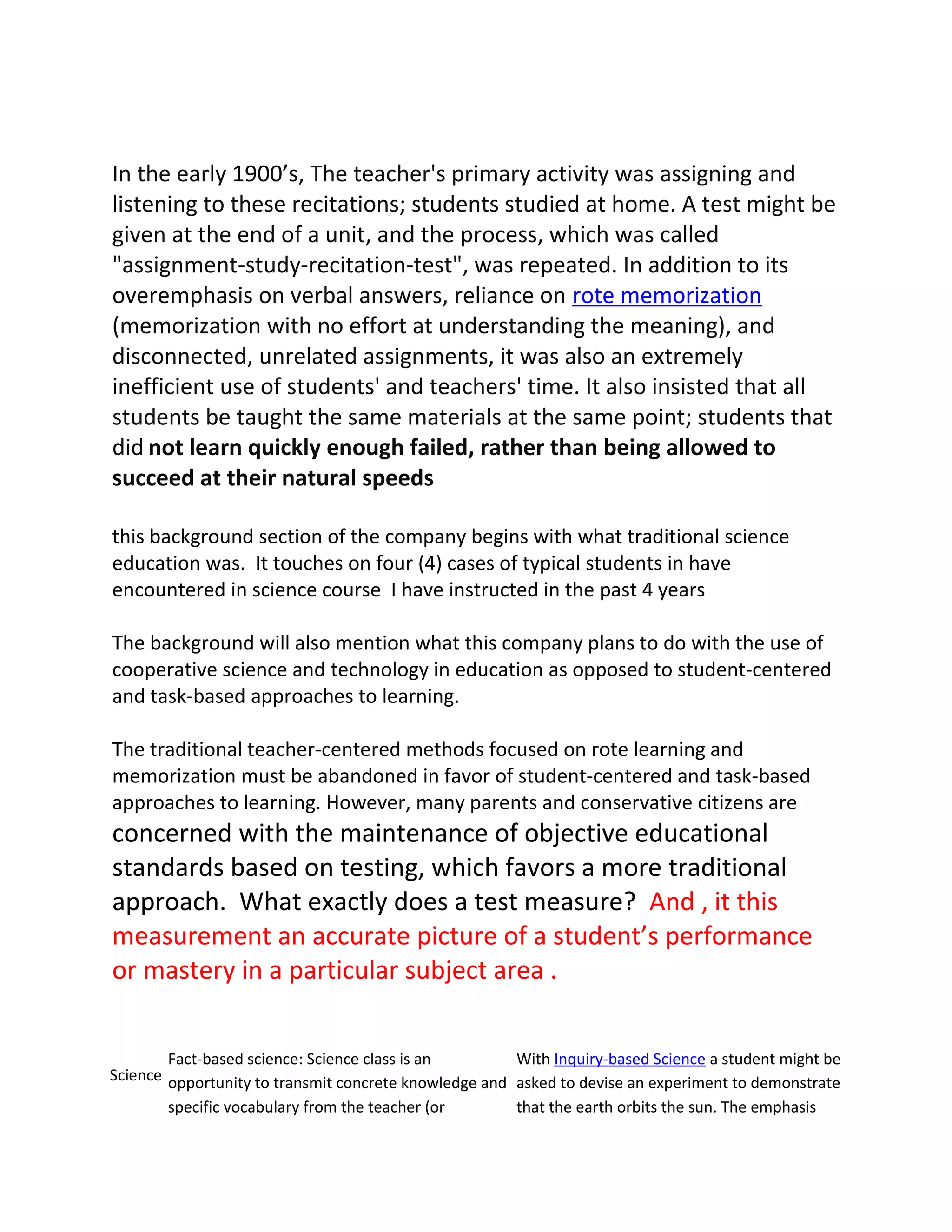
The use of cooperative learning and technology in science
education


Traditionally, education in science course like chemistry, physics and biology
(computer science) Maintains a student-centered and task-based approaches to
learning.
In the early 1900’s, The teacher's primary activity was assigning and
listening to these recitations; students studied at home. A test might be
given at the end of a unit, and the process, which was called
"assignment-study-recitation-test", was repeated. In addition to its
overemphasis on verbal answers, reliance on rote memorization
(memorization with no effort at understanding the meaning), and
disconnected, unrelated assignments, it was also an extremely
inefficient use of students' and teachers' time. It also insisted that all
students be taught the same materials at the same point; students that
did not learn quickly enough failed, rather than being allowed to
succeed at their natural speeds

this background section of the company begins with what traditional science
education was. It touches on four (4) cases of typical students in have
encountered in science course I have instructed in the past 4 years

The background will also mention what this company plans to do with the use of
cooperative science and technology in education as opposed to student-centered
and task-based approaches to learning.

The traditional teacher-centered methods focused on rote learning and
memorization must be abandoned in favor of student-centered and task-based
approaches to learning. However, many parents and conservative citizens are
concerned with the maintenance of objective educational
standards based on testing, which favors a more traditional
approach. What exactly does a test measure? And , it this
measurement an accurate picture of a student’s performance
or mastery in a particular subject area .


        Fact-based science: Science class is an        With Inquiry-based Science a student might be
Science opportunity to transmit concrete knowledge and asked to devise an experiment to demonstrate
        specific vocabulary from the teacher (or       that the earth orbits the sun. The emphasis
textbook) to the students. Students focus on          changes from memorizing information that
         memorizing what they are told. "Experiments"          was learned through a scientific method to
         follow cookbook-style procedures to produce the       actually using the scientific method of
         expected results.                                     discovery.


Traditional education, also known as back-to-basics, conventional education or customary education,
refers to long-established customs found in schools that society has traditionally deemed appropriate.

   Topic              Traditional approach                              Alternate approaches

             Teacher-centred instruction:
                                                       Student-centred instruction:
Person           •   Educational essentialism
                                                           •     Educational progressivism
              • Educational perennialism
          Students matched by age, and possibly        Students dynamically grouped by interest or ability
          also by ability. All students in a           for each project or subject, with the possibility of
Classroom
          classroom are taught the same                different groups each hour of the day. Multi-age
          material.                                    classrooms or open classrooms.[3]

             Traditional education emphasizes:
                                                       Progressive education emphasizes:
Teaching         •   Direct instruction and lectures
                                                           •     Hands-on activities
methods          •   Seatwork
                                                           •     Student-led discovery
                 •    Students learn through
                                                           •     Group activities
                      listening and observation[4]
             Instruction based on textbooks,           Project-based instruction using any available
Materials    lectures, and individual written          resource including Internet, library and outside
             assignments                               experts
In a study of “shared knowledge and team performance” these questions were
addressed:

  1. How effectively did they communicate?

  2. How effectively did they resolve conflicts?

  3. How effectively did they solve problems

What is knowledge of procedure?

It is procedural knowledge, or knowledge how to do something. The
claims to know how to juggle and how to drive are claims to have
procedural knowledge
To access knowledge of procedure, individuals where asked to write
down any procedures that they used to complete the task


Of course, It is possible to know all of the theory behind driving a car
(i.e. to have all of the relevant propositional knowledge) without actually
knowing how to drive a car (i.e. without having the procedural
knowledge).


What is cooperative learning?


The acronym PIES may be used to denote the key elements of positive
interdependence, individual accountability, equal participation, and
simultaneous interaction. Kagan (2003) has

Why Use Cooperative Learning?
Here are some of the most recent views into cooperative learning in
   science education

Research has shown that students who work in cooperative groups do
better on tests, especially with regard to reasoning and critical thinking
skills than those that do not (Johnson and Johnson, 1989).


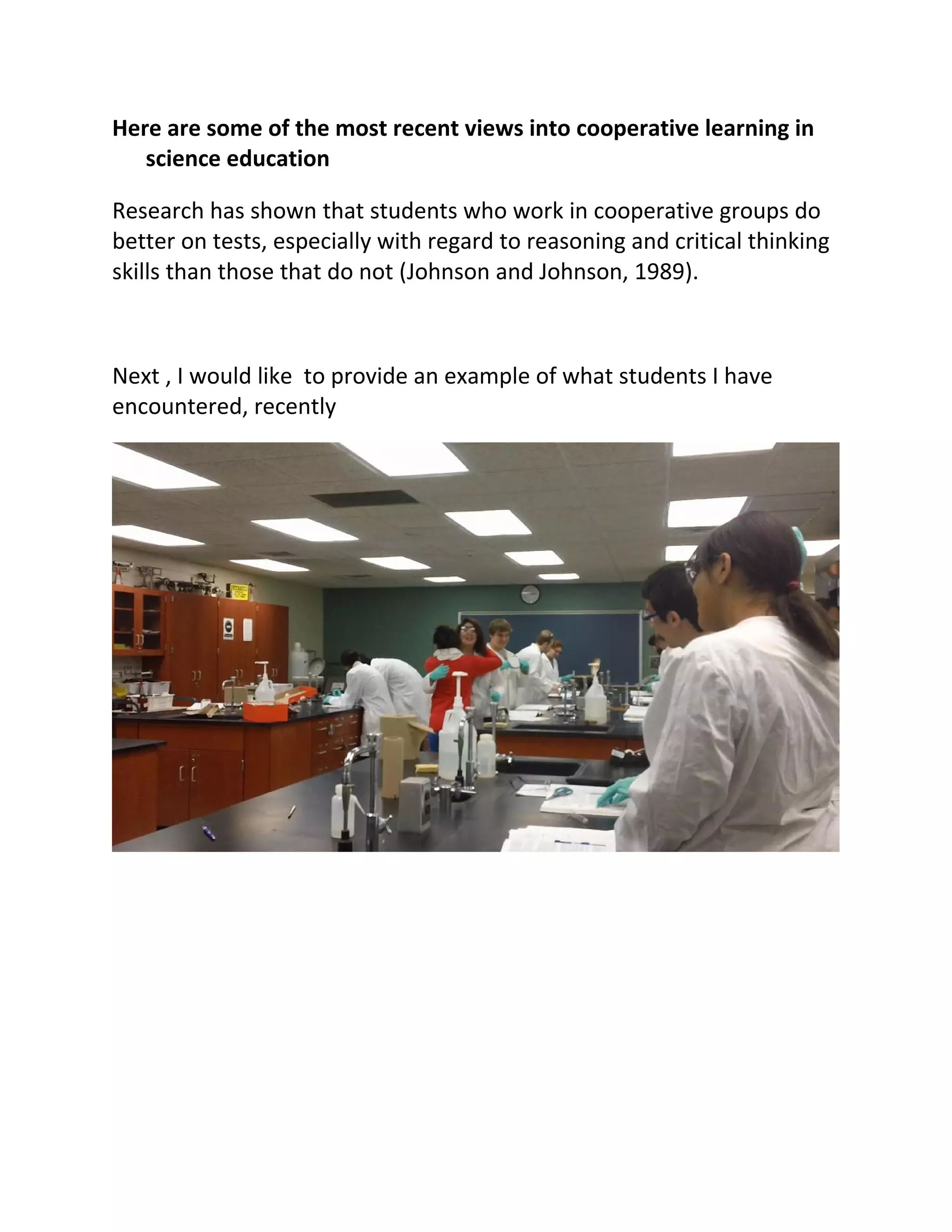
Next , I would like to provide an example of what students I have
encountered, recently
What is college population in Bronx like?

I would like to describe 4 students. They have been given letters so as
not to use names


  •   Student A

  •   Student B

  •   Student C

  •   Student D

Student a


   Student a is lively, bubbly, and a pleasure to have in your class.
  Often, she struggles with advanced chemistry classes. She comes
  from a nice family, and like most 23 year olds, works part time
  “capital one” and has many friends. When I tried to get Student b, a
  scholarship, her grades were not high enough. At a result

  • She did not belong to any science clubs. She also had inadequate
    grades to enter, or obtain any science awards.

  • She also never presented any poster presentations, or done any
    biology or chemistry research projects outside of her classwork

  • She was denied basic scholarships because of this
Student b


  • Student b is a bilingual student who is very bright. I had the
    pleasure of seeing her obtain her Asscociate degree and move on
    to a four year school. She has a high grade point index. She has
    Many friends, and she also works part-time at a pharmacy. She
    often wishes she did not have to work. She has aspirations to
    become a social worker. But has no mechanism to do so.


Student c Has disability services as do the over 30 percent of students
at Hostos community college have Needs additional time to take tests.
However,, is very popular on campus and Belongs to many clubs He
also belongs to Services for Students with Disabilities (SSWD) . This is an
office created under Section 504 of the Rehabilitation Act and New York
State and New York City statutes. The college has created an office,
Services for Students with Disabilities (SSWD), that provides services to
help each student with a disability maximize his or her potential for
success. Based on an intake interview and documentation provided by
a student, and student such as student c, may be found eligible for a
variety of accommodations may be provided to help qualified students
attain their academic objectives.
There are other services also provided to students with disabilities

(ie: autism, and job placement services)

high cases of asthma

Students with disability services: at a college like Hostos. 30% of the
population are designated for disability services. Also, historically,
much to the bronx and Harlem area is plaqued with high cases of
asthma (get grant write up)

Asthma in Bronx County is nearly a epidemic. The Bronx County has
some of the highest rates of asthma in the United States. Rates of
death from asthma in the Bronx are about three times higher than the
national average. Hospitalization rates are about five times higher. In
some neighborhoods in the Bronx it is estimated that 20% of the
children have asthma.3 Within New York City the disparity in asthma
hospitalization rates is very pronounced. According to a study,
hospitalization rates for asthma in Bronx County and East Harlem are
21 times higher than those of affluent parts of the city.

It is rather diificult to focus academically when suffering from asthmatic
symtomps
Student D is approximately 30 years old and about to obtain an
associates degree. She works full time. She also suffers from
asthma. She misses school because of this:

Students with asthma are also advised to:

  •   Carry an Asthma Attack Card with you at all times.
  •   Register with the college health centre, let them know you have
      asthma and ask who can be contacted in case of an emergency.
  •   Ensure you take your preventer routinely and carry your reliever
      inhaler at all times.
  •   If living on campus, ensure your roommates are aware of your
      condition and ensure that the accommodation is non-smoking.
  •   .


Normally, a college and it students, have populations which are
representative of the neighborhood in which it resides. What does this
have to do with programming and assessment? At the college of staten
Island, CUNY, there is vast over crowding, and not enough instructors
hired to teach at these colleges. When there is over crouding occurs:

  •

  • (1)There is a drop in the attention given by students to a
    particular classroom lecturer.

  • (2) There are also not enough classes offered –appropriate one’s
    which delay the graduation of many students
• (3)There are report “huge gaps” is many student programs due to
  the lack of appropriate classes offered.

• Students like student A and Student B, cannot fully enjoy a college
  experience. There are a great many distractions in a urban
  setting. The use of clubs, like the chemistry club, or bio club is
  beneficial. Earth day events are also great for providing a college
  environment for students who work part time
• Enhanced teaching methods:

•   1. If the instructor and students have an immediate assessment method,
    an immediate response to a given topic and its understanding may be
    addressed. College of Staten Island, and Hostos community collges are
    commuter colleges. Meaning, unlike Adelphi university and private 4 years
    schools, students do not dorm on campus


• 2. The student centered classroom as opposed to traditional
  methods. Mechanisms needed to target students who need
  additional help


• 3. eLearning mechanisms in the lecture portions and labs of
  science curriculum. A greater focus of procedure of problem
  solving, were appropriate


• 4. Classroom clickers or "student response systems" have become
  high-demand classroom tools in schools, universities, and training
  programs across the country
• 5. Working with student counselors and faculty development
  development office to assist and scaffold learning in difficult
  course areas.

QSAR inquiries, LLC

  • 1.
    QSAR Inquiries, LLC Immediateassessment method, The student centered classroom, eLearning mechanisms- Dr. Robert D.Craig, Ph.D The use of cooperative learning and technology in science education Traditionally, education in science course like chemistry, physics and biology (computer science) Maintains a student-centered and task-based approaches to learning.
  • 2.
    In the early1900’s, The teacher's primary activity was assigning and listening to these recitations; students studied at home. A test might be given at the end of a unit, and the process, which was called "assignment-study-recitation-test", was repeated. In addition to its overemphasis on verbal answers, reliance on rote memorization (memorization with no effort at understanding the meaning), and disconnected, unrelated assignments, it was also an extremely inefficient use of students' and teachers' time. It also insisted that all students be taught the same materials at the same point; students that did not learn quickly enough failed, rather than being allowed to succeed at their natural speeds this background section of the company begins with what traditional science education was. It touches on four (4) cases of typical students in have encountered in science course I have instructed in the past 4 years The background will also mention what this company plans to do with the use of cooperative science and technology in education as opposed to student-centered and task-based approaches to learning. The traditional teacher-centered methods focused on rote learning and memorization must be abandoned in favor of student-centered and task-based approaches to learning. However, many parents and conservative citizens are concerned with the maintenance of objective educational standards based on testing, which favors a more traditional approach. What exactly does a test measure? And , it this measurement an accurate picture of a student’s performance or mastery in a particular subject area . Fact-based science: Science class is an With Inquiry-based Science a student might be Science opportunity to transmit concrete knowledge and asked to devise an experiment to demonstrate specific vocabulary from the teacher (or that the earth orbits the sun. The emphasis
  • 3.
    textbook) to thestudents. Students focus on changes from memorizing information that memorizing what they are told. "Experiments" was learned through a scientific method to follow cookbook-style procedures to produce the actually using the scientific method of expected results. discovery. Traditional education, also known as back-to-basics, conventional education or customary education, refers to long-established customs found in schools that society has traditionally deemed appropriate. Topic Traditional approach Alternate approaches Teacher-centred instruction: Student-centred instruction: Person • Educational essentialism • Educational progressivism • Educational perennialism Students matched by age, and possibly Students dynamically grouped by interest or ability also by ability. All students in a for each project or subject, with the possibility of Classroom classroom are taught the same different groups each hour of the day. Multi-age material. classrooms or open classrooms.[3] Traditional education emphasizes: Progressive education emphasizes: Teaching • Direct instruction and lectures • Hands-on activities methods • Seatwork • Student-led discovery • Students learn through • Group activities listening and observation[4] Instruction based on textbooks, Project-based instruction using any available Materials lectures, and individual written resource including Internet, library and outside assignments experts
  • 4.
    In a studyof “shared knowledge and team performance” these questions were addressed: 1. How effectively did they communicate? 2. How effectively did they resolve conflicts? 3. How effectively did they solve problems What is knowledge of procedure? It is procedural knowledge, or knowledge how to do something. The claims to know how to juggle and how to drive are claims to have procedural knowledge To access knowledge of procedure, individuals where asked to write down any procedures that they used to complete the task Of course, It is possible to know all of the theory behind driving a car (i.e. to have all of the relevant propositional knowledge) without actually knowing how to drive a car (i.e. without having the procedural knowledge). What is cooperative learning? The acronym PIES may be used to denote the key elements of positive interdependence, individual accountability, equal participation, and simultaneous interaction. Kagan (2003) has Why Use Cooperative Learning?
  • 5.
    Here are someof the most recent views into cooperative learning in science education Research has shown that students who work in cooperative groups do better on tests, especially with regard to reasoning and critical thinking skills than those that do not (Johnson and Johnson, 1989). Next , I would like to provide an example of what students I have encountered, recently
  • 6.
    What is collegepopulation in Bronx like? I would like to describe 4 students. They have been given letters so as not to use names • Student A • Student B • Student C • Student D Student a Student a is lively, bubbly, and a pleasure to have in your class. Often, she struggles with advanced chemistry classes. She comes from a nice family, and like most 23 year olds, works part time “capital one” and has many friends. When I tried to get Student b, a scholarship, her grades were not high enough. At a result • She did not belong to any science clubs. She also had inadequate grades to enter, or obtain any science awards. • She also never presented any poster presentations, or done any biology or chemistry research projects outside of her classwork • She was denied basic scholarships because of this
  • 7.
    Student b • Student b is a bilingual student who is very bright. I had the pleasure of seeing her obtain her Asscociate degree and move on to a four year school. She has a high grade point index. She has Many friends, and she also works part-time at a pharmacy. She often wishes she did not have to work. She has aspirations to become a social worker. But has no mechanism to do so. Student c Has disability services as do the over 30 percent of students at Hostos community college have Needs additional time to take tests. However,, is very popular on campus and Belongs to many clubs He also belongs to Services for Students with Disabilities (SSWD) . This is an office created under Section 504 of the Rehabilitation Act and New York State and New York City statutes. The college has created an office, Services for Students with Disabilities (SSWD), that provides services to help each student with a disability maximize his or her potential for success. Based on an intake interview and documentation provided by a student, and student such as student c, may be found eligible for a variety of accommodations may be provided to help qualified students attain their academic objectives.
  • 8.
    There are otherservices also provided to students with disabilities (ie: autism, and job placement services) high cases of asthma Students with disability services: at a college like Hostos. 30% of the population are designated for disability services. Also, historically, much to the bronx and Harlem area is plaqued with high cases of asthma (get grant write up) Asthma in Bronx County is nearly a epidemic. The Bronx County has some of the highest rates of asthma in the United States. Rates of death from asthma in the Bronx are about three times higher than the national average. Hospitalization rates are about five times higher. In some neighborhoods in the Bronx it is estimated that 20% of the children have asthma.3 Within New York City the disparity in asthma hospitalization rates is very pronounced. According to a study, hospitalization rates for asthma in Bronx County and East Harlem are 21 times higher than those of affluent parts of the city. It is rather diificult to focus academically when suffering from asthmatic symtomps
  • 9.
    Student D isapproximately 30 years old and about to obtain an associates degree. She works full time. She also suffers from asthma. She misses school because of this: Students with asthma are also advised to: • Carry an Asthma Attack Card with you at all times. • Register with the college health centre, let them know you have asthma and ask who can be contacted in case of an emergency. • Ensure you take your preventer routinely and carry your reliever inhaler at all times. • If living on campus, ensure your roommates are aware of your condition and ensure that the accommodation is non-smoking. • . Normally, a college and it students, have populations which are representative of the neighborhood in which it resides. What does this have to do with programming and assessment? At the college of staten Island, CUNY, there is vast over crowding, and not enough instructors hired to teach at these colleges. When there is over crouding occurs: • • (1)There is a drop in the attention given by students to a particular classroom lecturer. • (2) There are also not enough classes offered –appropriate one’s which delay the graduation of many students
  • 10.
    • (3)There arereport “huge gaps” is many student programs due to the lack of appropriate classes offered. • Students like student A and Student B, cannot fully enjoy a college experience. There are a great many distractions in a urban setting. The use of clubs, like the chemistry club, or bio club is beneficial. Earth day events are also great for providing a college environment for students who work part time
  • 11.
    • Enhanced teachingmethods: • 1. If the instructor and students have an immediate assessment method, an immediate response to a given topic and its understanding may be addressed. College of Staten Island, and Hostos community collges are commuter colleges. Meaning, unlike Adelphi university and private 4 years schools, students do not dorm on campus • 2. The student centered classroom as opposed to traditional methods. Mechanisms needed to target students who need additional help • 3. eLearning mechanisms in the lecture portions and labs of science curriculum. A greater focus of procedure of problem solving, were appropriate • 4. Classroom clickers or "student response systems" have become high-demand classroom tools in schools, universities, and training programs across the country
  • 12.
    • 5. Workingwith student counselors and faculty development development office to assist and scaffold learning in difficult course areas.