Nathaniel Borst
John Belardo
BHS 103
Current Issues
➔ Late 1940s to the 1950s
◆ United States was ranked with the highest high school graduation rate in the
◆ world
◆ Today we are number 22 of 27 industrialized nations.
➔ The modern system has depreciated to a factory that puts whites into low paying
jobs and, for the most part, puts minorities into the corrections system.
➔ Basically, we know this to be a big issue and detrimental to our future as a nation
and as individuals because of the importance of education.
➔ Education’s integral importance means that problems in its operation and
function will be devastating to society in more or less obvious ways.
➔ Lack of education leads to increased rates of incarceration for example, lower
incomes, unemployment, and especially the endurance of the cycle of poverty.
➔ The weaknesses to our education are depriving the nation of engineers and
scientists for example, and that will eventually lead to our fall from a world leader.
➔ The education crisis is one of the biggest problems we are currently facing due to
its ongoing repercussions.
Current Issues
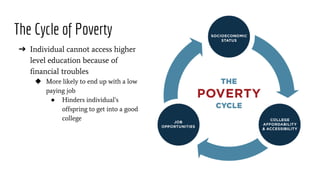
The Cycle of Poverty
➔ Individual cannot access higher
level education because of
financial troubles
◆ More likely to end up with a low
paying job
● Hinders individual’s
offspring to get into a good
college
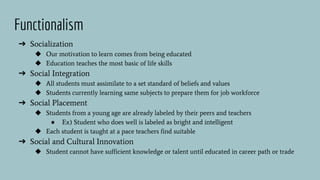
Functionalism
➔ Socialization
◆ Our motivation to learn comes from being educated
◆ Education teaches the most basic of life skills
➔ Social Integration
◆ All students must assimilate to a set standard of beliefs and values
◆ Students currently learning same subjects to prepare them for job workforce
➔ Social Placement
◆ Students from a young age are already labeled by their peers and teachers
● Ex) Student who does well is labeled as bright and intelligent
◆ Each student is taught at a pace teachers find suitable
➔ Social and Cultural Innovation
◆ Student cannot have sufficient knowledge or talent until educated in career path or trade
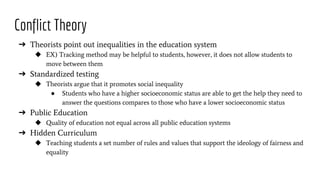
Conflict Theory
➔ Theorists point out inequalities in the education system
◆ EX) Tracking method may be helpful to students, however, it does not allow students to
move between them
➔ Standardized testing
◆ Theorists argue that it promotes social inequality
● Students who have a higher socioeconomic status are able to get the help they need to
answer the questions compares to those who have a lower socioeconomic status
➔ Public Education
◆ Quality of education not equal across all public education systems
➔ Hidden Curriculum
◆ Teaching students a set number of rules and values that support the ideology of fairness and
equality
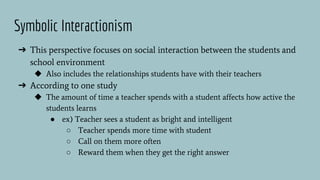
Symbolic Interactionism
➔ This perspective focuses on social interaction between the students and
school environment
◆ Also includes the relationships students have with their teachers
➔ According to one study
◆ The amount of time a teacher spends with a student affects how active the
students learns
● ex) Teacher sees a student as bright and intelligent
○ Teacher spends more time with student
○ Call on them more often
○ Reward them when they get the right answer
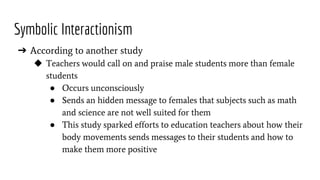
Symbolic Interactionism
➔ According to another study
◆ Teachers would call on and praise male students more than female
students
● Occurs unconsciously
● Sends an hidden message to females that subjects such as math
and science are not well suited for them
● This study sparked efforts to education teachers about how their
body movements sends messages to their students and how to
make them more positive
“What does the PISA Report Tell Us About U.S. Education?” Video
https://www.youtube.com/watch?v=hf9UVg-TdH0
Sources
Barkan, S. E. (2012). Sociological Perspectives on
Education. In A Primer on Social Problems
(Vol. 1). Retrieved May 15, 2016, from
http://jsmith.cis.byuh.edu/books/a-primer-on-social-
problems/s14-02-sociological-perspe
ctives-on-e.html
Carl, John. D. (2013) . THINK Social Problems 2013
[PowerPoint Slides] . Retrieved from
https://ollchs.instructure.com/courses/138/files/folder
/Powerpoints?preview=6600
Contact ONE. (2013). Retrieved May 18, 2016, from
https://www.one.org/international/about/contact/
Education. (n.d.). Retrieved May 18, 2016, from
http://www.worldvision.org/our-impact/education
Imka, M. (2009). Explaining Credentialism in Higher
Education Using Robert Park and Karl
Marx. Retrieved May 15, 2016, from
http://www.onu.edu/node/30607
Moore, L. (2012). Symbolic Interactionism and Moral
Hazards in Higher Education.
Administrative Issues Journal AIJ, 2(2), 26-39.
doi:10.5929/2012.2.2.3
Nield, R. (n.d.). National Center for Education Statistics
(NCES) Home Page, a part of the
U.S.Department of Education. Retrieved May 18,
2016, from https://nces.ed.gov/

BHS103 The American Education Crisis

  • 1.
  • 2.
    Current Issues ➔ Late1940s to the 1950s ◆ United States was ranked with the highest high school graduation rate in the ◆ world ◆ Today we are number 22 of 27 industrialized nations. ➔ The modern system has depreciated to a factory that puts whites into low paying jobs and, for the most part, puts minorities into the corrections system. ➔ Basically, we know this to be a big issue and detrimental to our future as a nation and as individuals because of the importance of education.
  • 3.
    ➔ Education’s integralimportance means that problems in its operation and function will be devastating to society in more or less obvious ways. ➔ Lack of education leads to increased rates of incarceration for example, lower incomes, unemployment, and especially the endurance of the cycle of poverty. ➔ The weaknesses to our education are depriving the nation of engineers and scientists for example, and that will eventually lead to our fall from a world leader. ➔ The education crisis is one of the biggest problems we are currently facing due to its ongoing repercussions. Current Issues
  • 4.
    The Cycle ofPoverty ➔ Individual cannot access higher level education because of financial troubles ◆ More likely to end up with a low paying job ● Hinders individual’s offspring to get into a good college
  • 5.
    Functionalism ➔ Socialization ◆ Ourmotivation to learn comes from being educated ◆ Education teaches the most basic of life skills ➔ Social Integration ◆ All students must assimilate to a set standard of beliefs and values ◆ Students currently learning same subjects to prepare them for job workforce ➔ Social Placement ◆ Students from a young age are already labeled by their peers and teachers ● Ex) Student who does well is labeled as bright and intelligent ◆ Each student is taught at a pace teachers find suitable ➔ Social and Cultural Innovation ◆ Student cannot have sufficient knowledge or talent until educated in career path or trade
  • 6.
    Conflict Theory ➔ Theoristspoint out inequalities in the education system ◆ EX) Tracking method may be helpful to students, however, it does not allow students to move between them ➔ Standardized testing ◆ Theorists argue that it promotes social inequality ● Students who have a higher socioeconomic status are able to get the help they need to answer the questions compares to those who have a lower socioeconomic status ➔ Public Education ◆ Quality of education not equal across all public education systems ➔ Hidden Curriculum ◆ Teaching students a set number of rules and values that support the ideology of fairness and equality
  • 7.
    Symbolic Interactionism ➔ Thisperspective focuses on social interaction between the students and school environment ◆ Also includes the relationships students have with their teachers ➔ According to one study ◆ The amount of time a teacher spends with a student affects how active the students learns ● ex) Teacher sees a student as bright and intelligent ○ Teacher spends more time with student ○ Call on them more often ○ Reward them when they get the right answer
  • 8.
    Symbolic Interactionism ➔ Accordingto another study ◆ Teachers would call on and praise male students more than female students ● Occurs unconsciously ● Sends an hidden message to females that subjects such as math and science are not well suited for them ● This study sparked efforts to education teachers about how their body movements sends messages to their students and how to make them more positive
  • 9.
    “What does thePISA Report Tell Us About U.S. Education?” Video https://www.youtube.com/watch?v=hf9UVg-TdH0
  • 10.
    Sources Barkan, S. E.(2012). Sociological Perspectives on Education. In A Primer on Social Problems (Vol. 1). Retrieved May 15, 2016, from http://jsmith.cis.byuh.edu/books/a-primer-on-social- problems/s14-02-sociological-perspe ctives-on-e.html Carl, John. D. (2013) . THINK Social Problems 2013 [PowerPoint Slides] . Retrieved from https://ollchs.instructure.com/courses/138/files/folder /Powerpoints?preview=6600 Contact ONE. (2013). Retrieved May 18, 2016, from https://www.one.org/international/about/contact/ Education. (n.d.). Retrieved May 18, 2016, from http://www.worldvision.org/our-impact/education Imka, M. (2009). Explaining Credentialism in Higher Education Using Robert Park and Karl Marx. Retrieved May 15, 2016, from http://www.onu.edu/node/30607 Moore, L. (2012). Symbolic Interactionism and Moral Hazards in Higher Education. Administrative Issues Journal AIJ, 2(2), 26-39. doi:10.5929/2012.2.2.3 Nield, R. (n.d.). National Center for Education Statistics (NCES) Home Page, a part of the U.S.Department of Education. Retrieved May 18, 2016, from https://nces.ed.gov/