

Teaching
with Dramatized
Experiences
“ All dramatization is essentially a process
of communication , in which both
participant and spectators are engaged .A
creative interaction takes place , a sharing
of ideas .
-Edgar Dale
Teaching with Dramatized Experiences
Dramatized experience - A
process of communication in
which both participant and
spectators are engaged
●Dramatic- is something that
is stirring or affecting or
moving.
●Dramatic Entrance- is
something that catches and
holds our attention, and has
emotional impacts.
Teaching with Dramatized Experiences
Dramatized Experiences can range from:
Formal Plays
Pageants
Tableau
Pantomime
Puppets
Role-playing
Teaching with Dramatized Experiences
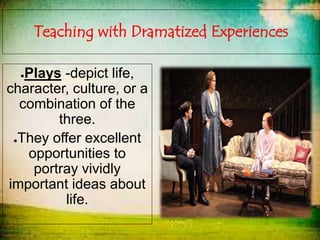
●Plays -depict life,
character, culture, or a
combination of the
three.
●They offer excellent
opportunities to
portray vividly
important ideas about
life.
Teaching with Dramatized Experiences
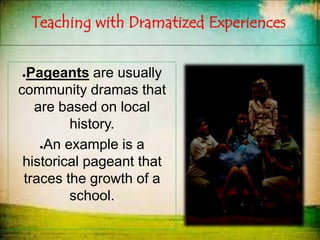
●Pageants are usually
community dramas that
are based on local
history.
●An example is a
historical pageant that
traces the growth of a
school.
Teaching with Dramatized Experiences
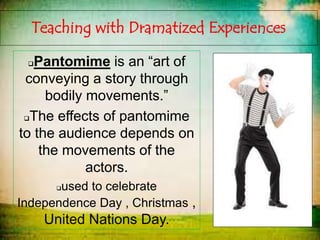
Pantomime is an “art of
conveying a story through
bodily movements.”
The effects of pantomime
to the audience depends on
the movements of the
actors.
used to celebrate
Independence Day , Christmas ,
United Nations Day.
Teaching with Dramatized Experiences
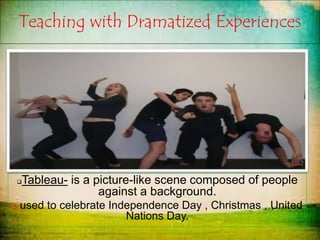
Tableau- is a picture-like scene composed of people
against a background.
 used to celebrate Independence Day , Christmas , United
Nations Day.
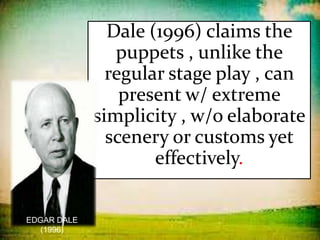
Dale (1996) claims the
puppets , unlike the
regular stage play , can
present w/ extreme
simplicity , w/o elaborate
scenery or customs yet
effectively.
EDGAR DALE
(1996)
Teaching with Dramatized Experiences
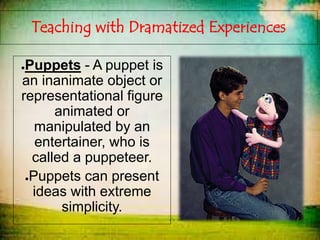
●Puppets - A puppet is
an inanimate object or
representational figure
animated or
manipulated by an
entertainer, who is
called a puppeteer.
●Puppets can present
ideas with extreme
simplicity.
Teaching with Dramatized Experiences
●Types of Puppets
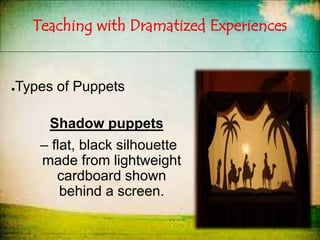
Shadow puppets
– flat, black silhouette
made from lightweight
cardboard shown
behind a screen.
Teaching with Dramatized Experiences
●Types of Puppets
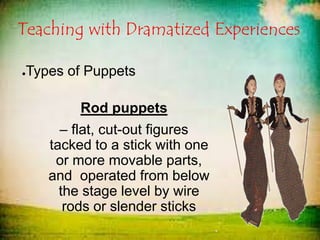
Rod puppets
– flat, cut-out figures
tacked to a stick with one
or more movable parts,
and operated from below
the stage level by wire
rods or slender sticks
Teaching with Dramatized Experiences
●Types of Puppets
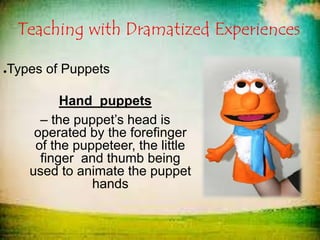
Hand puppets
– the puppet’s head is
operated by the forefinger
of the puppeteer, the little
finger and thumb being
used to animate the puppet
hands
Teaching with Dramatized Experiences
●Types of Puppets
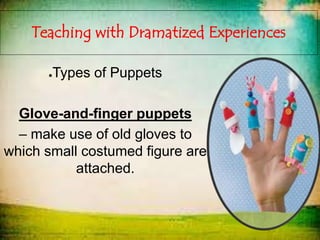
Glove-and-finger puppets
– make use of old gloves to
which small costumed figure are
attached.
Teaching with Dramatized Experiences
●Types of Puppets
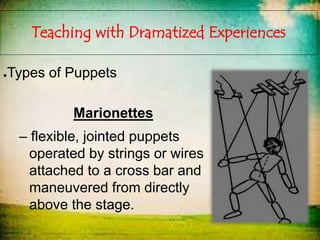
Marionettes
– flexible, jointed puppets
operated by strings or wires
attached to a cross bar and
maneuvered from directly
above the stage.
DALE (1996) quoting from the puppeteers of
America offers many suggestions among w/c are
the ff:
Do not use puppets for plays that can be done
just as well or better by other dramatic means.
Puppet plays must be based on action rather
than on words.
Keep the plays short
Do not omit the possibilities of music and
dancing as part the puppet show.
Adapt the puppet show to the age , background
, and taste of the students.
Teaching with Dramatized Experiences
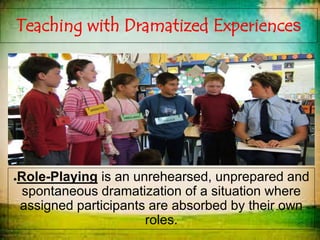
●Role-Playing is an unrehearsed, unprepared and
spontaneous dramatization of a situation where
assigned participants are absorbed by their own
roles.
HOW IS ROLE PLAYING DONE?
It can be done by describing a situation w/c
would create different viewpoints on an issue
and then asking the students to play the roles of
the individuals involved.
Any situations in w/c real feelings are
concealed. Consider situations in a school at
home or play ground , at work in government.
Reference
Corpuz, B. & Lucido P. 2008. Educational Technology 1. Metro
Manila: Lorimar Publishing Inc.
edtechb2.weebly.com/uploads/4/0/9/2/.../ed_tech_lesson_4__mj_tan_.
pp..

Edtech

  • 2.
    Teaching with Dramatized Experiences “ Alldramatization is essentially a process of communication , in which both participant and spectators are engaged .A creative interaction takes place , a sharing of ideas . -Edgar Dale
  • 3.
    Teaching with DramatizedExperiences Dramatized experience - A process of communication in which both participant and spectators are engaged ●Dramatic- is something that is stirring or affecting or moving. ●Dramatic Entrance- is something that catches and holds our attention, and has emotional impacts.
  • 4.
    Teaching with DramatizedExperiences Dramatized Experiences can range from: Formal Plays Pageants Tableau Pantomime Puppets Role-playing
  • 5.
    Teaching with DramatizedExperiences ●Plays -depict life, character, culture, or a combination of the three. ●They offer excellent opportunities to portray vividly important ideas about life.
  • 6.
    Teaching with DramatizedExperiences ●Pageants are usually community dramas that are based on local history. ●An example is a historical pageant that traces the growth of a school.
  • 7.
    Teaching with DramatizedExperiences Pantomime is an “art of conveying a story through bodily movements.” The effects of pantomime to the audience depends on the movements of the actors. used to celebrate Independence Day , Christmas , United Nations Day.
  • 8.
    Teaching with DramatizedExperiences Tableau- is a picture-like scene composed of people against a background.  used to celebrate Independence Day , Christmas , United Nations Day.
  • 9.
    Dale (1996) claimsthe puppets , unlike the regular stage play , can present w/ extreme simplicity , w/o elaborate scenery or customs yet effectively. EDGAR DALE (1996)
  • 10.
    Teaching with DramatizedExperiences ●Puppets - A puppet is an inanimate object or representational figure animated or manipulated by an entertainer, who is called a puppeteer. ●Puppets can present ideas with extreme simplicity.
  • 11.
    Teaching with DramatizedExperiences ●Types of Puppets Shadow puppets – flat, black silhouette made from lightweight cardboard shown behind a screen.
  • 12.
    Teaching with DramatizedExperiences ●Types of Puppets Rod puppets – flat, cut-out figures tacked to a stick with one or more movable parts, and operated from below the stage level by wire rods or slender sticks
  • 13.
    Teaching with DramatizedExperiences ●Types of Puppets Hand puppets – the puppet’s head is operated by the forefinger of the puppeteer, the little finger and thumb being used to animate the puppet hands
  • 14.
    Teaching with DramatizedExperiences ●Types of Puppets Glove-and-finger puppets – make use of old gloves to which small costumed figure are attached.
  • 15.
    Teaching with DramatizedExperiences ●Types of Puppets Marionettes – flexible, jointed puppets operated by strings or wires attached to a cross bar and maneuvered from directly above the stage.
  • 16.
    DALE (1996) quotingfrom the puppeteers of America offers many suggestions among w/c are the ff: Do not use puppets for plays that can be done just as well or better by other dramatic means. Puppet plays must be based on action rather than on words. Keep the plays short Do not omit the possibilities of music and dancing as part the puppet show. Adapt the puppet show to the age , background , and taste of the students.
  • 17.
    Teaching with DramatizedExperiences ●Role-Playing is an unrehearsed, unprepared and spontaneous dramatization of a situation where assigned participants are absorbed by their own roles.
  • 18.
    HOW IS ROLEPLAYING DONE? It can be done by describing a situation w/c would create different viewpoints on an issue and then asking the students to play the roles of the individuals involved. Any situations in w/c real feelings are concealed. Consider situations in a school at home or play ground , at work in government.
  • 19.
    Reference Corpuz, B. &Lucido P. 2008. Educational Technology 1. Metro Manila: Lorimar Publishing Inc. edtechb2.weebly.com/uploads/4/0/9/2/.../ed_tech_lesson_4__mj_tan_. pp..