

EDI: Workhorse of the Value Chain
A Closer Look at B2B Connectivity Benchmarks
in the Extended Supply Chain
11/20/2013

By Lora Cecere
Founder and CEO
Supply Chain Insights LLC
Contents
Contents ............................................................................................................................................................ 1
Research ........................................................................................................................................................... 2
Disclosure.......................................................................................................................................................... 3
Executive Overview ........................................................................................................................................... 4
The Current State of B2B Connectivity .............................................................................................................. 6
Importance to Supply Chain Execution .............................................................................................................. 8
Impact on Business Relationships ................................................................................................................... 12
Why EDI/XML? ................................................................................................................................................ 12
Where Do We Go From Here? ........................................................................................................................ 14
Recommendations........................................................................................................................................... 15
Summary ......................................................................................................................................................... 16
Appendix ......................................................................................................................................................... 17
Definitions Used in the Study ........................................................................................................................... 23
About Supply Chain Insights LLC .................................................................................................................... 24
About Lora Cecere .......................................................................................................................................... 24

Copyright © 2013

Supply Chain Insights LLC

Page 1
Research
Electronic Data Interchange (EDI) is now four decades old. Over this period, company processes have
matured. Today, for companies using EDI/XML, roughly 1/3 of all orders are processed automatically (handsfree processing). When they are automatically processed, fulfillment is faster and the collection of funds
happens more quickly with fewer errors. The net result is better customer service and faster cash-to-cash
cycles.
As technology has evolved, the pace to automate the extended supply chain and improve connectivity has
taken several twists and turns. Technologies like portals, trading exchanges, and business networks have
evolved, making many believe that EDI is obsolete. Nothing could be further from the truth. It is the workhorse
of the extended supply chain.
Progress has happened slowly primarily because many do not understand the benefits. The goal of this study
was to better understand the current state of B2B connectivity. As part of the study, we surveyed to
understand the use of EDI/XML and other forms of B2B connectivity. We also used the study to benchmark
benefits and understand the barriers.
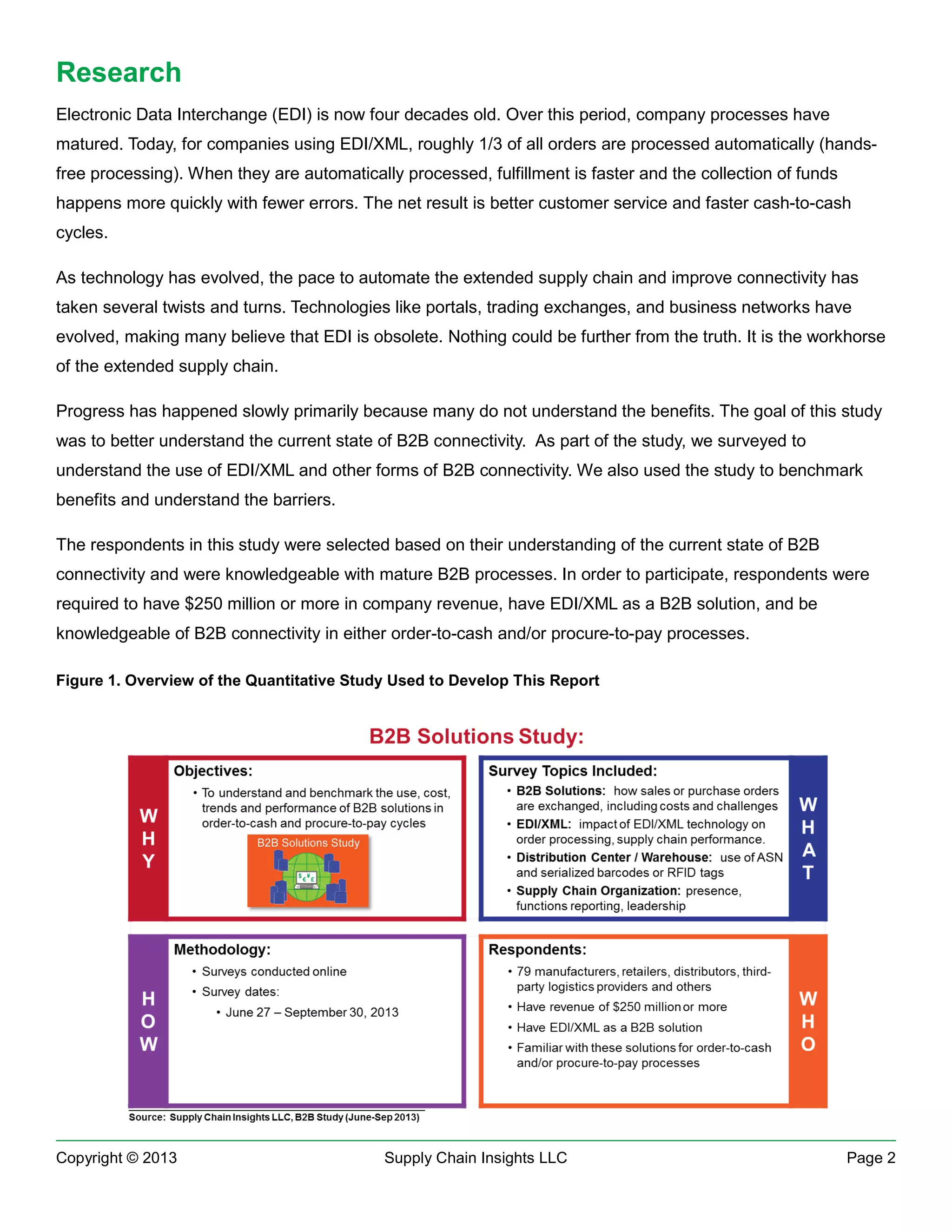
The respondents in this study were selected based on their understanding of the current state of B2B
connectivity and were knowledgeable with mature B2B processes. In order to participate, respondents were
required to have $250 million or more in company revenue, have EDI/XML as a B2B solution, and be
knowledgeable of B2B connectivity in either order-to-cash and/or procure-to-pay processes.
Figure 1. Overview of the Quantitative Study Used to Develop This Report

Copyright © 2013

Supply Chain Insights LLC

Page 2
Disclosure
This analysis is an independent and objective report on the B2B Solutions Survey completed by Supply Chain
Insights in the fall of 2013.
As a research firm, we are committed to open research. These reports are intended for you to read, share, and
use to improve your supply chain decisions. Please share this data freely within your company and across your
industry. As you do this, all we ask for in return is attribution. We publish under the Creative Commons License
Attribution-Noncommercial-Share Alike 3.0 United States and you will find our citation policy here.

Copyright © 2013

Supply Chain Insights LLC

Page 3
Executive Overview
The evolution of Electronic Data Interchange (EDI) standards and the evolution of Business-To-Business (B2B)
connectivity processes are now four decades old. Most executives see the progress as slow and expensive.
They are frustrated. They question the value.
Companies want to power value networks. They want to connect with trading partners. They want to make the
process both faster and easier. As a result, many are asking, “Does EDI use really matter? Is there value in the
automation of B2B/EDI connectivity to power value networks?” Increasingly, companies are looking for the
truth. This report attempts to answer these questions.
Companies want to build value networks and connect with trading partners. In our work with manufacturing
clients, we see that nine out of ten companies want to build a more effective end-to-end value network. There
is a growing understanding that the enterprise-centric endeavors over the last decade have plateaued, and that
there are significant costs and waste improvements to be had with the building of effective connectivity for the
extended supply chain.
However, most companies see EDI, and the exchange of documents through established protocols, as oldschool processes. They are looking for “a better mousetrap.” In the last decade, many techniques evolved and
they were overhyped. Early in the decade there were claims that XML was going to make EDI outdated.
Similarly, the use of business portals and business networks, sometimes termed trading partner exchanges,
were touted as better ways of improving trading partner connectivity. The promise was lower cost, faster
onboarding, and greater partner penetration. However, today EDI is the predominate method for B2B
connectivity.
No company studied uses just one method for B2B connectivity. Connectivity between trading partners is
usually a mix of portal, business network, and manual processes. While companies have invested in portals,
trading exchanges, and automated business networks, the adoption is low. Portals are one-way
communication. The use of portals is too passive and companies struggle to synchronize the many changes
that occur in sales and purchase order processing through this passive form of connectivity. Likewise, the
adoption of business networks in the establishment of B2B connectivity has been too slow. The networks
require a mass of partners connected as a community, and this development has been too slow.
Among the EDI/XML users surveyed for this report, EDI is used nearly six times more frequently in the
connection of trading partners than portals, and eight times more frequently than the use of business networks
(e.g., trading exchanges or specialized industry hubs). We also find that the process of sales order
management is more mature, and better automated, than those of procurement. EDI/XML is the workhorse of
the extended supply chain.

Copyright © 2013

Supply Chain Insights LLC

Page 4
Maturity in EDI/XML matters. In this study, we find that when companies successfully use EDI, there are REAL
and meaningful business results. For example, when companies can achieve hands-free orders, order-toshipment cycles decrease by 50%, there is greater accuracy in fulfillment, and business relationships improve.
For more on this story, read this report.

Copyright © 2013

Supply Chain Insights LLC

Page 5
The Current State of B2B Connectivity
The journey for effective B2B connectivity is now four decades old. It is not new. Many executives see the
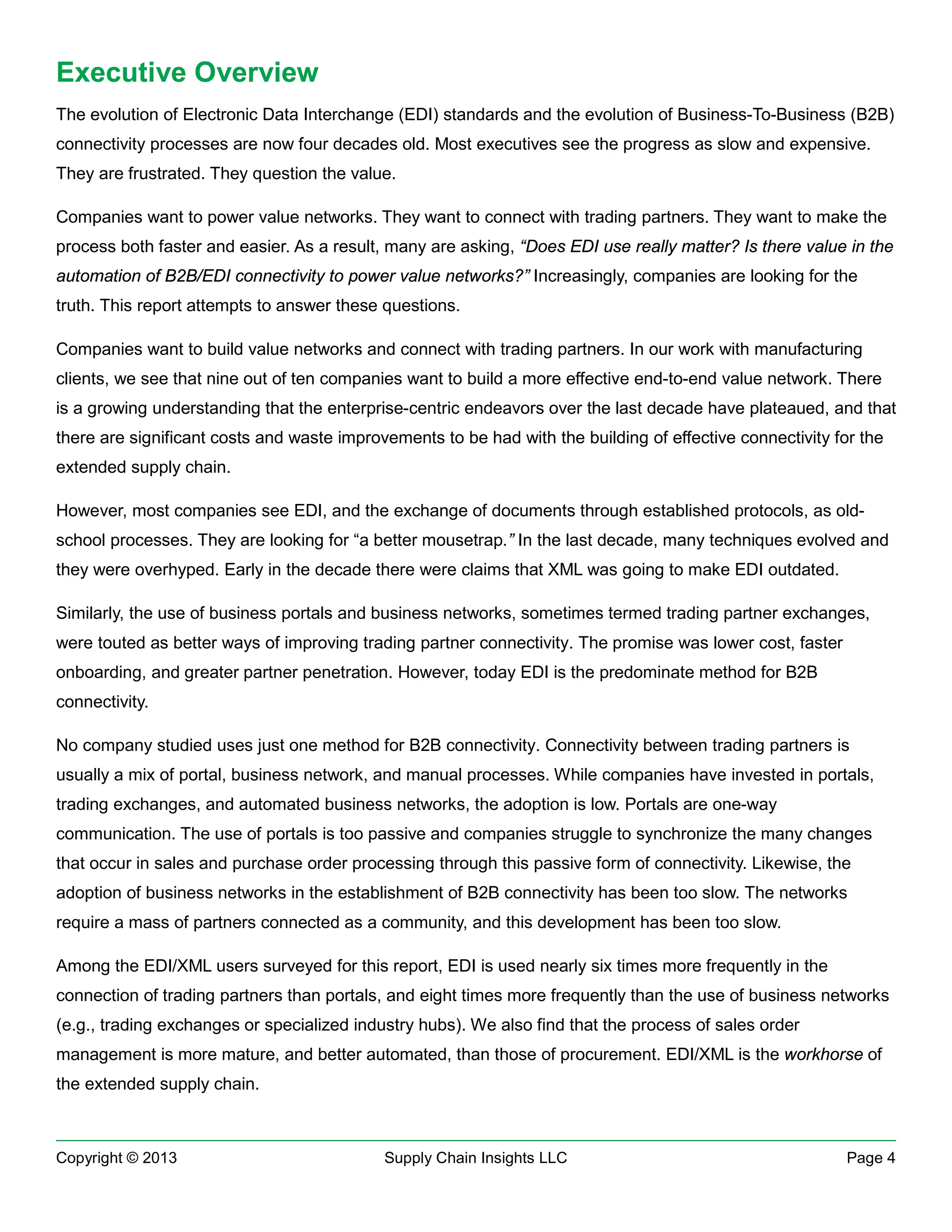
progress as slow and B2B through EDI as tedious. Today, as shown in figure 2, one in three orders can move
hands-free in business networks. The automation of sales processes is important for growth. Similarly, the
automation of the procurement processes is important in order to take out the friction in B2B trade. B2B
connectivity sounds easy, but the progress is slow because of the need for synchronization, data
harmonization and data translation.
Figure 2. Current State of Trading Partner Connectivity

Suppliers have less power than customers to define B2B programs; and, the programs over the last decade
are more complex. To be effective in business relationships the company needs to be effective at the
management of data in the value networks. As a result, the process for sales orders management is slightly
more mature on the use of B2B connectivity than those in procurement (procure-to-pay).
Today, business networks are more complex. The number of change orders has increased. The percentage of
new products launched and number of market offers (price, promotion and special packaging) has escalated.
B2B connectivity is more important today than it was at the start of the decade.

Copyright © 2013

Supply Chain Insights LLC

Page 6
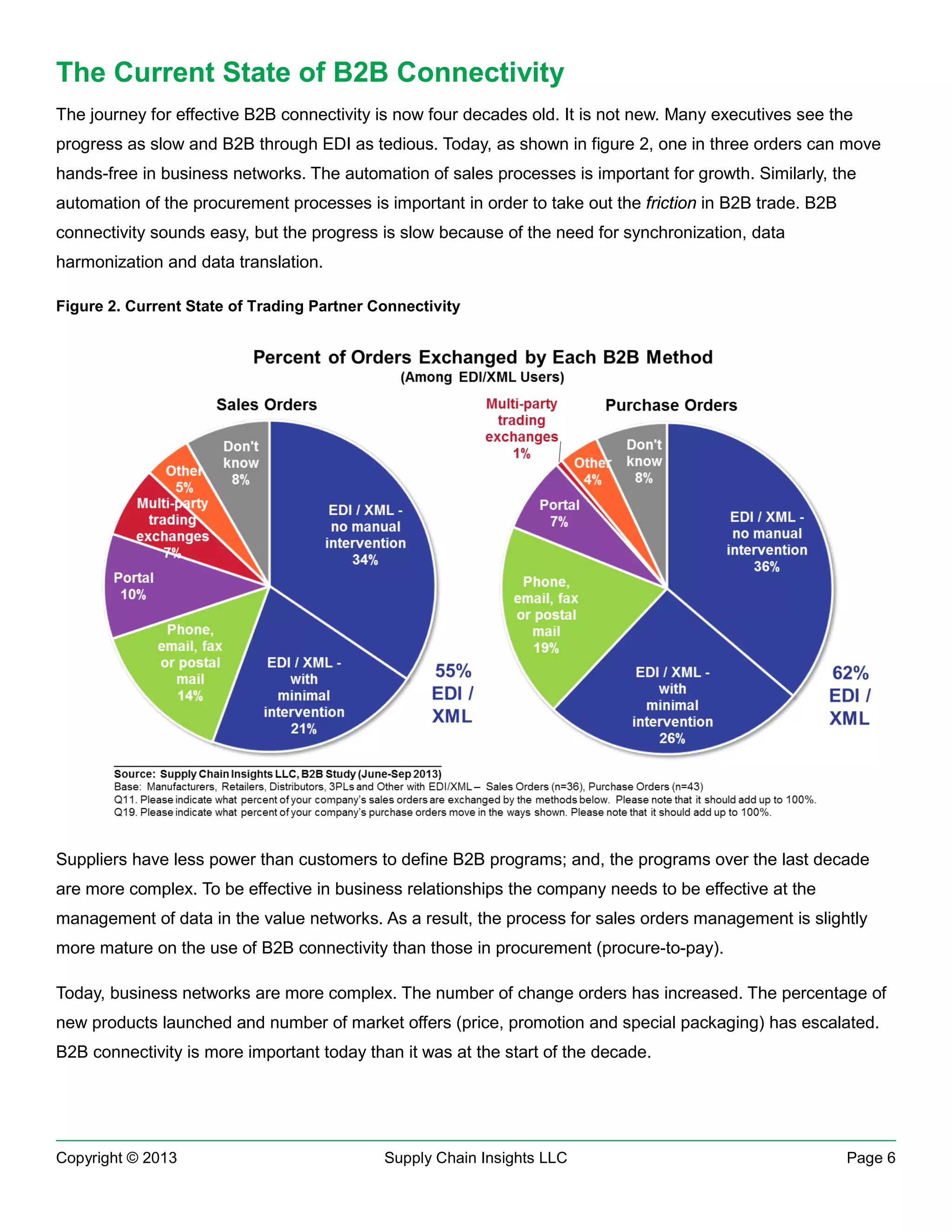
Figure 3. Current State of Trading Partner Connectivity (Automated vs. Not)

To better understand these dynamics, we share detailed findings for the two processes as an overview of the
quantitative project:
Order-To-Cash Process Overview:
•

EDI Hands-Free Orders Improve Order Cycle Times. When orders are managed B2B hands-free
(no manual intervention) through EDI/XML, the time from order receipt to shipment is halved. In the
survey, the average response changed from three days—if the order could be received and
processed without manual intervention through hands-free EDI—to seven days to ship an order that
needs manual manipulation.

•

Progress Is Slow. For these EDI/XML users, 34% of orders are moving through the systems
hands-free. While it is hard to compare studies with different demographics, and with a different
survey design, this is a 30% improvement over a prior analysis completed in 2004.

•

EDI Usage Reduces Fulfillment Errors. Irrespective of how they are processed, over 40% of
customer orders change at least once. Based on the survey results, we can clearly see that the use
of EDI reduces errors and improves processing times.

•

Few Incentives to Use EDI in Trading Partner Relationships. Despite the strong value
proposition, only 6% of respondents offer order discounts to customers for using EDI for order
processing.

Copyright © 2013

Supply Chain Insights LLC

Page 7
Procure-To-Pay Process Overview:
•

Hands-Free Purchase Orders Are Approximately 1/3 of Order Stream. For these EDI/XML
users, 36% of purchase orders are handled through EDI without manual intervention while 26% are
moving through the system manually.

•

EDI for Trading Partner Connectivity Is the Workhorse of the Industry. After a decade of hype,
the use of multi-party trading exchanges for purchase order fulfillment is in its infancy in procure-topay processes.

•

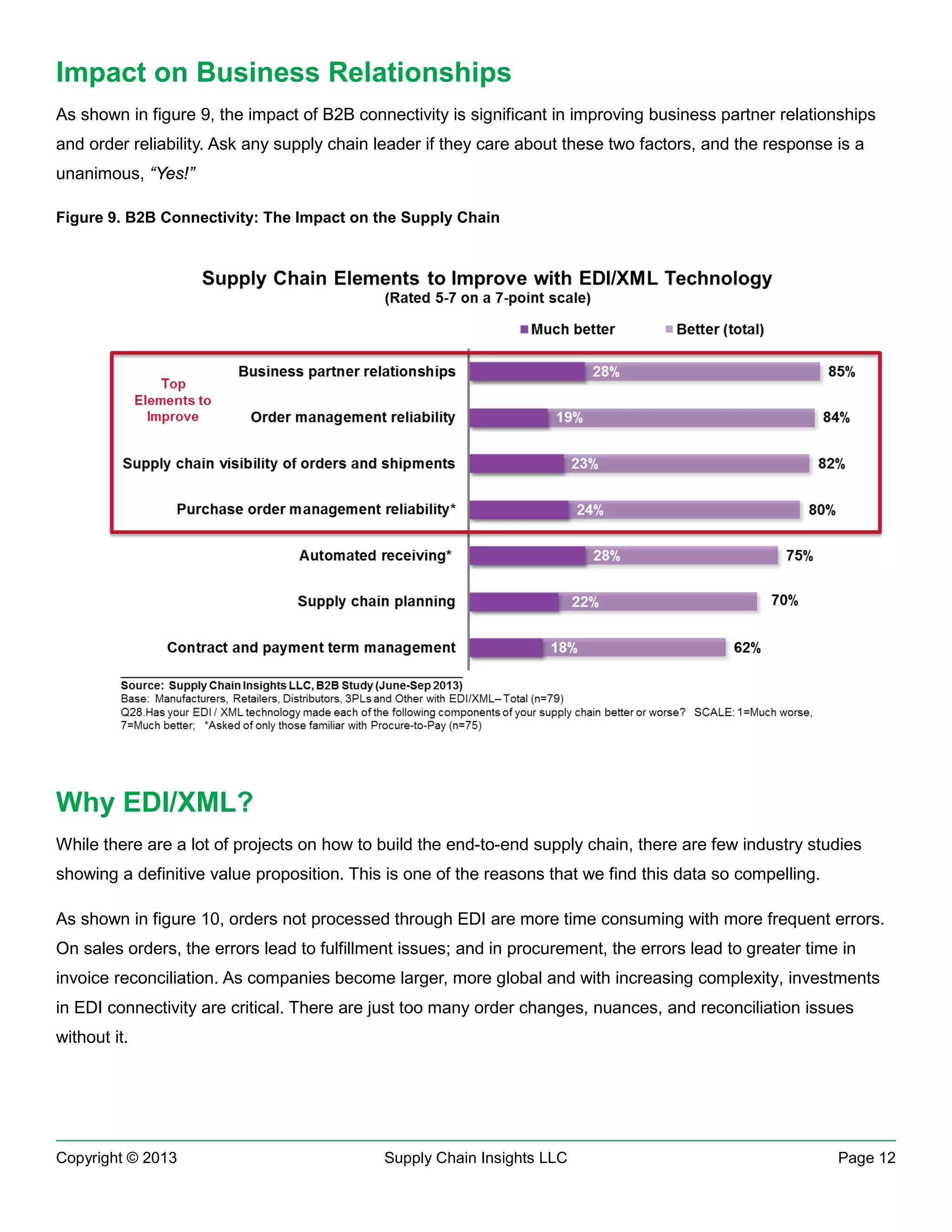
The Use of EDI Reduces Costs. Today, an average of 30% of shipments are received without
Advance Shipment Notification (ASN). Shipments without an ASN cost the average company an
additional $78 per purchase order to process.

•

The Industry Is Slowly Making Improvements in B2B Automation through EDI. In this study,
62% of purchase orders move through the system using EDI (EDI hands-free plus EDI with some
manual intervention). However the need for manual intervention is directionally higher than that with
customer orders.

Importance to Supply Chain Execution
The supply chain is becoming more complex and dependent on third-party B2B interaction. With the growth of
global value networks, companies today are more dependent on B2B standards and connectivity. Documents
like ASN and PO Acknowledgements take some of the “friction” out of the trading network, reducing the
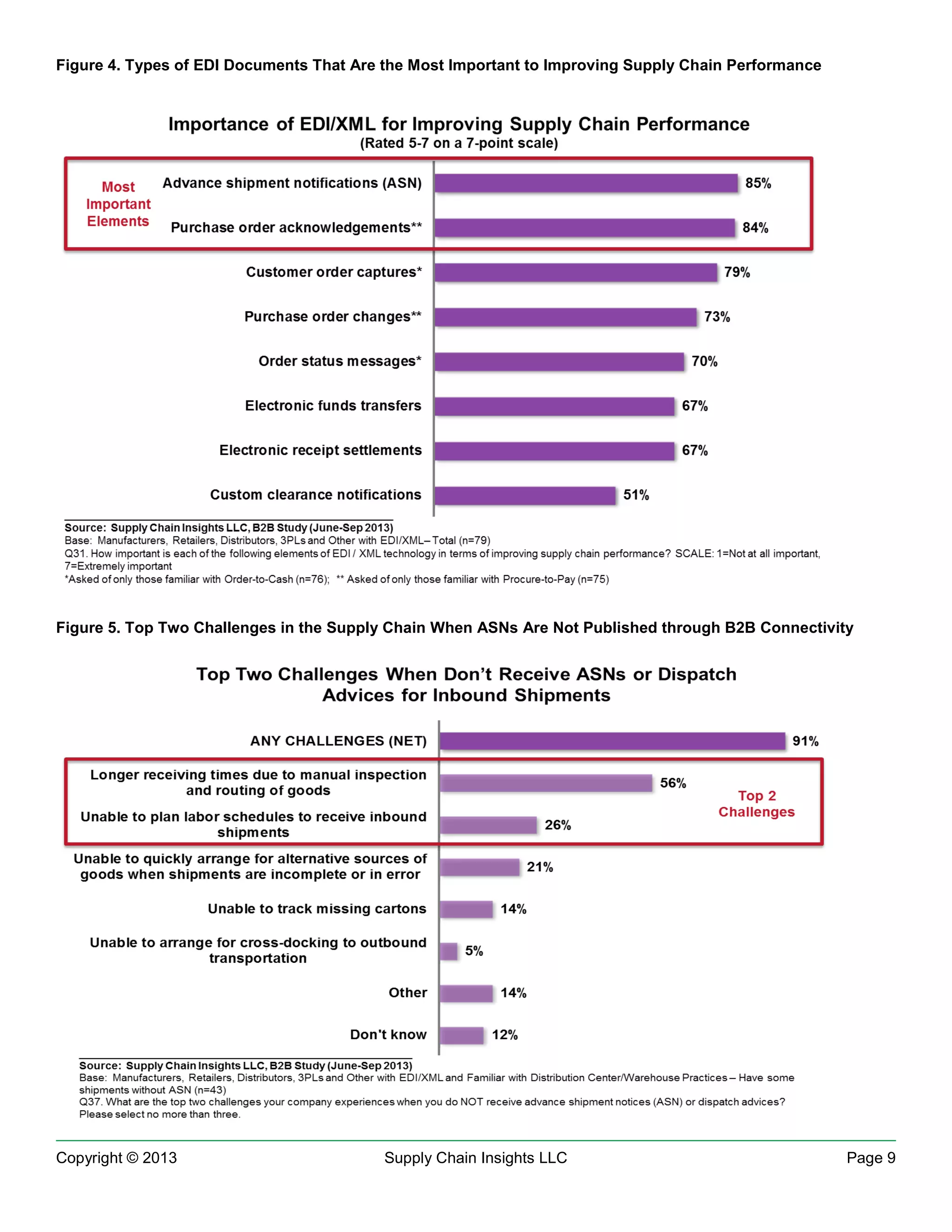
dependency on phone/fax and email communication. As shown in figure 4, it should come as no surprise to
see Advance Shipment Notification and Purchase Order Acknowledgements ranked as the most important type
of “document” or “message” for improving supply chain performance.
Supply chain flows are dependent on thousands of orders. They have growing complexity—order changes,
master/blanket orders, drop shipments through third-parties, shipping compliance, receipt by a third-party or
3PL—that needs automation. Keeping the order/shipment data current and accurate is paramount to ensure
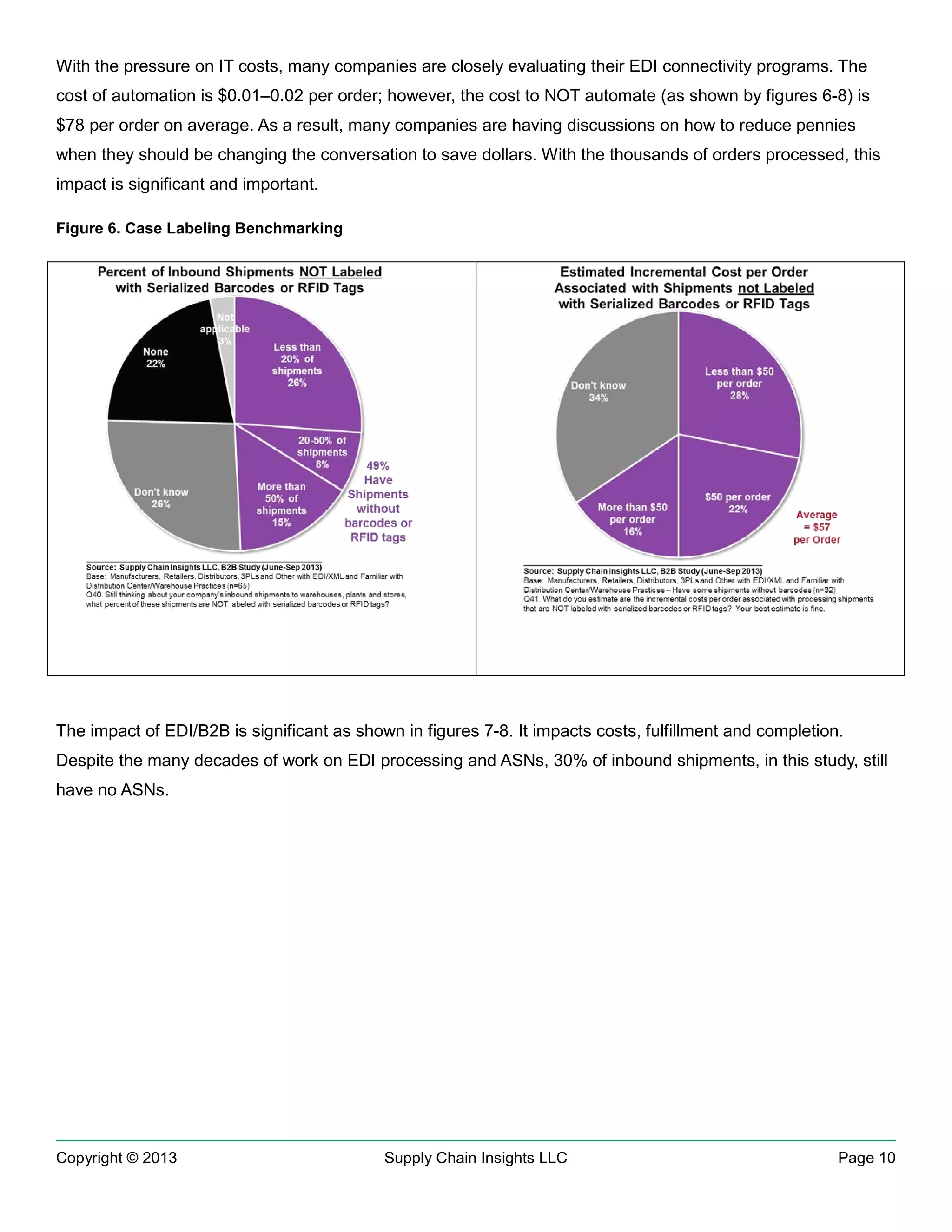
quick and accurate receiving. The lack of ASNs and PO Acknowledgement leads to longer receiving times and
lower efficiency due to unplanned shipments. The awareness/importance of these documents is a top-to-top
discussion. However, as seen in this study, 30% of orders are still received without the issuance of a B2B
document. This business pain is shown in figure 5.
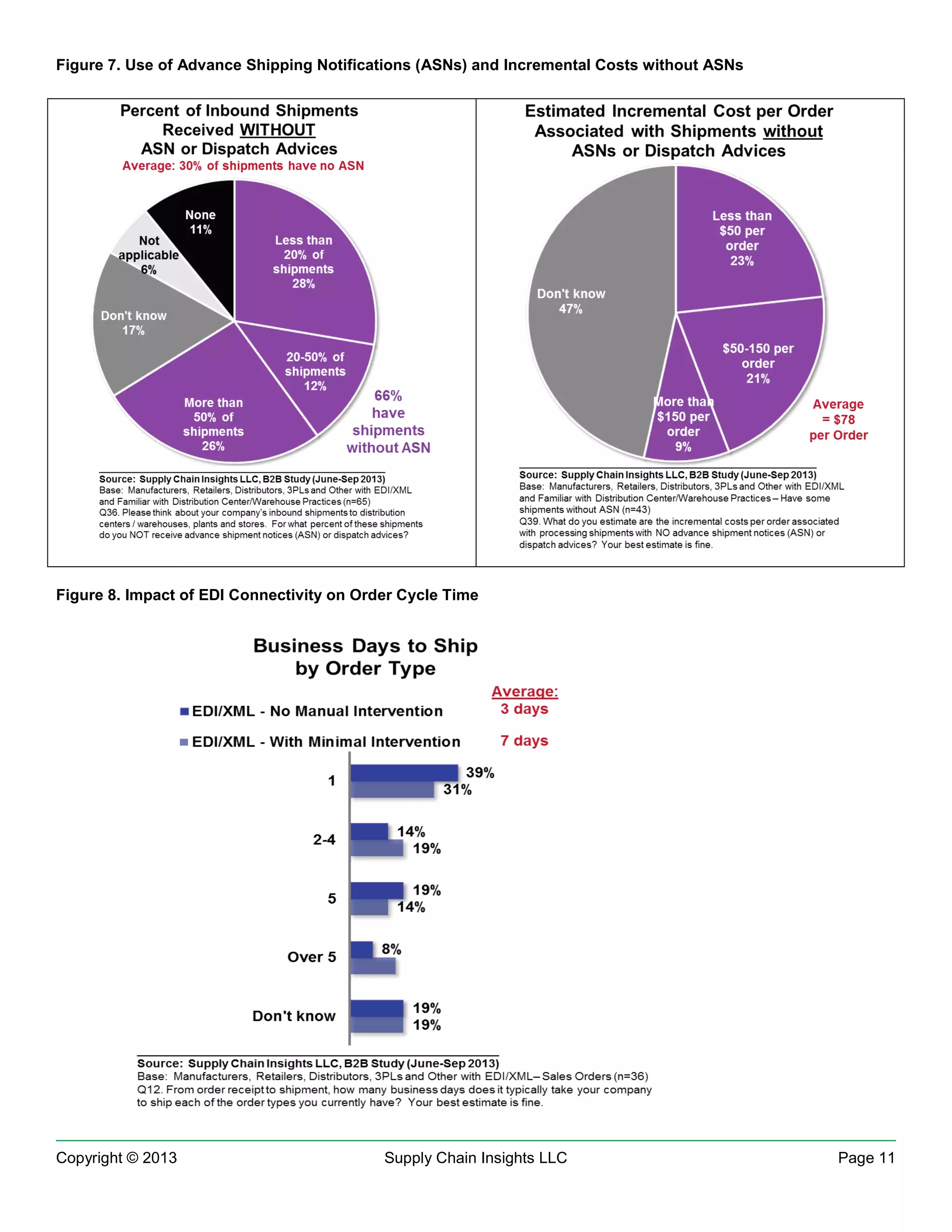
Case automation is less automated. In this study, as shown in figure 6, one in two cases do not have a
barcode or a RFID tag to accelerate warehouse receiving. The lack of case tagging and ASNs/Purchase Order
Acknowledgement is estimated to cost $1.50 per order. As this cost is multiplied over thousands of orders, the
cost becomes significant.
Copyright © 2013

Supply Chain Insights LLC

Page 8
Figure 4. Types of EDI Documents That Are the Most Important to Improving Supply Chain Performance

Figure 5. Top Two Challenges in the Supply Chain When ASNs Are Not Published through B2B Connectivity

Copyright © 2013

Supply Chain Insights LLC

Page 9
With the pressure on IT costs, many companies are closely evaluating their EDI connectivity programs. The
cost of automation is $0.01–0.02 per order; however, the cost to NOT automate (as shown by figures 6-8) is
$78 per order on average. As a result, many companies are having discussions on how to reduce pennies
when they should be changing the conversation to save dollars. With the thousands of orders processed, this
impact is significant and important.
Figure 6. Case Labeling Benchmarking

The impact of EDI/B2B is significant as shown in figures 7-8. It impacts costs, fulfillment and completion.
Despite the many decades of work on EDI processing and ASNs, 30% of inbound shipments, in this study, still
have no ASNs.

Copyright © 2013

Supply Chain Insights LLC

Page 10
Figure 7. Use of Advance Shipping Notifications (ASNs) and Incremental Costs without ASNs

Figure 8. Impact of EDI Connectivity on Order Cycle Time

Copyright © 2013

Supply Chain Insights LLC

Page 11
Impact on Business Relationships
As shown in figure 9, the impact of B2B connectivity is significant in improving business partner relationships
and order reliability. Ask any supply chain leader if they care about these two factors, and the response is a
unanimous, “Yes!”
Figure 9. B2B Connectivity: The Impact on the Supply Chain

Why EDI/XML?
While there are a lot of projects on how to build the end-to-end supply chain, there are few industry studies
showing a definitive value proposition. This is one of the reasons that we find this data so compelling.
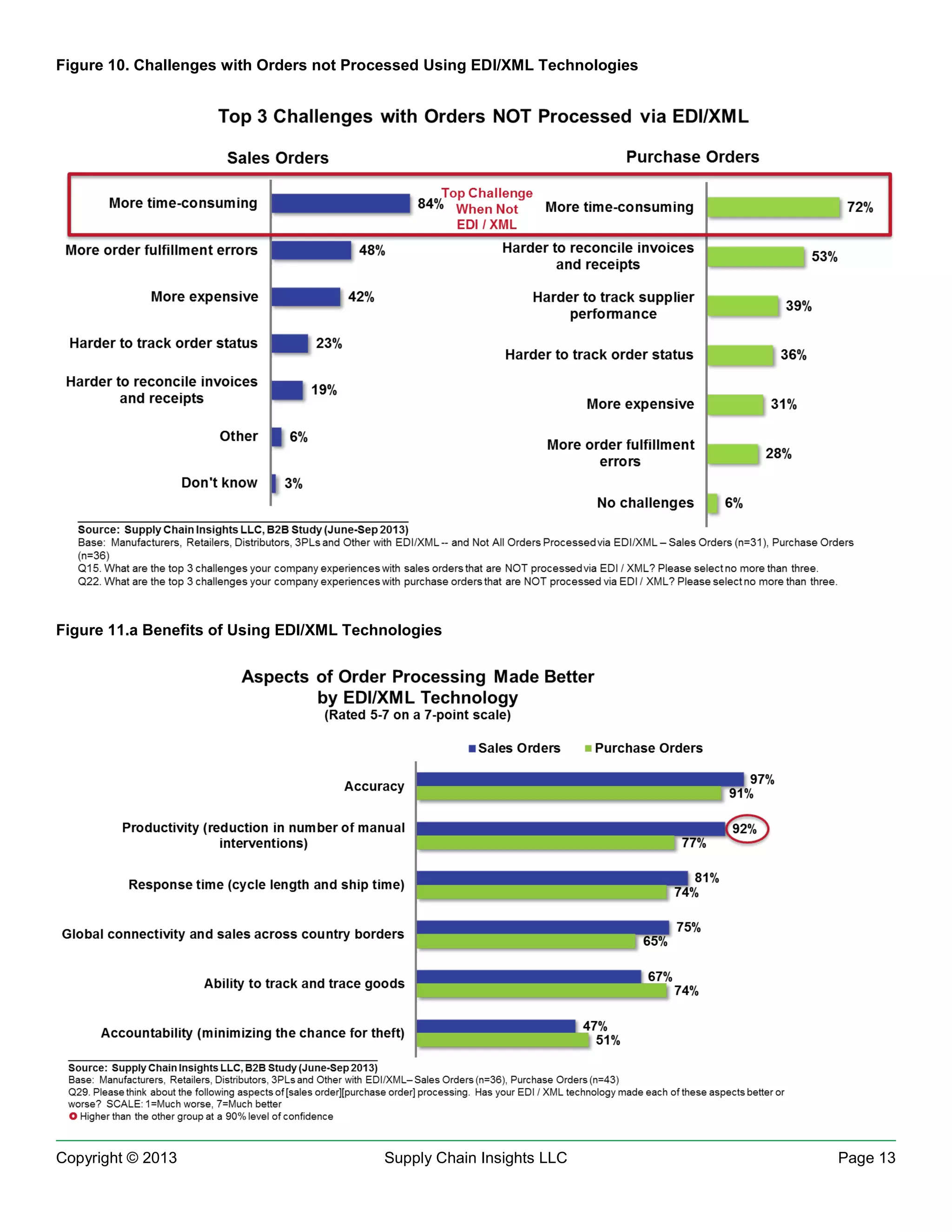
As shown in figure 10, orders not processed through EDI are more time consuming with more frequent errors.
On sales orders, the errors lead to fulfillment issues; and in procurement, the errors lead to greater time in
invoice reconciliation. As companies become larger, more global and with increasing complexity, investments
in EDI connectivity are critical. There are just too many order changes, nuances, and reconciliation issues
without it.

Copyright © 2013

Supply Chain Insights LLC

Page 12
Figure 10. Challenges with Orders not Processed Using EDI/XML Technologies

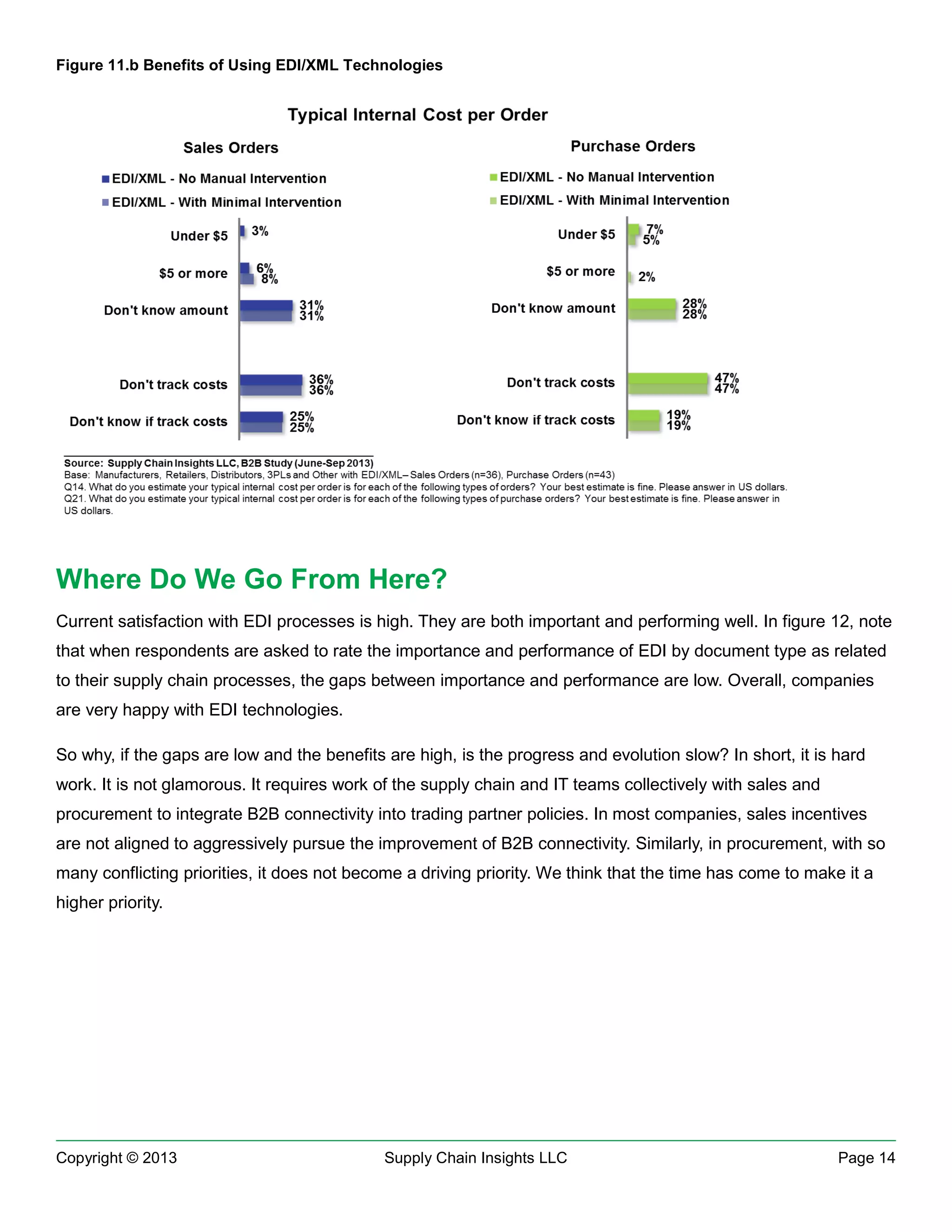
Figure 11.a Benefits of Using EDI/XML Technologies

Copyright © 2013

Supply Chain Insights LLC

Page 13
Figure 11.b Benefits of Using EDI/XML Technologies

Where Do We Go From Here?
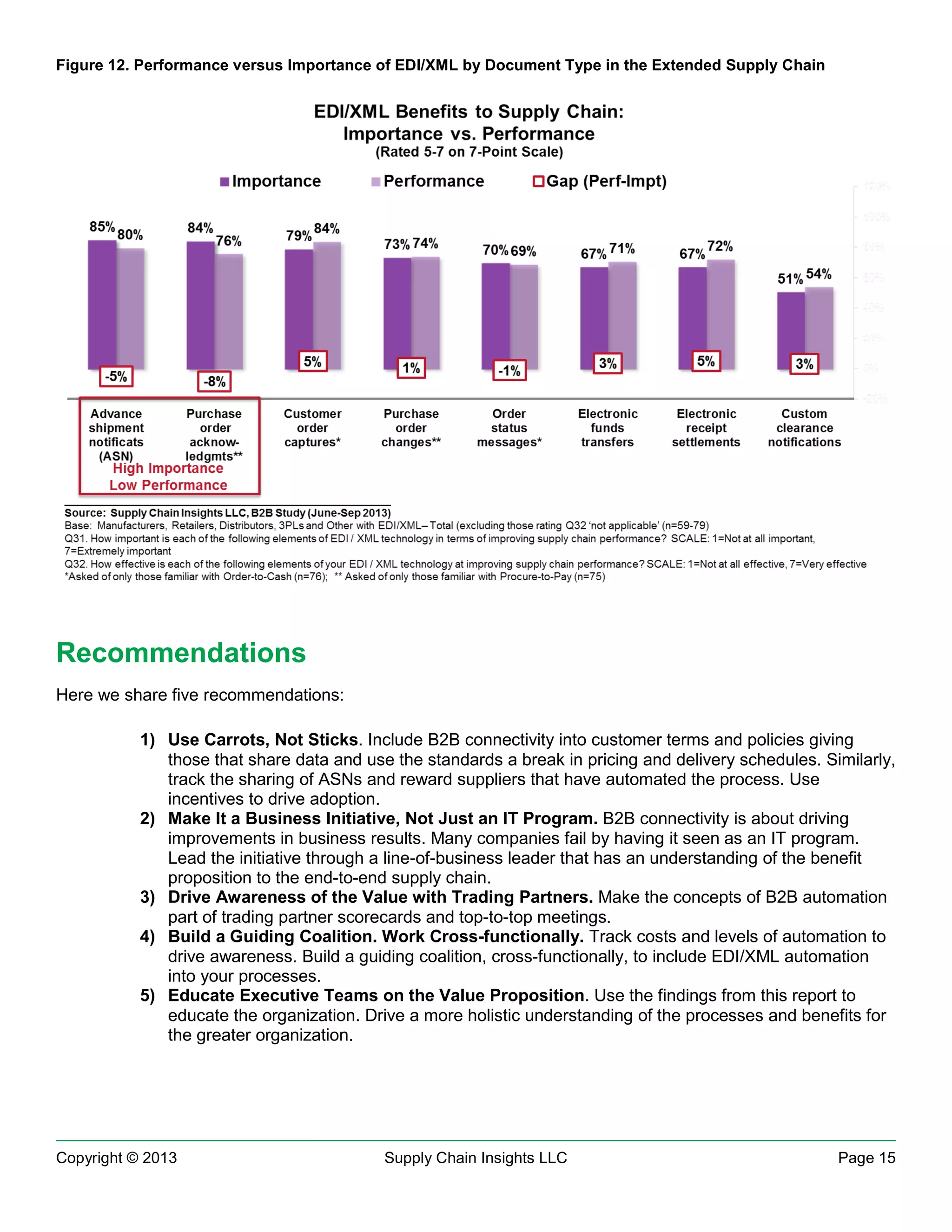
Current satisfaction with EDI processes is high. They are both important and performing well. In figure 12, note
that when respondents are asked to rate the importance and performance of EDI by document type as related
to their supply chain processes, the gaps between importance and performance are low. Overall, companies
are very happy with EDI technologies.
So why, if the gaps are low and the benefits are high, is the progress and evolution slow? In short, it is hard
work. It is not glamorous. It requires work of the supply chain and IT teams collectively with sales and
procurement to integrate B2B connectivity into trading partner policies. In most companies, sales incentives
are not aligned to aggressively pursue the improvement of B2B connectivity. Similarly, in procurement, with so
many conflicting priorities, it does not become a driving priority. We think that the time has come to make it a
higher priority.

Copyright © 2013

Supply Chain Insights LLC

Page 14
Figure 12. Performance versus Importance of EDI/XML by Document Type in the Extended Supply Chain

Recommendations
Here we share five recommendations:
1) Use Carrots, Not Sticks. Include B2B connectivity into customer terms and policies giving
those that share data and use the standards a break in pricing and delivery schedules. Similarly,
track the sharing of ASNs and reward suppliers that have automated the process. Use
incentives to drive adoption.
2) Make It a Business Initiative, Not Just an IT Program. B2B connectivity is about driving
improvements in business results. Many companies fail by having it seen as an IT program.
Lead the initiative through a line-of-business leader that has an understanding of the benefit
proposition to the end-to-end supply chain.
3) Drive Awareness of the Value with Trading Partners. Make the concepts of B2B automation
part of trading partner scorecards and top-to-top meetings.
4) Build a Guiding Coalition. Work Cross-functionally. Track costs and levels of automation to
drive awareness. Build a guiding coalition, cross-functionally, to include EDI/XML automation
into your processes.
5) Educate Executive Teams on the Value Proposition. Use the findings from this report to
educate the organization. Drive a more holistic understanding of the processes and benefits for
the greater organization.

Copyright © 2013

Supply Chain Insights LLC

Page 15
Summary
EDI/XML is the workhorse of the industry in building the extended supply chain. Despite the slow progression
of adoption, the processes have a high level of importance and a high level of performance with significant
benefits for both the order-to-cash and the procure-to-pay processes.

Copyright © 2013

Supply Chain Insights LLC

Page 16
Appendix
In this section, we share the demographic information of survey respondents and provide additional charts
referenced in the report. The participants in this research answered the surveys of their own free will. A small
portion of the respondents were given either a Starbucks gift card or a copy of Lora Cecere’s book Bricks
Matter, as an honorarium. In addition, the response was stimulated by an offer to share and discuss the survey
results in the form of Open Content research at the end of the study.
The names, both of individual respondents and companies participating, are held in confidence. At no point do
we share these. To better understand the responses, the demographics are shared to help the readers of this
report gain a better perspective on the results. The demographics and additional charts are found below in
figures A–J.
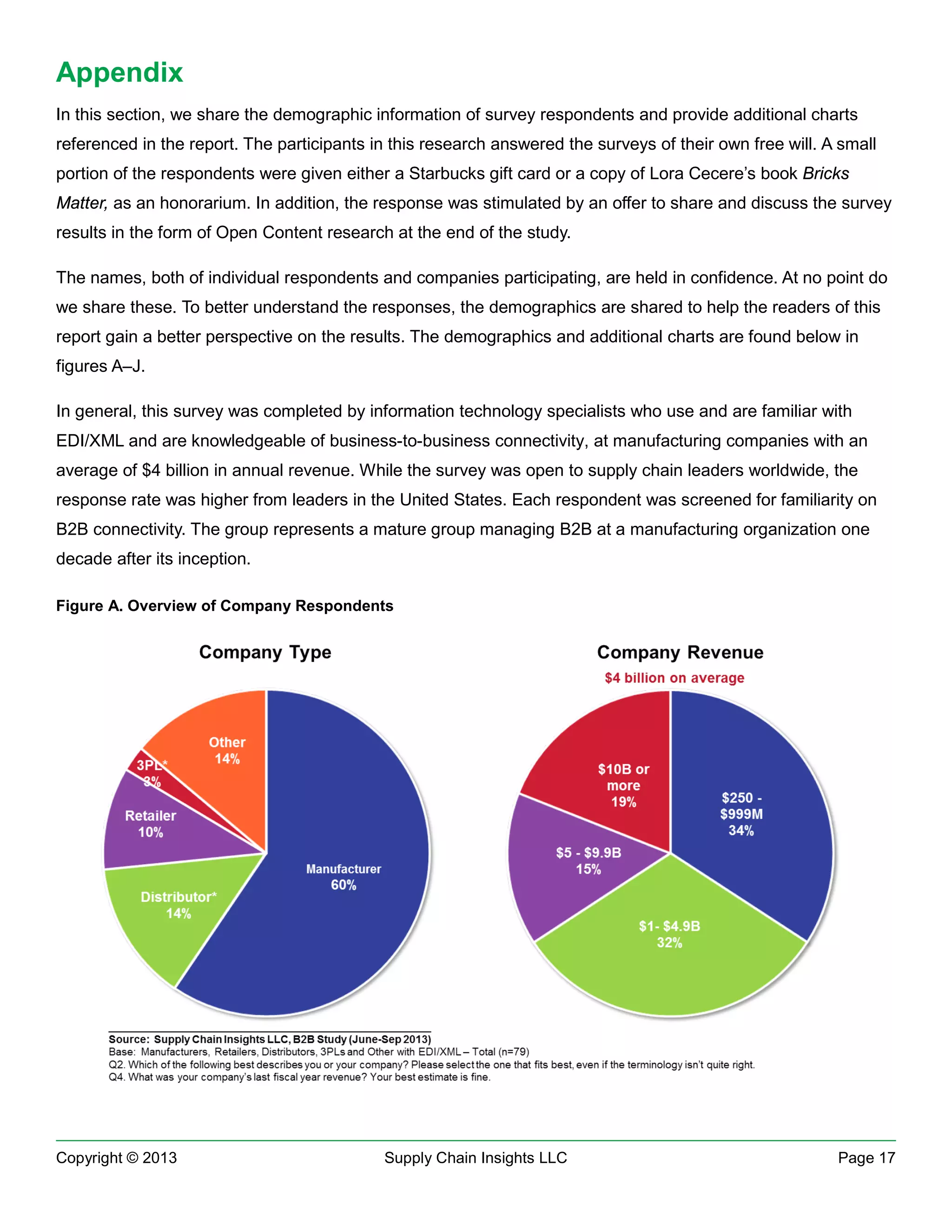
In general, this survey was completed by information technology specialists who use and are familiar with
EDI/XML and are knowledgeable of business-to-business connectivity, at manufacturing companies with an
average of $4 billion in annual revenue. While the survey was open to supply chain leaders worldwide, the
response rate was higher from leaders in the United States. Each respondent was screened for familiarity on
B2B connectivity. The group represents a mature group managing B2B at a manufacturing organization one
decade after its inception.
Figure A. Overview of Company Respondents

Copyright © 2013

Supply Chain Insights LLC

Page 17
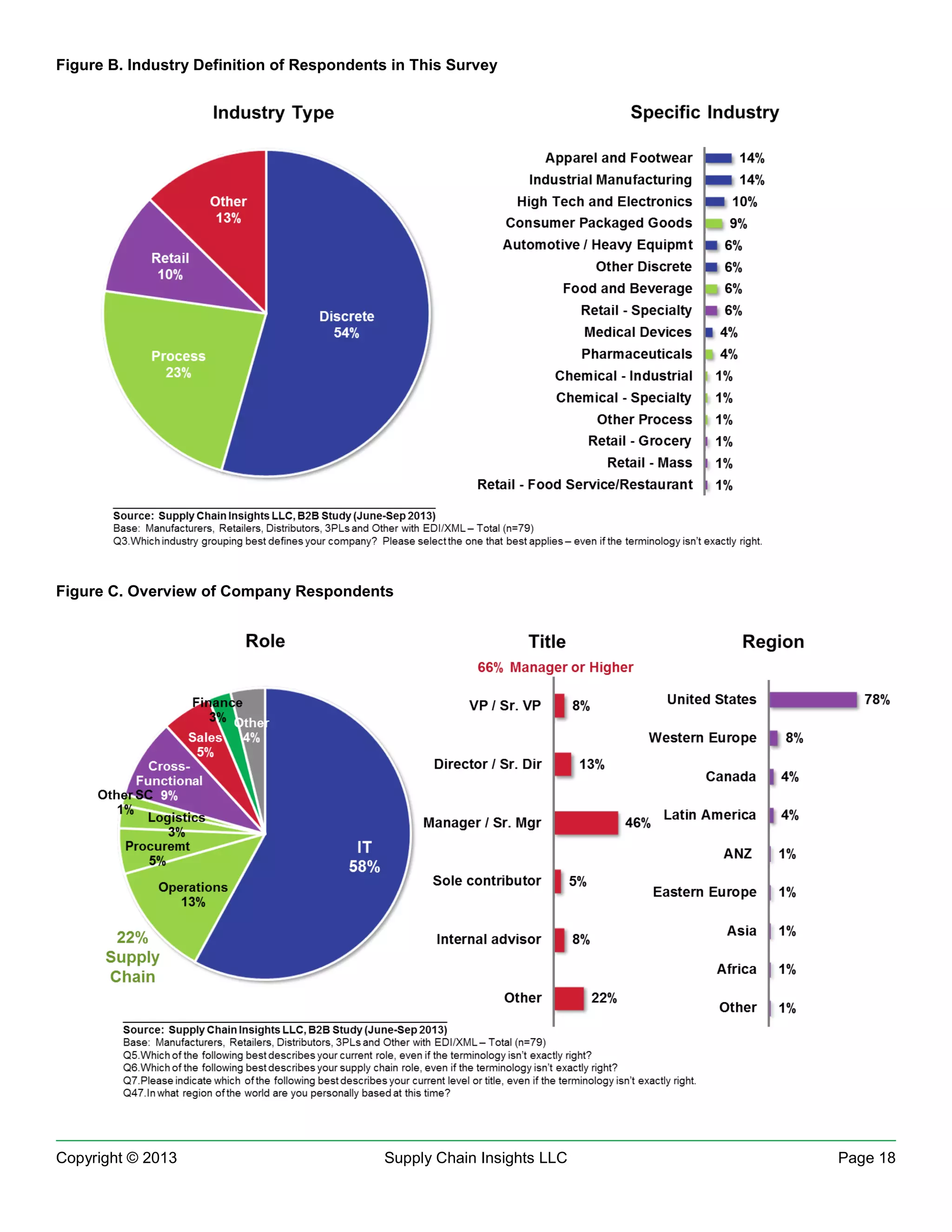
Figure B. Industry Definition of Respondents in This Survey

Figure C. Overview of Company Respondents

Copyright © 2013

Supply Chain Insights LLC

Page 18
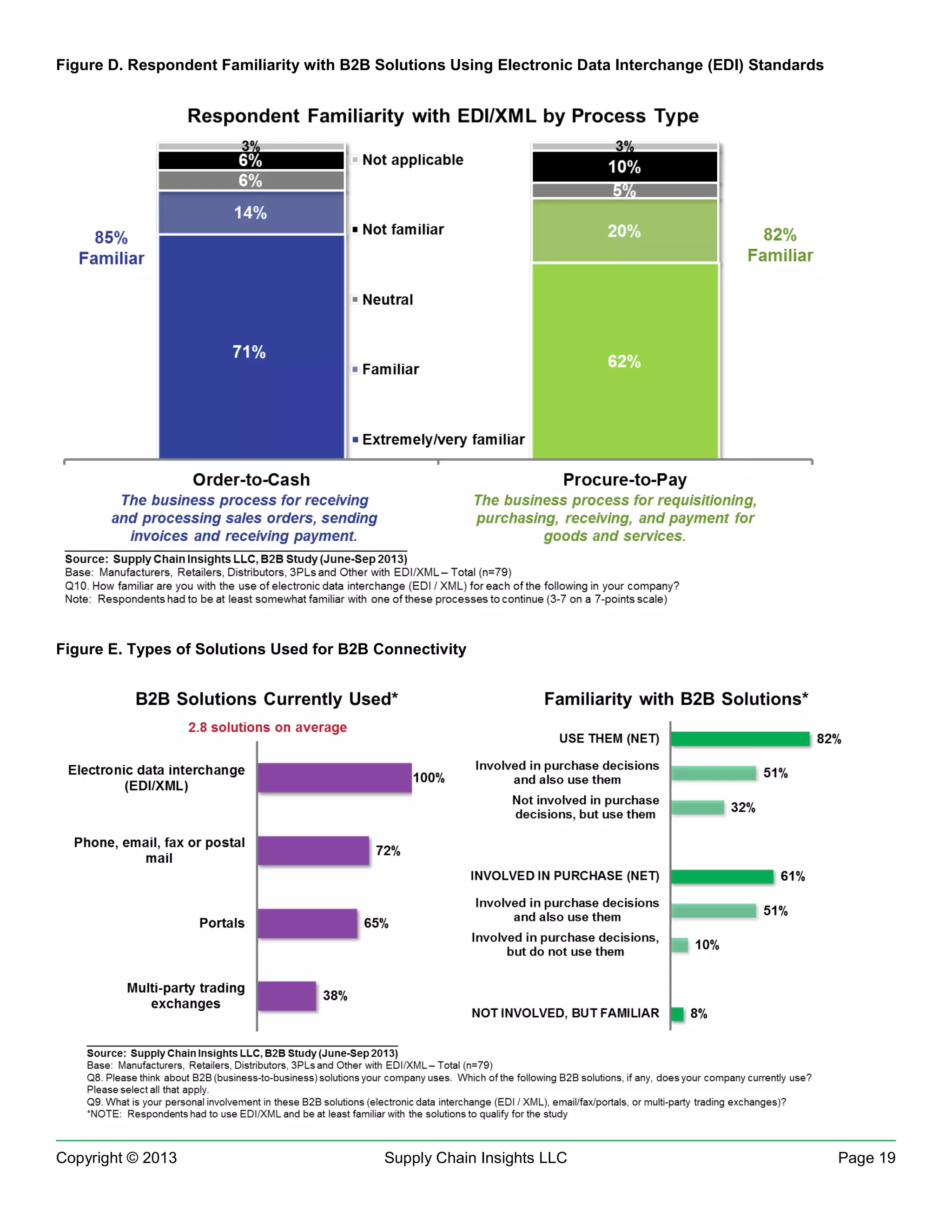
Figure D. Respondent Familiarity with B2B Solutions Using Electronic Data Interchange (EDI) Standards

Figure E. Types of Solutions Used for B2B Connectivity

Copyright © 2013

Supply Chain Insights LLC

Page 19
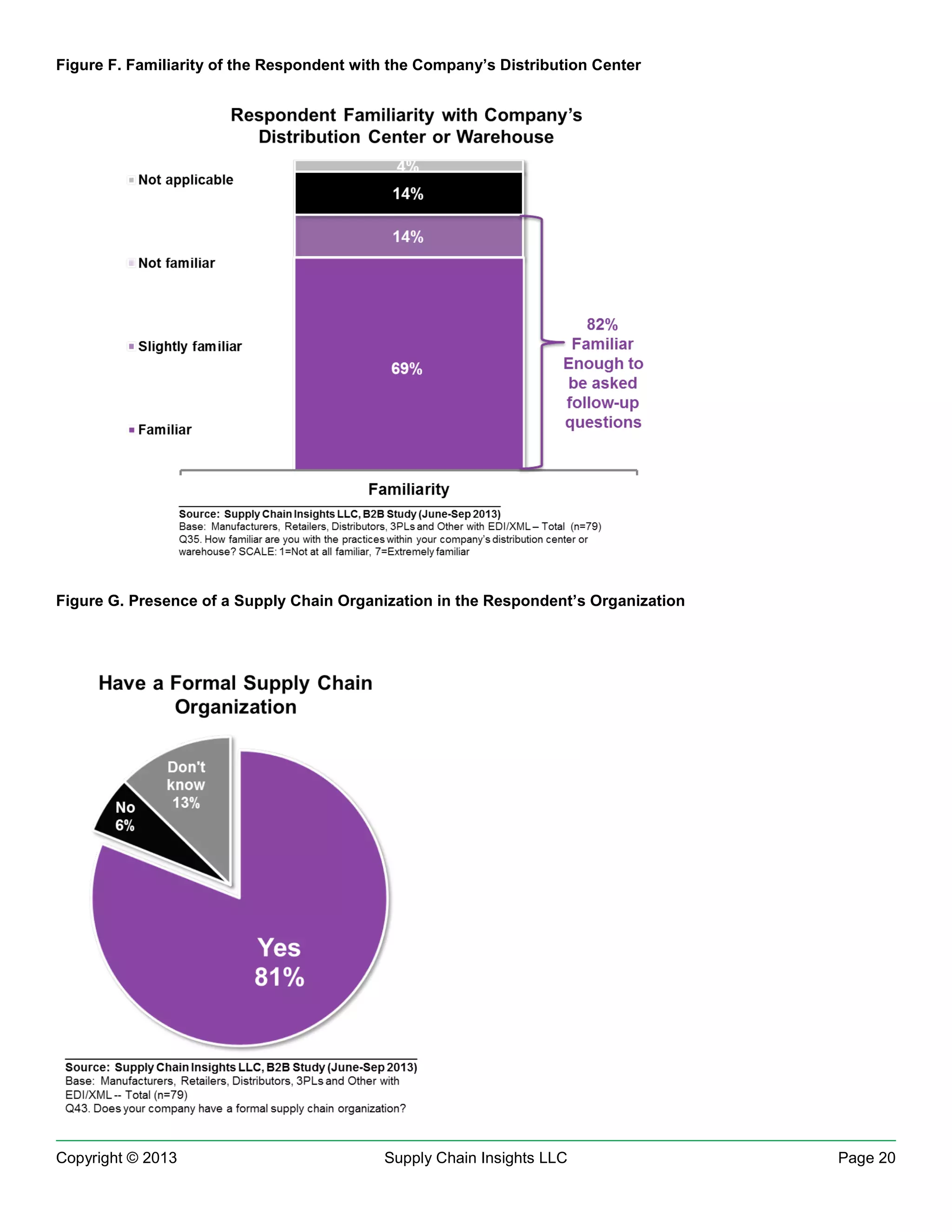
Figure F. Familiarity of the Respondent with the Company’s Distribution Center

Figure G. Presence of a Supply Chain Organization in the Respondent’s Organization

Copyright © 2013

Supply Chain Insights LLC

Page 20
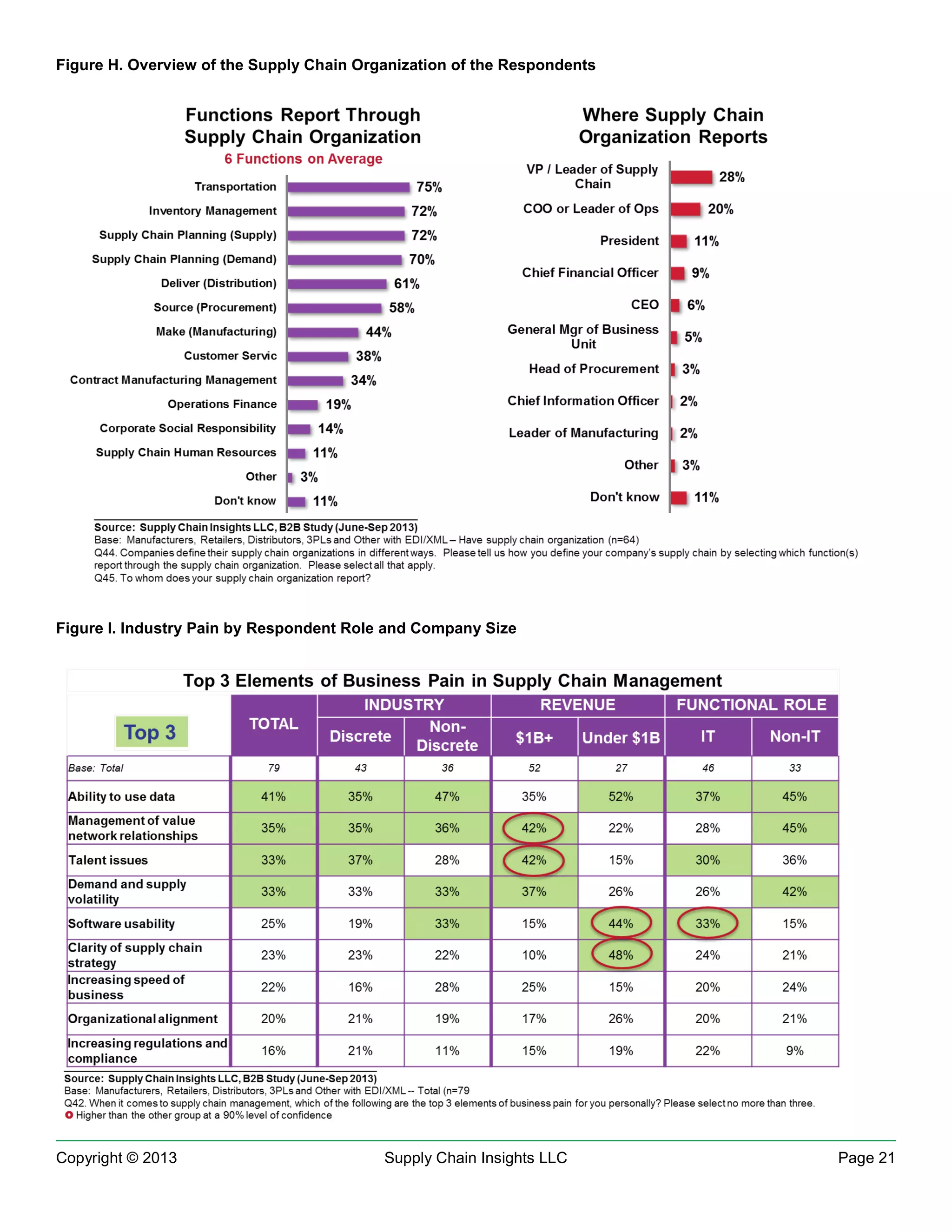
Figure H. Overview of the Supply Chain Organization of the Respondents

Figure I. Industry Pain by Respondent Role and Company Size

Copyright © 2013

Supply Chain Insights LLC

Page 21
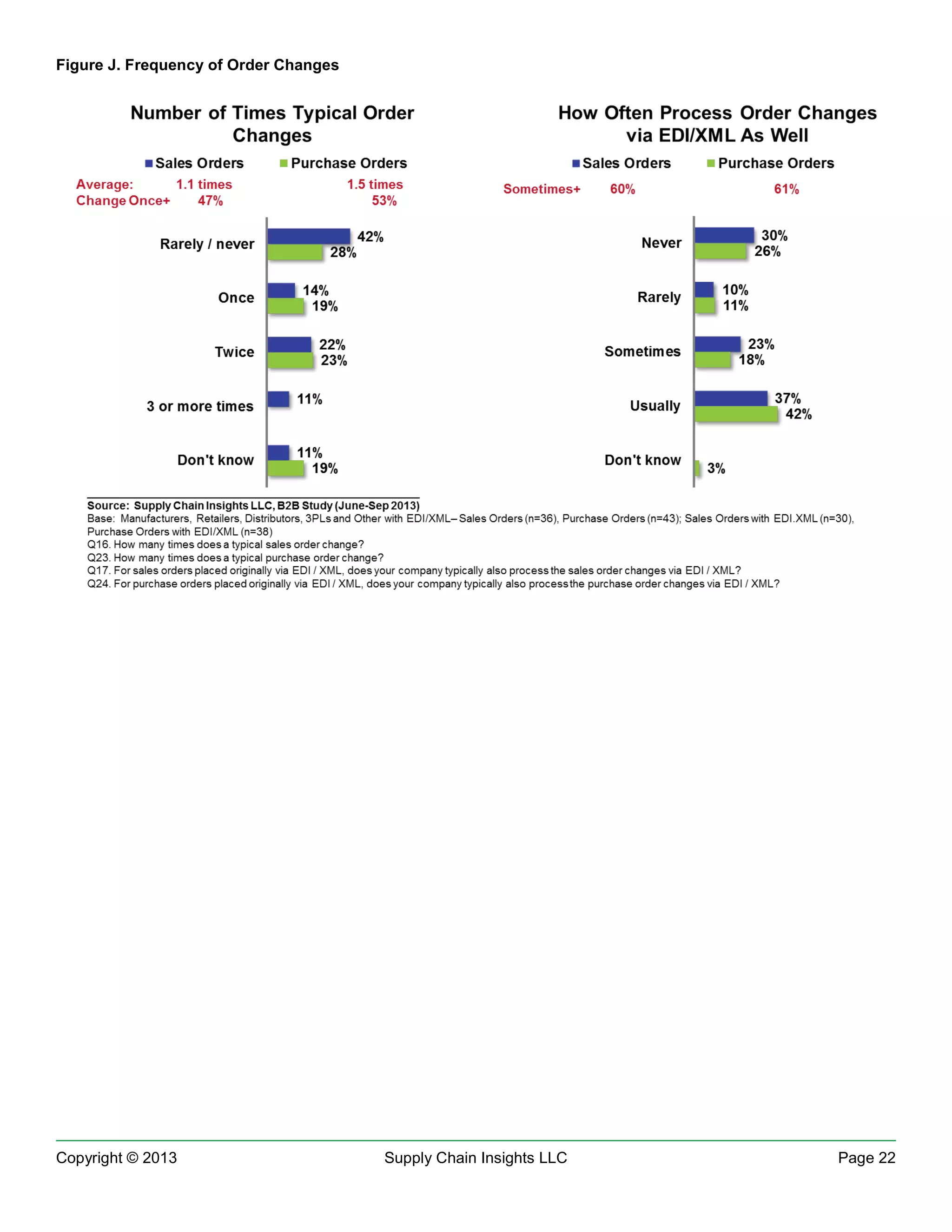
Figure J. Frequency of Order Changes

Copyright © 2013

Supply Chain Insights LLC

Page 22
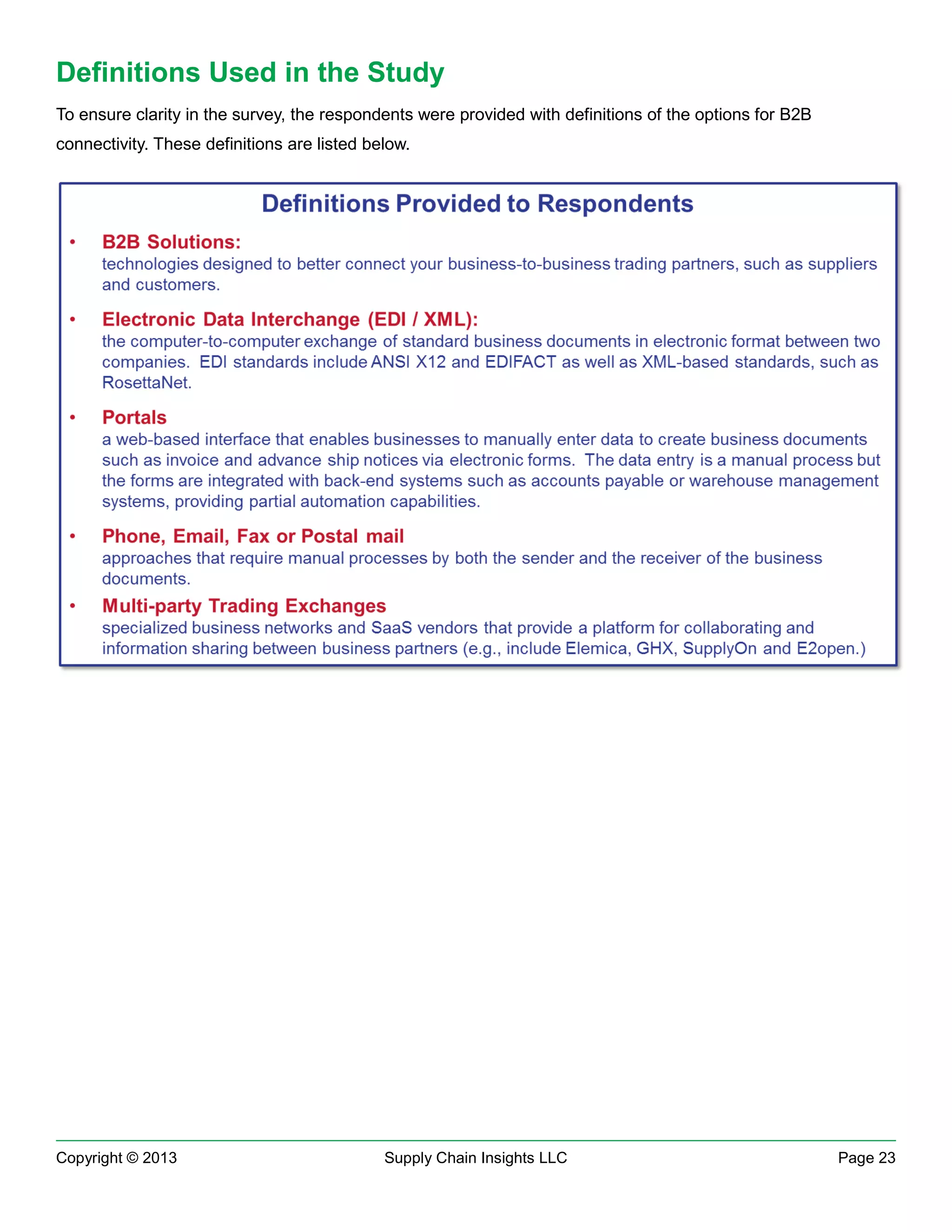
Definitions Used in the Study
To ensure clarity in the survey, the respondents were provided with definitions of the options for B2B
connectivity. These definitions are listed below.

Copyright © 2013

Supply Chain Insights LLC

Page 23
About Supply Chain Insights LLC
Founded in February, 2012 by Lora Cecere, Supply Chain Insights LLC is focused on delivering independent,
actionable and objective advice for supply chain leaders. If you need to know which practices and
technologies make the biggest difference to corporate performance, turn to us. We are a company dedicated to
this research. We help you understand supply chain trends, evolving technologies and which metrics matter.

About Lora Cecere
Lora Cecere (twitter ID @lcecere) is the Founder of Supply Chain Insights LLC and the
author of popular enterprise software blog Supply Chain Shaman currently read by 5,000
supply chain professionals. Her book, Bricks Matter, (co-authored with Charlie Chase)
published on December 26th, 2012. She is currently working on a second book, Metrics
That Matter, to publish in September 2014.

With over nine years as a research analyst with AMR Research, Altimeter Group, and
Gartner Group and now as a Founder of Supply Chain Insights, Lora understands supply chain. She has
worked with over 600 companies on their supply chain strategy and speaks at over 50 conferences a year on
the evolution of supply chain processes and technologies. Her research is designed for the early adopter
seeking first mover advantage.

Copyright © 2013

Supply Chain Insights LLC

Page 24

EDI: Workhorse of the Value Chain - 10 FEB 2014

  • 1.
    EDI: Workhorse ofthe Value Chain A Closer Look at B2B Connectivity Benchmarks in the Extended Supply Chain 11/20/2013 By Lora Cecere Founder and CEO Supply Chain Insights LLC
  • 2.
    Contents Contents ............................................................................................................................................................ 1 Research........................................................................................................................................................... 2 Disclosure.......................................................................................................................................................... 3 Executive Overview ........................................................................................................................................... 4 The Current State of B2B Connectivity .............................................................................................................. 6 Importance to Supply Chain Execution .............................................................................................................. 8 Impact on Business Relationships ................................................................................................................... 12 Why EDI/XML? ................................................................................................................................................ 12 Where Do We Go From Here? ........................................................................................................................ 14 Recommendations........................................................................................................................................... 15 Summary ......................................................................................................................................................... 16 Appendix ......................................................................................................................................................... 17 Definitions Used in the Study ........................................................................................................................... 23 About Supply Chain Insights LLC .................................................................................................................... 24 About Lora Cecere .......................................................................................................................................... 24 Copyright © 2013 Supply Chain Insights LLC Page 1
  • 3.
    Research Electronic Data Interchange(EDI) is now four decades old. Over this period, company processes have matured. Today, for companies using EDI/XML, roughly 1/3 of all orders are processed automatically (handsfree processing). When they are automatically processed, fulfillment is faster and the collection of funds happens more quickly with fewer errors. The net result is better customer service and faster cash-to-cash cycles. As technology has evolved, the pace to automate the extended supply chain and improve connectivity has taken several twists and turns. Technologies like portals, trading exchanges, and business networks have evolved, making many believe that EDI is obsolete. Nothing could be further from the truth. It is the workhorse of the extended supply chain. Progress has happened slowly primarily because many do not understand the benefits. The goal of this study was to better understand the current state of B2B connectivity. As part of the study, we surveyed to understand the use of EDI/XML and other forms of B2B connectivity. We also used the study to benchmark benefits and understand the barriers. The respondents in this study were selected based on their understanding of the current state of B2B connectivity and were knowledgeable with mature B2B processes. In order to participate, respondents were required to have $250 million or more in company revenue, have EDI/XML as a B2B solution, and be knowledgeable of B2B connectivity in either order-to-cash and/or procure-to-pay processes. Figure 1. Overview of the Quantitative Study Used to Develop This Report Copyright © 2013 Supply Chain Insights LLC Page 2
  • 4.
    Disclosure This analysis isan independent and objective report on the B2B Solutions Survey completed by Supply Chain Insights in the fall of 2013. As a research firm, we are committed to open research. These reports are intended for you to read, share, and use to improve your supply chain decisions. Please share this data freely within your company and across your industry. As you do this, all we ask for in return is attribution. We publish under the Creative Commons License Attribution-Noncommercial-Share Alike 3.0 United States and you will find our citation policy here. Copyright © 2013 Supply Chain Insights LLC Page 3
  • 5.
    Executive Overview The evolutionof Electronic Data Interchange (EDI) standards and the evolution of Business-To-Business (B2B) connectivity processes are now four decades old. Most executives see the progress as slow and expensive. They are frustrated. They question the value. Companies want to power value networks. They want to connect with trading partners. They want to make the process both faster and easier. As a result, many are asking, “Does EDI use really matter? Is there value in the automation of B2B/EDI connectivity to power value networks?” Increasingly, companies are looking for the truth. This report attempts to answer these questions. Companies want to build value networks and connect with trading partners. In our work with manufacturing clients, we see that nine out of ten companies want to build a more effective end-to-end value network. There is a growing understanding that the enterprise-centric endeavors over the last decade have plateaued, and that there are significant costs and waste improvements to be had with the building of effective connectivity for the extended supply chain. However, most companies see EDI, and the exchange of documents through established protocols, as oldschool processes. They are looking for “a better mousetrap.” In the last decade, many techniques evolved and they were overhyped. Early in the decade there were claims that XML was going to make EDI outdated. Similarly, the use of business portals and business networks, sometimes termed trading partner exchanges, were touted as better ways of improving trading partner connectivity. The promise was lower cost, faster onboarding, and greater partner penetration. However, today EDI is the predominate method for B2B connectivity. No company studied uses just one method for B2B connectivity. Connectivity between trading partners is usually a mix of portal, business network, and manual processes. While companies have invested in portals, trading exchanges, and automated business networks, the adoption is low. Portals are one-way communication. The use of portals is too passive and companies struggle to synchronize the many changes that occur in sales and purchase order processing through this passive form of connectivity. Likewise, the adoption of business networks in the establishment of B2B connectivity has been too slow. The networks require a mass of partners connected as a community, and this development has been too slow. Among the EDI/XML users surveyed for this report, EDI is used nearly six times more frequently in the connection of trading partners than portals, and eight times more frequently than the use of business networks (e.g., trading exchanges or specialized industry hubs). We also find that the process of sales order management is more mature, and better automated, than those of procurement. EDI/XML is the workhorse of the extended supply chain. Copyright © 2013 Supply Chain Insights LLC Page 4
  • 6.
    Maturity in EDI/XMLmatters. In this study, we find that when companies successfully use EDI, there are REAL and meaningful business results. For example, when companies can achieve hands-free orders, order-toshipment cycles decrease by 50%, there is greater accuracy in fulfillment, and business relationships improve. For more on this story, read this report. Copyright © 2013 Supply Chain Insights LLC Page 5
  • 7.
    The Current Stateof B2B Connectivity The journey for effective B2B connectivity is now four decades old. It is not new. Many executives see the progress as slow and B2B through EDI as tedious. Today, as shown in figure 2, one in three orders can move hands-free in business networks. The automation of sales processes is important for growth. Similarly, the automation of the procurement processes is important in order to take out the friction in B2B trade. B2B connectivity sounds easy, but the progress is slow because of the need for synchronization, data harmonization and data translation. Figure 2. Current State of Trading Partner Connectivity Suppliers have less power than customers to define B2B programs; and, the programs over the last decade are more complex. To be effective in business relationships the company needs to be effective at the management of data in the value networks. As a result, the process for sales orders management is slightly more mature on the use of B2B connectivity than those in procurement (procure-to-pay). Today, business networks are more complex. The number of change orders has increased. The percentage of new products launched and number of market offers (price, promotion and special packaging) has escalated. B2B connectivity is more important today than it was at the start of the decade. Copyright © 2013 Supply Chain Insights LLC Page 6
  • 8.
    Figure 3. CurrentState of Trading Partner Connectivity (Automated vs. Not) To better understand these dynamics, we share detailed findings for the two processes as an overview of the quantitative project: Order-To-Cash Process Overview: • EDI Hands-Free Orders Improve Order Cycle Times. When orders are managed B2B hands-free (no manual intervention) through EDI/XML, the time from order receipt to shipment is halved. In the survey, the average response changed from three days—if the order could be received and processed without manual intervention through hands-free EDI—to seven days to ship an order that needs manual manipulation. • Progress Is Slow. For these EDI/XML users, 34% of orders are moving through the systems hands-free. While it is hard to compare studies with different demographics, and with a different survey design, this is a 30% improvement over a prior analysis completed in 2004. • EDI Usage Reduces Fulfillment Errors. Irrespective of how they are processed, over 40% of customer orders change at least once. Based on the survey results, we can clearly see that the use of EDI reduces errors and improves processing times. • Few Incentives to Use EDI in Trading Partner Relationships. Despite the strong value proposition, only 6% of respondents offer order discounts to customers for using EDI for order processing. Copyright © 2013 Supply Chain Insights LLC Page 7
  • 9.
    Procure-To-Pay Process Overview: • Hands-FreePurchase Orders Are Approximately 1/3 of Order Stream. For these EDI/XML users, 36% of purchase orders are handled through EDI without manual intervention while 26% are moving through the system manually. • EDI for Trading Partner Connectivity Is the Workhorse of the Industry. After a decade of hype, the use of multi-party trading exchanges for purchase order fulfillment is in its infancy in procure-topay processes. • The Use of EDI Reduces Costs. Today, an average of 30% of shipments are received without Advance Shipment Notification (ASN). Shipments without an ASN cost the average company an additional $78 per purchase order to process. • The Industry Is Slowly Making Improvements in B2B Automation through EDI. In this study, 62% of purchase orders move through the system using EDI (EDI hands-free plus EDI with some manual intervention). However the need for manual intervention is directionally higher than that with customer orders. Importance to Supply Chain Execution The supply chain is becoming more complex and dependent on third-party B2B interaction. With the growth of global value networks, companies today are more dependent on B2B standards and connectivity. Documents like ASN and PO Acknowledgements take some of the “friction” out of the trading network, reducing the dependency on phone/fax and email communication. As shown in figure 4, it should come as no surprise to see Advance Shipment Notification and Purchase Order Acknowledgements ranked as the most important type of “document” or “message” for improving supply chain performance. Supply chain flows are dependent on thousands of orders. They have growing complexity—order changes, master/blanket orders, drop shipments through third-parties, shipping compliance, receipt by a third-party or 3PL—that needs automation. Keeping the order/shipment data current and accurate is paramount to ensure quick and accurate receiving. The lack of ASNs and PO Acknowledgement leads to longer receiving times and lower efficiency due to unplanned shipments. The awareness/importance of these documents is a top-to-top discussion. However, as seen in this study, 30% of orders are still received without the issuance of a B2B document. This business pain is shown in figure 5. Case automation is less automated. In this study, as shown in figure 6, one in two cases do not have a barcode or a RFID tag to accelerate warehouse receiving. The lack of case tagging and ASNs/Purchase Order Acknowledgement is estimated to cost $1.50 per order. As this cost is multiplied over thousands of orders, the cost becomes significant. Copyright © 2013 Supply Chain Insights LLC Page 8
  • 10.
    Figure 4. Typesof EDI Documents That Are the Most Important to Improving Supply Chain Performance Figure 5. Top Two Challenges in the Supply Chain When ASNs Are Not Published through B2B Connectivity Copyright © 2013 Supply Chain Insights LLC Page 9
  • 11.
    With the pressureon IT costs, many companies are closely evaluating their EDI connectivity programs. The cost of automation is $0.01–0.02 per order; however, the cost to NOT automate (as shown by figures 6-8) is $78 per order on average. As a result, many companies are having discussions on how to reduce pennies when they should be changing the conversation to save dollars. With the thousands of orders processed, this impact is significant and important. Figure 6. Case Labeling Benchmarking The impact of EDI/B2B is significant as shown in figures 7-8. It impacts costs, fulfillment and completion. Despite the many decades of work on EDI processing and ASNs, 30% of inbound shipments, in this study, still have no ASNs. Copyright © 2013 Supply Chain Insights LLC Page 10
  • 12.
    Figure 7. Useof Advance Shipping Notifications (ASNs) and Incremental Costs without ASNs Figure 8. Impact of EDI Connectivity on Order Cycle Time Copyright © 2013 Supply Chain Insights LLC Page 11
  • 13.
    Impact on BusinessRelationships As shown in figure 9, the impact of B2B connectivity is significant in improving business partner relationships and order reliability. Ask any supply chain leader if they care about these two factors, and the response is a unanimous, “Yes!” Figure 9. B2B Connectivity: The Impact on the Supply Chain Why EDI/XML? While there are a lot of projects on how to build the end-to-end supply chain, there are few industry studies showing a definitive value proposition. This is one of the reasons that we find this data so compelling. As shown in figure 10, orders not processed through EDI are more time consuming with more frequent errors. On sales orders, the errors lead to fulfillment issues; and in procurement, the errors lead to greater time in invoice reconciliation. As companies become larger, more global and with increasing complexity, investments in EDI connectivity are critical. There are just too many order changes, nuances, and reconciliation issues without it. Copyright © 2013 Supply Chain Insights LLC Page 12
  • 14.
    Figure 10. Challengeswith Orders not Processed Using EDI/XML Technologies Figure 11.a Benefits of Using EDI/XML Technologies Copyright © 2013 Supply Chain Insights LLC Page 13
  • 15.
    Figure 11.b Benefitsof Using EDI/XML Technologies Where Do We Go From Here? Current satisfaction with EDI processes is high. They are both important and performing well. In figure 12, note that when respondents are asked to rate the importance and performance of EDI by document type as related to their supply chain processes, the gaps between importance and performance are low. Overall, companies are very happy with EDI technologies. So why, if the gaps are low and the benefits are high, is the progress and evolution slow? In short, it is hard work. It is not glamorous. It requires work of the supply chain and IT teams collectively with sales and procurement to integrate B2B connectivity into trading partner policies. In most companies, sales incentives are not aligned to aggressively pursue the improvement of B2B connectivity. Similarly, in procurement, with so many conflicting priorities, it does not become a driving priority. We think that the time has come to make it a higher priority. Copyright © 2013 Supply Chain Insights LLC Page 14
  • 16.
    Figure 12. Performanceversus Importance of EDI/XML by Document Type in the Extended Supply Chain Recommendations Here we share five recommendations: 1) Use Carrots, Not Sticks. Include B2B connectivity into customer terms and policies giving those that share data and use the standards a break in pricing and delivery schedules. Similarly, track the sharing of ASNs and reward suppliers that have automated the process. Use incentives to drive adoption. 2) Make It a Business Initiative, Not Just an IT Program. B2B connectivity is about driving improvements in business results. Many companies fail by having it seen as an IT program. Lead the initiative through a line-of-business leader that has an understanding of the benefit proposition to the end-to-end supply chain. 3) Drive Awareness of the Value with Trading Partners. Make the concepts of B2B automation part of trading partner scorecards and top-to-top meetings. 4) Build a Guiding Coalition. Work Cross-functionally. Track costs and levels of automation to drive awareness. Build a guiding coalition, cross-functionally, to include EDI/XML automation into your processes. 5) Educate Executive Teams on the Value Proposition. Use the findings from this report to educate the organization. Drive a more holistic understanding of the processes and benefits for the greater organization. Copyright © 2013 Supply Chain Insights LLC Page 15
  • 17.
    Summary EDI/XML is theworkhorse of the industry in building the extended supply chain. Despite the slow progression of adoption, the processes have a high level of importance and a high level of performance with significant benefits for both the order-to-cash and the procure-to-pay processes. Copyright © 2013 Supply Chain Insights LLC Page 16
  • 18.
    Appendix In this section,we share the demographic information of survey respondents and provide additional charts referenced in the report. The participants in this research answered the surveys of their own free will. A small portion of the respondents were given either a Starbucks gift card or a copy of Lora Cecere’s book Bricks Matter, as an honorarium. In addition, the response was stimulated by an offer to share and discuss the survey results in the form of Open Content research at the end of the study. The names, both of individual respondents and companies participating, are held in confidence. At no point do we share these. To better understand the responses, the demographics are shared to help the readers of this report gain a better perspective on the results. The demographics and additional charts are found below in figures A–J. In general, this survey was completed by information technology specialists who use and are familiar with EDI/XML and are knowledgeable of business-to-business connectivity, at manufacturing companies with an average of $4 billion in annual revenue. While the survey was open to supply chain leaders worldwide, the response rate was higher from leaders in the United States. Each respondent was screened for familiarity on B2B connectivity. The group represents a mature group managing B2B at a manufacturing organization one decade after its inception. Figure A. Overview of Company Respondents Copyright © 2013 Supply Chain Insights LLC Page 17
  • 19.
    Figure B. IndustryDefinition of Respondents in This Survey Figure C. Overview of Company Respondents Copyright © 2013 Supply Chain Insights LLC Page 18
  • 20.
    Figure D. RespondentFamiliarity with B2B Solutions Using Electronic Data Interchange (EDI) Standards Figure E. Types of Solutions Used for B2B Connectivity Copyright © 2013 Supply Chain Insights LLC Page 19
  • 21.
    Figure F. Familiarityof the Respondent with the Company’s Distribution Center Figure G. Presence of a Supply Chain Organization in the Respondent’s Organization Copyright © 2013 Supply Chain Insights LLC Page 20
  • 22.
    Figure H. Overviewof the Supply Chain Organization of the Respondents Figure I. Industry Pain by Respondent Role and Company Size Copyright © 2013 Supply Chain Insights LLC Page 21
  • 23.
    Figure J. Frequencyof Order Changes Copyright © 2013 Supply Chain Insights LLC Page 22
  • 24.
    Definitions Used inthe Study To ensure clarity in the survey, the respondents were provided with definitions of the options for B2B connectivity. These definitions are listed below. Copyright © 2013 Supply Chain Insights LLC Page 23
  • 25.
    About Supply ChainInsights LLC Founded in February, 2012 by Lora Cecere, Supply Chain Insights LLC is focused on delivering independent, actionable and objective advice for supply chain leaders. If you need to know which practices and technologies make the biggest difference to corporate performance, turn to us. We are a company dedicated to this research. We help you understand supply chain trends, evolving technologies and which metrics matter. About Lora Cecere Lora Cecere (twitter ID @lcecere) is the Founder of Supply Chain Insights LLC and the author of popular enterprise software blog Supply Chain Shaman currently read by 5,000 supply chain professionals. Her book, Bricks Matter, (co-authored with Charlie Chase) published on December 26th, 2012. She is currently working on a second book, Metrics That Matter, to publish in September 2014. With over nine years as a research analyst with AMR Research, Altimeter Group, and Gartner Group and now as a Founder of Supply Chain Insights, Lora understands supply chain. She has worked with over 600 companies on their supply chain strategy and speaks at over 50 conferences a year on the evolution of supply chain processes and technologies. Her research is designed for the early adopter seeking first mover advantage. Copyright © 2013 Supply Chain Insights LLC Page 24