Supply Chain Risk
Management
Subrat Kumar Dash
Executive Briefing
Problem: Today’s supply chains are subject to disruption due to
intensifying trade disputes, political upheavals and wars, or high-cost
natural disasters.
Who: Fast-moving consumer goods, retail, chemicals, pharma, and
discrete-manufacturing industries
Why: Price rise/Shortages/Delivery Failures/Reputational damage
How: By integrating real-time data into your supply chain strategy, you
can track factors that could affect the success of your operations and
take pro-active action to prevent problems from arising.
Solution: Supply Chain Risk Management
OpenText Business Network
Vision: Helping you tackle the most complex digital transformation programs
with confidence.
Business Network : B2A (Business to Anything) at a global scale to create
streamlined supply chains, secure collaboration, and real-time business
intelligence.
Our Trading Grid connects trading partners globally and is used across a variety
of industries. It offers a cloud-based service that enables integration, data
management, messaging, communications and secure data exchange across an
increasingly complex network of off-cloud and cloud applications, connected
devices and business partners or customers.
Goal: To develop a more efficient and effective disruption/risk management
process for my customer.
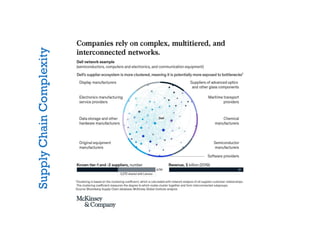
Supply
Chain
Complexity
Problem
• Natural disasters: According to McKinsey, damage from 40 weather
disasters in 2019 cost more than $1 billion each.
• Cybersecurity risks: According to the Interos report, Supply Chain
Experts Experience 2 or More Breaches Over a Year.
• Direct revenue loss: On average, organizations surveyed lose $184
million annually as a result of global supply chain disruptions.
• Productivity loss: The blockage in the Suez Canal in March 2021 is
reported to have delayed up to $10 billion in products.
• Reputational damage: Interos survey (83%) reported that reputational
damage was caused by disruptions in the supply chain.
Reference: https://conexiom.com/blog/the-cost-of-supply-chain-disruptions-20-statistics/
Companies can expect to lose almost 45 percent of one year's
profits over the course of ten years.
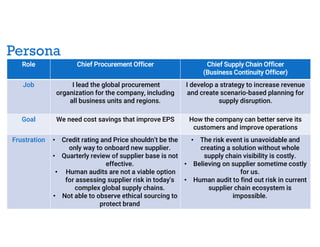
Persona
Role Chief Procurement Officer Chief Supply Chain Officer
(Business Continuity Officer)
Job I lead the global procurement
organization for the company, including
all business units and regions.
I develop a strategy to increase revenue
and create scenario-based planning for
supply disruption.
Goal We need cost savings that improve EPS How the company can better serve its
customers and improve operations
Frustration • Credit rating and Price shouldn’t be the
only way to onboard new supplier.
• Quarterly review of supplier base is not
effective.
• Human audits are not a viable option
for assessing supplier risk in today's
complex global supply chains.
• Not able to observe ethical sourcing to
protect brand
• The risk event is unavoidable and
creating a solution without whole
supply chain visibility is costly.
• Believing on supplier sometime costly
for us.
• Human audit to find out risk in current
supplier chain ecosystem is
impossible.
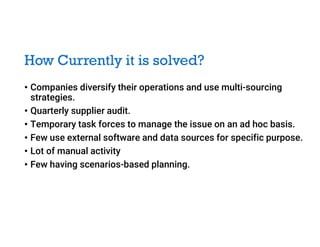
How Currently it is solved?
• Companies diversify their operations and use multi-sourcing
strategies.
• Quarterly supplier audit.
• Temporary task forces to manage the issue on an ad hoc basis.
• Few use external software and data sources for specific purpose.
• Lot of manual activity
• Few having scenarios-based planning.
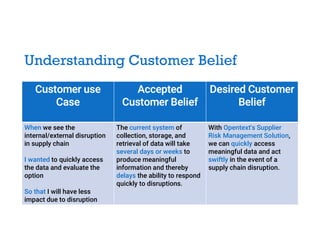
Understanding Customer Belief
Customer use
Case
Accepted
Customer Belief
Desired Customer
Belief
When we see the
internal/external disruption
in supply chain
I wanted to quickly access
the data and evaluate the
option
So that I will have less
impact due to disruption
The current system of
collection, storage, and
retrieval of data will take
several days or weeks to
produce meaningful
information and thereby
delays the ability to respond
quickly to disruptions.
With Opentext's Supplier
Risk Management Solution,
we can quickly access
meaningful data and act
swiftly in the event of a
supply chain disruption.
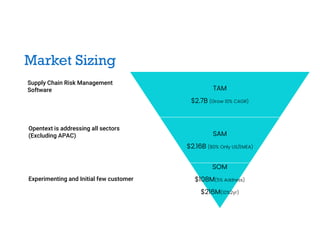
Market Sizing
TAM
$2.7B (Grow 10% CAGR)
SAM
$2.16B (80% Only US/EMEA)
SOM
$108M(5% Address)
$216M(10%2yr)
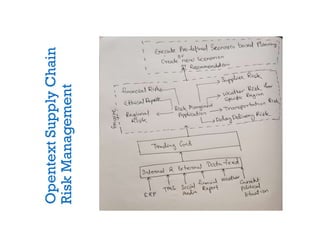
Supply Chain Risk Management
Software
Opentext is addressing all sectors
(Excluding APAC)
Experimenting and Initial few customer
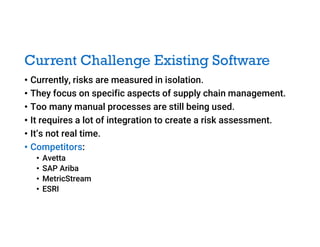
Current Challenge Existing Software
• Currently, risks are measured in isolation.
• They focus on specific aspects of supply chain management.
• Too many manual processes are still being used.
• It requires a lot of integration to create a risk assessment.
• It’s not real time.
• Competitors:
• Avetta
• SAP Ariba
• MetricStream
• ESRI
Opentext
Supply
Chain
Risk
Management
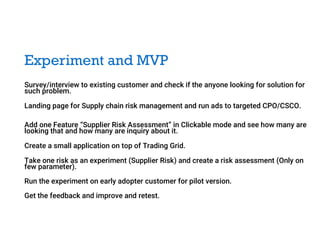
Experiment and MVP
Survey/interview to existing customer and check if the anyone looking for solution for
such problem.
Landing page for Supply chain risk management and run ads to targeted CPO/CSCO.
Add one Feature “Supplier Risk Assessment” in Clickable mode and see how many are
looking that and how many are inquiry about it.
Create a small application on top of Trading Grid.
Take one risk as an experiment (Supplier Risk) and create a risk assessment (Only on
few parameter).
Run the experiment on early adopter customer for pilot version.
Get the feedback and improve and retest.
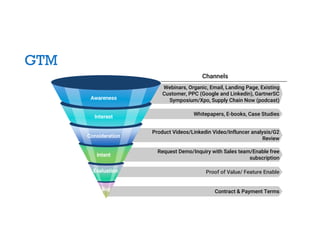
GTM
Contract & Payment Terms
Proof of Value/ Feature Enable
Request Demo/Inquiry with Sales team/Enable free
subscription
Product Videos/Linkedin Video/Influncer analysis/G2
Review
Whitepapers, E-books, Case Studies
Webinars, Organic, Email, Landing Page, Existing
Customer, PPC (Google and Linkedin), GartnerSC
Symposium/Xpo, Supply Chain Now (podcast)
Buy
Evaluation
Intent
Consideration
Interest
Awareness
Channels
Metrics
Leading Metrics
• Number of Risk Shared / Number of Risk Acted/ Number of Risk Ignored
• Time it took to identified the risk/ Time spend on application
Lagging Metrics
• Total Cost for Inability to Procure Supplies during disruption
• Total loss of revenue during current disruption
• Production impacted due to disruption
• Number of Backup supplier available
• 3PL/TMS metrics during disruption
• % of Compliance with partners
Edge_Strategy_Opentext_Supplier_Risk_Management.pdf

Edge_Strategy_Opentext_Supplier_Risk_Management.pdf

  • 1.
  • 2.
    Executive Briefing Problem: Today’ssupply chains are subject to disruption due to intensifying trade disputes, political upheavals and wars, or high-cost natural disasters. Who: Fast-moving consumer goods, retail, chemicals, pharma, and discrete-manufacturing industries Why: Price rise/Shortages/Delivery Failures/Reputational damage How: By integrating real-time data into your supply chain strategy, you can track factors that could affect the success of your operations and take pro-active action to prevent problems from arising. Solution: Supply Chain Risk Management
  • 3.
    OpenText Business Network Vision:Helping you tackle the most complex digital transformation programs with confidence. Business Network : B2A (Business to Anything) at a global scale to create streamlined supply chains, secure collaboration, and real-time business intelligence. Our Trading Grid connects trading partners globally and is used across a variety of industries. It offers a cloud-based service that enables integration, data management, messaging, communications and secure data exchange across an increasingly complex network of off-cloud and cloud applications, connected devices and business partners or customers. Goal: To develop a more efficient and effective disruption/risk management process for my customer.
  • 4.
  • 5.
    Problem • Natural disasters:According to McKinsey, damage from 40 weather disasters in 2019 cost more than $1 billion each. • Cybersecurity risks: According to the Interos report, Supply Chain Experts Experience 2 or More Breaches Over a Year. • Direct revenue loss: On average, organizations surveyed lose $184 million annually as a result of global supply chain disruptions. • Productivity loss: The blockage in the Suez Canal in March 2021 is reported to have delayed up to $10 billion in products. • Reputational damage: Interos survey (83%) reported that reputational damage was caused by disruptions in the supply chain. Reference: https://conexiom.com/blog/the-cost-of-supply-chain-disruptions-20-statistics/ Companies can expect to lose almost 45 percent of one year's profits over the course of ten years.
  • 6.
    Persona Role Chief ProcurementOfficer Chief Supply Chain Officer (Business Continuity Officer) Job I lead the global procurement organization for the company, including all business units and regions. I develop a strategy to increase revenue and create scenario-based planning for supply disruption. Goal We need cost savings that improve EPS How the company can better serve its customers and improve operations Frustration • Credit rating and Price shouldn’t be the only way to onboard new supplier. • Quarterly review of supplier base is not effective. • Human audits are not a viable option for assessing supplier risk in today's complex global supply chains. • Not able to observe ethical sourcing to protect brand • The risk event is unavoidable and creating a solution without whole supply chain visibility is costly. • Believing on supplier sometime costly for us. • Human audit to find out risk in current supplier chain ecosystem is impossible.
  • 7.
    How Currently itis solved? • Companies diversify their operations and use multi-sourcing strategies. • Quarterly supplier audit. • Temporary task forces to manage the issue on an ad hoc basis. • Few use external software and data sources for specific purpose. • Lot of manual activity • Few having scenarios-based planning.
  • 8.
    Understanding Customer Belief Customeruse Case Accepted Customer Belief Desired Customer Belief When we see the internal/external disruption in supply chain I wanted to quickly access the data and evaluate the option So that I will have less impact due to disruption The current system of collection, storage, and retrieval of data will take several days or weeks to produce meaningful information and thereby delays the ability to respond quickly to disruptions. With Opentext's Supplier Risk Management Solution, we can quickly access meaningful data and act swiftly in the event of a supply chain disruption.
  • 9.
    Market Sizing TAM $2.7B (Grow10% CAGR) SAM $2.16B (80% Only US/EMEA) SOM $108M(5% Address) $216M(10%2yr) Supply Chain Risk Management Software Opentext is addressing all sectors (Excluding APAC) Experimenting and Initial few customer
  • 10.
    Current Challenge ExistingSoftware • Currently, risks are measured in isolation. • They focus on specific aspects of supply chain management. • Too many manual processes are still being used. • It requires a lot of integration to create a risk assessment. • It’s not real time. • Competitors: • Avetta • SAP Ariba • MetricStream • ESRI
  • 11.
  • 12.
    Experiment and MVP Survey/interviewto existing customer and check if the anyone looking for solution for such problem. Landing page for Supply chain risk management and run ads to targeted CPO/CSCO. Add one Feature “Supplier Risk Assessment” in Clickable mode and see how many are looking that and how many are inquiry about it. Create a small application on top of Trading Grid. Take one risk as an experiment (Supplier Risk) and create a risk assessment (Only on few parameter). Run the experiment on early adopter customer for pilot version. Get the feedback and improve and retest.
  • 13.
    GTM Contract & PaymentTerms Proof of Value/ Feature Enable Request Demo/Inquiry with Sales team/Enable free subscription Product Videos/Linkedin Video/Influncer analysis/G2 Review Whitepapers, E-books, Case Studies Webinars, Organic, Email, Landing Page, Existing Customer, PPC (Google and Linkedin), GartnerSC Symposium/Xpo, Supply Chain Now (podcast) Buy Evaluation Intent Consideration Interest Awareness Channels
  • 14.
    Metrics Leading Metrics • Numberof Risk Shared / Number of Risk Acted/ Number of Risk Ignored • Time it took to identified the risk/ Time spend on application Lagging Metrics • Total Cost for Inability to Procure Supplies during disruption • Total loss of revenue during current disruption • Production impacted due to disruption • Number of Backup supplier available • 3PL/TMS metrics during disruption • % of Compliance with partners