EDGE computing and it’s role in architecting IoT
K. K. PATTANAIK
Wireless Sensor Networks laboratory
Atal Bihari Vajpayee –
Indian Institute of Information Technology and Management,
Gwalior
kkpatnaik@iiitm.ac.in
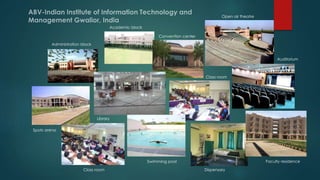
Administration block
Academic block
Convention center
Open air theatre
Auditorium
Class room
Library
Class room
Spots arena
Swimming pool
Dispensary
Faculty residence
Academic programs offered
• 4 year BTech in CSE (started in 2017)
• 5 year Integrated Post Graduate in IT
• 5 year Integrated Post Graduate in MBA
• 2 year Mtech in CN, IS, DC, VLSI
• PhD
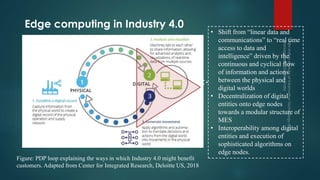
Figure: PDP loop explaining the ways in which Industry 4.0 might benefit
customers. Adapted from Center for Integrated Research, Deloitte US, 2018
• Shift from “linear data and
communications” to “real time
access to data and
intelligence” driven by the
continuous and cyclical flow
of information and actions
between the physical and
digital worlds
• Decentralization of digital
entities onto edge nodes
towards a modular structure of
MES
• Interoperability among digital
entities and execution of
sophisticated algorithms on
edge nodes.
Edge computing in Industry 4.0
Example on improving the availability of the
machine
Figure: OE without an adaptive mechanism Figure: OE as a consequence of adaptive mechanism
• Identification of “beginning of deterioration” and the “rate of deterioration” in OE of machine
is necessary to mitigate the unscheduled down state.
• Sophisticated algorithms at edge nodes to signal the deterioration and adaptively control the workload
will defer early breakdown and enhance average AOE
AOE =
𝐴𝑐𝑡𝑢𝑎𝑙 𝑡ℎ𝑟𝑜𝑢𝑔ℎ𝑝𝑢𝑡
𝐼𝑑𝑒𝑎𝑙 𝑡ℎ𝑟𝑜𝑢𝑔ℎ𝑝𝑢𝑡
Case of improving the average Absolute Operational Efficiency (AOE) of machine through edge intelligence
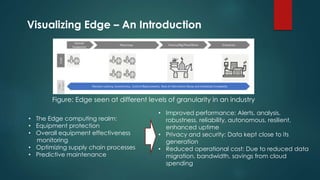
Visualizing Edge – An Introduction
Figure: Edge seen at different levels of granularity in an industry
• The Edge computing realm:
• Equipment protection
• Overall equipment effectiveness
monitoring
• Optimizing supply chain processes
• Predictive maintenance
• Improved performance: Alerts, analysis,
robustness, reliability, autonomous, resilient,
enhanced uptime
• Privacy and security: Data kept close to its
generation
• Reduced operational cost: Due to reduced data
migration, bandwidth, savings from cloud
spending
Visualizing Edge – An Introduction (continued)
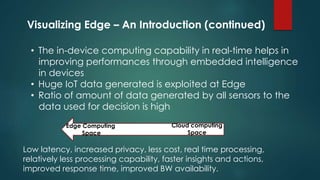
• The in-device computing capability in real-time helps in
improving performances through embedded intelligence
in devices
• Huge IoT data generated is exploited at Edge
• Ratio of amount of data generated by all sensors to the
data used for decision is high
Edge Computing
Space
Cloud computing
Space
Low latency, increased privacy, less cost, real time processing,
relatively less processing capability, faster insights and actions,
improved response time, improved BW availability.
Visualizing Edge – An Introduction (continued)
Edge Computing
Space
Cloud computing
Space
Low latency, increased privacy,
less cost, real time processing,
relatively less processing capability,
faster insights and actions,
improved response time,
improved BW availability.
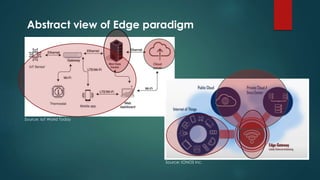
Abstract view of Edge paradigm
Source: IONOS Inc.
Source: IoT World Today
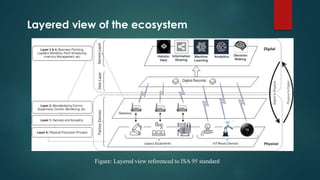
Figure: Layered view referenced to ISA 95 standard
Layered view of the ecosystem
Edge computing – Use cases
• Banks analyze ATM video feeds in real-time
• Mining companies use their data to optimize operations
• Chemical industries analyze the workers’ exposure trend to
harmful chemicals/gases
• Retailers can personalize the shopping experience of
customers and communicate specialized offers
• Industrial analytics
• Fleet management application
• Product traceability application
• Connected elevators to monitor the elevators’ health
• Cobots (collaborative robots) etc.
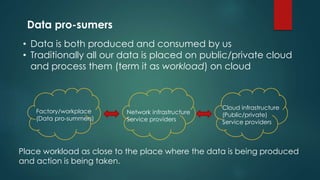
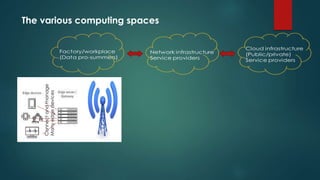
Data pro-sumers
• Data is both produced and consumed by us
• Traditionally all our data is placed on public/private cloud
and process them (term it as workload) on cloud
Cloud infrastructure
(Public/private)
Service providers
Network infrastructure
Service providers
Factory/workplace
(Data pro-summers)
Place workload as close to the place where the data is being produced
and action is being taken.
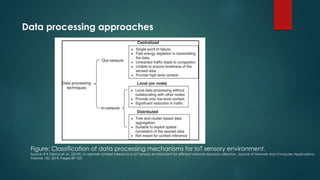
Data processing approaches
Figure: Classification of data processing mechanisms for IoT sensory environment.
Source: R K Verma et al., (2019), In-network context inference in IoT sensory environment for efficient network resource utilization, Journal of Network and Computer Applications,
Volume 130, 2019, Pages 89-103.
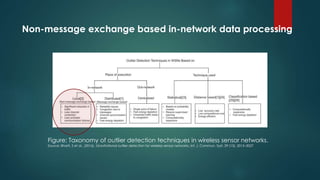
Non-message exchange based in-network data processing
Figure: Taxonomy of outlier detection techniques in wireless sensor networks.
Source: Bharti, S et al., (2016), Gravitational outlier detection for wireless sensor networks. Int. J. Commun. Syst. 29 (13), 2015–2027
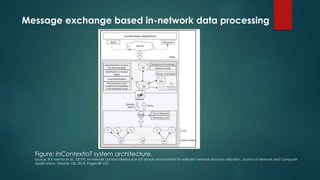
Message exchange based in-network data processing
Figure: InContextIoT system architecture.
Source: R K Verma et al., (2019), In-network context inference in IoT sensory environment for efficient network resource utilization, Journal of Network and Computer
Applications, Volume 130, 2019, Pages 89-103.
Message exchange based in-network data processing
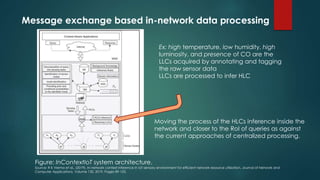
Figure: InContextIoT system architecture.
Source: R K Verma et al., (2019), In-network context inference in IoT sensory environment for efficient network resource utilization, Journal of Network and
Computer Applications, Volume 130, 2019, Pages 89-103.
Ex: high temperature, low humidity, high
luminosity, and presence of CO are the
LLCs acquired by annotating and tagging
the raw sensor data
LLCs are processed to infer HLC
Moving the process of the HLCs inference inside the
network and closer to the RoI of queries as against
the current approaches of centralized processing.
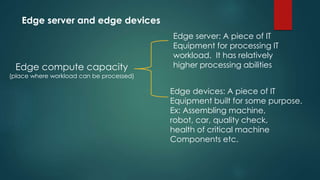
Edge server and edge devices
Edge compute capacity
(place where workload can be processed)
Edge server: A piece of IT
Equipment for processing IT
workload. It has relatively
higher processing abilities
Edge devices: A piece of IT
Equipment built for some purpose.
Ex: Assembling machine,
robot, car, quality check,
health of critical machine
Components etc.
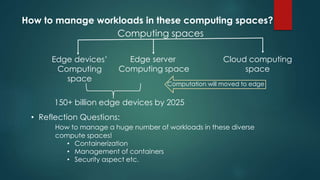
The various computing spaces
Connect
and
manage
Many
edge
devices
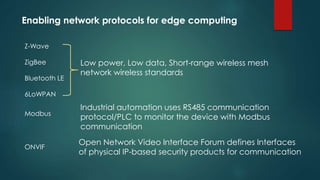
How to manage workloads in these computing spaces?
• Reflection Questions:
How to manage a huge number of workloads in these diverse
compute spaces!
• Containerization
• Management of containers
• Security aspect etc.
Computing spaces
Edge devices’
Computing
space
Edge server
Computing space
Cloud computing
space
150+ billion edge devices by 2025
Computation will moved to edge
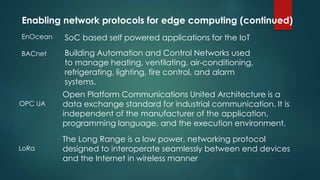
Enabling network protocols for edge computing
Low power, Low data, Short-range wireless mesh
network wireless standards
Z-Wave
ZigBee
Bluetooth LE
6LoWPAN
Industrial automation uses RS485 communication
protocol/PLC to monitor the device with Modbus
communication
Modbus
ONVIF
Open Network Video Interface Forum defines Interfaces
of physical IP-based security products for communication
Enabling network protocols for edge computing (continued)
SoC based self powered applications for the IoT
EnOcean
Open Platform Communications United Architecture is a
data exchange standard for industrial communication. It is
independent of the manufacturer of the application,
programming language, and the execution environment.
BACnet Building Automation and Control Networks used
to manage heating, ventilating, air-conditioning,
refrigerating, lighting, fire control, and alarm
systems.
OPC UA
The Long Range is a low power, networking protocol
designed to interoperate seamlessly between end devices
and the Internet in wireless manner
LoRa
Application layer protocols for gateway communication
To allow remote applications to communicate with the gateway
• MQTT: Message Queuing Telemetry Transport based on publish-subscribe
architecture
• AMQP: Advanced Message Queuing Protocol
• CoAP: Constrained Application Protocol, a web transfer protocol for IoT
• REST: Representational State Transfer architectural style for IoT atop
application layer
• WebSockets: A low-latency, full-duplex, persistent protocol that allows
the server to update the client application without an initiating request
from the client.
• JSON-RPC: A RPC protocol for microservices that allows clients to push
data/multiple calls to be sent to the server which need not be answered
in order.
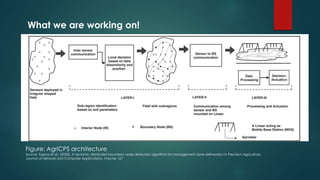
What we are working on!
Figure: AgriCPS architecture
Source: Sapna et al., (2020), A dynamic distributed boundary node detection algorithm for management zone delineation in Precision Agriculture,
Journal of Network and Computer Applications, Volume 167
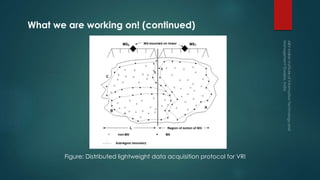
Figure: Distributed lightweight data acquisition protocol for VRI
What we are working on! (continued)
• Edge server placement schemes to minimize edge device to server
communication cost
• Split learning in edge-cloud collaboration for predictive maintenance
• Optimizing communication cost for interactive IoT sensory environments
• Workload offloading in multi-access edge computing
Contributions of all the PhD scholars of Wireless Sensor Networks laboratory at ABV-
IIITM Gwalior is appreciated and duly acknowledged.
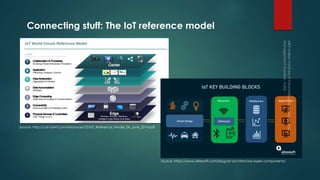
Connecting stuff: The IoT reference model
Source: http://cdn.iotwf.com/resources/72/IoT_Reference_Model_04_June_2014.pdf
Source: https://www.altexsoft.com/blog/iot-architecture-layers-components/
THANK YOU

Edge computing and its role in architecting IoT

  • 1.
    EDGE computing andit’s role in architecting IoT K. K. PATTANAIK Wireless Sensor Networks laboratory Atal Bihari Vajpayee – Indian Institute of Information Technology and Management, Gwalior kkpatnaik@iiitm.ac.in
  • 2.
    Administration block Academic block Conventioncenter Open air theatre Auditorium Class room Library Class room Spots arena Swimming pool Dispensary Faculty residence
  • 3.
    Academic programs offered •4 year BTech in CSE (started in 2017) • 5 year Integrated Post Graduate in IT • 5 year Integrated Post Graduate in MBA • 2 year Mtech in CN, IS, DC, VLSI • PhD
  • 4.
    Figure: PDP loopexplaining the ways in which Industry 4.0 might benefit customers. Adapted from Center for Integrated Research, Deloitte US, 2018 • Shift from “linear data and communications” to “real time access to data and intelligence” driven by the continuous and cyclical flow of information and actions between the physical and digital worlds • Decentralization of digital entities onto edge nodes towards a modular structure of MES • Interoperability among digital entities and execution of sophisticated algorithms on edge nodes. Edge computing in Industry 4.0
  • 5.
    Example on improvingthe availability of the machine Figure: OE without an adaptive mechanism Figure: OE as a consequence of adaptive mechanism • Identification of “beginning of deterioration” and the “rate of deterioration” in OE of machine is necessary to mitigate the unscheduled down state. • Sophisticated algorithms at edge nodes to signal the deterioration and adaptively control the workload will defer early breakdown and enhance average AOE AOE = 𝐴𝑐𝑡𝑢𝑎𝑙 𝑡ℎ𝑟𝑜𝑢𝑔ℎ𝑝𝑢𝑡 𝐼𝑑𝑒𝑎𝑙 𝑡ℎ𝑟𝑜𝑢𝑔ℎ𝑝𝑢𝑡 Case of improving the average Absolute Operational Efficiency (AOE) of machine through edge intelligence
  • 6.
    Visualizing Edge –An Introduction Figure: Edge seen at different levels of granularity in an industry • The Edge computing realm: • Equipment protection • Overall equipment effectiveness monitoring • Optimizing supply chain processes • Predictive maintenance • Improved performance: Alerts, analysis, robustness, reliability, autonomous, resilient, enhanced uptime • Privacy and security: Data kept close to its generation • Reduced operational cost: Due to reduced data migration, bandwidth, savings from cloud spending
  • 7.
    Visualizing Edge –An Introduction (continued) • The in-device computing capability in real-time helps in improving performances through embedded intelligence in devices • Huge IoT data generated is exploited at Edge • Ratio of amount of data generated by all sensors to the data used for decision is high Edge Computing Space Cloud computing Space Low latency, increased privacy, less cost, real time processing, relatively less processing capability, faster insights and actions, improved response time, improved BW availability.
  • 8.
    Visualizing Edge –An Introduction (continued) Edge Computing Space Cloud computing Space Low latency, increased privacy, less cost, real time processing, relatively less processing capability, faster insights and actions, improved response time, improved BW availability.
  • 9.
    Abstract view ofEdge paradigm Source: IONOS Inc. Source: IoT World Today
  • 10.
    Figure: Layered viewreferenced to ISA 95 standard Layered view of the ecosystem
  • 11.
    Edge computing –Use cases • Banks analyze ATM video feeds in real-time • Mining companies use their data to optimize operations • Chemical industries analyze the workers’ exposure trend to harmful chemicals/gases • Retailers can personalize the shopping experience of customers and communicate specialized offers • Industrial analytics • Fleet management application • Product traceability application • Connected elevators to monitor the elevators’ health • Cobots (collaborative robots) etc.
  • 12.
    Data pro-sumers • Datais both produced and consumed by us • Traditionally all our data is placed on public/private cloud and process them (term it as workload) on cloud Cloud infrastructure (Public/private) Service providers Network infrastructure Service providers Factory/workplace (Data pro-summers) Place workload as close to the place where the data is being produced and action is being taken.
  • 13.
    Data processing approaches Figure:Classification of data processing mechanisms for IoT sensory environment. Source: R K Verma et al., (2019), In-network context inference in IoT sensory environment for efficient network resource utilization, Journal of Network and Computer Applications, Volume 130, 2019, Pages 89-103.
  • 14.
    Non-message exchange basedin-network data processing Figure: Taxonomy of outlier detection techniques in wireless sensor networks. Source: Bharti, S et al., (2016), Gravitational outlier detection for wireless sensor networks. Int. J. Commun. Syst. 29 (13), 2015–2027
  • 15.
    Message exchange basedin-network data processing Figure: InContextIoT system architecture. Source: R K Verma et al., (2019), In-network context inference in IoT sensory environment for efficient network resource utilization, Journal of Network and Computer Applications, Volume 130, 2019, Pages 89-103.
  • 16.
    Message exchange basedin-network data processing Figure: InContextIoT system architecture. Source: R K Verma et al., (2019), In-network context inference in IoT sensory environment for efficient network resource utilization, Journal of Network and Computer Applications, Volume 130, 2019, Pages 89-103. Ex: high temperature, low humidity, high luminosity, and presence of CO are the LLCs acquired by annotating and tagging the raw sensor data LLCs are processed to infer HLC Moving the process of the HLCs inference inside the network and closer to the RoI of queries as against the current approaches of centralized processing.
  • 17.
    Edge server andedge devices Edge compute capacity (place where workload can be processed) Edge server: A piece of IT Equipment for processing IT workload. It has relatively higher processing abilities Edge devices: A piece of IT Equipment built for some purpose. Ex: Assembling machine, robot, car, quality check, health of critical machine Components etc.
  • 18.
    The various computingspaces Connect and manage Many edge devices
  • 19.
    How to manageworkloads in these computing spaces? • Reflection Questions: How to manage a huge number of workloads in these diverse compute spaces! • Containerization • Management of containers • Security aspect etc. Computing spaces Edge devices’ Computing space Edge server Computing space Cloud computing space 150+ billion edge devices by 2025 Computation will moved to edge
  • 20.
    Enabling network protocolsfor edge computing Low power, Low data, Short-range wireless mesh network wireless standards Z-Wave ZigBee Bluetooth LE 6LoWPAN Industrial automation uses RS485 communication protocol/PLC to monitor the device with Modbus communication Modbus ONVIF Open Network Video Interface Forum defines Interfaces of physical IP-based security products for communication
  • 21.
    Enabling network protocolsfor edge computing (continued) SoC based self powered applications for the IoT EnOcean Open Platform Communications United Architecture is a data exchange standard for industrial communication. It is independent of the manufacturer of the application, programming language, and the execution environment. BACnet Building Automation and Control Networks used to manage heating, ventilating, air-conditioning, refrigerating, lighting, fire control, and alarm systems. OPC UA The Long Range is a low power, networking protocol designed to interoperate seamlessly between end devices and the Internet in wireless manner LoRa
  • 22.
    Application layer protocolsfor gateway communication To allow remote applications to communicate with the gateway • MQTT: Message Queuing Telemetry Transport based on publish-subscribe architecture • AMQP: Advanced Message Queuing Protocol • CoAP: Constrained Application Protocol, a web transfer protocol for IoT • REST: Representational State Transfer architectural style for IoT atop application layer • WebSockets: A low-latency, full-duplex, persistent protocol that allows the server to update the client application without an initiating request from the client. • JSON-RPC: A RPC protocol for microservices that allows clients to push data/multiple calls to be sent to the server which need not be answered in order.
  • 23.
    What we areworking on! Figure: AgriCPS architecture Source: Sapna et al., (2020), A dynamic distributed boundary node detection algorithm for management zone delineation in Precision Agriculture, Journal of Network and Computer Applications, Volume 167
  • 24.
    Figure: Distributed lightweightdata acquisition protocol for VRI What we are working on! (continued)
  • 25.
    What we areworking on! (continued) • Edge server placement schemes to minimize edge device to server communication cost • Split learning in edge-cloud collaboration for predictive maintenance • Optimizing communication cost for interactive IoT sensory environments • Workload offloading in multi-access edge computing Contributions of all the PhD scholars of Wireless Sensor Networks laboratory at ABV- IIITM Gwalior is appreciated and duly acknowledged.
  • 26.
    Connecting stuff: TheIoT reference model Source: http://cdn.iotwf.com/resources/72/IoT_Reference_Model_04_June_2014.pdf Source: https://www.altexsoft.com/blog/iot-architecture-layers-components/
  • 27.