What is Edge Computing?
Edge computing is a distributed computing paradigm that brings computation and data
storage closer to the sources of data, rather than relying on a central data center or cloud.
This approach aims to improve response times, reduce bandwidth usage, and enable real-
time processing of data generated by Internet of Things (IoT) devices, sensors, and other
connected systems. By processing data closer to the edge, where it is generated, edge
computing can offer faster insights, reduced latency, and increased reliability, especially in
applications that require instant decision-making or have limited connectivity to the cloud.
Edge computing involves deploying small-scale computing infrastructure, such as micro data
centers, gateways, and embedded systems, at the edge of a network, closer to the source of
data. This allows for immediate processing and analysis of data, without the need to send it
back to a centralized cloud or data center. This can be especially beneficial in scenarios
where rapid response times are critical, such as autonomous vehicles, industrial automation,
and real-time monitoring of critical infrastructure.
by Harsh Dixit
The Rise of Edge Computing
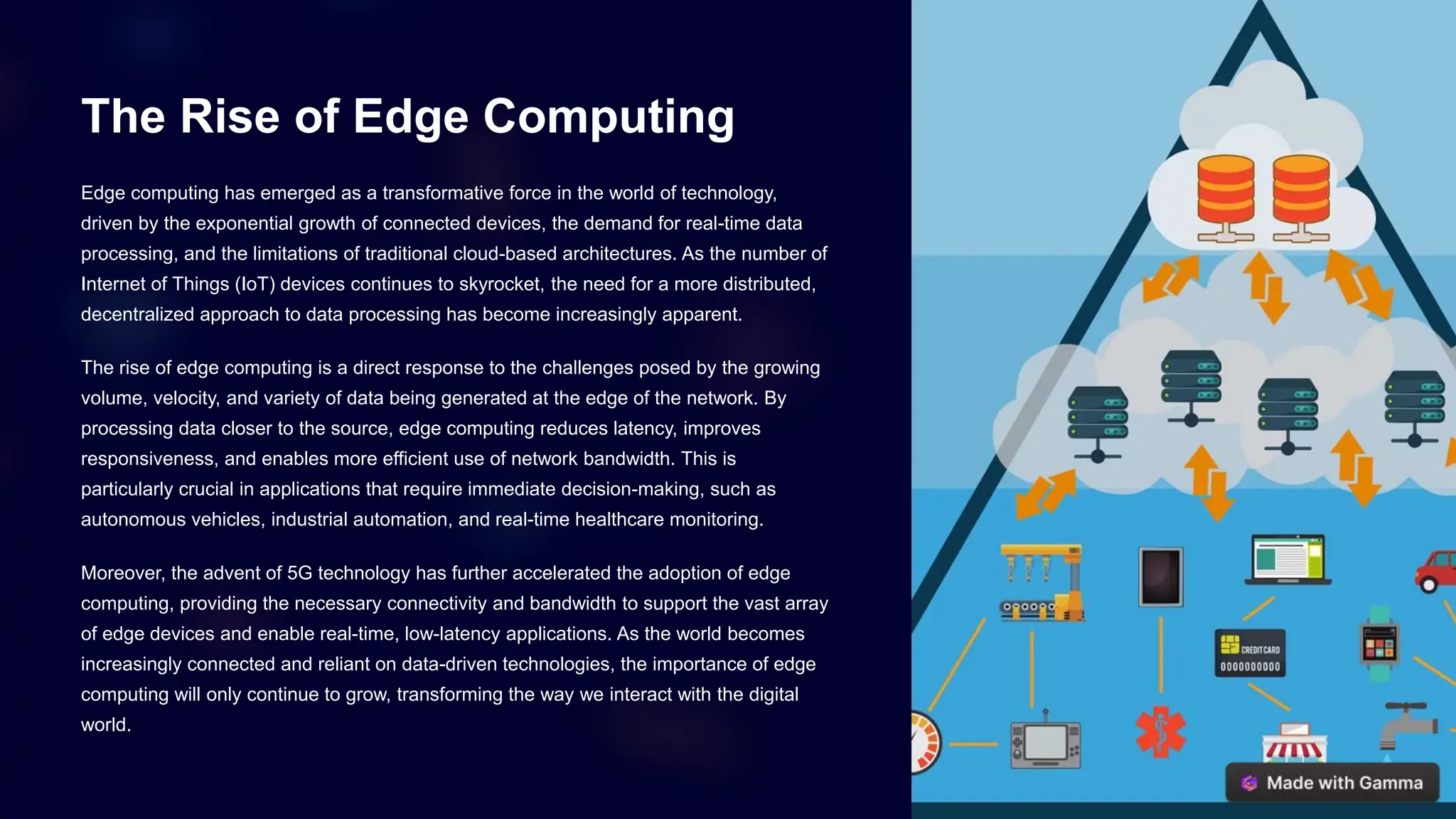
Edge computing has emerged as a transformative force in the world of technology,
driven by the exponential growth of connected devices, the demand for real-time data
processing, and the limitations of traditional cloud-based architectures. As the number of
Internet of Things (IoT) devices continues to skyrocket, the need for a more distributed,
decentralized approach to data processing has become increasingly apparent.
The rise of edge computing is a direct response to the challenges posed by the growing
volume, velocity, and variety of data being generated at the edge of the network. By
processing data closer to the source, edge computing reduces latency, improves
responsiveness, and enables more efficient use of network bandwidth. This is
particularly crucial in applications that require immediate decision-making, such as
autonomous vehicles, industrial automation, and real-time healthcare monitoring.
Moreover, the advent of 5G technology has further accelerated the adoption of edge
computing, providing the necessary connectivity and bandwidth to support the vast array
of edge devices and enable real-time, low-latency applications. As the world becomes
increasingly connected and reliant on data-driven technologies, the importance of edge
computing will only continue to grow, transforming the way we interact with the digital
world.
Key Benefits of Edge Computing
Reduced Latency
Edge computing moves data processing
and storage closer to the source of the
data, rather than relying on a centralized
cloud. This significantly reduces latency,
as data doesn't have to travel long
distances to reach the cloud and back.
This is crucial for applications that
require real-time responsiveness, such
as autonomous vehicles, remote
healthcare, and industrial automation.
Improved Bandwidth Efficiency
By processing data closer to the source,
edge computing reduces the amount of
data that needs to be transmitted to the
cloud, freeing up valuable bandwidth.
This is particularly important for IoT
devices and sensors that generate
massive amounts of data, as it allows
companies to process only the most
relevant information and reduce overall
data transmission costs.
Enhanced Security and Privacy
Edge computing can improve data
security and privacy by keeping
sensitive information local and avoiding
the need to send it to a remote cloud.
This is especially beneficial for
industries with strict data regulations,
such as healthcare and finance, as it
reduces the risk of data breaches and
unauthorized access.
Increased Reliability and
Resilience
Edge computing systems can continue
to operate even if the connection to the
central cloud is disrupted, ensuring
uninterrupted service and data
processing. This makes edge computing
particularly valuable for applications that
cannot tolerate downtime, such as
critical infrastructure monitoring,
emergency services, and remote energy
facilities.
Edge Computing Use Cases
1 Smart Cities
Edge computing is transforming the way smart cities operate. By processing data
closer to the source, edge devices can quickly respond to traffic patterns, monitor
air quality, manage energy grids, and coordinate emergency services. This real-
time data processing enables cities to optimize infrastructure, reduce congestion,
and enhance public safety in ways that would be impossible with traditional cloud-
based systems. Edge computing's low latency and autonomous capabilities are
critical for smart city applications that require instant decision-making and rapid
response times.
2 Industrial Automation
Edge computing is revolutionizing industrial processes by bringing intelligence
and decision-making closer to the machines and sensors on the factory floor. With
edge devices analyzing data in real-time, manufacturers can quickly detect
equipment anomalies, automate quality control, and optimize production
workflows. This results in increased efficiency, reduced downtime, and improved
product quality. Edge computing also enhances industrial IoT by enabling
autonomous control of robotic systems, predictive maintenance, and seamless
integration with existing operational technology (OT) infrastructure.
3 Healthcare Monitoring
In the healthcare sector, edge computing is enabling new remote patient
monitoring and telehealth capabilities. Wearable devices and in-home sensors
can continuously collect and analyze health data at the edge, alerting clinicians to
changes in a patient's condition and triggering timely interventions. This improves
patient outcomes by facilitating early detection of issues and reducing the need
Edge Computing Architecture
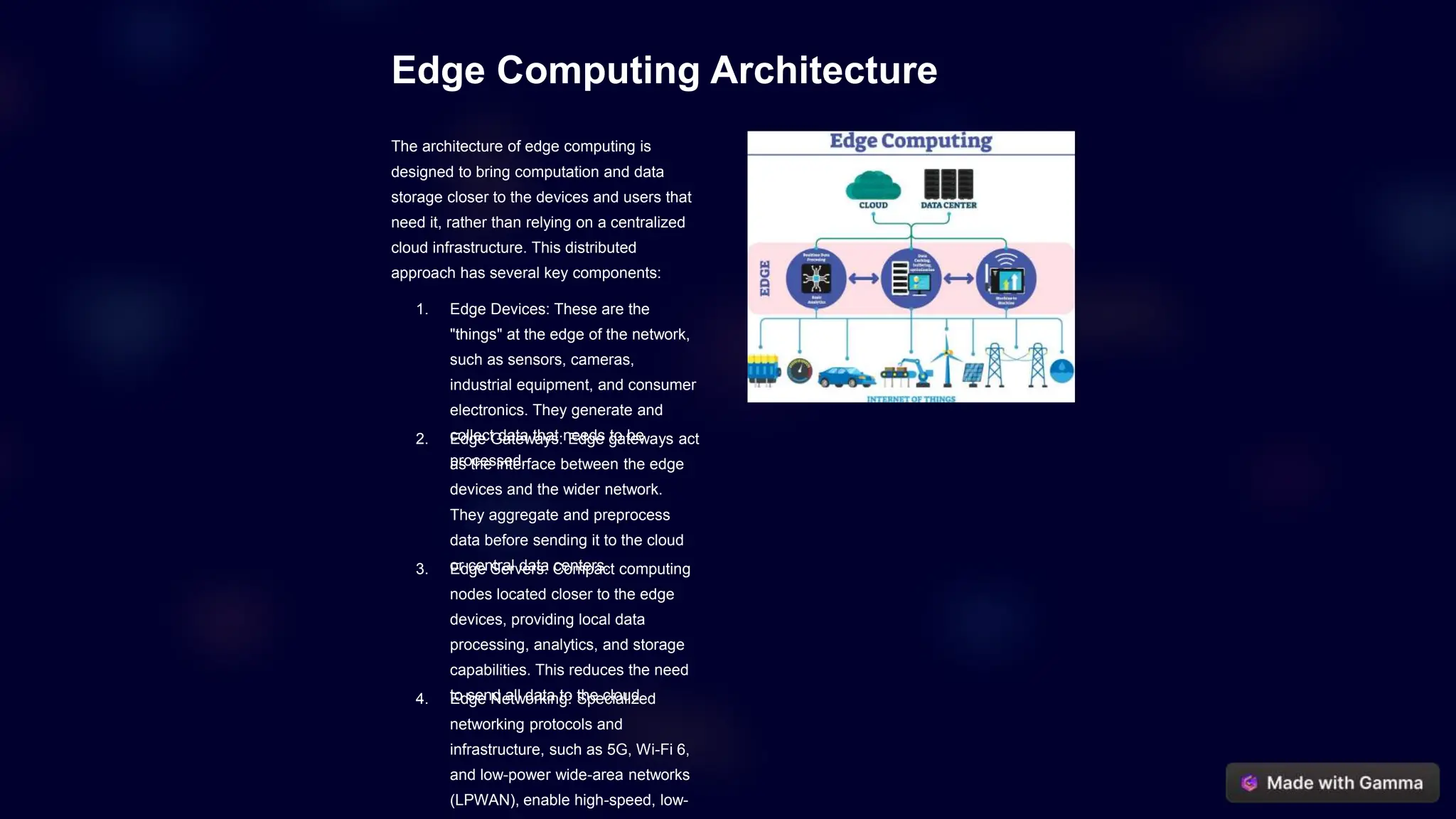
The architecture of edge computing is
designed to bring computation and data
storage closer to the devices and users that
need it, rather than relying on a centralized
cloud infrastructure. This distributed
approach has several key components:
1. Edge Devices: These are the
"things" at the edge of the network,
such as sensors, cameras,
industrial equipment, and consumer
electronics. They generate and
collect data that needs to be
processed.
2. Edge Gateways: Edge gateways act
as the interface between the edge
devices and the wider network.
They aggregate and preprocess
data before sending it to the cloud
or central data centers.
3. Edge Servers: Compact computing
nodes located closer to the edge
devices, providing local data
processing, analytics, and storage
capabilities. This reduces the need
to send all data to the cloud.
4. Edge Networking: Specialized
networking protocols and
infrastructure, such as 5G, Wi-Fi 6,
and low-power wide-area networks
(LPWAN), enable high-speed, low-
Edge Computing Devices and Sensors
Edge Devices
Edge computing devices are
the physical hardware that
perform data processing and
analysis at the edge of the
network, closer to the source
of data. These can include a
wide range of devices such
as industrial PCs,
programmable logic
controllers (PLCs), IoT
gateways, mobile devices,
and embedded systems.
These devices are designed
to be compact, energy-
efficient, and capable of
running specialized software
to carry out tasks like real-
time analytics, machine
learning, and data
aggregation without the
Sensors
Sensors are a critical
component of edge
computing, as they collect
the raw data that is then
processed and analyzed at
the edge. Edge sensors can
include a variety of devices
such as cameras,
thermometers, pressure
sensors, motion detectors,
and more. These sensors
are often deployed in remote
or hard-to-reach locations,
so they need to be rugged,
reliable, and able to operate
with minimal power
consumption. The data from
these sensors is then fed
into the edge devices for
near real-time processing
Connectivity
Connecting edge devices
and sensors to the broader
network is a crucial aspect
of edge computing. This can
be achieved through a
variety of communication
protocols and technologies,
such as Wi-Fi, Bluetooth,
Ethernet, cellular networks,
and specialized industrial
protocols like Modbus and
Profibus. Reliable and low-
latency connectivity is
essential for enabling the
real-time data processing
and decision-making at the
edge, reducing the need to
constantly send data back to
the cloud.
Edge Computing Protocols and
Standards
As the world of technology continues to evolve, the need for efficient and reliable communication
protocols and standards has become increasingly important, especially in the realm of edge
computing. Edge computing, which involves processing data closer to the source rather than in a
centralized cloud, requires a unique set of protocols and standards to ensure seamless data
transfer, low latency, and secure communications.
One of the key protocols in edge computing is the Message Queuing Telemetry Transport (MQTT)
protocol, which is designed to enable efficient and lightweight communication between devices
and applications. MQTT utilizes a publish-subscribe model, allowing devices to send and receive
data without the need for a constant connection, making it well-suited for low-bandwidth and
intermittent connectivity scenarios common in edge environments.
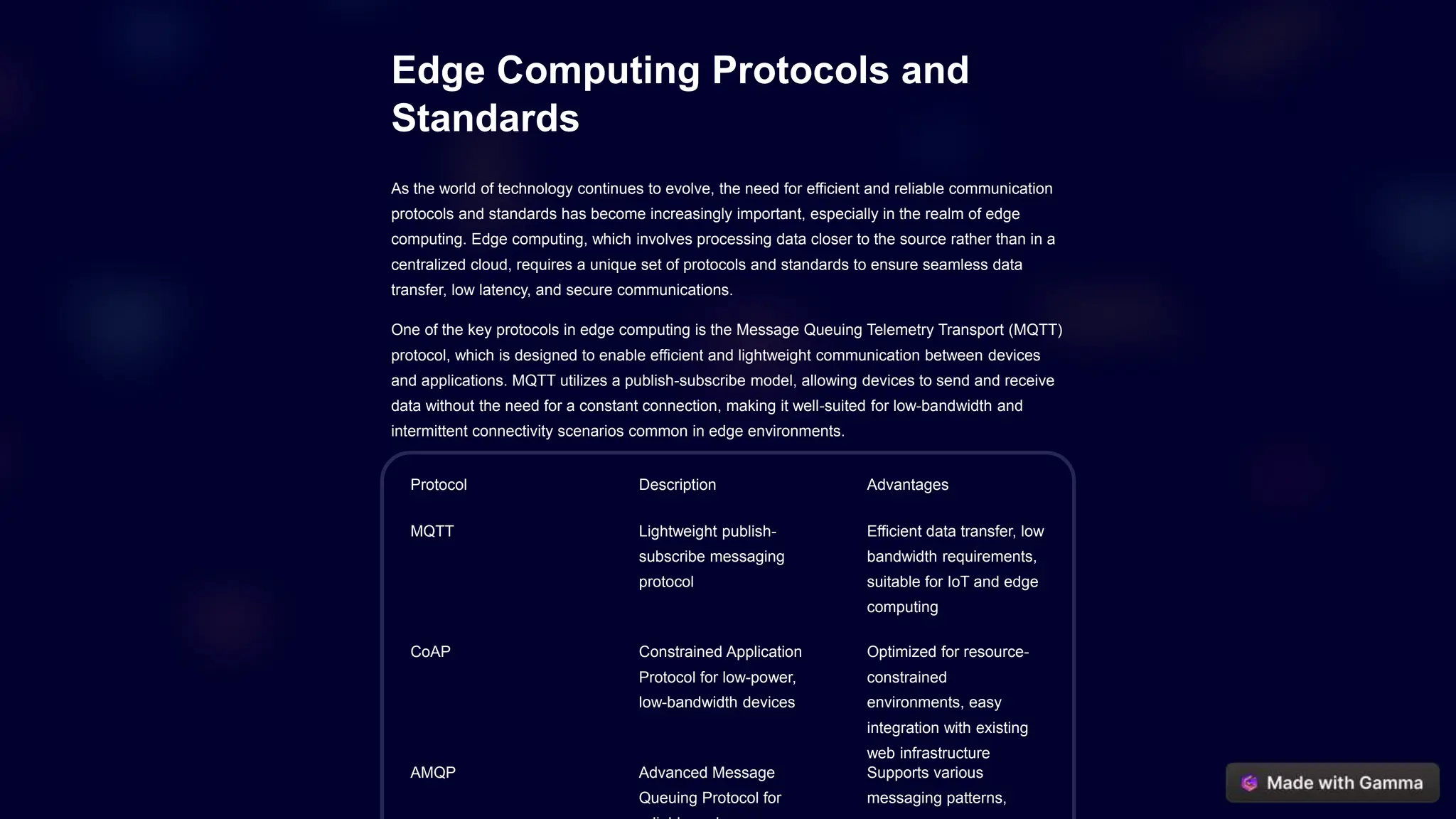
Protocol Description Advantages
MQTT Lightweight publish-
subscribe messaging
protocol
Efficient data transfer, low
bandwidth requirements,
suitable for IoT and edge
computing
CoAP Constrained Application
Protocol for low-power,
low-bandwidth devices
Optimized for resource-
constrained
environments, easy
integration with existing
web infrastructure
AMQP Advanced Message
Queuing Protocol for
Supports various
messaging patterns,
Challenges in Edge Computing
Resource
Constraints
Edge devices
often have limited
computational
power, memory,
and storage
compared to
centralized cloud
infrastructure.
This poses
challenges in
running complex
algorithms and
processing large
amounts of data
on the edge.
Developers must
optimize code,
leverage
specialized
hardware, and
find ways to
balance
performance and
Security and
Privacy
Edge computing
brings data closer
to the source, but
this also increases
the potential
attack surface.
Securing edge
devices,
protecting
sensitive data,
and ensuring
privacy can be
more complex
than in traditional
cloud setups.
Robust
authentication,
encryption, and
access control
mechanisms are
essential to
mitigate these
risks.
Interoperabili
ty and
Standards
The edge
computing
ecosystem
consists of a
diverse range of
devices,
platforms, and
protocols.
Achieving
seamless
integration and
interoperability
between these
components can
be a significant
challenge.
Adopting common
standards and
protocols is crucial
to enable smooth
data exchange
and collaboration
across the edge
Distributed
Management
With edge
computing, the
infrastructure
becomes more
distributed and
complex, making
centralized
management and
maintenance
more difficult.
Automating
deployment,
configuration, and
update processes
is essential to
ensure reliability
and reduce
operational
overhead.
Effective
monitoring and
diagnostics tools
are also
The Future of Edge Computing
1
Proliferation
Widespread adoption of edge computing across industries
2
Intelligence
Increasing AI and ML capabilities at the edge
3
Connectivity
Seamless integration with 5G and IoT networks
As the world becomes more connected and data-driven, the future of edge computing looks
increasingly promising. We can expect to see a continued proliferation of edge computing
deployments across a wide range of industries, from manufacturing and logistics to healthcare
and smart cities. These edge nodes will become increasingly intelligent, leveraging
advancements in artificial intelligence and machine learning to enable real-time analysis and
decision-making closer to the data sources.
Connectivity will also be a key driver of edge computing's growth, as the rollout of 5G networks
and the expansion of the Internet of Things create an abundance of edge devices and sensors
that require low-latency processing and intelligent automation. Edge computing will play a crucial
role in powering these connected ecosystems, enabling faster response times, improved security
and privacy, and more efficient use of network resources.
As edge computing continues to evolve, we can expect to see new innovations in hardware,
software, and deployment models, further enhancing the capabilities and versatility of this
transformative technology. The future of edge computing promises to be one of increased
intelligence, seamless integration, and ubiquitous presence, shaping the way we interact with
Conclusion: Embracing the Edge
As we've explored, edge computing is a transformative technology that is poised to reshape the
digital landscape. By bringing computing power and data processing closer to the source, edge
computing offers a future where real-time, hyper-responsive, and highly efficient digital
experiences become the norm. This shift towards the edge ushers in a new era of innovation,
where businesses can unlock unprecedented levels of operational agility, security, and cost
savings.
To fully embrace the power of edge computing, organizations must be willing to embrace the
change and adapt their strategies to this new paradigm. This means investing in the right edge
infrastructure, upskilling their workforce, and partnering with cutting-edge technology providers. By
doing so, they can position themselves at the forefront of the digital revolution, harnessing the
edge to drive breakthrough innovations and gain a competitive edge in their respective industries.
As we look to the future, the promise of edge computing only grows stronger. With the continued
advancement of IoT, 5G, and AI technologies, the edge will become an increasingly vital
component of the digital ecosystem, enabling new use cases and unlocking unimaginable
possibilities. By embracing the edge now, organizations can future-proof their operations and be
poised to thrive in the decades to come. The time to act is now, as the edge computing revolution
is upon us, and those who dare to lead the charge will reap the rewards of this transformative
technological shift.

What-is-Edge-Computing power point presentation

  • 1.
    What is EdgeComputing? Edge computing is a distributed computing paradigm that brings computation and data storage closer to the sources of data, rather than relying on a central data center or cloud. This approach aims to improve response times, reduce bandwidth usage, and enable real- time processing of data generated by Internet of Things (IoT) devices, sensors, and other connected systems. By processing data closer to the edge, where it is generated, edge computing can offer faster insights, reduced latency, and increased reliability, especially in applications that require instant decision-making or have limited connectivity to the cloud. Edge computing involves deploying small-scale computing infrastructure, such as micro data centers, gateways, and embedded systems, at the edge of a network, closer to the source of data. This allows for immediate processing and analysis of data, without the need to send it back to a centralized cloud or data center. This can be especially beneficial in scenarios where rapid response times are critical, such as autonomous vehicles, industrial automation, and real-time monitoring of critical infrastructure. by Harsh Dixit
  • 2.
    The Rise ofEdge Computing Edge computing has emerged as a transformative force in the world of technology, driven by the exponential growth of connected devices, the demand for real-time data processing, and the limitations of traditional cloud-based architectures. As the number of Internet of Things (IoT) devices continues to skyrocket, the need for a more distributed, decentralized approach to data processing has become increasingly apparent. The rise of edge computing is a direct response to the challenges posed by the growing volume, velocity, and variety of data being generated at the edge of the network. By processing data closer to the source, edge computing reduces latency, improves responsiveness, and enables more efficient use of network bandwidth. This is particularly crucial in applications that require immediate decision-making, such as autonomous vehicles, industrial automation, and real-time healthcare monitoring. Moreover, the advent of 5G technology has further accelerated the adoption of edge computing, providing the necessary connectivity and bandwidth to support the vast array of edge devices and enable real-time, low-latency applications. As the world becomes increasingly connected and reliant on data-driven technologies, the importance of edge computing will only continue to grow, transforming the way we interact with the digital world.
  • 3.
    Key Benefits ofEdge Computing Reduced Latency Edge computing moves data processing and storage closer to the source of the data, rather than relying on a centralized cloud. This significantly reduces latency, as data doesn't have to travel long distances to reach the cloud and back. This is crucial for applications that require real-time responsiveness, such as autonomous vehicles, remote healthcare, and industrial automation. Improved Bandwidth Efficiency By processing data closer to the source, edge computing reduces the amount of data that needs to be transmitted to the cloud, freeing up valuable bandwidth. This is particularly important for IoT devices and sensors that generate massive amounts of data, as it allows companies to process only the most relevant information and reduce overall data transmission costs. Enhanced Security and Privacy Edge computing can improve data security and privacy by keeping sensitive information local and avoiding the need to send it to a remote cloud. This is especially beneficial for industries with strict data regulations, such as healthcare and finance, as it reduces the risk of data breaches and unauthorized access. Increased Reliability and Resilience Edge computing systems can continue to operate even if the connection to the central cloud is disrupted, ensuring uninterrupted service and data processing. This makes edge computing particularly valuable for applications that cannot tolerate downtime, such as critical infrastructure monitoring, emergency services, and remote energy facilities.
  • 4.
    Edge Computing UseCases 1 Smart Cities Edge computing is transforming the way smart cities operate. By processing data closer to the source, edge devices can quickly respond to traffic patterns, monitor air quality, manage energy grids, and coordinate emergency services. This real- time data processing enables cities to optimize infrastructure, reduce congestion, and enhance public safety in ways that would be impossible with traditional cloud- based systems. Edge computing's low latency and autonomous capabilities are critical for smart city applications that require instant decision-making and rapid response times. 2 Industrial Automation Edge computing is revolutionizing industrial processes by bringing intelligence and decision-making closer to the machines and sensors on the factory floor. With edge devices analyzing data in real-time, manufacturers can quickly detect equipment anomalies, automate quality control, and optimize production workflows. This results in increased efficiency, reduced downtime, and improved product quality. Edge computing also enhances industrial IoT by enabling autonomous control of robotic systems, predictive maintenance, and seamless integration with existing operational technology (OT) infrastructure. 3 Healthcare Monitoring In the healthcare sector, edge computing is enabling new remote patient monitoring and telehealth capabilities. Wearable devices and in-home sensors can continuously collect and analyze health data at the edge, alerting clinicians to changes in a patient's condition and triggering timely interventions. This improves patient outcomes by facilitating early detection of issues and reducing the need
  • 5.
    Edge Computing Architecture Thearchitecture of edge computing is designed to bring computation and data storage closer to the devices and users that need it, rather than relying on a centralized cloud infrastructure. This distributed approach has several key components: 1. Edge Devices: These are the "things" at the edge of the network, such as sensors, cameras, industrial equipment, and consumer electronics. They generate and collect data that needs to be processed. 2. Edge Gateways: Edge gateways act as the interface between the edge devices and the wider network. They aggregate and preprocess data before sending it to the cloud or central data centers. 3. Edge Servers: Compact computing nodes located closer to the edge devices, providing local data processing, analytics, and storage capabilities. This reduces the need to send all data to the cloud. 4. Edge Networking: Specialized networking protocols and infrastructure, such as 5G, Wi-Fi 6, and low-power wide-area networks (LPWAN), enable high-speed, low-
  • 6.
    Edge Computing Devicesand Sensors Edge Devices Edge computing devices are the physical hardware that perform data processing and analysis at the edge of the network, closer to the source of data. These can include a wide range of devices such as industrial PCs, programmable logic controllers (PLCs), IoT gateways, mobile devices, and embedded systems. These devices are designed to be compact, energy- efficient, and capable of running specialized software to carry out tasks like real- time analytics, machine learning, and data aggregation without the Sensors Sensors are a critical component of edge computing, as they collect the raw data that is then processed and analyzed at the edge. Edge sensors can include a variety of devices such as cameras, thermometers, pressure sensors, motion detectors, and more. These sensors are often deployed in remote or hard-to-reach locations, so they need to be rugged, reliable, and able to operate with minimal power consumption. The data from these sensors is then fed into the edge devices for near real-time processing Connectivity Connecting edge devices and sensors to the broader network is a crucial aspect of edge computing. This can be achieved through a variety of communication protocols and technologies, such as Wi-Fi, Bluetooth, Ethernet, cellular networks, and specialized industrial protocols like Modbus and Profibus. Reliable and low- latency connectivity is essential for enabling the real-time data processing and decision-making at the edge, reducing the need to constantly send data back to the cloud.
  • 7.
    Edge Computing Protocolsand Standards As the world of technology continues to evolve, the need for efficient and reliable communication protocols and standards has become increasingly important, especially in the realm of edge computing. Edge computing, which involves processing data closer to the source rather than in a centralized cloud, requires a unique set of protocols and standards to ensure seamless data transfer, low latency, and secure communications. One of the key protocols in edge computing is the Message Queuing Telemetry Transport (MQTT) protocol, which is designed to enable efficient and lightweight communication between devices and applications. MQTT utilizes a publish-subscribe model, allowing devices to send and receive data without the need for a constant connection, making it well-suited for low-bandwidth and intermittent connectivity scenarios common in edge environments. Protocol Description Advantages MQTT Lightweight publish- subscribe messaging protocol Efficient data transfer, low bandwidth requirements, suitable for IoT and edge computing CoAP Constrained Application Protocol for low-power, low-bandwidth devices Optimized for resource- constrained environments, easy integration with existing web infrastructure AMQP Advanced Message Queuing Protocol for Supports various messaging patterns,
  • 8.
    Challenges in EdgeComputing Resource Constraints Edge devices often have limited computational power, memory, and storage compared to centralized cloud infrastructure. This poses challenges in running complex algorithms and processing large amounts of data on the edge. Developers must optimize code, leverage specialized hardware, and find ways to balance performance and Security and Privacy Edge computing brings data closer to the source, but this also increases the potential attack surface. Securing edge devices, protecting sensitive data, and ensuring privacy can be more complex than in traditional cloud setups. Robust authentication, encryption, and access control mechanisms are essential to mitigate these risks. Interoperabili ty and Standards The edge computing ecosystem consists of a diverse range of devices, platforms, and protocols. Achieving seamless integration and interoperability between these components can be a significant challenge. Adopting common standards and protocols is crucial to enable smooth data exchange and collaboration across the edge Distributed Management With edge computing, the infrastructure becomes more distributed and complex, making centralized management and maintenance more difficult. Automating deployment, configuration, and update processes is essential to ensure reliability and reduce operational overhead. Effective monitoring and diagnostics tools are also
  • 9.
    The Future ofEdge Computing 1 Proliferation Widespread adoption of edge computing across industries 2 Intelligence Increasing AI and ML capabilities at the edge 3 Connectivity Seamless integration with 5G and IoT networks As the world becomes more connected and data-driven, the future of edge computing looks increasingly promising. We can expect to see a continued proliferation of edge computing deployments across a wide range of industries, from manufacturing and logistics to healthcare and smart cities. These edge nodes will become increasingly intelligent, leveraging advancements in artificial intelligence and machine learning to enable real-time analysis and decision-making closer to the data sources. Connectivity will also be a key driver of edge computing's growth, as the rollout of 5G networks and the expansion of the Internet of Things create an abundance of edge devices and sensors that require low-latency processing and intelligent automation. Edge computing will play a crucial role in powering these connected ecosystems, enabling faster response times, improved security and privacy, and more efficient use of network resources. As edge computing continues to evolve, we can expect to see new innovations in hardware, software, and deployment models, further enhancing the capabilities and versatility of this transformative technology. The future of edge computing promises to be one of increased intelligence, seamless integration, and ubiquitous presence, shaping the way we interact with
  • 10.
    Conclusion: Embracing theEdge As we've explored, edge computing is a transformative technology that is poised to reshape the digital landscape. By bringing computing power and data processing closer to the source, edge computing offers a future where real-time, hyper-responsive, and highly efficient digital experiences become the norm. This shift towards the edge ushers in a new era of innovation, where businesses can unlock unprecedented levels of operational agility, security, and cost savings. To fully embrace the power of edge computing, organizations must be willing to embrace the change and adapt their strategies to this new paradigm. This means investing in the right edge infrastructure, upskilling their workforce, and partnering with cutting-edge technology providers. By doing so, they can position themselves at the forefront of the digital revolution, harnessing the edge to drive breakthrough innovations and gain a competitive edge in their respective industries. As we look to the future, the promise of edge computing only grows stronger. With the continued advancement of IoT, 5G, and AI technologies, the edge will become an increasingly vital component of the digital ecosystem, enabling new use cases and unlocking unimaginable possibilities. By embracing the edge now, organizations can future-proof their operations and be poised to thrive in the decades to come. The time to act is now, as the edge computing revolution is upon us, and those who dare to lead the charge will reap the rewards of this transformative technological shift.