Edge Computing
or
IoT Learns to Interact
Paul O’Hagan
paulohagan@hotmail.com
Executive Summary
• IoT today is all about reporting & alerting from edge devices to a cloud
• Edge computing promises the ability for the edge to act on what it senses,
turning IoT into actors, not just reporters
• Edge computing addresses the three key issues with cloud computing:
Latency, Security & Bandwidth
• Initial opportunities will be simple if-then-else scenarios until next gen
processors purpose built for AI functions are productized
Edge Computing – Simplified View
• Edge computing is pushing the decision back to the data source for
faster actioning
• The world has progressed from centralized computing, to
decentralized, to cloud computing
• Edge computing is the next wave, that is just beginning. Not all
systems are suited for a cloud computing model
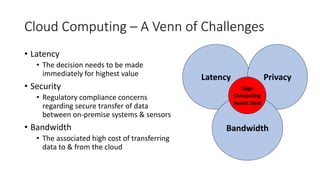
Cloud Computing – A Venn of Challenges
• Latency
• The decision needs to be made
immediately for highest value
• Security
• Regulatory compliance concerns
regarding secure transfer of data
between on-premise systems & sensors
• Bandwidth
• The associated high cost of transferring
data to & from the cloud
Latency Privacy
Bandwidth
Edge
Computing
Sweet Spot
The future of Edge Computing will be
AI tuned chips embedded in devices
Edge Computing – Use Cases
• AR & Maintenance Operations – the IoT device communicates with the AR
device to highlight the problem and tell the maintenance operator how to fix it.
• Neuroimaging – the MRI machine has an embedded AI that can recognize
anomalies at scan time, enabling faster patient response
• Smart Scanners – a portable scanner has an AI engine embedded, enabling the
decision about how to classify content to happen at the edge
• Voice Assistants – The AI engine is embedded into the VA device, reducing the
transmission of private information and increasing the speed of responses
Processor Gold Rush
• The task of processing AI is very different from standard computing or
GPU processing
• Software companies now building their own AI chips:
• Microsoft is building HoloLens specific chip
• Google is building Tensor Processing chip
• Amazon working on Alexa specific chip
• Apple working on Neural Engine chip for Alexa
• …
• The AI chip on the edge won’t replace the AI chip in the cloud. They
will complement with specialized inputs, processing and outputs
Summary
• Cloud computing isn’t the answer to every processing question
• Where privacy, latency and bandwidth concerns converge, edge computing
should be where the business looks for options
• Edge computing doesn’t require specialized AI chips to provide
business value
• However next generation AI specialized chips will change the edge computing
landscape

Edge Computing & AI

  • 1.
    Edge Computing or IoT Learnsto Interact Paul O’Hagan paulohagan@hotmail.com
  • 2.
    Executive Summary • IoTtoday is all about reporting & alerting from edge devices to a cloud • Edge computing promises the ability for the edge to act on what it senses, turning IoT into actors, not just reporters • Edge computing addresses the three key issues with cloud computing: Latency, Security & Bandwidth • Initial opportunities will be simple if-then-else scenarios until next gen processors purpose built for AI functions are productized
  • 3.
    Edge Computing –Simplified View • Edge computing is pushing the decision back to the data source for faster actioning • The world has progressed from centralized computing, to decentralized, to cloud computing • Edge computing is the next wave, that is just beginning. Not all systems are suited for a cloud computing model
  • 4.
    Cloud Computing –A Venn of Challenges • Latency • The decision needs to be made immediately for highest value • Security • Regulatory compliance concerns regarding secure transfer of data between on-premise systems & sensors • Bandwidth • The associated high cost of transferring data to & from the cloud Latency Privacy Bandwidth Edge Computing Sweet Spot
  • 5.
    The future ofEdge Computing will be AI tuned chips embedded in devices
  • 6.
    Edge Computing –Use Cases • AR & Maintenance Operations – the IoT device communicates with the AR device to highlight the problem and tell the maintenance operator how to fix it. • Neuroimaging – the MRI machine has an embedded AI that can recognize anomalies at scan time, enabling faster patient response • Smart Scanners – a portable scanner has an AI engine embedded, enabling the decision about how to classify content to happen at the edge • Voice Assistants – The AI engine is embedded into the VA device, reducing the transmission of private information and increasing the speed of responses
  • 7.
    Processor Gold Rush •The task of processing AI is very different from standard computing or GPU processing • Software companies now building their own AI chips: • Microsoft is building HoloLens specific chip • Google is building Tensor Processing chip • Amazon working on Alexa specific chip • Apple working on Neural Engine chip for Alexa • … • The AI chip on the edge won’t replace the AI chip in the cloud. They will complement with specialized inputs, processing and outputs
  • 8.
    Summary • Cloud computingisn’t the answer to every processing question • Where privacy, latency and bandwidth concerns converge, edge computing should be where the business looks for options • Edge computing doesn’t require specialized AI chips to provide business value • However next generation AI specialized chips will change the edge computing landscape