Edge Computing
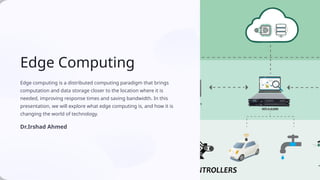
Edge computing is a distributed computing paradigm that brings
computation and data storage closer to the location where it is
needed, improving response times and saving bandwidth. In this
presentation, we will explore what edge computing is, and how it is
changing the world of technology.
Dr.Irshad Ahmed
Definition of Edge Computing
What is Edge
Computing?
Edge computing is a
network architecture
which enables data
processing to be done
at the edge of the
network, this means
that it’s done closer the
users and devices,
rather than in a central
location. Data is
processed locally on
edge devices or servers,
minimizing latency,
reducing data transfer
and bandwidth cost,
while improving
response times and
overall user experience.
Why Edge
Computing?
The rise of edge
computing is driven by
the emergence of new
technologies such as
IoT, real-time analytics,
5G networks, and
autonomous vehicles.
These technologies
generate and rely on a
vast amount of data,
which requires fast and
efficient processing
with low latency. With
Edge computing, this
processing happens
closer to the source,
reducing the time delay
from transferring data
to a central cloud
location.
Examples of Edge
Devices
Edge devices range
from consumer smart
devices like home
assistants, smart
thermostats, door
locks, and surveillance
cameras to industrial
devices like drones,
autonomous machines,
and remote sensors.
Difference between Edge Computing
and Cloud Computing
1
Centralized vs. Distributed
Cloud computing is a centralized model
of computing where central servers in
data centers run applications and store
data. Edge computing is a distributed
model of computing where processing is
done locally at the edge of the network.
2
Latency and Response Times
Cloud computing interactions rely solely on the network connection which can be slow and
unreliable. Edge computing provides low latency and high bandwidth, enabling faster data
processing, and better user experience.
3
Bandwidth and Network Control
Cloud computing requires high
bandwidth and centralized network
control, which creates a bottleneck for
data transmission while edge
computing minimizes the amount of
data transmitted over the network,
Use cases of Edge Computing
Smart Cities
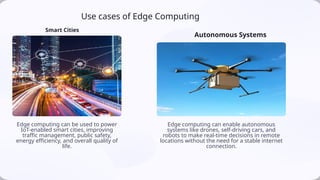
Edge computing can be used to power
IoT-enabled smart cities, improving
traffic management, public safety,
energy efficiency, and overall quality of
life.
Autonomous Systems
Edge computing can enable autonomous
systems like drones, self-driving cars, and
robots to make real-time decisions in remote
locations without the need for a stable internet
connection.
Use cases of Edge Computing
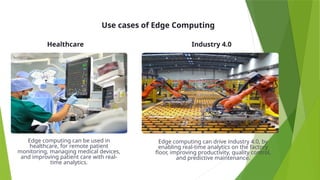
Edge computing can drive industry 4.0, by
enabling real-time analytics on the factory
floor, improving productivity, quality control,
and predictive maintenance.
Industry 4.0
Edge computing can be used in
healthcare, for remote patient
monitoring, managing medical devices,
and improving patient care with real-
time analytics.
Healthcare
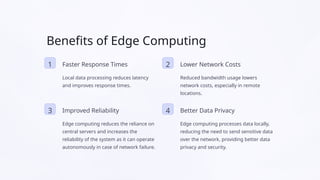
Benefits of Edge Computing
1 Faster Response Times
Local data processing reduces latency
and improves response times.
2 Lower Network Costs
Reduced bandwidth usage lowers
network costs, especially in remote
locations.
3 Improved Reliability
Edge computing reduces the reliance on
central servers and increases the
reliability of the system as it can operate
autonomously in case of network failure.
4 Better Data Privacy
Edge computing processes data locally,
reducing the need to send sensitive data
over the network, providing better data
privacy and security.
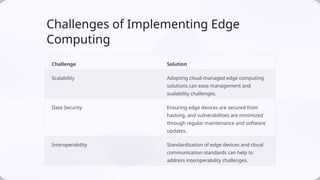
Challenges of Implementing Edge
Computing
Challenge Solution
Scalability Adopting cloud-managed edge computing
solutions can ease management and
scalability challenges.
Data Security Ensuring edge devices are secured from
hacking, and vulnerabilities are minimized
through regular maintenance and software
updates.
Interoperability Standardization of edge devices and cloud
communication standards can help to
address interoperability challenges.
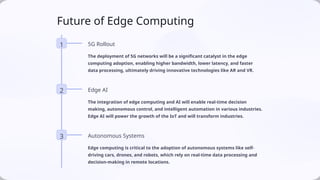
Future of Edge Computing
1 5G Rollout
The deployment of 5G networks will be a significant catalyst in the edge
computing adoption, enabling higher bandwidth, lower latency, and faster
data processing, ultimately driving innovative technologies like AR and VR.
2 Edge AI
The integration of edge computing and AI will enable real-time decision
making, autonomous control, and intelligent automation in various industries.
Edge AI will power the growth of the IoT and will transform industries.
3 Autonomous Systems
Edge computing is critical to the adoption of autonomous systems like self-
driving cars, drones, and robots, which rely on real-time data processing and
decision-making in remote locations.
Conclusion
Transforming
Technology
Edge computing is a
paradigm shift in computing
that is transforming how we
use technology. It has
immense potential to create
new business models,
enhance customer
experiences, and unlock new
revenue streams.
Connected World
As edge computing evolves,
it will provide more powerful
and efficient computing
capabilities, connecting
people, devices, and systems
Even more closely, delivering
new services and
experiences that were
previously thought
impossible.
Speeding up the future
The possibilities of edge
computing are infinite, from
smart cities to autonomous
systems, from AI to VR, and
they will only be limited by
our imagination. Edge
computing is undoubtedly
opening a new chapter of the
tech world, and it’s only just
getting started.
Basic Concept of Edge-Computing and its applications

Basic Concept of Edge-Computing and its applications

  • 1.
    Edge Computing Edge computingis a distributed computing paradigm that brings computation and data storage closer to the location where it is needed, improving response times and saving bandwidth. In this presentation, we will explore what edge computing is, and how it is changing the world of technology. Dr.Irshad Ahmed
  • 2.
    Definition of EdgeComputing What is Edge Computing? Edge computing is a network architecture which enables data processing to be done at the edge of the network, this means that it’s done closer the users and devices, rather than in a central location. Data is processed locally on edge devices or servers, minimizing latency, reducing data transfer and bandwidth cost, while improving response times and overall user experience. Why Edge Computing? The rise of edge computing is driven by the emergence of new technologies such as IoT, real-time analytics, 5G networks, and autonomous vehicles. These technologies generate and rely on a vast amount of data, which requires fast and efficient processing with low latency. With Edge computing, this processing happens closer to the source, reducing the time delay from transferring data to a central cloud location. Examples of Edge Devices Edge devices range from consumer smart devices like home assistants, smart thermostats, door locks, and surveillance cameras to industrial devices like drones, autonomous machines, and remote sensors.
  • 3.
    Difference between EdgeComputing and Cloud Computing 1 Centralized vs. Distributed Cloud computing is a centralized model of computing where central servers in data centers run applications and store data. Edge computing is a distributed model of computing where processing is done locally at the edge of the network. 2 Latency and Response Times Cloud computing interactions rely solely on the network connection which can be slow and unreliable. Edge computing provides low latency and high bandwidth, enabling faster data processing, and better user experience. 3 Bandwidth and Network Control Cloud computing requires high bandwidth and centralized network control, which creates a bottleneck for data transmission while edge computing minimizes the amount of data transmitted over the network,
  • 4.
    Use cases ofEdge Computing Smart Cities Edge computing can be used to power IoT-enabled smart cities, improving traffic management, public safety, energy efficiency, and overall quality of life. Autonomous Systems Edge computing can enable autonomous systems like drones, self-driving cars, and robots to make real-time decisions in remote locations without the need for a stable internet connection.
  • 5.
    Use cases ofEdge Computing Edge computing can drive industry 4.0, by enabling real-time analytics on the factory floor, improving productivity, quality control, and predictive maintenance. Industry 4.0 Edge computing can be used in healthcare, for remote patient monitoring, managing medical devices, and improving patient care with real- time analytics. Healthcare
  • 6.
    Benefits of EdgeComputing 1 Faster Response Times Local data processing reduces latency and improves response times. 2 Lower Network Costs Reduced bandwidth usage lowers network costs, especially in remote locations. 3 Improved Reliability Edge computing reduces the reliance on central servers and increases the reliability of the system as it can operate autonomously in case of network failure. 4 Better Data Privacy Edge computing processes data locally, reducing the need to send sensitive data over the network, providing better data privacy and security.
  • 7.
    Challenges of ImplementingEdge Computing Challenge Solution Scalability Adopting cloud-managed edge computing solutions can ease management and scalability challenges. Data Security Ensuring edge devices are secured from hacking, and vulnerabilities are minimized through regular maintenance and software updates. Interoperability Standardization of edge devices and cloud communication standards can help to address interoperability challenges.
  • 8.
    Future of EdgeComputing 1 5G Rollout The deployment of 5G networks will be a significant catalyst in the edge computing adoption, enabling higher bandwidth, lower latency, and faster data processing, ultimately driving innovative technologies like AR and VR. 2 Edge AI The integration of edge computing and AI will enable real-time decision making, autonomous control, and intelligent automation in various industries. Edge AI will power the growth of the IoT and will transform industries. 3 Autonomous Systems Edge computing is critical to the adoption of autonomous systems like self- driving cars, drones, and robots, which rely on real-time data processing and decision-making in remote locations.
  • 9.
    Conclusion Transforming Technology Edge computing isa paradigm shift in computing that is transforming how we use technology. It has immense potential to create new business models, enhance customer experiences, and unlock new revenue streams. Connected World As edge computing evolves, it will provide more powerful and efficient computing capabilities, connecting people, devices, and systems Even more closely, delivering new services and experiences that were previously thought impossible. Speeding up the future The possibilities of edge computing are infinite, from smart cities to autonomous systems, from AI to VR, and they will only be limited by our imagination. Edge computing is undoubtedly opening a new chapter of the tech world, and it’s only just getting started.