TABLE OF CONTENTS
Introduction
Evolution of Computing System
An overview of edge computing
Driving Factors of edge
Future Research Directions (Graceful adaptation of applications/ Collaborative & App-aware Network
Orchestration
Test and Verification frameworks)
Edge Networks
Benefits of Edge Computing
Edge Computing Expanding
Architecture: (Edge Computing Architecture/Cloudlet Computing/Fog Computing/Multi-access Edge
Computing/IoT)
Applications
Latest Trends in Edge Computing (Nvidia Jetson/Asus Tinker Board/Raspberry PI/Kalray MPPA)
In Reality: Edge vs Supercomputing/Cloud Computing
Present Challenges (Naming/Programmability/Edge Device Management)
Summery
INTRODUCTION TO
COMPUTING SYSTEM
A computer is an electronic device that can be programmed to accept
data (input), process it and generate result (output). A computer along
with additional hardware and software together is called a computer
system.
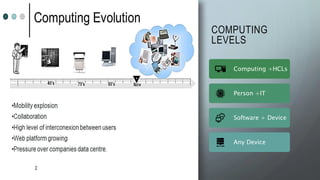
COMPUTING
LEVELS
Computing +HCLs
Person +IT
Software + Device
Any Device
AN OVERVIEW OF EDGE
COMPUTING
4 DRIVING FACTORS FOR EDGE
COMPUTING
1. Lower Latency
We are in the age where quotidian activities are dependent on technologies that need
to deliver instant results. When it comes to CDN or 5G, they are designed in a way to
process closer to the user to minimize latency. The most intense way to do it would be
to process it on the device, like Apple’s Face ID.
2. Larger Bandwidth
Our dependence on new-gen technologies and devices has not just proliferated the
devices being used, but it has exploded the amount of data being generated and
processed. To send this data over the network would require much larger bandwidth
than currently available. Edge Computing will solve these bandwidth constraints, as
the data will be processed at the edge and will not need to be transferred.
3. Higher Computing Capacity
More devices and more data will clearly mean more computing. This requirement of
higher computing cannot be met by central data centers due to its sheer volume. The
need of the hour is decentralization, for computing and storage. Therefore, edge
computing provides intelligent processing near the population centers.
4. Better Security
The data sent to the cloud can be of two types – personal data of users (messages
from my mobile or my heart rate from my smartwatch) or data of an organization that
can be sensitive and confidential (my organization’s client list or leads). For obvious
reasons we want to keep this data private and sending it to cloud is a matter of
FUTURE RESEARCH DIRECTIONS
The edge computing (EC) paradigm brings computation and storage
to the edge of the network where data is both consumed and
produced. This variation is necessary to cope with the increasing
amount of network-connected devices and data transmitted, that the
launch of the new 5G networks will expand. The aim is to avoid the
high latency and traffic bottlenecks associated with the use of Cloud
Computing in networks where several devices both access and
generate high volumes of data. EC also improves network support for
mobility, security, and privacy. This paper provides a discussion
around EC and summarized the definition and fundamental properties
of the EC architectures proposed in the literature (Multi-access Edge
Computing, Fog Computing, Cloudlet Computing, and Mobile Cloud
Computing). Subsequently, this paper examines significant use cases
for each EC architecture and debates some promising future research
directions.
EDGE NETWORK
BENEFITS OF EDGE COMPUTING
Speed. Speed is absolutely vital to any company's core business. ...
Security. While the proliferation of IoT edge computing devices does
increase the overall attack surface for networks, it also provides some
important security advantages. ...
Scalability. ...
Versatility. ...
Reliability.
EDGE COMPUTING EXPANDING
Until now, edge computing was promising
but still developing. In 2021, new business
models will emerge that facilitate the
deployment of edge in production. Cloud
platforms will compete while artificial
intelligence (AI) and 5G will drive the rapid
expansion of edge use cases.
ARCHITECTURE
Edge Computing Architecture:
Edge architecture is a distributed computing architecture that encompasses all the components
active in edge computing—all the devices, sensors, servers, clouds, etc. —wherever data is
processed or used at the far reaches of the network.
Cloudlet Computing
A Cloudlet is a small-scale datacenter or cloud located at the edge of the internet. Its objective is
to bring cloud-computing capabilities closer to the consumer. Cloudlets are region specific and
typically used for mobile consumers or devices. ... Both clouds and cloudlets achieve user isolation
through virtual machines.
Fog Computing:
Fog computing is a decentralized computing infrastructure in which data, compute, storage and
applications are located somewhere between the data source and the cloud. Like edge computing,
fog computing brings the advantages and power of the cloud closer to where data is created and
acted upon.
Multi-Access Edge Computing (MEC):
Multi-Access Edge Computing (MEC) moves the computing of traffic and services from a
centralized cloud to the edge of the network and closer to the customer. Instead of sending all
data to a cloud for processing, the network edge analyzes, processes, and stores the data.
Collecting and processing data closer to the customer reduces latency and brings real-time
performance to high-bandwidth applications.
IOT (Internet of Things:
The Internet of things (IoT) describes physical objects (or groups of such objects) that are
embedded with sensors, processing ability, software, and other technologies that connect and
exchange data with other devices and systems over the Internet or other communications networks
APPLICATIONS LATEST TRENDS IN EDGE
COMPUTING
Edge Computing will have to deal with ongoing developments in
AI/ML/DL to do computational analysis and data processing. To do
such complex arithmetic calculations, powerful embedded devices are
required to perform these calculations are needed. There are lots of
embedded hardware solutions available nowadays to support these
requirements. Here we explain selected embedded architectures that
will make Edge Computing more efficient and optimised.
APPLICATIONS LATEST TRENDS IN EDGE
COMPUTING
Nvidia Jetson:
Nvidia has introduced the Jetson series of embedded architectures to support ML calculations for
embedded applications. Jetson TK1 was first introduced in 2014. Nvidia has released many series in
embedded architecture since then.
ASUS Tinker Board:
ASUS has introduced the ASUS Tinker Board in early 2017. This early embedded architecture can run in
32-bit mode, but the latest ones can run on 64-bit. And they are direct competitors to the Raspberry
PI series.
Raspberry PI:
Raspberry PI is also an emerging embedded architecture in the Edge Computing domain. It has the
latest ARM Cortex-A7 CPU and VideoCore GPU. This VideoCore GPU is based on Digital Signal
Processing (DSP), which means it can efficiently process multimedia applications with low power
consumption.
Kalray MPPA:
Another impressive embedded architecture is Kalray, which has many CPU cores, unlike other
embedded architecture. Kalray named their embedded architecture “Massively Parallel Processor Array”
(MPPA). Kalray 3 rd generation MPPA architecture is called Coolidge (MPPA3-80 Coolidge), based on
FinFET technology with 16 nm size
PRESENT CHALLENGES
Network bandwidth. Network bandwidth shifts as
enterprises move compute and data to the edge. ...
Distributed computing. ...
Latency. ...
Security and accessibility. ...
Backup. ...
Data accumulation. ...
Control and management. ...
Scale.
EDGE COMPUTING DEVICE
MANAGEMENT
Edge computing can reduce the computing load on a
data center's infrastructure by moving data and
calculations to the edge. However, such devices add
complexity to an organization's IT system, because
staff must learn to deploy, secure and maintain them.
Consider the various software management options for
edge devices.
Integration into existing monitoring software tools.
Communication and bandwidth monitoring.
Latency monitoring.
Power monitoring.
Data storage.
Security.
Automation.
Backup and disaster recovery.
SUMMERY
In This Presentation We Learn About:
Evolution Of Computing System.
Overview Of Edge Computing.
Four Driving Factors Of Edge Computing.
Future Research Directions
Architecture
Applications Latest Trends In Edge Computing
Present Challenges
Edge Computing Device Management
THANKS
• Shamama Javed (Roll No: FA21-BPH045)
• Fatima Shah (Roll No: FA21-BPH-016)
• Malaika Noor (Roll No: FA21-BPH-025)
• Muhammad Talha (Roll No: FA21-BPH-033)
Comsats University,
Islamabad

Presentation1.pptx

  • 2.
    TABLE OF CONTENTS Introduction Evolutionof Computing System An overview of edge computing Driving Factors of edge Future Research Directions (Graceful adaptation of applications/ Collaborative & App-aware Network Orchestration Test and Verification frameworks) Edge Networks Benefits of Edge Computing Edge Computing Expanding Architecture: (Edge Computing Architecture/Cloudlet Computing/Fog Computing/Multi-access Edge Computing/IoT) Applications Latest Trends in Edge Computing (Nvidia Jetson/Asus Tinker Board/Raspberry PI/Kalray MPPA) In Reality: Edge vs Supercomputing/Cloud Computing Present Challenges (Naming/Programmability/Edge Device Management) Summery
  • 3.
    INTRODUCTION TO COMPUTING SYSTEM Acomputer is an electronic device that can be programmed to accept data (input), process it and generate result (output). A computer along with additional hardware and software together is called a computer system.
  • 4.
  • 5.
    AN OVERVIEW OFEDGE COMPUTING
  • 6.
    4 DRIVING FACTORSFOR EDGE COMPUTING 1. Lower Latency We are in the age where quotidian activities are dependent on technologies that need to deliver instant results. When it comes to CDN or 5G, they are designed in a way to process closer to the user to minimize latency. The most intense way to do it would be to process it on the device, like Apple’s Face ID. 2. Larger Bandwidth Our dependence on new-gen technologies and devices has not just proliferated the devices being used, but it has exploded the amount of data being generated and processed. To send this data over the network would require much larger bandwidth than currently available. Edge Computing will solve these bandwidth constraints, as the data will be processed at the edge and will not need to be transferred. 3. Higher Computing Capacity More devices and more data will clearly mean more computing. This requirement of higher computing cannot be met by central data centers due to its sheer volume. The need of the hour is decentralization, for computing and storage. Therefore, edge computing provides intelligent processing near the population centers. 4. Better Security The data sent to the cloud can be of two types – personal data of users (messages from my mobile or my heart rate from my smartwatch) or data of an organization that can be sensitive and confidential (my organization’s client list or leads). For obvious reasons we want to keep this data private and sending it to cloud is a matter of
  • 7.
    FUTURE RESEARCH DIRECTIONS Theedge computing (EC) paradigm brings computation and storage to the edge of the network where data is both consumed and produced. This variation is necessary to cope with the increasing amount of network-connected devices and data transmitted, that the launch of the new 5G networks will expand. The aim is to avoid the high latency and traffic bottlenecks associated with the use of Cloud Computing in networks where several devices both access and generate high volumes of data. EC also improves network support for mobility, security, and privacy. This paper provides a discussion around EC and summarized the definition and fundamental properties of the EC architectures proposed in the literature (Multi-access Edge Computing, Fog Computing, Cloudlet Computing, and Mobile Cloud Computing). Subsequently, this paper examines significant use cases for each EC architecture and debates some promising future research directions.
  • 8.
  • 9.
    BENEFITS OF EDGECOMPUTING Speed. Speed is absolutely vital to any company's core business. ... Security. While the proliferation of IoT edge computing devices does increase the overall attack surface for networks, it also provides some important security advantages. ... Scalability. ... Versatility. ... Reliability.
  • 10.
    EDGE COMPUTING EXPANDING Untilnow, edge computing was promising but still developing. In 2021, new business models will emerge that facilitate the deployment of edge in production. Cloud platforms will compete while artificial intelligence (AI) and 5G will drive the rapid expansion of edge use cases.
  • 11.
    ARCHITECTURE Edge Computing Architecture: Edgearchitecture is a distributed computing architecture that encompasses all the components active in edge computing—all the devices, sensors, servers, clouds, etc. —wherever data is processed or used at the far reaches of the network. Cloudlet Computing A Cloudlet is a small-scale datacenter or cloud located at the edge of the internet. Its objective is to bring cloud-computing capabilities closer to the consumer. Cloudlets are region specific and typically used for mobile consumers or devices. ... Both clouds and cloudlets achieve user isolation through virtual machines. Fog Computing: Fog computing is a decentralized computing infrastructure in which data, compute, storage and applications are located somewhere between the data source and the cloud. Like edge computing, fog computing brings the advantages and power of the cloud closer to where data is created and acted upon. Multi-Access Edge Computing (MEC): Multi-Access Edge Computing (MEC) moves the computing of traffic and services from a centralized cloud to the edge of the network and closer to the customer. Instead of sending all data to a cloud for processing, the network edge analyzes, processes, and stores the data. Collecting and processing data closer to the customer reduces latency and brings real-time performance to high-bandwidth applications. IOT (Internet of Things: The Internet of things (IoT) describes physical objects (or groups of such objects) that are embedded with sensors, processing ability, software, and other technologies that connect and exchange data with other devices and systems over the Internet or other communications networks
  • 12.
    APPLICATIONS LATEST TRENDSIN EDGE COMPUTING Edge Computing will have to deal with ongoing developments in AI/ML/DL to do computational analysis and data processing. To do such complex arithmetic calculations, powerful embedded devices are required to perform these calculations are needed. There are lots of embedded hardware solutions available nowadays to support these requirements. Here we explain selected embedded architectures that will make Edge Computing more efficient and optimised.
  • 13.
    APPLICATIONS LATEST TRENDSIN EDGE COMPUTING Nvidia Jetson: Nvidia has introduced the Jetson series of embedded architectures to support ML calculations for embedded applications. Jetson TK1 was first introduced in 2014. Nvidia has released many series in embedded architecture since then. ASUS Tinker Board: ASUS has introduced the ASUS Tinker Board in early 2017. This early embedded architecture can run in 32-bit mode, but the latest ones can run on 64-bit. And they are direct competitors to the Raspberry PI series. Raspberry PI: Raspberry PI is also an emerging embedded architecture in the Edge Computing domain. It has the latest ARM Cortex-A7 CPU and VideoCore GPU. This VideoCore GPU is based on Digital Signal Processing (DSP), which means it can efficiently process multimedia applications with low power consumption. Kalray MPPA: Another impressive embedded architecture is Kalray, which has many CPU cores, unlike other embedded architecture. Kalray named their embedded architecture “Massively Parallel Processor Array” (MPPA). Kalray 3 rd generation MPPA architecture is called Coolidge (MPPA3-80 Coolidge), based on FinFET technology with 16 nm size
  • 14.
    PRESENT CHALLENGES Network bandwidth.Network bandwidth shifts as enterprises move compute and data to the edge. ... Distributed computing. ... Latency. ... Security and accessibility. ... Backup. ... Data accumulation. ... Control and management. ... Scale.
  • 15.
    EDGE COMPUTING DEVICE MANAGEMENT Edgecomputing can reduce the computing load on a data center's infrastructure by moving data and calculations to the edge. However, such devices add complexity to an organization's IT system, because staff must learn to deploy, secure and maintain them. Consider the various software management options for edge devices. Integration into existing monitoring software tools. Communication and bandwidth monitoring. Latency monitoring. Power monitoring. Data storage. Security. Automation. Backup and disaster recovery.
  • 16.
    SUMMERY In This PresentationWe Learn About: Evolution Of Computing System. Overview Of Edge Computing. Four Driving Factors Of Edge Computing. Future Research Directions Architecture Applications Latest Trends In Edge Computing Present Challenges Edge Computing Device Management
  • 17.
    THANKS • Shamama Javed(Roll No: FA21-BPH045) • Fatima Shah (Roll No: FA21-BPH-016) • Malaika Noor (Roll No: FA21-BPH-025) • Muhammad Talha (Roll No: FA21-BPH-033) Comsats University, Islamabad