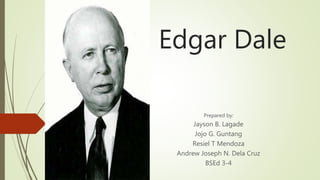
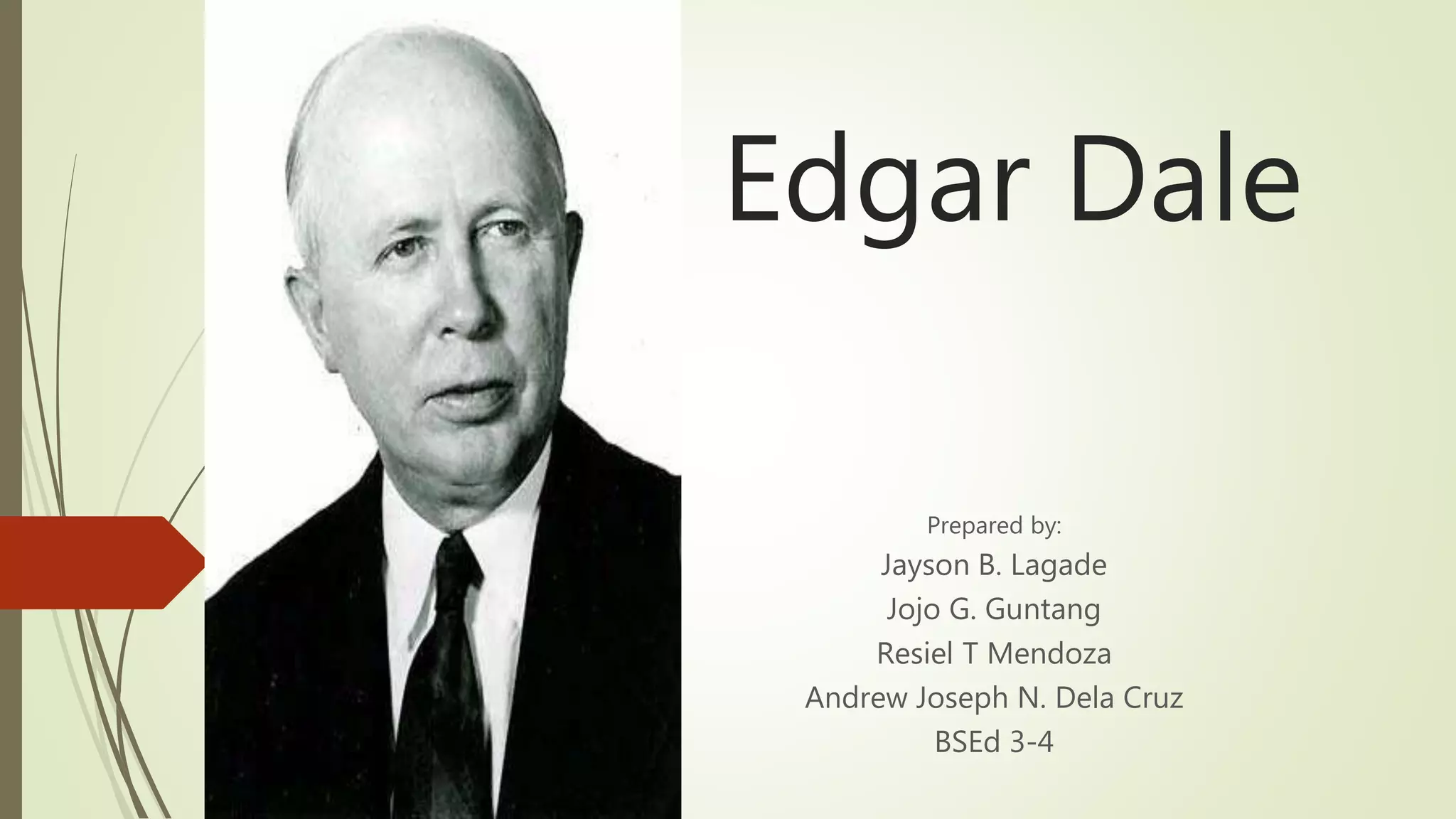
Edgar Dale
Prepared by:
Jayson B. Lagade
Jojo G. Guntang
Resiel T Mendoza
Andrew Joseph N. Dela Cruz
BSEd 3-4
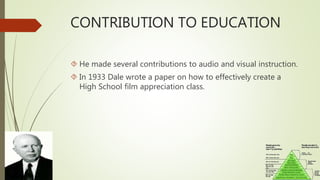
CONTRIBUTION TO EDUCATION
 He made several contributions to audio and visual instruction.
 In 1933 Dale wrote a paper on how to effectively create a
High School film appreciation class.
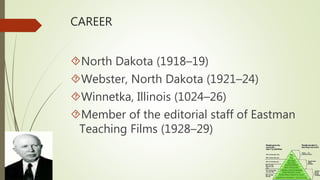
CAREER
North Dakota (1918–19)
Webster, North Dakota (1921–24)
Winnetka, Illinois (1024–26)
Member of the editorial staff of Eastman
Teaching Films (1928–29)
AWARDS
Educational Film Library Association Award
(1961)
Eastman Kodak Gold Medal Award (1968)
Distinguished Services Award (1972)
National Reading Hall of Fame (1972)
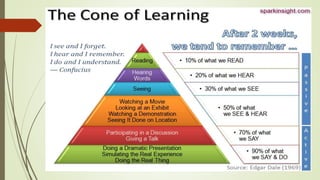
CONE OF LEARNING
Developed in 1946
It is a way to describe various learning
experiences
The perc
entages given relate to how much people
remember and is a recent modification
REFERENCES
 Wagner, Robert W. Edgar Dale: Professional. Theory into
Practice. Vol. 9, No. 2, Edgar Dale (Apr., 1970), pp. 89-95 -
http://www.jstor.org/pss/1475566
 http://pi.lib.uchicago.edu/1001/cat/bib/4174355
 http://prezi.com/xptp82dt9ysr/edgar-dale/
 http://www.willatworklearning.com/2006/10/people_rememb
er.html

Edgar dale

  • 1.
    Edgar Dale Prepared by: JaysonB. Lagade Jojo G. Guntang Resiel T Mendoza Andrew Joseph N. Dela Cruz BSEd 3-4
  • 2.
    CONTRIBUTION TO EDUCATION He made several contributions to audio and visual instruction.  In 1933 Dale wrote a paper on how to effectively create a High School film appreciation class.
  • 3.
    CAREER North Dakota (1918–19) Webster,North Dakota (1921–24) Winnetka, Illinois (1024–26) Member of the editorial staff of Eastman Teaching Films (1928–29)
  • 4.
    AWARDS Educational Film LibraryAssociation Award (1961) Eastman Kodak Gold Medal Award (1968) Distinguished Services Award (1972) National Reading Hall of Fame (1972)
  • 5.
    CONE OF LEARNING Developedin 1946 It is a way to describe various learning experiences The perc entages given relate to how much people remember and is a recent modification
  • 7.
    REFERENCES  Wagner, RobertW. Edgar Dale: Professional. Theory into Practice. Vol. 9, No. 2, Edgar Dale (Apr., 1970), pp. 89-95 - http://www.jstor.org/pss/1475566  http://pi.lib.uchicago.edu/1001/cat/bib/4174355  http://prezi.com/xptp82dt9ysr/edgar-dale/  http://www.willatworklearning.com/2006/10/people_rememb er.html

Editor's Notes

  • #3 INCLUDING A METHODOLOGY FOR ANALYZING THE CONTENT OF MOTION PICTURES. THIS PAPER HAS BEEN NOTED FOR HAVING A VERY DIFFERENT VIEW OF ADOLESCENT INTERACTION WITH FILMS THAN THAT TAKEN BY THE FILM CONTROL BOARDS OF THE TIME.
  • #6  the "Cone of Learning," it purports to inform viewers of how much people remember based on how they encounter information. Dale included no numbers and did not base his cone on scientific research, and he also warned readers not to take the cone too seriously
  • #7 , the Cone shows the progression of experiences from the most concrete (at the bottom of the cone) to the most abstract (at the top of the cone). It is important to note that Dale never intended the Cone to depict a value judgment of experiences; in other words, his argument was not that more concrete experiences were better than more abstract ones. Dale believed that any and all of the approaches could and should be used, depending on the needs of the learner.