Downloaded 41 times


![DRAFT
Submitted for publication in A. Kovalchick & K. Dawson, Ed's, Educational
Technology: An
Encyclopedia. Copyright ABC-Clio, Santa Barbara, CA, 2003.
This version includes only the text of the article. The figures are found in the
published version.
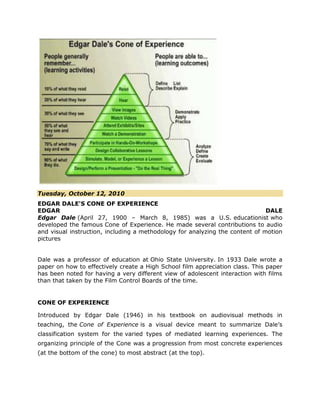
Introduced by Edgar Dale (1946) in his textbook on audiovisual methods in
teaching, the
Cone of Experience is a visual device meant to summarize Dale‘s classification
system for the
varied types of mediated learning experiences. The organizing principle of the Cone
was a
progression from most concrete experiences (at the bottom of the cone) to most
abstract (at the
top). The original labels for Dale‘s ten categories are: Direct, Purposeful
Experiences; Contrived
Experiences; Dramatic Participation; Demonstrations; Field Trips; Exhibits; Motion
Pictures;
Radio – Recordings – Still Pictures; Visual Symbols; and Verbal Symbols.
[Insert Figure 1 here.]
Dale made minor modifications of the visual in the second edition (1954), changing
Dramatic Participation to Dramatized Experiences and adding Television. By the
third edition of
the textbook, Dale (1969) acknowledged the growing popularity of Jerome Bruner‘s
(1966)
cognitive psychology concepts by overlaying Bruner‘s classification system for
modes of
learning—enactive, iconic, and symbolic—on top of his own categories. This
adaptation of his
own schema may have been portentous, perhaps giving implied license to others to
make other
creative adaptations and interpretations, not always to the credit of Dale‘s original
notion.
Application of the construct2
Dale‘s textbook in its three editions remained popular for over a quarter century.](https://image.slidesharecdn.com/luisedutech-130712222224-phpapp02/85/Luisedutech-4-320.jpg)
![Inasmuch as the Cone provided the organizing principle for the book, it became
ingrained in the
thinking of generations of educational technology students and professors who used
the
textbook. It stimulated many efforts to extend the original idea by developing its
implications
for elementary education, secondary education, adult education, corporate training,
and even
counseling.
As a visible leader in audiovisual education, Dale and his work had a great deal of
authority within the field. The Cone may be regarded as the earliest highly
influential conceptual
schema in the field. Dwyer (1978) in his landmark work on visual learning credits
Dale as one
of the thinkers who inspired the visual education movement:
An explanation for the current widespread use of visualization can be traced back
to the 1940s and 1950s when a number of theoretical orientations were
identified—specifically the iconicity theory identified by Morris (1946) [and]
Dale‘s (1946) cone of experience… (p. 6)
Dale‘s own claims for this classification system were modest and qualified. He
advised
against viewing the categories as ―rigid, inflexible divisions (p. 37).‖ He insisted
that the
classifications should not be regarded as any sort of ―hierarchy or rank order (p.
47).‖ This
addresses one of the most prevalent misconceptions of the Cone—that the
progression from
concrete to abstract represented a value judgment about concrete over abstract
learning activities.
Instead, Dale advocated the use of whatever methods or media were appropriate
for the learner
and the task, acknowledging that words can be a powerful and efficient means of
conveying
ideas even for the youngest children. If he had a bias regarding media it was
toward rich](https://image.slidesharecdn.com/luisedutech-130712222224-phpapp02/85/Luisedutech-5-320.jpg)

![construct to prescriptions, as pointed out by Subramony (in press). References to
―uses‖ or
―implications‖ of the Cone are scattered throughout the various editions of Dale‘s
textbook (Dale
1946, 1954, 1969). An example found in the third edition (1969) states ―When
properly
understood and used, however, the Cone can be a helpful and practical guide (p.
110).‖ With 4
this sort of ambiguity from the author, it is not surprising that many of his followers
attempted to
use the Cone as a prescriptive guide to lesson planning.
Origins of the Cone‘s concepts
Ideas parallel to those expressed by Dale in the Cone of Experience appeared in the
literature of education prior to 1946. Paul Saettler (1990), the historian of the field
of
instructional technology, points to Exposition and Illustration in Teaching, published
in 1910 by
John Adams ―which included the following ‗order of merit‘ concerning concreteness:
‗(1) the
real object, for which anything else is a more or less inefficient substitute; (2) a
model of the real
object; (3) a diagram dealing with some of the aspects of the object; and (4) a
mere verbal
description of the object.‘ (p. 140). However, a more direct ancestor of the Cone is
probably a
diagram presented by Hoban, Hoban, and Zisman (1937).
[Insert Figure 2 here.]
They made the conceptual breakthrough of constructing a graph in which visual
media
are arranged along the y axis while the learner‘s level of development—from the
concrete level
of thinking to the abstract level of thinking—is arrayed along the x axis. In applying
the graph to
a particular case, one would locate the learner‘s current level of conceptual
development](https://image.slidesharecdn.com/luisedutech-130712222224-phpapp02/85/Luisedutech-7-320.jpg)
![(concrete to abstract) then trace up to the slope line and then horizontally over to
the visual
medium that intersects at the same point. For example, an experienced learner
with a highly
developed (abstract) knowledge of ―jet propulsion‖ would be expected to be able to
learn more
about jet propulsion effectively with diagrams and verbal texts.
Hoban, Hoban, and Zisman‘s categories were: total situation, objects, models,
films,
stereographs, slides, flat pictures, maps, diagrams, and words. Dale‘s schema
differs mainly in
the addition of several classes of media and active learning experiences and the
simplification of 5
the schema by showing only y axis—the media, indicating the other dimension
(concreteabstract) by the pyramidal shape of the cone. Although Dale‘s schema
appears to be quite
derivative of Hoban, Hoban, and Zisman‘s graph, he does not explicitly
acknowledge this
source, although he makes several references to their book elsewhere in his
textbook.
Misappropriation of the Cone
It is important to discuss what the Cone is not as well as what it is because of a
widespread misrepresentation that has become ubiquitous in recent years. At some
point
someone conflated Dale‘s Cone with a spurious chart that purports to show what
percentage of
information people remember under different learning conditions. The original
version of this
chart, shown in Figure 3, has been traced to the Socony-Vacuum Oil Company,
according to
Dwyer (1978), who cites Treichler (1967).
[Insert Figure 3 here.]
As Dwyer points out, the reported percentages are impossible to interpret or verify
without specifying at least the method of measurement, the age of the learners, the
type of](https://image.slidesharecdn.com/luisedutech-130712222224-phpapp02/85/Luisedutech-8-320.jpg)
![learning task, and the content being remembered (p. 10). Despite the lack of
credibility, this
formulation is widely quoted, usually without attribution, and in recent years has
become
repeatedly conflated with Dale‘s Cone, with the percentage statements
superimposed on the
cone, replacing or supplementing Dale‘s original categories. The examples are too
numerous to
document here, but are discussed in detail and with citations in Subramony (in
press). A rather
sophisticated example of this conflation is shown as Figure 4.
[Insert Figure 4 here.]
In summary, the Cone of Experience is essentially a visual metaphor for the idea
that
learning activities can be placed in broad categories based on the extent to which
they convey the 6
concrete referents of real-life experiences. Although it has sometimes been
interpreted as
advocating the selection of certain media and methods over others (favoring
―realism‖), such was
not Dale‘s stated intent.
How Can Instructors Use the Cone of Experience?
According to Dale’s research, the least effective method at the top, involves learning from information
presented through verbal symbols, i.e., listening to spoken words. The most effective methods at the
bottom,
involves direct, purposeful learning experiences, such as hands-on or field experience. Direct purposeful
experiences represents reality or the closet things to real, everyday life.
The cone charts the average retention rate for various methods of teaching. The further you progress
down](https://image.slidesharecdn.com/luisedutech-130712222224-phpapp02/85/Luisedutech-9-320.jpg)


- Edgar Dale developed the Cone of Experience, a visual model that categorized learning experiences from most concrete (direct experiences) to most abstract (verbal symbols). - The Cone was introduced in Dale's 1946 textbook and became influential in conceptualizing how different media support learning. It suggested that more direct, hands-on experiences better support understanding than more abstract experiences. - While influential, the Cone was not intended as a prescriptive theory but a descriptive framework. However, others often interpreted it prescriptively by emphasizing its ranking of experience types rather than Dale's intention for it to explain relationships between experiences.


