Modeling Automation for
Achieving Scalability of
Process Optimization Services
4th IEEE CASE Conference, Washington D.C., August 25th 2008
Sudhendu Rai
Xerox Corporation
IEEE Conference on Automation Science and Engineering, Aug 23-26 (2008)Washington D.C.
Abstract
Many business enterprises outsource the management of processes and technology that they consider non-
core to third-party service providers. The challenge for the service providers is to leverage their expertise to
deliver managed services that more efficient, productive and profitable. Examples include IT infrastructure
management (IBM, HP), print services management (Xerox, Ricoh, Pitney Bowes), food services (Aramark,
Compass Group, Sodexo) and others. Many traditional product companies have increasingly diversified as
service providers of this type and rely on a combination of people and technology for services delivery.
The capability and expertise to deliver high quality optimized processes on a large scale without incurring high
costs is a key imperative for these companies. This is traditionally achieved through standardization of
processes, capture and dissemination of best practices and domain knowledge and structured training
programs. Process optimization technologies such as discrete-event simulation, stochastic process modeling
and advanced analytics have traditionally been the forte of expert (and often high-paid) consultants which has
limited their broad use in these services industries primarily due to cost constraints.
This talk will describe how process optimization solutions were developed and delivered on a large scale to the
Xerox document production outsourcing-services business. Early on, extensive consulting engagements with
end-customers were used to abstract and generalize the process optimization problem. Then the various steps
of the process optimization problem such as data collection, statistical analysis, simulation and modeling,
optimization, scheduling and monitoring were abstracted and modeled. Technology and algorithms for each
step were developed, refined, automated, integrated and then encapsulated in an easy-to-use software toolkit
that supported a structured customer engagement process by less-skilled delivery personnel. The delivery of
process optimization services using these automated tools that encapsulate advanced analytics, process
modeling, optimization and scheduling techniques has enabled significant savings and improvement in
customer satisfaction for the document production outsourcing-services business. The talk will conclude with a
discussion of lessons learnt and next steps to further automate and simplify the services delivery process.
IEEE Conference on Automation Science and Engineering, Aug 23-26 (2008)Washington D.C.
Author Bio
Dr. Rai is a Principal Scientist, Project Leader and a certified Lean Six Sigma Black Belt at the
Xerox Research Center in Webster, N.Y. He received his PhD. from MIT in 1993, MS from Caltech
in 1989, and BTech from IIT, Kanpur (India) in 1988 – all in Mechanical Engineering. Dr. Rai
joined Xerox in 1995 as a Member of Research & Technology staff. He was promoted to
Principal Scientist in 2001. During 1996-97 he demonstrated the feasibility of virtual
prototyping of xerographic components. He created, validated and implemented a new
methodology for performing quantitative trade-offs in large-system design. Between 1997 and
1998 he developed and implemented a novel distributed control architecture for moving paper
across multiple paper handling modules. He is the lead inventor of the LDP Lean Document
Production® Solution . Starting in 1998 he led a team that developed the algorithms, software
toolkit to support the initial offering and a training curriculum to train Xerox Global Services
consultants. He has personally led and implemented process improvement initiatives in dozens
of small and large print shops spanning multiple industry segments. He holds 15 patents (with
35 additional pending) and has published more than 20 technical papers in conference
proceedings and technical journals. The Xerox entry “LDP Lean Document Production® -
Dramatic Productivity Improvements for the Printing Industry” is a finalist in the 2008 Franz
Edelman Award competition (sponsored by INFORMS). He is a member of IIE, ASME, INFORMS,
Sigma Xi and a senior member of IEEE. He is a recipient of the Xerox Excellence in Science and
Technology Award and was selected as a finalist for the Rochester Engineer of the Year award in
2007.
IEEE Conference on Automation Science and Engineering, Aug 23-26 (2008)Washington D.C.
Growth in services outsourcing
•Enterprises are increasingly looking to outsource operations
that they consider non-core
•Examples include:
– IT systems and processes
– Document management (office and production)
– Food services
– Variety of business processes
• Maintaining good quality of service and high margins is a key
imperative for the service providers
IEEE Conference on Automation Science and Engineering, Aug 23-26 (2008)Washington D.C.
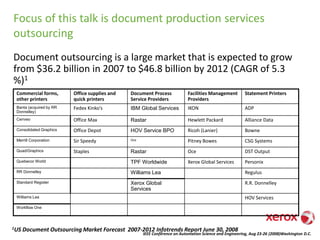
Focus of this talk is document production services
outsourcing
Document outsourcing is a large market that is expected to grow
from $36.2 billion in 2007 to $46.8 billion by 2012 (CAGR of 5.3
%)1
1US Document Outsourcing Market Forecast 2007-2012 Infotrends Report June 30, 2008
Commercial forms,
other printers
Office supplies and
quick printers
Document Process
Service Providers
Facilities Management
Providers
Statement Printers
Banta (acquired by RR
Donnelley)
Fedex Kinko’s IBM Global Services IKON ADP
Cenveo Office Max Rastar Hewlett Packard Alliance Data
Consolidated Graphics Office Depot HOV Service BPO Ricoh (Lanier) Bowne
Merrill Corporation Sir Speedy Oce Pitney Bowes CSG Systems
Quad/Graphics Staples Rastar Oce DST Output
Quebecor World TPF Worldwide Xerox Global Services Personix
RR Donnelley Williams Lea Regulus
Standard Register Xerox Global
Services
R.R. Donnelley
Williams Lea HOV Services
Workflow One
IEEE Conference on Automation Science and Engineering, Aug 23-26 (2008)Washington D.C.
Problem statement
Goal To optimize the quality of service metrics of document
production and management services processes on a large
distributed scale subject to the following constraints
– Keep deployment and operational costs low to drive higher
profit margins
– Achieve standardization of service
– Maintain process adaptability to changing customer
requirements
IEEE Conference on Automation Science and Engineering, Aug 23-26 (2008)Washington D.C.
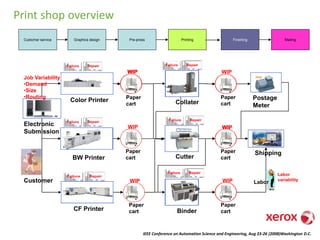
Print shop overview
Collater
Cutter
Binder
Postage
Meter
Shipping
Paper
cart
Paper
cart
Paper
cart
Failure Repair
Failure Repair
Failure Repair
Labor
Labor
variability
WIP
WIP
WIP
Finishing Mailing
Customer
Electronic
Submission
Job Variability
•Demand
•Size
•Routing
Graphics design Pre-pressCustomer service
Failure Repair
Color Printer
BW Printer
CF Printer
Paper
cart
Failure Repair
Failure Repair
WIP
Paper
cart
WIP
Paper
cart
WIP
Printing
Failure Repair
Failure Repair
Failure Repair
WIP
Failure Repair
Failure Repair
WIP
Failure Repair
Failure Repair
Failure Repair
Failure Repair
IEEE Conference on Automation Science and Engineering, Aug 23-26 (2008)Washington D.C.
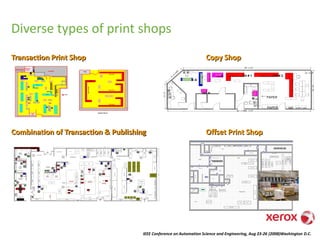
Diverse types of print shops
BellandHowell
Inserter
Inserter
Inserter
PB 8 Series
PB 8 Series
PB 8 Series
Inserter
Cage
Inserter Room
Desk
Desk
Desk
Desk
Desk
Desk
LOADING
Server Room
Mailing
Area
Input
Desk
P
r
i
n
t
e
r
1
Cutter
P
r
i
n
t
e
r
2
P
r
i
n
t
e
r
4
P
r
i
n
t
e
r
3
Desk
SQA
DESK
Moore
Sealer
Desk
Roll System
Printer
Desk
H
I
L
I
T
E
P
R
I
T
E
R
Desk
ShrinkWrapper
Pillar
DeskDesk
Desk
Desk
P
r
i
n
t
e
r
3
Desk
ShrinkWrapper
Roll System
Printer
Transaction Print Shop
55' - 4 1/4"
2' - 4 7/8"
18'-12"
62' - 1 1/8"
12'-0"
PAPER
PAPER
SKRINK
WRAP CUTTER DRILL
DOCUTECH # 2DOCUTECH # 1
D
O
C
U
T
EC
H
#
3
53905
1
0
0
D
O
C
4
0
B
DOC 40 A
DC
265 A
DC
265B
FAX
55' - 4 1/4"
Copy Shop
Combination of Transaction & Publishing Offset Print Shop
IEEE Conference on Automation Science and Engineering, Aug 23-26 (2008)Washington D.C.
360003000024000180001200060000
Median
Mean
4003002001000
A nderson-Darling Normality Test
V ariance 2034062.0
Skew ness 16.142
Kurtosis 383.015
N 1692
Minimum 1.0
A -Squared
1st Q uartile 6.0
Median 28.0
3rd Q uartile 152.0
Maximum 39802.0
95% C onfidence Interv al for Mean
267.4
425.32
403.4
95% C onfidence Interv al for Median
25.0 33.0
95% C onfidence Interv al for StDev
1379.7 1476.0
P-V alue < 0.005
Mean 335.4
StDev 1426.2
95% Confidence Intervals
Job Size (Page Count) distribution
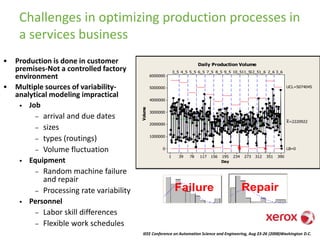
Challenges in optimizing production processes in
a services business
• Production is done in customer
premises-Not a controlled factory
environment
• Multiple sources of variability-
analytical modeling impractical
• Job
– arrival and due dates
– sizes
– types (routings)
– Volume fluctuation
• Equipment
– Random machine failure
and repair
– Processing rate variability
• Personnel
– Labor skill differences
– Flexible work schedules
Day
Volume
39035131227323419515611778391
6000000
5000000
4000000
3000000
2000000
1000000
0
_
X=2220922
UCL=5074045
LB=0
3_5 4_5 5_5 6_5 7_5 8_5 9_5 10_511_512_51_6 2_6 3_6
111
Daily Production Volume
Failure Repair
IEEE Conference on Automation Science and Engineering, Aug 23-26 (2008)Washington D.C.
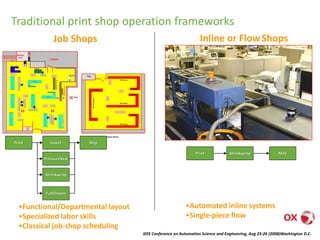
Traditional print shop operation frameworks
BellandHowell
Inserter
Inserter
Inserter
PB 8 Series
PB 8 Series
PB 8 Series
Inserter
Cage
Inserter Room
Desk
Desk
Desk
Desk
Desk
Desk
LOADING
Server Room
Mailing
Area
Input
Desk
P
r
i
n
t
e
r
1
Cutter
P
r
i
n
t
e
r
2
P
r
i
n
t
e
r
4
P
r
i
n
t
e
r
3
Desk
SQA
DESK
Moore
Sealer
Desk
Roll System
Printer
Desk
H
I
L
I
T
E
P
R
I
T
E
R
Desk
ShrinkWrapper
Pillar
DeskDesk
Desk
Desk
P
r
i
n
t
e
r
3
Desk
ShrinkWrapper
Roll System
Printer
•Functional/Departmental layout
•Specialized labor skills
•Classical job-shop scheduling
Job Shops Inline or FlowShops
Print Shrinkwrap
•Automated inline systems
•Single-piece flow
Print Insert Ship
PressureSeal
Shrinkwrap
Mail
Fulfillment
IEEE Conference on Automation Science and Engineering, Aug 23-26 (2008)Washington D.C.
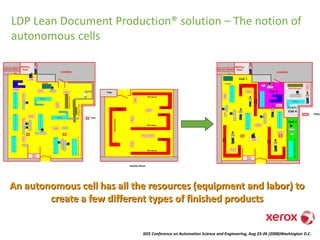
LDP Lean Document Production® solution – The notion of
autonomous cells
BellandHowell Inserter
Inserter
Inserter
PB 8 Series
PB 8 Series
PB 8 Series
Inserter
Cage
Inserter Room
Desk
Desk
Desk
Desk
Desk
Desk
LOADING
Server Room
Mailing
Area
Input
Desk
P
r
i
n
t
e
r
1
Cutter
P
r
i
n
t
e
r
2
P
r
i
n
t
e
r
4
P
r
i
n
t
e
r
3
Desk
SQA
DESK
Moore
Sealer
Desk
Roll System
Printer
Desk
H
I
L
I
T
E
P
R
I
T
E
R
Desk
ShrinkWrapper
Pillar
DeskDesk
Desk
Desk
P
r
i
n
t
e
r
3
Desk
ShrinkWrapper
Roll System
Printer
LOADING
Server Room
Mailing
Area
Input
Desk
P
r
i
n
t
e
r
1
Cutter
Inserter
PB8
Series
Inserter
PB8
Series
P
r
i
n
t
e
r
2
P
r
i
n
t
e
r
4
P
r
i
n
t
e
r
3
Desk
Desk
Desk
SQA
DESK
Inserter
PB8
Series
Moore
Sealer
Desk
Cell 4
Roll System
Printer
Desk
Desk
Cell 2
H
I
L
I
T
E
P
R
I
T
E
R
Desk
Shrink Wrapper
Pillar
Cell 3
Cell 1
An autonomous cell has all the resources (equipment and labor) to
create a few different types of finished products
IEEE Conference on Automation Science and Engineering, Aug 23-26 (2008)Washington D.C.
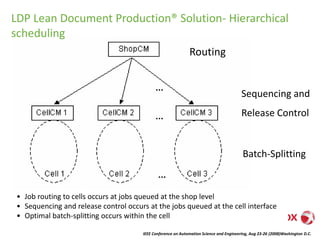
Routing
Sequencing and
Release Control
Batch-Splitting
• Job routing to cells occurs at jobs queued at the shop level
• Sequencing and release control occurs at the jobs queued at the cell interface
• Optimal batch-splitting occurs within the cell
LDP Lean Document Production® Solution- Hierarchical
scheduling
IEEE Conference on Automation Science and Engineering, Aug 23-26 (2008)Washington D.C.
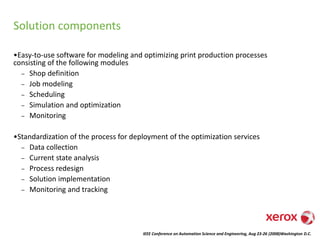
Solution components
•Easy-to-use software for modeling and optimizing print production processes
consisting of the following modules
– Shop definition
– Job modeling
– Scheduling
– Simulation and optimization
– Monitoring
•Standardization of the process for deployment of the optimization services
– Data collection
– Current state analysis
– Process redesign
– Solution implementation
– Monitoring and tracking
IEEE Conference on Automation Science and Engineering, Aug 23-26 (2008)Washington D.C.
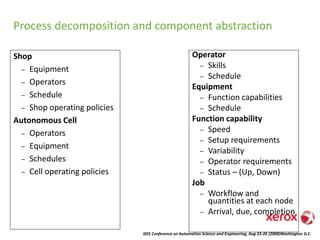
Process decomposition and component abstraction
Shop
– Equipment
– Operators
– Schedule
– Shop operating policies
Autonomous Cell
– Operators
– Equipment
– Schedules
– Cell operating policies
Operator
– Skills
– Schedule
Equipment
– Function capabilities
– Schedule
Function capability
– Speed
– Setup requirements
– Variability
– Operator requirements
– Status – (Up, Down)
Job
– Workflow and
quantities at each node
– Arrival, due, completion
IEEE Conference on Automation Science and Engineering, Aug 23-26 (2008)Washington D.C.
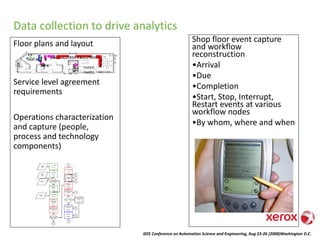
Data collection to drive analytics
Floor plans and layout
Service level agreement
requirements
Operations characterization
and capture (people,
process and technology
components)
Shop floor event capture
and workflow
reconstruction
•Arrival
•Due
•Completion
•Start, Stop, Interrupt,
Restart events at various
workflow nodes
•By whom, where and when
55' - 4 1/4"
2' - 4 7/8"
18'-12"
62' - 1 1/8"
12'-0"
PAPER
PAPER
SKRINKWRAP CUTTERDRILL
DOCUTECH # 2DOCUTECH # 1
DOCUTECH#3
53905100
DOC40B
DOC 40 A
DC265 A
DC265B
FAX
55' - 4 1/4"
IEEE Conference on Automation Science and Engineering, Aug 23-26 (2008)Washington D.C.
Modeling, analysis and optimization algorithms
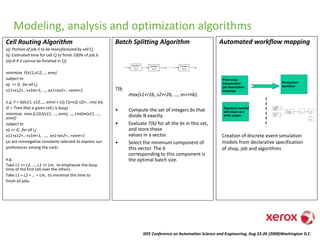
Cell Routing Algorithm
xij: Portion of job Ji to be manufactured by cell Cj.
tij: Estimated time for cell Cj to finish 100% of job Ji.
(tij=0 if Ji cannot be finished in Cj)
minimize F(x11,x12,…, xnm)
subject to
xij >= 0, for all i,j
x11+x12+…+x1m=1, …, xn1+xn2+…+xnm=1
e.g. F = Gj(x11, x12,…, xnm) = x1j t1j+x2j t2j+…+xnj tnj.
(F = Time that a given cell j is busy)
minimize max {L1G1(x11, …, xnm), …, LmGm(x11, …,
xnm)}
subject to
xij >= 0, for all i,j
x11+x12+…+x1m=1, …, xn1+xn2+…+xnm=1
Ljs are nonnegative constants selected to express our
preferences among the costs
e.g.
Take L1 >> L2, …, L1 >> Lm, to emphasize the busy
time of the first cell over the others.
Take L1 = L2 = … = Lm, to minimize the time to
finish all jobs.
Batch Splitting Algorithm
T(b) = s1 + (r1+r2+…+rn) b + (N/b –1)
max{s1+r1b, s2+r2b, …, sn+rnb}.
• Compute the set of integers bs that
divide N exactly.
• Evaluate T(b) for all the bs in this set,
and store these
values in a vector.
• Select the minimum component of
this vector. The b
corresponding to this component is
the optimal batch size.
Print Black
& White
Pages
Print Color
Pages
Collate
& Trim
Fold Stitch
Mail
Print Black
& White
Pages
Print Color
Pages
Collate
& Trim
Fold Stitch
Mail
Print shop
independent
job description
language
Production
workflow
Signature booklet
with black and
white pages
Automated workflow mapping
Creation of discrete event simulation
models from declarative specification
of shop, job and algorithms
IEEE Conference on Automation Science and Engineering, Aug 23-26 (2008)Washington D.C.
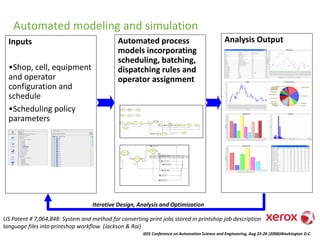
Automated modeling and simulation
Inputs
•Shop, cell, equipment
and operator
configuration and
schedule
•Scheduling policy
parameters
Automated process
models incorporating
scheduling, batching,
dispatching rules and
operator assignment
Analysis Output
Iterative Design, Analysis and Optimization
US Patent # 7,064,848: System and method for converting print jobs stored in printshop job description
language files into printshop workflow (Jackson & Rai)
IEEE Conference on Automation Science and Engineering, Aug 23-26 (2008)Washington D.C.
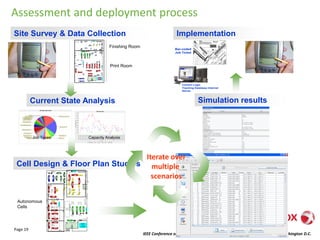
Current State Analysis
Job Types Capacity Analysis
Implementation
Bar-coded
Job Ticket
Control Logic
Tracking Database Internet
Server
Site Survey & Data Collection
Finishing Room
Print Room
Cell Design & Floor Plan Studies
Autonomous
Cells
Simulation results
Assessment and deployment process
Iterate over
multiple
scenarios
Page 19
IEEE Conference on Automation Science and Engineering, Aug 23-26 (2008)Washington D.C.
Impact on operational metrics
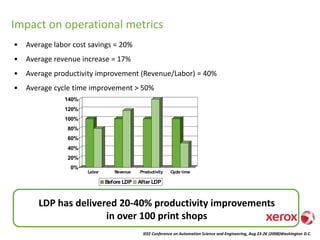
• Average labor cost savings = 20%
• Average revenue increase = 17%
• Average productivity improvement (Revenue/Labor) = 40%
• Average cycle time improvement > 50%
0%
20%
40%
60%
80%
100%
120%
140%
Labor Revenue Productivity Cycle time
Before LDP After LDP
LDP has delivered 20-40% productivity improvements
in over 100 print shops
IEEE Conference on Automation Science and Engineering, Aug 23-26 (2008)Washington D.C.
Lessons learned
•Participate early on in real services optimization engagements
to develop an accurate understanding of problem domain
•Automation can play a key role in large scale deployment – but
blind automation can be detrimental
•Automate keeping the skill level and mind-set of the end-user
(consultant) who will be using the toolkit. Hide complexity
under-the-hood of the tools.
•The automated tools should not be an end in themselves. They
should be designed to assist a domain expert to help them with
their optimization efforts (similar to the notion of autonomation
in Toyota Production System)
•Classroom training should be supplemented with hands-on-
training in live services optimization engagements
•Toolkit should be continually refined and expanded as more
and more of the problem domain is understood, abstracted and
generalized and better algorithms are developed
IEEE Conference on Automation Science and Engineering, Aug 23-26 (2008)Washington D.C.
Concluding remarks
•Automation of services analysis and optimization using easy-to-use S/W
toolkit and structured delivery processes can lead to scalability of services
delivery
•Problem formulation requires direct participation in services delivery
engagements and appropriate abstractions that can be generalized to the
services application
•Automation of process optimization tools can make the services delivery and
optimization robust to variations in skill and knowledge level of consultants
•Xerox has developed and deployed a set of tools under the general umbrella
of tools called “LDP Lean Document Production®”
– Over 100 personnel of varying skill sets have been trained in the use of
these tools
– Over 100 mid-sized to large print shops from the document production
services business have been assessed and optimized in the US, Canada,
China and Thailand
• We believe that services delivery optimization using a combination of
Industrial Engineering, Operations Research, IT tools and best practices
such as Lean and Six Sigma methodologies will usher in the next phase of
productivity improvements in the services business.
• The work discussed in this talk was selected as a finalist for the 2008
INFORMS Franz Edelman award

An innovative software framework and toolkit for process optimization deployed within a large enterprise

  • 1.
    Modeling Automation for AchievingScalability of Process Optimization Services 4th IEEE CASE Conference, Washington D.C., August 25th 2008 Sudhendu Rai Xerox Corporation
  • 2.
    IEEE Conference onAutomation Science and Engineering, Aug 23-26 (2008)Washington D.C. Abstract Many business enterprises outsource the management of processes and technology that they consider non- core to third-party service providers. The challenge for the service providers is to leverage their expertise to deliver managed services that more efficient, productive and profitable. Examples include IT infrastructure management (IBM, HP), print services management (Xerox, Ricoh, Pitney Bowes), food services (Aramark, Compass Group, Sodexo) and others. Many traditional product companies have increasingly diversified as service providers of this type and rely on a combination of people and technology for services delivery. The capability and expertise to deliver high quality optimized processes on a large scale without incurring high costs is a key imperative for these companies. This is traditionally achieved through standardization of processes, capture and dissemination of best practices and domain knowledge and structured training programs. Process optimization technologies such as discrete-event simulation, stochastic process modeling and advanced analytics have traditionally been the forte of expert (and often high-paid) consultants which has limited their broad use in these services industries primarily due to cost constraints. This talk will describe how process optimization solutions were developed and delivered on a large scale to the Xerox document production outsourcing-services business. Early on, extensive consulting engagements with end-customers were used to abstract and generalize the process optimization problem. Then the various steps of the process optimization problem such as data collection, statistical analysis, simulation and modeling, optimization, scheduling and monitoring were abstracted and modeled. Technology and algorithms for each step were developed, refined, automated, integrated and then encapsulated in an easy-to-use software toolkit that supported a structured customer engagement process by less-skilled delivery personnel. The delivery of process optimization services using these automated tools that encapsulate advanced analytics, process modeling, optimization and scheduling techniques has enabled significant savings and improvement in customer satisfaction for the document production outsourcing-services business. The talk will conclude with a discussion of lessons learnt and next steps to further automate and simplify the services delivery process.
  • 3.
    IEEE Conference onAutomation Science and Engineering, Aug 23-26 (2008)Washington D.C. Author Bio Dr. Rai is a Principal Scientist, Project Leader and a certified Lean Six Sigma Black Belt at the Xerox Research Center in Webster, N.Y. He received his PhD. from MIT in 1993, MS from Caltech in 1989, and BTech from IIT, Kanpur (India) in 1988 – all in Mechanical Engineering. Dr. Rai joined Xerox in 1995 as a Member of Research & Technology staff. He was promoted to Principal Scientist in 2001. During 1996-97 he demonstrated the feasibility of virtual prototyping of xerographic components. He created, validated and implemented a new methodology for performing quantitative trade-offs in large-system design. Between 1997 and 1998 he developed and implemented a novel distributed control architecture for moving paper across multiple paper handling modules. He is the lead inventor of the LDP Lean Document Production® Solution . Starting in 1998 he led a team that developed the algorithms, software toolkit to support the initial offering and a training curriculum to train Xerox Global Services consultants. He has personally led and implemented process improvement initiatives in dozens of small and large print shops spanning multiple industry segments. He holds 15 patents (with 35 additional pending) and has published more than 20 technical papers in conference proceedings and technical journals. The Xerox entry “LDP Lean Document Production® - Dramatic Productivity Improvements for the Printing Industry” is a finalist in the 2008 Franz Edelman Award competition (sponsored by INFORMS). He is a member of IIE, ASME, INFORMS, Sigma Xi and a senior member of IEEE. He is a recipient of the Xerox Excellence in Science and Technology Award and was selected as a finalist for the Rochester Engineer of the Year award in 2007.
  • 4.
    IEEE Conference onAutomation Science and Engineering, Aug 23-26 (2008)Washington D.C. Growth in services outsourcing •Enterprises are increasingly looking to outsource operations that they consider non-core •Examples include: – IT systems and processes – Document management (office and production) – Food services – Variety of business processes • Maintaining good quality of service and high margins is a key imperative for the service providers
  • 5.
    IEEE Conference onAutomation Science and Engineering, Aug 23-26 (2008)Washington D.C. Focus of this talk is document production services outsourcing Document outsourcing is a large market that is expected to grow from $36.2 billion in 2007 to $46.8 billion by 2012 (CAGR of 5.3 %)1 1US Document Outsourcing Market Forecast 2007-2012 Infotrends Report June 30, 2008 Commercial forms, other printers Office supplies and quick printers Document Process Service Providers Facilities Management Providers Statement Printers Banta (acquired by RR Donnelley) Fedex Kinko’s IBM Global Services IKON ADP Cenveo Office Max Rastar Hewlett Packard Alliance Data Consolidated Graphics Office Depot HOV Service BPO Ricoh (Lanier) Bowne Merrill Corporation Sir Speedy Oce Pitney Bowes CSG Systems Quad/Graphics Staples Rastar Oce DST Output Quebecor World TPF Worldwide Xerox Global Services Personix RR Donnelley Williams Lea Regulus Standard Register Xerox Global Services R.R. Donnelley Williams Lea HOV Services Workflow One
  • 6.
    IEEE Conference onAutomation Science and Engineering, Aug 23-26 (2008)Washington D.C. Problem statement Goal To optimize the quality of service metrics of document production and management services processes on a large distributed scale subject to the following constraints – Keep deployment and operational costs low to drive higher profit margins – Achieve standardization of service – Maintain process adaptability to changing customer requirements
  • 7.
    IEEE Conference onAutomation Science and Engineering, Aug 23-26 (2008)Washington D.C. Print shop overview Collater Cutter Binder Postage Meter Shipping Paper cart Paper cart Paper cart Failure Repair Failure Repair Failure Repair Labor Labor variability WIP WIP WIP Finishing Mailing Customer Electronic Submission Job Variability •Demand •Size •Routing Graphics design Pre-pressCustomer service Failure Repair Color Printer BW Printer CF Printer Paper cart Failure Repair Failure Repair WIP Paper cart WIP Paper cart WIP Printing Failure Repair Failure Repair Failure Repair WIP Failure Repair Failure Repair WIP Failure Repair Failure Repair Failure Repair Failure Repair
  • 8.
    IEEE Conference onAutomation Science and Engineering, Aug 23-26 (2008)Washington D.C. Diverse types of print shops BellandHowell Inserter Inserter Inserter PB 8 Series PB 8 Series PB 8 Series Inserter Cage Inserter Room Desk Desk Desk Desk Desk Desk LOADING Server Room Mailing Area Input Desk P r i n t e r 1 Cutter P r i n t e r 2 P r i n t e r 4 P r i n t e r 3 Desk SQA DESK Moore Sealer Desk Roll System Printer Desk H I L I T E P R I T E R Desk ShrinkWrapper Pillar DeskDesk Desk Desk P r i n t e r 3 Desk ShrinkWrapper Roll System Printer Transaction Print Shop 55' - 4 1/4" 2' - 4 7/8" 18'-12" 62' - 1 1/8" 12'-0" PAPER PAPER SKRINK WRAP CUTTER DRILL DOCUTECH # 2DOCUTECH # 1 D O C U T EC H # 3 53905 1 0 0 D O C 4 0 B DOC 40 A DC 265 A DC 265B FAX 55' - 4 1/4" Copy Shop Combination of Transaction & Publishing Offset Print Shop
  • 9.
    IEEE Conference onAutomation Science and Engineering, Aug 23-26 (2008)Washington D.C. 360003000024000180001200060000 Median Mean 4003002001000 A nderson-Darling Normality Test V ariance 2034062.0 Skew ness 16.142 Kurtosis 383.015 N 1692 Minimum 1.0 A -Squared 1st Q uartile 6.0 Median 28.0 3rd Q uartile 152.0 Maximum 39802.0 95% C onfidence Interv al for Mean 267.4 425.32 403.4 95% C onfidence Interv al for Median 25.0 33.0 95% C onfidence Interv al for StDev 1379.7 1476.0 P-V alue < 0.005 Mean 335.4 StDev 1426.2 95% Confidence Intervals Job Size (Page Count) distribution Challenges in optimizing production processes in a services business • Production is done in customer premises-Not a controlled factory environment • Multiple sources of variability- analytical modeling impractical • Job – arrival and due dates – sizes – types (routings) – Volume fluctuation • Equipment – Random machine failure and repair – Processing rate variability • Personnel – Labor skill differences – Flexible work schedules Day Volume 39035131227323419515611778391 6000000 5000000 4000000 3000000 2000000 1000000 0 _ X=2220922 UCL=5074045 LB=0 3_5 4_5 5_5 6_5 7_5 8_5 9_5 10_511_512_51_6 2_6 3_6 111 Daily Production Volume Failure Repair
  • 10.
    IEEE Conference onAutomation Science and Engineering, Aug 23-26 (2008)Washington D.C. Traditional print shop operation frameworks BellandHowell Inserter Inserter Inserter PB 8 Series PB 8 Series PB 8 Series Inserter Cage Inserter Room Desk Desk Desk Desk Desk Desk LOADING Server Room Mailing Area Input Desk P r i n t e r 1 Cutter P r i n t e r 2 P r i n t e r 4 P r i n t e r 3 Desk SQA DESK Moore Sealer Desk Roll System Printer Desk H I L I T E P R I T E R Desk ShrinkWrapper Pillar DeskDesk Desk Desk P r i n t e r 3 Desk ShrinkWrapper Roll System Printer •Functional/Departmental layout •Specialized labor skills •Classical job-shop scheduling Job Shops Inline or FlowShops Print Shrinkwrap •Automated inline systems •Single-piece flow Print Insert Ship PressureSeal Shrinkwrap Mail Fulfillment
  • 11.
    IEEE Conference onAutomation Science and Engineering, Aug 23-26 (2008)Washington D.C. LDP Lean Document Production® solution – The notion of autonomous cells BellandHowell Inserter Inserter Inserter PB 8 Series PB 8 Series PB 8 Series Inserter Cage Inserter Room Desk Desk Desk Desk Desk Desk LOADING Server Room Mailing Area Input Desk P r i n t e r 1 Cutter P r i n t e r 2 P r i n t e r 4 P r i n t e r 3 Desk SQA DESK Moore Sealer Desk Roll System Printer Desk H I L I T E P R I T E R Desk ShrinkWrapper Pillar DeskDesk Desk Desk P r i n t e r 3 Desk ShrinkWrapper Roll System Printer LOADING Server Room Mailing Area Input Desk P r i n t e r 1 Cutter Inserter PB8 Series Inserter PB8 Series P r i n t e r 2 P r i n t e r 4 P r i n t e r 3 Desk Desk Desk SQA DESK Inserter PB8 Series Moore Sealer Desk Cell 4 Roll System Printer Desk Desk Cell 2 H I L I T E P R I T E R Desk Shrink Wrapper Pillar Cell 3 Cell 1 An autonomous cell has all the resources (equipment and labor) to create a few different types of finished products
  • 12.
    IEEE Conference onAutomation Science and Engineering, Aug 23-26 (2008)Washington D.C. Routing Sequencing and Release Control Batch-Splitting • Job routing to cells occurs at jobs queued at the shop level • Sequencing and release control occurs at the jobs queued at the cell interface • Optimal batch-splitting occurs within the cell LDP Lean Document Production® Solution- Hierarchical scheduling
  • 13.
    IEEE Conference onAutomation Science and Engineering, Aug 23-26 (2008)Washington D.C. Solution components •Easy-to-use software for modeling and optimizing print production processes consisting of the following modules – Shop definition – Job modeling – Scheduling – Simulation and optimization – Monitoring •Standardization of the process for deployment of the optimization services – Data collection – Current state analysis – Process redesign – Solution implementation – Monitoring and tracking
  • 14.
    IEEE Conference onAutomation Science and Engineering, Aug 23-26 (2008)Washington D.C. Process decomposition and component abstraction Shop – Equipment – Operators – Schedule – Shop operating policies Autonomous Cell – Operators – Equipment – Schedules – Cell operating policies Operator – Skills – Schedule Equipment – Function capabilities – Schedule Function capability – Speed – Setup requirements – Variability – Operator requirements – Status – (Up, Down) Job – Workflow and quantities at each node – Arrival, due, completion
  • 15.
    IEEE Conference onAutomation Science and Engineering, Aug 23-26 (2008)Washington D.C. Data collection to drive analytics Floor plans and layout Service level agreement requirements Operations characterization and capture (people, process and technology components) Shop floor event capture and workflow reconstruction •Arrival •Due •Completion •Start, Stop, Interrupt, Restart events at various workflow nodes •By whom, where and when 55' - 4 1/4" 2' - 4 7/8" 18'-12" 62' - 1 1/8" 12'-0" PAPER PAPER SKRINKWRAP CUTTERDRILL DOCUTECH # 2DOCUTECH # 1 DOCUTECH#3 53905100 DOC40B DOC 40 A DC265 A DC265B FAX 55' - 4 1/4"
  • 16.
    IEEE Conference onAutomation Science and Engineering, Aug 23-26 (2008)Washington D.C. Modeling, analysis and optimization algorithms Cell Routing Algorithm xij: Portion of job Ji to be manufactured by cell Cj. tij: Estimated time for cell Cj to finish 100% of job Ji. (tij=0 if Ji cannot be finished in Cj) minimize F(x11,x12,…, xnm) subject to xij >= 0, for all i,j x11+x12+…+x1m=1, …, xn1+xn2+…+xnm=1 e.g. F = Gj(x11, x12,…, xnm) = x1j t1j+x2j t2j+…+xnj tnj. (F = Time that a given cell j is busy) minimize max {L1G1(x11, …, xnm), …, LmGm(x11, …, xnm)} subject to xij >= 0, for all i,j x11+x12+…+x1m=1, …, xn1+xn2+…+xnm=1 Ljs are nonnegative constants selected to express our preferences among the costs e.g. Take L1 >> L2, …, L1 >> Lm, to emphasize the busy time of the first cell over the others. Take L1 = L2 = … = Lm, to minimize the time to finish all jobs. Batch Splitting Algorithm T(b) = s1 + (r1+r2+…+rn) b + (N/b –1) max{s1+r1b, s2+r2b, …, sn+rnb}. • Compute the set of integers bs that divide N exactly. • Evaluate T(b) for all the bs in this set, and store these values in a vector. • Select the minimum component of this vector. The b corresponding to this component is the optimal batch size. Print Black & White Pages Print Color Pages Collate & Trim Fold Stitch Mail Print Black & White Pages Print Color Pages Collate & Trim Fold Stitch Mail Print shop independent job description language Production workflow Signature booklet with black and white pages Automated workflow mapping Creation of discrete event simulation models from declarative specification of shop, job and algorithms
  • 17.
    IEEE Conference onAutomation Science and Engineering, Aug 23-26 (2008)Washington D.C. Automated modeling and simulation Inputs •Shop, cell, equipment and operator configuration and schedule •Scheduling policy parameters Automated process models incorporating scheduling, batching, dispatching rules and operator assignment Analysis Output Iterative Design, Analysis and Optimization US Patent # 7,064,848: System and method for converting print jobs stored in printshop job description language files into printshop workflow (Jackson & Rai)
  • 18.
    IEEE Conference onAutomation Science and Engineering, Aug 23-26 (2008)Washington D.C.
  • 19.
    IEEE Conference onAutomation Science and Engineering, Aug 23-26 (2008)Washington D.C. Current State Analysis Job Types Capacity Analysis Implementation Bar-coded Job Ticket Control Logic Tracking Database Internet Server Site Survey & Data Collection Finishing Room Print Room Cell Design & Floor Plan Studies Autonomous Cells Simulation results Assessment and deployment process Iterate over multiple scenarios Page 19
  • 20.
    IEEE Conference onAutomation Science and Engineering, Aug 23-26 (2008)Washington D.C. Impact on operational metrics • Average labor cost savings = 20% • Average revenue increase = 17% • Average productivity improvement (Revenue/Labor) = 40% • Average cycle time improvement > 50% 0% 20% 40% 60% 80% 100% 120% 140% Labor Revenue Productivity Cycle time Before LDP After LDP LDP has delivered 20-40% productivity improvements in over 100 print shops
  • 21.
    IEEE Conference onAutomation Science and Engineering, Aug 23-26 (2008)Washington D.C. Lessons learned •Participate early on in real services optimization engagements to develop an accurate understanding of problem domain •Automation can play a key role in large scale deployment – but blind automation can be detrimental •Automate keeping the skill level and mind-set of the end-user (consultant) who will be using the toolkit. Hide complexity under-the-hood of the tools. •The automated tools should not be an end in themselves. They should be designed to assist a domain expert to help them with their optimization efforts (similar to the notion of autonomation in Toyota Production System) •Classroom training should be supplemented with hands-on- training in live services optimization engagements •Toolkit should be continually refined and expanded as more and more of the problem domain is understood, abstracted and generalized and better algorithms are developed
  • 22.
    IEEE Conference onAutomation Science and Engineering, Aug 23-26 (2008)Washington D.C. Concluding remarks •Automation of services analysis and optimization using easy-to-use S/W toolkit and structured delivery processes can lead to scalability of services delivery •Problem formulation requires direct participation in services delivery engagements and appropriate abstractions that can be generalized to the services application •Automation of process optimization tools can make the services delivery and optimization robust to variations in skill and knowledge level of consultants •Xerox has developed and deployed a set of tools under the general umbrella of tools called “LDP Lean Document Production®” – Over 100 personnel of varying skill sets have been trained in the use of these tools – Over 100 mid-sized to large print shops from the document production services business have been assessed and optimized in the US, Canada, China and Thailand • We believe that services delivery optimization using a combination of Industrial Engineering, Operations Research, IT tools and best practices such as Lean and Six Sigma methodologies will usher in the next phase of productivity improvements in the services business. • The work discussed in this talk was selected as a finalist for the 2008 INFORMS Franz Edelman award