16 October 2006 1
A Journey of Change: Delivering
Transformation at Transport for London
Welcome and Housekeeping
June 2015 2
Agenda
• Introduction to TfL
• TfL Change Programmes
• Project Management Methodology and Business
Change Framework
• Developing Change Capability
• Questions
June 2015 3
Introduction to TfL
• Executive arm of Greater London Authority
reporting to Mayor of London
• Formed in 2000 bringing together almost all
transport modes in London – London
Underground added in 2003
• Structured as 2 operating businesses, Rail &
Underground and Surface Transport, and
“Specialist Services” corporate functions
June 2015 4
The scale of TfL
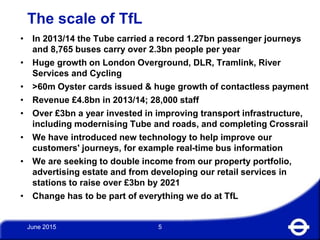
• In 2013/14 the Tube carried a record 1.27bn passenger journeys
and 8,765 buses carry over 2.3bn people per year
• Huge growth on London Overground, DLR, Tramlink, River
Services and Cycling
• >60m Oyster cards issued & huge growth of contactless payment
• Revenue £4.8bn in 2013/14; 28,000 staff
• Over £3bn a year invested in improving transport infrastructure,
including modernising Tube and roads, and completing Crossrail
• We have introduced new technology to help improve our
customers' journeys, for example real-time bus information
• We are seeking to double income from our property portfolio,
advertising estate and from developing our retail services in
stations to raise over £3bn by 2021
• Change has to be part of everything we do at TfL
June 2015 5
Drivers for Change at TfL
June 2015 6
Technology
Efficiency
Organisational
Capability development
Customer Service
Environmental
Drivers of change TfL Context
Future Ticketing, Mobile devices, Station Wi-fi
Reducing CO2, more and safer walking & cycling, noise reduction
Restructuring and integration of other organisations
Leadership, project and change management, commercial
Comprehensive spending review and efficiency targets
Fit for the Future Stations: and how we interact with customers
Economic London’s population increases by two bus loads per day
Political The Mayor’s Transport Strategy, General & Mayoral elections
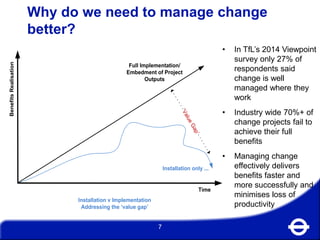
Why do we need to manage change
better?
7
‘ValueGap’
Time
BenefitsRealisation
Full Implementation/
Embedment of Project
Outputs
Installation only ...
Installation v Implementation
Addressing the ‘value gap’
• In TfL’s 2014 Viewpoint
survey only 27% of
respondents said
change is well
managed where they
work
• Industry wide 70%+ of
change projects fail to
achieve their full
benefits
• Managing change
effectively delivers
benefits faster and
more successfully and
minimises loss of
productivity
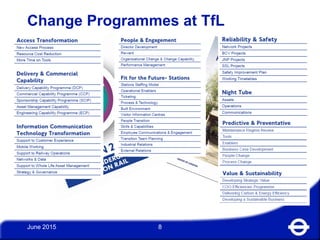
Change Programmes at TfL
June 2015 8
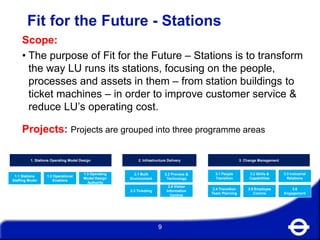
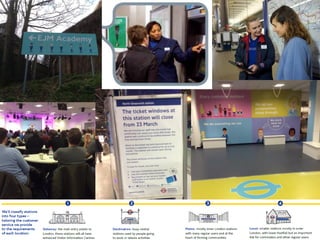
Fit for the Future - Stations
Scope:
• The purpose of Fit for the Future – Stations is to transform
the way LU runs its stations, focusing on the people,
processes and assets in them – from station buildings to
ticket machines – in order to improve customer service &
reduce LU’s operating cost.
Projects: Projects are grouped into three programme areas
9
3.6
Engagement
2.3 Ticketing
2.1 Built
Environment
2.2 Process &
Technology
1.1 Stations
Staffing Model
1.2 Operational
Enablers
2.4 Visitor
Information
Centres
3.2 Skills &
Capabilities
3.1 People
Transition
3.4 Transition
Team Planning
3.5 Employee
Comms
3.3 Industrial
Relations
1.3 Operating
Model Design
Authority
1. Stations Operating Model Design 2. Infrastructure Delivery 3. Change Management
March 2015 10
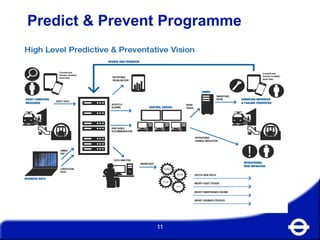
Predict & Prevent Programme
11
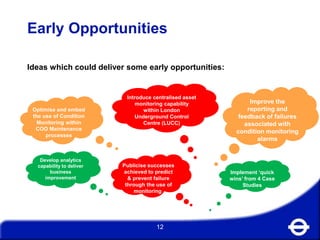
Early Opportunities
Ideas which could deliver some early opportunities:
12
Introduce centralised asset
monitoring capability
within London
Underground Control
Centre (LUCC)
Optimise and embed
the use of Condition
Monitoring within
COO Maintenance
processes
Improve the
reporting and
feedback of failures
associated with
condition monitoring
alarms
Publicise successes
achieved to predict
& prevent failure
through the use of
monitoring
Implement ‘quick
wins’ from 4 Case
Studies
Develop analytics
capability to deliver
business
improvement
RAMS Programme
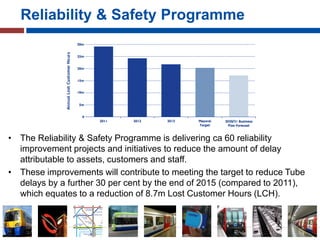
Reliability & Safety Programme
• The Reliability & Safety Programme is delivering ca 60 reliability
improvement projects and initiatives to reduce the amount of delay
attributable to assets, customers and staff.
• These improvements will contribute to meeting the target to reduce Tube
delays by a further 30 per cent by the end of 2015 (compared to 2011),
which equates to a reduction of 8.7m Lost Customer Hours (LCH).
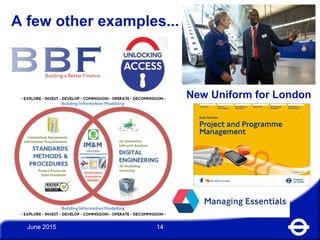
A few other examples...
June 2015 14
New Uniform for London
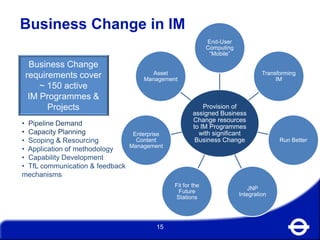
Business Change in IM
15
Business Change
requirements cover
~ 150 active
IM Programmes &
Projects
• Pipeline Demand
• Capacity Planning
• Scoping & Resourcing
• Application of methodology
• Capability Development
• TfL communication & feedback
mechanisms
Provision of
assigned Business
Change resources
to IM Programmes
with significant
Business Change
End-User
Computing
“Mobile”
Transforming
IM
Run Better
JNP
Integration
Fit for the
Future
Stations
Enterprise
Content
Management
Asset
Management
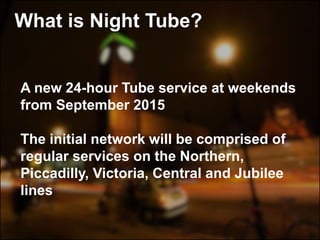
A new 24-hour Tube service at weekends
from September 2015
The initial network will be comprised of
regular services on the Northern,
Piccadilly, Victoria, Central and Jubilee
lines
What is Night Tube?
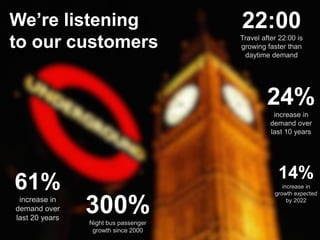
24%
increase in
demand over
last 10 years
61%
increase in
demand over
last 20 years
300%Night bus passenger
growth since 2000
14%
increase in
growth expected
by 2022
22:00
Travel after 22:00 is
growing faster than
daytime demand
We’re listening
to our customers
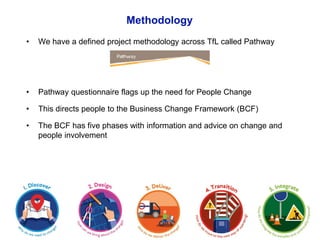
Methodology
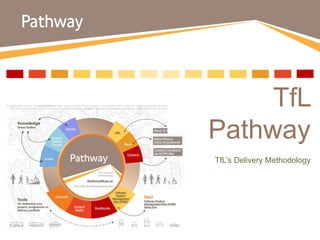
• We have a defined project methodology across TfL called Pathway
• Pathway questionnaire flags up the need for People Change
• This directs people to the Business Change Framework (BCF)
• The BCF has five phases with information and advice on change and
people involvement
TfL
Pathway
TfL’s Delivery Methodology
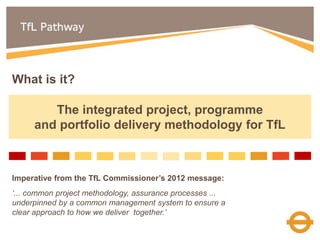
What is it?
Imperative from the TfL Commissioner’s 2012 message:
‘... common project methodology, assurance processes ...
underpinned by a common management system to ensure a
clear approach to how we deliver together.’
The integrated project, programme
and portfolio delivery methodology for TfL
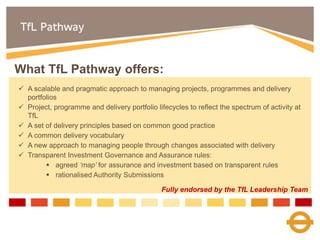
What TfL Pathway offers:
 A scalable and pragmatic approach to managing projects, programmes and delivery
portfolios
 Project, programme and delivery portfolio lifecycles to reflect the spectrum of activity at
TfL
 A set of delivery principles based on common good practice
 A common delivery vocabulary
 A new approach to managing people through changes associated with delivery
 Transparent Investment Governance and Assurance rules:
 agreed ‘map’ for assurance and investment based on transparent rules
 rationalised Authority Submissions
Fully endorsed by the TfL Leadership Team
Designed by working with more than 300 delivery staff around the TfL business
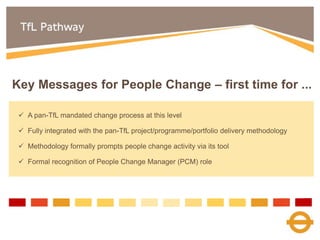
Key Messages for People Change – first time for ...
 A pan-TfL mandated change process at this level
 Fully integrated with the pan-TfL project/programme/portfolio delivery methodology
 Methodology formally prompts people change activity via its tool
 Formal recognition of People Change Manager (PCM) role
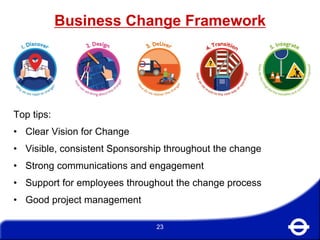
Business Change Framework
23
Top tips:
• Clear Vision for Change
• Visible, consistent Sponsorship throughout the change
• Strong communications and engagement
• Support for employees throughout the change process
• Good project management
What does the BCF look like?
Click on one of the BCF
phases for guidance
and useful tools
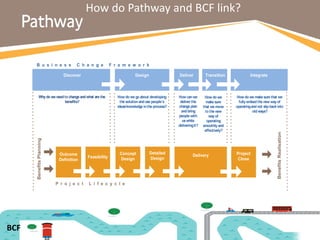
How do Pathway and BCF link?
Delivery
Discover Design Deliver Transition
B u s i n e s s C h a n g e F r a m e w o r k
P r o j e c t L i f e c y c l e
Project
Close
Detailed
Design
Concept
Design
Outcome
Definition
Feasibility
BenefitsPlanning
BenefitsRealisation
Integrate
Whydo we needto change andwhat are the
benefits?
How do we go about developing
the solutionanduse people’s
ideas/knowledge inthe process?
How canwe
deliver the
change plan
andbring
people with
uswhile
deliveringit?
How do we
make sure
that we move
to the new
wayof
operating
smoothlyand
effectively?
How do we make sure that we
fullyembedthe new wayof
operatingandnot slipbackinto
oldways?
BCF
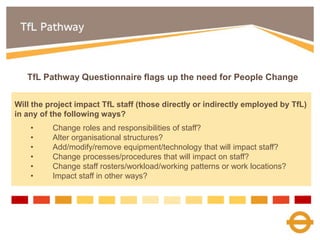
TfL Pathway Questionnaire flags up the need for People Change
Will the project impact TfL staff (those directly or indirectly employed by TfL)
in any of the following ways?
• Change roles and responsibilities of staff?
• Alter organisational structures?
• Add/modify/remove equipment/technology that will impact staff?
• Change processes/procedures that will impact on staff?
• Change staff rosters/workload/working patterns or work locations?
• Impact staff in other ways?
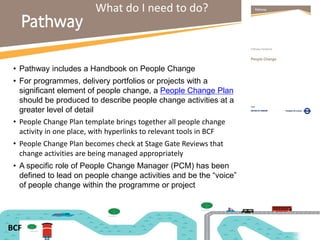
What do I need to do?
BCF
• Pathway includes a Handbook on People Change
• For programmes, delivery portfolios or projects with a
significant element of people change, a People Change Plan
should be produced to describe people change activities at a
greater level of detail
• People Change Plan template brings together all people change
activity in one place, with hyperlinks to relevant tools in BCF
• People Change Plan becomes check at Stage Gate Reviews that
change activities are being managed appropriately
• A specific role of People Change Manager (PCM) has been
defined to lead on people change activities and be the “voice”
of people change within the programme or project
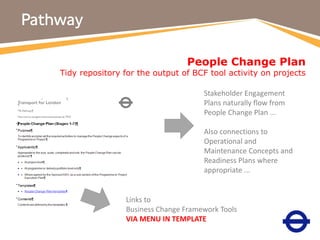
People Change Plan
Tidy repository for the output of BCF tool activity on projects
Stakeholder Engagement
Plans naturally flow from
People Change Plan ...
Also connections to
Operational and
Maintenance Concepts and
Readiness Plans where
appropriate ...
Links to
Business Change Framework Tools
VIA MENU IN TEMPLATE
People Change Manager
consulted on:• Stakeholder Engagement & Communications Plan
• Product Management Plan
• Project Requirements
• Project Execution Plan
• Lessons Learned
• Maintenance Concept
• Maintenance Readiness Plan
• Operational Concept
• Operational Readiness Plan
• Risk Management Strategy
• Schedule
• Equality Impact Assessment (EQIA)
16 October 2006 30
Developing Change Capability
March 2015 31
March 2015 32
16 October 2006 33
Q&A
This presentation was delivered
at an APM event
To find out more about
upcoming events please visit
our website
www.apm.org.uk/events

ECSIG (TfL) presentation 29 06-15 - final for sharing

  • 1.
    16 October 20061 A Journey of Change: Delivering Transformation at Transport for London
  • 2.
  • 3.
    Agenda • Introduction toTfL • TfL Change Programmes • Project Management Methodology and Business Change Framework • Developing Change Capability • Questions June 2015 3
  • 4.
    Introduction to TfL •Executive arm of Greater London Authority reporting to Mayor of London • Formed in 2000 bringing together almost all transport modes in London – London Underground added in 2003 • Structured as 2 operating businesses, Rail & Underground and Surface Transport, and “Specialist Services” corporate functions June 2015 4
  • 5.
    The scale ofTfL • In 2013/14 the Tube carried a record 1.27bn passenger journeys and 8,765 buses carry over 2.3bn people per year • Huge growth on London Overground, DLR, Tramlink, River Services and Cycling • >60m Oyster cards issued & huge growth of contactless payment • Revenue £4.8bn in 2013/14; 28,000 staff • Over £3bn a year invested in improving transport infrastructure, including modernising Tube and roads, and completing Crossrail • We have introduced new technology to help improve our customers' journeys, for example real-time bus information • We are seeking to double income from our property portfolio, advertising estate and from developing our retail services in stations to raise over £3bn by 2021 • Change has to be part of everything we do at TfL June 2015 5
  • 6.
    Drivers for Changeat TfL June 2015 6 Technology Efficiency Organisational Capability development Customer Service Environmental Drivers of change TfL Context Future Ticketing, Mobile devices, Station Wi-fi Reducing CO2, more and safer walking & cycling, noise reduction Restructuring and integration of other organisations Leadership, project and change management, commercial Comprehensive spending review and efficiency targets Fit for the Future Stations: and how we interact with customers Economic London’s population increases by two bus loads per day Political The Mayor’s Transport Strategy, General & Mayoral elections
  • 7.
    Why do weneed to manage change better? 7 ‘ValueGap’ Time BenefitsRealisation Full Implementation/ Embedment of Project Outputs Installation only ... Installation v Implementation Addressing the ‘value gap’ • In TfL’s 2014 Viewpoint survey only 27% of respondents said change is well managed where they work • Industry wide 70%+ of change projects fail to achieve their full benefits • Managing change effectively delivers benefits faster and more successfully and minimises loss of productivity
  • 8.
    Change Programmes atTfL June 2015 8
  • 9.
    Fit for theFuture - Stations Scope: • The purpose of Fit for the Future – Stations is to transform the way LU runs its stations, focusing on the people, processes and assets in them – from station buildings to ticket machines – in order to improve customer service & reduce LU’s operating cost. Projects: Projects are grouped into three programme areas 9 3.6 Engagement 2.3 Ticketing 2.1 Built Environment 2.2 Process & Technology 1.1 Stations Staffing Model 1.2 Operational Enablers 2.4 Visitor Information Centres 3.2 Skills & Capabilities 3.1 People Transition 3.4 Transition Team Planning 3.5 Employee Comms 3.3 Industrial Relations 1.3 Operating Model Design Authority 1. Stations Operating Model Design 2. Infrastructure Delivery 3. Change Management
  • 10.
  • 11.
    Predict & PreventProgramme 11
  • 12.
    Early Opportunities Ideas whichcould deliver some early opportunities: 12 Introduce centralised asset monitoring capability within London Underground Control Centre (LUCC) Optimise and embed the use of Condition Monitoring within COO Maintenance processes Improve the reporting and feedback of failures associated with condition monitoring alarms Publicise successes achieved to predict & prevent failure through the use of monitoring Implement ‘quick wins’ from 4 Case Studies Develop analytics capability to deliver business improvement
  • 13.
    RAMS Programme Reliability &Safety Programme • The Reliability & Safety Programme is delivering ca 60 reliability improvement projects and initiatives to reduce the amount of delay attributable to assets, customers and staff. • These improvements will contribute to meeting the target to reduce Tube delays by a further 30 per cent by the end of 2015 (compared to 2011), which equates to a reduction of 8.7m Lost Customer Hours (LCH).
  • 14.
    A few otherexamples... June 2015 14 New Uniform for London
  • 15.
    Business Change inIM 15 Business Change requirements cover ~ 150 active IM Programmes & Projects • Pipeline Demand • Capacity Planning • Scoping & Resourcing • Application of methodology • Capability Development • TfL communication & feedback mechanisms Provision of assigned Business Change resources to IM Programmes with significant Business Change End-User Computing “Mobile” Transforming IM Run Better JNP Integration Fit for the Future Stations Enterprise Content Management Asset Management
  • 16.
    A new 24-hourTube service at weekends from September 2015 The initial network will be comprised of regular services on the Northern, Piccadilly, Victoria, Central and Jubilee lines What is Night Tube?
  • 17.
    24% increase in demand over last10 years 61% increase in demand over last 20 years 300%Night bus passenger growth since 2000 14% increase in growth expected by 2022 22:00 Travel after 22:00 is growing faster than daytime demand We’re listening to our customers
  • 18.
    Methodology • We havea defined project methodology across TfL called Pathway • Pathway questionnaire flags up the need for People Change • This directs people to the Business Change Framework (BCF) • The BCF has five phases with information and advice on change and people involvement
  • 19.
  • 20.
    What is it? Imperativefrom the TfL Commissioner’s 2012 message: ‘... common project methodology, assurance processes ... underpinned by a common management system to ensure a clear approach to how we deliver together.’ The integrated project, programme and portfolio delivery methodology for TfL
  • 21.
    What TfL Pathwayoffers:  A scalable and pragmatic approach to managing projects, programmes and delivery portfolios  Project, programme and delivery portfolio lifecycles to reflect the spectrum of activity at TfL  A set of delivery principles based on common good practice  A common delivery vocabulary  A new approach to managing people through changes associated with delivery  Transparent Investment Governance and Assurance rules:  agreed ‘map’ for assurance and investment based on transparent rules  rationalised Authority Submissions Fully endorsed by the TfL Leadership Team Designed by working with more than 300 delivery staff around the TfL business
  • 22.
    Key Messages forPeople Change – first time for ...  A pan-TfL mandated change process at this level  Fully integrated with the pan-TfL project/programme/portfolio delivery methodology  Methodology formally prompts people change activity via its tool  Formal recognition of People Change Manager (PCM) role
  • 23.
    Business Change Framework 23 Toptips: • Clear Vision for Change • Visible, consistent Sponsorship throughout the change • Strong communications and engagement • Support for employees throughout the change process • Good project management
  • 24.
    What does theBCF look like? Click on one of the BCF phases for guidance and useful tools
  • 25.
    How do Pathwayand BCF link? Delivery Discover Design Deliver Transition B u s i n e s s C h a n g e F r a m e w o r k P r o j e c t L i f e c y c l e Project Close Detailed Design Concept Design Outcome Definition Feasibility BenefitsPlanning BenefitsRealisation Integrate Whydo we needto change andwhat are the benefits? How do we go about developing the solutionanduse people’s ideas/knowledge inthe process? How canwe deliver the change plan andbring people with uswhile deliveringit? How do we make sure that we move to the new wayof operating smoothlyand effectively? How do we make sure that we fullyembedthe new wayof operatingandnot slipbackinto oldways? BCF
  • 26.
    TfL Pathway Questionnaireflags up the need for People Change Will the project impact TfL staff (those directly or indirectly employed by TfL) in any of the following ways? • Change roles and responsibilities of staff? • Alter organisational structures? • Add/modify/remove equipment/technology that will impact staff? • Change processes/procedures that will impact on staff? • Change staff rosters/workload/working patterns or work locations? • Impact staff in other ways?
  • 27.
    What do Ineed to do? BCF • Pathway includes a Handbook on People Change • For programmes, delivery portfolios or projects with a significant element of people change, a People Change Plan should be produced to describe people change activities at a greater level of detail • People Change Plan template brings together all people change activity in one place, with hyperlinks to relevant tools in BCF • People Change Plan becomes check at Stage Gate Reviews that change activities are being managed appropriately • A specific role of People Change Manager (PCM) has been defined to lead on people change activities and be the “voice” of people change within the programme or project
  • 28.
    People Change Plan Tidyrepository for the output of BCF tool activity on projects Stakeholder Engagement Plans naturally flow from People Change Plan ... Also connections to Operational and Maintenance Concepts and Readiness Plans where appropriate ... Links to Business Change Framework Tools VIA MENU IN TEMPLATE
  • 29.
    People Change Manager consultedon:• Stakeholder Engagement & Communications Plan • Product Management Plan • Project Requirements • Project Execution Plan • Lessons Learned • Maintenance Concept • Maintenance Readiness Plan • Operational Concept • Operational Readiness Plan • Risk Management Strategy • Schedule • Equality Impact Assessment (EQIA)
  • 30.
    16 October 200630 Developing Change Capability
  • 31.
  • 32.
  • 33.
  • 34.
    This presentation wasdelivered at an APM event To find out more about upcoming events please visit our website www.apm.org.uk/events