1 
Experian Cybersecurity Survey 
EDELMAN BERLAND 
September 2014
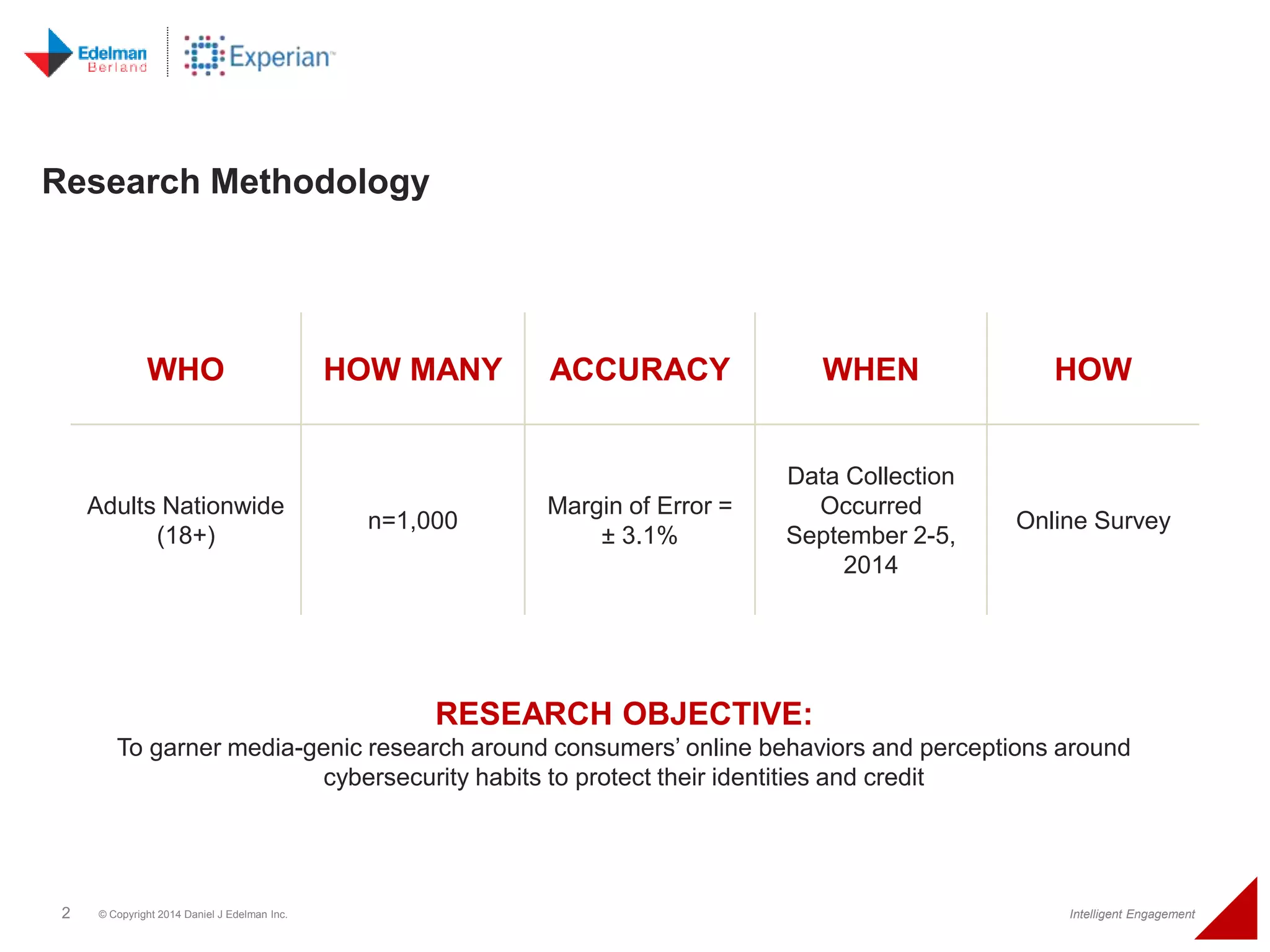
Research Methodology 
WHO HOW MANY ACCURACY WHEN HOW 
Adults Nationwide 
(18+) 
n=1,000 
Margin of Error = 
± 3.1% 
Data Collection 
Occurred 
September 2-5, 
2014 
Online Survey 
RESEARCH OBJECTIVE: 
To garner media-genic research around consumers’ online behaviors and perceptions around 
cybersecurity habits to protect their identities and credit 
2 © Copyright 2014 Daniel J Edelman Inc. Intelligent Engagement
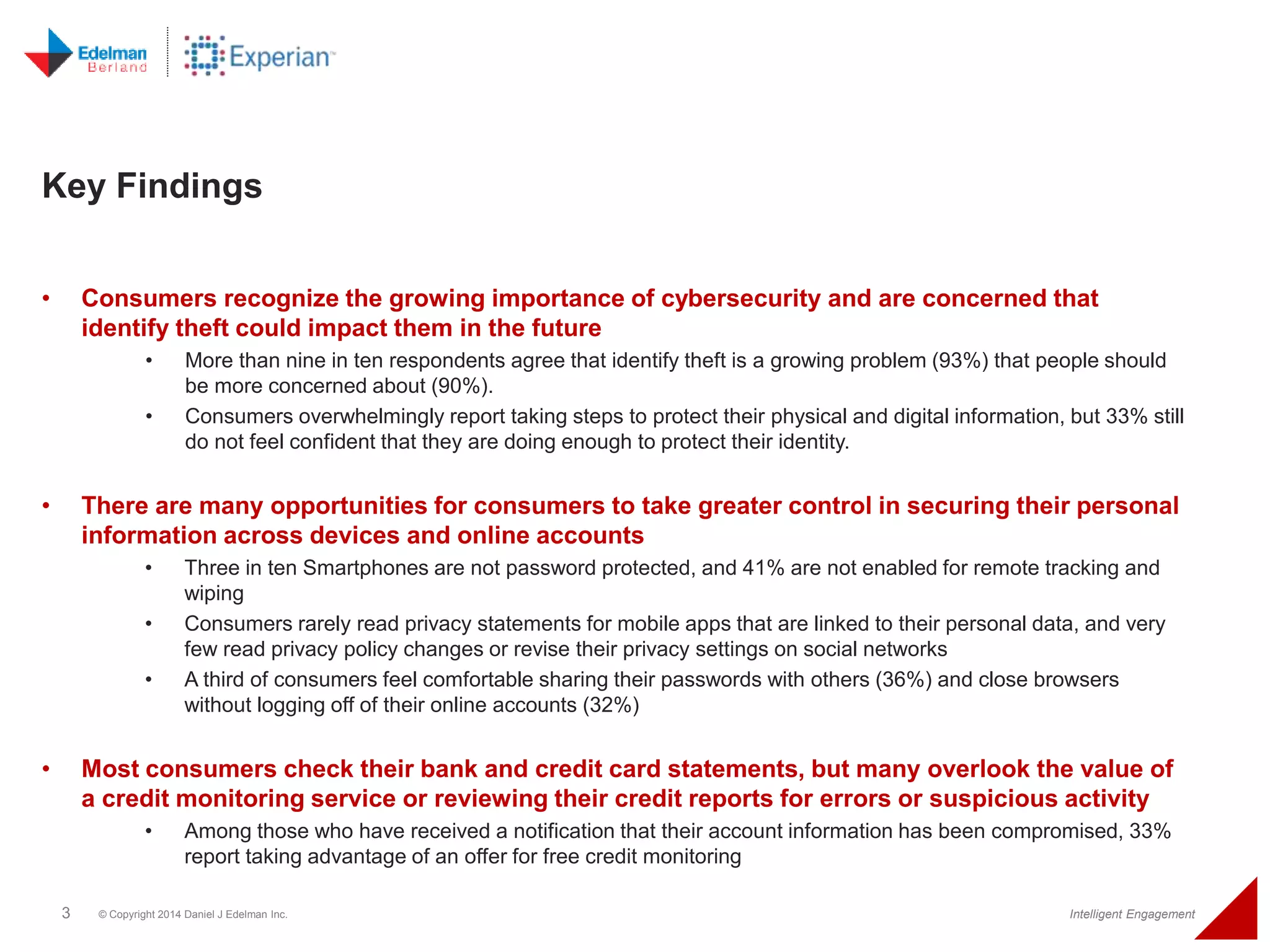
Key Findings 
• Consumers recognize the growing importance of cybersecurity and are concerned that 
identify theft could impact them in the future 
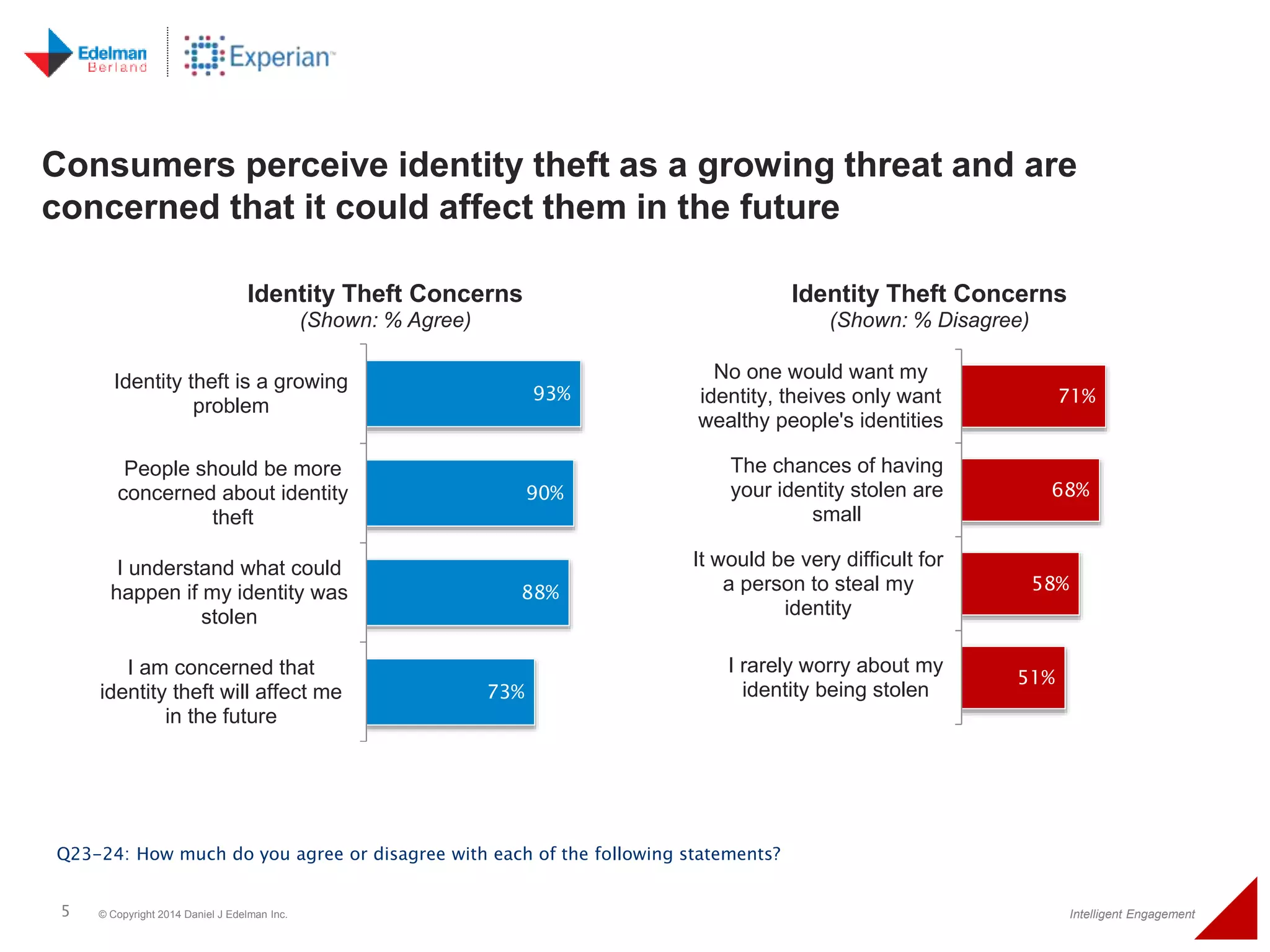
• More than nine in ten respondents agree that identify theft is a growing problem (93%) that people should 
be more concerned about (90%). 
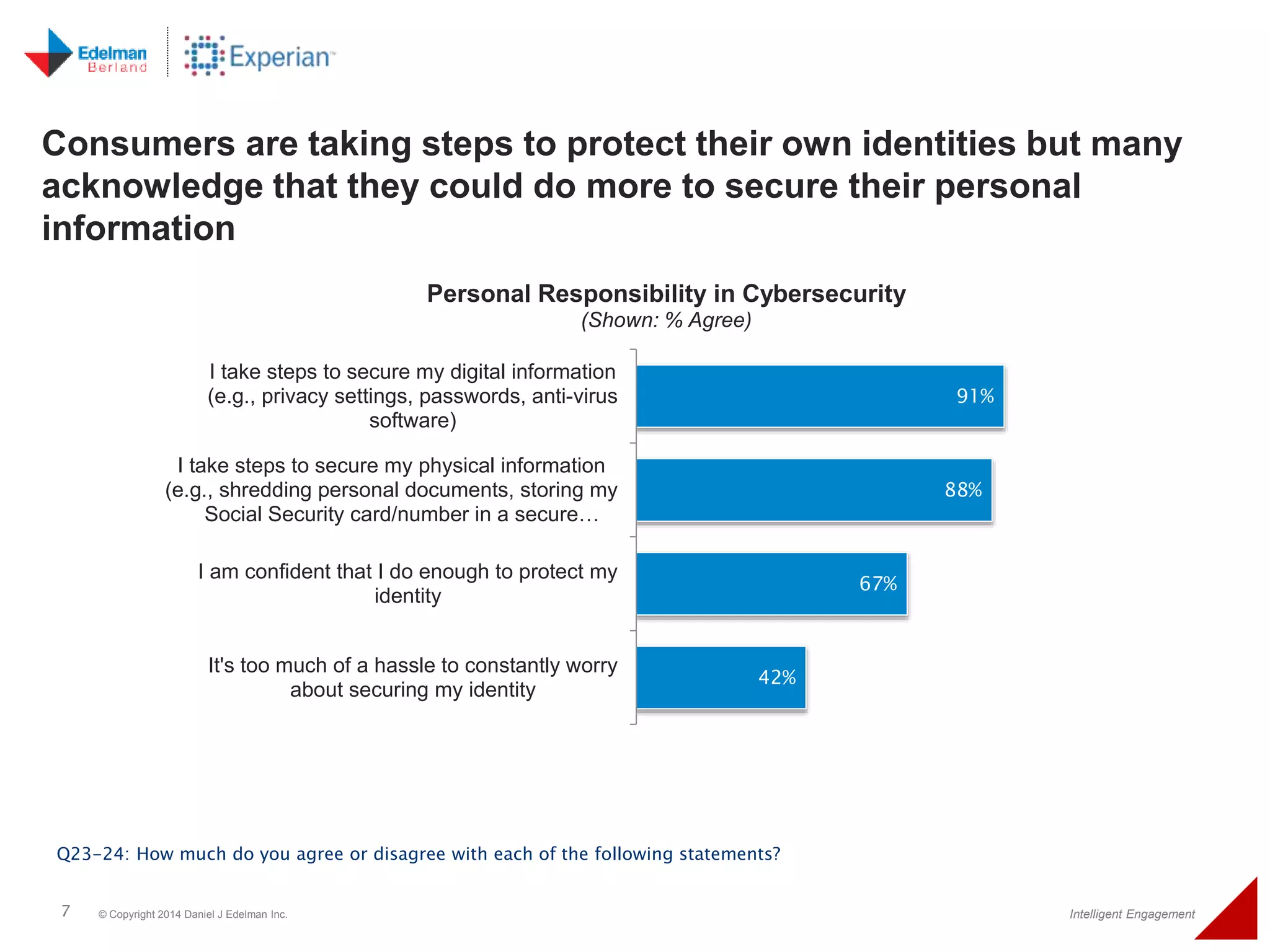
• Consumers overwhelmingly report taking steps to protect their physical and digital information, but 33% still 
do not feel confident that they are doing enough to protect their identity. 
• There are many opportunities for consumers to take greater control in securing their personal 
information across devices and online accounts 
• Three in ten Smartphones are not password protected, and 41% are not enabled for remote tracking and 
wiping 
• Consumers rarely read privacy statements for mobile apps that are linked to their personal data, and very 
few read privacy policy changes or revise their privacy settings on social networks 
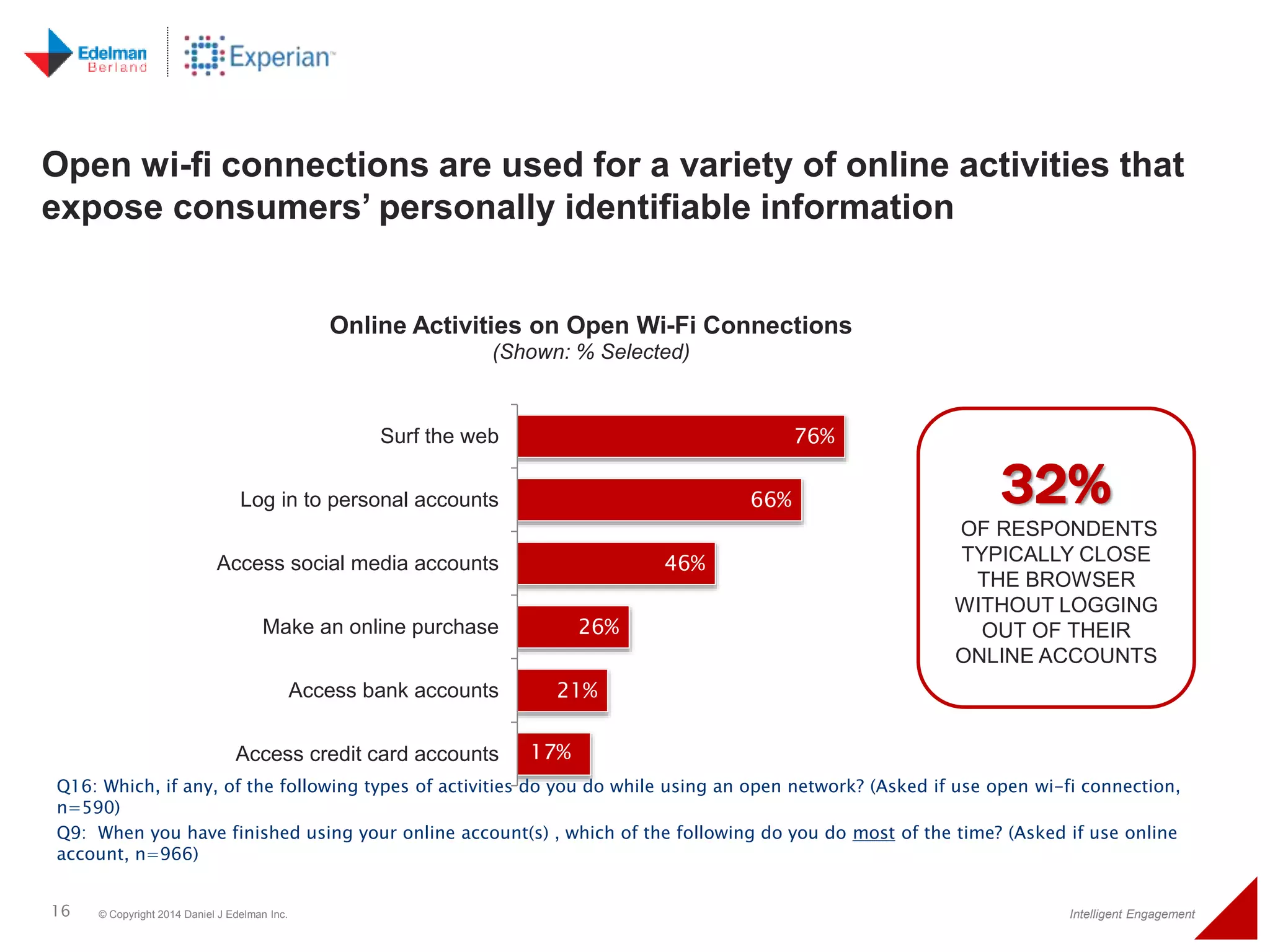
• A third of consumers feel comfortable sharing their passwords with others (36%) and close browsers 
without logging off of their online accounts (32%) 
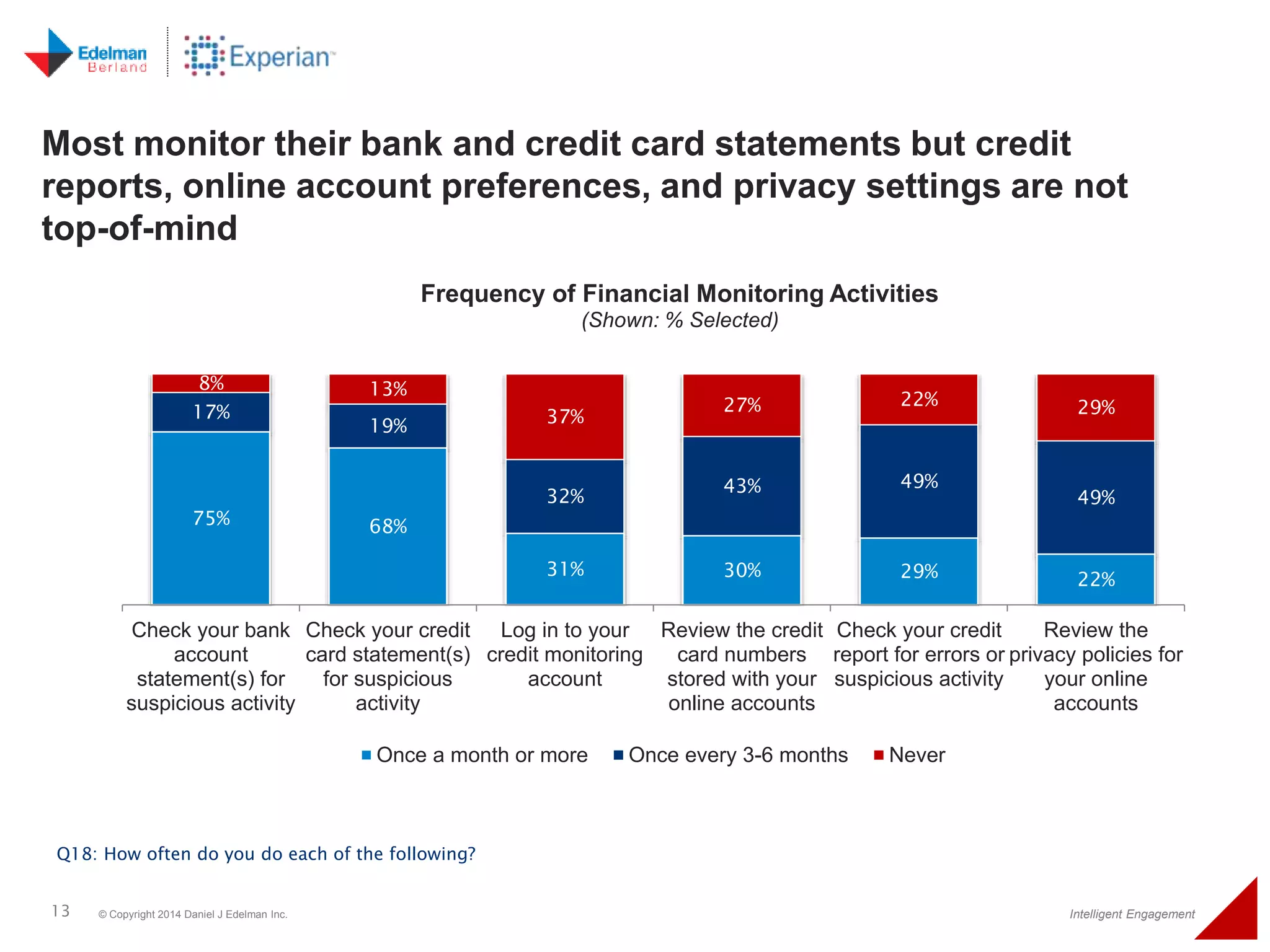
• Most consumers check their bank and credit card statements, but many overlook the value of 
a credit monitoring service or reviewing their credit reports for errors or suspicious activity 
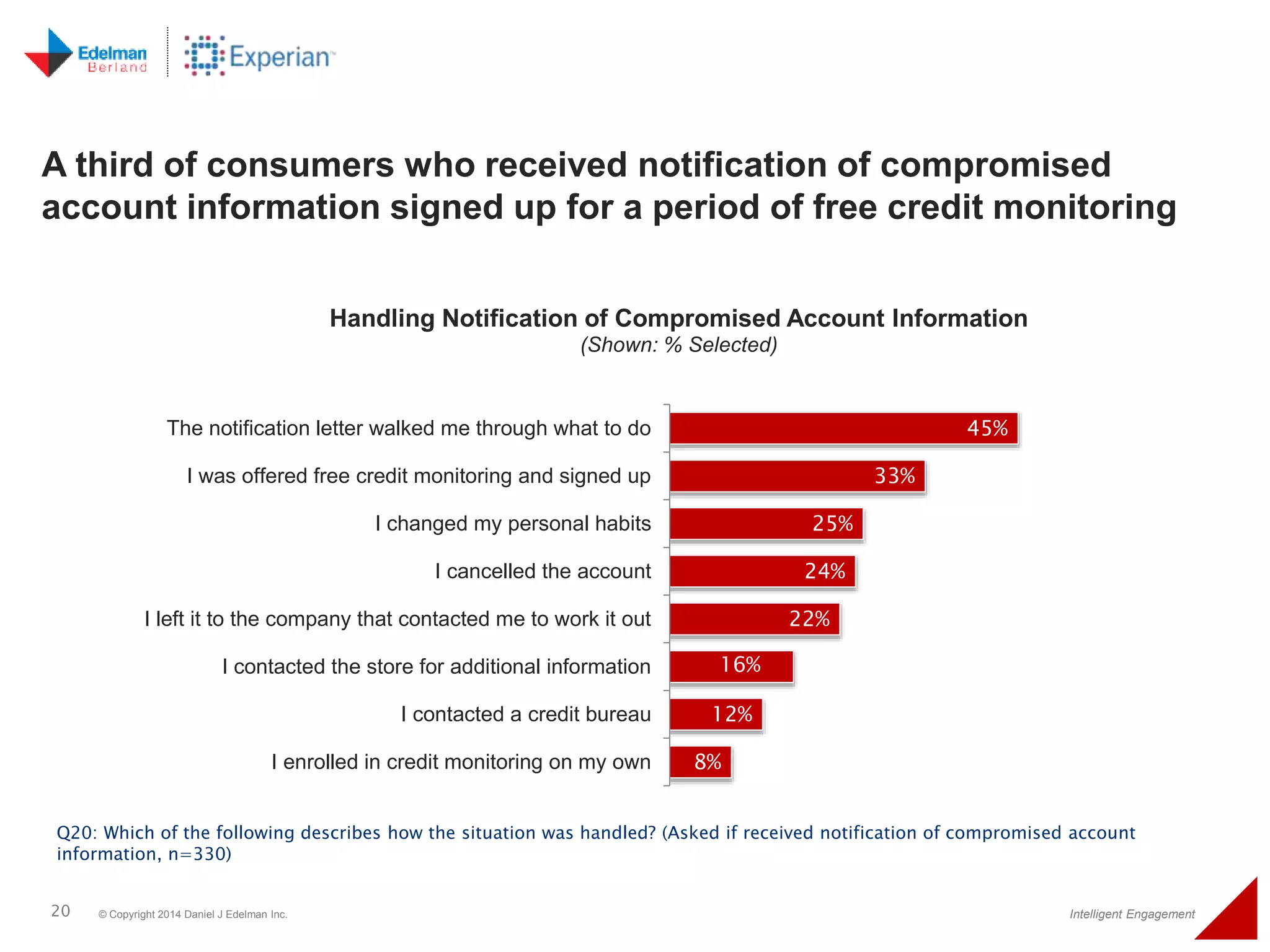
• Among those who have received a notification that their account information has been compromised, 33% 
report taking advantage of an offer for free credit monitoring 
3 © Copyright 2014 Daniel J Edelman Inc. Intelligent Engagement
CYBERSECURITY 
PERCEPTIONS
Consumers perceive identity theft as a growing threat and are 
concerned that it could affect them in the future 
93% 
90% 
Identity Theft Concerns 
88% 
73% 
(Shown: % Agree) 
Identity theft is a growing 
problem 
People should be more 
concerned about identity 
theft 
I understand what could 
happen if my identity was 
stolen 
I am concerned that 
identity theft will affect me 
in the future 
Identity Theft Concerns 
(Shown: % Disagree) 
No one would want my 
identity, theives only want 
wealthy people's identities 
The chances of having 
your identity stolen are 
It would be very difficult for 
a person to steal my 
I rarely worry about my 
identity being stolen 
Q23-24: How much do you agree or disagree with each of the following statements? 
71% 
68% 
58% 
51% 
small 
identity 
5 © Copyright 2014 Daniel J Edelman Inc. Intelligent Engagement
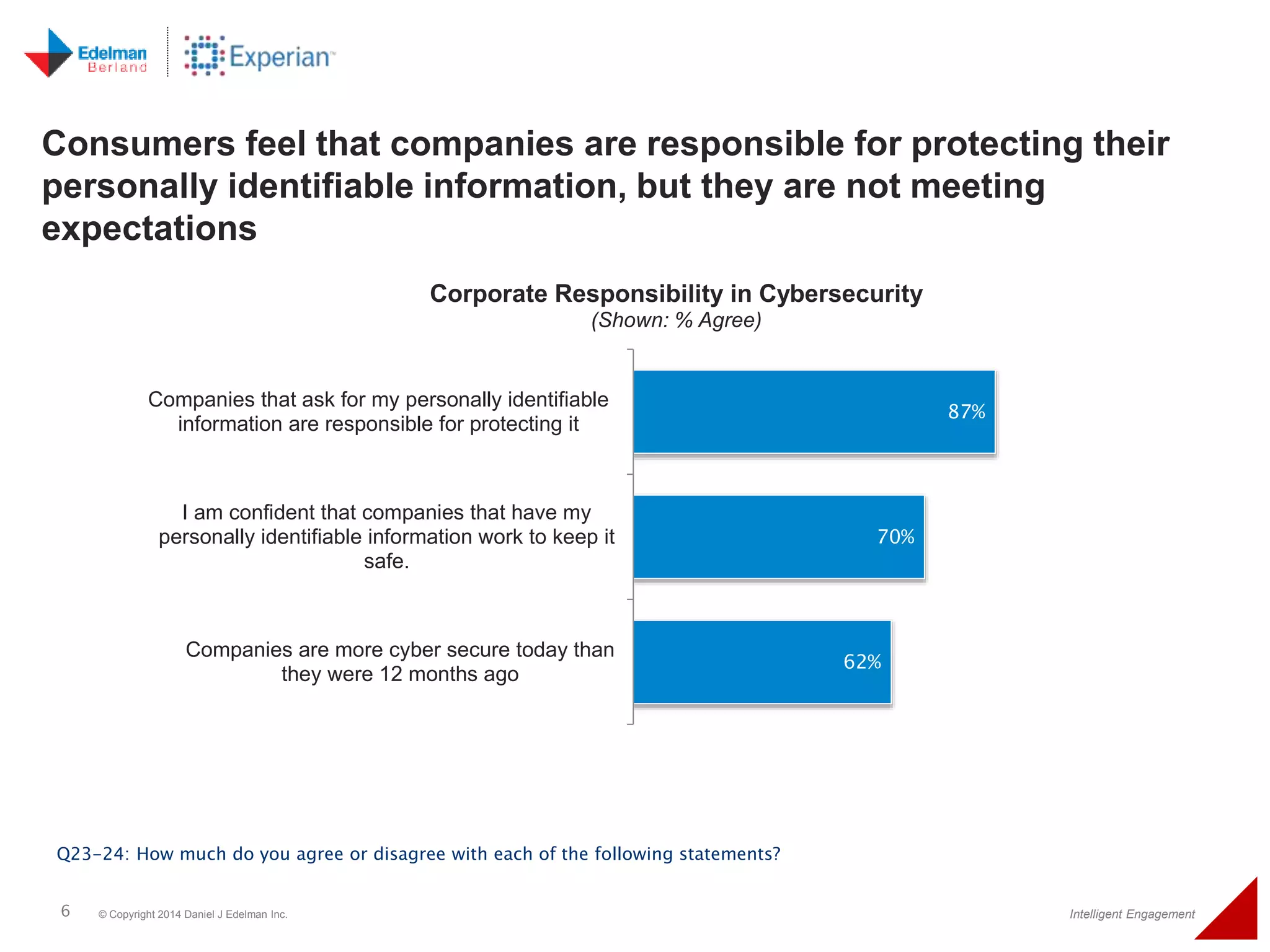
Consumers feel that companies are responsible for protecting their 
personally identifiable information, but they are not meeting 
expectations 
87% 
Corporate Responsibility in Cybersecurity 
70% 
62% 
(Shown: % Agree) 
Companies that ask for my personally identifiable 
information are responsible for protecting it 
I am confident that companies that have my 
personally identifiable information work to keep it 
safe. 
Companies are more cyber secure today than 
they were 12 months ago 
Q23-24: How much do you agree or disagree with each of the following statements? 
6 © Copyright 2014 Daniel J Edelman Inc. Intelligent Engagement
Consumers are taking steps to protect their own identities but many 
acknowledge that they could do more to secure their personal 
information 
91% 
88% 
Personal Responsibility in Cybersecurity 
67% 
42% 
(Shown: % Agree) 
I take steps to secure my digital information 
(e.g., privacy settings, passwords, anti-virus 
software) 
I take steps to secure my physical information 
(e.g., shredding personal documents, storing my 
Social Security card/number in a secure… 
I am confident that I do enough to protect my 
identity 
It's too much of a hassle to constantly worry 
about securing my identity 
Q23-24: How much do you agree or disagree with each of the following statements? 
7 © Copyright 2014 Daniel J Edelman Inc. Intelligent Engagement
DEVICE & ACCOUNT 
USAGE
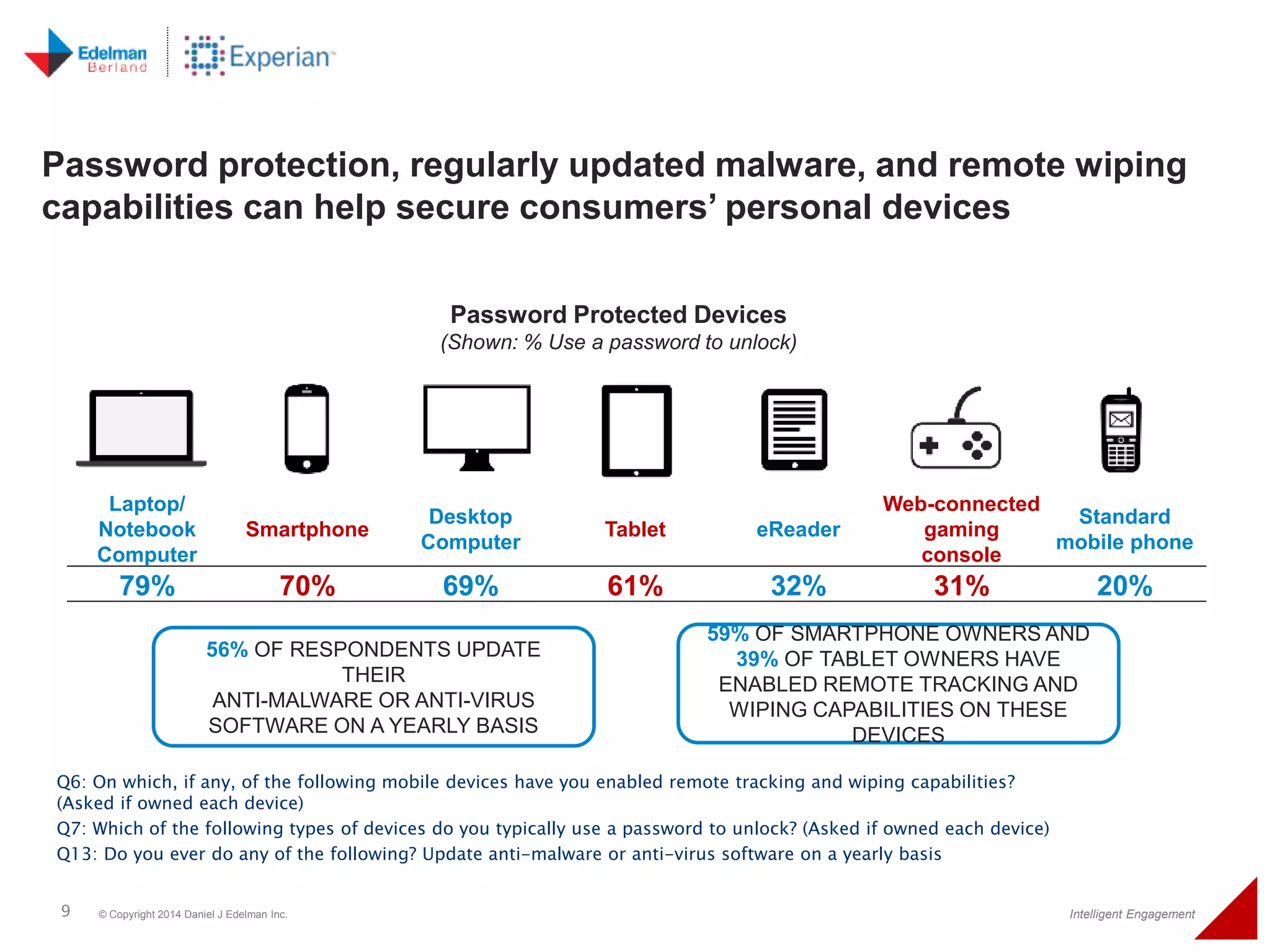
Password protection, regularly updated malware, and remote wiping 
capabilities can help secure consumers’ personal devices 
Laptop/ 
Notebook 
Computer 
Smartphone 
Password Protected Devices 
(Shown: % Use a password to unlock) 
Desktop 
Computer 
Tablet eReader 
Web-connected 
gaming 
console 
79% 70% 69% 61% 32% 31% 20% 
56% OF RESPONDENTS UPDATE 
THEIR 
ANTI-MALWARE OR ANTI-VIRUS 
SOFTWARE ON A YEARLY BASIS 
59% OF SMARTPHONE OWNERS AND 
39% OF TABLET OWNERS HAVE 
ENABLED REMOTE TRACKING AND 
WIPING CAPABILITIES ON THESE 
DEVICES 
Q6: On which, if any, of the following mobile devices have you enabled remote tracking and wiping capabilities? 
(Asked if owned each device) 
Q7: Which of the following types of devices do you typically use a password to unlock? (Asked if owned each device) 
Q13: Do you ever do any of the following? Update anti-malware or anti-virus software on a yearly basis 
Standard 
mobile phone 
9 © Copyright 2014 Daniel J Edelman Inc. Intelligent Engagement
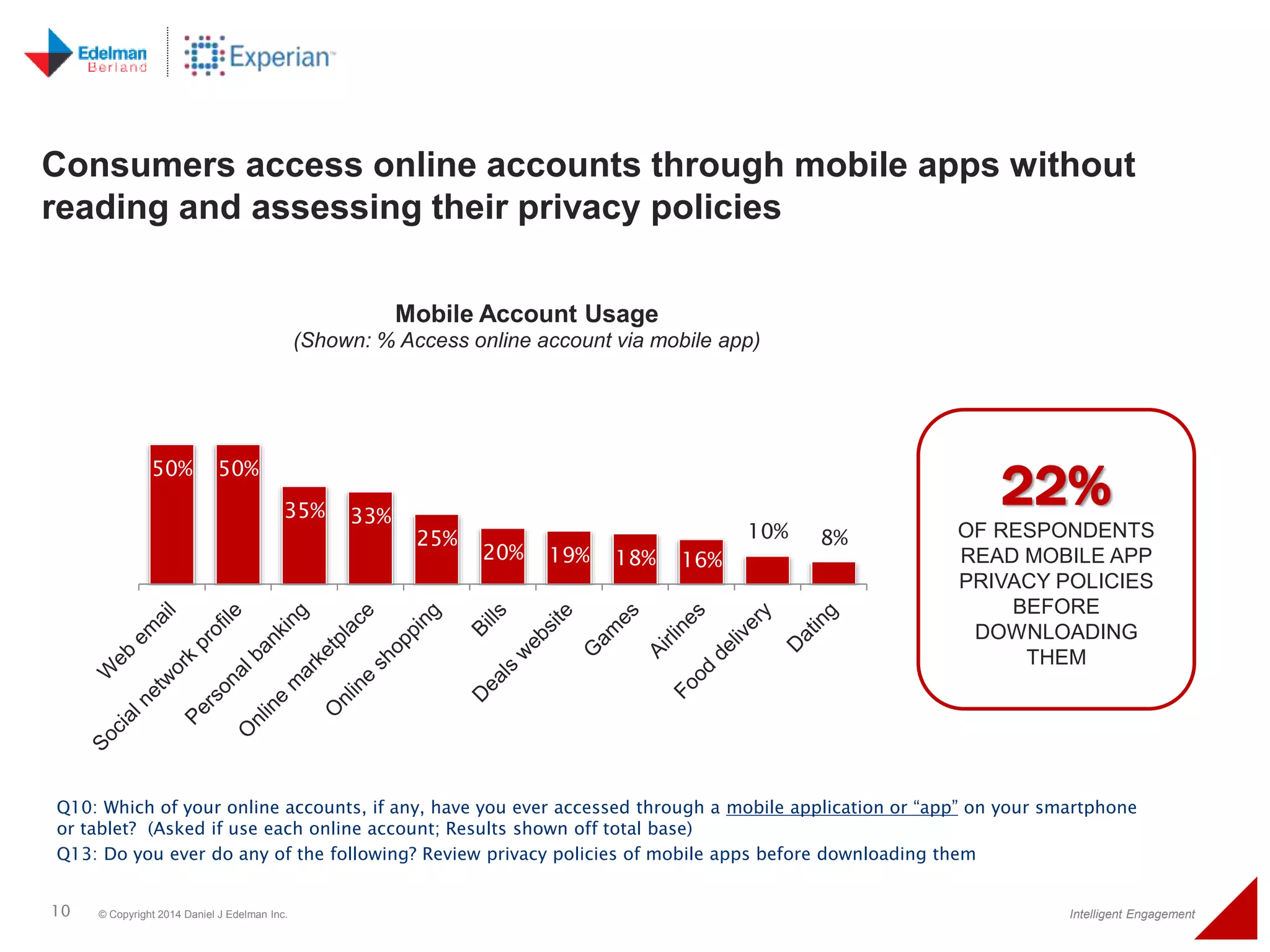
Consumers access online accounts through mobile apps without 
reading and assessing their privacy policies 
50% 50% 
(Shown: % Access online account via mobile app) 
35% 33% 
Mobile Account Usage 
25% 
20% 19% 18% 16% 
10% 8% 
22% 
OF RESPONDENTS 
READ MOBILE APP 
PRIVACY POLICIES 
BEFORE 
DOWNLOADING 
THEM 
Q10: Which of your online accounts, if any, have you ever accessed through a mobile application or “app” on your smartphone 
or tablet? (Asked if use each online account; Results shown off total base) 
Q13: Do you ever do any of the following? Review privacy policies of mobile apps before downloading them 
10 © Copyright 2014 Daniel J Edelman Inc. Intelligent Engagement
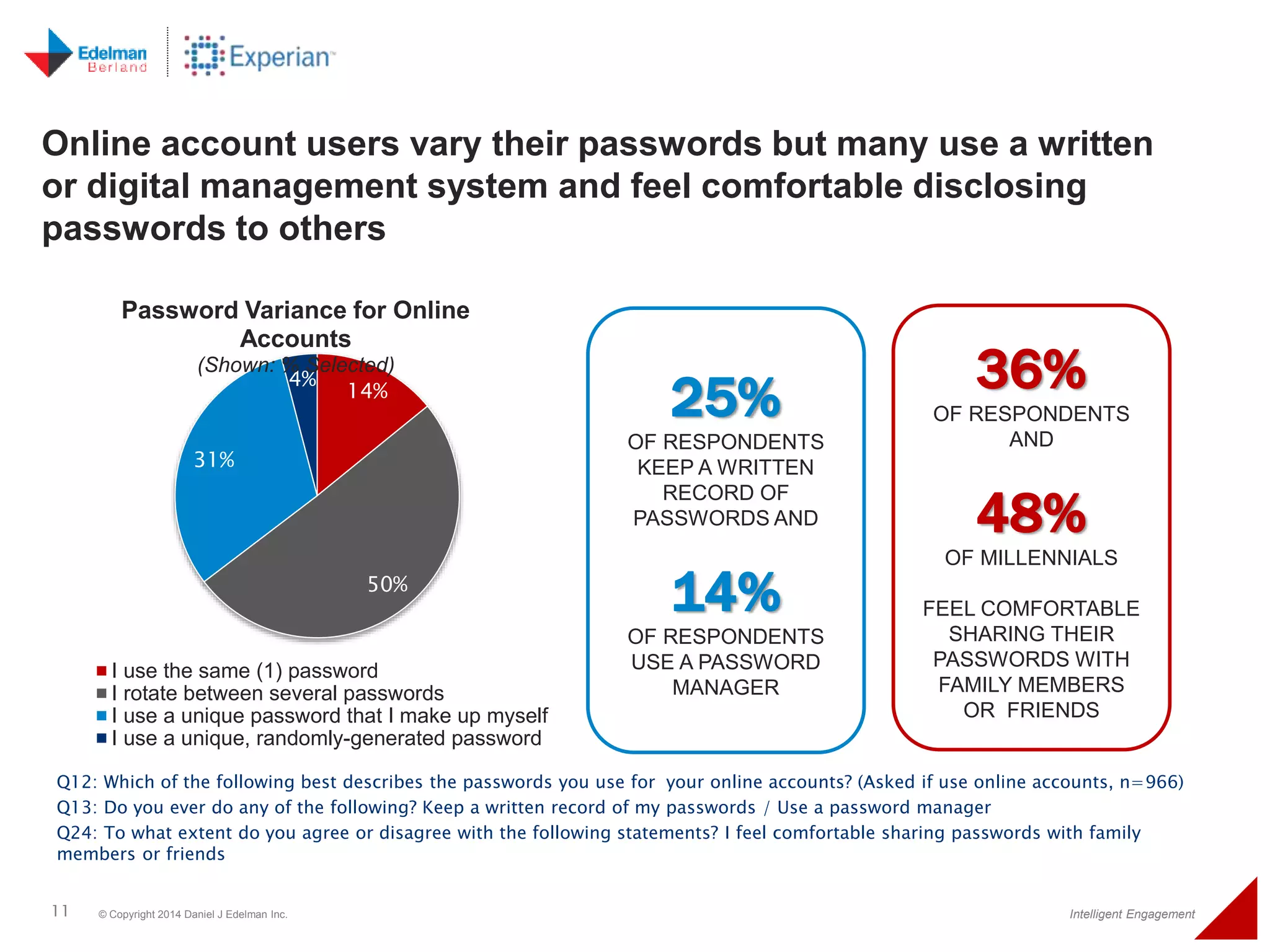
Online account users vary their passwords but many use a written 
or digital management system and feel comfortable disclosing 
passwords to others 
Password Variance for Online 
Accounts 
(Shown: % Selected) 
14% 
50% 
31% 
4% 
I use the same (1) password 
I rotate between several passwords 
I use a unique password that I make up myself 
I use a unique, randomly-generated password 
36% 
OF RESPONDENTS 
AND 
48% 
OF MILLENNIALS 
FEEL COMFORTABLE 
SHARING THEIR 
PASSWORDS WITH 
FAMILY MEMBERS 
OR FRIENDS 
25% 
OF RESPONDENTS 
KEEP A WRITTEN 
RECORD OF 
PASSWORDS AND 
14% 
OF RESPONDENTS 
USE A PASSWORD 
MANAGER 
Q12: Which of the following best describes the passwords you use for your online accounts? (Asked if use online accounts, n=966) 
Q13: Do you ever do any of the following? Keep a written record of my passwords / Use a password manager 
Q24: To what extent do you agree or disagree with the following statements? I feel comfortable sharing passwords with family 
members or friends 
11 © Copyright 2014 Daniel J Edelman Inc. Intelligent Engagement
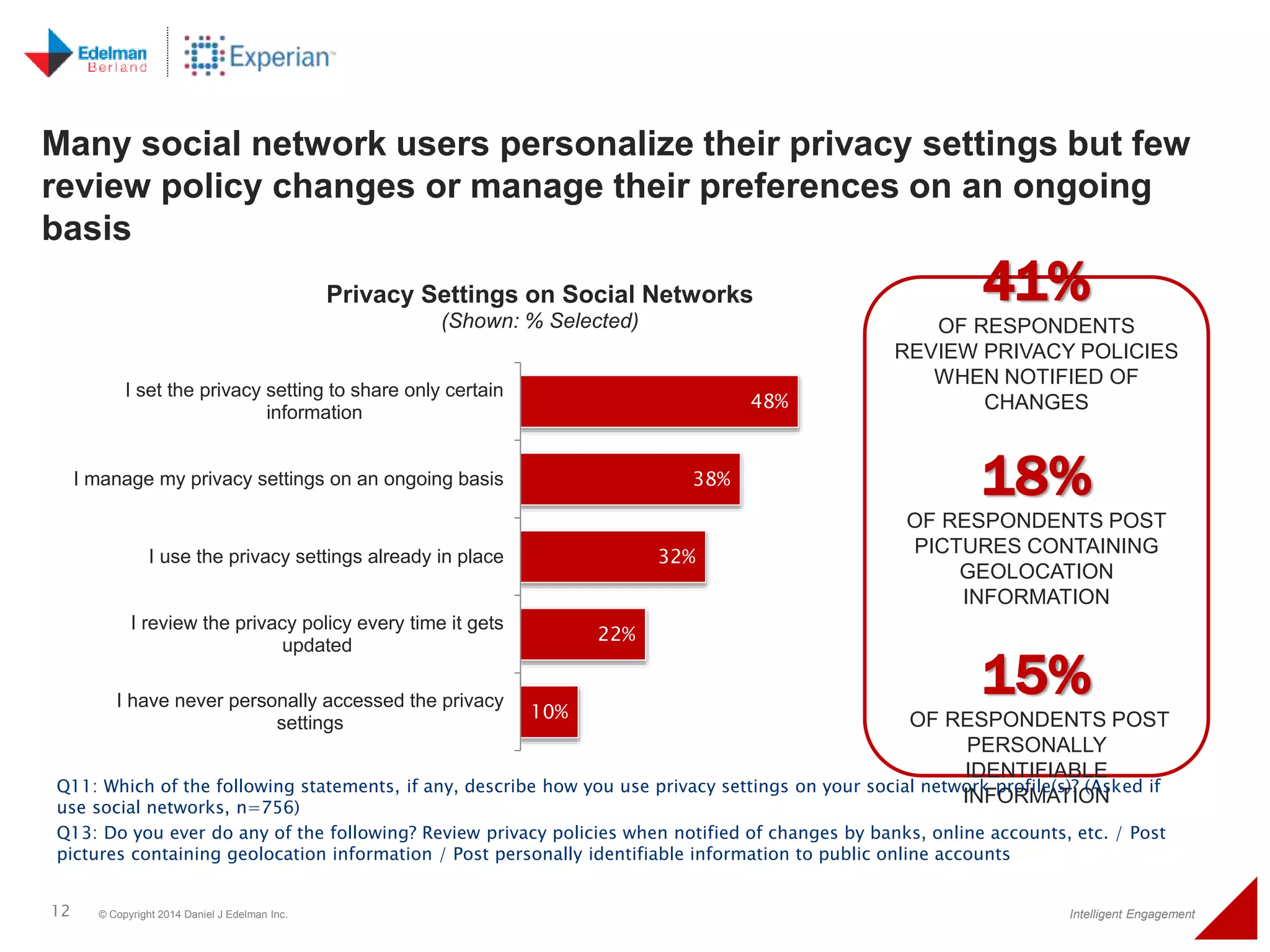
Many social network users personalize their privacy settings but few 
review policy changes or manage their preferences on an ongoing 
basis 
Privacy Settings on Social Networks 
48% 
38% 
32% 
(Shown: % Selected) 
22% 
10% 
I set the privacy setting to share only certain 
information 
I manage my privacy settings on an ongoing basis 
I use the privacy settings already in place 
I review the privacy policy every time it gets 
updated 
I have never personally accessed the privacy 
settings 
41% 
OF RESPONDENTS 
REVIEW PRIVACY POLICIES 
WHEN NOTIFIED OF 
CHANGES 
18% 
OF RESPONDENTS POST 
PICTURES CONTAINING 
GEOLOCATION 
INFORMATION 
15% 
OF RESPONDENTS POST 
PERSONALLY 
IDENTIFIABLE 
INFORMATION 
Q11: Which of the following statements, if any, describe how you use privacy settings on your social network profile(s)? (Asked if 
use social networks, n=756) 
Q13: Do you ever do any of the following? Review privacy policies when notified of changes by banks, online accounts, etc. / Post 
pictures containing geolocation information / Post personally identifiable information to public online accounts 
12 © Copyright 2014 Daniel J Edelman Inc. Intelligent Engagement
Most monitor their bank and credit card statements but credit 
reports, online account preferences, and privacy settings are not 
top-of-mind 
8% 13% 
17% 
19% 
75% 68% 
Check your bank 
account 
statement(s) for 
suspicious activity 
Frequency of Financial Monitoring Activities 
Check your credit 
card statement(s) 
for suspicious 
activity 
Once a month or more Once every 3-6 months Never 
Q18: How often do you do each of the following? 
(Shown: % Selected) 
37% 
32% 
27% 22% 29% 
43% 49% 
49% 
31% 30% 29% 22% 
Log in to your 
credit monitoring 
account 
Review the credit 
card numbers 
stored with your 
online accounts 
Check your credit 
report for errors or 
suspicious activity 
Review the 
privacy policies for 
your online 
accounts 
13 © Copyright 2014 Daniel J Edelman Inc. Intelligent Engagement
ONLINE BEHAVIORS
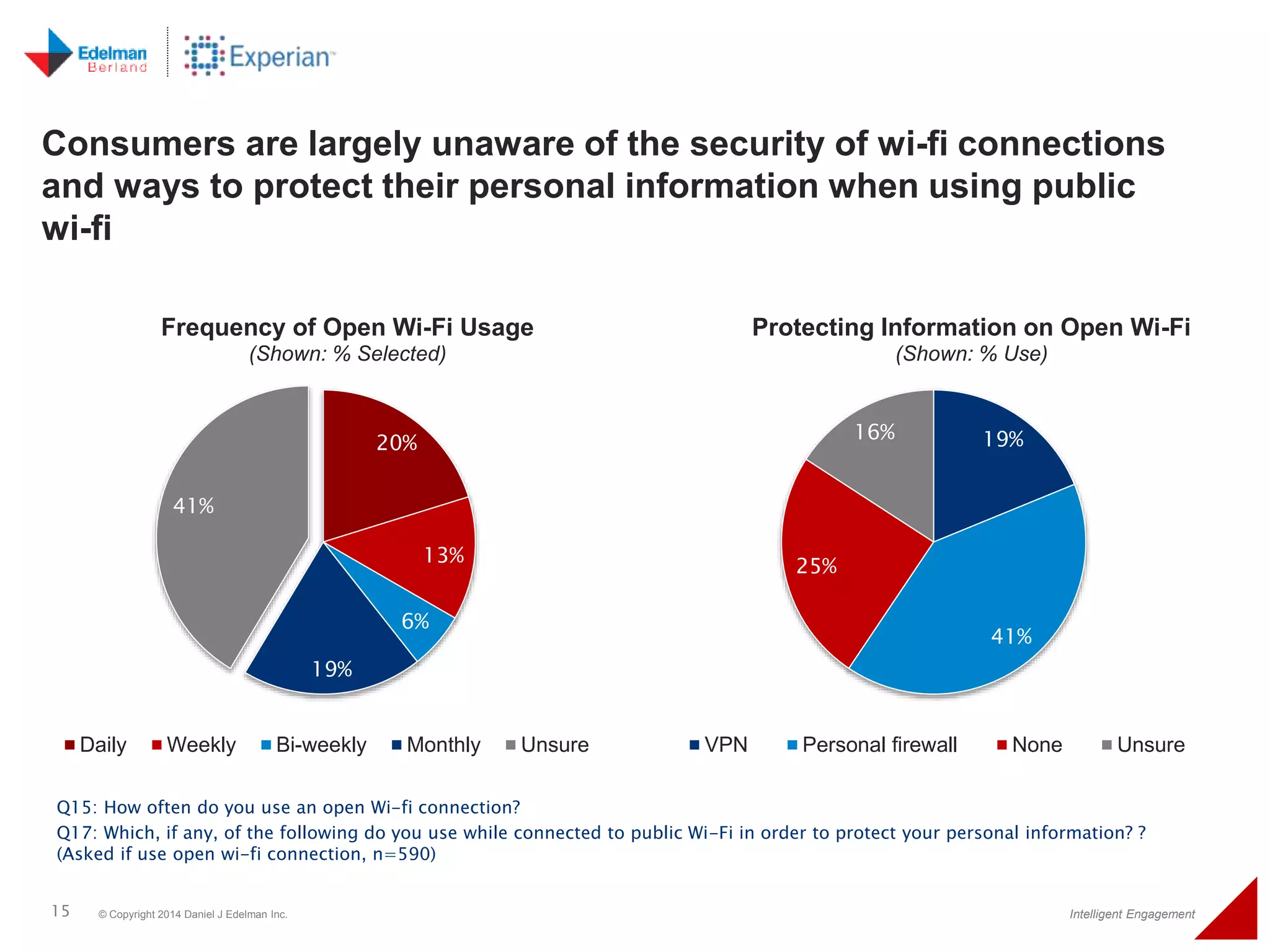
Consumers are largely unaware of the security of wi-fi connections 
and ways to protect their personal information when using public 
wi-fi 
Frequency of Open Wi-Fi Usage 
(Shown: % Selected) 
20% 
13% 
6% 
19% 
41% 
Daily Weekly Bi-weekly Monthly Unsure 
Protecting Information on Open Wi-Fi 
(Shown: % Use) 
19% 
41% 
25% 
16% 
VPN Personal firewall None Unsure 
Q15: How often do you use an open Wi-fi connection? 
Q17: Which, if any, of the following do you use while connected to public Wi-Fi in order to protect your personal information? ? 
(Asked if use open wi-fi connection, n=590) 
15 © Copyright 2014 Daniel J Edelman Inc. Intelligent Engagement
Open wi-fi connections are used for a variety of online activities that 
expose consumers’ personally identifiable information 
32% 
OF RESPONDENTS 
TYPICALLY CLOSE 
THE BROWSER 
WITHOUT LOGGING 
OUT OF THEIR 
ONLINE ACCOUNTS 
Online Activities on Open Wi-Fi Connections 
76% 
66% 
(Shown: % Selected) 
46% 
26% 
21% 
17% 
Surf the web 
Log in to personal accounts 
Access social media accounts 
Make an online purchase 
Access bank accounts 
Access credit card accounts 
Q16: Which, if any, of the following types of activities do you do while using an open network? (Asked if use open wi-fi connection, 
n=590) 
Q9: When you have finished using your online account(s) , which of the following do you do most of the time? (Asked if use online 
account, n=966) 
16 © Copyright 2014 Daniel J Edelman Inc. Intelligent Engagement
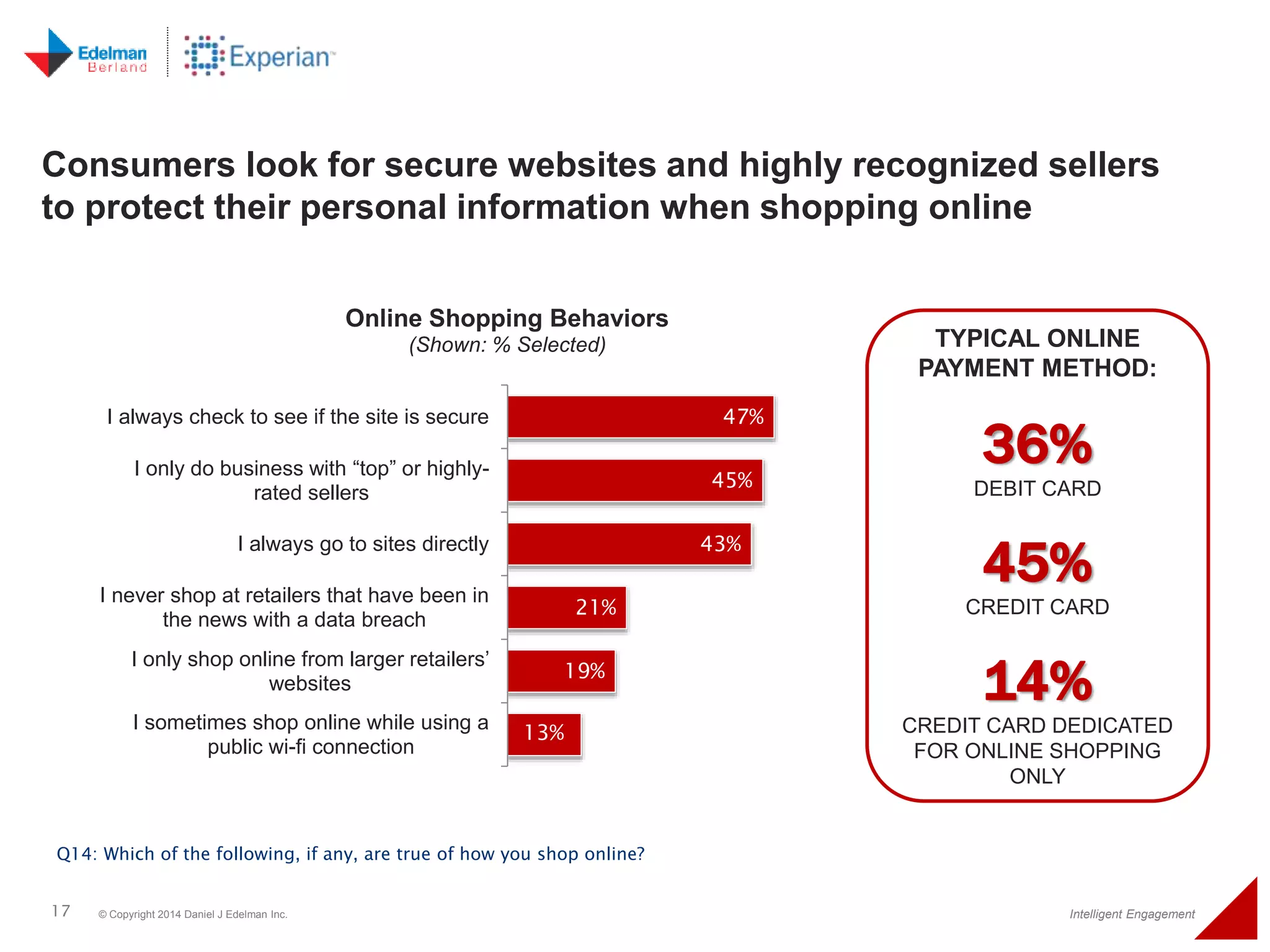
Consumers look for secure websites and highly recognized sellers 
to protect their personal information when shopping online 
47% 
45% 
43% 
Online Shopping Behaviors 
(Shown: % Selected) 
21% 
19% 
13% 
I always check to see if the site is secure 
I only do business with “top” or highly-rated 
sellers 
I always go to sites directly 
I never shop at retailers that have been in 
the news with a data breach 
I only shop online from larger retailers’ 
websites 
I sometimes shop online while using a 
public wi-fi connection 
Q14: Which of the following, if any, are true of how you shop online? 
TYPICAL ONLINE 
PAYMENT METHOD: 
36% 
DEBIT CARD 
45% 
CREDIT CARD 
14% 
CREDIT CARD DEDICATED 
FOR ONLINE SHOPPING 
ONLY 
17 © Copyright 2014 Daniel J Edelman Inc. Intelligent Engagement
DATA BREACHES & 
IDENTITY THEFT
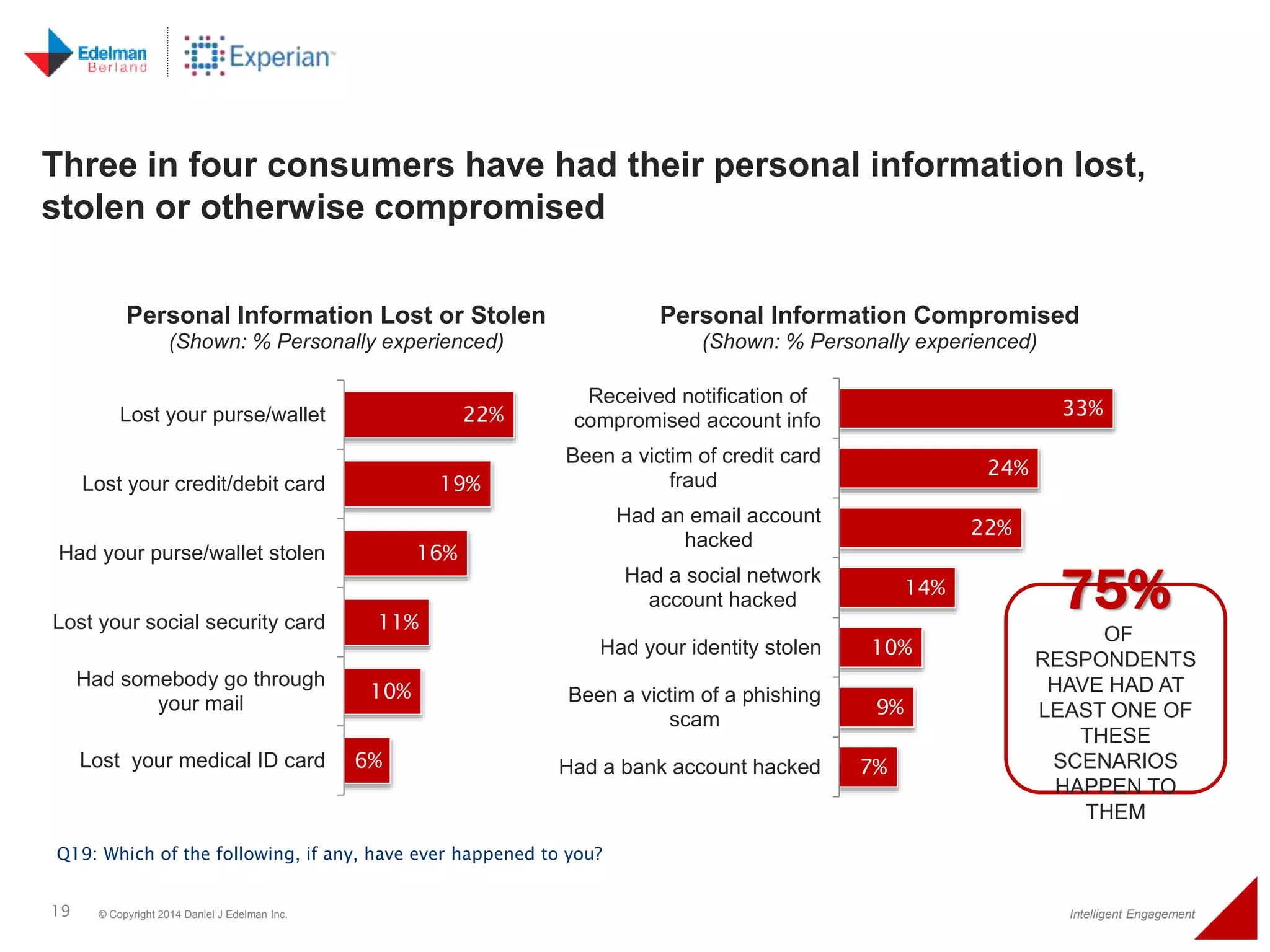
Three in four consumers have had their personal information lost, 
stolen or otherwise compromised 
Personal Information Compromised 
33% 
(Shown: % Personally experienced) 
24% 
22% 
14% 
10% 
9% 
7% 
Received notification of 
compromised account info 
Been a victim of credit card 
fraud 
Had an email account 
hacked 
Had a social network 
account hacked 
Had your identity stolen 
Been a victim of a phishing 
scam 
Had a bank account hacked 
Personal Information Lost or Stolen 
(Shown: % Personally experienced) 
22% 
19% 
16% 
11% 
10% 
6% 
Lost your purse/wallet 
Lost your credit/debit card 
Had your purse/wallet stolen 
Lost your social security card 
Had somebody go through 
your mail 
Lost your medical ID card 
Q19: Which of the following, if any, have ever happened to you? 
75% 
OF 
RESPONDENTS 
HAVE HAD AT 
LEAST ONE OF 
THESE 
SCENARIOS 
HAPPEN TO 
THEM 
19 © Copyright 2014 Daniel J Edelman Inc. Intelligent Engagement
A third of consumers who received notification of compromised 
account information signed up for a period of free credit monitoring 
Handling Notification of Compromised Account Information 
45% 
33% 
25% 
24% 
22% 
(Shown: % Selected) 
16% 
12% 
8% 
The notification letter walked me through what to do 
I was offered free credit monitoring and signed up 
I changed my personal habits 
I cancelled the account 
I left it to the company that contacted me to work it out 
I contacted the store for additional information 
I contacted a credit bureau 
I enrolled in credit monitoring on my own 
Q20: Which of the following describes how the situation was handled? (Asked if received notification of compromised account 
information, n=330) 
20 © Copyright 2014 Daniel J Edelman Inc. Intelligent Engagement
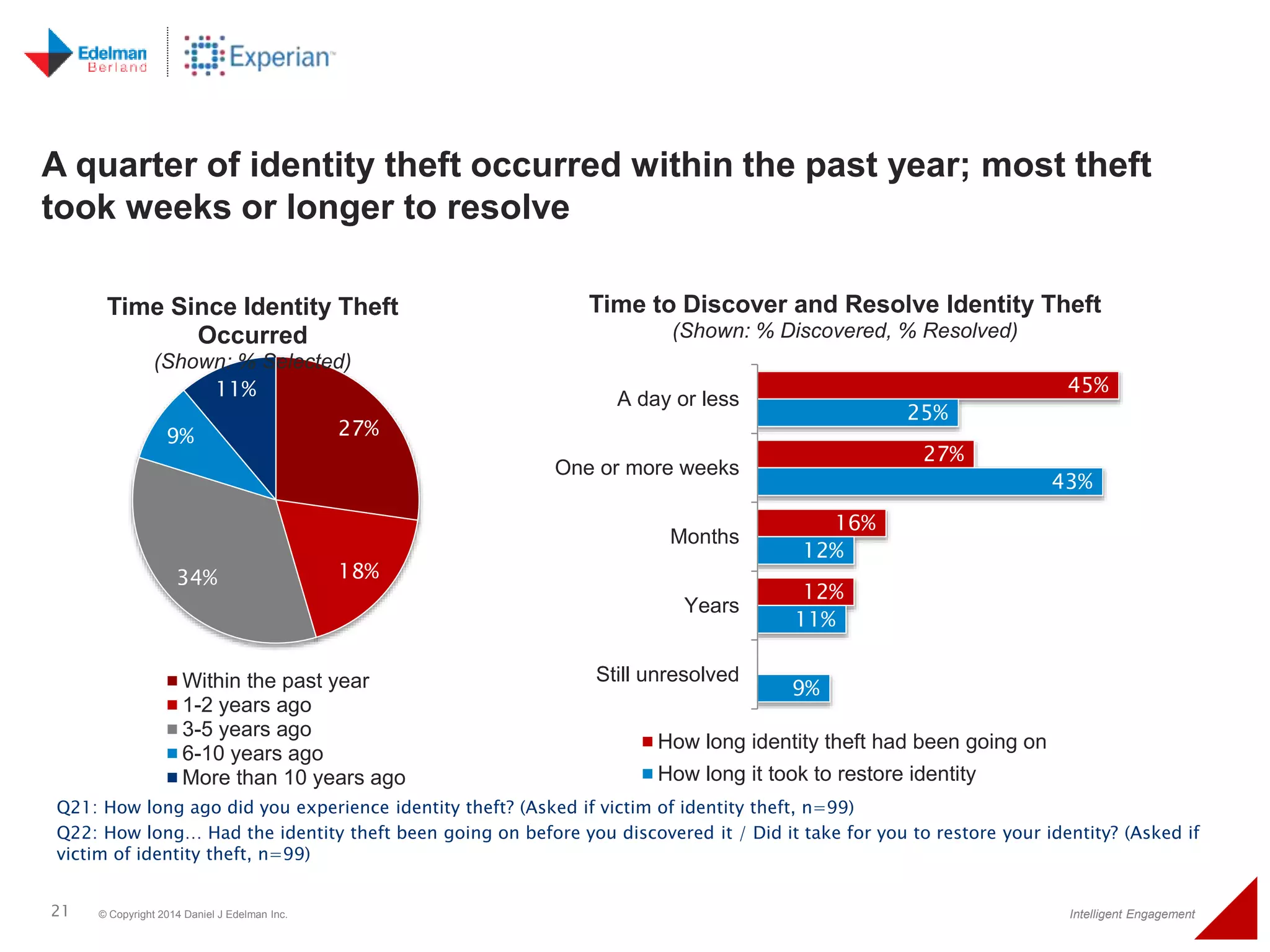
A quarter of identity theft occurred within the past year; most theft 
took weeks or longer to resolve 
Time Since Identity Theft 
(Shown: % Selected) 
27% 
9% 
Occurred 
11% 
34% 18% 
Within the past year 
1-2 years ago 
3-5 years ago 
6-10 years ago 
More than 10 years ago 
Time to Discover and Resolve Identity Theft 
45% 
(Shown: % Discovered, % Resolved) 
25% 
27% 
16% 
12% 
12% 
43% 
11% 
9% 
A day or less 
One or more weeks 
Months 
Years 
Still unresolved 
How long identity theft had been going on 
How long it took to restore identity 
Q21: How long ago did you experience identity theft? (Asked if victim of identity theft, n=99) 
Q22: How long… Had the identity theft been going on before you discovered it / Did it take for you to restore your identity? (Asked if 
victim of identity theft, n=99) 
21 © Copyright 2014 Daniel J Edelman Inc. Intelligent Engagement
22

Experian Cybersecurity Survey

  • 1.
    1 Experian CybersecuritySurvey EDELMAN BERLAND September 2014
  • 2.
    Research Methodology WHOHOW MANY ACCURACY WHEN HOW Adults Nationwide (18+) n=1,000 Margin of Error = ± 3.1% Data Collection Occurred September 2-5, 2014 Online Survey RESEARCH OBJECTIVE: To garner media-genic research around consumers’ online behaviors and perceptions around cybersecurity habits to protect their identities and credit 2 © Copyright 2014 Daniel J Edelman Inc. Intelligent Engagement
  • 3.
    Key Findings •Consumers recognize the growing importance of cybersecurity and are concerned that identify theft could impact them in the future • More than nine in ten respondents agree that identify theft is a growing problem (93%) that people should be more concerned about (90%). • Consumers overwhelmingly report taking steps to protect their physical and digital information, but 33% still do not feel confident that they are doing enough to protect their identity. • There are many opportunities for consumers to take greater control in securing their personal information across devices and online accounts • Three in ten Smartphones are not password protected, and 41% are not enabled for remote tracking and wiping • Consumers rarely read privacy statements for mobile apps that are linked to their personal data, and very few read privacy policy changes or revise their privacy settings on social networks • A third of consumers feel comfortable sharing their passwords with others (36%) and close browsers without logging off of their online accounts (32%) • Most consumers check their bank and credit card statements, but many overlook the value of a credit monitoring service or reviewing their credit reports for errors or suspicious activity • Among those who have received a notification that their account information has been compromised, 33% report taking advantage of an offer for free credit monitoring 3 © Copyright 2014 Daniel J Edelman Inc. Intelligent Engagement
  • 4.
  • 5.
    Consumers perceive identitytheft as a growing threat and are concerned that it could affect them in the future 93% 90% Identity Theft Concerns 88% 73% (Shown: % Agree) Identity theft is a growing problem People should be more concerned about identity theft I understand what could happen if my identity was stolen I am concerned that identity theft will affect me in the future Identity Theft Concerns (Shown: % Disagree) No one would want my identity, theives only want wealthy people's identities The chances of having your identity stolen are It would be very difficult for a person to steal my I rarely worry about my identity being stolen Q23-24: How much do you agree or disagree with each of the following statements? 71% 68% 58% 51% small identity 5 © Copyright 2014 Daniel J Edelman Inc. Intelligent Engagement
  • 6.
    Consumers feel thatcompanies are responsible for protecting their personally identifiable information, but they are not meeting expectations 87% Corporate Responsibility in Cybersecurity 70% 62% (Shown: % Agree) Companies that ask for my personally identifiable information are responsible for protecting it I am confident that companies that have my personally identifiable information work to keep it safe. Companies are more cyber secure today than they were 12 months ago Q23-24: How much do you agree or disagree with each of the following statements? 6 © Copyright 2014 Daniel J Edelman Inc. Intelligent Engagement
  • 7.
    Consumers are takingsteps to protect their own identities but many acknowledge that they could do more to secure their personal information 91% 88% Personal Responsibility in Cybersecurity 67% 42% (Shown: % Agree) I take steps to secure my digital information (e.g., privacy settings, passwords, anti-virus software) I take steps to secure my physical information (e.g., shredding personal documents, storing my Social Security card/number in a secure… I am confident that I do enough to protect my identity It's too much of a hassle to constantly worry about securing my identity Q23-24: How much do you agree or disagree with each of the following statements? 7 © Copyright 2014 Daniel J Edelman Inc. Intelligent Engagement
  • 8.
  • 9.
    Password protection, regularlyupdated malware, and remote wiping capabilities can help secure consumers’ personal devices Laptop/ Notebook Computer Smartphone Password Protected Devices (Shown: % Use a password to unlock) Desktop Computer Tablet eReader Web-connected gaming console 79% 70% 69% 61% 32% 31% 20% 56% OF RESPONDENTS UPDATE THEIR ANTI-MALWARE OR ANTI-VIRUS SOFTWARE ON A YEARLY BASIS 59% OF SMARTPHONE OWNERS AND 39% OF TABLET OWNERS HAVE ENABLED REMOTE TRACKING AND WIPING CAPABILITIES ON THESE DEVICES Q6: On which, if any, of the following mobile devices have you enabled remote tracking and wiping capabilities? (Asked if owned each device) Q7: Which of the following types of devices do you typically use a password to unlock? (Asked if owned each device) Q13: Do you ever do any of the following? Update anti-malware or anti-virus software on a yearly basis Standard mobile phone 9 © Copyright 2014 Daniel J Edelman Inc. Intelligent Engagement
  • 10.
    Consumers access onlineaccounts through mobile apps without reading and assessing their privacy policies 50% 50% (Shown: % Access online account via mobile app) 35% 33% Mobile Account Usage 25% 20% 19% 18% 16% 10% 8% 22% OF RESPONDENTS READ MOBILE APP PRIVACY POLICIES BEFORE DOWNLOADING THEM Q10: Which of your online accounts, if any, have you ever accessed through a mobile application or “app” on your smartphone or tablet? (Asked if use each online account; Results shown off total base) Q13: Do you ever do any of the following? Review privacy policies of mobile apps before downloading them 10 © Copyright 2014 Daniel J Edelman Inc. Intelligent Engagement
  • 11.
    Online account usersvary their passwords but many use a written or digital management system and feel comfortable disclosing passwords to others Password Variance for Online Accounts (Shown: % Selected) 14% 50% 31% 4% I use the same (1) password I rotate between several passwords I use a unique password that I make up myself I use a unique, randomly-generated password 36% OF RESPONDENTS AND 48% OF MILLENNIALS FEEL COMFORTABLE SHARING THEIR PASSWORDS WITH FAMILY MEMBERS OR FRIENDS 25% OF RESPONDENTS KEEP A WRITTEN RECORD OF PASSWORDS AND 14% OF RESPONDENTS USE A PASSWORD MANAGER Q12: Which of the following best describes the passwords you use for your online accounts? (Asked if use online accounts, n=966) Q13: Do you ever do any of the following? Keep a written record of my passwords / Use a password manager Q24: To what extent do you agree or disagree with the following statements? I feel comfortable sharing passwords with family members or friends 11 © Copyright 2014 Daniel J Edelman Inc. Intelligent Engagement
  • 12.
    Many social networkusers personalize their privacy settings but few review policy changes or manage their preferences on an ongoing basis Privacy Settings on Social Networks 48% 38% 32% (Shown: % Selected) 22% 10% I set the privacy setting to share only certain information I manage my privacy settings on an ongoing basis I use the privacy settings already in place I review the privacy policy every time it gets updated I have never personally accessed the privacy settings 41% OF RESPONDENTS REVIEW PRIVACY POLICIES WHEN NOTIFIED OF CHANGES 18% OF RESPONDENTS POST PICTURES CONTAINING GEOLOCATION INFORMATION 15% OF RESPONDENTS POST PERSONALLY IDENTIFIABLE INFORMATION Q11: Which of the following statements, if any, describe how you use privacy settings on your social network profile(s)? (Asked if use social networks, n=756) Q13: Do you ever do any of the following? Review privacy policies when notified of changes by banks, online accounts, etc. / Post pictures containing geolocation information / Post personally identifiable information to public online accounts 12 © Copyright 2014 Daniel J Edelman Inc. Intelligent Engagement
  • 13.
    Most monitor theirbank and credit card statements but credit reports, online account preferences, and privacy settings are not top-of-mind 8% 13% 17% 19% 75% 68% Check your bank account statement(s) for suspicious activity Frequency of Financial Monitoring Activities Check your credit card statement(s) for suspicious activity Once a month or more Once every 3-6 months Never Q18: How often do you do each of the following? (Shown: % Selected) 37% 32% 27% 22% 29% 43% 49% 49% 31% 30% 29% 22% Log in to your credit monitoring account Review the credit card numbers stored with your online accounts Check your credit report for errors or suspicious activity Review the privacy policies for your online accounts 13 © Copyright 2014 Daniel J Edelman Inc. Intelligent Engagement
  • 14.
  • 15.
    Consumers are largelyunaware of the security of wi-fi connections and ways to protect their personal information when using public wi-fi Frequency of Open Wi-Fi Usage (Shown: % Selected) 20% 13% 6% 19% 41% Daily Weekly Bi-weekly Monthly Unsure Protecting Information on Open Wi-Fi (Shown: % Use) 19% 41% 25% 16% VPN Personal firewall None Unsure Q15: How often do you use an open Wi-fi connection? Q17: Which, if any, of the following do you use while connected to public Wi-Fi in order to protect your personal information? ? (Asked if use open wi-fi connection, n=590) 15 © Copyright 2014 Daniel J Edelman Inc. Intelligent Engagement
  • 16.
    Open wi-fi connectionsare used for a variety of online activities that expose consumers’ personally identifiable information 32% OF RESPONDENTS TYPICALLY CLOSE THE BROWSER WITHOUT LOGGING OUT OF THEIR ONLINE ACCOUNTS Online Activities on Open Wi-Fi Connections 76% 66% (Shown: % Selected) 46% 26% 21% 17% Surf the web Log in to personal accounts Access social media accounts Make an online purchase Access bank accounts Access credit card accounts Q16: Which, if any, of the following types of activities do you do while using an open network? (Asked if use open wi-fi connection, n=590) Q9: When you have finished using your online account(s) , which of the following do you do most of the time? (Asked if use online account, n=966) 16 © Copyright 2014 Daniel J Edelman Inc. Intelligent Engagement
  • 17.
    Consumers look forsecure websites and highly recognized sellers to protect their personal information when shopping online 47% 45% 43% Online Shopping Behaviors (Shown: % Selected) 21% 19% 13% I always check to see if the site is secure I only do business with “top” or highly-rated sellers I always go to sites directly I never shop at retailers that have been in the news with a data breach I only shop online from larger retailers’ websites I sometimes shop online while using a public wi-fi connection Q14: Which of the following, if any, are true of how you shop online? TYPICAL ONLINE PAYMENT METHOD: 36% DEBIT CARD 45% CREDIT CARD 14% CREDIT CARD DEDICATED FOR ONLINE SHOPPING ONLY 17 © Copyright 2014 Daniel J Edelman Inc. Intelligent Engagement
  • 18.
    DATA BREACHES & IDENTITY THEFT
  • 19.
    Three in fourconsumers have had their personal information lost, stolen or otherwise compromised Personal Information Compromised 33% (Shown: % Personally experienced) 24% 22% 14% 10% 9% 7% Received notification of compromised account info Been a victim of credit card fraud Had an email account hacked Had a social network account hacked Had your identity stolen Been a victim of a phishing scam Had a bank account hacked Personal Information Lost or Stolen (Shown: % Personally experienced) 22% 19% 16% 11% 10% 6% Lost your purse/wallet Lost your credit/debit card Had your purse/wallet stolen Lost your social security card Had somebody go through your mail Lost your medical ID card Q19: Which of the following, if any, have ever happened to you? 75% OF RESPONDENTS HAVE HAD AT LEAST ONE OF THESE SCENARIOS HAPPEN TO THEM 19 © Copyright 2014 Daniel J Edelman Inc. Intelligent Engagement
  • 20.
    A third ofconsumers who received notification of compromised account information signed up for a period of free credit monitoring Handling Notification of Compromised Account Information 45% 33% 25% 24% 22% (Shown: % Selected) 16% 12% 8% The notification letter walked me through what to do I was offered free credit monitoring and signed up I changed my personal habits I cancelled the account I left it to the company that contacted me to work it out I contacted the store for additional information I contacted a credit bureau I enrolled in credit monitoring on my own Q20: Which of the following describes how the situation was handled? (Asked if received notification of compromised account information, n=330) 20 © Copyright 2014 Daniel J Edelman Inc. Intelligent Engagement
  • 21.
    A quarter ofidentity theft occurred within the past year; most theft took weeks or longer to resolve Time Since Identity Theft (Shown: % Selected) 27% 9% Occurred 11% 34% 18% Within the past year 1-2 years ago 3-5 years ago 6-10 years ago More than 10 years ago Time to Discover and Resolve Identity Theft 45% (Shown: % Discovered, % Resolved) 25% 27% 16% 12% 12% 43% 11% 9% A day or less One or more weeks Months Years Still unresolved How long identity theft had been going on How long it took to restore identity Q21: How long ago did you experience identity theft? (Asked if victim of identity theft, n=99) Q22: How long… Had the identity theft been going on before you discovered it / Did it take for you to restore your identity? (Asked if victim of identity theft, n=99) 21 © Copyright 2014 Daniel J Edelman Inc. Intelligent Engagement
  • 22.

Editor's Notes

  • #3 Survey methodology The data points referenced above come from a study commissioned by ConsumerInfo.com, Inc., an Experian company, produced by research firm Edelman Berland and conducted as an online survey of n=1,000 adults nationwide, ages 18+. Interviewing took place from September 2-5, 2014. The margin of error is plus or minus 3.1 percent.