Fraudsters Hackers & Thieves!
How can we better protect our customers?
It’s official: consumers do not feel their
private data is being kept private
Looking around at the headlines, where high-
profile breach after high-profile breach is
documented, the lack of trust in data security is
no surprise.
Whether it be through a corporate breach, where
consumers’ confidential information is revealed as
part of thousands of records stolen or
inappropriately handled, or an attack that they
themselves initiate via inappropriate use of their
personal computer or mobile phone, or anything in
between, breaches have caused consumer distrust
to become rampant when it comes to whether or
not their personal information is being kept safe.
This is hammered home in a recent Global Survey
on Internet Security and Trust report from
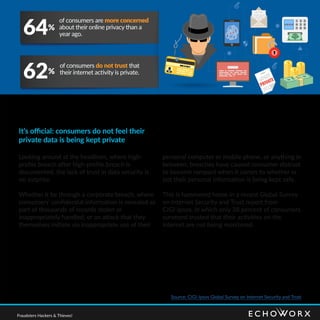
CIGI-Ipsos, in which only 38 percent of consumers
surveyed trusted that their activities on the
internet are not being monitored.
64%
of consumers are more concerned
about their online privacy than a
year ago.
of consumers do not trust that
their internet activity is private.
62%
Source: CIGI-Ipsos Global Survey on Internet Security and Trust
Fraudsters Hackers & Thieves!
Stop for a moment and think
How much of our lives are now conducted online,
or are connected in some way?
When you wake up in the morning, you likely
check personal and perhaps work email from a
tablet or mobile device. You might update
Facebook, Instagram or Twitter. You may ask your
Amazon Echo what the weather and traffic is like
on your way to work. You might place a grocery
order online, or order a new supply of toilet paper.
On the ride into work, you might use a Bluetooth
headset to listen to voice mails or catch up on the
day’s headlines.
When a large majority of our everyday life is
conducted online, how did the industry get to a
point where the consumers who have bought
into this “connected vision” don’t feel safe being
online?
Fraudsters Hackers & Thieves!
Data breaches have consequences far
beyond the fines
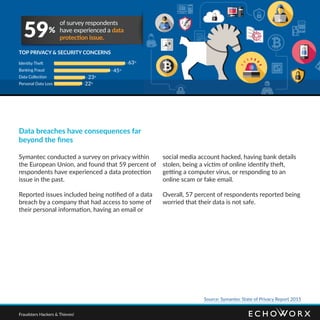
Symantec conducted a survey on privacy within
the European Union, and found that 59 percent of
respondents have experienced a data protection
issue in the past.
Reported issues included being notified of a data
breach by a company that had access to some of
their personal information, having an email or
social media account hacked, having bank details
stolen, being a victim of online identify theft,
getting a computer virus, or responding to an
online scam or fake email.
Overall, 57 percent of respondents reported being
worried that their data is not safe.
of survey respondents
have experienced a data
protection issue.59%
TOP PRIVACY & SECURITY CONCERNS
Identity Theft
Banking Fraud
Data Collection
Personal Data Loss
45%
23%
22%
63%
Source: Symantec State of Privacy Report 2015
Fraudsters Hackers & Thieves!
The more connected online, the greater
the risk
The National Telecommunications & Information
Administration (NTIA) in May released a report
that correlates how connected we are online with
a higher risk of data breaches.
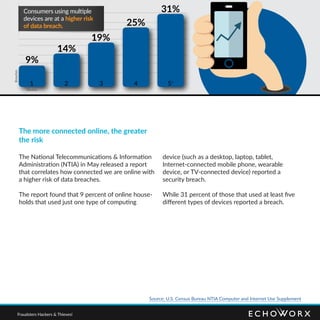
The report found that 9 percent of online house-
holds that used just one type of computing
device (such as a desktop, laptop, tablet,
Internet-connected mobile phone, wearable
device, or TV-connected device) reported a
security breach.
While 31 percent of those that used at least five
different types of devices reported a breach.
1 2 3 4 5+
9%
14%
25%
31%
Devices
Breaches
19%
Consumers using multiple
devices are at a higher risk
of data breach.
Source: U.S. Census Bureau NTIA Computer and Internet Use Supplement
Fraudsters Hackers & Thieves!
Fears and distrust about privacy, security
change how consumers use the Internet
Furthermore, there is a potential economic impact
to consumers’ distrust. The report also found that
consumers are so concerned with privacy and
security on the Internet that their household
opted out of participation in certain online
activities.
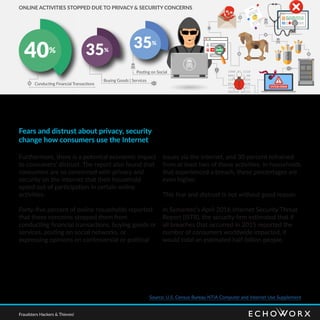
Forty-five percent of online households reported
that these concerns stopped them from
conducting financial transactions, buying goods or
services, posting on social networks, or
expressing opinions on controversial or political
issues via the Internet, and 30 percent refrained
from at least two of these activities. In households
that experienced a breach, these percentages are
even higher.
This fear and distrust is not without good reason.
In Symantec’s April 2016 Internet Security Threat
Report (ISTR), the security firm estimated that if
all breaches that occurred in 2015 reported the
number of consumers worldwide impacted, it
would total an estimated half-billion people.
40%
ONLINE ACTIVITIES STOPPED DUE TO PRIVACY & SECURITY CONCERNS
Conducting Financial Transactions
Buying Goods | Services
Posting on Social
35%
35%
Source: U.S. Census Bureau NTIA Computer and Internet Use Supplement
Fraudsters Hackers & Thieves!
Credit card numbers? Actually, there’s
a new kid in town
Financial information such as credit card
numbers are still coveted information, although
their per-card value is going down and their shelf
life is short since credit card companies and credit
card owners are using technology to shut down
fraudulent transactions quickly.
Instead, the new sought-after information
being targeted is information from insurance,
government and healthcare organizations.
The more details someone has about an
individual, the easier it is to commit identity fraud,
and targeting these groups provides more
complete profiles of individuals to criminals.
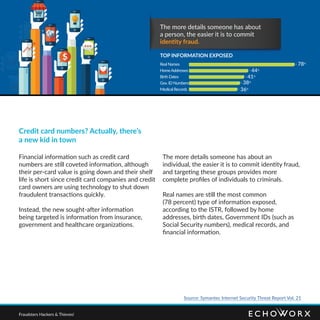
Real names are still the most common
(78 percent) type of information exposed,
according to the ISTR, followed by home
addresses, birth dates, Government IDs (such as
Social Security numbers), medical records, and
financial information.
The more details someone has about
a person, the easier it is to commit
identity fraud.
TOP INFORMATION EXPOSED
Real Names
HomeAddresses
Birth Dates
Gov. ID Numbers
Medical Records
78%
44%
41%
38%
36%
Source: Symantec Internet Security Threat Report Vol. 21
Fraudsters Hackers & Thieves!
The key to success, tailor the experience
to meet the individual user
Businesses can and should be doing much more
to secure customers’ private and oftentimes
sensitive information, reducing the risk for
everyone.
History has shown that when encryption
solutions—including email encryption—are
deployed properly, they work well.
But communications with customers requires a
different set of criteria than internal
communications or communications with partners.
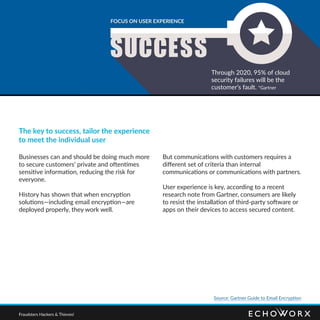
User experience is key, according to a recent
research note from Gartner, consumers are likely
to resist the installation of third-party software or
apps on their devices to access secured content.
FOCUS ON USER EXPERIENCE
Through 2020, 95% of cloud
security failures will be the
customer’s fault. *Gartner
Source: Gartner Guide to Email Encryption
Fraudsters Hackers & Thieves!
So, how can you better protect your
customers?
In summary, consumers today have become much
more discerning about their online activities, and
know controlling their online activity plays a role
in helping protect their privacy.
The organizations they do business with need to
take the security of customers’ private data just as
seriously, and invest the time, effort and budget
into ensuring its safety.
About Echoworx
Since 2000, Echoworx has been bringing simplicity and
flexibility to encryption. Echoworx’s flagship solution,
OneWorld Enterprise Encryption, provides an adaptive, fully
flexible approach to encryption that ensures the privacy
of sensitive messages. Enterprises investing in Echoworx’s
OneWorld platform, are gaining an adaptive, fully flexible
approach to encryption, creating seamless customer
experiences and in turn earning their loyalty and trust.
Recommended Reading
How Effective B2C Encryption Protection Works
Top Banks Demand Performance & Volume
OneWorld Enterprise Encryption
Why OneWorld Encryption with Office 365?
Fraudsters Hackers & Thieves!
Email encryption doesn’t have to be cryptic
www.echoworx.com
info@echoworx.com
NorthAmerica 1 800.346.4193 | UK 44 0.800.368.5334
@Echoworx

Fraudsters Hackers & Thieves!

  • 1.
    Fraudsters Hackers &Thieves! How can we better protect our customers?
  • 3.
    It’s official: consumersdo not feel their private data is being kept private Looking around at the headlines, where high- profile breach after high-profile breach is documented, the lack of trust in data security is no surprise. Whether it be through a corporate breach, where consumers’ confidential information is revealed as part of thousands of records stolen or inappropriately handled, or an attack that they themselves initiate via inappropriate use of their personal computer or mobile phone, or anything in between, breaches have caused consumer distrust to become rampant when it comes to whether or not their personal information is being kept safe. This is hammered home in a recent Global Survey on Internet Security and Trust report from CIGI-Ipsos, in which only 38 percent of consumers surveyed trusted that their activities on the internet are not being monitored. 64% of consumers are more concerned about their online privacy than a year ago. of consumers do not trust that their internet activity is private. 62% Source: CIGI-Ipsos Global Survey on Internet Security and Trust Fraudsters Hackers & Thieves!
  • 4.
    Stop for amoment and think How much of our lives are now conducted online, or are connected in some way? When you wake up in the morning, you likely check personal and perhaps work email from a tablet or mobile device. You might update Facebook, Instagram or Twitter. You may ask your Amazon Echo what the weather and traffic is like on your way to work. You might place a grocery order online, or order a new supply of toilet paper. On the ride into work, you might use a Bluetooth headset to listen to voice mails or catch up on the day’s headlines. When a large majority of our everyday life is conducted online, how did the industry get to a point where the consumers who have bought into this “connected vision” don’t feel safe being online? Fraudsters Hackers & Thieves!
  • 5.
    Data breaches haveconsequences far beyond the fines Symantec conducted a survey on privacy within the European Union, and found that 59 percent of respondents have experienced a data protection issue in the past. Reported issues included being notified of a data breach by a company that had access to some of their personal information, having an email or social media account hacked, having bank details stolen, being a victim of online identify theft, getting a computer virus, or responding to an online scam or fake email. Overall, 57 percent of respondents reported being worried that their data is not safe. of survey respondents have experienced a data protection issue.59% TOP PRIVACY & SECURITY CONCERNS Identity Theft Banking Fraud Data Collection Personal Data Loss 45% 23% 22% 63% Source: Symantec State of Privacy Report 2015 Fraudsters Hackers & Thieves!
  • 6.
    The more connectedonline, the greater the risk The National Telecommunications & Information Administration (NTIA) in May released a report that correlates how connected we are online with a higher risk of data breaches. The report found that 9 percent of online house- holds that used just one type of computing device (such as a desktop, laptop, tablet, Internet-connected mobile phone, wearable device, or TV-connected device) reported a security breach. While 31 percent of those that used at least five different types of devices reported a breach. 1 2 3 4 5+ 9% 14% 25% 31% Devices Breaches 19% Consumers using multiple devices are at a higher risk of data breach. Source: U.S. Census Bureau NTIA Computer and Internet Use Supplement Fraudsters Hackers & Thieves!
  • 7.
    Fears and distrustabout privacy, security change how consumers use the Internet Furthermore, there is a potential economic impact to consumers’ distrust. The report also found that consumers are so concerned with privacy and security on the Internet that their household opted out of participation in certain online activities. Forty-five percent of online households reported that these concerns stopped them from conducting financial transactions, buying goods or services, posting on social networks, or expressing opinions on controversial or political issues via the Internet, and 30 percent refrained from at least two of these activities. In households that experienced a breach, these percentages are even higher. This fear and distrust is not without good reason. In Symantec’s April 2016 Internet Security Threat Report (ISTR), the security firm estimated that if all breaches that occurred in 2015 reported the number of consumers worldwide impacted, it would total an estimated half-billion people. 40% ONLINE ACTIVITIES STOPPED DUE TO PRIVACY & SECURITY CONCERNS Conducting Financial Transactions Buying Goods | Services Posting on Social 35% 35% Source: U.S. Census Bureau NTIA Computer and Internet Use Supplement Fraudsters Hackers & Thieves!
  • 8.
    Credit card numbers?Actually, there’s a new kid in town Financial information such as credit card numbers are still coveted information, although their per-card value is going down and their shelf life is short since credit card companies and credit card owners are using technology to shut down fraudulent transactions quickly. Instead, the new sought-after information being targeted is information from insurance, government and healthcare organizations. The more details someone has about an individual, the easier it is to commit identity fraud, and targeting these groups provides more complete profiles of individuals to criminals. Real names are still the most common (78 percent) type of information exposed, according to the ISTR, followed by home addresses, birth dates, Government IDs (such as Social Security numbers), medical records, and financial information. The more details someone has about a person, the easier it is to commit identity fraud. TOP INFORMATION EXPOSED Real Names HomeAddresses Birth Dates Gov. ID Numbers Medical Records 78% 44% 41% 38% 36% Source: Symantec Internet Security Threat Report Vol. 21 Fraudsters Hackers & Thieves!
  • 9.
    The key tosuccess, tailor the experience to meet the individual user Businesses can and should be doing much more to secure customers’ private and oftentimes sensitive information, reducing the risk for everyone. History has shown that when encryption solutions—including email encryption—are deployed properly, they work well. But communications with customers requires a different set of criteria than internal communications or communications with partners. User experience is key, according to a recent research note from Gartner, consumers are likely to resist the installation of third-party software or apps on their devices to access secured content. FOCUS ON USER EXPERIENCE Through 2020, 95% of cloud security failures will be the customer’s fault. *Gartner Source: Gartner Guide to Email Encryption Fraudsters Hackers & Thieves!
  • 10.
    So, how canyou better protect your customers? In summary, consumers today have become much more discerning about their online activities, and know controlling their online activity plays a role in helping protect their privacy. The organizations they do business with need to take the security of customers’ private data just as seriously, and invest the time, effort and budget into ensuring its safety. About Echoworx Since 2000, Echoworx has been bringing simplicity and flexibility to encryption. Echoworx’s flagship solution, OneWorld Enterprise Encryption, provides an adaptive, fully flexible approach to encryption that ensures the privacy of sensitive messages. Enterprises investing in Echoworx’s OneWorld platform, are gaining an adaptive, fully flexible approach to encryption, creating seamless customer experiences and in turn earning their loyalty and trust. Recommended Reading How Effective B2C Encryption Protection Works Top Banks Demand Performance & Volume OneWorld Enterprise Encryption Why OneWorld Encryption with Office 365? Fraudsters Hackers & Thieves! Email encryption doesn’t have to be cryptic
  • 12.