

ECONOMIC
PLANNING
--evolution and strategy
EVOLUTION OF PLANNING
 Need of planning after independence
 Planning commission
 India’s economic state in 1950.
 FIVE YEAR PLANS
 The Nehruvian view(Fabian socialism)
Role of the State visualized
in the Fifties
 Land and agricultural reforms
 Providing basic facilities
 Limited privatization
 Encouraging investments
 Public mobilization of idle labor
In accordance with Directive
Principles
Early experience with Five Year
Plans
The First Five Year
Plan(1951-1956)
1. Little more than ongoing public
investment projects since
independence
2. Increase in the standard of living
3. Better employment opportunities
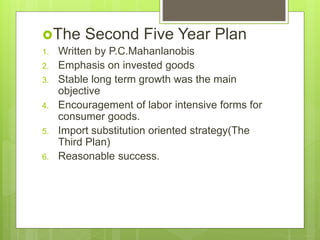
The Second Five Year Plan
1. Written by P.C.Mahanlanobis
2. Emphasis on invested goods
3. Stable long term growth was the main
objective
4. Encouragement of labor intensive forms for
consumer goods.
5. Import substitution oriented strategy(The
Third Plan)
6. Reasonable success.
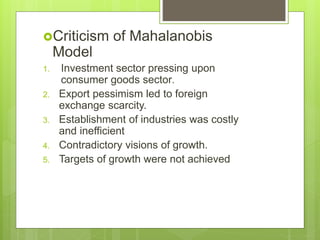
Criticism of Mahalanobis
Model
1. Investment sector pressing upon
consumer goods sector.
2. Export pessimism led to foreign
exchange scarcity.
3. Establishment of industries was costly
and inefficient
4. Contradictory visions of growth.
5. Targets of growth were not achieved
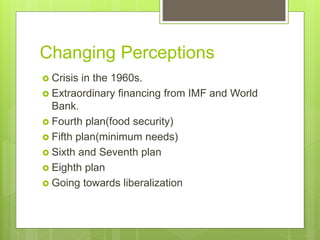
Changing Perceptions
 Crisis in the 1960s.
 Extraordinary financing from IMF and World
Bank.
 Fourth plan(food security)
 Fifth plan(minimum needs)
 Sixth and Seventh plan
 Eighth plan
 Going towards liberalization
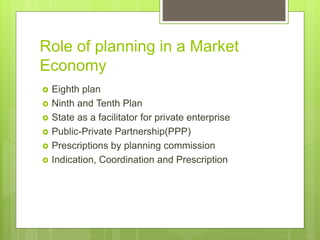
Role of planning in a Market
Economy
 Eighth plan
 Ninth and Tenth Plan
 State as a facilitator for private enterprise
 Public-Private Partnership(PPP)
 Prescriptions by planning commission
 Indication, Coordination and Prescription
Redefining the Role of the State
 PPP must be continued in the future as
well
 Government as a regulating body
 Greater attention to social sector
 The Twelfth Plan
THE ROAD
AHEAD…………
ADARSH (14113004)
ADITYA SHARMA (14113005)

Economic planning - India

  • 1.
  • 2.
    EVOLUTION OF PLANNING Need of planning after independence  Planning commission  India’s economic state in 1950.  FIVE YEAR PLANS  The Nehruvian view(Fabian socialism)
  • 3.
    Role of theState visualized in the Fifties  Land and agricultural reforms  Providing basic facilities  Limited privatization  Encouraging investments  Public mobilization of idle labor In accordance with Directive Principles
  • 4.
    Early experience withFive Year Plans The First Five Year Plan(1951-1956) 1. Little more than ongoing public investment projects since independence 2. Increase in the standard of living 3. Better employment opportunities
  • 5.
    The Second FiveYear Plan 1. Written by P.C.Mahanlanobis 2. Emphasis on invested goods 3. Stable long term growth was the main objective 4. Encouragement of labor intensive forms for consumer goods. 5. Import substitution oriented strategy(The Third Plan) 6. Reasonable success.
  • 6.
    Criticism of Mahalanobis Model 1.Investment sector pressing upon consumer goods sector. 2. Export pessimism led to foreign exchange scarcity. 3. Establishment of industries was costly and inefficient 4. Contradictory visions of growth. 5. Targets of growth were not achieved
  • 7.
    Changing Perceptions  Crisisin the 1960s.  Extraordinary financing from IMF and World Bank.  Fourth plan(food security)  Fifth plan(minimum needs)  Sixth and Seventh plan  Eighth plan  Going towards liberalization
  • 8.
    Role of planningin a Market Economy  Eighth plan  Ninth and Tenth Plan  State as a facilitator for private enterprise  Public-Private Partnership(PPP)  Prescriptions by planning commission  Indication, Coordination and Prescription
  • 9.
    Redefining the Roleof the State  PPP must be continued in the future as well  Government as a regulating body  Greater attention to social sector  The Twelfth Plan
  • 10.
  • 11.