DEVELOPMENT
ECONOMICS
CHAPTER
1
Introduction
1
2
Economic development
Economics and Development
studies
1.ECONOMIC
DEVELOPMENT
1.1. Definition of Economic Development:
• Schaffner (2013): Economic development refers to the process through
which an economy improves the economic, political, and social well-being of
its people. It involves structural transformations, improvements in
productivity, and changes in social institutions.
• Perkins et al. (2013): Economic development is the sustained, concerted
effort of policymakers and the community to promote the standard of living
and economic health in a specific area. It includes job creation, economic
growth, and equitable distribution of wealth.
• Todaro and Smith (2020): Economic development is a multidimensional
process involving major changes in social structures, popular attitudes, and
national institutions, as well as the acceleration of economic growth, the
reduction of inequality, and the eradication of absolute poverty.
GENERALLY, ECONOMIC DEVELOPMENT
INCLUDES:
The
acceleration
of economic
growth
Production
structural
transformatio
n
Equitable
distributio
n of
wealth
Sustained
improvement
s in health,
education and
other aspects
of human
welfare
Sustenance
is the ability to meet
basic needs
Freedom
to choose among different life
paths
Self-esteem
is a sense of worth and
self-respect
1.2. Core values of development
Schaffner (2013): Emphasizes
using a range of indicators
including GDP per capita, literacy
rates, and life expectancy to
measure development
Perkins et al. (2013): Discusses
composite indices such as the Human
Development Index (HDI) which
combines income, education, and
health indicators
Todaro and Smith (2020): Highlights the use of both
quantitative indicators (like income per capita and poverty
rates) and qualitative measures (like political freedom and
environmental sustainability)
Generally, Human development is a process of enlarging
people’s choices.
1.3. Measuring economic
development
1.4. Development and Well-being
• Schaffner (2013):
Connects
development with
overall well-being,
including
economic security,
education, health,
and social
inclusion
• Perkins et al.
(2013): Discusses
well-being as a
broad concept
encompassing
economic, social,
and psychological
dimensions.
• Todaro and Smith
(2020): Argues that
true development is
about improving
people's well-being,
measured through a
broader perspective
than just economic
metrics.
•
Schaffner (2013): Focuses on development that meets the
needs of the present without compromising the ability of
future generations to meet their own needs.
•
Perkins et al. (2013): Emphasizes the importance of
environmental sustainability and the need to integrate
environmental concerns into economic planning.
•
Todaro and Smith (2020): Highlights sustainable development
as a goal that integrates economic growth with
environmental stewardship and social equity.
1.5. Sustainable Development
17 Sustainable development
Goals
•
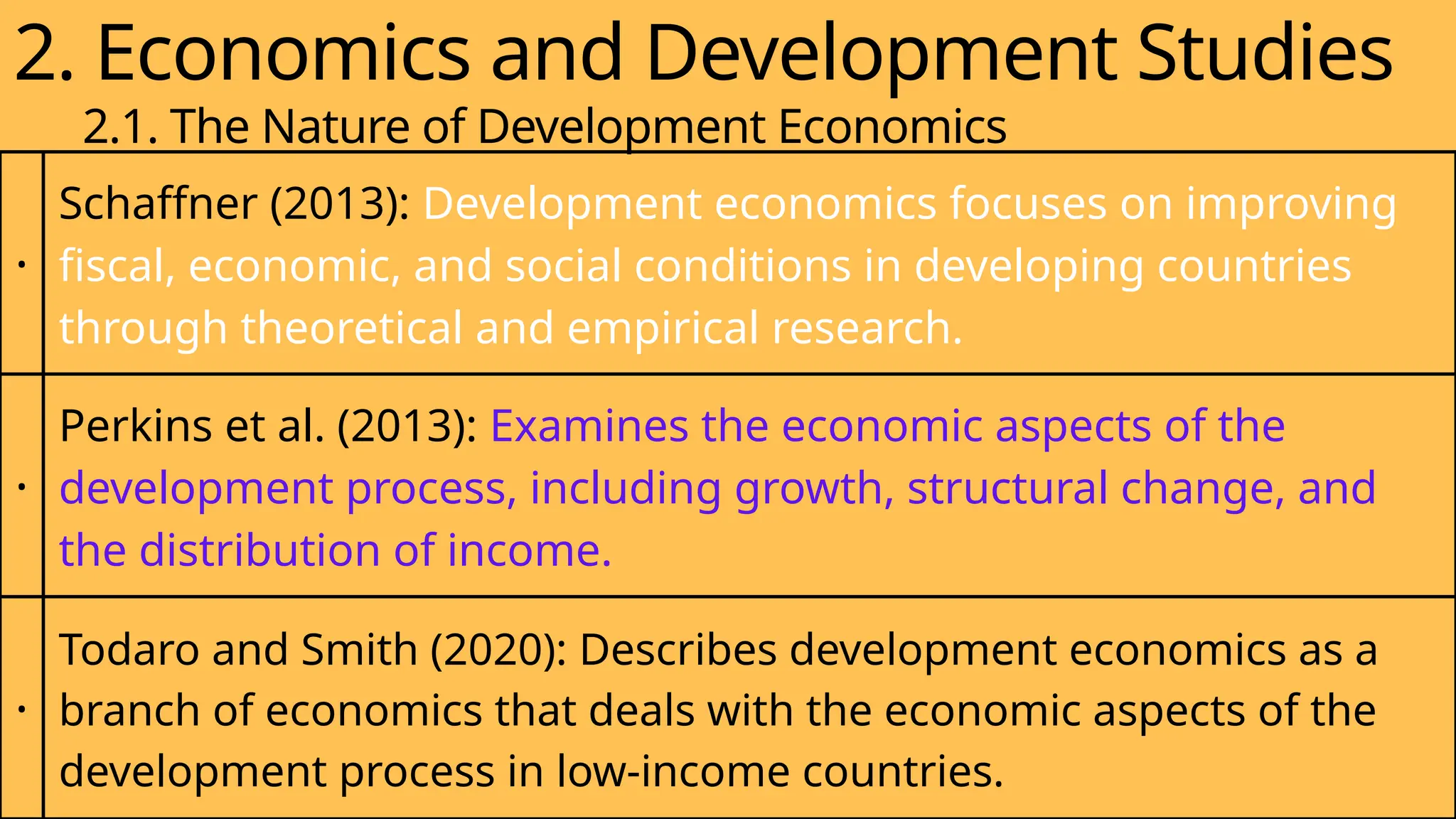
Schaffner (2013): Development economics focuses on improving
fiscal, economic, and social conditions in developing countries
through theoretical and empirical research.
•
Perkins et al. (2013): Examines the economic aspects of the
development process, including growth, structural change, and
the distribution of income.
•
Todaro and Smith (2020): Describes development economics as a
branch of economics that deals with the economic aspects of the
development process in low-income countries.
2. Economics and Development Studies
2.1. The Nature of Development Economics
2.2. Research Problems in Development Economics:
• Schaffner (2013): Identifies key research problems
such as poverty, inequality, health, education, and
governance.
• Perkins et al. (2013): Focuses on issues like
economic growth, income distribution, and the role
of government policy in development.
• Todaro and Smith (2020): Discusses major research
topics including poverty alleviation, economic
growth strategies, and sustainable development.
2.3. Characteristics of the Developing World:
• Schaffner (2013): Highlights characteristics such as
low income levels, high population growth, and
economic vulnerability.
• Perkins et al. (2013): Discusses features like
structural diversity, cultural heterogeneity, and
varying levels of development.
• Todaro and Smith (2020): Lists common
characteristics including widespread poverty, high
dependency ratios, and economic dualism.
Discussion Questions:
1. Discuss the role of institutions in economic
development according to Perkins et al. What
types of institutions are critical?
2. How do Todaro & Smith differentiate between
economic growth and economic development?
What are the implications for policy-making?
3. How does Schaffner define economic
development, and what are the key theories
associated with it?

Chapter 1 of the course Development Economics

  • 1.
  • 2.
  • 3.
  • 4.
    1.ECONOMIC DEVELOPMENT 1.1. Definition ofEconomic Development: • Schaffner (2013): Economic development refers to the process through which an economy improves the economic, political, and social well-being of its people. It involves structural transformations, improvements in productivity, and changes in social institutions. • Perkins et al. (2013): Economic development is the sustained, concerted effort of policymakers and the community to promote the standard of living and economic health in a specific area. It includes job creation, economic growth, and equitable distribution of wealth. • Todaro and Smith (2020): Economic development is a multidimensional process involving major changes in social structures, popular attitudes, and national institutions, as well as the acceleration of economic growth, the reduction of inequality, and the eradication of absolute poverty.
  • 5.
    GENERALLY, ECONOMIC DEVELOPMENT INCLUDES: The acceleration ofeconomic growth Production structural transformatio n Equitable distributio n of wealth Sustained improvement s in health, education and other aspects of human welfare
  • 6.
    Sustenance is the abilityto meet basic needs Freedom to choose among different life paths Self-esteem is a sense of worth and self-respect 1.2. Core values of development
  • 7.
    Schaffner (2013): Emphasizes usinga range of indicators including GDP per capita, literacy rates, and life expectancy to measure development Perkins et al. (2013): Discusses composite indices such as the Human Development Index (HDI) which combines income, education, and health indicators Todaro and Smith (2020): Highlights the use of both quantitative indicators (like income per capita and poverty rates) and qualitative measures (like political freedom and environmental sustainability) Generally, Human development is a process of enlarging people’s choices. 1.3. Measuring economic development
  • 8.
    1.4. Development andWell-being • Schaffner (2013): Connects development with overall well-being, including economic security, education, health, and social inclusion • Perkins et al. (2013): Discusses well-being as a broad concept encompassing economic, social, and psychological dimensions. • Todaro and Smith (2020): Argues that true development is about improving people's well-being, measured through a broader perspective than just economic metrics.
  • 9.
    • Schaffner (2013): Focuseson development that meets the needs of the present without compromising the ability of future generations to meet their own needs. • Perkins et al. (2013): Emphasizes the importance of environmental sustainability and the need to integrate environmental concerns into economic planning. • Todaro and Smith (2020): Highlights sustainable development as a goal that integrates economic growth with environmental stewardship and social equity. 1.5. Sustainable Development
  • 10.
  • 11.
    • Schaffner (2013): Developmenteconomics focuses on improving fiscal, economic, and social conditions in developing countries through theoretical and empirical research. • Perkins et al. (2013): Examines the economic aspects of the development process, including growth, structural change, and the distribution of income. • Todaro and Smith (2020): Describes development economics as a branch of economics that deals with the economic aspects of the development process in low-income countries. 2. Economics and Development Studies 2.1. The Nature of Development Economics
  • 12.
    2.2. Research Problemsin Development Economics: • Schaffner (2013): Identifies key research problems such as poverty, inequality, health, education, and governance. • Perkins et al. (2013): Focuses on issues like economic growth, income distribution, and the role of government policy in development. • Todaro and Smith (2020): Discusses major research topics including poverty alleviation, economic growth strategies, and sustainable development.
  • 13.
    2.3. Characteristics ofthe Developing World: • Schaffner (2013): Highlights characteristics such as low income levels, high population growth, and economic vulnerability. • Perkins et al. (2013): Discusses features like structural diversity, cultural heterogeneity, and varying levels of development. • Todaro and Smith (2020): Lists common characteristics including widespread poverty, high dependency ratios, and economic dualism.
  • 14.
    Discussion Questions: 1. Discussthe role of institutions in economic development according to Perkins et al. What types of institutions are critical? 2. How do Todaro & Smith differentiate between economic growth and economic development? What are the implications for policy-making? 3. How does Schaffner define economic development, and what are the key theories associated with it?