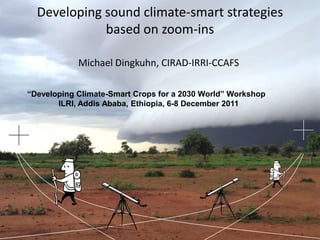
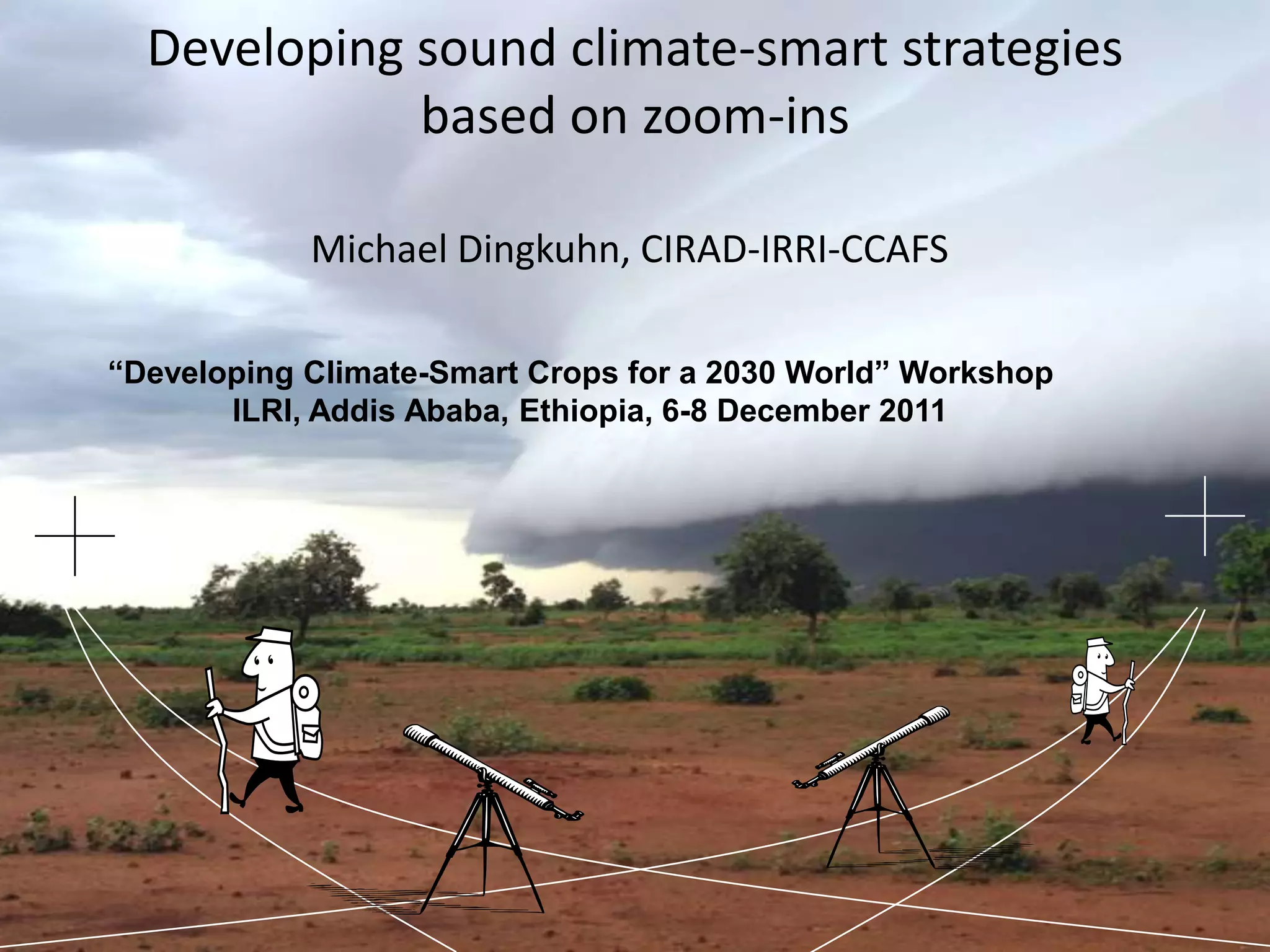

Developing sound climate-smart strategies
             based on zoom-ins

            Michael Dingkuhn, CIRAD-IRRI-CCAFS

“Developing Climate-Smart Crops for a 2030 World” Workshop
       ILRI, Addis Ababa, Ethiopia, 6-8 December 2011
Questions on zoom-ins
•   Rice, sorghum, beans, banana/plantain
•   How many zoom-ins per species?
•   Selection criteria?
•   Funding per zoom-in?
•   Integration with local / international projects?
•   Breeder interactions?
•   Modeling support?
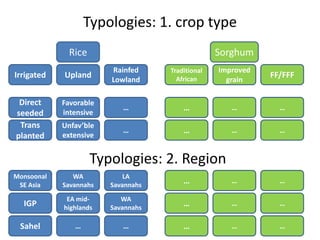
Typologies: 1. crop type
             Rice                                 Sorghum
                        Rainfed     Traditional   Improved
Irrigated   Upland                    African
                                                             FF/FFF
                        Lowland                     grain

 Direct     Favorable
                           …            …            …         …
seeded      intensive
 Trans      Unfav’ble
                           …            …            …         …
planted     extensive


                    Typologies: 2. Region
Monsoonal      WA           LA
 SE Asia    Savannahs   Savannahs
                                        …            …         …

             EA mid-       WA
  IGP       highlands   Savannahs
                                        …            …         …

 Sahel         …           …            …            …         …
Typologies:
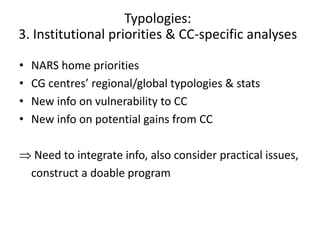
3. Institutional priorities & CC-specific analyses

•   NARS home priorities
•   CG centres’ regional/global typologies & stats
•   New info on vulnerability to CC
•   New info on potential gains from CC

     Need to integrate info, also consider practical issues,
    construct a doable program
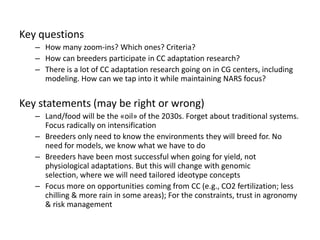
Key questions
   – How many zoom-ins? Which ones? Criteria?
   – How can breeders participate in CC adaptation research?
   – There is a lot of CC adaptation research going on in CG centers, including
     modeling. How can we tap into it while maintaining NARS focus?


Key statements (may be right or wrong)
   – Land/food will be the «oil» of the 2030s. Forget about traditional systems.
     Focus radically on intensification
   – Breeders only need to know the environments they will breed for. No
     need for models, we know what we have to do
   – Breeders have been most successful when going for yield, not
     physiological adaptations. But this will change with genomic
     selection, where we will need tailored ideotype concepts
   – Focus more on opportunities coming from CC (e.g., CO2 fertilization; less
     chilling & more rain in some areas); For the constraints, trust in agronomy
     & risk management
Extra materials
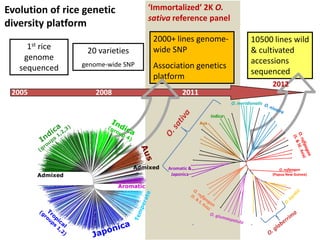
Evolution of rice genetic                 ‘Immortalized’ 2K O.
                                          sativa reference panel
diversity platform
                                           2000+ lines genome-                      10500 lines wild
     1st
       rice           20 varieties         wide SNP                                 & cultivated
    genome                                                                          accessions
                     genome-wide SNP       Association genetics
   sequenced                                                                        sequenced
                                           platform
                                                                                             2012
 2005                   2008                         2011
                                                                           O. meridionalis

                                                                  Indica
                                                            Aus


                                     Admixed   Aromatic &                                        O. rufipogon
           Admixed                              Japonica                                     (Papua New Guinea)


                               Aromatic
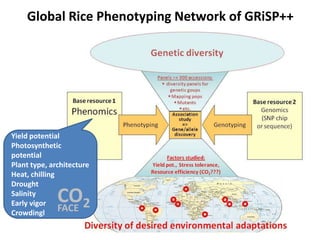
Global Rice Phenotyping Network of GRiSP++


Yield potential
Photosynthetic
potential
Plant type, architecture
Heat, chilling
Drought
Salinity
Early vigor   CO2
               FACE
Crowdingl
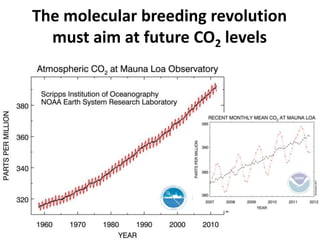
The molecular breeding revolution
  must aim at future CO2 levels
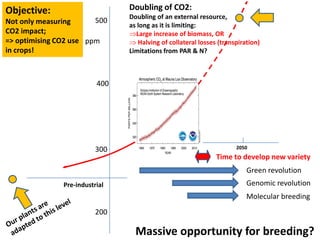
Objective:                      Doubling of CO2:
                                Doubling of an external resource,
Not only measuring      500
                                as long as it is limiting:
CO2 impact;                       Large increase of biomass, OR
=> optimising CO2 use ppm          Halving of collateral losses (transpiration)
in crops!                       Limitations from PAR & N?


                          400


                          300                                         2050
                                                               Time to develop new variety
                                                                          Green revolution
               Pre-industrial                                             Genomic revolution
                                                                          Molecular breeding
                          200

                                  Massive opportunity for breeding?
FACE facility design


                                                FACE
                75m                             office


                         75m


         A FACE facility on IRRI farm with 8 rings (4 ambient [green] and 4 elevated CO2 [orange]) each
         of size 25m diameter (300m2) on a 20 acre area


                1m buffer zone


                Individual plots

                28.8m2 check plot

                Walkways


                                 GRiSP:
                                 Plans for a phenotyping/breeding
25.0 m                           Field platform with enhanced CO2

Developing sound climate-smart strategies based on zoom-ins

  • 1.
    Developing sound climate-smartstrategies based on zoom-ins Michael Dingkuhn, CIRAD-IRRI-CCAFS “Developing Climate-Smart Crops for a 2030 World” Workshop ILRI, Addis Ababa, Ethiopia, 6-8 December 2011
  • 2.
    Questions on zoom-ins • Rice, sorghum, beans, banana/plantain • How many zoom-ins per species? • Selection criteria? • Funding per zoom-in? • Integration with local / international projects? • Breeder interactions? • Modeling support?
  • 3.
    Typologies: 1. croptype Rice Sorghum Rainfed Traditional Improved Irrigated Upland African FF/FFF Lowland grain Direct Favorable … … … … seeded intensive Trans Unfav’ble … … … … planted extensive Typologies: 2. Region Monsoonal WA LA SE Asia Savannahs Savannahs … … … EA mid- WA IGP highlands Savannahs … … … Sahel … … … … …
  • 4.
    Typologies: 3. Institutional priorities& CC-specific analyses • NARS home priorities • CG centres’ regional/global typologies & stats • New info on vulnerability to CC • New info on potential gains from CC Need to integrate info, also consider practical issues, construct a doable program
  • 5.
    Key questions – How many zoom-ins? Which ones? Criteria? – How can breeders participate in CC adaptation research? – There is a lot of CC adaptation research going on in CG centers, including modeling. How can we tap into it while maintaining NARS focus? Key statements (may be right or wrong) – Land/food will be the «oil» of the 2030s. Forget about traditional systems. Focus radically on intensification – Breeders only need to know the environments they will breed for. No need for models, we know what we have to do – Breeders have been most successful when going for yield, not physiological adaptations. But this will change with genomic selection, where we will need tailored ideotype concepts – Focus more on opportunities coming from CC (e.g., CO2 fertilization; less chilling & more rain in some areas); For the constraints, trust in agronomy & risk management
  • 6.
  • 7.
    Evolution of ricegenetic ‘Immortalized’ 2K O. sativa reference panel diversity platform 2000+ lines genome- 10500 lines wild 1st rice 20 varieties wide SNP & cultivated genome accessions genome-wide SNP Association genetics sequenced sequenced platform 2012 2005 2008 2011 O. meridionalis Indica Aus Admixed Aromatic & O. rufipogon Admixed Japonica (Papua New Guinea) Aromatic
  • 8.
    Global Rice PhenotypingNetwork of GRiSP++ Yield potential Photosynthetic potential Plant type, architecture Heat, chilling Drought Salinity Early vigor CO2 FACE Crowdingl
  • 9.
    The molecular breedingrevolution must aim at future CO2 levels
  • 10.
    Objective: Doubling of CO2: Doubling of an external resource, Not only measuring 500 as long as it is limiting: CO2 impact; Large increase of biomass, OR => optimising CO2 use ppm Halving of collateral losses (transpiration) in crops! Limitations from PAR & N? 400 300 2050 Time to develop new variety Green revolution Pre-industrial Genomic revolution Molecular breeding 200 Massive opportunity for breeding?
  • 11.
    FACE facility design FACE 75m office 75m A FACE facility on IRRI farm with 8 rings (4 ambient [green] and 4 elevated CO2 [orange]) each of size 25m diameter (300m2) on a 20 acre area 1m buffer zone Individual plots 28.8m2 check plot Walkways GRiSP: Plans for a phenotyping/breeding 25.0 m Field platform with enhanced CO2