Mauricio Parra Quijano
International Treaty on Plant Genetic Resources
for Food and Agriculture - FAO
CAPFITOGEN programme coordinator
http://www.capfitogen.net
¿What is CAPFITOGEN programme?
Programme to Strengthen National Plant Genetic Resource Capacities in
Latin America
Programme to Strengthen National Plant Genetic Resource Capacities in
Iberic-America
(Latin America + Spain + Portugal)
Global Programme to Strengthen National Plant Genetic Resource
Capacities
¿What is Strengthen Capacities?
Is to promote all processes which drive to higher levels of autonomy to
lead own matters by the target institution.
Autonomy is possible through self-interest, enough economic resources
and trained human staff.
CAPFITOGEN works with/for the human resources:
• Developing suitable technology for use as autonomous as
possible
• Training technical personnel in the use of this technology
CAPFITOGEN offers adapted technology options to technician/institutes
under limited economic resources work conditions, train this staff and
encouraging the autonomous capacity in PGR conservation and use
¿How CAPFITOGEN builds capacity?
• Developing adapted technology for the target region
• Transferring technology to staff from involved institutions
• Training this staff through face-to-face workshops
• Offering support to users which have adopted the transferred
technology
• Improving continuously the offered technology
¿What type of technology we develop?
• Technology specifically designed for efficient conservation and
utilization of plant genetic resources (crop + wild relatives)
• Supported by scientific advances which have been published in peer
review journals
• In most cases, the same team who developed the scientific advance is
involved in the process of developing adapted technology and its
transfer
• Easy to use. CAPFITOGEN technology does not require advanced
computer skills
• Very low cost of adoption (only a PC as input)
• Technology impact on daily activities that institutions are currently
carrying out, making them more efficient
• Designed to maximize the use of information on germplasm
(documentation), making available processes that usually are not
accessible in low resources conditions
¿What CAPFITOGEN tools are?
Initially they were focused on ex situ conservation, although some of them
have several applications even out of PGR scenario.
Phase 1: Our goals achieved
2012-2014
Seven tools focused on ex situ conservation
User guides
Three languages (Spanish, English, Portuguese)
Two regional (Latin American) workshops
Four national workshops (Cuba, Spain, Honduras, Uruguay)
About 150 trained technicians
¿What CAPFITOGEN tools are?
Phase 2: Our next challenges
2014-2016
Three new auxiliar tools
Three new tools focused on in situ conservation
User’s networks
E-Learning methods
Tools on server (internet connection required, no installation)
One final regional (Latin America + Spain + Portugal) workshop
Four national workshops
For the second phase, CAPFITOGEN program will try to expand its impact out of Latin
America but continuing with training and education activities in this region. In terms of
tools, CAPFITOGEN will focus on in situ conservation applications.
… beside this, CAPFITOGEN tools are
 Free of charge
 Free distribution
 Internet connection is not required
 Suitable for Windows OS (minimum Windows XP required)
 Accessible through USB memories (by request or distributed during the worksops)
and internet download (http://www.capfitogen.net/en)
 Available on Spanish, Portuguese and English, both the tools and user manual.
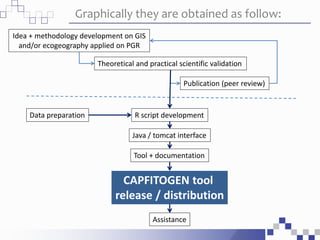
Graphically they are obtained as follow:
Idea + methodology development on GIS
and/or ecogeography applied on PGR
Theoretical and practical scientific validation
Publication (peer review)
Data preparation R script development
Java / tomcat interface
Tool + documentation
Assistance
CAPFITOGEN tool
release / distribution
The list of available CAPFITOGEN tools
• GEOQUAL
• ELCmapas
• ECOGEO
• Representa
• Colnucleo
• DIVmapas
• FIGS_R
Ex situ tools Auxiliar tools
• TesTable
• SelecVar
• rLayer
• Complementa
• Modela (06/2015)
• Criteria (09/2015)
In situ tools
CAPFITOGEN program is an effort of
Funded by:
With technical support of:
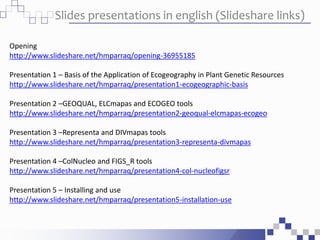
Slides presentations in english (Slideshare links)
Opening
http://www.slideshare.net/hmparraq/opening-36955185
Presentation 1 – Basis of the Application of Ecogeography in Plant Genetic Resources
http://www.slideshare.net/hmparraq/presentation1-ecogeographic-basis
Presentation 2 –GEOQUAL, ELCmapas and ECOGEO tools
http://www.slideshare.net/hmparraq/presentation2-geoqual-elcmapas-ecogeo
Presentation 3 –Representa and DIVmapas tools
http://www.slideshare.net/hmparraq/presentation3-representa-divmapas
Presentation 4 –ColNucleo and FIGS_R tools
http://www.slideshare.net/hmparraq/presentation4-col-nucleofigsr
Presentation 5 – Installing and use
http://www.slideshare.net/hmparraq/presentation5-installation-use
Thanks! And welcome to the CAPFITOGEN workshop

Opening session - CAPFITOGEN Programme introduction

  • 1.
    Mauricio Parra Quijano InternationalTreaty on Plant Genetic Resources for Food and Agriculture - FAO CAPFITOGEN programme coordinator http://www.capfitogen.net
  • 2.
    ¿What is CAPFITOGENprogramme? Programme to Strengthen National Plant Genetic Resource Capacities in Latin America Programme to Strengthen National Plant Genetic Resource Capacities in Iberic-America (Latin America + Spain + Portugal) Global Programme to Strengthen National Plant Genetic Resource Capacities
  • 3.
    ¿What is StrengthenCapacities? Is to promote all processes which drive to higher levels of autonomy to lead own matters by the target institution. Autonomy is possible through self-interest, enough economic resources and trained human staff. CAPFITOGEN works with/for the human resources: • Developing suitable technology for use as autonomous as possible • Training technical personnel in the use of this technology CAPFITOGEN offers adapted technology options to technician/institutes under limited economic resources work conditions, train this staff and encouraging the autonomous capacity in PGR conservation and use
  • 4.
    ¿How CAPFITOGEN buildscapacity? • Developing adapted technology for the target region • Transferring technology to staff from involved institutions • Training this staff through face-to-face workshops • Offering support to users which have adopted the transferred technology • Improving continuously the offered technology
  • 5.
    ¿What type oftechnology we develop? • Technology specifically designed for efficient conservation and utilization of plant genetic resources (crop + wild relatives) • Supported by scientific advances which have been published in peer review journals • In most cases, the same team who developed the scientific advance is involved in the process of developing adapted technology and its transfer • Easy to use. CAPFITOGEN technology does not require advanced computer skills • Very low cost of adoption (only a PC as input) • Technology impact on daily activities that institutions are currently carrying out, making them more efficient • Designed to maximize the use of information on germplasm (documentation), making available processes that usually are not accessible in low resources conditions
  • 6.
    ¿What CAPFITOGEN toolsare? Initially they were focused on ex situ conservation, although some of them have several applications even out of PGR scenario. Phase 1: Our goals achieved 2012-2014 Seven tools focused on ex situ conservation User guides Three languages (Spanish, English, Portuguese) Two regional (Latin American) workshops Four national workshops (Cuba, Spain, Honduras, Uruguay) About 150 trained technicians
  • 7.
    ¿What CAPFITOGEN toolsare? Phase 2: Our next challenges 2014-2016 Three new auxiliar tools Three new tools focused on in situ conservation User’s networks E-Learning methods Tools on server (internet connection required, no installation) One final regional (Latin America + Spain + Portugal) workshop Four national workshops For the second phase, CAPFITOGEN program will try to expand its impact out of Latin America but continuing with training and education activities in this region. In terms of tools, CAPFITOGEN will focus on in situ conservation applications.
  • 8.
    … beside this,CAPFITOGEN tools are  Free of charge  Free distribution  Internet connection is not required  Suitable for Windows OS (minimum Windows XP required)  Accessible through USB memories (by request or distributed during the worksops) and internet download (http://www.capfitogen.net/en)  Available on Spanish, Portuguese and English, both the tools and user manual.
  • 9.
    Graphically they areobtained as follow: Idea + methodology development on GIS and/or ecogeography applied on PGR Theoretical and practical scientific validation Publication (peer review) Data preparation R script development Java / tomcat interface Tool + documentation Assistance CAPFITOGEN tool release / distribution
  • 10.
    The list ofavailable CAPFITOGEN tools • GEOQUAL • ELCmapas • ECOGEO • Representa • Colnucleo • DIVmapas • FIGS_R Ex situ tools Auxiliar tools • TesTable • SelecVar • rLayer • Complementa • Modela (06/2015) • Criteria (09/2015) In situ tools
  • 11.
    CAPFITOGEN program isan effort of Funded by: With technical support of:
  • 12.
    Slides presentations inenglish (Slideshare links) Opening http://www.slideshare.net/hmparraq/opening-36955185 Presentation 1 – Basis of the Application of Ecogeography in Plant Genetic Resources http://www.slideshare.net/hmparraq/presentation1-ecogeographic-basis Presentation 2 –GEOQUAL, ELCmapas and ECOGEO tools http://www.slideshare.net/hmparraq/presentation2-geoqual-elcmapas-ecogeo Presentation 3 –Representa and DIVmapas tools http://www.slideshare.net/hmparraq/presentation3-representa-divmapas Presentation 4 –ColNucleo and FIGS_R tools http://www.slideshare.net/hmparraq/presentation4-col-nucleofigsr Presentation 5 – Installing and use http://www.slideshare.net/hmparraq/presentation5-installation-use
  • 13.
    Thanks! And welcometo the CAPFITOGEN workshop