Internship Report On
Home Automation-
IoT
-:SUBMITTED BY:-
MANORANJAN MAHARANA
(E C K 2 3 2 9 3 5 8 C @ E CK O VA T I O N . C O M )
Carried Out Under
“ Eckovation ”
Contents
1. What is IoT ??
2. What is the scope of IoT ??
3. What is Home Automation ??
4. Objective
5. Tools worked On
6. Circuit Diagram
7. Steps involved
8. Code
9. Issues faced
What is IoT ?? -
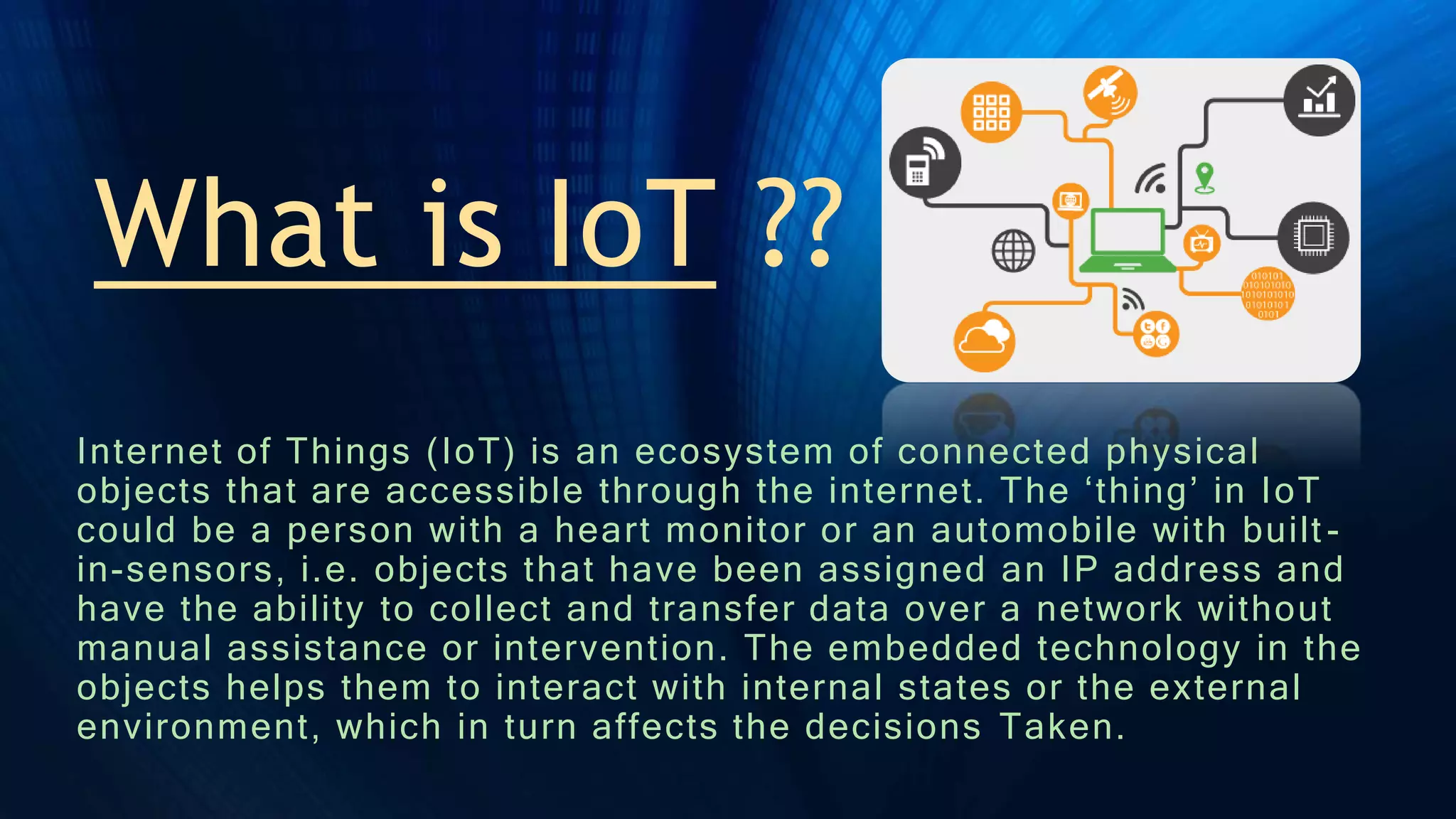
Internet of Things (IoT) is an ecosystem of connected physical
objects that are accessible through the internet. The ‘thing’ in IoT
could be a person with a heart monitor or an automobile with built -
in-sensors, i.e. objects that have been assigned an IP address and
have the ability to collect and transfer data over a network without
manual assistance or intervention. The embedded technology in the
objects helps them to interact with internal states or the external
environment, which in turn affects the decisions Taken.
What is the scope of IoT ?? -
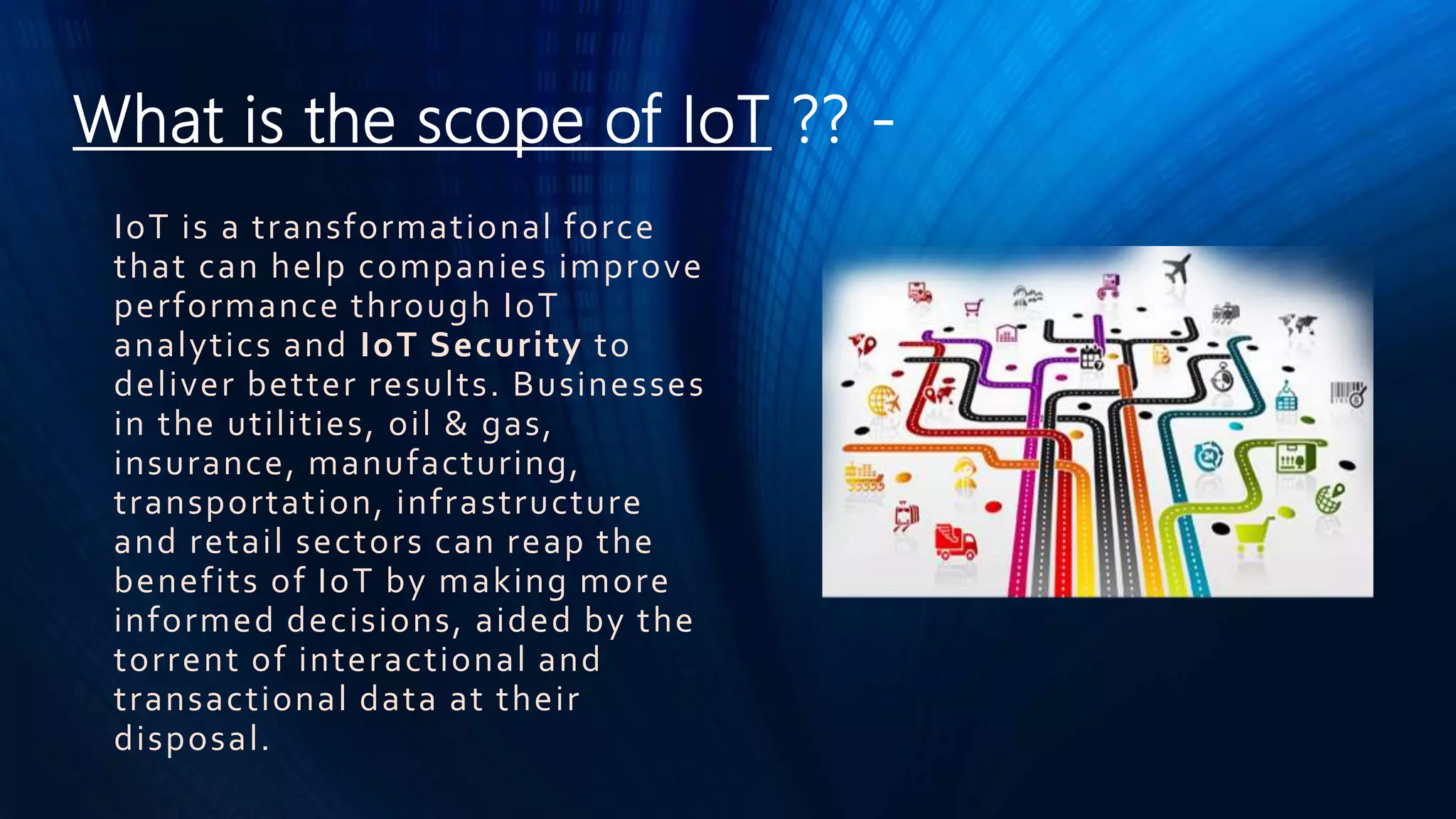
IoT is a transformational force
that can help companies improve
performance through IoT
analytics and IoT Security to
deliver better results. Businesses
in the utilities, oil & gas,
insurance, manufacturing,
transportation, infrastructure
and retail sectors can reap the
benefits of IoT by making more
informed decisions, aided by the
torrent of interactional and
transactional data at their
disposal.
What is Home Automation ?? -
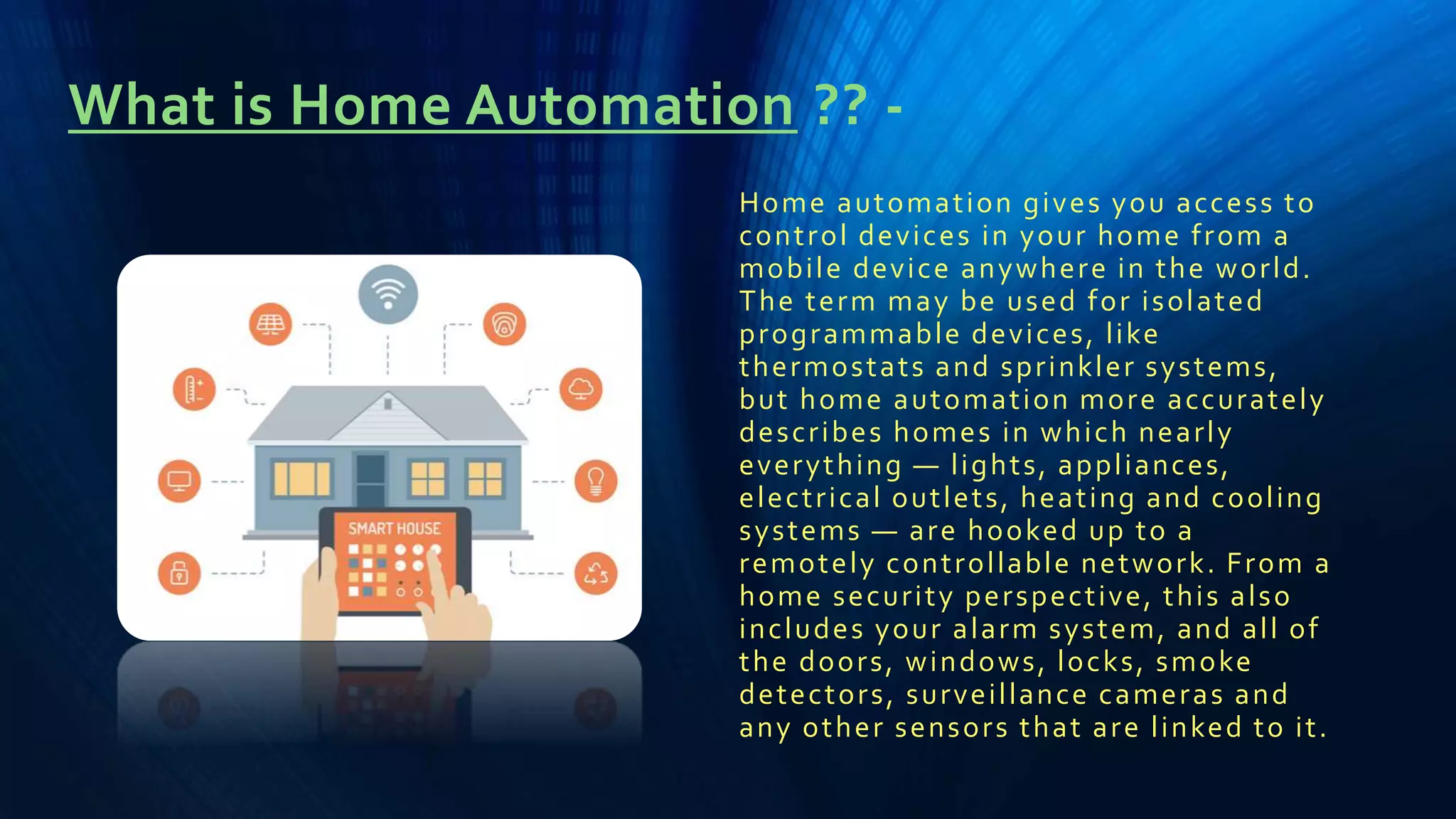
Home automation gives you access to
control devices in your home from a
mobile device anywhere in the world.
The term may be used for isolated
programmable devices, like
thermostats and sprinkler systems,
but home automation more accurately
describes homes in which nearly
everything — lights, appliances,
electrical outlets, heating and cooling
systems — are hooked up to a
remotely controllable network. From a
home security perspective, this also
includes your alarm system, and all of
the doors, windows, locks, smoke
detectors, surveillance cameras and
any other sensors that are linked to it.
Objective -
WE ARE REQUIRED TO AUTOMATE A
ROOM’S LIGHTING SYSTEM BY USING
THE KNOWLEDGE ACQUIRED DURING
THE IOT COURSE.
Tools Worked On
Hardware components –
• RaspberryPi 3B
( with Desbian OS )
• IR Sensor
• Relay
• Jumper wires
• Copper wires
• Electric Light Bulb ( 10Watt )
Softwares and Other
Services –
• Putty
• Xming
• PushBullet API
Code- https://github.com/Manoranjanmaharana1/Home-Automation/blob/master/Home%20Automation.py
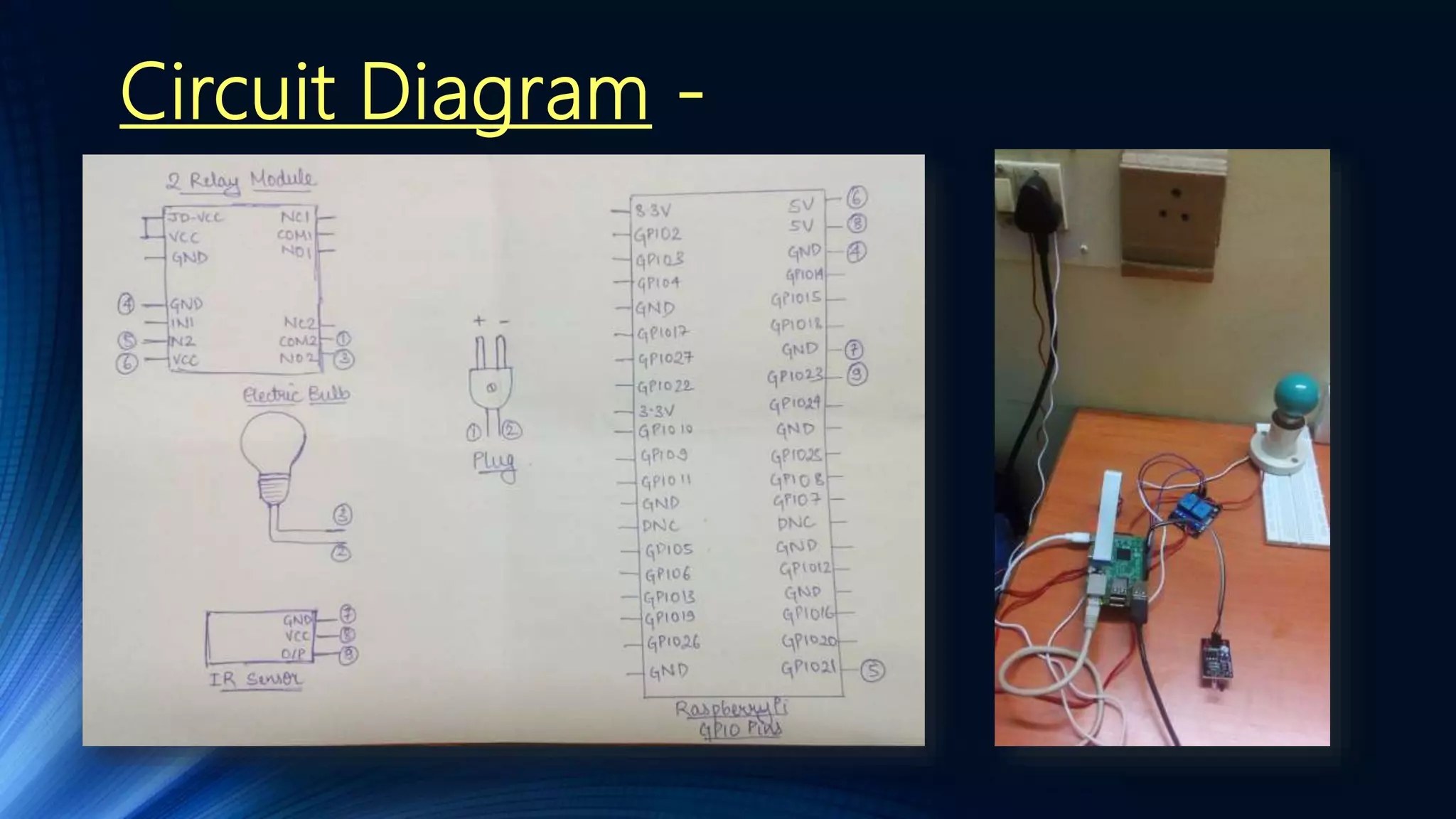
Circuit Diagram -
How it works -
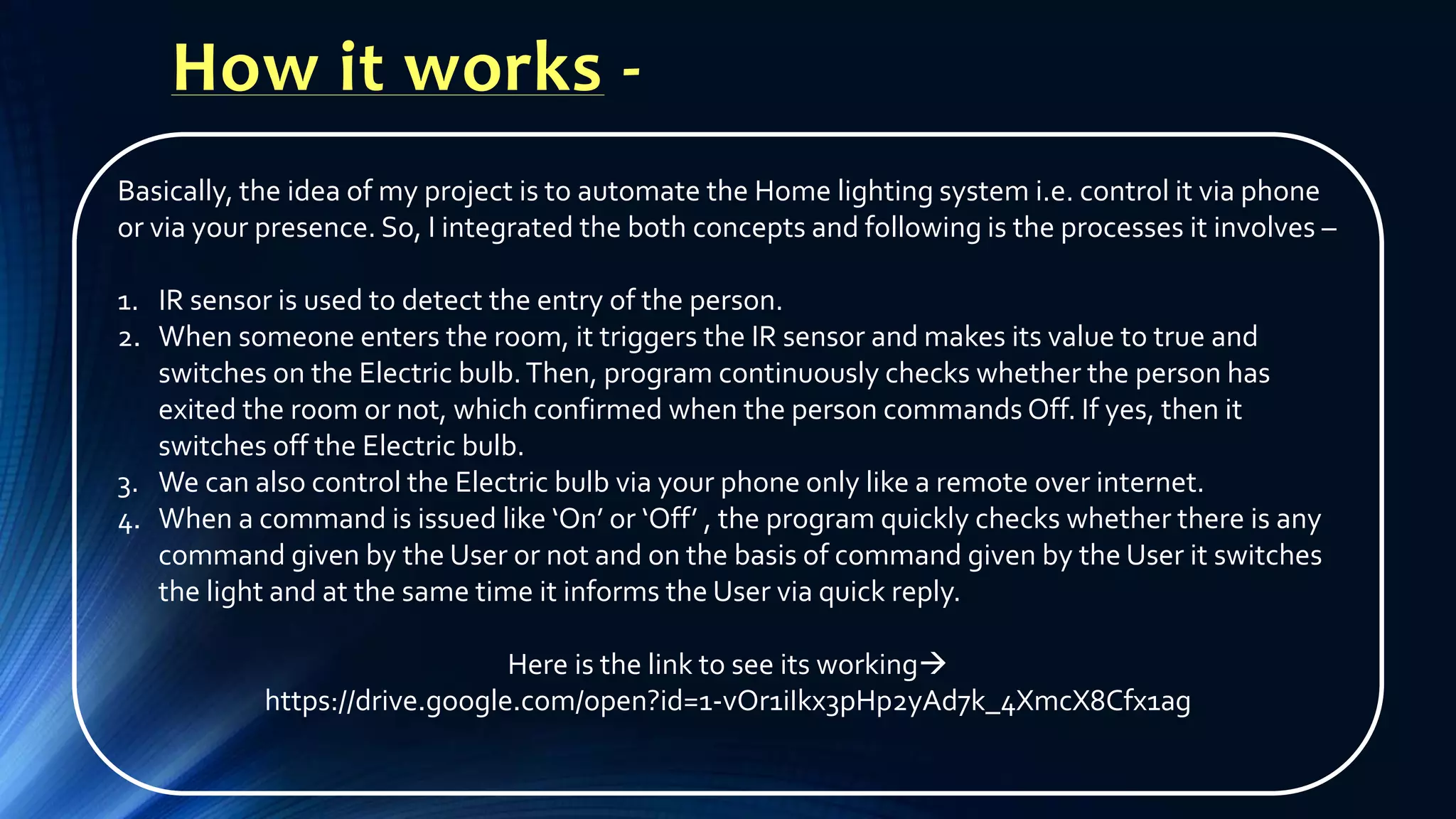
Basically, the idea of my project is to automate the Home lighting system i.e. control it via phone
or via your presence. So, I integrated the both concepts and following is the processes it involves –
1. IR sensor is used to detect the entry of the person.
2. When someone enters the room, it triggers the IR sensor and makes its value to true and
switches on the Electric bulb.Then, program continuously checks whether the person has
exited the room or not, which confirmed when the person commands Off. If yes, then it
switches off the Electric bulb.
3. We can also control the Electric bulb via your phone only like a remote over internet.
4. When a command is issued like ‘On’ or ‘Off’ , the program quickly checks whether there is any
command given by the User or not and on the basis of command given by the User it switches
the light and at the same time it informs the User via quick reply.
Here is the link to see its working
https://drive.google.com/open?id=1-vOr1iIkx3pHp2yAd7k_4XmcX8Cfx1ag
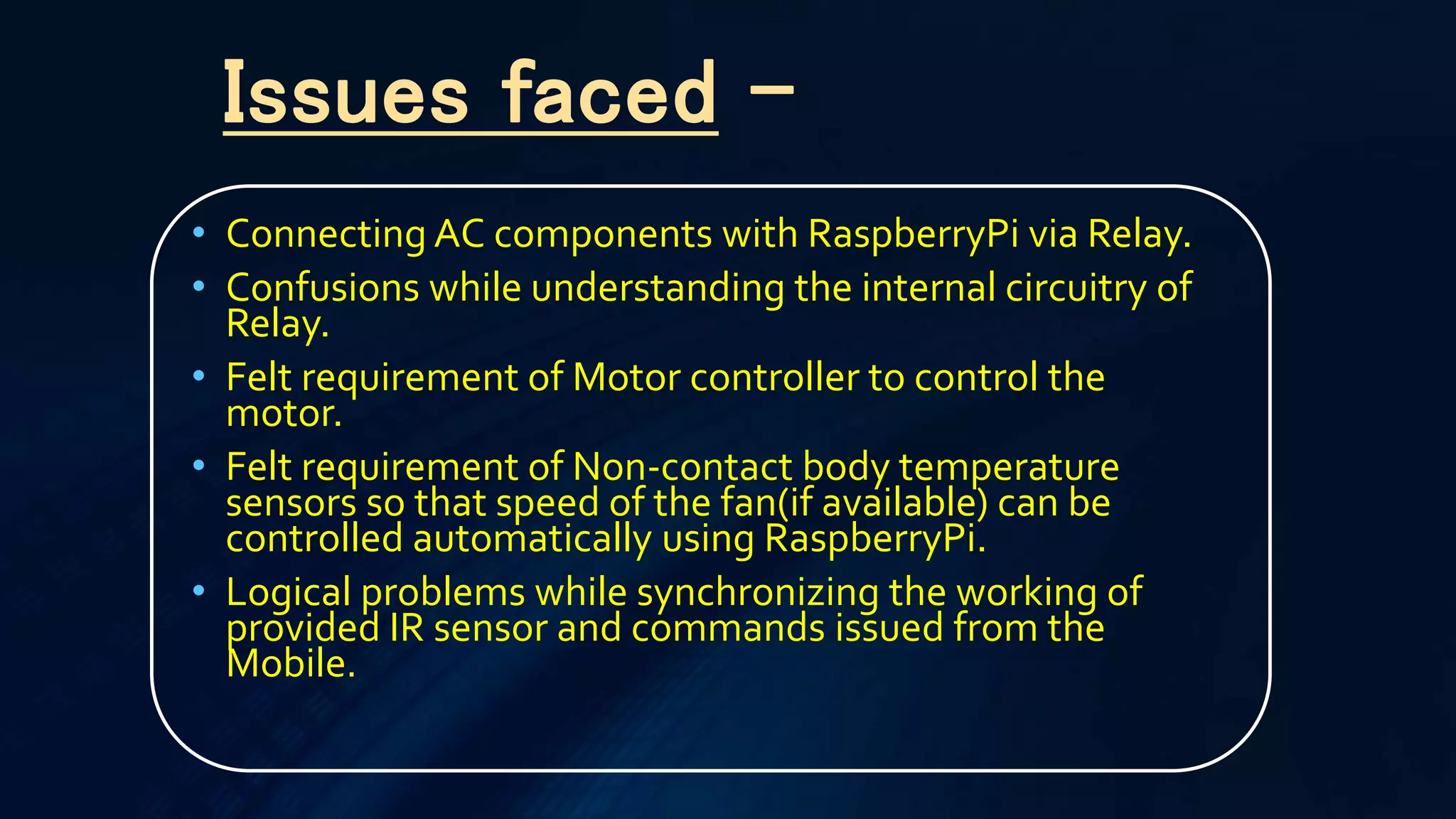
• Connecting AC components with RaspberryPi via Relay.
• Confusions while understanding the internal circuitry of
Relay.
• Felt requirement of Motor controller to control the
motor.
• Felt requirement of Non-contact body temperature
sensors so that speed of the fan(if available) can be
controlled automatically using RaspberryPi.
• Logical problems while synchronizing the working of
provided IR sensor and commands issued from the
Mobile.
Issues faced -
-: Thank You :-

Eckovation IoT internship Report PowerPoint presentation

  • 1.
    Internship Report On HomeAutomation- IoT -:SUBMITTED BY:- MANORANJAN MAHARANA (E C K 2 3 2 9 3 5 8 C @ E CK O VA T I O N . C O M ) Carried Out Under “ Eckovation ”
  • 2.
    Contents 1. What isIoT ?? 2. What is the scope of IoT ?? 3. What is Home Automation ?? 4. Objective 5. Tools worked On 6. Circuit Diagram 7. Steps involved 8. Code 9. Issues faced
  • 3.
    What is IoT?? - Internet of Things (IoT) is an ecosystem of connected physical objects that are accessible through the internet. The ‘thing’ in IoT could be a person with a heart monitor or an automobile with built - in-sensors, i.e. objects that have been assigned an IP address and have the ability to collect and transfer data over a network without manual assistance or intervention. The embedded technology in the objects helps them to interact with internal states or the external environment, which in turn affects the decisions Taken.
  • 4.
    What is thescope of IoT ?? - IoT is a transformational force that can help companies improve performance through IoT analytics and IoT Security to deliver better results. Businesses in the utilities, oil & gas, insurance, manufacturing, transportation, infrastructure and retail sectors can reap the benefits of IoT by making more informed decisions, aided by the torrent of interactional and transactional data at their disposal.
  • 5.
    What is HomeAutomation ?? - Home automation gives you access to control devices in your home from a mobile device anywhere in the world. The term may be used for isolated programmable devices, like thermostats and sprinkler systems, but home automation more accurately describes homes in which nearly everything — lights, appliances, electrical outlets, heating and cooling systems — are hooked up to a remotely controllable network. From a home security perspective, this also includes your alarm system, and all of the doors, windows, locks, smoke detectors, surveillance cameras and any other sensors that are linked to it.
  • 6.
    Objective - WE AREREQUIRED TO AUTOMATE A ROOM’S LIGHTING SYSTEM BY USING THE KNOWLEDGE ACQUIRED DURING THE IOT COURSE.
  • 7.
    Tools Worked On Hardwarecomponents – • RaspberryPi 3B ( with Desbian OS ) • IR Sensor • Relay • Jumper wires • Copper wires • Electric Light Bulb ( 10Watt ) Softwares and Other Services – • Putty • Xming • PushBullet API Code- https://github.com/Manoranjanmaharana1/Home-Automation/blob/master/Home%20Automation.py
  • 8.
  • 9.
    How it works- Basically, the idea of my project is to automate the Home lighting system i.e. control it via phone or via your presence. So, I integrated the both concepts and following is the processes it involves – 1. IR sensor is used to detect the entry of the person. 2. When someone enters the room, it triggers the IR sensor and makes its value to true and switches on the Electric bulb.Then, program continuously checks whether the person has exited the room or not, which confirmed when the person commands Off. If yes, then it switches off the Electric bulb. 3. We can also control the Electric bulb via your phone only like a remote over internet. 4. When a command is issued like ‘On’ or ‘Off’ , the program quickly checks whether there is any command given by the User or not and on the basis of command given by the User it switches the light and at the same time it informs the User via quick reply. Here is the link to see its working https://drive.google.com/open?id=1-vOr1iIkx3pHp2yAd7k_4XmcX8Cfx1ag
  • 10.
    • Connecting ACcomponents with RaspberryPi via Relay. • Confusions while understanding the internal circuitry of Relay. • Felt requirement of Motor controller to control the motor. • Felt requirement of Non-contact body temperature sensors so that speed of the fan(if available) can be controlled automatically using RaspberryPi. • Logical problems while synchronizing the working of provided IR sensor and commands issued from the Mobile. Issues faced -
  • 11.