
WEB BASED REALTIME CONTROL
AND
HOME AUTOMATIONSYSTEM
Presented by:
ATHULRAJR (13442006)
SHAMEEM A S (13442007)
Underthe Guidance of:
Mr. VISHNU P C
Asst . PROFESSOR
Dept. of EEE
1
CONTENTS
2
Hardware details
Software details
Working
Program
Advantages
Scopes
Conclusion
References
Introduction
Problem statement
Objectives
Literature review
Basic block diagram
Internet of things
Hardware requirements
Software requirements
INTRODUCTION..
 With advancement of internet technology lifestyle of every person is changing
drastically
 The home appliances we are using are technically very much improved but the
controlling methods are the same.
 We need to replace the old techniques with new advanced technologies.
 Which helps to save the time ,money and energy of human beings
 Using IOT, we can sense, monitor and control the devices within seconds and get
maximum results.
3
INTRODUCTION
 Electrical loads will be controlled automatically on the basis of
surrounding conditions
 The Domestic Electrical loads can be controlled by using mobile
application or website through internet
 This project is more useful for old people who cannot go to the switch
board and control the loads
 Using the remote control, electricity wastage can be reduced up to
some extent.
 Domestic loads can be controlled with ease.
4
PROBLEM STATEMENT
 While people are pursuing ever-growing high quality of their lives today.
This leads to more and more facilities and home appliances include into
their buildings. How to control and manage these versatile facilities and
appliances in a house?
 Usually conventional wall switches are located in different corners of a
house and, thus necessitate the need of manual operations like pressing to
turn the loads on or off. It becomes very difficult for the elderly or
physically handicapped people to operate them. How to help them?
5
OBJECTIVES
 To develop a user-centric intelligent home automation system which
will sense the surrounding conditions and change the home appliances
outputs.
 To develop a web based remotely controlling system which helps to
controlling and monitoring our home appliances.
6
LITERATURE REVIEW
 In 2015 Subhajith Dey, Sourav Mukherjee and Mili Sarkar of published a
journal in IJEEETC
 Concept of Internet Of Things.
 Home automation and security system
 Web based system with Arduino Uno microcontroller
 Energy conservation and reduction of human effort.
 In 2016 Zaid abdulzahra Jabbar and RS Kawitkar of SCOE,Pune
published a journal in IJARCCE
 Concept of home automation and its needs.
 Smart homes and energy management systems
 Controlling the equipments through gadgets.
7
LITERATURE REVIEW (contd..)
 In 2016 Vinay Sagar K N and Kusuma S M of MSRIT,Bangaluru published a journal in
IRJET
 Home automation using IOT
 Advantages of home automation systems
 Proposed system of automation
 In 2016 Yunus Tjandi and H.Mudassir of TEU state of Makassar published a journal in
IOSR-JEEE
 Monitoring and control of electrical equipments using arduino mega
 Quality and welfare of human life
 Connecting to gadgets via internet
 Use of Ethernet shield
8
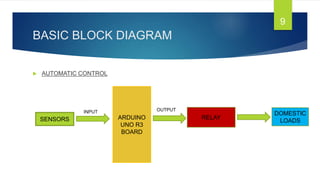
BASIC BLOCK DIAGRAM
 AUTOMATIC CONTROL
9
SENSORS ARDUINO
UNO R3
BOARD
RELAY
DOMESTIC
LOADS
INPUT OUTPUT
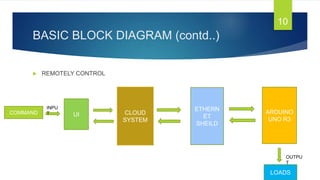
BASIC BLOCK DIAGRAM (contd..)
 REMOTELY CONTROL
10
COMMAND ARDUINO
UNO R3
ETHERN
ET
SHEILD
CLOUD
SYSTEM
UI
LOADS
INPU
T
OUTPU
T
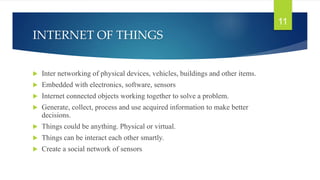
INTERNET OF THINGS
 Inter networking of physical devices, vehicles, buildings and other items.
 Embedded with electronics, software, sensors
 Internet connected objects working together to solve a problem.
 Generate, collect, process and use acquired information to make better
decisions.
 Things could be anything. Physical or virtual.
 Things can be interact each other smartly.
 Create a social network of sensors
11
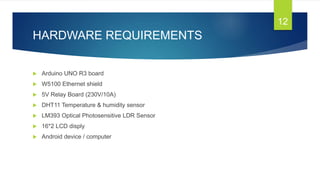
HARDWARE REQUIREMENTS
 Arduino UNO R3 board
 W5100 Ethernet shield
 5V Relay Board (230V/10A)
 DHT11 Temperature & humidity sensor
 LM393 Optical Photosensitive LDR Sensor
 16*2 LCD disply
 Android device / computer
12
SOFTWARE REQUIREMENTS
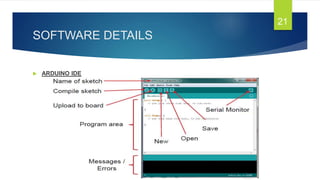
 ARDUINO IDE
 CAYYANE
13
HARDWARE DETAILS
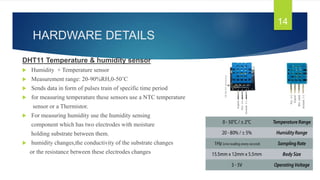
DHT11 Temperature & humidity sensor
 Humidity + Temperature sensor
 Measurement range: 20-90%RH,0-50’C
 Sends data in form of pulses train of specific time period
 for measuring temperature these sensors use a NTC temperature
sensor or a Thermistor.
 For measuring humidity use the humidity sensing
component which has two electrodes with moisture
holding substrate between them.
 humidity changes,the conductivity of the substrate changes
or the resistance between these electrodes changes
14
HARDWARE DETAILS (contd..)
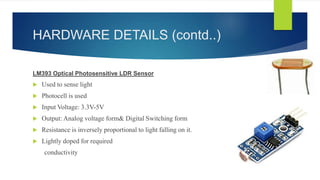
LM393 Optical Photosensitive LDR Sensor
 Used to sense light
 Photocell is used
 Input Voltage: 3.3V-5V
 Output: Analog voltage form& Digital Switching form
 Resistance is inversely proportional to light falling on it.
 Lightly doped for required
conductivity
HARDWARE DETAILS (contd..)
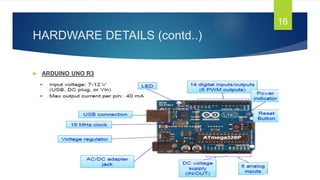
 ARDUINO UNO R3
16
HARDWARE DETAILS (contd..)
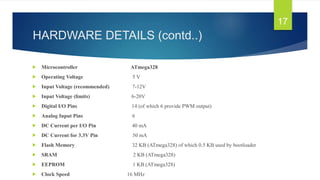
 Microcontroller ATmega328
 Operating Voltage 5 V
 Input Voltage (recommended) 7-12V
 Input Voltage (limits) 6-20V
 Digital I/O Pins 14 (of which 6 provide PWM output)
 Analog Input Pins 6
 DC Current per I/O Pin 40 mA
 DC Current for 3.3V Pin 50 mA
 Flash Memory 32 KB (ATmega328) of which 0.5 KB used by bootloader
 SRAM 2 KB (ATmega328)
 EEPROM 1 KB (ATmega328)
 Clock Speed 16 MHz
17
HARDWARE DETAILS (contd..)
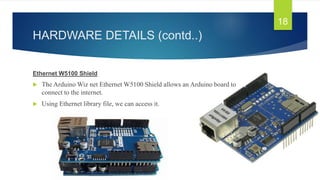
Ethernet W5100 Shield
 The Arduino Wiz net Ethernet W5100 Shield allows an Arduino board to
connect to the internet.
 Using Ethernet library file, we can access it.
18
HARDWARE DETAILS (contd..)
19
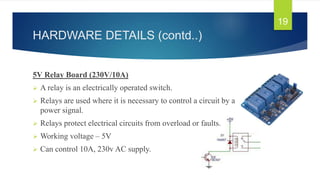
5V Relay Board (230V/10A)
 A relay is an electrically operated switch.
 Relays are used where it is necessary to control a circuit by a low-
power signal.
 Relays protect electrical circuits from overload or faults.
 Working voltage – 5V
 Can control 10A, 230v AC supply.
HARDWARE DETAILS (contd..)
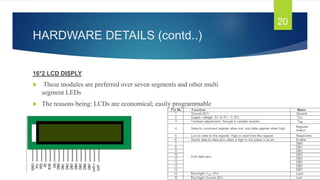
16*2 LCD DISPLY
 These modules are preferred over seven segments and other multi
segment LEDs
 The reasons being: LCDs are economical; easily programmable
20
SOFTWARE DETAILS
 ARDUINO IDE
21
WORKING
Consist of 2 types of controlling
 Automatic controlling.
 Remotely controlling.
22
WORKING (contd.)
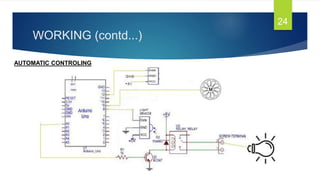
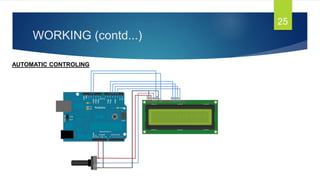
AUTOMATIC CONTROLING
 Sensors sensing data and given to arduino as input.
 Arduino comparing input and programmed values (Ref Values).
 Displaying the real time temperature and humidity & condition of
lamp, fan speed on LCD display connected.
 When light intensity is very low, then turn on the light through
relay.
 Monitoring the temperature and turn on when given value is
exceeding the limit.
23
WORKING (contd...)
24
AUTOMATIC CONTROLING
WORKING (contd...)
25
AUTOMATIC CONTROLING
WORKING (contd..)
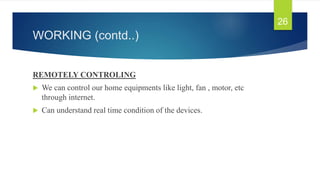
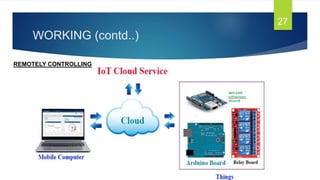
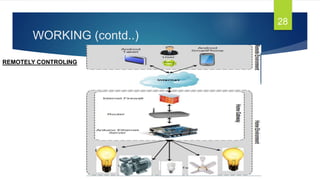
REMOTELY CONTROLING
 We can control our home equipments like light, fan , motor, etc
through internet.
 Can understand real time condition of the devices.
26
WORKING (contd..)
27
REMOTELY CONTROLLING
WORKING (contd..)
28
REMOTELY CONTROLING
WORKING (contd..)
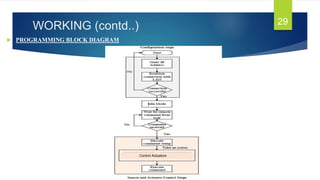
 PROGRAMMING BLOCK DIAGRAM
29
Control Actuators
PROGRAM
S8 EEE.txt
30
Advantages
 Useful for old people.
 Controlling the switching is easy
 Reduces human effort.
 Makes the switching control easy and convenient for Physically Disabled
people
 Saves electricity
31
SCOPES
 This technology can be utilised for industries as well as domestic applications
 For reducing the human efforts.
 To help the people who is physically challenged.
 Improves economy of electrical system.
 All globe access via internet.
 For turning the ordinary homes into smart homes.
 Security and the safety of the premises.
 Password protected system with biometric locking patterns.
 Senses understands and controls how we live our lives.
 Automatically adjust our living environments.
32
CONCLUSION
 In this project a web based real time controlling and home automation system is developed
using open source Arduino technology
 The system is very user friendly. Through this, we can convert home into smart home.
 Automated home control system with online and offline control is developed.
 Low cost home automation system with a compact and easy design.
 Useful for old ageddisabled people .
 The system is very safe and clean and the chances of shock is zero.
 The system will give us a chance to reduce our efforts and will give us the wisdom of
technology.
33
REFERENCES
 Vinay sagar K N,Kusuma S M “ Home Automation Using Internet of Things” International Research Journal of
Engineering and Technology (IRJET) e-ISSN: 2395 -0056 Volume: 02 Issue: 03 | June-2015
 Zaid Abdulzahra Jabbar, R.S. Kawitkar “ Implementation of Smart Home Control by Using Low Cost Arduino &
Android Design” International Journal of Advanced Research in Computer and Communication Engineering Vol.
5, Issue 2, February 2016
 Subhajit Dey, Tamaghna Kundu, Sourav Mukherjee and Mili Sarkar “Web Based Real-Time Home
AutomationAnd Security System” ISSN 2319 – 2518 www.ijeetc.com Vol. 4, No. 3, July 2015
 Yunus Tjandi , H. Muddassir “Monitoring And Device Electrical Control Equipment Based on Arduino Mega”
IOSR Journal of Electrical and Electronics Engineering (IOSR-JEEE) e-ISSN: 2278-1676,p-ISSN: 2320-3331,
Volume 11, Issue 5 Ver. II (Sep - Oct 2016), PP 101-108
 Samir Samanta, Koushik Kr. Khan, Arghya Bhattacharyya, Sounak Das, Atul Barman, Mr. Koushick Mathur
“Home Automation Using Arduino and ESP8266” International Journal of Advanced Engineering, Management
and Science (IJAEMS) [Vol-2, Issue-9, Sept- 2016]
34
Thankyou..
35

WEB BASED REALTIME CONTROL AND HOME AUTOMATION SYSTEM

  • 1.
    WEB BASED REALTIMECONTROL AND HOME AUTOMATIONSYSTEM Presented by: ATHULRAJR (13442006) SHAMEEM A S (13442007) Underthe Guidance of: Mr. VISHNU P C Asst . PROFESSOR Dept. of EEE 1
  • 2.
    CONTENTS 2 Hardware details Software details Working Program Advantages Scopes Conclusion References Introduction Problemstatement Objectives Literature review Basic block diagram Internet of things Hardware requirements Software requirements
  • 3.
    INTRODUCTION..  With advancementof internet technology lifestyle of every person is changing drastically  The home appliances we are using are technically very much improved but the controlling methods are the same.  We need to replace the old techniques with new advanced technologies.  Which helps to save the time ,money and energy of human beings  Using IOT, we can sense, monitor and control the devices within seconds and get maximum results. 3
  • 4.
    INTRODUCTION  Electrical loadswill be controlled automatically on the basis of surrounding conditions  The Domestic Electrical loads can be controlled by using mobile application or website through internet  This project is more useful for old people who cannot go to the switch board and control the loads  Using the remote control, electricity wastage can be reduced up to some extent.  Domestic loads can be controlled with ease. 4
  • 5.
    PROBLEM STATEMENT  Whilepeople are pursuing ever-growing high quality of their lives today. This leads to more and more facilities and home appliances include into their buildings. How to control and manage these versatile facilities and appliances in a house?  Usually conventional wall switches are located in different corners of a house and, thus necessitate the need of manual operations like pressing to turn the loads on or off. It becomes very difficult for the elderly or physically handicapped people to operate them. How to help them? 5
  • 6.
    OBJECTIVES  To developa user-centric intelligent home automation system which will sense the surrounding conditions and change the home appliances outputs.  To develop a web based remotely controlling system which helps to controlling and monitoring our home appliances. 6
  • 7.
    LITERATURE REVIEW  In2015 Subhajith Dey, Sourav Mukherjee and Mili Sarkar of published a journal in IJEEETC  Concept of Internet Of Things.  Home automation and security system  Web based system with Arduino Uno microcontroller  Energy conservation and reduction of human effort.  In 2016 Zaid abdulzahra Jabbar and RS Kawitkar of SCOE,Pune published a journal in IJARCCE  Concept of home automation and its needs.  Smart homes and energy management systems  Controlling the equipments through gadgets. 7
  • 8.
    LITERATURE REVIEW (contd..) In 2016 Vinay Sagar K N and Kusuma S M of MSRIT,Bangaluru published a journal in IRJET  Home automation using IOT  Advantages of home automation systems  Proposed system of automation  In 2016 Yunus Tjandi and H.Mudassir of TEU state of Makassar published a journal in IOSR-JEEE  Monitoring and control of electrical equipments using arduino mega  Quality and welfare of human life  Connecting to gadgets via internet  Use of Ethernet shield 8
  • 9.
    BASIC BLOCK DIAGRAM AUTOMATIC CONTROL 9 SENSORS ARDUINO UNO R3 BOARD RELAY DOMESTIC LOADS INPUT OUTPUT
  • 10.
    BASIC BLOCK DIAGRAM(contd..)  REMOTELY CONTROL 10 COMMAND ARDUINO UNO R3 ETHERN ET SHEILD CLOUD SYSTEM UI LOADS INPU T OUTPU T
  • 11.
    INTERNET OF THINGS Inter networking of physical devices, vehicles, buildings and other items.  Embedded with electronics, software, sensors  Internet connected objects working together to solve a problem.  Generate, collect, process and use acquired information to make better decisions.  Things could be anything. Physical or virtual.  Things can be interact each other smartly.  Create a social network of sensors 11
  • 12.
    HARDWARE REQUIREMENTS  ArduinoUNO R3 board  W5100 Ethernet shield  5V Relay Board (230V/10A)  DHT11 Temperature & humidity sensor  LM393 Optical Photosensitive LDR Sensor  16*2 LCD disply  Android device / computer 12
  • 13.
  • 14.
    HARDWARE DETAILS DHT11 Temperature& humidity sensor  Humidity + Temperature sensor  Measurement range: 20-90%RH,0-50’C  Sends data in form of pulses train of specific time period  for measuring temperature these sensors use a NTC temperature sensor or a Thermistor.  For measuring humidity use the humidity sensing component which has two electrodes with moisture holding substrate between them.  humidity changes,the conductivity of the substrate changes or the resistance between these electrodes changes 14
  • 15.
    HARDWARE DETAILS (contd..) LM393Optical Photosensitive LDR Sensor  Used to sense light  Photocell is used  Input Voltage: 3.3V-5V  Output: Analog voltage form& Digital Switching form  Resistance is inversely proportional to light falling on it.  Lightly doped for required conductivity
  • 16.
  • 17.
    HARDWARE DETAILS (contd..) Microcontroller ATmega328  Operating Voltage 5 V  Input Voltage (recommended) 7-12V  Input Voltage (limits) 6-20V  Digital I/O Pins 14 (of which 6 provide PWM output)  Analog Input Pins 6  DC Current per I/O Pin 40 mA  DC Current for 3.3V Pin 50 mA  Flash Memory 32 KB (ATmega328) of which 0.5 KB used by bootloader  SRAM 2 KB (ATmega328)  EEPROM 1 KB (ATmega328)  Clock Speed 16 MHz 17
  • 18.
    HARDWARE DETAILS (contd..) EthernetW5100 Shield  The Arduino Wiz net Ethernet W5100 Shield allows an Arduino board to connect to the internet.  Using Ethernet library file, we can access it. 18
  • 19.
    HARDWARE DETAILS (contd..) 19 5VRelay Board (230V/10A)  A relay is an electrically operated switch.  Relays are used where it is necessary to control a circuit by a low- power signal.  Relays protect electrical circuits from overload or faults.  Working voltage – 5V  Can control 10A, 230v AC supply.
  • 20.
    HARDWARE DETAILS (contd..) 16*2LCD DISPLY  These modules are preferred over seven segments and other multi segment LEDs  The reasons being: LCDs are economical; easily programmable 20
  • 21.
  • 22.
    WORKING Consist of 2types of controlling  Automatic controlling.  Remotely controlling. 22
  • 23.
    WORKING (contd.) AUTOMATIC CONTROLING Sensors sensing data and given to arduino as input.  Arduino comparing input and programmed values (Ref Values).  Displaying the real time temperature and humidity & condition of lamp, fan speed on LCD display connected.  When light intensity is very low, then turn on the light through relay.  Monitoring the temperature and turn on when given value is exceeding the limit. 23
  • 24.
  • 25.
  • 26.
    WORKING (contd..) REMOTELY CONTROLING We can control our home equipments like light, fan , motor, etc through internet.  Can understand real time condition of the devices. 26
  • 27.
  • 28.
  • 29.
    WORKING (contd..)  PROGRAMMINGBLOCK DIAGRAM 29 Control Actuators
  • 30.
  • 31.
    Advantages  Useful forold people.  Controlling the switching is easy  Reduces human effort.  Makes the switching control easy and convenient for Physically Disabled people  Saves electricity 31
  • 32.
    SCOPES  This technologycan be utilised for industries as well as domestic applications  For reducing the human efforts.  To help the people who is physically challenged.  Improves economy of electrical system.  All globe access via internet.  For turning the ordinary homes into smart homes.  Security and the safety of the premises.  Password protected system with biometric locking patterns.  Senses understands and controls how we live our lives.  Automatically adjust our living environments. 32
  • 33.
    CONCLUSION  In thisproject a web based real time controlling and home automation system is developed using open source Arduino technology  The system is very user friendly. Through this, we can convert home into smart home.  Automated home control system with online and offline control is developed.  Low cost home automation system with a compact and easy design.  Useful for old ageddisabled people .  The system is very safe and clean and the chances of shock is zero.  The system will give us a chance to reduce our efforts and will give us the wisdom of technology. 33
  • 34.
    REFERENCES  Vinay sagarK N,Kusuma S M “ Home Automation Using Internet of Things” International Research Journal of Engineering and Technology (IRJET) e-ISSN: 2395 -0056 Volume: 02 Issue: 03 | June-2015  Zaid Abdulzahra Jabbar, R.S. Kawitkar “ Implementation of Smart Home Control by Using Low Cost Arduino & Android Design” International Journal of Advanced Research in Computer and Communication Engineering Vol. 5, Issue 2, February 2016  Subhajit Dey, Tamaghna Kundu, Sourav Mukherjee and Mili Sarkar “Web Based Real-Time Home AutomationAnd Security System” ISSN 2319 – 2518 www.ijeetc.com Vol. 4, No. 3, July 2015  Yunus Tjandi , H. Muddassir “Monitoring And Device Electrical Control Equipment Based on Arduino Mega” IOSR Journal of Electrical and Electronics Engineering (IOSR-JEEE) e-ISSN: 2278-1676,p-ISSN: 2320-3331, Volume 11, Issue 5 Ver. II (Sep - Oct 2016), PP 101-108  Samir Samanta, Koushik Kr. Khan, Arghya Bhattacharyya, Sounak Das, Atul Barman, Mr. Koushick Mathur “Home Automation Using Arduino and ESP8266” International Journal of Advanced Engineering, Management and Science (IJAEMS) [Vol-2, Issue-9, Sept- 2016] 34
  • 35.