TEACHING WITH
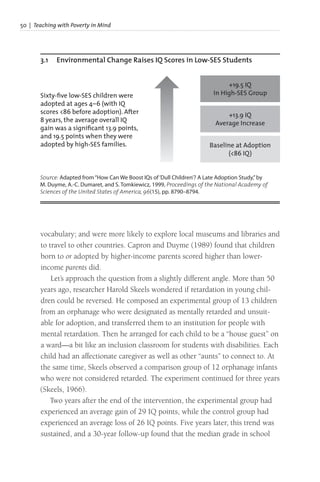
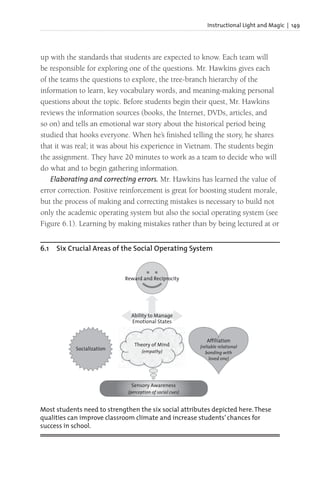
IN MIND
ERIC JENSEN
What Being Poor
Does to Kids’ Brains and
What Schools Can Do About It
ASCD cares about Planet Earth.
This book has been printed on environmentally friendly paper.
ERIC JENSEN
What Being Poor
Does to Kids’ Brains and
What Schools Can Do About It
TEACHING WITH
IN MIND
Alexandria, Virginia
1703 N. Beauregard St. • Alexandria, VA 22311 1714 USA
Phone: 800-933-2723 or 703-578-9600 • Fax: 703-575-5400
Web site: www.ascd.org • E-mail: member@ascd.org
Author guidelines: www.ascd.org/write
Gene R. Carter, Executive Director; Nancy Modrak, Publisher; Scott Willis, Director, Book Acquisitions
& Development; Julie Houtz, Director, Book Editing & Production; Miriam Goldstein, Editor;
Sima Jaafar, Senior Graphic Designer; Mike Kalyan, Production Manager; Cynthia Stock, Typesetter;
Sarah Plumb, Production Specialist
© 2009 by ASCD. All rights reserved. No part of this publication may be reproduced or transmit-
ted in any form or by any means, electronic or mechanical, including photocopy, recording, or
any information storage and retrieval system, without permission from ASCD. Readers who wish
to duplicate material copyrighted by ASCD may do so for a small fee by contacting the Copyright
Clearance Center (CCC), 222 Rosewood Dr., Danvers, MA 01923, USA (phone: 978-750-8400; fax:
978-646-8600; Web: www.copyright.com). For requests to reprint rather than photocopy, contact
ASCD’s permissions office: 703-575-5749 or permissions@ascd.org. Translation inquiries: transla-
tions@ascd.org.
Printed in the United States of America. Cover art © 2009 by ASCD. ASCD publications present
a variety of viewpoints. The views expressed or implied in this book should not be interpreted as
official positions of the Association.
All Web links in this book are correct as of the publication date below but may have become inac-
tive or otherwise modified since that time. If you notice a deactivated or changed link, please e-mail
books@ascd.org with the words “Link Update” in the subject line. In your message, please specify
the Web link, the book title, and the page number on which the link appears.
PAPERBACK ISBN: 978-1-4166-0884-4 ASCD product #109074 n11/09
Also available as an e-book (see Books in Print for the ISBNs).
Quantity discounts for the paperback edition only: 10–49 copies, 10%; 50+ copies, 15%; for 1,000
or more copies, call 800-933-2723, ext. 5634, or 703-575-5634. For desk copies: member@ascd.org.
Library of Congress Cataloging-in-Publication Data
Jensen, Eric, 1950–
Teaching with poverty in mind : what being poor does to kids’ brains and what
schools can do about it / Eric Jensen.
p. cm.
Includes bibliographical references and index.
ISBN 978-1-4166-0884-4 (pbk. : alk. paper)
1. Poor children—Education—United States. 2. Poverty—United States.
3. Educational equalization—United States. I. Title.
LC4091.J46 2009
371.826'9420973—dc22
2009028621
____________________________________________________________________
20 19 18 17 16 15 14 13 12 11 10 09 1 2 3 4 5 6 7 8 9 10 11 12
Introduction ....................................................................................................................... 1
1 Understanding the Nature of Poverty.................................................................5
2 How Poverty Affects Behavior and Academic Performance........................ 13
3 Embracing the Mind-Set of Change..................................................................46
4 Schoolwide Success Factors.................................................................................66
5 Classroom-Level Success Factors......................................................................106
6 Instructional Light and Magic............................................................................143
References........................................................................................................................ 153
Index...................................................................................................................................171
About the Author...........................................................................................................184
Teaching with Poverty in Mind
1
Introduction
I grew up in a typical middle-class home. Although the world of the wealthy
was appealing to me, what interested me more was the world of the poor.
“Why?” was the primary question I grappled with over the years. I was sim-
ply unable to fathom why the poor could (or would) not lift themselves out
of poverty. I believed that if “those people” simply tried harder or had “better
values,” they would be able to succeed.
Today, I realize that this attitude was terribly small-minded and preju-
diced. But I had to discover that on my own. Extensive education and travel
opened my eyes and transformed my soul. Today, I know much more about
what goes on in economically disadvantaged families.
This evolution in my thinking is not what drove me to write this book.
Instead, I was inspired by this stunningly simple question: “If life experi-
ences can change poor kids for the worse, can’t life experiences also change
them for the better?” Seeing and hearing how kids from desperate home
circumstances succeeded in schools around the world intrigued me. More
than two decades ago, I cofounded an academic enrichment program called
SuperCamp that has changed tens of thousands of lives worldwide, so I
know change can and does happen. My own success and that of others
inspired me to find out how it happens—and how it can be replicated.
This book focuses on the relationship between academic achievement
and low socioeconomic status (SES). In it, I make the following three claims:
2 | Teaching with Poverty in Mind
• Chronic exposure to poverty causes the brain to physically change in a
detrimental manner.
• Because the brain is designed to adapt from experience, it can also
change for the better. In other words, poor children can experience emo-
tional, social, and academic success.
• Although many factors affect academic success, certain key ones are
especially effective in turning around students raised in poverty.
In this book, I discuss these key factors, highlight real schools that possess
these factors, and provide a template for success with specific research-
based action steps. If a strategy makes the difference between learning and
not learning, it’s crucial. Here, I share such knockout factors as well as the
research behind them.
About that research. Researchers often claim, “This is what works.” But
for whom? Low-income, middle-income, or upper-income kids? Was the
study conducted over a few weeks, or did the researchers record longitudi-
nal data for 10 years after graduation? What does the phrase highly effective
teachers mean? Did these teachers’ students earn high scores on standardized
tests? Or did they enjoy overall success in life? Is the recommended strategy
sufficient in itself for success? Is it necessary for success? If so, is it necessary
for all students? Too many sources fail to elucidate these factors and boil
down the research to clear strategies that busy educators can apply directly
in their practice. That’s a gap that this book aims to fill. Here, I focus on the
few things that matter most; take any one of these factors out, and you’re
likely to fail.
Why is there such a stark disparity in academic achievement between
low-SES and well-off students? Theories explaining why economically
disadvantaged students underperform in school abound: their parents do
not have high IQs, their home environment is substandard, their parents are
missing or have moved, or they just don’t care. Yet these assumptions just
perpetuate the problem. A proportion of kids raised in poverty do succeed,
so we know that a high income level is not a necessary and sufficient condi-
tion for academic success. It’s true that many poor students have not suc-
ceeded, but that’s due less to parents than to certain school-site variables that
may surprise you.
Introduction | 3
This book offers a three-pronged approach. First, it provides a better
understanding of what poverty is and how it affects the students you work
with. You’ll learn more about the social, cognitive, health-related, and stress-
related challenges that economically disadvantaged kids face every day.
Second, it demonstrates what actually drives change, both at the macro level
(within a school) and at the micro level (inside a student’s brain). You’ll learn
about turnaround schools as well as schools that have a history of high per-
formance among students raised in poverty. The better you understand how
to bring about change, the better you can engage the resources necessary to
make it happen. Finally, this book addresses you and your school. What can
you learn from those who have succeeded? What practices are replicable?
Which instructional strategies will help you make miracles happen?
In this book, I aim to provide more than a framework. I give you the
theory, the research, and the strategies to ensure success at your school.
What I do not aim to provide is an exhaustive compendium of every idea
on reform, every instructional strategy, and every consultant’s opinion on
cultural differences. This book assumes you already know that leadership
counts, that a healthy environment is crucial, that you should use effective
pedagogy, that school safety is number one, and so on. Here you’ll learn
about what will give you an edge. Think of this book as a spotlight focus-
ing attention on what matters most. I hope that the strategies offered in this
book, distilled from my own experience and research, will provide an inspir-
ing and practical guide for improving the lives of your own students.
5
Chris Hawkins teaches history in a high-poverty secondary school. He’s
been teaching for 14 years and believes he’s a good teacher. But he gets
frustrated in his classes and hits a wall of despair at least once a week. His
complaints about his students are common among many who teach eco-
nomically disadvantaged students: chronic tardiness, lack of motivation,
and inappropriate behavior. Mr. Hawkins complains that his students act
out, use profanity, and disrespect others. “It’s like going to war every day,”
he says. The recurring thought that goes through his mind is “Retirement is
only six years away.”
How would you feel if your son or daughter were a student in Mr.
Hawkins’s class? Only two short generations ago, policymakers, school lead-
ers, and teachers commonly thought of children raised in poverty with sym-
pathy but without an understanding of how profoundly their chances for
success were diminished by their situation. Today, we have a broad research
base that clearly outlines the ramifications of living in poverty as well as evi-
dence of schools that do succeed with economically disadvantaged students.
We can safely say that we have no excuse to let any child fail. Poverty calls
for key information and smarter strategies, not resignation and despair.
What Is Poverty?
The word poverty provokes strong emotions and many questions. In the
United States, the official poverty thresholds are set by the Office of Man-
agement and Budget (OMB). Persons with income less than that deemed
1
Understanding the Nature of Poverty
6 | Teaching with Poverty in Mind
sufficient to purchase basic needs—food, shelter, clothing, and other
essentials—are designated as poor. In reality, the cost of living varies dra-
matically based on geography; for example, people classified as poor in San
Francisco might not feel as poor if they lived in Clay County, Kentucky. I
define poverty as a chronic and debilitating condition that results from multiple
adverse synergistic risk factors and affects the mind, body, and soul. However you
define it, poverty is complex; it does not mean the same thing for all people.
For the purposes of this book, we can identify six types of poverty: situ-
ational, generational, absolute, relative, urban, and rural.
• Situational poverty is generally caused by a sudden crisis or loss and
is often temporary. Events causing situational poverty include environ-
mental disasters, divorce, or severe health problems.
• Generational poverty occurs in families where at least two generations
have been born into poverty. Families living in this type of poverty are not
equipped with the tools to move out of their situations.
• Absolute poverty, which is rare in the United States, involves a scarcity
of such necessities as shelter, running water, and food. Families who live
in absolute poverty tend to focus on day-to-day survival.
• Relative poverty refers to the economic status of a family whose
income is insufficient to meet its society’s average standard of living.
• Urban poverty occurs in metropolitan areas with populations of at
least 50,000 people. The urban poor deal with a complex aggregate of
chronic and acute stressors (including crowding, violence, and noise) and
are dependent on often-inadequate large-city services.
• Rural poverty occurs in nonmetropolitan areas with populations
below 50,000. In rural areas, there are more single-guardian households,
and families often have less access to services, support for disabilities, and
quality education opportunities. Programs to encourage transition from
welfare to work are problematic in remote rural areas, where job opportu-
nities are few (Whitener, Gibbs, & Kusmin, 2003). The rural poverty rate
is growing and has exceeded the urban rate every year since data collec-
tion began in the 1960s. The difference between the two poverty rates
has averaged about 5 percent for the last 30 years, with urban rates near
10–15 percent and rural rates near 15–20 percent (Jolliffe, 2004).
Understanding the Nature of Poverty | 7
The Effects of Poverty
Poverty involves a complex array of risk factors that adversely affect the
population in a multitude of ways. The four primary risk factors afflicting
families living in poverty are
• Emotional and social challenges.
• Acute and chronic stressors.
• Cognitive lags.
• Health and safety issues.
Graber and Brooks-Gunn (1995) estimated that in 1995, 35 percent of
poor families experienced six or more risk factors (such as divorce, sickness,
or eviction); only 2 percent experienced no risk factors. In contrast, only
5 percent of well-off families experienced six or more risk factors, and 19
percent experienced none.
The aggregate of risk factors makes everyday living a struggle; they are
multifaceted and interwoven, building on and playing off one another with a
devastatingly synergistic effect (Atzaba-Poria, Pike, & Deater-Deckard, 2004).
In other words, one problem created by poverty begets another, which in
turn contributes to another, leading to a seemingly endless cascade of del-
eterious consequences. A head injury, for example, is a potentially dire event
for a child living in poverty. With limited access to adequate medical care,
the child may experience cognitive or emotional damage, mental illness, or
depression, possibly attended with denial or shame that further prevents the
child from getting necessary help; impairments in vision or hearing that go
untested, undiagnosed, and untreated; or undiagnosed behavior disorders,
such as AD/HD or oppositional personality disorder.
It’s safe to say that poverty and its attendant risk factors are damaging to
the physical, socioemotional, and cognitive well-being of children and their
families (Klebanov & Brooks-Gunn, 2006; Sapolsky, 2005). Data from the
Infant Health and Development Program show that 40 percent of children
living in chronic poverty had deficiencies in at least two areas of function-
ing (such as language and emotional responsiveness) at age 3 (Bradley et
al., 1994). The following two sections examine how inferior provisions both
at home and at school place poor children at risk for low academic perfor-
mance and failure to complete school.
8 | Teaching with Poverty in Mind
Poverty at Home
Compared with well-off children, poor children are disproportionately
exposed to adverse social and physical environments. Low-income neighbor-
hoods are likely to have lower-quality social, municipal, and local services.
Because of greater traffic volume, higher crime rates, and less playground
safety—to name but a few factors—poor neighborhoods are more hazard-
ous and less likely to contain green space than well-off neighborhoods are.
Poor children often breathe contaminated air and drink impure water. Their
households are more crowded, noisy, and physically deteriorated, and they
contain a greater number of safety hazards (National Commission on Teach-
ing and America’s Future [NCTAF], 2004).
Although childhood is generally considered to be a time of joyful, care-
free exploration, children living in poverty tend to spend less time find-
ing out about the world around them and more time struggling to survive
within it. Poor children have fewer and less-supportive networks than their
more affluent counterparts do; live in neighborhoods that are lower in
social capital; and, as adolescents, are more likely to rely on peers than on
adults for social and emotional support. Low-SES children also have fewer
cognitive-enrichment opportunities. They have fewer books at home, visit
the library less often, and spend considerably more time watching TV than
their middle-income counterparts do (Kumanyika & Grier, 2006).
Often, poor children live in chaotic, unstable households. They are more
likely to come from single-guardian homes, and their parents or caregivers
tend to be less emotionally responsive (Blair et al., 2008; Evans, Gonnella,
Marcynyszyn, Gentile, & Salpekar, 2005). Single parenthood strains resources
and correlates directly with poor school attendance, lower grades, and lower
chances of attending college (Xi & Lal, 2006). Contrast these children with
their peers living in stable two-parent families, who have more access to
financial resources and parental time, receive more supervision, participate in
more extracurricular activities, and do better in school (Evans, 2004).
Young children are especially vulnerable to the negative effects of change,
disruption, and uncertainty. Developing children need reliable caregivers who
offer high predictability, or their brains will typically develop adverse adaptive
responses. Chronic socioeconomic deprivation can create environments that
undermine the development of self and the capacity for self-determination
Understanding the Nature of Poverty | 9
and self-efficacy. Compared with their more affluent peers, low-SES children
form more stress-ridden attachments with parents, teachers, and adult care-
givers and have difficulty establishing rewarding friendships with children
their own age. They are more likely than well-off children to believe that their
parents are uninterested in their activities, to receive less positive reinforce-
ment from teachers and less homework help from babysitters, and to experi-
ence more turbulent or unhealthy friendships (Evans & English, 2002).
Common issues in low-income families include depression, chemical
dependence, and hectic work schedules—all factors that interfere with the
healthy attachments that foster children’s self-esteem, sense of mastery of
their environment, and optimistic attitudes. Instead, poor children often feel
isolated and unloved, feelings that kick off a downward spiral of unhappy
life events, including poor academic performance, behavioral problems,
dropping out of school, and drug abuse. These events tend to rule out col-
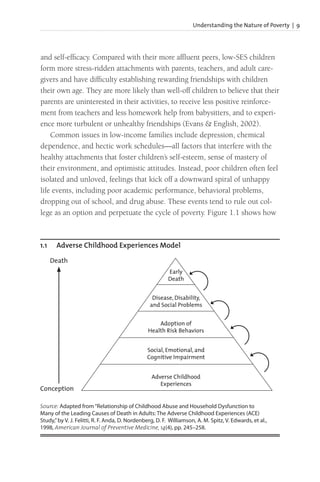
lege as an option and perpetuate the cycle of poverty. Figure 1.1 shows how
1.1 Adverse Childhood Experiences Model
Source: Adapted from“Relationship of Childhood Abuse and Household Dysfunction to
Many of the Leading Causes of Death in Adults: The Adverse Childhood Experiences (ACE)
Study,”by V. J. Felitti, R. F. Anda, D. Nordenberg, D. F. Williamson, A. M. Spitz, V. Edwards, et al.,
1998, American Journal of Preventive Medicine, 14(4), pp. 245–258.
Early
Death
Disease, Disability,
and Social Problems
Adoption of
Health Risk Behaviors
Social, Emotional, and
Cognitive Impairment
Adverse Childhood
Experiences
Death
Conception
10 | Teaching with Poverty in Mind
adverse childhood experiences can set off an avalanche of negative life expe-
riences, including social, emotional, and cognitive impairment; adoption of
risky behaviors; disease, disability, and social problems; and, in the worst
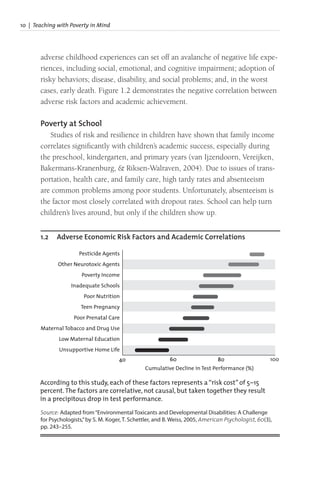
cases, early death. Figure 1.2 demonstrates the negative correlation between
adverse risk factors and academic achievement.
Poverty at School
Studies of risk and resilience in children have shown that family income
correlates significantly with children’s academic success, especially during
the preschool, kindergarten, and primary years (van Ijzendoorn, Vereijken,
Bakermans-Kranenburg, & Riksen-Walraven, 2004). Due to issues of trans-
portation, health care, and family care, high tardy rates and absenteeism
are common problems among poor students. Unfortunately, absenteeism is
the factor most closely correlated with dropout rates. School can help turn
children’s lives around, but only if the children show up.
1.2 Adverse Economic Risk Factors and Academic Correlations
Source: Adapted from“Environmental Toxicants and Developmental Disabilities: A Challenge
for Psychologists,”by S. M. Koger, T. Schettler, and B. Weiss, 2005, American Psychologist, 60(3),
pp. 243–255.
Pesticide Agents
Other Neurotoxic Agents
Poverty Income
Inadequate Schools
Poor Nutrition
Teen Pregnancy
Poor Prenatal Care
Maternal Tobacco and Drug Use
Low Maternal Education
Unsupportive Home Life
Cumulative Decline in Test Performance (%)
40 60 80 100
According to this study, each of these factors represents a“risk cost” of 5–15
percent.The factors are correlative, not causal, but taken together they result
in a precipitous drop in test performance.
Understanding the Nature of Poverty | 11
Attendance problems often indicate negative parent attitudes toward
school. Parents who did poorly in school themselves may have a negative
attitude about their children’s schools (Freiberg, 1993) and, in an effort
to protect them, may even discourage their children from participating
(Morrison-Gutman & McLoyd, 2000). These parents are often unwilling to
get involved in school functions or activities, to contact the school about
academic concerns, or to attend parent-teacher conferences (Morrison-
Gutman & McLoyd, 2000). Poor children are also more likely than well-
off children are to attend poorly maintained schools with less-qualified
teachers, and their day-care facilities—if available at all—are less adequate
(NCTAF
, 2004).
In addition, in many cases, low-achieving high school students report
a sense of alienation from their schools. Believing that no one cares or that
their teachers don’t like them or talk down to them, students will often give
up on academics (Mouton & Hawkins, 1996). Kids raised in poverty are
more likely to lack—and need—a caring, dependable adult in their lives,
and often it’s teachers to whom children look for that support.
Action Steps
Deepen staff understanding. It’s crucial for educators to keep in mind
the many factors, some of them invisible, that play a role in students’ class-
room actions. Many nonminority or middle-class teachers cannot under-
stand why children from poor backgrounds act the way they do at school.
Teachers don’t need to come from their students’ cultures to be able to teach
them, but empathy and cultural knowledge are essential. Therefore, an
introduction to how students are affected by poverty is highly useful.
Consider summarizing information from this chapter or other sources
and sharing it with staff. Hold discussions at staff meetings that inform and
inspire. Form study groups to explore the brain-based physiological effects
of chronic poverty. Debunk the myths among staff members who grew up in
middle-class or upper-middle-class households. For example, some teachers
perceive certain behaviors typical of low-SES children as “acting out,” when
often the behavior is a symptom of the effects of poverty and indicates a con-
dition such as a chronic stress disorder. Such disorders alter students’ brains
(Ford, Farah, Shera, & Hurt, 2007) and often lead to greater impulsivity and
12 | Teaching with Poverty in Mind
poor short-term memory. In the classroom, this translates into blurting, act-
ing before asking permission, and forgetting what to do next.
Change the school culture from pity to empathy. When staff members
work with children raised in poverty, a common observation is “Bless their
hearts, they come from such terrible circumstances.” The problem with that
sentiment is that it leads to lowered expectations. Encourage teachers to feel
empathy rather than pity; kids will appreciate your ability to know what it’s
like to be in their shoes. Establish a school culture of caring, not of giving
up. You can help foster such a culture by speaking respectfully, not conde-
scendingly, of and to your student population, and by using positive affirma-
tions, both vocally and through displays and posters.
Embracing a New Mission
Beyond its effects on individual children, poverty affects families, schools,
and communities (Bradley & Corwyn, 2002). And the problem promises
to get worse. Children of immigrants make up 22 percent of the total child
poverty cases in the United States (Rector, 2005), and immigration rates
continue to increase. Because of the massive influx of immigrants entering
the United States every year, the ensuing competition for low-wage jobs,
and the statistical link between low-wage earners and increased childbear-
ing (Schultz, 2005), the number of U.S. children in low-income situations is
forecast to rise over the next few decades.
We need to address this rising problem, and soon. The timing and dura-
tion of poverty matter. Children who experience poverty during their pre-
school and early school years experience lower rates of school completion
than children and adolescents who experience poverty only in later years.
In addition, for those who live below the poverty line for multiple years
and receive minimal support or interventions, each year of life “carries over”
problems from the prior year. Ultimately, these translate to earlier mortality
rates (Felitti et al., 1998).
But there is hope. I present research findings in the next few chapters that
suggest that early childhood interventions can be quite potent in reducing
poverty’s impact. Schools around the world are succeeding with poor stu-
dents, and yours can, too. We must end the cycle of blame and resignation
and embrace a new mission to help all our students fulfill their potential.
13
In Chapter 1, we were introduced to history teacher Chris Hawkins. The
family Mr. Hawkins grew up in was far from poor: his father was a colonel
in the U.S. Air Force, and his mother was a store manager. He had no clue
what growing up in poverty was like, and he was shocked to learn about
what typically goes on (and doesn’t go on) in the homes of his kids. He has
learned that there’s far more behind the apathetic or aggressive behaviors,
commonly attributed to a lack of politeness or dismissed as “lower-class”
issues, than he had assumed. What he’s learned about his students has
depressed and discouraged him. The mantra that gets him through the year
is the thought that retirement is only six years away.
The Risk Factors of Poverty
There is no shortage of theories explaining behavior differences among
children. The prevailing theory among psychologists and child development
specialists is that behavior stems from a combination of genes and environ-
ment. Genes begin the process: behavioral geneticists commonly claim that
DNA accounts for 30–50 percent of our behaviors (Saudino, 2005), an
estimate that leaves 50–70 percent explained by environment.
This tidy division of influencing factors may be somewhat misleading, how-
ever. First, the effects of the nine months a child spends in utero are far from
negligible, especially on IQ (Devlin, Daniels, & Roeder, 1997). Factors such as
quality of prenatal care, exposure to toxins, and stress have a strong influence
on the developing child. In addition, the relatively new field of epigenetics—the
2
How Poverty Affects Behavior
and Academic Performance
14 | Teaching with Poverty in Mind
study of heritable changes in gene function that occur without a change in
primary DNA sequence—blurs the line between nature and nurture. Environ-
ment affects the receptors on our cells, which send messages to genes, which
turn various functional switches on or off. It’s like this: like light switches,
genes can be turned on or off. When they’re switched on, they send signals that
can affect the processes or structures in individual cells. For example, lifting
weights tells the genes to “turn on” the signal to build muscle tissue. Genes can
be either activated or shut off by a host of other environmental factors, such as
stress and nutrition. These switches can either strengthen or impair aggression,
immune function, learning, and memory (Rutter, Moffitt, & Caspi, 2006).
Recent evidence (Harris, 2006) suggests that the complex web of social
relationships students experience—with peers, adults in the school, and
family members—exerts a much greater influence on their behavior than
researchers had previously assumed. This process starts with students’
core relationships with parents or primary caregivers in their lives, which
form a personality that is either secure and attached or insecure and unat-
tached. Securely attached children typically behave better in school (Blair
et al., 2008). Once students are in school, the dual factors of socialization
and social status contribute significantly to behavior. The school socializa-
tion process typically pressures students to be like their peers or risk social
rejection, whereas the quest for high social status drives students to attempt
to differentiate themselves in some areas—sports, personal style, sense of
humor, or street skills, for example.
Socioeconomic status forms a huge part of this equation. Children raised
in poverty rarely choose to behave differently, but they are faced daily with
overwhelming challenges that affluent children never have to confront, and
their brains have adapted to suboptimal conditions in ways that undermine
good school performance. Let’s revisit the most significant risk factors affect-
ing children raised in poverty, which I discussed in Chapter 1 (the word
EACH is a handy mnemonic):
• Emotional and Social Challenges.
• Acute and Chronic Stressors.
• Cognitive Lags.
• Health and Safety Issues.
How Poverty Affects Behavior and Academic Performance | 15
Combined, these factors present an extraordinary challenge to academic
and social success. This reality does not mean that success in school or life
is impossible. On the contrary, a better understanding of these challenges
points to actions educators can take to help their less-advantaged students
succeed.
Emotional and Social Challenges
Many low-SES children face emotional and social instability. Typically, the
weak or anxious attachments formed by infants in poverty become the
basis for full-blown insecurity during the early childhood years. Very young
children require healthy learning and exploration for optimal brain devel-
opment. Unfortunately, in impoverished families there tends to be a higher
prevalence of such adverse factors as teen motherhood, depression, and
inadequate health care, all of which lead to decreased sensitivity toward the
infant (van Ijzendoorn et al., 2004) and, later, poor school performance and
behavior on the child’s part.
Theory and Research
Beginning at birth, the attachment formed between parent and child
predicts the quality of future relationships with teachers and peers (Szewczyk-
Sokolowski, Bost, & Wainwright, 2005) and plays a leading role in the
development of such social functions as curiosity, arousal, emotional regula-
tion, independence, and social competence (Sroufe, 2005). The brains of
infants are hardwired for only six emotions: joy, anger, surprise, disgust,
sadness, and fear (Ekman, 2003). To grow up emotionally healthy, children
under 3 need
• A strong, reliable primary caregiver who provides consistent and
unconditional love, guidance, and support.
• Safe, predictable, stable environments.
• Ten to 20 hours each week of harmonious, reciprocal interactions.
This process, known as attunement, is most crucial during the first 6–24
months of infants’ lives and helps them develop a wider range of healthy
emotions, including gratitude, forgiveness, and empathy.
• Enrichment through personalized, increasingly complex activities.
16 | Teaching with Poverty in Mind
Children raised in poverty are much less likely to have these crucial needs
met than their more affluent peers are and, as a result, are subject to some
grave consequences. Deficits in these areas inhibit the production of new
brain cells, alter the path of maturation, and rework the healthy neural
circuitry in children’s brains, thereby undermining emotional and social
development and predisposing them to emotional dysfunction (Gunnar,
Frenn, Wewerka, & Van Ryzin, 2009; Miller, Seifer, Stroud, Sheinkopf, &
Dickstein, 2006).
The need for human contact and warmth is well established. A study of
infants in Irish foundling homes in the early 1900s found that of the 10,272
infants admitted to homes with minimal or absent maternal nurturing over a
25-year period, only 45 survived. Most of the survivors grew into pathologi-
cally unstable and socially problem-ridden adults (Joseph, 1999).
In many poor households, parental education is substandard, time is
short, and warm emotions are at a premium—all factors that put the attune-
ment process at risk (Feldman & Eidelman, 2009; Kearney, 1997; Segawa,
2008). Caregivers tend to be overworked, overstressed, and authoritarian
with children, using the same harsh disciplinary strategies used by their own
parents. They often lack warmth and sensitivity (Evans, 2004) and fail to
form solid, healthy relationships with their children (Ahnert, Pinquart, &
Lamb, 2006).
In addition, low-income caregivers are typically half as likely as higher-
income parents are to be able to track down where their children are in the
neighborhood (Evans, 2004), and frequently they do not know the names
of their children’s teachers or friends. One study found that only 36 percent
of low-income parents were involved in three or more school activities on
a regular basis, compared with 59 percent of parents above the poverty line
(U.S. Department of Health and Human Services, 2000).
Low-SES children are often left home to fend for themselves and their
younger siblings while their caregivers work long hours; compared with
their well-off peers, they spend less time playing outdoors and more time
watching television and are less likely to participate in after-school activities
(U.S. Census Bureau, 2000). Unfortunately, children won’t get the model for
how to develop proper emotions or respond appropriately to others from
watching cartoons; they need warm, person-to-person interactions. The
How Poverty Affects Behavior and Academic Performance | 17
failure to form positive relationships with peers inflicts long-term socio-
emotional consequences (Szewczyk-Sokolowski et al., 2005).
The human brain “downloads” the environment indiscriminately in an
attempt to understand and absorb the surrounding world, whether that
world is positive or negative. When children gain a sense of mastery of
their environments, they are more likely to develop feelings of self-worth,
confidence, and independence, which play heavily into the formation of
children’s personalities (Sroufe, 2005) and ultimately predict their success
and happiness in relationships and in life in general. Economic hardship
makes it more difficult for caregivers to create the trusting environments that
build children’s secure attachments. Behavior research shows that children
from impoverished homes develop psychiatric disturbances and maladap-
tive social functioning at a greater rate than their affluent counterparts do
(McCoy, Firck, Loney, & Ellis, 1999). In addition, low-SES children are more
likely to have social conduct problems, as rated by both teachers and peers
over a period of four years (Dodge, Pettit, & Bates, 1994). Unfortunately, a
study of negative emotionality and maternal support found that low-income
parents were less able than were well-off parents to adjust their parenting
to the demands of higher-needs children (Paulussen-Hoogeboom, Stams,
Hermanns, & Peetsma, 2007).
Low-income parents are often overwhelmed by diminished self-esteem,
depression, and a sense of powerlessness and inability to cope—feelings that
may get passed along to their children in the form of insufficient nurtur-
ing, negativity, and a general failure to focus on children’s needs. In a study
of emotional problems of children of single mothers, Keegan-Eamon and
Zuehl (2001) found that the stress of poverty increases depression rates
among mothers, which results in an increased use of physical punishment.
Children themselves are also susceptible to depression: research shows that
poverty is a major predictor of teenage depression (Denny, Clark, Fleming,
& Wall, 2004).
Effects on School Behavior and Performance
Strong, secure relationships help stabilize children’s behavior and provide
the core guidance needed to build lifelong social skills. Children who grow
up with such relationships learn healthy, appropriate emotional responses
18 | Teaching with Poverty in Mind
to everyday situations. But children raised in poor households often fail to
learn these responses, to the detriment of their school performance. For
example, students with emotional dysregulation may get so easily frustrated
that they give up on a task when success was just moments away. And social
dysfunction may inhibit students’ ability to work well in cooperative groups,
quite possibly leading to their exclusion by group members who believe they
aren’t “doing their part” or “pulling their share of the load.” This exclusion
and the accompanying decrease in collaboration and exchange of informa-
tion exacerbate at-risk students’ already shaky academic performance and
behavior.
Some teachers may interpret students’ emotional and social deficits as
a lack of respect or manners, but it is more accurate and helpful to under-
stand that the students come to school with a narrower range of appropriate
emotional responses than we expect. The truth is that many children simply
don’t have the repertoire of necessary responses. It is as though their brains’
“emotional keyboards” play only a few notes (see Figure 2.1).
The proper way to deal with such a deficit is first to understand students’
behavior and then to lay out clear behavioral expectations without sarcasm
2.1 The Emotional Keyboard
• Humility
• Forgiveness
• Empathy
• Optimism
• Compassion
• Sympathy
• Patience
• Shame
• Cooperation
• Gratitude
Taught Taught
Hardwired
• Sadness
• Joy
• Disgust
• Anger
• Surprise
• Fear
The emotional brain can be represented by a keyboard on which children from
poverty use fewer keys than well-off children.The six responses represented by
the darker shading on the keyboard and in the center box are hardwired in our
DNA.The responses represented by the lighter shading must be taught.
How Poverty Affects Behavior and Academic Performance | 19
or resentment. Understand that children raised in poverty are more likely
to display
• “Acting-out” behaviors.
• Impatience and impulsivity.
• Gaps in politeness and social graces.
• A more limited range of behavioral responses.
• Inappropriate emotional responses.
• Less empathy for others’ misfortunes.
These behaviors will likely puzzle, frustrate, or irritate teachers who have
less experience teaching students raised in poverty, but it’s important to
avoid labeling, demeaning, or blaming students. It is much easier to con-
demn a student’s behavior and demand that he or she change it than it is to
help the student change it. Every proper response that you don’t see at your
school is one that you need to be teaching. Rather than telling kids to “be
respectful,” demonstrate appropriate emotional responses and the circum-
stances in which to use them, and allow students to practice applying them.
To shift your own responses to inappropriate behavior, reframe your think-
ing: expect students to be impulsive, to blurt inappropriate language, and to
act “disrespectful” until you teach them stronger social and emotional skills
and until the social conditions at your school make it attractive not to do
those things.
It’s impossible to overemphasize this: every emotional response other
than the six hardwired emotions of joy, anger, surprise, disgust, sadness,
and fear must be taught. Cooperation, patience, embarrassment, empathy,
gratitude, and forgiveness are crucial to a smoothly running complex social
environment (like a classroom). When students lack these learned responses,
teachers who expect humility or penitence may get a smirk instead, a
response that may lead teachers to believe the student has an “attitude.” It’s
the primary caregiver’s job to teach the child when and how to display these
emotional responses, but when students do not bring these necessary behav-
iors to school, the school must teach them.
What all students do bring to school are three strong “relational” forces
that drive their school behaviors (Harris, 2006):
20 | Teaching with Poverty in Mind
1. The drive for reliable relationships. Students want the safety of a
primary safe and reliable relationship. Students would prefer parents,
positive friends, and teachers, but they’d take an “iffy” friend if no one else
were available. The relationships that teachers build with students form
the single strongest access to student goals, socialization, motivation, and
academic performance. For your school to foster high achievement, every
student will need a reliable partner or mentor.
2. The strengthening of peer socialization. Socialization is the drive for ac-
ceptance that encourages students to imitate their peers and join groups, from
clubs to cliques to gangs. Students want to belong somewhere. Evidence suggests
that it is peers, not parents, who have the greatest influence on school-age
students (Harris, 1998). If your school aims to improve student achievement,
academic success must be culturally acceptable among your students.
3. The quest for importance and social status. This is the quest to feel
special. Students compete for attention and social elevation by choosing
roles that will distinguish them (e.g., athlete, comedian, storyteller, gang
leader, scholar, or style maverick). Kids are very interested in what other
kids do, whether others like them, and how they rate on the social scale
(Harris, 2006). Every student will need to feel like the “status hunt” can
just as well lead to better grades as better behaviors.
Each of these forces shapes behaviors in significant ways. Schools that suc-
ceed use a combination of formal and informal strategies to influence these
three domains. Informally, teachers can incorporate classroom strategies that
build relationships and strengthen peer acceptance and social skills in class.
This is a fair warning to all administrators: do not dismiss the so-called “soft
side” of students’ lives, the social side. It runs their brains, their feelings,
and their behaviors—and those three run cognition! There is a complex
interplay between cognition and emotions. When students feel socialized
and accepted, they perform better academically. However, pushing students
harder and harder into performing well academically may conflict with
social/relational success. You will hit a test score ceiling until you include
students’ emotional and social lives in your school “makeover.” Accordingly,
throughout the remainder of this book, I offer specific strategies that address
all three of the relational forces.
How Poverty Affects Behavior and Academic Performance | 21
Action Steps
Embody respect. You can’t change what’s in your students’ bank account,
but you can change what’s in their emotional account. It may require a con-
siderable shift in your thinking. It is fruitless simply to demand respect from
students; many just don’t have the context, background, or skills to show it.
Instead,
• Give respect to students first, even when they seem least to deserve it.
• Share the decision making in class. For example, ask students whether
they would prefer to do a quick review of what they have learned to con-
solidate and strengthen their learning or move on to new material.
• Avoid such directives as “Do this right now!” Instead, maintain expecta-
tions while offering choice and soliciting input (e.g., “Would you rather
do your rough draft now or gather some more ideas first?”).
• Avoid demeaning sarcasm (e.g., “How about you actually do your
assignment quietly for a change?”).
• Model the process of adult thinking. For example, say, “We have to get
this done first because we have only enough time for these three things
today.” Keep your voice calm and avoid labeling actions.
• Discipline through positive relationships, not by exerting power or
authority. Avoid such negative directives as “Don’t be a wise guy!” or “Sit
down immediately!” Instead say, “We’ve got lots to do in class today.
When you’re ready to learn, please have a seat.”
Embed social skills. At every grade level, use a variety of classroom strate-
gies that strengthen social and emotional skills. For example,
• Teach basic but crucial meet-and-greet skills. Early in the year, when
students introduce themselves to other classmates, teach students to face
one another, make eye contact, smile, and shake hands.
• Embed turn-taking skills in class, even at the secondary level. You can
introduce and embed these skills using such strategies as learning stations,
partner work, and cooperative learning.
• Remind students to thank their classmates after completing collabora-
tive activities.
22 | Teaching with Poverty in Mind
• Implement social-emotional skill-building programs in the early years.
Programs like the PATHS program, Conscious Discipline, and Love and
Logic embed social skills into a classroom management framework.
Be inclusive. Create a familial atmosphere by using inclusive and affilia-
tive language. For example,
• Always refer to the school as “our school” and the class as “our class”;
avoid using a me-and-you model that reinforces power structures.
• Acknowledge students who make it to class, and thank them for small
things.
• Celebrate effort as well as achievement; praise students for reaching
milestones as well as for fulfilling end goals. Pack acknowledgments and
celebrations into every single class.
Acute and Chronic Stressors
Stress can be defined as the physiological response to the perception of
loss of control resulting from an adverse situation or person. Occasional or
“roller-coaster” stress is healthy for all of us; it supports our immune func-
tion and helps develop resiliency. However, the acute and chronic stress
that children raised in poverty experience leaves a devastating imprint
on their lives. Acute stress refers to severe stress resulting from exposure
to such trauma as abuse or violence, whereas chronic stress refers to high
stress sustained over time. Low-SES children are more subject to both of
these types of stress than are their more affluent peers, but chronic stress is
more common and exerts a more relentless influence on children’s day-to-
day lives. Children living in poverty experience significantly greater chronic
stress than do their more affluent counterparts (Almeida, Neupert, Banks,
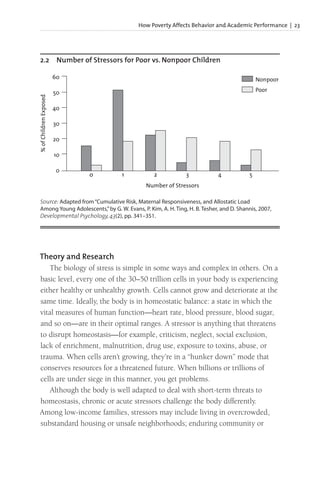
& Serido, 2005) (see Figure 2.2). This kind of stress exerts a devastating,
insidious influence on children’s physical, psychological, emotional, and
cognitive functioning—areas that affect brain development, academic suc-
cess, and social competence. Students subjected to such stress may lack
crucial coping skills and experience significant behavioral and academic
problems in school.
How Poverty Affects Behavior and Academic Performance | 23
Theory and Research
The biology of stress is simple in some ways and complex in others. On a
basic level, every one of the 30–50 trillion cells in your body is experiencing
either healthy or unhealthy growth. Cells cannot grow and deteriorate at the
same time. Ideally, the body is in homeostatic balance: a state in which the
vital measures of human function—heart rate, blood pressure, blood sugar,
and so on—are in their optimal ranges. A stressor is anything that threatens
to disrupt homeostasis—for example, criticism, neglect, social exclusion,
lack of enrichment, malnutrition, drug use, exposure to toxins, abuse, or
trauma. When cells aren’t growing, they’re in a “hunker down” mode that
conserves resources for a threatened future. When billions or trillions of
cells are under siege in this manner, you get problems.
Although the body is well adapted to deal with short-term threats to
homeostasis, chronic or acute stressors challenge the body differently.
Among low-income families, stressors may include living in overcrowded,
substandard housing or unsafe neighborhoods; enduring community or
2.2 Number of Stressors for Poor vs. Nonpoor Children
60
50
40
30
20
10
0
Number of Stressors
0 1 2 3
%
of
Children
Exposed
4 5
Nonpoor
Poor
Source: Adapted from“Cumulative Risk, Maternal Responsiveness, and Allostatic Load
Among Young Adolescents,”by G. W. Evans, P. Kim, A. H. Ting, H. B. Tesher, and D. Shannis, 2007,
Developmental Psychology, 43(2), pp. 341–351.
24 | Teaching with Poverty in Mind
domestic violence, separation or divorce, or the loss of family members;
and experiencing financial strain, forced mobility, or material deprivation
(Evans & English, 2002). The frequency and intensity of both stressful life
events and daily hassles are greater among low-SES children (Attar, Guerra,
& Tolan, 1994). For example, in any given year, more than half of all poor
children deal with evictions, utility disconnections, overcrowding, or lack
of a stove or refrigerator, compared with only 13 percent of well-off chil-
dren (Lichter, 1997). In addition, such factors as lack of proper supervision,
physical neglect or abuse, inadequate day care and schools, difficulties in
forming healthy friendships, and vulnerability to depression combine to
exert inordinate and debilitating stress upon the developing child.
More often than not, low-income parents are overstressed in trying to
meet the daily needs of their families. The resulting depression and negativ-
ity often lead to insufficient nurturing, disengaged parenting, and a diffi-
culty in focusing on the needs of children. Compared with middle-income
children, low-SES children are exposed to higher levels of familial violence,
disruption, and separation (Emery & Laumann-Billings, 1998). Lower levels
of parental education and occupation also correlate with greater incidence of
neighborhood crimes (Sampson, Raudenbush, & Earls, 1997). And com-
pared with their well-off peers, 2- to 4-year-olds from low-income families
interact with aggressive peers 40 percent more often in their neighborhoods
and 25 percent more often in child care settings (Sinclair, Pettit, Harrist,
Dodge, & Bates, 1994).
Abuse is a major stressor to children raised in poverty. Numerous studies
(Gershoff, 2002; Slack, Holl, McDaniel, Yoo, & Bolger, 2004) document that
caregivers’ disciplinary strategies grow harsher as income decreases. Lower-
income parents are, on average, more authoritarian with their children,
tending to issue harsh demands and inflict physical punishment such as
spanking (Bradley, Corwyn, Burchinal, McAdoo, & Coll, 2001; Bradley,
Corwyn, McAdoo, & Coll, 2001). One study found that blue-collar parents
were twice as likely to use physical punishment with their 7-year-olds as
white-collar parents were (Evans, 2004). Hussey, Chang, and Kotch (2006)
found that poor children were 1.52 times more likely to report physical
neglect and 1.83 times more likely to report sexual abuse than were well-
off children. Abuse occurs with much higher frequency when the parents
How Poverty Affects Behavior and Academic Performance | 25
use alcohol or drugs, experience an array of stressful life events (Emery &
Laumann-Billings, 1998), or live in decrepit, crime-ridden neighborhoods
with limited social support networks (Jack & Jordan, 1999).
The cost of these constant stressors is hard to quantify. Exposure to
chronic or acute stress is hardwired into children’s developing brains,
creating a devastating, cumulative effect (Coplan et al., 1996). Com-
pared with a healthy neuron, a stressed neuron generates a weaker signal,
handles less blood flow, processes less oxygen, and extends fewer connec-
tive branches to nearby cells. The prefrontal cortex and the hippocampus,
crucial for learning, cognition, and working memory, are the areas of the
brain most affected by cortisol, the so-called “stress hormone.” Experiments
have demonstrated that exposure to chronic or acute stress actually shrinks
neurons in the brain’s frontal lobes—an area that includes the prefrontal
cortex and is responsible for such functions as making judgments, planning,
and regulating impulsivity (Cook & Wellman, 2004)—and can modify and
impair the hippocampus in ways that reduce learning capacity (Vythilingam
et al., 2002).
Unpredictable stressors severely impair the brain’s capacity to learn and
remember (Yang et al., 2003). Child abuse, for example, is highly disruptive
to such developmental processes as the formation of healthy attachments,
emotional regulation, and temperament formation, and leads to a wide array
of social-emotional and psychological disturbances in adulthood (Emery &
Laumann-Billings, 1998). Neurobiological studies have shown considerable
alterations in the brain development of neglected or abused children. The
production of “fight-or-flight” stress hormones in these children atrophies
the areas that control emotional regulation, empathy, social functioning, and
other skills imperative to healthy emotional development (Joseph, 1999).
Chronic stress not only diminishes the complexity of neurons in the fron-
tal lobe and the hippocampus but also increases the complexity of neurons
in the amygdala, the brain’s emotion center (Conrad, 2006). This increased
complexity may make the stressed brain’s neurons far more sensitive to
memory modulation than neurons in nonstressed brains. In chronically
stressed kids, the combined effects on the hippocampus and the amygdala
may be precisely what facilitates emotional memory (the aspect of memory
that encompasses highly salient memories of events such as divorce, abuse,
26 | Teaching with Poverty in Mind
trauma, death, or abandonment) and reduces declarative memory (the aspect
of memory that stores standard knowledge and learning).
Chronic, unmediated stress often results in a condition known as an
allostatic load. Allostatic load is “carryover” stress. Instead of returning to a
healthy baseline of homeostasis, the growing brain adapts to negative life
experiences so that it becomes either hyper-responsive or hypo-responsive.
Szanton, Gill, and Allen (2005) found higher rates of chronic stress and
allostatic load among low-income populations than among high-income
populations.
Effects on School Behavior and Performance
Kids coming to your school don’t wear signs that say “Caution! Chronic
Stressors Live Here.” But stress has an insidious effect on learning and
behavior, and you should recognize the symptoms in the classroom.
Chronic stress
• Is linked to over 50 percent of all absences (Johnston-Brooks, Lewis,
Evans, & Whalen, 1998).
• Impairs attention and concentration (Erickson, Drevets, & Schulkin,
2003).
• Reduces cognition, creativity, and memory (Lupien, King, Meaney, &
McEwen, 2001).
• Diminishes social skills and social judgment (Wommack & Delville,
2004).
• Reduces motivation, determination, and effort (Johnson, 1981).
• Increases the likelihood of depression (Hammack, Robinson, Crawford,
& Li, 2004).
• Reduces neurogenesis (growth of new brain cells) (De Bellis et al., 2001).
A child who comes from a stressful home environment tends to chan-
nel that stress into disruptive behavior at school and be less able to develop
a healthy social and academic life (Bradley & Corwyn, 2002). Impulsivity,
for example, is a common disruptive classroom behavior among low-SES
students. But it’s actually an exaggerated response to stress that serves as a
survival mechanism: in conditions of poverty, those most likely to survive
are those who have an exaggerated stress response. Each risk factor in a
How Poverty Affects Behavior and Academic Performance | 27
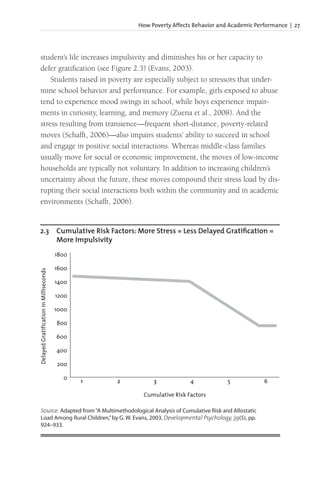
student’s life increases impulsivity and diminishes his or her capacity to
defer gratification (see Figure 2.3) (Evans, 2003).
Students raised in poverty are especially subject to stressors that under-
mine school behavior and performance. For example, girls exposed to abuse
tend to experience mood swings in school, while boys experience impair-
ments in curiosity, learning, and memory (Zuena et al., 2008). And the
stress resulting from transience—frequent short-distance, poverty-related
moves (Schafft, 2006)—also impairs students’ ability to succeed in school
and engage in positive social interactions. Whereas middle-class families
usually move for social or economic improvement, the moves of low-income
households are typically not voluntary. In addition to increasing children’s
uncertainty about the future, these moves compound their stress load by dis-
rupting their social interactions both within the community and in academic
environments (Schafft, 2006).
2.3 Cumulative Risk Factors: More Stress = Less Delayed Gratification =
More Impulsivity
1800
1600
1400
1200
1000
800
600
400
200
0
Cumulative Risk Factors
1 2 3 4
Delayed
Gratification
in
Milliseconds
5 6
Source: Adapted from“A Multimethodological Analysis of Cumulative Risk and Allostatic
Load Among Rural Children,”by G. W. Evans, 2003, Developmental Psychology, 39(5), pp.
924–933.
28 | Teaching with Poverty in Mind
Students who have to worry over safety concerns also tend to underper-
form academically (Pratt, Tallis, & Eysenck, 1997). Exposure to community
violence—an unsafe home neighborhood or a dangerous path to school—
contributes to lower academic performance (Schwartz & Gorman, 2003).
In addition, stress resulting from bullying and school violence impairs test
scores, diminishes attention spans, and increases absenteeism and tardiness
(Hoffman, 1996). It is discouraging, but many high school students either
stay home or skip classes due to fear of violence.
Socioeconomic status correlates positively with good parenting, which,
research has found, improves academic achievement (DeGarmo, Forgatch, &
Martinez, 1999). Unfortunately, the converse is also true: the chronic stress
of poverty impairs parenting skills, and disengaged or negative parenting in
turn impairs children’s school performance. Parents who are struggling just
to stay afloat tend to work extra hours, odd shifts, or multiple jobs and are
less able to provide attention and affection and to devote their time, energy,
and resources to their children. These deficits have been associated with
higher levels of externalizing behaviors and poor academic performance on
children’s part (Hsuch & Yoshikawa, 2007).
Fishbein and colleagues (2006) found that adolescence, a period accom-
panied by dramatic brain changes, is a particularly vulnerable time for chil-
dren to be exposed to chronic stress. They found that risky decision making
(such as alcohol or drug use) and poor social competency correlated with
adolescents’ previous exposure to highly stressful life events.
In addition, stress adversely affects cognition. One randomized, double-
blind, placebo-controlled study tested the effects of oral doses of cortisol (the
stress chemical) on subjects (Newcomer et al., 1999). Cortisol treatment at
the higher dose produced reversible decreases in verbal declarative memory
in otherwise healthy individuals (Newcomer et al., 1999).
Exposure to chronic or acute stress is debilitating. The most common adap-
tive behaviors include increased anxiety (as manifested in generalized anxiety
disorders or posttraumatic stress disorder) and an increased sense of detach-
ment and helplessness. Students from low-income families who experience
disruptive or traumatic events or who lack a measure of connectedness—to
family, to the community, or to a religious affiliation—demonstrate increased
hopelessness over time (Bolland, Lian, & Formichella, 2005). Nearly half
How Poverty Affects Behavior and Academic Performance | 29
(47 percent) of low-SES African American adolescents reported clinically
significant levels of depressive symptoms (Hammack et al., 2004). Low-SES
students are more likely to give up or become passive and uninterested in
school (Johnson, 1981). This giving-up process is known as learned helpless-
ness. It’s not genetic; it’s an adaptive response to life conditions. And sadly, it
frequently takes hold as early as 1st grade. Many kids with learned helpless-
ness become fatalistic about their lives and are more likely to drop out of
school or become pregnant while in their teens.
It is well documented that the effect of stressors is cumulative (Astone,
Misra, & Lynch, 2007; Evans, 2004; Evans & English, 2002; Evans, Kim,
Ting, Tesher, & Shannis, 2007; Geronimus, Hicken, Keene, & Bound, 2006;
Lucey, 2007). Children who have had greater exposure to abuse, neglect,
danger, loss, or other poverty-related experiences are more reactive to
stressors. Each stressor builds on and exacerbates other stressors and slowly
changes the student. It is the cumulative effect of all the stressors that often
makes life miserable for poor students.
When researchers provided classes in appropriate coping skills and stress-
relieving techniques, subjects demonstrated a decrease in hostility (Wad-
sworth, Raviv, Compas, & Connor-Smith, 2005) or depressive symptoms
(Peden, Rayens, Hall, & Grant, 2005). Unfortunately, these interventions,
along with stress-relieving recreational activities, are largely unavailable to
those living in poverty. For example, neighborhood parks and recreational
facilities tend to be scarcer, in hazardous areas, or in disrepair (Evans, 2004).
Poor children are half as likely as well-off children are to be taken to muse-
ums, theaters, or the library, and they are less likely to go on vacations or on
other fun or culturally enriching outings (Bradley & Corwyn, 2002).
Action Steps
Recognize the signs. Behavior that comes off as apathetic or rude may
actually indicate feelings of hopelessness or despair. It is crucial for teachers
to recognize the signs of chronic stress in students. Students who are at risk
for a stress-related disorder tend to
• Believe that they have minimal control over stressors.
• Have no idea how long the stressors will last, or how intense they will
remain.
30 | Teaching with Poverty in Mind
• Have few outlets through which they can release the frustration caused
by the stressors.
• Interpret stressors as evidence of circumstances worsening or becoming
more hopeless.
• Lack social support for the duress caused by the stressors.
Share with other staff members why it’s so important to avoid criticiz-
ing student impulsivity and “me first” behaviors. Whenever you and your
colleagues witness a behavior you consider inappropriate, ask yourselves
whether the discipline process is positive and therefore increases the chances
for better future behavior, or whether it’s punitive and therefore reduces the
chances for better future behavior.
Alter the environment. Change the school environment to mitigate stress
and resolve potential compliance issues with students who do not want to
change:
• Reduce the parallels with prison. For example, consider eliminating
bells and instead playing songs for class transitions.
• Reduce homework stress by incorporating time for homework in class
or right after class.
• Use cooperative structures; avoid a top-down authoritarian approach.
• Help students blow off steam by incorporating celebrations, role-plays,
and physical activities (e.g., walks, relays, or games) into your classes.
• Incorporate kinesthetic arts (e.g., drama or charades), creative proj-
ects (e.g., drawing or playing instruments), and hands-on activities (e.g.,
building or fixing) into your classes.
Empower students. Help students increase their perception of control
over their environment by showing them how to better manage their own
stress levels. Instead of telling students to act differently, take the time to
teach them how to act differently by
• Introducing conflict resolution skills. For example, teach students a
multistep process for handling upsets, starting with step 1: “Take a deep
breath and count to five.”
• Teaching students how to deal with anger and frustration (e.g., count-
ing to 10 and taking slow, deep breaths).
How Poverty Affects Behavior and Academic Performance | 31
• Introducing responsibilities and the value of giving restitution. In
schools that embrace restitution, students understand that if they disrupt
class, they need to “make it right” by doing something positive for the
class. For example, a student who throws objects in the classroom may be
assigned a cleaning or beautification project for the room.
• Teaching students to set goals to focus on what they want.
• Role-modeling how to solve real-world problems. Share an actual or
hypothetical situation, such as your car running out of gas. You could
explain that you tried to stretch the tank of gas too far and reveal how
you dealt with the problem (e.g., calling a friend to bring some gas). Such
examples show students how to take responsibility for and resolve the
challenges they face in life.
• Giving students a weekly life problem to solve collectively.
• Teaching social skills. For example, before each social interaction (e.g.,
pair-share or buddy teaching), ask students to make eye contact, shake
hands, and give a greeting. At the end of each interaction, have students
thank their partners.
• Introducing stress reduction techniques, both physical (e.g., dance or
yoga) and mental (e.g., guided periods of relaxation or meditation).
Cognitive Lags
Cognitive ability is highly complex. It can be measured in many different
ways and is affected by numerous factors, not least of which is socioeco-
nomic status. Socioeconomic status is strongly associated with a number of
indices of children’s cognitive ability, including IQ, achievement tests, grade
retention rates, and literacy (Baydar, Brooks-Gunn, & Furstenberg, 1993;
Brooks-Gunn, Guo, & Furstenberg, 1993; Liaw & Brooks-Gunn, 1994;
Smith, Brooks-Gunn, & Klebanov, 1997). There is a gulf between poor
and well-off children’s performance on just about every measure of cogni-
tive development, from the Bayley Infant Behavior Scales to standardized
achievement tests. The correlations between socioeconomic status and
cognitive ability and performance are typically quite significant (Gottfried,
Gottfried, Bathurst, Guerin, & Parramore, 2003) and persist throughout
the stages of development, from infancy through adolescence and into
32 | Teaching with Poverty in Mind
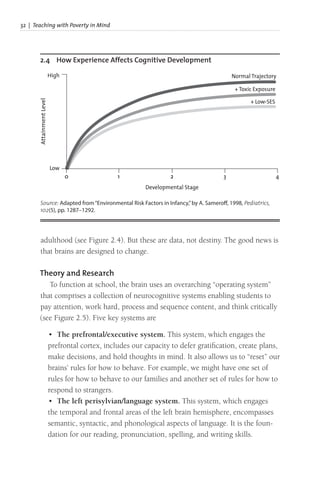
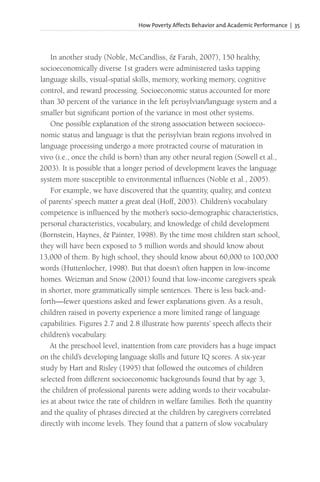
adulthood (see Figure 2.4). But these are data, not destiny. The good news is
that brains are designed to change.
Theory and Research
To function at school, the brain uses an overarching “operating system”
that comprises a collection of neurocognitive systems enabling students to
pay attention, work hard, process and sequence content, and think critically
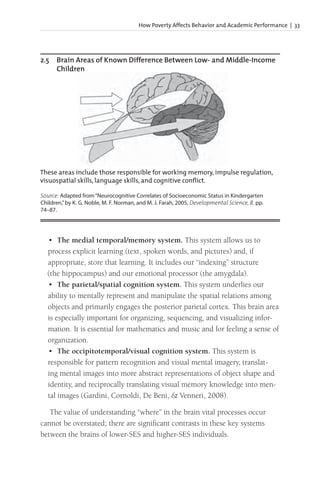
(see Figure 2.5). Five key systems are
• The prefrontal/executive system. This system, which engages the
prefrontal cortex, includes our capacity to defer gratification, create plans,
make decisions, and hold thoughts in mind. It also allows us to “reset” our
brains’ rules for how to behave. For example, we might have one set of
rules for how to behave to our families and another set of rules for how to
respond to strangers.
• The left perisylvian/language system. This system, which engages
the temporal and frontal areas of the left brain hemisphere, encompasses
semantic, syntactic, and phonological aspects of language. It is the foun-
dation for our reading, pronunciation, spelling, and writing skills.
2.4 How Experience Affects Cognitive Development
High
Low
Developmental Stage
0 1 2 3
Attainment
Level
4
Normal Trajectory
+ Low-SES
+ Toxic Exposure
Source: Adapted from“Environmental Risk Factors in Infancy,”by A. Sameroff, 1998, Pediatrics,
102(5), pp. 1287–1292.
How Poverty Affects Behavior and Academic Performance | 33
• The medial temporal/memory system. This system allows us to
process explicit learning (text, spoken words, and pictures) and, if
appropriate, store that learning. It includes our “indexing” structure
(the hippocampus) and our emotional processor (the amygdala).
• The parietal/spatial cognition system. This system underlies our
ability to mentally represent and manipulate the spatial relations among
objects and primarily engages the posterior parietal cortex. This brain area
is especially important for organizing, sequencing, and visualizing infor-
mation. It is essential for mathematics and music and for feeling a sense of
organization.
• The occipitotemporal/visual cognition system. This system is
responsible for pattern recognition and visual mental imagery, translat-
ing mental images into more abstract representations of object shape and
identity, and reciprocally translating visual memory knowledge into men-
tal images (Gardini, Cornoldi, De Beni, & Venneri, 2008).
The value of understanding “where” in the brain vital processes occur
cannot be overstated; there are significant contrasts in these key systems
between the brains of lower-SES and higher-SES individuals.
2.5 Brain Areas of Known Difference Between Low- and Middle-Income
Children
Source: Adapted from“Neurocognitive Correlates of Socioeconomic Status in Kindergarten
Children,”by K. G. Noble, M. F. Norman, and M. J. Farah, 2005, Developmental Science, 8, pp.
74–87.
These areas include those responsible for working memory, impulse regulation,
visuospatial skills, language skills, and cognitive conflict.
34 | Teaching with Poverty in Mind
With the advent of cognitive neuroscience, it has become possible to
assess these systems more selectively. One study (Noble, Norman, & Farah,
2005) examined the neurocognitive performance of 30 low-SES and 30
well-off African American kindergartners in the Philadelphia public schools.
The children were tested on a battery of tasks adapted from the cognitive
neuroscience literature, designed to assess the functioning of the aforemen-
tioned key neurocognitive systems. This was one of the first studies that
showed both global and specific brain differences between lower-income
and higher-income children. Another study (Farah et al., 2006) assessed
middle schoolers’ working memory and cognitive control and also found
significant disparities between lower-income and higher-income students in
the five neurocognitive areas. I’m often asked, “Has anyone actually scanned
the brains of low-SES children and contrasted them with those of higher-SES
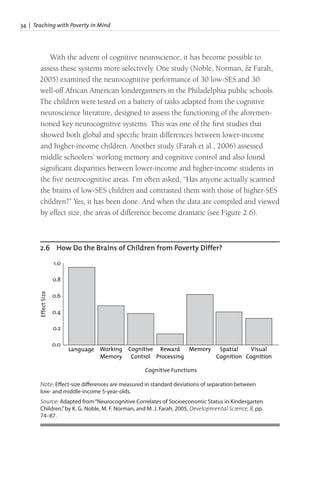
children?” Yes, it has been done. And when the data are compiled and viewed
by effect size, the areas of difference become dramatic (see Figure 2.6).
2.6 How Do the Brains of Children from Poverty Differ?
Note: Effect-size differences are measured in standard deviations of separation between
low- and middle-income 5-year-olds.
Source: Adapted from“Neurocognitive Correlates of Socioeconomic Status in Kindergarten
Children,”by K. G. Noble, M. F. Norman, and M. J. Farah, 2005, Developmental Science, 8, pp.
74–87.
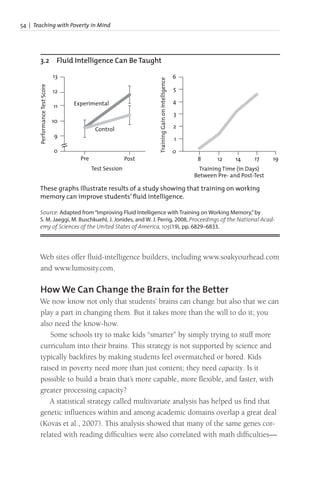
1.0
0.8
0.6
0.4
0.2
0.0
Cognitive Functions
Language
Effect
Size
Working
Memory
Cognitive
Control
Reward
Processing
Memory Spatial
Cognition
Visual
Cognition
How Poverty Affects Behavior and Academic Performance | 35
In another study (Noble, McCandliss, & Farah, 2007), 150 healthy,
socioeconomically diverse 1st graders were administered tasks tapping
language skills, visual-spatial skills, memory, working memory, cognitive
control, and reward processing. Socioeconomic status accounted for more
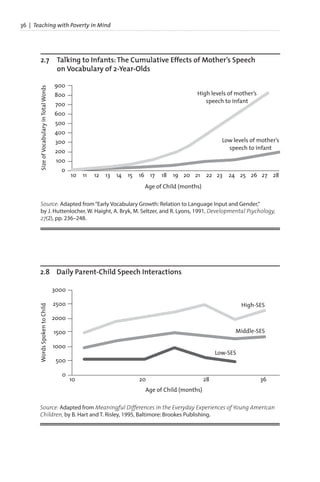
than 30 percent of the variance in the left perisylvian/language system and a
smaller but significant portion of the variance in most other systems.
One possible explanation of the strong association between socioeco-
nomic status and language is that the perisylvian brain regions involved in
language processing undergo a more protracted course of maturation in
vivo (i.e., once the child is born) than any other neural region (Sowell et al.,
2003). It is possible that a longer period of development leaves the language
system more susceptible to environmental influences (Noble et al., 2005).
For example, we have discovered that the quantity, quality, and context
of parents’ speech matter a great deal (Hoff, 2003). Children’s vocabulary
competence is influenced by the mother’s socio-demographic characteristics,
personal characteristics, vocabulary, and knowledge of child development
(Bornstein, Haynes, & Painter, 1998). By the time most children start school,
they will have been exposed to 5 million words and should know about
13,000 of them. By high school, they should know about 60,000 to 100,000
words (Huttenlocher, 1998). But that doesn’t often happen in low-income
homes. Weizman and Snow (2001) found that low-income caregivers speak
in shorter, more grammatically simple sentences. There is less back-and-
forth—fewer questions asked and fewer explanations given. As a result,
children raised in poverty experience a more limited range of language
capabilities. Figures 2.7 and 2.8 illustrate how parents’ speech affects their
children’s vocabulary.
At the preschool level, inattention from care providers has a huge impact
on the child’s developing language skills and future IQ scores. A six-year
study by Hart and Risley (1995) that followed the outcomes of children
selected from different socioeconomic backgrounds found that by age 3,
the children of professional parents were adding words to their vocabular-
ies at about twice the rate of children in welfare families. Both the quantity
and the quality of phrases directed at the children by caregivers correlated
directly with income levels. They found that a pattern of slow vocabulary
36 | Teaching with Poverty in Mind
2.8 Daily Parent-Child Speech Interactions
Source: Adapted from Meaningful Differences in the Everyday Experiences of Young American
Children, by B. Hart and T. Risley, 1995, Baltimore: Brookes Publishing.
3000
2500
2000
1500
1000
500
0
Age of Child (months)
Words
Spoken
to
Child
High-SES
Middle-SES
Low-SES
10 20 28 36
2.7 Talking to Infants:The Cumulative Effects of Mother’s Speech
on Vocabulary of 2-Year-Olds
Source: Adapted from“Early Vocabulary Growth: Relation to Language Input and Gender,”
by J. Huttenlocher, W. Haight, A. Bryk, M. Seltzer, and R. Lyons, 1991, Developmental Psychology,
27(2), pp. 236–248.
900
800
700
600
500
400
300
200
100
0
Age of Child (months)
Size
of
Vocabulary
in
Total
Words
10 11 12 13 14 15 16 17 18 19 20 21 22 23 24 25 26 27 28
High levels of mother’s
speech to infant
Low levels of mother’s
speech to infant
How Poverty Affects Behavior and Academic Performance | 37
growth helped put in place a slower cognitive pattern by the time children
turned 3. In fact, IQ tests performed later in childhood showed the welfare
students’ scores trailing behind those of the more affluent children by up to
29 percent. Parents of low socioeconomic status are also less likely to tailor
their conversations to evoke thoughtful and reasoned responses from their
children.
Going hand in hand with language acquisition, reading is one of the
most important factors affecting the development of a child’s brain. Read-
ing skills are not hardwired into the human brain; every subskill of reading,
including (but not limited to) phonological awareness, fluency, vocabulary,
phonics, and comprehension, must be explicitly taught. This teaching
requires attention, focus, and motivation from the primary caregiver. Again,
the time and expertise to make this happen are unfortunately in short sup-
ply among poor families. Evidence suggests that poverty adversely alters the
trajectory of the developing reading brain (Noble, Wolmetz, Ochs, Farah, &
McCandliss, 2006).
Even when low-income parents do everything they can for their children,
their limited resources put kids at a huge disadvantage. The growing human
brain desperately needs coherent, novel, challenging input, or it will scale
back its growth trajectory. When a child is neglected, the brain does not
grow as much (De Bellis, 2005; Grassi-Oliveira, Ashy, & Stein, 2008). Unfor-
tunately, low-SES children overall receive less cognitive stimulation than
middle-income children do. For example, they are less likely to be read to
by parents: Coley (2002) found that only 36 percent of low-income parents
read to their kindergarten-age children each day, compared with 62 percent
of upper-income parents. In addition, low-SES children are less likely to
be coached in learning skills or helped with homework, and they are half
as likely as their well-off peers to be taken to museums (Bradley, Corwyn,
Burchinal et al., 2001; Bradley, Corwyn, McAdoo et al., 2001) and on other
culturally enriching outings. They also have fewer play areas in their homes;
have less access to computers and the Internet (and use them in less sophis-
ticated ways); own fewer books, toys, and other recreational or learning
materials; spend more time watching television; and are less likely to have
friends over to play (Evans, 2004). Low-income parents’ financial limitations
38 | Teaching with Poverty in Mind
often exclude their kids from healthy after-school activities, such as music,
athletics, dance, or drama (Bracey, 2006).
Effects on School Behavior and Performance
Many children raised in poverty enter school a step behind their well-off
peers. The cognitive stimulation parents provide in the early childhood years
is crucial, and as we have seen, poor children receive less of it than their
well-off peers do. These deficits have been linked to underdeveloped cogni-
tive, social, and emotional competence in later childhood and have been
shown to be increasingly important influences on vocabulary growth, IQ,
and social skills (Bradley, Corwyn, Burchinal et al., 2001; Bradley, Corwyn,
McAdoo et al., 2001). Standardized intelligence tests show a correlation
between poverty and lower cognitive achievement, and low-SES kids often
earn below-average scores in reading, math, and science and demonstrate
poor writing skills. Although the effects of poverty are not automatic or
fixed, they often set in motion a vicious and stubborn cycle of low expecta-
tions. Poor academic performance often leads to diminished expectations,
which spread across the board and undermine children’s overall self-esteem.
The dramatic socioeconomic divide in education doesn’t help matters.
High-poverty, high-minority schools receive significantly less state and local
money than do more prosperous schools, and students in such schools are
more likely to be taught by teachers who are inexperienced or teaching out-
side their specialties (Jerald, 2001) (see Figure 2.9). This gap is most evident
in the subjects of math and reading.
2.9 Percentage of Teachers Outside Their Subject Expertise Assigned
to Teach in High-Poverty Schools
Source: Adapted from Dispelling the Myth Revisited: Preliminary Findings from a Nationwide
Analysis of“High-Flying”Schools, by C. D. Jerald, 2001, Washington, DC: The Education Trust.
Math English History
Physical
Science
All Public Schools 35.8% 33.1% 58.5% 59.1%
High-Poverty Schools 51.4% 41.7% 61.2% 61.2%
How Poverty Affects Behavior and Academic Performance | 39
Constantino (2005) examined six communities in the greater Los Angeles,
California, area and found that children in high-income communities had
access to significantly more books than children in low-income communities
did. In fact, she found that in some affluent communities, children had more
books in their homes than low-SES children had in all school sources com-
bined. Milne and Plourde (2006) identified six 2nd graders who came from
low-income households but demonstrated high achievement and found that
these children’s parents provided educational materials, implemented and
engaged in structured reading and study time, limited television viewing,
and emphasized the importance of education. The researchers concluded
that many of the factors of low socioeconomic status that negatively affect
student academic success could be overcome by better educating parents
about these essential needs.
The composite of academic skills needed for school success is actually a
short list. I have introduced these skills as chunks scattered throughout this
chapter. In Chapter 3, I list them together as an aggregate of subskills I call
the fundamental “operating system” for academic success.
Action Steps
Build core skills. When students underperform academically, teachers
can use assessments as an initial roadmap to ascertain the range and depth
of skill building they need. Of course, assessments don’t measure every skill
that students need to succeed in school. Those core skills include
• Attention and focus skills.
• Short- and long-term memory.
• Sequencing and processing skills.
• Problem-solving skills.
• Perseverance and ability to apply skills in the long term.
• Social skills.
• Hopefulness and self-esteem.
Once you determine which skills your students most need to hone,
create a plan, find a program, and allocate the resources. Later in this book,
I address the logistics of implementing an intervention program. Some
of the most important skills teachers should foster are social skills and
40 | Teaching with Poverty in Mind
problem-solving skills. When schools teach kids the social skills to resist
peer pressure, for example, students stay in school longer, do better academ-
ically, and get in less trouble (Wright, Nichols, Graber, Brooks-Gunn, & Bot-
vin, 2004). It is also essential to explicitly teach and model problem-solving
skills and provide feedback to students. Here’s an example of an established
problem-solving process you can post in the classroom:
1. Identify and define the problem.
2. Brainstorm solutions.
3. Evaluate each solution with a checklist or rubric.
4. Implement the selected solution.
5. Follow up and debrief on the results to learn.
In addition to posting a model, you can create simple case studies with
real-world problems for students to solve. For example, “You are leaving a
shopping mall with friends late at night. Your friend is supposed to do the
driving. But as far as you can tell, he looks pretty wasted. You have to get
home soon or you’ll get in trouble. What do you do?”
Pinpoint assessments. Helping to improve students’ cognitive abilities
and academic performance takes more than just knowing that a student is
behind in a given area. For example, with reading skills, you’ll want to find
out if the student’s difficulty is rooted in
• A vision or a hearing problem.
• A tracking issue.
• A vocabulary deficit.
• A comprehension challenge.
• A phonemic awareness or phonics issue.
• A fluency problem.
Quality assessment is essential, but follow-through is even more important.
Pinpointed assessments are crucial to determine areas of strength and weak-
ness. For example, the Woodcock-Johnson III Diagnostic Reading Battery
can reveal specific areas that need targeted practice.
Provide hope and support. Any student who feels “less than” cognitively
is likely not only to struggle academically, but also to be susceptible to such
How Poverty Affects Behavior and Academic Performance | 41
secondary issues as acting out, getting bullied or becoming a bully, having
lower self-esteem, or having feelings of depression or helplessness. Ensure
that teachers build supportive relationships, provide positive guidance, fos-
ter hope and optimism, and take time for affirmation and celebration.
Although the cognitive deficits in children from low-income families can
seem daunting, the strategies available today are far more targeted and effec-
tive than ever before. Kids from all over the United States can succeed with
the right interventions. I discuss these further in Chapters 4 and 5.
Recruit and train the best staff you can. You cannot afford to let dis-
advantaged kids receive substandard teaching. A Boston Public Schools
(1998) study of the effects of teachers found that in one academic year, the
top third of teachers produced as much as six times the learning growth as
the bottom third of teachers did. Tenth graders taught by the least effective
teachers made almost no gains in reading and even lost ground in math. To
find superior teachers, start asking around the district and at conferences,
post ads for teachers who love kids and love challenges, and ask the existing
good teachers at your school, “How do we keep you here?” Recruiting great
teachers is never easy, but it is possible if you know how to appeal to them.
Top teachers crave challenge and workplace flexibility and look for highly
supportive administrators. They continually strive to upgrade their skills and
knowledge by participating in staff development, attending out-of-town con-
ferences, and seeking out printed materials or DVDs. Appeal to their values
and specify what you can offer.
Health and Safety Issues
As we have seen, low-SES children are often subject to such health and
safety issues as malnutrition, environmental hazards, and insufficient health
care. Health and achievement overlap: every cell in our body needs a healthy
environment to function optimally. When a body’s cells are besieged daily
by stressors, they slow their growth trajectory and contract. Kids raised
in poverty have more cells in their body “under siege” than do kids from
middle- or upper-income families. The consequent adaptations that these
kids’ immune systems make diminish their ability to concentrate, learn, and
behave appropriately.
42 | Teaching with Poverty in Mind
Theory and Research
Stanford neuroscientist and stress expert Robert Sapolsky (2005) found
that the lower a child’s socioeconomic status is, the lower his or her overall
health. Substandard housing in low-income neighborhoods leaves chil-
dren exposed to everything from greater pedestrian risks (heavier traffic on
narrower streets) to environmental hazards (exposure to radon and carbon
monoxide) (Evans, 2004). Poor housing quality may cause respiratory mor-
bidity and childhood injuries (Matte & Jacobs, 2000) and may elevate psy-
chological distress in children (Evans, Wells, & Moch, 2003). Poor children
are more likely to live in old and inadequately maintained housing and to be
exposed to lead in peeling paint (Sargent et al., 1995)—a factor associated
with decreased IQ (Schwartz, 1994). And, as with other risk factors, these
negative environmental effects synergize with and build on one another
(Evans & Kantrowitz, 2002).
The lower parents’ income is, the more likely it is that children will be
born premature, low in birth weight, or with disabilities (Bradley & Corwyn,
2002). Expectant mothers living in poverty are more likely to live or work
in hazardous environments; to be exposed to pesticides (Moses et al., 1993);
and to smoke, drink alcohol, or use drugs during pregnancy, all factors
linked to prenatal issues and birth defects (Bradley & Corwyn, 2002) and
adverse cognitive outcomes in children (Chasnoff et al., 1998).
Children from low-income families have generally poorer physical health
than do their more affluent peers. In particular, there is a higher incidence
of such conditions as asthma (Gottlieb, Beiser, & O’Connor, 1995), respira-
tory infections (Simoes, 2003), tuberculosis (Rogers & Ginzberg, 1993), ear
infections and hearing loss (Menyuk, 1980), and obesity (Wang & Zhang,
2006). Contributing factors include poor nutrition (Bridgman & Phillips,
1998), unhealthy environmental conditions, and inability to obtain appro-
priate health care. Children with no health insurance may receive little or
no treatment for illnesses and are far more likely to die from injuries or
infections than are well-off children (Bradley & Corwyn, 2002). In addition,
early health conditions may have significant long-term consequences, even if
children’s socioeconomic status improves later in life (McLoyd, 1998). Fur-
ther, Broadman (2004) found that a significant portion of health differentials
How Poverty Affects Behavior and Academic Performance | 43
across neighborhoods (high- and low-income) could be explained by the
disparate levels of stress across these neighborhoods.
Effects on School Behavior and Performance
The greater incidence of health issues among lower-income students leads
to increased
• School absences.
• Duration of school absences.
• Tardiness rates.
• Incidents of illness during class.
• Rates of undiagnosed and/or untreated health problems or disabilities.
Each of these issues can occur among middle- and upper-income students,
but they are both more common and more severe among students living in
poverty. As a result, low-SES kids are often missing key classroom content
and skills. Teachers may see students as uncaring or uninterested, when the
real issue is that they’re not in class enough to keep up.
Action Steps
Increase health-related services. Lower-income students face a daunt-
ing array of health issues. Successful schools understand these challenges
and provide wide-ranging support and accommodations. Such support may
include
• Providing a physician on-site once a week.
• Working with a local pharmacy to arrange for access to medications.
• Arranging for a dentist to make designated school visits.
• Educating students’ caregivers about school resources.
• Providing tutors to help students who miss classes to catch up.
• Improving awareness among staff about health-related issues.
There are serious limitations on what schools can and should do about
student health. But all of us understand that when we don’t feel right, it’s
hard to listen, concentrate, and learn. Successful schools find ways to ensure
that students have a fighting chance to get and stay healthy.
44 | Teaching with Poverty in Mind
Develop an enrichment counterattack. A compelling body of research
(Dobrossy & Dunnett, 2004; Green, Melo, Christensen, Ngo, & Skene,
2006; Guilarte, Toscano, McGlothan, & Weaver, 2003; Nithianantharajah
& Hannan, 2006) suggests that early exposure to toxins, maternal stress,
trauma, alcohol, and other negatives can be ameliorated with environmental
enrichment. The better the school environment is, the less the child’s early
risk factors will impair his or her academic success. An enrichment school
• Provides wraparound health and medical services.
• Minimizes negative stress and strengthens coping skills.
• Uses a cognitively challenging curriculum.
• Provides tutoring and pullout services to build student skills.
• Fosters close relationships with staff and peers.
• Offers plenty of exercise options.
The whole point of school ought to be to enrich the life of every student.
Enrichment does not mean “more” or “faster” schooling. It means rich, bal-
anced, sustained, positive, and contrasting learning environments. That’s
what will change students’ lives over the long haul (see Figure 2.10).
Beating the Odds
This chapter has painted a bleak picture of children raised in poverty. Cer-
tainly not all children raised in poverty experience the brain and behavioral
2.10 Benefits of Academic Enrichment for Children from Poverty
Source: Adapted from“The Development of Cognitive and Academic Abilities: Growth Curves
from an Early Childhood Educational Experiment,”by F. A. Campbell, E. P. Pungello, S. Miller-
Johnson, M. Burchinal, and C. T. Ramey, 2001, Developmental Psychology, 37(2), pp. 231–242.
Kindergarten to 21 Years Old
Increased
• Intelligence (IQ)
• Reading and Math Skills
• Academic Locus of Control
• Social Competence
• Years in School, Including College
• Full-Time Employment
Decreased
• Grade Repetition
• Special Education Placement
• Teen Pregnancy
• Smoking and Drug Use
How Poverty Affects Behavior and Academic Performance | 45
changes described in this chapter, but we have seen that an aggregation of
disadvantages creates a difficult web of negatives. Poverty penetrates deeper
into the body, brain, and soul than many of us realize.
A childhood spent in poverty often sets the stage for a lifetime of setbacks.
Secure attachments and stable environments, so vitally important to the
social and emotional development of young children, are often denied to
our neediest kids. These children experience more stress due to loneliness,
aggression, isolation, and deviance in their peer relationships, and they are
more likely to describe feeling deprived, embarrassed, picked on, or bul-
lied. As a result, they more often face future struggles in marital and other
relationships.
However, research (Hill, Bromell, Tyson, & Flint, 2007) suggests that
although the first five years of a child’s life are very important, there is tre-
mendous opportunity during the school years for significant transformation.
Low-SES children’s behavior is an adaptive response to a chronic condition
of poverty, but a brain that is susceptible to adverse environmental effects
is equally susceptible to positive, enriching effects. You’ll learn more about
how brains can change for the better in Chapter 3.
46
When Mr. Hawkins’s more enthusiastic colleagues share how they have
changed students’ lives over the course of a year, he is skeptical. He doesn’t
see changes in his students. Years ago, he met the mother of one of his kids
and observed that “the apple doesn’t fall far from the tree.” He has noticed
how much Jason, one of his current students, behaves like his older brother,
Kevin, who dropped out in 11th grade. In his 14 years of teaching experi-
ence, Mr. Hawkins has watched this cycle repeat itself over and over again.
He continues to think about retirement, only six years away.
The Bad News and the Good News
We have established that the effects of poverty on the brain can be devastat-
ing. The good news is that being raised in poverty is not a sentence for a
substandard life. Research suggests that how well and how quickly we help
kids adapt to school forecasts long-term schooling outcomes (Stipek, 2001).
When teachers express despair over working with low-SES kids, I tell them,
“The reason things stay the same is because we’ve been the same. For things
to change, we must change!” Brains are designed to reflect the environments
they’re in, not rise above them. If we want our students to change, we must
change ourselves and the environments students spend time in every day. In
this chapter, I address the questions “Can the brain change for the better?”
and “How can we make it happen?”
3
Embracing the Mind-Set of Change
Embracing the Mind-Set of Change | 47
Brains Can Change
Neuroplasticity and Gene Expression
The most crucial concept to keep in mind when working with any popu-
lation of underachieving school-age kids is this: brains can and do change.
Brains are designed to change. Some changes are gradual, like those resulting
from learning a new language, while other changes are instant, like those
resulting from “aha” moments. Some changes are positive, such as those
wrought by quality nutrition, exercise, and learning; other changes are nega-
tive, such as those resulting from long-term neglect, chronic drug abuse, and
boredom.
Relatively recently, we have learned that we can intentionally change the
brain’s structure and organization. Neuroplasticity is the quality that allows
region-specific changes to occur in the brain as a result of experience. When
the experience is narrow and specific, such as an accident resulting in head
trauma, you get narrow, specific changes, whereas broader experiences—
such as exercise or maturation—result in more global changes. Research has
shown that our parietal, frontal, and temporal lobes are all receptive to spe-
cific stimuli that cause measurable neural changes. Here are some examples
of experience-based brain changes:
• Video games may enhance players’ attention skills (Dye, Green, &
Bavelier, 2009).
• Intensive language training evokes measurable physical changes in
auditory brain maps (Meinzer et al., 2004).
• With training, deaf people may develop enhanced visual capacity (Dye,
Hauser, & Bavelier, 2008).
• Spatial navigation abilities may correlate with a larger-than-average hip-
pocampus, an area responsible for explicit learning and memory (Maguire
et al., 2003).
• Learning to play music may cause changes in several sensory, motor,
and higher-order association areas of the brain that result in improved
attention, sequencing, and processing (Stewart, 2008).
• Learning new skills may result in increases in brain processing speed
and structural size (Driemeyer, Boyke, Gaser, Büchel, & May, 2008).
48 | Teaching with Poverty in Mind
• During periods of intense learning, students may experience increases
in gray matter of 1–3 percent in the areas of the brain most involved with
their studies (Draganski et al., 2006).
• Chronic pain changes the brain (May, 2008). One study (Teutsch,
Herken, Bingel, Schoell, & May, 2008) showed that repeated painful
stimulation resulted in a substantial increase of gray matter in the areas of
the brain involved with pain transmittal. These changes are stimulation-
dependent (i.e., they recede after the pain input ends).
On every single day of school, your students’ brains will be changing.
When their brains change, so do their levels of attention, learning, and cog-
nition. Whether they are changing for better or for worse depends heavily
on the quality of the staff at your school.
The old debate pits genes versus environmental factors, or nature ver-
sus nurture. That debate is outdated. Today, we recognize a third factor:
gene expression. Virtually unheard of 20 years ago, gene expression refers
to the translation of information encoded in a gene into protein or RNA.
This process “switches on” or activates the gene. Genes can be either active
(expressed) or silent (not expressed). Think about it: all humans share over
99 percent of the same genes. Yet look at any two humans, and the shared
genes may be expressed in one person and not in another. This factor is
a huge source of differentiation among humans. It explains why family
members—even identical twins—can share the same DNA and yet have very
different personalities.
For example, variations in maternal care can alter the activity of the genes
in children’s brains, and this change in gene expression may alter how chil-
dren respond to stress (Weaver et al., 2004). The study of these reversible
heritable changes in gene function, or the capacity of environmental factors
(e.g., stress, nutrition, exercise, learning, and socialization) to influence gene
activity, is known as epigenetics, which I briefly touched on in Chapter 2. The
new understandings that have emerged from this field have strong implica-
tions: educators must rethink old ideas that limit students’ academic poten-
tial to their performance on an IQ test. Through gene expression, students
can make significant transformations in behavior and cognition regardless of
the genetic makeup of their parents.
Embracing the Mind-Set of Change | 49
Changing IQ
If brains can physically change, does this mean we can change one of the
traditional measures of intelligence, IQ? Evidence (Gottfredson, 2004) sug-
gests that many low-SES students begin school with a lower-than-average IQ.
Are they academically “stuck,” or can their IQs increase? There’s good news.
Intelligence (as measured by IQ tests), although highly inheritable, is not
100 percent genetically determined. Twin studies show us that a whopping
60 percent of the variance in IQ is attributable to epigenetic factors, such as
socioeconomic status (Turkheimer, Haley, Waldron, D’Onofrio, & Gottes-
man, 2003). Research shows that IQ may also be affected by such factors as
• Home environment and living conditions (Tong, Baghurst, Vimpani,
& McMichael, 2007).
• Early childhood experiences and early educational intervention
(Chaudhari et al., 2005).
• Amount and duration of schooling (Cooper, Nye, Charlton, Lindsay,
& Greathouse, 1996; Murray, 1997; Wahlsten, 1997; Winship &
Korenman, 1997).
• Quality of nutrition (Isaacs et al., 2008).
These and other data indicate that IQ is not fixed but variable, and we can
influence many of the factors influencing it. One way to test this theory is
to identify adopted children with already-tested low IQs, enrich their living
conditions, and then measure their IQs later, comparing them with a control
group. One adoption study did precisely that.
Out of a large randomized sample pool of 5,003 files of adopted children,
researchers (Duyme, Dumaret, & Tomkiewicz, 1999) identified 65 deprived
children who were adopted between 4 and 6 years of age and had a pre-
adoption IQ below 86. Due to abuse or neglect as infants, these children had
an average IQ of 77. When tested again in early adolescence, the children’s
average IQ score was 91. (See Figure 3.1.) The lower a child’s initial IQ
was, the greater the gain; children who had low pre-adoption IQs earned
much higher scores in adolescence (Duyme et al., 1999). Disadvantaged
kids who were given enhanced conditions for eight years boosted their IQs
by as much as 20 points! The adoptive parents tended to work as manag-
ers, tradesmen, or craftsmen; were more likely to speak with a higher-level
50 | Teaching with Poverty in Mind
vocabulary; and were more likely to explore local museums and libraries and
to travel to other countries. Capron and Duyme (1989) found that children
born to or adopted by higher-income parents scored higher than lower-
income parents did.
Let’s approach the question from a slightly different angle. More than 50
years ago, researcher Harold Skeels wondered if retardation in young chil-
dren could be reversed. He composed an experimental group of 13 children
from an orphanage who were designated as mentally retarded and unsuit-
able for adoption, and transferred them to an institution for people with
mental retardation. Then he arranged for each child to be a “house guest” on
a ward—a bit like an inclusion classroom for students with disabilities. Each
child had an affectionate caregiver as well as other “aunts” to connect to. At
the same time, Skeels observed a comparison group of 12 orphanage infants
who were not considered retarded. The experiment continued for three years
(Skeels, 1966).
Two years after the end of the intervention, the experimental group had
experienced an average gain of 29 IQ points, while the control group had
experienced an average loss of 26 IQ points. Five years later, this trend was
sustained, and a 30-year follow-up found that the median grade in school
3.1 Environmental Change Raises IQ Scores in Low-SES Students
Source: Adapted from“How Can We Boost IQs of‘Dull Children’? A Late Adoption Study,”by
M. Duyme, A.-C. Dumaret, and S. Tomkiewicz, 1999, Proceedings of the National Academy of
Sciences of the United States of America, 96(15), pp. 8790–8794.
Sixty-five low-SES children were
adopted at ages 4–6 (with IQ
scores <86 before adoption). After
8 years, the average overall IQ
gain was a significant 13.9 points,
and 19.5 points when they were
adopted by high-SES families.
+19.5 IQ
in High-SES Group
+13.9 IQ
Average Increase
Baseline at Adoption
(<86 IQ)
Embracing the Mind-Set of Change | 51
completed was 12.0 (graduation from high school) for the experimental
group versus 2.75 (3rd grade) for the control group. All of the members of
the experimental group were self-supporting, whereas most in the control
group were dependent on others, with five still in institutions. Finally, the
28 children of the members of the experimental group (i.e., the next genera-
tion) had a mean IQ of 104! Environment clearly matters.
A number of randomized controlled trials have shown that educational
intervention has the potential to narrow the performance gap across socio-
economic status. For instance, the IQ of low-SES children who have partici-
pated in intensive early education is between one-half and one full standard
deviation higher than the IQ of children in low-income control groups
(Ramey & Ramey, 1998). Although critics often conclude that the benefits
of early intervention wane shortly after termination of the program (Haskins,
1989), some studies have shown effects that are sustained (Brooks-Gunn et
al., 1994) and cost-effective (meaning the interventions can be replicated
with available city and state funds and are not dependent on federal grants)
(Barnett, 1998).
An as-yet-untested approach to maximizing the efficacy of interventions
is to focus programs on the neurocognitive abilities that vary most steeply
with socioeconomic status, including working memory, vocabulary, ability to
defer gratification, self-control, and language skills. In addition, neurocogni-
tive analysis may reveal the different mediating roles that various SES-related
factors play across neurocognitive systems. By examining which underlying
factors are associated with which cognitive abilities, we can design and test
interventions with increased efficacy.
Although having a higher IQ does make a student more likely to stay
in school, staying in school can itself either elevate IQ or prevent it from
slipping. In fact, each additional month a student remains in school may
increase his or her IQ above what it would have been had he or she dropped
out. The earliest evidence comes from the turn of the last century, when
the London Board of Education studied children who had very low IQ
scores. The board’s report revealed that the IQ of children in the same family
decreased from the youngest to the oldest. The youngest children—ages 4
to 6—had an average IQ of 90, while the oldest children—ages 12 to 22—
had an average IQ of only 60. This finding suggests that factors other than
52 | Teaching with Poverty in Mind
heredity are at work (Kanaya, Scullin, & Ceci, 2003): the older children
progressively missed more school, and their IQs plummeted as a result.
IQ is affected by the amount of schooling students receive. Remaining
in school longer has been shown to increase Wechsler IQ test scores. Here’s
an illustration. In 1970, toward the end of the Vietnam War, a U.S. draft
priority was established by lottery. Men born on July 9, 1951, were picked
first and thus tended to stay in school longer to avoid the draft, whereas
men whose birthdays were matched with higher numbers had no incentive
to stay in school longer because it was unlikely that they would be called for
the draft. As a result, men born on July 9 not only had higher IQs but also
earned approximately 7 percent more money than did men born on, say,
July 7, who were picked last for the draft (Ceci, 2001). Students’ Wechsler
IQ scores are affected even by summer vacations: independent studies have
documented that there is a systematic decline in IQ scores over the summer
months (Cooper et al., 1996). The decline is most pronounced for children
whose summers are least academically oriented.
Dropping out of school can also diminish IQ. One large-scale study (Ceci,
1991) randomly selected 10 percent of all males in the Swedish school pop-
ulation born in 1948 (numbering about 55,000) and administered an IQ test
to these students at age 13. In 1966, 4,616 of the now-18-year-olds were
tested again. For each year of high school not completed, students experi-
enced an average loss of 1.8 IQ points (Murray, 1997). Evidence shows that
each year of school a student misses can cause IQ to drop up to 5 points
(Wahlsten, 1997), whereas remaining in school boosts IQ by an average of
2.7 points per year (Winship & Korenman, 1997).
Aside from these factors, a large body of research supports the existence
of the Flynn effect, which describes the tendency of IQ scores to increase
from one generation to the next (Flynn, 1984). Studies have observed this
trend in a wide variety of samples and indicate that mean IQ scores tend to
rise over time regardless of culture or race (Rushton, 2000) and even in sam-
ples of children labeled as learning disabled (Sanborn, Truscott, Phelps, &
McDougal, 2003). In fact, mean IQs have increased more than 15 points—a
full standard deviation—during the last 50 years worldwide (Bradmetz &
Mathy, 2006). How? One speculation is that changes in technology have
spawned a new generation with the exact skills that get rewarded on IQ tests.
Embracing the Mind-Set of Change | 53
Fluid Intelligence
As we have seen, a host of factors affects IQ. But we can change IQ even
more directly and purposefully by fostering fluid intelligence—that is, stu-
dents’ ability to rapidly adjust their strategies and thought processes from
one context to another. For example, a student who has learned the rule
of looking both ways before crossing the street would be able to apply this
learning in, say, the context of approaching a busy intersection. (“Maybe I
should approach slowly; there seems to be a lot of construction going on.”)
Fluid intelligence generally encompasses problem solving, pattern recogni-
tion, and abstract thinking and reasoning skills, as well as the ability to draw
inferences and understand the relationships of concepts outside the formal,
specific instruction and practice related to those concepts.
Often, skill sets we learn in one context are not useful in other contexts.
For example, one study found that adolescent street vendors in Brazil were
quite capable of doing the math required for their role as sellers (98 percent
accuracy), but many could not complete the exact same problem in a class-
room context (56 percent accuracy) (Carraher, Carraher, & Schliemann,
1985). Similarly, another study found that female shoppers who had no
difficulty comparing product values at the supermarket were unable to carry
out the same mathematical operations on paper-and-pencil tests in a lab
situation (Lave, 1988). Yet another study found that skilled handicappers
were able to use a highly complex interactive model with as many as seven
variables in wagering on harness races, but could not do this in a formal
setting (Ceci & Liker, 1986). These subjects’ “smarts” were contextual and
nontransferable.
Fluid intelligence is a context-independent, highly transferable skill that
will serve your students well in the real world. And if, as science suggests,
the brain has plasticity, then we ought to be able to teach this crucial type of
intelligence to students with lower IQ scores (see Figure 3.2).
The good news is that it can be taught; in fact, the more hours of training
that students receive, the greater the effects are (Jaeggi, Buschkuehl, Jonides,
& Perrig, 2008). Teachers can start by having students apply writing strate-
gies like brainstorming, mind maps, and prewriting to other scenarios. Or
for a science project, students could apply the stair-step planning process
by using graphic organizers and setting objectives. To get you started, many
54 | Teaching with Poverty in Mind
Web sites offer fluid-intelligence builders, including www.soakyourhead.com
and www.lumosity.com.
How We Can Change the Brain for the Better
We now know not only that students’ brains can change but also that we can
play a part in changing them. But it takes more than the will to do it; you
also need the know-how.
Some schools try to make kids “smarter” by simply trying to stuff more
curriculum into their brains. This strategy is not supported by science and
typically backfires by making students feel overmatched or bored. Kids
raised in poverty need more than just content; they need capacity. Is it
possible to build a brain that’s more capable, more flexible, and faster, with
greater processing capacity?
A statistical strategy called multivariate analysis has helped us find that
genetic influences within and among academic domains overlap a great deal
(Kovas et al., 2007). This analysis showed that many of the same genes cor-
related with reading difficulties were also correlated with math difficulties—
3.2 Fluid Intelligence Can Be Taught
Source: Adapted from“Improving Fluid Intelligence with Training on Working Memory,”by
S. M. Jaeggi, M. Buschkuehl, J. Jonides, and W. J. Perrig, 2008, Proceedings of the National Acad-
emy of Sciences of the United States of America, 105(19), pp. 6829–6833.
13
12
11
10
9
0
Performance
Test
Score
Pre Post
Experimental
Control
6
5
4
3
2
1
0
Training
Gain
on
Intelligence
8 12 14 17 19
Training Time (in Days)
Between Pre- and Post-Test
Test Session
These graphs illustrate results of a study showing that training on working
memory can improve students’ fluid intelligence.
Embracing the Mind-Set of Change | 55
for example, the ability to sort, sequence, and process data is used for both
domains. Behavioral geneticist Robert Plomin’s studies are of particular inter-
est to those who want to change students’ lives. His DNA research suggests
the likelihood of “generalist genes” that serve multiple learning functions
(Plomin & Kovas, 2005). We know that numerous epigenetic factors influ-
ence gene expression. Plomin observes, “If genetic effects on cognition are so
general, the effects of these genes on the brain are also likely to be general.
In this way, generalist genes may prove invaluable in integrating top-down
and bottom-up approaches to the systems biology of the brain” (Davis et
al., 2008). When you change the environment to help express your students’
generalist genes, you get a broad, significant ripple effect on behavior and
learning. But to get dramatic results, you must upgrade students’ brains’
“operating systems.”
The Brain’s Operating System
To succeed in school, students need to have an academic operating system
in place (see Figure 3.3). This operating system does not include absolutely
everything kids need in life; our brains develop other operating systems for
socialization, survival, and work, for example. The academic operating sys-
tem does not include such values as love, sacrifice, duty, fairness, humor, and
kindness. But as far as school success goes, these are the must-haves:
• The ability and motivation to defer gratification and make a sustained
effort to meet long-term goals.
• Auditory, visual, and tactile processing skills.
• Attentional skills that enable the student to engage, focus, and disen-
gage as needed.
• Short-term and working memory capacity.
• Sequencing skills (knowing the order of a process).
• A champion’s mind-set and confidence.
These skills form the foundation for school success and can give students the
capacity to override the adverse risk factors of poverty. These are not simple
study skills; they enable students to focus on, capture, process, evaluate,
prioritize, manipulate, and apply or present information in a meaningful
way. Without improving students’ brains’ capacity to process incoming data,
56 | Teaching with Poverty in Mind
student achievement will stagnate. An old Commodore 64 computer had so
little processing power that no matter how slowly you typed or how little
content you had, the system still tended to get overwhelmed. To improve
students’ processing capacity, you must give them support as you challenge
them. Every successful school intervention for low-SES kids features some
variation on the theme of rebuilding the operating system and honing the
fewest processes that matter most to the learning process. Such interven-
tions enrich students. Enrichment can be described as the result of positive
changes in an organism that arise from a sustained, positive contrast to the
organism’s prevailing impoverished environment.
The processes in the brain’s academic operating system are malleable and
can be trained and improved through a variety of activities. For example,
• Physical activity can increase the production of new brain cells (Pereira
et al., 2007), a process highly correlated with learning, mood, and memory.
• Playing chess can increase students’ capabilities in reading (Margulies,
1991) and math (Cage & Smith, 2000) by increasing attention, motiva-
tion, processing, and sequencing skills.
• The arts can improve attention, sequencing, processing, and cognitive
skills (Gazzaniga, Asbury, & Rick, 2008).
3.3 Academic Operating System
Sequencing Skills
Processing Skills
Attentional Skills
Ability to Defer
Gratification and Make
a Sustained Effort
Champion’s Mind-Set
Short-Term and Working Memory
Embracing the Mind-Set of Change | 57
• Completing tasks administered by computer-aided instructional pro-
grams that have subjects identify, count, and remember objects and hold
those objects’ locations in their working memories can increase attention
and improve working memory within several weeks, even generalizing to
improve performance on other memory tasks and an unrelated reasoning
task (Kerns, Eso, & Thomson, 1999; Klingberg et al., 2005; Westerberg &
Klingberg, 2007).
Music is a good example of a skill builder that can significantly improve
students’ academic operating systems. Music training enhances self-
discipline, wide brain function, and verbal memory (Chan, Ho, & Cheung,
1998). It has been found to improve performance in the core mathematical
system for representing abstract geometry, detecting geometric properties
of visual forms, relating Euclidean distance to numerical magnitude, and
using geometric relationships between forms on a map to locate objects
in a larger spatial layout (Spelke, 2008). In addition, the rehearsal process
develops focused attention, which in turn enhances memory (Jonides, 2008).
Finally, music enhances students’ long-term will and effort. It takes so long
to reach proficiency that students learn the power of persistence, which is
more strongly correlated with good grades than IQ itself is (Duckworth &
Seligman, 2006).
These simple but dramatic illustrations are perfect examples of our
capacity to escape our own genomes. Genes provide blueprints, but they are
susceptible to environmental and social input. Nobel laureate Eric Kandel
(1998) noted that “the regulation of gene expression by social factors makes
all bodily functions, including all functions of the brain, susceptible to social
influences. These social influences will be biologically incorporated in the
altered expressions of specific genes in specific nerve cells of specific regions
of the brain. These socially influenced alterations are transmitted culturally”
(p. 461). Note the emphasis on cultural influence; we’ll return to that theme
in Chapter 4.
Most low-SES kids’ brains have adapted to survive their circumstances,
not to get As in school. Their brains may lack the attention, sequencing,
and processing systems for successful learning. It’s up to us to upgrade their
operating systems—or see a downgrade in their performance.
58 | Teaching with Poverty in Mind
Educational Intervention and Long-Term Enrichment
In an effort to maximize educational gains, educators and policymak-
ers are placing more importance on the early education of the 19 million
children in the United States under the age of 5. The first few years of life
are crucial for a child’s learning and cognitive development. The long-term
benefits of high-quality early education programs are well documented
(Campbell, Pungello, Miller-Johnson, Burchinal, & Ramey, 2001; Ramey &
Ramey, 2006). Studies have shown that educational intervention has the
potential to narrow or eliminate the socioeconomic performance gap, show-
ing sustained (Brooks-Gunn et al., 1994) and cost-effective (Barnett, 1998)
results. Evaluations of well-run prekindergarten programs have found that
children exposed to high-quality early education were less likely to drop out
of school, repeat grades, or need special education, compared with similar
children who did not have such exposure (Barnett, 1998). Research into
individual, early childhood, or school-based enrichment interventions has
demonstrated that quality enrichment programs
• Improve language fluency, IQ, and other cognitive processes.
• Reduce school problems and academic failure in both elementary and
high school.
• Improve social, academic, and emotional intelligence when imple-
mented in early childhood (Campbell et al., 2001).
In addition, children in these programs display fewer risk behaviors,
have fewer legal problems, are less likely to drop out of school, and are less
dependent on welfare. Results are clearly linked to the quality and dura-
tion of interventions; smaller, customized, age-appropriate activities that
continue over time are essential. Many improvements take four to six years
(Campbell & Ramey, 1994). In some cases, enrichment may be very expen-
sive, but the benefits can be long-lasting.
One key study (Williams et al., 2002) examined an intervention that
developed the practical intelligence (i.e., intelligence that is directly action-
able in everyday life) of middle school students from diverse socioeconomic
backgrounds attending diverse types of schools and found that it boosted
achievement. Students who develop practical intelligence are able to
self-assess and self-correct during the learning process, instead of afterward.
Embracing the Mind-Set of Change | 59
Teachers in the study were trained to deliver a program emphasizing five
sources of metacognitive awareness: knowing why, knowing self, knowing dif-
ferences, knowing process, and revisiting. The thinking skills teachers taught
enhanced students’ practical and academic abilities in each of the target skill
areas (reading, writing, homework, and test taking). Results indicated that
thinking skills can be taught to enhance academic success: the research-
ers worked with teachers in Connecticut and Massachusetts schools over a
two-year period and found that the children (all from diverse socioeconomic
backgrounds) experienced increased outcomes in the four skill areas
(Williams et al., 2002).
The Boys & Girls Clubs of America put together an enriching after-school
program designed to help low-SES students living in public housing. The
program was set up outside school, close to kids’ homes, and provided
transportation and met parental wishes in terms of time of day, cost, trans-
portation, and curriculum. Follow-up data (Schinke, Cole, & Poulin, 2000)
gave strong statistical support to the provision of educational enhancements
in nonschool settings for at-risk youths. These data, collected 30 months
after the program started, showed
• Improved reading, verbal, writing, and tutoring skills.
• Better overall school performance.
• Stronger interest in class material.
• Higher school grades than those of the control group.
• Improved school attendance
Environmental enrichment programs can be very effective in changing
the IQs of children living in low-SES families. Many researchers think that
the earlier the interventions the better, because there may be a “sensitive”
time for the brain, from birth to age 5, when it is more receptive to major
rewiring. Yet there is tremendous opportunity to affect students even after
they have discovered the opposite sex, autonomy, and roving peer groups.
At the University of North Carolina at Chapel Hill, researchers founded
the Abecedarian project, a carefully controlled study that randomly selected
57 low-SES infants to receive early intervention in a high-quality child care
setting up to age 5. The study assigned 54 infants with comparable life
circumstances to an untreated control group. The experimental group was
60 | Teaching with Poverty in Mind
given developmentally appropriate activities, games, and social-emotional
support. The study collected cognitive test scores from the subjects between
the ages of 3 and 21 and analyzed academic test scores between the ages of
8 and 21. Sixteen years after the end of the intervention—when the subjects
were 21—the treated students, on average, attained higher scores on both
cognitive and academic tests (Ramey & Campbell, 1991). Compared with
those in the untreated control group, youths receiving the experimental
enriched treatment
• Earned higher cognitive test scores through age 21.
• Demonstrated enhanced language skills.
• Earned consistently higher reading achievement scores.
• Demonstrated moderate effect sizes in mathematics achievement.
• Were more likely to still be in school at age 21 (40 percent versus
20 percent).
• Were more likely to attend a four-year college (35 percent versus
14 percent).
• Were less likely to have experienced trouble with the legal system.
(Ramey & Campbell, 1991)
Some critics charge that the IQ gains seen in the experimental group
initially rose and then leveled off during late elementary and middle school.
This is true; there are limits to what enrichment interventions can achieve.
Yet in the area of life-skill intelligences, the Abecedarian students did very
well (see Figure 3.4).
Head Start, a program born from a social-political awareness that many
children living in poverty were unable to make gains from existing preschool
opportunities, provides another illustration of how educational interven-
tions can uncover human potential. This federally funded program provides
economically deprived preschoolers with educational, nutritional, medi-
cal, and social services at special centers based in schools and community
settings throughout the United States. Many have criticized the program for
not delivering dramatic enough outcomes. But the program has been well
researched, and longitudinal studies on the effectiveness of Head Start indi-
cate that participating students demonstrate higher educational outcomes
and lower occurrences of criminal activity in later years (Love et al., 2005;
Embracing the Mind-Set of Change | 61
Oden, Schweinhart, & Weikart, 2000). Another study followed Head Start
children into adulthood and found that some positive results continued
(Schweinhart, Barnes, & Weikart, 1993).
In 2004, 900,000 children were enrolled in Head Start programs. The
challenge of managing a program of this scope is difficult to fathom. The
wide range of potential stumbling blocks (e.g., transience, dropout rates,
and child abuse or neglect) makes it difficult to control, and some believe
that Head Start’s preventive intervention activities start too late for at-risk
children. In 2002, soon after the first wave of local Early Head Start pro-
grams were funded, a multisite national randomized controlled trial (RCT)
examined 17 of the initial 64 sites to determine whether Early Head Start
programs could be successful and, if so, how they worked. Although the
specific interventions varied from program to program, all of them aimed to
enhance child development through relationship activities with more than
one staff member, to increase parent participation, and to educate parents
on child development. In addition, all the programs provided services to
families and links to potentially helpful community relationships. Some
3.4 Academic Benefits of Abecedarian
Source: Adapted from“Poverty, Early Childhood Education, and Academic Competence: The
Abecedarian Experiment,”by C. T. Ramey and F. A. Campbell, 1991, in A. C. Huston (Ed.), Chil-
dren in Poverty: Child Development and Public Policy (pp. 190–221), Cambridge, UK: Cambridge
University Press.
0 10 20 30 40
Percentage of Students in Study
Special Education
Grade Retention
High School
Completion
Attendance at
4-Year College
50 60 70
Program Group
Nonprogram Group
62 | Teaching with Poverty in Mind
programs emphasized home visits, whereas others were center-based; still
others included elements of both approaches.
Results of the RCT (Love et al., 2002), which involved some 3,000
families, found that Early Head Start programs had significant positive influ-
ences on the cognitive, linguistic, and socioemotional development of 2- and
3-year-olds. The study also found positive effects on parenting based on
observations of parent-child interactions and on parental self-reports. The
programs that showed the strongest results were those that were indepen-
dently evaluated as more fully implementing standards for quality of inter-
vention services and continuous improvement and those that incorporated
home visits as well as center components. The children in this study are now
5 and being evaluated before their entry into kindergarten. A longitudinal
study is necessary to assess the extent to which the program succeeds in
its goals of increasing children’s readiness to learn and their socioemotional
readiness for school.
The Perry Preschool in Ypsilanti, Michigan, ran a study that examined the
lives of 123 African Americans born into poverty and at high risk for school
failure. From 1962 to 1967, the 3- and 4-year-old subjects were randomly
divided into an experimental group that received a high-quality preschool
program and a control group that received no preschool program. Research-
ers followed up on the subjects as adults, examining their school, social
services, and arrest records, and found that those who had received the
preschool program earned more money, were more likely to hold a job, had
committed fewer crimes, and were more likely to have graduated from high
school than adults who did not attend the enrichment preschool (Weikart,
1998). Rather than providing a quick fix, the program had a ripple effect,
positively influencing children’s lives over the long haul. Despite the lack of
clear-cut, uniform results, it is clear that early care programs do make a dif-
ference (Barnett, 1998), and they are worth supporting.
Action Steps
Change staff members’ mind-sets. Most teachers understand that good
teaching can change students. Yet some may think that IQ is fixed and
that slower learners will stay slow. Encourage teachers to “brag” about
students who beat the odds. Put up posters in the staff lounge stating such
Embracing the Mind-Set of Change | 63
affirmations as “Miracles happen here every day!” and “Kids can change, and
we can make it happen.” Providing good staff development—even holding
monthly book club meetings or distributing research articles—is essential.
Begin spreading the message right away.
Invest in staff. Many schools and districts tout such slogans as “We make
our students the #1 priority!” The problem is that to truly make that hap-
pen, you need staff members who feel included, supported, challenged, and
nurtured—in other words, who feel that they are #1 as well! When you take
care of your staff members, they can take care of the students. First, adminis-
ter broad-based assessments to identify any gaps and ask some key questions:
Does every student have a caring adult to whom he or she can go? Does every
student have some connections to peers (e.g., through a buddy program or a
club)? Is every student receiving an enriching curriculum that incorporates
the arts and physical activity? Is every student up to par in such essential
cognitive skills as vocabulary building and reading fluency? Then introduce a
themed topic for the school year (e.g., targeted skill building). Provide train-
ing that addresses the chosen theme while promoting team building among
staff members. Once the school year has started, implement monthly micro-
training sessions to maintain momentum and accountability. The better your
staff is, the better the academic achievement at your school will be.
Support ongoing collaboration. Be sure to foster strong staff relation-
ships and team building every single school year. Staff members should
know all their colleagues’ names, as well as a few personal details about each
one. Show staff how to make positive changes in instruction, discipline, and
class environment. Educate staff about the capacity of the brain to change,
and form a study group to discuss literature that examines how students
change. Apply for grants, if necessary, to afford year-round staff development.
Encourage staff dialogue. Structure conversations among staff members.
In the staff lounge, share success stories more than you share frustrations. If
needed, have one-on-one conversations with staff members who are not yet
on board. The Susan Scott book Fierce Conversations suggests strategies for
how to start and continue difficult conversations and helps participants find
a common ground and move their thinking and actions forward.
Gather quality data. Assume that you need more useful data than you
already have. Test students for processing and sequencing deficits as well
64 | Teaching with Poverty in Mind
as memory and attention skills. Quality assessment is crucial, and follow-
through even more so. Pinpointed assessments enable us to determine areas
of strength and weakness. In Chapter 4, I discuss this process in more depth.
The Enrichment Mind-Set
Although the jury may still be out on the optimal type of enrichment mind-
set for those working with kids in poverty, we do know for certain that the
following extremes will not work:
• Focusing only on the basics (drill and kill).
• Maintaining order through a show of force.
• Eliminating or reducing time for arts, sports, and physical education.
• Increasing and intensifying classroom discipline.
• Decreasing interaction among students.
• Installing metal detectors.
• Delivering more heavy-handed top-down lectures.
Nor does it work to pity kids raised in poverty and assume that their
background dooms them to failure. The first approach is simplistic and
narrow-minded, and the second approach is elitist, defeatist, and, quite
often, classist or racist. What works is to acknowledge that the human brain
is designed to change from experiences and that if we design enough high-
quality experiences, over time we will get positive change.
Although enrichment obviously has its strong points, there are some
important caveats to keep in mind. Not all programs deliver on their prom-
ises. We don’t often know how much enrichment is needed, and for how
long, to get the maximum effect. However, the research does suggest that the
worse off kids are, the greater the potential gain. If students come from good
home environments, not much more than good teaching is necessary. But
if students come from disadvantaged backgrounds, enrichment can have a
dramatic impact on learning. And in these cases, an enrichment mind-set is
crucial: every staff member must be on board and fully believe that every kid
can succeed.
You’ll know when everyone at your school is on board. You’ll see it in
the hallways, hear it in the classrooms, and feel it from the kids. You’ll
notice that students enjoy their classes and overall school experience and
Embracing the Mind-Set of Change | 65
are hopeful about their future; that teachers share information and strategies
with colleagues and discuss issues constructively; that the staff lounge airs
more success stories than complaints; and that teachers give affirmations and
support to kids all day.
The first prerequisite for change is your belief in it—and your willing-
ness to change yourself first. At school, embody the change you want to see
in students. We can help kids rise above their predicted path of struggle if
we see them as possibilities, not as problems. We must stop using low IQ as
an excuse for giving up on children and instead provide positive, enriching
experiences that build their academic operating systems. Students’ brains
don’t change from more of the same. We must believe that change is pos-
sible; understand that the brain is malleable and will adapt to environmental
input; and be willing to change that input, too. In Chapter 4, I outline a
useful model to help you in your quest.
66
Mr. Hawkins has slowly gained some exposure to a new paradigm. For
years, he has been frustrated by what he has considered unacceptably poor
behavior and academic performance from his low-SES students. But now
he has learned that poverty creates across-the-board negative effects and
produces many changes in the brain that contribute to suboptimal classroom
performance. He has also learned that cognitive capacity, even IQ, is not
fixed but can be improved. This new understanding has given him hope, but
the buy-in process has only just begun. Although he’s theoretically open to
change, he’s not so sure about his own school’s capacity for it. Mr. Hawkins
sees plenty of problems all around him. At least, he now says, “There might
be something I can do before retirement. That’s only six years from now.”
Five SHARE Factors for Schools
By now we have seen the damage that poverty does to children’s physical,
social, and emotional well-being and how it leads to changes in the brain
that contribute to suboptimal school behavior and performance. We have
also learned that cognitive capacity is not fixed but improvable. Now it’s
time to do something about it.
This chapter and the next address the question, “Which policies have the
greatest positive impact on the brains of students raised in poverty?” The
data are abundant yet confusing; it seems that nearly every conceivable strat-
egy has been tried. To make the task less daunting, I summarize what many
researchers have published about what works and describe what I have
4
Schoolwide Success Factors
Schoolwide Success Factors | 67
personally seen work in schools teaching low-SES populations. The resulting
model is not the only way a school can succeed—but it is representative of
the schools that are succeeding.
Although low-SES and minority students typically perform more poorly
than their well-off, nonminority peers do on tests of academic achievement
(Reeves, 2003), some schools with high poverty and minority rates have
turned these statistics around, demonstrating scores comparable with or
higher than those of other schools in their districts or states. Aggregating
the research from several quality studies will give us a broad base for action.
Here are the studies I consulted for this purpose:
• High Performance in High Poverty Schools: 90/90/90 and Beyond
(Reeves, 2003)
• Inside the Black Box of High-Performing High-Poverty Schools (Kannapel &
Clements, with Taylor & Hibpshman, 2005)
• Learning from Nine High Poverty, High Achieving Blue Ribbon Schools (U.S.
Department of Education, 2006)
• McREL Insights: Schools That “Beat the Odds” (Mid-continent Research
for Education and Learning, 2005)
• No Excuses: 21 Lessons from High-Performing, High-Poverty Schools
(Carter, 2000)
• The Results Fieldbook: Practical Strategies from Dramatically Improved
Schools (Schmoker, 2001)
• Similar Students, Different Results: Why Do Some Schools Do Better? A
Large-Scale Survey of California Elementary Schools Serving Low-Income Stu-
dents (Williams et al., 2005)
In the United States, the requirement to be considered a Title I or high-
poverty school is that 50 percent or more of students are eligible for free or
reduced-price lunch, but I was most interested in schools with 75–100 per-
cent of students coming from poverty. A review of the test scores of selected
schools highlighted in the studies listed above suggests that the schools
were considered high-performing if at least half of students had achieved a
passing (proficient) score on the state standardized test. In the current age of
accountability, the increased focus on school and student success as mea-
sured by standardized test scores has provided objective statistical support
68 | Teaching with Poverty in Mind
for certain key factors affecting achievement. High-poverty, high-achieving
schools share a number of characteristics, including
• Academic press for achievement.
• Availability of instructional resources.
• Belief that all students can succeed at high levels.
• Caring staff and faculty.
• Clear curriculum choices.
• Coherent, standards-based curriculum and instructional program.
• Collaborative decision making.
• Collaborative scoring of student work.
• Dedication to diversity and equity.
• Emphasis on reading skills.
• High expectations.
• Ongoing data collection and formative assessments.
• Orderly climate.
• Regular assessment of student progress combined with feedback and
remediation.
• Regular teacher-parent communication.
• Shared mission and goals.
• Strategic assignment of staff.
• Strong focus on student achievement.
• Structure (including student goals and class management).
• Support for teacher influence (teacher aides, paraprofessionals).
• Teachers’ acceptance of the role they play in student success or failure.
• Unequivocal focus on academic achievement, with a no-excuses
mind-set.
• Use of assessment data to improve student achievement and
instruction.
The problem with this list is that although all these factors are important,
no school has the time, money, or human capital to substantively change
20-plus factors at a time. So how can we translate these findings into a work-
able action plan? The first step is to pare the list down to a manageable focus
without compromising the potency of the research invested. Accordingly, I
narrowed down the list to the few factors that matter most.
Schoolwide Success Factors | 69
First, I combined any approaches that sounded similar—for example,
“strong focus on academic achievement” and “unequivocal focus on academic
achievement, with a no-excuses mind-set”—as well as any approaches
that were subsets or natural consequences of others. Next, I eliminated
any approaches that were not “make-or-break” factors. Then I carefully scru-
tinized the factors that would be typically considered valuable for students
from all socioeconomic backgrounds; many schools already do those well.
Finally, I gave priority to any factor known to accelerate changes in the brain.
Although successful schools tend to use an integrated approach, for the
purpose of clarity and simplicity I divided the approaches into two sets:
schoolwide and classroom-focused. This chapter is about what it takes to
make a difference at the school level; I address classroom-level approaches
in Chapter 5. In each chapter, I address a set of five factors whose first ini-
tials spell out the word SHARE and explore each factor within the context of
highly successful schools. The school-level set of factors consists of
• Support of the Whole Child.
• Hard Data.
• Accountability.
• Relationship Building.
• Enrichment Mind-Set.
Support of the Whole Child
School leaders who adopt the mantra of high expectations often demand
that their students sit quietly, remain attentive, show motivation, stay out of
trouble, work hard, and act polite when those students are in fact hungry,
unhealthy, stressed, and emotionally stretched to the edge. The high expecta-
tions policy makes sense only if your students are buttressed by high support.
Kids raised in poverty—those kids who have the greatest social, academic,
emotional, and health needs—are often those who have the least access to
essential human services and classroom accommodations.
Some administrators may find it inconvenient or even crazy to be expected
to provide a wide-ranging net of services that other schools don’t have to pro-
vide. But consider the alternatives. Most schools teaching kids from poverty
do underperform, and those accountable often make excuses about “those
70 | Teaching with Poverty in Mind
kids.” But kids who get wraparound support are able to stop dwelling on their
problems and limitations and to start focusing on the educational opportuni-
ties available to them. Until your school finds ways to address the social, emo-
tional, and health-related challenges that your kids face every day, academic
excellence is just a politically correct but highly unlikely goal.
Theory and Research
To understand why these services are needed, we must go back more
than half a century to Abraham Maslow’s (1943) hierarchy of needs, which
asserts that students cannot be expected to function at a high academic level
when their basic needs—for food, shelter, medical care, safety, family, and
friendships, for example—are unmet. There’s an old saying that goes, “When
you’re up to your neck in alligators, it’s hard to remember that your initial
objective was to drain the swamp.” For kids who are up to their necks in
alligators, the secret is to provide the services that reduce their distractions
and stressors and strengthen their ability to learn and succeed.
Schools that successfully educate low-SES students commonly incorpo-
rate a 360-degree wraparound student support system. Many administrators
build political alliances and work to gain school board and district support
in every way they can to enable them to move quickly and decisively. With-
out support from a wide range of agencies, the job is much tougher.
The ways schools do this are varied; some schools focus on one or two
much-needed areas of support, whereas others try to cover almost every-
thing. In addition to the standard range of support services, some students
may need additional accommodations to succeed. Kids raised in poverty are
more likely to have disabilities than middle- and upper-income kids are. As
a result, educators should be extra vigilant in discovering ways to support
their least advantaged learners. All students with active Individualized Edu-
cation Plans (IEPs) or 504 Plans are entitled to the appropriate accommoda-
tions to empower them to fully participate in state- and districtwide testing.
Legally, accommodations must be specified in the IEP, but this requirement
does not prohibit teachers from using good judgment with resource alloca-
tion or from making the occasional sensible exception to the rule. Accom-
modations as simple as providing a quiet place for a student to take a test
can lessen the effects of students’ disabilities or disadvantages.
Schoolwide Success Factors | 71
High-Poverty Schools Making It Happen
The Preuss School in La Jolla, California, is a public charter school with
760 middle and high school students, 94 percent of whom are minorities
and 100 percent of whom are eligible for free or reduced-price lunch. Yet
the school’s graduation rates are through the roof, and more than 95 percent
of its graduates are accepted to and attend four-year colleges. In their 2008
rankings, both Newsweek and U.S. News & World Report included Preuss in
their lists of the top 10 high schools in the United States.
What does The Preuss School do differently? In short, it refuses to let
students fail. As with many successful schools, the staff has high expecta-
tions. But the school buttresses those expectations with 360-degree student
support. The school year is a nonstop enrichment program. Specifically,
Preuss offers
• A health care department partnership with the University of California,
San Diego, supported by a foundation grant that allows access to medical
care on a referral basis and provides a physician to work with teachers, a
nurse practitioner for adolescent health, and an on-site nurse.
• Full-time resource specialists for students with Individualized Educa-
tion Plans and roving resource specialists for students with speech, hear-
ing, or physical disabilities.
• A district psychologist, available for testing and counseling, and a pri-
vate psychologist, available to students for on-site, no-cost therapy.
• Teachers who regularly participate in problem-solving sessions with
students and families to help improve coping capacity.
• Tutoring in every subject by qualified university tutors who take the
time to ensure that students will succeed at their work.
• On-campus internships for students.
At Preuss, no student feels alone, ignored, or burdensome. Kids’ parents
know that anything they are unable to provide for their kids’ academic suc-
cess is likely to be provided at school. The feeling of support that kids get
at Preuss may be what contributes to their high attendance and graduation
rates. This wraparound support fosters stronger, more disciplined student
effort. Although it may be surprising to hear it, self-discipline actually counts
more than IQ when it comes to academic achievement (see Figure 4.1).
72 | Teaching with Poverty in Mind
Action Steps
Survey your student needs. When kids are preoccupied with essential
safety, health, and relational issues, they cannot focus on academics. Consult
your school’s counselors and special education teachers about the accom-
modations that make sense for students. The most common support services
students need include
• Academic and alternative tutoring.
• Academic, career, or mental health counseling.
• Access to medications.
• Child care for teen parents.
• Community services (housing and utilities).
• Dental care.
• Life skills classes in finances, health, housing, and so on.
• Medical care, both urgent and long-term.
4.1 Self-Discipline Beats IQ
Source: Adapted from“Self-Discipline Outdoes IQ in Predicting Academic Performance of
Adolescents,”by A. L. Duckworth and M. P. Seligman, 2005, Psychological Science, 16(12), pp.
939–944.
94
92
90
88
86
84
82
80
Final
GPA
Percentile
Grouping
1 2 3 4 5
Quintiles
Self-Discipline
IQ
A two-year study of 8th graders revealed that self-discipline was a significantly
better predictor of academic performance than IQ.This graph depicts final grade
point average as a function of ranked quintiles of IQ and self-discipline.
Schoolwide Success Factors | 73
• Psychology (diagnosis and therapy).
• Reading materials.
• Transportation for when students stay late for after-school help.
Include parents and provide adult support and outreach. Build strong,
long-term relationships, identify the most critical areas of need, and offer
content that parents need most. Offer on-site programs on such topics as
nutrition, parenting, and study skill coaching for children.
Develop community partnerships. Schools obviously have limited fund-
ing, yet many community agencies have the resources and the will to donate
or partner with you to provide needed support services. You might arrange
• Free medical services (donated by a local hospital).
• Free tutoring (provided by nearby university students who get aca-
demic or volunteer credits).
• Free mental health services (by retired psychologists or therapists).
• Free books (donated by the library, clubs, the Rotary Club, parents,
and so on).
Each child has a limited set of internal resources for dealing with every-
day worries as well as bigger stressors. Once that capacity is maxed out, the
first casualty is school. Why? When kids are worried about being evicted
or living in abusive households, doing well in school barely makes it onto
the to-do list. If you have a painful, persistent toothache, the teacher’s well-
designed lesson seems irrelevant. To get kids to focus on academic excel-
lence, we must remove the real-world concerns that are much higher on
their mental and emotional priority lists.
Hard Data
A key feature of high-performing schools is an unwillingness to accept state
or district tests as the sole measures of achievement. Successful schools
generate their own high-quality, useful data on an ongoing basis and provide
immediate feedback to both students and teachers.
Every student is an individual with his or her own learning styles, needs,
and skills; teachers can’t be expected to intuit these for each student. That’s
why schools need to collect accurate, relevant, and specific data in a timely
74 | Teaching with Poverty in Mind
fashion. With high-quality data on student performance, teachers can con-
tinually adjust their instructional decisions, and students can modify their
learning strategies.
The three most important steps to becoming a data-friendly school are
(1) selling teachers on the value of data so that they can teach smarter, not
harder; (2) creating a culture of continual data collection, analysis, and appli-
cation; and (3) emphasizing that using data to improve the teaching process
is a sign of professionalism, not an acquiescence to failure. Data tell us that
students’ IQ scores do not determine their destiny. Everyone at your school
should know that a staggering number of kids perform much better than
their IQ scores predict they will. What matter more to their success potential
are their emotional skill sets and the sheer effort they put in (see Figure 4.2).
Theory and Research
Specific, ongoing data collection is a must for success in all schools,
but especially in high-poverty ones. Multiple studies suggest that data can
4.2 Effort and Emotional IQ Matter More Than IQ
in Predicting Achievement
Source: Adapted from“Beyond IQ: Broad-Based Measurement of Individual Success Poten-
tial or‘Emotional Intelligence,’”by A. Mehrabian, 2002, Genetic, Social, & General Psychology
Monographs, 126(2), pp. 133–239.
40 50 60 80 90
Each dot represents a real student’s
score.These are not averages.
140
130
120
110
100
90
80
70
60
50
40
100 110
The arrow points out that
half of all kids performed
better than their IQ scores
would predict.
Performance
on
Woodcock-Johnson
III
NU
Tests
of
Achievement
70
{
Schoolwide Success Factors | 75
support school inquiry and drive achievement gains (Herman & Gribbons,
2001). The factors that most determine data’s effectiveness are the quality,
accuracy, and timeliness of the data; the school’s capacity for data disaggre-
gation; the collaborative use of data organized around a clear set of ques-
tions; and leadership structures that support schoolwide use of data (Lachat
& Smith, 2005). Successful schools effectively analyze the information and
then adjust school policies and instructional strategies accordingly (Williams
et al., 2005).
This cycle of continual assessment and adjustment, known as formative
assessment, must be ongoing, purposeful, and customized for your school.
Formative assessments show you exactly where your students stand at any
given time. If your data point to gaps in the school climate, you can work on
that. If your data show gaps in student learning, focus on building skills to
upgrade students’ academic operating systems. Evidence (National Educa-
tion Association, 2003) suggests that when given clear, current, and useful
data, most teachers are willing to make changes. Assessment expert W. James
Popham (2008) suggests that formative assessment improves teaching, learn-
ing, classroom climate, professional development of teachers, and school
performance. Formative assessment can turn the classroom into a collabora-
tion between students and teachers to reach agreed-upon learning goals.
High-Poverty Schools Making It Happen
At Sampit Elementary School, located in rural South Carolina, 90 percent
of students receive free or reduced-price lunch. In 2000, Sampit’s test scores
were considered below average. Since that time, Sampit has become a high-
achieving school, with more than 85 percent of its students having achieved
at least a Basic rating in English language arts and math. Educators at Sampit
study prior or pre-assessment data and ongoing assessment data from state
and district assessments at meetings designed for this purpose. At these
meetings, participants set goals for improvement, identify students needing
additional interventions, and plan these interventions. At subsequent meet-
ings, they review the new data to determine whether goals have been met
using specific, continuous, accurate, relevant, and timely collection, inter-
pretation, and application of data.
76 | Teaching with Poverty in Mind
At Ira Harbison Elementary in National City, California, instruction is
driven by formative assessment data, and students are divided into small
groups according to their needs. Teachers receive training in the data
management programs, which help them organize the data in meaningful
ways and determine instructional groupings. Ira Harbison not only provides
students with computer-driven instruction but also provides teachers with
ongoing, pertinent reports of student strengths and weaknesses, both for
individual students and for whole classes.
Watson Williams, a secondary magnet school for the performing arts in
Utica, New York, uses computer-assisted instruction and frequent assess-
ments to yield data that drive instruction on a daily basis. Teachers meet
before school for 15 minutes each day (with grade-level colleagues Monday
through Thursday and with subject-level colleagues Friday) to review assess-
ment data and make instructional decisions based on them. The school also
conducts detailed item analyses from state test results and investigates items
on which students score below the district average. Through this process,
the school has identified deficits in such areas as vocabulary and integrated
the content into the curriculum at every grade level.
Action Steps
Good teaching is not magic, and it is not based solely on intuition. To
guide you in tailoring the strengths of your staff and faculty to the individual
instructional needs of your students, you need a rigorous program of data
analysis and application. When your teachers create and embrace a culture
of continuous data collection and use, they will teach smarter. Turnaround
schools typically create reports at regular intervals on a variety of indica-
tors, set up internal databases to capture data normally sent to the district or
to generate data at a finer grain size than required by the district, and hold
regular meetings to act on any concerns generated by the data.
Develop criteria for the data you need. If you go to your doctor with a
knee problem, the doctor will check your symptoms, look at your medical
history, conduct mobility testing, and possibly order an MRI. Similarly, your
school must collect multiple forms of data for each student. Asking ques-
tions about the school’s current performance is a good place to start. Gather
data that answer three core questions:
Schoolwide Success Factors | 77
1. Both generally and specifically, how are we doing? You can break
this down to grade level, subject area, and micro skills (e.g., How are we
doing with text comprehension levels for 4th grade boys?)
2. To what degree are we serving the needs of all students? You must
be brutally honest in asking this and related questions (e.g., How many
tardies, suspensions, or referrals have we had in the last month? Who is
getting them, and who is giving them?).
3. What are we good at, and where do we need help? Your school
might be good in some areas (e.g., staff morale) but weak in others (e.g.,
teaching key learning-to-learn skills).
Have staff members respond to these questions anonymously using simple
half-sheets of paper. Tally the results, present them at a staff meeting, and
use the answers as a springboard for the change process. For the purposes
of this survey, give equal weight to standardized assessment results and find-
ings from school-based assessments targeting the cultural, academic, and
social issues most relevant to your own school. Answering these questions
can stimulate additional detailed questions about the what and the how of
student performance. Ron Fitzgerald, a former superintendent of a high-
performing high school, is now a consultant who has established his own list
of questions to determine which data to collect and how to analyze them:
1. What is each student’s status on the knowledge, skills, and attitudes to
be covered in a course, class, or unit?
2. What are each student’s learning styles, strengths, weaknesses, and
special interests?
3. Does the student need additional assistance during or after a specific
learning segment?
4. What final learning can you celebrate and document for each student?
5. Based on learning outcomes and discussion with students, what
changes can you make to improve the effectiveness of your teaching in
the future?
Gather only the data you need. It may take some time for your school
to reach this point. Most schools initially under- or overcollect data. You’ll
need to answer questions about every aspect of students’ present state
78 | Teaching with Poverty in Mind
of performance, but too much data can overwhelm a staff. Keep yourself
sane by setting a limited number of measurable achievement goals for the
lowest-scoring students and targeting the specific standards where achieve-
ment is lowest.
Use multiple data sources (e.g., interim classroom test results, student
portfolios, teacher-created strength analyses, or schoolwide student inven-
tories) to answer your questions and different data sets to provide differ-
ent kinds of information about student performance. Resist the common
temptation to use a single form of data to understand your students; it won’t
be enough. To be useful, data sets must focus on the academic issues that
matter most, including working memory (Automated Working Memory
Assessment [AWMA], Working Memory Rating Scale [WMRS], or Working
Memory Test Battery [WMTB-C]); language (Speed and Capacity of Language
Processing Test [SCOLP]); and sequencing and processing (Woodcock-
Johnson III). These skills enhance students’ abilities to meet academic
requirements, and all of them can be honed.
The better your school gets at data gathering, the more specific your data
requirements will become. But first and foremost, your data must be specific,
continuous, accurate, relevant, and fast. SCARF is a handy mnemonic to keep
these essential qualities in mind.
Keep tweaking the quantity of data. You’ll be able to mine existing data
by collecting and managing relevant information on school performance
and characteristics. But you’ll also need the relatively new data forms men-
tioned above.
Analyze and share the data. You will need to be able to translate data for
educators, parents, community members, and policymakers, so your data
should be user-friendly. You may have some in-house resources to do this
for you, but if not, you may be able to get help from a nearby university or
psychologist or a data analysis firm. Although the task of comprehensive
data collection and analysis may seem daunting, there are many simple and
easy-to-understand visual tools available, including
• Spreadsheet databases.
• Column charts that allow visual comparison.
• Pareto charts to identify priorities.
Schoolwide Success Factors | 79
• Run charts or line charts to display trends.
• Scatter charts to show relationships or correlations.
• Rubrics to measure performance against standards or to analyze
strengths and weaknesses in individual or group performance.
• Cause-and-effect diagrams.
• Story-boarding panels.
The data must be in a coherent and actionable form. Do not overwhelm
your staff with endless eye-glazing tables of information. One of the best
ways to present the data is in clear visual formats. To get some ideas on how
to make your data more user-friendly, go to www.visual-literacy.org/pages/
documents.htm and click on “Periodic Table” for a useful example of a fresh,
effective presentation tool (Lengler & Eppler, 2007).
Develop plans to apply the data. Top schools avoid “paralysis by analy-
sis.” Here is a recommended scenario:
1. Consult assessment data to identify your school’s areas of lowest perfor-
mance, and then set a limited number of goals addressing those deficits.
2. Work with staff to find better ways to teach the necessary skills and
continuously refine these strategies by using a baseline and measuring the
number of students who actually learn the targeted skills.
3. Create a specific plan and put it into action.
Here’s an example of this process in practice. At one school, only 4 per-
cent of students reached the writing standard in “descriptive settings.” The
teacher team checked the interpretive guide to the state assessment to learn
what an effective descriptive setting looked like. In less than 30 minutes,
they sketched out an effective lesson for addressing this deficit. They imple-
mented the lesson and assessed progress weekly. In a short time, the teachers
got an astonishing 94 percent of students to write high-quality descriptive
settings. One half-hour meeting and one month of implementation of the
lesson plan achieved clear results (Schmoker, 2002).
It’s not hard to foster a more data-friendly culture in your school. You can
begin by encouraging your teachers to share information about students with
one another, discussing who needs help and what has worked with individ-
ual students in the past. Have them set three to five measurable achievement
80 | Teaching with Poverty in Mind
goals in the lowest-scoring subjects or courses and work together to design,
modify, and assess instructional strategies that directly target low student
performance on specific standards.
Accountability
Talk to kids in unsuccessful schools, and they might tell you about school
facilities that are falling apart, or about teachers who don’t know the sub-
jects they are teaching, or who lecture without bothering to engage their
students, or who dismiss their students’ life problems as trivial. Ask teach-
ers in unsuccessful schools why low-SES kids usually don’t succeed, and
they will often blame students’ poverty, decry the violence in the neighbor-
hood, explain away students’ lack of motivation, or point fingers at parents’
neglect. Their reasons, in other words, amount to stories and excuses. To
these teachers, it’s all about the problems inherent in disadvantaged chil-
dren’s circumstances. Ultimately, all we educators have are our stories or our
results. Those who don’t get results often cling to their stories about why
success eludes them. Those who get results simply point to the numbers
and say, “We did it!”
You cannot assign a sense of responsibility to teachers. Responsibility
is a moral and ethical sensitivity to the effects of our actions. A relevant,
emotional before-and-after story from a turnaround student may effectively
demonstrate to teachers how much their actions matter; then again, it may
not. Responsibility is a character quality that staff members have to choose
for themselves. Accountability, on the other hand, is part of the job descrip-
tion. Every teacher is accountable for his or her actions and can be evalu-
ated with quality data. The best way to achieve accountability is to create
a compelling, collaborative goal and then to administer formative assess-
ments that provide useful, specific data demonstrating progress toward
that goal.
Ultimately, teachers will have to buy into the process, commit to teach-
ing “smarter,” and learn to adjust their practice on the fly to reach collective
goals. If your teachers stay the course and follow through, your school will
probably achieve some measure of success. Figure 4.3 demonstrates what a
difference high levels of dedication and implementation make.
Schoolwide Success Factors | 81
Theory and Research
A key premise of this book is that brains are designed to change, adapting
from life experiences for better or worse. The degree of change you can elicit
in your students is directly proportional to these factors:
1. Positive contrast. How do the conditions you create contrast with your
students’ prevailing everyday experiences? If your school days are “more of
the same,” you can expect to see few positive effects. Enrichment pro-
grams are beneficial only if they clearly improve on the home environment
in ways that directly affect measured outcomes (Barnett, 1995).
2. Consistent sustainability. For many low-SES children, a Montessori
preschool can work wonders all the way through middle school, because
it offers a more enriched curriculum than many low-performing schools
do (Miller & Bizzell, 1984). But your school doesn’t need to be a private
school to succeed; it needs to provide consistent enrichment over time.
4.3 Gains in Standard Deviation at Three Levels of
Implementation of SHARE Factors
Source: Adapted from“Examining the Role of Implementation Quality in School-Based Pre-
vention Using the PATHS Curriculum,”by C. Kam, M. Greenberg, and C. Walls, 2003, Prevention
Science, 4(1).
1.25
1.00
.75
.50
.25
0
–.25
–.50
Standard
Deviation
Gain
Scores
Across
Achievement
(adjusted)
High Intermediate None to Partial
Levels of Implementation
82 | Teaching with Poverty in Mind
Let’s assume you’re implementing the SHARE factors in this chapter.
Will implementation alone guarantee success? Passion comes from feeling
responsible and accountable for results, which means it’s the rigor, intensity,
and duration of the enriching education you provide that matters. Let’s do
the math. Here’s what your staff is up against:
1. Every student in your school gets 168 hours each week (7 days × 24
hours).
2. Subtract the time kids spend on sleeping, eating, grooming, dealing
with medical and transportation issues, looking after siblings, moving, and
dealing with family emergencies and a host of other disruptions (12–13
hours per day × 7 days = 84–91 hours).
3. That leaves each child with a maximum of 84 hours each week, or 4,368
hours each year. Out of that block, you get, at most, 30 school hours each
week (6 hours × 5 days) for 36 to 42 weeks per year. At the high end, you
get 1,260 hours each year (30 hours per week × 42 weeks) for changing
student lives.
4. Here’s the key ratio: 1,260 hours out of a possible 4,368. You have 28
percent of a student’s waking time. You are outnumbered by more than
two to one.
The significance of that number—28 percent—is profound. There is very
little you can do about students’ home lives, or about the people with whom
they associate. With the small proportion of their lives that you do have
access to, you cannot afford to waste a single class or school day. You cannot
afford to put a student down or treat him unfairly. You cannot afford to bore
a student or fail to engage her in class. You cannot suspend a student for
anything frivolous; in fact, the more days students spend out of school, the
less chance you have of success. School needs to be a nonstop bobsled run,
full of activity, challenge, correction, support, and enrichment. You need
to challenge students to do their best every hour of every day they are in
your charge. Unless your school is doing this month after month, year after
year, you have no chance. If you surrender to the despair and deprivation
of students’ lives outside school, you will make your classroom and school
Schoolwide Success Factors | 83
failure a self-fulfilling prophecy. To get the best from your students, you
must expect and demand the best from yourself.
If you are serious about helping students from poverty to succeed, keep
this in mind: your 1,260 hours have to be so spectacular that they can over-
come the other 7,500 hours in your students’ lives. Is your school that good?
High-Poverty Schools Making It Happen
Every time you read the success story of a turnaround school, you’ll find
that it has high expectations that are embraced—not just parroted—by the
entire staff. The El Paso, Texas, community has taken the no-excuses, high-
expectations mind-set to heart. Despite their city’s extraordinarily high pov-
erty rate, local education leaders set some very high accountability standards
for what their students should know and be able to do. And unlike other
communities, they didn’t stop there. Faculty members at the University of
Texas, El Paso, felt accountable, too. So they revamped the way the uni-
versity prepared teachers. Since the university implemented these changes,
preservice elementary teachers, for example, take more than twice as much
math and science as their predecessors did. The teachers of these courses are
math and science professors who themselves participated in the standard-
setting process and who know at a deep level what kinds of mathematical
understanding the teachers need.
The community also formed a group known as the El Paso Collabora-
tive to provide support to existing teachers and to help them teach to the
new standards. The collaborative sponsored intensive summer workshops,
monthly meetings for teachers within content areas, and work sessions in
schools to analyze student assignments against the standards. The three
school districts within El Paso also released 60 teachers to coach their peers.
The results are clear: no more low-performing schools, and increased expec-
tations and achievement for all groups of students, with even bigger increases
among the groups that have historically been left behind (Ferguson & Meyer,
2001). El Paso and similarly successful communities have a lot to teach us
about how to raise overall achievement and close gaps.
At Lapwai Elementary School in Idaho, the student population is mostly
made up of low-SES American Indian children, of whom 95 percent are
84 | Teaching with Poverty in Mind
reading at or above grade level. The secret? Everyone at the school has
accepted his or her share of responsibility and feels accountable for the
results. The teachers assign tough work and expect the students to do it—
and do it right. What matters is a relentless focus on the academic core, on
clear and high standards, and on accountability systems that demand results
for all kinds of students—all supported by intensive efforts to help teachers
improve their practice and to provide extra instruction for students who need
it. Instead of making excuses, the school lays down the gauntlet of excellence
and provides teachers who know and care about the subjects they are teach-
ing and spend every moment of class engaging students (Parrett, 2005).
You see this same pathway in the 65-plus KIPP (Knowledge Is Power Pro-
gram) schools that teach more than 16,000 students in 20 U.S. states. KIPP
school populations are more than 90 percent African American and Latino,
and more than 80 percent of KIPP students are eligible for free or reduced-
price meals. Students are accepted regardless of their prior academic records,
conduct, or socioeconomic backgrounds. Yet KIPP students consistently
qualify for acceptance to universities. How? High standards, enrichment,
and the support to make it happen. In addition, KIPP provides teachers
with more hours to work with kids by extending the school day and the
school year, which begins in July. Students attend school from 7:30 a.m. to
5:00 p.m. Monday through Thursday (on Fridays, they are released at 2:30
p.m.) and on alternating Saturdays. The accountability at the KIPP schools is
strong, and it shows.
Action Steps
Increase teachers’ control and authority. In general, teachers are more
willing to become accountable when they have some say-so over the pro-
cesses involved. Give teachers input in such matters as
• Team teaching.
• Facility management.
• Staff development.
• Curriculum and use of materials.
• Budgeting decisions.
• Personnel changes.
Schoolwide Success Factors | 85
• Schoolwide decision making.
• Shared school management.
• Administrative processes.
Value your teachers. Many teachers feel underpaid, undervalued, and
overworked. Quit assuming that staff members are tireless workhorse volun-
teers and understand that they have many “gears” they work at and emo-
tional levels they bring to the job each day. You can also
• Share research findings demonstrating that each year students have
good teachers, their test scores improve.
• Make sure you acknowledge staff at formal meetings, in the classroom,
and in the hallway.
• Hold fun “awards assembly” parties at which every staff member does
something nice for a selected colleague.
• Celebrate your teachers: ensure that administrative staff notices when
a teacher does something out of the ordinary, or call a local paper to do a
story on a standout teacher.
• Stop wasting staff time by delivering administrative information in
meetings that might better be handled by e-mail.
Redesign staffing roles. An old adage states that once the classroom
door is closed, teaching is a lonely job. It doesn’t have to be that way. Class
schedules can be revamped to allow for extended team teaching. Teachers
can share blocks of students (e.g., 4 teachers can look after 120 students and
continually change the ratios and teaming), classrooms, and resource rooms.
Create a “flattened” school bureaucracy to make administrators’ role more
supportive and less supervisory. In addition,
• Provide teacher support services (e.g., health services, time to run
errands, time off).
• Reassign support staff (e.g., create shared services and new roles).
• Provide common planning time (e.g., early or late planning or mid-
day rotating segments with partial staff while other staff doubles up
assignments).
• Fund the process of joint planning to ensure enough time and money for all.
• Share classrooms and labs to reduce costs and increase collegiality.
86 | Teaching with Poverty in Mind
We know that students have the ability to learn even the most challeng-
ing work, regardless of race or socioeconomic status. Schools that hold
themselves accountable for students’ success do not give low-SES and
minority students remedial coursework or keep them from rigorous classes
because of their economic backgrounds and home lives. Teachers are typi-
cally hesitant to become more accountable unless they have the resources to
succeed. If your staff does not feel accountable, there may be good reasons
for it. Even if your school has a challenging curriculum and a culture of high
expectations, change will not happen unless you support and nurture your
teachers. For many teachers, change is hard. Some teachers are unwilling to
change, and for some it may take a year or two. Be patient, and do not quit
on a teacher until you have exhausted other options.
Relationship Building
Secure attachments and stable environments, so vitally important to young
children’s healthy social and emotional development, are often severely lack-
ing in low-income homes. Poverty stunts the formation of healthy relation-
ships. Overworked, overstressed, and undereducated low-SES parents are
more inclined to demonstrate a lack of interest in and neglect or negativity
toward their children. Not getting the opportunity to form solid attachments
initiates a stream of long-term physiological, psychological, and sociological
consequences for children.
Theory and Research
Relationships come in many forms, and each exerts a different kind of
force on our lives. In some cases, the forces are subtle, working their magic
over time. In other cases, the forces are more like a blunt trauma. Relation-
ships that matter at your school include
• Students’ relationships with their peers.
• Caregivers’ relationships with their children.
• School staff members’ relationships with one another.
• Teachers’ relationships with students.
As we saw in Chapter 2, low-SES children often experience impaired
relational experiences. It starts early for most; impoverished parents are
Schoolwide Success Factors | 87
often dealing with the chronic stress of poverty, struggling just to stay afloat
(Keegan-Eamon & Zuehl, 2001), which results in less attention, support,
and affection for the developing child. Outside the home, children in pov-
erty are more likely to describe feeling deprived, embarrassed, picked on, or
bullied. These children feel isolated and unworthy in their younger years
and often become depressed or even psychologically disturbed as they come
of age and face struggles in marital and other relationships. Children who
learn early on that they cannot rely on those closest to them and who are left
to suffer repeated hurts of isolation, criticism, and disappointment find it
more difficult to rise above their circumstances (Mikulincer & Shaver, 2001).
The implications for classrooms are profound: no curriculum, instruction, or
assessment, however high-quality, will succeed in a hostile social climate.
Children’s lack of secure attachments is manifested in the classroom
through bids for attention, acting out, and anxiety. Commonly, kids display
an “I don’t need anyone’s help” attitude. This attitude keeps the child at a
safe distance from a world that has provided no reliable relationships. When
students exhibit these behaviors, don’t take them personally. Instead, be
empathetic and make yourself a source of reliable support. Early chaos in a
child’s life is highly disruptive, and without any stable, positive relationships,
kids typically develop a host of behavioral problems. The good news is that
schools can provide the resources not just to help students form new attach-
ments but also to reverse the damage already done.
The assumption that students from poverty won’t succeed at school
because of their home lives is not supported by research. Teachers are in an
opportune position to provide strong relationship support. According to Lee
and Burkam (2003), students were less likely to drop out and more likely to
graduate when they felt a positive bond with teachers and others at school.
The one-on-one attention and nurturing guidance that come from lower
student-teacher ratios enable children to succeed academically and help
improve their self-esteem.
A study by Finn and Achilles (1999) of 1,803 low-SES minority stu-
dents found that self-esteem and school engagement were among the most
important factors keeping kids in school. Another study (Kretovics, Farber,
& Armaline, 2004) examined the ALeRT (Accelerated Learning, cultur-
ally Responsive Teaching) centers. These projects work to improve schools’
88 | Teaching with Poverty in Mind
performance by developing a comprehensively supportive learning commu-
nity and by providing ongoing professional development for teachers. Teach-
ers, coaches, and counselors can do a great deal to instill in kids a more
hopeful and future-oriented view of their school experience.
One of the easiest and most successful ways to build strong relationships
is to implement “looping,” a strategy that keeps a cohort of students with the
same teachers from one grade level to the next. This practice builds a stronger
family atmosphere and fosters more consistent and coherent student-teacher
interaction. This “carryover” relationship is also academically beneficial: in
the second year of a loop, the class doesn’t have to start from scratch and can
gain up to six additional weeks of instructional time. Looping helps teachers
create curricular continuity from one year to the next; kids are less likely to
fall through the cracks or get “passed off” to another teacher. At the elemen-
tary level, looping works well over a three-year span, but at the middle and
high school levels, looping works best over two-year spans because of greater
student turnover and transfer rates. Looping is correlated with
• Improved reading and math performance (Hampton, Mumford, &
Bond, 1997).
• Emotional stability and improved conflict resolution and teamwork
(Checkley, 1995).
• Stronger bonds and increased involvement among students, teachers,
and caregivers (Checkley, 1995).
• Higher attendance rates, lower retention rates, and fewer special educa-
tion referrals (Hampton et al., 1997).
Although strong student-parent relationships are ideal, students often
seek out and value relationships with teachers, counselors, and mentors.
Teachers who are sensitive to their students and who openly share their
enthusiasm for learning and their belief in their students’ abilities can help
buffer low-SES kids from the many risks and stressors they experience in
their lives (Zhang & Carrasquillo, 1995). Disadvantaged elementary stu-
dents who felt connected with their teachers showed improvements in their
reading and vocabulary abilities (Pianta & Stuhlman, 2004), and in the
higher grades, minority students who had a math teacher of the same race
Schoolwide Success Factors | 89
and gender were more likely to enroll in higher-level math courses, thereby
significantly improving their odds of graduating from college (Klopfenstein,
2004). And teens who have had a long-term relationship with a mentor
enjoy higher self-esteem, better health, less involvement with gangs or vio-
lence, more exposure to positive social norms, and better outcomes at school
and work (DuBois & Silverthorn, 2005). Mentors can model a passion for
learning, offer academic help, build strong relationships, and direct students
to services as needed. Jekielek, Moore, and Hair (2002) found that, com-
pared with students in a nonmentored control group, mentored students
• Were more optimistic about their academics.
• Were less likely to miss or skip school or class.
• Engaged in fewer antisocial activities.
• Were less likely to initiate drug or alcohol use.
• Earned higher GPAs.
• Were less likely to hit someone.
• Were less likely to lie to a parent.
• Experienced better peer relationships.
• Were more likely to give emotional support to classmates and friends.
One of the key ingredients in mentoring is longevity (DuBois & Silver-
thorn, 2004), and this is an area where high school athletic programs have
proven especially beneficial. An in-depth survey (Newman, 2005) of coaches
and their impact on male students’ academic performance found that most
of the coaches were highly involved with their student athletes. Two-thirds
of the coaches said in the survey that they took time to talk with students
individually and to follow up with teachers and parents about the students’
academic performance. Likewise, more than 80 percent of the student
athletes said that they believed their coach cared about their grades, and
three-fourths of the students rated their coach as one of the top three most
influential people in their lives (Newman, 2005). Because students are more
likely to stick with a sport that they start off playing, their involvement in
athletic programs greatly increases the likelihood of having the long-term
emotional support of a positive adult role model (Herrera et al., 2007). Not
surprisingly, athletic programs have been found to increase rates of academic
90 | Teaching with Poverty in Mind
performance and graduation and to reduce behavioral problems in schools
(Ratey & Hagerman, 2008; Sallis et al., 1999).
Up to this point, this section has addressed relationship building through
socialization, which encourages your students to seek acceptance by being
like others. The quest for social status exerts equal pressure on students
but is just the opposite: it creates competition within a group to be better.
Humans everywhere strive for high social status because the world seems
to bestow more privileges on those who have it. Schools aren’t immune:
the highest-achieving students are named on the Dean’s List, and athletic
teams choose their Most Valuable Players. People will strive to get to the top
rung of whatever social ladder they occupy. Kids, too, collect data through
experiences and have a pretty good idea of where they rank in class, in their
neighborhood, on the dance floor, or on a sports team. Now, what’s the sig-
nificance of this status seeking?
If a student perceives that he or she cannot reach the top tier in social
status, then acceptance becomes even more important. One well-designed
study (Kirkpatrick & Ellis, 2001) teased apart the distinction between status
and acceptance. Students who felt they were high-status tended to be more
aggressive (think of famous athletes, politicians, or gang leaders), whereas
those who felt accepted were less aggressive. The assertive quest for status
may put some students at odds with students who also want their group
(and peer) acceptance.
What you want to emphasize at school is moderate social status and
group acceptance. The best thing you and your staff can do is include,
include, include. Help students feel accepted for who they are, and give
them all micro-niches for status by finding some tasks or narrow skill or
knowledge sets at which they excel. Poor or weak relationships generate a
host of negative effects, including chronic elevated levels of cortisol, which
can destroy new brain cells, impair social judgment, reduce memory, and
diminish cognition (Sapolsky, 2005). But when students feel accepted, have
sufficient social status, and maintain positive relationships, they bloom aca-
demically. Over the long haul, honing students’ so-called “soft skills” is just
as important as building their academic operating systems (Hawkins, Guo,
Hill, Battin-Pearson, & Abbott, 2001; Hawkins, Kosterman, Catalano, Hill,
& Abbott, 2008).
Schoolwide Success Factors | 91
High-Poverty Schools Making It Happen
The Healthy Kids Mentoring Program, which paired at-risk 4th grad-
ers with specially trained mentors from the community, found that keep-
ing mentoring sessions linked with the school improved students’ feelings
of bonding and inclusion at school (King, Vidourek, Davis, & McClellan,
2002). After one semester of mentoring, nearly three-fourths of the stu-
dents—who had previously been failing two or more classes—saw improve-
ments in their grades and reading skills (King et al., 2002). Other benefits
included improved self-esteem and better relationships with family, peers,
and school faculty (King et al., 2002).
Nearly three-fourths of the student body at Belle Chasse Primary School
in Belle Chasse, Louisiana, is eligible for free or reduced-price meals. Yet the
school’s 4th graders scored third-highest in the entire state in mathematics
and sixth-highest in English language arts (view the scores online at www.
publicschoolreview.com/school_ov/school_id/34499). This Blue Ribbon
school had the fewest number of unsatisfactory scores (4 percent) of any
school in the state. It’s no coincidence that the school makes relationships
a priority. The former principal, Cynthia Hoyle, created a structured but
family-like school climate. The principals know every single kid in the
school by name. Teachers send weekly notes home to parents. School lead-
ers support the staff, and staff members support the children. When disaster
or tragedy strikes (the school was hit hard by Hurricane Katrina in 2005),
the staff jumps right into “How can we help?” mode. This bonding creates
an extraordinary level of responsiveness—even a healthy sense of mutual
obligation. The students want to do better because the staff cares so much.
They don’t want to let anyone down.
Action Steps
Build relationships among staff. Your students can see whether staff
members get along and support one another. A divided staff influences stu-
dents’ perceptions about the value of relationships, and when staff members
aren’t on the same page, odds of success drop dramatically. Therefore, staff
collaboration and collegiality are key to making your school work. Teachers
should reach agreements on vision, goals, methods, micro-targets, and even
scoring rubrics. Interdisciplinary, collaborative teams can create targeted,
92 | Teaching with Poverty in Mind
data-driven instructional practices, including small-group instruction,
matching assessment criteria, and cross-checking of student portfolios to
discover strengths and weaknesses. To build stronger relationships among
staff members and increase their effectiveness,
• Hold informal events such as celebrations of success, all-staff retreats,
going-away parties, or holiday events.
• Plan short team-building staff development programs or activities that
get colleagues discussing their backgrounds, strengths, and hobbies.
• Set up temporary councils or committees to address such issues
as school safety, parent concerns, academic achievement, and district
mandates.
• Encourage teachers to partner with grade-level or subject-area col-
leagues for lesson planning, grading, and rubric development.
• Engage staff in school improvement efforts by having them collect data,
share ideas, and participate in staff development sessions.
The format of staff-to-staff interactions is less important than the degree
to which school staff members feel ownership—that they have some control
over the change process. Certainly, the mere existence of mechanisms to
stimulate interaction does not guarantee staff involvement, but the suc-
cessful reforms I studied devised a number of promising strategies, such as
off-campus faculty social events, team-building activities, and grade-level or
content-level work teams.
Build relationships among students. Students who know, trust, and
cooperate with one another typically do better academically. Often men-
tioned but too rarely used, cooperative learning is a powerful strategy that
enables students to play different roles (e.g., leader, recorder, speaker, and
organizer) in multiple relationships with other students. Use the first week
of school as a time for students to share their strengths (“I can fix any tech
problem”), hobbies (“I really like collecting baseball cards”), and stories
(“When I was in 2nd grade I had a crush on a cafeteria worker”). Divide the
class into pairs and ask students to learn three things about their partners.
Then have students introduce their partners to the rest of the class.
Students will have a hard time bonding with peers and doing well aca-
demically unless they feel safe, appreciated, important, and supported. The
Schoolwide Success Factors | 93
following survey, which you may want to distribute after the first 30 days of
school, provides you with a starting point:
1. Do you feel safe at school? If so, what is it that helps you feel safe? If
not, what would make you feel safer?
2. Do you belong and fit in with others? If so, what is it that helps you
feel like you belong? If not, what would help make you feel like you belong?
3. Are you in good standing with others? If so, what is it that helps you
feel important? If not, what do you think would boost your status?
4. Are you supported? If so, what is it that helps you feel supported? If
not, what would ensure greater support?
Build student-staff relationships. This may seem obvious, but for kids
raised in poverty, it’s a make-or-break factor. Treat students with respect, and
you’ll get it back. To strengthen these relationships,
• Avoid raising your voice unless it’s an emergency.
• Do what you say you are going to do.
• Acknowledge a change in plans if you need to make one.
• Always say “please” and “thank you”; never demand what you want.
• Take responsibility for any mistakes you make, and make amends.
• Be consistent and fair to all students; show no favoritism.
• Offer support in helping students reach their goals.
• Positively reinforce students when they do something right.
• Show that you care more than you show authority or knowledge.
Many schools rely on power and authority rather than positive rela-
tionships to get students to behave or perform well. The problem with
the coercion approach is simple: the weaker the relationships, the more
resources and authority you need to get the same job done. If a staff member
needs help carrying supplies out to her car, and she has good relationships
with her students, she is likely to get not one but several volunteers. People
will do more, and do it more willingly, for people they respect and enjoy
being around.
The Midwest Educational Reform Consortium (MERC) has suggested
that a school can “act like a small school” even if it isn’t one. Such schools
are generally safer, more effective, more inviting, and higher-achieving. They
94 | Teaching with Poverty in Mind
tend to incorporate more team teaching, less ability grouping, less academic
departmentalization, and smaller student groupings.
There’s a huge difference between an orderly school, where things run
smoothly, and an ordered school, which follows a top-down authoritarian
model. The former respects students; the latter treats them like second-class
citizens. For every teacher who complains about all the things that “those
kids” won’t do, there are plenty of teachers who rejoice that their students
would do anything for them. Relationships will make or break your school.
Do not fool yourself into thinking that students’ feelings about themselves,
their peers, and their teachers are unimportant. On the contrary, most
students care more than anything about who cares about them! Adults who
build trusting, supportive relationships with low-SES students help foster
those students’ independence and self-esteem and protect them from the
deleterious effects of poverty. Principals, teachers, counselors, and coaches
must provide the much-needed outstretched hand that will help children lift
themselves out of the poverty cycle.
Enrichment Mind-Set
Doing the same thing over and over and expecting a different result is a rec-
ipe for failure. Your school will get results only when you and your staff shift
your collective mind-set from “those poor kids” to “our gifted kids.” Stop
thinking remediation and start thinking enrichment. The enrichment mind-
set means fostering intellectual curiosity, emotional engagement, and social
bonding. An enriched learning environment offers challenging, complex
curriculum and instruction, provides the lowest-performing students with
the most highly qualified teachers, minimizes stressors, boosts participation
in physical activity and the arts, ensures that students get good nutrition,
and provides students with the support they need to reach high expectations.
Essentially, the enrichment mind-set means maximizing students’ and staff
members’ potential, whatever it takes. Whether or not students choose to go
to college, enrichment programs prepare them to succeed in life.
Theory and Research
A study by Poplin and Soto-Hinman (2006) looked at teachers who
had the highest performance rates in high-poverty schools that had not yet
Schoolwide Success Factors | 95
achieved high-performing status. These researchers found that the teachers
with the highest scores used direct instruction in an engaging, well-paced,
respectful but demanding format. Teachers need to express high expecta-
tions and provide the support to go with them, collaboratively use assess-
ment data to guide professional decisions, and create caring environments.
Regardless of the approach, your teachers are the key components. It is
crucial to assign the right students to the right teachers. One study (Sand-
ers & Rivers, 1996) tracked student progress over three years and found
that low-achieving students taught by the least effective teachers gained
an average of 14 percentile points, whereas low-achieving students taught
by the most effective teachers gained an average of 53 percentile points.
As teacher effectiveness increased, lower-achieving students were first to
benefit, followed by average students and, finally, by students considerably
above average. Students under the tutelage of the least effective teachers
made unsatisfactory gains. It is therefore essential for administrators to
develop and implement strategies that lead to improved teacher effective-
ness. Conduct formative teacher evaluation in conjunction with professional
development. As a first step, make sure teachers use all available indicators
of student academic growth to enable them to identify their own relative
strengths and weaknesses.
High-Poverty Schools Making It Happen
At Esparza Elementary in San Antonio, Texas, principal Melva Matkin
acknowledges to parents and staff that the school’s students lack many of
the benefits of a middle-class upbringing. But instead of bemoaning the
situation, the school staff provides after-school enrichment activities, such
as guitar or violin lessons, archery, chess, ballet folklórico, technology, and
journalism. In addition, her school provides more field trips and real-life
experiences than do other, more affluent schools. The school’s prevailing
attitude is “Because our students have less, we must provide more.”
Enrichment on a schoolwide level reflects a broad commitment to the
school’s mission and has a dramatic impact on student performance. Schools
like Esparza are driven by an unshakable faith in the rightness and even the
urgency of their work. This mind-set permeates the school at every level
and affects decision making, hiring practices, staff development, funding,
96 | Teaching with Poverty in Mind
and public relations. Principals are valued as instructional leaders, and staff
members dedicate themselves to continuous improvement by using data to
drive their teaching, valuing professional learning, and embracing personal
accountability.
Action Steps
Create a strong environmental message. Pleasant scenery, greenery, and
natural settings in the classroom, school, and campus can provide a wel-
come respite for students and reduce mental fatigue.
• Initiate a student project to spruce up the school environment by
planting trees, bushes, flowers, or a vegetable garden.
• Encourage teachers to conduct some of their lessons outdoors, in a
nearby park or under a tree.
• Never allow graffiti to remain on school walls, lockers, or any other
surface.
• If possible, let fresh air into your rooms.
• Put up stress-relieving posters or murals of natural settings.
• Bring plants and flowers into the classroom to relieve an otherwise
dreary setting and reinvigorate your students.
• Allow classes to adopt sections of the school (e.g., “This hallway is
managed by Mr. Robbins’s class”).
Create a staffwide enrichment mind-set. Many of your students will
have undiagnosed stress disorders (e.g., reactive attachment disorder,
depression, generalized anxiety disorder, post-traumatic stress disorder, or
learned helplessness) or learning delays (e.g., dyscalculia or dyslexia). For
many, an Individualized Education Plan is appropriate. The IEP should be
created by a team of people who know the student best, including at least
one parent or guardian, a school counselor, a special education teacher, and
the teacher most involved with the student. The IEP should outline student
strengths and weaknesses and set a plan in motion, including clear, measur-
able goals for weekly, monthly, and annual checkpoints. To match student
progress with these goals, you’ll need a wide variety of data to establish
benchmarks. The process should begin in staff meetings and end in the
Schoolwide Success Factors | 97
classroom. On a general note, set the bar high with an attitude of “enrich
like crazy” by
• Communicating a strong message to staff that every level of student
achievement, however low or high, should be considered the floor, not
the ceiling.
• Insisting that staff members talk to kids about career opportunities that
stretch their imaginations.
• Holding book drives among your staff, asking teachers to bring in
books to donate to students, to get enriching materials into kids’ homes.
• Getting away from the drill-and-kill mind-set and moving toward fresh,
engaged learning.
Always look for one more enriching edge. Many schools ensure that no
opportunity to create an enriching experience is wasted. KIPP academies have
extended school days and years, for example. Months away from school-
ing hurt, so many schools wisely get their low-SES students into extensive
summer programs. In addition, a large and compelling body of research
suggests that nutrition plays a major role in cognition, memory, mood, and
behavior. Nutritional status is strongly correlated with a host of family and
environmental variables—including socioeconomic status—likely to affect
neurocognitive development. Studies have shown that food insecurity—
which is more prevalent among low-SES children—has a deleterious effect
on students’ reading skills and mathematical performance (Jyoti, Frongillo,
& Jones, 2005). An essential point to note is that the quantity of food low-
SES children get isn’t the problem so much as the quality of the food. In fact,
dietary restriction (20–30 percent less quantity) is good for learning: recent
research suggests that dietary restriction increases the production of new
brain cells (Levenson & Rich, 2007). Chronic stress—which, as we know,
is a key risk factor among low-SES populations—may also steer the diet in
a more unhealthy direction, thereby contributing to long-term disease risk
(Cartwright et al., 2003). High stress is associated with high consumption of
fatty foods, low consumption of fruits and vegetables, and a greater likeli-
hood of snacking and skipping breakfast. Two good books to consult on this
subject include Brain Foods for Kids by Nicola Graimes and, for your staff,
98 | Teaching with Poverty in Mind
The Edge Effect by Eric Braverman. You may also want to initiate a school-
wide effort to inform parents that taking care of their children means giving
them high-quality food, not a high quantity of substandard food. In the
meantime, your school can
• Begin to order cafeteria foods that are more healthful (and thus brain-
friendly) and reduce the availability of foods of marginal value (e.g., fatty,
starchy, and sugary foods).
• Post information about how different foods affect the brain (e.g., “Pro-
teins help the brain stay alert”).
• Get kids involved in science projects that assess the nutritional value of
various foods.
Enrichment programs can be implemented through three types of
approaches: top-down, bottom-up, or a combination of the two. The top-
down approach means that policymakers, administrators, or executives are
mandating and supporting enrichment efforts. The bottom-up implementa-
tion means that the real doers (teachers, child care providers, and parents)
begin taking actions unilaterally, regardless of the “official” policy. The com-
bination approach means that while the “doers” are taking immediate action
to maximize possibilities, additional efforts are in progress to affect public
policy. As a rule, the combination approach is most effective because it is
more comprehensive and pervasive.
Seven Achievement Killers:
Mistakes That High-Performing Schools Never Make
We have unpacked the positive schoolwide strategies; now it’s time to look
at what doesn’t work. Although it’s true that every school staff has to find its
own particular path to success, here are seven across-the-board “success kill-
ers” to avoid.
Mistake #1: Overdoing the Pep Talks and Hot Air
Avoid the rah-rah speeches about how we all can and should do better.
Instead of repeating platitudes, explain why hope is justified. Talk about what
will happen, when it will happen, and how it will happen. The planning pro-
cess is relevant only when the staff that’s doing the planning is buying into
Schoolwide Success Factors | 99
the change. If the staff isn’t buying, the change won’t happen. Administrators
can effect change by sharing a clear, coherent vision of hope that is sup-
ported by doable, budgeted steps. Communicate to your staff key dates and
benchmarks for the improvement effort; the specific action steps to be taken;
the specific sources of time, money, and human capital; clear objectives for
everyone; and confident, genuine excitement.
Mistake #2: Planning Endlessly
Avoid thinking that the more you plan and the more paperwork you
generate, the better your plan will be. Don’t fool yourself into thinking that
the more time you spend getting the plan right, the fewer mistakes your
plan will have. You will make mistakes; get over it. Just keep them inexpen-
sive, learn from them, and move on. If you cannot generate, share, and agree
upon a plan in 30 days, the plan is too complicated. If your plan is more
than 10 pages long, condense it. Your plan needs to decide what changes, if
any, your school needs to make in the following areas:
• Physical environment.
• Morale and attitude.
• Data collection and management.
• Policymaking.
• Staff recruitment and development.
• Classroom engagement strategies.
• Instructional practices and academic enrichment.
• Student support services.
Your plan should assign responsibilities to staff members, communicate
when staff teams will be assembled, and specify how ongoing data collection
and morale building will be addressed.
Mistake #3: Putting Kids First and Staff Last
An essential part of the formula for success is getting your staff on board,
collectively, to buy into the new paradigm of change. Put staff first on your
list of priorities, because teacher quality matters (Jordan, Mendro, & Weeras-
inghe, 1997). Of course, we all want to find and keep good teachers, but we
should also continually upgrade their skills and assign the best teachers to
100 | Teaching with Poverty in Mind
the kids who struggle the most. Reward those highly effective staff members
to stay on.
Like soldiers in war, teachers need logistical support (e.g., classroom sup-
plies), emotional support (e.g., a willing ear, an open door, and flexible accom-
modations), and development (e.g., training in new instructional strategies).
There’s no way to sugarcoat this: it takes money to bring in high-quality
people for the long haul. You’ll need to sharpen your proposal-writing skills
for getting funding to support better staff development, for example. In the
meantime, your staff needs to feel they are supported by the administration.
There are many ways to do that, including
• Giving short but sincere compliments.
• Visiting classrooms and pointing out positives.
• Brainstorming with other staff members and following up on how the
staff has (or has not) implemented the ideas.
• Providing a steady hand and being a dependable listener.
• Paying attention to and taking steps to resolve such teacher issues as
stress, lack of planning time, lack of collegiality, and so on.
• Helping staff to form study groups with this book.
• Taking over a teacher’s classroom while he or she observes a highly
effective teacher’s class.
Finally, give teachers the time they need for destressing, debriefing, and
collaborating. Excellence takes time. You cannot expect your staff to get
results in a high-stakes, challenging job with no planning time. That’s like
asking an actress to perform without giving her a chance to read the script
or walk through her lines. You’ll never get the quality you need by cutting
corners. Each school needs to find its own way to carve out this time; for
example, you could have teachers meet 45 minutes before or after school once
every week or two, designate monthly early dismissal days, have rotating sub-
stitute teachers take over classes while teachers meet, or have half a teacher
team take charge of the kids for the entire team while the other half meets.
Mistake #4: Creating a Climate of Fear
Teachers work best when they feel free to make “errors of enthusiasm.”
Your staff needs leeway to try out new things, to take risks with students and
Schoolwide Success Factors | 101
step outside the box now and then. If the administrative climate imposed
is that of desperation and fear, you’re not likely to get results. Your staff can
be professional but still have a sense of humor and enjoy staff celebrations.
Teaching well is a tough job, and expecting teachers to be locked in on test
scores on a daily basis is unreasonable. Keep the climate focused on the
overarching mission and cut teachers slack when needed.
Melva Matkin, the principal of Esparza Elementary in San Antonio, Texas,
does everything she can to avoid the “fear mentality” but acknowledges that
it’s tough. The district and statewide focus on testing really challenges her
staff. Teachers sometimes end up in a mode of compliance (“Just tell me
what to do, and I’ll do it!”) rather than a mode of creativity, innovation, and
risk taking. Many are afraid to veer too far from the materials provided or to
step back far enough from the situation to get a broad perspective of what
the students need to know. Every year, her challenge as principal is to help
teachers get a bigger picture of what they really need to do. She provides
them with support and encouragement to do what is both fun and right for
kids. Her approach seems to be paying off: Esparza has received a Governor’s
Educator Excellence Award and been designated a Texas Blue Ribbon School,
a National Blue Ribbon School of Excellence, a Title I Distinguished School,
and a Texas Recognized School. Matkin has clearly been able to avoid the
mistake of using fear to “motivate” staff. Give teachers the tools and the
“why,” and support them to do their job.
Mistake #5: Measuring Improvement Solely Through Test Scores
Top schools understand and work with the standards because they are
the public, mainstream measures of a school’s success. When test scores go
up, morale goes up. But when you focus only on the measurable tangibles,
like your test score data, you’ll miss out on some other, equally important
data. The “vibes” at your school may not be measurable, but you can sure
feel them. Trust your intuition as well as the hard data. “Soft” signs of a suc-
cessful school include
• Teachers and students socializing and helping one another out.
• High levels of school spirit among students and staff.
• Teachers who show affection toward students and one another.
102 | Teaching with Poverty in Mind
• Smiles on kids’ and adults’ faces as they walk around campus.
• Small celebrations.
• Fewer fights and upsets.
• Better social skills among students.
Another problem with focusing purely on test scores is that it actually
takes your focus away from long-term improvement. According to former
superintendent and current consultant Ron Fitzgerald, all school leaders
ought to be able to agree to each of these statements:
1. Your school has staff task forces that design, maintain, and improve
school programs, policies, and procedures.
2. Your school district, and each school in the district, has drafted a mis-
sion statement approved by the school board.
3. Each school and teacher in the district uses concept models to guide
actions and evaluations under the mission statement.
4. Each school and teacher in the district pays strong attention to research
on brain-friendly teaching.
5. Each school’s annual professional growth activities are focused on
improving the staff’s application of its defined concept models as well as on
such areas as new state requirements and new health and safety concerns.
6. Each teacher uses formative assessment data to improve learning results.
Mistake #6:Treating the Symptoms, Not the Causes
Aspirin might make your headache go away temporarily. But if your life-
style or workplace continually generates stressful situations, the headache’s
just going to come back. When faced with a problem, it’s important to treat
the causes rather than the symptoms. For example, if kids in your school
have deficits in reading fluency, a reading program may address the problem,
but making more books available for kids to take home could address the
source of the problem. Similarly, adding any new discipline program may
help improve student behavior, but the good ones (e.g., Conscious Disci-
pline or Love and Logic) meet needs to reduce the need for kids to act out. Just
increasing classroom engagement may reduce many discipline issues per-
manently. In fact, at some schools, implementing a heavy-handed discipline
program may undermine your progress. If kids act out because of cultural
Schoolwide Success Factors | 103
differences, consider implementing a diversity program to personally involve
them in the content. If kids behave poorly out of boredom, the only way
you’ll solve the problem is to use strategies that actively engage students. If
kids feel disconnected, strengthen relationships through mentoring, clubs,
team-building exercises, and community activities. Whatever you do, avoid
wasting precious time, money, teacher morale, and emotional energy on
“solutions” that only treat the symptoms.
Mistake #7: Counting On Big Wins Quickly
Some schools begin their turnaround process with 20, 30, or even 50
goals. That’s not going to happen in a school year. Improvement is not a
race; it’s not even a marathon. It is the process of life. Don’t waste time on
grand plans; instead, focus on immediate micro changes. The big changes
will happen, but they’ll take time (Felner et al., 1997). Start looking for and
celebrating the daily practices that will eventually turn the tide. At your
school, you can
• Set manageable daily, weekly, and monthly goals, and stick to them.
• Make one small change each week and practice it until it’s second
nature.
• Make one big change each month and practice it until it’s second nature.
• Add stress-reducing activities, paint and clean up the classrooms,
increase available light, and make any other small modifications that will
improve student performance and morale.
• Celebrate progress and set new goals.
Moving Forward Together
Let’s say you’re an administrator taking over a high school in Baltimore,
Maryland, that has a bad reputation as low-performing and wildly undis-
ciplined. Let’s say your goals are to (1) increase attendance, (2) decrease
dropout rates, (3) triple the rate of promotion from 9th to 10th grade, and
(4) get a 28-point increase in the number of students passing the state math
test. How would you do it?
Baltimore’s Patterson High School is a high-performing, high-poverty
school that accomplished these goals by decreasing class size (thus building
104 | Teaching with Poverty in Mind
relationships and accountability); instituting career academies and a 9th
grade success academy (thus providing enrichment); focusing on the future
(thus providing hope); and providing extra help for students through tutor-
ing and evening, weekend, and summer school programs (thus building the
skills to upgrade students’ academic operating systems). Today, this school
continues to succeed.
In Hamilton County, Tennessee, the Benwood Initiative was launched after
a statewide report identified nine of Hamilton County’s elementary schools—
all in Chattanooga—as being among the 20 lowest-achieving schools in
the state. The district hired new principals for the majority of the schools,
and the Public Education Fund started a principal leadership institute that
taught principals to use data and to coach teachers to improve instruction.
The district removed concentrations of ineffective teachers at high-poverty
schools by reshuffling the teachers throughout the district. Then the new
leadership implemented job-embedded professional development to improve
teachers’ instructional practice. Most teachers received in-class coaching, and
specially selected teachers became Osborne Fellows, a status that entitled
them to full scholarships in master’s degree programs customized to fit the
needs of the district and the special challenges of urban teaching. The district
also rewarded top teachers with bonuses. In the 2004–2005 school year, 53
percent of Benwood 3rd graders scored at the Advanced or Proficient level in
reading on the Tennessee Comprehensive Assessment Program; in 2007, 80
percent scored at that level (Chenoweth, 2007).
What do the schools profiled in this book have in common? They have
all done more than talk about change and make plans for change. They set
themselves apart by actually rolling up their sleeves to be the change. There
was no waiting for a miracle; the staff collectively chose to be the miracle.
A telltale sign of a low-performing school is a culture of excuses. At suc-
cessful schools, teachers, administrators, and students are all on the same
side. Like the schools profiled above, these schools build academic knowl-
edge, social skills, and personal character through high standards, rigorous
coursework, and strong relationships between teachers and students and
between the school and the community. Successful schools instill substantial
and realistic hope and cultivate the dreams of the next generation.
Schoolwide Success Factors | 105
Countless schools have beaten the odds stacked against them. A power-
ful, schoolwide approach leads to positive effects that are neither transient
nor localized. Such an approach enables you to focus on the priorities that
will give you the biggest return on your investment of precious time, money,
and human capital. To become a turnaround school, you need to isolate the
important factors for change and focus relentlessly on them. In Chapter 5, I
examine how you can implement specific changes at the classroom level.
106
Mr. Hawkins is starting to see a glimmer of hope. He has learned that his
students’ cognitive capacity can be improved, and he has been introduced
to some schools that have achieved success with the students he used to
refer to as “those kids.” But now he’s feeling a new and different pressure.
The focus is turning to the classroom—specifically, his classroom. He asks
himself a new question that he has never thought of before: “Do I have what
it takes to succeed at working with kids from poverty?” Just asking this
question was a breakthrough for him. He is starting to see “those kids” as
“our kids” and is embarking on the most important journey of all, reflection.
He now thinks, “I wonder if I can get good enough before retirement—it’s
less than six years away.”
Five SHARE Factors for Classrooms
In Chapter 4, we looked at schools that effected positive, widespread change.
Now let’s take a look at improvement from the classroom perspective. The
more you examine the research, the greater the perspectives offered. All
researchers (including myself) have biases based on their own life experi-
ences. There are differences in the philosophy of instruction, for example:
some believe that good curriculum is the key, while those who are handed a
prepackaged, standardized curriculum may find that empowering students
to discover meaning will better serve them over the long haul. Some believe
that classroom discipline should underpin good instruction, whereas others
5
Classroom-Level Success Factors
Classroom-Level Success Factors | 107
believe that strong emotional engagement all but erases discipline problems.
The list of classroom factors that make a difference is potentially huge. Here
is a list of research I have consulted in building my own list of essential
classroom factors:
• A “Teacher’s Dozen”: Fourteen General, Research-Based Principles for
Improving Higher Learning in Our Classrooms (Angelo, 1993)
• Principals and Student Achievement (Cotton, 2003)
• Teaching with the Brain in Mind (Jensen, 2005)
• Classroom Instruction That Works (Marzano, Pickering, & Pollock, 2001)
• The Art and Science of Teaching (Marzano, 2007)
• Teaching What Matters Most: Standards and Strategies for Raising Student
Achievement (Strong, Silver, & Perini, 2001)
• Twelve Principles of Effective Teaching and Learning for Which There Is
Substantial Empirical Support (Tiberius & Tipping, 1990)
The best way to launch an improvement effort is to increase the odds
of success with the factor you have the most influence over: the quality of
teaching in your school. If your staff is already reasonably skilled, what will
make a difference with kids living in poverty? That’s the focus of this chapter.
My takeaway message is simple: it’s not how much you do; it’s what you do,
and for how long. I considered both the research listed above and what we
know about the effects of poverty to arrive at the instructional strategies that
I believe matter most.
Five themes emerge from the research as drivers of change. Of course,
none of these themes exists in a vacuum, and they are all influenced by
the systemic factors discussed in Chapter 4. Nonetheless, the classroom is
ground zero—the place where all these forces converge either to compel suc-
cess or to allow failure. Here, supported by the research and the schools that
make them happen, are the classroom-level SHARE factors:
• Standards-Based Curriculum and Instruction.
• Hope Building.
• Arts, Athletics, and Advanced Placement.
• Retooling of the Operating System.
• Engaging Instruction.
108 | Teaching with Poverty in Mind
Standards-Based Curriculum and Instruction
As we have seen, a multitude of factors influence low-SES students’ success
in school: support of the whole child, hard data, accountability, relationship
building, and an enrichment mind-set. Unfortunately, the overall speed of
implementation of change in schools teaching students from poverty has
been agonizingly slow, and many of the outcomes are subjective and incre-
mental. In the final analysis, test scores are still where the rubber meets the
road: they are the most noticeable marker by which educators are judged.
And the way to improve test scores is to align curriculum and instruction
with state standards.
Theory and Research
For most schools teaching students in poverty, meeting the standards
is a bit like trying to nail Jell-O to a tree. The effects of standards on these
schools have been well studied, and the standards rarely match up with
good instruction. Assessment expert James Popham (2004) says, “Forget
it—the standard achievement test makers have no interest in selecting test
items that will reflect effective instruction” (p. 46). Standardized tests require
fine-grained contrasts, meaning that test makers get very few questions to
distinguish minor skill and knowledge contrasts among students. Those
contrasts create score spread, which must be produced by just an hour or
two of testing, so test items must have a wide range of difficulty.
Which testing items produce the widest spread? According to Popham,
it’s those that are most closely linked to socioeconomic status. Popham
found that anywhere from 15 to 80 percent of questions (depending on the
subject area being tested) on norm-referenced standardized achievement
tests were SES-linked. Therefore, because students’ socioeconomic status
is out of the control of school officials, there will always be a testing gap.
He suggests that we all learn a bit more about assessment and start adopt-
ing instruments that actually measure what we’re teaching. Tests ought to
include fewer and more general items and should give teachers more specific
feedback so that they can actually improve instruction.
Having said that, standards are here to stay for the foreseeable future, and
your school still needs to pay attention to them. Standards-based reform has
Classroom-Level Success Factors | 109
actually had a few positive effects on student achievement (Gamoran, 2007).
In addition, closer adherence to standards improves teacher focus, and that
correlates with improved teacher quality at low-income schools (Desimone,
Smith, Hayes, & Frisvold, 2005). Standards have helped to
• Expose social inequities in school performance—schools must report
test results separately for students in different demographic subgroups.
• Obtain better opportunities for disadvantaged students—schools not
achieving adequate yearly progress receive transfers and supplemental
services.
• Improve opportunities for disadvantaged students—No Child Left
Behind requires districts to place a “highly qualified teacher” in every
classroom.
• Promote curricula and teaching methods for which there is scientific
evidence of success.
• Put everyone on the same page at each grade level, no matter what
school you are at.
Of course, standards alone are not enough, but they are an important
component in helping to turn around low-performing schools. Although
standards may not be the most accurate long-term measure, they still matter
to many primary stakeholders: parents, policymakers, voters, and teachers.
The reason top schools focus on standards is simple: for many, it is the most
visible measure of a school’s success. One of the reasons for their value may
be survival: staff members are practically forced to work together toward a
meaningful goal. Improved schools vertically align their curricula to articu-
late with state standards and assessments. Although you’ll use multiple
measures to assess your students’ performance, remember that the standards
are still in the magnified center of the public’s attention span.
High-Poverty Schools Making It Happen
Let’s examine a high-performing school whose emphasis on the standards
has led to significant improvement. North Star Academy in New Jersey
serves 384 students, 99 percent of whom are minorities and 90 percent of
whom receive free or reduced-price lunch. Its graduation rate is nearly 100
110 | Teaching with Poverty in Mind
percent. One hundred percent of North Star’s 12th grade general education
students pass the New Jersey High School Statewide Assessment, compared
with 44.2 percent of students in the Newark school district and 19.5 percent
of students from nearby neighborhood schools. North Star has the highest
rate of four-year college acceptance and attendance of any school in the state
of New Jersey, regardless of socioeconomic level.
What’s the secret of North Star’s accomplishment? The school’s most
innovative features are the level of personalization it provides and its com-
mitment to ensuring student mastery of the content standards. The school
has developed a set of interim assessments, aligned with the curriculum and
state standards, that it administers every six to eight weeks to help teachers
understand student needs. Teachers receive the results in an easy-to-read
spreadsheet. In addition, the school’s assistant principals and lead teach-
ers do a daily walk-through of the school, visiting at least 85 percent of the
classrooms and providing informal feedback.
With the data from these observations and from the interim student
assessments, teachers use the North Star Assessment Analysis Sheet and
Instruction Plan template to draw connections between their instruction and
student performance and to decide what they need to do to help students
master the standards. The teacher and the department analyze results to
identify which students or groups of students did not learn the standard and
therefore need additional instruction, whether through small-group work,
tutoring, or acceleration. Teachers develop plans to differentiate instruction,
supplemented by other forms of support that help students perform to the
level of the standards. Teachers receive training in the data management
programs that are used to organize the student assessment data and then
determine instructional groupings. If a student is not doing well, his or her
teacher immediately asks the question “How can I teach this differently, and
what needs to change so that the student will achieve mastery?”
Action Steps
Turn standards into meaningful units. The overall standards need to be
broken down into daily objectives. You’ll need to do some additional work
to translate them into meaningful teaching units. Within your school dis-
trict’s curriculum, your staff will need to customize thematically. Here’s how:
Classroom-Level Success Factors | 111
1. Take the time to identify core concepts, skills, and essential questions
that go together. Use Wiggins and McTighe’s book Understanding by Design
(2005) as a guide to take the lessons and units and create essential ques-
tions that address the big picture of each objective.
2.“Chunk” similar objectives together within units to make units more
meaningful and to enable students to retain the important concepts. You
might even create an overall theme for your units.
3. Help students see the patterns within the content and skills being
taught; resist just teaching scattered, unrelated objectives. Teaching the-
matically related information enables better neural network connection.
4. Create questions as a guide through the objectives and units, so that
students’ brains are able to focus on the more important points within
lessons and units. I recommend making these questions open-ended and
higher-level. The questions can even be so general that they become the
focus of the whole unit (in effect, these would be essential questions).
5. When you create the detailed objectives for each unit, remember that
they must include the specific content covered plus a challenging verb of
action. It’s not uncommon for teachers to write something like “American
Indians” in their lesson-planning books, but this is not an objective; it’s
a topic. What exactly will students know and be able to do and connect
with after this lesson? Ask yourself this question while writing the objec-
tive that will be assessed at the end of the lesson or unit.
Pre-assess to determine students’ background knowledge. Even if you
already have a good idea of what you want to teach, this step will allow you
to make an immediate customized lesson.
1. Create pre-tests containing a combination of fill-in-the-blank, short-
answer, and multiple-choice questions.
2. Ensure that the questions represent the key concepts and skills that will
be taught in the upcoming unit.
3. Write out a half-dozen questions for each lesson objective, and sub-
divide them cleanly. That way, you’ll be better able to ascertain students’
level of understanding of each lesson objective.
4. Add a few edgy or provocative “teaser” questions that prime students’
interest in the upcoming unit.
112 | Teaching with Poverty in Mind
5. Give the unit pre-test about one week before starting the unit to ensure
that you have plenty of time to adjust your lessons according to students’
background knowledge.
Adjust your lesson plans. Adjust your daily lessons according to the pre-
assessment results. You’ll want to
• Know where to begin the unit or lesson, depending on students’ back-
ground knowledge.
• Note student misconceptions before the unit.
• Know how long you might need to spend on a certain concept.
• Know how to sequence your objectives for the unit.
• Know how to group students.
• Know how to prime the students’ brains for what is coming up in
the unit.
• Show students the conceptual “chunks” in the unit through a mind
map, graphic organizer, or concept web.
• Know how to decide which students you might be able to exempt from
the unit to work on more challenging unit-related projects (known as cur-
riculum compacting).
• Be able to find “experts” in the classroom.
• Compare students’ knowledge before and after the lesson or unit.
Hope Building
We have expectations of all kids, but sometimes we expect too little—
especially of children raised in poverty. We assume that low-SES students
will have less access to resources, be more stressed, be sick more often, and
have less emotional support and intellectual stimulation at home. However,
the likely conclusion—the one that says that children of poverty will neces-
sarily do poorly in school—should not be automatic. Although it has statisti-
cal support, it does not have to be true. Why?
Because teacher beliefs and assumptions play a big part in the outcome,
especially for students subjected to low expectations. These students have
experienced enough negatives in their lives and often feel hopeless and see
no viable future for themselves. More than any other school population, they
need a megadose of hope. Hope changes brain chemistry, which influences
Classroom-Level Success Factors | 113
the decisions we make and the actions we take. Hopefulness must be perva-
sive, and every single student should be able to feel it, see it, and hear it daily.
Theory and Research
One possible and dire consequence of unrelenting hopelessness is
learned helplessness, which is not a genetic phenomenon but an adaptive
response to life conditions. As I discussed in Chapter 2, this is a well-studied
(Peterson, Maier, & Seligman, 1995) and chronic condition. Students with
learned helplessness believe that they have no control over their situations
and that whatever they do is futile. Because of these persistent feelings of
inadequacy, individuals will remain passive even when they actually have
the power to change their circumstances. Such beliefs and behaviors can
take hold as early as 1st grade. Many kids with learned helplessness become
fatalistic about their lives, and they’re more likely to drop out of school or
become pregnant while in their teens.
Hope and learned optimism are crucial factors in turning low-SES stu-
dents into high achievers. Far from being some wistful ideal, hope, like other
powerful positive emotions, may trigger change through enhanced metabolic
states like physical activity and by influencing brain-changing gene expres-
sion (Jiaxu & Weiyi, 2000). Hopeful kids try harder, persist longer, and
ultimately get better grades. When educators believe students are competent,
students tend to perform better; conversely, when educators believe students
have deficits, students tend to perform more poorly (Johns, Schmader, &
Martens, 2005). One study (Zohar, Degani, & Vaaknin, 2001) found that
49 percent of teachers surveyed considered higher-order thinking “inap-
propriate” for poor or low-achieving students. It becomes a self-fulfilling
prophecy: expect less, get less, lose hope—and the cycle continues.
High-Poverty Schools Making It Happen
How much difference does hope really make? The student body at Bur-
gess Elementary School in Atlanta, Georgia, is 99 percent African American,
with 81 percent qualifying for free or reduced-price lunch. After instituting
a program that educated stakeholders on standards, heightened parental
involvement, built strong community partnerships, and enhanced emotional
connections among parents, students, and teachers, Burgess went from
114 | Teaching with Poverty in Mind
29 percent above the national norm in reading and 34 percent in math to 64
percent above the national norm in reading and 72 percent in math. High
hopes and the enrichment, support, and strong relationships stemming from
those hopes made all the difference.
In an experiment at Oak Elementary School (a pseudonym), research-
ers Rosenthal and Jacobson (1992) administered an intelligence test to all
students at the beginning of the school year. Then they randomly selected
20 percent of the students—independent of their test results—and reported
to the teachers that these students were showing “unusual potential for
intellectual growth” and could be expected to “bloom” in their academic
performance by the end of the year. Eight months later, at the end of the
academic year, the researchers came back and retested all the students. Stu-
dents labeled as “intelligent” showed significant improvement in test perfor-
mance over those who were not singled out for the teachers’ attention. As
the researchers noted, the change in teachers’ expectations of these “special”
children had led to an actual change in the children’s performance. For ethi-
cal reasons, the Oak Elementary experiment focused only on favorable or
positive expectations’ impact on intellectual competence, but it is reasonable
to infer that unfavorable expectations could lead to a corresponding decrease
in performance.
Action Steps
Could your staff have expectations that are too low? Could your students
be missing out on a more challenging curriculum because of teacher bias?
These steps will help you find out.
Inventory students and staff. Find out the level of hope or hopelessness
among your students. Create and administer a simple 25-question survey for
students asking such questions as
1. What is the likelihood of your succeeding in school and graduating?
(a) Not good.
(b) Hard to tell.
(c) Excellent.
2. How much support do you feel you get from your teachers in your
schoolwork and personal life?
Classroom-Level Success Factors | 115
(a) Not much.
(b) Some.
(c) Plenty.
3. When you think about where you’ll be 10 or 20 years from now, what
comes to mind?
(a) Uncertainty.
(b) Some good and some bad.
(c) Mostly good things.
Now create and administer a simple 25-question survey asking staff
members how often they use certain strategies (without labeling them as
“hope builders”):
1. How often do you find yourself telling success stories of past students
or famous people that students might be able to relate to?
(a) That’s not my style.
(b) Occasionally.
(c) Several times a week.
2. Do you use affirmations and celebrate learning milestones?
(a) That’s not my style.
(b) Occasionally.
(c) Several times a week.
3. How often do you use positive, optimistic language with your students
(e.g., “You’ve got a great gift!” or “I love how you did that! Where did you
come up with that idea?” or “I know you haven’t done well, but I’m on
your side and I know how to get you where you want to go.”)?
(a) That’s not my style.
(b) Occasionally.
(c) Several times a week.
Implement 24/7 hope. There has been a good deal of research on the
power of hope and optimism. A pioneer is Martin Seligman, also known
as the “father of positive psychology.” His research (Seligman & Csikszent-
mihalyi, 2000) suggests that hopefulness can be taught; in fact, there is a
popular university-level curriculum that teaches positive states—what they
are and how to prolong them; an engaged life—the value of participation, not
116 | Teaching with Poverty in Mind
passivity; and a meaningful life—how to focus on the things that matter most
and get outside yourself with service work and volunteering. Other strate-
gies that build hope include
• Using daily affirmations (both verbally stated and posted on walls).
• Asking to hear students’ hopes and offering reinforcement of those
hopes.
• Telling students specifically why they can succeed.
• Providing needed academic resources (e.g., paper and pencils, com-
puter time).
• Helping students to set goals and build goal-getting skills.
• Telling true stories of hope about people to whom students can relate.
• Offering help, encouragement, and caring as often as needed.
• Teaching students life skills in small daily chunks.
• Avoiding complaining about students’ deficits. If they don’t have it,
teach it!
• Treating all the kids in your class as potentially gifted.
• Building academic, emotional, and social assets in students.
Do not interpret hope as a pie-in-the-sky or Pollyanna attitude. Hope
changes brain chemistry, which influences behaviors. Spreading hope does
not mean giving students a thoughtless pep talk to the tune of “You can be
a doctor, an astronaut, or the next U.S. president in three easy steps!” What
you must say to your students is this: “You have your dreams, and that’s a
good start. Be persistent and work hard. We’re on your side, and we’ll do
everything we can to help you succeed. Go for it!” Ask staff members to
make an index card of each hope-building strategy or to post the list on the
classroom’s back wall. Implement a strategy until it becomes second nature
and the classroom is filled with hope.
Monitor results. You’ll want to get readings on the implementation of
hopefulness at your school:
• Administer the 25-question survey mentioned above twice a year to get
a reading from students.
• Take informal walks around campus and make short visits to classrooms.
You should see kids who smile and talk with other students and teachers.
Classroom-Level Success Factors | 117
• Look for a spirit of volunteerism. Optimistic kids volunteer for projects,
services, and mentoring.
• Ask staff to keep track of random acts of kindness and hopeful activi-
ties. You see kids for just 30 hours a week; you cannot afford to give them
a bad day.
Here is a true story demonstrating the power of hope. Monty was a poor
16-year-old student growing up in the rural agricultural region of Salinas,
California. When asked to write a “dreams” essay in high school about his
life after graduation, he wrote about running a huge ranch and raising thor-
oughbred horses. A few days later, his teacher returned the graded essays.
To his shock, Monty received an F. He asked his teacher, “How can I get an
F on my dreams?” The teacher replied, “Because I asked you to be practical,
and you were not practical.” Monty stared in disbelief. The teacher, realizing
his emotional state, added, “However, if you’d like to rewrite the paper and
make your dreams more practical, I’ll let you do that so you can raise your
grade.” Monty collected himself and looked the teacher in the eye. “Miss,
you can keep your F; I’ll keep my dreams.” And in the end, Monty did reach
his dreams. He owns a large thoroughbred ranch, has trained horses for the
Queen of England, has written five bestselling books, and was the subject of
a major motion picture. Monty Roberts is the original “horse whisperer.”
Monty grew up in generational poverty; all he had were his hopes and
dreams. Dreams mobilize your students. If you do nothing else, provide
hope for the future. For many people living in poverty, hope and faith in
tomorrow are the only things that keep them going each day. Every mem-
ber of your staff must buy into this fact: if brains can change for the worse
because of hopelessness, they can change for the better because of the hope
provided by good people in a good school. For students living in poverty,
hope is not a frivolous luxury but an absolute necessity.
Arts, Athletics, and Advanced Placement
The “old-school” way of thinking is that kids with less background knowl-
edge need a slower-paced or dumbed-down curriculum. But that myth has
been debunked (Marzano, 2004): there are specific strategies that can help
build the background knowledge needed for success. Many educators have
118 | Teaching with Poverty in Mind
tried and failed at raising expectations permanently. When students don’t
immediately meet the new higher expectations, these teachers say, “See, I
knew it. They just can’t do it.” But no curriculum, instruction, or assessment
should be considered in a vacuum. You can’t raise expectations without also
raising students’ learning capacity. High-performing high-poverty schools
not only add complex, challenging curriculum—including the arts, athletics,
and advanced placement classes—but also add capacity to each student.
Theory and Research
Before low-SES kids even get to school, they have been subjected to years
of doing without. As we saw in Chapter 2, poor children are half as likely
to be taken to museums, theaters, or the library and are less likely to go on
other culturally enriching outings (Bradley & Corwyn, 2002). They have
fewer or smaller designated play areas in the home and spend more time
watching television and less time exercising than well-off children do (Evans,
2004). Financial limitations often exclude low-SES kids from healthy after-
school activities, such as music, athletics, dance, or drama (Bracey, 2006).
The arts and a challenging curriculum enhance essential learning skills and
cognition, whereas sports, recess, and physical activity increase neurogenesis
and reduce kids’ chances for depression. Therefore, it is in our own best
interest to incorporate the arts, athletic activity, and advanced placement
curriculum into the school day.
The enriching and engaging arts. The arts are an oft-neglected area of
the curriculum that have a dramatic impact on student performance. The
arts can build attentional skills (Posner, Rothbart, Sheese, & Kieras, 2008);
develop processing skills, such as sequencing and manipulation of proce-
dures and data (Jonides, 2008); strengthen memory skills, especially short-
term memory (Chan et al., 1998); and build lifelong, transferable skills, such
as reading (Wandell, Dougherty, Ben-Shachar, & Deutsch, 2008). Theater,
drama, and other performance arts foster participants’ emotional intelligence,
timing, reflection, and respect for diversity; build memorization and process-
ing skills; and help students win social status and friends (Gazzaniga et al.,
2008). Studying the arts also correlates with higher SAT scores: compared
with those taking no arts courses, students taking theater and drama scored
Classroom-Level Success Factors | 119
higher on the widely used college entrance test (visit http://old.menc.org/
information/advocate/sat.html for details).
UCLA professor of education James Catterall (Catterall, Chapleau, & Iwa-
naga, 1999) analyzed data on more than 25,000 students from the National
Educational Longitudinal Survey to determine how engagement in the arts
relates to student performance and attitudes. He found that students with
high levels of arts participation outperform “arts-poor” students on virtually
every measure and that high arts participation makes a more significant differ-
ence to low-income students than to high-income students. In addition, Cat-
terall documented the difference between low-SES students who took music
lessons in grades 8–12 and comparable students who took no music lessons
and found that the former not only significantly increased their math scores
but also improved their reading, history, and geography scores by 40 percent.
Integration of music in the curriculum can contribute to better academic per-
formance and enhanced neurobiological development. If you scan the brains
of musically inexperienced children, give them 15 weeks of piano lessons, and
then scan their brains again, you’ll see physical changes (Stewart et al., 2003).
Training in the arts influences cognition because participants become
motivated to practice their particular art with intentional, focused determi-
nation. This motivation typically leads to sustained attention, which leads to
greater efficiency of the brain network involved in attention. That improved
attention in turn leads to cognitive improvement in many areas, including
math and science (Spelke, 2008), according to the results of a three-year col-
laboration between the Dana Consortium on Arts and Cognition and more
than a dozen neuroscientists from five universities (Gazzaniga, 2008). For
the first time, we are seeing that we can teach transferable skills that may
raise students’ practical or “fluid” intelligence (Jaeggi et al., 2008). In fact,
the implicit learning that the arts provide transfers better than the explicit
“textbook” learning of many other subjects. Arts build your students’ aca-
demic operating systems as well as or better than anything else your school
offers. To put it bluntly, if you do not have a strong arts program, what are
you replacing it with?
Athletics that advance academics. Physical education and athletics are
another aspect of school not commonly associated with improved cognition.
120 | Teaching with Poverty in Mind
But in addition to improving students’ health, cardiovascular capacity, mus-
cle strength, body coordination, speed, reaction times, and stress responses,
athletics enhance cognition (Sibley & Etnier, 2003), academic outcomes
(Pellegrini & Bohn, 2005), and graduation rates, and they reduce behavioral
problems (Newman, 2005). Schools that cut physical education time in
favor of more “sit-and-git” test prep are missing out on big academic gains.
Exercise increases the release of brain-derived neurotrophic factor (BDNF),
a protein that supports learning and memory function, repair and mainte-
nance of neural circuits, and the production of brain cells that are crucial to
forming the connections the brain needs to learn. It also strengthens cells
and protects them from dying out (Bjørnebekk, Mathé, & Brené, 2005).
Fernando Gómez-Pinilla and his team at UCLA found that voluntary exer-
cise increased levels of BDNF in the hippocampus, a brain area involved
with learning and memory (Gómez-Pinilla, Dao, & So, 1997). Some stud-
ies have found strong evidence that exercise increases the production and
functionality of brain cells in mammals, which are highly correlated with
learning, mood, and memory (Fabel et al., 2003; van Praag, Kempermann,
& Gage, 1999). One study found that joggers consistently performed better
than non-joggers on learning and memory tests that required the use of
the prefrontal cortex (Harada et al., 2004). In addition, exercise leads to
increased levels of calcium, which is transported to the brain and enhances
dopamine synthesis, making the brain sharper for both cognitive problem
solving and working memory (Sutoo & Akiyama, 2003).
How does all this brain stuff translate into practice? What happens to
student achievement when schools engage kids in high-quality physical edu-
cation? First, it improves self-concept (Tremblay, Vitaro, & Brendgen, 2000)
and reduces stress and aggression (Wagner, 1997). Second, it improves aca-
demic performance (Sallis et al., 1999). An analysis conducted by the Cali-
fornia Department of Education showed a significant relationship between
public school students’ academic achievement and their physical fitness
(Slater, 2003). The study matched reading and mathematics scores with the
fitness scores of 353,000 5th graders, 322,000 7th graders, and 279,000 9th
graders. At each of the three grade levels measured, higher fitness levels were
associated with higher achievement. Exercise protects against the negative
factors of stress and disabilities and diseases and enhances memory, focus,
Classroom-Level Success Factors | 121
and brain function, leading to better cognition and achievement. Harvard’s
John Ratey (Ratey & Hagerman, 2008) notes that even moderate exercise
can sharpen memory and improve cognitive function and highlights a
school district study showing how the students getting the most fitness also
ended up with the highest academic scores.
Research also suggests that there are structural properties of an exercise-
enhanced brain that optimize learning and future changes (Bruel-Jungerman,
Rampon, & Laroche, 2007)—exactly what kids from poverty need! Charles
H. Hillman, an associate professor of kinesiology at the University of Illinois
at Urbana-Champaign, and Darla M. Castelli assessed the physical fitness
levels of 239 3rd and 5th graders from four Illinois elementary schools.
Their findings, published in the Journal of Sport & Exercise Psychology, show
that children who got good marks in aerobic fitness and body-mass index
earned higher scores on state exams in reading and mathematics. That
relationship held true regardless of children’s socioeconomic status (Hillman,
Castelli, & Buck, 2005).
Sensory motor labs are another way to help jump-start academics. Many
kids, especially those from poverty, do not have the essential brain wiring
for academic success. Lyelle Palmer’s motor skills development program at
the Minnesota Learning Resource Center gives kids the foundational sensory
motor skills to build academic skills in the future. Four Title I schools in
North Carolina school districts implemented Palmer’s SMART (Stimulating
Maturity through Accelerated Readiness Training) program. The program
produced high-level foundations of readiness and early literacy mastery in
more than 80 percent of students from poverty (Palmer, Giese, & DeBoer,
2008). Palmer’s work suggests that the sensory motor labs increase cognitive
achievement at a much greater rate than simple, boring, brain-unfriendly
seatwork does. The brain’s cognitive systems require strong sensory plat-
forms. Many students do not get the necessary early childhood experiences,
but these solutions help the brain catch up.
At Timberwilde Elementary, a high-poverty school in Texas, the teacher-
designed motor lab serves a population of kindergartners in a school of
more than 800 students. The staff set up stations that are planned, sequen-
tial, and developmental, with a variety of cross-lateral (i.e., arm and leg
movements that cross over from one side of the body to the other), bilateral
122 | Teaching with Poverty in Mind
(e.g., climbing), and unilateral (e.g., reaching) activities. The lab started in
September 2007 and ended in May 2008. Students at the University of Texas
at San Antonio studying motor development helped monitor the stations.
Students engaged in 30-minute sessions four days a week for the entire
school year. Timberwilde physical education teacher Jill Johnstone finds that
her students do more than outperform the control groups; they often jump a
whole school year! She plans to publish her data soon.
A study involving 163 overweight children in Augusta, Georgia, found
that the cognitive and academic benefits of exercise seem to increase with
the size of the dose. For this study, a cross-disciplinary research team ran-
domly assigned children to one of three groups. The first group engaged in
40 minutes of physical activity every day after school, the second group got
a 20-minute daily workout, and the third group did not participate in any
special exercise sessions. After 14 weeks, the children who made the great-
est improvement, as measured by both a standardized academic test and
a test measuring their level of executive function (thinking processes that
involve planning, organizing, abstract thought, or self-control), were those
who spent 40 minutes a day playing tag and other active games designed by
the researchers. The cognitive and academic gains for the 20-minutes-a-day
group were half as large (Viadero, 2008).
Advanced placement jump-starters. An advanced placement curriculum
builds hope within students for a better future, challenges rather than bores,
exposes academic gaps to be remedied, and develops pride, self-concept,
and self-esteem. Taking just one advanced placement (AP) course exposes
a student to college-level work and the accompanying emphasis on critical
thinking, study skills, and increased content knowledge. In fact, AP courses
are predictors of college success. In a U.S. Department of Education study,
Clifford Adelman (1999) concluded that “no matter how one divides the
universe of students . . . a high school curriculum of high academic intensity
and quality is the factor that contributes to a student’s likelihood of com-
pleting a college degree” (p. 21). As a contributing factor of college success,
participation in AP courses outranked grade point average, class rank, and
SAT scores (pp. 18, 25).
Another study (McCauley, 2007) tested whether taking advanced placement
and dual enrollment courses influenced high school students’ likelihood of
Classroom-Level Success Factors | 123
graduating from a four-year college or university within six years. A total of
3,781 AP and/or dual enrollment students and 2,760 non-AP and non–dual
enrollment students were included in the study. Overall, the results showed
that taking an AP course was a significant factor because such courses
enabled high school students to become familiar with college expectations
and gain college credit. In other words, a focus on college preparation in the
context of a rigorous high school curriculum demystifies the college-going
experience.
AVID (Advancement Via Individual Determination) is a national school-
based program for low-income and first-generation students that requires
students to enroll in college-preparatory classes, receive tutoring from col-
lege students, attend sessions with guest speakers from colleges and busi-
nesses, and participate in field trips to colleges and universities. A number of
prominent education researchers have studied AVID, and their conclusions
have informed curricular revisions and approaches to student success (Dat-
now, Hubbard, & Mehan, 2002; Slavin & Calderon, 2001).
Beginning in 1989, Hugh Mehan and colleagues studied AVID programs
in the San Diego Unified School District, examining numerous student
records and closely studying eight AVID sites. Mehan learned that AVID
graduates enroll in college at a rate two-and-one-half times greater than that
of their contemporaries and that AVID coordinators redefine the role of the
teacher, assisting students in navigating the “hidden curriculum” of schools
(Mehan, Villanueva, Hubbard, & Lintz, 1996). He notes that the longer stu-
dents stay in AVID, the more successful they are. The lessons learned through
AVID and its approach to schoolwide achievement have broader implications.
High-Poverty Schools Making It Happen
Can the arts turn around your school? The Chicago Arts Partnerships in
Education (CAPE) has developed an innovative arts-integrated curriculum
that has produced an inspiring turnaround in student achievement at 14
high-poverty schools in the large and deeply troubled Chicago public school
district. At one Chicago elementary school, 84 percent of students come
from families living below the poverty line, and 30 percent do not speak
English. Before arts were introduced, a measly 38 percent were reading at
grade level, and only 49 percent were performing at grade level in math. A
124 | Teaching with Poverty in Mind
strong arts program has changed things: 60 percent of students now read at
grade level, and 68 percent perform at or above grade level in math (Leroux
& Grossman, 1999).
Watson Williams, a magnet school for the performing arts in Utica, New
York, is another elementary school success story. Watson Williams has a stu-
dent mobility rate of 22 percent, and 96 percent of its students are eligible
for free or reduced-price lunch. The performing arts teachers meet with the
regular education teachers to integrate key concepts and vocabulary from
each subject into the performing arts curriculum and performances.
For some kids, studying the arts in school is all the enrichment they’ll
get. Like many National Blue Ribbon Schools, Lincoln Elementary School in
Mount Vernon, New York, is fully immersed in the arts. Why? In addition to
building the students’ brains for academics, the arts serve as an engagement
and motivation strategy. At Lincoln, the curriculum hooks kids with arts at
every opportunity. “Capture them in the arts, and the academics will follow,”
declares Lincoln’s principal, George Albano. Albano is a mentor to faculty,
an instructional leader who is comfortable discussing content with teach-
ers, and an administrator familiar with his students’ accomplishments and
struggles. The school is a great place to be: it offers a rich, interdisciplinary
curriculum that somehow finds a way to blend literacy and jazz, physics and
physical education.
In Greenville, South Carolina, the arts have transformed math classrooms.
Sixth graders learn about negative and positive numbers by dancing along a
number line, not filling out worksheets. After support from a Kennedy Cen-
ter for the Performing Arts grant, teachers abandoned their worksheet-style
teaching techniques in favor of arts-based methods. It was a big change, but
student enthusiasm and achievement soared.
In Ohio, Toledo School for the Arts is another arts-oriented showcase.
Although the school provides a college-preparatory curriculum with arts-
based learning, its main focus is on the whole child. Staff members want stu-
dents to become lifelong learners whether they head to college, to art school,
or directly into work as artists.
In Augusta, Georgia, the John S. Davidson Fine Arts Magnet School is a
high-performing public school teaching students in grades 6–12. In addition to
Classroom-Level Success Factors | 125
a curriculum of college-preparatory and advanced placement academic courses,
Davidson offers courses in visual arts, music, chorus, dance, and theater.
Finally, at Belle Isle Enterprise Middle School in Oklahoma, all students
are expected to study foreign languages and participate in fine and perform-
ing arts, with periodic exhibitions and performances punctuating the school
year. Fifty-nine percent of Belle Isle students are eligible for free or reduced-
price lunch, yet 97–99 percent of all students achieved a rating of Proficient
or above on the state tests.
Can active kids become smarter kids? Educators in Naperville Dis-
trict 203, a suburban district of 18,600 students just west of Chicago, put
students through more than a dozen heart-pumping activities. The students
wear heart monitors, which they check to maintain a heart rate of 160–190
beats per minute for 25-minute stretches at a time throughout the week.
When the experimental class started in the fall of 2004, it included about a
dozen students who were targeted for extra help on the basis of low read-
ing test scores and teacher recommendations. Reading teachers were also
recruited to infuse a bit of literacy instruction into some of the activities. For
example, one game calls for students to race around on scooters to match
words with their definitions, which are written on pieces of paper on the
floor, said Paul Zientarski, the school’s instructional coordinator for physical
education and health. After their early morning exercise session, the stu-
dents joined other struggling readers and writers in a special literacy class
designed to give them extra academic help in those areas.
At the end of one semester, Naperville educators found, students who
took part in the early morning exercise program right before the literacy
class earned higher scores than students who had exercised more than two
hours before the class or who hadn’t exercised at all. Naperville educators
tried the same approach the following school year with an introductory
algebra class and found that students who both exercised and took a special
math class increased their scores on a standardized algebra test by 20.4 per-
cent. The gain for students in the control group was 3.87 percent, according
to Zientarski. That finding led guidance counselors to recommend that all
students schedule their toughest academic classes right after physical educa-
tion (Dibble, 2008).
126 | Teaching with Poverty in Mind
Does advanced placement really work? Some advocates for poor and
minority students say that educators should make a concerted effort to reach
those students, providing counseling and additional support to encourage
their enrollment in rigorous classes (Viadero, 2002). A news story (Welsh,
2006) contrasted two northern Virginia schools, Wakefield High School
and T. C. Williams High School, just two miles away from each other. T. C.
Williams’s student body is about 42 percent black, 24 percent Hispanic, and
27 percent white (plus 7 percent other), whereas Wakefield’s is about 29
percent black, 44 percent Hispanic, and 17 percent white (plus 10 percent
other). Forty percent of T. C. Williams students and 50 percent of Wakefield
students are eligible for free or reduced-price lunch. At the time of the story,
the participation rate in AP classes at Wakefield was 36 percent higher than
that at T. C. Williams, yet Wakefield’s passing rate on AP exams was 51 per-
cent versus T. C. Williams’s rate of 39 percent. In other words, rigorous high
school courses can actually mitigate the effects of low socioeconomic status.
Southwest High School, a successful comprehensive high school located
south of San Diego, promotes rigorous college preparation for all of its stu-
dents and uses the AVID model as the foundation for its reform efforts. Eighty-
four percent of the school’s 2,474 students are Hispanic, and 32 percent are
designated limited-English-proficient. The AVID program is implemented as
an integral part of the school day, and more than 40 percent of the faculty has
been trained in the AVID approach. The number of students taking advanced
placement tests has increased from 290 to 920 over a four-year period, with
about 350 earning passing scores. Ninety percent of the AVID students at
Southwest go on to college, almost all of them to four-year colleges.
Action Steps
Implement a strong arts program. This fact cannot be emphasized
enough: arts build the student brain’s academic operating system. Arts can
and should be integrated into all subject areas. At the elementary level,
make arts mandatory for at least 30 minutes a day, three to five days a
week. Ensure that skill-building classes are taught by a qualified arts teacher.
Provide opportunities at the secondary level for music arts (learning musi-
cal instruments, singing), visual arts (drawing, painting, graphics, mapping),
and kinetic arts (dance, theater).
Classroom-Level Success Factors | 127
Step up the activity. Ensure that every single student in your school
participates in physical activity a minimum of 30 minutes a day, five days a
week. This ought to be nonnegotiable (with exceptions for illness, inclement
weather, or serious disabilities).
• Use recess or physical education to engage kids who bully, sit around
doing nothing, or dislike the activities offered.
• At every level, get kids who struggle with reading and math into sen-
sory motor labs to engage in sequencing, attentional, and processing tasks
that build cognitive capacity.
• Make recess or physical education classes mandatory, not optional or
dependent on the time available.
• Offer a variety of choices of gross motor activities to engage in.
Implement an advanced placement curriculum. Once physical activ-
ity and the arts have made the brain “fitter,” it must then be challenged by
higher-level courses. Although conventional wisdom has schools “dumb-
ing down” their curricula to retain high-risk students, a study by Lee and
Burkam (2003) revealed that schools that combined rigorous curricula
with learner-centered approaches fared much better than did less academi-
cally demanding schools or those with negative or uninteresting teaching
styles. Students who are challenged with rigorous coursework will step up
to the challenge. In fact, a surprisingly large number of kids say that school
is not challenging enough (Yazzie-Mintz, 2007). Investigate the possibility
of implementing a wider advanced placement curriculum at your school
while providing simultaneous support to enhance students’ study, memory,
and reading skills. Get tutoring for every kid who needs it at no cost. Many
secondary schools partner with a local community or university, and under-
graduate students often offer tutoring for extra credit or community service.
The greater the complexity and difficulty of the curriculum, the greater the
need for learning-to-learn skills.
Giving at-risk students a more challenging curriculum may seem ques-
tionable on the surface, but the dramatic results of AVID programs through-
out the United States put any questions to rest. Instill in kids the belief that
this curriculum is doable, that they can excel at it, and that the staff will
provide the support needed for success.
128 | Teaching with Poverty in Mind
Retooling of the Operating System
The enrichment process is not magic. To process new information, students
must first develop skills to learn and think in new ways. Although studying
the arts, participating in athletics, and taking AP courses may initially seem
to be luxuries, especially in at-risk schools, their positive impact on the
brain and learning is undeniable. In fact, these “luxuries” may be crucial to
student success especially at high-risk schools because they provide students
with the memory capacity to juggle multiple functions and retrieve oth-
ers, speed of operations to prevent multiple tasks from bogging down the
brain, the capacity to sequence, the ability to focus over time, and a posi-
tive attitude. Without these capacities, your students have little chance of
succeeding.
In Chapter 3, I discussed the importance of building students’ academic
operating systems. The better students’ operating systems are, the better
they’ll be able to handle the complex and rigorous challenges that school
and life throw at them. The acronym CHAMPS stands for the following
essential subskills in your students’ operating systems:
• Champion’s Mind-Set. Students with a champion’s mind-set demon-
strate an attitude of success and are confident that they can change and
learn new behaviors. You can build this skill through modeling and by
discussing biographies of relatable successful people and instilling opti-
mism in students.
• Hopeful Effort. Students who demonstrate hopeful effort have the emo-
tional long-term drive to achieve and the ability to delay gratification. You
can build this skill by listening to and encouraging students’ hopes and
dreams and by teaching goal-setting and study skills.
• Attentional Skills. Students with strong attentional skills possess the
ability to stay focused for detailed learning, to shift when needed, and to
resist making impulsive decisions. You can build this skill through project-
based learning, inquiry, music training, and drama and theater arts.
• Memory. Students with good short-term and working memory have
high visual and verbal capacity. You can build this skill through in-depth
projects, music, and drama.
Classroom-Level Success Factors | 129
• Processing Skills. Students with strong processing skills are able to
manipulate and manage visual, auditory, and tactile sensory input. You
can build this skill through such varied activities as music, cooking, writ-
ing, visual arts, critical thinking, and sports.
• Sequencing Skills. Students with strong sequencing skills are orga-
nized and able to apply strategies and prioritize tasks and items. You can
build this skill through such activities as music, cooking, projects, sports,
and math.
Theory and Research
Low-performing schools may recognize that their students underperform,
but they aren’t teaching the kids how to improve. Retooling students’ operat-
ing systems means giving them “upgrades” in memory, attention, processing
speed, and sequencing skills (Shaywitz et al., 1998), as well as in perceptual-
motor skills, auditory processing, volition, and problem-solving skills (Gaab,
Gabrieli, Deutsch, Tallal, & Temple, 2007).
Although No Child Left Behind provides that students in schools that
continually fail to make adequate yearly progress can receive supplemental
educational services, only 20 percent of eligible students are receiving these
services, partly because of a lack of quality programs (Burch, Steinberg, &
Donovan, 2007). Nonetheless, one-to-one tutoring (Farkas, 1998) and
certain computer-based models (Gaab et al., 2007), both of which customize
learning to match the precise needs of the student, have been shown to be
effective. For example, computer reading programs like Fast ForWord have
shown strong gains in as little as 12 weeks (Temple et al., 2003).
Because school time is often booked up with requirements, it may be
necessary to create skill-building programs outside school to get the job
done. One program aimed at enhancing the educational performance of
economically disadvantaged early adolescents who live in public housing
had students participate in discussions with adults, engage in writing activi-
ties and leisure reading, complete their homework, help others, and play
games using cognitive skills. Follow-up data collected after two-and-one-half
years revealed uniformly positive outcomes for program youth on measures
of reading, verbal skills, writing, and tutoring. Overall grade averages and
130 | Teaching with Poverty in Mind
school attendance in reading, spelling, history, science, and social studies
were higher for program youth than for comparison and control youth. The
results of programs like these support the value of supplemental skill build-
ing in nonschool settings for at-risk youths (Schinke et al., 2000).
Although many real-life situations can help build students’ academic
operating systems, children raised in poverty are far less likely to be exposed
to the enriching experiences that build the CHAMPS skill sets. For example,
low-SES children are less likely than their well-off peers are to participate
in activities that build attentional skills, such as games, sports, arts, and
computer-based skill building. Yet attention is the building block for all
higher-level cognition (Posner, 2008). One of the fastest ways to make gains
is to get students in quality programs that lay the foundation of core skills
that will enable rapid gains elsewhere. For example, effort and emotional
IQ are teachable traits that enable even low-IQ students to succeed (Mehra-
bian, 2002). If you want kids to improve fast and dramatically, skill building
is among the best things you can do. You’ll find little disagreement among
educators on the value of skill building; the challenge is in the execution of
this concept.
High-Poverty Schools Making It Happen
Every successful school intervention for low-SES kids features some
variation on the theme of rebuilding students’ academic operating systems.
These programs improve students’ reading and writing skills, engage them
in physical education and the arts, and teach crucial life skills. They are con-
sidered standard at schools teaching students with special needs. An effec-
tive approach developed by Michael Giangreco (Giangreco, Cloninger, &
Iverson, 1998) called COACH (Choosing Outcomes and Accommodations
for Children) assesses what the student doesn’t know, solicits the student’s
family’s outlook on priorities, and establishes how to teach the identified
skills in inclusive environments. The student’s IEP team plans and conducts
alternative assessments, which help identify areas that need to be shored up.
The COACH program
• Identifies family-centered priorities.
• Describes additional learning outcomes.
Classroom-Level Success Factors | 131
• Outlines general supports to be provided for the student.
• Translates priorities into IEP goals and objectives.
• Summarizes the educational program as a Program-at-a-Glance.
• Organizes the planning team to implement the program.
• Coordinates participation in general education classes.
• Individualizes lesson plans to facilitate learning.
• Evaluates the impact of educational experiences.
Typically, schools use COACH to identify IEP goals and to document a
student’s present level of functioning in the selected goals. The planning
activities conducted using COACH are then documented in the IEP. Instead
of bemoaning underperformance, teachers diagnose the problems and pre-
scribe a specific course of action that provides students with the supplemen-
tal help they need to reinforce their basic skills. Farkas and Durham (2007)
have concluded that when skill building is poorly executed, results go down.
But skill-building programs can work effectively when they match student
needs, provide tutoring in smaller groups, are accessible to all students, and
require regular student attendance.
A number of schools have incorporated some or all of these components
to turn around generally low performance among students. Ira Harbison
Elementary in National City, California, a diverse community 12 miles from
the United States–Mexico border, has shown impressive increases in student
achievement. Sixty percent of the school’s students are Hispanic, 45 percent
are English language learners (ELLs), and 100 percent are eligible for free
or reduced-price lunch. The school also has a 17 percent student mobil-
ity rate. In 2002, only 4 percent of ELLs and 28 percent of students overall
received a rating of Proficient or higher on the 6th grade reading test, and
only 16 percent of ELLs and 40 percent of students overall received a rating
of Proficient or higher on the math test. Four years later, 23 percent of ELLs
and 45 percent of students overall received a rating of Proficient or higher
on the reading test, and 38 percent of ELLs and 49 percent of students
overall received a rating of Proficient or higher on the math test. What
changed? The school leadership focused on massive upgrades in students’
academic operating systems—in particular, their sequencing, processing,
and attentional skills. First through 3rd graders now receive three hours of
132 | Teaching with Poverty in Mind
daily targeted literacy instruction, while 4th–6th graders receive two hours,
supplemented by additional support and instruction for ELLs.
At high-achieving Sampit Elementary School in Georgetown, South
Carolina, the 5th grade assessment data from 2005 indicated that 93 percent
of students received a rating of Basic or higher in English language arts, and
88 percent received the same rating in math. Sampit has a strong school-
wide focus on reading, requiring students to participate in the 100 Book
Challenge sponsored by Harcourt Trophy and American Reading Company,
which provide new books to the school several times a year. Sampit also
participates in the Accelerated Reader program, and teachers work with
individual students to ensure that all students are reading materials at the
appropriate levels.
Action Steps
Use a comprehensive 360-degree assessment. Consult the data you’ve
been gathering to determine your students’ strengths and weaknesses. Now
use a new “lens” to look for student strengths by asking yourself how stu-
dents are doing on the six CHAMPS factors.
Develop and implement a targeted plan. You may be able to use exist-
ing programs to rebuild students’ operating systems, but the protocol may
need to change. To maximize the rate and quality of change, students need
consistent, coherent, sustained support in skill building. Implement your
programs three to five days a week, allotting 30–90 minutes per day. Ensure
the students buy into the program and build in real, just-in-time feedback.
Enrich students’ operating systems. Again, use the CHAMPS factors to
guide you:
• Champion’s Mind-Set. Use affirmations, help students with goal setting,
tell them about research that says brains can change, and incorporate daily
celebrations of learning.
• Hopeful Effort. Use hopeful expressions, build strong relationships,
share success stories from positive role models, share strategies to help
students meet their goals, celebrate small successes, and provide students
with mentors.
Classroom-Level Success Factors | 133
• Attentional Skills. Focus on high-interest content to engage students in
reading, arts, or games. Teach students to play chess, or have them build
something small and detailed.
• Memory. Teach content in small chunks or through a conceptual orga-
nizer like a mind map, provide students with memory aids and encod-
ing tools, encourage kinetic activity, and have students practice musical
instruments or play chess.
• Processing Skills. Use specialized software like Fast ForWord, have stu-
dents practice musical instruments or play chess, and use think-out-loud
strategies to walk students through critical thinking processes.
• Sequencing Skills. Engage students in project-based learning, have
them build or assemble something, ask them to teach a process to their
classmates, have them practice musical instruments, and have them play
physical games (hopscotch, activities in sensory motor labs) and board
games (chess, checkers).
Monitor results and modify skill-building activities as needed. Good
intentions aren’t enough. Stay on top of your skill-building efforts. Ensure
that kids buy in to the process and understand the activities’ purposes and
objectives well. Be sure to give them constructive, helpful feedback, negative
as well as positive. Expect to see results in 4 to 16 weeks, depending on the
complexity of the program and its goals.
Skill building can have a strong impact, but only when you maintain
your focus on what’s truly important and what actually works. Sloppy,
haphazard, nontargeted, or large-group instruction will not build specific
subskills. If you want to help your low-SES students to succeed, you need
to identify their weaknesses in basic skill areas and upgrade their academic
operating systems. Only then will they be able to take advantage of the
engaging, enriched learning opportunities you have to offer them.
Engaging Instruction
Kids raised in poverty are often victims of inattention in their own homes
and, consequently, have poor social skills. How can you reverse the effects of
years of neglect and persuade them that school can be personally productive
134 | Teaching with Poverty in Mind
and meaningful? The best way is to engage them in instruction that includes
them and their interests in the process.
Theory and Research
In recent years, researchers have formed a strong consensus on the
importance of engaged learning. In general, classrooms are not very engag-
ing. The largest annual survey on engagement is conducted by the University
of Indiana, which asks an extraordinary sample size of 81,000 kids about
their school experiences. Its results are consistently depressing: almost one-
half of all secondary students are bored every day, and one out of every six
high school students is bored in every single class (Yazzie-Mintz, 2007). If
you’re looking to make some changes in kids’ everyday experiences, this is a
great place to start.
Many teachers would rank keeping classroom discipline as one of their
top challenges, so much so that there are countless discipline programs on
the market for teachers to follow. Not surprisingly, the percentage of 8th
grade teachers who reported spending more than one-fifth of their time
on classroom discipline increased sharply from 12 percent in low-poverty
schools to more than 21 percent in schools whose student populations are
more than 40 percent low-SES (Lippman, Burns, & McArthur, 1996). This
means that in poor schools, a significant percentage of teachers are fritter-
ing away more than one-fifth of their precious hours on power and control
struggles. In a school year with 1,000 teaching hours, that’s 200 hours—five
work weeks—spent on behavior corrections! No wonder so many kids from
poverty struggle. You don’t have time for that. Change your mind-set and
start thinking how you can engage their minds and emotions. Engaged kids
stay out of trouble; bored kids get into mischief.
Generally speaking, engaging instruction is any strategy that gets students
to participate emotionally, cognitively, or behaviorally. Engagement hap-
pens when you as an instructional leader stimulate, motivate, and acti-
vate. Engagement can result from fun games, intellectual challenges, social
interactions, and your own enthusiasm. This process has been well explored,
and everyone (e.g., Jensen, 2003; Marzano, 2007; Reeve, 2006) has a differ-
ent way of understanding, describing, and prescribing engagement. Often,
what high school students enjoy most is what they get to do least: engage in
Classroom-Level Success Factors | 135
discussions and debates, the arts, group projects, and drama (see Figures 5.1
and 5.2).
Although the everyday experiences of elementary kids are typically far
more engaging than those of secondary students, there are still concerns.
The NICHD Study of Early Child Care and Youth Development was con-
ducted over the course of three years in more than 2,500 1st, 3rd, and 5th
grade classrooms and based on live observations of more than 1,000 chil-
dren around the United States. Pianta, Belsky, Houts, and Morrison (2007)
discovered that 5th graders spend 93 percent of their time sitting and work-
ing alone (see Figure 5.3)!
Here, according to Jones, Valdez, Nowakowski, and Rasmussen (1994),
are the principal indicators of student engagement:
• Students volunteer for class assignments, to complete chores, or simply
to answer questions.
• Students do things the first time they are asked and do not have to be
nagged.
5.1 What Do Students Enjoy Most?
Source: Adapted from Voices of Students on Engagement: A Report on the 2006 High School
Survey of Student Engagement, by E. Yazzie-Mintz, 2007, Bloomington, IN: Center for Evalua-
tion and Education Policy, Indiana University.
50
45
40
35
30
25
20
15
10
5
0
Percentage
Reporting
Discussion
and
Debate
Art and
Drama
Activities
Group
Projects
Role-
Plays
Presen-
tations
Individual
Reading
Research
Projects
Writing
Projects
Teacher
Lecture
Not at All
A Little
Somewhat
Very Much
136 | Teaching with Poverty in Mind
• Students participate in after-school activities, such as clubs, sports, or
social events.
• In cooperative groups, students listen actively, ask questions, and make
contributions.
• Students actively participate in their own learning, get involved in
making decisions in the course of their study, conduct vigorous research,
think of ideas for projects, and use technology to make discoveries based
on their choices.
Student engagement speaks volumes about teachers and schools’ aca-
demic climate. Engagement happens when students are choosing to attend,
participate, and learn. Every one of the schools I have profiled in this book
makes engagement a high priority, but let’s take a closer look at a few that
epitomize the principles and benefits of engaged learning.
High-Poverty Schools Making It Happen
In January 2003, Curtis Middle School in San Bernardino, California,
narrowly escaped the threat of being closed down. More recently, the school
5.2 How Often Are Students Bored?
Source: Adapted from Voices of Students on Engagement: A Report on the 2006 High School
Survey of Student Engagement, by E. Yazzie-Mintz, 2007, Bloomington, IN: Center for Evalua-
tion and Education Policy, Indiana University.
50
45
40
35
30
25
20
15
10
5
0
Percentage
Reporting
Once or Twice Never
Every Class Every Day Once in a While
This bar graph depicts student responses to the question“Have you ever been
bored in high school?”
Classroom-Level Success Factors | 137
5.3 Distribution of Class Time for 5th Graders
Source: Adapted from“Teaching: Opportunities to Learn in America’s Elementary
Classrooms,”by R. C. Pianta, J. Belsky, R. Houts, and F. Morrison, 2007, Science, 315(5820),
pp. 1795–1796.
Working with Others
7%
Individual
Seatwork
93%
has satisfied 13 of 25 adequate yearly progress criteria. Currently, 97 per-
cent of the school’s students are eligible for free or reduced-price lunch.
Curtis attributes its transformation to having teachers become leaders on
the campus. The teachers implemented a structured professional learning
community to find ways to increase student motivation and engagement
schoolwide. They began a five-month cycle of research, observation, collabo-
ration, implementation, and assessment during a two-hour weekly block of
professional development time. During the first month, teachers researched
a strategy; the next month, the leader teachers demonstrated the strategy in
lessons attended by the other teachers. Next, teachers met to discuss their
insights, any questions they still had, and ways to implement the strategy
in their own classes. Teachers then implemented the strategy as administra-
tors gathered informal data on the implementation. Finally, teachers met to
examine student work and other measures and conducted self-assessments
to find ways to improve their use of the strategy. This professional develop-
ment led to a culture of trust and collaboration among the teachers and a
family environment throughout the school (Atkins & Rossi, 2007), leading
to fewer discipline problems and increased student engagement.
The design of San Diego’s High Tech High (HTH), an independent public
charter school designed to serve 600 students in grades 7–12, is based on
three key principles: personalization, adult world connection, and common
138 | Teaching with Poverty in Mind
intellectual mission. The school was conceived by a group of local high-
technology business leaders and educators to address the high-tech indus-
try’s problems of finding qualified people to fill the growing number of job
opportunities in the area. In this case, technology is used as the hook to
increase engagement. Innovative features include performance-based assess-
ment, daily shared planning time for staff, state-of-the-art technical facilities
for project-based learning, internships for all students, and close links to the
high-tech workplace.
HTH is a performance-based school: every student creates a digital
portfolio that provides a comprehensive look at his or her work and learning.
Each digital portfolio includes a personal statement, a résumé, work samples,
and information about projects and internships. The digital portfolio is
mapped to the traditional high school transcript to ensure that HTH’s stu-
dents can demonstrate their learning and educational achievements in ways
that fit the standard measurements of achievement used by the state and by
colleges and universities. Student projects include building robots, a hover-
craft, and a submarine and producing a video on Japanese internment camps
during World War II. Art is also integrated into all aspects of the curriculum
and appears throughout the school.
HTH’s emphasis on project-based learning helps students develop a
personal connection to their work. Students explore their individual inter-
ests and passions and collaborate with adults on work whose meaning goes
beyond that of a graded course. Every junior or senior completes at least
one term-long internship outside the school. All of HTH’s graduates have
gone on to college. The school’s API Statewide Rank score is 10, meaning the
school’s Academic Performance Index fell into the top 10 percent in Califor-
nia. HTH also has the highest test scores in the state for Latino students and
disadvantaged youth.
In Long Beach, California, there is a high-minority school that never has
issues with engagement. Founding director Marvin Smith has developed
a school that is focused on providing opportunities rarely made available
to low-SES kids. Like many schools that succeed with kids raised in pov-
erty, the Micro-Enterprise Charter Academy has a rigorous curriculum of
academic preparation and college readiness. In fact, all students participate
in college-preparatory coursework that explicitly teaches academic, social,
Classroom-Level Success Factors | 139
and financial strategies for obtaining a college education. But the school’s
genius lies in how it achieves this. Smith gives students the tools to collapse
the digital divide between different socioeconomic classes, and all students
apply technological solutions (e.g., multimedia presentations, spreadsheet
applications, Web design, and project management tools) to academic and
real-world situations. They all engage in ongoing entrepreneurship projects,
in which students work on community projects and think of potential future
career opportunities and business ideas, and students design and implement
micro-enterprises with explicitly taught leadership skills. Graduation rates
are through the roof, and kids love coming to school.
Action Steps
One of the most powerful ways to engage students is to let them take
charge of their own learning. Students know their seats, their working
partners, and where the learning supplies are located. They are self-regulated
and come up with learning goals and problems that are meaningful to them.
They manage their own time and use rubrics or checklists to manage the
quality of their work. These students are more likely to find passion, excite-
ment, and pleasure in learning. Teachers serve as coaches or facilitators,
guiding students to the desired goals. Students participate in real-life activi-
ties through collaboration, exploration, and discovery with peers. Students
do not walk into your class pre-assembled this way. They need encourage-
ment, training, coaching, and support.
Find, recruit, and train the best staff you can find. To start this process,
strike up a conversation at conferences with the best to discover how to
attract strong teachers to your school. Ask some of the best teachers in your
district what it would take to get them to teach in one of the district’s most
challenging schools. Some will tell you they can’t handle the commute, oth-
ers would need a change in colleagues, and some may even say the school
needs painting. At least decide if you can change anything to attract the best.
Gather information from students. Remember, we get kids for only 30
hours a week, and we have to be dead-on to transform their lives. Admin-
ister a 10-question survey that asks students how often they feel excited,
supported, and actively engaged in the learning process. If your school is
not consistently engaging, you’re losing your kids. Find out how often kids
140 | Teaching with Poverty in Mind
are bored; many staff members will need empirical evidence before they can
accept that the kids they are teaching are not compelled to even participate.
Communicate the evidence and make a plan. Once you have the data,
share them with the staff in a nonthreatening way. Do not say “This is how
boring you are,” but “This is what our kids say.” The survey is just feedback,
not a crucifixion. Then, consult available resources, brainstorm as a group,
or solicit ideas from the most engaging teachers to develop a list of engage-
ment strategies for each teacher to use.
Add a strategy each week and monitor progress. Engaging students
means more than increasing social interactions or using more technology.
In fact, highly engaging teachers tend to use a host of strategies that keep
students involved nonstop in the learning process (Jensen, 2003). Most
teachers can succeed if they have just one new strategy to apply each week.
Let them try something out, get comfortable with it, tweak it, and make it
automatic. The goal is to manage students’ emotional states to make them
receptive to learning as much of the time as possible. It can be done, and
here’s how to do it:
• Switch up social groups. Mix up the class time so that kids are only
in one social grouping for 10–20 minutes at a time. Use study buddies,
assigned teams, whole-class activities, or temporary ad hoc partnerships.
• Incorporate movement through learning stations, class switching, and
assemblies. Class switching allows teachers who are strong in physical
activities to take on another teacher’s kids for a short time both to show
the other teacher how to incorporate movement and to give the kids a
high-energy physical break. Assemblies can incorporate energizing fan
rituals like dancing or the wave.
• Ask more compelling questions; avoid unanswerable rhetorical ques-
tions. Include your entire class in your questions: instead of asking “Who
saw [XYZ movie] last weekend?” ask “How many of you have seen or expe-
rienced this in your life?” This way, you end up including those who didn’t
see the movie but who share a common experience featured in the movie.
• Appreciate and acknowledge every response. When you make a habit
of thanking students for putting themselves out there, you’ll see more
hands up in the air. Don’t feel the need to evaluate everything they say.
Classroom-Level Success Factors | 141
Don’t say “Well, that’s not entirely true.” Instead, say “Thanks for jumping
in. Let’s grab a few more comments, then we’ll debrief them all to figure
out what we have here.”
• Use energizers, games, drama, simulations, and other demonstration
strategies.
• Keep the content alive with call-backs, hand raisers, stretching, and
unfinished sentences and review questions.
• Be passionate about what you teach so that students are drawn into the
emotional drama of the content.
It can be challenging to find ways to encourage disadvantaged students
to embrace classrooms and a school system that historically have worked
against them, but these students can still be positively surprised by what
happens in their classrooms. Interaction with the physical world and with
other people enables students to discover concepts and apply skills. By
integrating what they have learned, students themselves become producers
of knowledge, capable of making significant contributions to the world’s
knowledge base. What they have learned and how they learned it not only
are important in their own right but also validate students’ self-worth.
One important caveat: there are limits to the sheer quantity of content
that students of any socioeconomic status can take in during a class period
or day. Our brains allow for unlimited “priming effect” exposure, meaning
we can get a superficial exposure to names, people, and events over time
that gives us a notion about the content. But to process content and build
in-depth understandings, students need time. Our brains may have limited
vocabulary or prior knowledge. They have limited working memory and
need time to recycle proteins and glucose and to consolidate new learning
at the synapse and create connections. In short, engaging classes build in
processing time. There are hundreds of strategies than can help students
process each body of content better (Jensen & Nickelsen, 2008), but most
important is this ratio: never use more than 50 percent of instructional time
to deliver new content. If you give students at least half the time to process
the content, they will understand and remember it longer. You can teach
faster, but students will just forget faster (Alvarez & Cavanagh, 2004; Izawa,
2000; Klingberg, 2000; Todd & Marois, 2004; Wood, 2002).
142 | Teaching with Poverty in Mind
The Extras
The power of the strategies discussed in this chapter is that although they are
designed to build success with low-SES students, they will work well with
students of all income levels. There is no need to reserve these classroom
strategies for certain groups of students. They just happen to be of greater
value to schools working with kids from poverty. For example, I can give
vitamin supplements to 1,000 kids. For those who eat well, exercise, and
manage their stress, the supplements may be of less value. But for those who
don’t follow that healthy routine, supplements may provide an extra boost
that makes all the difference. Similarly, in the classroom, some of these strat-
egies may not be a big deal to every single student. But to some, they make
all the difference. Never, ever give up those “extras.”
143
Veteran teacher Chris Hawkins is starting to feel as though change just
might happen for him. He feels willing to make a renewed commitment
to his profession, his students, and himself. Ask him and he’ll tell you that
he’s now “on board.” His current biggest challenge is to work out the many
new strategies he’s learned and apply them in his history class; he’s been a
“stand and deliver” teacher for so long. But Mr. Hawkins now knows that if
he wants things to change, he has to change. Now he’s asking for some help.
He has read books on improving his teaching, so he knows what to do; he
just doesn’t understand exactly how and when to do it. He’s thinking about
retirement differently these days. He’s thinking, “I want to get this figured
out fast. Retirement is coming up way too quickly.”
A Day in the Life of Mr. Hawkins’s Classroom
The data are pretty convincing; regardless of overall school policies, teachers’
daily value is substantial (Nye, Konstantopoulos, & Hedges, 2004). Even if
your school has only one outstanding teacher, that teacher can still act as a
role model. The principal can substitute for teachers in turn while they leave
their classes to observe the exemplary teacher in practice. Sometimes you’ve
got to see it to believe it.
This chapter pulls together the book’s core ideas by following Mr.
Hawkins through a typical Monday. This may help you better visualize how
you can apply the practices in your own classroom. You may notice that
not every strategy is mentioned here. That wasn’t an accident; it’s just not
6
Instructional Light and Magic
144 | Teaching with Poverty in Mind
productive to list every single classroom minute of the day and every single
thing teachers should do. Presumably, teachers are already aware of many
of these things. Here, I focus on the factors that matter most, the better to
highlight the differences that will reshape the brains and enrich the lives of
your kids.
The phrase “instructional light and magic” refers to your ability to shine a
spotlight on what matters most. Then get ready for the magic, because it will
happen.
Before Class
Collecting data. Mr. Hawkins, our history teacher, has 32 students: 15
boys and 17 girls. Two are pregnant, and 5 are being raised by caregivers
rather than parents. Mr. Hawkins has surveyed his class and learned that 8
students really like NBA basketball, 22 are into music, and the majority are
dominantly kinesthetic learners. He has also found out that 80 percent of his
class earned low scores in descriptive writing and reading comprehension.
Planning. Mr. Hawkins thinks about particular students who need extra
help. He has made plans well ahead of time to ensure their success. He’ll
use preteaching, priming, and a quick buddy review. He walks through his
lesson in advance, asking himself, “How will I engage students? How will I
make the content come alive? How will I ensure that it’s memorable?” He has
prepared his iPod with special themed playlists: class openings, reflection
music, energizing tunes, seatwork soundtrack, special effects, and closing-
the-class music.
Making personal preparations. Mr. Hawkins hydrates before class, eats
an energy bar, and listens to his favorite music to get ready for his students’
arrival. He knows that when he’s in a positive state, his students notice and
have a better class experience.
Creating a positive physical environment. Mr. Hawkins has some limita-
tions in terms of his classroom environment, so he focuses on what matters
most: ensuring sufficient ventilation, acoustics, and lighting and posting
useful content on his walls, including new vocabulary words, how-to-write
models, charts of how the different class teams are doing, key upcoming
ideas, and positive affirmations. What he cannot influence, he lets go of.
Upbeat, positive music plays as students arrive. Today, his iPod is playing
Instructional Light and Magic | 145
“Ain’t No Stopping Us,” “You Can Make It If You Try,” “I’m into Something
Good,” and “You Are My Number One.”
First 10 Minutes of Class Time
Mr. Hawkins now knows more about what kids need than he ever did
before, including strong relationships, hope, engagement, success, and
respect. He developed the following beginning-of-class six-step sequence to
fulfill those needs.
Building relationships. Each Monday morning, Mr. Hawkins greets every
student at the door with a positive affirmation (“Good morning, Jasmine! It’s
good to see you—get ready for a great week”). He doesn’t do this every other
day of the week, but Monday is special; his personal greetings get the week
off to a good start.
Getting started. Mr. Hawkins plays the “class song” that his students
chose from a selection of positive songs he offered. He times the song so that
even after the bell rings, the kids get about one minute of pre-class social
time. This extra minute allows students to catch up with one another and
gives Mr. Hawkins an opportunity to see what’s going on in his kids’ lives. For
example, there may have been an eviction, an illness, a parent who left, or
even a death in the neighborhood. Mr. Hawkins uses this student social time
to listen in or simply watch body language. When the song ends, class starts.
Boosting social status. To support social status and make sure every stu-
dent feels included, Mr. Hawkins has divided his class into teams. Students
start class by sitting with their “home” teams. They know their teams lose
points if they are not all seated by the time the class song ends. The points
give teams “bragging rights,” but no other privileges. Each team has a name,
a cheer, a leader, and a weekly performance chart posted on the wall. The
role of team leader is rotated so that every student gets a chance to lead at
some point during the school year. Each week, students engage in team-
building activities as well as working on projects.
Taking care of administrative tasks. All the class business (attendance,
announcements, and so on) is conducted by team leaders within the
first 30–60 seconds of class. The team leaders give the attendance to Mr.
Hawkins, and the team leader whose turn it is reads the daily announce-
ments to the class. Mr. Hawkins uses this time to appreciate one thing about
146 | Teaching with Poverty in Mind
that student (“I liked the volume of your voice”) and make one suggestion
(“Look out at all your classmates first before speaking”). This process teaches
every student a bit of poise and a few social skills over the semester.
Connecting with real life. Every Monday, Mr. Hawkins tells the class
something about his weekend. This true story might be funny, sad, dramatic,
petty, or intriguing. During this one-to-two-minute period, students connect
personally with Mr. Hawkins. He knows that for many kids, a stable, caring
adult is important in their lives. Sometimes his stories are about the every-
day problems he encounters, like registering a car, a silly disagreement he
had with his wife, or getting his online bank account set up. Once he brings
up a problem, Mr. Hawkins will often turn it over to the teams to solve,
asking them, “What would you do if you were me? How would you get out
of this jam if you were dealt this card in life?” This simple activity fosters
students’ problem-solving skills and teaches them how to play the “cards”
they are dealt in life. He encourages kids to become participants in life, not
spectators.
Jump-starting the brain. At the beginning of each class, Mr. Hawkins
runs through a quick review using one of seven or eight strategies in his
repertoire; each takes no more than five minutes, requires no planning, and
uses minimal materials. Today’s review strategy is a team fill-in activity. Mr.
Hawkins uses a PowerPoint presentation to show a graphic organizer of the
previous class’s key concepts. About 12 words of the 25–30 total words are
missing on the mind map. Every team gets three minutes to figure out what
content belongs and where it goes. Mr. Hawkins spurs a little competitive
spirit, but he keeps it in good fun. When the three-minute time limit is
up, he reviews the results and corrects errors. This activity gives students a
review of the last class, and it gives Mr. Hawkins an idea of where he needs
to focus.
Core Class Time
Making it relevant. After you’ve gotten students’ attention comes the
tricky part of engaging students’ interest. Making the topic relevant and
creating buy-in activates neuronal assemblies, also known as networks, in
particular ways that influence states. “Today, you’ll learn how an entire presi-
dential election was stolen from a candidate, right in front of everyone’s eyes.
Instructional Light and Magic | 147
And it was all legal. How do you think they pulled that off? Working in your
teams, come up with your best guess.” After the teams meet, Mr. Hawkins
has a student list each team’s predictions on a whiteboard.
Building hope. Mr. Hawkins makes sure to incorporate hope building as
he teaches. He keeps a stack of 3 × 5 cards with simple strategies to use. In
time, the process will become automatic and he’ll include them in the lesson
without thinking. Today, he’s remembering to ask at least two kids about
their dreams and to affirm them with confidence. It feels funny to do that,
he admits, but it’s a start. He never used to do anything close to it. As a kid,
he had always had hope: trying to build it in others seems artificial. But he
knows it’s essential.
Building the operating system. Mr. Hawkins is conscious of the impor-
tance of building crucial learning skills as he teaches. As with hope building,
he keeps a stack of 3 × 5 cards listing simple strategies that will eventually
become second nature. For now, he diligently rotates his strategies: “Today,
I’m going to show you a cool way to help you remember what you learn, so
you’ll be able to spend less time studying but know things even better.” He
goes on to show his students how to use mind maps to take much better
notes and to sequence and process them for better retention.
Getting physical. Mr. Hawkins knows his students don’t perceive how
much control they have over their feelings. Because negative states of worry,
disengagement, and distress all contribute to lower cognitive performance,
and positive emotional states help students learn more, managing emotional
states has become a challenging “sideline” task. Working memory needs
dopamine for optimal functioning, and Mr. Hawkins knows that a good way
to boost it is to engage in fun physical activities. The fringe benefit is a boost
in heart rate, circulation to the brain, and production of other “uppers” for
the brain, like adrenaline. Every 12 to 15 minutes, Mr. Hawkins ensures that
students are up, out of their seats, and doing something physical. Some of
his favorites have students
• “Jigsaw” new learning by spreading out to join other teams, then
returning and sharing what they learned.
• Stand up, touch three walls, find a partner, and engage in the think-
pair-share strategy.
148 | Teaching with Poverty in Mind
• Stand and select one team member to lead the rest of the team in 30
seconds of a dance step or other energizer.
• Stand up and form a new group with non–team members and play
kinesthetic math games.
• Stand in the middle of the room and vote on matters of opinion with
their bodies. For example, if they agree with a given statement, they go to
the left side of the room; if they disagree, they go to the right side.
• Touch 12 chairs and find a partner. Each partner takes a side in a
debate and gets 30 seconds to make a case for his or her assigned point of
view. Then they switch sides and debate the topic again.
Mr. Hawkins has learned some of the secrets to conducting success-
ful classroom activities. For example, he always gives just one direction
at a time, which manages the actions better. He is familiar with the recent
research (Gobet & Clarkson, 2004) suggesting that our working memory
maxes out at two items. And although many teachers complain that once
you get kids revved up, it’s hard to calm them down, Mr. Hawkins under-
stands the value of calming activities. He often leads a brief ritual of visualiz-
ing or deep breathing to bring his students back to an attentive state of mind.
Framing the content. Mr. Hawkins used to complain that his kids weren’t
vested enough in the content. Now he knows to use such strategies as
framing, known in political circles as putting a spin on things. This power-
ful strategy creates an intentional bias toward what follows so that students
are more likely to “buy into” the content. You can frame a word, an activ-
ity, an assignment, or a whole class. Framing is the set-up for a story, the
background for an activity, or anything else that “hooks” the learner men-
tally. Framing creates an emotional invitation to learn. Today, Mr. Hawkins
reads a riveting autobiographical passage that gets students thinking about
the lesson. It’s about an African American man who was drafted during the
Vietnam War but who could not vote in his hometown because of illegal
voter registration quirks. This reading springboarded a conversation about
prejudice, both at the national level and at school.
Delivering the content. Today, Mr. Hawkins is going the cooperative, or
collaborative, learning route. He has broken the unit on post–World War II
elections into three essential questions for the week. The questions match
Instructional Light and Magic | 149
up with the standards that students are expected to know. Each team will
be responsible for exploring one of the questions. Mr. Hawkins gives each
of the teams the questions to explore, the tree-branch hierarchy of the
information to learn, key vocabulary words, and meaning-making personal
questions about the topic. Before students begin their quest, Mr. Hawkins
reviews the information sources (books, the Internet, DVDs, articles, and
so on) and tells an emotional war story about the historical period being
studied that hooks everyone. When he’s finished telling the story, he shares
that it was real; it was about his experience in Vietnam. The students begin
the assignment. They have 20 minutes to work as a team to decide who will
do what and to begin gathering information.
Elaborating and correcting errors. Mr. Hawkins has learned the value of
error correction. Positive reinforcement is great for boosting student morale,
but the process of making and correcting mistakes is necessary to build not
only the academic operating system but also the social operating system (see
Figure 6.1). Learning by making mistakes rather than by being lectured at or
6.1 Six Crucial Areas of the Social Operating System
Reward and Reciprocity
Ability to Manage
Emotional States
Sensory Awareness
(perception of social cues)
Socialization
Affiliation
(reliable relational
bonding with
loved one)
Theory of Mind
(empathy)
Most students need to strengthen the six social attributes depicted here.These
qualities can improve classroom climate and increase students’ chances for
success in school.
150 | Teaching with Poverty in Mind
immediately told the correct solution requires a safe environment that pro-
vides plenty of chances to make mistakes and correct errors. In today’s class,
it’s more information gathering because the elaboration will be happening
over the next couple of days. There will be time tomorrow for the digging
and processing. Mr. Hawkins also administers a quiz twice a week. It’s never
a surprise, always predictably given on Tuesday and Friday. He knows the
research: repeated testing on the same content produces better scores than
repetition, studying, or new testing (Karpicke & Roediger, 2008).
Last 10 Minutes of Class Time
Strengthening memory. Near the end of every class, Mr. Hawkins wisely
sets aside this time. During this segment, he reviews the content from the
last two weeks in an easy-to-recall format, using acronyms, graphic organiz-
ers, callbacks, and rhymes. He ensures that every student feels successful
before he or she leaves for the day.
Assigning homework. Mr. Hawkins gives out a list of optional short-
answer homework questions at the beginning of each unit and allows five
minutes at the end of class for doing homework. This is an example of an
accommodation that levels the playing field and shows an understanding
of the world of poverty. During this time, he provides individual help and
collects homework from those who are done. No student is penalized for
not doing homework; it just helps Mr. Hawkins get a better understanding
of his kids.
Cleaning up. Mr. Hawkins conducts more than a dozen rituals that get
class jobs (e.g., cleanup) done in a productive way. For the last two min-
utes of class, teams know that it’s time to get the class back in top shape.
Everything needs to be put away, organized, and cleaned up. He plays
a wrapping-up song called “Hold On to Your Dreams.” The teams move
quickly, humming the words. When they finish, each team celebrates with
its team cheer, and the energy is high. The goal is always to be cleaned up
and ready to go by the last note of the song. During this time, Mr. Hawkins
again is building relationships. He knows that he must ramp up his relation-
ship building by enhancing social status, fostering an inclusive environment,
mentoring, and being a stable, reliable, supportive adult in students’ lives.
Instructional Light and Magic | 151
Closing the day. During the last minute of class, there’s always time for an
affirmation to teammates, a cliffhanger story for next time, or a brief visual-
ization of success. Asking kids to visualize success on an upcoming skill or
knowledge set is no “New Age” strategy. When done well, mental practice is
known not only to make physical changes in the brain but also to improve
task performance (Pascual-Leone, Amedi, Fregni, & Merabet, 2005). Mr.
Hawkins makes it a point to end the class on a high note.
Enriching Minds, Changing Lives
Critics may say that Mr. Hawkins’s class has more fluff than substance. That’s
exactly what Mr. Hawkins would have said a few short years ago, before he
began to understand what kids raised in poverty need. Note that in his class
structure, he invests part of his allotment of time in managing students’ emo-
tional states. When you’ve got only a few hours a week to counter the effects
of years of poverty, you can’t waste a minute. Teachers like Mr. Hawkins
have learned to provide emotional support while they engage students’
interest and build their intellectual skills. Mr. Hawkins’s students are excited
and motivated and have fewer discipline problems than they used to. Mr.
Hawkins likes the changes he is seeing and now refers to his students as “my
kids.” On their part, kids actually enjoy being in his classes.
Good teaching can mitigate the effects of low socioeconomic status and
lack of school resources. Your staff is the key to students’ success, and it’s
time to rethink how they use their time. The quality of your students’ educa-
tion will not exceed the aggregate quality of the teaching staff at your school.
Every school staff has to find its own way; there is no magic formula or silver
bullet to solve every problem and turn all low-SES kids into high achiev-
ers. But we do know that school turnarounds are accomplished by fostering
caring relationships that build students’ resilience and self-esteem, by setting
high academic standards in the belief that all students can learn, and by ini-
tiating a focused and collaborative effort among staff members, parents, and
the community to engage and challenge students to learn the things they
need to learn.
Take a moment and visualize the members of your staff. You’ll notice a
wide range of interests, skills, political views, backgrounds, and knowledge
152 | Teaching with Poverty in Mind
areas. Now imagine them at sunrise, starting their respective days: they are
asking either “How long until retirement?” or “What miracles can I create
today?” Which question are your teachers asking? Is it time for you and your
school to take the plunge? Are you up for the challenge? Breathe easy; you
can do it. Join the efforts, sell the vision, make the plans, take action, and
join the celebration.
153
Adelman, C. (1999). Answers in the tool box: Academic intensity, attendance patterns, and bach-
elor’s degree attainment. Washington, DC: U.S. Department of Education, Office of Educa-
tional Research and Improvement.
Ahnert, L., Pinquart, M., & Lamb, M. (2006). Security of children’s relationships with nonpa-
rental care provider. Child Development, 77(3), 664–679.
Almeida, D. M., Neupert, S. D., Banks, S. R., & Serido, J. (2005). Do daily stress processes
account for socioeconomic health disparities? Journal of Gerontology Series B: Psychological
Sciences and Social Sciences, 60(2), 34–39.
Alvarez, G. A., & Cavanagh, P. (2004). The capacity of visual short-term memory is set both by
visual information load and by number of objects. Psychological Science, 15(2), 106–111.
Angelo, T. A. (1993, April). A “teacher’s dozen”: Fourteen general, research-based principles for
improving higher learning in our classrooms. AAHE Bulletin, 45(8), 3–7, 13.
Astone, N. M., Misra, D., & Lynch, C. (2007). The effect of maternal socio-economic status
throughout the lifespan on infant birth weight. Paediatric and Perinatal Epidemiology, 21(4),
310–318.
Atkins, K., & Rossi, M. (2007). Change from within. Educational Leadership, 65(1), 1–5.
Attar, B. K., Guerra, N. G., & Tolan, P. H. (1994). Neighborhood disadvantage, stressful life
events, and adjustment in urban elementary-school children. Journal of Clinical Child
Psychology, 23, 391–400.
Atzaba-Poria, N., Pike, A., & Deater-Deckard, K. (2004). Do risk factors for problem behaviour
act in a cumulative manner? An examination of ethnic minority and majority children
through an ecological perspective. Journal of Child Psychology and Psychiatry, 45(4),
707–718.
Barnett, W. S. (1995). Long-term effects of early childhood care and education on disadvan-
taged children’s cognitive development and school success. The Future of Children, 5(3),
25–50.
Barnett, W. S. (1998). Long-term cognitive and academic effects of early childhood education
on children in poverty. Preventive Medicine, 27(2), 204–207.
Baydar, N., Brooks-Gunn, J., & Furstenberg, F
. (1993). Early warning signs of functional illit-
eracy: Predictors in childhood and adolescence. Child Development, 64(3), 815–829.
References
154 | Teaching with Poverty in Mind
Bjørnebekk, A., Mathé, A. A., & Brené, S. (2005). The antidepressant effect of running is asso-
ciated with increased hippocampal cell proliferation. The International Journal of Neuropsy-
chopharmacology, 8(3), 357–368.
Blair, C., Granger, D. A., Kivlighan, K. T., Mills-Koonce, R., Willoughby, M., Greenberg, M. T.,
et al. (2008). Maternal and child contributions to cortisol response to emotional arousal
in young children from low-income, rural communities. Developmental Psychology, 44(4),
1095–1109.
Bolland, L., Lian, B. E., & Formichella, C. M. (2005). The origins of hopelessness among
inner-city African-American adolescents. American Journal of Community Psychology, 36(3/4),
293–305.
Bornstein, M. H., Haynes, M. O., & Painter, K. M. (1998). Sources of child vocabulary compe-
tence: A multivariate model. Journal of Child Language, 25(2), 367–393.
Boston Public Schools. (1998, March 9). High school restructuring. Boston: Author.
Bracey, G. W. (2006). Poverty’s infernal mechanism. Principal Leadership, 6(6), 60.
Bradley, R. H., & Corwyn, R. F
. (2002, February). Socioeconomic status and child develop-
ment. Annual Review of Psychology, 53, 371–399.
Bradley, R. H., Corwyn, R. F
., Burchinal, M., McAdoo, H. P., & Coll, C. G. (2001). The home
environments of children in the United States, Part II: Relations with behavioral develop-
ment through age thirteen. Child Development, 72(6), 1868–1886.
Bradley, R. H., Corwyn, R. F
., McAdoo, H. P., & Coll, C. G. (2001). The home environments of
children in the United States, Part I: Variations by age, ethnicity, and poverty status. Child
Development, 72(6), 1844–1867.
Bradley, R. H., Whiteside-Mansell, L., Mundfrom, D. J., Casey, P. H., Kelleher, K. J., & Pope,
S. K. (1994). Early indications of resilience and their relation to experiences in the home
environments of low birthweight, premature children living in poverty. Child Development,
65(2), 346–360.
Bradmetz, J., & Mathy, F
. (2006). An estimate of the Flynn effect: Changes in IQ and subtest
gains of 10-yr-old French children between 1965 and 1988. Psychological Reports, 99(3),
743–746.
Bridgman, A., & Phillips, D. (1998). New findings on poverty and child health and nutrition: Sum-
mary of a research briefing. Washington, DC: National Academy Press.
Broadman, J. D. (2004). Stress and physical health: The role of neighborhoods as mediating
and moderating mechanisms. Social Science and Medicine, 58(12), 2473–2483.
Brooks-Gunn, J., Guo, G., & Furstenberg, F
. (1993). Who drops out of and who continues
beyond high school? Journal of Research on Adolescence, 3(3), 271–294.
Brooks-Gunn, J., McCarton, C., Casey, P., McCormick, M., Bauer, C., Bernbaum, J., et al.
(1994). Early intervention in low birthweight, premature infants. Journal of the American
Medical Association, 272, 1257–1262.
Bruel-Jungerman, E., Rampon, C., & Laroche, S. (2007). Adult hippocampal neurogenesis,
synaptic plasticity and memory: Facts and hypotheses. Reviews in the Neurosciences, 18(2),
93–114.
Burch, P., Steinberg, M., & Donovan, J. (2007). Supplemental educational services and NCLB:
Policy assumptions, market practices, emerging issues. Educational Evaluation and Policy
Analysis, 29(2), 115–133.
Cage, B., & Smith, J. (2000). The effects of chess instruction on mathematics achievement of
southern, rural, black, secondary students. Research in the Schools, 7(1), 9–26.
References | 155
Campbell, F
. A., Pungello, E. P., Miller-Johnson, S., Burchinal, M., & Ramey, C. T. (2001). The
development of cognitive and academic abilities: Growth curves from an early childhood
educational experiment. Developmental Psychology, 37(2), 231–242.
Campbell, F
. A., & Ramey, C. T. (1994, April). Effects of early intervention on intellectual and
academic achievement: A follow-up study of children from low-income families. Child
Development, 65, 684–698.
Capron, C., & Duyme, M. (1989). Assessment of effects of socio-economic status on IQ in a
full cross-fostering study. Nature, 340, 552–554.
Carraher, T. N., Carraher, D., & Schliemann, A. D. (1985). Mathematics in the streets and in
schools. British Journal of Developmental Psychology, 3, 21–29.
Carter, S. C. (2000). No excuses: 21 lessons from high-performing, high-poverty schools. Washing-
ton, DC: Heritage Foundation.
Cartwright, M., Wardle, J., Steggles, N., Simon, A. E., Croker, H., & Jarvis, M. J. (2003). Stress
and dietary practices in adolescents. Health Psychology, 22(4), 362–369.
Catterall, J. S., Chapleau, R., & Iwanaga, J. (1999). Involvement in the arts and human devel-
opment: General involvement and intensive involvement in music and theatre arts. In E. B.
Fiske (Ed.), Champions of change: The impact of the arts on learning (pp. 48–62). Washington,
DC: Arts Education Partnership.
Ceci, S. J. (1991). How much does schooling influence general intelligence and its cognitive
components? A reassessment of the evidence. Developmental Psychology, 27(5), 703–722.
Ceci, S. (2001, July 1). IQ to the test. Psychology Today. Retrieved March 17, 2007, from
http://psychologytoday.com/articles/pto-20010701-000024.html
Ceci, S. J., & Liker, J. (1986). A day at the races: A study of IQ, expertise, and cognitive com-
plexity. Journal of Experimental Psychology: General, 115, 255–266.
Chan, A. S., Ho, Y. C., & Cheung, M. C. (1998). Music training improves verbal memory.
Nature, 396, 128.
Chasnoff, I. J., Anson, A., Hatcher, R., Stenson, H., Iaukea, K., & Randolph, L. (1998). Prena-
tal exposure to cocaine and other drugs. Outcome at four to six years. Annals of the New
York Academy of Sciences, 846, 314–328.
Chaudhari, S., Otiv, M., Chitale, A., Hoge, M., Pandit, A., & Mote, A. (2005). Biology versus
environment in low birth weight children. Indian Pediatrics, 42(8), 763–770.
Checkley, K. (1995). Multiyear education: Reaping the benefits of “looping.” Education Update,
37(8), 1, 3, 6.
Chenoweth, K. (2007). “It’s being done”: Academic success in unexpected schools. Cambridge, MA:
Harvard Education Press.
Coley, R. (2002). An uneven start: Indicators of inequality in school readiness. Princeton, NJ: Edu-
cational Testing Service.
Conrad, C. D. (2006). What is the functional significance of chronic stress-induced CA3 dendritic
retraction within the hippocampus? Behavioral and Cognitive Neuroscience Reviews, 5(1), 41–60.
Constantino, R. (2005). Print environments between high and low socioeconomic status (SES)
communities. Teacher Librarian, 32(3), 22–25.
Cook, S. C., & Wellman, C. L. (2004). Chronic stress alters dendritic morphology in rat
medial prefrontal cortex. Neurobiology, 60(2), 236–248.
Cooper, H., Nye, B., Charlton, K., Lindsay, J., & Greathouse, S. (1996). The effects of summer
vacation on achievement test scores: A narrative and meta-analytic review. Review of Educa-
tional Research, 66(3), 227–268.
156 | Teaching with Poverty in Mind
Coplan, J. D., Andrews, M. W., Rosenblum, L. A., Owens, M. J., Friedman, S., Gorman, J. M.,
et al. (1996). Persistent elevations of cerebrospinal fluid concentrations of corticotropin-
releasing factor in adult nonhuman primates exposed to early-life stressors: Implications
for the pathophysiology of mood and anxiety disorders. Proceedings of the National Academy
of Sciences of the United States of America, 93, 1619–1623.
Cotton, K. (2003). Principals and student achievement. Alexandria, VA: ASCD.
Datnow, A., Hubbard, L., & Mehan, H. (2002). Extending educational reform: From one school to
many. New York: Routledge Falmer.
Davis, O. S., Kovas, Y., Harlaar, N., Busfield, P., McMillan, A., Frances, J., et al. (2008). Gener-
alist genes and the Internet generation: Etiology of learning abilities by web testing at age
10. Genes, Brain, and Behavior, 7(4), 455–462.
De Bellis, M. D. (2005). The psychobiology of neglect. Child Maltreatment, 10(2), 150–172.
De Bellis, M. D., Keshavan, M. S., Beers, S. R., Hall, J., Frustaci, K., Masalehdan, A., et al.
(2001). Sex differences in brain maturation during childhood and adolescence. Cerebral
Cortex, 11(6), 552–557.
DeGarmo, D. S., Forgatch, M. S., & Martinez, C. R. (1999). Parenting of divorced mothers as
a link between social status and boys’ academic outcomes: Unpacking the effects of socio-
economic status. Child Development, 70, 1231–1245.
Denny, S., Clark, T., Fleming, T., & Wall, M. (2004). Emotional resilience: Risk and protective
factors for depression among alternative education students in New Zealand. American
Journal of Orthopsychiatry, 74(2), 137–149.
Desimone, L. M., Smith, T. M., Hayes, S. A., & Frisvold, D. (2005). Beyond accountability and
average mathematics scores: Relating state education policy attributes to cognitive achieve-
ment domains. Educational Measurement: Issues and Practice, 24(4), 5–18.
Devlin, B., Daniels, M., & Roeder, K. (1997). The heritability of IQ. Nature, 388(6641),
468–471.
Dibble, S. (2008, January 22). District 203 provided spark for book: Psychiatrist draws con-
nection between physical activity and learning. Daily Herald (Illinois). Retrieved May 3,
2008, from www.johnratey.com/Articles/District203providedspark%20.pdf
Dobrossy, M. D., & Dunnett, S. B. (2004). Environmental enrichment affects striatal graft mor-
phology and functional recovery. European Journal of Neuroscience, 19(1), 159–168.
Dodge, K. A., Pettit, G. S., & Bates, J. E. (1994). Socialization mediators of the relation
between socioeconomic status and child conduct problems. Child Development, 65(2),
649–665.
Draganski, B., Gaser, C., Kempermann, G., Kuhn, H. G., Winkler, J., Büchel, C.,
et al. (2006). Temporal and spatial dynamics of brain structure changes during extensive
learning. The Journal of Neuroscience, 26(23), 6314–6317.
Driemeyer, J., Boyke, J., Gaser, C., Büchel, C., & May, A. (2008). Changes in gray matter
induced by learning—Revisited. PLoS ONE, 3(7), e2669.
DuBois, D. L., & Silverthorn, N. (2004). Do deviant peer associations mediate the contributions
of self-esteem to problem behavior during early adolescence? A 2-year longitudinal study.
Journal of Clinical Child and Adolescent Psychology, 33(2), 382–388.
DuBois, D. L., & Silverthorn, N. (2005). Natural mentoring relationships and adolescent
health: Evidence from a national study. American Journal of Public Health, 95(3),
518–524.
Duckworth, A. L., & Seligman, M. P. (2005). Self-discipline outdoes IQ in predicting academic
performance of adolescents. Psychological Science, 16(12), 939–944.
References | 157
Duckworth, A. L., & Seligman, M. E. P. (2006). Self-discipline gives girls the edge: Gender in
self-discipline, grades, and achievement test scores. Journal of Educational Psychology, 98(1),
198–208.
Duyme, M., Dumaret, A.-C., & Tomkiewicz, S. (1999, July 20). How can we boost IQs of “dull
children”? A late adoption study. Proceedings of the National Academy of Sciences of the United
States of America, 96(15), 8790–8794.
Dye, M. W., Green, C. S., & Bavelier, D. (2009). The development of attention skills in action
video game players. Neuropsychologia, 47(8–9), 1780–1789.
Dye, M. W., Hauser, P. C., & Bavelier, D. (2008, December). Visual skills and cross-modal
plasticity in deaf readers: Possible implications for acquiring meaning from print. Annals of
the New York Academy of Sciences, 1145, 71–82.
Ekman, P. (2003). Emotions revealed: Recognizing faces and feelings to improve communication and
personal life. New York: Henry Holt.
Emery, R. E., & Laumann-Billings, L. (1998). An overview of the nature, causes, and conse-
quences of abusive family relationships: Toward differentiating maltreatment and violence.
American Psychologist, 53, 121–135.
Erickson, K., Drevets, W., & Schulkin, J. (2003). Glucocorticoid regulation of diverse cogni-
tive functions in normal and pathological emotional states. Neuroscience and Biobehavioral
Reviews, 27, 233–246.
Evans, G. W. (2003). A multimethodological analysis of cumulative risk and allostatic load
among rural children. Developmental Psychology, 39(5), 924–933.
Evans, G. W. (2004). The environment of childhood poverty. American Psychologist, 59(2), 77–92.
Evans, G. W., & English, K. (2002). The environment of poverty: Multiple stressor exposure,
psychophysiological stress, and socioemotional adjustment. Child Development, 73(4),
1238–1248.
Evans, G. W., Gonnella, C., Marcynyszyn, L. A., Gentile, L., & Salpekar, N. (2005). The role
of chaos in poverty and children’s socioemotional adjustment. Psychological Science, 16(7),
560–565.
Evans, G. W., & Kantrowitz, E. (2002, May). Socioeconomic status and health: The potential
role of environmental risk exposure. Annual Review of Public Health, 23, 303–331.
Evans, G. W., Kim, P., Ting, A. H., Tesher, H. B., & Shannis, D. (2007). Cumulative risk,
maternal responsiveness, and allostatic load among young adolescents. Developmental
Psychology, 43(2), 341–351.
Evans, G. W., Wells, N. M., & Moch, A. (2003). Housing and mental health: A review of the evi-
dence and a methodological and conceptual critique. Journal of Social Issues, 59(3), 475–500.
Fabel, K., Fabel, K., Tam, B., Kaufer, D., Baiker, A., Simmons, N., et al. (2003). VEGF is neces-
sary for exercise-induced adult hippocampal neurogenesis. European Journal of Neuroscience,
18(10), 2803–2812.
Farah, M. J., Shera, D. M., Savage, J. H., Betancourt, L., Giannetta, J. M., Brodsky, N. L., et al.
(2006). Childhood poverty: Specific associations with neurocognitive development. Brain
Research, 1110(1), 166–174.
Farkas, G. (1998). Reading one-to-one: An intensive program serving a great many students
while still achieving large effects. In J. Crane (Ed.), Social programs that work (pp. 75–109).
New York: Russell Sage Foundation Press.
Farkas, G., & Durham, R. (2007). The role of tutoring in standards-based reform. In A. Gamo-
ran (Ed.), Standards-based reform and the poverty gap: Lessons for “No Child Left Behind” (pp.
201–228). Washington, DC: Brookings Institution Press.
158 | Teaching with Poverty in Mind
Feldman, R., & Eidelman, A. I. (2009). Biological and environmental initial conditions shape
the trajectories of cognitive and social-emotional development across the first years of life.
Developmental Science, 12(1), 194–200.
Felitti, V. J., Anda, R. F
., Nordenberg, D., Williamson, D. F
., Spitz, A. M., Edwards, V., et al.
(1998). Relationship of childhood abuse and household dysfunction to many of the lead-
ing causes of death in adults: The Adverse Childhood Experiences (ACE) Study. American
Journal of Preventive Medicine, 14(4), 245–258.
Felner, R., Jackson, A., Kasak, D., Mulhall, P., Brand, S., & Flowers, N. (1997). The impact of
school reform for the middle years: Longitudinal study of a network engaged in Turning
Points–based comprehensive school transformation. Phi Delta Kappan, 78(7), 528–550.
Ferguson, D. L., & Meyer, G. (2001). Benito Martinez Elementary, El Paso, TX. Schools on the
move: Stories of urban schools engaged in inclusive journeys of change. Newton, MA: National
Institute for Urban School Improvement, Education Development Center Inc.
Finn, J. D., & Achilles, C. M. (1999). Tennessee’s class size study: Findings, implications, mis-
conceptions. Educational Evaluation and Policy Analysis, 21(2), 97–109.
Fishbein, D. H., Herman-Stahl, M., Eldreth, D., Paschall, M. J., Hyde, C., Hubal, R., et al.
(2006). Mediators of the stress-substance-use relationship in urban male adolescents. Pre-
vention Science, 7(2), 113–126.
Flynn, J. R. (1984). The mean IQ of Americans: Massive gains 1932 to 1978. Psychological
Bulletin, 95, 29–51.
Ford, S., Farah, M. S., Shera, D. M., & Hurt, H. (2007). Neurocognitive correlates of problem
behavior in environmentally at-risk adolescents. Journal of Developmental and Behavioral
Pediatrics, 28(5), 376–385.
Freiberg, H. (1993). A school that fosters resilience in inner-city youth. The Journal of Negro
Education, 62(3), 364.
Gaab, N., Gabrieli, J. D., Deutsch, G. K., Tallal, P., & Temple E. (2007). Neural correlates of
rapid auditory processing are disrupted in children with developmental dyslexia and ame-
liorated with training: An fMRI study. Neurological Neuroscience, 25(3–4), 295–310.
Gamoran, A. (Ed.). (2007). Standards-based reform and the poverty gap: Lessons for “No Child Left
Behind.” Washington, DC: Brookings Institution Press.
Gardini, S., Cornoldi, C., De Beni, R., & Venneri, A. (2008, November 6). Cognitive and
neuronal processes involved in sequential generation of general and specific mental images.
Psychological Research, 645–655.
Gazzaniga, M. (Organizer), & Asbury, C., & Rich, B. (Eds.). (2008). Learning, arts, and the
brain: The Dana Consortium report on arts and cognition. New York & Washington, DC:
Dana Press.
Geronimus, A. T., Hicken, M., Keene, D., & Bound, J. (2006). Weathering and age patterns
of allostatic load scores among blacks and whites in the United States. American Journal of
Public Health, 96, 826–833.
Gershoff, E. T. (2002). Corporal punishment by parents and associated child behaviors and
experiences: A meta-analytic and theoretical review. Psychological Bulletin, 128(4), 539–579.
Giangreco, M. F
., Cloninger, C. J., & Iverson, V. S. (1998). Choosing outcomes and accommoda-
tions for children (COACH): A guide to educational planning for students with disabilities (2nd
ed.). Baltimore: Brookes Publishing.
Gobet, F
., & Clarkson, G. (2004). Chunks in expert memory: Evidence for the magical number
four . . . or is it two? Memory, 12(6), 732–747.
References | 159
Gómez-Pinilla, F
., Dao, L., & So, V. (1997). Physical exercise induces FGF-2 and its mRNA in
the hippocampus. Brain Research, 764(1–2), 1–8.
Gottfredson, L. S. (2004). Intelligence: Is it the epidemiologists’ elusive “fundamental cause” of
social class inequalities in health? Journal of Personality and Social Psychology, 86, 174–199.
Gottfried, A. W., Gottfried, A. E., Bathurst, K., Guerin, D. W., & Parramore, M. M. (2003).
Socioeconomic status in children’s development and family environment: Infancy through
adolescence. In M. H. Bornstein & R. H. Bradley (Eds.), Socioeconomic status, parenting, and
child development (pp. 260–285). Mahwah, NJ: Lawrence Erlbaum Associates.
Gottlieb, D. J., Beiser, A. S., & O’Connor, G. T. (1995). Poverty, race, and medication use are
correlates of asthma hospitalization rates: A small area analysis in Boston. Chest, 108(1),
28–35.
Graber, J. A., & Brooks-Gunn, J. (1995). Models of development: Understanding risk in ado-
lescence. Suicide and Life-Threatening Behavior, 25, 18–25.
Grassi-Oliveira, R., Ashy, M., & Stein, L. M. (2008). Psychobiology of childhood maltreatment:
Effects of allostatic load? Revista Brasileira de Psiquiatria, 30(1), 60–68.
Green, R. E., Melo, B., Christensen, B., Ngo, L., & Skene, C. (2006). Evidence of transient
enhancement to cognitive functioning in healthy young adults through environmental
enrichment: Implications for rehabilitation after brain injury. Brain and Cognition, 60(2),
201–203.
Guilarte, T. R., Toscano, C. D., McGlothan, J. L., & Weaver, S. A. (2003). Environmental
enrichment reverses cognitive and molecular deficits induced by developmental lead expo-
sure. Annals of Neurology, 53(1), 50–56.
Gunnar, M. R., Frenn, K., Wewerka, S. S., & Van Ryzin, M. J. (2009). Moderate versus severe
early life stress: Associations with stress reactivity and regulation in 10–12-year-old chil-
dren. Psychoneuroendocrinology, 34(1), 62–75.
Hammack, P. L., Robinson, W. L., Crawford, I., & Li, S. T. (2004). Poverty and depressed
mood among urban African-American adolescents: A family stress perspective. Journal of
Child and Family Studies, 13(3), 309–323.
Hampton, F
., Mumford, D., & Bond, L. (1997, March). Enhancing urban student achievement
through family oriented school practices. Paper presented at the annual meeting of the Ameri-
can Educational Research Association, Chicago, IL.
Harada, C., Harada, T., Mitamura, Y., Quah, H. M., Ohtsuka, K., Kotake, S., et al. (2004, January
15). Diverse NF-kappaB expression in epiretinal membranes after human diabetic retinopathy
and proliferative vitreoretinopathy. Molecular Vision, 10, 31–36.
Harris, J. R. (1998). The nurture assumption. New York: W. H. Norton.
Harris, J. R. (2006). No two alike. New York: W. H. Norton.
Hart, B., & Risley, T. (1995). Meaningful differences in the everyday experiences of young American
children. Baltimore: Brookes Publishing.
Haskins, R. (1989). Beyond metaphor: The efficacy of early childhood education. American
Psychologist, 44(2), 274–282.
Hawkins, J. D., Guo, J., Hill, K. G., Battin-Pearson, S., & Abbott, R. D. (2001). Long-term
effects of the Seattle Social Development Intervention on school bonding trajectories.
Applied Developmental Science, 5(4), 225–236.
Hawkins, J. D., Kosterman, R., Catalano, R. F
., Hill, K. G., & Abbott, R. D. (2008). Effects
of Social Development Intervention in childhood 15 years later. Archives of Pediatrics and
Adolescent Medicine, 162(12), 1133–1141.
160 | Teaching with Poverty in Mind
Herman, J., & Gribbons, B. (2001). Lessons learned in using data to support school inquiry and
continuous improvement: Final report to the Stuart Foundation. Los Angeles: Center for the
Study of Evaluation.
Herrera, C., Grossman, J. B., Kauh, T. J., Feldman, A. F
., & McMaken, J., with Jucovy, L. Z.
(2007, August). Making a difference in schools: The Big Brothers Big Sisters school-based men-
toring impact study. Philadelphia: Public/Private Ventures.
Hill, N. E., Bromell, L., Tyson, D. F
., & Flint, R. (2007). Developmental commentary: Ecologi-
cal perspectives on parental influences during adolescence. Journal of Clinical Child and
Adolescent Psychology, 36(3), 367–377.
Hillman, C. H., Castelli, D. M., & Buck, S. M. (2005). Aerobic fitness and neurocognitive
function in healthy preadolescent children. Medicine and Science in Sports and Exercise,
37(11), 1967–1974.
Hoff, E. (2003). The specificity of environmental influence: Socioeconomic status affects early
vocabulary development via maternal speech. Child Development, 74(5), 1368–1378.
Hoffman, A. M. (1996). Schools, violence, and society. Westport, CT: Praeger Publishers.
Hsuch, J., & Yoshikawa, H. (2007). Working nonstandard schedules and variable shifts in low-
income families: Associations with parental psychological well-being, family functioning,
and child well-being. Developmental Psychology, 43(3), 620–632.
Hussey, J. M., Chang, J. J., & Kotch, J. B. (2006). Child maltreatment in the United States:
Prevalence, risk factors, and adolescent health consequences. Pediatrics, 118(3), 933–942.
Huttenlocher, J. (1998). Language input and language growth. Preventive Medicine, 27(2),
195–199.
Huttenlocher, J., Haight, W., Bryk, A., Seltzer, M., & Lyons, R. (1991). Early vocabulary
growth: Relation to language input and gender. Developmental Psychology, 27(2), 236–248.
Isaacs, E. B., Gadian, D. G., Sabatini, S., Chong, W. K., Quinn, B. T., Fischl, B. R., et al. (2008).
The effect of early human diet on caudate volumes and IQ. Pediatric Research, 63(3),
308–314.
Izawa, C. (2000). Total time and efficient time management: In search of optimal learning and
retention via study-test-rest presentation programs. American Journal of Psychology, 113(2),
221–248.
Jack, G., & Jordan, B. (1999). Social capital and child welfare. Children and Society, 13,
242–256.
Jaeggi, S. M., Buschkuehl, M., Jonides, J., & Perrig, W. J. (2008). Improving fluid intelligence
with training on working memory. Proceedings of the National Academy of Sciences of the
United States of America, 105(19), 6829–6833.
Jekielek, S., Moore, K. A., & Hair, E. (2002, February). Mentoring: A promising strategy for
youth development. Child Trends [research brief]. Available: www.mentoring.ca.gov/pdf/
MentoringBrief2002.pdf
Jensen, E. (2003). Tools for engagement. Thousand Oaks, CA: Corwin Press.
Jensen, E. (2005). Teaching with the brain in mind. Alexandria, VA: ASCD.
Jensen, E., & Nickelsen, L. (2008). Deeper learning: 7 powerful strategies for in-depth and longer-
lasting learning. Thousand Oaks, CA: Corwin Press.
Jerald, C. D. (2001). Dispelling the myth revisited: Preliminary findings from a nationwide analysis
of “high-flying” schools. Washington, DC: The Education Trust.
Jiaxu, C., & Weiyi, Y. (2000). Influence of acute and chronic treadmill exercise on rat brain
POMC gene expression. Medicine and Science in Sports and Exercise, 32(5), 954–957.
References | 161
Johns, M., Schmader, T., & Martens, A. (2005). Knowing is half the battle: Teaching stereo-
type threat as a means of improving women’s math performance. Psychological Science, 16,
175–179.
Johnson, D. S. (1981). Naturally acquired learned helplessness: The relationship of school
failure to achievement behavior, attributions, and self-concept. Journal of Educational Psy-
chology, 73(2), 174–180.
Johnston-Brooks, C. H., Lewis, M. A., Evans, G. W., & Whalen, C. K. (1998). Chronic stress
and illness in children: The role of allostatic load. Psychosomatic Medicine, 60(5), 597–603.
Jolliffe, D. (2004, July 20). Rural poverty at a glance. Rural Development Research Report Num-
ber 100. Washington, DC: Economic Research Service, U.S. Department of Agriculture.
Retrieved June 10, 2009, from www.ers.usda.gov/Publications/RDRR100
Jones, B., Valdez, G., Nowakowski, J., & Rasmussen, C. (1994). Designing learning and
technology for educational reform. Oak Brook, IL: North Central Regional Educational
Laboratory.
Jonides, J. (2008). Musical skill and cognition. In M. Gazzaniga (Organizer) & C. Asbury &
B. Rich (Eds.), Learning, arts, and the brain: The Dana Consortium report on arts and cognition
(pp. 11–16). New York & Washington, DC: Dana Press.
Jordan, H., Mendro, R., & Weerasinghe, D. (1997). Teacher effects on longitudinal student
achievement: A report on research in progress. Paper presented at the annual CREATE meet-
ing, Indianapolis, IN.
Joseph, R. (1999). Environmental influences on neural plasticity, the limbic system, emotional
development and attachment: A review. Child Psychiatry and Human Development, 29(3),
189–208.
Jyoti, D. F
., Frongillo, E. A., & Jones, S. J. (2005, December). Food insecurity affects school
children’s academic performance, weight gain, and social skills. Journal of Nutrition, 135,
2831–2839.
Kam, C., Greenberg, M., & Walls, C. (2003). Examining the role of implementation quality in
school-based prevention using the PATHS curriculum. Prevention Science, 4(1).
Kanaya, T., Scullin, M. H., & Ceci, S. J. (2003). The Flynn effect and U.S. policies: The impact
of rising IQ scores on American society via mental retardation diagnoses. American Psy-
chologist, 58(10), 778–790.
Kandel, E. (1998, April). A new intellectual framework for psychiatry? The American Journal of
Psychiatry, 155, 457–469.
Kannapel, P. J., & Clements, S. K., with Taylor, D., & Hibpshman, T. (2005). Inside the black
box of high-performing high-poverty schools. Lexington, KY: Prichard Committee for Aca-
demic Excellence.
Karpicke, J. D., & Roediger, H. L. (2008). The critical importance of retrieval for learning. Sci-
ence, 319(5865), 966–968.
Keegan-Eamon, M., & Zuehl, R. M. (2001). Maternal depression and physical punishment as
mediators of the effect of poverty on socioemotional problems of children in single-mother
families. American Journal of Orthopsychiatry, 71(2), 218–226.
Kearney, J. A. (1997). Emotional development in infancy: Theoretical models and nursing
implications. Journal of Child and Adolescent Psychiatric Nursing, 10(4), 7–17.
Kerns, K. A., Eso, K., & Thomson, J. (1999). Investigation of a direct intervention for
improving attention in young children with ADHD. Developmental Neuropsychology, 16(2),
273–295.
162 | Teaching with Poverty in Mind
King, K., Vidourek, R., Davis, B., & McClellan, W. (2002). Increasing self-esteem and school
connectedness through a multidimensional mentoring program. Journal of School Health,
72(7), 294–299.
Kirkpatrick, L. A., & Ellis, B. J. (2001). An evolutionary-psychological approach to self-
esteem: Multiple domains and multiple functions. In G. J. O. Fletcher & M. S. Clark (Eds.),
Blackwell handbook of social psychology: Interpersonal processes (pp. 411–436). Malden, MA:
Blackwell.
Klebanov, P., & Brooks-Gunn, J. (2006, December). Cumulative, human capital, and psycho-
logical risk in the context of early intervention: Links with IQ at ages 3, 5, and 8. Annals of
the New York Academy of Sciences, 1094, 63–82.
Klingberg, T. (2000). Limitations in information processing in the human brain: Neuroimag-
ing of dual task performance and working memory tasks. Progress in Brain Research, 126,
95–102.
Klingberg, T., Fernell, E., Olesen, P. J., Johnson, M., Gustafsson, P., Dahlström, K., et al. (2005).
Computerized training of working memory in children with ADHD—A randomized,
controlled trial. Journal of the American Academy of Child and Adolescent Psychiatry, 44(2),
177–186.
Klopfenstein, K. (2004). Advanced placement: Do minorities have equal opportunity? Econom-
ics of Education Review, 23(2), 115–131.
Koger, S. M., Schettler, T., & Weiss, B. (2005). Environmental toxicants and developmental
disabilities: A challenge for psychologists. American Psychologist, 60(3), 243–255.
Kovas, Y., Haworth, C. M., Harlaar, N., Petrill, S. A., Dale, P. S., & Plomin, R. (2007). Overlap
and specificity of genetic and environmental influences on mathematics and reading dis-
ability in 10-year-old twins. Journal of Child Psychology and Psychiatry, 48(9), 914–922.
Kretovics, J., Farber, K. S., & Armaline, W. D. (2004). It ain’t brain surgery: Reconstructing
schools to improve the education of children placed at risk. Educational Horizons, 82(3),
213–225.
Kumanyika, S., & Grier, S. (2006). Targeting interventions for ethnic minority and low-income
populations. Future Child, 16(1), 187–207.
Lachat, M., & Smith, S. (2005). Practices that support data use in urban high schools. Journal
of Education for Students Placed at Risk (JESPAR), 10(3), 333–349.
Lave, J. (1988). Cognition in practice. New York: Cambridge University Press.
Lee, V., & Burkam, D. (2003). Dropping out of high school: The role of school organization
and structure. American Educational Research Journal, 40(2), 353–393.
Lengler, R., & Eppler, M. (2007). Towards a periodic table of visualization methods for manage-
ment. IASTED proceedings of the Conference on Graphics and Visualization in Engineering
(GVE 2007), Clearwater, FL.
Leroux, C., & Grossman, R. (1999, October 21). Arts in the schools paint masterpiece: Higher
scores. Chicago Tribune, p. A-1.
Levenson, C. W., & Rich, N. J. (2007). Eat less, live longer? New insights into the role of
caloric restriction in the brain. Nutrition Reviews, 65(9), 412–415.
Lewis, A. (1993, June). The payoff from a quality preschool. Phi Delta Kappan, 74, 746–749.
Liaw, F
. R., & Brooks-Gunn, J. (1994). Cumulative familial risks and low-birthweight children’s
cognitive and behavioral development. Journal of Clinical Child Psychology, 23(4), 360–372.
Lichter, D. T. (1997, August). Poverty and inequality among children. Annual Review of Sociol-
ogy, 23, 121–145.
References | 163
Lippman, L., Burns, S., & McArthur, E. (1996). Urban schools: The challenge of location and
poverty. Washington, DC: U.S. Department of Education, Office of Educational Research
and Improvement.
Love, J. M., et al. (2005). The effectiveness of Early Head Start for 3-year-old children and
their parents: Lessons for policy and programs. Developmental Psychology, 41(6), 885–901.
Love, J. M., Kisker, E. E., Ross, C. M., Schochet, P. Z., Brooks-Gunn, J., Paulsell, D., et al.
(2002). Making a difference in the lives of infants and toddlers and their families: The impacts
of Early Head Start. Volume I: Final technical report. Princeton, NJ: Mathematica Policy
Research Inc.
Lucey, P. (2007). Social determinates of health. Nursing Economics, 25(2), 103–109.
Lupien, S. J., King, S., Meaney, M. J., & McEwen, B. S. (2001). Can poverty get under your
skin? Basal cortisol levels and cognitive function in children from low and high socioeco-
nomic status. Developmental Psychopathology, 13(3), 653–676.
Maguire, E. A., Spiers, H. J., Good, C. D., Hartley, T., Frackowiak, R. S., & Burgess, N. (2003).
Navigation expertise and the human hippocampus: A structural brain imaging analysis.
Hippocampus, 13(2), 250–259.
Margulies, S. (1991). The effect of chess on reading scores: District Nine Chess Program second
year report. New York: The American Chess Foundation. Available: www.geocities.com/
chess_camp/margulies.pdf
Marzano, R. J. (2004). Building background knowledge for academic achievement: Research on
What Works in School. Alexandria, VA: ASCD.
Marzano, R. J. (2007). The art and science of teaching. Alexandria, VA: ASCD.
Marzano, R. J., Pickering, D. J., & Pollock, J. E. (2001). Classroom instruction that works.
Alexandria, VA: ASCD.
Maslow, A. H. (1943). A theory of human motivation. Psychological Review, 50, 370–396.
Matte, T. D., & Jacobs, D. E. (2000). Housing and health—Current issues and implications for
research and programs. Journal of Urban Health, 77(1), 7–25.
May, A. (2008). Chronic pain may change the structure of the brain. Pain, 137, 7–15.
McCauley, D. S. (2007). The impact of advanced placement and dual enrollment programs on
college graduation. Research report. San Marcos, TX: Texas State University–San Marcos.
Retrieved June 30, 2008, from http://ecommons.txstate.edu/arp/206
McCoy, M. B., Frick, P. J., Loney, B. R., & Ellis, M. L. (1999). The potential mediating role of
parenting practices in the development of conduct problems in a clinic-referred sample.
Journal of Child and Family Studies, 8(4), 477–494.
McLoyd, V. C. (1998). Socioeconomic disadvantage and child development. American Psycholo-
gist, 53(2), 185–204.
Mehan, H., Villanueva, I., Hubbard, L., & Lintz, A. (1996). Constructing school success: The
consequences of untracking low-achieving students. Cambridge, UK: Cambridge University
Press.
Mehrabian, A. (2002). Beyond IQ: Broad-based measurement of individual success potential or
“emotional intelligence.” Genetic, Social, & General Psychology Monographs, 126(2), 133–239.
Meinzer, M., Elbert, T., Wienbruch, C., Djundja, D., Barthel, G., & Rockstroh, B. (2004,
August). Intensive language training enhances brain plasticity in chronic aphasia. BMC
Biology, 2, 20.
Menyuk, P. (1980). Effect of persistent otitis media on language development. Annals of Otology,
Rhinology, and Laryngology Supplement, 89(3), 257–263.
164 | Teaching with Poverty in Mind
Mid-continent Research for Education and Learning (McREL). (2005). Schools that “beat the
odds.” McREL Insights. Aurora, CO: Author. Retrieved June 28, 2008, from www.mcrel.org/
PDF/SchoolImprovementReform/5051IR_Beat_the_odds.pdf
Mikulincer, M., & Shaver, R. (2001, July). Attachment theory and intergroup bias: Evidence
that priming the secure base schema attenuates negative reactions to out-groups. Journal of
Personality and Social Psychology, 81, 97–115.
Miller, A. L., Seifer, R., Stroud, L., Sheinkopf, S. J., & Dickstein, S. (2006, December). Biobe-
havioral indices of emotion regulation relate to school attitudes, motivation, and behavior
problems in a low-income preschool sample. Annals of the New York Academy of Sciences,
1094, 325–329.
Miller, L. B., & Bizzell, R. P. (1984). Long-term effects of four preschool programs: Ninth- and
tenth-grade results. Child Development, 55(4), 1570–1587.
Milne, A., & Plourde, L. A. (2006). Factors of a low-SES household: What aids academic
achievement? Journal of Instructional Psychology, 33(3), 183–193.
Morrison-Gutman, L., & McLoyd, V. (2000). Parents’ management of their children’s education
within the home, at school, and in the community: An examination of African-American
families living in poverty. The Urban Review, 32(1), 1–24.
Moses, M., Johnson, E. S., Anger, W. K., Burse, V. W., Horstman, S. W., Jackson, R. J., et al.
(1993). Environmental equity and pesticide exposure. Toxicology and Industrial Health, 9(5),
913–959.
Mouton, S. G., & Hawkins, J. (1996). School attachment perspectives of low-attached high
school students. Educational Psychology, 16(3), 297–304.
Murray, A. (1997). Young people without an upper secondary education in Sweden: Their
home background, school and labour market experiences. Scandinavian Journal of Educa-
tional Research, 41(2), 93–125.
National Commission on Teaching and America’s Future (NCTAF). (2004). 2004 Summit on
High Quality Teacher Preparation. Available: www.nctaf.org/resources/events/2004_
summit-1
National Education Association (NEA). (2003, Spring). Using data about classroom practice and
student work to improve professional development for educators. Washington, DC: The NEA
Foundation for the Improvement of Education. Available: www.neafoundation.org/
downloads/NEA-Using_Date_Classroom_Practice.pdf
Newcomer, J. W., Selke, G., Melson, A. K., Hershey, T., Craft, S., Richards, K., et al. (1999).
Decreased memory performance in healthy humans induced by stress-level cortisol treat-
ment. Archives of General Psychiatry, 56(6), 527–533.
Newman, T. (2005, Spring). Coaches’ roles in the academic success of male student athletes.
The Sport Journal, 8.
Nithianantharajah, J., & Hannan, A. J. (2006). Enriched environments, experience-dependent
plasticity and disorders of the nervous system. Nature Reviews Neuroscience, 7(9), 697–709.
Noble, K. G., McCandliss, B. D., & Farah, M. J. (2007). Socioeconomic gradients predict indi-
vidual differences in neurocognitive abilities. Developmental Science, 10(4), 464–480.
Noble, K. G., Norman, M. F
., & Farah, M. J. (2005, January). Neurocognitive correlates of socio-
economic status in kindergarten children. Developmental Science, 8(1), 74–87.
Noble, K. G., Wolmetz, M. E., Ochs, L. G., Farah, M. J., & McCandliss, B. D. (2006, Novem-
ber). Brain-behavior relationships in reading acquisition are modulated by socioeconomic
factors. Developmental Science, 9(6), 642–654.
References | 165
Nye, B., Konstantopoulos, S., & Hedges, L. V. (2004). How large are teacher effects? Educa-
tional Evaluation and Policy Analysis, 26(3), 237–257.
Oden, S., Schweinhart, L., & Weikart, D. (2000). Into adulthood: A study of the effects of Head
Start. Ypsilanti, MI: High/Scope Press.
Palmer, L. L., Giese, L., & DeBoer, B. (2008). Early literacy champions in North Carolina: Acceler-
ated learning documentation for K–3 SMART (Stimulating Maturity through Accelerated Readi-
ness Training). Minneapolis, MN: Minnesota Learning Resource Center.
Parrett, W. H. (2005). Against all odds: Reversing low achievement of one school’s Native
American students. School Administrator, 62(1), 26.
Pascual-Leone, A., Amedi, A., Fregni, F
., & Merabet, L. B. (2005). The plastic human brain
cortex. Annual Review of Neuroscience, 28, 377–401.
Paulussen-Hoogeboom, M. C., Stams, G. J., Hermanns, J. M. A., & Peetsma, T. T. D. (2007).
Child negative emotionality and parenting from infancy to preschool: A meta-analytic
review. Journal of Youth and Adolescence, 37(7), 875–887.
Peden, A. R., Rayens, M. K., Hall, L. A., & Grant, E. (2005). Testing an intervention to reduce
negative thinking, depressive symptoms, and chronic stressors in low-income single moth-
ers. Journal of Nursing Scholarship, 37(3), 268–274.
Pellegrini, A. D., & Bohn, C. M. (2005). The role of recess in children’s cognitive performance
and school adjustment. Educational Researcher, 34(1), 13–19.
Pereira, A. C., Huddleston, D. E., Brickman, A. M., Sosunov, A. A., Hen, R., McKhann, G. M.,
et al. (2007). An in vivo correlate of exercise-induced neurogenesis in the adult dentate
gyrus. Proceedings of the National Academy of Sciences of the United States of America, 104(13),
5638–5643.
Peterson, C., Maier, S. F
., & Seligman, M. E. P. (1995). Learned helplessness: A theory for the age
of personal control. New York: Oxford University Press.
Pianta, R. C., Belsky, J., Houts, R., & Morrison, F
. (2007). Teaching: Opportunities to learn in
America’s elementary classrooms. Science, 315(5820), 1795–1796.
Pianta, R. C., & Stuhlman, M. (2004). Teacher-child relationships and children’s success in the
first years of school. School Psychology Review, 33(3), 444–458.
Plomin, R., & Kovas, Y. (2005). Generalist genes and learning disabilities. Psychological Bulletin,
131(4), 592–617.
Popham, W. J. (2004). A game without winners. Educational Leadership, 62(3), 46–50.
Popham, W. J. (2008). Transformative assessment. Alexandria, VA: ASCD.
Poplin, M., & Soto-Hinman, I. (2006). Taking off ideological blinders: Lessons from the start
of a study on effective teachers in high-poverty schools. The Journal of Education, 186(3),
41–44.
Posner, M. I. (2008). Measuring alertness. Annals of the New York Academy of Sciences, 1129,
193–199.
Posner, M., Rothbart, M. K., Sheese, B. E., & Kieras, J. (2008). How arts training influences
cognition. In M. Gazzaniga (Organizer) & C. Asbury & B. Rich (Eds.), Learning, arts, and
the brain: The Dana Consortium report on arts and cognition (pp. 1–10). New York & Wash-
ington, DC: Dana Press.
Pratt, P., Tallis, F
., & Eysenck, M. (1997). Information-processing, storage characteristics and
worry. Behavior Research & Therapy, 35(11), 1015–1023.
Ramey, C. T., & Campbell, F
. A. (1991). Poverty, early childhood education, and academic
competence: The Abecedarian experiment. In A. C. Huston (Ed.), Children in poverty:
166 | Teaching with Poverty in Mind
Child development and public policy (pp. 190–221). Cambridge, UK: Cambridge University
Press.
Ramey, C., & Ramey, S. (1998). Prevention of intellectual disabilities: Early interventions to
improve cognitive development. Preventive Medicine, 27, 224–232.
Ramey, C. T., & Ramey, S. L. (2006). Early learning and school readiness: Can early interven-
tion make a difference? In N. F
. Watt, C. C. Ayoub, R. H. Bradley, J. E. Puma, & W. A.
Lebeouf (Eds.), The crisis in youth mental health: Critical issues and effective programs, vol. 4:
Early intervention programs and policies (pp. 291–317). Westport, CT: Praeger Press.
Ratey, J., & Hagerman, E. (2008). Spark: The revolutionary new science of exercise and the brain.
Boston: Little, Brown & Company.
Rector, R. E. (2005). Importing poverty: Immigration and poverty in the United States: A book of
charts (Special Report #9). Washington, DC: The Heritage Foundation.
Reeve, J. (2006). Extrinsic rewards and inner motivation. In C. Evertson, C. M. Weinstein, & C. S.
Weinstein (Eds.), Handbook of classroom management: Research, practice and contemporary issues
(pp. 645–664). Mahwah, NJ: Lawrence Erlbaum Associates.
Reeves, D. B. (2003). High performance in high poverty schools: 90/90/90 and beyond. Denver,
CO: Center for Performance Assessment.
Rogers, D. E., & Ginzberg, E. (1993). Medical care and the health of the poor. Boulder, CO:
Westview Press.
Rosenthal, R., & Jacobson, L. (1992). Pygmalion in the classroom: Teacher expectation and pupils’
intellectual development (Expanded ed.). New York: Irvington.
Rushton, J. P. (2000). Flynn effects not genetic and unrelated to race differences. American
Psychologist, 55(5), 542–543.
Rutter, M., Moffitt, T. E., & Caspi, A. (2006). Gene-environment interplay and psychopathol-
ogy: Multiple varieties but real effects. Journal of Child Psychology and Psychiatry, 47(3–4),
226–261.
Sallis, J., McKenzie, T., Kolody, B., Lewis, M., Marshall, S., & Rosengard, P. (1999). Effects of
health-related physical education on academic achievement: Project SPARK. Research Quar-
terly for Exercise and Sport, 70(2), 127–134.
Sameroff, A. (1998). Environmental risk factors in infancy. Pediatrics, 102(5), 1287–1292.
Sampson, R. J., Raudenbush, S. W., & Earls, F
. (1997, August 15). Neighborhoods and violent
crime: A multilevel study of collective efficacy. Science, 277, 918–924.
Sanborn, K. J., Truscott, S. D., Phelps, L., & McDougal, J. L. (2003). Does the Flynn effect dif-
fer by IQ level in samples of students classified as learning disabled? Journal of Psychoeduca-
tional Assessment, 21(2), 145–159.
Sanders, W. L., & Rivers, J. C. (1996). Cumulative and residual effects of teachers on future student
academic achievement. Knoxville, TN: University of Tennessee Value-Added Research and
Assessment Center.
Sapolsky, R. (2005). Sick of poverty. Scientific American, 293(6), 92–99.
Sargent, D., Brown, M. J., Freeman, J. L., Bailey, A., Goodman, D., & Freeman, D. H., Jr. (1995).
Childhood lead poisoning in Massachusetts communities: Its association with sociodemo-
graphic and housing characteristics. American Journal of Public Health, 85(4), 528–534.
Saudino, K. J. (2005). Behavioral genetics and child temperament. Journal of Developmental and
Behavioral Pediatrics, 26(3), 214–223.
Schafft, K. A. (2006). Poverty, residential mobility, and student transiency within a rural New
York school district. Rural Sociology, 71(2), 212–231.
References | 167
Schinke, S. P., Cole, K. C., & Poulin, S. R. (2000). Enhancing the educational achievement of
at-risk youth. Prevention Science, 1(1), 51–60.
Schmoker, M. (2001). The results fieldbook: Practical strategies from dramatically improved schools.
Alexandria, VA: ASCD.
Schmoker, M. (2002). Up and away. Journal of Staff Development, 23(2), 10–13.
Schwartz, D., & Gorman, A. H. (2003). Community violence exposure and children’s aca-
demic functioning. Journal of Educational Psychology, 95(1), 163–173.
Schwartz, J. (1994). Low-level lead exposure and children’s IQ: A meta-analysis and search for
a threshold. Environmental Research, 65(1), 42–55.
Schweinhart, L. J., Barnes, H. V., & Weikart, D. P. (1993). Significant benefits: The High/Scope
Perry Preschool Study through age 27. (Monographs of the High/Scope Educational Research
Foundation). Ypsilanti, MI: High/Scope Press.
Segawa, M. (2008). Development of intellect, emotion, and intentions, and their neuronal
systems. Brain and Nerve, 60(9), 1009–1016.
Seligman, M. E., & Csikszentmihalyi, M. (2000). Positive psychology: An introduction. Ameri-
can Psychologist, 55(1), 5–14.
Shaywitz, S. E., Shaywitz, B. A., Pugh, K. R., Fulbright, R. K., Constable, R. T., Mencl, W. E.,
et al. (1998). Functional disruption in the organization of the brain for reading in dys-
lexia. Proceedings of the National Academy of Sciences of the United States of America, 95(5),
2636–2641.
Sibley, B. A., & Etnier, J. L. (2003). The relationship between physical activity and cognition in
children: A meta-analysis. Pediatric Exercise Science, 15, 243–256.
Simoes, E. A. (2003). Environmental and demographic risk factors for respiratory syncytial
virus lower respiratory tract disease. Journal of Pediatrics, 143, S118–S126.
Sinclair, J. J., Pettit, G. S., Harrist, A. W., Dodge, K. A., & Bates, J. E. (1994). Encounters with
aggressive peers in early childhood: Frequency, age differences and correlates of risk for
behavior problems. International Journal of Behavioral Development, 17, 675–696.
Skeels, H. M. (1966). Adult status of children with contrasting early life experiences: A follow-
up study. Monographs of the Society for Research in Child Development, 31(3), 1–65.
Slack, K. S., Holl, J. L., McDaniel, M., Yoo, J., & Bolger, K. (2004). Understanding the risks of
child neglect: An exploration of poverty and parenting characteristics. Child Maltreatment,
9(4), 395–408.
Slater, P. (2003, January 28). State schools chief O’Connell announces California kids’ 2002 physical
fitness results. California Department of Education. Retrieved July 8, 2007, from www.cde.
ca.gov/nr/ne/yr03/yr03rel07.asp
Slavin, R. E., & Calderon, M. (2001). Effective programs for Latino students. Mahwah, NJ: Law-
rence Erlbaum Associates.
Smith, J. R., Brooks-Gunn, J., & Klebanov, P. K. (1997). Consequences of living in poverty for
young children’s cognitive and verbal ability and early school achievement. In G. Duncan
& J. Brooks-Gunn (Eds.), Consequences of growing up poor (pp. 132–189). New York: Rus-
sell Sage Foundation.
Sowell, E. R., Peterson, B. S., Thompson, P. M., Welcome, S. E., Henkenius, A. L., & Toga, A. W.
(2003). Mapping cortical change across the human life span. Nature Neuroscience, 6(3),
309–315.
Spelke, E. (2008). Effects of music instruction on developing cognitive systems at the founda-
tions of mathematics and science. In M. Gazzaniga (Organizer) & C. Asbury & B. Rich
168 | Teaching with Poverty in Mind
(Eds.), Learning, arts, and the brain: The Dana Consortium report on arts and cognition (pp.
17–50). New York & Washington, DC: Dana Press.
Sroufe, A. L. (2005). Attachment and development: A prospective, longitudinal study from
birth to adulthood. Attachment and Human Development, 7(4), 349–367.
Stewart, L. (2008). Do musicians have different brains? Clinical Medicine, 8(3), 304–308.
Stipek, D. J. (2001). Pathways to constructive lives: The importance of early school success. Wash-
ington, DC: American Psychological Association.
Strong, R., Silver, H., & Perini, M. (2001). Teaching what matters most: Standards and strategies
for raising student achievement. Alexandria, VA: ASCD.
Sutoo, D., & Akiyama, K. (2003). The significance of increase in striatal D(2) receptors in
epileptic EL mice. Brain Research, 980(1), 24–30.
Szanton, S. L., Gill, J. M., & Allen, J. K. (2005). Allostatic load: A mechanism of socioeco-
nomic health disparities? Biological Research for Nursing, 7(1), 7–15.
Szewczyk-Sokolowski, M., Bost, K. K., & Wainwright, A. B. (2005, August). Attachment, tem-
perament, and preschool children’s peer acceptance. Social Development, 14, 379–397.
Temple, E., Deutsch, G. K., Poldrack, R. A., Miller, S. L., Tallal, P., Merzenich, M. M., et al.
(2003). Neural deficits in children with dyslexia ameliorated by behavioral remediation:
Evidence from functional MRI. Proceedings of the National Academy of Sciences of the United
States of America, 100(5), 2860–2865.
Teutsch, S., Herken, W., Bingel, U., Schoell, E., & May, A. (2008). Changes in brain gray mat-
ter due to repetitive painful stimulation. Neuroimage, 42(2), 845–849.
Tiberius, R., & Tipping, J. (1990). Twelve principles of effective teaching and learning for which
there is substantial empirical support. Toronto, Canada: University of Toronto.
Todd, J. J., & Marois, R. (2004). Capacity limit of visual short-term memory in human poste-
rior parietal cortex. Nature, 428(6984), 751–754.
Tong, S., Baghurst, P., Vimpani, G., & McMichael, A. (2007). Socioeconomic position,
maternal IQ, home environment, and cognitive development. Journal of Pediatrics, 151(3),
284–288.
Tremblay, R. E., Vitaro, F
., & Brendgen, M. (2000). Influence of deviant friends on delin-
quency: Searching for moderator variables. Journal of Abnormal Child Psychology, 28,
313–325.
Turkheimer, E., Haley, A., Waldron, M., D’Onofrio, B., & Gottesman, I. I. (2003, November).
Socioeconomic status modifies heritability of IQ in young children. Psychological Science,
14(6), 623–628.
U.S. Census Bureau. (2000). National household education survey. Washington, DC: National
Center for Education Statistics.
U.S. Census Bureau. (2006, August 29). Income climbs, poverty stabilizes, uninsured rate
increases. Retrieved June 10, 2009, from www.census.gov/Press-Release/www/releases/
archives/income_wealth/007419.html
U.S. Department of Education. (2006). Learning from nine high poverty, high achieving Blue
Ribbon schools. Retrieved May 21, 2009, from www.ed.gov/programs/nclbbrs/2006/
profiles
U.S. Department of Health and Human Services. (2000). Trends in the well-being of America’s
children and youth. Washington, DC: Author.
U.S. News & World Report. (2008, December 4). Best high schools: Gold medal list. Retrieved
May 21, 2009, from www.usnews.com/articles/education/high-schools/2008/12/04/best-
high-schools-gold-medal-list.html
References | 169
van Ijzendoorn, M. H., Vereijken, C. M. J. L., Bakermans-Kranenburg, M. J., & Riksen-
Walraven, M. J. (2004). Assessing attachment security with the attachment q sort:
Meta-analytic evidence for the validity of the observer AQS. Child Development, 75(4),
1188–1213.
van Praag, H., Kempermann, G., & Gage, F
. H. (1999). Running increases cell proliferation
and neurogenesis in the adult mouse dentate gyrus. Nature Neuroscience, 2(3), 266–270.
Viadero, D. (2002, June 5). Study finds social barriers to advanced classes. Education Week, p. 5.
Viadero, D. (2008, February 13). Exercise seen as priming pump for students’ academic
strides: Case grows stronger for physical activity’s link to improved brain function. Educa-
tion Week, pp. 1, 3.
Vythilingam, M., Heim, C., Newport, J., Miller, A. H., Anderson, E., Bronen, R., et al. (2002).
Childhood trauma associated with smaller hippocampal volume in women with major
depression. American Journal of Psychiatry, 159(12), 2072–2080.
Wadsworth, M. E., Raviv, T., Compas, B. E., & Connor-Smith, J. K. (2005). Parent and adoles-
cent responses to poverty-related stress: Tests of mediated and moderated coping models.
Journal of Child and Family Studies, 14(2), 283–298.
Wagner, M. (1997). The effects of isotonic resistance exercise on aggression variable in adult male
inmates in the Texas Department of Criminal Justice. Doctoral dissertation, Texas A & M
University, College Station.
Wahlsten, D. (1997). The malleability of intelligence is not constrained by heritability. In B.
Devlin, S. E. Feinberg, D. P. Resnick, & K. Roeder (Eds.), Intelligence, genes, and success:
Scientists respond to The Bell Curve (pp. 71–87). New York: Springer.
Wandell, B., Dougherty, R., Ben-Shachar, M., & Deutsch, G. (2008). Training in the arts, read-
ing, and brain imaging. In M. Gazzaniga (Organizer) & C. Asbury & B. Rich (Eds.), Learn-
ing, arts, and the brain: The Dana Consortium report on arts and cognition (pp. 51–60). New
York & Washington, DC: Dana Press.
Wang, Y., & Zhang, Q. (2006). Are American children and adolescents of low socioeconomic
status at increased risk of obesity? Changes in the association between overweight and
family income between 1971 and 2002. American Journal of Clinical Nutrition, 84, 707–716.
Weaver, I. C., Cervoni, N., Champagne, F
. A., D’Alessio, A. C., Sharma, S., Seckl, J. R., et al.
(2004). Epigenetic programming by maternal behavior. Nature Neuroscience, 7(8), 847–854.
Weikart, D. P. (1998). Changing early childhood development through educational interven-
tion. Preventive Medicine, 27(2), 233–237.
Weizman, Z. O., & Snow, C. E. (2001). Lexical input as related to children’s vocabulary acqui-
sition: Effects of sophisticated exposure and support for meaning. Developmental Psychology,
37(2), 265–279.
Welsh, P. (2006, September 19). Students aren’t interchangeable. USA Today, p. 9.
Westerberg, H., & Klingberg, T. (2007). Changes in cortical activity after training of working
memory—A single-subject analysis. Physiology & Behavior, 92(1–2), 186–192.
Whitener, L. A., Gibbs, R., & Kusmin, L. (2003, June). Rural welfare reform: Lessons learned.
Amber Waves. Washington, DC: Economic Research Service, U.S. Department of Agri-
culture. Retrieved May 21, 2009, from www.ers.usda.gov/AmberWaves/June03/Features/
RuralWelfareReforme.htm
Wiggins, G., & McTighe, J. (2005). Understanding by design. Alexandria, VA: ASCD.
Williams, T., et al. (2005, October). Similar students, different results: Why do some schools do bet-
ter? A large-scale survey of California elementary schools serving low-income students. Mountain
View, CA: EdSource.
170 | Teaching with Poverty in Mind
Williams, W. M., Blythe, T., White, N., Li, J., Gardner, H., & Sternberg, R. J. (2002). Applying
psychological theories to educational practice. Psychological Science, 6, 623–628.
Winship, C., & Korenman, S. (1997). Does staying in school make you smarter? The effect of
education on IQ in The Bell Curve. In B. Devlin, S. E. Feinberg, D. P. Resnick, & K. Roeder
(Eds.), Intelligence, genes, and success: Scientists respond to The Bell Curve (pp. 215–234).
New York: Springer.
Wommack, J. C., & Delville, Y. (2004). Behavioral and neuroendocrine adaptations to repeated
stress during puberty in male golden hamsters. Journal of Neuroendocrinology, 16(9),
767–775.
Wood, C. (2002). Changing the pace of school: Slowing down the day to improve the quality
of learning. Phi Delta Kappan, 83(7), 545–550.
Wright, A. J., Nichols, T. R., Graber, J. A., Brooks-Gunn, J., & Botvin, G. J. (2004). It’s not
what you say, it’s how many different ways you can say it: Links between divergent peer
resistance skills and delinquency a year later. Journal of Adolescent Health, 35(5), 380–391.
Yang, Y., Cao, J., Xiong, W., Zhang, J., Zhou, Q., Wei, H., et al. (2003). Both stress experience
and age determine the impairment or enhancement effect of stress on spatial memory
retrieval. Journal of Endocrinology, 178(1), 45–54.
Yazzie-Mintz, E. (2007). Voices of students on engagement: A report on the 2006 High School Survey
of Student Engagement. Bloomington, IN: Center for Evaluation and Education Policy, Indi-
ana University.
Zhang, S. Y., & Carrasquillo, A. (1995). Chinese parents’ influence on academic performance.
New York State Association for Bilingual Education Journal, 10, 46–53.
Zohar, A., Degani, A., & Vaaknin, E. (2001). Teachers’ beliefs about low-achieving students
and higher order thinking. Teaching and Teacher Education, 17(4), 469–485.
Zuena, A. R., Mairesse, J., Casolini, P., Cinque, C., Alemà, G. S., Morley-Fletcher, S., et al.
(2008). Prenatal restraint stress generates two distinct behavioral and neurochemical pro-
files in male and female rats. PLoS ONE, 3(5), e2170.
171
Index
Abecedarian project, 59–60, 61f
absenteeism
causes of, 10–11, 26, 43
strong relationships at school and, 88
absolute poverty, 6
abuse
developmental impact of, 25
high incidence of, in low-SES parents,
24–25
and school behavior and performance,
27
as stressor, 24–25
Accelerated Reader program, 132
accountability, 80–86
achieving, 80
action steps for implementation of,
84–86
vs. responsibility, 80
sample schools employing, 83–84
theory and research, 81–83
Adelman, Clifford, 122
adrenaline, 147
advanced placement curriculum
impact on academic performance,
122–123
implementation of, 127
sample school programs, 126
Advancement Via Individual Determination
(AVID) programs, 123, 126, 127
after-school activities, participation in, as
indication of engagement, 136
after-school enrichment programs, 59, 95
note: page numbers followed by f refer to figures.
Albano, George, 124
alcoholism. See substance abuse
ALeRT (Accelerated Learning, culturally-
Responsive Teaching) centers, 87–88
allostatic load, 26
amygdala, 25, 33
anger management, teaching to students, 30
application of skills, and student engagement,
141
The Art and Science of Teaching (Marzano),
107
arts programs
and brain development, 56
implementation of, 126
limited access to, in low-SES children,
118
sample school programs, 123–124
and student engagement, 135, 135f,
138
and student performance, 118–119
assemblies, incorporating movement into,
140
assessment. See also data
of core skills deficits, 39, 40, 130–
131, 132, 133
formative
and accountability, 80
and data, need for, 75
sample schools employing,
75–76
and teacher effectiveness, 95,
110
172 | Teaching with Poverty in Mind
assessment (continued)
of hope-building strategy use by
teachers, 115
of hope levels among students, 114–
115, 116–117
of improvement, 101–102
repeated testing, and retention of
information, 150
self-assessment and correction,
programs to develop, 58–59
of student academic needs,
importance of, 63–64
of student engagement, 139–140
of students’ background knowledge
(pre-assessment), 111–112
of students’ peer relationships, 92–93
of student support needs, 72
athletic programs and physical activities
and brain development, 56, 120–121
impact on academic performance,
119–122, 125
implementation of, 127
incorporating into classroom, 147–
148
limited access to, in low-SES children,
118
physiological effects of, 119–120
and relationship building, 89–90
sample school programs, 125
sensory motor labs, 121–122
for stress reduction, 30
attendance
causes of problems with, 10–11, 26,
43
strong relationships at school and, 88
attention and concentration skills
arts education and, 119
chronic stress and, 26
as core skill, 39, 55, 56f, 128, 130
exercise and, 120–121
teaching of, 128, 133
attunement, 15, 16
Automated Working Memory Assessment
(AWMA), 78
AVID (Advancement Via Individual
Determination) programs, 123, 126, 127
AWMA. See Automated Working Memory
Assessment
Bayley Infant Behavior Scales, 31
BDNF
. See brain-derived neurotrophic factor
behavior. See also impulsivity
appropriate, teaching, 19–20
expectations for, laying out, 18–19
genetic vs. environmental factors in,
13–14
prefrontal/executive system and, 32
in utero exposures and, 13–14
behavior, inappropriate
importance of understanding causes
of, 11–12
as symptom of impaired ability to
form relationships, 86–87
typical forms of, 19
behavioral disorders, undiagnosed, 7
Belle Chase Primary School (Louisiana), 91
Bell Isle Enterprise Middle School
(Oklahoma), 125
Benwood Initiative (Tennessee), 104
books, access to, socioeconomic status and,
38, 38f
boredom, number of students reporting, 134,
136f
Boys & Girls Clubs of America after-school
programs, 59
brain
chronic stress and, 25
processing time needed by, 141
brain-derived neurotrophic factor (BDNF),
120
brain development
action steps for improving, 62–64
experience-based changes, 46, 47–48
(See also brain’s operating system,
remodeling of)
early childhood educational
intervention and, 58–62
engagement and, 146
exercise and, 56, 120–121
gene expression and, 48, 57
“generalist” genes and, 54–55
IQ improvement through,
49–52, 50f
neuroplasticity, 47–48
reading and, 37
“sensitive” period, 59
Brain Foods for Kids (Graimes), 97
brain’s operating system, 55–56, 56f
remodeling of, 128–133 (See also
brain development)
sample school programs,
130–132
Index | 173
brain’s operating system (continued)
remodeling of
strategies and activities for,
56–57, 128–129, 132–133,
147
students as participants in,
133
theory and research, 129–130
subskills, 128–129
brain systems
function deficits in low-SES children,
33–38, 34f
functions of, 32–33
Braverman, Eric, 98
bullying, as stressor, 28
Burgess Elementary School (Georgia),
113–114
buy in, creating, 146–147, 148
calming activities, 148
CAPE. See Chicago Arts Partnerships in
Education
Castelli, Darla M., 121
Catterall, James, 119
champion’s mind-set
as core skill, 128
teaching of, 128, 132
CHAMPS skills, 128–129, 132–133
change. See instability and change
chess, and brain development, 56
Chicago Arts Partnerships in Education
(CAPE), 123–124
Choosing Outcomes and Accommodations
for Children (COACH), 130–131
classroom. See also teaching strategies
familial atmosphere in, 22
music in, 144–145, 150
positive environment, creation of, 30,
96, 144–145
Classroom Instruction That Works (Marzano,
Pickering, & Pollock), 107
class switching, and student engagement,
140
clean up, allowing time for, 150
COACH (Choosing Outcomes and
Accommodations for Children),
130–131
coaches, relationship with, and academic
success, 89–90
cognitive control deficits in low-SES children,
34, 34f
cognitive lags
action plans for overcoming, 39–41
chronic stress and, 28
effects on school behavior and
performance, 37–38
socioeconomic status and, 31–32, 32f
theory and research on, 32–38
undiagnosed, 96
college preparation, focus on
and academic performance, 123
and student motivation, 138–139
community, partnering with, to support
children, 73
community violence, as stressor, 28
computer-assisted instruction
and brain development, 57, 129
and data collection, 76
computer reading programs, 129
confidence, as core skill, 55, 56f. See also
champion’s mind set
conflict resolution skills, teaching to
students, 30
Conscious Discipline program, 22, 102
cooperative work
maladaptive social functioning and,
18
and relationship building, 92
standards-based curriculum and
instruction and, 109
and student engagement, 135, 135f,
140
student teams, 145, 146, 147,
148–149
coping skills, teaching of, 29
cortisol, 25, 28, 90
counselors, relationship with students, and
academic success, 88–89
culture of excuses, 80, 104
curriculum, for low-SES children, 117–118,
127
Curtis Middle School (California), 136–137
cycle of poverty, perpetuation of, 9–10, 9f
Dana Consortium on Arts and Cognition,
119
data, 73–80. See also assessment
acting in response to, 79–80
analysis and presentation of, 78–79
data-friendly school, steps to
becoming, 74, 76–80
effectiveness of, factors in, 75
174 | Teaching with Poverty in Mind
data (continued)
importance of gathering, 73–74, 144
management of, teacher training in,
76
multiple sources, necessity of, 78
necessary, criteria for, 76–77, 78
quality of, SCARF acronym for, 78
sample school data-collection
programs, 75–76
theory and research on value of,
74–75
unnecessary, avoiding collection of,
77–78
decision making, sharing with students, 21,
30
declarative memory, chronic stress and,
25–26
depression
chronic stress and, 26, 29
in low-income families, 9
poverty as predictor of, 17
in single mothers, 17
development. See brain development;
emotional development; language
development
diet, environmental enrichment programs
and, 97–98
differentiated instruction, 110
digital portfolios, 138
disabilities
high incidence of, in low-SES
children, 42
supports for students with, 70, 71
disciplinary strategies
in classroom
development of, 102–103
engaging instruction, 134
ineffective strategies, 64
instructions, limiting number
of, 148
percentage of class time used
for, 134
positive, importance of, 21, 30
student-teacher relationship
and, 93–94
of low-SES parents, emotional damage
done by, 16, 24–25
dopamine, 120, 147
dreams. See expectations; goals; hope
building
dropout(s), diminished IQ in, 51–52
dropout rate, correlation with absenteeism,
10
drug abuse. See substance abuse
EACH acronym (poverty risk factors), 7, 14
early childhood educational intervention
effectiveness of, 58–62
focus on areas of greatest
socioeconomic divergence, 51
and IQ, increase in, 49, 51
programs, 58–62
The Edge Effect (Braverman), 98
education, maternal, and academic
performance, 10f
effort
and academic performance, 74
as core skill, 128
teaching of, 128, 130, 132
El Paso, Texas school system, accountability
in, 83
El Paso Collaborative, 83
emotional and social challenges
action steps for overcoming, 21–22
effects on school behavior and
performance, 17–20
theory and research on, 15–17
emotional development
healthy, requirements for, 15
in low-SES children
chronic stress and, 25, 28–29
factors affecting, 15–17
stunted emotional range,
17–19, 18f
teaching of, 19–20, 21–22
emotional intelligence/skills
and academic performance, 74
arts education and, 118
teaching of, 130
emotional memory, chronic stress and, 25–26
emotions
appropriate, teaching of, 19–20,
21–22
hardwired vs. learned, 15, 17–19, 18f
of low-SES children, management of,
147, 151
empathy with low-SES children, importance
of, 11, 12
empowering of students
decision making, sharing with
students, 21, 30
for stress reduction, 30–31
Index | 175
engagement. See also instruction, engaging
assessment of, 139–140
and brain development, 146
cooperative work and, 135, 135f, 140
indications of, 135–136
teaching students about benefits of,
115–116
enrichment, defined, 56
enrichment activities. See also SHARE factors
and brain development, 37, 39
limited access to, in low-SES children,
8, 16, 37–38, 118, 130
as requirement for healthy emotional
development, 15–16
enrichment mind-set, 64–65, 94–98
components of, 94
defined, 94
implementation of, 96–98
sample schools employing, 95–96
theory and research on, 94–95
enrichment programs. See also early
childhood educational intervention
administrative structure of, 102
after-school programs, 59, 95
benefits of, 44, 44f
caveats about, 64
components of, 94
consistency and sustainability, 81
implementation methods, 98
improvement, focus on, 102
and IQ, 59, 60
nutrition and, 97–98
planning of, 99, 103, 104
sample successful school programs,
71, 75–76, 83–84, 91, 95–96,
103–105, 109, 110, 113–114,
123–126, 130–132, 136–139
school time, maximizing use of,
82–83
strategies
commonly-used, 44
ineffective, 98–103
sample class using, 143–151
success, factors in, 81–82
environmental factors
in behavior, 13–14
in brain development, 46, 47–48
(See also brain’s operating system,
remodeling of)
early childhood educational
intervention, 58–62
environmental factors (continued)
in brain development
engagement, 146
exercise, 56, 120–121
gene expression, 48, 57
“generalist” genes and, 54–55
IQ improvement through,
49–52, 50f
neuroplasticity, 47–48
reading and, 37
“sensitive” period for, 59
epigenetics, 13–14, 48
errors by students, correction of, 149–150
Esparza Elementary School (Texas), 95, 101
exercise. See athletic programs and physical
activities
expectations. See also hope building
high, support needed to meet, 69
impact on performance, 112–113,
113–114, 117
impact on self-esteem, 38
familial atmosphere, creating in classroom,
22
Fast ForWord, 129
fatalism
chronic stress and, 29
impact of, 113
Fierce Conversations (Scott), 63
Fitzgerald, Ron, 77
fluid intelligence
arts education and, 119
teaching of, 53–54, 54f
value of, 53
Flynn effect, 52
food insecurity, and learning, 97
formative assessment
and accountability, 80
and data, need for, 75
sample schools employing, 75–76
and teacher effectiveness, 95, 110
framing, 148
friendships. See peer relationships
frontal lobes, chronic stress and, 25
frustration, teaching children to manage, 30
functional deficiencies, percent of low-SES
children with, 7
gene(s)
and behavior, 13–14
and brain function, 48
176 | Teaching with Poverty in Mind
gene(s) (continued)
“generalist,” 54–55
heritable changes in function, 13–14,
48
and intelligence, 49
gene expression
and changes in brain function, 48, 57
hopefulness and, 113
generational poverty, 6
Giangreco, Michael, 130
goals. See also hope building
importance of, for accountability, 80
teaching students to set, 31
Gómez-Pinilla, Fernando, 120
Graimes, Nicola, 97
gratification, delay of
focus on, in early education
interventions, 51
as fundamental skill, 55, 56f
Greenville, South Carolina schools, 124
hands-on activities, for stress reduction, 30
Hawkins, Chris, 5, 13, 46, 66, 106, 143–151
Head Start program, 60–62
health, socioeconomic status and, 42–43
health and safety issues
effects on school behavior and
performance, 43
socioeconomic status and, 41
strategies for remediation of, 43–44
as stressor, 28
theory and research on impact of,
42–43
health insurance, lack of, 42
health-related service in schools
increasing, 43
sample school programs, 71
Healthy Kids Mentoring Program, 91
hierarchy of needs (Maslow), 70
High Performance in High-Poverty Schools
(Reeves), 67
high-poverty, high-performing schools
characteristics, 67–68
defined, 67
methods of. See SHARE factors
success stories, 71, 75–76, 83–84,
91, 95–96, 103–105, 109, 110,
113–114, 123–126, 130–132,
136–139
high-poverty school, defined, 67
High Tech High (HTH), 137–138
Hillman, Charles H., 121
hippocampus, 25, 33, 47, 120
home environment and living conditions. See
also poverty
and academic performance, 10f
housing, poor-quality, health impact
of, 42
and IQ, 49–51, 50f
homework
assigning of, 150
in-school time for, 30, 150
stress of, reducing, 30
hope building, 112–117. See also
expectations
action steps for implementing, 114–
117, 147
assessment of hope levels, 115–116,
116–117
impact of hopelessness, 40–41
vs. pep talk, 116
sample schools using, 113–114
theory and research on, 113
hopeful effort
as core skill, 128
teaching of, 128, 130, 132
hopefulness
as core skill, 39
as teachable skill, 115–116
housing, poor-quality, health impact of, 42
Hoyle, Cynthia, 91
HSPA. See New Jersey High School Statewide
Assessment
IEPs. See Individualized Education Plans
imagery, mental, brain systems involved in,
33
immigrants, and poverty, projected increase
in, 12
improvement
assessment of, 101–102
long-term, maintaining focus on, 102
impulsivity
chronic stress and, 25, 26–27, 27f
of low-SES children, 11–12
teaching strategies for, 30
inclusion, as classroom strategy, 22
Individualized Education Plans (IEPs)
development of, 96, 130–131
supporting children with, 70
Infant Health and Development Program, 7
Inside the Black Box of High-Performing High-
Poverty Schools (Kannapel, Clements,
Taylor & Hibpshman), 67
Index | 177
instability and change
and emotional development, 15, 17
impact on child, 8–9
as stressor, 27
instruction, engaging, 133–141. See also
teaching strategies
action steps for planning and
implementation, 137, 139–141
indications of engagement, 135–136
individual effectiveness of strategies,
142
quantity of content, limits on, 141
sample school programs, 136–139
strategies, 140–141, 146
theory and research on, 134–136
instructional light and magic, 144
internships, and student engagement, 138
IQ
vs. academic performance, 74, 74f
early childhood educational
intervention and, 49, 51
environmental enrichment programs
and, 59, 60
environmental factors affecting,
49–52, 50f
fluid intelligence and, 53–54, 54f
Flynn effect, 52
lead poisoning and, 42
vs. other factors, in academic
performance, 71, 72f, 74, 74f
parents’ verbal interaction with child
and, 35, 37
persistence and, 57
Ira Harbison Elementary School (California),
76, 131–132
John S. Davidson Fine Arts Magnet School
(Georgia), 124–125
Johnstone, Jill, 122
judgment, chronic stress and, 26, 28
Kandel, Eric, 57
Kennedy Center for the Performing Arts,
124
KIPP (Knowledge Is Power Program) schools,
84
language development. See also vocabulary
development
brain systems involved in, 32
deficits in low-SES children, 34f,
35–37, 36f
language development (continued)
focus on, in early education
interventions, 51
importance of assessing, 78
language training, and brain development, 47
Lapwai Elementary School (Idaho), 83–84
lead poisoning, and IQ, 42
learned helplessness
chronic stress and, 29
impact of, 113
learning
and brain development, 47–48
brain systems involved in, 33
chronic stress and, 25
by making mistakes, 149–150
Learning from Nine High Poverty, High
Achieving Blue Ribbon Schools (U.S.
Department of Education), 67
left perisylvian/language system, 32, 35
Lincoln Elementary School (New York), 124
long-term improvement, maintaining focus
on, 102
looping, as relationship-building strategy, 88
Love and Logic program, 22, 102
Maslow, Abraham, 70
mathematical skill, music training and, 57
Matkin, Melva, 95, 101
McREL Insights: Schools That “Beat the Odds”
(McREL), 67
medial temporal/memory system, 33
medical care, inadequate, impact of, 7
Mehan, Hugh, 123
memory
arts education and, 118
brain systems involved in, 33
building of, 128, 133, 150
chronic stress and, 25–26, 28
as core skill, 39, 55, 56f, 128
deficits in low-SES children, 34, 34f
exercise and, 120–121
improvement of, 57
working
as core skill, 55, 56f
deficits in low-SES children,
34, 34f
and fluid intelligence, 54f
focus on, in early education
interventions, 51
importance of assessing, 78
improvement of, 57, 147
limitations of, 148
178 | Teaching with Poverty in Mind
mental imagery, brain systems involved in,
33
mentors, and academic success, 88–89
MERC. See Midwest Educational Reform
Consortium
Micro-Enterprise Charter Academy, 138–139
Midwest Educational Reform Consortium
(MERC), 93
Minnesota Learning Resource Center, 121
minority students, mentors for, 88–89
mistakes, learning by making, 149–150
mothers
education of, and child’s academic
performance, 10f
low-SES, and child’s health, 42
substance abuse, and child’s academic
performance, 10f, 42
motivation. See also champion’s mind set;
perseverance
arts and, 124
chronic stress and, 26
college preparation focus and,
138–139
peer relationships as, 19–20
real-life engagement as, 137–138, 139
relationship with teacher and, 11,
20, 41
social status as, 20, 90
motor skills development programs, 121–122
movement, incorporating into instruction,
140
multivariate analysis, 54–55
music, in classroom, 144–145, 150
music training, and brain development, 47, 57
Naperville District 203 (Illinois), 125
National Educational Longitudinal Survey,
119
National Institute of Child Health and
Human Development (NICHD) Study of
Early Child Care and Youth Development,
135
needs, hierarchy of (Maslow), 70
neighborhoods, low-income, risk factors in, 8
neurogenesis, chronic stress and, 26
neurons, chronic stress and, 25
neuroplasticity, and brain development,
47–48
neurotoxin exposure, and cognitive
development, 10f, 42
New Jersey High School Statewide
Assessment (HSPA), 110
NICHD (National Institute of Child Health
and Human Development) Study of
Early Child Care and Youth Development,
135
No Child Left Behind, 109, 129
No Excuses: 21 lessons from High-Performing,
High-Poverty Schools (Carter), 67
North Star Academy (New Jersey), 109–110
nutrition
deficits, and academic performance,
10f
environmental enrichment programs
and, 97–98
and IQ, 49
objective of lesson, vs. topic, 111
Office of Management and Budget (OMB),
definition of poverty, 5
100 Book Challenge, 132
optimism, teaching. See hope building
orderly vs. ordered school, 94
Osborne Fellows, 104
pain, chronic, and brain development, 48
Palmer, Lyelle, 121
parents. See also mothers
relationship with, and emotional
development, 9, 14, 15–16
single, 8, 17
verbal interaction with, and language
development, 35–37, 36f
parents, low-SES
chronic stress in, and parenting skills,
28
discipline, damage done by, 16,
24–25
emotional and behavioral disorders
in, 17, 24
and impairment of child’s ability to
form relationships, 86–87
inability to adjust parenting strategy,
17
partnering with, to support children,
73
support and outreach programs for,
73
work schedules, demanding, and
relationship with child, 9, 16
parietal/spatial cognitive system, 33
PATHS program, 22
pattern recognition, brain systems involved
in, 33
Index | 179
Patterson High School (Maryland), 103–104
peer relationships. See also socialization;
social skills
aggressive peers, and stress, 24
assessment of, 92–93
failure to form, 16–17
feeling of acceptance, helping students
to achieve, 90
friendships of low-SES children,
characteristics of, 9
improving, as key to motivation, 20
and social status, desire for, 20, 90
strategies for building, 92–93
performance, poor, of low-SES children
as assumed outcome, 2
and diminished expectations, 38
teachers expectations, changing of,
62–63 (See also enrichment
mind-set)
as unnecessary outcome, 5, 41
Perry Preschool (Michigan), 62
perseverance. See also motivation
as core skill, 39
and IQ, 57
teaching students to have, 57
pesticide exposure, and cognitive
development, 10f, 42
physical activity. See athletic programs and
physical activities
planning, pre-class, 144
planning time, 85, 100
Plomin, Robert, 55
Popham, James, 108–109
positive affirmations, importance of, 12. See
also hope building
poverty
definition of, 5–6
effects of, 7–11
cumulative effect of stressors,
7, 9–10, 9f, 29, 42
depression, 17
at home, 8–10
at school, 10–11
timing and duration as factors
in, 12
projected increase in, 12
risk factors of, 7, 13–15 (See also
cognitive lags; emotional and
social challenges; health and
safety issues; stressors, acute and
chronic)
types of, 6
practical intelligence, programs to develop,
58–59
prefrontal/executive system, 32, 120
prenatal care, poor, and academic
performance, 10f
Preuss School (California), 71
Principals and Student Achievement (Cotton),
107
problem-solving process, steps in, 40
problem-solving skills
as core skills, 39–40
teaching of, 31, 40, 146
processing skills
arts education and, 118
building of, 129, 133
as core skill, 129
importance of assessing, 78
project-based learning, and student
engagement, 138
psychiatric disorders, prevalence in low-SES
children, 17
questions
as focus of instructional unit, 111
inclusive, and student engagement,
140
student answers, proper response to,
140–141
Ratey, John, 121
reading, and brain development, 37
real-life engagement, and student motivation,
137–138, 139
relationships, 86–94. See also parents,
relationship with; peer relationships;
social status, desire for; teachers,
relationship with
and academic success, 87–88
action steps for building, 88, 91–94,
145–146, 150
impaired ability for, 86–87
important types of, 86
poor, biological effects of, 90
sample school programs for building, 91
and sense of responsibility, 91
students’ desire for, as motivation,
19–20
students’ perception of, staff
relationships and, 91
theory and research on, 86–90
relative poverty, 6
research claims, evaluation of, 2
180 | Teaching with Poverty in Mind
respect
for children
introducing into school culture,
12
and relationship building, 93
children’s lack of, as symptom, 18
modeling of, for students, 21
responsibility
vs. accountability, 80
relationships and, 91
teaching of, 31
restitution concept, for teaching
responsibility, 31
The Results Fieldbook: Practical Strategies from
Dramatically Improved Schools (Schmoker),
67
review of material, strategies for, 146, 150
reward processing, deficits in low-SES
children, 34f
Roberts, Monty, 117
rural poverty, 6
safety concerns. See health and safety issues
Sampit Elementary School (South Carolina),
75, 132
sarcasm, avoiding, 21
SAT, arts education and, 118–119
SCARF acronym (data quality), 78
schooling, amount and duration of, and IQ,
49, 51–52
schools, low-SES. See also classroom; high-
poverty, high-performing schools
bureaucracy, “flattening” of, 85
enrichment mind-set, impact of,
64–65
inadequate, and academic
performance, 10f
low funding levels, 38
maintenance of, 11
orderly, vs. ordered, 94
strategies for excellence. See SHARE
factors
stress reduction in, 30, 96
targeted school-year themes for, 63
teacher experience/expertise levels,
38, 38f
school time, maximizing use of, 82–83
SCOLP. See Speed and Capacity of Language
Processing Test
Scott, Susan, 63
self-assessment and correction, programs to
develop, 58–59
self-control, focus on, in early education
interventions, 51
self-directed learning, and student
engagement, 139
self-discipline, vs. IQ, as indicator of
achievement, 71, 72f
self-esteem
and academic success, 38, 87
boosting of, 40–41
as core skill, 39
exercise and, 120
expectations and, 38
mentors and, 89
student engagement and, 141
Seligman, Martin, 115
sensory motor labs, 121–122
sequencing skills
arts education and, 118
building of, 129, 133
as core skill, 39, 55, 56f, 129
importance of assessing, 78
SHARE factors
classroom-level, 106–107 (See also
advanced placement curriculum;
arts programs; athletic programs
and physical activities; brain’s
operating system, remodeling
of; hope building; instruction,
engaging; standards-based
curriculum and instruction)
sample class employing, 143–151
school-level, 66–69 (See also
accountability; data; enrichment
mind-set; relationships; support of
whole child)
success of, 81f
Similar Students, Different Results: Why Do
Some Schools Do Better? Large-Scale Survey
of California Elementary Schools Serving
Low-Income Students (Williams et al.), 67
situational poverty, 6
Skeels, Harold, 50
skills, core, 39
assessment of deficits in, 39, 40,
130–131, 132, 133
building of, 39–40, 128–129, 132–
133, 147
CHAMPS skills, 128–129, 132–133
SMART (Stimulating Maturity through
Accelerated Readiness Training)
program, 121
Smith, Marvin, 138
Index | 181
social inequality, exposure of, via
standardized testing, 109
socialization
impact on development, 14, 15, 17
improving, as key to motivation, 20
influence on behavior, 14
social networks of low-SES children,
poor quality of, 8
social operating system, 149f
social skills
chronic stress and, 26, 28
as core skills, 39
deficient
in low-SES children, 17, 18
reversing effects of, 133–134
as symptom, 18
importance of teaching, 39–40, 90
teaching of, 21–22, 31, 146
social status
arts education and, 118
boosting, in classroom activities, 145
desire for, as motivation for students,
20, 90
Southwest High School (California), 126
spatial cognition
and brain development, 47
brain systems involved in, 33
deficits in low-SES children, 34f
Speed and Capacity of Language Processing
Test (SCOLP), 78
sports. See athletic programs and physical
activities
standardized tests
performance of high-poverty, high-
performing schools on, 67
socioeconomic bias in, 108
standards-based curriculum and instruction,
108–112
action steps for implementation of,
110–112
sample schools employing, 109–110
theory and research on, 108–109
stress disorders, undiagnosed, 96
stressors, acute and chronic
acute stressor, defined, 22
and allostatic load, 26
children’s beliefs about, 29–30
chronic stressor, defined, 22
cumulative effect of, 7, 9–10, 9f, 29, 42
and diet, 97
effects on school behavior and
performance, 26–29
stressors, acute and chronic (continued)
greater number and intensity of, in
low-SES children, 22, 23f, 24
recognizing signs of, 29–30
school environment and, 30, 96
strategies for overcoming effects of,
29–31
stressor, defined, 23
theory and research
causes of stress, 23–25
health and developmental
impact, 25–26
stress-relieving activities
in classroom, 30–31, 103
exercise as, 120–121
lack of, in poor neighborhoods, 29
teaching to students, 30–31
students
activities enjoyed by, 134, 145f
levels of boredom reported by, 134,
146f
time spent working alone, 135,
137f
substance abuse
and child abuse, 24–25
in low-SES families, 9
in low-SES mothers, 42
maternal, and academic performance,
10f
success, visualization of, 151
Supercamp, 1
supplemental educational services, number
of eligible students receiving, 129
support of whole child, 69–73
action steps, 72–73
necessity of, 69, 73
sample school program, 71
support services commonly needed,
72–73
theory and research on, 70
symptoms, treating of, instead of causes,
102–103
T. C. Williams High School, 126
tardiness, causes of, 10–11
teachers. See also instruction, engaging;
teaching strategies
accountability, strategies for
increasing, 84–86
administration support for, 63, 85,
86, 100
authority of, increasing, 84–85, 92
182 | Teaching with Poverty in Mind
teachers (continued)
building relationships among, 63,
91–92
change, willingness to accept, 143
accountability and, 80
administration support and, 86
coherent vision and, 98–99
hard data and, 75, 140
support and, 99–100
changing expectations of, 62–63
as coaches or facilitators, 139
collaboration among, supporting, 63
dialogue among, fostering, 63
enrichment mind-set in. See
enrichment mind-set
formative assessment of, 95, 110
freedom, allowing maximum degree
of, 100–101
frustrations of, 5, 13
highly effective
importance of defining, 2
matching with low-
achievement students, 95
as models for others, 143
need for, 95
recruitment and retention of,
41, 100, 139
motivation of, 62–63
peer feedback for, 110
planning time, 85, 100
preparation for class, 144–145
redesigning of staff roles, 85
relationship with
and academic success, 88–89
importance of, for motivation,
20
personal information, sharing
of, 146, 148–149
as source of hope and support,
41
strategies for building, 93–94
unsupportive, impact of, 11
support services and staff for, 85
training for, 63, 83
A “Teacher’s Dozen”: Fourteen General
Research-Based Principles for Improving
Higher Learning in Our Classrooms
(Angelo), 107
teaching strategies. See also disciplinary
strategies
empathy and cultural knowledge,
importance of, 11, 12
teaching strategies (continued)
enrichment mind-set. See enrichment
mind-set
ineffective strategies, 64, 98–103
knowledge of effects of poverty,
importance of, 11–12
pre-assessment of students’
background knowledge,
111–112
questions, guiding, 111
for relationship building, 88, 92–94,
145, 146, 150
sample class employing, 143–151
SHARE strategies, 106–107 (See also
advanced placement curriculum;
arts programs; athletic programs
and physical activities; brain’s
operating system, remodeling
of; hope building; instruction,
engaging; standards-based
curriculum and instruction)
for stressors, overcoming effects of,
29–31
thematic linking of material, 111
variety of opinions on, 106–107
Teaching What Matters Most: Standards and
Strategies for Raising Student Achievement
(Strong, Silver, and Perini), 107
Teaching with the Brain in Mind (Jensen), 107
team-building activities, 145
teams, dividing students into, 145, 146, 147,
148–149
team teaching, implementation of, 85
technology, and student engagement, 138–
139, 140
teen pregnancy, and academic performance,
10f
television, time spent watching
and academic success, 39
in low-SES children, 8, 16
Tennessee Comprehensive Assessment
Program, 104
thematic linking of material, 111
thinking skills, teaching of, 59
Timberwilde Elementary School (Texas), 121
Title I school, defined, 67
Toledo School for the Arts, 124
tutoring services, 127, 129
Twelve Principles of Effective Teaching and
Learning for Which There Is Substantial
Empirical Support (Tiberius and Tipping),
107
Index | 183
Understanding by Design (Wiggins and
McTighe), 111
University of Indiana survey on engagement,
134
urban poverty, 6
U.S. Department of Education, 67
visual cognition, deficits in low-SES children,
34f
vocabulary development
in early education interventions, 51
parents’ verbal interaction with child
and, 35, 36f
volunteer service
and hopefulness, 117
as indication of engagement, 135
teaching benefits of, 116
Wakefield High School (Virginia), 126
Watson Williams School (New York), 76, 124
Wechsler IQ test, 52
WMRS. See Working Memory Rating Scale
WMTB-C. See Working Memory Test Battery
Woodcock-Johnson III, 78
Woodcock-Johnson III Diagnostic Reading
Battery, 40
Woodcock-Johnson III NU Tests of
Achievement, 74f
working memory. See memory, working
Working Memory Rating Scale (WMRS), 78
Working Memory Test Battery (WMTB-C), 78
work schedules, demanding, and parents’
relationship with child, 9, 16
Zientarski, Paul, 125
184
Eric Jensen is a former teacher with a real love of learning. He has taught
at all levels, from elementary school through university, and he is currently
completing his Ph.D. in human development. In 1981, Jensen cofounded
the United States’ first and largest brain-compatible learning program, now
with more than 50,000 graduates. He has since written Teaching with the
Brain in Mind, Brain-Based Learning, Enriching the Brain, and 25 other books
on learning and the brain. A leader in the brain-based movement, he has
made more than 65 visits to neuroscience labs and interacts with dozens of
neuroscientists annually.
He is currently a member of the Society for Neuroscience and the New
York Academy of Sciences. He was the founder of the Learning Brain EXPO
and has trained educators and trainers worldwide in this field for 25 years.
He is deeply committed to making a positive, lasting difference in the way
we learn. Currently, he speaks at conferences and conducts in-school profes-
sional development on poverty and engagement. For more information,
contact Diane Jensen at diane@jlcbrain.com. In-depth training on achieve-
ment and engagement with students from poverty can be found at www.
povertysuccess.com.
About the Author
Related ASCD Resources: Brain-Based Learning and
Teaching Students from Poverty
At the time of publication, the following ASCD resources were available (ASCD stock numbers
appear in parentheses). For up-to-date information about ASCD resources, go to www.ascd.org.
Multimedia
The Human Brain Professional Inquiry Kit by Bonnie Benesh (#999003)
Networks
Visit the ASCD Web site (www.ascd.org) and click on About ASCD. Go to the section on Net-
works for information about professional educators who have formed groups around topics
such as “Brain-Compatible Learning.” Look in the Network Directory for current facilitators’
addresses and phone numbers.
Online Courses
Visit the ASCD Web site (www.ascd.org) for the following professional development opportunities:
The Brain: Understanding the Mind (#PD04OC44)
The Brain: Understanding the Physical Brain (#PD99OC05)
Print Products
Arts with the Brain in Mind by Eric Jensen (#101011)
The Best Schools: How Human Development Research Should Inform Educational Practice by
Thomas Armstrong (#106044)
The Brain-Compatible Classroom: Using What We Know About Learning to Improve Teaching by
Laura Erlauer (#101269)
Brain-Friendly Strategies for the Inclusion Classroom by Judy Willis (#107040)
Brain Matters: Translating Research into Classroom Practice by Patricia Wolfe (#101004)
Discipline with Dignity, 3rd edition: New Challenges, New Solutions by Richard L. Curwin, Allen N.
Mendler, and Brian D. Mendler (#108036)
Educational Leadership, May 2007: Educating the Whole Child (#107033)
Educational Leadership, April 2008: Poverty and Learning (#108026)
Educational Leadership, May 2008: Reshaping High Schools (#108027)
Education Update, June 2005: Mental Mileage (#105113)
How to Teach So Students Remember by Marilee Sprenger (#105016)
Preventing Early Learning Failure by Bob Sornson (#101003)
Research-Based Strategies to Ignite Student Learning: Insights from a Neurologist and Classroom
Teacher by Judy Willis (#107006)
Teaching the Brain to Read: Strategies for Improving Fluency, Vocabulary, and Comprehension
by Judy Willis (#107073)
Teaching to the Brain’s Natural Learning Systems by Barbara K. Given (#101075)
Teaching with the Brain in Mind by Eric Jensen (#104013)
Video and DVD
The Brain and Early Childhood (two videotapes with a facilitator’s guide) (#400054)
Building Academic Background Knowledge (three programs on one DVD with a facilitator’s
guide) (#605020)
The Whole Child Initiative helps schools and communities create learning
environments that allow students to be healthy, safe, engaged, supported, and
challenged. To learn more about other books and resources that relate to the whole child, visit
www.wholechildeducation.org.
For more information, visit us on the World Wide Web (http://www.ascd.org); send an e-mail
message to member@ascd.org; call the ASCD Service Center (1-800-933-ASCD or 703-578-
9600, then press 2); send a fax to 703-575-5400; or write to Information Services, ASCD,
1703 N. Beauregard St., Alexandria, VA 22311-1714 USA.
Hjm`oci,3+'+++`_p^odjikmja`nndjigncq`
ejdi`_oc`nnj^dodjiajmNpk`mqdndjii_pmmd^pgph
?`q`gjkh`io#N?$'rjmg_rd_`g`midib
^jhhpidotjao`^c`mn'kmdi^dkgn'npk`mdio`i_`ion'
^pmmd^pgph_`q`gjk`mn'i_joc`mdinomp^odjig
g`_`mn)Ocdn`q`m(bmjrdibjmbiduodjidn
_`_d^o`_ojg`midibi_o`^cdibi_oc`
np^^`nnja`^cnop_`io)
H`h]`mnm`^`dq`oc`rm_(rdiidibhbudi`
@_p^odjigG`_`mncdki_hitjoc`mqgp]g`
]`i`Ø
on'di^gp_dib]jjfngdf`ocdnji`)
H`h]`mncdknm`qdg]g`amjhngjrnPN-4)
EjdiN?Oj_t
Ojg`mihjm`'bjojrrr)n^_)jmb*g`mihjm`
jm^gg#ojgg(am``dioc`Pido`_Noo`ni_
i_$53++(4..(N?#-2-.$jm
2+.(023(41++)
G`miHjm`:
O Y f l  l g
www.ascd.org/learnmore
1703 North Beauregard Street,Alexandria,VA 22311-1714 USA

E-Book - Teaching with poverty in mind.PDF

  • 1.
    TEACHING WITH IN MIND ERICJENSEN What Being Poor Does to Kids’ Brains and What Schools Can Do About It
  • 3.
    ASCD cares aboutPlanet Earth. This book has been printed on environmentally friendly paper.
  • 4.
    ERIC JENSEN What BeingPoor Does to Kids’ Brains and What Schools Can Do About It TEACHING WITH IN MIND Alexandria, Virginia
  • 5.
    1703 N. BeauregardSt. • Alexandria, VA 22311 1714 USA Phone: 800-933-2723 or 703-578-9600 • Fax: 703-575-5400 Web site: www.ascd.org • E-mail: member@ascd.org Author guidelines: www.ascd.org/write Gene R. Carter, Executive Director; Nancy Modrak, Publisher; Scott Willis, Director, Book Acquisitions & Development; Julie Houtz, Director, Book Editing & Production; Miriam Goldstein, Editor; Sima Jaafar, Senior Graphic Designer; Mike Kalyan, Production Manager; Cynthia Stock, Typesetter; Sarah Plumb, Production Specialist © 2009 by ASCD. All rights reserved. No part of this publication may be reproduced or transmit- ted in any form or by any means, electronic or mechanical, including photocopy, recording, or any information storage and retrieval system, without permission from ASCD. Readers who wish to duplicate material copyrighted by ASCD may do so for a small fee by contacting the Copyright Clearance Center (CCC), 222 Rosewood Dr., Danvers, MA 01923, USA (phone: 978-750-8400; fax: 978-646-8600; Web: www.copyright.com). For requests to reprint rather than photocopy, contact ASCD’s permissions office: 703-575-5749 or permissions@ascd.org. Translation inquiries: transla- tions@ascd.org. Printed in the United States of America. Cover art © 2009 by ASCD. ASCD publications present a variety of viewpoints. The views expressed or implied in this book should not be interpreted as official positions of the Association. All Web links in this book are correct as of the publication date below but may have become inac- tive or otherwise modified since that time. If you notice a deactivated or changed link, please e-mail books@ascd.org with the words “Link Update” in the subject line. In your message, please specify the Web link, the book title, and the page number on which the link appears. PAPERBACK ISBN: 978-1-4166-0884-4 ASCD product #109074 n11/09 Also available as an e-book (see Books in Print for the ISBNs). Quantity discounts for the paperback edition only: 10–49 copies, 10%; 50+ copies, 15%; for 1,000 or more copies, call 800-933-2723, ext. 5634, or 703-575-5634. For desk copies: member@ascd.org. Library of Congress Cataloging-in-Publication Data Jensen, Eric, 1950– Teaching with poverty in mind : what being poor does to kids’ brains and what schools can do about it / Eric Jensen. p. cm. Includes bibliographical references and index. ISBN 978-1-4166-0884-4 (pbk. : alk. paper) 1. Poor children—Education—United States. 2. Poverty—United States. 3. Educational equalization—United States. I. Title. LC4091.J46 2009 371.826'9420973—dc22 2009028621 ____________________________________________________________________ 20 19 18 17 16 15 14 13 12 11 10 09 1 2 3 4 5 6 7 8 9 10 11 12
  • 6.
    Introduction ....................................................................................................................... 1 1Understanding the Nature of Poverty.................................................................5 2 How Poverty Affects Behavior and Academic Performance........................ 13 3 Embracing the Mind-Set of Change..................................................................46 4 Schoolwide Success Factors.................................................................................66 5 Classroom-Level Success Factors......................................................................106 6 Instructional Light and Magic............................................................................143 References........................................................................................................................ 153 Index...................................................................................................................................171 About the Author...........................................................................................................184 Teaching with Poverty in Mind
  • 8.
    1 Introduction I grew upin a typical middle-class home. Although the world of the wealthy was appealing to me, what interested me more was the world of the poor. “Why?” was the primary question I grappled with over the years. I was sim- ply unable to fathom why the poor could (or would) not lift themselves out of poverty. I believed that if “those people” simply tried harder or had “better values,” they would be able to succeed. Today, I realize that this attitude was terribly small-minded and preju- diced. But I had to discover that on my own. Extensive education and travel opened my eyes and transformed my soul. Today, I know much more about what goes on in economically disadvantaged families. This evolution in my thinking is not what drove me to write this book. Instead, I was inspired by this stunningly simple question: “If life experi- ences can change poor kids for the worse, can’t life experiences also change them for the better?” Seeing and hearing how kids from desperate home circumstances succeeded in schools around the world intrigued me. More than two decades ago, I cofounded an academic enrichment program called SuperCamp that has changed tens of thousands of lives worldwide, so I know change can and does happen. My own success and that of others inspired me to find out how it happens—and how it can be replicated. This book focuses on the relationship between academic achievement and low socioeconomic status (SES). In it, I make the following three claims:
  • 9.
    2 | Teachingwith Poverty in Mind • Chronic exposure to poverty causes the brain to physically change in a detrimental manner. • Because the brain is designed to adapt from experience, it can also change for the better. In other words, poor children can experience emo- tional, social, and academic success. • Although many factors affect academic success, certain key ones are especially effective in turning around students raised in poverty. In this book, I discuss these key factors, highlight real schools that possess these factors, and provide a template for success with specific research- based action steps. If a strategy makes the difference between learning and not learning, it’s crucial. Here, I share such knockout factors as well as the research behind them. About that research. Researchers often claim, “This is what works.” But for whom? Low-income, middle-income, or upper-income kids? Was the study conducted over a few weeks, or did the researchers record longitudi- nal data for 10 years after graduation? What does the phrase highly effective teachers mean? Did these teachers’ students earn high scores on standardized tests? Or did they enjoy overall success in life? Is the recommended strategy sufficient in itself for success? Is it necessary for success? If so, is it necessary for all students? Too many sources fail to elucidate these factors and boil down the research to clear strategies that busy educators can apply directly in their practice. That’s a gap that this book aims to fill. Here, I focus on the few things that matter most; take any one of these factors out, and you’re likely to fail. Why is there such a stark disparity in academic achievement between low-SES and well-off students? Theories explaining why economically disadvantaged students underperform in school abound: their parents do not have high IQs, their home environment is substandard, their parents are missing or have moved, or they just don’t care. Yet these assumptions just perpetuate the problem. A proportion of kids raised in poverty do succeed, so we know that a high income level is not a necessary and sufficient condi- tion for academic success. It’s true that many poor students have not suc- ceeded, but that’s due less to parents than to certain school-site variables that may surprise you.
  • 10.
    Introduction | 3 Thisbook offers a three-pronged approach. First, it provides a better understanding of what poverty is and how it affects the students you work with. You’ll learn more about the social, cognitive, health-related, and stress- related challenges that economically disadvantaged kids face every day. Second, it demonstrates what actually drives change, both at the macro level (within a school) and at the micro level (inside a student’s brain). You’ll learn about turnaround schools as well as schools that have a history of high per- formance among students raised in poverty. The better you understand how to bring about change, the better you can engage the resources necessary to make it happen. Finally, this book addresses you and your school. What can you learn from those who have succeeded? What practices are replicable? Which instructional strategies will help you make miracles happen? In this book, I aim to provide more than a framework. I give you the theory, the research, and the strategies to ensure success at your school. What I do not aim to provide is an exhaustive compendium of every idea on reform, every instructional strategy, and every consultant’s opinion on cultural differences. This book assumes you already know that leadership counts, that a healthy environment is crucial, that you should use effective pedagogy, that school safety is number one, and so on. Here you’ll learn about what will give you an edge. Think of this book as a spotlight focus- ing attention on what matters most. I hope that the strategies offered in this book, distilled from my own experience and research, will provide an inspir- ing and practical guide for improving the lives of your own students.
  • 12.
    5 Chris Hawkins teacheshistory in a high-poverty secondary school. He’s been teaching for 14 years and believes he’s a good teacher. But he gets frustrated in his classes and hits a wall of despair at least once a week. His complaints about his students are common among many who teach eco- nomically disadvantaged students: chronic tardiness, lack of motivation, and inappropriate behavior. Mr. Hawkins complains that his students act out, use profanity, and disrespect others. “It’s like going to war every day,” he says. The recurring thought that goes through his mind is “Retirement is only six years away.” How would you feel if your son or daughter were a student in Mr. Hawkins’s class? Only two short generations ago, policymakers, school lead- ers, and teachers commonly thought of children raised in poverty with sym- pathy but without an understanding of how profoundly their chances for success were diminished by their situation. Today, we have a broad research base that clearly outlines the ramifications of living in poverty as well as evi- dence of schools that do succeed with economically disadvantaged students. We can safely say that we have no excuse to let any child fail. Poverty calls for key information and smarter strategies, not resignation and despair. What Is Poverty? The word poverty provokes strong emotions and many questions. In the United States, the official poverty thresholds are set by the Office of Man- agement and Budget (OMB). Persons with income less than that deemed 1 Understanding the Nature of Poverty
  • 13.
    6 | Teachingwith Poverty in Mind sufficient to purchase basic needs—food, shelter, clothing, and other essentials—are designated as poor. In reality, the cost of living varies dra- matically based on geography; for example, people classified as poor in San Francisco might not feel as poor if they lived in Clay County, Kentucky. I define poverty as a chronic and debilitating condition that results from multiple adverse synergistic risk factors and affects the mind, body, and soul. However you define it, poverty is complex; it does not mean the same thing for all people. For the purposes of this book, we can identify six types of poverty: situ- ational, generational, absolute, relative, urban, and rural. • Situational poverty is generally caused by a sudden crisis or loss and is often temporary. Events causing situational poverty include environ- mental disasters, divorce, or severe health problems. • Generational poverty occurs in families where at least two generations have been born into poverty. Families living in this type of poverty are not equipped with the tools to move out of their situations. • Absolute poverty, which is rare in the United States, involves a scarcity of such necessities as shelter, running water, and food. Families who live in absolute poverty tend to focus on day-to-day survival. • Relative poverty refers to the economic status of a family whose income is insufficient to meet its society’s average standard of living. • Urban poverty occurs in metropolitan areas with populations of at least 50,000 people. The urban poor deal with a complex aggregate of chronic and acute stressors (including crowding, violence, and noise) and are dependent on often-inadequate large-city services. • Rural poverty occurs in nonmetropolitan areas with populations below 50,000. In rural areas, there are more single-guardian households, and families often have less access to services, support for disabilities, and quality education opportunities. Programs to encourage transition from welfare to work are problematic in remote rural areas, where job opportu- nities are few (Whitener, Gibbs, & Kusmin, 2003). The rural poverty rate is growing and has exceeded the urban rate every year since data collec- tion began in the 1960s. The difference between the two poverty rates has averaged about 5 percent for the last 30 years, with urban rates near 10–15 percent and rural rates near 15–20 percent (Jolliffe, 2004).
  • 14.
    Understanding the Natureof Poverty | 7 The Effects of Poverty Poverty involves a complex array of risk factors that adversely affect the population in a multitude of ways. The four primary risk factors afflicting families living in poverty are • Emotional and social challenges. • Acute and chronic stressors. • Cognitive lags. • Health and safety issues. Graber and Brooks-Gunn (1995) estimated that in 1995, 35 percent of poor families experienced six or more risk factors (such as divorce, sickness, or eviction); only 2 percent experienced no risk factors. In contrast, only 5 percent of well-off families experienced six or more risk factors, and 19 percent experienced none. The aggregate of risk factors makes everyday living a struggle; they are multifaceted and interwoven, building on and playing off one another with a devastatingly synergistic effect (Atzaba-Poria, Pike, & Deater-Deckard, 2004). In other words, one problem created by poverty begets another, which in turn contributes to another, leading to a seemingly endless cascade of del- eterious consequences. A head injury, for example, is a potentially dire event for a child living in poverty. With limited access to adequate medical care, the child may experience cognitive or emotional damage, mental illness, or depression, possibly attended with denial or shame that further prevents the child from getting necessary help; impairments in vision or hearing that go untested, undiagnosed, and untreated; or undiagnosed behavior disorders, such as AD/HD or oppositional personality disorder. It’s safe to say that poverty and its attendant risk factors are damaging to the physical, socioemotional, and cognitive well-being of children and their families (Klebanov & Brooks-Gunn, 2006; Sapolsky, 2005). Data from the Infant Health and Development Program show that 40 percent of children living in chronic poverty had deficiencies in at least two areas of function- ing (such as language and emotional responsiveness) at age 3 (Bradley et al., 1994). The following two sections examine how inferior provisions both at home and at school place poor children at risk for low academic perfor- mance and failure to complete school.
  • 15.
    8 | Teachingwith Poverty in Mind Poverty at Home Compared with well-off children, poor children are disproportionately exposed to adverse social and physical environments. Low-income neighbor- hoods are likely to have lower-quality social, municipal, and local services. Because of greater traffic volume, higher crime rates, and less playground safety—to name but a few factors—poor neighborhoods are more hazard- ous and less likely to contain green space than well-off neighborhoods are. Poor children often breathe contaminated air and drink impure water. Their households are more crowded, noisy, and physically deteriorated, and they contain a greater number of safety hazards (National Commission on Teach- ing and America’s Future [NCTAF], 2004). Although childhood is generally considered to be a time of joyful, care- free exploration, children living in poverty tend to spend less time find- ing out about the world around them and more time struggling to survive within it. Poor children have fewer and less-supportive networks than their more affluent counterparts do; live in neighborhoods that are lower in social capital; and, as adolescents, are more likely to rely on peers than on adults for social and emotional support. Low-SES children also have fewer cognitive-enrichment opportunities. They have fewer books at home, visit the library less often, and spend considerably more time watching TV than their middle-income counterparts do (Kumanyika & Grier, 2006). Often, poor children live in chaotic, unstable households. They are more likely to come from single-guardian homes, and their parents or caregivers tend to be less emotionally responsive (Blair et al., 2008; Evans, Gonnella, Marcynyszyn, Gentile, & Salpekar, 2005). Single parenthood strains resources and correlates directly with poor school attendance, lower grades, and lower chances of attending college (Xi & Lal, 2006). Contrast these children with their peers living in stable two-parent families, who have more access to financial resources and parental time, receive more supervision, participate in more extracurricular activities, and do better in school (Evans, 2004). Young children are especially vulnerable to the negative effects of change, disruption, and uncertainty. Developing children need reliable caregivers who offer high predictability, or their brains will typically develop adverse adaptive responses. Chronic socioeconomic deprivation can create environments that undermine the development of self and the capacity for self-determination
  • 16.
    Understanding the Natureof Poverty | 9 and self-efficacy. Compared with their more affluent peers, low-SES children form more stress-ridden attachments with parents, teachers, and adult care- givers and have difficulty establishing rewarding friendships with children their own age. They are more likely than well-off children to believe that their parents are uninterested in their activities, to receive less positive reinforce- ment from teachers and less homework help from babysitters, and to experi- ence more turbulent or unhealthy friendships (Evans & English, 2002). Common issues in low-income families include depression, chemical dependence, and hectic work schedules—all factors that interfere with the healthy attachments that foster children’s self-esteem, sense of mastery of their environment, and optimistic attitudes. Instead, poor children often feel isolated and unloved, feelings that kick off a downward spiral of unhappy life events, including poor academic performance, behavioral problems, dropping out of school, and drug abuse. These events tend to rule out col- lege as an option and perpetuate the cycle of poverty. Figure 1.1 shows how 1.1 Adverse Childhood Experiences Model Source: Adapted from“Relationship of Childhood Abuse and Household Dysfunction to Many of the Leading Causes of Death in Adults: The Adverse Childhood Experiences (ACE) Study,”by V. J. Felitti, R. F. Anda, D. Nordenberg, D. F. Williamson, A. M. Spitz, V. Edwards, et al., 1998, American Journal of Preventive Medicine, 14(4), pp. 245–258. Early Death Disease, Disability, and Social Problems Adoption of Health Risk Behaviors Social, Emotional, and Cognitive Impairment Adverse Childhood Experiences Death Conception
  • 17.
    10 | Teachingwith Poverty in Mind adverse childhood experiences can set off an avalanche of negative life expe- riences, including social, emotional, and cognitive impairment; adoption of risky behaviors; disease, disability, and social problems; and, in the worst cases, early death. Figure 1.2 demonstrates the negative correlation between adverse risk factors and academic achievement. Poverty at School Studies of risk and resilience in children have shown that family income correlates significantly with children’s academic success, especially during the preschool, kindergarten, and primary years (van Ijzendoorn, Vereijken, Bakermans-Kranenburg, & Riksen-Walraven, 2004). Due to issues of trans- portation, health care, and family care, high tardy rates and absenteeism are common problems among poor students. Unfortunately, absenteeism is the factor most closely correlated with dropout rates. School can help turn children’s lives around, but only if the children show up. 1.2 Adverse Economic Risk Factors and Academic Correlations Source: Adapted from“Environmental Toxicants and Developmental Disabilities: A Challenge for Psychologists,”by S. M. Koger, T. Schettler, and B. Weiss, 2005, American Psychologist, 60(3), pp. 243–255. Pesticide Agents Other Neurotoxic Agents Poverty Income Inadequate Schools Poor Nutrition Teen Pregnancy Poor Prenatal Care Maternal Tobacco and Drug Use Low Maternal Education Unsupportive Home Life Cumulative Decline in Test Performance (%) 40 60 80 100 According to this study, each of these factors represents a“risk cost” of 5–15 percent.The factors are correlative, not causal, but taken together they result in a precipitous drop in test performance.
  • 18.
    Understanding the Natureof Poverty | 11 Attendance problems often indicate negative parent attitudes toward school. Parents who did poorly in school themselves may have a negative attitude about their children’s schools (Freiberg, 1993) and, in an effort to protect them, may even discourage their children from participating (Morrison-Gutman & McLoyd, 2000). These parents are often unwilling to get involved in school functions or activities, to contact the school about academic concerns, or to attend parent-teacher conferences (Morrison- Gutman & McLoyd, 2000). Poor children are also more likely than well- off children are to attend poorly maintained schools with less-qualified teachers, and their day-care facilities—if available at all—are less adequate (NCTAF , 2004). In addition, in many cases, low-achieving high school students report a sense of alienation from their schools. Believing that no one cares or that their teachers don’t like them or talk down to them, students will often give up on academics (Mouton & Hawkins, 1996). Kids raised in poverty are more likely to lack—and need—a caring, dependable adult in their lives, and often it’s teachers to whom children look for that support. Action Steps Deepen staff understanding. It’s crucial for educators to keep in mind the many factors, some of them invisible, that play a role in students’ class- room actions. Many nonminority or middle-class teachers cannot under- stand why children from poor backgrounds act the way they do at school. Teachers don’t need to come from their students’ cultures to be able to teach them, but empathy and cultural knowledge are essential. Therefore, an introduction to how students are affected by poverty is highly useful. Consider summarizing information from this chapter or other sources and sharing it with staff. Hold discussions at staff meetings that inform and inspire. Form study groups to explore the brain-based physiological effects of chronic poverty. Debunk the myths among staff members who grew up in middle-class or upper-middle-class households. For example, some teachers perceive certain behaviors typical of low-SES children as “acting out,” when often the behavior is a symptom of the effects of poverty and indicates a con- dition such as a chronic stress disorder. Such disorders alter students’ brains (Ford, Farah, Shera, & Hurt, 2007) and often lead to greater impulsivity and
  • 19.
    12 | Teachingwith Poverty in Mind poor short-term memory. In the classroom, this translates into blurting, act- ing before asking permission, and forgetting what to do next. Change the school culture from pity to empathy. When staff members work with children raised in poverty, a common observation is “Bless their hearts, they come from such terrible circumstances.” The problem with that sentiment is that it leads to lowered expectations. Encourage teachers to feel empathy rather than pity; kids will appreciate your ability to know what it’s like to be in their shoes. Establish a school culture of caring, not of giving up. You can help foster such a culture by speaking respectfully, not conde- scendingly, of and to your student population, and by using positive affirma- tions, both vocally and through displays and posters. Embracing a New Mission Beyond its effects on individual children, poverty affects families, schools, and communities (Bradley & Corwyn, 2002). And the problem promises to get worse. Children of immigrants make up 22 percent of the total child poverty cases in the United States (Rector, 2005), and immigration rates continue to increase. Because of the massive influx of immigrants entering the United States every year, the ensuing competition for low-wage jobs, and the statistical link between low-wage earners and increased childbear- ing (Schultz, 2005), the number of U.S. children in low-income situations is forecast to rise over the next few decades. We need to address this rising problem, and soon. The timing and dura- tion of poverty matter. Children who experience poverty during their pre- school and early school years experience lower rates of school completion than children and adolescents who experience poverty only in later years. In addition, for those who live below the poverty line for multiple years and receive minimal support or interventions, each year of life “carries over” problems from the prior year. Ultimately, these translate to earlier mortality rates (Felitti et al., 1998). But there is hope. I present research findings in the next few chapters that suggest that early childhood interventions can be quite potent in reducing poverty’s impact. Schools around the world are succeeding with poor stu- dents, and yours can, too. We must end the cycle of blame and resignation and embrace a new mission to help all our students fulfill their potential.
  • 20.
    13 In Chapter 1,we were introduced to history teacher Chris Hawkins. The family Mr. Hawkins grew up in was far from poor: his father was a colonel in the U.S. Air Force, and his mother was a store manager. He had no clue what growing up in poverty was like, and he was shocked to learn about what typically goes on (and doesn’t go on) in the homes of his kids. He has learned that there’s far more behind the apathetic or aggressive behaviors, commonly attributed to a lack of politeness or dismissed as “lower-class” issues, than he had assumed. What he’s learned about his students has depressed and discouraged him. The mantra that gets him through the year is the thought that retirement is only six years away. The Risk Factors of Poverty There is no shortage of theories explaining behavior differences among children. The prevailing theory among psychologists and child development specialists is that behavior stems from a combination of genes and environ- ment. Genes begin the process: behavioral geneticists commonly claim that DNA accounts for 30–50 percent of our behaviors (Saudino, 2005), an estimate that leaves 50–70 percent explained by environment. This tidy division of influencing factors may be somewhat misleading, how- ever. First, the effects of the nine months a child spends in utero are far from negligible, especially on IQ (Devlin, Daniels, & Roeder, 1997). Factors such as quality of prenatal care, exposure to toxins, and stress have a strong influence on the developing child. In addition, the relatively new field of epigenetics—the 2 How Poverty Affects Behavior and Academic Performance
  • 21.
    14 | Teachingwith Poverty in Mind study of heritable changes in gene function that occur without a change in primary DNA sequence—blurs the line between nature and nurture. Environ- ment affects the receptors on our cells, which send messages to genes, which turn various functional switches on or off. It’s like this: like light switches, genes can be turned on or off. When they’re switched on, they send signals that can affect the processes or structures in individual cells. For example, lifting weights tells the genes to “turn on” the signal to build muscle tissue. Genes can be either activated or shut off by a host of other environmental factors, such as stress and nutrition. These switches can either strengthen or impair aggression, immune function, learning, and memory (Rutter, Moffitt, & Caspi, 2006). Recent evidence (Harris, 2006) suggests that the complex web of social relationships students experience—with peers, adults in the school, and family members—exerts a much greater influence on their behavior than researchers had previously assumed. This process starts with students’ core relationships with parents or primary caregivers in their lives, which form a personality that is either secure and attached or insecure and unat- tached. Securely attached children typically behave better in school (Blair et al., 2008). Once students are in school, the dual factors of socialization and social status contribute significantly to behavior. The school socializa- tion process typically pressures students to be like their peers or risk social rejection, whereas the quest for high social status drives students to attempt to differentiate themselves in some areas—sports, personal style, sense of humor, or street skills, for example. Socioeconomic status forms a huge part of this equation. Children raised in poverty rarely choose to behave differently, but they are faced daily with overwhelming challenges that affluent children never have to confront, and their brains have adapted to suboptimal conditions in ways that undermine good school performance. Let’s revisit the most significant risk factors affect- ing children raised in poverty, which I discussed in Chapter 1 (the word EACH is a handy mnemonic): • Emotional and Social Challenges. • Acute and Chronic Stressors. • Cognitive Lags. • Health and Safety Issues.
  • 22.
    How Poverty AffectsBehavior and Academic Performance | 15 Combined, these factors present an extraordinary challenge to academic and social success. This reality does not mean that success in school or life is impossible. On the contrary, a better understanding of these challenges points to actions educators can take to help their less-advantaged students succeed. Emotional and Social Challenges Many low-SES children face emotional and social instability. Typically, the weak or anxious attachments formed by infants in poverty become the basis for full-blown insecurity during the early childhood years. Very young children require healthy learning and exploration for optimal brain devel- opment. Unfortunately, in impoverished families there tends to be a higher prevalence of such adverse factors as teen motherhood, depression, and inadequate health care, all of which lead to decreased sensitivity toward the infant (van Ijzendoorn et al., 2004) and, later, poor school performance and behavior on the child’s part. Theory and Research Beginning at birth, the attachment formed between parent and child predicts the quality of future relationships with teachers and peers (Szewczyk- Sokolowski, Bost, & Wainwright, 2005) and plays a leading role in the development of such social functions as curiosity, arousal, emotional regula- tion, independence, and social competence (Sroufe, 2005). The brains of infants are hardwired for only six emotions: joy, anger, surprise, disgust, sadness, and fear (Ekman, 2003). To grow up emotionally healthy, children under 3 need • A strong, reliable primary caregiver who provides consistent and unconditional love, guidance, and support. • Safe, predictable, stable environments. • Ten to 20 hours each week of harmonious, reciprocal interactions. This process, known as attunement, is most crucial during the first 6–24 months of infants’ lives and helps them develop a wider range of healthy emotions, including gratitude, forgiveness, and empathy. • Enrichment through personalized, increasingly complex activities.
  • 23.
    16 | Teachingwith Poverty in Mind Children raised in poverty are much less likely to have these crucial needs met than their more affluent peers are and, as a result, are subject to some grave consequences. Deficits in these areas inhibit the production of new brain cells, alter the path of maturation, and rework the healthy neural circuitry in children’s brains, thereby undermining emotional and social development and predisposing them to emotional dysfunction (Gunnar, Frenn, Wewerka, & Van Ryzin, 2009; Miller, Seifer, Stroud, Sheinkopf, & Dickstein, 2006). The need for human contact and warmth is well established. A study of infants in Irish foundling homes in the early 1900s found that of the 10,272 infants admitted to homes with minimal or absent maternal nurturing over a 25-year period, only 45 survived. Most of the survivors grew into pathologi- cally unstable and socially problem-ridden adults (Joseph, 1999). In many poor households, parental education is substandard, time is short, and warm emotions are at a premium—all factors that put the attune- ment process at risk (Feldman & Eidelman, 2009; Kearney, 1997; Segawa, 2008). Caregivers tend to be overworked, overstressed, and authoritarian with children, using the same harsh disciplinary strategies used by their own parents. They often lack warmth and sensitivity (Evans, 2004) and fail to form solid, healthy relationships with their children (Ahnert, Pinquart, & Lamb, 2006). In addition, low-income caregivers are typically half as likely as higher- income parents are to be able to track down where their children are in the neighborhood (Evans, 2004), and frequently they do not know the names of their children’s teachers or friends. One study found that only 36 percent of low-income parents were involved in three or more school activities on a regular basis, compared with 59 percent of parents above the poverty line (U.S. Department of Health and Human Services, 2000). Low-SES children are often left home to fend for themselves and their younger siblings while their caregivers work long hours; compared with their well-off peers, they spend less time playing outdoors and more time watching television and are less likely to participate in after-school activities (U.S. Census Bureau, 2000). Unfortunately, children won’t get the model for how to develop proper emotions or respond appropriately to others from watching cartoons; they need warm, person-to-person interactions. The
  • 24.
    How Poverty AffectsBehavior and Academic Performance | 17 failure to form positive relationships with peers inflicts long-term socio- emotional consequences (Szewczyk-Sokolowski et al., 2005). The human brain “downloads” the environment indiscriminately in an attempt to understand and absorb the surrounding world, whether that world is positive or negative. When children gain a sense of mastery of their environments, they are more likely to develop feelings of self-worth, confidence, and independence, which play heavily into the formation of children’s personalities (Sroufe, 2005) and ultimately predict their success and happiness in relationships and in life in general. Economic hardship makes it more difficult for caregivers to create the trusting environments that build children’s secure attachments. Behavior research shows that children from impoverished homes develop psychiatric disturbances and maladap- tive social functioning at a greater rate than their affluent counterparts do (McCoy, Firck, Loney, & Ellis, 1999). In addition, low-SES children are more likely to have social conduct problems, as rated by both teachers and peers over a period of four years (Dodge, Pettit, & Bates, 1994). Unfortunately, a study of negative emotionality and maternal support found that low-income parents were less able than were well-off parents to adjust their parenting to the demands of higher-needs children (Paulussen-Hoogeboom, Stams, Hermanns, & Peetsma, 2007). Low-income parents are often overwhelmed by diminished self-esteem, depression, and a sense of powerlessness and inability to cope—feelings that may get passed along to their children in the form of insufficient nurtur- ing, negativity, and a general failure to focus on children’s needs. In a study of emotional problems of children of single mothers, Keegan-Eamon and Zuehl (2001) found that the stress of poverty increases depression rates among mothers, which results in an increased use of physical punishment. Children themselves are also susceptible to depression: research shows that poverty is a major predictor of teenage depression (Denny, Clark, Fleming, & Wall, 2004). Effects on School Behavior and Performance Strong, secure relationships help stabilize children’s behavior and provide the core guidance needed to build lifelong social skills. Children who grow up with such relationships learn healthy, appropriate emotional responses
  • 25.
    18 | Teachingwith Poverty in Mind to everyday situations. But children raised in poor households often fail to learn these responses, to the detriment of their school performance. For example, students with emotional dysregulation may get so easily frustrated that they give up on a task when success was just moments away. And social dysfunction may inhibit students’ ability to work well in cooperative groups, quite possibly leading to their exclusion by group members who believe they aren’t “doing their part” or “pulling their share of the load.” This exclusion and the accompanying decrease in collaboration and exchange of informa- tion exacerbate at-risk students’ already shaky academic performance and behavior. Some teachers may interpret students’ emotional and social deficits as a lack of respect or manners, but it is more accurate and helpful to under- stand that the students come to school with a narrower range of appropriate emotional responses than we expect. The truth is that many children simply don’t have the repertoire of necessary responses. It is as though their brains’ “emotional keyboards” play only a few notes (see Figure 2.1). The proper way to deal with such a deficit is first to understand students’ behavior and then to lay out clear behavioral expectations without sarcasm 2.1 The Emotional Keyboard • Humility • Forgiveness • Empathy • Optimism • Compassion • Sympathy • Patience • Shame • Cooperation • Gratitude Taught Taught Hardwired • Sadness • Joy • Disgust • Anger • Surprise • Fear The emotional brain can be represented by a keyboard on which children from poverty use fewer keys than well-off children.The six responses represented by the darker shading on the keyboard and in the center box are hardwired in our DNA.The responses represented by the lighter shading must be taught.
  • 26.
    How Poverty AffectsBehavior and Academic Performance | 19 or resentment. Understand that children raised in poverty are more likely to display • “Acting-out” behaviors. • Impatience and impulsivity. • Gaps in politeness and social graces. • A more limited range of behavioral responses. • Inappropriate emotional responses. • Less empathy for others’ misfortunes. These behaviors will likely puzzle, frustrate, or irritate teachers who have less experience teaching students raised in poverty, but it’s important to avoid labeling, demeaning, or blaming students. It is much easier to con- demn a student’s behavior and demand that he or she change it than it is to help the student change it. Every proper response that you don’t see at your school is one that you need to be teaching. Rather than telling kids to “be respectful,” demonstrate appropriate emotional responses and the circum- stances in which to use them, and allow students to practice applying them. To shift your own responses to inappropriate behavior, reframe your think- ing: expect students to be impulsive, to blurt inappropriate language, and to act “disrespectful” until you teach them stronger social and emotional skills and until the social conditions at your school make it attractive not to do those things. It’s impossible to overemphasize this: every emotional response other than the six hardwired emotions of joy, anger, surprise, disgust, sadness, and fear must be taught. Cooperation, patience, embarrassment, empathy, gratitude, and forgiveness are crucial to a smoothly running complex social environment (like a classroom). When students lack these learned responses, teachers who expect humility or penitence may get a smirk instead, a response that may lead teachers to believe the student has an “attitude.” It’s the primary caregiver’s job to teach the child when and how to display these emotional responses, but when students do not bring these necessary behav- iors to school, the school must teach them. What all students do bring to school are three strong “relational” forces that drive their school behaviors (Harris, 2006):
  • 27.
    20 | Teachingwith Poverty in Mind 1. The drive for reliable relationships. Students want the safety of a primary safe and reliable relationship. Students would prefer parents, positive friends, and teachers, but they’d take an “iffy” friend if no one else were available. The relationships that teachers build with students form the single strongest access to student goals, socialization, motivation, and academic performance. For your school to foster high achievement, every student will need a reliable partner or mentor. 2. The strengthening of peer socialization. Socialization is the drive for ac- ceptance that encourages students to imitate their peers and join groups, from clubs to cliques to gangs. Students want to belong somewhere. Evidence suggests that it is peers, not parents, who have the greatest influence on school-age students (Harris, 1998). If your school aims to improve student achievement, academic success must be culturally acceptable among your students. 3. The quest for importance and social status. This is the quest to feel special. Students compete for attention and social elevation by choosing roles that will distinguish them (e.g., athlete, comedian, storyteller, gang leader, scholar, or style maverick). Kids are very interested in what other kids do, whether others like them, and how they rate on the social scale (Harris, 2006). Every student will need to feel like the “status hunt” can just as well lead to better grades as better behaviors. Each of these forces shapes behaviors in significant ways. Schools that suc- ceed use a combination of formal and informal strategies to influence these three domains. Informally, teachers can incorporate classroom strategies that build relationships and strengthen peer acceptance and social skills in class. This is a fair warning to all administrators: do not dismiss the so-called “soft side” of students’ lives, the social side. It runs their brains, their feelings, and their behaviors—and those three run cognition! There is a complex interplay between cognition and emotions. When students feel socialized and accepted, they perform better academically. However, pushing students harder and harder into performing well academically may conflict with social/relational success. You will hit a test score ceiling until you include students’ emotional and social lives in your school “makeover.” Accordingly, throughout the remainder of this book, I offer specific strategies that address all three of the relational forces.
  • 28.
    How Poverty AffectsBehavior and Academic Performance | 21 Action Steps Embody respect. You can’t change what’s in your students’ bank account, but you can change what’s in their emotional account. It may require a con- siderable shift in your thinking. It is fruitless simply to demand respect from students; many just don’t have the context, background, or skills to show it. Instead, • Give respect to students first, even when they seem least to deserve it. • Share the decision making in class. For example, ask students whether they would prefer to do a quick review of what they have learned to con- solidate and strengthen their learning or move on to new material. • Avoid such directives as “Do this right now!” Instead, maintain expecta- tions while offering choice and soliciting input (e.g., “Would you rather do your rough draft now or gather some more ideas first?”). • Avoid demeaning sarcasm (e.g., “How about you actually do your assignment quietly for a change?”). • Model the process of adult thinking. For example, say, “We have to get this done first because we have only enough time for these three things today.” Keep your voice calm and avoid labeling actions. • Discipline through positive relationships, not by exerting power or authority. Avoid such negative directives as “Don’t be a wise guy!” or “Sit down immediately!” Instead say, “We’ve got lots to do in class today. When you’re ready to learn, please have a seat.” Embed social skills. At every grade level, use a variety of classroom strate- gies that strengthen social and emotional skills. For example, • Teach basic but crucial meet-and-greet skills. Early in the year, when students introduce themselves to other classmates, teach students to face one another, make eye contact, smile, and shake hands. • Embed turn-taking skills in class, even at the secondary level. You can introduce and embed these skills using such strategies as learning stations, partner work, and cooperative learning. • Remind students to thank their classmates after completing collabora- tive activities.
  • 29.
    22 | Teachingwith Poverty in Mind • Implement social-emotional skill-building programs in the early years. Programs like the PATHS program, Conscious Discipline, and Love and Logic embed social skills into a classroom management framework. Be inclusive. Create a familial atmosphere by using inclusive and affilia- tive language. For example, • Always refer to the school as “our school” and the class as “our class”; avoid using a me-and-you model that reinforces power structures. • Acknowledge students who make it to class, and thank them for small things. • Celebrate effort as well as achievement; praise students for reaching milestones as well as for fulfilling end goals. Pack acknowledgments and celebrations into every single class. Acute and Chronic Stressors Stress can be defined as the physiological response to the perception of loss of control resulting from an adverse situation or person. Occasional or “roller-coaster” stress is healthy for all of us; it supports our immune func- tion and helps develop resiliency. However, the acute and chronic stress that children raised in poverty experience leaves a devastating imprint on their lives. Acute stress refers to severe stress resulting from exposure to such trauma as abuse or violence, whereas chronic stress refers to high stress sustained over time. Low-SES children are more subject to both of these types of stress than are their more affluent peers, but chronic stress is more common and exerts a more relentless influence on children’s day-to- day lives. Children living in poverty experience significantly greater chronic stress than do their more affluent counterparts (Almeida, Neupert, Banks, & Serido, 2005) (see Figure 2.2). This kind of stress exerts a devastating, insidious influence on children’s physical, psychological, emotional, and cognitive functioning—areas that affect brain development, academic suc- cess, and social competence. Students subjected to such stress may lack crucial coping skills and experience significant behavioral and academic problems in school.
  • 30.
    How Poverty AffectsBehavior and Academic Performance | 23 Theory and Research The biology of stress is simple in some ways and complex in others. On a basic level, every one of the 30–50 trillion cells in your body is experiencing either healthy or unhealthy growth. Cells cannot grow and deteriorate at the same time. Ideally, the body is in homeostatic balance: a state in which the vital measures of human function—heart rate, blood pressure, blood sugar, and so on—are in their optimal ranges. A stressor is anything that threatens to disrupt homeostasis—for example, criticism, neglect, social exclusion, lack of enrichment, malnutrition, drug use, exposure to toxins, abuse, or trauma. When cells aren’t growing, they’re in a “hunker down” mode that conserves resources for a threatened future. When billions or trillions of cells are under siege in this manner, you get problems. Although the body is well adapted to deal with short-term threats to homeostasis, chronic or acute stressors challenge the body differently. Among low-income families, stressors may include living in overcrowded, substandard housing or unsafe neighborhoods; enduring community or 2.2 Number of Stressors for Poor vs. Nonpoor Children 60 50 40 30 20 10 0 Number of Stressors 0 1 2 3 % of Children Exposed 4 5 Nonpoor Poor Source: Adapted from“Cumulative Risk, Maternal Responsiveness, and Allostatic Load Among Young Adolescents,”by G. W. Evans, P. Kim, A. H. Ting, H. B. Tesher, and D. Shannis, 2007, Developmental Psychology, 43(2), pp. 341–351.
  • 31.
    24 | Teachingwith Poverty in Mind domestic violence, separation or divorce, or the loss of family members; and experiencing financial strain, forced mobility, or material deprivation (Evans & English, 2002). The frequency and intensity of both stressful life events and daily hassles are greater among low-SES children (Attar, Guerra, & Tolan, 1994). For example, in any given year, more than half of all poor children deal with evictions, utility disconnections, overcrowding, or lack of a stove or refrigerator, compared with only 13 percent of well-off chil- dren (Lichter, 1997). In addition, such factors as lack of proper supervision, physical neglect or abuse, inadequate day care and schools, difficulties in forming healthy friendships, and vulnerability to depression combine to exert inordinate and debilitating stress upon the developing child. More often than not, low-income parents are overstressed in trying to meet the daily needs of their families. The resulting depression and negativ- ity often lead to insufficient nurturing, disengaged parenting, and a diffi- culty in focusing on the needs of children. Compared with middle-income children, low-SES children are exposed to higher levels of familial violence, disruption, and separation (Emery & Laumann-Billings, 1998). Lower levels of parental education and occupation also correlate with greater incidence of neighborhood crimes (Sampson, Raudenbush, & Earls, 1997). And com- pared with their well-off peers, 2- to 4-year-olds from low-income families interact with aggressive peers 40 percent more often in their neighborhoods and 25 percent more often in child care settings (Sinclair, Pettit, Harrist, Dodge, & Bates, 1994). Abuse is a major stressor to children raised in poverty. Numerous studies (Gershoff, 2002; Slack, Holl, McDaniel, Yoo, & Bolger, 2004) document that caregivers’ disciplinary strategies grow harsher as income decreases. Lower- income parents are, on average, more authoritarian with their children, tending to issue harsh demands and inflict physical punishment such as spanking (Bradley, Corwyn, Burchinal, McAdoo, & Coll, 2001; Bradley, Corwyn, McAdoo, & Coll, 2001). One study found that blue-collar parents were twice as likely to use physical punishment with their 7-year-olds as white-collar parents were (Evans, 2004). Hussey, Chang, and Kotch (2006) found that poor children were 1.52 times more likely to report physical neglect and 1.83 times more likely to report sexual abuse than were well- off children. Abuse occurs with much higher frequency when the parents
  • 32.
    How Poverty AffectsBehavior and Academic Performance | 25 use alcohol or drugs, experience an array of stressful life events (Emery & Laumann-Billings, 1998), or live in decrepit, crime-ridden neighborhoods with limited social support networks (Jack & Jordan, 1999). The cost of these constant stressors is hard to quantify. Exposure to chronic or acute stress is hardwired into children’s developing brains, creating a devastating, cumulative effect (Coplan et al., 1996). Com- pared with a healthy neuron, a stressed neuron generates a weaker signal, handles less blood flow, processes less oxygen, and extends fewer connec- tive branches to nearby cells. The prefrontal cortex and the hippocampus, crucial for learning, cognition, and working memory, are the areas of the brain most affected by cortisol, the so-called “stress hormone.” Experiments have demonstrated that exposure to chronic or acute stress actually shrinks neurons in the brain’s frontal lobes—an area that includes the prefrontal cortex and is responsible for such functions as making judgments, planning, and regulating impulsivity (Cook & Wellman, 2004)—and can modify and impair the hippocampus in ways that reduce learning capacity (Vythilingam et al., 2002). Unpredictable stressors severely impair the brain’s capacity to learn and remember (Yang et al., 2003). Child abuse, for example, is highly disruptive to such developmental processes as the formation of healthy attachments, emotional regulation, and temperament formation, and leads to a wide array of social-emotional and psychological disturbances in adulthood (Emery & Laumann-Billings, 1998). Neurobiological studies have shown considerable alterations in the brain development of neglected or abused children. The production of “fight-or-flight” stress hormones in these children atrophies the areas that control emotional regulation, empathy, social functioning, and other skills imperative to healthy emotional development (Joseph, 1999). Chronic stress not only diminishes the complexity of neurons in the fron- tal lobe and the hippocampus but also increases the complexity of neurons in the amygdala, the brain’s emotion center (Conrad, 2006). This increased complexity may make the stressed brain’s neurons far more sensitive to memory modulation than neurons in nonstressed brains. In chronically stressed kids, the combined effects on the hippocampus and the amygdala may be precisely what facilitates emotional memory (the aspect of memory that encompasses highly salient memories of events such as divorce, abuse,
  • 33.
    26 | Teachingwith Poverty in Mind trauma, death, or abandonment) and reduces declarative memory (the aspect of memory that stores standard knowledge and learning). Chronic, unmediated stress often results in a condition known as an allostatic load. Allostatic load is “carryover” stress. Instead of returning to a healthy baseline of homeostasis, the growing brain adapts to negative life experiences so that it becomes either hyper-responsive or hypo-responsive. Szanton, Gill, and Allen (2005) found higher rates of chronic stress and allostatic load among low-income populations than among high-income populations. Effects on School Behavior and Performance Kids coming to your school don’t wear signs that say “Caution! Chronic Stressors Live Here.” But stress has an insidious effect on learning and behavior, and you should recognize the symptoms in the classroom. Chronic stress • Is linked to over 50 percent of all absences (Johnston-Brooks, Lewis, Evans, & Whalen, 1998). • Impairs attention and concentration (Erickson, Drevets, & Schulkin, 2003). • Reduces cognition, creativity, and memory (Lupien, King, Meaney, & McEwen, 2001). • Diminishes social skills and social judgment (Wommack & Delville, 2004). • Reduces motivation, determination, and effort (Johnson, 1981). • Increases the likelihood of depression (Hammack, Robinson, Crawford, & Li, 2004). • Reduces neurogenesis (growth of new brain cells) (De Bellis et al., 2001). A child who comes from a stressful home environment tends to chan- nel that stress into disruptive behavior at school and be less able to develop a healthy social and academic life (Bradley & Corwyn, 2002). Impulsivity, for example, is a common disruptive classroom behavior among low-SES students. But it’s actually an exaggerated response to stress that serves as a survival mechanism: in conditions of poverty, those most likely to survive are those who have an exaggerated stress response. Each risk factor in a
  • 34.
    How Poverty AffectsBehavior and Academic Performance | 27 student’s life increases impulsivity and diminishes his or her capacity to defer gratification (see Figure 2.3) (Evans, 2003). Students raised in poverty are especially subject to stressors that under- mine school behavior and performance. For example, girls exposed to abuse tend to experience mood swings in school, while boys experience impair- ments in curiosity, learning, and memory (Zuena et al., 2008). And the stress resulting from transience—frequent short-distance, poverty-related moves (Schafft, 2006)—also impairs students’ ability to succeed in school and engage in positive social interactions. Whereas middle-class families usually move for social or economic improvement, the moves of low-income households are typically not voluntary. In addition to increasing children’s uncertainty about the future, these moves compound their stress load by dis- rupting their social interactions both within the community and in academic environments (Schafft, 2006). 2.3 Cumulative Risk Factors: More Stress = Less Delayed Gratification = More Impulsivity 1800 1600 1400 1200 1000 800 600 400 200 0 Cumulative Risk Factors 1 2 3 4 Delayed Gratification in Milliseconds 5 6 Source: Adapted from“A Multimethodological Analysis of Cumulative Risk and Allostatic Load Among Rural Children,”by G. W. Evans, 2003, Developmental Psychology, 39(5), pp. 924–933.
  • 35.
    28 | Teachingwith Poverty in Mind Students who have to worry over safety concerns also tend to underper- form academically (Pratt, Tallis, & Eysenck, 1997). Exposure to community violence—an unsafe home neighborhood or a dangerous path to school— contributes to lower academic performance (Schwartz & Gorman, 2003). In addition, stress resulting from bullying and school violence impairs test scores, diminishes attention spans, and increases absenteeism and tardiness (Hoffman, 1996). It is discouraging, but many high school students either stay home or skip classes due to fear of violence. Socioeconomic status correlates positively with good parenting, which, research has found, improves academic achievement (DeGarmo, Forgatch, & Martinez, 1999). Unfortunately, the converse is also true: the chronic stress of poverty impairs parenting skills, and disengaged or negative parenting in turn impairs children’s school performance. Parents who are struggling just to stay afloat tend to work extra hours, odd shifts, or multiple jobs and are less able to provide attention and affection and to devote their time, energy, and resources to their children. These deficits have been associated with higher levels of externalizing behaviors and poor academic performance on children’s part (Hsuch & Yoshikawa, 2007). Fishbein and colleagues (2006) found that adolescence, a period accom- panied by dramatic brain changes, is a particularly vulnerable time for chil- dren to be exposed to chronic stress. They found that risky decision making (such as alcohol or drug use) and poor social competency correlated with adolescents’ previous exposure to highly stressful life events. In addition, stress adversely affects cognition. One randomized, double- blind, placebo-controlled study tested the effects of oral doses of cortisol (the stress chemical) on subjects (Newcomer et al., 1999). Cortisol treatment at the higher dose produced reversible decreases in verbal declarative memory in otherwise healthy individuals (Newcomer et al., 1999). Exposure to chronic or acute stress is debilitating. The most common adap- tive behaviors include increased anxiety (as manifested in generalized anxiety disorders or posttraumatic stress disorder) and an increased sense of detach- ment and helplessness. Students from low-income families who experience disruptive or traumatic events or who lack a measure of connectedness—to family, to the community, or to a religious affiliation—demonstrate increased hopelessness over time (Bolland, Lian, & Formichella, 2005). Nearly half
  • 36.
    How Poverty AffectsBehavior and Academic Performance | 29 (47 percent) of low-SES African American adolescents reported clinically significant levels of depressive symptoms (Hammack et al., 2004). Low-SES students are more likely to give up or become passive and uninterested in school (Johnson, 1981). This giving-up process is known as learned helpless- ness. It’s not genetic; it’s an adaptive response to life conditions. And sadly, it frequently takes hold as early as 1st grade. Many kids with learned helpless- ness become fatalistic about their lives and are more likely to drop out of school or become pregnant while in their teens. It is well documented that the effect of stressors is cumulative (Astone, Misra, & Lynch, 2007; Evans, 2004; Evans & English, 2002; Evans, Kim, Ting, Tesher, & Shannis, 2007; Geronimus, Hicken, Keene, & Bound, 2006; Lucey, 2007). Children who have had greater exposure to abuse, neglect, danger, loss, or other poverty-related experiences are more reactive to stressors. Each stressor builds on and exacerbates other stressors and slowly changes the student. It is the cumulative effect of all the stressors that often makes life miserable for poor students. When researchers provided classes in appropriate coping skills and stress- relieving techniques, subjects demonstrated a decrease in hostility (Wad- sworth, Raviv, Compas, & Connor-Smith, 2005) or depressive symptoms (Peden, Rayens, Hall, & Grant, 2005). Unfortunately, these interventions, along with stress-relieving recreational activities, are largely unavailable to those living in poverty. For example, neighborhood parks and recreational facilities tend to be scarcer, in hazardous areas, or in disrepair (Evans, 2004). Poor children are half as likely as well-off children are to be taken to muse- ums, theaters, or the library, and they are less likely to go on vacations or on other fun or culturally enriching outings (Bradley & Corwyn, 2002). Action Steps Recognize the signs. Behavior that comes off as apathetic or rude may actually indicate feelings of hopelessness or despair. It is crucial for teachers to recognize the signs of chronic stress in students. Students who are at risk for a stress-related disorder tend to • Believe that they have minimal control over stressors. • Have no idea how long the stressors will last, or how intense they will remain.
  • 37.
    30 | Teachingwith Poverty in Mind • Have few outlets through which they can release the frustration caused by the stressors. • Interpret stressors as evidence of circumstances worsening or becoming more hopeless. • Lack social support for the duress caused by the stressors. Share with other staff members why it’s so important to avoid criticiz- ing student impulsivity and “me first” behaviors. Whenever you and your colleagues witness a behavior you consider inappropriate, ask yourselves whether the discipline process is positive and therefore increases the chances for better future behavior, or whether it’s punitive and therefore reduces the chances for better future behavior. Alter the environment. Change the school environment to mitigate stress and resolve potential compliance issues with students who do not want to change: • Reduce the parallels with prison. For example, consider eliminating bells and instead playing songs for class transitions. • Reduce homework stress by incorporating time for homework in class or right after class. • Use cooperative structures; avoid a top-down authoritarian approach. • Help students blow off steam by incorporating celebrations, role-plays, and physical activities (e.g., walks, relays, or games) into your classes. • Incorporate kinesthetic arts (e.g., drama or charades), creative proj- ects (e.g., drawing or playing instruments), and hands-on activities (e.g., building or fixing) into your classes. Empower students. Help students increase their perception of control over their environment by showing them how to better manage their own stress levels. Instead of telling students to act differently, take the time to teach them how to act differently by • Introducing conflict resolution skills. For example, teach students a multistep process for handling upsets, starting with step 1: “Take a deep breath and count to five.” • Teaching students how to deal with anger and frustration (e.g., count- ing to 10 and taking slow, deep breaths).
  • 38.
    How Poverty AffectsBehavior and Academic Performance | 31 • Introducing responsibilities and the value of giving restitution. In schools that embrace restitution, students understand that if they disrupt class, they need to “make it right” by doing something positive for the class. For example, a student who throws objects in the classroom may be assigned a cleaning or beautification project for the room. • Teaching students to set goals to focus on what they want. • Role-modeling how to solve real-world problems. Share an actual or hypothetical situation, such as your car running out of gas. You could explain that you tried to stretch the tank of gas too far and reveal how you dealt with the problem (e.g., calling a friend to bring some gas). Such examples show students how to take responsibility for and resolve the challenges they face in life. • Giving students a weekly life problem to solve collectively. • Teaching social skills. For example, before each social interaction (e.g., pair-share or buddy teaching), ask students to make eye contact, shake hands, and give a greeting. At the end of each interaction, have students thank their partners. • Introducing stress reduction techniques, both physical (e.g., dance or yoga) and mental (e.g., guided periods of relaxation or meditation). Cognitive Lags Cognitive ability is highly complex. It can be measured in many different ways and is affected by numerous factors, not least of which is socioeco- nomic status. Socioeconomic status is strongly associated with a number of indices of children’s cognitive ability, including IQ, achievement tests, grade retention rates, and literacy (Baydar, Brooks-Gunn, & Furstenberg, 1993; Brooks-Gunn, Guo, & Furstenberg, 1993; Liaw & Brooks-Gunn, 1994; Smith, Brooks-Gunn, & Klebanov, 1997). There is a gulf between poor and well-off children’s performance on just about every measure of cogni- tive development, from the Bayley Infant Behavior Scales to standardized achievement tests. The correlations between socioeconomic status and cognitive ability and performance are typically quite significant (Gottfried, Gottfried, Bathurst, Guerin, & Parramore, 2003) and persist throughout the stages of development, from infancy through adolescence and into
  • 39.
    32 | Teachingwith Poverty in Mind adulthood (see Figure 2.4). But these are data, not destiny. The good news is that brains are designed to change. Theory and Research To function at school, the brain uses an overarching “operating system” that comprises a collection of neurocognitive systems enabling students to pay attention, work hard, process and sequence content, and think critically (see Figure 2.5). Five key systems are • The prefrontal/executive system. This system, which engages the prefrontal cortex, includes our capacity to defer gratification, create plans, make decisions, and hold thoughts in mind. It also allows us to “reset” our brains’ rules for how to behave. For example, we might have one set of rules for how to behave to our families and another set of rules for how to respond to strangers. • The left perisylvian/language system. This system, which engages the temporal and frontal areas of the left brain hemisphere, encompasses semantic, syntactic, and phonological aspects of language. It is the foun- dation for our reading, pronunciation, spelling, and writing skills. 2.4 How Experience Affects Cognitive Development High Low Developmental Stage 0 1 2 3 Attainment Level 4 Normal Trajectory + Low-SES + Toxic Exposure Source: Adapted from“Environmental Risk Factors in Infancy,”by A. Sameroff, 1998, Pediatrics, 102(5), pp. 1287–1292.
  • 40.
    How Poverty AffectsBehavior and Academic Performance | 33 • The medial temporal/memory system. This system allows us to process explicit learning (text, spoken words, and pictures) and, if appropriate, store that learning. It includes our “indexing” structure (the hippocampus) and our emotional processor (the amygdala). • The parietal/spatial cognition system. This system underlies our ability to mentally represent and manipulate the spatial relations among objects and primarily engages the posterior parietal cortex. This brain area is especially important for organizing, sequencing, and visualizing infor- mation. It is essential for mathematics and music and for feeling a sense of organization. • The occipitotemporal/visual cognition system. This system is responsible for pattern recognition and visual mental imagery, translat- ing mental images into more abstract representations of object shape and identity, and reciprocally translating visual memory knowledge into men- tal images (Gardini, Cornoldi, De Beni, & Venneri, 2008). The value of understanding “where” in the brain vital processes occur cannot be overstated; there are significant contrasts in these key systems between the brains of lower-SES and higher-SES individuals. 2.5 Brain Areas of Known Difference Between Low- and Middle-Income Children Source: Adapted from“Neurocognitive Correlates of Socioeconomic Status in Kindergarten Children,”by K. G. Noble, M. F. Norman, and M. J. Farah, 2005, Developmental Science, 8, pp. 74–87. These areas include those responsible for working memory, impulse regulation, visuospatial skills, language skills, and cognitive conflict.
  • 41.
    34 | Teachingwith Poverty in Mind With the advent of cognitive neuroscience, it has become possible to assess these systems more selectively. One study (Noble, Norman, & Farah, 2005) examined the neurocognitive performance of 30 low-SES and 30 well-off African American kindergartners in the Philadelphia public schools. The children were tested on a battery of tasks adapted from the cognitive neuroscience literature, designed to assess the functioning of the aforemen- tioned key neurocognitive systems. This was one of the first studies that showed both global and specific brain differences between lower-income and higher-income children. Another study (Farah et al., 2006) assessed middle schoolers’ working memory and cognitive control and also found significant disparities between lower-income and higher-income students in the five neurocognitive areas. I’m often asked, “Has anyone actually scanned the brains of low-SES children and contrasted them with those of higher-SES children?” Yes, it has been done. And when the data are compiled and viewed by effect size, the areas of difference become dramatic (see Figure 2.6). 2.6 How Do the Brains of Children from Poverty Differ? Note: Effect-size differences are measured in standard deviations of separation between low- and middle-income 5-year-olds. Source: Adapted from“Neurocognitive Correlates of Socioeconomic Status in Kindergarten Children,”by K. G. Noble, M. F. Norman, and M. J. Farah, 2005, Developmental Science, 8, pp. 74–87. 1.0 0.8 0.6 0.4 0.2 0.0 Cognitive Functions Language Effect Size Working Memory Cognitive Control Reward Processing Memory Spatial Cognition Visual Cognition
  • 42.
    How Poverty AffectsBehavior and Academic Performance | 35 In another study (Noble, McCandliss, & Farah, 2007), 150 healthy, socioeconomically diverse 1st graders were administered tasks tapping language skills, visual-spatial skills, memory, working memory, cognitive control, and reward processing. Socioeconomic status accounted for more than 30 percent of the variance in the left perisylvian/language system and a smaller but significant portion of the variance in most other systems. One possible explanation of the strong association between socioeco- nomic status and language is that the perisylvian brain regions involved in language processing undergo a more protracted course of maturation in vivo (i.e., once the child is born) than any other neural region (Sowell et al., 2003). It is possible that a longer period of development leaves the language system more susceptible to environmental influences (Noble et al., 2005). For example, we have discovered that the quantity, quality, and context of parents’ speech matter a great deal (Hoff, 2003). Children’s vocabulary competence is influenced by the mother’s socio-demographic characteristics, personal characteristics, vocabulary, and knowledge of child development (Bornstein, Haynes, & Painter, 1998). By the time most children start school, they will have been exposed to 5 million words and should know about 13,000 of them. By high school, they should know about 60,000 to 100,000 words (Huttenlocher, 1998). But that doesn’t often happen in low-income homes. Weizman and Snow (2001) found that low-income caregivers speak in shorter, more grammatically simple sentences. There is less back-and- forth—fewer questions asked and fewer explanations given. As a result, children raised in poverty experience a more limited range of language capabilities. Figures 2.7 and 2.8 illustrate how parents’ speech affects their children’s vocabulary. At the preschool level, inattention from care providers has a huge impact on the child’s developing language skills and future IQ scores. A six-year study by Hart and Risley (1995) that followed the outcomes of children selected from different socioeconomic backgrounds found that by age 3, the children of professional parents were adding words to their vocabular- ies at about twice the rate of children in welfare families. Both the quantity and the quality of phrases directed at the children by caregivers correlated directly with income levels. They found that a pattern of slow vocabulary
  • 43.
    36 | Teachingwith Poverty in Mind 2.8 Daily Parent-Child Speech Interactions Source: Adapted from Meaningful Differences in the Everyday Experiences of Young American Children, by B. Hart and T. Risley, 1995, Baltimore: Brookes Publishing. 3000 2500 2000 1500 1000 500 0 Age of Child (months) Words Spoken to Child High-SES Middle-SES Low-SES 10 20 28 36 2.7 Talking to Infants:The Cumulative Effects of Mother’s Speech on Vocabulary of 2-Year-Olds Source: Adapted from“Early Vocabulary Growth: Relation to Language Input and Gender,” by J. Huttenlocher, W. Haight, A. Bryk, M. Seltzer, and R. Lyons, 1991, Developmental Psychology, 27(2), pp. 236–248. 900 800 700 600 500 400 300 200 100 0 Age of Child (months) Size of Vocabulary in Total Words 10 11 12 13 14 15 16 17 18 19 20 21 22 23 24 25 26 27 28 High levels of mother’s speech to infant Low levels of mother’s speech to infant
  • 44.
    How Poverty AffectsBehavior and Academic Performance | 37 growth helped put in place a slower cognitive pattern by the time children turned 3. In fact, IQ tests performed later in childhood showed the welfare students’ scores trailing behind those of the more affluent children by up to 29 percent. Parents of low socioeconomic status are also less likely to tailor their conversations to evoke thoughtful and reasoned responses from their children. Going hand in hand with language acquisition, reading is one of the most important factors affecting the development of a child’s brain. Read- ing skills are not hardwired into the human brain; every subskill of reading, including (but not limited to) phonological awareness, fluency, vocabulary, phonics, and comprehension, must be explicitly taught. This teaching requires attention, focus, and motivation from the primary caregiver. Again, the time and expertise to make this happen are unfortunately in short sup- ply among poor families. Evidence suggests that poverty adversely alters the trajectory of the developing reading brain (Noble, Wolmetz, Ochs, Farah, & McCandliss, 2006). Even when low-income parents do everything they can for their children, their limited resources put kids at a huge disadvantage. The growing human brain desperately needs coherent, novel, challenging input, or it will scale back its growth trajectory. When a child is neglected, the brain does not grow as much (De Bellis, 2005; Grassi-Oliveira, Ashy, & Stein, 2008). Unfor- tunately, low-SES children overall receive less cognitive stimulation than middle-income children do. For example, they are less likely to be read to by parents: Coley (2002) found that only 36 percent of low-income parents read to their kindergarten-age children each day, compared with 62 percent of upper-income parents. In addition, low-SES children are less likely to be coached in learning skills or helped with homework, and they are half as likely as their well-off peers to be taken to museums (Bradley, Corwyn, Burchinal et al., 2001; Bradley, Corwyn, McAdoo et al., 2001) and on other culturally enriching outings. They also have fewer play areas in their homes; have less access to computers and the Internet (and use them in less sophis- ticated ways); own fewer books, toys, and other recreational or learning materials; spend more time watching television; and are less likely to have friends over to play (Evans, 2004). Low-income parents’ financial limitations
  • 45.
    38 | Teachingwith Poverty in Mind often exclude their kids from healthy after-school activities, such as music, athletics, dance, or drama (Bracey, 2006). Effects on School Behavior and Performance Many children raised in poverty enter school a step behind their well-off peers. The cognitive stimulation parents provide in the early childhood years is crucial, and as we have seen, poor children receive less of it than their well-off peers do. These deficits have been linked to underdeveloped cogni- tive, social, and emotional competence in later childhood and have been shown to be increasingly important influences on vocabulary growth, IQ, and social skills (Bradley, Corwyn, Burchinal et al., 2001; Bradley, Corwyn, McAdoo et al., 2001). Standardized intelligence tests show a correlation between poverty and lower cognitive achievement, and low-SES kids often earn below-average scores in reading, math, and science and demonstrate poor writing skills. Although the effects of poverty are not automatic or fixed, they often set in motion a vicious and stubborn cycle of low expecta- tions. Poor academic performance often leads to diminished expectations, which spread across the board and undermine children’s overall self-esteem. The dramatic socioeconomic divide in education doesn’t help matters. High-poverty, high-minority schools receive significantly less state and local money than do more prosperous schools, and students in such schools are more likely to be taught by teachers who are inexperienced or teaching out- side their specialties (Jerald, 2001) (see Figure 2.9). This gap is most evident in the subjects of math and reading. 2.9 Percentage of Teachers Outside Their Subject Expertise Assigned to Teach in High-Poverty Schools Source: Adapted from Dispelling the Myth Revisited: Preliminary Findings from a Nationwide Analysis of“High-Flying”Schools, by C. D. Jerald, 2001, Washington, DC: The Education Trust. Math English History Physical Science All Public Schools 35.8% 33.1% 58.5% 59.1% High-Poverty Schools 51.4% 41.7% 61.2% 61.2%
  • 46.
    How Poverty AffectsBehavior and Academic Performance | 39 Constantino (2005) examined six communities in the greater Los Angeles, California, area and found that children in high-income communities had access to significantly more books than children in low-income communities did. In fact, she found that in some affluent communities, children had more books in their homes than low-SES children had in all school sources com- bined. Milne and Plourde (2006) identified six 2nd graders who came from low-income households but demonstrated high achievement and found that these children’s parents provided educational materials, implemented and engaged in structured reading and study time, limited television viewing, and emphasized the importance of education. The researchers concluded that many of the factors of low socioeconomic status that negatively affect student academic success could be overcome by better educating parents about these essential needs. The composite of academic skills needed for school success is actually a short list. I have introduced these skills as chunks scattered throughout this chapter. In Chapter 3, I list them together as an aggregate of subskills I call the fundamental “operating system” for academic success. Action Steps Build core skills. When students underperform academically, teachers can use assessments as an initial roadmap to ascertain the range and depth of skill building they need. Of course, assessments don’t measure every skill that students need to succeed in school. Those core skills include • Attention and focus skills. • Short- and long-term memory. • Sequencing and processing skills. • Problem-solving skills. • Perseverance and ability to apply skills in the long term. • Social skills. • Hopefulness and self-esteem. Once you determine which skills your students most need to hone, create a plan, find a program, and allocate the resources. Later in this book, I address the logistics of implementing an intervention program. Some of the most important skills teachers should foster are social skills and
  • 47.
    40 | Teachingwith Poverty in Mind problem-solving skills. When schools teach kids the social skills to resist peer pressure, for example, students stay in school longer, do better academ- ically, and get in less trouble (Wright, Nichols, Graber, Brooks-Gunn, & Bot- vin, 2004). It is also essential to explicitly teach and model problem-solving skills and provide feedback to students. Here’s an example of an established problem-solving process you can post in the classroom: 1. Identify and define the problem. 2. Brainstorm solutions. 3. Evaluate each solution with a checklist or rubric. 4. Implement the selected solution. 5. Follow up and debrief on the results to learn. In addition to posting a model, you can create simple case studies with real-world problems for students to solve. For example, “You are leaving a shopping mall with friends late at night. Your friend is supposed to do the driving. But as far as you can tell, he looks pretty wasted. You have to get home soon or you’ll get in trouble. What do you do?” Pinpoint assessments. Helping to improve students’ cognitive abilities and academic performance takes more than just knowing that a student is behind in a given area. For example, with reading skills, you’ll want to find out if the student’s difficulty is rooted in • A vision or a hearing problem. • A tracking issue. • A vocabulary deficit. • A comprehension challenge. • A phonemic awareness or phonics issue. • A fluency problem. Quality assessment is essential, but follow-through is even more important. Pinpointed assessments are crucial to determine areas of strength and weak- ness. For example, the Woodcock-Johnson III Diagnostic Reading Battery can reveal specific areas that need targeted practice. Provide hope and support. Any student who feels “less than” cognitively is likely not only to struggle academically, but also to be susceptible to such
  • 48.
    How Poverty AffectsBehavior and Academic Performance | 41 secondary issues as acting out, getting bullied or becoming a bully, having lower self-esteem, or having feelings of depression or helplessness. Ensure that teachers build supportive relationships, provide positive guidance, fos- ter hope and optimism, and take time for affirmation and celebration. Although the cognitive deficits in children from low-income families can seem daunting, the strategies available today are far more targeted and effec- tive than ever before. Kids from all over the United States can succeed with the right interventions. I discuss these further in Chapters 4 and 5. Recruit and train the best staff you can. You cannot afford to let dis- advantaged kids receive substandard teaching. A Boston Public Schools (1998) study of the effects of teachers found that in one academic year, the top third of teachers produced as much as six times the learning growth as the bottom third of teachers did. Tenth graders taught by the least effective teachers made almost no gains in reading and even lost ground in math. To find superior teachers, start asking around the district and at conferences, post ads for teachers who love kids and love challenges, and ask the existing good teachers at your school, “How do we keep you here?” Recruiting great teachers is never easy, but it is possible if you know how to appeal to them. Top teachers crave challenge and workplace flexibility and look for highly supportive administrators. They continually strive to upgrade their skills and knowledge by participating in staff development, attending out-of-town con- ferences, and seeking out printed materials or DVDs. Appeal to their values and specify what you can offer. Health and Safety Issues As we have seen, low-SES children are often subject to such health and safety issues as malnutrition, environmental hazards, and insufficient health care. Health and achievement overlap: every cell in our body needs a healthy environment to function optimally. When a body’s cells are besieged daily by stressors, they slow their growth trajectory and contract. Kids raised in poverty have more cells in their body “under siege” than do kids from middle- or upper-income families. The consequent adaptations that these kids’ immune systems make diminish their ability to concentrate, learn, and behave appropriately.
  • 49.
    42 | Teachingwith Poverty in Mind Theory and Research Stanford neuroscientist and stress expert Robert Sapolsky (2005) found that the lower a child’s socioeconomic status is, the lower his or her overall health. Substandard housing in low-income neighborhoods leaves chil- dren exposed to everything from greater pedestrian risks (heavier traffic on narrower streets) to environmental hazards (exposure to radon and carbon monoxide) (Evans, 2004). Poor housing quality may cause respiratory mor- bidity and childhood injuries (Matte & Jacobs, 2000) and may elevate psy- chological distress in children (Evans, Wells, & Moch, 2003). Poor children are more likely to live in old and inadequately maintained housing and to be exposed to lead in peeling paint (Sargent et al., 1995)—a factor associated with decreased IQ (Schwartz, 1994). And, as with other risk factors, these negative environmental effects synergize with and build on one another (Evans & Kantrowitz, 2002). The lower parents’ income is, the more likely it is that children will be born premature, low in birth weight, or with disabilities (Bradley & Corwyn, 2002). Expectant mothers living in poverty are more likely to live or work in hazardous environments; to be exposed to pesticides (Moses et al., 1993); and to smoke, drink alcohol, or use drugs during pregnancy, all factors linked to prenatal issues and birth defects (Bradley & Corwyn, 2002) and adverse cognitive outcomes in children (Chasnoff et al., 1998). Children from low-income families have generally poorer physical health than do their more affluent peers. In particular, there is a higher incidence of such conditions as asthma (Gottlieb, Beiser, & O’Connor, 1995), respira- tory infections (Simoes, 2003), tuberculosis (Rogers & Ginzberg, 1993), ear infections and hearing loss (Menyuk, 1980), and obesity (Wang & Zhang, 2006). Contributing factors include poor nutrition (Bridgman & Phillips, 1998), unhealthy environmental conditions, and inability to obtain appro- priate health care. Children with no health insurance may receive little or no treatment for illnesses and are far more likely to die from injuries or infections than are well-off children (Bradley & Corwyn, 2002). In addition, early health conditions may have significant long-term consequences, even if children’s socioeconomic status improves later in life (McLoyd, 1998). Fur- ther, Broadman (2004) found that a significant portion of health differentials
  • 50.
    How Poverty AffectsBehavior and Academic Performance | 43 across neighborhoods (high- and low-income) could be explained by the disparate levels of stress across these neighborhoods. Effects on School Behavior and Performance The greater incidence of health issues among lower-income students leads to increased • School absences. • Duration of school absences. • Tardiness rates. • Incidents of illness during class. • Rates of undiagnosed and/or untreated health problems or disabilities. Each of these issues can occur among middle- and upper-income students, but they are both more common and more severe among students living in poverty. As a result, low-SES kids are often missing key classroom content and skills. Teachers may see students as uncaring or uninterested, when the real issue is that they’re not in class enough to keep up. Action Steps Increase health-related services. Lower-income students face a daunt- ing array of health issues. Successful schools understand these challenges and provide wide-ranging support and accommodations. Such support may include • Providing a physician on-site once a week. • Working with a local pharmacy to arrange for access to medications. • Arranging for a dentist to make designated school visits. • Educating students’ caregivers about school resources. • Providing tutors to help students who miss classes to catch up. • Improving awareness among staff about health-related issues. There are serious limitations on what schools can and should do about student health. But all of us understand that when we don’t feel right, it’s hard to listen, concentrate, and learn. Successful schools find ways to ensure that students have a fighting chance to get and stay healthy.
  • 51.
    44 | Teachingwith Poverty in Mind Develop an enrichment counterattack. A compelling body of research (Dobrossy & Dunnett, 2004; Green, Melo, Christensen, Ngo, & Skene, 2006; Guilarte, Toscano, McGlothan, & Weaver, 2003; Nithianantharajah & Hannan, 2006) suggests that early exposure to toxins, maternal stress, trauma, alcohol, and other negatives can be ameliorated with environmental enrichment. The better the school environment is, the less the child’s early risk factors will impair his or her academic success. An enrichment school • Provides wraparound health and medical services. • Minimizes negative stress and strengthens coping skills. • Uses a cognitively challenging curriculum. • Provides tutoring and pullout services to build student skills. • Fosters close relationships with staff and peers. • Offers plenty of exercise options. The whole point of school ought to be to enrich the life of every student. Enrichment does not mean “more” or “faster” schooling. It means rich, bal- anced, sustained, positive, and contrasting learning environments. That’s what will change students’ lives over the long haul (see Figure 2.10). Beating the Odds This chapter has painted a bleak picture of children raised in poverty. Cer- tainly not all children raised in poverty experience the brain and behavioral 2.10 Benefits of Academic Enrichment for Children from Poverty Source: Adapted from“The Development of Cognitive and Academic Abilities: Growth Curves from an Early Childhood Educational Experiment,”by F. A. Campbell, E. P. Pungello, S. Miller- Johnson, M. Burchinal, and C. T. Ramey, 2001, Developmental Psychology, 37(2), pp. 231–242. Kindergarten to 21 Years Old Increased • Intelligence (IQ) • Reading and Math Skills • Academic Locus of Control • Social Competence • Years in School, Including College • Full-Time Employment Decreased • Grade Repetition • Special Education Placement • Teen Pregnancy • Smoking and Drug Use
  • 52.
    How Poverty AffectsBehavior and Academic Performance | 45 changes described in this chapter, but we have seen that an aggregation of disadvantages creates a difficult web of negatives. Poverty penetrates deeper into the body, brain, and soul than many of us realize. A childhood spent in poverty often sets the stage for a lifetime of setbacks. Secure attachments and stable environments, so vitally important to the social and emotional development of young children, are often denied to our neediest kids. These children experience more stress due to loneliness, aggression, isolation, and deviance in their peer relationships, and they are more likely to describe feeling deprived, embarrassed, picked on, or bul- lied. As a result, they more often face future struggles in marital and other relationships. However, research (Hill, Bromell, Tyson, & Flint, 2007) suggests that although the first five years of a child’s life are very important, there is tre- mendous opportunity during the school years for significant transformation. Low-SES children’s behavior is an adaptive response to a chronic condition of poverty, but a brain that is susceptible to adverse environmental effects is equally susceptible to positive, enriching effects. You’ll learn more about how brains can change for the better in Chapter 3.
  • 53.
    46 When Mr. Hawkins’smore enthusiastic colleagues share how they have changed students’ lives over the course of a year, he is skeptical. He doesn’t see changes in his students. Years ago, he met the mother of one of his kids and observed that “the apple doesn’t fall far from the tree.” He has noticed how much Jason, one of his current students, behaves like his older brother, Kevin, who dropped out in 11th grade. In his 14 years of teaching experi- ence, Mr. Hawkins has watched this cycle repeat itself over and over again. He continues to think about retirement, only six years away. The Bad News and the Good News We have established that the effects of poverty on the brain can be devastat- ing. The good news is that being raised in poverty is not a sentence for a substandard life. Research suggests that how well and how quickly we help kids adapt to school forecasts long-term schooling outcomes (Stipek, 2001). When teachers express despair over working with low-SES kids, I tell them, “The reason things stay the same is because we’ve been the same. For things to change, we must change!” Brains are designed to reflect the environments they’re in, not rise above them. If we want our students to change, we must change ourselves and the environments students spend time in every day. In this chapter, I address the questions “Can the brain change for the better?” and “How can we make it happen?” 3 Embracing the Mind-Set of Change
  • 54.
    Embracing the Mind-Setof Change | 47 Brains Can Change Neuroplasticity and Gene Expression The most crucial concept to keep in mind when working with any popu- lation of underachieving school-age kids is this: brains can and do change. Brains are designed to change. Some changes are gradual, like those resulting from learning a new language, while other changes are instant, like those resulting from “aha” moments. Some changes are positive, such as those wrought by quality nutrition, exercise, and learning; other changes are nega- tive, such as those resulting from long-term neglect, chronic drug abuse, and boredom. Relatively recently, we have learned that we can intentionally change the brain’s structure and organization. Neuroplasticity is the quality that allows region-specific changes to occur in the brain as a result of experience. When the experience is narrow and specific, such as an accident resulting in head trauma, you get narrow, specific changes, whereas broader experiences— such as exercise or maturation—result in more global changes. Research has shown that our parietal, frontal, and temporal lobes are all receptive to spe- cific stimuli that cause measurable neural changes. Here are some examples of experience-based brain changes: • Video games may enhance players’ attention skills (Dye, Green, & Bavelier, 2009). • Intensive language training evokes measurable physical changes in auditory brain maps (Meinzer et al., 2004). • With training, deaf people may develop enhanced visual capacity (Dye, Hauser, & Bavelier, 2008). • Spatial navigation abilities may correlate with a larger-than-average hip- pocampus, an area responsible for explicit learning and memory (Maguire et al., 2003). • Learning to play music may cause changes in several sensory, motor, and higher-order association areas of the brain that result in improved attention, sequencing, and processing (Stewart, 2008). • Learning new skills may result in increases in brain processing speed and structural size (Driemeyer, Boyke, Gaser, Büchel, & May, 2008).
  • 55.
    48 | Teachingwith Poverty in Mind • During periods of intense learning, students may experience increases in gray matter of 1–3 percent in the areas of the brain most involved with their studies (Draganski et al., 2006). • Chronic pain changes the brain (May, 2008). One study (Teutsch, Herken, Bingel, Schoell, & May, 2008) showed that repeated painful stimulation resulted in a substantial increase of gray matter in the areas of the brain involved with pain transmittal. These changes are stimulation- dependent (i.e., they recede after the pain input ends). On every single day of school, your students’ brains will be changing. When their brains change, so do their levels of attention, learning, and cog- nition. Whether they are changing for better or for worse depends heavily on the quality of the staff at your school. The old debate pits genes versus environmental factors, or nature ver- sus nurture. That debate is outdated. Today, we recognize a third factor: gene expression. Virtually unheard of 20 years ago, gene expression refers to the translation of information encoded in a gene into protein or RNA. This process “switches on” or activates the gene. Genes can be either active (expressed) or silent (not expressed). Think about it: all humans share over 99 percent of the same genes. Yet look at any two humans, and the shared genes may be expressed in one person and not in another. This factor is a huge source of differentiation among humans. It explains why family members—even identical twins—can share the same DNA and yet have very different personalities. For example, variations in maternal care can alter the activity of the genes in children’s brains, and this change in gene expression may alter how chil- dren respond to stress (Weaver et al., 2004). The study of these reversible heritable changes in gene function, or the capacity of environmental factors (e.g., stress, nutrition, exercise, learning, and socialization) to influence gene activity, is known as epigenetics, which I briefly touched on in Chapter 2. The new understandings that have emerged from this field have strong implica- tions: educators must rethink old ideas that limit students’ academic poten- tial to their performance on an IQ test. Through gene expression, students can make significant transformations in behavior and cognition regardless of the genetic makeup of their parents.
  • 56.
    Embracing the Mind-Setof Change | 49 Changing IQ If brains can physically change, does this mean we can change one of the traditional measures of intelligence, IQ? Evidence (Gottfredson, 2004) sug- gests that many low-SES students begin school with a lower-than-average IQ. Are they academically “stuck,” or can their IQs increase? There’s good news. Intelligence (as measured by IQ tests), although highly inheritable, is not 100 percent genetically determined. Twin studies show us that a whopping 60 percent of the variance in IQ is attributable to epigenetic factors, such as socioeconomic status (Turkheimer, Haley, Waldron, D’Onofrio, & Gottes- man, 2003). Research shows that IQ may also be affected by such factors as • Home environment and living conditions (Tong, Baghurst, Vimpani, & McMichael, 2007). • Early childhood experiences and early educational intervention (Chaudhari et al., 2005). • Amount and duration of schooling (Cooper, Nye, Charlton, Lindsay, & Greathouse, 1996; Murray, 1997; Wahlsten, 1997; Winship & Korenman, 1997). • Quality of nutrition (Isaacs et al., 2008). These and other data indicate that IQ is not fixed but variable, and we can influence many of the factors influencing it. One way to test this theory is to identify adopted children with already-tested low IQs, enrich their living conditions, and then measure their IQs later, comparing them with a control group. One adoption study did precisely that. Out of a large randomized sample pool of 5,003 files of adopted children, researchers (Duyme, Dumaret, & Tomkiewicz, 1999) identified 65 deprived children who were adopted between 4 and 6 years of age and had a pre- adoption IQ below 86. Due to abuse or neglect as infants, these children had an average IQ of 77. When tested again in early adolescence, the children’s average IQ score was 91. (See Figure 3.1.) The lower a child’s initial IQ was, the greater the gain; children who had low pre-adoption IQs earned much higher scores in adolescence (Duyme et al., 1999). Disadvantaged kids who were given enhanced conditions for eight years boosted their IQs by as much as 20 points! The adoptive parents tended to work as manag- ers, tradesmen, or craftsmen; were more likely to speak with a higher-level
  • 57.
    50 | Teachingwith Poverty in Mind vocabulary; and were more likely to explore local museums and libraries and to travel to other countries. Capron and Duyme (1989) found that children born to or adopted by higher-income parents scored higher than lower- income parents did. Let’s approach the question from a slightly different angle. More than 50 years ago, researcher Harold Skeels wondered if retardation in young chil- dren could be reversed. He composed an experimental group of 13 children from an orphanage who were designated as mentally retarded and unsuit- able for adoption, and transferred them to an institution for people with mental retardation. Then he arranged for each child to be a “house guest” on a ward—a bit like an inclusion classroom for students with disabilities. Each child had an affectionate caregiver as well as other “aunts” to connect to. At the same time, Skeels observed a comparison group of 12 orphanage infants who were not considered retarded. The experiment continued for three years (Skeels, 1966). Two years after the end of the intervention, the experimental group had experienced an average gain of 29 IQ points, while the control group had experienced an average loss of 26 IQ points. Five years later, this trend was sustained, and a 30-year follow-up found that the median grade in school 3.1 Environmental Change Raises IQ Scores in Low-SES Students Source: Adapted from“How Can We Boost IQs of‘Dull Children’? A Late Adoption Study,”by M. Duyme, A.-C. Dumaret, and S. Tomkiewicz, 1999, Proceedings of the National Academy of Sciences of the United States of America, 96(15), pp. 8790–8794. Sixty-five low-SES children were adopted at ages 4–6 (with IQ scores <86 before adoption). After 8 years, the average overall IQ gain was a significant 13.9 points, and 19.5 points when they were adopted by high-SES families. +19.5 IQ in High-SES Group +13.9 IQ Average Increase Baseline at Adoption (<86 IQ)
  • 58.
    Embracing the Mind-Setof Change | 51 completed was 12.0 (graduation from high school) for the experimental group versus 2.75 (3rd grade) for the control group. All of the members of the experimental group were self-supporting, whereas most in the control group were dependent on others, with five still in institutions. Finally, the 28 children of the members of the experimental group (i.e., the next genera- tion) had a mean IQ of 104! Environment clearly matters. A number of randomized controlled trials have shown that educational intervention has the potential to narrow the performance gap across socio- economic status. For instance, the IQ of low-SES children who have partici- pated in intensive early education is between one-half and one full standard deviation higher than the IQ of children in low-income control groups (Ramey & Ramey, 1998). Although critics often conclude that the benefits of early intervention wane shortly after termination of the program (Haskins, 1989), some studies have shown effects that are sustained (Brooks-Gunn et al., 1994) and cost-effective (meaning the interventions can be replicated with available city and state funds and are not dependent on federal grants) (Barnett, 1998). An as-yet-untested approach to maximizing the efficacy of interventions is to focus programs on the neurocognitive abilities that vary most steeply with socioeconomic status, including working memory, vocabulary, ability to defer gratification, self-control, and language skills. In addition, neurocogni- tive analysis may reveal the different mediating roles that various SES-related factors play across neurocognitive systems. By examining which underlying factors are associated with which cognitive abilities, we can design and test interventions with increased efficacy. Although having a higher IQ does make a student more likely to stay in school, staying in school can itself either elevate IQ or prevent it from slipping. In fact, each additional month a student remains in school may increase his or her IQ above what it would have been had he or she dropped out. The earliest evidence comes from the turn of the last century, when the London Board of Education studied children who had very low IQ scores. The board’s report revealed that the IQ of children in the same family decreased from the youngest to the oldest. The youngest children—ages 4 to 6—had an average IQ of 90, while the oldest children—ages 12 to 22— had an average IQ of only 60. This finding suggests that factors other than
  • 59.
    52 | Teachingwith Poverty in Mind heredity are at work (Kanaya, Scullin, & Ceci, 2003): the older children progressively missed more school, and their IQs plummeted as a result. IQ is affected by the amount of schooling students receive. Remaining in school longer has been shown to increase Wechsler IQ test scores. Here’s an illustration. In 1970, toward the end of the Vietnam War, a U.S. draft priority was established by lottery. Men born on July 9, 1951, were picked first and thus tended to stay in school longer to avoid the draft, whereas men whose birthdays were matched with higher numbers had no incentive to stay in school longer because it was unlikely that they would be called for the draft. As a result, men born on July 9 not only had higher IQs but also earned approximately 7 percent more money than did men born on, say, July 7, who were picked last for the draft (Ceci, 2001). Students’ Wechsler IQ scores are affected even by summer vacations: independent studies have documented that there is a systematic decline in IQ scores over the summer months (Cooper et al., 1996). The decline is most pronounced for children whose summers are least academically oriented. Dropping out of school can also diminish IQ. One large-scale study (Ceci, 1991) randomly selected 10 percent of all males in the Swedish school pop- ulation born in 1948 (numbering about 55,000) and administered an IQ test to these students at age 13. In 1966, 4,616 of the now-18-year-olds were tested again. For each year of high school not completed, students experi- enced an average loss of 1.8 IQ points (Murray, 1997). Evidence shows that each year of school a student misses can cause IQ to drop up to 5 points (Wahlsten, 1997), whereas remaining in school boosts IQ by an average of 2.7 points per year (Winship & Korenman, 1997). Aside from these factors, a large body of research supports the existence of the Flynn effect, which describes the tendency of IQ scores to increase from one generation to the next (Flynn, 1984). Studies have observed this trend in a wide variety of samples and indicate that mean IQ scores tend to rise over time regardless of culture or race (Rushton, 2000) and even in sam- ples of children labeled as learning disabled (Sanborn, Truscott, Phelps, & McDougal, 2003). In fact, mean IQs have increased more than 15 points—a full standard deviation—during the last 50 years worldwide (Bradmetz & Mathy, 2006). How? One speculation is that changes in technology have spawned a new generation with the exact skills that get rewarded on IQ tests.
  • 60.
    Embracing the Mind-Setof Change | 53 Fluid Intelligence As we have seen, a host of factors affects IQ. But we can change IQ even more directly and purposefully by fostering fluid intelligence—that is, stu- dents’ ability to rapidly adjust their strategies and thought processes from one context to another. For example, a student who has learned the rule of looking both ways before crossing the street would be able to apply this learning in, say, the context of approaching a busy intersection. (“Maybe I should approach slowly; there seems to be a lot of construction going on.”) Fluid intelligence generally encompasses problem solving, pattern recogni- tion, and abstract thinking and reasoning skills, as well as the ability to draw inferences and understand the relationships of concepts outside the formal, specific instruction and practice related to those concepts. Often, skill sets we learn in one context are not useful in other contexts. For example, one study found that adolescent street vendors in Brazil were quite capable of doing the math required for their role as sellers (98 percent accuracy), but many could not complete the exact same problem in a class- room context (56 percent accuracy) (Carraher, Carraher, & Schliemann, 1985). Similarly, another study found that female shoppers who had no difficulty comparing product values at the supermarket were unable to carry out the same mathematical operations on paper-and-pencil tests in a lab situation (Lave, 1988). Yet another study found that skilled handicappers were able to use a highly complex interactive model with as many as seven variables in wagering on harness races, but could not do this in a formal setting (Ceci & Liker, 1986). These subjects’ “smarts” were contextual and nontransferable. Fluid intelligence is a context-independent, highly transferable skill that will serve your students well in the real world. And if, as science suggests, the brain has plasticity, then we ought to be able to teach this crucial type of intelligence to students with lower IQ scores (see Figure 3.2). The good news is that it can be taught; in fact, the more hours of training that students receive, the greater the effects are (Jaeggi, Buschkuehl, Jonides, & Perrig, 2008). Teachers can start by having students apply writing strate- gies like brainstorming, mind maps, and prewriting to other scenarios. Or for a science project, students could apply the stair-step planning process by using graphic organizers and setting objectives. To get you started, many
  • 61.
    54 | Teachingwith Poverty in Mind Web sites offer fluid-intelligence builders, including www.soakyourhead.com and www.lumosity.com. How We Can Change the Brain for the Better We now know not only that students’ brains can change but also that we can play a part in changing them. But it takes more than the will to do it; you also need the know-how. Some schools try to make kids “smarter” by simply trying to stuff more curriculum into their brains. This strategy is not supported by science and typically backfires by making students feel overmatched or bored. Kids raised in poverty need more than just content; they need capacity. Is it possible to build a brain that’s more capable, more flexible, and faster, with greater processing capacity? A statistical strategy called multivariate analysis has helped us find that genetic influences within and among academic domains overlap a great deal (Kovas et al., 2007). This analysis showed that many of the same genes cor- related with reading difficulties were also correlated with math difficulties— 3.2 Fluid Intelligence Can Be Taught Source: Adapted from“Improving Fluid Intelligence with Training on Working Memory,”by S. M. Jaeggi, M. Buschkuehl, J. Jonides, and W. J. Perrig, 2008, Proceedings of the National Acad- emy of Sciences of the United States of America, 105(19), pp. 6829–6833. 13 12 11 10 9 0 Performance Test Score Pre Post Experimental Control 6 5 4 3 2 1 0 Training Gain on Intelligence 8 12 14 17 19 Training Time (in Days) Between Pre- and Post-Test Test Session These graphs illustrate results of a study showing that training on working memory can improve students’ fluid intelligence.
  • 62.
    Embracing the Mind-Setof Change | 55 for example, the ability to sort, sequence, and process data is used for both domains. Behavioral geneticist Robert Plomin’s studies are of particular inter- est to those who want to change students’ lives. His DNA research suggests the likelihood of “generalist genes” that serve multiple learning functions (Plomin & Kovas, 2005). We know that numerous epigenetic factors influ- ence gene expression. Plomin observes, “If genetic effects on cognition are so general, the effects of these genes on the brain are also likely to be general. In this way, generalist genes may prove invaluable in integrating top-down and bottom-up approaches to the systems biology of the brain” (Davis et al., 2008). When you change the environment to help express your students’ generalist genes, you get a broad, significant ripple effect on behavior and learning. But to get dramatic results, you must upgrade students’ brains’ “operating systems.” The Brain’s Operating System To succeed in school, students need to have an academic operating system in place (see Figure 3.3). This operating system does not include absolutely everything kids need in life; our brains develop other operating systems for socialization, survival, and work, for example. The academic operating sys- tem does not include such values as love, sacrifice, duty, fairness, humor, and kindness. But as far as school success goes, these are the must-haves: • The ability and motivation to defer gratification and make a sustained effort to meet long-term goals. • Auditory, visual, and tactile processing skills. • Attentional skills that enable the student to engage, focus, and disen- gage as needed. • Short-term and working memory capacity. • Sequencing skills (knowing the order of a process). • A champion’s mind-set and confidence. These skills form the foundation for school success and can give students the capacity to override the adverse risk factors of poverty. These are not simple study skills; they enable students to focus on, capture, process, evaluate, prioritize, manipulate, and apply or present information in a meaningful way. Without improving students’ brains’ capacity to process incoming data,
  • 63.
    56 | Teachingwith Poverty in Mind student achievement will stagnate. An old Commodore 64 computer had so little processing power that no matter how slowly you typed or how little content you had, the system still tended to get overwhelmed. To improve students’ processing capacity, you must give them support as you challenge them. Every successful school intervention for low-SES kids features some variation on the theme of rebuilding the operating system and honing the fewest processes that matter most to the learning process. Such interven- tions enrich students. Enrichment can be described as the result of positive changes in an organism that arise from a sustained, positive contrast to the organism’s prevailing impoverished environment. The processes in the brain’s academic operating system are malleable and can be trained and improved through a variety of activities. For example, • Physical activity can increase the production of new brain cells (Pereira et al., 2007), a process highly correlated with learning, mood, and memory. • Playing chess can increase students’ capabilities in reading (Margulies, 1991) and math (Cage & Smith, 2000) by increasing attention, motiva- tion, processing, and sequencing skills. • The arts can improve attention, sequencing, processing, and cognitive skills (Gazzaniga, Asbury, & Rick, 2008). 3.3 Academic Operating System Sequencing Skills Processing Skills Attentional Skills Ability to Defer Gratification and Make a Sustained Effort Champion’s Mind-Set Short-Term and Working Memory
  • 64.
    Embracing the Mind-Setof Change | 57 • Completing tasks administered by computer-aided instructional pro- grams that have subjects identify, count, and remember objects and hold those objects’ locations in their working memories can increase attention and improve working memory within several weeks, even generalizing to improve performance on other memory tasks and an unrelated reasoning task (Kerns, Eso, & Thomson, 1999; Klingberg et al., 2005; Westerberg & Klingberg, 2007). Music is a good example of a skill builder that can significantly improve students’ academic operating systems. Music training enhances self- discipline, wide brain function, and verbal memory (Chan, Ho, & Cheung, 1998). It has been found to improve performance in the core mathematical system for representing abstract geometry, detecting geometric properties of visual forms, relating Euclidean distance to numerical magnitude, and using geometric relationships between forms on a map to locate objects in a larger spatial layout (Spelke, 2008). In addition, the rehearsal process develops focused attention, which in turn enhances memory (Jonides, 2008). Finally, music enhances students’ long-term will and effort. It takes so long to reach proficiency that students learn the power of persistence, which is more strongly correlated with good grades than IQ itself is (Duckworth & Seligman, 2006). These simple but dramatic illustrations are perfect examples of our capacity to escape our own genomes. Genes provide blueprints, but they are susceptible to environmental and social input. Nobel laureate Eric Kandel (1998) noted that “the regulation of gene expression by social factors makes all bodily functions, including all functions of the brain, susceptible to social influences. These social influences will be biologically incorporated in the altered expressions of specific genes in specific nerve cells of specific regions of the brain. These socially influenced alterations are transmitted culturally” (p. 461). Note the emphasis on cultural influence; we’ll return to that theme in Chapter 4. Most low-SES kids’ brains have adapted to survive their circumstances, not to get As in school. Their brains may lack the attention, sequencing, and processing systems for successful learning. It’s up to us to upgrade their operating systems—or see a downgrade in their performance.
  • 65.
    58 | Teachingwith Poverty in Mind Educational Intervention and Long-Term Enrichment In an effort to maximize educational gains, educators and policymak- ers are placing more importance on the early education of the 19 million children in the United States under the age of 5. The first few years of life are crucial for a child’s learning and cognitive development. The long-term benefits of high-quality early education programs are well documented (Campbell, Pungello, Miller-Johnson, Burchinal, & Ramey, 2001; Ramey & Ramey, 2006). Studies have shown that educational intervention has the potential to narrow or eliminate the socioeconomic performance gap, show- ing sustained (Brooks-Gunn et al., 1994) and cost-effective (Barnett, 1998) results. Evaluations of well-run prekindergarten programs have found that children exposed to high-quality early education were less likely to drop out of school, repeat grades, or need special education, compared with similar children who did not have such exposure (Barnett, 1998). Research into individual, early childhood, or school-based enrichment interventions has demonstrated that quality enrichment programs • Improve language fluency, IQ, and other cognitive processes. • Reduce school problems and academic failure in both elementary and high school. • Improve social, academic, and emotional intelligence when imple- mented in early childhood (Campbell et al., 2001). In addition, children in these programs display fewer risk behaviors, have fewer legal problems, are less likely to drop out of school, and are less dependent on welfare. Results are clearly linked to the quality and dura- tion of interventions; smaller, customized, age-appropriate activities that continue over time are essential. Many improvements take four to six years (Campbell & Ramey, 1994). In some cases, enrichment may be very expen- sive, but the benefits can be long-lasting. One key study (Williams et al., 2002) examined an intervention that developed the practical intelligence (i.e., intelligence that is directly action- able in everyday life) of middle school students from diverse socioeconomic backgrounds attending diverse types of schools and found that it boosted achievement. Students who develop practical intelligence are able to self-assess and self-correct during the learning process, instead of afterward.
  • 66.
    Embracing the Mind-Setof Change | 59 Teachers in the study were trained to deliver a program emphasizing five sources of metacognitive awareness: knowing why, knowing self, knowing dif- ferences, knowing process, and revisiting. The thinking skills teachers taught enhanced students’ practical and academic abilities in each of the target skill areas (reading, writing, homework, and test taking). Results indicated that thinking skills can be taught to enhance academic success: the research- ers worked with teachers in Connecticut and Massachusetts schools over a two-year period and found that the children (all from diverse socioeconomic backgrounds) experienced increased outcomes in the four skill areas (Williams et al., 2002). The Boys & Girls Clubs of America put together an enriching after-school program designed to help low-SES students living in public housing. The program was set up outside school, close to kids’ homes, and provided transportation and met parental wishes in terms of time of day, cost, trans- portation, and curriculum. Follow-up data (Schinke, Cole, & Poulin, 2000) gave strong statistical support to the provision of educational enhancements in nonschool settings for at-risk youths. These data, collected 30 months after the program started, showed • Improved reading, verbal, writing, and tutoring skills. • Better overall school performance. • Stronger interest in class material. • Higher school grades than those of the control group. • Improved school attendance Environmental enrichment programs can be very effective in changing the IQs of children living in low-SES families. Many researchers think that the earlier the interventions the better, because there may be a “sensitive” time for the brain, from birth to age 5, when it is more receptive to major rewiring. Yet there is tremendous opportunity to affect students even after they have discovered the opposite sex, autonomy, and roving peer groups. At the University of North Carolina at Chapel Hill, researchers founded the Abecedarian project, a carefully controlled study that randomly selected 57 low-SES infants to receive early intervention in a high-quality child care setting up to age 5. The study assigned 54 infants with comparable life circumstances to an untreated control group. The experimental group was
  • 67.
    60 | Teachingwith Poverty in Mind given developmentally appropriate activities, games, and social-emotional support. The study collected cognitive test scores from the subjects between the ages of 3 and 21 and analyzed academic test scores between the ages of 8 and 21. Sixteen years after the end of the intervention—when the subjects were 21—the treated students, on average, attained higher scores on both cognitive and academic tests (Ramey & Campbell, 1991). Compared with those in the untreated control group, youths receiving the experimental enriched treatment • Earned higher cognitive test scores through age 21. • Demonstrated enhanced language skills. • Earned consistently higher reading achievement scores. • Demonstrated moderate effect sizes in mathematics achievement. • Were more likely to still be in school at age 21 (40 percent versus 20 percent). • Were more likely to attend a four-year college (35 percent versus 14 percent). • Were less likely to have experienced trouble with the legal system. (Ramey & Campbell, 1991) Some critics charge that the IQ gains seen in the experimental group initially rose and then leveled off during late elementary and middle school. This is true; there are limits to what enrichment interventions can achieve. Yet in the area of life-skill intelligences, the Abecedarian students did very well (see Figure 3.4). Head Start, a program born from a social-political awareness that many children living in poverty were unable to make gains from existing preschool opportunities, provides another illustration of how educational interven- tions can uncover human potential. This federally funded program provides economically deprived preschoolers with educational, nutritional, medi- cal, and social services at special centers based in schools and community settings throughout the United States. Many have criticized the program for not delivering dramatic enough outcomes. But the program has been well researched, and longitudinal studies on the effectiveness of Head Start indi- cate that participating students demonstrate higher educational outcomes and lower occurrences of criminal activity in later years (Love et al., 2005;
  • 68.
    Embracing the Mind-Setof Change | 61 Oden, Schweinhart, & Weikart, 2000). Another study followed Head Start children into adulthood and found that some positive results continued (Schweinhart, Barnes, & Weikart, 1993). In 2004, 900,000 children were enrolled in Head Start programs. The challenge of managing a program of this scope is difficult to fathom. The wide range of potential stumbling blocks (e.g., transience, dropout rates, and child abuse or neglect) makes it difficult to control, and some believe that Head Start’s preventive intervention activities start too late for at-risk children. In 2002, soon after the first wave of local Early Head Start pro- grams were funded, a multisite national randomized controlled trial (RCT) examined 17 of the initial 64 sites to determine whether Early Head Start programs could be successful and, if so, how they worked. Although the specific interventions varied from program to program, all of them aimed to enhance child development through relationship activities with more than one staff member, to increase parent participation, and to educate parents on child development. In addition, all the programs provided services to families and links to potentially helpful community relationships. Some 3.4 Academic Benefits of Abecedarian Source: Adapted from“Poverty, Early Childhood Education, and Academic Competence: The Abecedarian Experiment,”by C. T. Ramey and F. A. Campbell, 1991, in A. C. Huston (Ed.), Chil- dren in Poverty: Child Development and Public Policy (pp. 190–221), Cambridge, UK: Cambridge University Press. 0 10 20 30 40 Percentage of Students in Study Special Education Grade Retention High School Completion Attendance at 4-Year College 50 60 70 Program Group Nonprogram Group
  • 69.
    62 | Teachingwith Poverty in Mind programs emphasized home visits, whereas others were center-based; still others included elements of both approaches. Results of the RCT (Love et al., 2002), which involved some 3,000 families, found that Early Head Start programs had significant positive influ- ences on the cognitive, linguistic, and socioemotional development of 2- and 3-year-olds. The study also found positive effects on parenting based on observations of parent-child interactions and on parental self-reports. The programs that showed the strongest results were those that were indepen- dently evaluated as more fully implementing standards for quality of inter- vention services and continuous improvement and those that incorporated home visits as well as center components. The children in this study are now 5 and being evaluated before their entry into kindergarten. A longitudinal study is necessary to assess the extent to which the program succeeds in its goals of increasing children’s readiness to learn and their socioemotional readiness for school. The Perry Preschool in Ypsilanti, Michigan, ran a study that examined the lives of 123 African Americans born into poverty and at high risk for school failure. From 1962 to 1967, the 3- and 4-year-old subjects were randomly divided into an experimental group that received a high-quality preschool program and a control group that received no preschool program. Research- ers followed up on the subjects as adults, examining their school, social services, and arrest records, and found that those who had received the preschool program earned more money, were more likely to hold a job, had committed fewer crimes, and were more likely to have graduated from high school than adults who did not attend the enrichment preschool (Weikart, 1998). Rather than providing a quick fix, the program had a ripple effect, positively influencing children’s lives over the long haul. Despite the lack of clear-cut, uniform results, it is clear that early care programs do make a dif- ference (Barnett, 1998), and they are worth supporting. Action Steps Change staff members’ mind-sets. Most teachers understand that good teaching can change students. Yet some may think that IQ is fixed and that slower learners will stay slow. Encourage teachers to “brag” about students who beat the odds. Put up posters in the staff lounge stating such
  • 70.
    Embracing the Mind-Setof Change | 63 affirmations as “Miracles happen here every day!” and “Kids can change, and we can make it happen.” Providing good staff development—even holding monthly book club meetings or distributing research articles—is essential. Begin spreading the message right away. Invest in staff. Many schools and districts tout such slogans as “We make our students the #1 priority!” The problem is that to truly make that hap- pen, you need staff members who feel included, supported, challenged, and nurtured—in other words, who feel that they are #1 as well! When you take care of your staff members, they can take care of the students. First, adminis- ter broad-based assessments to identify any gaps and ask some key questions: Does every student have a caring adult to whom he or she can go? Does every student have some connections to peers (e.g., through a buddy program or a club)? Is every student receiving an enriching curriculum that incorporates the arts and physical activity? Is every student up to par in such essential cognitive skills as vocabulary building and reading fluency? Then introduce a themed topic for the school year (e.g., targeted skill building). Provide train- ing that addresses the chosen theme while promoting team building among staff members. Once the school year has started, implement monthly micro- training sessions to maintain momentum and accountability. The better your staff is, the better the academic achievement at your school will be. Support ongoing collaboration. Be sure to foster strong staff relation- ships and team building every single school year. Staff members should know all their colleagues’ names, as well as a few personal details about each one. Show staff how to make positive changes in instruction, discipline, and class environment. Educate staff about the capacity of the brain to change, and form a study group to discuss literature that examines how students change. Apply for grants, if necessary, to afford year-round staff development. Encourage staff dialogue. Structure conversations among staff members. In the staff lounge, share success stories more than you share frustrations. If needed, have one-on-one conversations with staff members who are not yet on board. The Susan Scott book Fierce Conversations suggests strategies for how to start and continue difficult conversations and helps participants find a common ground and move their thinking and actions forward. Gather quality data. Assume that you need more useful data than you already have. Test students for processing and sequencing deficits as well
  • 71.
    64 | Teachingwith Poverty in Mind as memory and attention skills. Quality assessment is crucial, and follow- through even more so. Pinpointed assessments enable us to determine areas of strength and weakness. In Chapter 4, I discuss this process in more depth. The Enrichment Mind-Set Although the jury may still be out on the optimal type of enrichment mind- set for those working with kids in poverty, we do know for certain that the following extremes will not work: • Focusing only on the basics (drill and kill). • Maintaining order through a show of force. • Eliminating or reducing time for arts, sports, and physical education. • Increasing and intensifying classroom discipline. • Decreasing interaction among students. • Installing metal detectors. • Delivering more heavy-handed top-down lectures. Nor does it work to pity kids raised in poverty and assume that their background dooms them to failure. The first approach is simplistic and narrow-minded, and the second approach is elitist, defeatist, and, quite often, classist or racist. What works is to acknowledge that the human brain is designed to change from experiences and that if we design enough high- quality experiences, over time we will get positive change. Although enrichment obviously has its strong points, there are some important caveats to keep in mind. Not all programs deliver on their prom- ises. We don’t often know how much enrichment is needed, and for how long, to get the maximum effect. However, the research does suggest that the worse off kids are, the greater the potential gain. If students come from good home environments, not much more than good teaching is necessary. But if students come from disadvantaged backgrounds, enrichment can have a dramatic impact on learning. And in these cases, an enrichment mind-set is crucial: every staff member must be on board and fully believe that every kid can succeed. You’ll know when everyone at your school is on board. You’ll see it in the hallways, hear it in the classrooms, and feel it from the kids. You’ll notice that students enjoy their classes and overall school experience and
  • 72.
    Embracing the Mind-Setof Change | 65 are hopeful about their future; that teachers share information and strategies with colleagues and discuss issues constructively; that the staff lounge airs more success stories than complaints; and that teachers give affirmations and support to kids all day. The first prerequisite for change is your belief in it—and your willing- ness to change yourself first. At school, embody the change you want to see in students. We can help kids rise above their predicted path of struggle if we see them as possibilities, not as problems. We must stop using low IQ as an excuse for giving up on children and instead provide positive, enriching experiences that build their academic operating systems. Students’ brains don’t change from more of the same. We must believe that change is pos- sible; understand that the brain is malleable and will adapt to environmental input; and be willing to change that input, too. In Chapter 4, I outline a useful model to help you in your quest.
  • 73.
    66 Mr. Hawkins hasslowly gained some exposure to a new paradigm. For years, he has been frustrated by what he has considered unacceptably poor behavior and academic performance from his low-SES students. But now he has learned that poverty creates across-the-board negative effects and produces many changes in the brain that contribute to suboptimal classroom performance. He has also learned that cognitive capacity, even IQ, is not fixed but can be improved. This new understanding has given him hope, but the buy-in process has only just begun. Although he’s theoretically open to change, he’s not so sure about his own school’s capacity for it. Mr. Hawkins sees plenty of problems all around him. At least, he now says, “There might be something I can do before retirement. That’s only six years from now.” Five SHARE Factors for Schools By now we have seen the damage that poverty does to children’s physical, social, and emotional well-being and how it leads to changes in the brain that contribute to suboptimal school behavior and performance. We have also learned that cognitive capacity is not fixed but improvable. Now it’s time to do something about it. This chapter and the next address the question, “Which policies have the greatest positive impact on the brains of students raised in poverty?” The data are abundant yet confusing; it seems that nearly every conceivable strat- egy has been tried. To make the task less daunting, I summarize what many researchers have published about what works and describe what I have 4 Schoolwide Success Factors
  • 74.
    Schoolwide Success Factors| 67 personally seen work in schools teaching low-SES populations. The resulting model is not the only way a school can succeed—but it is representative of the schools that are succeeding. Although low-SES and minority students typically perform more poorly than their well-off, nonminority peers do on tests of academic achievement (Reeves, 2003), some schools with high poverty and minority rates have turned these statistics around, demonstrating scores comparable with or higher than those of other schools in their districts or states. Aggregating the research from several quality studies will give us a broad base for action. Here are the studies I consulted for this purpose: • High Performance in High Poverty Schools: 90/90/90 and Beyond (Reeves, 2003) • Inside the Black Box of High-Performing High-Poverty Schools (Kannapel & Clements, with Taylor & Hibpshman, 2005) • Learning from Nine High Poverty, High Achieving Blue Ribbon Schools (U.S. Department of Education, 2006) • McREL Insights: Schools That “Beat the Odds” (Mid-continent Research for Education and Learning, 2005) • No Excuses: 21 Lessons from High-Performing, High-Poverty Schools (Carter, 2000) • The Results Fieldbook: Practical Strategies from Dramatically Improved Schools (Schmoker, 2001) • Similar Students, Different Results: Why Do Some Schools Do Better? A Large-Scale Survey of California Elementary Schools Serving Low-Income Stu- dents (Williams et al., 2005) In the United States, the requirement to be considered a Title I or high- poverty school is that 50 percent or more of students are eligible for free or reduced-price lunch, but I was most interested in schools with 75–100 per- cent of students coming from poverty. A review of the test scores of selected schools highlighted in the studies listed above suggests that the schools were considered high-performing if at least half of students had achieved a passing (proficient) score on the state standardized test. In the current age of accountability, the increased focus on school and student success as mea- sured by standardized test scores has provided objective statistical support
  • 75.
    68 | Teachingwith Poverty in Mind for certain key factors affecting achievement. High-poverty, high-achieving schools share a number of characteristics, including • Academic press for achievement. • Availability of instructional resources. • Belief that all students can succeed at high levels. • Caring staff and faculty. • Clear curriculum choices. • Coherent, standards-based curriculum and instructional program. • Collaborative decision making. • Collaborative scoring of student work. • Dedication to diversity and equity. • Emphasis on reading skills. • High expectations. • Ongoing data collection and formative assessments. • Orderly climate. • Regular assessment of student progress combined with feedback and remediation. • Regular teacher-parent communication. • Shared mission and goals. • Strategic assignment of staff. • Strong focus on student achievement. • Structure (including student goals and class management). • Support for teacher influence (teacher aides, paraprofessionals). • Teachers’ acceptance of the role they play in student success or failure. • Unequivocal focus on academic achievement, with a no-excuses mind-set. • Use of assessment data to improve student achievement and instruction. The problem with this list is that although all these factors are important, no school has the time, money, or human capital to substantively change 20-plus factors at a time. So how can we translate these findings into a work- able action plan? The first step is to pare the list down to a manageable focus without compromising the potency of the research invested. Accordingly, I narrowed down the list to the few factors that matter most.
  • 76.
    Schoolwide Success Factors| 69 First, I combined any approaches that sounded similar—for example, “strong focus on academic achievement” and “unequivocal focus on academic achievement, with a no-excuses mind-set”—as well as any approaches that were subsets or natural consequences of others. Next, I eliminated any approaches that were not “make-or-break” factors. Then I carefully scru- tinized the factors that would be typically considered valuable for students from all socioeconomic backgrounds; many schools already do those well. Finally, I gave priority to any factor known to accelerate changes in the brain. Although successful schools tend to use an integrated approach, for the purpose of clarity and simplicity I divided the approaches into two sets: schoolwide and classroom-focused. This chapter is about what it takes to make a difference at the school level; I address classroom-level approaches in Chapter 5. In each chapter, I address a set of five factors whose first ini- tials spell out the word SHARE and explore each factor within the context of highly successful schools. The school-level set of factors consists of • Support of the Whole Child. • Hard Data. • Accountability. • Relationship Building. • Enrichment Mind-Set. Support of the Whole Child School leaders who adopt the mantra of high expectations often demand that their students sit quietly, remain attentive, show motivation, stay out of trouble, work hard, and act polite when those students are in fact hungry, unhealthy, stressed, and emotionally stretched to the edge. The high expecta- tions policy makes sense only if your students are buttressed by high support. Kids raised in poverty—those kids who have the greatest social, academic, emotional, and health needs—are often those who have the least access to essential human services and classroom accommodations. Some administrators may find it inconvenient or even crazy to be expected to provide a wide-ranging net of services that other schools don’t have to pro- vide. But consider the alternatives. Most schools teaching kids from poverty do underperform, and those accountable often make excuses about “those
  • 77.
    70 | Teachingwith Poverty in Mind kids.” But kids who get wraparound support are able to stop dwelling on their problems and limitations and to start focusing on the educational opportuni- ties available to them. Until your school finds ways to address the social, emo- tional, and health-related challenges that your kids face every day, academic excellence is just a politically correct but highly unlikely goal. Theory and Research To understand why these services are needed, we must go back more than half a century to Abraham Maslow’s (1943) hierarchy of needs, which asserts that students cannot be expected to function at a high academic level when their basic needs—for food, shelter, medical care, safety, family, and friendships, for example—are unmet. There’s an old saying that goes, “When you’re up to your neck in alligators, it’s hard to remember that your initial objective was to drain the swamp.” For kids who are up to their necks in alligators, the secret is to provide the services that reduce their distractions and stressors and strengthen their ability to learn and succeed. Schools that successfully educate low-SES students commonly incorpo- rate a 360-degree wraparound student support system. Many administrators build political alliances and work to gain school board and district support in every way they can to enable them to move quickly and decisively. With- out support from a wide range of agencies, the job is much tougher. The ways schools do this are varied; some schools focus on one or two much-needed areas of support, whereas others try to cover almost every- thing. In addition to the standard range of support services, some students may need additional accommodations to succeed. Kids raised in poverty are more likely to have disabilities than middle- and upper-income kids are. As a result, educators should be extra vigilant in discovering ways to support their least advantaged learners. All students with active Individualized Edu- cation Plans (IEPs) or 504 Plans are entitled to the appropriate accommoda- tions to empower them to fully participate in state- and districtwide testing. Legally, accommodations must be specified in the IEP, but this requirement does not prohibit teachers from using good judgment with resource alloca- tion or from making the occasional sensible exception to the rule. Accom- modations as simple as providing a quiet place for a student to take a test can lessen the effects of students’ disabilities or disadvantages.
  • 78.
    Schoolwide Success Factors| 71 High-Poverty Schools Making It Happen The Preuss School in La Jolla, California, is a public charter school with 760 middle and high school students, 94 percent of whom are minorities and 100 percent of whom are eligible for free or reduced-price lunch. Yet the school’s graduation rates are through the roof, and more than 95 percent of its graduates are accepted to and attend four-year colleges. In their 2008 rankings, both Newsweek and U.S. News & World Report included Preuss in their lists of the top 10 high schools in the United States. What does The Preuss School do differently? In short, it refuses to let students fail. As with many successful schools, the staff has high expecta- tions. But the school buttresses those expectations with 360-degree student support. The school year is a nonstop enrichment program. Specifically, Preuss offers • A health care department partnership with the University of California, San Diego, supported by a foundation grant that allows access to medical care on a referral basis and provides a physician to work with teachers, a nurse practitioner for adolescent health, and an on-site nurse. • Full-time resource specialists for students with Individualized Educa- tion Plans and roving resource specialists for students with speech, hear- ing, or physical disabilities. • A district psychologist, available for testing and counseling, and a pri- vate psychologist, available to students for on-site, no-cost therapy. • Teachers who regularly participate in problem-solving sessions with students and families to help improve coping capacity. • Tutoring in every subject by qualified university tutors who take the time to ensure that students will succeed at their work. • On-campus internships for students. At Preuss, no student feels alone, ignored, or burdensome. Kids’ parents know that anything they are unable to provide for their kids’ academic suc- cess is likely to be provided at school. The feeling of support that kids get at Preuss may be what contributes to their high attendance and graduation rates. This wraparound support fosters stronger, more disciplined student effort. Although it may be surprising to hear it, self-discipline actually counts more than IQ when it comes to academic achievement (see Figure 4.1).
  • 79.
    72 | Teachingwith Poverty in Mind Action Steps Survey your student needs. When kids are preoccupied with essential safety, health, and relational issues, they cannot focus on academics. Consult your school’s counselors and special education teachers about the accom- modations that make sense for students. The most common support services students need include • Academic and alternative tutoring. • Academic, career, or mental health counseling. • Access to medications. • Child care for teen parents. • Community services (housing and utilities). • Dental care. • Life skills classes in finances, health, housing, and so on. • Medical care, both urgent and long-term. 4.1 Self-Discipline Beats IQ Source: Adapted from“Self-Discipline Outdoes IQ in Predicting Academic Performance of Adolescents,”by A. L. Duckworth and M. P. Seligman, 2005, Psychological Science, 16(12), pp. 939–944. 94 92 90 88 86 84 82 80 Final GPA Percentile Grouping 1 2 3 4 5 Quintiles Self-Discipline IQ A two-year study of 8th graders revealed that self-discipline was a significantly better predictor of academic performance than IQ.This graph depicts final grade point average as a function of ranked quintiles of IQ and self-discipline.
  • 80.
    Schoolwide Success Factors| 73 • Psychology (diagnosis and therapy). • Reading materials. • Transportation for when students stay late for after-school help. Include parents and provide adult support and outreach. Build strong, long-term relationships, identify the most critical areas of need, and offer content that parents need most. Offer on-site programs on such topics as nutrition, parenting, and study skill coaching for children. Develop community partnerships. Schools obviously have limited fund- ing, yet many community agencies have the resources and the will to donate or partner with you to provide needed support services. You might arrange • Free medical services (donated by a local hospital). • Free tutoring (provided by nearby university students who get aca- demic or volunteer credits). • Free mental health services (by retired psychologists or therapists). • Free books (donated by the library, clubs, the Rotary Club, parents, and so on). Each child has a limited set of internal resources for dealing with every- day worries as well as bigger stressors. Once that capacity is maxed out, the first casualty is school. Why? When kids are worried about being evicted or living in abusive households, doing well in school barely makes it onto the to-do list. If you have a painful, persistent toothache, the teacher’s well- designed lesson seems irrelevant. To get kids to focus on academic excel- lence, we must remove the real-world concerns that are much higher on their mental and emotional priority lists. Hard Data A key feature of high-performing schools is an unwillingness to accept state or district tests as the sole measures of achievement. Successful schools generate their own high-quality, useful data on an ongoing basis and provide immediate feedback to both students and teachers. Every student is an individual with his or her own learning styles, needs, and skills; teachers can’t be expected to intuit these for each student. That’s why schools need to collect accurate, relevant, and specific data in a timely
  • 81.
    74 | Teachingwith Poverty in Mind fashion. With high-quality data on student performance, teachers can con- tinually adjust their instructional decisions, and students can modify their learning strategies. The three most important steps to becoming a data-friendly school are (1) selling teachers on the value of data so that they can teach smarter, not harder; (2) creating a culture of continual data collection, analysis, and appli- cation; and (3) emphasizing that using data to improve the teaching process is a sign of professionalism, not an acquiescence to failure. Data tell us that students’ IQ scores do not determine their destiny. Everyone at your school should know that a staggering number of kids perform much better than their IQ scores predict they will. What matter more to their success potential are their emotional skill sets and the sheer effort they put in (see Figure 4.2). Theory and Research Specific, ongoing data collection is a must for success in all schools, but especially in high-poverty ones. Multiple studies suggest that data can 4.2 Effort and Emotional IQ Matter More Than IQ in Predicting Achievement Source: Adapted from“Beyond IQ: Broad-Based Measurement of Individual Success Poten- tial or‘Emotional Intelligence,’”by A. Mehrabian, 2002, Genetic, Social, & General Psychology Monographs, 126(2), pp. 133–239. 40 50 60 80 90 Each dot represents a real student’s score.These are not averages. 140 130 120 110 100 90 80 70 60 50 40 100 110 The arrow points out that half of all kids performed better than their IQ scores would predict. Performance on Woodcock-Johnson III NU Tests of Achievement 70 {
  • 82.
    Schoolwide Success Factors| 75 support school inquiry and drive achievement gains (Herman & Gribbons, 2001). The factors that most determine data’s effectiveness are the quality, accuracy, and timeliness of the data; the school’s capacity for data disaggre- gation; the collaborative use of data organized around a clear set of ques- tions; and leadership structures that support schoolwide use of data (Lachat & Smith, 2005). Successful schools effectively analyze the information and then adjust school policies and instructional strategies accordingly (Williams et al., 2005). This cycle of continual assessment and adjustment, known as formative assessment, must be ongoing, purposeful, and customized for your school. Formative assessments show you exactly where your students stand at any given time. If your data point to gaps in the school climate, you can work on that. If your data show gaps in student learning, focus on building skills to upgrade students’ academic operating systems. Evidence (National Educa- tion Association, 2003) suggests that when given clear, current, and useful data, most teachers are willing to make changes. Assessment expert W. James Popham (2008) suggests that formative assessment improves teaching, learn- ing, classroom climate, professional development of teachers, and school performance. Formative assessment can turn the classroom into a collabora- tion between students and teachers to reach agreed-upon learning goals. High-Poverty Schools Making It Happen At Sampit Elementary School, located in rural South Carolina, 90 percent of students receive free or reduced-price lunch. In 2000, Sampit’s test scores were considered below average. Since that time, Sampit has become a high- achieving school, with more than 85 percent of its students having achieved at least a Basic rating in English language arts and math. Educators at Sampit study prior or pre-assessment data and ongoing assessment data from state and district assessments at meetings designed for this purpose. At these meetings, participants set goals for improvement, identify students needing additional interventions, and plan these interventions. At subsequent meet- ings, they review the new data to determine whether goals have been met using specific, continuous, accurate, relevant, and timely collection, inter- pretation, and application of data.
  • 83.
    76 | Teachingwith Poverty in Mind At Ira Harbison Elementary in National City, California, instruction is driven by formative assessment data, and students are divided into small groups according to their needs. Teachers receive training in the data management programs, which help them organize the data in meaningful ways and determine instructional groupings. Ira Harbison not only provides students with computer-driven instruction but also provides teachers with ongoing, pertinent reports of student strengths and weaknesses, both for individual students and for whole classes. Watson Williams, a secondary magnet school for the performing arts in Utica, New York, uses computer-assisted instruction and frequent assess- ments to yield data that drive instruction on a daily basis. Teachers meet before school for 15 minutes each day (with grade-level colleagues Monday through Thursday and with subject-level colleagues Friday) to review assess- ment data and make instructional decisions based on them. The school also conducts detailed item analyses from state test results and investigates items on which students score below the district average. Through this process, the school has identified deficits in such areas as vocabulary and integrated the content into the curriculum at every grade level. Action Steps Good teaching is not magic, and it is not based solely on intuition. To guide you in tailoring the strengths of your staff and faculty to the individual instructional needs of your students, you need a rigorous program of data analysis and application. When your teachers create and embrace a culture of continuous data collection and use, they will teach smarter. Turnaround schools typically create reports at regular intervals on a variety of indica- tors, set up internal databases to capture data normally sent to the district or to generate data at a finer grain size than required by the district, and hold regular meetings to act on any concerns generated by the data. Develop criteria for the data you need. If you go to your doctor with a knee problem, the doctor will check your symptoms, look at your medical history, conduct mobility testing, and possibly order an MRI. Similarly, your school must collect multiple forms of data for each student. Asking ques- tions about the school’s current performance is a good place to start. Gather data that answer three core questions:
  • 84.
    Schoolwide Success Factors| 77 1. Both generally and specifically, how are we doing? You can break this down to grade level, subject area, and micro skills (e.g., How are we doing with text comprehension levels for 4th grade boys?) 2. To what degree are we serving the needs of all students? You must be brutally honest in asking this and related questions (e.g., How many tardies, suspensions, or referrals have we had in the last month? Who is getting them, and who is giving them?). 3. What are we good at, and where do we need help? Your school might be good in some areas (e.g., staff morale) but weak in others (e.g., teaching key learning-to-learn skills). Have staff members respond to these questions anonymously using simple half-sheets of paper. Tally the results, present them at a staff meeting, and use the answers as a springboard for the change process. For the purposes of this survey, give equal weight to standardized assessment results and find- ings from school-based assessments targeting the cultural, academic, and social issues most relevant to your own school. Answering these questions can stimulate additional detailed questions about the what and the how of student performance. Ron Fitzgerald, a former superintendent of a high- performing high school, is now a consultant who has established his own list of questions to determine which data to collect and how to analyze them: 1. What is each student’s status on the knowledge, skills, and attitudes to be covered in a course, class, or unit? 2. What are each student’s learning styles, strengths, weaknesses, and special interests? 3. Does the student need additional assistance during or after a specific learning segment? 4. What final learning can you celebrate and document for each student? 5. Based on learning outcomes and discussion with students, what changes can you make to improve the effectiveness of your teaching in the future? Gather only the data you need. It may take some time for your school to reach this point. Most schools initially under- or overcollect data. You’ll need to answer questions about every aspect of students’ present state
  • 85.
    78 | Teachingwith Poverty in Mind of performance, but too much data can overwhelm a staff. Keep yourself sane by setting a limited number of measurable achievement goals for the lowest-scoring students and targeting the specific standards where achieve- ment is lowest. Use multiple data sources (e.g., interim classroom test results, student portfolios, teacher-created strength analyses, or schoolwide student inven- tories) to answer your questions and different data sets to provide differ- ent kinds of information about student performance. Resist the common temptation to use a single form of data to understand your students; it won’t be enough. To be useful, data sets must focus on the academic issues that matter most, including working memory (Automated Working Memory Assessment [AWMA], Working Memory Rating Scale [WMRS], or Working Memory Test Battery [WMTB-C]); language (Speed and Capacity of Language Processing Test [SCOLP]); and sequencing and processing (Woodcock- Johnson III). These skills enhance students’ abilities to meet academic requirements, and all of them can be honed. The better your school gets at data gathering, the more specific your data requirements will become. But first and foremost, your data must be specific, continuous, accurate, relevant, and fast. SCARF is a handy mnemonic to keep these essential qualities in mind. Keep tweaking the quantity of data. You’ll be able to mine existing data by collecting and managing relevant information on school performance and characteristics. But you’ll also need the relatively new data forms men- tioned above. Analyze and share the data. You will need to be able to translate data for educators, parents, community members, and policymakers, so your data should be user-friendly. You may have some in-house resources to do this for you, but if not, you may be able to get help from a nearby university or psychologist or a data analysis firm. Although the task of comprehensive data collection and analysis may seem daunting, there are many simple and easy-to-understand visual tools available, including • Spreadsheet databases. • Column charts that allow visual comparison. • Pareto charts to identify priorities.
  • 86.
    Schoolwide Success Factors| 79 • Run charts or line charts to display trends. • Scatter charts to show relationships or correlations. • Rubrics to measure performance against standards or to analyze strengths and weaknesses in individual or group performance. • Cause-and-effect diagrams. • Story-boarding panels. The data must be in a coherent and actionable form. Do not overwhelm your staff with endless eye-glazing tables of information. One of the best ways to present the data is in clear visual formats. To get some ideas on how to make your data more user-friendly, go to www.visual-literacy.org/pages/ documents.htm and click on “Periodic Table” for a useful example of a fresh, effective presentation tool (Lengler & Eppler, 2007). Develop plans to apply the data. Top schools avoid “paralysis by analy- sis.” Here is a recommended scenario: 1. Consult assessment data to identify your school’s areas of lowest perfor- mance, and then set a limited number of goals addressing those deficits. 2. Work with staff to find better ways to teach the necessary skills and continuously refine these strategies by using a baseline and measuring the number of students who actually learn the targeted skills. 3. Create a specific plan and put it into action. Here’s an example of this process in practice. At one school, only 4 per- cent of students reached the writing standard in “descriptive settings.” The teacher team checked the interpretive guide to the state assessment to learn what an effective descriptive setting looked like. In less than 30 minutes, they sketched out an effective lesson for addressing this deficit. They imple- mented the lesson and assessed progress weekly. In a short time, the teachers got an astonishing 94 percent of students to write high-quality descriptive settings. One half-hour meeting and one month of implementation of the lesson plan achieved clear results (Schmoker, 2002). It’s not hard to foster a more data-friendly culture in your school. You can begin by encouraging your teachers to share information about students with one another, discussing who needs help and what has worked with individ- ual students in the past. Have them set three to five measurable achievement
  • 87.
    80 | Teachingwith Poverty in Mind goals in the lowest-scoring subjects or courses and work together to design, modify, and assess instructional strategies that directly target low student performance on specific standards. Accountability Talk to kids in unsuccessful schools, and they might tell you about school facilities that are falling apart, or about teachers who don’t know the sub- jects they are teaching, or who lecture without bothering to engage their students, or who dismiss their students’ life problems as trivial. Ask teach- ers in unsuccessful schools why low-SES kids usually don’t succeed, and they will often blame students’ poverty, decry the violence in the neighbor- hood, explain away students’ lack of motivation, or point fingers at parents’ neglect. Their reasons, in other words, amount to stories and excuses. To these teachers, it’s all about the problems inherent in disadvantaged chil- dren’s circumstances. Ultimately, all we educators have are our stories or our results. Those who don’t get results often cling to their stories about why success eludes them. Those who get results simply point to the numbers and say, “We did it!” You cannot assign a sense of responsibility to teachers. Responsibility is a moral and ethical sensitivity to the effects of our actions. A relevant, emotional before-and-after story from a turnaround student may effectively demonstrate to teachers how much their actions matter; then again, it may not. Responsibility is a character quality that staff members have to choose for themselves. Accountability, on the other hand, is part of the job descrip- tion. Every teacher is accountable for his or her actions and can be evalu- ated with quality data. The best way to achieve accountability is to create a compelling, collaborative goal and then to administer formative assess- ments that provide useful, specific data demonstrating progress toward that goal. Ultimately, teachers will have to buy into the process, commit to teach- ing “smarter,” and learn to adjust their practice on the fly to reach collective goals. If your teachers stay the course and follow through, your school will probably achieve some measure of success. Figure 4.3 demonstrates what a difference high levels of dedication and implementation make.
  • 88.
    Schoolwide Success Factors| 81 Theory and Research A key premise of this book is that brains are designed to change, adapting from life experiences for better or worse. The degree of change you can elicit in your students is directly proportional to these factors: 1. Positive contrast. How do the conditions you create contrast with your students’ prevailing everyday experiences? If your school days are “more of the same,” you can expect to see few positive effects. Enrichment pro- grams are beneficial only if they clearly improve on the home environment in ways that directly affect measured outcomes (Barnett, 1995). 2. Consistent sustainability. For many low-SES children, a Montessori preschool can work wonders all the way through middle school, because it offers a more enriched curriculum than many low-performing schools do (Miller & Bizzell, 1984). But your school doesn’t need to be a private school to succeed; it needs to provide consistent enrichment over time. 4.3 Gains in Standard Deviation at Three Levels of Implementation of SHARE Factors Source: Adapted from“Examining the Role of Implementation Quality in School-Based Pre- vention Using the PATHS Curriculum,”by C. Kam, M. Greenberg, and C. Walls, 2003, Prevention Science, 4(1). 1.25 1.00 .75 .50 .25 0 –.25 –.50 Standard Deviation Gain Scores Across Achievement (adjusted) High Intermediate None to Partial Levels of Implementation
  • 89.
    82 | Teachingwith Poverty in Mind Let’s assume you’re implementing the SHARE factors in this chapter. Will implementation alone guarantee success? Passion comes from feeling responsible and accountable for results, which means it’s the rigor, intensity, and duration of the enriching education you provide that matters. Let’s do the math. Here’s what your staff is up against: 1. Every student in your school gets 168 hours each week (7 days × 24 hours). 2. Subtract the time kids spend on sleeping, eating, grooming, dealing with medical and transportation issues, looking after siblings, moving, and dealing with family emergencies and a host of other disruptions (12–13 hours per day × 7 days = 84–91 hours). 3. That leaves each child with a maximum of 84 hours each week, or 4,368 hours each year. Out of that block, you get, at most, 30 school hours each week (6 hours × 5 days) for 36 to 42 weeks per year. At the high end, you get 1,260 hours each year (30 hours per week × 42 weeks) for changing student lives. 4. Here’s the key ratio: 1,260 hours out of a possible 4,368. You have 28 percent of a student’s waking time. You are outnumbered by more than two to one. The significance of that number—28 percent—is profound. There is very little you can do about students’ home lives, or about the people with whom they associate. With the small proportion of their lives that you do have access to, you cannot afford to waste a single class or school day. You cannot afford to put a student down or treat him unfairly. You cannot afford to bore a student or fail to engage her in class. You cannot suspend a student for anything frivolous; in fact, the more days students spend out of school, the less chance you have of success. School needs to be a nonstop bobsled run, full of activity, challenge, correction, support, and enrichment. You need to challenge students to do their best every hour of every day they are in your charge. Unless your school is doing this month after month, year after year, you have no chance. If you surrender to the despair and deprivation of students’ lives outside school, you will make your classroom and school
  • 90.
    Schoolwide Success Factors| 83 failure a self-fulfilling prophecy. To get the best from your students, you must expect and demand the best from yourself. If you are serious about helping students from poverty to succeed, keep this in mind: your 1,260 hours have to be so spectacular that they can over- come the other 7,500 hours in your students’ lives. Is your school that good? High-Poverty Schools Making It Happen Every time you read the success story of a turnaround school, you’ll find that it has high expectations that are embraced—not just parroted—by the entire staff. The El Paso, Texas, community has taken the no-excuses, high- expectations mind-set to heart. Despite their city’s extraordinarily high pov- erty rate, local education leaders set some very high accountability standards for what their students should know and be able to do. And unlike other communities, they didn’t stop there. Faculty members at the University of Texas, El Paso, felt accountable, too. So they revamped the way the uni- versity prepared teachers. Since the university implemented these changes, preservice elementary teachers, for example, take more than twice as much math and science as their predecessors did. The teachers of these courses are math and science professors who themselves participated in the standard- setting process and who know at a deep level what kinds of mathematical understanding the teachers need. The community also formed a group known as the El Paso Collabora- tive to provide support to existing teachers and to help them teach to the new standards. The collaborative sponsored intensive summer workshops, monthly meetings for teachers within content areas, and work sessions in schools to analyze student assignments against the standards. The three school districts within El Paso also released 60 teachers to coach their peers. The results are clear: no more low-performing schools, and increased expec- tations and achievement for all groups of students, with even bigger increases among the groups that have historically been left behind (Ferguson & Meyer, 2001). El Paso and similarly successful communities have a lot to teach us about how to raise overall achievement and close gaps. At Lapwai Elementary School in Idaho, the student population is mostly made up of low-SES American Indian children, of whom 95 percent are
  • 91.
    84 | Teachingwith Poverty in Mind reading at or above grade level. The secret? Everyone at the school has accepted his or her share of responsibility and feels accountable for the results. The teachers assign tough work and expect the students to do it— and do it right. What matters is a relentless focus on the academic core, on clear and high standards, and on accountability systems that demand results for all kinds of students—all supported by intensive efforts to help teachers improve their practice and to provide extra instruction for students who need it. Instead of making excuses, the school lays down the gauntlet of excellence and provides teachers who know and care about the subjects they are teach- ing and spend every moment of class engaging students (Parrett, 2005). You see this same pathway in the 65-plus KIPP (Knowledge Is Power Pro- gram) schools that teach more than 16,000 students in 20 U.S. states. KIPP school populations are more than 90 percent African American and Latino, and more than 80 percent of KIPP students are eligible for free or reduced- price meals. Students are accepted regardless of their prior academic records, conduct, or socioeconomic backgrounds. Yet KIPP students consistently qualify for acceptance to universities. How? High standards, enrichment, and the support to make it happen. In addition, KIPP provides teachers with more hours to work with kids by extending the school day and the school year, which begins in July. Students attend school from 7:30 a.m. to 5:00 p.m. Monday through Thursday (on Fridays, they are released at 2:30 p.m.) and on alternating Saturdays. The accountability at the KIPP schools is strong, and it shows. Action Steps Increase teachers’ control and authority. In general, teachers are more willing to become accountable when they have some say-so over the pro- cesses involved. Give teachers input in such matters as • Team teaching. • Facility management. • Staff development. • Curriculum and use of materials. • Budgeting decisions. • Personnel changes.
  • 92.
    Schoolwide Success Factors| 85 • Schoolwide decision making. • Shared school management. • Administrative processes. Value your teachers. Many teachers feel underpaid, undervalued, and overworked. Quit assuming that staff members are tireless workhorse volun- teers and understand that they have many “gears” they work at and emo- tional levels they bring to the job each day. You can also • Share research findings demonstrating that each year students have good teachers, their test scores improve. • Make sure you acknowledge staff at formal meetings, in the classroom, and in the hallway. • Hold fun “awards assembly” parties at which every staff member does something nice for a selected colleague. • Celebrate your teachers: ensure that administrative staff notices when a teacher does something out of the ordinary, or call a local paper to do a story on a standout teacher. • Stop wasting staff time by delivering administrative information in meetings that might better be handled by e-mail. Redesign staffing roles. An old adage states that once the classroom door is closed, teaching is a lonely job. It doesn’t have to be that way. Class schedules can be revamped to allow for extended team teaching. Teachers can share blocks of students (e.g., 4 teachers can look after 120 students and continually change the ratios and teaming), classrooms, and resource rooms. Create a “flattened” school bureaucracy to make administrators’ role more supportive and less supervisory. In addition, • Provide teacher support services (e.g., health services, time to run errands, time off). • Reassign support staff (e.g., create shared services and new roles). • Provide common planning time (e.g., early or late planning or mid- day rotating segments with partial staff while other staff doubles up assignments). • Fund the process of joint planning to ensure enough time and money for all. • Share classrooms and labs to reduce costs and increase collegiality.
  • 93.
    86 | Teachingwith Poverty in Mind We know that students have the ability to learn even the most challeng- ing work, regardless of race or socioeconomic status. Schools that hold themselves accountable for students’ success do not give low-SES and minority students remedial coursework or keep them from rigorous classes because of their economic backgrounds and home lives. Teachers are typi- cally hesitant to become more accountable unless they have the resources to succeed. If your staff does not feel accountable, there may be good reasons for it. Even if your school has a challenging curriculum and a culture of high expectations, change will not happen unless you support and nurture your teachers. For many teachers, change is hard. Some teachers are unwilling to change, and for some it may take a year or two. Be patient, and do not quit on a teacher until you have exhausted other options. Relationship Building Secure attachments and stable environments, so vitally important to young children’s healthy social and emotional development, are often severely lack- ing in low-income homes. Poverty stunts the formation of healthy relation- ships. Overworked, overstressed, and undereducated low-SES parents are more inclined to demonstrate a lack of interest in and neglect or negativity toward their children. Not getting the opportunity to form solid attachments initiates a stream of long-term physiological, psychological, and sociological consequences for children. Theory and Research Relationships come in many forms, and each exerts a different kind of force on our lives. In some cases, the forces are subtle, working their magic over time. In other cases, the forces are more like a blunt trauma. Relation- ships that matter at your school include • Students’ relationships with their peers. • Caregivers’ relationships with their children. • School staff members’ relationships with one another. • Teachers’ relationships with students. As we saw in Chapter 2, low-SES children often experience impaired relational experiences. It starts early for most; impoverished parents are
  • 94.
    Schoolwide Success Factors| 87 often dealing with the chronic stress of poverty, struggling just to stay afloat (Keegan-Eamon & Zuehl, 2001), which results in less attention, support, and affection for the developing child. Outside the home, children in pov- erty are more likely to describe feeling deprived, embarrassed, picked on, or bullied. These children feel isolated and unworthy in their younger years and often become depressed or even psychologically disturbed as they come of age and face struggles in marital and other relationships. Children who learn early on that they cannot rely on those closest to them and who are left to suffer repeated hurts of isolation, criticism, and disappointment find it more difficult to rise above their circumstances (Mikulincer & Shaver, 2001). The implications for classrooms are profound: no curriculum, instruction, or assessment, however high-quality, will succeed in a hostile social climate. Children’s lack of secure attachments is manifested in the classroom through bids for attention, acting out, and anxiety. Commonly, kids display an “I don’t need anyone’s help” attitude. This attitude keeps the child at a safe distance from a world that has provided no reliable relationships. When students exhibit these behaviors, don’t take them personally. Instead, be empathetic and make yourself a source of reliable support. Early chaos in a child’s life is highly disruptive, and without any stable, positive relationships, kids typically develop a host of behavioral problems. The good news is that schools can provide the resources not just to help students form new attach- ments but also to reverse the damage already done. The assumption that students from poverty won’t succeed at school because of their home lives is not supported by research. Teachers are in an opportune position to provide strong relationship support. According to Lee and Burkam (2003), students were less likely to drop out and more likely to graduate when they felt a positive bond with teachers and others at school. The one-on-one attention and nurturing guidance that come from lower student-teacher ratios enable children to succeed academically and help improve their self-esteem. A study by Finn and Achilles (1999) of 1,803 low-SES minority stu- dents found that self-esteem and school engagement were among the most important factors keeping kids in school. Another study (Kretovics, Farber, & Armaline, 2004) examined the ALeRT (Accelerated Learning, cultur- ally Responsive Teaching) centers. These projects work to improve schools’
  • 95.
    88 | Teachingwith Poverty in Mind performance by developing a comprehensively supportive learning commu- nity and by providing ongoing professional development for teachers. Teach- ers, coaches, and counselors can do a great deal to instill in kids a more hopeful and future-oriented view of their school experience. One of the easiest and most successful ways to build strong relationships is to implement “looping,” a strategy that keeps a cohort of students with the same teachers from one grade level to the next. This practice builds a stronger family atmosphere and fosters more consistent and coherent student-teacher interaction. This “carryover” relationship is also academically beneficial: in the second year of a loop, the class doesn’t have to start from scratch and can gain up to six additional weeks of instructional time. Looping helps teachers create curricular continuity from one year to the next; kids are less likely to fall through the cracks or get “passed off” to another teacher. At the elemen- tary level, looping works well over a three-year span, but at the middle and high school levels, looping works best over two-year spans because of greater student turnover and transfer rates. Looping is correlated with • Improved reading and math performance (Hampton, Mumford, & Bond, 1997). • Emotional stability and improved conflict resolution and teamwork (Checkley, 1995). • Stronger bonds and increased involvement among students, teachers, and caregivers (Checkley, 1995). • Higher attendance rates, lower retention rates, and fewer special educa- tion referrals (Hampton et al., 1997). Although strong student-parent relationships are ideal, students often seek out and value relationships with teachers, counselors, and mentors. Teachers who are sensitive to their students and who openly share their enthusiasm for learning and their belief in their students’ abilities can help buffer low-SES kids from the many risks and stressors they experience in their lives (Zhang & Carrasquillo, 1995). Disadvantaged elementary stu- dents who felt connected with their teachers showed improvements in their reading and vocabulary abilities (Pianta & Stuhlman, 2004), and in the higher grades, minority students who had a math teacher of the same race
  • 96.
    Schoolwide Success Factors| 89 and gender were more likely to enroll in higher-level math courses, thereby significantly improving their odds of graduating from college (Klopfenstein, 2004). And teens who have had a long-term relationship with a mentor enjoy higher self-esteem, better health, less involvement with gangs or vio- lence, more exposure to positive social norms, and better outcomes at school and work (DuBois & Silverthorn, 2005). Mentors can model a passion for learning, offer academic help, build strong relationships, and direct students to services as needed. Jekielek, Moore, and Hair (2002) found that, com- pared with students in a nonmentored control group, mentored students • Were more optimistic about their academics. • Were less likely to miss or skip school or class. • Engaged in fewer antisocial activities. • Were less likely to initiate drug or alcohol use. • Earned higher GPAs. • Were less likely to hit someone. • Were less likely to lie to a parent. • Experienced better peer relationships. • Were more likely to give emotional support to classmates and friends. One of the key ingredients in mentoring is longevity (DuBois & Silver- thorn, 2004), and this is an area where high school athletic programs have proven especially beneficial. An in-depth survey (Newman, 2005) of coaches and their impact on male students’ academic performance found that most of the coaches were highly involved with their student athletes. Two-thirds of the coaches said in the survey that they took time to talk with students individually and to follow up with teachers and parents about the students’ academic performance. Likewise, more than 80 percent of the student athletes said that they believed their coach cared about their grades, and three-fourths of the students rated their coach as one of the top three most influential people in their lives (Newman, 2005). Because students are more likely to stick with a sport that they start off playing, their involvement in athletic programs greatly increases the likelihood of having the long-term emotional support of a positive adult role model (Herrera et al., 2007). Not surprisingly, athletic programs have been found to increase rates of academic
  • 97.
    90 | Teachingwith Poverty in Mind performance and graduation and to reduce behavioral problems in schools (Ratey & Hagerman, 2008; Sallis et al., 1999). Up to this point, this section has addressed relationship building through socialization, which encourages your students to seek acceptance by being like others. The quest for social status exerts equal pressure on students but is just the opposite: it creates competition within a group to be better. Humans everywhere strive for high social status because the world seems to bestow more privileges on those who have it. Schools aren’t immune: the highest-achieving students are named on the Dean’s List, and athletic teams choose their Most Valuable Players. People will strive to get to the top rung of whatever social ladder they occupy. Kids, too, collect data through experiences and have a pretty good idea of where they rank in class, in their neighborhood, on the dance floor, or on a sports team. Now, what’s the sig- nificance of this status seeking? If a student perceives that he or she cannot reach the top tier in social status, then acceptance becomes even more important. One well-designed study (Kirkpatrick & Ellis, 2001) teased apart the distinction between status and acceptance. Students who felt they were high-status tended to be more aggressive (think of famous athletes, politicians, or gang leaders), whereas those who felt accepted were less aggressive. The assertive quest for status may put some students at odds with students who also want their group (and peer) acceptance. What you want to emphasize at school is moderate social status and group acceptance. The best thing you and your staff can do is include, include, include. Help students feel accepted for who they are, and give them all micro-niches for status by finding some tasks or narrow skill or knowledge sets at which they excel. Poor or weak relationships generate a host of negative effects, including chronic elevated levels of cortisol, which can destroy new brain cells, impair social judgment, reduce memory, and diminish cognition (Sapolsky, 2005). But when students feel accepted, have sufficient social status, and maintain positive relationships, they bloom aca- demically. Over the long haul, honing students’ so-called “soft skills” is just as important as building their academic operating systems (Hawkins, Guo, Hill, Battin-Pearson, & Abbott, 2001; Hawkins, Kosterman, Catalano, Hill, & Abbott, 2008).
  • 98.
    Schoolwide Success Factors| 91 High-Poverty Schools Making It Happen The Healthy Kids Mentoring Program, which paired at-risk 4th grad- ers with specially trained mentors from the community, found that keep- ing mentoring sessions linked with the school improved students’ feelings of bonding and inclusion at school (King, Vidourek, Davis, & McClellan, 2002). After one semester of mentoring, nearly three-fourths of the stu- dents—who had previously been failing two or more classes—saw improve- ments in their grades and reading skills (King et al., 2002). Other benefits included improved self-esteem and better relationships with family, peers, and school faculty (King et al., 2002). Nearly three-fourths of the student body at Belle Chasse Primary School in Belle Chasse, Louisiana, is eligible for free or reduced-price meals. Yet the school’s 4th graders scored third-highest in the entire state in mathematics and sixth-highest in English language arts (view the scores online at www. publicschoolreview.com/school_ov/school_id/34499). This Blue Ribbon school had the fewest number of unsatisfactory scores (4 percent) of any school in the state. It’s no coincidence that the school makes relationships a priority. The former principal, Cynthia Hoyle, created a structured but family-like school climate. The principals know every single kid in the school by name. Teachers send weekly notes home to parents. School lead- ers support the staff, and staff members support the children. When disaster or tragedy strikes (the school was hit hard by Hurricane Katrina in 2005), the staff jumps right into “How can we help?” mode. This bonding creates an extraordinary level of responsiveness—even a healthy sense of mutual obligation. The students want to do better because the staff cares so much. They don’t want to let anyone down. Action Steps Build relationships among staff. Your students can see whether staff members get along and support one another. A divided staff influences stu- dents’ perceptions about the value of relationships, and when staff members aren’t on the same page, odds of success drop dramatically. Therefore, staff collaboration and collegiality are key to making your school work. Teachers should reach agreements on vision, goals, methods, micro-targets, and even scoring rubrics. Interdisciplinary, collaborative teams can create targeted,
  • 99.
    92 | Teachingwith Poverty in Mind data-driven instructional practices, including small-group instruction, matching assessment criteria, and cross-checking of student portfolios to discover strengths and weaknesses. To build stronger relationships among staff members and increase their effectiveness, • Hold informal events such as celebrations of success, all-staff retreats, going-away parties, or holiday events. • Plan short team-building staff development programs or activities that get colleagues discussing their backgrounds, strengths, and hobbies. • Set up temporary councils or committees to address such issues as school safety, parent concerns, academic achievement, and district mandates. • Encourage teachers to partner with grade-level or subject-area col- leagues for lesson planning, grading, and rubric development. • Engage staff in school improvement efforts by having them collect data, share ideas, and participate in staff development sessions. The format of staff-to-staff interactions is less important than the degree to which school staff members feel ownership—that they have some control over the change process. Certainly, the mere existence of mechanisms to stimulate interaction does not guarantee staff involvement, but the suc- cessful reforms I studied devised a number of promising strategies, such as off-campus faculty social events, team-building activities, and grade-level or content-level work teams. Build relationships among students. Students who know, trust, and cooperate with one another typically do better academically. Often men- tioned but too rarely used, cooperative learning is a powerful strategy that enables students to play different roles (e.g., leader, recorder, speaker, and organizer) in multiple relationships with other students. Use the first week of school as a time for students to share their strengths (“I can fix any tech problem”), hobbies (“I really like collecting baseball cards”), and stories (“When I was in 2nd grade I had a crush on a cafeteria worker”). Divide the class into pairs and ask students to learn three things about their partners. Then have students introduce their partners to the rest of the class. Students will have a hard time bonding with peers and doing well aca- demically unless they feel safe, appreciated, important, and supported. The
  • 100.
    Schoolwide Success Factors| 93 following survey, which you may want to distribute after the first 30 days of school, provides you with a starting point: 1. Do you feel safe at school? If so, what is it that helps you feel safe? If not, what would make you feel safer? 2. Do you belong and fit in with others? If so, what is it that helps you feel like you belong? If not, what would help make you feel like you belong? 3. Are you in good standing with others? If so, what is it that helps you feel important? If not, what do you think would boost your status? 4. Are you supported? If so, what is it that helps you feel supported? If not, what would ensure greater support? Build student-staff relationships. This may seem obvious, but for kids raised in poverty, it’s a make-or-break factor. Treat students with respect, and you’ll get it back. To strengthen these relationships, • Avoid raising your voice unless it’s an emergency. • Do what you say you are going to do. • Acknowledge a change in plans if you need to make one. • Always say “please” and “thank you”; never demand what you want. • Take responsibility for any mistakes you make, and make amends. • Be consistent and fair to all students; show no favoritism. • Offer support in helping students reach their goals. • Positively reinforce students when they do something right. • Show that you care more than you show authority or knowledge. Many schools rely on power and authority rather than positive rela- tionships to get students to behave or perform well. The problem with the coercion approach is simple: the weaker the relationships, the more resources and authority you need to get the same job done. If a staff member needs help carrying supplies out to her car, and she has good relationships with her students, she is likely to get not one but several volunteers. People will do more, and do it more willingly, for people they respect and enjoy being around. The Midwest Educational Reform Consortium (MERC) has suggested that a school can “act like a small school” even if it isn’t one. Such schools are generally safer, more effective, more inviting, and higher-achieving. They
  • 101.
    94 | Teachingwith Poverty in Mind tend to incorporate more team teaching, less ability grouping, less academic departmentalization, and smaller student groupings. There’s a huge difference between an orderly school, where things run smoothly, and an ordered school, which follows a top-down authoritarian model. The former respects students; the latter treats them like second-class citizens. For every teacher who complains about all the things that “those kids” won’t do, there are plenty of teachers who rejoice that their students would do anything for them. Relationships will make or break your school. Do not fool yourself into thinking that students’ feelings about themselves, their peers, and their teachers are unimportant. On the contrary, most students care more than anything about who cares about them! Adults who build trusting, supportive relationships with low-SES students help foster those students’ independence and self-esteem and protect them from the deleterious effects of poverty. Principals, teachers, counselors, and coaches must provide the much-needed outstretched hand that will help children lift themselves out of the poverty cycle. Enrichment Mind-Set Doing the same thing over and over and expecting a different result is a rec- ipe for failure. Your school will get results only when you and your staff shift your collective mind-set from “those poor kids” to “our gifted kids.” Stop thinking remediation and start thinking enrichment. The enrichment mind- set means fostering intellectual curiosity, emotional engagement, and social bonding. An enriched learning environment offers challenging, complex curriculum and instruction, provides the lowest-performing students with the most highly qualified teachers, minimizes stressors, boosts participation in physical activity and the arts, ensures that students get good nutrition, and provides students with the support they need to reach high expectations. Essentially, the enrichment mind-set means maximizing students’ and staff members’ potential, whatever it takes. Whether or not students choose to go to college, enrichment programs prepare them to succeed in life. Theory and Research A study by Poplin and Soto-Hinman (2006) looked at teachers who had the highest performance rates in high-poverty schools that had not yet
  • 102.
    Schoolwide Success Factors| 95 achieved high-performing status. These researchers found that the teachers with the highest scores used direct instruction in an engaging, well-paced, respectful but demanding format. Teachers need to express high expecta- tions and provide the support to go with them, collaboratively use assess- ment data to guide professional decisions, and create caring environments. Regardless of the approach, your teachers are the key components. It is crucial to assign the right students to the right teachers. One study (Sand- ers & Rivers, 1996) tracked student progress over three years and found that low-achieving students taught by the least effective teachers gained an average of 14 percentile points, whereas low-achieving students taught by the most effective teachers gained an average of 53 percentile points. As teacher effectiveness increased, lower-achieving students were first to benefit, followed by average students and, finally, by students considerably above average. Students under the tutelage of the least effective teachers made unsatisfactory gains. It is therefore essential for administrators to develop and implement strategies that lead to improved teacher effective- ness. Conduct formative teacher evaluation in conjunction with professional development. As a first step, make sure teachers use all available indicators of student academic growth to enable them to identify their own relative strengths and weaknesses. High-Poverty Schools Making It Happen At Esparza Elementary in San Antonio, Texas, principal Melva Matkin acknowledges to parents and staff that the school’s students lack many of the benefits of a middle-class upbringing. But instead of bemoaning the situation, the school staff provides after-school enrichment activities, such as guitar or violin lessons, archery, chess, ballet folklórico, technology, and journalism. In addition, her school provides more field trips and real-life experiences than do other, more affluent schools. The school’s prevailing attitude is “Because our students have less, we must provide more.” Enrichment on a schoolwide level reflects a broad commitment to the school’s mission and has a dramatic impact on student performance. Schools like Esparza are driven by an unshakable faith in the rightness and even the urgency of their work. This mind-set permeates the school at every level and affects decision making, hiring practices, staff development, funding,
  • 103.
    96 | Teachingwith Poverty in Mind and public relations. Principals are valued as instructional leaders, and staff members dedicate themselves to continuous improvement by using data to drive their teaching, valuing professional learning, and embracing personal accountability. Action Steps Create a strong environmental message. Pleasant scenery, greenery, and natural settings in the classroom, school, and campus can provide a wel- come respite for students and reduce mental fatigue. • Initiate a student project to spruce up the school environment by planting trees, bushes, flowers, or a vegetable garden. • Encourage teachers to conduct some of their lessons outdoors, in a nearby park or under a tree. • Never allow graffiti to remain on school walls, lockers, or any other surface. • If possible, let fresh air into your rooms. • Put up stress-relieving posters or murals of natural settings. • Bring plants and flowers into the classroom to relieve an otherwise dreary setting and reinvigorate your students. • Allow classes to adopt sections of the school (e.g., “This hallway is managed by Mr. Robbins’s class”). Create a staffwide enrichment mind-set. Many of your students will have undiagnosed stress disorders (e.g., reactive attachment disorder, depression, generalized anxiety disorder, post-traumatic stress disorder, or learned helplessness) or learning delays (e.g., dyscalculia or dyslexia). For many, an Individualized Education Plan is appropriate. The IEP should be created by a team of people who know the student best, including at least one parent or guardian, a school counselor, a special education teacher, and the teacher most involved with the student. The IEP should outline student strengths and weaknesses and set a plan in motion, including clear, measur- able goals for weekly, monthly, and annual checkpoints. To match student progress with these goals, you’ll need a wide variety of data to establish benchmarks. The process should begin in staff meetings and end in the
  • 104.
    Schoolwide Success Factors| 97 classroom. On a general note, set the bar high with an attitude of “enrich like crazy” by • Communicating a strong message to staff that every level of student achievement, however low or high, should be considered the floor, not the ceiling. • Insisting that staff members talk to kids about career opportunities that stretch their imaginations. • Holding book drives among your staff, asking teachers to bring in books to donate to students, to get enriching materials into kids’ homes. • Getting away from the drill-and-kill mind-set and moving toward fresh, engaged learning. Always look for one more enriching edge. Many schools ensure that no opportunity to create an enriching experience is wasted. KIPP academies have extended school days and years, for example. Months away from school- ing hurt, so many schools wisely get their low-SES students into extensive summer programs. In addition, a large and compelling body of research suggests that nutrition plays a major role in cognition, memory, mood, and behavior. Nutritional status is strongly correlated with a host of family and environmental variables—including socioeconomic status—likely to affect neurocognitive development. Studies have shown that food insecurity— which is more prevalent among low-SES children—has a deleterious effect on students’ reading skills and mathematical performance (Jyoti, Frongillo, & Jones, 2005). An essential point to note is that the quantity of food low- SES children get isn’t the problem so much as the quality of the food. In fact, dietary restriction (20–30 percent less quantity) is good for learning: recent research suggests that dietary restriction increases the production of new brain cells (Levenson & Rich, 2007). Chronic stress—which, as we know, is a key risk factor among low-SES populations—may also steer the diet in a more unhealthy direction, thereby contributing to long-term disease risk (Cartwright et al., 2003). High stress is associated with high consumption of fatty foods, low consumption of fruits and vegetables, and a greater likeli- hood of snacking and skipping breakfast. Two good books to consult on this subject include Brain Foods for Kids by Nicola Graimes and, for your staff,
  • 105.
    98 | Teachingwith Poverty in Mind The Edge Effect by Eric Braverman. You may also want to initiate a school- wide effort to inform parents that taking care of their children means giving them high-quality food, not a high quantity of substandard food. In the meantime, your school can • Begin to order cafeteria foods that are more healthful (and thus brain- friendly) and reduce the availability of foods of marginal value (e.g., fatty, starchy, and sugary foods). • Post information about how different foods affect the brain (e.g., “Pro- teins help the brain stay alert”). • Get kids involved in science projects that assess the nutritional value of various foods. Enrichment programs can be implemented through three types of approaches: top-down, bottom-up, or a combination of the two. The top- down approach means that policymakers, administrators, or executives are mandating and supporting enrichment efforts. The bottom-up implementa- tion means that the real doers (teachers, child care providers, and parents) begin taking actions unilaterally, regardless of the “official” policy. The com- bination approach means that while the “doers” are taking immediate action to maximize possibilities, additional efforts are in progress to affect public policy. As a rule, the combination approach is most effective because it is more comprehensive and pervasive. Seven Achievement Killers: Mistakes That High-Performing Schools Never Make We have unpacked the positive schoolwide strategies; now it’s time to look at what doesn’t work. Although it’s true that every school staff has to find its own particular path to success, here are seven across-the-board “success kill- ers” to avoid. Mistake #1: Overdoing the Pep Talks and Hot Air Avoid the rah-rah speeches about how we all can and should do better. Instead of repeating platitudes, explain why hope is justified. Talk about what will happen, when it will happen, and how it will happen. The planning pro- cess is relevant only when the staff that’s doing the planning is buying into
  • 106.
    Schoolwide Success Factors| 99 the change. If the staff isn’t buying, the change won’t happen. Administrators can effect change by sharing a clear, coherent vision of hope that is sup- ported by doable, budgeted steps. Communicate to your staff key dates and benchmarks for the improvement effort; the specific action steps to be taken; the specific sources of time, money, and human capital; clear objectives for everyone; and confident, genuine excitement. Mistake #2: Planning Endlessly Avoid thinking that the more you plan and the more paperwork you generate, the better your plan will be. Don’t fool yourself into thinking that the more time you spend getting the plan right, the fewer mistakes your plan will have. You will make mistakes; get over it. Just keep them inexpen- sive, learn from them, and move on. If you cannot generate, share, and agree upon a plan in 30 days, the plan is too complicated. If your plan is more than 10 pages long, condense it. Your plan needs to decide what changes, if any, your school needs to make in the following areas: • Physical environment. • Morale and attitude. • Data collection and management. • Policymaking. • Staff recruitment and development. • Classroom engagement strategies. • Instructional practices and academic enrichment. • Student support services. Your plan should assign responsibilities to staff members, communicate when staff teams will be assembled, and specify how ongoing data collection and morale building will be addressed. Mistake #3: Putting Kids First and Staff Last An essential part of the formula for success is getting your staff on board, collectively, to buy into the new paradigm of change. Put staff first on your list of priorities, because teacher quality matters (Jordan, Mendro, & Weeras- inghe, 1997). Of course, we all want to find and keep good teachers, but we should also continually upgrade their skills and assign the best teachers to
  • 107.
    100 | Teachingwith Poverty in Mind the kids who struggle the most. Reward those highly effective staff members to stay on. Like soldiers in war, teachers need logistical support (e.g., classroom sup- plies), emotional support (e.g., a willing ear, an open door, and flexible accom- modations), and development (e.g., training in new instructional strategies). There’s no way to sugarcoat this: it takes money to bring in high-quality people for the long haul. You’ll need to sharpen your proposal-writing skills for getting funding to support better staff development, for example. In the meantime, your staff needs to feel they are supported by the administration. There are many ways to do that, including • Giving short but sincere compliments. • Visiting classrooms and pointing out positives. • Brainstorming with other staff members and following up on how the staff has (or has not) implemented the ideas. • Providing a steady hand and being a dependable listener. • Paying attention to and taking steps to resolve such teacher issues as stress, lack of planning time, lack of collegiality, and so on. • Helping staff to form study groups with this book. • Taking over a teacher’s classroom while he or she observes a highly effective teacher’s class. Finally, give teachers the time they need for destressing, debriefing, and collaborating. Excellence takes time. You cannot expect your staff to get results in a high-stakes, challenging job with no planning time. That’s like asking an actress to perform without giving her a chance to read the script or walk through her lines. You’ll never get the quality you need by cutting corners. Each school needs to find its own way to carve out this time; for example, you could have teachers meet 45 minutes before or after school once every week or two, designate monthly early dismissal days, have rotating sub- stitute teachers take over classes while teachers meet, or have half a teacher team take charge of the kids for the entire team while the other half meets. Mistake #4: Creating a Climate of Fear Teachers work best when they feel free to make “errors of enthusiasm.” Your staff needs leeway to try out new things, to take risks with students and
  • 108.
    Schoolwide Success Factors| 101 step outside the box now and then. If the administrative climate imposed is that of desperation and fear, you’re not likely to get results. Your staff can be professional but still have a sense of humor and enjoy staff celebrations. Teaching well is a tough job, and expecting teachers to be locked in on test scores on a daily basis is unreasonable. Keep the climate focused on the overarching mission and cut teachers slack when needed. Melva Matkin, the principal of Esparza Elementary in San Antonio, Texas, does everything she can to avoid the “fear mentality” but acknowledges that it’s tough. The district and statewide focus on testing really challenges her staff. Teachers sometimes end up in a mode of compliance (“Just tell me what to do, and I’ll do it!”) rather than a mode of creativity, innovation, and risk taking. Many are afraid to veer too far from the materials provided or to step back far enough from the situation to get a broad perspective of what the students need to know. Every year, her challenge as principal is to help teachers get a bigger picture of what they really need to do. She provides them with support and encouragement to do what is both fun and right for kids. Her approach seems to be paying off: Esparza has received a Governor’s Educator Excellence Award and been designated a Texas Blue Ribbon School, a National Blue Ribbon School of Excellence, a Title I Distinguished School, and a Texas Recognized School. Matkin has clearly been able to avoid the mistake of using fear to “motivate” staff. Give teachers the tools and the “why,” and support them to do their job. Mistake #5: Measuring Improvement Solely Through Test Scores Top schools understand and work with the standards because they are the public, mainstream measures of a school’s success. When test scores go up, morale goes up. But when you focus only on the measurable tangibles, like your test score data, you’ll miss out on some other, equally important data. The “vibes” at your school may not be measurable, but you can sure feel them. Trust your intuition as well as the hard data. “Soft” signs of a suc- cessful school include • Teachers and students socializing and helping one another out. • High levels of school spirit among students and staff. • Teachers who show affection toward students and one another.
  • 109.
    102 | Teachingwith Poverty in Mind • Smiles on kids’ and adults’ faces as they walk around campus. • Small celebrations. • Fewer fights and upsets. • Better social skills among students. Another problem with focusing purely on test scores is that it actually takes your focus away from long-term improvement. According to former superintendent and current consultant Ron Fitzgerald, all school leaders ought to be able to agree to each of these statements: 1. Your school has staff task forces that design, maintain, and improve school programs, policies, and procedures. 2. Your school district, and each school in the district, has drafted a mis- sion statement approved by the school board. 3. Each school and teacher in the district uses concept models to guide actions and evaluations under the mission statement. 4. Each school and teacher in the district pays strong attention to research on brain-friendly teaching. 5. Each school’s annual professional growth activities are focused on improving the staff’s application of its defined concept models as well as on such areas as new state requirements and new health and safety concerns. 6. Each teacher uses formative assessment data to improve learning results. Mistake #6:Treating the Symptoms, Not the Causes Aspirin might make your headache go away temporarily. But if your life- style or workplace continually generates stressful situations, the headache’s just going to come back. When faced with a problem, it’s important to treat the causes rather than the symptoms. For example, if kids in your school have deficits in reading fluency, a reading program may address the problem, but making more books available for kids to take home could address the source of the problem. Similarly, adding any new discipline program may help improve student behavior, but the good ones (e.g., Conscious Disci- pline or Love and Logic) meet needs to reduce the need for kids to act out. Just increasing classroom engagement may reduce many discipline issues per- manently. In fact, at some schools, implementing a heavy-handed discipline program may undermine your progress. If kids act out because of cultural
  • 110.
    Schoolwide Success Factors| 103 differences, consider implementing a diversity program to personally involve them in the content. If kids behave poorly out of boredom, the only way you’ll solve the problem is to use strategies that actively engage students. If kids feel disconnected, strengthen relationships through mentoring, clubs, team-building exercises, and community activities. Whatever you do, avoid wasting precious time, money, teacher morale, and emotional energy on “solutions” that only treat the symptoms. Mistake #7: Counting On Big Wins Quickly Some schools begin their turnaround process with 20, 30, or even 50 goals. That’s not going to happen in a school year. Improvement is not a race; it’s not even a marathon. It is the process of life. Don’t waste time on grand plans; instead, focus on immediate micro changes. The big changes will happen, but they’ll take time (Felner et al., 1997). Start looking for and celebrating the daily practices that will eventually turn the tide. At your school, you can • Set manageable daily, weekly, and monthly goals, and stick to them. • Make one small change each week and practice it until it’s second nature. • Make one big change each month and practice it until it’s second nature. • Add stress-reducing activities, paint and clean up the classrooms, increase available light, and make any other small modifications that will improve student performance and morale. • Celebrate progress and set new goals. Moving Forward Together Let’s say you’re an administrator taking over a high school in Baltimore, Maryland, that has a bad reputation as low-performing and wildly undis- ciplined. Let’s say your goals are to (1) increase attendance, (2) decrease dropout rates, (3) triple the rate of promotion from 9th to 10th grade, and (4) get a 28-point increase in the number of students passing the state math test. How would you do it? Baltimore’s Patterson High School is a high-performing, high-poverty school that accomplished these goals by decreasing class size (thus building
  • 111.
    104 | Teachingwith Poverty in Mind relationships and accountability); instituting career academies and a 9th grade success academy (thus providing enrichment); focusing on the future (thus providing hope); and providing extra help for students through tutor- ing and evening, weekend, and summer school programs (thus building the skills to upgrade students’ academic operating systems). Today, this school continues to succeed. In Hamilton County, Tennessee, the Benwood Initiative was launched after a statewide report identified nine of Hamilton County’s elementary schools— all in Chattanooga—as being among the 20 lowest-achieving schools in the state. The district hired new principals for the majority of the schools, and the Public Education Fund started a principal leadership institute that taught principals to use data and to coach teachers to improve instruction. The district removed concentrations of ineffective teachers at high-poverty schools by reshuffling the teachers throughout the district. Then the new leadership implemented job-embedded professional development to improve teachers’ instructional practice. Most teachers received in-class coaching, and specially selected teachers became Osborne Fellows, a status that entitled them to full scholarships in master’s degree programs customized to fit the needs of the district and the special challenges of urban teaching. The district also rewarded top teachers with bonuses. In the 2004–2005 school year, 53 percent of Benwood 3rd graders scored at the Advanced or Proficient level in reading on the Tennessee Comprehensive Assessment Program; in 2007, 80 percent scored at that level (Chenoweth, 2007). What do the schools profiled in this book have in common? They have all done more than talk about change and make plans for change. They set themselves apart by actually rolling up their sleeves to be the change. There was no waiting for a miracle; the staff collectively chose to be the miracle. A telltale sign of a low-performing school is a culture of excuses. At suc- cessful schools, teachers, administrators, and students are all on the same side. Like the schools profiled above, these schools build academic knowl- edge, social skills, and personal character through high standards, rigorous coursework, and strong relationships between teachers and students and between the school and the community. Successful schools instill substantial and realistic hope and cultivate the dreams of the next generation.
  • 112.
    Schoolwide Success Factors| 105 Countless schools have beaten the odds stacked against them. A power- ful, schoolwide approach leads to positive effects that are neither transient nor localized. Such an approach enables you to focus on the priorities that will give you the biggest return on your investment of precious time, money, and human capital. To become a turnaround school, you need to isolate the important factors for change and focus relentlessly on them. In Chapter 5, I examine how you can implement specific changes at the classroom level.
  • 113.
    106 Mr. Hawkins isstarting to see a glimmer of hope. He has learned that his students’ cognitive capacity can be improved, and he has been introduced to some schools that have achieved success with the students he used to refer to as “those kids.” But now he’s feeling a new and different pressure. The focus is turning to the classroom—specifically, his classroom. He asks himself a new question that he has never thought of before: “Do I have what it takes to succeed at working with kids from poverty?” Just asking this question was a breakthrough for him. He is starting to see “those kids” as “our kids” and is embarking on the most important journey of all, reflection. He now thinks, “I wonder if I can get good enough before retirement—it’s less than six years away.” Five SHARE Factors for Classrooms In Chapter 4, we looked at schools that effected positive, widespread change. Now let’s take a look at improvement from the classroom perspective. The more you examine the research, the greater the perspectives offered. All researchers (including myself) have biases based on their own life experi- ences. There are differences in the philosophy of instruction, for example: some believe that good curriculum is the key, while those who are handed a prepackaged, standardized curriculum may find that empowering students to discover meaning will better serve them over the long haul. Some believe that classroom discipline should underpin good instruction, whereas others 5 Classroom-Level Success Factors
  • 114.
    Classroom-Level Success Factors| 107 believe that strong emotional engagement all but erases discipline problems. The list of classroom factors that make a difference is potentially huge. Here is a list of research I have consulted in building my own list of essential classroom factors: • A “Teacher’s Dozen”: Fourteen General, Research-Based Principles for Improving Higher Learning in Our Classrooms (Angelo, 1993) • Principals and Student Achievement (Cotton, 2003) • Teaching with the Brain in Mind (Jensen, 2005) • Classroom Instruction That Works (Marzano, Pickering, & Pollock, 2001) • The Art and Science of Teaching (Marzano, 2007) • Teaching What Matters Most: Standards and Strategies for Raising Student Achievement (Strong, Silver, & Perini, 2001) • Twelve Principles of Effective Teaching and Learning for Which There Is Substantial Empirical Support (Tiberius & Tipping, 1990) The best way to launch an improvement effort is to increase the odds of success with the factor you have the most influence over: the quality of teaching in your school. If your staff is already reasonably skilled, what will make a difference with kids living in poverty? That’s the focus of this chapter. My takeaway message is simple: it’s not how much you do; it’s what you do, and for how long. I considered both the research listed above and what we know about the effects of poverty to arrive at the instructional strategies that I believe matter most. Five themes emerge from the research as drivers of change. Of course, none of these themes exists in a vacuum, and they are all influenced by the systemic factors discussed in Chapter 4. Nonetheless, the classroom is ground zero—the place where all these forces converge either to compel suc- cess or to allow failure. Here, supported by the research and the schools that make them happen, are the classroom-level SHARE factors: • Standards-Based Curriculum and Instruction. • Hope Building. • Arts, Athletics, and Advanced Placement. • Retooling of the Operating System. • Engaging Instruction.
  • 115.
    108 | Teachingwith Poverty in Mind Standards-Based Curriculum and Instruction As we have seen, a multitude of factors influence low-SES students’ success in school: support of the whole child, hard data, accountability, relationship building, and an enrichment mind-set. Unfortunately, the overall speed of implementation of change in schools teaching students from poverty has been agonizingly slow, and many of the outcomes are subjective and incre- mental. In the final analysis, test scores are still where the rubber meets the road: they are the most noticeable marker by which educators are judged. And the way to improve test scores is to align curriculum and instruction with state standards. Theory and Research For most schools teaching students in poverty, meeting the standards is a bit like trying to nail Jell-O to a tree. The effects of standards on these schools have been well studied, and the standards rarely match up with good instruction. Assessment expert James Popham (2004) says, “Forget it—the standard achievement test makers have no interest in selecting test items that will reflect effective instruction” (p. 46). Standardized tests require fine-grained contrasts, meaning that test makers get very few questions to distinguish minor skill and knowledge contrasts among students. Those contrasts create score spread, which must be produced by just an hour or two of testing, so test items must have a wide range of difficulty. Which testing items produce the widest spread? According to Popham, it’s those that are most closely linked to socioeconomic status. Popham found that anywhere from 15 to 80 percent of questions (depending on the subject area being tested) on norm-referenced standardized achievement tests were SES-linked. Therefore, because students’ socioeconomic status is out of the control of school officials, there will always be a testing gap. He suggests that we all learn a bit more about assessment and start adopt- ing instruments that actually measure what we’re teaching. Tests ought to include fewer and more general items and should give teachers more specific feedback so that they can actually improve instruction. Having said that, standards are here to stay for the foreseeable future, and your school still needs to pay attention to them. Standards-based reform has
  • 116.
    Classroom-Level Success Factors| 109 actually had a few positive effects on student achievement (Gamoran, 2007). In addition, closer adherence to standards improves teacher focus, and that correlates with improved teacher quality at low-income schools (Desimone, Smith, Hayes, & Frisvold, 2005). Standards have helped to • Expose social inequities in school performance—schools must report test results separately for students in different demographic subgroups. • Obtain better opportunities for disadvantaged students—schools not achieving adequate yearly progress receive transfers and supplemental services. • Improve opportunities for disadvantaged students—No Child Left Behind requires districts to place a “highly qualified teacher” in every classroom. • Promote curricula and teaching methods for which there is scientific evidence of success. • Put everyone on the same page at each grade level, no matter what school you are at. Of course, standards alone are not enough, but they are an important component in helping to turn around low-performing schools. Although standards may not be the most accurate long-term measure, they still matter to many primary stakeholders: parents, policymakers, voters, and teachers. The reason top schools focus on standards is simple: for many, it is the most visible measure of a school’s success. One of the reasons for their value may be survival: staff members are practically forced to work together toward a meaningful goal. Improved schools vertically align their curricula to articu- late with state standards and assessments. Although you’ll use multiple measures to assess your students’ performance, remember that the standards are still in the magnified center of the public’s attention span. High-Poverty Schools Making It Happen Let’s examine a high-performing school whose emphasis on the standards has led to significant improvement. North Star Academy in New Jersey serves 384 students, 99 percent of whom are minorities and 90 percent of whom receive free or reduced-price lunch. Its graduation rate is nearly 100
  • 117.
    110 | Teachingwith Poverty in Mind percent. One hundred percent of North Star’s 12th grade general education students pass the New Jersey High School Statewide Assessment, compared with 44.2 percent of students in the Newark school district and 19.5 percent of students from nearby neighborhood schools. North Star has the highest rate of four-year college acceptance and attendance of any school in the state of New Jersey, regardless of socioeconomic level. What’s the secret of North Star’s accomplishment? The school’s most innovative features are the level of personalization it provides and its com- mitment to ensuring student mastery of the content standards. The school has developed a set of interim assessments, aligned with the curriculum and state standards, that it administers every six to eight weeks to help teachers understand student needs. Teachers receive the results in an easy-to-read spreadsheet. In addition, the school’s assistant principals and lead teach- ers do a daily walk-through of the school, visiting at least 85 percent of the classrooms and providing informal feedback. With the data from these observations and from the interim student assessments, teachers use the North Star Assessment Analysis Sheet and Instruction Plan template to draw connections between their instruction and student performance and to decide what they need to do to help students master the standards. The teacher and the department analyze results to identify which students or groups of students did not learn the standard and therefore need additional instruction, whether through small-group work, tutoring, or acceleration. Teachers develop plans to differentiate instruction, supplemented by other forms of support that help students perform to the level of the standards. Teachers receive training in the data management programs that are used to organize the student assessment data and then determine instructional groupings. If a student is not doing well, his or her teacher immediately asks the question “How can I teach this differently, and what needs to change so that the student will achieve mastery?” Action Steps Turn standards into meaningful units. The overall standards need to be broken down into daily objectives. You’ll need to do some additional work to translate them into meaningful teaching units. Within your school dis- trict’s curriculum, your staff will need to customize thematically. Here’s how:
  • 118.
    Classroom-Level Success Factors| 111 1. Take the time to identify core concepts, skills, and essential questions that go together. Use Wiggins and McTighe’s book Understanding by Design (2005) as a guide to take the lessons and units and create essential ques- tions that address the big picture of each objective. 2.“Chunk” similar objectives together within units to make units more meaningful and to enable students to retain the important concepts. You might even create an overall theme for your units. 3. Help students see the patterns within the content and skills being taught; resist just teaching scattered, unrelated objectives. Teaching the- matically related information enables better neural network connection. 4. Create questions as a guide through the objectives and units, so that students’ brains are able to focus on the more important points within lessons and units. I recommend making these questions open-ended and higher-level. The questions can even be so general that they become the focus of the whole unit (in effect, these would be essential questions). 5. When you create the detailed objectives for each unit, remember that they must include the specific content covered plus a challenging verb of action. It’s not uncommon for teachers to write something like “American Indians” in their lesson-planning books, but this is not an objective; it’s a topic. What exactly will students know and be able to do and connect with after this lesson? Ask yourself this question while writing the objec- tive that will be assessed at the end of the lesson or unit. Pre-assess to determine students’ background knowledge. Even if you already have a good idea of what you want to teach, this step will allow you to make an immediate customized lesson. 1. Create pre-tests containing a combination of fill-in-the-blank, short- answer, and multiple-choice questions. 2. Ensure that the questions represent the key concepts and skills that will be taught in the upcoming unit. 3. Write out a half-dozen questions for each lesson objective, and sub- divide them cleanly. That way, you’ll be better able to ascertain students’ level of understanding of each lesson objective. 4. Add a few edgy or provocative “teaser” questions that prime students’ interest in the upcoming unit.
  • 119.
    112 | Teachingwith Poverty in Mind 5. Give the unit pre-test about one week before starting the unit to ensure that you have plenty of time to adjust your lessons according to students’ background knowledge. Adjust your lesson plans. Adjust your daily lessons according to the pre- assessment results. You’ll want to • Know where to begin the unit or lesson, depending on students’ back- ground knowledge. • Note student misconceptions before the unit. • Know how long you might need to spend on a certain concept. • Know how to sequence your objectives for the unit. • Know how to group students. • Know how to prime the students’ brains for what is coming up in the unit. • Show students the conceptual “chunks” in the unit through a mind map, graphic organizer, or concept web. • Know how to decide which students you might be able to exempt from the unit to work on more challenging unit-related projects (known as cur- riculum compacting). • Be able to find “experts” in the classroom. • Compare students’ knowledge before and after the lesson or unit. Hope Building We have expectations of all kids, but sometimes we expect too little— especially of children raised in poverty. We assume that low-SES students will have less access to resources, be more stressed, be sick more often, and have less emotional support and intellectual stimulation at home. However, the likely conclusion—the one that says that children of poverty will neces- sarily do poorly in school—should not be automatic. Although it has statisti- cal support, it does not have to be true. Why? Because teacher beliefs and assumptions play a big part in the outcome, especially for students subjected to low expectations. These students have experienced enough negatives in their lives and often feel hopeless and see no viable future for themselves. More than any other school population, they need a megadose of hope. Hope changes brain chemistry, which influences
  • 120.
    Classroom-Level Success Factors| 113 the decisions we make and the actions we take. Hopefulness must be perva- sive, and every single student should be able to feel it, see it, and hear it daily. Theory and Research One possible and dire consequence of unrelenting hopelessness is learned helplessness, which is not a genetic phenomenon but an adaptive response to life conditions. As I discussed in Chapter 2, this is a well-studied (Peterson, Maier, & Seligman, 1995) and chronic condition. Students with learned helplessness believe that they have no control over their situations and that whatever they do is futile. Because of these persistent feelings of inadequacy, individuals will remain passive even when they actually have the power to change their circumstances. Such beliefs and behaviors can take hold as early as 1st grade. Many kids with learned helplessness become fatalistic about their lives, and they’re more likely to drop out of school or become pregnant while in their teens. Hope and learned optimism are crucial factors in turning low-SES stu- dents into high achievers. Far from being some wistful ideal, hope, like other powerful positive emotions, may trigger change through enhanced metabolic states like physical activity and by influencing brain-changing gene expres- sion (Jiaxu & Weiyi, 2000). Hopeful kids try harder, persist longer, and ultimately get better grades. When educators believe students are competent, students tend to perform better; conversely, when educators believe students have deficits, students tend to perform more poorly (Johns, Schmader, & Martens, 2005). One study (Zohar, Degani, & Vaaknin, 2001) found that 49 percent of teachers surveyed considered higher-order thinking “inap- propriate” for poor or low-achieving students. It becomes a self-fulfilling prophecy: expect less, get less, lose hope—and the cycle continues. High-Poverty Schools Making It Happen How much difference does hope really make? The student body at Bur- gess Elementary School in Atlanta, Georgia, is 99 percent African American, with 81 percent qualifying for free or reduced-price lunch. After instituting a program that educated stakeholders on standards, heightened parental involvement, built strong community partnerships, and enhanced emotional connections among parents, students, and teachers, Burgess went from
  • 121.
    114 | Teachingwith Poverty in Mind 29 percent above the national norm in reading and 34 percent in math to 64 percent above the national norm in reading and 72 percent in math. High hopes and the enrichment, support, and strong relationships stemming from those hopes made all the difference. In an experiment at Oak Elementary School (a pseudonym), research- ers Rosenthal and Jacobson (1992) administered an intelligence test to all students at the beginning of the school year. Then they randomly selected 20 percent of the students—independent of their test results—and reported to the teachers that these students were showing “unusual potential for intellectual growth” and could be expected to “bloom” in their academic performance by the end of the year. Eight months later, at the end of the academic year, the researchers came back and retested all the students. Stu- dents labeled as “intelligent” showed significant improvement in test perfor- mance over those who were not singled out for the teachers’ attention. As the researchers noted, the change in teachers’ expectations of these “special” children had led to an actual change in the children’s performance. For ethi- cal reasons, the Oak Elementary experiment focused only on favorable or positive expectations’ impact on intellectual competence, but it is reasonable to infer that unfavorable expectations could lead to a corresponding decrease in performance. Action Steps Could your staff have expectations that are too low? Could your students be missing out on a more challenging curriculum because of teacher bias? These steps will help you find out. Inventory students and staff. Find out the level of hope or hopelessness among your students. Create and administer a simple 25-question survey for students asking such questions as 1. What is the likelihood of your succeeding in school and graduating? (a) Not good. (b) Hard to tell. (c) Excellent. 2. How much support do you feel you get from your teachers in your schoolwork and personal life?
  • 122.
    Classroom-Level Success Factors| 115 (a) Not much. (b) Some. (c) Plenty. 3. When you think about where you’ll be 10 or 20 years from now, what comes to mind? (a) Uncertainty. (b) Some good and some bad. (c) Mostly good things. Now create and administer a simple 25-question survey asking staff members how often they use certain strategies (without labeling them as “hope builders”): 1. How often do you find yourself telling success stories of past students or famous people that students might be able to relate to? (a) That’s not my style. (b) Occasionally. (c) Several times a week. 2. Do you use affirmations and celebrate learning milestones? (a) That’s not my style. (b) Occasionally. (c) Several times a week. 3. How often do you use positive, optimistic language with your students (e.g., “You’ve got a great gift!” or “I love how you did that! Where did you come up with that idea?” or “I know you haven’t done well, but I’m on your side and I know how to get you where you want to go.”)? (a) That’s not my style. (b) Occasionally. (c) Several times a week. Implement 24/7 hope. There has been a good deal of research on the power of hope and optimism. A pioneer is Martin Seligman, also known as the “father of positive psychology.” His research (Seligman & Csikszent- mihalyi, 2000) suggests that hopefulness can be taught; in fact, there is a popular university-level curriculum that teaches positive states—what they are and how to prolong them; an engaged life—the value of participation, not
  • 123.
    116 | Teachingwith Poverty in Mind passivity; and a meaningful life—how to focus on the things that matter most and get outside yourself with service work and volunteering. Other strate- gies that build hope include • Using daily affirmations (both verbally stated and posted on walls). • Asking to hear students’ hopes and offering reinforcement of those hopes. • Telling students specifically why they can succeed. • Providing needed academic resources (e.g., paper and pencils, com- puter time). • Helping students to set goals and build goal-getting skills. • Telling true stories of hope about people to whom students can relate. • Offering help, encouragement, and caring as often as needed. • Teaching students life skills in small daily chunks. • Avoiding complaining about students’ deficits. If they don’t have it, teach it! • Treating all the kids in your class as potentially gifted. • Building academic, emotional, and social assets in students. Do not interpret hope as a pie-in-the-sky or Pollyanna attitude. Hope changes brain chemistry, which influences behaviors. Spreading hope does not mean giving students a thoughtless pep talk to the tune of “You can be a doctor, an astronaut, or the next U.S. president in three easy steps!” What you must say to your students is this: “You have your dreams, and that’s a good start. Be persistent and work hard. We’re on your side, and we’ll do everything we can to help you succeed. Go for it!” Ask staff members to make an index card of each hope-building strategy or to post the list on the classroom’s back wall. Implement a strategy until it becomes second nature and the classroom is filled with hope. Monitor results. You’ll want to get readings on the implementation of hopefulness at your school: • Administer the 25-question survey mentioned above twice a year to get a reading from students. • Take informal walks around campus and make short visits to classrooms. You should see kids who smile and talk with other students and teachers.
  • 124.
    Classroom-Level Success Factors| 117 • Look for a spirit of volunteerism. Optimistic kids volunteer for projects, services, and mentoring. • Ask staff to keep track of random acts of kindness and hopeful activi- ties. You see kids for just 30 hours a week; you cannot afford to give them a bad day. Here is a true story demonstrating the power of hope. Monty was a poor 16-year-old student growing up in the rural agricultural region of Salinas, California. When asked to write a “dreams” essay in high school about his life after graduation, he wrote about running a huge ranch and raising thor- oughbred horses. A few days later, his teacher returned the graded essays. To his shock, Monty received an F. He asked his teacher, “How can I get an F on my dreams?” The teacher replied, “Because I asked you to be practical, and you were not practical.” Monty stared in disbelief. The teacher, realizing his emotional state, added, “However, if you’d like to rewrite the paper and make your dreams more practical, I’ll let you do that so you can raise your grade.” Monty collected himself and looked the teacher in the eye. “Miss, you can keep your F; I’ll keep my dreams.” And in the end, Monty did reach his dreams. He owns a large thoroughbred ranch, has trained horses for the Queen of England, has written five bestselling books, and was the subject of a major motion picture. Monty Roberts is the original “horse whisperer.” Monty grew up in generational poverty; all he had were his hopes and dreams. Dreams mobilize your students. If you do nothing else, provide hope for the future. For many people living in poverty, hope and faith in tomorrow are the only things that keep them going each day. Every mem- ber of your staff must buy into this fact: if brains can change for the worse because of hopelessness, they can change for the better because of the hope provided by good people in a good school. For students living in poverty, hope is not a frivolous luxury but an absolute necessity. Arts, Athletics, and Advanced Placement The “old-school” way of thinking is that kids with less background knowl- edge need a slower-paced or dumbed-down curriculum. But that myth has been debunked (Marzano, 2004): there are specific strategies that can help build the background knowledge needed for success. Many educators have
  • 125.
    118 | Teachingwith Poverty in Mind tried and failed at raising expectations permanently. When students don’t immediately meet the new higher expectations, these teachers say, “See, I knew it. They just can’t do it.” But no curriculum, instruction, or assessment should be considered in a vacuum. You can’t raise expectations without also raising students’ learning capacity. High-performing high-poverty schools not only add complex, challenging curriculum—including the arts, athletics, and advanced placement classes—but also add capacity to each student. Theory and Research Before low-SES kids even get to school, they have been subjected to years of doing without. As we saw in Chapter 2, poor children are half as likely to be taken to museums, theaters, or the library and are less likely to go on other culturally enriching outings (Bradley & Corwyn, 2002). They have fewer or smaller designated play areas in the home and spend more time watching television and less time exercising than well-off children do (Evans, 2004). Financial limitations often exclude low-SES kids from healthy after- school activities, such as music, athletics, dance, or drama (Bracey, 2006). The arts and a challenging curriculum enhance essential learning skills and cognition, whereas sports, recess, and physical activity increase neurogenesis and reduce kids’ chances for depression. Therefore, it is in our own best interest to incorporate the arts, athletic activity, and advanced placement curriculum into the school day. The enriching and engaging arts. The arts are an oft-neglected area of the curriculum that have a dramatic impact on student performance. The arts can build attentional skills (Posner, Rothbart, Sheese, & Kieras, 2008); develop processing skills, such as sequencing and manipulation of proce- dures and data (Jonides, 2008); strengthen memory skills, especially short- term memory (Chan et al., 1998); and build lifelong, transferable skills, such as reading (Wandell, Dougherty, Ben-Shachar, & Deutsch, 2008). Theater, drama, and other performance arts foster participants’ emotional intelligence, timing, reflection, and respect for diversity; build memorization and process- ing skills; and help students win social status and friends (Gazzaniga et al., 2008). Studying the arts also correlates with higher SAT scores: compared with those taking no arts courses, students taking theater and drama scored
  • 126.
    Classroom-Level Success Factors| 119 higher on the widely used college entrance test (visit http://old.menc.org/ information/advocate/sat.html for details). UCLA professor of education James Catterall (Catterall, Chapleau, & Iwa- naga, 1999) analyzed data on more than 25,000 students from the National Educational Longitudinal Survey to determine how engagement in the arts relates to student performance and attitudes. He found that students with high levels of arts participation outperform “arts-poor” students on virtually every measure and that high arts participation makes a more significant differ- ence to low-income students than to high-income students. In addition, Cat- terall documented the difference between low-SES students who took music lessons in grades 8–12 and comparable students who took no music lessons and found that the former not only significantly increased their math scores but also improved their reading, history, and geography scores by 40 percent. Integration of music in the curriculum can contribute to better academic per- formance and enhanced neurobiological development. If you scan the brains of musically inexperienced children, give them 15 weeks of piano lessons, and then scan their brains again, you’ll see physical changes (Stewart et al., 2003). Training in the arts influences cognition because participants become motivated to practice their particular art with intentional, focused determi- nation. This motivation typically leads to sustained attention, which leads to greater efficiency of the brain network involved in attention. That improved attention in turn leads to cognitive improvement in many areas, including math and science (Spelke, 2008), according to the results of a three-year col- laboration between the Dana Consortium on Arts and Cognition and more than a dozen neuroscientists from five universities (Gazzaniga, 2008). For the first time, we are seeing that we can teach transferable skills that may raise students’ practical or “fluid” intelligence (Jaeggi et al., 2008). In fact, the implicit learning that the arts provide transfers better than the explicit “textbook” learning of many other subjects. Arts build your students’ aca- demic operating systems as well as or better than anything else your school offers. To put it bluntly, if you do not have a strong arts program, what are you replacing it with? Athletics that advance academics. Physical education and athletics are another aspect of school not commonly associated with improved cognition.
  • 127.
    120 | Teachingwith Poverty in Mind But in addition to improving students’ health, cardiovascular capacity, mus- cle strength, body coordination, speed, reaction times, and stress responses, athletics enhance cognition (Sibley & Etnier, 2003), academic outcomes (Pellegrini & Bohn, 2005), and graduation rates, and they reduce behavioral problems (Newman, 2005). Schools that cut physical education time in favor of more “sit-and-git” test prep are missing out on big academic gains. Exercise increases the release of brain-derived neurotrophic factor (BDNF), a protein that supports learning and memory function, repair and mainte- nance of neural circuits, and the production of brain cells that are crucial to forming the connections the brain needs to learn. It also strengthens cells and protects them from dying out (Bjørnebekk, Mathé, & Brené, 2005). Fernando Gómez-Pinilla and his team at UCLA found that voluntary exer- cise increased levels of BDNF in the hippocampus, a brain area involved with learning and memory (Gómez-Pinilla, Dao, & So, 1997). Some stud- ies have found strong evidence that exercise increases the production and functionality of brain cells in mammals, which are highly correlated with learning, mood, and memory (Fabel et al., 2003; van Praag, Kempermann, & Gage, 1999). One study found that joggers consistently performed better than non-joggers on learning and memory tests that required the use of the prefrontal cortex (Harada et al., 2004). In addition, exercise leads to increased levels of calcium, which is transported to the brain and enhances dopamine synthesis, making the brain sharper for both cognitive problem solving and working memory (Sutoo & Akiyama, 2003). How does all this brain stuff translate into practice? What happens to student achievement when schools engage kids in high-quality physical edu- cation? First, it improves self-concept (Tremblay, Vitaro, & Brendgen, 2000) and reduces stress and aggression (Wagner, 1997). Second, it improves aca- demic performance (Sallis et al., 1999). An analysis conducted by the Cali- fornia Department of Education showed a significant relationship between public school students’ academic achievement and their physical fitness (Slater, 2003). The study matched reading and mathematics scores with the fitness scores of 353,000 5th graders, 322,000 7th graders, and 279,000 9th graders. At each of the three grade levels measured, higher fitness levels were associated with higher achievement. Exercise protects against the negative factors of stress and disabilities and diseases and enhances memory, focus,
  • 128.
    Classroom-Level Success Factors| 121 and brain function, leading to better cognition and achievement. Harvard’s John Ratey (Ratey & Hagerman, 2008) notes that even moderate exercise can sharpen memory and improve cognitive function and highlights a school district study showing how the students getting the most fitness also ended up with the highest academic scores. Research also suggests that there are structural properties of an exercise- enhanced brain that optimize learning and future changes (Bruel-Jungerman, Rampon, & Laroche, 2007)—exactly what kids from poverty need! Charles H. Hillman, an associate professor of kinesiology at the University of Illinois at Urbana-Champaign, and Darla M. Castelli assessed the physical fitness levels of 239 3rd and 5th graders from four Illinois elementary schools. Their findings, published in the Journal of Sport & Exercise Psychology, show that children who got good marks in aerobic fitness and body-mass index earned higher scores on state exams in reading and mathematics. That relationship held true regardless of children’s socioeconomic status (Hillman, Castelli, & Buck, 2005). Sensory motor labs are another way to help jump-start academics. Many kids, especially those from poverty, do not have the essential brain wiring for academic success. Lyelle Palmer’s motor skills development program at the Minnesota Learning Resource Center gives kids the foundational sensory motor skills to build academic skills in the future. Four Title I schools in North Carolina school districts implemented Palmer’s SMART (Stimulating Maturity through Accelerated Readiness Training) program. The program produced high-level foundations of readiness and early literacy mastery in more than 80 percent of students from poverty (Palmer, Giese, & DeBoer, 2008). Palmer’s work suggests that the sensory motor labs increase cognitive achievement at a much greater rate than simple, boring, brain-unfriendly seatwork does. The brain’s cognitive systems require strong sensory plat- forms. Many students do not get the necessary early childhood experiences, but these solutions help the brain catch up. At Timberwilde Elementary, a high-poverty school in Texas, the teacher- designed motor lab serves a population of kindergartners in a school of more than 800 students. The staff set up stations that are planned, sequen- tial, and developmental, with a variety of cross-lateral (i.e., arm and leg movements that cross over from one side of the body to the other), bilateral
  • 129.
    122 | Teachingwith Poverty in Mind (e.g., climbing), and unilateral (e.g., reaching) activities. The lab started in September 2007 and ended in May 2008. Students at the University of Texas at San Antonio studying motor development helped monitor the stations. Students engaged in 30-minute sessions four days a week for the entire school year. Timberwilde physical education teacher Jill Johnstone finds that her students do more than outperform the control groups; they often jump a whole school year! She plans to publish her data soon. A study involving 163 overweight children in Augusta, Georgia, found that the cognitive and academic benefits of exercise seem to increase with the size of the dose. For this study, a cross-disciplinary research team ran- domly assigned children to one of three groups. The first group engaged in 40 minutes of physical activity every day after school, the second group got a 20-minute daily workout, and the third group did not participate in any special exercise sessions. After 14 weeks, the children who made the great- est improvement, as measured by both a standardized academic test and a test measuring their level of executive function (thinking processes that involve planning, organizing, abstract thought, or self-control), were those who spent 40 minutes a day playing tag and other active games designed by the researchers. The cognitive and academic gains for the 20-minutes-a-day group were half as large (Viadero, 2008). Advanced placement jump-starters. An advanced placement curriculum builds hope within students for a better future, challenges rather than bores, exposes academic gaps to be remedied, and develops pride, self-concept, and self-esteem. Taking just one advanced placement (AP) course exposes a student to college-level work and the accompanying emphasis on critical thinking, study skills, and increased content knowledge. In fact, AP courses are predictors of college success. In a U.S. Department of Education study, Clifford Adelman (1999) concluded that “no matter how one divides the universe of students . . . a high school curriculum of high academic intensity and quality is the factor that contributes to a student’s likelihood of com- pleting a college degree” (p. 21). As a contributing factor of college success, participation in AP courses outranked grade point average, class rank, and SAT scores (pp. 18, 25). Another study (McCauley, 2007) tested whether taking advanced placement and dual enrollment courses influenced high school students’ likelihood of
  • 130.
    Classroom-Level Success Factors| 123 graduating from a four-year college or university within six years. A total of 3,781 AP and/or dual enrollment students and 2,760 non-AP and non–dual enrollment students were included in the study. Overall, the results showed that taking an AP course was a significant factor because such courses enabled high school students to become familiar with college expectations and gain college credit. In other words, a focus on college preparation in the context of a rigorous high school curriculum demystifies the college-going experience. AVID (Advancement Via Individual Determination) is a national school- based program for low-income and first-generation students that requires students to enroll in college-preparatory classes, receive tutoring from col- lege students, attend sessions with guest speakers from colleges and busi- nesses, and participate in field trips to colleges and universities. A number of prominent education researchers have studied AVID, and their conclusions have informed curricular revisions and approaches to student success (Dat- now, Hubbard, & Mehan, 2002; Slavin & Calderon, 2001). Beginning in 1989, Hugh Mehan and colleagues studied AVID programs in the San Diego Unified School District, examining numerous student records and closely studying eight AVID sites. Mehan learned that AVID graduates enroll in college at a rate two-and-one-half times greater than that of their contemporaries and that AVID coordinators redefine the role of the teacher, assisting students in navigating the “hidden curriculum” of schools (Mehan, Villanueva, Hubbard, & Lintz, 1996). He notes that the longer stu- dents stay in AVID, the more successful they are. The lessons learned through AVID and its approach to schoolwide achievement have broader implications. High-Poverty Schools Making It Happen Can the arts turn around your school? The Chicago Arts Partnerships in Education (CAPE) has developed an innovative arts-integrated curriculum that has produced an inspiring turnaround in student achievement at 14 high-poverty schools in the large and deeply troubled Chicago public school district. At one Chicago elementary school, 84 percent of students come from families living below the poverty line, and 30 percent do not speak English. Before arts were introduced, a measly 38 percent were reading at grade level, and only 49 percent were performing at grade level in math. A
  • 131.
    124 | Teachingwith Poverty in Mind strong arts program has changed things: 60 percent of students now read at grade level, and 68 percent perform at or above grade level in math (Leroux & Grossman, 1999). Watson Williams, a magnet school for the performing arts in Utica, New York, is another elementary school success story. Watson Williams has a stu- dent mobility rate of 22 percent, and 96 percent of its students are eligible for free or reduced-price lunch. The performing arts teachers meet with the regular education teachers to integrate key concepts and vocabulary from each subject into the performing arts curriculum and performances. For some kids, studying the arts in school is all the enrichment they’ll get. Like many National Blue Ribbon Schools, Lincoln Elementary School in Mount Vernon, New York, is fully immersed in the arts. Why? In addition to building the students’ brains for academics, the arts serve as an engagement and motivation strategy. At Lincoln, the curriculum hooks kids with arts at every opportunity. “Capture them in the arts, and the academics will follow,” declares Lincoln’s principal, George Albano. Albano is a mentor to faculty, an instructional leader who is comfortable discussing content with teach- ers, and an administrator familiar with his students’ accomplishments and struggles. The school is a great place to be: it offers a rich, interdisciplinary curriculum that somehow finds a way to blend literacy and jazz, physics and physical education. In Greenville, South Carolina, the arts have transformed math classrooms. Sixth graders learn about negative and positive numbers by dancing along a number line, not filling out worksheets. After support from a Kennedy Cen- ter for the Performing Arts grant, teachers abandoned their worksheet-style teaching techniques in favor of arts-based methods. It was a big change, but student enthusiasm and achievement soared. In Ohio, Toledo School for the Arts is another arts-oriented showcase. Although the school provides a college-preparatory curriculum with arts- based learning, its main focus is on the whole child. Staff members want stu- dents to become lifelong learners whether they head to college, to art school, or directly into work as artists. In Augusta, Georgia, the John S. Davidson Fine Arts Magnet School is a high-performing public school teaching students in grades 6–12. In addition to
  • 132.
    Classroom-Level Success Factors| 125 a curriculum of college-preparatory and advanced placement academic courses, Davidson offers courses in visual arts, music, chorus, dance, and theater. Finally, at Belle Isle Enterprise Middle School in Oklahoma, all students are expected to study foreign languages and participate in fine and perform- ing arts, with periodic exhibitions and performances punctuating the school year. Fifty-nine percent of Belle Isle students are eligible for free or reduced- price lunch, yet 97–99 percent of all students achieved a rating of Proficient or above on the state tests. Can active kids become smarter kids? Educators in Naperville Dis- trict 203, a suburban district of 18,600 students just west of Chicago, put students through more than a dozen heart-pumping activities. The students wear heart monitors, which they check to maintain a heart rate of 160–190 beats per minute for 25-minute stretches at a time throughout the week. When the experimental class started in the fall of 2004, it included about a dozen students who were targeted for extra help on the basis of low read- ing test scores and teacher recommendations. Reading teachers were also recruited to infuse a bit of literacy instruction into some of the activities. For example, one game calls for students to race around on scooters to match words with their definitions, which are written on pieces of paper on the floor, said Paul Zientarski, the school’s instructional coordinator for physical education and health. After their early morning exercise session, the stu- dents joined other struggling readers and writers in a special literacy class designed to give them extra academic help in those areas. At the end of one semester, Naperville educators found, students who took part in the early morning exercise program right before the literacy class earned higher scores than students who had exercised more than two hours before the class or who hadn’t exercised at all. Naperville educators tried the same approach the following school year with an introductory algebra class and found that students who both exercised and took a special math class increased their scores on a standardized algebra test by 20.4 per- cent. The gain for students in the control group was 3.87 percent, according to Zientarski. That finding led guidance counselors to recommend that all students schedule their toughest academic classes right after physical educa- tion (Dibble, 2008).
  • 133.
    126 | Teachingwith Poverty in Mind Does advanced placement really work? Some advocates for poor and minority students say that educators should make a concerted effort to reach those students, providing counseling and additional support to encourage their enrollment in rigorous classes (Viadero, 2002). A news story (Welsh, 2006) contrasted two northern Virginia schools, Wakefield High School and T. C. Williams High School, just two miles away from each other. T. C. Williams’s student body is about 42 percent black, 24 percent Hispanic, and 27 percent white (plus 7 percent other), whereas Wakefield’s is about 29 percent black, 44 percent Hispanic, and 17 percent white (plus 10 percent other). Forty percent of T. C. Williams students and 50 percent of Wakefield students are eligible for free or reduced-price lunch. At the time of the story, the participation rate in AP classes at Wakefield was 36 percent higher than that at T. C. Williams, yet Wakefield’s passing rate on AP exams was 51 per- cent versus T. C. Williams’s rate of 39 percent. In other words, rigorous high school courses can actually mitigate the effects of low socioeconomic status. Southwest High School, a successful comprehensive high school located south of San Diego, promotes rigorous college preparation for all of its stu- dents and uses the AVID model as the foundation for its reform efforts. Eighty- four percent of the school’s 2,474 students are Hispanic, and 32 percent are designated limited-English-proficient. The AVID program is implemented as an integral part of the school day, and more than 40 percent of the faculty has been trained in the AVID approach. The number of students taking advanced placement tests has increased from 290 to 920 over a four-year period, with about 350 earning passing scores. Ninety percent of the AVID students at Southwest go on to college, almost all of them to four-year colleges. Action Steps Implement a strong arts program. This fact cannot be emphasized enough: arts build the student brain’s academic operating system. Arts can and should be integrated into all subject areas. At the elementary level, make arts mandatory for at least 30 minutes a day, three to five days a week. Ensure that skill-building classes are taught by a qualified arts teacher. Provide opportunities at the secondary level for music arts (learning musi- cal instruments, singing), visual arts (drawing, painting, graphics, mapping), and kinetic arts (dance, theater).
  • 134.
    Classroom-Level Success Factors| 127 Step up the activity. Ensure that every single student in your school participates in physical activity a minimum of 30 minutes a day, five days a week. This ought to be nonnegotiable (with exceptions for illness, inclement weather, or serious disabilities). • Use recess or physical education to engage kids who bully, sit around doing nothing, or dislike the activities offered. • At every level, get kids who struggle with reading and math into sen- sory motor labs to engage in sequencing, attentional, and processing tasks that build cognitive capacity. • Make recess or physical education classes mandatory, not optional or dependent on the time available. • Offer a variety of choices of gross motor activities to engage in. Implement an advanced placement curriculum. Once physical activ- ity and the arts have made the brain “fitter,” it must then be challenged by higher-level courses. Although conventional wisdom has schools “dumb- ing down” their curricula to retain high-risk students, a study by Lee and Burkam (2003) revealed that schools that combined rigorous curricula with learner-centered approaches fared much better than did less academi- cally demanding schools or those with negative or uninteresting teaching styles. Students who are challenged with rigorous coursework will step up to the challenge. In fact, a surprisingly large number of kids say that school is not challenging enough (Yazzie-Mintz, 2007). Investigate the possibility of implementing a wider advanced placement curriculum at your school while providing simultaneous support to enhance students’ study, memory, and reading skills. Get tutoring for every kid who needs it at no cost. Many secondary schools partner with a local community or university, and under- graduate students often offer tutoring for extra credit or community service. The greater the complexity and difficulty of the curriculum, the greater the need for learning-to-learn skills. Giving at-risk students a more challenging curriculum may seem ques- tionable on the surface, but the dramatic results of AVID programs through- out the United States put any questions to rest. Instill in kids the belief that this curriculum is doable, that they can excel at it, and that the staff will provide the support needed for success.
  • 135.
    128 | Teachingwith Poverty in Mind Retooling of the Operating System The enrichment process is not magic. To process new information, students must first develop skills to learn and think in new ways. Although studying the arts, participating in athletics, and taking AP courses may initially seem to be luxuries, especially in at-risk schools, their positive impact on the brain and learning is undeniable. In fact, these “luxuries” may be crucial to student success especially at high-risk schools because they provide students with the memory capacity to juggle multiple functions and retrieve oth- ers, speed of operations to prevent multiple tasks from bogging down the brain, the capacity to sequence, the ability to focus over time, and a posi- tive attitude. Without these capacities, your students have little chance of succeeding. In Chapter 3, I discussed the importance of building students’ academic operating systems. The better students’ operating systems are, the better they’ll be able to handle the complex and rigorous challenges that school and life throw at them. The acronym CHAMPS stands for the following essential subskills in your students’ operating systems: • Champion’s Mind-Set. Students with a champion’s mind-set demon- strate an attitude of success and are confident that they can change and learn new behaviors. You can build this skill through modeling and by discussing biographies of relatable successful people and instilling opti- mism in students. • Hopeful Effort. Students who demonstrate hopeful effort have the emo- tional long-term drive to achieve and the ability to delay gratification. You can build this skill by listening to and encouraging students’ hopes and dreams and by teaching goal-setting and study skills. • Attentional Skills. Students with strong attentional skills possess the ability to stay focused for detailed learning, to shift when needed, and to resist making impulsive decisions. You can build this skill through project- based learning, inquiry, music training, and drama and theater arts. • Memory. Students with good short-term and working memory have high visual and verbal capacity. You can build this skill through in-depth projects, music, and drama.
  • 136.
    Classroom-Level Success Factors| 129 • Processing Skills. Students with strong processing skills are able to manipulate and manage visual, auditory, and tactile sensory input. You can build this skill through such varied activities as music, cooking, writ- ing, visual arts, critical thinking, and sports. • Sequencing Skills. Students with strong sequencing skills are orga- nized and able to apply strategies and prioritize tasks and items. You can build this skill through such activities as music, cooking, projects, sports, and math. Theory and Research Low-performing schools may recognize that their students underperform, but they aren’t teaching the kids how to improve. Retooling students’ operat- ing systems means giving them “upgrades” in memory, attention, processing speed, and sequencing skills (Shaywitz et al., 1998), as well as in perceptual- motor skills, auditory processing, volition, and problem-solving skills (Gaab, Gabrieli, Deutsch, Tallal, & Temple, 2007). Although No Child Left Behind provides that students in schools that continually fail to make adequate yearly progress can receive supplemental educational services, only 20 percent of eligible students are receiving these services, partly because of a lack of quality programs (Burch, Steinberg, & Donovan, 2007). Nonetheless, one-to-one tutoring (Farkas, 1998) and certain computer-based models (Gaab et al., 2007), both of which customize learning to match the precise needs of the student, have been shown to be effective. For example, computer reading programs like Fast ForWord have shown strong gains in as little as 12 weeks (Temple et al., 2003). Because school time is often booked up with requirements, it may be necessary to create skill-building programs outside school to get the job done. One program aimed at enhancing the educational performance of economically disadvantaged early adolescents who live in public housing had students participate in discussions with adults, engage in writing activi- ties and leisure reading, complete their homework, help others, and play games using cognitive skills. Follow-up data collected after two-and-one-half years revealed uniformly positive outcomes for program youth on measures of reading, verbal skills, writing, and tutoring. Overall grade averages and
  • 137.
    130 | Teachingwith Poverty in Mind school attendance in reading, spelling, history, science, and social studies were higher for program youth than for comparison and control youth. The results of programs like these support the value of supplemental skill build- ing in nonschool settings for at-risk youths (Schinke et al., 2000). Although many real-life situations can help build students’ academic operating systems, children raised in poverty are far less likely to be exposed to the enriching experiences that build the CHAMPS skill sets. For example, low-SES children are less likely than their well-off peers are to participate in activities that build attentional skills, such as games, sports, arts, and computer-based skill building. Yet attention is the building block for all higher-level cognition (Posner, 2008). One of the fastest ways to make gains is to get students in quality programs that lay the foundation of core skills that will enable rapid gains elsewhere. For example, effort and emotional IQ are teachable traits that enable even low-IQ students to succeed (Mehra- bian, 2002). If you want kids to improve fast and dramatically, skill building is among the best things you can do. You’ll find little disagreement among educators on the value of skill building; the challenge is in the execution of this concept. High-Poverty Schools Making It Happen Every successful school intervention for low-SES kids features some variation on the theme of rebuilding students’ academic operating systems. These programs improve students’ reading and writing skills, engage them in physical education and the arts, and teach crucial life skills. They are con- sidered standard at schools teaching students with special needs. An effec- tive approach developed by Michael Giangreco (Giangreco, Cloninger, & Iverson, 1998) called COACH (Choosing Outcomes and Accommodations for Children) assesses what the student doesn’t know, solicits the student’s family’s outlook on priorities, and establishes how to teach the identified skills in inclusive environments. The student’s IEP team plans and conducts alternative assessments, which help identify areas that need to be shored up. The COACH program • Identifies family-centered priorities. • Describes additional learning outcomes.
  • 138.
    Classroom-Level Success Factors| 131 • Outlines general supports to be provided for the student. • Translates priorities into IEP goals and objectives. • Summarizes the educational program as a Program-at-a-Glance. • Organizes the planning team to implement the program. • Coordinates participation in general education classes. • Individualizes lesson plans to facilitate learning. • Evaluates the impact of educational experiences. Typically, schools use COACH to identify IEP goals and to document a student’s present level of functioning in the selected goals. The planning activities conducted using COACH are then documented in the IEP. Instead of bemoaning underperformance, teachers diagnose the problems and pre- scribe a specific course of action that provides students with the supplemen- tal help they need to reinforce their basic skills. Farkas and Durham (2007) have concluded that when skill building is poorly executed, results go down. But skill-building programs can work effectively when they match student needs, provide tutoring in smaller groups, are accessible to all students, and require regular student attendance. A number of schools have incorporated some or all of these components to turn around generally low performance among students. Ira Harbison Elementary in National City, California, a diverse community 12 miles from the United States–Mexico border, has shown impressive increases in student achievement. Sixty percent of the school’s students are Hispanic, 45 percent are English language learners (ELLs), and 100 percent are eligible for free or reduced-price lunch. The school also has a 17 percent student mobil- ity rate. In 2002, only 4 percent of ELLs and 28 percent of students overall received a rating of Proficient or higher on the 6th grade reading test, and only 16 percent of ELLs and 40 percent of students overall received a rating of Proficient or higher on the math test. Four years later, 23 percent of ELLs and 45 percent of students overall received a rating of Proficient or higher on the reading test, and 38 percent of ELLs and 49 percent of students overall received a rating of Proficient or higher on the math test. What changed? The school leadership focused on massive upgrades in students’ academic operating systems—in particular, their sequencing, processing, and attentional skills. First through 3rd graders now receive three hours of
  • 139.
    132 | Teachingwith Poverty in Mind daily targeted literacy instruction, while 4th–6th graders receive two hours, supplemented by additional support and instruction for ELLs. At high-achieving Sampit Elementary School in Georgetown, South Carolina, the 5th grade assessment data from 2005 indicated that 93 percent of students received a rating of Basic or higher in English language arts, and 88 percent received the same rating in math. Sampit has a strong school- wide focus on reading, requiring students to participate in the 100 Book Challenge sponsored by Harcourt Trophy and American Reading Company, which provide new books to the school several times a year. Sampit also participates in the Accelerated Reader program, and teachers work with individual students to ensure that all students are reading materials at the appropriate levels. Action Steps Use a comprehensive 360-degree assessment. Consult the data you’ve been gathering to determine your students’ strengths and weaknesses. Now use a new “lens” to look for student strengths by asking yourself how stu- dents are doing on the six CHAMPS factors. Develop and implement a targeted plan. You may be able to use exist- ing programs to rebuild students’ operating systems, but the protocol may need to change. To maximize the rate and quality of change, students need consistent, coherent, sustained support in skill building. Implement your programs three to five days a week, allotting 30–90 minutes per day. Ensure the students buy into the program and build in real, just-in-time feedback. Enrich students’ operating systems. Again, use the CHAMPS factors to guide you: • Champion’s Mind-Set. Use affirmations, help students with goal setting, tell them about research that says brains can change, and incorporate daily celebrations of learning. • Hopeful Effort. Use hopeful expressions, build strong relationships, share success stories from positive role models, share strategies to help students meet their goals, celebrate small successes, and provide students with mentors.
  • 140.
    Classroom-Level Success Factors| 133 • Attentional Skills. Focus on high-interest content to engage students in reading, arts, or games. Teach students to play chess, or have them build something small and detailed. • Memory. Teach content in small chunks or through a conceptual orga- nizer like a mind map, provide students with memory aids and encod- ing tools, encourage kinetic activity, and have students practice musical instruments or play chess. • Processing Skills. Use specialized software like Fast ForWord, have stu- dents practice musical instruments or play chess, and use think-out-loud strategies to walk students through critical thinking processes. • Sequencing Skills. Engage students in project-based learning, have them build or assemble something, ask them to teach a process to their classmates, have them practice musical instruments, and have them play physical games (hopscotch, activities in sensory motor labs) and board games (chess, checkers). Monitor results and modify skill-building activities as needed. Good intentions aren’t enough. Stay on top of your skill-building efforts. Ensure that kids buy in to the process and understand the activities’ purposes and objectives well. Be sure to give them constructive, helpful feedback, negative as well as positive. Expect to see results in 4 to 16 weeks, depending on the complexity of the program and its goals. Skill building can have a strong impact, but only when you maintain your focus on what’s truly important and what actually works. Sloppy, haphazard, nontargeted, or large-group instruction will not build specific subskills. If you want to help your low-SES students to succeed, you need to identify their weaknesses in basic skill areas and upgrade their academic operating systems. Only then will they be able to take advantage of the engaging, enriched learning opportunities you have to offer them. Engaging Instruction Kids raised in poverty are often victims of inattention in their own homes and, consequently, have poor social skills. How can you reverse the effects of years of neglect and persuade them that school can be personally productive
  • 141.
    134 | Teachingwith Poverty in Mind and meaningful? The best way is to engage them in instruction that includes them and their interests in the process. Theory and Research In recent years, researchers have formed a strong consensus on the importance of engaged learning. In general, classrooms are not very engag- ing. The largest annual survey on engagement is conducted by the University of Indiana, which asks an extraordinary sample size of 81,000 kids about their school experiences. Its results are consistently depressing: almost one- half of all secondary students are bored every day, and one out of every six high school students is bored in every single class (Yazzie-Mintz, 2007). If you’re looking to make some changes in kids’ everyday experiences, this is a great place to start. Many teachers would rank keeping classroom discipline as one of their top challenges, so much so that there are countless discipline programs on the market for teachers to follow. Not surprisingly, the percentage of 8th grade teachers who reported spending more than one-fifth of their time on classroom discipline increased sharply from 12 percent in low-poverty schools to more than 21 percent in schools whose student populations are more than 40 percent low-SES (Lippman, Burns, & McArthur, 1996). This means that in poor schools, a significant percentage of teachers are fritter- ing away more than one-fifth of their precious hours on power and control struggles. In a school year with 1,000 teaching hours, that’s 200 hours—five work weeks—spent on behavior corrections! No wonder so many kids from poverty struggle. You don’t have time for that. Change your mind-set and start thinking how you can engage their minds and emotions. Engaged kids stay out of trouble; bored kids get into mischief. Generally speaking, engaging instruction is any strategy that gets students to participate emotionally, cognitively, or behaviorally. Engagement hap- pens when you as an instructional leader stimulate, motivate, and acti- vate. Engagement can result from fun games, intellectual challenges, social interactions, and your own enthusiasm. This process has been well explored, and everyone (e.g., Jensen, 2003; Marzano, 2007; Reeve, 2006) has a differ- ent way of understanding, describing, and prescribing engagement. Often, what high school students enjoy most is what they get to do least: engage in
  • 142.
    Classroom-Level Success Factors| 135 discussions and debates, the arts, group projects, and drama (see Figures 5.1 and 5.2). Although the everyday experiences of elementary kids are typically far more engaging than those of secondary students, there are still concerns. The NICHD Study of Early Child Care and Youth Development was con- ducted over the course of three years in more than 2,500 1st, 3rd, and 5th grade classrooms and based on live observations of more than 1,000 chil- dren around the United States. Pianta, Belsky, Houts, and Morrison (2007) discovered that 5th graders spend 93 percent of their time sitting and work- ing alone (see Figure 5.3)! Here, according to Jones, Valdez, Nowakowski, and Rasmussen (1994), are the principal indicators of student engagement: • Students volunteer for class assignments, to complete chores, or simply to answer questions. • Students do things the first time they are asked and do not have to be nagged. 5.1 What Do Students Enjoy Most? Source: Adapted from Voices of Students on Engagement: A Report on the 2006 High School Survey of Student Engagement, by E. Yazzie-Mintz, 2007, Bloomington, IN: Center for Evalua- tion and Education Policy, Indiana University. 50 45 40 35 30 25 20 15 10 5 0 Percentage Reporting Discussion and Debate Art and Drama Activities Group Projects Role- Plays Presen- tations Individual Reading Research Projects Writing Projects Teacher Lecture Not at All A Little Somewhat Very Much
  • 143.
    136 | Teachingwith Poverty in Mind • Students participate in after-school activities, such as clubs, sports, or social events. • In cooperative groups, students listen actively, ask questions, and make contributions. • Students actively participate in their own learning, get involved in making decisions in the course of their study, conduct vigorous research, think of ideas for projects, and use technology to make discoveries based on their choices. Student engagement speaks volumes about teachers and schools’ aca- demic climate. Engagement happens when students are choosing to attend, participate, and learn. Every one of the schools I have profiled in this book makes engagement a high priority, but let’s take a closer look at a few that epitomize the principles and benefits of engaged learning. High-Poverty Schools Making It Happen In January 2003, Curtis Middle School in San Bernardino, California, narrowly escaped the threat of being closed down. More recently, the school 5.2 How Often Are Students Bored? Source: Adapted from Voices of Students on Engagement: A Report on the 2006 High School Survey of Student Engagement, by E. Yazzie-Mintz, 2007, Bloomington, IN: Center for Evalua- tion and Education Policy, Indiana University. 50 45 40 35 30 25 20 15 10 5 0 Percentage Reporting Once or Twice Never Every Class Every Day Once in a While This bar graph depicts student responses to the question“Have you ever been bored in high school?”
  • 144.
    Classroom-Level Success Factors| 137 5.3 Distribution of Class Time for 5th Graders Source: Adapted from“Teaching: Opportunities to Learn in America’s Elementary Classrooms,”by R. C. Pianta, J. Belsky, R. Houts, and F. Morrison, 2007, Science, 315(5820), pp. 1795–1796. Working with Others 7% Individual Seatwork 93% has satisfied 13 of 25 adequate yearly progress criteria. Currently, 97 per- cent of the school’s students are eligible for free or reduced-price lunch. Curtis attributes its transformation to having teachers become leaders on the campus. The teachers implemented a structured professional learning community to find ways to increase student motivation and engagement schoolwide. They began a five-month cycle of research, observation, collabo- ration, implementation, and assessment during a two-hour weekly block of professional development time. During the first month, teachers researched a strategy; the next month, the leader teachers demonstrated the strategy in lessons attended by the other teachers. Next, teachers met to discuss their insights, any questions they still had, and ways to implement the strategy in their own classes. Teachers then implemented the strategy as administra- tors gathered informal data on the implementation. Finally, teachers met to examine student work and other measures and conducted self-assessments to find ways to improve their use of the strategy. This professional develop- ment led to a culture of trust and collaboration among the teachers and a family environment throughout the school (Atkins & Rossi, 2007), leading to fewer discipline problems and increased student engagement. The design of San Diego’s High Tech High (HTH), an independent public charter school designed to serve 600 students in grades 7–12, is based on three key principles: personalization, adult world connection, and common
  • 145.
    138 | Teachingwith Poverty in Mind intellectual mission. The school was conceived by a group of local high- technology business leaders and educators to address the high-tech indus- try’s problems of finding qualified people to fill the growing number of job opportunities in the area. In this case, technology is used as the hook to increase engagement. Innovative features include performance-based assess- ment, daily shared planning time for staff, state-of-the-art technical facilities for project-based learning, internships for all students, and close links to the high-tech workplace. HTH is a performance-based school: every student creates a digital portfolio that provides a comprehensive look at his or her work and learning. Each digital portfolio includes a personal statement, a résumé, work samples, and information about projects and internships. The digital portfolio is mapped to the traditional high school transcript to ensure that HTH’s stu- dents can demonstrate their learning and educational achievements in ways that fit the standard measurements of achievement used by the state and by colleges and universities. Student projects include building robots, a hover- craft, and a submarine and producing a video on Japanese internment camps during World War II. Art is also integrated into all aspects of the curriculum and appears throughout the school. HTH’s emphasis on project-based learning helps students develop a personal connection to their work. Students explore their individual inter- ests and passions and collaborate with adults on work whose meaning goes beyond that of a graded course. Every junior or senior completes at least one term-long internship outside the school. All of HTH’s graduates have gone on to college. The school’s API Statewide Rank score is 10, meaning the school’s Academic Performance Index fell into the top 10 percent in Califor- nia. HTH also has the highest test scores in the state for Latino students and disadvantaged youth. In Long Beach, California, there is a high-minority school that never has issues with engagement. Founding director Marvin Smith has developed a school that is focused on providing opportunities rarely made available to low-SES kids. Like many schools that succeed with kids raised in pov- erty, the Micro-Enterprise Charter Academy has a rigorous curriculum of academic preparation and college readiness. In fact, all students participate in college-preparatory coursework that explicitly teaches academic, social,
  • 146.
    Classroom-Level Success Factors| 139 and financial strategies for obtaining a college education. But the school’s genius lies in how it achieves this. Smith gives students the tools to collapse the digital divide between different socioeconomic classes, and all students apply technological solutions (e.g., multimedia presentations, spreadsheet applications, Web design, and project management tools) to academic and real-world situations. They all engage in ongoing entrepreneurship projects, in which students work on community projects and think of potential future career opportunities and business ideas, and students design and implement micro-enterprises with explicitly taught leadership skills. Graduation rates are through the roof, and kids love coming to school. Action Steps One of the most powerful ways to engage students is to let them take charge of their own learning. Students know their seats, their working partners, and where the learning supplies are located. They are self-regulated and come up with learning goals and problems that are meaningful to them. They manage their own time and use rubrics or checklists to manage the quality of their work. These students are more likely to find passion, excite- ment, and pleasure in learning. Teachers serve as coaches or facilitators, guiding students to the desired goals. Students participate in real-life activi- ties through collaboration, exploration, and discovery with peers. Students do not walk into your class pre-assembled this way. They need encourage- ment, training, coaching, and support. Find, recruit, and train the best staff you can find. To start this process, strike up a conversation at conferences with the best to discover how to attract strong teachers to your school. Ask some of the best teachers in your district what it would take to get them to teach in one of the district’s most challenging schools. Some will tell you they can’t handle the commute, oth- ers would need a change in colleagues, and some may even say the school needs painting. At least decide if you can change anything to attract the best. Gather information from students. Remember, we get kids for only 30 hours a week, and we have to be dead-on to transform their lives. Admin- ister a 10-question survey that asks students how often they feel excited, supported, and actively engaged in the learning process. If your school is not consistently engaging, you’re losing your kids. Find out how often kids
  • 147.
    140 | Teachingwith Poverty in Mind are bored; many staff members will need empirical evidence before they can accept that the kids they are teaching are not compelled to even participate. Communicate the evidence and make a plan. Once you have the data, share them with the staff in a nonthreatening way. Do not say “This is how boring you are,” but “This is what our kids say.” The survey is just feedback, not a crucifixion. Then, consult available resources, brainstorm as a group, or solicit ideas from the most engaging teachers to develop a list of engage- ment strategies for each teacher to use. Add a strategy each week and monitor progress. Engaging students means more than increasing social interactions or using more technology. In fact, highly engaging teachers tend to use a host of strategies that keep students involved nonstop in the learning process (Jensen, 2003). Most teachers can succeed if they have just one new strategy to apply each week. Let them try something out, get comfortable with it, tweak it, and make it automatic. The goal is to manage students’ emotional states to make them receptive to learning as much of the time as possible. It can be done, and here’s how to do it: • Switch up social groups. Mix up the class time so that kids are only in one social grouping for 10–20 minutes at a time. Use study buddies, assigned teams, whole-class activities, or temporary ad hoc partnerships. • Incorporate movement through learning stations, class switching, and assemblies. Class switching allows teachers who are strong in physical activities to take on another teacher’s kids for a short time both to show the other teacher how to incorporate movement and to give the kids a high-energy physical break. Assemblies can incorporate energizing fan rituals like dancing or the wave. • Ask more compelling questions; avoid unanswerable rhetorical ques- tions. Include your entire class in your questions: instead of asking “Who saw [XYZ movie] last weekend?” ask “How many of you have seen or expe- rienced this in your life?” This way, you end up including those who didn’t see the movie but who share a common experience featured in the movie. • Appreciate and acknowledge every response. When you make a habit of thanking students for putting themselves out there, you’ll see more hands up in the air. Don’t feel the need to evaluate everything they say.
  • 148.
    Classroom-Level Success Factors| 141 Don’t say “Well, that’s not entirely true.” Instead, say “Thanks for jumping in. Let’s grab a few more comments, then we’ll debrief them all to figure out what we have here.” • Use energizers, games, drama, simulations, and other demonstration strategies. • Keep the content alive with call-backs, hand raisers, stretching, and unfinished sentences and review questions. • Be passionate about what you teach so that students are drawn into the emotional drama of the content. It can be challenging to find ways to encourage disadvantaged students to embrace classrooms and a school system that historically have worked against them, but these students can still be positively surprised by what happens in their classrooms. Interaction with the physical world and with other people enables students to discover concepts and apply skills. By integrating what they have learned, students themselves become producers of knowledge, capable of making significant contributions to the world’s knowledge base. What they have learned and how they learned it not only are important in their own right but also validate students’ self-worth. One important caveat: there are limits to the sheer quantity of content that students of any socioeconomic status can take in during a class period or day. Our brains allow for unlimited “priming effect” exposure, meaning we can get a superficial exposure to names, people, and events over time that gives us a notion about the content. But to process content and build in-depth understandings, students need time. Our brains may have limited vocabulary or prior knowledge. They have limited working memory and need time to recycle proteins and glucose and to consolidate new learning at the synapse and create connections. In short, engaging classes build in processing time. There are hundreds of strategies than can help students process each body of content better (Jensen & Nickelsen, 2008), but most important is this ratio: never use more than 50 percent of instructional time to deliver new content. If you give students at least half the time to process the content, they will understand and remember it longer. You can teach faster, but students will just forget faster (Alvarez & Cavanagh, 2004; Izawa, 2000; Klingberg, 2000; Todd & Marois, 2004; Wood, 2002).
  • 149.
    142 | Teachingwith Poverty in Mind The Extras The power of the strategies discussed in this chapter is that although they are designed to build success with low-SES students, they will work well with students of all income levels. There is no need to reserve these classroom strategies for certain groups of students. They just happen to be of greater value to schools working with kids from poverty. For example, I can give vitamin supplements to 1,000 kids. For those who eat well, exercise, and manage their stress, the supplements may be of less value. But for those who don’t follow that healthy routine, supplements may provide an extra boost that makes all the difference. Similarly, in the classroom, some of these strat- egies may not be a big deal to every single student. But to some, they make all the difference. Never, ever give up those “extras.”
  • 150.
    143 Veteran teacher ChrisHawkins is starting to feel as though change just might happen for him. He feels willing to make a renewed commitment to his profession, his students, and himself. Ask him and he’ll tell you that he’s now “on board.” His current biggest challenge is to work out the many new strategies he’s learned and apply them in his history class; he’s been a “stand and deliver” teacher for so long. But Mr. Hawkins now knows that if he wants things to change, he has to change. Now he’s asking for some help. He has read books on improving his teaching, so he knows what to do; he just doesn’t understand exactly how and when to do it. He’s thinking about retirement differently these days. He’s thinking, “I want to get this figured out fast. Retirement is coming up way too quickly.” A Day in the Life of Mr. Hawkins’s Classroom The data are pretty convincing; regardless of overall school policies, teachers’ daily value is substantial (Nye, Konstantopoulos, & Hedges, 2004). Even if your school has only one outstanding teacher, that teacher can still act as a role model. The principal can substitute for teachers in turn while they leave their classes to observe the exemplary teacher in practice. Sometimes you’ve got to see it to believe it. This chapter pulls together the book’s core ideas by following Mr. Hawkins through a typical Monday. This may help you better visualize how you can apply the practices in your own classroom. You may notice that not every strategy is mentioned here. That wasn’t an accident; it’s just not 6 Instructional Light and Magic
  • 151.
    144 | Teachingwith Poverty in Mind productive to list every single classroom minute of the day and every single thing teachers should do. Presumably, teachers are already aware of many of these things. Here, I focus on the factors that matter most, the better to highlight the differences that will reshape the brains and enrich the lives of your kids. The phrase “instructional light and magic” refers to your ability to shine a spotlight on what matters most. Then get ready for the magic, because it will happen. Before Class Collecting data. Mr. Hawkins, our history teacher, has 32 students: 15 boys and 17 girls. Two are pregnant, and 5 are being raised by caregivers rather than parents. Mr. Hawkins has surveyed his class and learned that 8 students really like NBA basketball, 22 are into music, and the majority are dominantly kinesthetic learners. He has also found out that 80 percent of his class earned low scores in descriptive writing and reading comprehension. Planning. Mr. Hawkins thinks about particular students who need extra help. He has made plans well ahead of time to ensure their success. He’ll use preteaching, priming, and a quick buddy review. He walks through his lesson in advance, asking himself, “How will I engage students? How will I make the content come alive? How will I ensure that it’s memorable?” He has prepared his iPod with special themed playlists: class openings, reflection music, energizing tunes, seatwork soundtrack, special effects, and closing- the-class music. Making personal preparations. Mr. Hawkins hydrates before class, eats an energy bar, and listens to his favorite music to get ready for his students’ arrival. He knows that when he’s in a positive state, his students notice and have a better class experience. Creating a positive physical environment. Mr. Hawkins has some limita- tions in terms of his classroom environment, so he focuses on what matters most: ensuring sufficient ventilation, acoustics, and lighting and posting useful content on his walls, including new vocabulary words, how-to-write models, charts of how the different class teams are doing, key upcoming ideas, and positive affirmations. What he cannot influence, he lets go of. Upbeat, positive music plays as students arrive. Today, his iPod is playing
  • 152.
    Instructional Light andMagic | 145 “Ain’t No Stopping Us,” “You Can Make It If You Try,” “I’m into Something Good,” and “You Are My Number One.” First 10 Minutes of Class Time Mr. Hawkins now knows more about what kids need than he ever did before, including strong relationships, hope, engagement, success, and respect. He developed the following beginning-of-class six-step sequence to fulfill those needs. Building relationships. Each Monday morning, Mr. Hawkins greets every student at the door with a positive affirmation (“Good morning, Jasmine! It’s good to see you—get ready for a great week”). He doesn’t do this every other day of the week, but Monday is special; his personal greetings get the week off to a good start. Getting started. Mr. Hawkins plays the “class song” that his students chose from a selection of positive songs he offered. He times the song so that even after the bell rings, the kids get about one minute of pre-class social time. This extra minute allows students to catch up with one another and gives Mr. Hawkins an opportunity to see what’s going on in his kids’ lives. For example, there may have been an eviction, an illness, a parent who left, or even a death in the neighborhood. Mr. Hawkins uses this student social time to listen in or simply watch body language. When the song ends, class starts. Boosting social status. To support social status and make sure every stu- dent feels included, Mr. Hawkins has divided his class into teams. Students start class by sitting with their “home” teams. They know their teams lose points if they are not all seated by the time the class song ends. The points give teams “bragging rights,” but no other privileges. Each team has a name, a cheer, a leader, and a weekly performance chart posted on the wall. The role of team leader is rotated so that every student gets a chance to lead at some point during the school year. Each week, students engage in team- building activities as well as working on projects. Taking care of administrative tasks. All the class business (attendance, announcements, and so on) is conducted by team leaders within the first 30–60 seconds of class. The team leaders give the attendance to Mr. Hawkins, and the team leader whose turn it is reads the daily announce- ments to the class. Mr. Hawkins uses this time to appreciate one thing about
  • 153.
    146 | Teachingwith Poverty in Mind that student (“I liked the volume of your voice”) and make one suggestion (“Look out at all your classmates first before speaking”). This process teaches every student a bit of poise and a few social skills over the semester. Connecting with real life. Every Monday, Mr. Hawkins tells the class something about his weekend. This true story might be funny, sad, dramatic, petty, or intriguing. During this one-to-two-minute period, students connect personally with Mr. Hawkins. He knows that for many kids, a stable, caring adult is important in their lives. Sometimes his stories are about the every- day problems he encounters, like registering a car, a silly disagreement he had with his wife, or getting his online bank account set up. Once he brings up a problem, Mr. Hawkins will often turn it over to the teams to solve, asking them, “What would you do if you were me? How would you get out of this jam if you were dealt this card in life?” This simple activity fosters students’ problem-solving skills and teaches them how to play the “cards” they are dealt in life. He encourages kids to become participants in life, not spectators. Jump-starting the brain. At the beginning of each class, Mr. Hawkins runs through a quick review using one of seven or eight strategies in his repertoire; each takes no more than five minutes, requires no planning, and uses minimal materials. Today’s review strategy is a team fill-in activity. Mr. Hawkins uses a PowerPoint presentation to show a graphic organizer of the previous class’s key concepts. About 12 words of the 25–30 total words are missing on the mind map. Every team gets three minutes to figure out what content belongs and where it goes. Mr. Hawkins spurs a little competitive spirit, but he keeps it in good fun. When the three-minute time limit is up, he reviews the results and corrects errors. This activity gives students a review of the last class, and it gives Mr. Hawkins an idea of where he needs to focus. Core Class Time Making it relevant. After you’ve gotten students’ attention comes the tricky part of engaging students’ interest. Making the topic relevant and creating buy-in activates neuronal assemblies, also known as networks, in particular ways that influence states. “Today, you’ll learn how an entire presi- dential election was stolen from a candidate, right in front of everyone’s eyes.
  • 154.
    Instructional Light andMagic | 147 And it was all legal. How do you think they pulled that off? Working in your teams, come up with your best guess.” After the teams meet, Mr. Hawkins has a student list each team’s predictions on a whiteboard. Building hope. Mr. Hawkins makes sure to incorporate hope building as he teaches. He keeps a stack of 3 × 5 cards with simple strategies to use. In time, the process will become automatic and he’ll include them in the lesson without thinking. Today, he’s remembering to ask at least two kids about their dreams and to affirm them with confidence. It feels funny to do that, he admits, but it’s a start. He never used to do anything close to it. As a kid, he had always had hope: trying to build it in others seems artificial. But he knows it’s essential. Building the operating system. Mr. Hawkins is conscious of the impor- tance of building crucial learning skills as he teaches. As with hope building, he keeps a stack of 3 × 5 cards listing simple strategies that will eventually become second nature. For now, he diligently rotates his strategies: “Today, I’m going to show you a cool way to help you remember what you learn, so you’ll be able to spend less time studying but know things even better.” He goes on to show his students how to use mind maps to take much better notes and to sequence and process them for better retention. Getting physical. Mr. Hawkins knows his students don’t perceive how much control they have over their feelings. Because negative states of worry, disengagement, and distress all contribute to lower cognitive performance, and positive emotional states help students learn more, managing emotional states has become a challenging “sideline” task. Working memory needs dopamine for optimal functioning, and Mr. Hawkins knows that a good way to boost it is to engage in fun physical activities. The fringe benefit is a boost in heart rate, circulation to the brain, and production of other “uppers” for the brain, like adrenaline. Every 12 to 15 minutes, Mr. Hawkins ensures that students are up, out of their seats, and doing something physical. Some of his favorites have students • “Jigsaw” new learning by spreading out to join other teams, then returning and sharing what they learned. • Stand up, touch three walls, find a partner, and engage in the think- pair-share strategy.
  • 155.
    148 | Teachingwith Poverty in Mind • Stand and select one team member to lead the rest of the team in 30 seconds of a dance step or other energizer. • Stand up and form a new group with non–team members and play kinesthetic math games. • Stand in the middle of the room and vote on matters of opinion with their bodies. For example, if they agree with a given statement, they go to the left side of the room; if they disagree, they go to the right side. • Touch 12 chairs and find a partner. Each partner takes a side in a debate and gets 30 seconds to make a case for his or her assigned point of view. Then they switch sides and debate the topic again. Mr. Hawkins has learned some of the secrets to conducting success- ful classroom activities. For example, he always gives just one direction at a time, which manages the actions better. He is familiar with the recent research (Gobet & Clarkson, 2004) suggesting that our working memory maxes out at two items. And although many teachers complain that once you get kids revved up, it’s hard to calm them down, Mr. Hawkins under- stands the value of calming activities. He often leads a brief ritual of visualiz- ing or deep breathing to bring his students back to an attentive state of mind. Framing the content. Mr. Hawkins used to complain that his kids weren’t vested enough in the content. Now he knows to use such strategies as framing, known in political circles as putting a spin on things. This power- ful strategy creates an intentional bias toward what follows so that students are more likely to “buy into” the content. You can frame a word, an activ- ity, an assignment, or a whole class. Framing is the set-up for a story, the background for an activity, or anything else that “hooks” the learner men- tally. Framing creates an emotional invitation to learn. Today, Mr. Hawkins reads a riveting autobiographical passage that gets students thinking about the lesson. It’s about an African American man who was drafted during the Vietnam War but who could not vote in his hometown because of illegal voter registration quirks. This reading springboarded a conversation about prejudice, both at the national level and at school. Delivering the content. Today, Mr. Hawkins is going the cooperative, or collaborative, learning route. He has broken the unit on post–World War II elections into three essential questions for the week. The questions match
  • 156.
    Instructional Light andMagic | 149 up with the standards that students are expected to know. Each team will be responsible for exploring one of the questions. Mr. Hawkins gives each of the teams the questions to explore, the tree-branch hierarchy of the information to learn, key vocabulary words, and meaning-making personal questions about the topic. Before students begin their quest, Mr. Hawkins reviews the information sources (books, the Internet, DVDs, articles, and so on) and tells an emotional war story about the historical period being studied that hooks everyone. When he’s finished telling the story, he shares that it was real; it was about his experience in Vietnam. The students begin the assignment. They have 20 minutes to work as a team to decide who will do what and to begin gathering information. Elaborating and correcting errors. Mr. Hawkins has learned the value of error correction. Positive reinforcement is great for boosting student morale, but the process of making and correcting mistakes is necessary to build not only the academic operating system but also the social operating system (see Figure 6.1). Learning by making mistakes rather than by being lectured at or 6.1 Six Crucial Areas of the Social Operating System Reward and Reciprocity Ability to Manage Emotional States Sensory Awareness (perception of social cues) Socialization Affiliation (reliable relational bonding with loved one) Theory of Mind (empathy) Most students need to strengthen the six social attributes depicted here.These qualities can improve classroom climate and increase students’ chances for success in school.
  • 157.
    150 | Teachingwith Poverty in Mind immediately told the correct solution requires a safe environment that pro- vides plenty of chances to make mistakes and correct errors. In today’s class, it’s more information gathering because the elaboration will be happening over the next couple of days. There will be time tomorrow for the digging and processing. Mr. Hawkins also administers a quiz twice a week. It’s never a surprise, always predictably given on Tuesday and Friday. He knows the research: repeated testing on the same content produces better scores than repetition, studying, or new testing (Karpicke & Roediger, 2008). Last 10 Minutes of Class Time Strengthening memory. Near the end of every class, Mr. Hawkins wisely sets aside this time. During this segment, he reviews the content from the last two weeks in an easy-to-recall format, using acronyms, graphic organiz- ers, callbacks, and rhymes. He ensures that every student feels successful before he or she leaves for the day. Assigning homework. Mr. Hawkins gives out a list of optional short- answer homework questions at the beginning of each unit and allows five minutes at the end of class for doing homework. This is an example of an accommodation that levels the playing field and shows an understanding of the world of poverty. During this time, he provides individual help and collects homework from those who are done. No student is penalized for not doing homework; it just helps Mr. Hawkins get a better understanding of his kids. Cleaning up. Mr. Hawkins conducts more than a dozen rituals that get class jobs (e.g., cleanup) done in a productive way. For the last two min- utes of class, teams know that it’s time to get the class back in top shape. Everything needs to be put away, organized, and cleaned up. He plays a wrapping-up song called “Hold On to Your Dreams.” The teams move quickly, humming the words. When they finish, each team celebrates with its team cheer, and the energy is high. The goal is always to be cleaned up and ready to go by the last note of the song. During this time, Mr. Hawkins again is building relationships. He knows that he must ramp up his relation- ship building by enhancing social status, fostering an inclusive environment, mentoring, and being a stable, reliable, supportive adult in students’ lives.
  • 158.
    Instructional Light andMagic | 151 Closing the day. During the last minute of class, there’s always time for an affirmation to teammates, a cliffhanger story for next time, or a brief visual- ization of success. Asking kids to visualize success on an upcoming skill or knowledge set is no “New Age” strategy. When done well, mental practice is known not only to make physical changes in the brain but also to improve task performance (Pascual-Leone, Amedi, Fregni, & Merabet, 2005). Mr. Hawkins makes it a point to end the class on a high note. Enriching Minds, Changing Lives Critics may say that Mr. Hawkins’s class has more fluff than substance. That’s exactly what Mr. Hawkins would have said a few short years ago, before he began to understand what kids raised in poverty need. Note that in his class structure, he invests part of his allotment of time in managing students’ emo- tional states. When you’ve got only a few hours a week to counter the effects of years of poverty, you can’t waste a minute. Teachers like Mr. Hawkins have learned to provide emotional support while they engage students’ interest and build their intellectual skills. Mr. Hawkins’s students are excited and motivated and have fewer discipline problems than they used to. Mr. Hawkins likes the changes he is seeing and now refers to his students as “my kids.” On their part, kids actually enjoy being in his classes. Good teaching can mitigate the effects of low socioeconomic status and lack of school resources. Your staff is the key to students’ success, and it’s time to rethink how they use their time. The quality of your students’ educa- tion will not exceed the aggregate quality of the teaching staff at your school. Every school staff has to find its own way; there is no magic formula or silver bullet to solve every problem and turn all low-SES kids into high achiev- ers. But we do know that school turnarounds are accomplished by fostering caring relationships that build students’ resilience and self-esteem, by setting high academic standards in the belief that all students can learn, and by ini- tiating a focused and collaborative effort among staff members, parents, and the community to engage and challenge students to learn the things they need to learn. Take a moment and visualize the members of your staff. You’ll notice a wide range of interests, skills, political views, backgrounds, and knowledge
  • 159.
    152 | Teachingwith Poverty in Mind areas. Now imagine them at sunrise, starting their respective days: they are asking either “How long until retirement?” or “What miracles can I create today?” Which question are your teachers asking? Is it time for you and your school to take the plunge? Are you up for the challenge? Breathe easy; you can do it. Join the efforts, sell the vision, make the plans, take action, and join the celebration.
  • 160.
    153 Adelman, C. (1999).Answers in the tool box: Academic intensity, attendance patterns, and bach- elor’s degree attainment. Washington, DC: U.S. Department of Education, Office of Educa- tional Research and Improvement. Ahnert, L., Pinquart, M., & Lamb, M. (2006). Security of children’s relationships with nonpa- rental care provider. Child Development, 77(3), 664–679. Almeida, D. M., Neupert, S. D., Banks, S. R., & Serido, J. (2005). Do daily stress processes account for socioeconomic health disparities? Journal of Gerontology Series B: Psychological Sciences and Social Sciences, 60(2), 34–39. Alvarez, G. A., & Cavanagh, P. (2004). The capacity of visual short-term memory is set both by visual information load and by number of objects. Psychological Science, 15(2), 106–111. Angelo, T. A. (1993, April). A “teacher’s dozen”: Fourteen general, research-based principles for improving higher learning in our classrooms. AAHE Bulletin, 45(8), 3–7, 13. Astone, N. M., Misra, D., & Lynch, C. (2007). The effect of maternal socio-economic status throughout the lifespan on infant birth weight. Paediatric and Perinatal Epidemiology, 21(4), 310–318. Atkins, K., & Rossi, M. (2007). Change from within. Educational Leadership, 65(1), 1–5. Attar, B. K., Guerra, N. G., & Tolan, P. H. (1994). Neighborhood disadvantage, stressful life events, and adjustment in urban elementary-school children. Journal of Clinical Child Psychology, 23, 391–400. Atzaba-Poria, N., Pike, A., & Deater-Deckard, K. (2004). Do risk factors for problem behaviour act in a cumulative manner? An examination of ethnic minority and majority children through an ecological perspective. Journal of Child Psychology and Psychiatry, 45(4), 707–718. Barnett, W. S. (1995). Long-term effects of early childhood care and education on disadvan- taged children’s cognitive development and school success. The Future of Children, 5(3), 25–50. Barnett, W. S. (1998). Long-term cognitive and academic effects of early childhood education on children in poverty. Preventive Medicine, 27(2), 204–207. Baydar, N., Brooks-Gunn, J., & Furstenberg, F . (1993). Early warning signs of functional illit- eracy: Predictors in childhood and adolescence. Child Development, 64(3), 815–829. References
  • 161.
    154 | Teachingwith Poverty in Mind Bjørnebekk, A., Mathé, A. A., & Brené, S. (2005). The antidepressant effect of running is asso- ciated with increased hippocampal cell proliferation. The International Journal of Neuropsy- chopharmacology, 8(3), 357–368. Blair, C., Granger, D. A., Kivlighan, K. T., Mills-Koonce, R., Willoughby, M., Greenberg, M. T., et al. (2008). Maternal and child contributions to cortisol response to emotional arousal in young children from low-income, rural communities. Developmental Psychology, 44(4), 1095–1109. Bolland, L., Lian, B. E., & Formichella, C. M. (2005). The origins of hopelessness among inner-city African-American adolescents. American Journal of Community Psychology, 36(3/4), 293–305. Bornstein, M. H., Haynes, M. O., & Painter, K. M. (1998). Sources of child vocabulary compe- tence: A multivariate model. Journal of Child Language, 25(2), 367–393. Boston Public Schools. (1998, March 9). High school restructuring. Boston: Author. Bracey, G. W. (2006). Poverty’s infernal mechanism. Principal Leadership, 6(6), 60. Bradley, R. H., & Corwyn, R. F . (2002, February). Socioeconomic status and child develop- ment. Annual Review of Psychology, 53, 371–399. Bradley, R. H., Corwyn, R. F ., Burchinal, M., McAdoo, H. P., & Coll, C. G. (2001). The home environments of children in the United States, Part II: Relations with behavioral develop- ment through age thirteen. Child Development, 72(6), 1868–1886. Bradley, R. H., Corwyn, R. F ., McAdoo, H. P., & Coll, C. G. (2001). The home environments of children in the United States, Part I: Variations by age, ethnicity, and poverty status. Child Development, 72(6), 1844–1867. Bradley, R. H., Whiteside-Mansell, L., Mundfrom, D. J., Casey, P. H., Kelleher, K. J., & Pope, S. K. (1994). Early indications of resilience and their relation to experiences in the home environments of low birthweight, premature children living in poverty. Child Development, 65(2), 346–360. Bradmetz, J., & Mathy, F . (2006). An estimate of the Flynn effect: Changes in IQ and subtest gains of 10-yr-old French children between 1965 and 1988. Psychological Reports, 99(3), 743–746. Bridgman, A., & Phillips, D. (1998). New findings on poverty and child health and nutrition: Sum- mary of a research briefing. Washington, DC: National Academy Press. Broadman, J. D. (2004). Stress and physical health: The role of neighborhoods as mediating and moderating mechanisms. Social Science and Medicine, 58(12), 2473–2483. Brooks-Gunn, J., Guo, G., & Furstenberg, F . (1993). Who drops out of and who continues beyond high school? Journal of Research on Adolescence, 3(3), 271–294. Brooks-Gunn, J., McCarton, C., Casey, P., McCormick, M., Bauer, C., Bernbaum, J., et al. (1994). Early intervention in low birthweight, premature infants. Journal of the American Medical Association, 272, 1257–1262. Bruel-Jungerman, E., Rampon, C., & Laroche, S. (2007). Adult hippocampal neurogenesis, synaptic plasticity and memory: Facts and hypotheses. Reviews in the Neurosciences, 18(2), 93–114. Burch, P., Steinberg, M., & Donovan, J. (2007). Supplemental educational services and NCLB: Policy assumptions, market practices, emerging issues. Educational Evaluation and Policy Analysis, 29(2), 115–133. Cage, B., & Smith, J. (2000). The effects of chess instruction on mathematics achievement of southern, rural, black, secondary students. Research in the Schools, 7(1), 9–26.
  • 162.
    References | 155 Campbell,F . A., Pungello, E. P., Miller-Johnson, S., Burchinal, M., & Ramey, C. T. (2001). The development of cognitive and academic abilities: Growth curves from an early childhood educational experiment. Developmental Psychology, 37(2), 231–242. Campbell, F . A., & Ramey, C. T. (1994, April). Effects of early intervention on intellectual and academic achievement: A follow-up study of children from low-income families. Child Development, 65, 684–698. Capron, C., & Duyme, M. (1989). Assessment of effects of socio-economic status on IQ in a full cross-fostering study. Nature, 340, 552–554. Carraher, T. N., Carraher, D., & Schliemann, A. D. (1985). Mathematics in the streets and in schools. British Journal of Developmental Psychology, 3, 21–29. Carter, S. C. (2000). No excuses: 21 lessons from high-performing, high-poverty schools. Washing- ton, DC: Heritage Foundation. Cartwright, M., Wardle, J., Steggles, N., Simon, A. E., Croker, H., & Jarvis, M. J. (2003). Stress and dietary practices in adolescents. Health Psychology, 22(4), 362–369. Catterall, J. S., Chapleau, R., & Iwanaga, J. (1999). Involvement in the arts and human devel- opment: General involvement and intensive involvement in music and theatre arts. In E. B. Fiske (Ed.), Champions of change: The impact of the arts on learning (pp. 48–62). Washington, DC: Arts Education Partnership. Ceci, S. J. (1991). How much does schooling influence general intelligence and its cognitive components? A reassessment of the evidence. Developmental Psychology, 27(5), 703–722. Ceci, S. (2001, July 1). IQ to the test. Psychology Today. Retrieved March 17, 2007, from http://psychologytoday.com/articles/pto-20010701-000024.html Ceci, S. J., & Liker, J. (1986). A day at the races: A study of IQ, expertise, and cognitive com- plexity. Journal of Experimental Psychology: General, 115, 255–266. Chan, A. S., Ho, Y. C., & Cheung, M. C. (1998). Music training improves verbal memory. Nature, 396, 128. Chasnoff, I. J., Anson, A., Hatcher, R., Stenson, H., Iaukea, K., & Randolph, L. (1998). Prena- tal exposure to cocaine and other drugs. Outcome at four to six years. Annals of the New York Academy of Sciences, 846, 314–328. Chaudhari, S., Otiv, M., Chitale, A., Hoge, M., Pandit, A., & Mote, A. (2005). Biology versus environment in low birth weight children. Indian Pediatrics, 42(8), 763–770. Checkley, K. (1995). Multiyear education: Reaping the benefits of “looping.” Education Update, 37(8), 1, 3, 6. Chenoweth, K. (2007). “It’s being done”: Academic success in unexpected schools. Cambridge, MA: Harvard Education Press. Coley, R. (2002). An uneven start: Indicators of inequality in school readiness. Princeton, NJ: Edu- cational Testing Service. Conrad, C. D. (2006). What is the functional significance of chronic stress-induced CA3 dendritic retraction within the hippocampus? Behavioral and Cognitive Neuroscience Reviews, 5(1), 41–60. Constantino, R. (2005). Print environments between high and low socioeconomic status (SES) communities. Teacher Librarian, 32(3), 22–25. Cook, S. C., & Wellman, C. L. (2004). Chronic stress alters dendritic morphology in rat medial prefrontal cortex. Neurobiology, 60(2), 236–248. Cooper, H., Nye, B., Charlton, K., Lindsay, J., & Greathouse, S. (1996). The effects of summer vacation on achievement test scores: A narrative and meta-analytic review. Review of Educa- tional Research, 66(3), 227–268.
  • 163.
    156 | Teachingwith Poverty in Mind Coplan, J. D., Andrews, M. W., Rosenblum, L. A., Owens, M. J., Friedman, S., Gorman, J. M., et al. (1996). Persistent elevations of cerebrospinal fluid concentrations of corticotropin- releasing factor in adult nonhuman primates exposed to early-life stressors: Implications for the pathophysiology of mood and anxiety disorders. Proceedings of the National Academy of Sciences of the United States of America, 93, 1619–1623. Cotton, K. (2003). Principals and student achievement. Alexandria, VA: ASCD. Datnow, A., Hubbard, L., & Mehan, H. (2002). Extending educational reform: From one school to many. New York: Routledge Falmer. Davis, O. S., Kovas, Y., Harlaar, N., Busfield, P., McMillan, A., Frances, J., et al. (2008). Gener- alist genes and the Internet generation: Etiology of learning abilities by web testing at age 10. Genes, Brain, and Behavior, 7(4), 455–462. De Bellis, M. D. (2005). The psychobiology of neglect. Child Maltreatment, 10(2), 150–172. De Bellis, M. D., Keshavan, M. S., Beers, S. R., Hall, J., Frustaci, K., Masalehdan, A., et al. (2001). Sex differences in brain maturation during childhood and adolescence. Cerebral Cortex, 11(6), 552–557. DeGarmo, D. S., Forgatch, M. S., & Martinez, C. R. (1999). Parenting of divorced mothers as a link between social status and boys’ academic outcomes: Unpacking the effects of socio- economic status. Child Development, 70, 1231–1245. Denny, S., Clark, T., Fleming, T., & Wall, M. (2004). Emotional resilience: Risk and protective factors for depression among alternative education students in New Zealand. American Journal of Orthopsychiatry, 74(2), 137–149. Desimone, L. M., Smith, T. M., Hayes, S. A., & Frisvold, D. (2005). Beyond accountability and average mathematics scores: Relating state education policy attributes to cognitive achieve- ment domains. Educational Measurement: Issues and Practice, 24(4), 5–18. Devlin, B., Daniels, M., & Roeder, K. (1997). The heritability of IQ. Nature, 388(6641), 468–471. Dibble, S. (2008, January 22). District 203 provided spark for book: Psychiatrist draws con- nection between physical activity and learning. Daily Herald (Illinois). Retrieved May 3, 2008, from www.johnratey.com/Articles/District203providedspark%20.pdf Dobrossy, M. D., & Dunnett, S. B. (2004). Environmental enrichment affects striatal graft mor- phology and functional recovery. European Journal of Neuroscience, 19(1), 159–168. Dodge, K. A., Pettit, G. S., & Bates, J. E. (1994). Socialization mediators of the relation between socioeconomic status and child conduct problems. Child Development, 65(2), 649–665. Draganski, B., Gaser, C., Kempermann, G., Kuhn, H. G., Winkler, J., Büchel, C., et al. (2006). Temporal and spatial dynamics of brain structure changes during extensive learning. The Journal of Neuroscience, 26(23), 6314–6317. Driemeyer, J., Boyke, J., Gaser, C., Büchel, C., & May, A. (2008). Changes in gray matter induced by learning—Revisited. PLoS ONE, 3(7), e2669. DuBois, D. L., & Silverthorn, N. (2004). Do deviant peer associations mediate the contributions of self-esteem to problem behavior during early adolescence? A 2-year longitudinal study. Journal of Clinical Child and Adolescent Psychology, 33(2), 382–388. DuBois, D. L., & Silverthorn, N. (2005). Natural mentoring relationships and adolescent health: Evidence from a national study. American Journal of Public Health, 95(3), 518–524. Duckworth, A. L., & Seligman, M. P. (2005). Self-discipline outdoes IQ in predicting academic performance of adolescents. Psychological Science, 16(12), 939–944.
  • 164.
    References | 157 Duckworth,A. L., & Seligman, M. E. P. (2006). Self-discipline gives girls the edge: Gender in self-discipline, grades, and achievement test scores. Journal of Educational Psychology, 98(1), 198–208. Duyme, M., Dumaret, A.-C., & Tomkiewicz, S. (1999, July 20). How can we boost IQs of “dull children”? A late adoption study. Proceedings of the National Academy of Sciences of the United States of America, 96(15), 8790–8794. Dye, M. W., Green, C. S., & Bavelier, D. (2009). The development of attention skills in action video game players. Neuropsychologia, 47(8–9), 1780–1789. Dye, M. W., Hauser, P. C., & Bavelier, D. (2008, December). Visual skills and cross-modal plasticity in deaf readers: Possible implications for acquiring meaning from print. Annals of the New York Academy of Sciences, 1145, 71–82. Ekman, P. (2003). Emotions revealed: Recognizing faces and feelings to improve communication and personal life. New York: Henry Holt. Emery, R. E., & Laumann-Billings, L. (1998). An overview of the nature, causes, and conse- quences of abusive family relationships: Toward differentiating maltreatment and violence. American Psychologist, 53, 121–135. Erickson, K., Drevets, W., & Schulkin, J. (2003). Glucocorticoid regulation of diverse cogni- tive functions in normal and pathological emotional states. Neuroscience and Biobehavioral Reviews, 27, 233–246. Evans, G. W. (2003). A multimethodological analysis of cumulative risk and allostatic load among rural children. Developmental Psychology, 39(5), 924–933. Evans, G. W. (2004). The environment of childhood poverty. American Psychologist, 59(2), 77–92. Evans, G. W., & English, K. (2002). The environment of poverty: Multiple stressor exposure, psychophysiological stress, and socioemotional adjustment. Child Development, 73(4), 1238–1248. Evans, G. W., Gonnella, C., Marcynyszyn, L. A., Gentile, L., & Salpekar, N. (2005). The role of chaos in poverty and children’s socioemotional adjustment. Psychological Science, 16(7), 560–565. Evans, G. W., & Kantrowitz, E. (2002, May). Socioeconomic status and health: The potential role of environmental risk exposure. Annual Review of Public Health, 23, 303–331. Evans, G. W., Kim, P., Ting, A. H., Tesher, H. B., & Shannis, D. (2007). Cumulative risk, maternal responsiveness, and allostatic load among young adolescents. Developmental Psychology, 43(2), 341–351. Evans, G. W., Wells, N. M., & Moch, A. (2003). Housing and mental health: A review of the evi- dence and a methodological and conceptual critique. Journal of Social Issues, 59(3), 475–500. Fabel, K., Fabel, K., Tam, B., Kaufer, D., Baiker, A., Simmons, N., et al. (2003). VEGF is neces- sary for exercise-induced adult hippocampal neurogenesis. European Journal of Neuroscience, 18(10), 2803–2812. Farah, M. J., Shera, D. M., Savage, J. H., Betancourt, L., Giannetta, J. M., Brodsky, N. L., et al. (2006). Childhood poverty: Specific associations with neurocognitive development. Brain Research, 1110(1), 166–174. Farkas, G. (1998). Reading one-to-one: An intensive program serving a great many students while still achieving large effects. In J. Crane (Ed.), Social programs that work (pp. 75–109). New York: Russell Sage Foundation Press. Farkas, G., & Durham, R. (2007). The role of tutoring in standards-based reform. In A. Gamo- ran (Ed.), Standards-based reform and the poverty gap: Lessons for “No Child Left Behind” (pp. 201–228). Washington, DC: Brookings Institution Press.
  • 165.
    158 | Teachingwith Poverty in Mind Feldman, R., & Eidelman, A. I. (2009). Biological and environmental initial conditions shape the trajectories of cognitive and social-emotional development across the first years of life. Developmental Science, 12(1), 194–200. Felitti, V. J., Anda, R. F ., Nordenberg, D., Williamson, D. F ., Spitz, A. M., Edwards, V., et al. (1998). Relationship of childhood abuse and household dysfunction to many of the lead- ing causes of death in adults: The Adverse Childhood Experiences (ACE) Study. American Journal of Preventive Medicine, 14(4), 245–258. Felner, R., Jackson, A., Kasak, D., Mulhall, P., Brand, S., & Flowers, N. (1997). The impact of school reform for the middle years: Longitudinal study of a network engaged in Turning Points–based comprehensive school transformation. Phi Delta Kappan, 78(7), 528–550. Ferguson, D. L., & Meyer, G. (2001). Benito Martinez Elementary, El Paso, TX. Schools on the move: Stories of urban schools engaged in inclusive journeys of change. Newton, MA: National Institute for Urban School Improvement, Education Development Center Inc. Finn, J. D., & Achilles, C. M. (1999). Tennessee’s class size study: Findings, implications, mis- conceptions. Educational Evaluation and Policy Analysis, 21(2), 97–109. Fishbein, D. H., Herman-Stahl, M., Eldreth, D., Paschall, M. J., Hyde, C., Hubal, R., et al. (2006). Mediators of the stress-substance-use relationship in urban male adolescents. Pre- vention Science, 7(2), 113–126. Flynn, J. R. (1984). The mean IQ of Americans: Massive gains 1932 to 1978. Psychological Bulletin, 95, 29–51. Ford, S., Farah, M. S., Shera, D. M., & Hurt, H. (2007). Neurocognitive correlates of problem behavior in environmentally at-risk adolescents. Journal of Developmental and Behavioral Pediatrics, 28(5), 376–385. Freiberg, H. (1993). A school that fosters resilience in inner-city youth. The Journal of Negro Education, 62(3), 364. Gaab, N., Gabrieli, J. D., Deutsch, G. K., Tallal, P., & Temple E. (2007). Neural correlates of rapid auditory processing are disrupted in children with developmental dyslexia and ame- liorated with training: An fMRI study. Neurological Neuroscience, 25(3–4), 295–310. Gamoran, A. (Ed.). (2007). Standards-based reform and the poverty gap: Lessons for “No Child Left Behind.” Washington, DC: Brookings Institution Press. Gardini, S., Cornoldi, C., De Beni, R., & Venneri, A. (2008, November 6). Cognitive and neuronal processes involved in sequential generation of general and specific mental images. Psychological Research, 645–655. Gazzaniga, M. (Organizer), & Asbury, C., & Rich, B. (Eds.). (2008). Learning, arts, and the brain: The Dana Consortium report on arts and cognition. New York & Washington, DC: Dana Press. Geronimus, A. T., Hicken, M., Keene, D., & Bound, J. (2006). Weathering and age patterns of allostatic load scores among blacks and whites in the United States. American Journal of Public Health, 96, 826–833. Gershoff, E. T. (2002). Corporal punishment by parents and associated child behaviors and experiences: A meta-analytic and theoretical review. Psychological Bulletin, 128(4), 539–579. Giangreco, M. F ., Cloninger, C. J., & Iverson, V. S. (1998). Choosing outcomes and accommoda- tions for children (COACH): A guide to educational planning for students with disabilities (2nd ed.). Baltimore: Brookes Publishing. Gobet, F ., & Clarkson, G. (2004). Chunks in expert memory: Evidence for the magical number four . . . or is it two? Memory, 12(6), 732–747.
  • 166.
    References | 159 Gómez-Pinilla,F ., Dao, L., & So, V. (1997). Physical exercise induces FGF-2 and its mRNA in the hippocampus. Brain Research, 764(1–2), 1–8. Gottfredson, L. S. (2004). Intelligence: Is it the epidemiologists’ elusive “fundamental cause” of social class inequalities in health? Journal of Personality and Social Psychology, 86, 174–199. Gottfried, A. W., Gottfried, A. E., Bathurst, K., Guerin, D. W., & Parramore, M. M. (2003). Socioeconomic status in children’s development and family environment: Infancy through adolescence. In M. H. Bornstein & R. H. Bradley (Eds.), Socioeconomic status, parenting, and child development (pp. 260–285). Mahwah, NJ: Lawrence Erlbaum Associates. Gottlieb, D. J., Beiser, A. S., & O’Connor, G. T. (1995). Poverty, race, and medication use are correlates of asthma hospitalization rates: A small area analysis in Boston. Chest, 108(1), 28–35. Graber, J. A., & Brooks-Gunn, J. (1995). Models of development: Understanding risk in ado- lescence. Suicide and Life-Threatening Behavior, 25, 18–25. Grassi-Oliveira, R., Ashy, M., & Stein, L. M. (2008). Psychobiology of childhood maltreatment: Effects of allostatic load? Revista Brasileira de Psiquiatria, 30(1), 60–68. Green, R. E., Melo, B., Christensen, B., Ngo, L., & Skene, C. (2006). Evidence of transient enhancement to cognitive functioning in healthy young adults through environmental enrichment: Implications for rehabilitation after brain injury. Brain and Cognition, 60(2), 201–203. Guilarte, T. R., Toscano, C. D., McGlothan, J. L., & Weaver, S. A. (2003). Environmental enrichment reverses cognitive and molecular deficits induced by developmental lead expo- sure. Annals of Neurology, 53(1), 50–56. Gunnar, M. R., Frenn, K., Wewerka, S. S., & Van Ryzin, M. J. (2009). Moderate versus severe early life stress: Associations with stress reactivity and regulation in 10–12-year-old chil- dren. Psychoneuroendocrinology, 34(1), 62–75. Hammack, P. L., Robinson, W. L., Crawford, I., & Li, S. T. (2004). Poverty and depressed mood among urban African-American adolescents: A family stress perspective. Journal of Child and Family Studies, 13(3), 309–323. Hampton, F ., Mumford, D., & Bond, L. (1997, March). Enhancing urban student achievement through family oriented school practices. Paper presented at the annual meeting of the Ameri- can Educational Research Association, Chicago, IL. Harada, C., Harada, T., Mitamura, Y., Quah, H. M., Ohtsuka, K., Kotake, S., et al. (2004, January 15). Diverse NF-kappaB expression in epiretinal membranes after human diabetic retinopathy and proliferative vitreoretinopathy. Molecular Vision, 10, 31–36. Harris, J. R. (1998). The nurture assumption. New York: W. H. Norton. Harris, J. R. (2006). No two alike. New York: W. H. Norton. Hart, B., & Risley, T. (1995). Meaningful differences in the everyday experiences of young American children. Baltimore: Brookes Publishing. Haskins, R. (1989). Beyond metaphor: The efficacy of early childhood education. American Psychologist, 44(2), 274–282. Hawkins, J. D., Guo, J., Hill, K. G., Battin-Pearson, S., & Abbott, R. D. (2001). Long-term effects of the Seattle Social Development Intervention on school bonding trajectories. Applied Developmental Science, 5(4), 225–236. Hawkins, J. D., Kosterman, R., Catalano, R. F ., Hill, K. G., & Abbott, R. D. (2008). Effects of Social Development Intervention in childhood 15 years later. Archives of Pediatrics and Adolescent Medicine, 162(12), 1133–1141.
  • 167.
    160 | Teachingwith Poverty in Mind Herman, J., & Gribbons, B. (2001). Lessons learned in using data to support school inquiry and continuous improvement: Final report to the Stuart Foundation. Los Angeles: Center for the Study of Evaluation. Herrera, C., Grossman, J. B., Kauh, T. J., Feldman, A. F ., & McMaken, J., with Jucovy, L. Z. (2007, August). Making a difference in schools: The Big Brothers Big Sisters school-based men- toring impact study. Philadelphia: Public/Private Ventures. Hill, N. E., Bromell, L., Tyson, D. F ., & Flint, R. (2007). Developmental commentary: Ecologi- cal perspectives on parental influences during adolescence. Journal of Clinical Child and Adolescent Psychology, 36(3), 367–377. Hillman, C. H., Castelli, D. M., & Buck, S. M. (2005). Aerobic fitness and neurocognitive function in healthy preadolescent children. Medicine and Science in Sports and Exercise, 37(11), 1967–1974. Hoff, E. (2003). The specificity of environmental influence: Socioeconomic status affects early vocabulary development via maternal speech. Child Development, 74(5), 1368–1378. Hoffman, A. M. (1996). Schools, violence, and society. Westport, CT: Praeger Publishers. Hsuch, J., & Yoshikawa, H. (2007). Working nonstandard schedules and variable shifts in low- income families: Associations with parental psychological well-being, family functioning, and child well-being. Developmental Psychology, 43(3), 620–632. Hussey, J. M., Chang, J. J., & Kotch, J. B. (2006). Child maltreatment in the United States: Prevalence, risk factors, and adolescent health consequences. Pediatrics, 118(3), 933–942. Huttenlocher, J. (1998). Language input and language growth. Preventive Medicine, 27(2), 195–199. Huttenlocher, J., Haight, W., Bryk, A., Seltzer, M., & Lyons, R. (1991). Early vocabulary growth: Relation to language input and gender. Developmental Psychology, 27(2), 236–248. Isaacs, E. B., Gadian, D. G., Sabatini, S., Chong, W. K., Quinn, B. T., Fischl, B. R., et al. (2008). The effect of early human diet on caudate volumes and IQ. Pediatric Research, 63(3), 308–314. Izawa, C. (2000). Total time and efficient time management: In search of optimal learning and retention via study-test-rest presentation programs. American Journal of Psychology, 113(2), 221–248. Jack, G., & Jordan, B. (1999). Social capital and child welfare. Children and Society, 13, 242–256. Jaeggi, S. M., Buschkuehl, M., Jonides, J., & Perrig, W. J. (2008). Improving fluid intelligence with training on working memory. Proceedings of the National Academy of Sciences of the United States of America, 105(19), 6829–6833. Jekielek, S., Moore, K. A., & Hair, E. (2002, February). Mentoring: A promising strategy for youth development. Child Trends [research brief]. Available: www.mentoring.ca.gov/pdf/ MentoringBrief2002.pdf Jensen, E. (2003). Tools for engagement. Thousand Oaks, CA: Corwin Press. Jensen, E. (2005). Teaching with the brain in mind. Alexandria, VA: ASCD. Jensen, E., & Nickelsen, L. (2008). Deeper learning: 7 powerful strategies for in-depth and longer- lasting learning. Thousand Oaks, CA: Corwin Press. Jerald, C. D. (2001). Dispelling the myth revisited: Preliminary findings from a nationwide analysis of “high-flying” schools. Washington, DC: The Education Trust. Jiaxu, C., & Weiyi, Y. (2000). Influence of acute and chronic treadmill exercise on rat brain POMC gene expression. Medicine and Science in Sports and Exercise, 32(5), 954–957.
  • 168.
    References | 161 Johns,M., Schmader, T., & Martens, A. (2005). Knowing is half the battle: Teaching stereo- type threat as a means of improving women’s math performance. Psychological Science, 16, 175–179. Johnson, D. S. (1981). Naturally acquired learned helplessness: The relationship of school failure to achievement behavior, attributions, and self-concept. Journal of Educational Psy- chology, 73(2), 174–180. Johnston-Brooks, C. H., Lewis, M. A., Evans, G. W., & Whalen, C. K. (1998). Chronic stress and illness in children: The role of allostatic load. Psychosomatic Medicine, 60(5), 597–603. Jolliffe, D. (2004, July 20). Rural poverty at a glance. Rural Development Research Report Num- ber 100. Washington, DC: Economic Research Service, U.S. Department of Agriculture. Retrieved June 10, 2009, from www.ers.usda.gov/Publications/RDRR100 Jones, B., Valdez, G., Nowakowski, J., & Rasmussen, C. (1994). Designing learning and technology for educational reform. Oak Brook, IL: North Central Regional Educational Laboratory. Jonides, J. (2008). Musical skill and cognition. In M. Gazzaniga (Organizer) & C. Asbury & B. Rich (Eds.), Learning, arts, and the brain: The Dana Consortium report on arts and cognition (pp. 11–16). New York & Washington, DC: Dana Press. Jordan, H., Mendro, R., & Weerasinghe, D. (1997). Teacher effects on longitudinal student achievement: A report on research in progress. Paper presented at the annual CREATE meet- ing, Indianapolis, IN. Joseph, R. (1999). Environmental influences on neural plasticity, the limbic system, emotional development and attachment: A review. Child Psychiatry and Human Development, 29(3), 189–208. Jyoti, D. F ., Frongillo, E. A., & Jones, S. J. (2005, December). Food insecurity affects school children’s academic performance, weight gain, and social skills. Journal of Nutrition, 135, 2831–2839. Kam, C., Greenberg, M., & Walls, C. (2003). Examining the role of implementation quality in school-based prevention using the PATHS curriculum. Prevention Science, 4(1). Kanaya, T., Scullin, M. H., & Ceci, S. J. (2003). The Flynn effect and U.S. policies: The impact of rising IQ scores on American society via mental retardation diagnoses. American Psy- chologist, 58(10), 778–790. Kandel, E. (1998, April). A new intellectual framework for psychiatry? The American Journal of Psychiatry, 155, 457–469. Kannapel, P. J., & Clements, S. K., with Taylor, D., & Hibpshman, T. (2005). Inside the black box of high-performing high-poverty schools. Lexington, KY: Prichard Committee for Aca- demic Excellence. Karpicke, J. D., & Roediger, H. L. (2008). The critical importance of retrieval for learning. Sci- ence, 319(5865), 966–968. Keegan-Eamon, M., & Zuehl, R. M. (2001). Maternal depression and physical punishment as mediators of the effect of poverty on socioemotional problems of children in single-mother families. American Journal of Orthopsychiatry, 71(2), 218–226. Kearney, J. A. (1997). Emotional development in infancy: Theoretical models and nursing implications. Journal of Child and Adolescent Psychiatric Nursing, 10(4), 7–17. Kerns, K. A., Eso, K., & Thomson, J. (1999). Investigation of a direct intervention for improving attention in young children with ADHD. Developmental Neuropsychology, 16(2), 273–295.
  • 169.
    162 | Teachingwith Poverty in Mind King, K., Vidourek, R., Davis, B., & McClellan, W. (2002). Increasing self-esteem and school connectedness through a multidimensional mentoring program. Journal of School Health, 72(7), 294–299. Kirkpatrick, L. A., & Ellis, B. J. (2001). An evolutionary-psychological approach to self- esteem: Multiple domains and multiple functions. In G. J. O. Fletcher & M. S. Clark (Eds.), Blackwell handbook of social psychology: Interpersonal processes (pp. 411–436). Malden, MA: Blackwell. Klebanov, P., & Brooks-Gunn, J. (2006, December). Cumulative, human capital, and psycho- logical risk in the context of early intervention: Links with IQ at ages 3, 5, and 8. Annals of the New York Academy of Sciences, 1094, 63–82. Klingberg, T. (2000). Limitations in information processing in the human brain: Neuroimag- ing of dual task performance and working memory tasks. Progress in Brain Research, 126, 95–102. Klingberg, T., Fernell, E., Olesen, P. J., Johnson, M., Gustafsson, P., Dahlström, K., et al. (2005). Computerized training of working memory in children with ADHD—A randomized, controlled trial. Journal of the American Academy of Child and Adolescent Psychiatry, 44(2), 177–186. Klopfenstein, K. (2004). Advanced placement: Do minorities have equal opportunity? Econom- ics of Education Review, 23(2), 115–131. Koger, S. M., Schettler, T., & Weiss, B. (2005). Environmental toxicants and developmental disabilities: A challenge for psychologists. American Psychologist, 60(3), 243–255. Kovas, Y., Haworth, C. M., Harlaar, N., Petrill, S. A., Dale, P. S., & Plomin, R. (2007). Overlap and specificity of genetic and environmental influences on mathematics and reading dis- ability in 10-year-old twins. Journal of Child Psychology and Psychiatry, 48(9), 914–922. Kretovics, J., Farber, K. S., & Armaline, W. D. (2004). It ain’t brain surgery: Reconstructing schools to improve the education of children placed at risk. Educational Horizons, 82(3), 213–225. Kumanyika, S., & Grier, S. (2006). Targeting interventions for ethnic minority and low-income populations. Future Child, 16(1), 187–207. Lachat, M., & Smith, S. (2005). Practices that support data use in urban high schools. Journal of Education for Students Placed at Risk (JESPAR), 10(3), 333–349. Lave, J. (1988). Cognition in practice. New York: Cambridge University Press. Lee, V., & Burkam, D. (2003). Dropping out of high school: The role of school organization and structure. American Educational Research Journal, 40(2), 353–393. Lengler, R., & Eppler, M. (2007). Towards a periodic table of visualization methods for manage- ment. IASTED proceedings of the Conference on Graphics and Visualization in Engineering (GVE 2007), Clearwater, FL. Leroux, C., & Grossman, R. (1999, October 21). Arts in the schools paint masterpiece: Higher scores. Chicago Tribune, p. A-1. Levenson, C. W., & Rich, N. J. (2007). Eat less, live longer? New insights into the role of caloric restriction in the brain. Nutrition Reviews, 65(9), 412–415. Lewis, A. (1993, June). The payoff from a quality preschool. Phi Delta Kappan, 74, 746–749. Liaw, F . R., & Brooks-Gunn, J. (1994). Cumulative familial risks and low-birthweight children’s cognitive and behavioral development. Journal of Clinical Child Psychology, 23(4), 360–372. Lichter, D. T. (1997, August). Poverty and inequality among children. Annual Review of Sociol- ogy, 23, 121–145.
  • 170.
    References | 163 Lippman,L., Burns, S., & McArthur, E. (1996). Urban schools: The challenge of location and poverty. Washington, DC: U.S. Department of Education, Office of Educational Research and Improvement. Love, J. M., et al. (2005). The effectiveness of Early Head Start for 3-year-old children and their parents: Lessons for policy and programs. Developmental Psychology, 41(6), 885–901. Love, J. M., Kisker, E. E., Ross, C. M., Schochet, P. Z., Brooks-Gunn, J., Paulsell, D., et al. (2002). Making a difference in the lives of infants and toddlers and their families: The impacts of Early Head Start. Volume I: Final technical report. Princeton, NJ: Mathematica Policy Research Inc. Lucey, P. (2007). Social determinates of health. Nursing Economics, 25(2), 103–109. Lupien, S. J., King, S., Meaney, M. J., & McEwen, B. S. (2001). Can poverty get under your skin? Basal cortisol levels and cognitive function in children from low and high socioeco- nomic status. Developmental Psychopathology, 13(3), 653–676. Maguire, E. A., Spiers, H. J., Good, C. D., Hartley, T., Frackowiak, R. S., & Burgess, N. (2003). Navigation expertise and the human hippocampus: A structural brain imaging analysis. Hippocampus, 13(2), 250–259. Margulies, S. (1991). The effect of chess on reading scores: District Nine Chess Program second year report. New York: The American Chess Foundation. Available: www.geocities.com/ chess_camp/margulies.pdf Marzano, R. J. (2004). Building background knowledge for academic achievement: Research on What Works in School. Alexandria, VA: ASCD. Marzano, R. J. (2007). The art and science of teaching. Alexandria, VA: ASCD. Marzano, R. J., Pickering, D. J., & Pollock, J. E. (2001). Classroom instruction that works. Alexandria, VA: ASCD. Maslow, A. H. (1943). A theory of human motivation. Psychological Review, 50, 370–396. Matte, T. D., & Jacobs, D. E. (2000). Housing and health—Current issues and implications for research and programs. Journal of Urban Health, 77(1), 7–25. May, A. (2008). Chronic pain may change the structure of the brain. Pain, 137, 7–15. McCauley, D. S. (2007). The impact of advanced placement and dual enrollment programs on college graduation. Research report. San Marcos, TX: Texas State University–San Marcos. Retrieved June 30, 2008, from http://ecommons.txstate.edu/arp/206 McCoy, M. B., Frick, P. J., Loney, B. R., & Ellis, M. L. (1999). The potential mediating role of parenting practices in the development of conduct problems in a clinic-referred sample. Journal of Child and Family Studies, 8(4), 477–494. McLoyd, V. C. (1998). Socioeconomic disadvantage and child development. American Psycholo- gist, 53(2), 185–204. Mehan, H., Villanueva, I., Hubbard, L., & Lintz, A. (1996). Constructing school success: The consequences of untracking low-achieving students. Cambridge, UK: Cambridge University Press. Mehrabian, A. (2002). Beyond IQ: Broad-based measurement of individual success potential or “emotional intelligence.” Genetic, Social, & General Psychology Monographs, 126(2), 133–239. Meinzer, M., Elbert, T., Wienbruch, C., Djundja, D., Barthel, G., & Rockstroh, B. (2004, August). Intensive language training enhances brain plasticity in chronic aphasia. BMC Biology, 2, 20. Menyuk, P. (1980). Effect of persistent otitis media on language development. Annals of Otology, Rhinology, and Laryngology Supplement, 89(3), 257–263.
  • 171.
    164 | Teachingwith Poverty in Mind Mid-continent Research for Education and Learning (McREL). (2005). Schools that “beat the odds.” McREL Insights. Aurora, CO: Author. Retrieved June 28, 2008, from www.mcrel.org/ PDF/SchoolImprovementReform/5051IR_Beat_the_odds.pdf Mikulincer, M., & Shaver, R. (2001, July). Attachment theory and intergroup bias: Evidence that priming the secure base schema attenuates negative reactions to out-groups. Journal of Personality and Social Psychology, 81, 97–115. Miller, A. L., Seifer, R., Stroud, L., Sheinkopf, S. J., & Dickstein, S. (2006, December). Biobe- havioral indices of emotion regulation relate to school attitudes, motivation, and behavior problems in a low-income preschool sample. Annals of the New York Academy of Sciences, 1094, 325–329. Miller, L. B., & Bizzell, R. P. (1984). Long-term effects of four preschool programs: Ninth- and tenth-grade results. Child Development, 55(4), 1570–1587. Milne, A., & Plourde, L. A. (2006). Factors of a low-SES household: What aids academic achievement? Journal of Instructional Psychology, 33(3), 183–193. Morrison-Gutman, L., & McLoyd, V. (2000). Parents’ management of their children’s education within the home, at school, and in the community: An examination of African-American families living in poverty. The Urban Review, 32(1), 1–24. Moses, M., Johnson, E. S., Anger, W. K., Burse, V. W., Horstman, S. W., Jackson, R. J., et al. (1993). Environmental equity and pesticide exposure. Toxicology and Industrial Health, 9(5), 913–959. Mouton, S. G., & Hawkins, J. (1996). School attachment perspectives of low-attached high school students. Educational Psychology, 16(3), 297–304. Murray, A. (1997). Young people without an upper secondary education in Sweden: Their home background, school and labour market experiences. Scandinavian Journal of Educa- tional Research, 41(2), 93–125. National Commission on Teaching and America’s Future (NCTAF). (2004). 2004 Summit on High Quality Teacher Preparation. Available: www.nctaf.org/resources/events/2004_ summit-1 National Education Association (NEA). (2003, Spring). Using data about classroom practice and student work to improve professional development for educators. Washington, DC: The NEA Foundation for the Improvement of Education. Available: www.neafoundation.org/ downloads/NEA-Using_Date_Classroom_Practice.pdf Newcomer, J. W., Selke, G., Melson, A. K., Hershey, T., Craft, S., Richards, K., et al. (1999). Decreased memory performance in healthy humans induced by stress-level cortisol treat- ment. Archives of General Psychiatry, 56(6), 527–533. Newman, T. (2005, Spring). Coaches’ roles in the academic success of male student athletes. The Sport Journal, 8. Nithianantharajah, J., & Hannan, A. J. (2006). Enriched environments, experience-dependent plasticity and disorders of the nervous system. Nature Reviews Neuroscience, 7(9), 697–709. Noble, K. G., McCandliss, B. D., & Farah, M. J. (2007). Socioeconomic gradients predict indi- vidual differences in neurocognitive abilities. Developmental Science, 10(4), 464–480. Noble, K. G., Norman, M. F ., & Farah, M. J. (2005, January). Neurocognitive correlates of socio- economic status in kindergarten children. Developmental Science, 8(1), 74–87. Noble, K. G., Wolmetz, M. E., Ochs, L. G., Farah, M. J., & McCandliss, B. D. (2006, Novem- ber). Brain-behavior relationships in reading acquisition are modulated by socioeconomic factors. Developmental Science, 9(6), 642–654.
  • 172.
    References | 165 Nye,B., Konstantopoulos, S., & Hedges, L. V. (2004). How large are teacher effects? Educa- tional Evaluation and Policy Analysis, 26(3), 237–257. Oden, S., Schweinhart, L., & Weikart, D. (2000). Into adulthood: A study of the effects of Head Start. Ypsilanti, MI: High/Scope Press. Palmer, L. L., Giese, L., & DeBoer, B. (2008). Early literacy champions in North Carolina: Acceler- ated learning documentation for K–3 SMART (Stimulating Maturity through Accelerated Readi- ness Training). Minneapolis, MN: Minnesota Learning Resource Center. Parrett, W. H. (2005). Against all odds: Reversing low achievement of one school’s Native American students. School Administrator, 62(1), 26. Pascual-Leone, A., Amedi, A., Fregni, F ., & Merabet, L. B. (2005). The plastic human brain cortex. Annual Review of Neuroscience, 28, 377–401. Paulussen-Hoogeboom, M. C., Stams, G. J., Hermanns, J. M. A., & Peetsma, T. T. D. (2007). Child negative emotionality and parenting from infancy to preschool: A meta-analytic review. Journal of Youth and Adolescence, 37(7), 875–887. Peden, A. R., Rayens, M. K., Hall, L. A., & Grant, E. (2005). Testing an intervention to reduce negative thinking, depressive symptoms, and chronic stressors in low-income single moth- ers. Journal of Nursing Scholarship, 37(3), 268–274. Pellegrini, A. D., & Bohn, C. M. (2005). The role of recess in children’s cognitive performance and school adjustment. Educational Researcher, 34(1), 13–19. Pereira, A. C., Huddleston, D. E., Brickman, A. M., Sosunov, A. A., Hen, R., McKhann, G. M., et al. (2007). An in vivo correlate of exercise-induced neurogenesis in the adult dentate gyrus. Proceedings of the National Academy of Sciences of the United States of America, 104(13), 5638–5643. Peterson, C., Maier, S. F ., & Seligman, M. E. P. (1995). Learned helplessness: A theory for the age of personal control. New York: Oxford University Press. Pianta, R. C., Belsky, J., Houts, R., & Morrison, F . (2007). Teaching: Opportunities to learn in America’s elementary classrooms. Science, 315(5820), 1795–1796. Pianta, R. C., & Stuhlman, M. (2004). Teacher-child relationships and children’s success in the first years of school. School Psychology Review, 33(3), 444–458. Plomin, R., & Kovas, Y. (2005). Generalist genes and learning disabilities. Psychological Bulletin, 131(4), 592–617. Popham, W. J. (2004). A game without winners. Educational Leadership, 62(3), 46–50. Popham, W. J. (2008). Transformative assessment. Alexandria, VA: ASCD. Poplin, M., & Soto-Hinman, I. (2006). Taking off ideological blinders: Lessons from the start of a study on effective teachers in high-poverty schools. The Journal of Education, 186(3), 41–44. Posner, M. I. (2008). Measuring alertness. Annals of the New York Academy of Sciences, 1129, 193–199. Posner, M., Rothbart, M. K., Sheese, B. E., & Kieras, J. (2008). How arts training influences cognition. In M. Gazzaniga (Organizer) & C. Asbury & B. Rich (Eds.), Learning, arts, and the brain: The Dana Consortium report on arts and cognition (pp. 1–10). New York & Wash- ington, DC: Dana Press. Pratt, P., Tallis, F ., & Eysenck, M. (1997). Information-processing, storage characteristics and worry. Behavior Research & Therapy, 35(11), 1015–1023. Ramey, C. T., & Campbell, F . A. (1991). Poverty, early childhood education, and academic competence: The Abecedarian experiment. In A. C. Huston (Ed.), Children in poverty:
  • 173.
    166 | Teachingwith Poverty in Mind Child development and public policy (pp. 190–221). Cambridge, UK: Cambridge University Press. Ramey, C., & Ramey, S. (1998). Prevention of intellectual disabilities: Early interventions to improve cognitive development. Preventive Medicine, 27, 224–232. Ramey, C. T., & Ramey, S. L. (2006). Early learning and school readiness: Can early interven- tion make a difference? In N. F . Watt, C. C. Ayoub, R. H. Bradley, J. E. Puma, & W. A. Lebeouf (Eds.), The crisis in youth mental health: Critical issues and effective programs, vol. 4: Early intervention programs and policies (pp. 291–317). Westport, CT: Praeger Press. Ratey, J., & Hagerman, E. (2008). Spark: The revolutionary new science of exercise and the brain. Boston: Little, Brown & Company. Rector, R. E. (2005). Importing poverty: Immigration and poverty in the United States: A book of charts (Special Report #9). Washington, DC: The Heritage Foundation. Reeve, J. (2006). Extrinsic rewards and inner motivation. In C. Evertson, C. M. Weinstein, & C. S. Weinstein (Eds.), Handbook of classroom management: Research, practice and contemporary issues (pp. 645–664). Mahwah, NJ: Lawrence Erlbaum Associates. Reeves, D. B. (2003). High performance in high poverty schools: 90/90/90 and beyond. Denver, CO: Center for Performance Assessment. Rogers, D. E., & Ginzberg, E. (1993). Medical care and the health of the poor. Boulder, CO: Westview Press. Rosenthal, R., & Jacobson, L. (1992). Pygmalion in the classroom: Teacher expectation and pupils’ intellectual development (Expanded ed.). New York: Irvington. Rushton, J. P. (2000). Flynn effects not genetic and unrelated to race differences. American Psychologist, 55(5), 542–543. Rutter, M., Moffitt, T. E., & Caspi, A. (2006). Gene-environment interplay and psychopathol- ogy: Multiple varieties but real effects. Journal of Child Psychology and Psychiatry, 47(3–4), 226–261. Sallis, J., McKenzie, T., Kolody, B., Lewis, M., Marshall, S., & Rosengard, P. (1999). Effects of health-related physical education on academic achievement: Project SPARK. Research Quar- terly for Exercise and Sport, 70(2), 127–134. Sameroff, A. (1998). Environmental risk factors in infancy. Pediatrics, 102(5), 1287–1292. Sampson, R. J., Raudenbush, S. W., & Earls, F . (1997, August 15). Neighborhoods and violent crime: A multilevel study of collective efficacy. Science, 277, 918–924. Sanborn, K. J., Truscott, S. D., Phelps, L., & McDougal, J. L. (2003). Does the Flynn effect dif- fer by IQ level in samples of students classified as learning disabled? Journal of Psychoeduca- tional Assessment, 21(2), 145–159. Sanders, W. L., & Rivers, J. C. (1996). Cumulative and residual effects of teachers on future student academic achievement. Knoxville, TN: University of Tennessee Value-Added Research and Assessment Center. Sapolsky, R. (2005). Sick of poverty. Scientific American, 293(6), 92–99. Sargent, D., Brown, M. J., Freeman, J. L., Bailey, A., Goodman, D., & Freeman, D. H., Jr. (1995). Childhood lead poisoning in Massachusetts communities: Its association with sociodemo- graphic and housing characteristics. American Journal of Public Health, 85(4), 528–534. Saudino, K. J. (2005). Behavioral genetics and child temperament. Journal of Developmental and Behavioral Pediatrics, 26(3), 214–223. Schafft, K. A. (2006). Poverty, residential mobility, and student transiency within a rural New York school district. Rural Sociology, 71(2), 212–231.
  • 174.
    References | 167 Schinke,S. P., Cole, K. C., & Poulin, S. R. (2000). Enhancing the educational achievement of at-risk youth. Prevention Science, 1(1), 51–60. Schmoker, M. (2001). The results fieldbook: Practical strategies from dramatically improved schools. Alexandria, VA: ASCD. Schmoker, M. (2002). Up and away. Journal of Staff Development, 23(2), 10–13. Schwartz, D., & Gorman, A. H. (2003). Community violence exposure and children’s aca- demic functioning. Journal of Educational Psychology, 95(1), 163–173. Schwartz, J. (1994). Low-level lead exposure and children’s IQ: A meta-analysis and search for a threshold. Environmental Research, 65(1), 42–55. Schweinhart, L. J., Barnes, H. V., & Weikart, D. P. (1993). Significant benefits: The High/Scope Perry Preschool Study through age 27. (Monographs of the High/Scope Educational Research Foundation). Ypsilanti, MI: High/Scope Press. Segawa, M. (2008). Development of intellect, emotion, and intentions, and their neuronal systems. Brain and Nerve, 60(9), 1009–1016. Seligman, M. E., & Csikszentmihalyi, M. (2000). Positive psychology: An introduction. Ameri- can Psychologist, 55(1), 5–14. Shaywitz, S. E., Shaywitz, B. A., Pugh, K. R., Fulbright, R. K., Constable, R. T., Mencl, W. E., et al. (1998). Functional disruption in the organization of the brain for reading in dys- lexia. Proceedings of the National Academy of Sciences of the United States of America, 95(5), 2636–2641. Sibley, B. A., & Etnier, J. L. (2003). The relationship between physical activity and cognition in children: A meta-analysis. Pediatric Exercise Science, 15, 243–256. Simoes, E. A. (2003). Environmental and demographic risk factors for respiratory syncytial virus lower respiratory tract disease. Journal of Pediatrics, 143, S118–S126. Sinclair, J. J., Pettit, G. S., Harrist, A. W., Dodge, K. A., & Bates, J. E. (1994). Encounters with aggressive peers in early childhood: Frequency, age differences and correlates of risk for behavior problems. International Journal of Behavioral Development, 17, 675–696. Skeels, H. M. (1966). Adult status of children with contrasting early life experiences: A follow- up study. Monographs of the Society for Research in Child Development, 31(3), 1–65. Slack, K. S., Holl, J. L., McDaniel, M., Yoo, J., & Bolger, K. (2004). Understanding the risks of child neglect: An exploration of poverty and parenting characteristics. Child Maltreatment, 9(4), 395–408. Slater, P. (2003, January 28). State schools chief O’Connell announces California kids’ 2002 physical fitness results. California Department of Education. Retrieved July 8, 2007, from www.cde. ca.gov/nr/ne/yr03/yr03rel07.asp Slavin, R. E., & Calderon, M. (2001). Effective programs for Latino students. Mahwah, NJ: Law- rence Erlbaum Associates. Smith, J. R., Brooks-Gunn, J., & Klebanov, P. K. (1997). Consequences of living in poverty for young children’s cognitive and verbal ability and early school achievement. In G. Duncan & J. Brooks-Gunn (Eds.), Consequences of growing up poor (pp. 132–189). New York: Rus- sell Sage Foundation. Sowell, E. R., Peterson, B. S., Thompson, P. M., Welcome, S. E., Henkenius, A. L., & Toga, A. W. (2003). Mapping cortical change across the human life span. Nature Neuroscience, 6(3), 309–315. Spelke, E. (2008). Effects of music instruction on developing cognitive systems at the founda- tions of mathematics and science. In M. Gazzaniga (Organizer) & C. Asbury & B. Rich
  • 175.
    168 | Teachingwith Poverty in Mind (Eds.), Learning, arts, and the brain: The Dana Consortium report on arts and cognition (pp. 17–50). New York & Washington, DC: Dana Press. Sroufe, A. L. (2005). Attachment and development: A prospective, longitudinal study from birth to adulthood. Attachment and Human Development, 7(4), 349–367. Stewart, L. (2008). Do musicians have different brains? Clinical Medicine, 8(3), 304–308. Stipek, D. J. (2001). Pathways to constructive lives: The importance of early school success. Wash- ington, DC: American Psychological Association. Strong, R., Silver, H., & Perini, M. (2001). Teaching what matters most: Standards and strategies for raising student achievement. Alexandria, VA: ASCD. Sutoo, D., & Akiyama, K. (2003). The significance of increase in striatal D(2) receptors in epileptic EL mice. Brain Research, 980(1), 24–30. Szanton, S. L., Gill, J. M., & Allen, J. K. (2005). Allostatic load: A mechanism of socioeco- nomic health disparities? Biological Research for Nursing, 7(1), 7–15. Szewczyk-Sokolowski, M., Bost, K. K., & Wainwright, A. B. (2005, August). Attachment, tem- perament, and preschool children’s peer acceptance. Social Development, 14, 379–397. Temple, E., Deutsch, G. K., Poldrack, R. A., Miller, S. L., Tallal, P., Merzenich, M. M., et al. (2003). Neural deficits in children with dyslexia ameliorated by behavioral remediation: Evidence from functional MRI. Proceedings of the National Academy of Sciences of the United States of America, 100(5), 2860–2865. Teutsch, S., Herken, W., Bingel, U., Schoell, E., & May, A. (2008). Changes in brain gray mat- ter due to repetitive painful stimulation. Neuroimage, 42(2), 845–849. Tiberius, R., & Tipping, J. (1990). Twelve principles of effective teaching and learning for which there is substantial empirical support. Toronto, Canada: University of Toronto. Todd, J. J., & Marois, R. (2004). Capacity limit of visual short-term memory in human poste- rior parietal cortex. Nature, 428(6984), 751–754. Tong, S., Baghurst, P., Vimpani, G., & McMichael, A. (2007). Socioeconomic position, maternal IQ, home environment, and cognitive development. Journal of Pediatrics, 151(3), 284–288. Tremblay, R. E., Vitaro, F ., & Brendgen, M. (2000). Influence of deviant friends on delin- quency: Searching for moderator variables. Journal of Abnormal Child Psychology, 28, 313–325. Turkheimer, E., Haley, A., Waldron, M., D’Onofrio, B., & Gottesman, I. I. (2003, November). Socioeconomic status modifies heritability of IQ in young children. Psychological Science, 14(6), 623–628. U.S. Census Bureau. (2000). National household education survey. Washington, DC: National Center for Education Statistics. U.S. Census Bureau. (2006, August 29). Income climbs, poverty stabilizes, uninsured rate increases. Retrieved June 10, 2009, from www.census.gov/Press-Release/www/releases/ archives/income_wealth/007419.html U.S. Department of Education. (2006). Learning from nine high poverty, high achieving Blue Ribbon schools. Retrieved May 21, 2009, from www.ed.gov/programs/nclbbrs/2006/ profiles U.S. Department of Health and Human Services. (2000). Trends in the well-being of America’s children and youth. Washington, DC: Author. U.S. News & World Report. (2008, December 4). Best high schools: Gold medal list. Retrieved May 21, 2009, from www.usnews.com/articles/education/high-schools/2008/12/04/best- high-schools-gold-medal-list.html
  • 176.
    References | 169 vanIjzendoorn, M. H., Vereijken, C. M. J. L., Bakermans-Kranenburg, M. J., & Riksen- Walraven, M. J. (2004). Assessing attachment security with the attachment q sort: Meta-analytic evidence for the validity of the observer AQS. Child Development, 75(4), 1188–1213. van Praag, H., Kempermann, G., & Gage, F . H. (1999). Running increases cell proliferation and neurogenesis in the adult mouse dentate gyrus. Nature Neuroscience, 2(3), 266–270. Viadero, D. (2002, June 5). Study finds social barriers to advanced classes. Education Week, p. 5. Viadero, D. (2008, February 13). Exercise seen as priming pump for students’ academic strides: Case grows stronger for physical activity’s link to improved brain function. Educa- tion Week, pp. 1, 3. Vythilingam, M., Heim, C., Newport, J., Miller, A. H., Anderson, E., Bronen, R., et al. (2002). Childhood trauma associated with smaller hippocampal volume in women with major depression. American Journal of Psychiatry, 159(12), 2072–2080. Wadsworth, M. E., Raviv, T., Compas, B. E., & Connor-Smith, J. K. (2005). Parent and adoles- cent responses to poverty-related stress: Tests of mediated and moderated coping models. Journal of Child and Family Studies, 14(2), 283–298. Wagner, M. (1997). The effects of isotonic resistance exercise on aggression variable in adult male inmates in the Texas Department of Criminal Justice. Doctoral dissertation, Texas A & M University, College Station. Wahlsten, D. (1997). The malleability of intelligence is not constrained by heritability. In B. Devlin, S. E. Feinberg, D. P. Resnick, & K. Roeder (Eds.), Intelligence, genes, and success: Scientists respond to The Bell Curve (pp. 71–87). New York: Springer. Wandell, B., Dougherty, R., Ben-Shachar, M., & Deutsch, G. (2008). Training in the arts, read- ing, and brain imaging. In M. Gazzaniga (Organizer) & C. Asbury & B. Rich (Eds.), Learn- ing, arts, and the brain: The Dana Consortium report on arts and cognition (pp. 51–60). New York & Washington, DC: Dana Press. Wang, Y., & Zhang, Q. (2006). Are American children and adolescents of low socioeconomic status at increased risk of obesity? Changes in the association between overweight and family income between 1971 and 2002. American Journal of Clinical Nutrition, 84, 707–716. Weaver, I. C., Cervoni, N., Champagne, F . A., D’Alessio, A. C., Sharma, S., Seckl, J. R., et al. (2004). Epigenetic programming by maternal behavior. Nature Neuroscience, 7(8), 847–854. Weikart, D. P. (1998). Changing early childhood development through educational interven- tion. Preventive Medicine, 27(2), 233–237. Weizman, Z. O., & Snow, C. E. (2001). Lexical input as related to children’s vocabulary acqui- sition: Effects of sophisticated exposure and support for meaning. Developmental Psychology, 37(2), 265–279. Welsh, P. (2006, September 19). Students aren’t interchangeable. USA Today, p. 9. Westerberg, H., & Klingberg, T. (2007). Changes in cortical activity after training of working memory—A single-subject analysis. Physiology & Behavior, 92(1–2), 186–192. Whitener, L. A., Gibbs, R., & Kusmin, L. (2003, June). Rural welfare reform: Lessons learned. Amber Waves. Washington, DC: Economic Research Service, U.S. Department of Agri- culture. Retrieved May 21, 2009, from www.ers.usda.gov/AmberWaves/June03/Features/ RuralWelfareReforme.htm Wiggins, G., & McTighe, J. (2005). Understanding by design. Alexandria, VA: ASCD. Williams, T., et al. (2005, October). Similar students, different results: Why do some schools do bet- ter? A large-scale survey of California elementary schools serving low-income students. Mountain View, CA: EdSource.
  • 177.
    170 | Teachingwith Poverty in Mind Williams, W. M., Blythe, T., White, N., Li, J., Gardner, H., & Sternberg, R. J. (2002). Applying psychological theories to educational practice. Psychological Science, 6, 623–628. Winship, C., & Korenman, S. (1997). Does staying in school make you smarter? The effect of education on IQ in The Bell Curve. In B. Devlin, S. E. Feinberg, D. P. Resnick, & K. Roeder (Eds.), Intelligence, genes, and success: Scientists respond to The Bell Curve (pp. 215–234). New York: Springer. Wommack, J. C., & Delville, Y. (2004). Behavioral and neuroendocrine adaptations to repeated stress during puberty in male golden hamsters. Journal of Neuroendocrinology, 16(9), 767–775. Wood, C. (2002). Changing the pace of school: Slowing down the day to improve the quality of learning. Phi Delta Kappan, 83(7), 545–550. Wright, A. J., Nichols, T. R., Graber, J. A., Brooks-Gunn, J., & Botvin, G. J. (2004). It’s not what you say, it’s how many different ways you can say it: Links between divergent peer resistance skills and delinquency a year later. Journal of Adolescent Health, 35(5), 380–391. Yang, Y., Cao, J., Xiong, W., Zhang, J., Zhou, Q., Wei, H., et al. (2003). Both stress experience and age determine the impairment or enhancement effect of stress on spatial memory retrieval. Journal of Endocrinology, 178(1), 45–54. Yazzie-Mintz, E. (2007). Voices of students on engagement: A report on the 2006 High School Survey of Student Engagement. Bloomington, IN: Center for Evaluation and Education Policy, Indi- ana University. Zhang, S. Y., & Carrasquillo, A. (1995). Chinese parents’ influence on academic performance. New York State Association for Bilingual Education Journal, 10, 46–53. Zohar, A., Degani, A., & Vaaknin, E. (2001). Teachers’ beliefs about low-achieving students and higher order thinking. Teaching and Teacher Education, 17(4), 469–485. Zuena, A. R., Mairesse, J., Casolini, P., Cinque, C., Alemà, G. S., Morley-Fletcher, S., et al. (2008). Prenatal restraint stress generates two distinct behavioral and neurochemical pro- files in male and female rats. PLoS ONE, 3(5), e2170.
  • 178.
    171 Index Abecedarian project, 59–60,61f absenteeism causes of, 10–11, 26, 43 strong relationships at school and, 88 absolute poverty, 6 abuse developmental impact of, 25 high incidence of, in low-SES parents, 24–25 and school behavior and performance, 27 as stressor, 24–25 Accelerated Reader program, 132 accountability, 80–86 achieving, 80 action steps for implementation of, 84–86 vs. responsibility, 80 sample schools employing, 83–84 theory and research, 81–83 Adelman, Clifford, 122 adrenaline, 147 advanced placement curriculum impact on academic performance, 122–123 implementation of, 127 sample school programs, 126 Advancement Via Individual Determination (AVID) programs, 123, 126, 127 after-school activities, participation in, as indication of engagement, 136 after-school enrichment programs, 59, 95 note: page numbers followed by f refer to figures. Albano, George, 124 alcoholism. See substance abuse ALeRT (Accelerated Learning, culturally- Responsive Teaching) centers, 87–88 allostatic load, 26 amygdala, 25, 33 anger management, teaching to students, 30 application of skills, and student engagement, 141 The Art and Science of Teaching (Marzano), 107 arts programs and brain development, 56 implementation of, 126 limited access to, in low-SES children, 118 sample school programs, 123–124 and student engagement, 135, 135f, 138 and student performance, 118–119 assemblies, incorporating movement into, 140 assessment. See also data of core skills deficits, 39, 40, 130– 131, 132, 133 formative and accountability, 80 and data, need for, 75 sample schools employing, 75–76 and teacher effectiveness, 95, 110
  • 179.
    172 | Teachingwith Poverty in Mind assessment (continued) of hope-building strategy use by teachers, 115 of hope levels among students, 114– 115, 116–117 of improvement, 101–102 repeated testing, and retention of information, 150 self-assessment and correction, programs to develop, 58–59 of student academic needs, importance of, 63–64 of student engagement, 139–140 of students’ background knowledge (pre-assessment), 111–112 of students’ peer relationships, 92–93 of student support needs, 72 athletic programs and physical activities and brain development, 56, 120–121 impact on academic performance, 119–122, 125 implementation of, 127 incorporating into classroom, 147– 148 limited access to, in low-SES children, 118 physiological effects of, 119–120 and relationship building, 89–90 sample school programs, 125 sensory motor labs, 121–122 for stress reduction, 30 attendance causes of problems with, 10–11, 26, 43 strong relationships at school and, 88 attention and concentration skills arts education and, 119 chronic stress and, 26 as core skill, 39, 55, 56f, 128, 130 exercise and, 120–121 teaching of, 128, 133 attunement, 15, 16 Automated Working Memory Assessment (AWMA), 78 AVID (Advancement Via Individual Determination) programs, 123, 126, 127 AWMA. See Automated Working Memory Assessment Bayley Infant Behavior Scales, 31 BDNF . See brain-derived neurotrophic factor behavior. See also impulsivity appropriate, teaching, 19–20 expectations for, laying out, 18–19 genetic vs. environmental factors in, 13–14 prefrontal/executive system and, 32 in utero exposures and, 13–14 behavior, inappropriate importance of understanding causes of, 11–12 as symptom of impaired ability to form relationships, 86–87 typical forms of, 19 behavioral disorders, undiagnosed, 7 Belle Chase Primary School (Louisiana), 91 Bell Isle Enterprise Middle School (Oklahoma), 125 Benwood Initiative (Tennessee), 104 books, access to, socioeconomic status and, 38, 38f boredom, number of students reporting, 134, 136f Boys & Girls Clubs of America after-school programs, 59 brain chronic stress and, 25 processing time needed by, 141 brain-derived neurotrophic factor (BDNF), 120 brain development action steps for improving, 62–64 experience-based changes, 46, 47–48 (See also brain’s operating system, remodeling of) early childhood educational intervention and, 58–62 engagement and, 146 exercise and, 56, 120–121 gene expression and, 48, 57 “generalist” genes and, 54–55 IQ improvement through, 49–52, 50f neuroplasticity, 47–48 reading and, 37 “sensitive” period, 59 Brain Foods for Kids (Graimes), 97 brain’s operating system, 55–56, 56f remodeling of, 128–133 (See also brain development) sample school programs, 130–132
  • 180.
    Index | 173 brain’soperating system (continued) remodeling of strategies and activities for, 56–57, 128–129, 132–133, 147 students as participants in, 133 theory and research, 129–130 subskills, 128–129 brain systems function deficits in low-SES children, 33–38, 34f functions of, 32–33 Braverman, Eric, 98 bullying, as stressor, 28 Burgess Elementary School (Georgia), 113–114 buy in, creating, 146–147, 148 calming activities, 148 CAPE. See Chicago Arts Partnerships in Education Castelli, Darla M., 121 Catterall, James, 119 champion’s mind-set as core skill, 128 teaching of, 128, 132 CHAMPS skills, 128–129, 132–133 change. See instability and change chess, and brain development, 56 Chicago Arts Partnerships in Education (CAPE), 123–124 Choosing Outcomes and Accommodations for Children (COACH), 130–131 classroom. See also teaching strategies familial atmosphere in, 22 music in, 144–145, 150 positive environment, creation of, 30, 96, 144–145 Classroom Instruction That Works (Marzano, Pickering, & Pollock), 107 class switching, and student engagement, 140 clean up, allowing time for, 150 COACH (Choosing Outcomes and Accommodations for Children), 130–131 coaches, relationship with, and academic success, 89–90 cognitive control deficits in low-SES children, 34, 34f cognitive lags action plans for overcoming, 39–41 chronic stress and, 28 effects on school behavior and performance, 37–38 socioeconomic status and, 31–32, 32f theory and research on, 32–38 undiagnosed, 96 college preparation, focus on and academic performance, 123 and student motivation, 138–139 community, partnering with, to support children, 73 community violence, as stressor, 28 computer-assisted instruction and brain development, 57, 129 and data collection, 76 computer reading programs, 129 confidence, as core skill, 55, 56f. See also champion’s mind set conflict resolution skills, teaching to students, 30 Conscious Discipline program, 22, 102 cooperative work maladaptive social functioning and, 18 and relationship building, 92 standards-based curriculum and instruction and, 109 and student engagement, 135, 135f, 140 student teams, 145, 146, 147, 148–149 coping skills, teaching of, 29 cortisol, 25, 28, 90 counselors, relationship with students, and academic success, 88–89 culture of excuses, 80, 104 curriculum, for low-SES children, 117–118, 127 Curtis Middle School (California), 136–137 cycle of poverty, perpetuation of, 9–10, 9f Dana Consortium on Arts and Cognition, 119 data, 73–80. See also assessment acting in response to, 79–80 analysis and presentation of, 78–79 data-friendly school, steps to becoming, 74, 76–80 effectiveness of, factors in, 75
  • 181.
    174 | Teachingwith Poverty in Mind data (continued) importance of gathering, 73–74, 144 management of, teacher training in, 76 multiple sources, necessity of, 78 necessary, criteria for, 76–77, 78 quality of, SCARF acronym for, 78 sample school data-collection programs, 75–76 theory and research on value of, 74–75 unnecessary, avoiding collection of, 77–78 decision making, sharing with students, 21, 30 declarative memory, chronic stress and, 25–26 depression chronic stress and, 26, 29 in low-income families, 9 poverty as predictor of, 17 in single mothers, 17 development. See brain development; emotional development; language development diet, environmental enrichment programs and, 97–98 differentiated instruction, 110 digital portfolios, 138 disabilities high incidence of, in low-SES children, 42 supports for students with, 70, 71 disciplinary strategies in classroom development of, 102–103 engaging instruction, 134 ineffective strategies, 64 instructions, limiting number of, 148 percentage of class time used for, 134 positive, importance of, 21, 30 student-teacher relationship and, 93–94 of low-SES parents, emotional damage done by, 16, 24–25 dopamine, 120, 147 dreams. See expectations; goals; hope building dropout(s), diminished IQ in, 51–52 dropout rate, correlation with absenteeism, 10 drug abuse. See substance abuse EACH acronym (poverty risk factors), 7, 14 early childhood educational intervention effectiveness of, 58–62 focus on areas of greatest socioeconomic divergence, 51 and IQ, increase in, 49, 51 programs, 58–62 The Edge Effect (Braverman), 98 education, maternal, and academic performance, 10f effort and academic performance, 74 as core skill, 128 teaching of, 128, 130, 132 El Paso, Texas school system, accountability in, 83 El Paso Collaborative, 83 emotional and social challenges action steps for overcoming, 21–22 effects on school behavior and performance, 17–20 theory and research on, 15–17 emotional development healthy, requirements for, 15 in low-SES children chronic stress and, 25, 28–29 factors affecting, 15–17 stunted emotional range, 17–19, 18f teaching of, 19–20, 21–22 emotional intelligence/skills and academic performance, 74 arts education and, 118 teaching of, 130 emotional memory, chronic stress and, 25–26 emotions appropriate, teaching of, 19–20, 21–22 hardwired vs. learned, 15, 17–19, 18f of low-SES children, management of, 147, 151 empathy with low-SES children, importance of, 11, 12 empowering of students decision making, sharing with students, 21, 30 for stress reduction, 30–31
  • 182.
    Index | 175 engagement.See also instruction, engaging assessment of, 139–140 and brain development, 146 cooperative work and, 135, 135f, 140 indications of, 135–136 teaching students about benefits of, 115–116 enrichment, defined, 56 enrichment activities. See also SHARE factors and brain development, 37, 39 limited access to, in low-SES children, 8, 16, 37–38, 118, 130 as requirement for healthy emotional development, 15–16 enrichment mind-set, 64–65, 94–98 components of, 94 defined, 94 implementation of, 96–98 sample schools employing, 95–96 theory and research on, 94–95 enrichment programs. See also early childhood educational intervention administrative structure of, 102 after-school programs, 59, 95 benefits of, 44, 44f caveats about, 64 components of, 94 consistency and sustainability, 81 implementation methods, 98 improvement, focus on, 102 and IQ, 59, 60 nutrition and, 97–98 planning of, 99, 103, 104 sample successful school programs, 71, 75–76, 83–84, 91, 95–96, 103–105, 109, 110, 113–114, 123–126, 130–132, 136–139 school time, maximizing use of, 82–83 strategies commonly-used, 44 ineffective, 98–103 sample class using, 143–151 success, factors in, 81–82 environmental factors in behavior, 13–14 in brain development, 46, 47–48 (See also brain’s operating system, remodeling of) early childhood educational intervention, 58–62 environmental factors (continued) in brain development engagement, 146 exercise, 56, 120–121 gene expression, 48, 57 “generalist” genes and, 54–55 IQ improvement through, 49–52, 50f neuroplasticity, 47–48 reading and, 37 “sensitive” period for, 59 epigenetics, 13–14, 48 errors by students, correction of, 149–150 Esparza Elementary School (Texas), 95, 101 exercise. See athletic programs and physical activities expectations. See also hope building high, support needed to meet, 69 impact on performance, 112–113, 113–114, 117 impact on self-esteem, 38 familial atmosphere, creating in classroom, 22 Fast ForWord, 129 fatalism chronic stress and, 29 impact of, 113 Fierce Conversations (Scott), 63 Fitzgerald, Ron, 77 fluid intelligence arts education and, 119 teaching of, 53–54, 54f value of, 53 Flynn effect, 52 food insecurity, and learning, 97 formative assessment and accountability, 80 and data, need for, 75 sample schools employing, 75–76 and teacher effectiveness, 95, 110 framing, 148 friendships. See peer relationships frontal lobes, chronic stress and, 25 frustration, teaching children to manage, 30 functional deficiencies, percent of low-SES children with, 7 gene(s) and behavior, 13–14 and brain function, 48
  • 183.
    176 | Teachingwith Poverty in Mind gene(s) (continued) “generalist,” 54–55 heritable changes in function, 13–14, 48 and intelligence, 49 gene expression and changes in brain function, 48, 57 hopefulness and, 113 generational poverty, 6 Giangreco, Michael, 130 goals. See also hope building importance of, for accountability, 80 teaching students to set, 31 Gómez-Pinilla, Fernando, 120 Graimes, Nicola, 97 gratification, delay of focus on, in early education interventions, 51 as fundamental skill, 55, 56f Greenville, South Carolina schools, 124 hands-on activities, for stress reduction, 30 Hawkins, Chris, 5, 13, 46, 66, 106, 143–151 Head Start program, 60–62 health, socioeconomic status and, 42–43 health and safety issues effects on school behavior and performance, 43 socioeconomic status and, 41 strategies for remediation of, 43–44 as stressor, 28 theory and research on impact of, 42–43 health insurance, lack of, 42 health-related service in schools increasing, 43 sample school programs, 71 Healthy Kids Mentoring Program, 91 hierarchy of needs (Maslow), 70 High Performance in High-Poverty Schools (Reeves), 67 high-poverty, high-performing schools characteristics, 67–68 defined, 67 methods of. See SHARE factors success stories, 71, 75–76, 83–84, 91, 95–96, 103–105, 109, 110, 113–114, 123–126, 130–132, 136–139 high-poverty school, defined, 67 High Tech High (HTH), 137–138 Hillman, Charles H., 121 hippocampus, 25, 33, 47, 120 home environment and living conditions. See also poverty and academic performance, 10f housing, poor-quality, health impact of, 42 and IQ, 49–51, 50f homework assigning of, 150 in-school time for, 30, 150 stress of, reducing, 30 hope building, 112–117. See also expectations action steps for implementing, 114– 117, 147 assessment of hope levels, 115–116, 116–117 impact of hopelessness, 40–41 vs. pep talk, 116 sample schools using, 113–114 theory and research on, 113 hopeful effort as core skill, 128 teaching of, 128, 130, 132 hopefulness as core skill, 39 as teachable skill, 115–116 housing, poor-quality, health impact of, 42 Hoyle, Cynthia, 91 HSPA. See New Jersey High School Statewide Assessment IEPs. See Individualized Education Plans imagery, mental, brain systems involved in, 33 immigrants, and poverty, projected increase in, 12 improvement assessment of, 101–102 long-term, maintaining focus on, 102 impulsivity chronic stress and, 25, 26–27, 27f of low-SES children, 11–12 teaching strategies for, 30 inclusion, as classroom strategy, 22 Individualized Education Plans (IEPs) development of, 96, 130–131 supporting children with, 70 Infant Health and Development Program, 7 Inside the Black Box of High-Performing High- Poverty Schools (Kannapel, Clements, Taylor & Hibpshman), 67
  • 184.
    Index | 177 instabilityand change and emotional development, 15, 17 impact on child, 8–9 as stressor, 27 instruction, engaging, 133–141. See also teaching strategies action steps for planning and implementation, 137, 139–141 indications of engagement, 135–136 individual effectiveness of strategies, 142 quantity of content, limits on, 141 sample school programs, 136–139 strategies, 140–141, 146 theory and research on, 134–136 instructional light and magic, 144 internships, and student engagement, 138 IQ vs. academic performance, 74, 74f early childhood educational intervention and, 49, 51 environmental enrichment programs and, 59, 60 environmental factors affecting, 49–52, 50f fluid intelligence and, 53–54, 54f Flynn effect, 52 lead poisoning and, 42 vs. other factors, in academic performance, 71, 72f, 74, 74f parents’ verbal interaction with child and, 35, 37 persistence and, 57 Ira Harbison Elementary School (California), 76, 131–132 John S. Davidson Fine Arts Magnet School (Georgia), 124–125 Johnstone, Jill, 122 judgment, chronic stress and, 26, 28 Kandel, Eric, 57 Kennedy Center for the Performing Arts, 124 KIPP (Knowledge Is Power Program) schools, 84 language development. See also vocabulary development brain systems involved in, 32 deficits in low-SES children, 34f, 35–37, 36f language development (continued) focus on, in early education interventions, 51 importance of assessing, 78 language training, and brain development, 47 Lapwai Elementary School (Idaho), 83–84 lead poisoning, and IQ, 42 learned helplessness chronic stress and, 29 impact of, 113 learning and brain development, 47–48 brain systems involved in, 33 chronic stress and, 25 by making mistakes, 149–150 Learning from Nine High Poverty, High Achieving Blue Ribbon Schools (U.S. Department of Education), 67 left perisylvian/language system, 32, 35 Lincoln Elementary School (New York), 124 long-term improvement, maintaining focus on, 102 looping, as relationship-building strategy, 88 Love and Logic program, 22, 102 Maslow, Abraham, 70 mathematical skill, music training and, 57 Matkin, Melva, 95, 101 McREL Insights: Schools That “Beat the Odds” (McREL), 67 medial temporal/memory system, 33 medical care, inadequate, impact of, 7 Mehan, Hugh, 123 memory arts education and, 118 brain systems involved in, 33 building of, 128, 133, 150 chronic stress and, 25–26, 28 as core skill, 39, 55, 56f, 128 deficits in low-SES children, 34, 34f exercise and, 120–121 improvement of, 57 working as core skill, 55, 56f deficits in low-SES children, 34, 34f and fluid intelligence, 54f focus on, in early education interventions, 51 importance of assessing, 78 improvement of, 57, 147 limitations of, 148
  • 185.
    178 | Teachingwith Poverty in Mind mental imagery, brain systems involved in, 33 mentors, and academic success, 88–89 MERC. See Midwest Educational Reform Consortium Micro-Enterprise Charter Academy, 138–139 Midwest Educational Reform Consortium (MERC), 93 Minnesota Learning Resource Center, 121 minority students, mentors for, 88–89 mistakes, learning by making, 149–150 mothers education of, and child’s academic performance, 10f low-SES, and child’s health, 42 substance abuse, and child’s academic performance, 10f, 42 motivation. See also champion’s mind set; perseverance arts and, 124 chronic stress and, 26 college preparation focus and, 138–139 peer relationships as, 19–20 real-life engagement as, 137–138, 139 relationship with teacher and, 11, 20, 41 social status as, 20, 90 motor skills development programs, 121–122 movement, incorporating into instruction, 140 multivariate analysis, 54–55 music, in classroom, 144–145, 150 music training, and brain development, 47, 57 Naperville District 203 (Illinois), 125 National Educational Longitudinal Survey, 119 National Institute of Child Health and Human Development (NICHD) Study of Early Child Care and Youth Development, 135 needs, hierarchy of (Maslow), 70 neighborhoods, low-income, risk factors in, 8 neurogenesis, chronic stress and, 26 neurons, chronic stress and, 25 neuroplasticity, and brain development, 47–48 neurotoxin exposure, and cognitive development, 10f, 42 New Jersey High School Statewide Assessment (HSPA), 110 NICHD (National Institute of Child Health and Human Development) Study of Early Child Care and Youth Development, 135 No Child Left Behind, 109, 129 No Excuses: 21 lessons from High-Performing, High-Poverty Schools (Carter), 67 North Star Academy (New Jersey), 109–110 nutrition deficits, and academic performance, 10f environmental enrichment programs and, 97–98 and IQ, 49 objective of lesson, vs. topic, 111 Office of Management and Budget (OMB), definition of poverty, 5 100 Book Challenge, 132 optimism, teaching. See hope building orderly vs. ordered school, 94 Osborne Fellows, 104 pain, chronic, and brain development, 48 Palmer, Lyelle, 121 parents. See also mothers relationship with, and emotional development, 9, 14, 15–16 single, 8, 17 verbal interaction with, and language development, 35–37, 36f parents, low-SES chronic stress in, and parenting skills, 28 discipline, damage done by, 16, 24–25 emotional and behavioral disorders in, 17, 24 and impairment of child’s ability to form relationships, 86–87 inability to adjust parenting strategy, 17 partnering with, to support children, 73 support and outreach programs for, 73 work schedules, demanding, and relationship with child, 9, 16 parietal/spatial cognitive system, 33 PATHS program, 22 pattern recognition, brain systems involved in, 33
  • 186.
    Index | 179 PattersonHigh School (Maryland), 103–104 peer relationships. See also socialization; social skills aggressive peers, and stress, 24 assessment of, 92–93 failure to form, 16–17 feeling of acceptance, helping students to achieve, 90 friendships of low-SES children, characteristics of, 9 improving, as key to motivation, 20 and social status, desire for, 20, 90 strategies for building, 92–93 performance, poor, of low-SES children as assumed outcome, 2 and diminished expectations, 38 teachers expectations, changing of, 62–63 (See also enrichment mind-set) as unnecessary outcome, 5, 41 Perry Preschool (Michigan), 62 perseverance. See also motivation as core skill, 39 and IQ, 57 teaching students to have, 57 pesticide exposure, and cognitive development, 10f, 42 physical activity. See athletic programs and physical activities planning, pre-class, 144 planning time, 85, 100 Plomin, Robert, 55 Popham, James, 108–109 positive affirmations, importance of, 12. See also hope building poverty definition of, 5–6 effects of, 7–11 cumulative effect of stressors, 7, 9–10, 9f, 29, 42 depression, 17 at home, 8–10 at school, 10–11 timing and duration as factors in, 12 projected increase in, 12 risk factors of, 7, 13–15 (See also cognitive lags; emotional and social challenges; health and safety issues; stressors, acute and chronic) types of, 6 practical intelligence, programs to develop, 58–59 prefrontal/executive system, 32, 120 prenatal care, poor, and academic performance, 10f Preuss School (California), 71 Principals and Student Achievement (Cotton), 107 problem-solving process, steps in, 40 problem-solving skills as core skills, 39–40 teaching of, 31, 40, 146 processing skills arts education and, 118 building of, 129, 133 as core skill, 129 importance of assessing, 78 project-based learning, and student engagement, 138 psychiatric disorders, prevalence in low-SES children, 17 questions as focus of instructional unit, 111 inclusive, and student engagement, 140 student answers, proper response to, 140–141 Ratey, John, 121 reading, and brain development, 37 real-life engagement, and student motivation, 137–138, 139 relationships, 86–94. See also parents, relationship with; peer relationships; social status, desire for; teachers, relationship with and academic success, 87–88 action steps for building, 88, 91–94, 145–146, 150 impaired ability for, 86–87 important types of, 86 poor, biological effects of, 90 sample school programs for building, 91 and sense of responsibility, 91 students’ desire for, as motivation, 19–20 students’ perception of, staff relationships and, 91 theory and research on, 86–90 relative poverty, 6 research claims, evaluation of, 2
  • 187.
    180 | Teachingwith Poverty in Mind respect for children introducing into school culture, 12 and relationship building, 93 children’s lack of, as symptom, 18 modeling of, for students, 21 responsibility vs. accountability, 80 relationships and, 91 teaching of, 31 restitution concept, for teaching responsibility, 31 The Results Fieldbook: Practical Strategies from Dramatically Improved Schools (Schmoker), 67 review of material, strategies for, 146, 150 reward processing, deficits in low-SES children, 34f Roberts, Monty, 117 rural poverty, 6 safety concerns. See health and safety issues Sampit Elementary School (South Carolina), 75, 132 sarcasm, avoiding, 21 SAT, arts education and, 118–119 SCARF acronym (data quality), 78 schooling, amount and duration of, and IQ, 49, 51–52 schools, low-SES. See also classroom; high- poverty, high-performing schools bureaucracy, “flattening” of, 85 enrichment mind-set, impact of, 64–65 inadequate, and academic performance, 10f low funding levels, 38 maintenance of, 11 orderly, vs. ordered, 94 strategies for excellence. See SHARE factors stress reduction in, 30, 96 targeted school-year themes for, 63 teacher experience/expertise levels, 38, 38f school time, maximizing use of, 82–83 SCOLP. See Speed and Capacity of Language Processing Test Scott, Susan, 63 self-assessment and correction, programs to develop, 58–59 self-control, focus on, in early education interventions, 51 self-directed learning, and student engagement, 139 self-discipline, vs. IQ, as indicator of achievement, 71, 72f self-esteem and academic success, 38, 87 boosting of, 40–41 as core skill, 39 exercise and, 120 expectations and, 38 mentors and, 89 student engagement and, 141 Seligman, Martin, 115 sensory motor labs, 121–122 sequencing skills arts education and, 118 building of, 129, 133 as core skill, 39, 55, 56f, 129 importance of assessing, 78 SHARE factors classroom-level, 106–107 (See also advanced placement curriculum; arts programs; athletic programs and physical activities; brain’s operating system, remodeling of; hope building; instruction, engaging; standards-based curriculum and instruction) sample class employing, 143–151 school-level, 66–69 (See also accountability; data; enrichment mind-set; relationships; support of whole child) success of, 81f Similar Students, Different Results: Why Do Some Schools Do Better? Large-Scale Survey of California Elementary Schools Serving Low-Income Students (Williams et al.), 67 situational poverty, 6 Skeels, Harold, 50 skills, core, 39 assessment of deficits in, 39, 40, 130–131, 132, 133 building of, 39–40, 128–129, 132– 133, 147 CHAMPS skills, 128–129, 132–133 SMART (Stimulating Maturity through Accelerated Readiness Training) program, 121 Smith, Marvin, 138
  • 188.
    Index | 181 socialinequality, exposure of, via standardized testing, 109 socialization impact on development, 14, 15, 17 improving, as key to motivation, 20 influence on behavior, 14 social networks of low-SES children, poor quality of, 8 social operating system, 149f social skills chronic stress and, 26, 28 as core skills, 39 deficient in low-SES children, 17, 18 reversing effects of, 133–134 as symptom, 18 importance of teaching, 39–40, 90 teaching of, 21–22, 31, 146 social status arts education and, 118 boosting, in classroom activities, 145 desire for, as motivation for students, 20, 90 Southwest High School (California), 126 spatial cognition and brain development, 47 brain systems involved in, 33 deficits in low-SES children, 34f Speed and Capacity of Language Processing Test (SCOLP), 78 sports. See athletic programs and physical activities standardized tests performance of high-poverty, high- performing schools on, 67 socioeconomic bias in, 108 standards-based curriculum and instruction, 108–112 action steps for implementation of, 110–112 sample schools employing, 109–110 theory and research on, 108–109 stress disorders, undiagnosed, 96 stressors, acute and chronic acute stressor, defined, 22 and allostatic load, 26 children’s beliefs about, 29–30 chronic stressor, defined, 22 cumulative effect of, 7, 9–10, 9f, 29, 42 and diet, 97 effects on school behavior and performance, 26–29 stressors, acute and chronic (continued) greater number and intensity of, in low-SES children, 22, 23f, 24 recognizing signs of, 29–30 school environment and, 30, 96 strategies for overcoming effects of, 29–31 stressor, defined, 23 theory and research causes of stress, 23–25 health and developmental impact, 25–26 stress-relieving activities in classroom, 30–31, 103 exercise as, 120–121 lack of, in poor neighborhoods, 29 teaching to students, 30–31 students activities enjoyed by, 134, 145f levels of boredom reported by, 134, 146f time spent working alone, 135, 137f substance abuse and child abuse, 24–25 in low-SES families, 9 in low-SES mothers, 42 maternal, and academic performance, 10f success, visualization of, 151 Supercamp, 1 supplemental educational services, number of eligible students receiving, 129 support of whole child, 69–73 action steps, 72–73 necessity of, 69, 73 sample school program, 71 support services commonly needed, 72–73 theory and research on, 70 symptoms, treating of, instead of causes, 102–103 T. C. Williams High School, 126 tardiness, causes of, 10–11 teachers. See also instruction, engaging; teaching strategies accountability, strategies for increasing, 84–86 administration support for, 63, 85, 86, 100 authority of, increasing, 84–85, 92
  • 189.
    182 | Teachingwith Poverty in Mind teachers (continued) building relationships among, 63, 91–92 change, willingness to accept, 143 accountability and, 80 administration support and, 86 coherent vision and, 98–99 hard data and, 75, 140 support and, 99–100 changing expectations of, 62–63 as coaches or facilitators, 139 collaboration among, supporting, 63 dialogue among, fostering, 63 enrichment mind-set in. See enrichment mind-set formative assessment of, 95, 110 freedom, allowing maximum degree of, 100–101 frustrations of, 5, 13 highly effective importance of defining, 2 matching with low- achievement students, 95 as models for others, 143 need for, 95 recruitment and retention of, 41, 100, 139 motivation of, 62–63 peer feedback for, 110 planning time, 85, 100 preparation for class, 144–145 redesigning of staff roles, 85 relationship with and academic success, 88–89 importance of, for motivation, 20 personal information, sharing of, 146, 148–149 as source of hope and support, 41 strategies for building, 93–94 unsupportive, impact of, 11 support services and staff for, 85 training for, 63, 83 A “Teacher’s Dozen”: Fourteen General Research-Based Principles for Improving Higher Learning in Our Classrooms (Angelo), 107 teaching strategies. See also disciplinary strategies empathy and cultural knowledge, importance of, 11, 12 teaching strategies (continued) enrichment mind-set. See enrichment mind-set ineffective strategies, 64, 98–103 knowledge of effects of poverty, importance of, 11–12 pre-assessment of students’ background knowledge, 111–112 questions, guiding, 111 for relationship building, 88, 92–94, 145, 146, 150 sample class employing, 143–151 SHARE strategies, 106–107 (See also advanced placement curriculum; arts programs; athletic programs and physical activities; brain’s operating system, remodeling of; hope building; instruction, engaging; standards-based curriculum and instruction) for stressors, overcoming effects of, 29–31 thematic linking of material, 111 variety of opinions on, 106–107 Teaching What Matters Most: Standards and Strategies for Raising Student Achievement (Strong, Silver, and Perini), 107 Teaching with the Brain in Mind (Jensen), 107 team-building activities, 145 teams, dividing students into, 145, 146, 147, 148–149 team teaching, implementation of, 85 technology, and student engagement, 138– 139, 140 teen pregnancy, and academic performance, 10f television, time spent watching and academic success, 39 in low-SES children, 8, 16 Tennessee Comprehensive Assessment Program, 104 thematic linking of material, 111 thinking skills, teaching of, 59 Timberwilde Elementary School (Texas), 121 Title I school, defined, 67 Toledo School for the Arts, 124 tutoring services, 127, 129 Twelve Principles of Effective Teaching and Learning for Which There Is Substantial Empirical Support (Tiberius and Tipping), 107
  • 190.
    Index | 183 Understandingby Design (Wiggins and McTighe), 111 University of Indiana survey on engagement, 134 urban poverty, 6 U.S. Department of Education, 67 visual cognition, deficits in low-SES children, 34f vocabulary development in early education interventions, 51 parents’ verbal interaction with child and, 35, 36f volunteer service and hopefulness, 117 as indication of engagement, 135 teaching benefits of, 116 Wakefield High School (Virginia), 126 Watson Williams School (New York), 76, 124 Wechsler IQ test, 52 WMRS. See Working Memory Rating Scale WMTB-C. See Working Memory Test Battery Woodcock-Johnson III, 78 Woodcock-Johnson III Diagnostic Reading Battery, 40 Woodcock-Johnson III NU Tests of Achievement, 74f working memory. See memory, working Working Memory Rating Scale (WMRS), 78 Working Memory Test Battery (WMTB-C), 78 work schedules, demanding, and parents’ relationship with child, 9, 16 Zientarski, Paul, 125
  • 191.
    184 Eric Jensen isa former teacher with a real love of learning. He has taught at all levels, from elementary school through university, and he is currently completing his Ph.D. in human development. In 1981, Jensen cofounded the United States’ first and largest brain-compatible learning program, now with more than 50,000 graduates. He has since written Teaching with the Brain in Mind, Brain-Based Learning, Enriching the Brain, and 25 other books on learning and the brain. A leader in the brain-based movement, he has made more than 65 visits to neuroscience labs and interacts with dozens of neuroscientists annually. He is currently a member of the Society for Neuroscience and the New York Academy of Sciences. He was the founder of the Learning Brain EXPO and has trained educators and trainers worldwide in this field for 25 years. He is deeply committed to making a positive, lasting difference in the way we learn. Currently, he speaks at conferences and conducts in-school profes- sional development on poverty and engagement. For more information, contact Diane Jensen at diane@jlcbrain.com. In-depth training on achieve- ment and engagement with students from poverty can be found at www. povertysuccess.com. About the Author
  • 192.
    Related ASCD Resources:Brain-Based Learning and Teaching Students from Poverty At the time of publication, the following ASCD resources were available (ASCD stock numbers appear in parentheses). For up-to-date information about ASCD resources, go to www.ascd.org. Multimedia The Human Brain Professional Inquiry Kit by Bonnie Benesh (#999003) Networks Visit the ASCD Web site (www.ascd.org) and click on About ASCD. Go to the section on Net- works for information about professional educators who have formed groups around topics such as “Brain-Compatible Learning.” Look in the Network Directory for current facilitators’ addresses and phone numbers. Online Courses Visit the ASCD Web site (www.ascd.org) for the following professional development opportunities: The Brain: Understanding the Mind (#PD04OC44) The Brain: Understanding the Physical Brain (#PD99OC05) Print Products Arts with the Brain in Mind by Eric Jensen (#101011) The Best Schools: How Human Development Research Should Inform Educational Practice by Thomas Armstrong (#106044) The Brain-Compatible Classroom: Using What We Know About Learning to Improve Teaching by Laura Erlauer (#101269) Brain-Friendly Strategies for the Inclusion Classroom by Judy Willis (#107040) Brain Matters: Translating Research into Classroom Practice by Patricia Wolfe (#101004) Discipline with Dignity, 3rd edition: New Challenges, New Solutions by Richard L. Curwin, Allen N. Mendler, and Brian D. Mendler (#108036) Educational Leadership, May 2007: Educating the Whole Child (#107033) Educational Leadership, April 2008: Poverty and Learning (#108026) Educational Leadership, May 2008: Reshaping High Schools (#108027) Education Update, June 2005: Mental Mileage (#105113) How to Teach So Students Remember by Marilee Sprenger (#105016) Preventing Early Learning Failure by Bob Sornson (#101003) Research-Based Strategies to Ignite Student Learning: Insights from a Neurologist and Classroom Teacher by Judy Willis (#107006) Teaching the Brain to Read: Strategies for Improving Fluency, Vocabulary, and Comprehension by Judy Willis (#107073) Teaching to the Brain’s Natural Learning Systems by Barbara K. Given (#101075) Teaching with the Brain in Mind by Eric Jensen (#104013) Video and DVD The Brain and Early Childhood (two videotapes with a facilitator’s guide) (#400054) Building Academic Background Knowledge (three programs on one DVD with a facilitator’s guide) (#605020) The Whole Child Initiative helps schools and communities create learning environments that allow students to be healthy, safe, engaged, supported, and challenged. To learn more about other books and resources that relate to the whole child, visit www.wholechildeducation.org. For more information, visit us on the World Wide Web (http://www.ascd.org); send an e-mail message to member@ascd.org; call the ASCD Service Center (1-800-933-ASCD or 703-578- 9600, then press 2); send a fax to 703-575-5400; or write to Information Services, ASCD, 1703 N. Beauregard St., Alexandria, VA 22311-1714 USA.
  • 194.