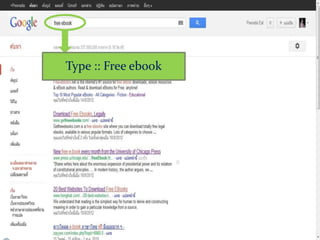
www.google.co.th
Type :: Free ebook
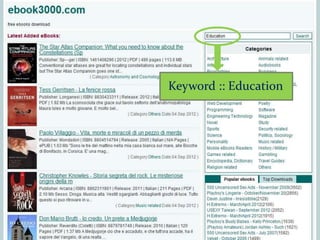
www.ebook3000.com
Keyword :: Education
Choose this =]
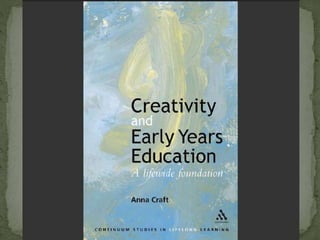
Choose for Download file
Click !!
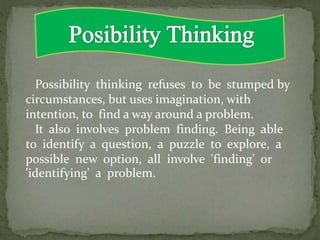
Possibility thinking refuses to be stumped by
circumstances, but uses imagination, with
intention, to find a way around a problem.
It also involves problem finding. Being able
to identify a question, a puzzle to explore, a
possible new option, all involve 'finding' or
'identifying' a problem.
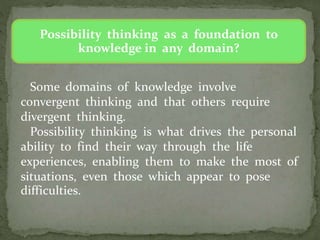
Possibility thinking as a foundation to
knowledge in any domain?
Some domains of knowledge involve
convergent thinking and that others require
divergent thinking.
Possibility thinking is what drives the personal
ability to find their way through the life
experiences, enabling them to make the most of
situations, even those which appear to pose
difficulties.
Possibility thinking in the early years
In the early years, creativity can be linked
with certain activities, like painting, drawing,
imaginative play, etc.
By the way in which creativity is put forward
in curriculum policy guidelines such as the
Early Learning Goals. But it is also a heritage
from the culture and practices of early years
education and care.
Play and possibilities
For children in the early years, play is a core
learning mode and vehicle for learning and
expression. It is difficult to see how imagination
and self-expression could not be present in all
imaginative play. Similarly, all imaginative play is
a form of self-creation, or expression of agency,
although often in role rather than as oneself.
Some pedagogical implications of valuing
possibility thinking
A creative practitioner will stimulate and
support possibility thinking across the curriculum
and across the setting, in a variety of ways.
For example, storytelling, dramatic play, role
play, etc. Some of these activities will involve a
reasoned structuring of activities, and others will
involve much less.
Possibility thinking continues to be a powerful
driver of their actions and ideas.
Any
Question??

EBOOK

  • 2.
  • 3.
  • 4.
  • 5.
  • 6.
  • 7.
  • 8.
  • 12.
    Possibility thinking refusesto be stumped by circumstances, but uses imagination, with intention, to find a way around a problem. It also involves problem finding. Being able to identify a question, a puzzle to explore, a possible new option, all involve 'finding' or 'identifying' a problem.
  • 13.
    Possibility thinking asa foundation to knowledge in any domain? Some domains of knowledge involve convergent thinking and that others require divergent thinking. Possibility thinking is what drives the personal ability to find their way through the life experiences, enabling them to make the most of situations, even those which appear to pose difficulties.
  • 14.
    Possibility thinking inthe early years In the early years, creativity can be linked with certain activities, like painting, drawing, imaginative play, etc. By the way in which creativity is put forward in curriculum policy guidelines such as the Early Learning Goals. But it is also a heritage from the culture and practices of early years education and care.
  • 15.
    Play and possibilities Forchildren in the early years, play is a core learning mode and vehicle for learning and expression. It is difficult to see how imagination and self-expression could not be present in all imaginative play. Similarly, all imaginative play is a form of self-creation, or expression of agency, although often in role rather than as oneself.
  • 16.
    Some pedagogical implicationsof valuing possibility thinking A creative practitioner will stimulate and support possibility thinking across the curriculum and across the setting, in a variety of ways. For example, storytelling, dramatic play, role play, etc. Some of these activities will involve a reasoned structuring of activities, and others will involve much less. Possibility thinking continues to be a powerful driver of their actions and ideas.
  • 18.