• Identify thecharacteristics of thinking.
• Apply thinking skills to the analysis of daily
life, work, and academic issues.
• Evaluate arguments in terms of truth,
validity, and soundness.
LEARNING
OBJECTIVES
3.
Thinking is acollection of internal processes directed toward solving
a problem. When one uses symbols or concepts to imagine
something internally or to solve problems mentally one is said to be
thinking. In a wider sense thinking includes diverse cognitive
processes that involve understanding, language, memories retrieval
and processing patterns and sensory inputs. More importantly
thinking allows one to manipulate objects mentally to solve problems
without actually doing the physical motion.
4.
BASIC THINKING
PROCESS
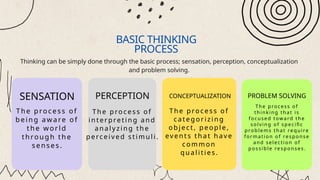
Thinking canbe simply done through the basic process; sensation, perception, conceptualization
and problem solving.
SENSATION
The p roce ss of
be i ng aw are of
the wor l d
through the
se nse s.
PERCEPTION
Th e p ro cess of
i n terp re ti n g an d
an al y z i n g th e
p ercei v ed sti m u l i .
CONCEPTUALIZATION
Th e p roce ss of
categ ori zi n g
ob j ect, p eop l e ,
eve n ts th at h av e
com m on
q u al i ti es.
PROBLEM SOLVING
The process of
thinking that is
focused toward the
solving of specific
problems that require
formation of response
and selection of
possible responses.
5.
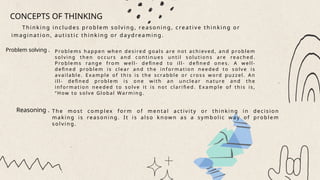
CONCEPTS OF THINKING
Thin ki n g in clu d es p rob l em sol vi ng , re ason i ng , cre ati ve t h in ki ng o r
im ag in at ion , a ut ist ic th in ki n g or d ayd rea min g .
Problem solving . Problems hap pe n w he n d es ire d goals are n ot ac hieved , and p roblem
solving th en oc cu rs an d con tinu es un til s olu tion s are reac he d.
Problems rang e f rom w e ll- de fine d t o ill- d efin ed one s . A we ll-
de fin e d proble m is c le ar an d th e inf ormat ion n ee de d to solve is
av ailable . Example of th is is the sc rab ble or c ros s w ord p uzze l. A n
ill- de fi ne d prob le m is on e w it h an un clear nature an d the
in for mation n ee ded to s olve it is no t clarifie d. Ex ample of t his is ,
“H ow t o s olv e Global Warmin g.
Reasoning . T h e m o st co m pl ex f or m o f m e n ta l a ct iv it y o r t h i n k i n g i n decis io n
m a k in g is rea so n i n g . I t i s a l so k n ow n a s a sy m bo l ic w a y of pro ble m
so lv i n g.
6.
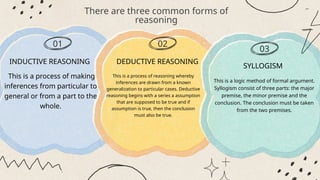
There are threecommon forms of
reasoning
01 02
03
This is a process of making
inferences from particular to
general or from a part to the
whole.
INDUCTIVE REASONING DEDUCTIVE REASONING
This is a process of reasoning whereby
inferences are drawn from a known
generalization to particular cases. Deductive
reasoning begins with a series a assumption
that are supposed to be true and if
assumption is true, then the conclusion
must also be true.
SYLLOGISM
This is a logic method of formal argument.
Syllogism consist of three parts: the major
premise, the minor premise and the
conclusion. The conclusion must be taken
from the two premises.
7.
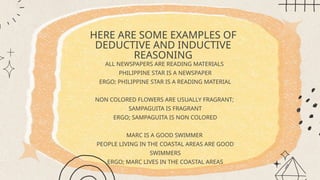
HERE ARE SOMEEXAMPLES OF
DEDUCTIVE AND INDUCTIVE
REASONING
ALL NEWSPAPERS ARE READING MATERIALS
PHILIPPINE STAR IS A NEWSPAPER
ERGO; PHILIPPINE STAR IS A READING MATERIAL
NON COLORED FLOWERS ARE USUALLY FRAGRANT;
SAMPAGUITA IS FRAGRANT
ERGO; SAMPAGUITA IS NON COLORED
MARC IS A GOOD SWIMMER
PEOPLE LIVING IN THE COASTAL AREAS ARE GOOD
SWIMMERS
ERGO; MARC LIVES IN THE COASTAL AREAS
8.
creative thinking or
imagination
somepsychologists state that imagination
means creative thinking or invention. creative
thinking is a response in a unique and novel
way. it transforms past experiences into new
situation that may rise to discoveries,
invention and artistic work. for instance, you
were asked; how many uses of newspapers
can you think of? perhaps you can come up
with many uses of news paper depending on
your creative thinking.
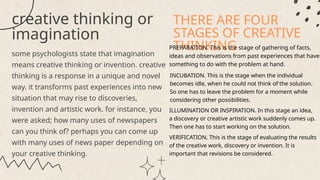
THERE ARE FOUR
STAGES OF CREATIVE
THINKING
PREPARATION. This is the stage of gathering of facts,
ideas and observations from past experiences that have
something to do with the problem at hand.
INCUBATION. This is the stage when the individual
becomes idle, when he could not think of the solution.
So one has to leave the problem for a moment while
considering other possibilities.
ILLUMINATION OR INSPIRATION. In this stage an idea,
a discovery or creative artistic work suddenly comes up.
Then one has to start working on the solution.
VERIFICATION. This is the stage of evaluating the results
of the creative work, discovery or invention. It is
important that revisions be considered.
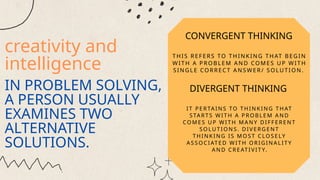
9.
creativity and
intelligence
IN PROBLEMSOLVING,
A PERSON USUALLY
EXAMINES TWO
ALTERNATIVE
SOLUTIONS.
CONVERGENT THINKING
THIS REF ERS TO TH IN K ING TH AT BEGIN
W ITH A P ROBL EM AN D COM ES U P W ITH
SIN GL E CO RREC T A NS W ER/ S OLUTION .
DIVERGENT THINKING
IT P E RTA INS TO T H IN K ING T H AT
START S WIT H A P ROB L E M A ND
COM E S U P WI T H M AN Y DIFF E RE NT
SO LU T ION S. D IV E RG E NT
T H INK ING IS M OST CLOSE LY
ASSOCIAT E D W IT H ORIGINA L IT Y
AN D CRE AT I VI T Y.
10.
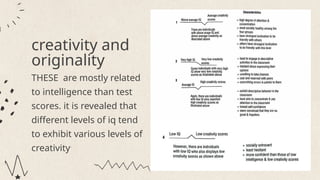
creativity and
originality
THESE aremostly related
to intelligence than test
scores. it is revealed that
different levels of iq tend
to exhibit various levels of
creativity
11.
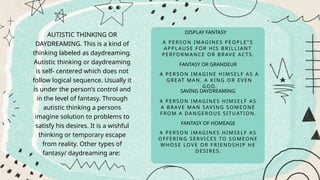
AUTISTIC THINKING OR
DAYDREAMING.This is a kind of
thinking labeled as daydreaming.
Autistic thinking or daydreaming
is self- centered which does not
follow logical sequence. Usually it
is under the person's control and
in the level of fantasy. Through
autistic thinking a persons
imagine solution to problems to
satisfy his desires. It is a wishful
thinking or temporary escape
from reality. Other types of
fantasy/ daydreaming are:
DISPLAY FANTASY
A PERSON I MAGINES PE OPLE" S
APPL AUSE FOR HIS BRILLI ANT
PERFORMANCE OR BRAVE ACTS.
FANTASY OR GRANDEUR
A PERSON I MAGINE HI MSELF A S A
GREAT MA N, A KING OR EVEN
GOD.
SAVING DAYDREAMING
A PERSON I MAGINES HI MSE LF A S
A BRAVE MA N SAVING SOMEONE
FROM A DANGEROUS SITUAT ION.
FANTASY OF HOMEAGE
A PERSON I MAGINES HI MSE LF A S
OFFE RING SERVICES TO SOMEONE
WHOSE LOVE OR FRI END SHIP HE
DE SI RE S.
12.
theories of
thinking
there aretwo theories of thinking: central theory and motor
theory. central theory assumes that thinking and reasoning
depend mainly in the activity of the brain. the motor theory
holds that thinking is based on the muscular reactions from all
parts of the body and neural activities of the nervous system.


![THINKING-XI E SIS [Autosaved].pptx......](https://cdn.slidesharecdn.com/ss_thumbnails/thinking-xiesisautosaved-240629235329-02f286a2-thumbnail.jpg?width=640&height=640&fit=bounds)


