reasons why
you need a story,
not just data
Data can be
enlightening and powerful.
But the purpose of data is not to simply create charts and graphs.
The purpose of data is to answer questions and spark curiosity.
Storytelling
helps bring
data to life.
It adds context,
engagement, and
emotion to fact.
Tweet This
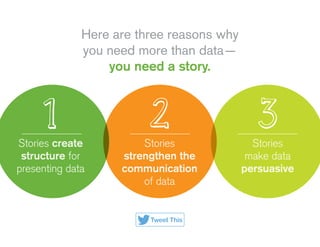
Here are three reasons why
you need more than data—
you need a story.
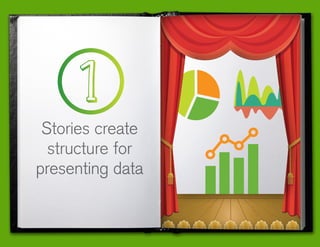
Stories create
structure for
presenting data
Stories
strengthen the
communication
of data
Stories
make data
persuasive
Tweet This
Stories create
structure for
presenting data
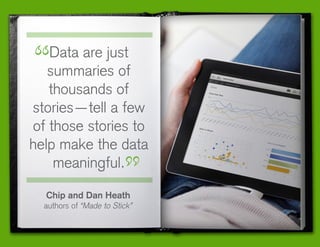
Chip and Dan Heath
authors of “Made to Stick”
Data are just
summaries of
thousands of
stories—tell a few
of those stories to
help make the data
meaningful.
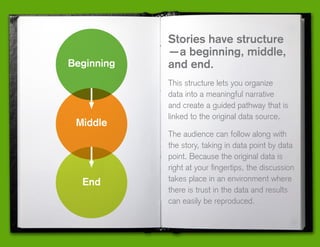
Stories have structure
—a beginning, middle,
and end.
This structure lets you organize
data into a meaningful narrative
and create a guided pathway that is
linked to the original data source.
The audience can follow along with
the story, taking in data point by data
point. Because the original data is
right at your fingertips, the discussion
takes place in an environment where
there is trust in the data and results
can easily be reproduced.
Beginning
Middle
End
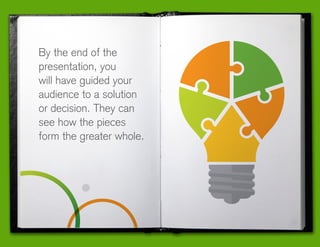
By the end of the
presentation, you
will have guided your
audience to a solution
or decision. They can
see how the pieces
form the greater whole.
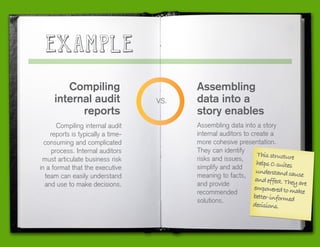
Compiling internal audit
reports is typically a time-
consuming and complicated
process. Internal auditors
must articulate business risk
in a format that the executive
team can easily understand
and use to make decisions.
Compiling
internal audit
reports
Assembling data into a story
internal auditors to create a
more cohesive presentation.
They can identify
risks and issues,
simplify and add
meaning to facts,
and provide
recommended
solutions.
Assembling
data into a
story enables
VS.
Thisstructure
helpsC-suites
understandcause
andeffect.Theyare
empoweredtomake
better-informed
decisions.
Stories
strengthen the
communication
of data
Tweet This
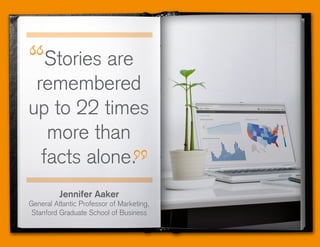
Jennifer Aaker
General Atlantic Professor of Marketing,
Stanford Graduate School of Business
Stories are
remembered
up to 22 times
more than
facts alone.
Humans are wired
to tell stories.
It’s how we naturally communicate
information and ideas. Even boring
topics become interesting with a
great story.
The same is true of data.
Numbers in a spreadsheet can
be confusing and disengaging.
But packaging that data into a
story makes the facts digestible,
contextual, and memorable.
The most engaging
stories are multi-way
conversations.
They give listeners
room to ask
questions, just like
an interactive data
visualization.
Journalists have always been
publishing statistics and facts in
their articles. But the rise of data
analytics and data visualization
has caused more reporters to
adapt their traditional narratives
into data stories.
The Guardian pioneered the
concept of “data journalism”
in 2009 when Simon Rogers
created the Guardian Datablog.
Today nearly
every media outlet
reports stories
using infographics,
maps, charts, and
graphs.
The reason is simple.Data visualizationsdrive traffic and
sharing. Data
storytelling has
become a primary
way media serve
readers in the
digital era.
Stories make
data persuasive
Tweet This
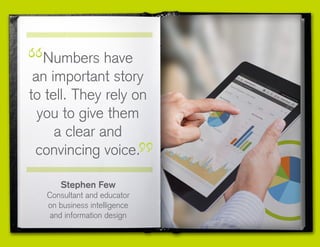
Stephen Few
Consultant and educator
on business intelligence
and information design
Numbers have
an important story
to tell. They rely on
you to give them
a clear and
convincing voice.
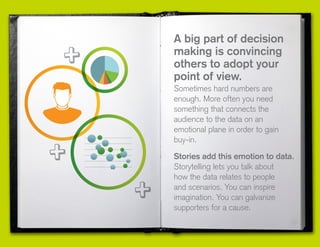
A big part of decision
making is convincing
others to adopt your
point of view.
Sometimes hard numbers are
enough. More often you need
something that connects the
audience to the data on an
emotional plane in order to gain
buy-in.
Stories add this emotion to data.
Storytelling lets you talk about
how the data relates to people
and scenarios. You can inspire
imagination. You can galvanize
supporters for a cause.
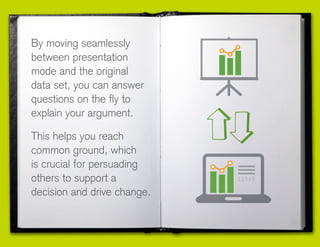
By moving seamlessly
between presentation
mode and the original
data set, you can answer
questions on the fly to
explain your argument.
This helps you reach
common ground, which
is crucial for persuading
others to support a
decision and drive change.
Marketers often face challenges
when gaining internal buy-in
for new campaigns. Securing
budget typically requires
marketers to calculate and
prove the ROI of their plans.
Data plays a natural
role here—and it is
made more powerful
by storytelling.
Marketers increase
their power of
persuasion by
explaining and
proving how
their ideas will
help internal
stakeholders
achieve their
goals.
Marketers can
describe how the
data relates to
the needs of the
business and
internal team
members.
Marketers
can convince
stakeholders
because they are
establishing context
for the data and
providing evidence
of the potential
results.
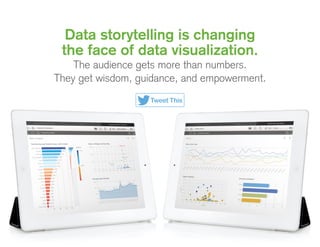
Data storytelling is changing
the face of data visualization.
The audience gets more than numbers.
They get wisdom, guidance, and empowerment.
Tweet This
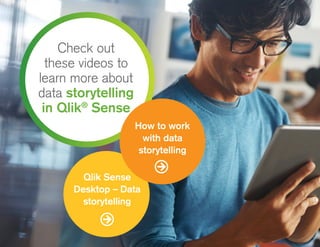
Check out
these videos to
learn more about
data storytelling
in Qlik®
Sense
Qlik Sense
Desktop – Data
storytelling
How to work
with data
storytelling
© 2015 QlikTech International AB. All rights reserved. Qlik®
, QlikView®
, Qlik®
Sense, QlikTech®
, and the QlikTech logos are trademarks of QlikTech International AB which have been
registered in multiple countries. Other marks and logos mentioned herein are trademarks or registered trademarks of their respective owners.
qlik.com

3 razones para contar historias...

  • 1.
    reasons why you needa story, not just data
  • 2.
    Data can be enlighteningand powerful. But the purpose of data is not to simply create charts and graphs. The purpose of data is to answer questions and spark curiosity.
  • 3.
    Storytelling helps bring data tolife. It adds context, engagement, and emotion to fact. Tweet This
  • 4.
    Here are threereasons why you need more than data— you need a story. Stories create structure for presenting data Stories strengthen the communication of data Stories make data persuasive Tweet This
  • 5.
  • 6.
    Chip and DanHeath authors of “Made to Stick” Data are just summaries of thousands of stories—tell a few of those stories to help make the data meaningful.
  • 7.
    Stories have structure —abeginning, middle, and end. This structure lets you organize data into a meaningful narrative and create a guided pathway that is linked to the original data source. The audience can follow along with the story, taking in data point by data point. Because the original data is right at your fingertips, the discussion takes place in an environment where there is trust in the data and results can easily be reproduced. Beginning Middle End
  • 8.
    By the endof the presentation, you will have guided your audience to a solution or decision. They can see how the pieces form the greater whole.
  • 9.
    Compiling internal audit reportsis typically a time- consuming and complicated process. Internal auditors must articulate business risk in a format that the executive team can easily understand and use to make decisions. Compiling internal audit reports Assembling data into a story internal auditors to create a more cohesive presentation. They can identify risks and issues, simplify and add meaning to facts, and provide recommended solutions. Assembling data into a story enables VS. Thisstructure helpsC-suites understandcause andeffect.Theyare empoweredtomake better-informed decisions.
  • 10.
  • 11.
    Jennifer Aaker General AtlanticProfessor of Marketing, Stanford Graduate School of Business Stories are remembered up to 22 times more than facts alone.
  • 12.
    Humans are wired totell stories. It’s how we naturally communicate information and ideas. Even boring topics become interesting with a great story. The same is true of data. Numbers in a spreadsheet can be confusing and disengaging. But packaging that data into a story makes the facts digestible, contextual, and memorable.
  • 13.
    The most engaging storiesare multi-way conversations. They give listeners room to ask questions, just like an interactive data visualization.
  • 14.
    Journalists have alwaysbeen publishing statistics and facts in their articles. But the rise of data analytics and data visualization has caused more reporters to adapt their traditional narratives into data stories. The Guardian pioneered the concept of “data journalism” in 2009 when Simon Rogers created the Guardian Datablog. Today nearly every media outlet reports stories using infographics, maps, charts, and graphs. The reason is simple.Data visualizationsdrive traffic and sharing. Data storytelling has become a primary way media serve readers in the digital era.
  • 15.
  • 16.
    Stephen Few Consultant andeducator on business intelligence and information design Numbers have an important story to tell. They rely on you to give them a clear and convincing voice.
  • 17.
    A big partof decision making is convincing others to adopt your point of view. Sometimes hard numbers are enough. More often you need something that connects the audience to the data on an emotional plane in order to gain buy-in. Stories add this emotion to data. Storytelling lets you talk about how the data relates to people and scenarios. You can inspire imagination. You can galvanize supporters for a cause.
  • 18.
    By moving seamlessly betweenpresentation mode and the original data set, you can answer questions on the fly to explain your argument. This helps you reach common ground, which is crucial for persuading others to support a decision and drive change.
  • 19.
    Marketers often facechallenges when gaining internal buy-in for new campaigns. Securing budget typically requires marketers to calculate and prove the ROI of their plans. Data plays a natural role here—and it is made more powerful by storytelling. Marketers increase their power of persuasion by explaining and proving how their ideas will help internal stakeholders achieve their goals. Marketers can describe how the data relates to the needs of the business and internal team members. Marketers can convince stakeholders because they are establishing context for the data and providing evidence of the potential results.
  • 20.
    Data storytelling ischanging the face of data visualization. The audience gets more than numbers. They get wisdom, guidance, and empowerment. Tweet This
  • 21.
    Check out these videosto learn more about data storytelling in Qlik® Sense Qlik Sense Desktop – Data storytelling How to work with data storytelling
  • 22.
    © 2015 QlikTechInternational AB. All rights reserved. Qlik® , QlikView® , Qlik® Sense, QlikTech® , and the QlikTech logos are trademarks of QlikTech International AB which have been registered in multiple countries. Other marks and logos mentioned herein are trademarks or registered trademarks of their respective owners. qlik.com