Data Driven Storytelling
“The universe is not made of atoms,
it is made of stories.”
Muriel Rukeyser
Nathan Gasser
ngasser@rockriverstar.com
Briana Morgan
brianalmorgan@gmail.com
Why Storytelling?
Humans are wired for storytelling
Stories are how we imagine possibilities, encode our values, and
teach lessons to the next generation. Stories impart facts,
opinions, judgments, and emotions. Stories have a unique power
to both inform and persuade.
Why Data?
We live in a results-driven world
Nonprofits are expected to be “run like a business”
Foundations make “investments”, not grants
Let me tell you a story…
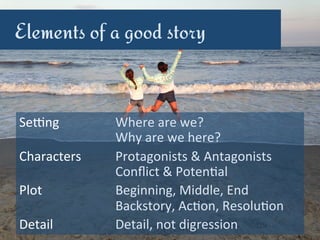
Elements of a good story
Se#ng 	
  Where	
  are	
  we? 	


  Why	
  are	
  we	
  here?	
  
Characters 	
  Protagonists	
  &	
  Antagonists	
  
	
  Conflict	
  &	
  Poten8al	
  	
  
Plot 	
  Beginning,	
  Middle,	
  End	
  
	
  Backstory,	
  Ac8on,	
  Resolu8on	
  	
  
Detail 	
  Detail,	
  not	
  digression	
  
Whose story is it?
Do you want people to explore and come to their own
conclusions?
Or you have a message you want them to take away?
How about the data?
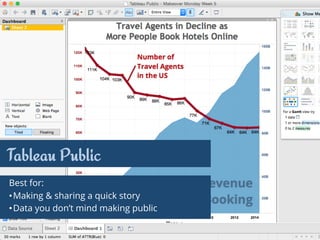
Tableau Public
Best for:
• Making & sharing a quick story
• Data you don’t mind making public
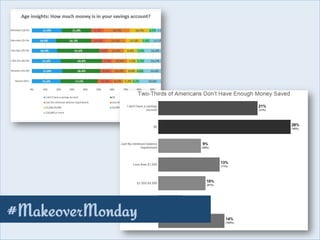
#MakeoverMonday
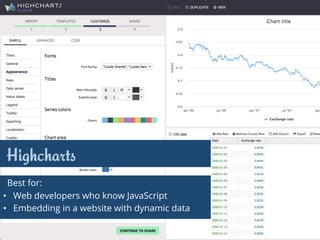
Highcharts
Best for:
•  Web developers who know JavaScript
•  Embedding in a website with dynamic data
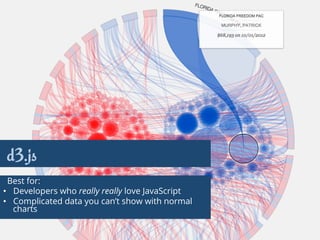
d3.js
Best for:
•  Developers who really really love JavaScript
•  Complicated data you can’t show with normal
charts
More examples if we have time…
•  Charts
–  http://viz.healthmetricsandevaluation.org/gbd-compare/
•  Maps
–  http://pooreconomics.com/data/country/home
•  Interactive
–  http://foods.bridgingthegapresearch.org
•  Immersive Presentation
–  http://rwjf.org/maketobaccohistory
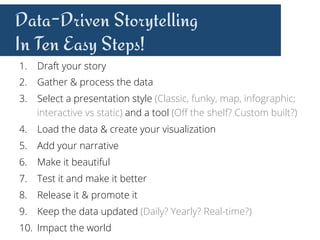
Data-Driven Storytelling
In Ten Easy Steps!
1.  Draft your story
2.  Gather & process the data
3.  Select a presentation style (Classic, funky, map, infographic;
interactive vs static) and a tool (Off the shelf? Custom built?)
4.  Load the data & create your visualization
5.  Add your narrative
6.  Make it beautiful
7.  Test it and make it better
8.  Release it & promote it
9.  Keep the data updated (Daily? Yearly? Real-time?)
10.  Impact the world
Workshop Time
Your Story
•  Who are your characters – your heroes
and villains?
•  Who’s your audience? Do they know
your characters?
Your Data
•  What data will you need to tell this
story?
•  Do you have it now, or can you easily
acquire it?
•  Will it need to be processed and
analyzed, or just presented?
Your Stage
•  How can you best reach your audience
with this story?
– Your website? Social media? Email? Print?
•  What do you want them to take away
from your story, and what actions can
they take?
•  How will you measure the impact your
story has?
Links n’ Stuff
http://bit.ly/216QxUn
Thanks for Listening!
Nathan Gasser
ngasser@rockriverstar.com
Briana Morgan
brianalmorgan@gmail.com

Data driven storytelling

  • 1.
    Data Driven Storytelling “Theuniverse is not made of atoms, it is made of stories.” Muriel Rukeyser
  • 2.
  • 3.
  • 4.
    Humans are wiredfor storytelling Stories are how we imagine possibilities, encode our values, and teach lessons to the next generation. Stories impart facts, opinions, judgments, and emotions. Stories have a unique power to both inform and persuade.
  • 5.
  • 6.
    We live ina results-driven world Nonprofits are expected to be “run like a business” Foundations make “investments”, not grants
  • 7.
    Let me tellyou a story…
  • 8.
    Elements of agood story Se#ng  Where  are  we?      Why  are  we  here?   Characters  Protagonists  &  Antagonists    Conflict  &  Poten8al     Plot  Beginning,  Middle,  End    Backstory,  Ac8on,  Resolu8on     Detail  Detail,  not  digression  
  • 9.
    Whose story isit? Do you want people to explore and come to their own conclusions? Or you have a message you want them to take away?
  • 10.
  • 11.
    Tableau Public Best for: • Making& sharing a quick story • Data you don’t mind making public
  • 12.
  • 13.
    Highcharts Best for: •  Webdevelopers who know JavaScript •  Embedding in a website with dynamic data
  • 14.
    d3.js Best for: •  Developerswho really really love JavaScript •  Complicated data you can’t show with normal charts
  • 15.
    More examples ifwe have time… •  Charts –  http://viz.healthmetricsandevaluation.org/gbd-compare/ •  Maps –  http://pooreconomics.com/data/country/home •  Interactive –  http://foods.bridgingthegapresearch.org •  Immersive Presentation –  http://rwjf.org/maketobaccohistory
  • 16.
    Data-Driven Storytelling In TenEasy Steps! 1.  Draft your story 2.  Gather & process the data 3.  Select a presentation style (Classic, funky, map, infographic; interactive vs static) and a tool (Off the shelf? Custom built?) 4.  Load the data & create your visualization 5.  Add your narrative 6.  Make it beautiful 7.  Test it and make it better 8.  Release it & promote it 9.  Keep the data updated (Daily? Yearly? Real-time?) 10.  Impact the world
  • 17.
  • 18.
    Your Story •  Whoare your characters – your heroes and villains? •  Who’s your audience? Do they know your characters?
  • 19.
    Your Data •  Whatdata will you need to tell this story? •  Do you have it now, or can you easily acquire it? •  Will it need to be processed and analyzed, or just presented?
  • 20.
    Your Stage •  Howcan you best reach your audience with this story? – Your website? Social media? Email? Print? •  What do you want them to take away from your story, and what actions can they take? •  How will you measure the impact your story has?
  • 21.
  • 22.
    Thanks for Listening! NathanGasser ngasser@rockriverstar.com Briana Morgan brianalmorgan@gmail.com