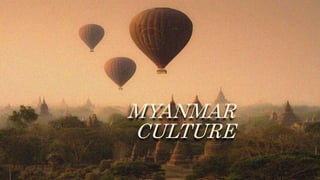
MYANMAR
CULTURE
WELCOME TO
MYANMAR!
Min-gala-
bar!
Contents
• Introduction
• Language, Music and dance
• Religion and festivals
• Sports
• Food
• Travel and people
• Conclusion
Introduction
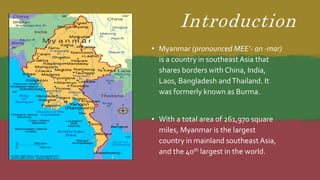
• Myanmar (pronounced MEE’- an -mar)
is a country in southeast Asia that
shares borders with China, India,
Laos, Bangladesh andThailand. It
was formerly known as Burma.
• With a total area of 261,970 square
miles, Myanmar is the largest
country in mainland southeast Asia,
and the 40th largest in the world.
.
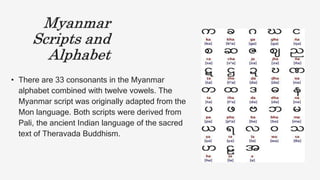
• There are 33 consonants in the Myanmar
alphabet combined with twelve vowels. The
Myanmar script was originally adapted from the
Mon language. Both scripts were derived from
Pali, the ancient Indian language of the sacred
text of Theravada Buddhism.
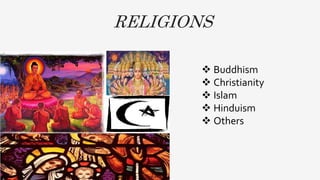
 Buddhism
 Christianity
 Islam
 Hinduism
 Others
RELIGIONS
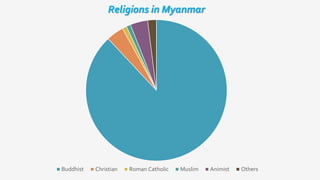
Religions in Myanmar
Buddhist Christian Roman Catholic Muslim Animist Others
FESTIVALS
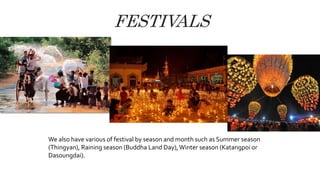
We also have various of festival by season and month such as Summer season
(Thingyan), Raining season (Buddha Land Day),Winter season (Katangpoi or
Dasoungdai).
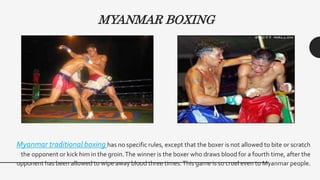
Myanmar traditional boxing has no specific rules, except that the boxer is not allowed to bite or scratch
the opponent or kick him in the groin.The winner is the boxer who draws blood for a fourth time, after the
opponent has been allowed to wipe away blood three times.This game is so cruel even to Myanmar people.
MYANMAR BOXING
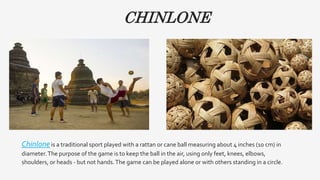
CHINLONE
Chinloneis a traditional sport played with a rattan or cane ball measuring about 4 inches (10 cm) in
diameter.The purpose of the game is to keep the ball in the air, using only feet, knees, elbows,
shoulders, or heads - but not hands.The game can be played alone or with others standing in a circle.
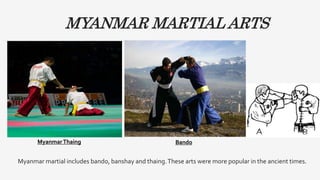
Myanmar martial includes bando, banshay and thaing.These arts were more popular in the ancient times.
MYANMAR MARTIAL ARTS
MyanmarThaing Bando
COCK-FIGHTING
• In the countryside, villagers organize traditional cock-fights, with spectators laying bets on the bird
they hope will win. Bird owners sometimes attach sharp spurs to the legs of their roosters, which are
trained to attack the opponent.
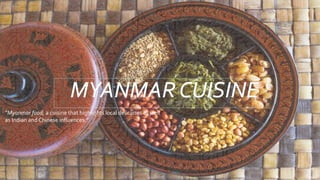
“Myanmar food, a cuisine that highlights local delicacies as well
as Indian and Chinese influences.”
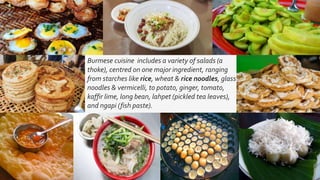
Burmese cuisine includes a variety of salads (a
thoke), centred on one major ingredient, ranging
from starches like rice, wheat & rice noodles, glass
noodles & vermicelli, to potato, ginger, tomato,
kaffir lime, long bean, lahpet (pickled tea leaves),
and ngapi (fish paste).
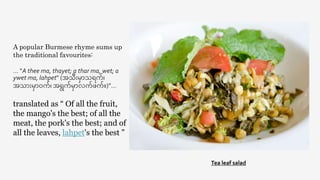
Tea leaf salad
A popular Burmese rhyme sums up
the traditional favourites:
… "A thee ma, thayet; a thar ma, wet; a
ywet ma, lahpet" (အသီးမှာသရက်၊
အသှာီးမှာဝက်၊ အရွက်မှာလက်ဖက်။)”…
translated as “ Of all the fruit,
the mango's the best; of all the
meat, the pork's the best; and of
all the leaves, lahpet's the best "
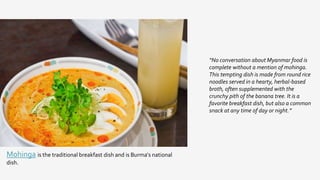
“No conversation about Myanmar food is
complete without a mention of mohinga.
This tempting dish is made from round rice
noodles served in a hearty, herbal-based
broth, often supplemented with the
crunchy pith of the banana tree. It is a
favorite breakfast dish, but also a common
snack at any time of day or night.”
Mohinga is the traditional breakfast dish and is Burma's national
dish.
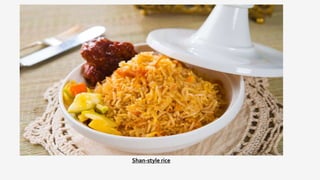
Shan-style rice
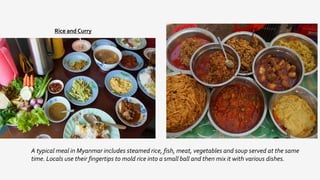
Rice and Curry
A typical meal in Myanmar includes steamed rice, fish, meat, vegetables and soup served at the same
time. Locals use their fingertips to mold rice into a small ball and then mix it with various dishes.
Shan-khout-swal (Shan Noodles)
Myanmar Pancakes Tea leaf salad
Balloon flight over Bagan (Mandalay)
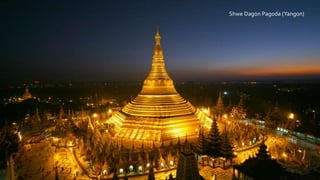
Shwe Dagon Pagoda (Yangon)
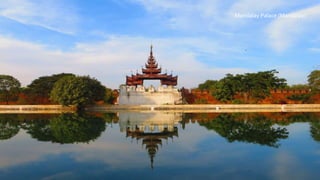
Mandalay Palace (Mandalay)
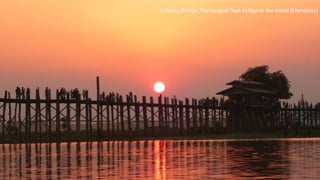
U Being Bridge,The longestTeak bridge in the world (Mandalay)
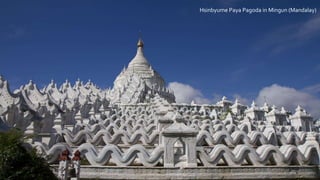
Hsinbyume Paya Pagoda in Mingun (Mandalay)
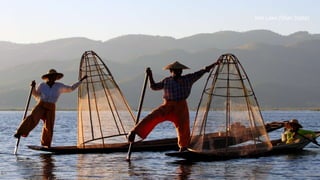
Inle Lake (Shan State)
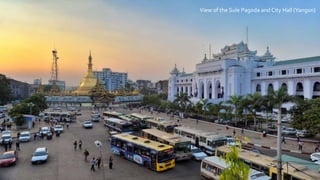
View of the Sule Pagoda and City Hall (Yangon)
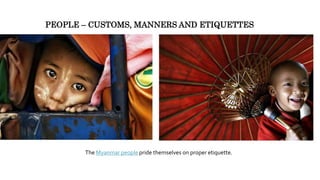
The Myanmar people pride themselves on proper etiquette.
PEOPLE – CUSTOMS, MANNERS AND ETIQUETTES
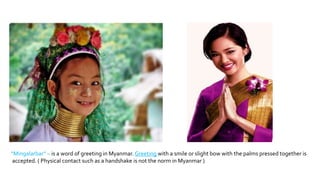
“Mingalarbar” – is a word of greeting in Myanmar. Greeting with a smile or slight bow with the palms pressed together is
accepted. ( Physical contact such as a handshake is not the norm in Myanmar )
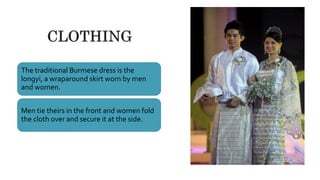
The traditional Burmese dress is the
longyi, a wraparound skirt worn by men
and women.
Men tie theirs in the front and women fold
the cloth over and secure it at the side.
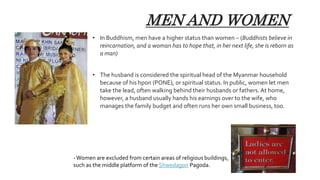
MEN AND WOMEN
• In Buddhism, men have a higher status than women – (Buddhists believe in
reincarnation, and a woman has to hope that, in her next life, she is reborn as
a man)
• The husband is considered the spiritual head of the Myanmar household
because of his hpon (PONE), or spiritual status. In public, women let men
take the lead, often walking behind their husbands or fathers. At home,
however, a husband usually hands his earnings over to the wife, who
manages the family budget and often runs her own small business, too.
-Women are excluded from certain areas of religious buildings,
such as the middle platform of the Shwedagon Pagoda.
Marriage
- dependent on family and friends.
- Children in Myanmar will almost
always live with their parents up until
the day they marry and if that said marriage
doesn’t make out good, then the kids move
back in with the parents.
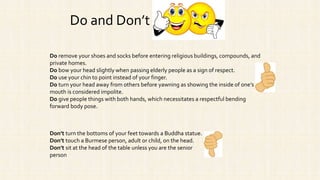
Do remove your shoes and socks before entering religious buildings, compounds, and
private homes.
Do bow your head slightly when passing elderly people as a sign of respect.
Do use your chin to point instead of your finger.
Do turn your head away from others before yawning as showing the inside of one’s
mouth is considered impolite.
Do give people things with both hands, which necessitates a respectful bending
forward body pose.
Do and Don’t
Don’t turn the bottoms of your feet towards a Buddha statue.
Don’t touch a Burmese person, adult or child, on the head.
Don’t sit at the head of the table unless you are the senior
person
THANKYOU!
Kyay–zuu-
par!

Myanmar culture

  • 1.
  • 2.
  • 3.
    Contents • Introduction • Language,Music and dance • Religion and festivals • Sports • Food • Travel and people • Conclusion
  • 4.
    Introduction • Myanmar (pronouncedMEE’- an -mar) is a country in southeast Asia that shares borders with China, India, Laos, Bangladesh andThailand. It was formerly known as Burma. • With a total area of 261,970 square miles, Myanmar is the largest country in mainland southeast Asia, and the 40th largest in the world.
  • 5.
  • 6.
    • There are33 consonants in the Myanmar alphabet combined with twelve vowels. The Myanmar script was originally adapted from the Mon language. Both scripts were derived from Pali, the ancient Indian language of the sacred text of Theravada Buddhism.
  • 8.
     Buddhism  Christianity Islam  Hinduism  Others RELIGIONS
  • 9.
    Religions in Myanmar BuddhistChristian Roman Catholic Muslim Animist Others
  • 10.
    FESTIVALS We also havevarious of festival by season and month such as Summer season (Thingyan), Raining season (Buddha Land Day),Winter season (Katangpoi or Dasoungdai).
  • 12.
    Myanmar traditional boxinghas no specific rules, except that the boxer is not allowed to bite or scratch the opponent or kick him in the groin.The winner is the boxer who draws blood for a fourth time, after the opponent has been allowed to wipe away blood three times.This game is so cruel even to Myanmar people. MYANMAR BOXING
  • 13.
    CHINLONE Chinloneis a traditionalsport played with a rattan or cane ball measuring about 4 inches (10 cm) in diameter.The purpose of the game is to keep the ball in the air, using only feet, knees, elbows, shoulders, or heads - but not hands.The game can be played alone or with others standing in a circle.
  • 14.
    Myanmar martial includesbando, banshay and thaing.These arts were more popular in the ancient times. MYANMAR MARTIAL ARTS MyanmarThaing Bando
  • 15.
    COCK-FIGHTING • In thecountryside, villagers organize traditional cock-fights, with spectators laying bets on the bird they hope will win. Bird owners sometimes attach sharp spurs to the legs of their roosters, which are trained to attack the opponent.
  • 16.
    “Myanmar food, acuisine that highlights local delicacies as well as Indian and Chinese influences.”
  • 17.
    Burmese cuisine includesa variety of salads (a thoke), centred on one major ingredient, ranging from starches like rice, wheat & rice noodles, glass noodles & vermicelli, to potato, ginger, tomato, kaffir lime, long bean, lahpet (pickled tea leaves), and ngapi (fish paste).
  • 18.
    Tea leaf salad Apopular Burmese rhyme sums up the traditional favourites: … "A thee ma, thayet; a thar ma, wet; a ywet ma, lahpet" (အသီးမှာသရက်၊ အသှာီးမှာဝက်၊ အရွက်မှာလက်ဖက်။)”… translated as “ Of all the fruit, the mango's the best; of all the meat, the pork's the best; and of all the leaves, lahpet's the best "
  • 19.
    “No conversation aboutMyanmar food is complete without a mention of mohinga. This tempting dish is made from round rice noodles served in a hearty, herbal-based broth, often supplemented with the crunchy pith of the banana tree. It is a favorite breakfast dish, but also a common snack at any time of day or night.” Mohinga is the traditional breakfast dish and is Burma's national dish.
  • 20.
  • 21.
    Rice and Curry Atypical meal in Myanmar includes steamed rice, fish, meat, vegetables and soup served at the same time. Locals use their fingertips to mold rice into a small ball and then mix it with various dishes.
  • 22.
  • 24.
    Balloon flight overBagan (Mandalay)
  • 26.
  • 27.
  • 29.
    U Being Bridge,ThelongestTeak bridge in the world (Mandalay)
  • 30.
    Hsinbyume Paya Pagodain Mingun (Mandalay)
  • 31.
  • 32.
    View of theSule Pagoda and City Hall (Yangon)
  • 33.
    The Myanmar peoplepride themselves on proper etiquette. PEOPLE – CUSTOMS, MANNERS AND ETIQUETTES
  • 34.
    “Mingalarbar” – isa word of greeting in Myanmar. Greeting with a smile or slight bow with the palms pressed together is accepted. ( Physical contact such as a handshake is not the norm in Myanmar )
  • 35.
    The traditional Burmesedress is the longyi, a wraparound skirt worn by men and women. Men tie theirs in the front and women fold the cloth over and secure it at the side.
  • 36.
    MEN AND WOMEN •In Buddhism, men have a higher status than women – (Buddhists believe in reincarnation, and a woman has to hope that, in her next life, she is reborn as a man) • The husband is considered the spiritual head of the Myanmar household because of his hpon (PONE), or spiritual status. In public, women let men take the lead, often walking behind their husbands or fathers. At home, however, a husband usually hands his earnings over to the wife, who manages the family budget and often runs her own small business, too. -Women are excluded from certain areas of religious buildings, such as the middle platform of the Shwedagon Pagoda.
  • 37.
    Marriage - dependent onfamily and friends. - Children in Myanmar will almost always live with their parents up until the day they marry and if that said marriage doesn’t make out good, then the kids move back in with the parents.
  • 38.
    Do remove yourshoes and socks before entering religious buildings, compounds, and private homes. Do bow your head slightly when passing elderly people as a sign of respect. Do use your chin to point instead of your finger. Do turn your head away from others before yawning as showing the inside of one’s mouth is considered impolite. Do give people things with both hands, which necessitates a respectful bending forward body pose. Do and Don’t Don’t turn the bottoms of your feet towards a Buddha statue. Don’t touch a Burmese person, adult or child, on the head. Don’t sit at the head of the table unless you are the senior person
  • 39.

Editor's Notes

  • #19 This is the most popular Myanmar food. To make the dish, the sour, slightly bitter leaves are mixed by hand with shredded cabbage, sliced tomatoes, nuts and peas. The dish can be a snack, an appetizer or, coupled with a plate of rice.
  • #20 No conversation about Myanmar food is complete without a mention of mohinga. This tempting dish is made from round rice noodles served in a hearty, herbal-based broth, often supplemented with the crunchy pith of the banana tree. It is a favorite breakfast dish, but also a common snack at any time of day or night.