The soccer globalization game
K. K. Haugen and H. A. Solberg
Molde University College and Trondheim Business School
NORWAY

EASM – 2008
Heidelberg - Germany
Some facts, figures and motivation
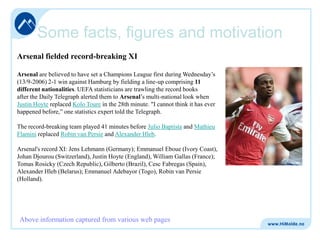
Arsenal fielded record-breaking XI
Arsenal are believed to have set a Champions League first during Wednesday’s
(13/9-2006) 2-1 win against Hamburg by fielding a line-up comprising 11
different nationalities. UEFA statisticians are trawling the record books
after the Daily Telegraph alerted them to Arsenal’s multi-national look when
Justin Hoyte replaced Kolo Toure in the 28th minute. "I cannot think it has ever
happened before,” one statistics expert told the Telegraph.
The record-breaking team played 41 minutes before Julio Baptista and Mathieu
Flamini replaced Robin van Persie and Alexander Hleb.
Arsenal's record XI: Jens Lehmann (Germany); Emmanuel Eboue (Ivory Coast),
Johan Djourou (Switzerland), Justin Hoyte (England), William Gallas (France);
Tomas Rosicky (Czech Republic), Gilberto (Brazil), Cesc Fabregas (Spain),
Alexander Hleb (Belarus); Emmanuel Adebayor (Togo), Robin van Persie
(Holland).

Above information captured from various web pages
Some more facts and figures
• Brazilian soccer player exports for around $1
bill. between 1994-2005
• 55% increase between 04-05 (positive trend)
• Coffee yearly exports (2003) around $1.3 bill.
→
Soccer exports amounts to more than
10% of coffee exports (main Brazilian
export good)
Outline
• Develop a simplified game model to
shed light on player migration patterns
in European soccer.
• Discuss model extensions
• Redevelop the model to discuss Profitvs. Win-maximization.
Setting
• 2 clubs have made a player buying decision.
• The choice is between a ”Foreign” or a
”Local” player.
• We focus on a single match (CL-qualifier).
• Hence, a win/loose situation. Winning yields a
substantional revenue, loosing yields nothing.
• The buying choice affects playing strength
differently between the ”Foreign/Local”
groups.
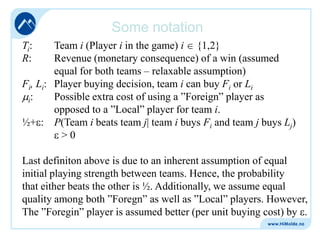
Some notation
Ti:
R:

Team i (Player i in the game) i {1,2}
Revenue (monetary consequence) of a win (assumed
equal for both teams – relaxable assumption)
Fi, Li: Player buying decision, team i can buy Fi or Li
Possible extra cost of using a ”Foreign” player as
i:
opposed to a ”Local” player for team i.
½+ : P(Team i beats team j| team i buys Fi and team j buys Lj)
>0
Last definiton above is due to an inherent assumption of equal
initial playing strength between teams. Hence, the probability
that either beats the other is ½. Additionally, we assume equal
quality among both ”Foregn” as well as ”Local” players. However,
The ”Foregin” player is assumed better (per unit buying cost) by .
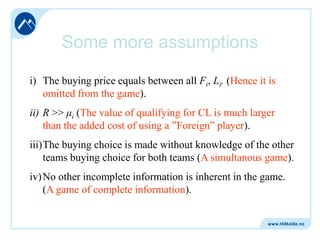
Some more assumptions
i) The buying price equals between all Fi, Li. (Hence it is
omitted from the game).
ii) R >> μi (The value of qualifying for CL is much larger
than the added cost of using a ”Foreign” player).

iii)The buying choice is made without knowledge of the other
teams buying choice for both teams (A simultanous game).
iv) No other incomplete information is inherent in the game.
(A game of complete information).
The game formulation
Given previous assumptions, it is straightforward to construct the normal form game below:
Nash equilibria (NEQ)
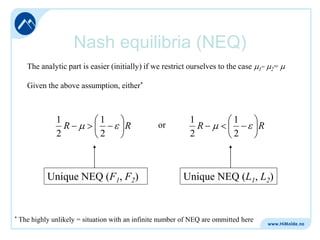
The analytic part is easier (initially) if we restrict ourselves to the case

1=

2=

Given the above assumption, either*

1
R
2

1
2

R

Unique NEQ (F1, F2)

*

or

1
R
2

1
2

R

Unique NEQ (L1, L2)

The highly unlikely = situation with an infinite number of NEQ are ommitted here
Not a very revolutionary result…
Some (ridiculously) simple algebra:

1
R
2

1
2

R

R

or in plain english: If the expected marginal revenue gain by choosing a
”Foreign player” (εR) is larger than the marginal extra cost (μ), then both
teams choose the ”Foreign Player” in equilibrium.
Note however, that the R-values are typically very big (CL-premium). So
a relatively small ε may lead to significant εR-values that may superseed
most μ-values.
Note also the inherent Prisoner’s Dilemma structure [both teams would
actually prefer the (L1, L2) outcome given coordination possibilities].
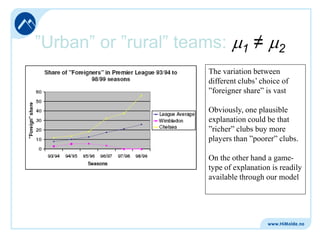
”Urban” or ”rural” teams:

1

≠

2

The variation between
different clubs’ choice of
”foreigner share” is vast
Obviously, one plausible
explanation could be that
”richer” clubs buy more
players than ”poorer” clubs.
On the other hand a gametype of explanation is readily
available through our model
”Urban” or ”rural” teams
It is perhaps not unlikely that making a brazilian player perform
(happily) in say Barcelona – Spain, is easier (and cheaper) than
say Tromsø Norway
The consequence is: (modelwise)
Tromsø

Barcelona

It is (relatively) straightforward to show [algebra omitted here]
That if:
P
{1,2}
i
j i, j
Then ”pooling” or ”separating” NEQs exist.
Temporary conclusion
• Perhaps not ”revolutionary” conclusions
so far. ”Buying foreign players if they
contribute more to income than they
cost is (of course) expected.
• However, the modelling frame makes it
easy to expand analytic possibilities
• In the paper we also analyze ”crowding costs”
as well as team specific revenues.
Shifting focus to player quality through price
• Slightly more interesting results are obtainable by the
same modelling frame - but a simple model change is
needed.
• Now we look at the same two (equally good) clubs
facing the same type of match, but the buying
decision relates to an expensive (Ep) or a cheap (Cp)
player.
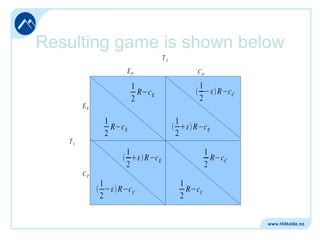
• Hence, the added cost of ”handling” a foreigner ( ) is
removed, and explicit buying costs for the expensive
player (cE) and the cheap player (cC) are added. (cE >
cC)
• Apart from this simple change, all other model
assumptions are kept.
Resulting game is shown below
Profit vs. Win-maximization
• Some (sports economic) authors [Késenne among
others] claim objective funtion differences between
US and European sports.
• Some say that US sports producers maximise profits
while European sports producers (at least to a
greater extent) maximise the probability of winning.
• If this is correct, one should expect larger
financial/economic problems in European compared
to US sports.
• This kind of problem can be easily analyzed at micro
level through the modelling framework we apply.
The Win-maximization game
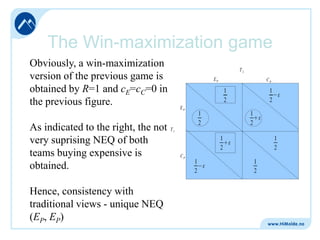
Obviously, a win-maximization
version of the previous game is
obtained by R=1 and cE=cC=0 in
the previous figure.
As indicated to the right, the not
very suprising NEQ of both
teams buying expensive is
obtained.
Hence, consistency with
traditional views - unique NEQ
(EP, EP)
The profit-maximizing game
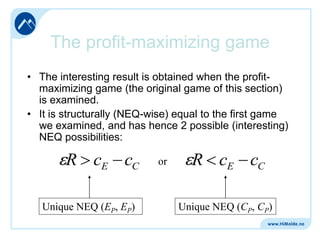
• The interesting result is obtained when the profitmaximizing game (the original game of this section)
is examined.
• It is structurally (NEQ-wise) equal to the first game
we examined, and has hence 2 possible (interesting)
NEQ possibilities:

R cE cC
Unique NEQ (EP, EP)

or

R cE cC
Unique NEQ (CP, CP)
Implications:
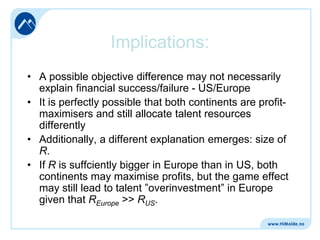
• A possible objective difference may not necessarily
explain financial success/failure - US/Europe
• It is perfectly possible that both continents are profitmaximisers and still allocate talent resources
differently
• Additionally, a different explanation emerges: size of
R.
• If R is suffciently bigger in Europe than in US, both
continents may maximise profits, but the game effect
may still lead to talent ”overinvestment” in Europe
given that REurope >> RUS.

Easm 2008

  • 1.
    The soccer globalizationgame K. K. Haugen and H. A. Solberg Molde University College and Trondheim Business School NORWAY EASM – 2008 Heidelberg - Germany
  • 2.
    Some facts, figuresand motivation Arsenal fielded record-breaking XI Arsenal are believed to have set a Champions League first during Wednesday’s (13/9-2006) 2-1 win against Hamburg by fielding a line-up comprising 11 different nationalities. UEFA statisticians are trawling the record books after the Daily Telegraph alerted them to Arsenal’s multi-national look when Justin Hoyte replaced Kolo Toure in the 28th minute. "I cannot think it has ever happened before,” one statistics expert told the Telegraph. The record-breaking team played 41 minutes before Julio Baptista and Mathieu Flamini replaced Robin van Persie and Alexander Hleb. Arsenal's record XI: Jens Lehmann (Germany); Emmanuel Eboue (Ivory Coast), Johan Djourou (Switzerland), Justin Hoyte (England), William Gallas (France); Tomas Rosicky (Czech Republic), Gilberto (Brazil), Cesc Fabregas (Spain), Alexander Hleb (Belarus); Emmanuel Adebayor (Togo), Robin van Persie (Holland). Above information captured from various web pages
  • 3.
    Some more factsand figures • Brazilian soccer player exports for around $1 bill. between 1994-2005 • 55% increase between 04-05 (positive trend) • Coffee yearly exports (2003) around $1.3 bill. → Soccer exports amounts to more than 10% of coffee exports (main Brazilian export good)
  • 4.
    Outline • Develop asimplified game model to shed light on player migration patterns in European soccer. • Discuss model extensions • Redevelop the model to discuss Profitvs. Win-maximization.
  • 5.
    Setting • 2 clubshave made a player buying decision. • The choice is between a ”Foreign” or a ”Local” player. • We focus on a single match (CL-qualifier). • Hence, a win/loose situation. Winning yields a substantional revenue, loosing yields nothing. • The buying choice affects playing strength differently between the ”Foreign/Local” groups.
  • 6.
    Some notation Ti: R: Team i(Player i in the game) i {1,2} Revenue (monetary consequence) of a win (assumed equal for both teams – relaxable assumption) Fi, Li: Player buying decision, team i can buy Fi or Li Possible extra cost of using a ”Foreign” player as i: opposed to a ”Local” player for team i. ½+ : P(Team i beats team j| team i buys Fi and team j buys Lj) >0 Last definiton above is due to an inherent assumption of equal initial playing strength between teams. Hence, the probability that either beats the other is ½. Additionally, we assume equal quality among both ”Foregn” as well as ”Local” players. However, The ”Foregin” player is assumed better (per unit buying cost) by .
  • 7.
    Some more assumptions i)The buying price equals between all Fi, Li. (Hence it is omitted from the game). ii) R >> μi (The value of qualifying for CL is much larger than the added cost of using a ”Foreign” player). iii)The buying choice is made without knowledge of the other teams buying choice for both teams (A simultanous game). iv) No other incomplete information is inherent in the game. (A game of complete information).
  • 8.
    The game formulation Givenprevious assumptions, it is straightforward to construct the normal form game below:
  • 9.
    Nash equilibria (NEQ) Theanalytic part is easier (initially) if we restrict ourselves to the case 1= 2= Given the above assumption, either* 1 R 2 1 2 R Unique NEQ (F1, F2) * or 1 R 2 1 2 R Unique NEQ (L1, L2) The highly unlikely = situation with an infinite number of NEQ are ommitted here
  • 10.
    Not a veryrevolutionary result… Some (ridiculously) simple algebra: 1 R 2 1 2 R R or in plain english: If the expected marginal revenue gain by choosing a ”Foreign player” (εR) is larger than the marginal extra cost (μ), then both teams choose the ”Foreign Player” in equilibrium. Note however, that the R-values are typically very big (CL-premium). So a relatively small ε may lead to significant εR-values that may superseed most μ-values. Note also the inherent Prisoner’s Dilemma structure [both teams would actually prefer the (L1, L2) outcome given coordination possibilities].
  • 11.
    ”Urban” or ”rural”teams: 1 ≠ 2 The variation between different clubs’ choice of ”foreigner share” is vast Obviously, one plausible explanation could be that ”richer” clubs buy more players than ”poorer” clubs. On the other hand a gametype of explanation is readily available through our model
  • 12.
    ”Urban” or ”rural”teams It is perhaps not unlikely that making a brazilian player perform (happily) in say Barcelona – Spain, is easier (and cheaper) than say Tromsø Norway The consequence is: (modelwise) Tromsø Barcelona It is (relatively) straightforward to show [algebra omitted here] That if: P {1,2} i j i, j Then ”pooling” or ”separating” NEQs exist.
  • 13.
    Temporary conclusion • Perhapsnot ”revolutionary” conclusions so far. ”Buying foreign players if they contribute more to income than they cost is (of course) expected. • However, the modelling frame makes it easy to expand analytic possibilities • In the paper we also analyze ”crowding costs” as well as team specific revenues.
  • 14.
    Shifting focus toplayer quality through price • Slightly more interesting results are obtainable by the same modelling frame - but a simple model change is needed. • Now we look at the same two (equally good) clubs facing the same type of match, but the buying decision relates to an expensive (Ep) or a cheap (Cp) player. • Hence, the added cost of ”handling” a foreigner ( ) is removed, and explicit buying costs for the expensive player (cE) and the cheap player (cC) are added. (cE > cC) • Apart from this simple change, all other model assumptions are kept.
  • 15.
    Resulting game isshown below
  • 16.
    Profit vs. Win-maximization •Some (sports economic) authors [Késenne among others] claim objective funtion differences between US and European sports. • Some say that US sports producers maximise profits while European sports producers (at least to a greater extent) maximise the probability of winning. • If this is correct, one should expect larger financial/economic problems in European compared to US sports. • This kind of problem can be easily analyzed at micro level through the modelling framework we apply.
  • 17.
    The Win-maximization game Obviously,a win-maximization version of the previous game is obtained by R=1 and cE=cC=0 in the previous figure. As indicated to the right, the not very suprising NEQ of both teams buying expensive is obtained. Hence, consistency with traditional views - unique NEQ (EP, EP)
  • 18.
    The profit-maximizing game •The interesting result is obtained when the profitmaximizing game (the original game of this section) is examined. • It is structurally (NEQ-wise) equal to the first game we examined, and has hence 2 possible (interesting) NEQ possibilities: R cE cC Unique NEQ (EP, EP) or R cE cC Unique NEQ (CP, CP)
  • 19.
    Implications: • A possibleobjective difference may not necessarily explain financial success/failure - US/Europe • It is perfectly possible that both continents are profitmaximisers and still allocate talent resources differently • Additionally, a different explanation emerges: size of R. • If R is suffciently bigger in Europe than in US, both continents may maximise profits, but the game effect may still lead to talent ”overinvestment” in Europe given that REurope >> RUS.