An economic model of player
trade – a game theoretic approach
Kjetil K. Haugen
Molde University College

New Perspectives in Sports
Economics - IASE 2006
Motivation
Quirk and El-Hodiri, “An economic model
of a Professional Sports League”, J. of Pol.
Econ., 1971 (Quote:)
“The approach we adopt in this paper is to assume
that the firm treats its own contract sales as under
its own control, while it assumes that no contract
sales take place among other teams.”
Idea: How far can “actual” game theory bring us?
New Perspectives in Sports
Economics - IASE 2006
Outline
1)
2)
3)
4)
5)
6)

A two-player simultaneous game
An arbitrage argument
Nash equilibria
Proof
Conclusions
Suggestions for further work

New Perspectives in Sports
Economics - IASE 2006
A two-player simultaneous game: Assumptions
i.
ii.

iii.
iv.
v.

vi.

vii.

2 teams (T1, T2) engaged in a future match, each team has put up one
(“identical”) player for sale at a fixed price c.
Marginally different playing strengths - T1 slightly “better” than T2
(meaning [P(Win), P(Loose), P(Draw)]=[p+ , p- , 1-2p] for T1 , > 0)
Actions for each team, buy the player (B) or not buy (NB)
Buying decisions made simultaneously (or without information on other
teams buying decision)
Teams maximize Pay off (defined below). A parameter (assumed small)
increases (or decreases) expected point score conditioned on the buying
decision. Expected point score calculated by a 3-1-0 award system
A revenue function R(expected point score) is present converting playing
strength to cash flow (i.e Pay off = cash flow + R(expected point score)
R’’() is either > 0 or < 0, and all information above is known by both
teams. (A game of complete information)

New Perspectives in Sports
Economics - IASE 2006
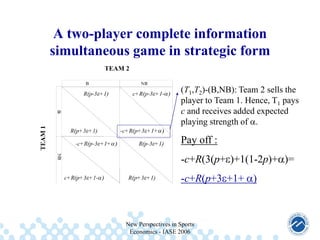
A two-player complete information
simultaneous game in strategic form
(T1,T2)-(B,NB): Team 2 sells the
player to Team 1. Hence, T1 pays
c and receives added expected
playing strength of .

Pay off :
-c+R(3(p+ )+1(1-2p)+ )=
-c+R(p+3 +1+ )

New Perspectives in Sports
Economics - IASE 2006
An arbitrage argument to establish c
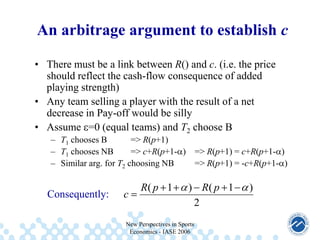
• There must be a link between R() and c. (i.e. the price
should reflect the cash-flow consequence of added
playing strength)
• Any team selling a player with the result of a net
decrease in Pay-off would be silly
• Assume =0 (equal teams) and T2 choose B
– T1 chooses B
=> R(p+1)
– T1 chooses NB
=> c+R(p+1- )
– Similar arg. for T2 choosing NB

Consequently:

c

R( p 1

=> R(p+1) = c+R(p+1- )
=> R(p+1) = -c+R(p+1- )

) R( p 1
2

New Perspectives in Sports
Economics - IASE 2006

)
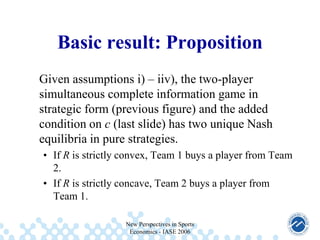
Basic result: Proposition
Given assumptions i) – iiv), the two-player
simultaneous complete information game in
strategic form (previous figure) and the added
condition on c (last slide) has two unique Nash
equilibria in pure strategies.
• If R is strictly convex, Team 1 buys a player from Team
2.
• If R is strictly concave, Team 2 buys a player from
Team 1.
New Perspectives in Sports
Economics - IASE 2006
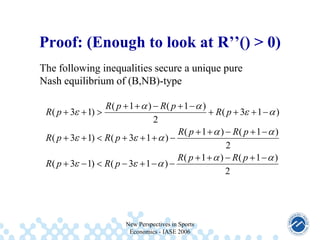
Proof: (Enough to look at R’’() > 0)
The following inequalities secure a unique pure
Nash equilibrium of (B,NB)-type
R( p 3

1)

R( p 1

R( p 3

1)

R( p 3

R( p 3

1)

R( p 3

) R( p 1 )
R( p 3 1
2
R( p 1 ) R( p 1
1 )
2
R( p 1 ) R( p 1
1 )
2

New Perspectives in Sports
Economics - IASE 2006

)
)
)
A little trick to move on….
A linear Taylor expansion: R(x
and some algebra yields:

)

R(x)

0

[ R' ( p 1 3 ) R' ( p 1)]

0

[ R' ( p 1 3 ) R' ( p 1)]

0

R’(x)

[ R' ( p 1) R' ( p 1 3 )]

If R’’> 0, these inequalities are satisfied (QED)

New Perspectives in Sports
Economics - IASE 2006
Conclusions: (1)
• The shape of R determines the “trade-direction”
completely
• A concave R secures trade by the weaker team
(i.e. increased competition)
• Somewhat contradictory to (standard) equilibrium
based theory
• However: Note strong assumptions
• One match (no league)
• Fairly equal teams ( 0)
• Low contribution to team playing strength by trade ( << p+1)

New Perspectives in Sports
Economics - IASE 2006
Conclusions: (2)
• In soccer, single games are important, CL or
WC
– At this level, high quality teams (i.e
– Fairly equal (quality) (i.e is small)

is small)

• Hence, this model (in such situations)
predicts an “invisible hand” preserving
competition given the “normal” assumption
of concave R.

New Perspectives in Sports
Economics - IASE 2006
Further work?
•
•
•
•

More teams
More games (league)
Incomplete information
Situations other than sports (other labour
markets): leisure industry

New Perspectives in Sports
Economics - IASE 2006

Iase 2006

  • 1.
    An economic modelof player trade – a game theoretic approach Kjetil K. Haugen Molde University College New Perspectives in Sports Economics - IASE 2006
  • 2.
    Motivation Quirk and El-Hodiri,“An economic model of a Professional Sports League”, J. of Pol. Econ., 1971 (Quote:) “The approach we adopt in this paper is to assume that the firm treats its own contract sales as under its own control, while it assumes that no contract sales take place among other teams.” Idea: How far can “actual” game theory bring us? New Perspectives in Sports Economics - IASE 2006
  • 3.
    Outline 1) 2) 3) 4) 5) 6) A two-player simultaneousgame An arbitrage argument Nash equilibria Proof Conclusions Suggestions for further work New Perspectives in Sports Economics - IASE 2006
  • 4.
    A two-player simultaneousgame: Assumptions i. ii. iii. iv. v. vi. vii. 2 teams (T1, T2) engaged in a future match, each team has put up one (“identical”) player for sale at a fixed price c. Marginally different playing strengths - T1 slightly “better” than T2 (meaning [P(Win), P(Loose), P(Draw)]=[p+ , p- , 1-2p] for T1 , > 0) Actions for each team, buy the player (B) or not buy (NB) Buying decisions made simultaneously (or without information on other teams buying decision) Teams maximize Pay off (defined below). A parameter (assumed small) increases (or decreases) expected point score conditioned on the buying decision. Expected point score calculated by a 3-1-0 award system A revenue function R(expected point score) is present converting playing strength to cash flow (i.e Pay off = cash flow + R(expected point score) R’’() is either > 0 or < 0, and all information above is known by both teams. (A game of complete information) New Perspectives in Sports Economics - IASE 2006
  • 5.
    A two-player completeinformation simultaneous game in strategic form (T1,T2)-(B,NB): Team 2 sells the player to Team 1. Hence, T1 pays c and receives added expected playing strength of . Pay off : -c+R(3(p+ )+1(1-2p)+ )= -c+R(p+3 +1+ ) New Perspectives in Sports Economics - IASE 2006
  • 6.
    An arbitrage argumentto establish c • There must be a link between R() and c. (i.e. the price should reflect the cash-flow consequence of added playing strength) • Any team selling a player with the result of a net decrease in Pay-off would be silly • Assume =0 (equal teams) and T2 choose B – T1 chooses B => R(p+1) – T1 chooses NB => c+R(p+1- ) – Similar arg. for T2 choosing NB Consequently: c R( p 1 => R(p+1) = c+R(p+1- ) => R(p+1) = -c+R(p+1- ) ) R( p 1 2 New Perspectives in Sports Economics - IASE 2006 )
  • 7.
    Basic result: Proposition Givenassumptions i) – iiv), the two-player simultaneous complete information game in strategic form (previous figure) and the added condition on c (last slide) has two unique Nash equilibria in pure strategies. • If R is strictly convex, Team 1 buys a player from Team 2. • If R is strictly concave, Team 2 buys a player from Team 1. New Perspectives in Sports Economics - IASE 2006
  • 8.
    Proof: (Enough tolook at R’’() > 0) The following inequalities secure a unique pure Nash equilibrium of (B,NB)-type R( p 3 1) R( p 1 R( p 3 1) R( p 3 R( p 3 1) R( p 3 ) R( p 1 ) R( p 3 1 2 R( p 1 ) R( p 1 1 ) 2 R( p 1 ) R( p 1 1 ) 2 New Perspectives in Sports Economics - IASE 2006 ) ) )
  • 9.
    A little trickto move on…. A linear Taylor expansion: R(x and some algebra yields: ) R(x) 0 [ R' ( p 1 3 ) R' ( p 1)] 0 [ R' ( p 1 3 ) R' ( p 1)] 0 R’(x) [ R' ( p 1) R' ( p 1 3 )] If R’’> 0, these inequalities are satisfied (QED) New Perspectives in Sports Economics - IASE 2006
  • 10.
    Conclusions: (1) • Theshape of R determines the “trade-direction” completely • A concave R secures trade by the weaker team (i.e. increased competition) • Somewhat contradictory to (standard) equilibrium based theory • However: Note strong assumptions • One match (no league) • Fairly equal teams ( 0) • Low contribution to team playing strength by trade ( << p+1) New Perspectives in Sports Economics - IASE 2006
  • 11.
    Conclusions: (2) • Insoccer, single games are important, CL or WC – At this level, high quality teams (i.e – Fairly equal (quality) (i.e is small) is small) • Hence, this model (in such situations) predicts an “invisible hand” preserving competition given the “normal” assumption of concave R. New Perspectives in Sports Economics - IASE 2006
  • 12.
    Further work? • • • • More teams Moregames (league) Incomplete information Situations other than sports (other labour markets): leisure industry New Perspectives in Sports Economics - IASE 2006