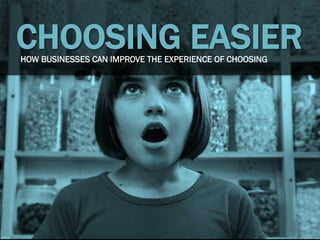
CHOOSING EASIERHOW BUSINESSES CAN IMPROVE THE EXPERIENCE OF CHOOSING
ABOUT THE SPEAKER
Sheena Iyengar is a psycho-economist.
She is the inaugural S.T. Lee Professor of
Business in the Management Division at
Columbia Business School and the
Faculty Director of the Eugene Lang
Entrepreneurship Center and known for
her research on choice, culture, and
innovation.
•  a typical American makes 
about 70 choices a day
•  an average grocery store
today offers you 45,000
products
•  a typical Walmart today
offers you 100,000 products
The choice causes overload problem.
The more choices available, the more
likely people were to completely avoid it.
3 m a i n n e g a t i v e
consequences  to offering
people more and more
choices:
1.  They are more
likely to delay
choosing
2.  They are more
likely to make
worse choices
3.  They are more
likely to choose
things that make
them less
satisfied
There are four simple
techniques you can
apply in your businesses
to avoid it.
1.  CUT
2.  CONCRETIZE
3.  CATEGORIZE
4.  CONDITION FOR
COMPLEXITY
CUT
Get rid of the extraneous alternatives.
When Procter&Gamble went from 26 different kinds of
Head&Shoulders to 15, they saw an increase in sales by
10 percent.
CONCRETIZE
Make it real.
In order for people to understand the differences between the
choices, they have to be able to understand the consequences
associated with each choice, and that the consequences need
to be felt in a very concrete way.
CATEGORIZE
We can handle more categories than we can handle choices. 
400 magazines divided into 20 categories make people
believe that they are given more choice and a better choosing
experience than when they are given 600 magazines divided
into 10 categories.
CONDITION FOR COMPLEXITY
We can actually handle a lot more information than we think
we can when we gradually increase the complexity.
You've got to make 60 different decisions to completely make
up a custom made car from a German car manufacturer.
These techniques are designed to help you manage
your choices.
Better for you - better for the people that you are
serving. 
Ted talk:
http://www.ted.com/talks/
sheena_iyengar_choosing_what_to_choose

Choosing easier. How businesses can improve the experience of choosing.

  • 1.
    CHOOSING EASIERHOW BUSINESSESCAN IMPROVE THE EXPERIENCE OF CHOOSING
  • 2.
    ABOUT THE SPEAKER SheenaIyengar is a psycho-economist. She is the inaugural S.T. Lee Professor of Business in the Management Division at Columbia Business School and the Faculty Director of the Eugene Lang Entrepreneurship Center and known for her research on choice, culture, and innovation.
  • 3.
    •  a typicalAmerican makes  about 70 choices a day •  an average grocery store today offers you 45,000 products •  a typical Walmart today offers you 100,000 products
  • 4.
    The choice causesoverload problem. The more choices available, the more likely people were to completely avoid it.
  • 5.
    3 m ai n n e g a t i v e consequences  to offering people more and more choices: 1.  They are more likely to delay choosing 2.  They are more likely to make worse choices 3.  They are more likely to choose things that make them less satisfied
  • 6.
    There are foursimple techniques you can apply in your businesses to avoid it. 1.  CUT 2.  CONCRETIZE 3.  CATEGORIZE 4.  CONDITION FOR COMPLEXITY
  • 7.
    CUT Get rid ofthe extraneous alternatives. When Procter&Gamble went from 26 different kinds of Head&Shoulders to 15, they saw an increase in sales by 10 percent.
  • 8.
    CONCRETIZE Make it real. Inorder for people to understand the differences between the choices, they have to be able to understand the consequences associated with each choice, and that the consequences need to be felt in a very concrete way.
  • 9.
    CATEGORIZE We can handlemore categories than we can handle choices.  400 magazines divided into 20 categories make people believe that they are given more choice and a better choosing experience than when they are given 600 magazines divided into 10 categories.
  • 10.
    CONDITION FOR COMPLEXITY Wecan actually handle a lot more information than we think we can when we gradually increase the complexity. You've got to make 60 different decisions to completely make up a custom made car from a German car manufacturer.
  • 11.
    These techniques aredesigned to help you manage your choices. Better for you - better for the people that you are serving. 
  • 12.