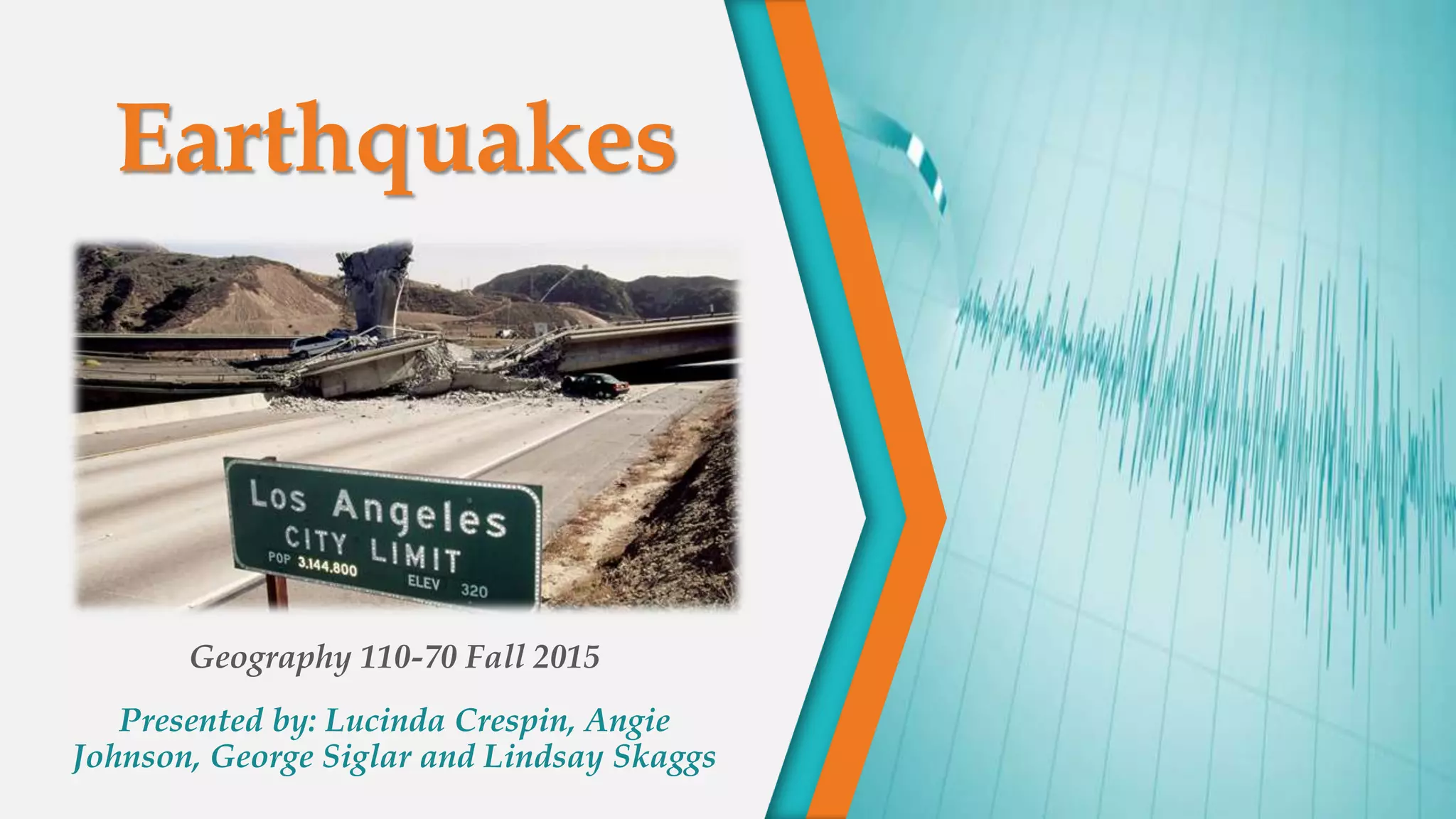
Geography 110-70 Fall 2015
Presented by: Lucinda Crespin, Angie
Johnson, George Siglar and Lindsay Skaggs
Earthquakes
Earthquake – What is it?
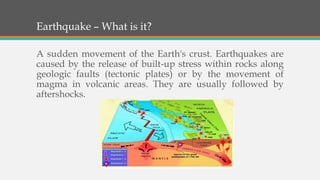
A sudden movement of the Earth's crust. Earthquakes are
caused by the release of built-up stress within rocks along
geologic faults (tectonic plates) or by the movement of
magma in volcanic areas. They are usually followed by
aftershocks.
Where Are Tectonic Plates Located?
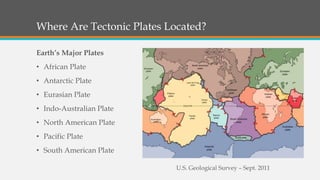
Earth’s Major Plates
• African Plate
• Antarctic Plate
• Eurasian Plate
• Indo-Australian Plate
• North American Plate
• Pacific Plate
• South American Plate
U.S. Geological Survey – Sept. 2011
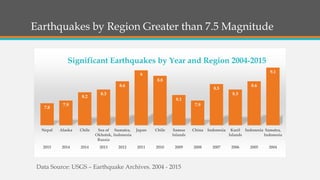
Earthquakes by Region Greater than 7.5 Magnitude
7.8
7.9
8.2
8.3
8.6
9
8.8
8.1
7.9
8.5
8.3
8.6
9.1
Nepal Alaska Chile Sea of
Okhotsk,
Russia
Sumatra,
Indonesia
Japan Chile Samoa
Islands
China Indonesia Kuril
Islands
Indonesia Samatra,
Indonesia
2015 2014 2014 2013 2012 2011 2010 2009 2008 2007 2006 2005 2004
Significant Earthquakes by Year and Region 2004-2015
Data Source: USGS – Earthquake Archives. 2004 - 2015
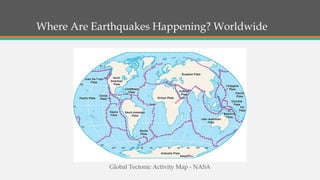
Where Are Earthquakes Happening? Worldwide
Global Tectonic Activity Map - NASA
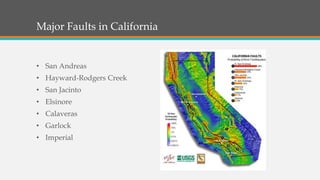
Major Faults in California
• San Andreas
• Hayward-Rodgers Creek
• San Jacinto
• Elsinore
• Calaveras
• Garlock
• Imperial
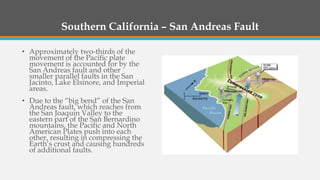
Southern California – San Andreas Fault
• Approximately two-thirds of the
movement of the Pacific plate
movement is accounted for by the
San Andreas fault and other
smaller parallel faults in the San
Jacinto, Lake Elsinore, and Imperial
areas.
• Due to the “big bend” of the San
Andreas fault, which reaches from
the San Joaquin Valley to the
eastern part of the San Bernardino
mountains, the Pacific and North
American Plates push into each
other, resulting in compressing the
Earth’s crust and causing hundreds
of additional faults.
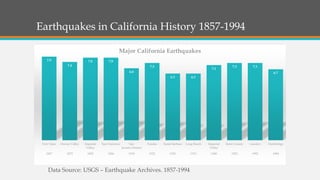
Earthquakes in California History 1857-1994
Data Source: USGS – Earthquake Archives. 1857-1994
7.9
7.4
7.8 7.8
6.8
7.3
6.3 6.3
7.1
7.3 7.3
6.7
Fort Tejon Owens Valley Imperial
Valley
San Francisco San
Jacinto/Hemet
Eureka Santa Barbara Long Beach Imperial
Valley
Kern County Landers Northridge
1857 1872 1892 1906 1918 1922 1925 1933 1940 1952 1992 1994
Major California Earthquakes
Southern California – Significant Earthquakes
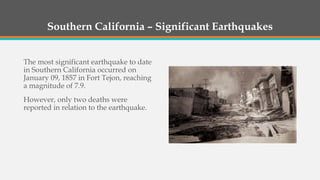
The most significant earthquake to date
in Southern California occurred on
January 09, 1857 in Fort Tejon, reaching
a magnitude of 7.9.
However, only two deaths were
reported in relation to the earthquake.
Southern California – Significant Earthquakes
(cont.)
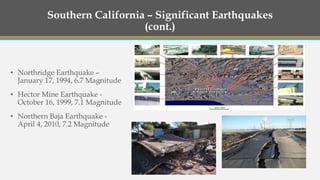
• Northridge Earthquake –
January 17, 1994, 6.7 Magnitude
• Hector Mine Earthquake -
October 16, 1999, 7.1 Magnitude
• Northern Baja Earthquake -
April 4, 2010, 7.2 Magnitude
Significant Earthquakes – United States
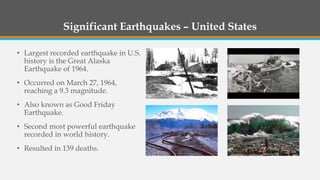
• Largest recorded earthquake in U.S.
history is the Great Alaska
Earthquake of 1964.
• Occurred on March 27, 1964,
reaching a 9.3 magnitude.
• Also known as Good Friday
Earthquake.
• Second most powerful earthquake
recorded in world history.
• Resulted in 139 deaths.
Significant Earthquakes – Around the World
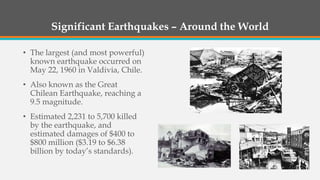
• The largest (and most powerful)
known earthquake occurred on
May 22, 1960 in Valdivia, Chile.
• Also known as the Great
Chilean Earthquake, reaching a
9.5 magnitude.
• Estimated 2,231 to 5,700 killed
by the earthquake, and
estimated damages of $400 to
$800 million ($3.19 to $6.38
billion by today’s standards).
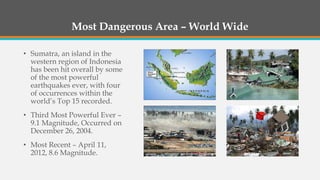
Most Dangerous Area – World Wide
• Sumatra, an island in the
western region of Indonesia
has been hit overall by some
of the most powerful
earthquakes ever, with four
of occurrences within the
world’s Top 15 recorded.
• Third Most Powerful Ever –
9.1 Magnitude, Occurred on
December 26, 2004.
• Most Recent – April 11,
2012, 8.6 Magnitude.
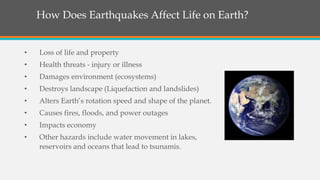
• Loss of life and property
• Health threats - injury or illness
• Damages environment (ecosystems)
• Destroys landscape (Liquefaction and landslides)
• Alters Earth’s rotation speed and shape of the planet.
• Causes fires, floods, and power outages
• Impacts economy
• Other hazards include water movement in lakes,
reservoirs and oceans that lead to tsunamis.
How Does Earthquakes Affect Life on Earth?
Issues and Concerns with Earthquakes
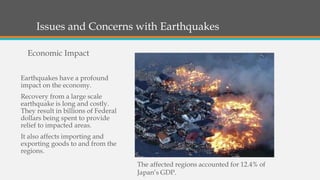
Earthquakes have a profound
impact on the economy.
Recovery from a large scale
earthquake is long and costly.
They result in billions of Federal
dollars being spent to provide
relief to impacted areas.
It also affects importing and
exporting goods to and from the
regions.
Economic Impact
The affected regions accounted for 12.4% of
Japan’s GDP.
Issues and Concerns with Earthquakes
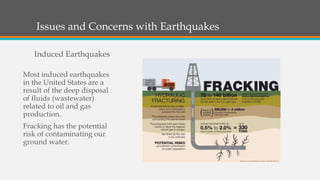
Most induced earthquakes
in the United States are a
result of the deep disposal
of fluids (wastewater)
related to oil and gas
production.
Fracking has the potential
risk of contaminating our
ground water.
Induced Earthquakes
Issues and Concerns with Earthquakes
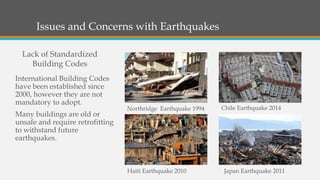
International Building Codes
have been established since
2000, however they are not
mandatory to adopt.
Many buildings are old or
unsafe and require retrofitting
to withstand future
earthquakes.
Lack of Standardized
Building Codes
Haiti Earthquake 2010 Japan Earthquake 2011
Chile Earthquake 2014Northridge Earthquake 1994
Issues and Concerns with Earthquakes
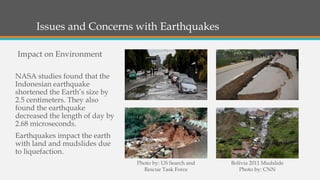
NASA studies found that the
Indonesian earthquake
shortened the Earth’s size by
2.5 centimeters. They also
found the earthquake
decreased the length of day by
2.68 microseconds.
Earthquakes impact the earth
with land and mudslides due
to liquefaction.
Impact on Environment
Photo by: US Search and
Rescue Task Force
Bolivia 2011 Mudslide
Photo by: CNN
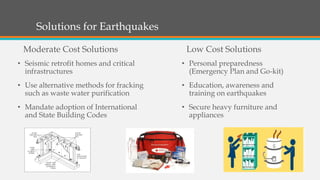
• Seismic retrofit homes and critical
infrastructures
• Use alternative methods for fracking
such as waste water purification
• Mandate adoption of International
and State Building Codes
Solutions for Earthquakes
Low Cost Solutions
• Personal preparedness
(Emergency Plan and Go-kit)
• Education, awareness and
training on earthquakes
• Secure heavy furniture and
appliances
Moderate Cost Solutions
Earthquake Education and Training
Awareness and Education
• www.ready.gov
• www.usgs.gov
• www.dhs.gov/citizen-corps
• www.caloes.ca.gov
• www.caltech.edu
Free Disaster Training
• www.fema.gov/community-
emergency-response-teams
• www.teex.org
• www.training.fema.gov/is/crslist.aspx
• www.redcross.org/ca/san-
bernardino/take-a-class
Summary of Earthquakes
In conclusion, Earthquakes are a natural disaster that will occur worldwide
and cause shaking, rolling, aftershocks and secondary disasters along the
tectonic plates. The best tools to increase your survival rate is being proactive
and develop a plan for you and your family. People who live near active
faults can increase their knowledge about earthquakes, build a go kit for 3-7
days to include non-perishable foods, water and first aid supplies, secure
heavy furniture, secure appliances and retrofit home if necessary.
Protecting our homes, critical infrastructures and environment can reduce the
costs of recovery. Public awareness, education and training are the key to
reduce and minimize loss of life, property and environment.
Citations
"Moving Slabs "This Dynamic Earth, USGS"" United States Geological Survey. U.S. Department of Interior, 19 Sept. 2011. Accessed Web. 19 Oct. 2015.
<http://pubs.usgs.gov/gip/dynamic/slabs.html>.
Johns, Chris. "Tectonic Plate Photo Gallery." National Geographic. National Geographic Society, n.d. Accessed Web. 19 Oct. 2015.
<http://science.nationalgeographic.com/science/photos/plate-tectonics-gallery.jpg>.
Weier, John. "Putting Earthquakes in Their Place: Feature Articles." National Aeronautics and Space Administration, 7 Feb. 2000. Accessed Web. 07 Nov.
2015. <http://earthobservatory.nasa.gov/Features/Tectonics/>.
Hess, Darrel, and Tom L. McKnight. "Chapter 14." McKnight's Physical Geography: A Landscape Appreciation. 10th ed. Pearson Prentice Hall, 2011. Print.
Sever, Megan. "California's Impending "Big One"" California's Impending "big One" American Geological Institute, 15 Apr. 2008. Accessed Web. 07 Nov.
2015. <http://www.geotimes.org/apr08/article.html?id=WebExtra041508.html>.
Von Hake, Carl A. "California Earthquake History." Earthquake Hazards Program. U.S. Department of Interior, 14 Jan. 2015. Accessed Web. 07 Nov. 2015.
<http://earthquake.usgs.gov/earthquakes/states/california/history.php>.
Jones, Lucille, and Mark Benthien. "Southern California Faults." Putting Down Roots in Earthquake Country. Southern California Earthquake Center for
University of Southern California, 2011. Accessed Web. 07 Nov. 2015. <http://www.earthquakecountry.info/roots/socal-faults.html>.
Dunbar, Brian. "Japan Quake May Have Shortened Earth Days, Moved Axis." NASA. NASA, 14 Mar. 2011. Web. 07 Nov. 2015.
<http://www.nasa.gov/topics/earth/features/japanquake/earth20110314.html>.
Ferreira, Susana. "The Sad Economic Lesson of the Earthquakes in Nepal." Fortune Insider Nepal Earthquake. Fortune.com, 13 May 2015. Web. 07 Nov.
2015. <http://fortune.com/2015/05/13/the-sad-economic-lesson-of-the-earthquakes-in-nepal>.
Rubinstein, Justin L., and Alireza Babaie Mahani. "Myths and Facts on Wastewater Injection, Hydraulic Fracturing, Enhanced Oil Recovery, and Induced
Seismicity." (n.d.): n. pag. United States Geological Survey. U.S. Department of Interior. Web.
<https://profile.usgs.gov/myscience/upload_folder/ci2015Jun1012005755600Induced_EQs_Review.pdf>.
CITATIONS

Earthquakes

  • 1.
    Geography 110-70 Fall2015 Presented by: Lucinda Crespin, Angie Johnson, George Siglar and Lindsay Skaggs Earthquakes
  • 2.
    Earthquake – Whatis it? A sudden movement of the Earth's crust. Earthquakes are caused by the release of built-up stress within rocks along geologic faults (tectonic plates) or by the movement of magma in volcanic areas. They are usually followed by aftershocks.
  • 3.
    Where Are TectonicPlates Located? Earth’s Major Plates • African Plate • Antarctic Plate • Eurasian Plate • Indo-Australian Plate • North American Plate • Pacific Plate • South American Plate U.S. Geological Survey – Sept. 2011
  • 4.
    Earthquakes by RegionGreater than 7.5 Magnitude 7.8 7.9 8.2 8.3 8.6 9 8.8 8.1 7.9 8.5 8.3 8.6 9.1 Nepal Alaska Chile Sea of Okhotsk, Russia Sumatra, Indonesia Japan Chile Samoa Islands China Indonesia Kuril Islands Indonesia Samatra, Indonesia 2015 2014 2014 2013 2012 2011 2010 2009 2008 2007 2006 2005 2004 Significant Earthquakes by Year and Region 2004-2015 Data Source: USGS – Earthquake Archives. 2004 - 2015
  • 5.
    Where Are EarthquakesHappening? Worldwide Global Tectonic Activity Map - NASA
  • 6.
    Major Faults inCalifornia • San Andreas • Hayward-Rodgers Creek • San Jacinto • Elsinore • Calaveras • Garlock • Imperial
  • 7.
    Southern California –San Andreas Fault • Approximately two-thirds of the movement of the Pacific plate movement is accounted for by the San Andreas fault and other smaller parallel faults in the San Jacinto, Lake Elsinore, and Imperial areas. • Due to the “big bend” of the San Andreas fault, which reaches from the San Joaquin Valley to the eastern part of the San Bernardino mountains, the Pacific and North American Plates push into each other, resulting in compressing the Earth’s crust and causing hundreds of additional faults.
  • 8.
    Earthquakes in CaliforniaHistory 1857-1994 Data Source: USGS – Earthquake Archives. 1857-1994 7.9 7.4 7.8 7.8 6.8 7.3 6.3 6.3 7.1 7.3 7.3 6.7 Fort Tejon Owens Valley Imperial Valley San Francisco San Jacinto/Hemet Eureka Santa Barbara Long Beach Imperial Valley Kern County Landers Northridge 1857 1872 1892 1906 1918 1922 1925 1933 1940 1952 1992 1994 Major California Earthquakes
  • 9.
    Southern California –Significant Earthquakes The most significant earthquake to date in Southern California occurred on January 09, 1857 in Fort Tejon, reaching a magnitude of 7.9. However, only two deaths were reported in relation to the earthquake.
  • 10.
    Southern California –Significant Earthquakes (cont.) • Northridge Earthquake – January 17, 1994, 6.7 Magnitude • Hector Mine Earthquake - October 16, 1999, 7.1 Magnitude • Northern Baja Earthquake - April 4, 2010, 7.2 Magnitude
  • 11.
    Significant Earthquakes –United States • Largest recorded earthquake in U.S. history is the Great Alaska Earthquake of 1964. • Occurred on March 27, 1964, reaching a 9.3 magnitude. • Also known as Good Friday Earthquake. • Second most powerful earthquake recorded in world history. • Resulted in 139 deaths.
  • 12.
    Significant Earthquakes –Around the World • The largest (and most powerful) known earthquake occurred on May 22, 1960 in Valdivia, Chile. • Also known as the Great Chilean Earthquake, reaching a 9.5 magnitude. • Estimated 2,231 to 5,700 killed by the earthquake, and estimated damages of $400 to $800 million ($3.19 to $6.38 billion by today’s standards).
  • 13.
    Most Dangerous Area– World Wide • Sumatra, an island in the western region of Indonesia has been hit overall by some of the most powerful earthquakes ever, with four of occurrences within the world’s Top 15 recorded. • Third Most Powerful Ever – 9.1 Magnitude, Occurred on December 26, 2004. • Most Recent – April 11, 2012, 8.6 Magnitude.
  • 14.
    • Loss oflife and property • Health threats - injury or illness • Damages environment (ecosystems) • Destroys landscape (Liquefaction and landslides) • Alters Earth’s rotation speed and shape of the planet. • Causes fires, floods, and power outages • Impacts economy • Other hazards include water movement in lakes, reservoirs and oceans that lead to tsunamis. How Does Earthquakes Affect Life on Earth?
  • 15.
    Issues and Concernswith Earthquakes Earthquakes have a profound impact on the economy. Recovery from a large scale earthquake is long and costly. They result in billions of Federal dollars being spent to provide relief to impacted areas. It also affects importing and exporting goods to and from the regions. Economic Impact The affected regions accounted for 12.4% of Japan’s GDP.
  • 16.
    Issues and Concernswith Earthquakes Most induced earthquakes in the United States are a result of the deep disposal of fluids (wastewater) related to oil and gas production. Fracking has the potential risk of contaminating our ground water. Induced Earthquakes
  • 17.
    Issues and Concernswith Earthquakes International Building Codes have been established since 2000, however they are not mandatory to adopt. Many buildings are old or unsafe and require retrofitting to withstand future earthquakes. Lack of Standardized Building Codes Haiti Earthquake 2010 Japan Earthquake 2011 Chile Earthquake 2014Northridge Earthquake 1994
  • 18.
    Issues and Concernswith Earthquakes NASA studies found that the Indonesian earthquake shortened the Earth’s size by 2.5 centimeters. They also found the earthquake decreased the length of day by 2.68 microseconds. Earthquakes impact the earth with land and mudslides due to liquefaction. Impact on Environment Photo by: US Search and Rescue Task Force Bolivia 2011 Mudslide Photo by: CNN
  • 19.
    • Seismic retrofithomes and critical infrastructures • Use alternative methods for fracking such as waste water purification • Mandate adoption of International and State Building Codes Solutions for Earthquakes Low Cost Solutions • Personal preparedness (Emergency Plan and Go-kit) • Education, awareness and training on earthquakes • Secure heavy furniture and appliances Moderate Cost Solutions
  • 20.
    Earthquake Education andTraining Awareness and Education • www.ready.gov • www.usgs.gov • www.dhs.gov/citizen-corps • www.caloes.ca.gov • www.caltech.edu Free Disaster Training • www.fema.gov/community- emergency-response-teams • www.teex.org • www.training.fema.gov/is/crslist.aspx • www.redcross.org/ca/san- bernardino/take-a-class
  • 21.
    Summary of Earthquakes Inconclusion, Earthquakes are a natural disaster that will occur worldwide and cause shaking, rolling, aftershocks and secondary disasters along the tectonic plates. The best tools to increase your survival rate is being proactive and develop a plan for you and your family. People who live near active faults can increase their knowledge about earthquakes, build a go kit for 3-7 days to include non-perishable foods, water and first aid supplies, secure heavy furniture, secure appliances and retrofit home if necessary. Protecting our homes, critical infrastructures and environment can reduce the costs of recovery. Public awareness, education and training are the key to reduce and minimize loss of life, property and environment.
  • 22.
    Citations "Moving Slabs "ThisDynamic Earth, USGS"" United States Geological Survey. U.S. Department of Interior, 19 Sept. 2011. Accessed Web. 19 Oct. 2015. <http://pubs.usgs.gov/gip/dynamic/slabs.html>. Johns, Chris. "Tectonic Plate Photo Gallery." National Geographic. National Geographic Society, n.d. Accessed Web. 19 Oct. 2015. <http://science.nationalgeographic.com/science/photos/plate-tectonics-gallery.jpg>. Weier, John. "Putting Earthquakes in Their Place: Feature Articles." National Aeronautics and Space Administration, 7 Feb. 2000. Accessed Web. 07 Nov. 2015. <http://earthobservatory.nasa.gov/Features/Tectonics/>. Hess, Darrel, and Tom L. McKnight. "Chapter 14." McKnight's Physical Geography: A Landscape Appreciation. 10th ed. Pearson Prentice Hall, 2011. Print. Sever, Megan. "California's Impending "Big One"" California's Impending "big One" American Geological Institute, 15 Apr. 2008. Accessed Web. 07 Nov. 2015. <http://www.geotimes.org/apr08/article.html?id=WebExtra041508.html>. Von Hake, Carl A. "California Earthquake History." Earthquake Hazards Program. U.S. Department of Interior, 14 Jan. 2015. Accessed Web. 07 Nov. 2015. <http://earthquake.usgs.gov/earthquakes/states/california/history.php>. Jones, Lucille, and Mark Benthien. "Southern California Faults." Putting Down Roots in Earthquake Country. Southern California Earthquake Center for University of Southern California, 2011. Accessed Web. 07 Nov. 2015. <http://www.earthquakecountry.info/roots/socal-faults.html>. Dunbar, Brian. "Japan Quake May Have Shortened Earth Days, Moved Axis." NASA. NASA, 14 Mar. 2011. Web. 07 Nov. 2015. <http://www.nasa.gov/topics/earth/features/japanquake/earth20110314.html>. Ferreira, Susana. "The Sad Economic Lesson of the Earthquakes in Nepal." Fortune Insider Nepal Earthquake. Fortune.com, 13 May 2015. Web. 07 Nov. 2015. <http://fortune.com/2015/05/13/the-sad-economic-lesson-of-the-earthquakes-in-nepal>. Rubinstein, Justin L., and Alireza Babaie Mahani. "Myths and Facts on Wastewater Injection, Hydraulic Fracturing, Enhanced Oil Recovery, and Induced Seismicity." (n.d.): n. pag. United States Geological Survey. U.S. Department of Interior. Web. <https://profile.usgs.gov/myscience/upload_folder/ci2015Jun1012005755600Induced_EQs_Review.pdf>. CITATIONS

Editor's Notes

  • #3 Johns, Chris. "Tectonic Plate Photo Gallery." National Geographic's. National Geographic Society, n.d. Accessed Web. 21 Oct. 2015. <http://science.nationalgeographic.com/science/photos/plate-tectonics-gallery.jpg>.
  • #4 "Moving Slabs "This Dynamic Earth, USGS"" United States Geological Survey. U.S. Department of Interior, 19 Sept. 2011. Web. 19 Oct. 2015. <http://pubs.usgs.gov/gip/dynamic/slabs.html>.
  • #5 Map data from archived earthquakes http://earthquake.usgs.gov
  • #6 Weier, John. "Putting Earthquakes in Their Place : Feature Articles." Putting Earthquakes in Their Place : Feature Articles. National Aeronautics and Space Administration, 7 Feb. 2000. Web. 07 Nov. 2015. <http://earthobservatory.nasa.gov/Features/Tectonics/>.
  • #7 Sever, Megan. "California's Impending "Big One"" California's Impending "big One" American Geological Institute, 15 Apr. 2008. Web. 07 Nov. 2015. <http://www.geotimes.org/apr08/article.html?id=WebExtra041508.html>.
  • #8 Jones, Lucille, and Mark Benthien. "Southern California Faults." Putting Down Roots in Earthquake Country. Southern California Earthquake Center/USC, 2011. Web. 07 Nov. 2015. <http://www.earthquakecountry.info/roots/socal-faults.html>.
  • #9 Von Hake, Carl A. "California Earthquake History." Earthquake Hazards Program. U.S. Department of Interior, 14 Jan. 2015. Web. 07 Nov. 2015. <http://earthquake.usgs.gov/earthquakes/states/california/history.php>.
  • #15 Information from various websites: http://www.nasa.gov/topics/earth/features/japanquake/earth20110314.html http://www.livescience.com/31404-chile-earthquake-ecosystem-impacts.html http://www.fema.gov/why-earthquakes-occur http://fortune.com/2015/05/13/the-sad-economic-lesson-of-the-earthquakes-in-nepal/ http://emergency.cdc.gov/disasters/landslides.asp
  • #16 http://www.latimes.com/world/la-fg-japan-tsunami-before-after-slider-htmlstory.html http://emergency.lacity.org/emergencychecklist/laemergenciesthreats/index.htm http://www.businessinsider.com/tohuko-vs-kobe-economic-impact-of-japans-earthquake-2011-3
  • #17 https://profile.usgs.gov/myscience/upload_folder/ci2015Jun1012005755600Induced_EQs_Review.pdf http://www.napavalley.edu/Library/Pages/HSI-STEM-2015-Summer-Institute---Fracking-Resources.aspx
  • #18 http://www.ngdc.noaa.gov/hazardimages/event/show/258 http://www.foxnews.com/world/2013/02/27/on-3rd-anniversary-big-chile-quake-survivor-recalls-deadly-jolt-that-changed/ http://www.latimes.com/world/la-fg-japan-tsunami-before-after-slider-htmlstory.html http://www.nbclosangeles.com/news/local/Timeline-The-Northridge-Earthquake-240665071.html
  • #19 http://www.nasa.gov/home/hqnews/2005/jan/HQ_05011_earthquake.html http://www.ussartf.org/landslides.htm http://www.cnn.com/2011/WORLD/americas/02/28/bolivia.landslide/