SF Department of Public Health                                                Quarterly IIPP Training
Occupational Safety & Health                                               Earthquake Preparedness

Earthquake Preparedness & What to Do When an Earthquake Occurs
Prepared by:    Shawn Holle, Safety Analyst

Preparedness at Work
No one knows when the next earthquake will occur in the San Francisco Bay Area, but we can
reduce our risk of injury, death and property loss by being prepared.
Detailed information regarding earthquakes and other emergencies can be obtained online at
the following links:

www.72hours.org

www.oes.ca.gov

Both are excellent and are linked to hundreds of sources for additional preparedness
information.

Emergency Evacuation Plans for DPH Locations
In addition to CCSF’s Continuity of Operations Plans, your sites should have an
Emergency Evacuation Plan. Be familiar with the current plan at your facility:

     Do you know the emergency evacuation procedures for work site?
     Do you know your place of refuge?
     Do you know where your emergency supplies are stored?
     Does your facility conduct practice evacuation drills twice a year?
     Are you familiar with the additional security measures at the jail?

Preparedness at Home

     Heavy furniture and appliances secured to walls?
     Do you have a disaster plan that includes:
     o    What to do during various disasters such as earthquakes and fires?
     o    Selection of a safe place outside your home to meet family members?

     o    A plan for dealing with your pets

     o    A designated out-of-state contact person who can be phoned to relay
          information?
         Do you have disaster supply kits in your home and car?
SF Department of Public Health                                               Quarterly IIPP Training
Occupational Safety & Health                                              Earthquake Preparedness

During an Earthquake and Aftershocks

Indoors
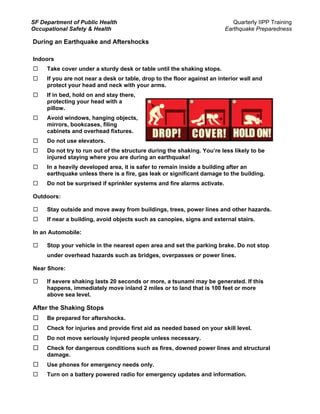
     Take cover under a sturdy desk or table until the shaking stops.
     If you are not near a desk or table, drop to the floor against an interior wall and
     protect your head and neck with your arms.
     If in bed, hold on and stay there,
     protecting your head with a
     pillow.
     Avoid windows, hanging objects,
     mirrors, bookcases, filing
     cabinets and overhead fixtures.
     Do not use elevators.
     Do not try to run out of the structure during the shaking. You’re less likely to be
     injured staying where you are during an earthquake!
     In a heavily developed area, it is safer to remain inside a building after an
     earthquake unless there is a fire, gas leak or significant damage to the building.
     Do not be surprised if sprinkler systems and fire alarms activate.

Outdoors:

     Stay outside and move away from buildings, trees, power lines and other hazards.
     If near a building, avoid objects such as canopies, signs and external stairs.

In an Automobile:

     Stop your vehicle in the nearest open area and set the parking brake. Do not stop
     under overhead hazards such as bridges, overpasses or power lines.

Near Shore:

     If severe shaking lasts 20 seconds or more, a tsunami may be generated. If this
     happens, immediately move inland 2 miles or to land that is 100 feet or more
     above sea level.

After the Shaking Stops
     Be prepared for aftershocks.
     Check for injuries and provide first aid as needed based on your skill level.
     Do not move seriously injured people unless necessary.
     Check for dangerous conditions such as fires, downed power lines and structural
     damage.
     Use phones for emergency needs only.
     Turn on a battery powered radio for emergency updates and information.
SF Department of Public Health                                              Quarterly IIPP Training
Occupational Safety & Health                                             Earthquake Preparedness

Your Role as a Disaster Service Worker
     The Mayor of San Francisco or Governor may declare a catastrophe, and
     All City workers will be required to report as Disaster Service Workers.
     As a Disaster Service Worker, you can be assigned disaster service work that
     promotes the protection of public health and safety.
     During a catastrophe, your first priority is to make sure your family is safe. After
     ensuring the safety of your family, you are required to make every effort to report
     to work for your emergency assignment.
     Disaster service work is performed in two 12 hour shifts (A & B).
     o   Shift A are employees living in San Francisco and report immediately.
     o   Shift B are employees living outside of San Francisco and report 12 hours later
         or as instructed in emergency broadcasts.
     The Office of Emergency Services (OES) and the DPH will coordinate work
     assignments. Your assignment may require you to serve at a location and time
     different from your normal work assignment. Under no circumstances will you be
     assigned work requiring skills you do not possess that may put you at risk of
     injury.
     How do I receive Disaster Service Worker information?
     o   Listen to KCBS (740 AM), KGO (810 AM), KNBR (680 AM) and KQED (88.5 FM)
         for instructions on reporting to work.
     o   For specific DPH information and instructions, call the DPH Emergency Update
         line at 557-4298 or (916) 441-4521.
     When reporting for disaster service work:
     o   Bring your employee and Disaster Service Worker ID.
     o   Report to your designated Staging Area. For people living outside of San
         Francisco facing the possibility of inaccessible bridges and roads, report to
         the following staging area nearest you.

            Vallejo-Mare Island Ferry Terminal

            Larkspur Landing Ferry Terminal

            Sausalito Ferry Terminal

            Berkeley Marina

            Richmond Marina

            Jack London Square Ferry Terminal

            Bay Farm Island Ferry Terminal

            Port of Redwood City

Earthquake Preparedness

  • 1.
    SF Department ofPublic Health Quarterly IIPP Training Occupational Safety & Health Earthquake Preparedness Earthquake Preparedness & What to Do When an Earthquake Occurs Prepared by: Shawn Holle, Safety Analyst Preparedness at Work No one knows when the next earthquake will occur in the San Francisco Bay Area, but we can reduce our risk of injury, death and property loss by being prepared. Detailed information regarding earthquakes and other emergencies can be obtained online at the following links: www.72hours.org www.oes.ca.gov Both are excellent and are linked to hundreds of sources for additional preparedness information. Emergency Evacuation Plans for DPH Locations In addition to CCSF’s Continuity of Operations Plans, your sites should have an Emergency Evacuation Plan. Be familiar with the current plan at your facility: Do you know the emergency evacuation procedures for work site? Do you know your place of refuge? Do you know where your emergency supplies are stored? Does your facility conduct practice evacuation drills twice a year? Are you familiar with the additional security measures at the jail? Preparedness at Home Heavy furniture and appliances secured to walls? Do you have a disaster plan that includes: o What to do during various disasters such as earthquakes and fires? o Selection of a safe place outside your home to meet family members? o A plan for dealing with your pets o A designated out-of-state contact person who can be phoned to relay information? Do you have disaster supply kits in your home and car?
  • 2.
    SF Department ofPublic Health Quarterly IIPP Training Occupational Safety & Health Earthquake Preparedness During an Earthquake and Aftershocks Indoors Take cover under a sturdy desk or table until the shaking stops. If you are not near a desk or table, drop to the floor against an interior wall and protect your head and neck with your arms. If in bed, hold on and stay there, protecting your head with a pillow. Avoid windows, hanging objects, mirrors, bookcases, filing cabinets and overhead fixtures. Do not use elevators. Do not try to run out of the structure during the shaking. You’re less likely to be injured staying where you are during an earthquake! In a heavily developed area, it is safer to remain inside a building after an earthquake unless there is a fire, gas leak or significant damage to the building. Do not be surprised if sprinkler systems and fire alarms activate. Outdoors: Stay outside and move away from buildings, trees, power lines and other hazards. If near a building, avoid objects such as canopies, signs and external stairs. In an Automobile: Stop your vehicle in the nearest open area and set the parking brake. Do not stop under overhead hazards such as bridges, overpasses or power lines. Near Shore: If severe shaking lasts 20 seconds or more, a tsunami may be generated. If this happens, immediately move inland 2 miles or to land that is 100 feet or more above sea level. After the Shaking Stops Be prepared for aftershocks. Check for injuries and provide first aid as needed based on your skill level. Do not move seriously injured people unless necessary. Check for dangerous conditions such as fires, downed power lines and structural damage. Use phones for emergency needs only. Turn on a battery powered radio for emergency updates and information.
  • 3.
    SF Department ofPublic Health Quarterly IIPP Training Occupational Safety & Health Earthquake Preparedness Your Role as a Disaster Service Worker The Mayor of San Francisco or Governor may declare a catastrophe, and All City workers will be required to report as Disaster Service Workers. As a Disaster Service Worker, you can be assigned disaster service work that promotes the protection of public health and safety. During a catastrophe, your first priority is to make sure your family is safe. After ensuring the safety of your family, you are required to make every effort to report to work for your emergency assignment. Disaster service work is performed in two 12 hour shifts (A & B). o Shift A are employees living in San Francisco and report immediately. o Shift B are employees living outside of San Francisco and report 12 hours later or as instructed in emergency broadcasts. The Office of Emergency Services (OES) and the DPH will coordinate work assignments. Your assignment may require you to serve at a location and time different from your normal work assignment. Under no circumstances will you be assigned work requiring skills you do not possess that may put you at risk of injury. How do I receive Disaster Service Worker information? o Listen to KCBS (740 AM), KGO (810 AM), KNBR (680 AM) and KQED (88.5 FM) for instructions on reporting to work. o For specific DPH information and instructions, call the DPH Emergency Update line at 557-4298 or (916) 441-4521. When reporting for disaster service work: o Bring your employee and Disaster Service Worker ID. o Report to your designated Staging Area. For people living outside of San Francisco facing the possibility of inaccessible bridges and roads, report to the following staging area nearest you. Vallejo-Mare Island Ferry Terminal Larkspur Landing Ferry Terminal Sausalito Ferry Terminal Berkeley Marina Richmond Marina Jack London Square Ferry Terminal Bay Farm Island Ferry Terminal Port of Redwood City