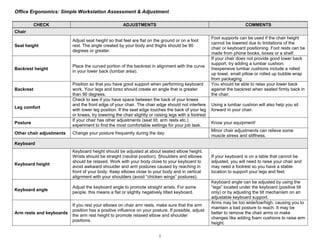
Office Ergonomics: Simple Workstation Assessment & Adjustment

           CHECK                                     ADJUSTMENTS                                                       COMMENTS
Chair
                                                                                                      Foot supports can be used if the chair height
                          Adjust seat height so that feet are flat on the ground or on a foot
                                                                                                      cannot be lowered due to limitations of the
Seat height               rest. The angle created by your body and thighs should be 90
                                                                                                      chair or keyboard positioning. Foot rests can be
                          degrees or greater.
                                                                                                      made from phone books, boxes or a shelf.
                                                                                                      If your chair does not provide good lower back
                                                                                                      support, try adding a lumbar cushion.
                          Place the curved portion of the backrest in alignment with the curve
Backrest height                                                                                       Inexpensive lumbar cushions include a rolled
                          in your lower back (lumbar area).
                                                                                                      up towel, small pillow or rolled up bubble wrap
                                                                                                      from packaging.
                          Position so that you have good support when performing keyboard             You should be able to relax your lower back
Backrest                  work. Your legs and torso should create an angle that is greater            against the backrest when seated firmly back in
                          than 90 degrees.                                                            the chair.
                          Check to see if you have space between the back of your knees
                          and the front edge of your chair. The chair edge should not interfere       Using a lumbar cushion will also help you sit
Leg comfort
                          with lower leg position. If the seat edge touches the back of your leg      forward in your chair.
                          or knees, try lowering the chair slightly or raising legs with a footrest
                          If your chair has other adjustments (seat tilt, arm rests etc.)
Posture                                                                                               Know your equipment!
                          experiment to find the most comfortable settings for your job task.
                                                                                                      Minor chair adjustments can relieve some
Other chair adjustments   Change your posture frequently during the day.
                                                                                                      muscle stress and stiffness.
Keyboard
                          Keyboard height should be adjusted at about seated elbow height.
                          Wrists should be straight (neutral position). Shoulders and elbows          If your keyboard is on a table that cannot be
                          should be relaxed. Work with your body close to your keyboard to            adjusted, you will need to raise your chair and
Keyboard height
                          avoid awkward shoulder and arm postures caused by reaching in               may need a footrest so you have a stable
                          front of your body. Keep elbows close to your body and in vertical          location to support your legs and feet.
                          alignment with your shoulders (avoid “chicken wings” postures).
                                                                                                      Keyboard angle can be adjusted by using the
                          Adjust the keyboard angle to promote straight wrists. For some              “legs” located under the keyboard (positive tilt
Keyboard angle
                          people, this means a flat or slightly negatively tilted keyboard.           only) or by adjusting the tilt mechanism on an
                                                                                                      adjustable keyboard support.
                                                                                                      Arms may be too wide/low/high, causing you to
                          If you rest your elbows on chair arm rests, make sure that the arm
                                                                                                      maintain a bad posture to reach. It may be
                          position has a positive influence on your posture. If possible, adjust
Arm rests and keyboards                                                                               better to remove the chair arms or make
                          the arm rest height to promote relaxed elbow and shoulder
                                                                                                      changes like adding foam cushions to raise arm
                          positions.
                                                                                                      height.

                                                                         1
Office Ergonomics: Simple Workstation Assessment & Adjustment

          CHECK                                      ADJUSTMENTS                                                      COMMENTS
Mouse
                           Position your mouse at the same level and as close as possible to
                           your keyboard to prevent excessive reaches. Try alternating use of
Mouse position
                           the mouse with your left hand or try alternative input device, such as
                           trackball or touchpad.
Monitor
                                                                                                    Have someone help you determine if the
                                                                                                    monitor is correctly placed. Inexpensive ideas
                           Top monitor should be at or below eye level (unless you are a
                                                                                                    for adjusting monitor height include using
                           bifocal wearer) when you are seated to prevent bent neck or
                                                                                                    phone books or paper reams.
Monitor height             shoulder postures. Adjusting the monitor height may require
                                                                                                    If you are a bifocal or trifocal wearer, lower the
                           removing the CPU (central processing unit) and placing it to the side
                                                                                                    monitor until the bifocal correction works
                           of the monitor or beneath the desk.
                                                                                                    comfortably without tilting your head
                                                                                                    backwards.
                           The distance from your eyes to the monitor is usually in the range       If your monitor is outside of this range, check to
Monitor distance           between 18 and 32 inches. Exact distance will depend on what is a        see if there are other factors that are
                           comfortable for you.                                                     influencing the monitor location.
Copy Holders
                           Documents that you need to view while typing should be placed            Select a copy holder that is appropriate for the
Placement                  near the monitor screen. The copy holder can be slightly below or to     size of your documents and whether you need
                           the side of the screen.                                                  to make notations.
Wrist Rests / Mouse Pads
                                                                                                    Wrist rests should be slightly curved, cushioned
                                                                                                    and covered with a smooth material that
                           Use a wrist rest and or mouse pad to reduce pressure on the wrist        minimizes friction.
Reduce pressure against    and to improve wrist posture. These devices are helpful if your          Do not plant your wrists on the wrist rest while
hard surfaces              wrists tend to bend downward when you key or your wrists rest on a       typing because doing so will cause awkward
                           hard or sharp surface like the desk top or edge.                         wrist postures.
                                                                                                    Never rest your wrists on a hard or sharp edged
                                                                                                    surface.


                                                                        2
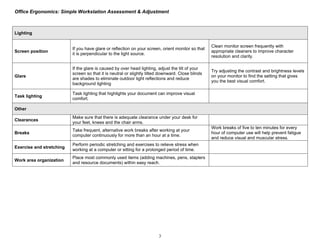
Office Ergonomics: Simple Workstation Assessment & Adjustment


Lighting

                                                                                                   Clean monitor screen frequently with
                          If you have glare or reflection on your screen, orient monitor so that
Screen position                                                                                    appropriate cleaners to improve character
                          it is perpendicular to the light source.
                                                                                                   resolution and clarity.

                          If the glare is caused by over head lighting, adjust the tilt of your
                                                                                                   Try adjusting the contrast and brightness levels
                          screen so that it is neutral or slightly tilted downward. Close blinds
Glare                                                                                              on your monitor to find the setting that gives
                          are shades to eliminate outdoor light reflections and reduce
                                                                                                   you the best visual comfort.
                          background lighting

                          Task lighting that highlights your document can improve visual
Task lighting
                          comfort.

Other
                          Make sure that there is adequate clearance under your desk for
Clearances
                          your feet, knees and the chair arms.
                                                                                                   Work breaks of five to ten minutes for every
                          Take frequent, alternative work breaks after working at your
Breaks                                                                                             hour of computer use will help prevent fatigue
                          computer continuously for more than an hour at a time.
                                                                                                   and reduce visual and muscular stress.
                          Perform periodic stretching and exercises to relieve stress when
Exercise and stretching
                          working at a computer or sitting for a prolonged period of time.
                          Place most commonly used items (adding machines, pens, staplers
Work area organization
                          and resource documents) within easy reach.


                                                                        3

Ergonomics Computerworkstationchecklist

  • 1.
    Office Ergonomics: SimpleWorkstation Assessment & Adjustment CHECK ADJUSTMENTS COMMENTS Chair Foot supports can be used if the chair height Adjust seat height so that feet are flat on the ground or on a foot cannot be lowered due to limitations of the Seat height rest. The angle created by your body and thighs should be 90 chair or keyboard positioning. Foot rests can be degrees or greater. made from phone books, boxes or a shelf. If your chair does not provide good lower back support, try adding a lumbar cushion. Place the curved portion of the backrest in alignment with the curve Backrest height Inexpensive lumbar cushions include a rolled in your lower back (lumbar area). up towel, small pillow or rolled up bubble wrap from packaging. Position so that you have good support when performing keyboard You should be able to relax your lower back Backrest work. Your legs and torso should create an angle that is greater against the backrest when seated firmly back in than 90 degrees. the chair. Check to see if you have space between the back of your knees and the front edge of your chair. The chair edge should not interfere Using a lumbar cushion will also help you sit Leg comfort with lower leg position. If the seat edge touches the back of your leg forward in your chair. or knees, try lowering the chair slightly or raising legs with a footrest If your chair has other adjustments (seat tilt, arm rests etc.) Posture Know your equipment! experiment to find the most comfortable settings for your job task. Minor chair adjustments can relieve some Other chair adjustments Change your posture frequently during the day. muscle stress and stiffness. Keyboard Keyboard height should be adjusted at about seated elbow height. Wrists should be straight (neutral position). Shoulders and elbows If your keyboard is on a table that cannot be should be relaxed. Work with your body close to your keyboard to adjusted, you will need to raise your chair and Keyboard height avoid awkward shoulder and arm postures caused by reaching in may need a footrest so you have a stable front of your body. Keep elbows close to your body and in vertical location to support your legs and feet. alignment with your shoulders (avoid “chicken wings” postures). Keyboard angle can be adjusted by using the Adjust the keyboard angle to promote straight wrists. For some “legs” located under the keyboard (positive tilt Keyboard angle people, this means a flat or slightly negatively tilted keyboard. only) or by adjusting the tilt mechanism on an adjustable keyboard support. Arms may be too wide/low/high, causing you to If you rest your elbows on chair arm rests, make sure that the arm maintain a bad posture to reach. It may be position has a positive influence on your posture. If possible, adjust Arm rests and keyboards better to remove the chair arms or make the arm rest height to promote relaxed elbow and shoulder changes like adding foam cushions to raise arm positions. height. 1
  • 2.
    Office Ergonomics: SimpleWorkstation Assessment & Adjustment CHECK ADJUSTMENTS COMMENTS Mouse Position your mouse at the same level and as close as possible to your keyboard to prevent excessive reaches. Try alternating use of Mouse position the mouse with your left hand or try alternative input device, such as trackball or touchpad. Monitor Have someone help you determine if the monitor is correctly placed. Inexpensive ideas Top monitor should be at or below eye level (unless you are a for adjusting monitor height include using bifocal wearer) when you are seated to prevent bent neck or phone books or paper reams. Monitor height shoulder postures. Adjusting the monitor height may require If you are a bifocal or trifocal wearer, lower the removing the CPU (central processing unit) and placing it to the side monitor until the bifocal correction works of the monitor or beneath the desk. comfortably without tilting your head backwards. The distance from your eyes to the monitor is usually in the range If your monitor is outside of this range, check to Monitor distance between 18 and 32 inches. Exact distance will depend on what is a see if there are other factors that are comfortable for you. influencing the monitor location. Copy Holders Documents that you need to view while typing should be placed Select a copy holder that is appropriate for the Placement near the monitor screen. The copy holder can be slightly below or to size of your documents and whether you need the side of the screen. to make notations. Wrist Rests / Mouse Pads Wrist rests should be slightly curved, cushioned and covered with a smooth material that Use a wrist rest and or mouse pad to reduce pressure on the wrist minimizes friction. Reduce pressure against and to improve wrist posture. These devices are helpful if your Do not plant your wrists on the wrist rest while hard surfaces wrists tend to bend downward when you key or your wrists rest on a typing because doing so will cause awkward hard or sharp surface like the desk top or edge. wrist postures. Never rest your wrists on a hard or sharp edged surface. 2
  • 3.
    Office Ergonomics: SimpleWorkstation Assessment & Adjustment Lighting Clean monitor screen frequently with If you have glare or reflection on your screen, orient monitor so that Screen position appropriate cleaners to improve character it is perpendicular to the light source. resolution and clarity. If the glare is caused by over head lighting, adjust the tilt of your Try adjusting the contrast and brightness levels screen so that it is neutral or slightly tilted downward. Close blinds Glare on your monitor to find the setting that gives are shades to eliminate outdoor light reflections and reduce you the best visual comfort. background lighting Task lighting that highlights your document can improve visual Task lighting comfort. Other Make sure that there is adequate clearance under your desk for Clearances your feet, knees and the chair arms. Work breaks of five to ten minutes for every Take frequent, alternative work breaks after working at your Breaks hour of computer use will help prevent fatigue computer continuously for more than an hour at a time. and reduce visual and muscular stress. Perform periodic stretching and exercises to relieve stress when Exercise and stretching working at a computer or sitting for a prolonged period of time. Place most commonly used items (adding machines, pens, staplers Work area organization and resource documents) within easy reach. 3