D
EPED
C
O
PY
i
English for
Academic and
Professional
Purposes
Teacher’s Guide
Department of Education
Republic of the Philippines
This learning resource was collaboratively developed and
reviewed by educators from public and private schools, colleges, and/or
universities. We encourage teachers and other education stakeholders
to email their feedback, comments, and recommendations to the
Department of Education at action@deped.gov.ph.
We value your feedback and recommendations.
All rights reserved. No part of this material may be reproduced or transmitted in any form or by any means -
electronic or mechanical including photocopying – without written permission from the DepEd Central Office. First Edition, 2016
D
EPED
C
O
PY
ii
English for Academic and Professional Purposes
Teacher’s Guide
First Edition 2016
Republic Act 8293. Section 176 states that: No copyright shall subsist in any work
of the Government of the Philippines. However, prior approval of the government agency or
office wherein the work is created shall be necessary for exploitation of such work for profit.
Such agency or office may, among other things, impose as a condition the payment of
royalties.
Borrowed materials (i.e., songs, stories, poems, pictures, photos, brand names,
trademarks, etc.) included in this learning resource are owned by their respective copyright
holders. DepEd is represented by the Filipinas Copyright Licensing Society (FILCOLS), Inc.
in seeking permission to use these materials from their respective copyright owners. All
means have been exhausted in seeking permission to use these materials. The publisher
and authors do not represent nor claim ownership over them
Only institutions and companies which have entered an agreement with FILCOLS
and only within the agreed framework may copy from this Reader. Those who have not
entered in an agreement with FILCOLS must, if they wish to copy, contact the publishers and
authors directly.
Authors and publishers may email or contact FILCOLS at filcols@gmail.com or
(02) 435-5258, respectively.
Published by the Department of Education
Secretary: Br. Armin A. Luistro FSC
Undersecretary: Dina S. Ocampo, PhD
Printed in the Philippines by _______________
Department of Education-Bureau of Learning Resources (DepEd-BLR)
Office Address: Ground Floor, Bonifacio Bldg., DepEd Complex
Meralco Avenue, Pasig City, Philippines 1600
Telefax: (02) 634-1054;634-1072;631-4985
E-mail Address: blr.lrqad@deped.gov.ph; blr.lrpd@deped.gov.ph
Development Team of English for Academic and Professional Purposes Teacher’s Guide
Ma. Milagros C. Laurel, PhD Adelaida F. Lucero, PhD
Rosalina T. Bumatay-Cruz, PhD
Cover Design: Jason O. Villena Fermin M. Fabella, Jr
Sharlyn P. Sanclaria
Management Team of English for Academic and Professional Purposes Teacher’s Guide
Bureau of Curriculum Development
Bureau of Learning Resources
All rights reserved. No part of this material may be reproduced or transmitted in any form or by any means -
electronic or mechanical including photocopying – without written permission from the DepEd Central Office. First Edition, 2016
D
EPED
C
O
PY
iii
All rights reserved. No part of this material may be reproduced or transmitted in any form or by any means -
electronic or mechanical including photocopying – without written permission from the DepEd Central Office. First Edition, 2016
D
EPED
C
O
PY
iv
All rights reserved. No part of this material may be reproduced or transmitted in any form or by any means -
electronic or mechanical including photocopying – without written permission from the DepEd Central Office. First Edition, 2016
D
EPED
C
O
PY
v
All rights reserved. No part of this material may be reproduced or transmitted in any form or by any means -
electronic or mechanical including photocopying – without written permission from the DepEd Central Office. First Edition, 2016
D
EPED
C
O
PY
vi
All rights reserved. No part of this material may be reproduced or transmitted in any form or by any means -
electronic or mechanical including photocopying – without written permission from the DepEd Central Office. First Edition, 2016
D
EPED
C
O
PY
vii
All rights reserved. No part of this material may be reproduced or transmitted in any form or by any means -
electronic or mechanical including photocopying – without written permission from the DepEd Central Office. First Edition, 2016
D
EPED
C
O
PY
viii
All rights reserved. No part of this material may be reproduced or transmitted in any form or by any means -
electronic or mechanical including photocopying – without written permission from the DepEd Central Office. First Edition, 2016
D
EPED
C
O
PY
ix
PREFACE
The articles in the Reader vary in subject matter, length, and style of writing
in order to give the students a wide range of reading exposure. Some are light in
tone but informative; others are serious and content-heavy. The reading materials
thus provide exciting opportunities for learning.
The recommended activities contained in this accompanying teacher’s guide
train the students to become effective readers. The activities are grouped into 1) a
motivating introduction that builds up on the learner’s schema, their prior
knowledge and their skills required in their earlier years of schooling, 2) the lesson
proper, where guide questions lead to activities that develop and enhance the
learning competencies of the students, and 3) concluding activities that encourage
the students to apply their new learnings to practical situations independently.
The teacher’s are encouraged to use this guide as a springboard for lively
classroom discussions. For this reason, most of the selections contain only general
instructions to give room for the teachers to innovate and adapt the materials to
their classroom conditions.
Some reactions include more detailed explanations to facilitate discussions
on more specialized topics. The expanded activities found in these actions serve as
lesson exemplars.
All rights reserved. No part of this material may be reproduced or transmitted in any form or by any means -
electronic or mechanical including photocopying – without written permission from the DepEd Central Office. First Edition, 2016
D
EPED
C
O
PY
x
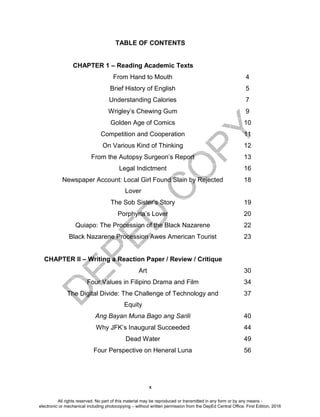
TABLE OF CONTENTS
CHAPTER 1 – Reading Academic Texts
From Hand to Mouth 4
Brief History of English 5
Understanding Calories 7
Wrigley’s Chewing Gum 9
Golden Age of Comics 10
Competition and Cooperation 11
On Various Kind of Thinking 12
From the Autopsy Surgeon’s Report 13
Legal Indictment 16
Newspaper Account: Local Girl Found Slain by Rejected
Lover
18
The Sob Sister’s Story 19
Porphyria’s Lover 20
Quiapo: The Procession of the Black Nazarene 22
Black Nazarene Procession Awes American Tourist 23
CHAPTER II – Writing a Reaction Paper / Review / Critique
Art 30
Four Values in Filipino Drama and Film 34
The Digital Divide: The Challenge of Technology and
Equity
37
Ang Bayan Muna Bago ang Sarili 40
Why JFK’s Inaugural Succeeded 44
Dead Water 49
Four Perspective on Heneral Luna 56
All rights reserved. No part of this material may be reproduced or transmitted in any form or by any means -
electronic or mechanical including photocopying – without written permission from the DepEd Central Office. First Edition, 2016
D
EPED
C
O
PY
xi
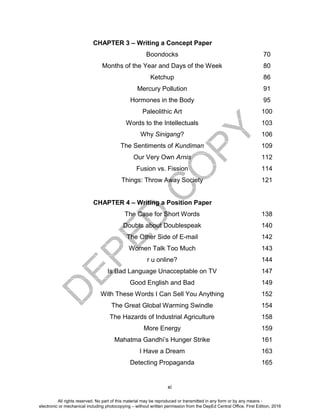
CHAPTER 3 – Writing a Concept Paper
Boondocks 70
Months of the Year and Days of the Week 80
Ketchup 86
Mercury Pollution 91
Hormones in the Body 95
Paleolithic Art 100
Words to the Intellectuals 103
Why Sinigang? 106
The Sentiments of Kundiman 109
Our Very Own Arnis 112
Fusion vs. Fission 114
Things: Throw Away Society 121
CHAPTER 4 – Writing a Position Paper
The Case for Short Words 138
Doubts about Doublespeak 140
The Other Side of E-mail 142
Women Talk Too Much 143
r u online? 144
Is Bad Language Unacceptable on TV 147
Good English and Bad 149
With These Words I Can Sell You Anything 152
The Great Global Warming Swindle 154
The Hazards of Industrial Agriculture 158
More Energy 159
Mahatma Gandhi’s Hunger Strike 161
I Have a Dream 163
Detecting Propaganda 165
All rights reserved. No part of this material may be reproduced or transmitted in any form or by any means -
electronic or mechanical including photocopying – without written permission from the DepEd Central Office. First Edition, 2016
D
EPED
C
O
PY
xii
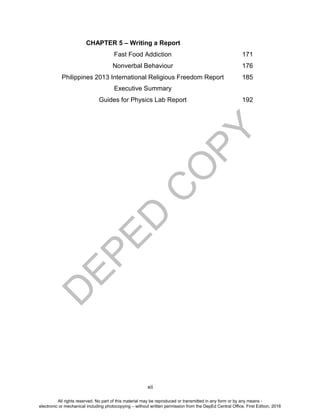
CHAPTER 5 – Writing a Report
Fast Food Addiction 171
Nonverbal Behaviour 176
Philippines 2013 International Religious Freedom Report
Executive Summary
185
Guides for Physics Lab Report 192
All rights reserved. No part of this material may be reproduced or transmitted in any form or by any means -
electronic or mechanical including photocopying – without written permission from the DepEd Central Office. First Edition, 2016
D
EPED
C
O
PY
13
Chapter I
Reading Academic Texts
All rights reserved. No part of this material may be reproduced or transmitted in any form or by any means -
electronic or mechanical including photocopying – without written permission from the DepEd Central Office. First Edition, 2016
D
EPED
C
O
PY
2
All rights reserved. No part of this material may be reproduced or transmitted in any form or by any means -
electronic or mechanical including photocopying – without written permission from the DepEd Central Office. First Edition, 2016
D
EPED
C
O
PY
3
Reading Academic Texts
Reading is one skill that is put into good use everyday. As soon as we
go to the kitchen and open the cupboard to prepare our first meal for the day,
we start reading the labels on the boxes and cans found on the shelves. We
pick a box of cereals and read the instructions written on the package. With
proper understanding of these directions, we can enjoy a hearty breakfast.
This section aims to enhance the students’ skills in reading academic
texts. In the earlier years the students were taught reading strategies. These
strategies can give them a better grasp of the reading texts.
The first two selections provide an account of the history of language;
one discusses language development from gestures to speech, the other
gives a broad perspective of the periods in the history of the English
Language. The chronological presentation of facts can help explain how
languages change through time.
The four selections that follow are a sharp contrast to the first two in
terms of length. These selections though brief, provide sufficient information
on a variety of topics. The longer selections require skills that enable the
reader to determine text structures as the key to understanding meaning and
gathering information.
This section also contains texts that illustrate the use of the English
language in different disciplines. The language registers as these varieties of
English in the different fields of learning are called, are distinctly shown in the
selections that include the language of medicine, law, journalism, and
literature.
All rights reserved. No part of this material may be reproduced or transmitted in any form or by any means -
electronic or mechanical including photocopying – without written permission from the DepEd Central Office. First Edition, 2016
D
EPED
C
O
PY
4
“From Hand to Mouth”
Motivating Introduction
1. Ask the students to observe people talking to one another. Tell them to pay
attention to the hand movements of these people in conversation.
2. Let the students communicate to one another without using oral language.
Find out how long the students can sustain their “silent conversation.”
Lesson Proper
1. Ask the students to prepare an outline of the selection. Let them identify the
main headings of the article.
2. Make the students list the evidence that vocal language was a development
later than gesture or signed language.
3. Prepare the following worksheet indicating the advantages and
disadvantages of the speech or vocal language, and of gesture or signed
language.
SPEECH GESTURE
Advantages Disadvantages Advantages Disadvantages
Post-Lesson Activity
1. Assign students to do a research on the origin of language.
2. Ask them to comment on the different theories of language origin.
3. Let the students discuss other developments in communication (e.g., written
language, electronic or computer-mediated communication).
All rights reserved. No part of this material may be reproduced or transmitted in any form or by any means -
electronic or mechanical including photocopying – without written permission from the DepEd Central Office. First Edition, 2016
D
EPED
C
O
PY
5
“Brief History of English”
Motivating Introduction
1. Assign the students to consult the dictionary for the origin of the following
words:
a. cheese f. chicken
b. camp g. carpenter
c. school h. sky
d. religion i. cat
e. beef j. altar
2. Give them an additional list in class (horse, coliseum, candle, mother, father,
menu, chef, captain, navy, military)
Lesson Proper
1. Introduce the following terms to the students:
a. Old English
b. Middle English
c. Modern English
d. Anglo-Saxons
e. Indo-European language
f. Celts
g. Dialect
h. Case
i. Standardization
j. Mutually intelligible language
Notes
 Old English usually refers to the period in the history of the English language
covering the years from 449 (or 450) to 1100 (or 1150). Around the year 450,
England was invaded by the Germanic tribes (the Angels, the Saxons, and
the Jutes). These Germanic tribes are regarded as “the founders of The
English nation” [Albert C. Baugh and Thomas Cable, A History of the English
Language (London: Routledge, 2002)]. The account of these invasions is
found in the Benedictine monk Bede’s work Ecclesiastical History of the
English People, which was completed in 731 (Baugh and Cable 2002). The
earliest records of the language date back to about 700.
 Middle English covers the period from 1100 (or 1150) to 1500. William of
Normandy, a French territory, conquered England in 1066. The French rule
brought change to the English language. The Anglo-Saxons chronicle existed
until 1154. By that time, the English language had taken on new futures
different from the ones of Old English.
All rights reserved. No part of this material may be reproduced or transmitted in any form or by any means -
electronic or mechanical including photocopying – without written permission from the DepEd Central Office. First Edition, 2016
D
EPED
C
O
PY
6
 Modern English covers the period 1500 to the present in the history of the
English language. The introduction of the movable printing process into
England by William Caxton in 1476 made possible the production of uniform
copies of big numbers of books. The increase in the number of schools, in
literacy production, and in travel and explorations brought change to the
language from the time of the Renaissance in the 1500s.
 The Anglo-Saxon is the term that came about with reference to the Teutonic
tribes that invaded England. The term is often used to refer to “the earliest
period of English” (Baugh and Cable 2002).
 Indo-European language is the family of languages to which English belongs.
 The Celts were “the original inhabitants of the British Isles before the arrival
of the Romans” [Phillip, The Story of English (London: Quercus, 2009)].
 Dialect is a variation of a language.
 Case is the choice of form depending on the function of words (nouns,
pronouns, adjectives) in the sentences in an inflected language.
 Standardization suggests an “ideal” norm or model of usage.
 Mutually intelligible language indicated that the language are distinct from
each other and are not dialects of the same language.
2. Talk about the use of the English language in the Philippines and other
countries in Asia. Explain to the students the role of English in global
communication.
Post-Lesson Activity
1. Ask the students to look up the origin of the following words used by Filipinos:
a. mesa f. silya
b. lapis g. titser
c. bag h. baso
d. kabayo i. kotse
e. tsunami j. lahar
2. Explain briefly how these words became part of the local language(s) in the
Philippines.
All rights reserved. No part of this material may be reproduced or transmitted in any form or by any means -
electronic or mechanical including photocopying – without written permission from the DepEd Central Office. First Edition, 2016
D
EPED
C
O
PY
7
“Understanding Calories”
Motivating Introduction
1. Bring to class some pictures of some food items with their nutritional
information from the dried goods section of the grocery (e.g., a small can of
sardines, a can of fruit cocktail).
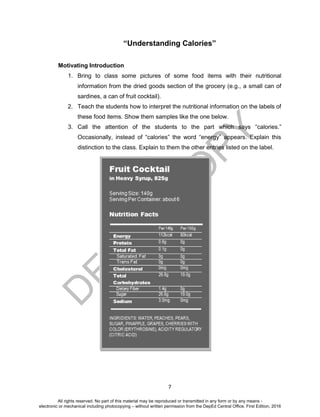
2. Teach the students how to interpret the nutritional information on the labels of
these food items. Show them samples like the one below.
3. Call the attention of the students to the part which says “calories.”
Occasionally, instead of “calories” the word “energy” appears. Explain this
distinction to the class. Explain to them the other entries listed on the label.
All rights reserved. No part of this material may be reproduced or transmitted in any form or by any means -
electronic or mechanical including photocopying – without written permission from the DepEd Central Office. First Edition, 2016
D
EPED
C
O
PY
8
Lesson Proper
1. Guide the students through a careful reading of the selection.
2. Let them identify the function of each paragraph (e.g., Paragraph 1
introduces the topic by giving a definition of calorie).
3. Ask the students why it is important to understand calories.
Post-Lesson Activity
1. Ask the students to interview a school athlete or a team coach about calories
intake. What is a healthy intake of calories?
2. Go to the grocery and compare the nutritional ingredients of products that are
sugar-free with those that contain sugar (e.g., Regular Coca-Cola, Coke Light
and Coke Zero)
All rights reserved. No part of this material may be reproduced or transmitted in any form or by any means -
electronic or mechanical including photocopying – without written permission from the DepEd Central Office. First Edition, 2016
D
EPED
C
O
PY
9
“Wrigley’s Chewing Gum”
Motivating Introduction
1. Ask the students if they have tasted chewing gum.
2. Do the students think that chewing gum is popular?
Lesson Proper
1. Let the students read the opening paragraph. What does it say about the
subject matter?
2. Make the students prepare a chronology of how Wrigley’s chewing gum came
to be.
3. Do the students think that chewing gum is a good premium that can still be
used to sell other products?
Post-Lesson Activity
1. Assign the students to observe how new products are introduced to the
market. Are there promotional campaigns to launch the new products?
2. Do the manufacturers of new products use give-away items in order to sell
their products?
3. Tell the students that in some countries, chewing gum is banned. A person
caught chewing gum ends up paying a fine. Encourage the students to
discuss why there is a chewing gum ban in some countries. Should chewing
gum be banned in the Philippines? Let students present their stand on this
issue.
All rights reserved. No part of this material may be reproduced or transmitted in any form or by any means -
electronic or mechanical including photocopying – without written permission from the DepEd Central Office. First Edition, 2016
D
EPED
C
O
PY
10
“The Golden Age of Comics”
Motivating Introduction
1. Ask the students if they read comic books.
2. Ask them about their favourite comic books and characters.
3. Let them tell the class what it is that they find interesting in comic books.
Lesson Proper
1. Ask the students to identify the thesis sentence of the selection. The thesis
sentence states the central idea of the selection. This thesis statement may
be expressed or implied.
2. Let the students prepare an outline of the selection. Show them how the
ideas are arranged in the selection.
Post-Lesson Activity
1. Find out from the students if they read local comic books. Do they know some
of the local comic book characters?
2. How do the foreign comic books compare with the local comic books? Which
is more appealing to the students?
3. Ask the students to work in groups of five to create their own original comic
books.
All rights reserved. No part of this material may be reproduced or transmitted in any form or by any means -
electronic or mechanical including photocopying – without written permission from the DepEd Central Office. First Edition, 2016
D
EPED
C
O
PY
11
“Competition and Cooperation”
Motivating Introduction
1. Start your class with a spelling contest. Form two teams. Ten words will be
given. For every word to be spelled, each team will choose its representative
who will compete with the other team.
2. Help the students process their learning from this experience with working in
a group and competing with another.
Lesson Proper
1. Discuss the definition of competition and cooperation in class.
2. Ask the students if they noticed similarities and/or contradictions in the
definition and application of these two concepts. Call the attention of the
students to the mechanics of holding contests or competition. The competing
teams act in harmony with each other, agreeing on the terms of competition,
the rules of the contest, the general conduct of the event. Without
cooperation, the competition will not achieve its goals.
Post-Lesson Activity
1. Ask the students to gather information from the last election. Tell them to
identify the candidates who ran for the Senate. Indicate the political parties
they belonged to.
2. Ask the students to discuss how competition and cooperation work during the
election campaign period.
3. How do competition and cooperation work within the family?
All rights reserved. No part of this material may be reproduced or transmitted in any form or by any means -
electronic or mechanical including photocopying – without written permission from the DepEd Central Office. First Edition, 2016
D
EPED
C
O
PY
12
“On Various Kind of Thinking”
Motivating Introduction
1. How many times have we heard the expression “Think about it” or “Give me
time to think it?”
2. Do the students think while they are listening to their teacher?
3. Give the students a few minutes of reflection. After three minutes, ask them
what they thought about. Compare the different subjects of their reflection.
Lesson Proper
1. Ask the students to state the central idea of the selection.
2. Ask them to name the various kinds of thinking. How were they able to
identify these kinds of thinking? Did they find markers in the essay that
served as clues or indicators? Call their attention to expressions (Par. 2), Like
“This is our... kind of thinking” “... a second kind of thinking ... (Par. 4), “A third
kind of thinking... “(Par. 5), “In the past this type of thinking has been called
Reason” (Par. 18).
3. In order to determine the structure of a text, the readers are advised to look
for markers such as the ones given above and other similar expressions such
as “first..., “ “ next...,” “ as a result...,” “finally...,” “in conclusion...,” “to sum
up...” These markers help situate the succeeding statement or sentence in
the entire text. The last three expressions in the list given above (i.e.,
“finally...,” “in conclusion...,” and “to sum up...,”) clearly end a discourse.
4. Ask the students to outline this selection with the help of the structural
markers.
Post-Lesson Activity
1. Ask the students if they have engaged in the various kinds of thinking. Which
type of thinking do they most frequently engage in?
2. What benefits do we get from the different types of thinking?
All rights reserved. No part of this material may be reproduced or transmitted in any form or by any means -
electronic or mechanical including photocopying – without written permission from the DepEd Central Office. First Edition, 2016
D
EPED
C
O
PY
13
“From the Autopsy Surgeon’s Report”
Motivating Introduction
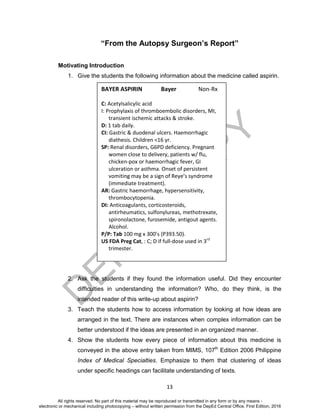
1. Give the students the following information about the medicine called aspirin.
2. Ask the students if they found the information useful. Did they encounter
difficulties in understanding the information? Who, do they think, is the
intended reader of this write-up about aspirin?
3. Teach the students how to access information by looking at how ideas are
arranged in the text. There are instances when complex information can be
better understood if the ideas are presented in an organized manner.
4. Show the students how every piece of information about this medicine is
conveyed in the above entry taken from MIMS, 107th
Edition 2006 Philippine
Index of Medical Specialties. Emphasize to them that clustering of ideas
under specific headings can facilitate understanding of texts.
BAYER ASPIRIN Bayer Non-Rx
C: Acetylsalicylic acid
I: Prophylaxis of thromboembolic disorders, MI,
transient ischemic attacks & stroke.
D: 1 tab daily.
CI: Gastric & duodenal ulcers. Haemorrhagic
diathesis. Children <16 yr.
SP: Renal disorders, G6PD deficiency. Pregnant
women close to delivery, patients w/ flu,
chicken-pox or haemorrhagic fever, GI
ulceration or asthma. Onset of persistent
vomiting may be a sign of Reye’s syndrome
(immediate treatment).
AR: Gastric haemorrhage, hypersensitivity,
thrombocytopenia.
DI: Anticoagulants, corticosteroids,
antirheumatics, sulfonylureas, methotrexate,
spironolactone, furosemide, antigout agents.
Alcohol.
P/P: Tab 100 mg x 300’s (P393.50).
US FDA Preg Cat, : C; D if full-dose used in 3rd
trimester.
All rights reserved. No part of this material may be reproduced or transmitted in any form or by any means -
electronic or mechanical including photocopying – without written permission from the DepEd Central Office. First Edition, 2016
D
EPED
C
O
PY
14
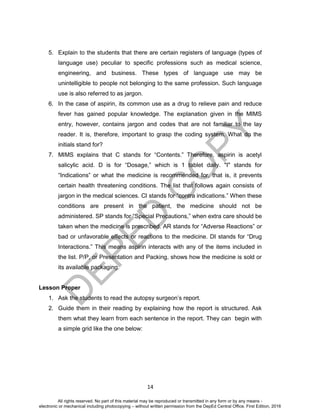
5. Explain to the students that there are certain registers of language (types of
language use) peculiar to specific professions such as medical science,
engineering, and business. These types of language use may be
unintelligible to people not belonging to the same profession. Such language
use is also referred to as jargon.
6. In the case of aspirin, its common use as a drug to relieve pain and reduce
fever has gained popular knowledge. The explanation given in the MIMS
entry, however, contains jargon and codes that are not familiar to the lay
reader. It is, therefore, important to grasp the coding system. What do the
initials stand for?
7. MIMS explains that C stands for “Contents.” Therefore, aspirin is acetyl
salicylic acid. D is for “Dosage,” which is 1 tablet daily. "I" stands for
“Indications” or what the medicine is recommended for, that is, it prevents
certain health threatening conditions. The list that follows again consists of
jargon in the medical sciences. CI stands for “contra indications.” When these
conditions are present in the patient, the medicine should not be
administered. SP stands for “Special Precautions,” when extra care should be
taken when the medicine is prescribed. AR stands for “Adverse Reactions” or
bad or unfavorable effects or reactions to the medicine. DI stands for “Drug
Interactions.” This means aspirin interacts with any of the items included in
the list. P/P, or Presentation and Packing, shows how the medicine is sold or
its available packaging.
Lesson Proper
1. Ask the students to read the autopsy surgeon’s report.
2. Guide them in their reading by explaining how the report is structured. Ask
them what they learn from each sentence in the report. They can begin with
a simple grid like the one below:
All rights reserved. No part of this material may be reproduced or transmitted in any form or by any means -
electronic or mechanical including photocopying – without written permission from the DepEd Central Office. First Edition, 2016
D
EPED
C
O
PY
15
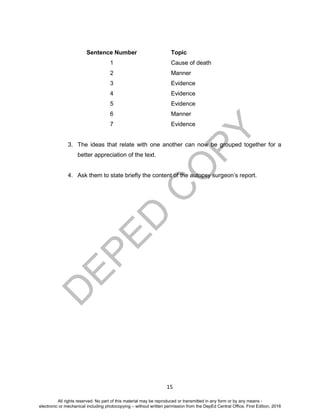
3. The ideas that relate with one another can now be grouped together for a
better appreciation of the text.
4. Ask them to state briefly the content of the autopsy surgeon’s report.
Sentence Number Topic
1
2
3
4
5
6
7
Cause of death
Manner
Evidence
Evidence
Evidence
Manner
Evidence
All rights reserved. No part of this material may be reproduced or transmitted in any form or by any means -
electronic or mechanical including photocopying – without written permission from the DepEd Central Office. First Edition, 2016
D
EPED
C
O
PY
16
“Legal Indictment”
Motivating Introduction
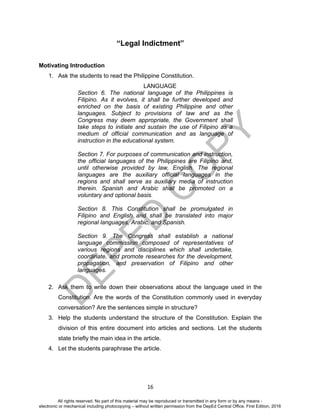
1. Ask the students to read the Philippine Constitution.
LANGUAGE
Section 6. The national language of the Philippines is
Filipino. As it evolves, it shall be further developed and
enriched on the basis of existing Philippine and other
languages. Subject to provisions of law and as the
Congress may deem appropriate, the Government shall
take steps to initiate and sustain the use of Filipino as a
medium of official communication and as language of
instruction in the educational system.
Section 7. For purposes of communication and instruction,
the official languages of the Philippines are Filipino and,
until otherwise provided by law, English. The regional
languages are the auxiliary official languages in the
regions and shall serve as auxiliary media of instruction
therein. Spanish and Arabic shall be promoted on a
voluntary and optional basis.
Section 8. This Constitution shall be promulgated in
Filipino and English and shall be translated into major
regional languages, Arabic, and Spanish.
Section 9. The Congress shall establish a national
language commission composed of representatives of
various regions and disciplines which shall undertake,
coordinate, and promote researches for the development,
propagation, and preservation of Filipino and other
languages.
2. Ask them to write down their observations about the language used in the
Constitution. Are the words of the Constitution commonly used in everyday
conversation? Are the sentences simple in structure?
3. Help the students understand the structure of the Constitution. Explain the
division of this entire document into articles and sections. Let the students
state briefly the main idea in the article.
4. Let the students paraphrase the article.
All rights reserved. No part of this material may be reproduced or transmitted in any form or by any means -
electronic or mechanical including photocopying – without written permission from the DepEd Central Office. First Edition, 2016
D
EPED
C
O
PY
17
Lesson Proper
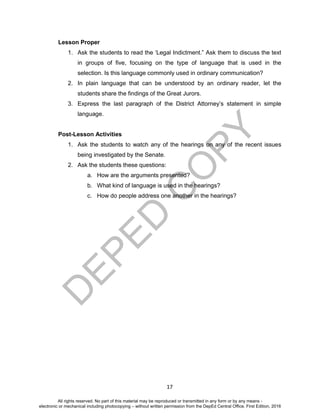
1. Ask the students to read the ‘Legal Indictment.” Ask them to discuss the text
in groups of five, focusing on the type of language that is used in the
selection. Is this language commonly used in ordinary communication?
2. In plain language that can be understood by an ordinary reader, let the
students share the findings of the Great Jurors.
3. Express the last paragraph of the District Attorney’s statement in simple
language.
Post-Lesson Activities
1. Ask the students to watch any of the hearings on any of the recent issues
being investigated by the Senate.
2. Ask the students these questions:
a. How are the arguments presented?
b. What kind of language is used in the hearings?
c. How do people address one another in the hearings?
All rights reserved. No part of this material may be reproduced or transmitted in any form or by any means -
electronic or mechanical including photocopying – without written permission from the DepEd Central Office. First Edition, 2016
D
EPED
C
O
PY
18
“Newspaper Account: Local Girl
Found Slain by Rejected Lover”
Motivating Introduction
1. Assign the students to bring a copy of any broadsheet/newspaper.
2. Ask them to read articles from the paper in groups of five.
3. Make them identify the information contained in the news articles.
4. Let them pay attention to the words and sentences used in the news articles.
Ask them if the words are difficult to understand.
5. Who is narrating the event?
Lesson Proper
1. Ask the students to read the news report on “Local Girl Found Slain by
Rejected Lover.”
2. Ask them to compare this text with the article that they read from the
newspaper that they had brought. What kind of information did they get from
the text?
3. Did they notice any similarity/difference between the two?
4. Are the words and sentences difficult to understand?
5. Who is narrating the event? How was the event narrated?
Post-Lesson Proper
1. At the end of this activity, summarize the students’ observations.
2. What did they learn about writing a news article? Discuss with them the
characteristics of a news report.
3. For the final activity, ask the students to write a news report about a recent
school activity.
All rights reserved. No part of this material may be reproduced or transmitted in any form or by any means -
electronic or mechanical including photocopying – without written permission from the DepEd Central Office. First Edition, 2016
D
EPED
C
O
PY
19
“The Sob Sister’s Story”
Motivating Introduction
1. Ask the students if they have heard of people committing crimes because of
love.
2. Ask them to explain if such acts are justifiable. Listen to the students’ point of
view. Help them to process their answers, emphasizing the need to rise
above human weaknesses and uphold moral values.
Lesson Proper
1. Ask the class to read “The Sob Sister’s Story.”
2. Make the students aware of the difference between the language used in the
text and that found in the preceding texts – “From the Autopsy Surgeon’s
Report,” “Legal indictment” and “Newspaper Account: Local Girl Found Slain
by Rejected Lover.”
3. Ask the students how they got to know what happened in “The Sob Sister’s
Story.”
4. Who is narrating the story? How does the narrator feel about what happened
in the story?
5. Discuss with the students the structure and features of the story; pay
particular attention to the elements of fiction.
6. Let the students re-tell the story in their own words.
Post-Lesson Activity
1. Engage the students in the discussion of moral and ethical issues in society.
2. How can the youth participate in the movement against crime in our society?
3. What role does the family play in the prevention of crime or other forms of
misconduct?
All rights reserved. No part of this material may be reproduced or transmitted in any form or by any means -
electronic or mechanical including photocopying – without written permission from the DepEd Central Office. First Edition, 2016
D
EPED
C
O
PY
20
“Porphyria’s Lover”
Motivating Introduction
1. Review the characteristics/elements of a typical poem. How can one tell if a
text is a poem or not? Is each feature characteristic of a poem? Are words
arranged into lines and stanzas? Do the words rhyme at the end of the lines?
Is there rhythm in the lines? To facilitate the discussion, give examples of
these elements.
2. You can choose a poem that the students are familiar with.
Trees
by Joyce Kilmer
I think that I shall never see
A poem lovely as a tree.
A tree whose hungry mouth is prest
Against the earth's sweet flowing breast;
A tree that looks at God all day,
And lifts her leafy arms to pray;
A tree that may in summer wear
A nest of robins in her hair
Upon whose bosom snow has lain;
Who intimately lives with rain.
Poems are made by fools like me,
But only God can make a tree.
a. Talk about the form of this poem.
1. How many stanzas are there in the poem? (6)
2. How many lines make up each stanza? (2)
3. What is the rhyme scheme/pattern of each stanza? (aa)
4. Is there a dominant rhythm in the entire poem? (yes, iambic
tetrameter)
b. Explain the use of figurative language in the poem. Cite examples of
personification and simile.
All rights reserved. No part of this material may be reproduced or transmitted in any form or by any means -
electronic or mechanical including photocopying – without written permission from the DepEd Central Office. First Edition, 2016
D
EPED
C
O
PY
21
e.g., A tree whose hungry mouth is prest.
Against the earth’s sweet flowing breast.
c. Ask the students to paraphrase the poem.
Lesson Proper
1. Ask the students to read aloud “Porphyria’s Lover.”
2. Discuss the different elements of poetry found in this literary text.
3. The poem contains a narrative. From whose point of view is the story being
told? How does this point of view affect the telling of the story?
4. Compare “Porphyria’s Lover” with the form of other renditions of the same
story that have been discussed. How does this poem differ from the earlier
texts?
5. Help the students to re-tell the story of Porphyria and her lover.
Post-Lesson Activity
1. Organize the students into two or three groups, depending on the size of the
class.
2. Ask the students to dramatize the story, using the autopsy surgeon’s report,
the district attorney’s statement, and the sob sister’s narrative as sources for
the script for their presentation.
3. Help the students create a script for their stage presentation. The students
can make use of their knowledge of variations in language use in various
professions. The characters in the play will use different registers of
language.
All rights reserved. No part of this material may be reproduced or transmitted in any form or by any means -
electronic or mechanical including photocopying – without written permission from the DepEd Central Office. First Edition, 2016
D
EPED
C
O
PY
22
“Quiapo: The Procession of the Black Nazarene”
Motivating Introduction
1. Ask the students what they know about the annual celebration of the Feast of
the Black Nazarene in the district of Quiapo.
2. If they have not heard of this event, ask them to gather information from
newspaper and from books.
3. Ask them if there is a difference in the style of presentation of information
between these two sources. How do the newspaper accounts differ from the
book sources?
Lesson Proper
1. Together with the students, read the poem aloud.
2. Ask the students to paraphrase the poem.
a. In the first stanza, explain to them the reference to “The sober days
that follow the intoxicated season.” How does the poem describe the
atmosphere on the feast day of the black Nazarene?
b. Who are being described in the second stanza?
c. Notice the shift in the object of description in the third stanza.
d. As the procession moves, more description is given in the fourth
stanza.
e. The fifth stanza, through a series of parallel phrases, mentions the
manifestations of the devotion to the Black Nazarene.
f. The sixth stanza, through another series of parallel phrases,
emphasizes what the devotees’ experience.
Post-Lesson Activity
1. Ask the students to prepare a list of new words they learned from the poem.
2. Make them use these words in sentences.
All rights reserved. No part of this material may be reproduced or transmitted in any form or by any means -
electronic or mechanical including photocopying – without written permission from the DepEd Central Office. First Edition, 2016
D
EPED
C
O
PY
23
“Black Nazarene Procession Awes American Tourist”
Motivating Introduction
1. Do a review of the elements of reporting.
2. What information should be included in a news report? How is news
conveyed to the audience?
Lesson Proper
1. Ask the students if the article “Black Nazarene Procession Awes American
Tourist” follows a conventional format of a news report.
2. Call the attention of the students to the opening paragraphs of the news
article. What is the function of these paragraphs?
3. What is contained in the last two paragraphs of the article?
Post-Lesson Activity
1. The American tourist Gerry Blevins said that “the Philippines is [a] much nicer
[place] than the United States.” Ask the students to comment on this remark.
2. Ask them to give examples of why they think (or do not think) the Philippines
is a better place than other parts of the world.
3. The students can also form two teams and conduct a debate on the topic
“Why the Philippines is a good/not a good place for tourists to visit.”
All rights reserved. No part of this material may be reproduced or transmitted in any form or by any means -
electronic or mechanical including photocopying – without written permission from the DepEd Central Office. First Edition, 2016
D
EPED
C
O
PY
24
Assessment
1. Ask the students to gather information on interesting places, folk traditions,
cultural practices, and beliefs found in their hometown.
2. They can do this through observations and cultural exposure, interviews with
the elders in the community, and research in the internet and in school and
public libraries.
3. Require them to submit an outline of their findings.
4. Let them prepare an essay summarizing their findings.
Examples of Topics:
1. The students of Arts and Design can choose an interesting work(s) of art that
their place is known for (e.g., the paintings by folk artists of Angono, Rizal;
the old churches in Ilocos, in Metro Manila or in the Visayas; handwoven
textiles of the T’boli and Yakan communities; the wooden furniture of Betis).
2. The students of Sports can choose to focus on Filipino games or any sports
activity that is popular in the community.
3. The students taking the academic track, particularly those in the Social
Sciences and the Humanities may opt to investigate our religious beliefs and
cultural practices.
4. The students who are going to specialize in creative writing may choose to
write a poem or a story to talk about their discoveries; the arts students may
want to paint a scenery depicting a cultural tradition.
5. Those going into the health sciences can look at the relevance of folk healing
practices and examine their contribution to the contemporary medical
practices.
6. Students interested in science and technology can attempt to connect folk
technology with scientific gadgets. The use of simple technology such as the
pulley mechanism used in outdoor performances of religious plays like the
sinakulo or the salubong can be enhanced with the introduction of more
sophisticated machines.
All rights reserved. No part of this material may be reproduced or transmitted in any form or by any means -
electronic or mechanical including photocopying – without written permission from the DepEd Central Office. First Edition, 2016
D
EPED
C
O
PY
25
Chapter 2
Writing a
Reaction Paper / Review / Critique
All rights reserved. No part of this material may be reproduced or transmitted in any form or by any means -
electronic or mechanical including photocopying – without written permission from the DepEd Central Office. First Edition, 2016
D
EPED
C
O
PY
26
All rights reserved. No part of this material may be reproduced or transmitted in any form or by any means -
electronic or mechanical including photocopying – without written permission from the DepEd Central Office. First Edition, 2016
D
EPED
C
O
PY
27
Writing a Reaction Paper, Review, and Critique
A very important expository discourse that students must know how to write is
the reaction paper or review, or critique. It is mainly written to communicate a fair
assessment of situations, people, events, and literary and artistic works and
performances. Whether a social commentary, or a critical judgment, it conveys
incisive insights into its analysis of events, its interpretation of the meaning or
importance of a work or artifact, or its appreciation of the moral or aesthetic values
reflected in the work or performance. It may include the main purpose of the event;
the devices and strategies employed; an evaluation of its success or failure; and an
assessment of its significance and relevance, timeliness or timelessness.1
The teacher should explain to the students these general guidelines for
writing the reaction paper:
Guidelines for Writing the Reaction Paper/Review/Critique2
1. Value Communicated
a. Sound critical judgment
b. A fair and balanced assessment of situations or events, people and
things
2. Basic Content
a. Ranges from an off-hand gut reaction, favorable or unfavorable,
merely expressive of emotion to a more rational impersonal critical
analysis that seriously communicates some value, ethical or moral,
some hidden or forgotten truth, and some aesthetic delight
b. May take the form of a reflection, an appeal, a protest, a tribute or
denunciation, a speculation
c. In general, the content would include the following topics:
1
Borrowed from Concepcion Dadufalza, “The Reaction Paper,” Reading into Writing 2: a Handbook-
Workbook-Rreader for Critical Reading and Writing for Expository discourse (Makati City: Bookmark,
Inc., c1996), pp.257-258.
2
Ibid.
All rights reserved. No part of this material may be reproduced or transmitted in any form or by any means -
electronic or mechanical including photocopying – without written permission from the DepEd Central Office. First Edition, 2016
D
EPED
C
O
PY
28
1.) For human situations:
a.) A brief description of the event
b.) People involved, their roles and contributions
c.) Other driving forces, in the open or hidden and
unsuspected
d.) Implications and consequences
e.) Assessment and prognostication
f.) Some offered solutions
2.) For cultural affairs, people, works, performances:
a.) The central purposes of the event or product
b.) The means, devices, strategies employed to achieve
the purposes
c.) An evaluation of the achievement: success or failure
d.) The significance (if any) beyond mere entertainment of
the event or product in ethical and/or aesthetic terms,
its timeliness and/or timelessness
3. Modes of Ordering (Any of the following):
a. From the event/performance/artifact/work presented and
described/narrated in themselves to the writer’s critical evaluation of
the entire event, show or work in a sequence of its elements
b. Discussion that intersperses critical comments between mention or
description of the details of the event, show or work
c. From a cover statement giving an over-all judgment of the event,
show or piece to a discussion of each angle, aspect or element of the
event, show or work illustrating or providing evidence for the
evaluative cover statement
4. Basic qualities of a Good Reaction Paper
a. Gives a fair and balance social commentary
b. Provides relevant and accurate factual information on the situation
c. Exhibits by means of thorough and in-depth analysis an appreciation
of context (including time, place, people, involvement, their motivation,
and actuations)
All rights reserved. No part of this material may be reproduced or transmitted in any form or by any means -
electronic or mechanical including photocopying – without written permission from the DepEd Central Office. First Edition, 2016
D
EPED
C
O
PY
29
d. Makes a clear distinction, through language, between what is actual
and what is probable or possible
e. Exhibits a deep sense of humanity and an understanding of the
human situation even while expressing disapproval or disagreement
most intensely
5. Basic Qualities of an Adequate Critical Judgment
a. Provides accurate and relevant information on the event, show, or
work
b. Exhibits full appreciation of the purpose behind the event, show, or
work
c. Shows a clear understanding of the means (strategies, techniques,
devices, etc.) and their appropriateness and power in achieving the
purpose
d. Exhibits fairness and balance in the judgment made
e. Projects incisive and profound insights into its (1) analysis of the event
on artifact, (2) interpretation of the underlying meaning or significance
of the event or artifact, and (3) appreciation of the values “(moral
and/or aesthetic) unfolded in every detail of the event or artifact”
All rights reserved. No part of this material may be reproduced or transmitted in any form or by any means -
electronic or mechanical including photocopying – without written permission from the DepEd Central Office. First Edition, 2016
D
EPED
C
O
PY
30
“Art”
Critique of a Visual Statement
Motivating Introduction
1. Regale the students with the socio-political roles of famous art works,
especially the painting, Guernica.
2. Interest the students in the role that these art works played in reacting to
socio-political events and advancing the artists’ views and positions. Mention
the powerful Victor Hugo novel turned stage play and movie, Les Miserables;
silversmith Paul Revere’s engraving, the Boston Massacre, which mainly
galvanized the anti-British Revolution; Francisco Goya’s The Third of May
1808, the most famous and extreme depiction of Napoleon’s execution of
Spanish rebels; even Jose Rizal’s Noli Me Tangere which inspired our own
anti-Spanish revolution.
3. Fascinate the students with this little anecdote:
One of the most iconic images of the 20th century,
Guernica depicts the carnage from the bombing raid on a
Spanish village by the Nazi air force. During WWII, when
Nazi officers visited Picasso's studio and saw a print of the
famous image, they asked, "Did you do that?" Picasso
answered, "No, you did."
Lesson Proper
Reading the Critique and Reacting to It
1. Unlocking Verbal Difficulties: Have the students look up the meanings of
these expressions in order for them to read the text with greater facility.
a. Cubist style
b. Filtered through the artist’s eyes
c. Visual argument
d. Multiple perspectives
e. Stronghold
f. Outrage
g. Mural
h. Devastation of war
All rights reserved. No part of this material may be reproduced or transmitted in any form or by any means -
electronic or mechanical including photocopying – without written permission from the DepEd Central Office. First Edition, 2016
D
EPED
C
O
PY
31
i. Commissioned
j. Atrocity
k. Imminent
l. Critically acclaimed
m. Depicts images simultaneously
n. Assumptions
o. Emotional cacophony of war
p. Carnage of war
2. Comprehending the Text: Use these questions to guide the students in
understanding the essay.
a. Explain how and why “art is an interpretation,” not a faithful depiction
of reality.
b. What is meant by art as a visual argument?
c. What are achieved by the cubist style of painting?
d. On which shared historical experience does Picasso base his
painting, Guernica?
e. Why would Picasso think that “people viewing the painting would be
upset by it?”
f. In what way does cubism allow Picasso to paint “truth rather than
reality?”
g. Which symbols in the painting would the viewers have readily
recognized?
3. Reading the text more critically, let the students reflect on the painting more
deeply and discuss their answers to these questions:
a. Which images catch your attention, and why?
b. What, do you think, is the main image? Which images are found in the
foreground? Why do you think Picasso arranged the images in the
way he did? How do these images relate to one another?
c. How would you describe the images? Which of these images are
underscored? Which are exaggerated or idealized?
d. What are gained by his use of black and white?
All rights reserved. No part of this material may be reproduced or transmitted in any form or by any means -
electronic or mechanical including photocopying – without written permission from the DepEd Central Office. First Edition, 2016
D
EPED
C
O
PY
32
e. Why did Picasso title his painting, Guernica? Would it have made a
different impact if it had been given a different title, like “The Carnage
of War?”
f. Aside from being a recognizable image for Spain, what else would the
bull stand for? How about the horse?
g. Explain how the painting could simultaneously protest the violence of
war and appeal for peace.
4. Structural Analysis. Explain these elements to the students:
a. Main idea. Using the possibilities afforded by cubism in representing
reality through multiple perspectives, Picasso created a mural
depicting his outrage against the devastating bombing of Guernica.
b. Supporting details. Using “wailing figures, panicked faces, darkness
contrasted by jumbled images of light all project the horrors of war.”
The painting depicting the horrors of war entitled Guernica would
strongly resonate among the people familiar with the bombings, and
everyone condemning the atrocities of war. Insinuating that such
carnage should not happen again, the painting also becomes an
appeal for peace.
Concluding Activities
Inspire student appreciation for significant visual reactions (art works) to
socio-political phenomena by immersing the learners in these projects:
1. Art and Design: Savor Juan Luna’s Spoliarium, at the National Museum;
research on the background of this world- acclaimed Filipino painting. Then
write a three-paragraph critique of the mural focusing on the subject, the
images and the manner of their depiction, the use of color, light and other
devices, and the overall message of the artwork.
2. Academic Track: List at least ten famous politically committed art works of the
world, the occasion or event that each work reacts to/against, and the
message and impact of the work on the people for which it was created. Then
write a three-paragraph essay explaining how and why visual art works make
for effective visual socio-political statements/arguments.
All rights reserved. No part of this material may be reproduced or transmitted in any form or by any means -
electronic or mechanical including photocopying – without written permission from the DepEd Central Office. First Edition, 2016
D
EPED
C
O
PY
33
3. Tech Voc: After listing the ten major tourist-hotel destinations, museums, or
theme parks in various parts of the country, select major Philippine art works
(paintings, engravings, sculpture, installation art, etc.) that should be mainly
featured in each destination. In a three-paragraph essay, explain why you
chose the art work, and the appropriateness of the political message for the
hotel/tourist destination, and its geographical and historical
importance/relevance. Example: The huge mural, the Battle of Mactan, hangs
in a covered structure in the Mactan Shrine.
4. Sports: After selecting your top choices of art works depicting sports, write a
three-paragraph essay of their favorite subjects, the artistic devices
employed, and their messages.
Summary
1. Picasso’s Guernica embodies his visual statement or expression of outrage
against the violent effects of war especially on civilians.
2. By presenting the “carnage of war”, he and his art work were making a visual
argument for peace.
3. To present the horrifying effects of war, he uses the multiple perspectives and
images afforded by the cubist style.
All rights reserved. No part of this material may be reproduced or transmitted in any form or by any means -
electronic or mechanical including photocopying – without written permission from the DepEd Central Office. First Edition, 2016
D
EPED
C
O
PY
34
“Four Values in Filipino Drama and Film”
Motivating Introduction
1. Ask the students what their favorite Tagalog movies are. Why would they
consider them their favorites?
2. Make them choose their top ten favorite actresses from among the following:
a. Carla Abellana b. Angel Aquino c. Nora Aunor
d. Julia Barretto e. Ann Curtis f. Eugene Domingo
g. Bianca Gonzalez h. Kristine Hermosa i. Heart Evangelista
j. Marian Rivera k. Pops Fernandez l. Maja Salvador
m. Pokwang n. Liza Soberano o. Dawn Zulueta
Do Caucasian looks figure in the choices?
Lesson Proper
Reading the Text and Reacting to It
1. Getting to Know the Author
a. Inform the students that before they read more about the Filipino
audience’s preferences for the fair-haired girls, and other colonial
choices, they should first meet the Philippine studies scholar-author:
b. Dr. Nicanor Tiongson is a leading critic, playwright, and academic
professor emeritus from the Film Institute of U.P. Diliman. His
important works include The Women of Malolos, Noli at Fili sa
Dekadang Dos Mil, and Manuel Conde,
c. This founding member of Manunuri ng Wikang Filipino has specialized
in Philippine cinema, Philippine theater, Philippine arts, and popular
culture.
2. Unlocking Verbal Difficulties. Ask the students to look up these expressions in
order to make their reading comprehension smooth:
a. Insidious manner
b. Prevalence
c. Perniciousness
All rights reserved. No part of this material may be reproduced or transmitted in any form or by any means -
electronic or mechanical including photocopying – without written permission from the DepEd Central Office. First Edition, 2016
D
EPED
C
O
PY
35
d. Encapsulated
e. Perpetuated
f. Invariably
g. Caucasian
h. Relegated
i. Slapstick comedies
j. Authenticity
k. Colonial aesthetics
l. Commendable
m. Adulation for the white
n. Subjugated
o. Most abject
p. Wreak havoc
q. Catharsis
r. Maudlin
s. Raison d’etre
t. Run-of-the-mill
3. Comprehending the Text. To help the students do a critical reading of the
text, ask them these guide questions:
a. What are the four negative values that have dominated our stage and
film?
b. What are the roots of these “disvalues.” How did these advance the
cause of the colonial rulers?
c. How has the adulation for the white affected our dignity and our
national pride?
d. Which two factors have created box office hits?
e. If religion “was the opiate of the masses in the past,” what have
become “that opiate today?”
f. What is wrong with suffering and submissiveness?
g. What does Tiongson mean by, “Filipino aesthetics will blossom only if
the Filipino can depict his experience with utmost authenticity?”
h. How can the concept of entertainment be deepened and enriched?
All rights reserved. No part of this material may be reproduced or transmitted in any form or by any means -
electronic or mechanical including photocopying – without written permission from the DepEd Central Office. First Edition, 2016
D
EPED
C
O
PY
36
i. Analysis of the Structure of the Text: As the first part of the critical
review discusses the “disvalues” that plague our film and stage, what
does the second part discuss?
j. Identify the four counterpart values that could help Filipinos find their
identity.
Concluding Activities
1. Academic Track: Does our use of English help promote colonial mentality?
Explain your views in two to three paragraphs.
2. Art and Design: Research on how our Western-oriented perspectives in
music have marginalized, if not denigrated our indigenous music. (Search the
Internet for studies of Dr. Ramon P. Santos.)
3. Tech Voc: Discuss how our clothes/fashion, hairdos, dance crazes, holiday
practices (Christmas, Thanksgiving, Mother’s Day, Father’s Day, etc.) reflect
our colonial mentality. Use specific illustrations to support your points.
4. Sports: Discuss how Manny Pacquiao, as a boxer, exemplifies the four
counter values more than the “disvalues.”
Summary
1. Major ideas
a. The four “disvalues” that have perniciously prevailed in our film and
stage include: “White is Beautiful,” “Shows are the Best,” “Hurrah for
the Underdog,” and “All Is Right with the World.”
b. The four counter values that could undermine the pernicious effects of
the colonial values include: “Brown is Beautiful,” “Shows with
Substance are the Best,” ”It’s Good to think and Decide for Oneself,”
and “The World Could Indeed Be More Beautiful.”
2. Supporting Ideas
a. The causes and effects of the colonial values show their denigration
of the Filipino.
b. The counter values form a critical, scientific, and realistic frame of
mind that can help develop the Filipinos’ cultural economic and
political independence.
All rights reserved. No part of this material may be reproduced or transmitted in any form or by any means -
electronic or mechanical including photocopying – without written permission from the DepEd Central Office. First Edition, 2016
D
EPED
C
O
PY
37
“The Digital Divide: The Challenge of Technology and Equity”
Motivating Introduction
1. Ask the students how many of them have computers/laptops/tablets. How
many have internet connections? How many have smart phones? How many
have cell phones?
2. Ask further: How many homes and schools have computers? Do you think
that majority of our students, all over the country, have computers? Do they
have internet connections? Do they have cell phones?
Lesson Proper
Reading and Reacting to the Text
1. Unlocking verbal difficulties. To understand the text better, ask the students
to look up the meanings of these difficult expressions and use them in
sentences:
a. Equity
b. Grow exponentially
c. Instantaneously
d. Similar disparities
e. Exacerbates disparities
f. Authentic settings
2. Understanding the Text. Ask these guide questions to help the students
understand the essay:
a. What comprise “information technology” and its far-reaching effects?
b. What are the implications of having “only 6 percent of the population
in developing countries [are] connected to telephones?”
c. What is meant by “digital divide?”
d. Explain how income, race, education, household type, and
geographical location, affect digital equity.
e. Why are women and minority groups not eligible for the jobs with the
highest salaries?
f. Why do schools with rich students have greater access to Internet?
All rights reserved. No part of this material may be reproduced or transmitted in any form or by any means -
electronic or mechanical including photocopying – without written permission from the DepEd Central Office. First Edition, 2016
D
EPED
C
O
PY
38
g. How can the computer and the internet be the great equalizer among
people?
h. How does the use of figures and percentages bolster the observations
that certain factors have created the “digital divide?”
3. Reacting to the Text. Ask the students:
a. How can the internet be used in “culturally relevant ways?”
b. In the Philippines, have students benefitted much from information
technology?
c. Can computers and internets bridge the gaps in educational
achievements between the rural and urban schools in the Philippines?
d. Can we say that information technology has become an end in itself in
the Philippines? Why or why not?
e. Considering that internet speed in the Philippines is much slower than
that of its ASEAN neighbors, does this speed create another reason
for disparity?
4. Analyzing the Text Structure. Explain these notes to the students.
a. Introduction – Information Technology is “influencing the way many
people live and work today; computers are common in homes and
work areas.”
b. Thesis - Access to information technology affects our work and way of
life.
c. Supporting details
(1.) Despite the growing number of computers, the world’s
population have little access to computers and the internet.
(2.) Only 6 percent of the third world countries have
telephones, much fewer have computers.
(3.) In the USA, except for the Native Americans with few
telephones, 94% have telephones, but only 56 percent
have computers.
(4.) Income, race, education, household type, and
geographical location create “digital divides.”
All rights reserved. No part of this material may be reproduced or transmitted in any form or by any means -
electronic or mechanical including photocopying – without written permission from the DepEd Central Office. First Edition, 2016
D
EPED
C
O
PY
39
(5.) Ethnic minorities (African-Americans, Latinos and Native
Americans) and women (gender) benefit less from
information technology jobs.
(6.) The schools of the rich children have greater access to the
internet.
d. Conclusion – Equal or greater access to computers and the internet
plus their interacting with the technology as an end to itself, will
reduce disparities in schools, and among peoples.
Concluding Activities
Engage the students in these learning activities:
1. Academic Track. Research on the number of students in your school who
have laptops and tablets, and have internet access. Find out how they use
the internet – as resources for assignments, for social media sites such as
Facebook and blogs, or some other reason. Write a two-paragraph reaction
on how beneficial to their educational needs the internet could be.
2. Art and Design. The different arts may now be executed using computer
technology. Prepare a computer-aided design or visual representation of the
digital divide discussed in the essay.
3. Tech Voc. Write a two-paragraph commentary on how diverse industrial arts
can benefit from the computer and internet access.
4. Sports. Write a two- to three-paragraph commentary on online sports games
– how popular are these games? How effective are these in developing
sportsmanship, and physical health?
Summary
1. Thesis: Computers and the internet may have affected various facets of our
life; however, most of the world’s population have little access to computer
technology and the internet.
2. Strategy for development – The essay uses figures and percentages to
represent the groups that do not have as much access to the internet as the
rich, the white, and the educated Americans.
All rights reserved. No part of this material may be reproduced or transmitted in any form or by any means -
electronic or mechanical including photocopying – without written permission from the DepEd Central Office. First Edition, 2016
D
EPED
C
O
PY
40
“Ang Bayan Muna Bago ang Sarili”
Motivating Introduction
1. Make the students relive the tragic homecoming of Ninoy Aquino in August
1983. Recall how his strong desire to serve the Filipinos made him come
home despite warnings against the concomitant dangers. Unfortunately, he
was gunned down at the International airport.
2. Make the students realize how his death became a rallying cry for unity and
survival for many Filipinos, but after five years, Cardinal Sin reminds the
Filipinos how they seem to have forgotten his “dream.”
Lesson Proper
Reading and Reacting to the Homily
1. Getting to Know the Author. Inform the students of the significant role played
by the author, Catholic Archbishop of Manila, Jaime Cardinal Sin, as he used
his influence to rally for the rights of the poor. In this excerpt from his homily,
he notes how the people have forgotten their important role of helping build
the nation.
2. Unlocking Verbal Difficulties. Ask the students what these expressions mean:
a. Transcending our petty selves
b. Authentic name
c. Cynics
d. Predominant strain
e. Demoralizing
f. Destabilizing
g. Anarchic
h. “Basket of crabs”
i. Addressed vigorously
j. Unrelentingly
k. Chronic illness
l. Operative guideline
m. Too calloused
All rights reserved. No part of this material may be reproduced or transmitted in any form or by any means -
electronic or mechanical including photocopying – without written permission from the DepEd Central Office. First Edition, 2016
D
EPED
C
O
PY
41
3. Comprehending the Essay. To guide the students in comprehending the
essay, ask them these questions:
a. What is Ninoy’s gift? How should the Filipinos show “gratitude” for this
gift?
b. What does the “truest motto of our people” mean?
c. How have we transformed the ideal?
d. What is the significance of the allusion to the three monkeys to our
“national pastime?”
e. In what way “must we criticize in order to be free?”
f. When does our criticizing degenerate into self-destruction?
g. What does Cardinal sin mean by “our national game, an anarchic
free-for-all- in a ‘basket of crabs’?”
h. How does the other meaning of K.K.K. negate the moral order that
must be addressed vigorously?
i. What does he mean by our need as citizens “to go into an action
mode ourselves?”
j. Where should change start?
k. What qualities are reflected by the motto, “Bayan muna, bago and
sarili?”
4. Reacting Critically to the Essay. Make the students think more critically of the
homily message by asking these questions:
a. Of the four versions of K.K.K., which, do you think, is most applicable
to our people and government today? Why?
b. In what ways is the motto, “Bayan muna, bago ang sarili” a non-
operative ideal even today?
c. Would you agree with the Cardinal that the saying, “Every man for
himself” is a “formula for disaster”?
d. Who is Chino Roces? Is his call for a moral order in 1988 still
applicable today?
e. Why must we begin change with ourselves?
f. Given our socio-political problems today, do you think “Bayan muna,
bago ang sarili” would be the best motto that we can adopt to make us
transcend our selfish ways, our social and political problems?
All rights reserved. No part of this material may be reproduced or transmitted in any form or by any means -
electronic or mechanical including photocopying – without written permission from the DepEd Central Office. First Edition, 2016
D
EPED
C
O
PY
42
5. Analyzing the Essay Strategies. Call attention to the devices used by
Cardinal Sin to emphasize his points. What specific effects are achieved by
these:
a. Why does the homily start with an allusion to the gift of Ninoy to the
Filipinos? What does he achieve by this reference?
b. Why does he bring up the four parodies of the true meaning of KKK if
these were a far cry from the ideal?
c. What is the importance of his allusion to the three monkeys who see,
hear, and speak no evil?
d. In the next paragraph, he quotes Ninoy, “We must criticize in order to
be free…” What is the effect of this exhortation- quotation on the idea
of the preceding paragraph?
e. Again, what is the significance of the pun on what KKK stands for in
Par.7? Why is it juxtaposed with the allusion to Chino Roces and his
call for a renewed moral order?
f. Do you agree that “our President [at that time, Cory Aquino] is bent on
pursuing the battle against corruption forcefully?”
g. To make the guideline, “Bayan muna, bago ang sarili” operative, we
must start with ourselves… and implement it for a year; otherwise, we
would be dreaming an “impossible dream” and not “follow the star.”
What is gained from borrowing from the popular song?
Concluding Activities
Make the students realize that the message from Cardinal Sin becomes more
significant if the students implement a facet of it in their contextualized activities.
1. Academic. Choose a government official, youth leader, or any popular
personality who has practiced “Bayan muna, bago ang sarili.” Explain how
he/she made the motto her/his guiding principle.
2. Art and Design. Prepare simple but striking posters of the motto in various
major languages to be placed in the various offices of government service in
the country.
All rights reserved. No part of this material may be reproduced or transmitted in any form or by any means -
electronic or mechanical including photocopying – without written permission from the DepEd Central Office. First Edition, 2016
D
EPED
C
O
PY
43
3. Tech Voc. Request a slot from the public service program of [government]
television channel to feature a weekly 30-minute presentation of a school or
government office featuring a “Bayan muna, bago ang sarili” experience.
4. Sports. In the spirit of bayanihan, and “Bayan muna, bago ang sarili,” create
weekly sports tournaments in your barangay. After linking up with the
barangay officials and civic-spirited citizens, make the championship game
fall on the barangay fiesta or Christmas celebration to drum up
support/donations for uniforms, sports equipment, uniforms, and prizes.
Summary
1. Main Points - Instead of showing love of country first before our own self
interests, we have made “Kanya-Kanyang Katwiran/ Kabig/Kurakot our way
of life. The challenge is to use our freedom of speech to criticize and be free,
instead of endless, destabilizing criticism of others; and to work together
against corruption. Specifically, the challenge is to start practicing “Bayan
muna, bago ang sarili” among ourselves and make it govern our deeds for
one year.
2.
3. Strategies - The allusions to Ninoy’s “gift,” to the laudable KKK motto, to
Ninoy’s quotable views on constructive criticism, and to Chino Roces’ call for
a moral order emphasize Cardinal Sin’s message. The contrasts between the
unifying KKK motto vs. the parodies of this; between the three monkeys and
the freedom of speech and criticism advanced by Ninoy; between the
propensity to corruption and the call for a renewed moral order, between the
self-interests and the need for unity against corruption all underscore
Cardinal Sin’s call for making “Bayan muna, bago ang sarili” an operative
principle and to start now and do it for a year.
All rights reserved. No part of this material may be reproduced or transmitted in any form or by any means -
electronic or mechanical including photocopying – without written permission from the DepEd Central Office. First Edition, 2016
D
EPED
C
O
PY
44
“Why JFK’s Inaugural Succeeded”
Motivating Introduction
Inspire the students to meet a very promising youngest American president
by introducing John F. Kennedy.
1. Inform the audience that: Kennedy remains the iconic figure of America's
Camelot–an era people remember for the energy and idealism emanating
from the White House. He was the youthful, earnest visionary who might
have changed the world, if not for his cruel fate. In A Thousand Days, Arthur
Schlesinger captured the sense of loss that many felt after Kennedy's death:
"It was all gone now–the life-affirming, the life-enhancing zest, the brilliance,
the wit, the cool commitment, the steady purpose.”
2. Impress on the students that the JFK inaugural address is considered one of
the best; hence, they must read it before reading the reaction to it:
The Inaugural Address of John F. Kennedy is
considered one of the greatest speeches in twentieth-
century American public address. Communication scholars
have ranked the speech second in a list of the hundred
"top speeches" of the twentieth century based on its impact
and artistry. It is famous for its eloquence and for its call to
duty: "Ask not what your country can do for you--ask what
you can do for your country.”
All rights reserved. No part of this material may be reproduced or transmitted in any form or by any means -
electronic or mechanical including photocopying – without written permission from the DepEd Central Office. First Edition, 2016
D
EPED
C
O
PY
45
Lesson Proper
Reading the Text and Reacting to It
1. Getting to Know the Author. Before reading the text, the students would do
well to know the author of the reaction paper. Provide them this mini
background:
A noted historian, the Yale- and Columbia-
educated Thurston Clarke has written eleven widely
acclaimed works of fiction and nonfiction, including three
New York Times Notable Books and two books about
JFK: Ask Not: The Inauguration of John F. Kennedy and
the Speech That Changed America (2004), and JFK's
Last Hundred Days: The Transformation of a Man and the
Emergence of a Great President in which he asserts that
“JFK's legacy lies as much in the promise he didn't live to
fulfill as in what he actually accomplished.”
2. Unlocking Verbal Difficulties. Advise the students to address the difficult
expressions first in order for them to read the text smoothly and critically.
a. Currier & Ives
b. Exhilarating air
c. Much animosity
d. Smoldering bomb
e. Droned on
f. Alterations
g. Political spectrum
h. Astounding
i. Paraphrased lines
j. Impossible to replicate
k. Most memorable
l. Off-the-cuff remarks
m. De rigueur
n. Engage his emotions
o. Distillation of the spiritual and philosophical principles
All rights reserved. No part of this material may be reproduced or transmitted in any form or by any means -
electronic or mechanical including photocopying – without written permission from the DepEd Central Office. First Edition, 2016
D
EPED
C
O
PY
46
3. Comprehending the Text. Use these guide questions as study helps for the
students:
a. What does Clarke mean by a scene worthy of Currier & Ives? (Par. 1)
b. Which among the “No one knew that…” details makes Kennedy most
endearing”? (Par. 2)
c. Which is the best proof that the inaugural address was greatly
received by all sectors? (Par. 3)
d. Why was George W. Bush the “most recent offender?” (Par. 4)
e. Which constituted the magic of his inaugural address? (Par.5)
f. Which “magical element” of the address would be nearly impossible to
replicate? (Par. 6)
g. Which JF Kennedy trait is reflected in his continuing alterations on his
reading copy?
h. What is the significance of his speech revisions without help from the
“speechwriting teams that have become de rigueur?” Why did he not
need much help revising his dictation? (Par. 9)
i. Which five important moments in his life influenced his eloquent
delivery? (Par 10)
j. Which two sentences proved to be an emotional tuning point of his
delivery? Why were these emotionally-powered? (Par. 11)
k. What elements really evoked the deep emotional response to his
inaugural speech from the Americans? (Par. 12)
l. Unlike other critical reviews of the speech, which emphasize JFK’s
ideas, especially his championing freedom and democracy as well as
defending these all over the world, and probe his very effective
rhetorical devices and memorable lines, Clarke focuses on other
points. According to him, why did JFK’s inaugural address succeed?
All rights reserved. No part of this material may be reproduced or transmitted in any form or by any means -
electronic or mechanical including photocopying – without written permission from the DepEd Central Office. First Edition, 2016
D
EPED
C
O
PY
47
Analyzing the Text Structure
1. Introductory observations
a. Par. 1 lays the overall view of the well stage-managed setting (worthy
of Currier & Ives).
b. Par. 2 zeroes in on the unnoticed, unsuspected, even humanizing
“goings-on” among those on stage.
2. Body: focus on the success of the address.
a. Par. 3 focuses on details proving the success of the address, from
comments, to soaring Gallup polls to later Presidents’ paraphrasing of
his quotable quotes.
b. Par. 4- provides the magical factors for the success, not just in the
message/words.
c. Par. 5 – asserts the crucial factors for success that cannot be
replicated – his life, and his close call with death that imbued the
address “with power and urgency.”
All rights reserved. No part of this material may be reproduced or transmitted in any form or by any means -
electronic or mechanical including photocopying – without written permission from the DepEd Central Office. First Edition, 2016
D
EPED
C
O
PY
48
Concluding Activities
Ask the students to do the following:
1. Academic. Secure a text copy and a video recording of the inaugural address
of Pres. Rodrigo Duterte and explain why the address succeeded/failed.
2. Art and Design. Design a website featuring the different programs
foregrounded in the Philippine President’s inaugural address.
3. Tech Voc. Write a three-paragraph reaction to the election promise of
eradicating drugs and criminality in three to six months. Would the tough -
talking President be able to keep the promise without violating human rights?
How would this implementation affect our tourism promotion?
4. Sports. What kind of sports program should the Duterte administration
emphasize? Write a two-paragraph proposal to revitalize the national sports
program to be incorporated in the President’s State of the Nation Address
SONA).
Summary
1. Although the reaction paper-editorial maintains that the address is one of the
best in America, it focuses more on the factors for its success than on the
contents.
2. Although it notes various memorable quotes from the speech, even imitated
by later Presidents, the editorial stresses that not the ideas and words alone
have evoked the magic of the inaugural speech, but several factors in JFK’s
life that cannot be replicated contributed to the eloquence of his message and
its delivery.
3. Most important, his war experiences and close calls with death together with
the loss of a brother and friends in battle, added the authentic passion and
emotion that so touched the listeners.
All rights reserved. No part of this material may be reproduced or transmitted in any form or by any means -
electronic or mechanical including photocopying – without written permission from the DepEd Central Office. First Edition, 2016
D
EPED
C
O
PY
49
“Dead Water”
Motivating Introduction
Instill in the students an appreciation for a different kind of a reaction paper.
Instead of an essay, Wen-Ito wrote this poem as a reaction to the stagnant water
around.
1. Ask the students to think of all the garbage- and plastic bag-filled ditches,
“esteros” around, and even areas in Manila Bay. Think of the fly- and rodent-
infested piles of uncollected garbage especially in various parts of Metro
Manila.
2. Ask the learners what the implications of these polluted bodies of water have
on the residents, on the bathers and swimmers. Remind them too of the flash
floods during the rainy season and what constitute the aftermath of the rain-
drenched and flooded areas where the infested garbage piles had remained.
Lesson Proper
Reading the Poem and Reacting to it
Make the student’s realize that after a first reading of the poem, it is
imperative to know the poet behind the creative and environmental perceptive.
1. Appreciate the Poet’s Role. Share a brief background about the colorful life of
Wen-i-to/Wen Yi-duo:2
“On June 6, 1946, at 5pm, after stepping out of the office
of the Democratic Weekly, Wen Yiduo died in a hail of bullets.
Mao blamed the Nationalists and transformed Wen into a paragon
of the revolution.
Wen had received a classical education. But he came of
age as old imperial China and its institutions were being swept
away, and the Chinese people were looking ahead to a new
China. It was fertile ground for a young poet.
In 1922, Wen studied art and literature at the Art Institute
of Chicago. There he published his first collection of poetry,
Hongzu or Red Candle. Returning to China in 1925, he became a
university professor, active in the political and aesthetic debates of
2
This is borrowed from Robert Hammond Dorsett (Translator), “Stagnant Water & Other Poems by
Wen Yiduo”, in https://chinafile.com/library.books/Stagnant-Water-Other-Poems-Wen-Yiduo,
March26, 2014
All rights reserved. No part of this material may be reproduced or transmitted in any form or by any means -
electronic or mechanical including photocopying – without written permission from the DepEd Central Office. First Edition, 2016
D
EPED
C
O
PY
50
the time. His published his second collection of poems, Sishui, or
Dead Water, in 1928.
As political trends shifted from an intellectual, elitist base
toward a populist one, Wen was one of the leaders of a movement
to reform Chinese poetry, from a classical style and diction far
removed from everyday usage, to adapting common speech and
direct observation, while maintaining a strict, albeit new,
formalism.
However, Wen never resolved the conflicts that existed
within him: The elitist and the proletarian, the scholar and the
activist, the traditionalist and the innovator, the personal man and
the public man, fought for ascendancy. Yet it was these
contradictions that proved so fruitful and give his poetry its
singular power.”
2. Unlocking Verbal difficulties. Make the students realize that before they can
understand the poem and interpret its meaning well, they have to know the
meanings of these expressions used:
a. Raise a single ripple
b. Silky gauze
c. Colorful spume
d. Ferment into jade wine
e. White scum
3. Comprehending the Text. Use these questions to guide the students in
understanding the literal meaning of the poem:
a. Stanza 1- When is water “hopelessly dead?”
b. Stanza 1- Why cannot a breeze “raise a single ripple on it?”
c. Stanza 2- Can the green on rubbish copper become emeralds? Can
peach blossoms sprout from thrown away tin cans? Can grease cover
the surface with “silky gauze?” Can germs produce colorful foam on
this water? In what ways can these “emeralds, “peach blossoms,”
“silky gauze,” and “colorful spume” come out of the stagnant water?
d. Stanza 3 – Again, can dead water be fermented into wine? When can
white scum be viewed as floating pearls? When do pearls chuckle and
become big pearls, then turn into gnats? In what ways would these
gnats steal the rum?
All rights reserved. No part of this material may be reproduced or transmitted in any form or by any means -
electronic or mechanical including photocopying – without written permission from the DepEd Central Office. First Edition, 2016
D
EPED
C
O
PY
51
e. Stanza 4- In what way can one see that the “hopelessly dead water”
may have a bright touch? Why would the frogs croak in delight “when
they cannot bear the silence?”
f. Stanza 5 – In a seeming contradiction of early assertions that pearls,
peach blossoms, colorful spume, etc. all beautiful images, can spring
from the dead water, why does the last stanza say that nothing
beautiful can live in the dead water? What frame of mind is revealed
when one leaves it to the devil to cultivate the dead water? What may
come out of the dead water if the devil “cultivates” it?
4. Interpreting the text. To make the students move beyond the literal reading of
the text, ask them these guide questions:
a. What does a hopelessly dead water stand for?
b. If the breeze cannot even move the water to produce a ripple, why
would one add to the pollution by throwing in rusty scraps and left
over food and soup? What does such an action signify?
c. From your science, you learn that the green on copper is more of
blue-green layer of corrosion that develops on the surface of copper
when exposed to sulfur and oxide compounds; that the oily film
floating on water may be caused by decomposition of grease; that the
colorful foam or water may be caused by cyanobacteria with harmful
cyanotoxins. Why does the poet “romanticize” versions of these
effects of corrosion, decomposition, and toxicity as “emeralds, silky
gauze, or colorful spume?”
d. What tone does the poet use, especially in Stanza 3, when he gives in
to fermenting the water into jade wine, etc.? Can water be fermented?
Why would that fermented water be “jade wine?”
e. What do the small pearls stand for? What does their chuckling mean?
And how can their chuckling turn them into big pearls? Moreover, how
do they burst as gnats that steal the drink?
f. As though the persona relents a little about the hopelessly dead
water, he/she allows it a “touch of something bright.” To what would
this bright touch refer? In what way would the frogs no longer able “to
All rights reserved. No part of this material may be reproduced or transmitted in any form or by any means -
electronic or mechanical including photocopying – without written permission from the DepEd Central Office. First Edition, 2016
D
EPED
C
O
PY
52
bear the silence?’” Why would the dead water (not the frogs)
sing/croak its “song of delight?”
g. In the last stanza, what do the last two lines signify, considering that
the water is hopelessly dead and unable to contain any form of
beauty? On what note does the poem end then?
5. Critical Reading of the Text
Remind the students of the brief background on the writer. That he
was killed for his writings means that his socio-political background calls for a
reading beyond an environmentalist’s concern. Ask them to examine the two
interpretations below and explain which they would agree with, or which parts
they would disagree with, and why:
a. In “Dead Water” Wen Yiduo made claims to the past. With the
passage of time the consolidation of the Qing rule and censorship
determined how the fall of the Ming dynasty was remembered,
imagined and represented, Yiduo represented the poets of this era as
they tried to base their poetry on past models and make them
meaningful for the present generation. The dead water was symbolic
of the state of China. The people were desperate and hopeless.
Realizing the lack of new ideas, the narrator stated “Here is a ditch of
hopelessly dead water / No breeze can raise a single ripple on it /
Might as well throw in rusty metal scraps / or even pour left-over food
Reminders:
The persona in a poem is the role or character adopted by the author to
speak or act in the text.
Tone in poetry or prose refers to the writer's attitude toward the subject
or audience. It may be admiring, afraid, aggravated, aggressive, agitated, angry,
apathetic, apologetic, sarcastic, and sardonic.
It is the emotional coloring of the poem.
All rights reserved. No part of this material may be reproduced or transmitted in any form or by any means -
electronic or mechanical including photocopying – without written permission from the DepEd Central Office. First Edition, 2016
D
EPED
C
O
PY
53
and soup in it” (ll. 1-4).This stanza makes a powerful statement on the
times of China. A ray of hope had sparked the era, the narrator
explains to the reader “this ditch of hopelessly dead water / may still
claim a touch of something bright / [and] the dead water will croak its
song of delight” (ll. 13-14, 15).
Poetically, the poem displayed a duality of what was potentially dead
could have life and could potentially live again. The poem appeals to
the use of nature and natural elements to symbolically stimulate the
reader. Despite the narrator’s losing hope in the last stanza, the
reader is stimulated to believe that a new era is approaching and a
new social state is on the verge of beginning.
b. “Stagnant water”. The "dead water" symbols, irony , and other artistic
techniques refer to The Northern Warlords, the dark rule, the
performance of the author, and the government's determination
opposed to darkness.
The poem of five sections can be divided into three parts. the first part
(Section 1) the "dead" water, refers to the old China and the emotions
of the reality of corruption. A “Hopeless dead" has a profound
meaning: it symbolizes that in the semi feudal warlords’ corruption in
the dark, semi colonial old China, is "a ditch of despair and the poet’s
disappointment. In the second sentence of the poem, "the wind
blowing up a ripple," "cool" and "dead" can refer to all the fresh ideas
and strength that cannot create the slightest reaction in the stagnant
water." In the poem’s third, fourth sentences "If you are to throw some
junk-heap, you might as well throw leftover," express that the
"stagnant water", following the disappointment, caused the mood of
extreme hate. If the reality is so dark, desperate, rather than let it rot
completely, the hopelessly bad will grow more thoroughly bad, and
the new things may grow stronger. This poem expresses here how
the poet is full of anger, yet has ardent hope for good things.
All rights reserved. No part of this material may be reproduced or transmitted in any form or by any means -
electronic or mechanical including photocopying – without written permission from the DepEd Central Office. First Edition, 2016
D
EPED
C
O
PY
54
c. In the second part (second, third or fourth), the poet makes a detailed
depiction of the "dead water,” specifically vividly reveals the social
status of the old China -- decadent, and this expression of the old
Chinese hatred, anger, sarcasm.
In the third part (the last section), the poet expresses the curse of
reality, the eager desire to change reality. In the first two sentences,
the poet, in a very flat tone, asserts that the dark China Society is
completely negating, denying that “this is a stagnant ditch of
desperation, definitely not beautiful. The ugly reclaiming the world –
actually, the ugly to the extreme, attempts a ray of hope. Therefore,
the last two sentences include not only the despair of the poet for the
old China, but also the new China’s expectation and longing, with a
strong desire to change the reality.
The poem then comprises a strong attack and curse of the reign of
the dark old Chinese, and expresses the poet’s deep patriotism.
(From “Stagnant Water” in http://www.et97.com/view/37664.htm)
Concluding Activities
Ask the students to perform these contextualized activities to make the poem
more relevant to their concerns.
1. Academic: Write a two-paragraph description of the most polluted Philippine
river, the Marilao River. Focus on the details of its pollution and the hazards
these bring. Make the third paragraph a crucial step to revive it and make it
“alive” and fresh again.
2. Art and Design: Prepare a visual graphic of the highly polluted Marilao River.
Focus on the images that contribute to its hopelessly dead state. Accompany
the visual with a two-paragraph description of the stagnant water and its
implications on public health.
3. Sports: Explain how swimming in a polluted river or lake can be very
dangerous for athletes.
All rights reserved. No part of this material may be reproduced or transmitted in any form or by any means -
electronic or mechanical including photocopying – without written permission from the DepEd Central Office. First Edition, 2016
D
EPED
C
O
PY
55
4. Tech Voc: Pretend that you are the secretary of the Department of
Environment and Natural Resources. Write an urgent program of action to
clean up the Marilao River and transform it into a clean, toxic-free river that
can “support and protect the livelihoods of the people and wildlife that depend
on these waterways and the life-sustaining resources that they provide.”
Summary
This creative reaction to a hopelessly dead ditch water emphasizes how
useless and polluted it has become.
1. It satirizes the fermentation, corrosion, and toxification that happen through
seemingly beautiful images of emeralds (patina of corrosion), silky gauze
(grease decomposition), and colorful spume (toxic cyanobacteria).
2. Greater irony is created through images of graver spoilage presented as
pretty objects, like jade wine (green liquid of corrosion), pearls (of scum), etc.
3. In ultimate frustration, the persona leaves the cultivation of this dead water to
a devil even, and sees what kind of world can ensue.
4. While these images, as well as the sarcastic and ironic tone deplore the
hopelessness of the polluted water, this decayed water may be seen as a
criticism of China and its political, even moral decay. And if the dead water
cannot be rehabilitated, even by the symbolic devil, China cannot be
revitalized by the Kuomintang and political rivalries (at the time).
All rights reserved. No part of this material may be reproduced or transmitted in any form or by any means -
electronic or mechanical including photocopying – without written permission from the DepEd Central Office. First Edition, 2016
D
EPED
C
O
PY
56
“Four Perspectives on Heneral Luna
1. “Epic Movie Shows How the Revolution Assassinated Heneral Luna”
(Inquirer.net)
2. “Heneral Luna” (Film Police Review)
3. “Heneral Luna Shows the Human Side of the Hero” (Rose Carmelle Lacuata,
ABS-CBN.Com)”
4. “Heneral Luna” (Clarence Tsui, PDT)”
Motivating Introduction
Draw out the students’ reactions to the movie Heneral Luna. Then ask them
these questions:
1. Why did many school authorities “require” students from different parts of the
country to watch Heneral Luna?
2. Did the movie open your eyes to several views about Antonio Luna, Gen.
Aguinaldo, and other leaders of the revolution? Which details and facets of
the movie did you find most interesting, most striking, or most unforgettable?
Lesson Proper
Reading the Reviews and Reacting to Them
1. Brief Background on the Film Subject
Find out how much the students know about Antonio Luna.
Do they know that he was much more than what most people
consider him -- the great military strategist and the greatest
general of the Revolution? Do they know that he excelled in
chemistry, had a Licentiate and later a doctorate in pharmacy
(Madrid)? Do they know that after his highly acclaimed
dissertation on malaria, he studied bacteriology and histology
(Paris), and medical chemistry in Belgium and Germany? Do they
know that as a chemistry expert in Manila, he was the first to study
environmental science, and forensic science? Do they realize that
when he was associated with the Katipunan, he was jailed, and
then exiled to Madrid, where he studied military science when he
was released from prison? When he returned to the country, he
founded a military academy where trained soldiers but earned
their ire for his having been a strict disciplinarian. But do they
realize that for all his ideals and efforts, he was assassinated,
stabbed allegedly by his own people?
All rights reserved. No part of this material may be reproduced or transmitted in any form or by any means -
electronic or mechanical including photocopying – without written permission from the DepEd Central Office. First Edition, 2016
D
EPED
C
O
PY
57
2. Unlocking Verbal Difficulties. Make the students eliminate stumbling blocks to
smooth reading and comprehension by their looking up the meanings of
these expressions:
a. Group 1 from “Epic Movie Shows How the Revolution Assassinated
Heneral Luna:”
(1.) revitalizes dormant genres
(2.) well-choreographed
(3.) production design
(4.) nascent
(5.) expatriates
(6.) stark fashion
(7.) fossilized
(8.) desiccated
(9.) contemplative character
(10.) cliché heroics
(11.) pantheon of heroes
(12.) hubris
(13.) damaged culture
(14.) parochial interests
(15.) opportunism
b. Group 2 from “Heneral Luna:”
(1.) compelling story
(2.) allegorical
(3.) run-of-the-mill historical bio pic
(4.) dastardly
(5.) periphery
(6.) inner turmoil
(7.) volatile
(8.) rile up their morale
(9.) banter
(10.) nuanced
(11.) cohorts
(12.) political foil
(13.) snippets
(14.) rowdy meeting
(15.) glossed over
(16.) grit
(17.) trifecta
All rights reserved. No part of this material may be reproduced or transmitted in any form or by any means -
electronic or mechanical including photocopying – without written permission from the DepEd Central Office. First Edition, 2016
D
EPED
C
O
PY
58
c. Group 3 from “Heneral Luna Shows Human Side of Hero:”
(1.) artistic license
(2.) spewing curse words
(3.) superb portrayal
(4.) comfort zone
d. Group 4 from ““Heneral Luna” (Tsui):
(1.) spearheading
(2.) treachery
(3.) high octane turn
(4.) swash-buckling drama
(5.) futility of ideals
(6.) global diaspora
(7.) mainstream production values
(8.) reconstructing the historical narrative
(9.) broached
(10.) pedagogical objective
(11.) lingua franca
(12.) inconvenient truth
(13.) delved headlong into the revolution
(14.) reconciliatory voices
(15.) dissenting comrades
(16.) j’accuse
(17.) double-dealing
(18.) clandestine affair
(19.) impunity
(20.) anachronism
(21.) unflinchingly
(22.) subtlety
(23.) raucous
(24.) still chaotic political landscape
3. Understanding the Texts. Make the students note that the four movie reviews
critique the same movie, Heneral Luna. Ask them if they find that the four
reviews are all extolling the movie, foregrounding similar/different strengths
and flaws, and/or asserting unique observations.
All rights reserved. No part of this material may be reproduced or transmitted in any form or by any means -
electronic or mechanical including photocopying – without written permission from the DepEd Central Office. First Edition, 2016
D
EPED
C
O
PY
59
Ask these guide questions:
a. Review 1 – “Epic Movie Shows How the Revolution Assassinated
Heneral Luna”
(1.) How does Director Jerrold Tarog revive the historical
action movie in Heneral Luna?
(2.) In what ways may the movie be considered “superbly
made?”
(3.) How significant is the reference to Juan Luna’s Spoliarium
to the ending of the movie?
(4.) How different “an action man” is Gen. Luna from other
Filipino heroes depicted in movies?
(5.) What makes the subject matter of the movie most
intriguing?
(6.) Explain why A. Luna was a tragic character, a “victim of the
damaged culture of the Filipinos,” and of the “ultra-
nationalism that has bedeviled Philippine history.”
(7.) Do you agree that Gen. A. Luna “was assassinated by the
Revolution?” Why or why not?
b. Review 2- Heneral Luna
(1.) What makes Heneral Luna different from the run-of-the-mill
historical biopic?
(2.) What tone do you detect in Par. 3 when the review asserts
that the “real focus here is the tension, the inner turmoil,
that brewed in the ranks of our so-called founding fathers?”
(3.) Which is the most praiseworthy feature of the movie?
(4.) Which is the problematic element?
(5.) What are the positive and negative effects of the use of the
frame narrative?
All rights reserved. No part of this material may be reproduced or transmitted in any form or by any means -
electronic or mechanical including photocopying – without written permission from the DepEd Central Office. First Edition, 2016
D
EPED
C
O
PY
60
c. Review 3 – Heneral Luna
(1.) How does the movie "pay tribute to the heroic military
commander spearheading the Philippine struggle for
nationhood at the end of the 19th century?”
(2.) What important qualities of the blockbuster movie “have
generated immense buzz in the Philippines?
(3.) Outside of the country, however, what limitations would
prevent the movie from winning in international
competitions?
(4.) What special role does Joven play in reconstructing our
history in the movie?
(5.) Contrast Gen. Luna with Aguinaldo, especially in their traits
and their manner of operation.
(6.) Explain what is meant by the bold observation here that
the movie, in effect, “plays out a whirlwind J’accuse?”
(7.) In what way is Luna depicted as “a selfless patriot in a
dangerous age?”
(8.) Clarify how the movie is a “wake-up call” against our worst
enemies.
(9.) How relevant is the movie message to our contemporary
political landscape?
(10.) Among its artistic components, which is the heavy weight?
d. Review 4- “Heneral Luna shows human side of hero”
(1.) In what way was Luna’s personality “beautifully captured in
Heneral Luna?”
(2.) What is the effect of showing Luna’s merciless killing by
fellow Filipinos in the big screen?
(3.) How did the film “combine history and art, without
sacrificing anything?”
(4.) How does the movie show to Filipinos that “heroes are
humans, too?”
All rights reserved. No part of this material may be reproduced or transmitted in any form or by any means -
electronic or mechanical including photocopying – without written permission from the DepEd Central Office. First Edition, 2016
D
EPED
C
O
PY
61
General Comparative Analysis
1. In asserting what a success the historical action movie has been, each of the
reviews point out these artistic merits: a compelling allegorical and relevant
story, an impassioned score, an impassioned sound design/score, masterful
cinematography, a “fantastic script,” and John Arcilla’s stellar performance.
2. The reviewers are one in praising the acting prowess of Arcilla, especially in
portraying the whole spectrum of emotions of the larger-than-life general
including the “passionate, sympathetic, battle-weary softer side of the
character.” However, the film police review finds that the rest of the cast,
while not weak, had difficulty keeping up “with the gravitas of John Arcilla’s
Luna.”
3. It is Clarence Tsui’s review that provides convincing supporting details for his
discussion of the merits of the movie.
a. The “technically marvelous” sound design is illustrated by Luna’s table
banging “overpowering the raucous Cabinet meeting,” the guitar mini
concert in the middle and the overall “masterful score.”
b. Illustrating the well-crafted cinematography is the innovative flashback
sequence moving to the general’s young days, seamlessly moving to
different settings as a masterfully executed visual spectacle.
c. The most notable artistic element, the “poetic yet conversational”
script, features dialogues seemingly taken from a sonata, and lines so
elegant that “curse words sound so cultured, so tasteful.”
4. Even the film police review, which finds some “erratic pacing problems” in the
first act, asserts that Heneral Luna tells “a compelling story – allegorical and
timely to the present day.”
5. The story of political intrigue and conspiracy unveils an intellectual and action
hero; hence, it becomes a “tribute to the heroic military commander
spearheading the struggle for nationhood.”
a. His “brilliance, hubris, and tragic flaw make Luna a tragic hero,
victimized by the Filipinos’ damaged culture (inability to transcend
parochial and self interests).”
b. Luna was also depicted close to his real life traits, including his
cursing and losing his temper.
All rights reserved. No part of this material may be reproduced or transmitted in any form or by any means -
electronic or mechanical including photocopying – without written permission from the DepEd Central Office. First Edition, 2016
D
EPED
C
O
PY
62
6. Finally, the common message shows the bravery and treachery in war that
has relevance in contemporary politics.
a. El Heneral was assassinated by the Revolution. (Inquirer.net)
b. Heroes are human, too. (Carmelle Lacuata)
c. Hen. Luna is a story of “how a dissenting voice can get swept away
and perish under a wave of egos and personal interest.” (film police
review)
d. As Luna “battles foreign forces and then adversaries in his own
ranks,” his story “mirrors the chaos of contemporary politics.”
e. Luna lives the principle: put country before family and everything else.
Concluding Activities
Ask the students to do these projects:
1. Academic: One motif of the movie focuses on “Artikulo Uno.” Research on
this Constitutional provision and write on how Luna uses it to enforce military
discipline among the soldiers.
2. Art and Design: The movie gained popularity based on word-of-mouth and a
grassroots campaign. Conceptualize how you would promote the movie
through posters and other forms of media.
3. Tech-Voc: Create either a meal or drink inspired by the characters in the
movie and/or the period it is set in.
4. Sports: Create a 15-minute workout or game based on the movie.
Summary
1. The movie reviews reflect how a great general of the revolution fighting for
nationhood becomes a victim of shallow interests of people in politics and
government.
2. The blockbuster movie has great artistic merits: laudable script,
choreography, sound/score, great acting especially by Arcilla.
3. It is both a tribute to the great military leader and a projection of the human
side of the hero.
All rights reserved. No part of this material may be reproduced or transmitted in any form or by any means -
electronic or mechanical including photocopying – without written permission from the DepEd Central Office. First Edition, 2016
D
EPED
C
O
PY
63
Assessment
Answer these questions concisely.
1. On the reaction paper/review/critique
a. Is a report on an event a reaction paper?
b. Can a summary of a novel or literary work pass for a critique?
c. What are the qualities of a good review or reaction paper?
d. Would a favorable or unfavorable gut-reaction expressing an emotion
be considered a reaction paper? Why or Why not?
e. The speaker in a poem need not refer to the poet; who is this created
speaker?
2. On the sample reaction papers
a. Do you think that Gen. Luna exemplified the operative principle that
Cardinal Sin had preached almost a century later -- “Bayan muna,
bago ang sarili?”
b. Critics emphasize the memorable lines from Kennedy’s inaugural
address; even important writers praised him for his effective rhetorical
devices; and still others were inspired by the legacy of democracy and
the promise to defend liberty throughout the world. But why does
Clarke choose to write about other factors behind the success of the
inaugural address?
c. Why may a poem, like “Dead Water” be an effective social
commentary?
d. Without the use of words, how can a work of art like Guernica
eloquently protest a horrific event like the Guernica bombing?
e. Of the many forms of social divides – economic classes, color bars,
religious conflicts, political ideological divisions, and digital divide –
which is the most harmful? Which is the easiest to bridge? Why?
Research on our claims to the West Philippine Sea vis-a-vis the Chinese
incursions into these contested waters – especially its huge military buildup, and the
destruction of the Coral Triangle. Then, write a 400-word reaction paper on the
following contextualized topics:
All rights reserved. No part of this material may be reproduced or transmitted in any form or by any means -
electronic or mechanical including photocopying – without written permission from the DepEd Central Office. First Edition, 2016
D
EPED
C
O
PY
64
1. Academic:
a. Social Sciences and Law - Make a fair and balanced commentary on
the claims of the Philippines on the West Philippine Sea versus those
of China.
b. Science and Humanities students- Discuss the implications of China’s
building artificial islands and military installations on marine life in the
South China Sea.
2. Art and Design:
a. Craft a web design, or graphic design illustrating the military
installations endangering South China Sea marine life or the
destruction of the Coral Triangle; then, write an essay, a commentary,
on these destructive effects.
3. Sports:
a. Discuss the possibilities of sports-friendly relations among naval
forces of Vietnam, Malaysia, and the Philippines through sports
competitions on the Spratly's, and underwater sports packages (diving
and snorkeling) around the atolls.
4. Tech-Voc:
a. With the ivory ban, the Chinese fishers now rake in endangered giant
clams not only for the meat but also for the handicraft carved from
giant clams. [According to Dr. Edgardo Gomez, Prof. Emeritus of
Marine Science, U.P, their pillage of the South China Sea for their
booming handicraft (especially in Tanmen, Hainan Island, China) is
destroying the reef ecosystem.] Write about the income possibilities of
our own fisherfolk in they engage in shellfish carving too.
All rights reserved. No part of this material may be reproduced or transmitted in any form or by any means -
electronic or mechanical including photocopying – without written permission from the DepEd Central Office. First Edition, 2016
D
EPED
C
O
PY
65
Chapter 3
Writing a Concept Paper
All rights reserved. No part of this material may be reproduced or transmitted in any form or by any means -
electronic or mechanical including photocopying – without written permission from the DepEd Central Office. First Edition, 2016
D
EPED
C
O
PY
66
All rights reserved. No part of this material may be reproduced or transmitted in any form or by any means -
electronic or mechanical including photocopying – without written permission from the DepEd Central Office. First Edition, 2016
D
EPED
C
O
PY
67
Writing a Concept Paper
An important academic paper that the student must learn to read and write
critically is the concept paper. Presenting samples of brief as well as full-blown
concept papers from different areas of knowledge, this module not only clarifies what
a concept paper is and its contents, but also foregrounds the values it
communicates, the strategies that may be employed in reading and writing one, and
the characteristics of a well-written concept paper.
As each article presents a concept and builds on the others, you may employ
a sequential approach: motivating learners, informing the students of the objectives,
presenting either well-explained and illustrated information, or guide questions for the
lesson proper, providing learning/practice activities and interesting modes of
assessment together with appreciative feedback, and clinching summaries and
reminders.
1. A motivating introduction arouses curiosity, entices the students to stop,
look, listen, and try relevant “gimmicks,” and/or hints the relevance and
significance of the concept to their lives, or their future.
2. Specifying the objectives of the lesson as short-term learning outcomes
gives clear directions to the student about what he/she expects to learn.
These also provide the foundation for course planning, including organizing
course content, designing instructional materials, and methods.
3. For the lesson proper to be well understood, unlocking verbal difficulties,
leading questions, clear explanations, apt illustrations, and examples may be
used.
a. Interesting and relevant Learning activities and practice exercises
would enhance learning and may lead to a writing assignment.
b. Assessment questions and projects may be either tried and tested
types, or daring and do-able ones.
c. Positive and encouraging feedback for the activities or the
assessment results should be devised.
4. The Reminder is a boxed aide-mémoire or prompt for both the teacher and
the student.
5. The Summary winds up the lesson with a reiteration of important points.
All rights reserved. No part of this material may be reproduced or transmitted in any form or by any means -
electronic or mechanical including photocopying – without written permission from the DepEd Central Office. First Edition, 2016
D
EPED
C
O
PY
68
To challenge the student to prepare a well-written concept paper on “walls,”
the module closes with a power point presentation focusing on various kinds of walls,
their diverse uses, and their structural materials. Ranging from the house wall, to the
mural, the prison walls, the virtual economic walls, the color bars, the socio-political
divides, the religious walls, the psychological walls, the cordon sanitaire; the famous
walls of the world – the Wailing Wall, the Berlin Wall, the Great Wall of China, the
Walls of Babylon, the walled complex of Sacsayhuaman of Peru, the Intramuros, and
the Vietnam Veterans Memorial Wall in the United States – ---the rich variety of
digital graphics provokes student imagination and thinking into creating a
remarkable, even exceptional concept paper either on building walls, or breaking
walls in his/her discipline.
Content Standard
In this module, the learner comprehends the values, the principles, and the
uses of the concept paper.
Performance Standard
At the end of this module, the learner prepares a well-organized concept
paper in a specific discipline.
Matrix of Essentials
Text Title Critical Reading Focus Activities
1. “Boondocks” The core definition at the
heart of a concept paper
Naming and defining at least thirty-
five new English words borrowed
from Filipino; Writing brief
etymological narratives of new
English words derived from Filipino
2. “Months of the
Year” and
“Days of the
Week”
Strategy for concept
clarification: Greek and
Latin, and other
etymological narratives
Guessing meanings of words after
identifying their Roots, prefixes and
suffixes; narrating etymological
stories
3. “Ketchup” Semantic History Writing an outline.
4. “Fusion vs. Strategy for writing a Writing the body of a simple
All rights reserved. No part of this material may be reproduced or transmitted in any form or by any means -
electronic or mechanical including photocopying – without written permission from the DepEd Central Office. First Edition, 2016
D
EPED
C
O
PY
69
Fission” concept Paper:
Expanding Initial
Definition with
Comparison and
Contrast
concept paper using an initial
definition, and expanding this thru
the contrast of various aspects of
given terms along the lines of the
contrasts between fusion and
fission in the reading text.
5. “Things:
Throw Away
Society”
Par. pattern: illustrations
and examples, contrast
order: inductive
Writing a rudimentary outline for a
concept paper; writing an
introductory paragraph(s) using a
paragraph pattern
6. “Mercury
Pollution”
Concept paper : one
structure: definition with
effects
Listing effects of oil spills in
certain areas of El Nino in the
provinces, of flash floods in Metro
Manila
7. “Hormones in
the body”
Categories and Their
Functions
Contextualized activities
8. “Paleolithic
Art”
Theories to explain
Paleolithic Art
Contextualized activities
9. “Words to the
Intellectuals”
Definition with
expansions
Contextualized activities
10. “The
Sentiments of
Kundiman”
Definition, classification
comparison
Contextualized activities
11 “Our Very Own
Arnis”
Chronological
development
Contextualized activities
12 “Why
Sinigang?”
Influences, effects,
examples)
Contextualized activities
13. Culminating
work: Writing a
Concept Paper
on Walls
Core definition plus
classification and other
choice (s) of patterns of
development
Writing a 500-word concept Paper
on Walls
All rights reserved. No part of this material may be reproduced or transmitted in any form or by any means -
electronic or mechanical including photocopying – without written permission from the DepEd Central Office. First Edition, 2016
D
EPED
C
O
PY
70
“Boondocks”
A Mini-Concept paper
Motivating Introduction
Find out how familiar the students are about the dynamic growth of the
English language as it continually borrows words from other languages. Do they
realize how our Philippine languages have been enriched by borrowings from other
languages?
1. Think of these Questions:
a. Did you know that asa, salita, balita, karma, mukha, guro, dalita, hari,
are borrowed from the Sanskrit/Indian language?
b. Can you enumerate words that have enriched our Philippine
languages by foreign language borrowings?
i. From Spanish – ventana, sinturon, kutsilyo, mesa, primero,
segundo, tercero, singko, derecho, canta, obra, premio, etc.
ii. Indonesian/Malay – gunting, payong, anak, halo halo, lima,’
and salamat.
iii. American – kontraktwal, empleyado, burger, barbecue, keyk,
klase, riserts, etc. (We simply tagalized the spelling!)
2. Ask These Questions:
a. Did you know that on June 26, 2015, forty-one Filipino words and
expressions were added to the Oxford English Dictionary?
Examples: barong, bahala na, barkada, barangay, KKB, kikay, suki,
pulutan, etc.
b. How about Filipino words that have been Americanized?
cooties (from kuto or head lice), carabao (from kalabaw), machin
(matsing), calamondin (kalamunding, a citrus tree), and boondocks
(bundok)
All rights reserved. No part of this material may be reproduced or transmitted in any form or by any means -
electronic or mechanical including photocopying – without written permission from the DepEd Central Office. First Edition, 2016
D
EPED
C
O
PY
71
Objectives
This lesson introduces the students to the main purpose of a concept paper –
to clarify the meaning of a concept, here, “boondocks.” Through this lesson too, they
learn that:
1. a definition usually forms the core of a concept paper;
2. this definition may consist of the original meaning of the term/concept,
especially one of foreign borrowing, and the modifications on its original
meaning and
3. the later and present-day uses of the word clarify the concept further.
Reminders: To inform the students of the other techniques and uses of definition,
this lesson provides a supplement:
Definitions3
Purposes:
1. To clarify meaning of words, or to correct misinterpretations, or misuse
of a term.
2. To stipulate the meaning of a term by limiting, extending, or redirecting
the sense in which a term is usually understood; to use a term,
borrowed from another field of knowledge, in a special way.
Ex: “Window dressing” – used to make a shop window more attractive
to buyers.
stipulatively used in a false banking report to deceptively project an
impression of economic stability or financial growth
Techniques
1. Formal – follows a pattern or equation:
term + genus + differentia (differentiating characteristics)
Ex. A robot is a machine that looks like a human being and performs
complex acts of a human being (Webster)
2. By synonym- using a word or phrase that shares a meaning with the
term being defined. Ex: Hashish – marijuana.
3. By origin or semantic history – Ex. Yoga comes from the Sanskrit “to
join”
4. By Illustration – Ex: Known for their shedding their leaves in the fall,
deciduous trees include oaks, maples, and beeches.
3
Based on Concepcion Dadufalza, “Supplement on Definition,” in Reading into Writing 2: A
Handbook-Workbook-Reader for Critical Reading and Writing in Expository Discourse (Makati:
Bookmark, 1996), 184-186.
All rights reserved. No part of this material may be reproduced or transmitted in any form or by any means -
electronic or mechanical including photocopying – without written permission from the DepEd Central Office. First Edition, 2016
D
EPED
C
O
PY
72
5. By function – Ex: A thermometer measures temperature change.
6. By analysis (Breaking down wholes into parts, aspects into levels, and
a process into steps) Ex: The republican form of government has three
branches: the executive, the legislative, and the judiciary.
7. By likeness or similarity – Ex: Brighter than 100million suns, quasars
stand like beacons on the shore of the universe…
8. By analogy or metaphor –Ex: The germs and bacteria or antigens are
like a gang of villains invading our body, attacking our unseen
defenders, the layers of macrophages, cytokines, and lymphocytes,
9. By contrast- use of opposites
Ex: Unlike those of gas, the particles of plasma are electrically charged.
10. By negation – stating what a term is not.
Ex: Wild rice, an American delicacy, is not rice at all but the seed of a
tall aquatic grass.
[Since these purposes and techniques of definition will be helpful in
understanding concept papers and writing them, you would do well to discuss
these in class.]
Lesson Proper
Unlocking Verbal Difficulties. After asking the students to identifying their
meanings, ask them to use these expressions in sentences.
1. Back country - sparsely inhabited rural areas; wilderness.
2. Infamous- extremely bad reputation
Main idea and supporting ideas
Point out that the concept, a Tagalog-borrowed word has been modified,
and made part of the English language. What is the main idea (thesis) of the
text? What are the supporting details?
1. Thesis - Boondocks refers to a remote rural isolated or even wild area.
2. Supporting detail 1- Borrowed from the Tagalog word, bundok, meaning
mountain, the word now refers to any rough country, with the letter-s
added to make it refer to locations.
All rights reserved. No part of this material may be reproduced or transmitted in any form or by any means -
electronic or mechanical including photocopying – without written permission from the DepEd Central Office. First Edition, 2016
D
EPED
C
O
PY
73
3. Supporting detail 2 -Earlier used by the U.S servicemen during the world
war to refer to the remote swampy areas used for training, it later referred
to distant, rural areas.
4. Supporting detail 3 - Boondockers, a derivative, are shoes suitable for
rough terrain.
5. Supporting detail 4- Boonies became the slang equivalent of
boondocks.
A. Structure
The short text is a mini concept paper that consists of a core
definition clarifying the meaning of the term, boondocks, and the expansion
of this core definition. Study the chart below.
The expansions of the core definition consists of the origin of the term
from the Tagalog word; the Americanized version which adds –s to the word,
in keeping with the American way of referring to locations (as in the woods,
the damps.); the popular use of the term by American soldiers for remote
training areas; the unpleasant linkage of the term to an investigation into the
death of a recruit; and the later day use of the term without that infamous
All rights reserved. No part of this material may be reproduced or transmitted in any form or by any means -
electronic or mechanical including photocopying – without written permission from the DepEd Central Office. First Edition, 2016
D
EPED
C
O
PY
74
history. Boondockers, shoes for rough areas, and bonnies, the slang
version of boondocks, are derived from the term. (also “expansions” on the
defined term)
This tracing of the origin of a word and the development of its
meaning is called etymology.4
Providing the origin of a term and its semantic
(or meaning) history is one technique of definition.
Learning Activities. How Well do You Know Our Own Language?
Engage the students in these two activities.
A. Dyad Activity: Filipino words borrowed from Foreign Languages.
Provides student - partners a copy of the following grid listing several
Philippine borrowed words, and their meanings, but leaving the last column
blank. (The teacher’s copy has all the columns for his/her reference). Make
each dyad (or partnership) guesses the foreign language from which the
word or expression was borrowed: they should write I for Indian (Sanskrit),
IM for Indonesian-Malaysian, C for Chinese (Mandarin), J for Japanese,
and S for Spanish.
[This activity may be done orally too, with you asking after each answer
why the students think it is an Indian or Chinese borrowing.]
After filling out the last column of the grid, they write their observation
about Philippine/Filipino words in one sentence. Then each one comments
on what this activity reflects about language in general, and on
Filipino/Philippine language in particular
4
In linguistics, etymology refers to “the history of the forms and meanings of words,” and how
their form and meaning have changed over time. Glossary of grammar and Rhetorical terms
http://grammar.about.com/od/e/g/etymologyterm.htm.
All rights reserved. No part of this material may be reproduced or transmitted in any form or by any means -
electronic or mechanical including photocopying – without written permission from the DepEd Central Office. First Edition, 2016
D
EPED
C
O
PY
75
Filipino Word Origin Meaning
Language
Origin
Language
Borrowed
From
1. Bibíg Bibir Mouth I
2. Daán Jalan Street, Road, Way I
3. Bathalà Bathara Supreme Being IM
4. Hikaw hī–kau (H) Earrings C
5. Dahan–dahan dandan Slowly, carefully J
6. Abante Avante Ahead, forward S
7. Palayók Periuk Cooking pot I
8. Budhî Bodhi Conscience IM
9. Lawin lǎoyīng (M) Hawk C
10. Habà Haba Length, breadth J
11. Ambisyoso Ambicioso Ambitious S
12. Sintá Cinta Love I
13. Kathâ Gatha Fabrication, Tall Story IM
14. Susì só–sî (H) Key C
15. Kabán Kaban Sack of rice J
16. Abiso Aviso Warning S
17. Dukhâ Dukkha Poverty IM
18. Sukì chu–khe (H) Regular customer C
19. Katól katori-senkō Mosquito coil J
20. Saráp Sedap Delicious I
21. Giyera Guerra War S
22. Tawad Tawar To bargain, To forgive I
23. Tausi tāu-si (H) Fermented beans C
24. Mahárlika Mahardikka Nobility IM
25. Mukhâ Mukha Face IM
26. Tamang-tamà tama-tama Just right J
27. Kalye Calle Street S
28. Teka te-yuka Wait J
All rights reserved. No part of this material may be reproduced or transmitted in any form or by any means -
electronic or mechanical including photocopying – without written permission from the DepEd Central Office. First Edition, 2016
D
EPED
C
O
PY
76
B. Brief Etymological Narratives.
Ask these questions: Did you know that these words have been
included in the Oxford English Dictionary (OED)? Where and how have we
used kikay? Do you know the little stories behind our own use of these
words?
Ask each student to examine two of the Tagalog loan words below,
now included in the Oxford English Dictionary (OED). Make the students
write a brief paragraph narrating their mini- stories, starting from their
original use in Tagalog/Filipino, their new coined forms, if any, the probable
reason for their having been included in the OED (when other words have
not), and end the paragraphs with their new meanings found in the OED.
(There may also be a semantic change, when new meanings are assigned
to existing words. For instance, how did the word salvage, acquire its new
meaning, “to execute summarily,” a far cry from the usual meaning, “to
rescue”? )
1. kikay
2. gimmick
3. barangay
4. kuya
5. suki
6. salvage
Example: Balikbayan literally means “return (balik) to one’s country
(bayan). The compound word was coined from the earlier practice of
Filipinos immigrating to Hawaii for work, then returning to the Philippines to
retire with ample savings. Anyone who had gone to work abroad and
returns to the country, whether temporarily or permanently, is now a
balikbayan. Although generally connoting an elderly but moneyed returning
immigrant, today, it also means a richer returning OFW. Also, it can be
used with “box” as a modifier (i.e., balikbayan box) to refer to a box of
presents either as arrival gifts for relatives and friends, or as a special
package of clothes, small appliances, and goodies sent by an overseas
worker to the family on Christmas, or other occasion.
All rights reserved. No part of this material may be reproduced or transmitted in any form or by any means -
electronic or mechanical including photocopying – without written permission from the DepEd Central Office. First Edition, 2016
D
EPED
C
O
PY
77
Give this Learning Activity on Etymological Narratives as part of an
assignment: Asking relatives/older person about the stories behind the
words vis-à-vis their present meanings given in the Oxford English
Dictionary, ask the students to narrate more interesting background stories
of the words. Then request the students to share their word narratives to
the class. Ask their views regarding the continuing growth of the English.
Also ask them what factors could have contributed to the adoption of these
words by the English language.
Make the students realize that their brief paragraphs explaining the original
meanings and changed meanings of the Filipino words comprise mini concept
papers. How?
Make them analyze their paragraphs for their “core definitions” and for their
“expansions.” They could make their own visuals for these.
All rights reserved. No part of this material may be reproduced or transmitted in any form or by any means -
electronic or mechanical including photocopying – without written permission from the DepEd Central Office. First Edition, 2016
D
EPED
C
O
PY
78
Assessment
(The students’ answers to these questions reflect how well they have understood
certain basic principles of the concept paper, including the mini version.)
Answers:
1. c- Whatever the technique(s) used, the paper is meant to clarify the
meaning of a concept. Distinguishing old and new meanings, and tracing
its semantic history helps in accomplishing this purpose.
2. a- Again, the technique of tracing the origin and development of a term
and its meanings helps clarify the term/concept, but the core strategy
usually used is definition.
3. c- Etymology traces, not just the origin, nor the change in meaning, but
the origin and development of the term.
4. c- Boondockers is an acceptable word derived from the word
boondocks.
Complete the statements with the best phrases. Write the letters only.
1. A concept paper is written mainly to :
a. distinguish between the old and new meaning of a word/concept.
b. trace the development of a word from its old form to its new one.
c. clarify the meaning of a concept.
2. At the heart of a concept paper is usually:
a. the definition of the term.
b. the semantic history of the concept.
c. a distinction between its standard and slang versions.
3. The etymology of a concept or word clarifies:
a. the changes in the meaning of the word.
b. the original form of the concept.
c. the origin and development of the word/concept.
4. In the paragraph on the boondocks, boondockers is:
a. the etymology of the word.
b. the plural form of the term.
c. a derivative from the term.
d. a slang version of the term.
All rights reserved. No part of this material may be reproduced or transmitted in any form or by any means -
electronic or mechanical including photocopying – without written permission from the DepEd Central Office. First Edition, 2016
D
EPED
C
O
PY
79
Feedback:
Provide these positive comments as feedback:
1. Scoring 4 points: You show a very laudable understanding of the lesson.
2. Scoring 3: One mistake is a good indication that you have generally
learned the basics of writing a concept paper.
3. Scoring 2: You may need to reread the lesson and re-do the exercises in
order to prepare you better for the more complex versions of the concept
paper.
Summary
Boondocks, from the Tagalog word, bundok (mountain), refers to a remote,
even wild area. Its ending in –s, and changed spelling reflect how borrowed
words may be modified to suit the new meaning and use given it by the American
borrowers.
The mini concept paper may consist of the definition of the word; in this
case, its origin and changed meaning. The addition of the new uses of the word
clarifies the concept further.
All rights reserved. No part of this material may be reproduced or transmitted in any form or by any means -
electronic or mechanical including photocopying – without written permission from the DepEd Central Office. First Edition, 2016
D
EPED
C
O
PY
80
“Months of the Year” and “Days of the Week”
Clarifying Concepts Through Etymological Narratives
Motivating Introduction
Motivate the students with these instructions.
1. Think of the origins of place names – Manila (Maynilad), Ilocos, Sultan
Kudarat
2. Think of the origins of terms named after people- Watt, pasteurize, shrapnel,
galvanize, mesmerize
Lesson Proper
Read and React
1. Unlocking verbal Difficulties. Ask the students to look up the meanings of
these terms and use them in sentences.
a. forage for food
b. thongs
c. full of whimsy
d. flatfootedly
e. vernal equinox
f. prosy and downright english
g. potency of medicine
h. shrivel
i. vault of the sky
j. wheedled
2. Comprehension guide
a. Ask the students to complete the following table summarizing the
origins of months of the year and the days of the week. Include both
the Latin/Italian and English origins.
All rights reserved. No part of this material may be reproduced or transmitted in any form or by any means -
electronic or mechanical including photocopying – without written permission from the DepEd Central Office. First Edition, 2016
D
EPED
C
O
PY
81
Month/
Day
Roman/
Italian Origin
Meaning/Des
cription
English
origin
Meaning/
Description
January Janus Two-faced
god looking to
the past and
the future
Wulf-monath
or wolf month
The bitter cold
made wolves
forage for food
in the villages
February Februaria –
goddess of
Thong
(februa)
beating of
barren women
by two young
men
Sprote-
Kalemonath
Cabbage-
sprouting
month
March
April
May
June
July
August
September
October
November
December
b. Inform the students that other origins of words include the Greek or
Latin root words, modified by the prefix and suffixes. Examples given
are words for time, place, size, and shape: Anachronism,
Antediluvian, Antipode, Primeval, and Archipelago. Geographical
names include mesa, Delta, Estuary, Longitude, Latitude, and Cloud.
c. Provide them this “Lesson Supplement: On Etymologies:”
i. Etymology of a word as the origin of that Word: The
word etymology is derived from the Greek word ἐτυμολογία,
etymologia, itself from ἔτυμον, etymon, meaning "true sense,"
and the suffix -logia, denoting "the study of."
ii. Around seventy-five per cent of English words come from
Greek and Latin roots. Hence, you can multiply your word
bank a hundredfold if you are familiar with these roots. Below
are thirty common root words from Greek and Latin.
All rights reserved. No part of this material may be reproduced or transmitted in any form or by any means -
electronic or mechanical including photocopying – without written permission from the DepEd Central Office. First Edition, 2016
D
EPED
C
O
PY
82
Thirty Useful Greek and Latin Roots
Greek and Latin Roots Meaning Examples
Bios Life Biography, biology
Capt Take, hold, seize Capture, Captive
Cede, Cess Yield, give away Concede, recede
Chron Time Chronology, chronic
Cred Believe Credit, credible
Culpare Blame Culpable
Cosm World, universe Cosmic, cosmos
Dem People
Democracy, endemic,
pandemic
Dic, dict Speak, say Dictator dictate
Duc, duct Lead Induct, conduct
Fac, fec Do, make Factory
Gamos Marriage Bigamy
Geo Earth Geographic, geocentric
Graph Write Graphic, graphology
Metron Measure Metronome, geometry
Mit, miss Send Remit, dismiss
Logos Study of, science of Biology, astrology
Pon, pos, posit Place Postpone, position
Ped Foot Pedestrian, biped
Phobia Fear Hydrophobia
Por Carry Portable, transport
Psyche Mind, life, soul Psyche, psychology
Pyr, pyros Fire Pyrotechnic, anti-pyretic
Scrip, script Write Scripture, inscribe
Spec Look Spectator, inspect
Stat Stand, put in place Statue, stature
Vers, vert Turn Versatile, convert
Vid, vis See Video, visualize
Voc, vok Call Invoke, vocation
Vol Wish Voluntary, benevolent
Terra Earth Terrain, terrestrial
All rights reserved. No part of this material may be reproduced or transmitted in any form or by any means -
electronic or mechanical including photocopying – without written permission from the DepEd Central Office. First Edition, 2016
D
EPED
C
O
PY
83
Prefixes change the meaning of the root word. Hence, recognizing prefixes
and their meanings would help the learners build bigger word stores.
Prefixes Meanings Examples
Ab Away from Absent, abdicate
Bene Good Benefactor
Circum Around Circumference
Equi Equal Equidistant
Extra Outside Extra-curricular
Intra Within Intramural
Inter Among Intercontinental
Intro Into Introduce
Mal Bad Maltreat
Multi Many Multimillionaire
Mis Wrong Mistake
Non Not Non-existent
Syn Together with synagogue
Pre Before Premarital
Poly Many Polygon
Post After Postgraduate
Dis Opposite of Disrespectful
Dis Depriving of, away Disappear, disrobe
In (ie/il/im) Not, in, towards Insignificant, inbreed, infer
Pro
Before, in favor, moving
forward
Prophet, propel, pro-labor
Sub Under, below, lower in rank
Submarine, subordinate,
subhuman
Super Over and above, beyond Superman, supersonic
Hyper Over, above, excessive Hyperbolic, hyperacidic
Hypo Under, beneath, below Hypodermal, hypoglycemic
Trans Across, beyond Transcontinental, transcendental
Un Not, the opposite of Unclear
Com, con With, together Compartment, committee
Ex Out of, former Export, ex-mayor
De Down, away Descend, deport
Re Back, again, anew Repay, restore, re-elect
Anti
Against, reverse, prevents,
cures, neutralizes
Anti-labor, antiperistalsis,
antitoxin, antacid
A, an Of, off, not, without Akin, amentia, agnostic
All rights reserved. No part of this material may be reproduced or transmitted in any form or by any means -
electronic or mechanical including photocopying – without written permission from the DepEd Central Office. First Edition, 2016
D
EPED
C
O
PY
84
Another affix, the suffix, changes the meaning and use of the word. It is
usually placed after the root of the word. This chart could help the learners master
how suffixes indicate the uses of the words.
Suffix Meanings
Part of Speech
formed by Suffix
Examples
-ate
To become,
to produce
Verb Vaccinate, salivate
-ment
-ness
Act of, state of Noun
Enjoyment
firmness
-ity
-sion, -cion
Act of, state of noun
Propensity
Diversion
-ian One skilled in Noun Pediatrician
-ly In the manner of Adverb Politely
-able
-ible
Worthy of, capable
of
Adjective
Adorable
Sensible
-ful
-ous
-ic, -ty, --y
Characterized by,
full of
Adjective
Deceitful,
tremendous,
atrocious,
Toxic, handy
-less Without Adjective Senseless
Ize, ise
Yze
To do, to perform Verb
Apologize
Chastise
paralyze
-or
-ess
-ee
-ist
A person who Noun
Actor
Preacher, actress
Honoree,
Pharmacist
-ian
-ant
-ore
-yer
A person who noun
Custodian
Assistant
Commodore
lawyer
Again, suggest that there are myriad possibilities of combining roots, prefixes,
and suffixes.
Concluding Learning Activities
1. Breaking Down Words. Break down the following words into their prefixes,
suffixes, and roots. Then guess their meanings. An example is provided for
you.
All rights reserved. No part of this material may be reproduced or transmitted in any form or by any means -
electronic or mechanical including photocopying – without written permission from the DepEd Central Office. First Edition, 2016
D
EPED
C
O
PY
85
Words Roots Prefixes Suffixes Meaning
Microcosmic
Cosm
(world)
Micro (small)
-Ic
(characterized
by, being)
Being or like a
miniature world
For the Students in these Tracts:
a. Academic Track – Subterranean, predictability, biogenetical, pandemic,
inscription, blitzkrieg
b. Art and design- chiaroscuro, iconography, kinetic art, mural, simulacra
zoomorphic
c. Tech-Voc – apprenticeship, flexicurity, benchmarking, pan frying, infertility
d. Sports – aquabatics, decathlon, eggbeater, flamme rouge, haute école
e. IA and IT – intranet, metadata, wire framing, software, website,
2. Etymology Discovery. After consulting a dictionary or the internet for the
history of each word, write a two-sentence description of the origin of each.
a. Academic- chauvinism, malapropism, forum, gerrymander, gargantuan,
namby-pamby, cabal,
b. Art and design- tragedy, nasty, muse (noun), paparazzi, graffiti
c. Sports- marathon, nutmegged, soccer, basketball, hat trick, pomme
d. Voc Tech- sandwich, French fries, chickpea, hackneyed, boycott,
,devilling,
e. IA and IT- Omnigraffle, Axure, bug, Apache, spam, virus, Google
Summary
1. The etymological stories behind words, like those of the months of the year
and days of the week, can be both entertaining and thought-provoking. These
origin stories though may be very different from the present meanings and
uses of the words.
2. As a strategy for clarifying terms, etymological narratives could form the
introduction of a concept paper.
3. The study of words, their roots, prefixes, and suffixes, could help the learners
understand polysyllabic words, or form new words from these building blocks
of words.
All rights reserved. No part of this material may be reproduced or transmitted in any form or by any means -
electronic or mechanical including photocopying – without written permission from the DepEd Central Office. First Edition, 2016
D
EPED
C
O
PY
86
“Ketchup”
Semantic History
Motivational Introduction
Give these reflection questions for the students.
1. Think of Sauces for Foods
a. Enumerate the sauces used for Filipino dishes and describe each.
b. Enumerate the sauces for fast food favorites and describe each.
c. Compare and contrast our native sauces and their uses with those of
contemporary foreign dishes.
2. Think further
a. Have you heard of “KBL” (mix of kamatis, bagoong, and lasona or
onion) and its uses as dip for barbecued meats and fishes?
b. Have you tried the popular biting sauce of pickled pepper (vinegar,
salt, and cayenne) used for meat dishes, especially kilawin?
Lesson Proper
Read the Essay and React to It
Unlocking Verbal Difficulties. Ask the students to look up the meanings of
these terms and use them in sentences.
1. distinct
2. exotic
3. ingredients
4. mass-produced
5. staples of the kitchen
Comprehension Guide Questions
Ask them these guide questions:
1. What makes the “ketchup” (or catsup) we know different from its Asian
ancestors?
2. How do the Chinese “ke-tiap” and the Indonesian “ketjab” differ?
3. How did the English modify the Singapore-Malaysian-borrowed “kechap”?
All rights reserved. No part of this material may be reproduced or transmitted in any form or by any means -
electronic or mechanical including photocopying – without written permission from the DepEd Central Office. First Edition, 2016
D
EPED
C
O
PY
87
4. To whom may be attributed the American version of the ketchup?
5. How did Heinz make the tomato-based ketchup more popular and
marketable?
Structural Analysis
Let the students know that the text uses a basically chronological
organization.
1. Introduction: States the thesis - Today’s tomato-based ketchup is different
from its Eastern ancestors.
2. Body: Traces the development of the sauce from its Chinese origins.
a. Chinese: The 17th
century ke-tiap sauce was made of pickled fish,
shellfish, and spices.
b. Indonesian: The dark ketjap consisted of fermented black soy beans,
cooked and sweetened.
c. English recreations of the Malaysia- and Singapore-borrowed sauce
in 18th century: included mushrooms and walnuts.
d. American version in mid 19th century – Thomas Jefferson’s addition
of tomatoes to the ketchup.
e. Popular version since 1876 - Henry Heinz’s mass-production of the
tomato-based sauce
3. Conclusion: Heinz’s improving the marketability of the sauce in 1880 through
a slogan and the creation of sixty-five other various products.
All rights reserved. No part of this material may be reproduced or transmitted in any form or by any means -
electronic or mechanical including photocopying – without written permission from the DepEd Central Office. First Edition, 2016
D
EPED
C
O
PY
88
Concluding Activities
1. Contextualized Activities. Make the students do these activities.
a. Academic track – Research and report on the different sauces/dips
or dressing used by the Japanese, Chinese, Korean, Indian, and
Malaysian/Singaporean for:
i. Dipping and Mixing
ii. Braising or Glazing
iii. Tossing and Coating
iv. Stir Frying
v. Marinades for Grilling
b. Tech Voc – Triad Project:
i. Concoct at least three distinct sauces/dips made of a
combination of local products (vinegar, patis, gata, tomatoes,
calamansi, garlic, onion, pepper, cucumber, sesame seeds,
honey, and the like); record the ingredients/recipe; and
conduct a taste test among your classmates for the most
preferred sauce/dip. Create a grid reflecting their preferences.
ii. Interview Charlie’s Prichon or other lechon stories about the
seven sauces for their pita wedges of fried suckling pig:
hoisin, honey mustard, white garlic, chili tagalog, sate, honey
lemon, and liver (traditional lechon sauce)
c. Sports- Create a taste test competition involving different food sauces.
d. Arts and Design- Prepare an artistic visual page (web page or
cartolina) on the “Five Mother Sauces Every Cook Should Know.”
Considering color weights, font sizes, and other design principles,
project an appealing but informative visual.
2. Practice Exercise: Chronological Development
Ask the students to read the essay below and construct a two-level topic
outline tracing the development of the salad dressing.
All rights reserved. No part of this material may be reproduced or transmitted in any form or by any means -
electronic or mechanical including photocopying – without written permission from the DepEd Central Office. First Edition, 2016
D
EPED
C
O
PY
89
History of Salad Dressings
Salad dressings have a long and colorful history, dating back to
ancient times. The Babylonians used oil and vinegar for dressing greens
nearly 2,000 years ago. Egyptians favored a salad dressed with oil,
vinegar and Asian spices. Mayonnaise is said to have made its debut at a
French Nobleman’s table over 200 years ago.
Salads were favorites in the great courts of European Monarchs.
Royal chefs often combined as many as 35 ingredients in one enormous
salad bowl, and included exotic green ingredients such as flower petals.
England’s King Henry IV's favorite salad was a tossed mixture of new
potatoes (boiled and diced), sardines and herb dressing. Mary, Queen of
Scots, preferred boiled celery root diced and tossed with lettuce, creamy
mustard dressing, truffles, chervil and hard-cooked egg slices.
In the twentieth century, Americans began using basic dressing
ingredients (oil, vinegar or lemon juice, and spices) to create an infinite
variety of dressings to complement salads.
Prepared dressings were largely unavailable until the turn of the
century. Until then, home chefs had to start from scratch. Due to
variations in ingredients, partly because of lacking storage conditions and
year-round supply sources), results varied significantly. Gradually,
restaurants began packaging and selling their consistent dressings
product to customers, and the salad dressing industry began.
Many of the major brands of salad dressings available today were
on the market as early as the 1920’s.
In 1896, Joe Marzetti opened a restaurant in Columbus, OH and
began to serve his customers a variety of dressings developed from old
country recipes. He began packaging his dressings to sell to restaurant
customers in 1919.
In 1912 Richard Hellmann, a deli owner in New York, began to sell
his blue ribbon mayonnaise in wooden containers. One year later, in
response to a very strong consumer demand, Mr. Hellmann began to
market the mayonnaise in glass jars.
In 1925, the Kraft Cheese Company entered the salad products
business with the purchase of several regional mayonnaise
manufacturers and the Milani Company (which led to Kraft’s initial entry
into the pourable dressing business with French dressing as its first
flavor).
All rights reserved. No part of this material may be reproduced or transmitted in any form or by any means -
electronic or mechanical including photocopying – without written permission from the DepEd Central Office. First Edition, 2016
D
EPED
C
O
PY
90
Summary
1. Thesis – The tomato-based ketchup used today is different from its Asian
ancestors.
2. Body – From the Chinese ke-tiap of pickled fish, shellfish, and spices, to the
Indonesian ketjap of sweetened and cooked fermented lack soy beans, the
sauce was modified by the English with their addition of mushrooms and
walnuts, until it was further enriched by tomatoes by Thomas Jefferson. Heinz
mass-produced the tomato-based sauce.
3. Conclusion – A marketable slogan plus various varieties made the Heinz
ketchup popular.
4. Order of development – A chronological presentation of development stages
was used.
All rights reserved. No part of this material may be reproduced or transmitted in any form or by any means -
electronic or mechanical including photocopying – without written permission from the DepEd Central Office. First Edition, 2016
D
EPED
C
O
PY
91
“Mercury Pollution”
Causes and Effects for Clarification
Motivational Introduction
Provide the students with this background Information:
Minamata disease (M. d.) is methylmercury (MeHg) poisoning that occurred
in humans who ingested fish and shellfish contaminated by MeHg discharged in
waste water from a chemical plant (Chisso Co. Ltd.). It was in May 1956, that M. d.
was first officially “discovered” in Minamata City, south-west region of Japan’s
Kyushu Island. The marine products in Minamata Bay displayed high levels of Hg
contamination (5.61 to 35.7 ppm). The Hg content in hair of patients, their family and
inhabitants of the Shiranui Sea coastline were also detected at high levels of Hg
(max. 705 ppm). Typical symptoms of M. d. are as follows: sensory disturbances
(glove and stocking type), ataxia, dysarthria, constriction of the visual field, auditory
disturbances and tremor. Further, the fetus was poisoned by MeHg when their
mothers ingested contaminated marine life (named congenital M. d.). The symptoms
of patients were serious, and extensive lesions of the brain were observed. While the
number of grave cases with acute M. d. in the initial stage was decreasing, the
number of chronic M. d. patients who manifested symptoms gradually over an
extended period of time was on the increase.
For the past 36 years, over 17,000 people from Kumamoto and Kagoshima
prefectures have claimed to have been Minamata disease victims. Of these, 1,408
have passed away, but even before the official discovery of Minamata disease,
caused by Chisso Company, many had died from it.
In 1964 Minamata disease also broke out along the Agano River in Niigata
prefecture, where the Showa Denko Corporation used the same production process.
Elsewhere in the world, damage to health due to mercury pollution from factories has
also been reported along the Songhua (Sungari) River in China, and in Canada. And
in recent years rivers and lakes polluted by mercury in the Amazon and Tanzania
have created serious health problems.
Make the students reflect on these questions:
1. How certain are we that the fish and shellfish we eat are free of mercury
poisoning?
2. Are the people near mining areas and coal plants aware of the dangers of
mercury pollution?
All rights reserved. No part of this material may be reproduced or transmitted in any form or by any means -
electronic or mechanical including photocopying – without written permission from the DepEd Central Office. First Edition, 2016
D
EPED
C
O
PY
92
Ask the students to read the text on “Mercury Pollution.”
1. Unlocking Verbal Difficulties. Make the students look up the meanings of
these words:
a. Acid rain
b. Vaporizes
c. Plant emissions
d. Aquatic food chains
e. Phytoplankton
f. Interconnectivity
g. Miniscule
h. Ecosystem
i. Vulnerable
j. Ameliorate
k. Extensively
l. Cataclysmic events
Comprehension Questions. Ask these questions as guide for comprehension:
1. Based on Par. 1, what may be a definition of environmental pollution?
2. How grave is the mercury pollution arising from coal-fired plants?(Par. 2)
3. Explain how mercury can poison our food chain. (Par 3)
4. Can we say that with the Clean Air Act, mercury levels are now safe in the
USA? Why? (Par 4). Would our own waterways be free of mercury pollution?
5. Why is the natural process of methylation dangerous to humans and wildlife?
(Par 5)
6. Explain why humans may be easy victims of toxic methyl mercury. (Par 6)
7. Compare the short term and long term impacts of mercury pollution. (Par 7)
8. Clarify how our interconnectivity has made us strong in the face of
“cataclysmic events,” and yet, ironically, it is “this interconnectivity that has
made our ecosystem vulnerable.”
Structural Analysis. Explain how the text is organized:
1. Introduction: Paragraph 1 presents the view that environmental problems are
usually discussed in general terms; hence, there is a need to focus on the
specific threats to the environment, particularly, mercury pollution.
All rights reserved. No part of this material may be reproduced or transmitted in any form or by any means -
electronic or mechanical including photocopying – without written permission from the DepEd Central Office. First Edition, 2016
D
EPED
C
O
PY
93
2. Body of the Text
a. Causes: The largest sources of mercury pollution are far-flung coal-
fired plants
b. Process: The process by which mercury pollution goes up the food
chain is explained.
c. Effects
(1.) In the USA, long-term effects of mercury pollution on the
environment have remained.
(2.) Methylation affects aquatic life, humans, and wildlife.
(3.) More troubling than the short-term effects of digesting toxic
mercury are the long-term effects of mercury pollution on the
food chain and on the next generation of fowls.
3. Conclusion: Understanding the process and the effects of mercury pollution
would help address its impact.
Concluding Activities
Make the students do these activities.
1. Contextualized Activities
a. B.A. and Econ: Comparison of the Cost of Damage Caused by
Minamata Disease in the Area Around Minamata Bay to the Cost of
Pollution Control and Preventive Measures (Unit: million Japanese
yen per year); Cost for Pollution Control and Prevention Measures;
Yearly average paid by Chisso Co., Ltd., in the form of investments to
control polluted areas.
b. Science and Acad: The negative effects of mercury pollution led to the
promulgation of the Minamata Convention in October 2013. Research
on the provisions of this treaty, the signatories, and its objectives.
c. Tech-Voc: Research on the levels of mercury pollution in sea foods in
coastal areas. Is red tide less dangerous than mercury pollution?
d. Arts and Design: Prepare posters reflecting the gross damage on the
victims of the Minamata disease.
e. Sports: Research on the levels of safety of the beaches, bays, and
lakes used for swimming by athletes, tourists, and citizens of areas
All rights reserved. No part of this material may be reproduced or transmitted in any form or by any means -
electronic or mechanical including photocopying – without written permission from the DepEd Central Office. First Edition, 2016
D
EPED
C
O
PY
94
near coal plants and gold and nickel mining. Prepare a grid detailing
the levels of safety and pollution of these various areas.
f. IA and IT – Create a mixed graphic design emphasizing the dangers
of air pollution/mercury pollution
2. Practice Exercise
Ask the students to research on a specific environmental hazard
which Filipinos should address.
Make them follow the organization of the essay, “Mercury Pollution,”
as they write a topic outline of an imaginary essay on that specific
environmental hazard based on the results of their research. Include the
cause(s)/source(s) of the hazard as well as its short-term and long-term
effects.
Reminder
A topic outline provides a quick overview of major and minor ideas to
be included in an essay. Each division or member of the subdivision employs
words and phrases in parallel structures. Generally speaking, the following
outlines represent possible frameworks for organizing their essay:
1. Comparison – contrast
2. Chronological arrangement
3. Sequential ordering
4. Advantages - disadvantages / Pros vs. Cons
5. Cause - effect
6. Problem - solution
Summary
1. Concept clarified: Mercury pollution
2. Strategies used: Causes of mercury pollution; process analysis of mercury
pollution affecting the food chain and ecosystems; short-term and long term
effects of mercury pollution with examples.
3. Order of development: Inductive method leading to a clearer understanding of
the process of mercury pollution and its effects
All rights reserved. No part of this material may be reproduced or transmitted in any form or by any means -
electronic or mechanical including photocopying – without written permission from the DepEd Central Office. First Edition, 2016
D
EPED
C
O
PY
95
“Hormones in the Body”
Classification and Functions
Motivating Introduction
Cite instances in which old scientific views had been challenged and
replaced:
1. All matter was once thought to be composed of various combinations of
classical elements (most famously: air, earth, fire, and water). This was finally
refuted by Antoine Lavoisier's publication of Elements of Chemistry, which
contained the first modern list of chemical elements, in 1789.
2. Aristotelian physics was challenged and replaced by Newtonian physics, then
later superseded by relativistic physics and quantum physics.
3. The continental drift theory was incorporated into and improved upon by plate
tectonics.
Show that continuing scientific investigations and experiments have been
crucial in directing our way of life. Predicting typhoons and rainfall have helped us
prepare for possible disasters. Campaigns to eat natural and organic foods rich in
vitamins and minerals have made us re-examine our diets. Ask the students to cite
some more examples.
Lesson Proper
Reading the Essay and Reacting to It
1. Unlocking Verbal Difficulties. (May be given as an assignment)
Considering the context of the word or phrase, ask what these
expressions from the text would mean:
a. Challenged the view (Par. 1)
b. Regulate the production (Par. 1)
c. Coordination of processes (Par. 2)
d. Spurred (Par. 2)
e. Categorized (Par. 3)
f. Exocrine system (Par. 3)
g. Intricate (Par. 4)
h. Alleviate ailments (Par. 4)
i. Hormone therapy (Par. 5)
j. Estrogen (Par. 5)
k. Progesterone (Par. 5)
All rights reserved. No part of this material may be reproduced or transmitted in any form or by any means -
electronic or mechanical including photocopying – without written permission from the DepEd Central Office. First Edition, 2016
D
EPED
C
O
PY
96
l. Tempered their enthusiasm (Par. 5)
m. Pathologically small (Par. 6)
n. Foolhardy (Par. 6)
o. Dispense it (Par. 6)
2. Comprehension questions. Ask these questions.
a. What was the old view regarding the communication system and
behavioral processes in the body?
b. How was this view challenged? How was it proven that chemicals, not
nerve impulses, spurred body processes?
c. What kinds of definition are used for “hormone” to replace secretin?
Why would “hormone” be preferred to “secretin’?
d. Which glands make up the endocrine system? What about the
exocrine system?
e. Which hormonal functions would you consider “less obvious but
difficult to track?”
f. What are the functions of the hormone replacement therapy (or
HRT)? What are some risks of HRT?
g. When are human growth hormone (HGH) treatments given? Why
should physicians and researchers be very careful about prescribing
human growth hormones?
3. Structural Analysis. Explain the following:
a. The main idea or thesis of the essay: Hormones, not nerve impulses,
regulate body processes.
b. Introduction: Background information on the regulators of body
processes. By the twentieth century the old view that the nervous
system controlled communication system in the body and resulting
behavior was challenged by William Bayliss and Ernest Starling. Their
experiments showed that secretin produced by intestinal cells
“regulate the production of chemicals in a different organ, the
pancreas.”
c. Body: Definition, Classification, and Functions of Hormones.
1.) Explain the definition. Coordination of processes could be done
by chemicals alone. The term applied to the chemical is
“hormone,” derived from the Greek word “hormone,” to excite.
Hence, the formal definition of “hormone” as “the chemical
produced by one tissue to make things happen elsewhere.”
2.) Classification or Categories of Hormones
a.) Those produced by the endocrine system secrete
hormones directly into the blood stream.
b.) Those produced by the exocrine system are used outside
the bloodstream, mainly for digestion.
All rights reserved. No part of this material may be reproduced or transmitted in any form or by any means -
electronic or mechanical including photocopying – without written permission from the DepEd Central Office. First Edition, 2016
D
EPED
C
O
PY
97
3.) Functions of Hormones
a.) Key roles – regulate body processes that without them
could cause death.
b.) Less obvious but far-reaching roles - Modify moods, affect
human behavior, personality, etc.
c.) Hormone Therapies
1.) Hormone replacement therapy (HRT)
a.) Used for women’s middle age problems of mood
swings, sudden changes in temperature, and
other discomforts. also, for bone weakening
b.) Problems associated with HRT include risk of
heart disease, cancer, and blood clots in
bloodstream
2.) Human growth hormone (HGH)
a.) Mainly for children with growth problems
b.) Caution practiced by researchers and physicians
because of risks associated with HGH
Concluding Activities
Make the students do these assessment activities:
A. Comprehension Questions. Select the best phrase/clause to complete the
sentence.
1. “Hormone” is derived from:
a. the Greek word “hormon” which means “to excite”
b. the chemical secretin produced by body organs
c. the label for the chemicals given by William Bayliss and Ernest
Starling
2. Glands of the endocrine system:
a. secrete hormones into the bloodstream
b. control the voluntary body movements
c. include the pancreas and the mammary glands
3. Exocrine glands secrete substances:
a. that they pour into the bloodstream
b. that they release into an external environment
c. that they exchange for the hormones from the endocrine glands
All rights reserved. No part of this material may be reproduced or transmitted in any form or by any means -
electronic or mechanical including photocopying – without written permission from the DepEd Central Office. First Edition, 2016
D
EPED
C
O
PY
98
4. The pancreas performs:
a. exclusively digestive functions
b. both endocrine and exocrine functions
c. produces only enzymes for digestion
5. Suppressing appetite, or calming aggression, or even changing one’s
attitude to others
a. may need simple hormone therapy.
b. may involve only tiny amounts of the right hormones.
c. tap intricate hormonal systems.
6. Hormone Replacement therapy (HRT), which has been used for
decades,
a. prescribes a combination of estrogen and progesterone for middle
aged women.
b. addresses mood swings and discomforts in old age.
c. may cure some types of cancer.
7. Some proponents of HRT “have tempered their enthusiasm” because
a. they may not have sufficient background on the therapy.
b. new methods have doused their interest in the therapy.
c. this therapy could have serious side effects.
8. “Foolhardy” in “It is foolhardy to dispense it” means
a. hard-headed.
b. dangerous and risky.
c. recklessly bold.
9. Human growth hormone (HGH) may be given
a. to speed up growth of youngsters.
b. to improve digestion and to delay aging.
c. to children who would be pathologically short without it.
10. Before the twentieth century, scientists believed
a. those nerve impulses were the engine for thought, body
movements, and processes.
b. that the chemical secretin controlled body processes.
c. that body relied only on chemicals for its processes.
All rights reserved. No part of this material may be reproduced or transmitted in any form or by any means -
electronic or mechanical including photocopying – without written permission from the DepEd Central Office. First Edition, 2016
D
EPED
C
O
PY
99
(Answers: 1. a, 2. a, 3. b, 4. b 5.b, 6. a, 7. c 8. b, 9.b 10. a)
B. Performance Assessment
All Tracks - Dyads: Research on the various endocrine and exocrine glands,
and their functions. Prepare a table of these glands and functions.
Summary
Sum up the lessons learned from the text
1. Content – The concept paper focuses on how the study of hormones
by William Bayliss and Ernest Starling replaced the old view that the
nervous system controlled body processes. It defines the hormone,
using both the origin of the term, and a formal definition. The paper
also introduces the categories of hormones and their functions. While
the endocrine system secretes hormones directly into the
bloodstream, the exocrine system secretes hormones used outside
the blood stream. Some key roles of hormones include regulating
body processes and those crucial to life. Others are less obvious
functions, but still important, for they affect moods, personality
development, and growth. Hormone therapies include HRT for middle
aged women problems and HGH for growth problems. Because of the
after effects, however, physicians and researchers have to be
cautious about prescribing them.
2. Structure – Share this brief analysis of the text structure
a.) Core Definition – After the background on the challenged old
view that the nervous system controls body processes, the
core definition of the hormone is given.
b.) Body: Expansions of the definition come in the form of:
(1.)Categories of hormones and their functions.
(2.)Contrasts between these types and functions
(3.)Special uses of the hormones – the hormone therapies
a.) The uses and risks of the HRT
b.) The uses and risks of the HGH.
All rights reserved. No part of this material may be reproduced or transmitted in any form or by any means -
electronic or mechanical including photocopying – without written permission from the DepEd Central Office. First Edition, 2016
D
EPED
C
O
PY
100
“Paleolithic Art”
Clarification through Theories
Motivating Introduction
1. Think cave paintings
Ask the students how familiar they are with the Altamira caves and
their polychrome paintings and engravings of animals and hands that extend
to 270 meters in the cave. Do they realize that these arts on cave walls date
back to the Stone Age?
2. Think further
Do they know that critics found that “all the essential features of art
converge at Altamira par excellence?” Those artistic techniques (drawing,
painting, and engraving), the treatment of shape and use of the medium,
large formats and three dimensionality, naturalism and abstraction,
symbolism: were all in Altamira? That in 1934 Henri Moore found the works
so stunning that he called the ancient art “the Royal Academy of Rock Art?”
Lesson Proper
Reading and Reacting to It.
1. Unlocking Verbal Difficulties
Tell the students that before discovering what made the cave art so
impressive, they must look up the meanings of these difficult words:
a. paleolithic
b. inaccessibility
c. remoteness
d. hypothesized
e. reconstruct
f. discredited
g. enigma
h. contemporaneous
i. concave
j. convex
k. polychrome
l. occasionally
All rights reserved. No part of this material may be reproduced or transmitted in any form or by any means -
electronic or mechanical including photocopying – without written permission from the DepEd Central Office. First Edition, 2016
D
EPED
C
O
PY
101
2. Reading the text and reacting to it
Ask these questions to facilitate comprehension of the text:
a. Why could these art works discovered in 1879 not have been mere
decorations?
b. Why did some believe that the ancient hunter-artists might have
attributed magical properties to the images?
c. Why would the “hunting-magic” and “food-creation” theories not hold?
d. What other suggested theories have been discredited? Why?
e. Why can we not be certain of any explanation for the prehistoric art?
f. Distinguish between a “positive” and a “negative” hand imprint which
abounds also in the cave art in Pech-Merle.
g. What insight about cave painting might the Pech-Merle animal
carvings suggest?
h. Why do you think were cattle and bison painted on convex surfaces;
horses and hands on concave surfaces?
3. Analyzing the broad structure of the text. Share these views with the
students:
a. Main point – Because no contemporaneous explanations could be
recorded during these prehistoric times, the cave arts will remain an
enigma.
b. Supporting view 1- Various theories suggesting why the dark wall caves
served as murals for animal and hand paintings have been discredited.
c. Supporting view 2 – Even the probable reason why concave and convex
surfaces were used for certain subjects especially in Pech-Merle cannot be
determined.
Concluding Activities
Require the students to comply with the tasks specified.
1. Assessment Questions
Make the students write their concise answers to these
comprehension and critical thinking questions on a sheet of paper.
a. What striking qualities and circumstances must have amazed art
critics on their discovery of the Altamira cave art? What does Henri
Moore mean by labeling it the “Royal Academy of Rock Art?”
All rights reserved. No part of this material may be reproduced or transmitted in any form or by any means -
electronic or mechanical including photocopying – without written permission from the DepEd Central Office. First Edition, 2016
D
EPED
C
O
PY
102
b. Why could the representations of human hands be considered
“signatures” of cult or community members,” more than of individual
artists?
c. What is your theory behind the use of bulging rock surfaces for the
bison and cattle paintings, and the horse and hand paintings on
concave surfaces?
2. Contextualized Activities
a. Academic Track: Research on enigmatic ancient art forms, and
suggest possible theories for their creation. Write these possible
explanations in a two-paragraph essay.
b. Art and Design: Research on the "The Angono Petroglyphs" (Filipino:
Mga Petroglipo ng Angono) as the oldest known ancient cave arts in
the Philippines, and write a two-paragraph essay on its distinctive
features and significance.
c. Tech-Voc: While nutrition science and the media are bombarding us
with novelty diet plans and healthy eating secrets, would the answers
lie in the Stone Age ancestors’ or Caveman Diet? Explain what the
Paleolithic Diet (or Paleo), Stone Age, or Warrior diet is, and why we
should adopt the eating habits of cavemen of around 10,000 years
ago. What could be the benefits and risks from this diet? Write your
explanation in a two-paragraph essay.
d. Sports: What is/are the first ever sport(s) invented? Explain how and
why the Paleolithic and Neolithic men could have engaged in
this/these sport(s).
Summary
Various theories attempt to explain why prehistoric hunter-artists covered
cave walls with animal and hand paintings and engravings, and why some surfaces
and techniques were used; however, these theories have been discredited. Since
there are no contemporaneous recorded explanations during the Paleolithic era,
these amazing art works remain an enigma.
All rights reserved. No part of this material may be reproduced or transmitted in any form or by any means -
electronic or mechanical including photocopying – without written permission from the DepEd Central Office. First Edition, 2016
D
EPED
C
O
PY
103
“Words to the Intellectuals”
Fidel Castro
Definition with Expansions
Motivating Introduction
1. Think.
Ask the students what comes to mind when they hear the term
“revolutionary.”
2. Think Further.
Do they think that an artist can also be a revolutionary?
Lesson Proper
Reading the Essay and Reacting to It.
Before the students read Fidel Castro’s famous speech to the intellectuals in
1961, introduce the author to them.
1. Getting to Know the Author
Share these important data about the revolutionary author:
Cuban leader Fidel Alejandro Castro Ruiz (1926- ) established the
first communist state in that continent after leading an overthrow of the
Fulgencio Batista’s military dictatorship in 1959. He governed the
Republic of Cuba as Prime Minister from 1959 to 1976, and then as
President from 1976 to 2008, or until he handed off power to his
younger brother Raúl in 2008. “Although Castro’s rule successfully
reduced illiteracy, stamped out racism and improved public health care,
it was widely criticized for stifling economic and political freedoms.”
2. Unlocking Verbal Difficulties
Ask the students to familiarize themselves with the meanings of these
terms as they are used in the essay:
a. exploited
b. ideology
c. vanguard of the people
d. renounce
All rights reserved. No part of this material may be reproduced or transmitted in any form or by any means -
electronic or mechanical including photocopying – without written permission from the DepEd Central Office. First Edition, 2016
D
EPED
C
O
PY
104
e. stifle art
f. material sense
g. posterity
h. self-hypnosis
i. incorrigible
3. Comprehending the Text
Ask the students these guide questions to help them understand the text:
a. To whom does Fidel Castro address his message?
b. Which goals and objectives constitute the revolutionary’s concerns?
c. What should be the basis or perspective for the revolutionary’s
actions, and goals, for fighting for the good, the useful, and the
beautiful?
d. What then constitutes a truly revolutionary attitude?
e. What is the duty of the Revolution to artists who do not oppose the
Revolution but do not have a revolutionary attitude?
f. Which facets of a better life for the people should the revolutionary
work for?
g. What should be the twin goals of the artist?
h. Why should the artists create for their contemporaries, not for
posterity?
Concluding Activities
Make the students comply with these requirements:
1. Assessment
Ask the students to write their answers to these critical reading
questions on a sheet of paper.
a. "Within the revolution, everything; against the revolution, nothing."
This was the catchphrase of the historic 1961 meeting of Cuban
artists and intellectuals when Fidel Castro made his famous address,
"Words to Intellectuals." Explain what this framework of cultural
freedom of expression in the early years of the revolution meant.
All rights reserved. No part of this material may be reproduced or transmitted in any form or by any means -
electronic or mechanical including photocopying – without written permission from the DepEd Central Office. First Edition, 2016
D
EPED
C
O
PY
105
b. Would all intellectuals and artists be happy working within this
framework?
2. Contextualized Activities
a. Academic. Read about the Cultural Revolution in Cuba and try to
deduce its social and educational implications.
b. Art and Design. Research on how art played a key role in the Cuban
revolution and how Cuban art remained dynamic despite the
repressive government.
c. Tech-Voc. Considering the renewed ties between the USA and Cuba,
what are the places of artistic and cultural importance that a tourist
may now visit more freely?
d. Sports. How have the athletes been affected by the cultural revolution
in Cuba? Explain in a two-paragraph essay.
All rights reserved. No part of this material may be reproduced or transmitted in any form or by any means -
electronic or mechanical including photocopying – without written permission from the DepEd Central Office. First Edition, 2016
D
EPED
C
O
PY
106
“Why Sinigang?”
Doreen G. Fernandez
Influences, Effects, and Examples
Motivating Introduction
1. Think Food. Ask the students what their favorite dish is. What would be the
most preferred dish among the various regions?
2. Think Further. Ask them: If they realize that among the Cordillerans, where
coconut milk is rare, would not sinigang be also rare? Which recipe would the
mountain folk choose for the meat from the hunt? In the Ilocos Region where
“vinegar Iloco” and fish sauce (or bagoong) seem to be the preferred
condiments, which would be the favorite dishes?
Lesson Proper
Reading the Text and Reacting to It
1. Getting To Know the Author. Introduce our food expert to the students
before reading what she has to say about sinigang: Doreen G. Fernandez
was first an outstanding teacher (with a Metrobank Award to her name),
writer, cultural historian, and scholar of Philippine theater. Second, she was
an iconic food critic who wrote several columns and books on Filipino cuisine.
2. Unlocking Verbal Difficulties: Make the students look up the meanings of
these words to ensure a more productive reading:
a. adaptable
b. ubiquitous
c. teeming seas
d. pristine quality
e. proliferation
f. simmered
g. succulence of roots
h. cuisine
i. legacy
j. instinctive
All rights reserved. No part of this material may be reproduced or transmitted in any form or by any means -
electronic or mechanical including photocopying – without written permission from the DepEd Central Office. First Edition, 2016
D
EPED
C
O
PY
107
k. nuances
l. improvisation
m. abysmal poverty of imagination
3. Understanding the Text
Ask the students these questions to help them comprehend the essay:
a. Which factor has primarily shaped the Filipino taste?
b. Enumerate the varied uses and preparations for rice.
c. What products do the “dietary constant,” the coconut yield?
d. Which factors have given birth to the rich variety of “native cuisine?”
e. How has the native cuisine been influenced by the Chinese?
f. How have our dishes been enriched by the Spaniards?
4. Analyzing the Text Structure. Explain to the students that the essay may be
divided into two parts: how the topographical and geographical features of the
country shaped the native cuisine, and how the foreign influences have
enriched our dishes.
a. Ask the students to explain how the island landscape has provided
various foods from land and water, and shaped the manner of
preparing them.
b. Make the students explain the distinctive influences that the Chinese
and the Spaniards had on our cuisine.
Concluding Activities
1. Assessment Questions. Make the students answer the following questions
on ruled paper:
a. In what way would sinigang be a metaphor for our taste for food and
our cuisine-shaping experience?
b. Are the vast variety of our foods and the wide range of food
preparations a testament to our versatility and creativity as a people?
Explain your answer.
All rights reserved. No part of this material may be reproduced or transmitted in any form or by any means -
electronic or mechanical including photocopying – without written permission from the DepEd Central Office. First Edition, 2016
D
EPED
C
O
PY
108
Contextualized Activities:
a. Academic. Conduct a survey among the students in your school as to which
would be their choice of our national dish and why – adobo, chicken
barbecue, nilaga, paksiw, sinigang, pinakbet, and laing? Present the results
of the survey in a two-paragraph essay.
b. Art and Design. Compile and present to class a visual design of the five
most exotic dishes in the country. Accompany this with a page containing
brief descriptions of the dishes and what have influenced their recipe
creation.
c. Tech – Voc. Prepare a table of Philippine regional dishes specifying the top
product of the region, the corollary favorite dish and food preparation.
d. Sports. Prepare a game focused on “How Well do you Know Our Native
Dishes?”
Summary
Share this lesson summary with the students.
1. Main Idea. The Filipino cuisine is a product of our island landscape and the
influence of the Chinese and the Spaniards.
2. Supporting Details.
a. Influences on our “native cuisine” come from the “island landscape,”
its bountiful surrounding waters and the land (from which we have
gathered and produced various animal and plant food products), the
weather and seasons (which spawned various foods at various times
of the year), and the means and lifestyle of the people (which
determined the simplicity or complexity of their recipes and
preparations).
b. The foreign influences that enriched our cuisine came from the
Chinese (with the “noodles explosion) and the Spaniards (with their
“rich recipes”).
3. Conclusion
The Filipino cuisine identity seems reflected by sinigang.
All rights reserved. No part of this material may be reproduced or transmitted in any form or by any means -
electronic or mechanical including photocopying – without written permission from the DepEd Central Office. First Edition, 2016
D
EPED
C
O
PY
109
“The Sentiments of Kundiman”
Definition, Comparison, and Illustration
Motivating Introduction
Make the students listen to a tape of “Nasaan Ka, Irog?” Then ask them to
react to the melody and to the music.
1. Think. Ask the students what they thought and felt about the melody and the
lyrics. Do they realize that that song is considered the best example of the
kundiman during the revolutionary period? And that Francisco Santiago and
Nicanor Abelardo, the composers, are two of the greatest composers of the
kundiman?
2. Think further. Ask the students how their favorite contemporary songs
compare with the kundiman. Do they feel that the kundiman is more Filipino
yet old?
Lesson Proper
Reading the Essay and Reacting to It
1. Unlocking Verbal Difficulties. Ask the students to look up the meanings of
these words associated with the earlier song types:
a. madrigal
b. erotic
c. sentimental
d. jocose
e. rhythmic pattern
f. melodic Inflection
g. forerunner
h. predominating
i. invocation
j. chanson
All rights reserved. No part of this material may be reproduced or transmitted in any form or by any means -
electronic or mechanical including photocopying – without written permission from the DepEd Central Office. First Edition, 2016
D
EPED
C
O
PY
110
2. Comprehending the Essay. Clarify that the essay mainly explains the
meaning of the concept, kundiman. Ask them these questions to guide them
in understanding the essay and its methods of clarification:
a. How does the essay define kundiman? What kind of definition is
used?
b. What are the characteristics of the kundiman?
c. Which was allegedly the favorite song of the Filipino soldiers during
the revolution?
d. What are the other early types of Philippine music?
e. What are the similarities among the kumintang, the awit, the balitaw,
the danza, and the kundiman? What are their differences?
f. What is distinctive about the awit?
g. How do a folk song and an art song differ?
3. Analyzing the Devices Used. Make the students analyze the way the main
point is developed:
a. Ask the students what elements are compared to show the kinship
among the kundiman and other early song types.
b. Ask them what other devices of clarification, and patterns of
development are used, in addition to definition and comparison. How
effective are these in clarifying the nature of the kundiman?
Concluding Activities
1. Academic. Research further on the kundiman, particularly the famous
composers, their contributions to the creation/modification of the kundiman,
and their major pieces. Write these data in grid form.
2. Art and Design. Ask a musical group to tape a rap version of Jocelynang
Baliwag. Let the class listen to this version, later, to the kundiman version.
Then write a paragraph comparing the class reactions to the two versions.
3. Sports. Create zumba moves to the tune of the folk songs, “Salidom-ay,” and
“Tsit-si-rit-sit.”
4. Tech Voc. Make a table of the famous singers of each region: the folk
singers of the kundiman, balitaw, and kumintang, and their songs.
All rights reserved. No part of this material may be reproduced or transmitted in any form or by any means -
electronic or mechanical including photocopying – without written permission from the DepEd Central Office. First Edition, 2016
D
EPED
C
O
PY
111
Summary
To conclude discussion on the essay, share this summary with the students.
1. Main Idea – The kundiman is an erotic and gloomy love song with a serious
melody, and sung on various occasions, including serenading the beloved.
2. Supporting Details – The kundiman is related to the kumintang, the awit,
and the Bisayan balitaw in terms of accentuation/ rhythmic pattern and time
signature.
3. Contrast – Unlike the folk song, the song of the common people, the
kundiman is an art song composed with its music and lyrics perfectly
combined.
All rights reserved. No part of this material may be reproduced or transmitted in any form or by any means -
electronic or mechanical including photocopying – without written permission from the DepEd Central Office. First Edition, 2016
D
EPED
C
O
PY
112
“Our Very Own Arnis”
Pepper Marcelo
Etymological Definition and Chronological Development
Motivating Introduction
1. Think Self-Defense. Ask the students, males and females, what their mode
of self-defense is. Which style of martial arts do they practice? Do the
females realize that they can be good at arnis?
2. Think Further. Ask them if they know that arnis has been made the national
sport. Do they also know that arnis is now a required physical education
course?
Reading the Essay and Reacting to it
1. Unlocking Verbal Difficulties. Ask the students to know the meanings of
these arnis-related terms:
a. Martial Arts
b. Eskrima/Kali
c. Baston
d. Sipa or sepak takraw
e. appropriating Filipino martial arts
f. ARPI
g. bickering groups
2. Comprehending the Text. Pose these questions as guides for the students’
understanding the text:
a. What are the different fighting styles covered by the term “arnis?”
b. What is the significance of former President Gloria M. Arroyo’s signing
RA 9850 into law?
c. What is the significance of making arnis a national sport?
d. What are the implications of the use of Filipino martial arts by big time
international action stars?
e. What problems are posed by the number and variety of arnis fighting
styles?
f. How may arnis be promoted and maximized as a national sport?
All rights reserved. No part of this material may be reproduced or transmitted in any form or by any means -
electronic or mechanical including photocopying – without written permission from the DepEd Central Office. First Edition, 2016
D
EPED
C
O
PY
113
3. Analyzing the Structure of the Text. Inform the students that a topic like
revitalizing arnis as a national sport effectively uses a definition and
discussion of developments chronologically.
a. Starting point: Defining and describing arnis, and its various names,
strategies, and use of weapons or no weapons.
b. Chronological development:
1.) Signing into law RA9850l declaring arnis a national sport
and making arnis a required P.E. course
2.) Renewed interest in arnis and its cultural importance with
the rise of foreign martial arts
3.) Inspiration for arnis from international actions stars;
especially Bruce Lee’s using Filipino martial arts
4.) ARPI’s efforts to unite and consolidate various bickering
schools of arnis
5.) Promoting arnis by making it an event in the Palarong
Pambansa and featuring it in national and international events
Performing Learning Activities
1. Academic. Make a comparative study of the various Asian martial arts in
terms of fighting styles, nationwide participation, and possible success rate
for self- defense.
2. Art and Design. Watch Jay Ignacio’s “Bladed hand.” Then write a mini
concept paper on the Filipino martial arts as a “testament not only to the great
masters of FMA, but also to the inherent struggle to keep the Philippine
indigenous fighting arts alive and swinging.”
3. Tech Voc. Discuss modern arnis as a blended system initiated by Remy
Presas, and compare it with the traditional arnis fighting and its/their
strategies. In effect, this is your mini concept paper clarifying what modern
arnis is.
4. Sports. Demonstrate to the class the different arnis styles of fighting/self-
defense, in the process, distinguishing the different types of arnis -- kali,
escrima, tjakalele, and arnis de mano. Submit a mini concept paper
discussing these different types, with sketches or illustrations of the
moves/strategies.
All rights reserved. No part of this material may be reproduced or transmitted in any form or by any means -
electronic or mechanical including photocopying – without written permission from the DepEd Central Office. First Edition, 2016
D
EPED
C
O
PY
114
“Fusion vs. Fission”
Isaac Asimov
Definition with Comparison and Contrast
Motivational Introduction
1. Think. Make students reflect on the current problems besetting the world and
the country. The teacher may ask these questions.
a. Next to the carnage and destruction inflicted by the ISIS, which are
the gravest global problems beleaguering the world?
b. What are the top problems that our country faces?
c. Can you rank these problems according to the most important for
global and national concerns?
2. Think further. Ask the students these questions to make them think more
deeply for answers.
a. What will the world’s major source of energy when and if oil supplies
will run out?
b. What are the country’s alternative sources of energy? Can these
alternative sources of energy replace oil when and if the country can
no longer import nor produce sufficient oil?
c. Can we rely on solar energy as substitute for oil as energy source?
d. Would atomic or nuclear energy and its wastes be made safe enough
for daily use?
e. Do you think there is an ongoing energy race among the super
powers, the way there were some arms race and space race in the
past?
Lesson Proper
3. Read and React. Before reading the excerpt from “Tomorrow’s Energy,”
make the students know who the author, Isaac Asimov is.5
5
“Famous People: Isaac Asimov” in http://www.thefamouspeople.com/profiles/isaac-asimov-
158.php
All rights reserved. No part of this material may be reproduced or transmitted in any form or by any means -
electronic or mechanical including photocopying – without written permission from the DepEd Central Office. First Edition, 2016
D
EPED
C
O
PY
115
a. Would they know that this immigrant to America was a great
professor of biochemistry (with a Ph.D. in biochemistry from Columbia
University), who taught science, wrote science books for children and
adults, wrote hundreds of fiction (including novels), first used the term
robotics, and developed the Three Laws of Robotics? The National
Robotics Week in the USA is held annually in his honor.
b. Moreover, he introduced the world to various literary genres, but
especially to “science fiction.” He founded the Committee for the
Scientific Investigation of Claims of the Paranormal (CSICOP), and
won these prestigious awards: Thomas Alva Edison Foundation
Award, Howard W. Blakeslee Award, Boston University's Publication
Merit Award, and the Special Hugo Award.
c. Trivia- Aside from “robotics,” he also coined the term “spome.” What
does this mean?
4. Unlocking Verbal Difficulties. Can the students guess the meanings of
these words as they are used in the paragraphs of the text? The dictionary
can always be the referee for the right meanings:
a. fusion – merging of two different elements
b. fission- splitting into parts
c. coalesce- combine to form a whole
d. subtly - cleverly
e. prime- first in quality
f. virtually- essentially; for all means and purposes
g. “haves” and “have-nots” – rich; poor
5. Read the Essay Critically by answering these guide questions.
(The teacher may refer to the italicized answers and the grid for reference.)
a. What is the main idea of the essay?
The twenty-first century’s major source of clean and
cheap energy may be from fusion power, in which “very
small atoms are combined into somewhat larger ones”6
6
Ibid. 152.
All rights reserved. No part of this material may be reproduced or transmitted in any form or by any means -
electronic or mechanical including photocopying – without written permission from the DepEd Central Office. First Edition, 2016
D
EPED
C
O
PY
116
b. Would you agree with this view? Why?
Yes. The renewable alternative sources of energy
(solar, hydroelectric, wind, biomass, etc.) cannot provide
the needed energy for the world. Solar energy, for
instance, is very dilute; not properly or equally distributed
geographically. Nuclear energy from nuclear power plants
has been feared because of the grave dangers from leaks
and accidents, like those of the Three Mile Island accident
in the USA, the Chernobyl and the Kyshtym disasters in
the Soviet Union, and the Fukushima Daiichi disaster in
Japan.
But if energy can be harnessed from nuclear fusion
soon, its promise of cheap and clean energy would be
preferred by everyone.
6. What are the differences between nuclear fission and nuclear fusion? [First, a
science student could be requested to explain the processes of fission and
fusion as illustrated by the two pictures below. Then a grid drawn on the
board and filled up during class discussion or as a report of two science
students, could draw more interest.]
Nuclear Fission- when a nucleus splices in two or more
smaller nuclei. This means 7
that fission is a form of elemental
transmutation. Nuclear fission releases energy
7
These illustrations and explanatory notes on nuclear fusion and nuclear fission are borrowed from
http://www.joeruff.com/artruff/physics/Student_Pages/The_Atom/Nuclear%20Decay.htm.
All rights reserved. No part of this material may be reproduced or transmitted in any form or by any means -
electronic or mechanical including photocopying – without written permission from the DepEd Central Office. First Edition, 2016
D
EPED
C
O
PY
117
Nuclear Fusion- when multiple nuclei join to form a nucleus
that's heavier. It releases or absorbs energy depending on
the mass of the nuclei
Fission vs. Fusion
Bases for
comparison:
Fission Fusion
Process
entails breaking down large
atoms into dangerous
radioactive materials
very small atoms are combined
to form larger ones
Energy source uses uranium, a rare metal uses deuterium, found
everywhere there is water.
By- Product produces dangerous
radioactive materials
produces helium, a very safe
substance
Safety large quantities of uranium
are used; if anything goes
wrong, radioactive
substances escape into the
environment
small quantities of deuterium are
used; if something goes wrong,
the process simply stops.
Energy
produced
produces considerable
energy per pound of fuel
produces four times energy more
per pound of fuel.
Advantage As long as the radioactive
substances do not leak into
the environment, nuclear
fission is a good source of
energy.
cheap and clean energy;
accessible fuel sources
everywhere there is water
All rights reserved. No part of this material may be reproduced or transmitted in any form or by any means -
electronic or mechanical including photocopying – without written permission from the DepEd Central Office. First Edition, 2016
D
EPED
C
O
PY
118
7. Nuclear fusion seems a lot better than fission, but what then would be the
drawbacks to its use?
a. Safety - Some quantities of mildly radioactive substances
could also be produced; hence, these have to be kept out
of the environment.
b. Starting Fusion process - More problematic is the
difficulty of setting up and holding in place the needed 100
million degrees centigrade to make fusion going.
American, British, and Soviet scientists have “steadily
come closer” to producing the needed magnetic fields, or
laser beams, but are not yet there. Even when the
magnetic fields or laser beams are ready, there will be the
need to set up gigantic power stations to keep the source
of fuel constant, and to keep the environment safe from
pollution.
8. If the device and technology for fusion energy would happen, in what way
would it be “an energy without geography?”
Since every country has access to water, including seas and oceans,
every country would have access to fusion energy.
Understanding the Structure of the Essay
You may ask how the body of the essay is developed.
1. Why is fusion continually discussed in relation to fission?
The two energy sources are opposites; hence, they are continually
contrasted. Since fission is better known with the current use of nuclear
energy, well-known aspects are discussed.
a. Hence, the core definition of fusion is simultaneously introduced with
the definition of its opposite, fission.
b. Expansions of the initial definition come in the form of contrasts
between the more familiar fission in terms of the process of
production, the energy source, the by-product, the safety, especially
of the by-product, the amount of energy produced, and their overall
favorable or unfavorable impact on the world.
Again, the structure follows the core definition with expansions
pattern. However, since the term and its expanded characteristics are
clarified better by the use of contrast (between a virtually unfamiliar
concept and a relatively familiar one), both the core definition and the
expansions employ contrast too:
All rights reserved. No part of this material may be reproduced or transmitted in any form or by any means -
electronic or mechanical including photocopying – without written permission from the DepEd Central Office. First Edition, 2016
D
EPED
C
O
PY
119
Structure
Or Device
Used in the
Essay
Initial
Definition:
Contrast in
process
Expansion
1:
Difference
in energy
source
Expansion
2:
Contrast in
By-Product
Expansion
3:
Difference
in level of
Safety
Expansion
4:
Difference
in Amount
of Energy
produced
Expansion
5:
Contrast in
overall
Advantage
Fusion
Combination
of small
atoms into
large ones
Deuterium,
everywhere
in water
Helium,
safe
Small
amounts
used; if it
goes
wrong,
process
stops
Four times
that of
fission per
pound of
fuel
Cheap,
clean
energy;
ubiquitous
sources of
fuel
Fission Process:
Breakdown
of large
atoms into
radioactive
materials
Uranium,
rare
Radioactive
materials,
dangerous if
leaks to
environment
If w/
problem,
dangerous
radioactive
substances
harm
people and
environmen
t
Considerable
energy
Safe as
long as no
leaks and
accidents
happen
c. Conclusion- To end the essay with a certain impact, not only the
thesis, that fusion provides a cheap and safe alternative source of
energy is reiterated, but also a memorable point is added– the
possibility of obliterating the economic gap between the haves and the
have-nots through nuclear fusion.
Concluding Learning Activities
Ask pairs of students to think together to do the following:
1. Dyad Descriptions of Binary Opposites. Specifying some criteria/bases for
contrasting description, pairs of students could inform the rest of the class
about the opposite terms/words. A grid may be used.
a. Tech-Voc :masculine vs. feminine livelihoods
b. Art and Design: modern art vs. traditional art
c. Sports: sports vs. e-sports/ athletes vs. video game players
d. Art and Design: Art vs. craft; Artist vs. craftsman/artisan
e. Academic Track: democracy vs. dictatorship
patriarchal vs. matriarchal
f. IT and IA- security vs. privacy
All rights reserved. No part of this material may be reproduced or transmitted in any form or by any means -
electronic or mechanical including photocopying – without written permission from the DepEd Central Office. First Edition, 2016
D
EPED
C
O
PY
120
Example: First World vs. Third World Countries
Bases for Contrast First World Countries Third World Countries
Economic Status Rich and developed Poor and underdeveloped
Education High level of literacy and
education
Low levels of literacy and
education
Political status Technologically advanced Independent, but
dependent on developed
countries; often unstable
governments
Ideology Capitalist, democratic May be capitalist or
quasi-socialist, even
communist
2. Writing A Paragraph Using Contrast. Instruct the students write a two-
paragraph body of a concept paper/ expository essay explaining one of the
terms above by means of the paragraph pattern of contrast. Using the
concept paper, “Fusion vs. Fission” as your model, contrast the two concepts
in terms of the bases you have enumerated.
Summary
1. If the meaning of a concept can be better explained by relating it to its
opposite, contrasting the two concepts or ideas, in terms of various bases or
criteria could be a very effective mode of paragraph development.
2. The essay structure could consist of an initial definition of the antithetical
concepts, and expanded by asserting other contrasting characteristics or
various points of differences between the two (such as in terms of the fuel
used, the by-products, the degree of safety, etc.).
3. Concluding the essay: The focal point of concern, that fusion provides a
cheap and safe alternative source of energy, is reiterated, with an additional
comment on the possibility of obliterating the economic gap between the
haves and the have-nots.
REMINDER:
Contrast is a paragraph pattern showing the differences between
two objects, two activities, two processes, or two terms. Comparison,
on the other hand, shows similarities between/among two or more
objects, processes, or terms.
All rights reserved. No part of this material may be reproduced or transmitted in any form or by any means -
electronic or mechanical including photocopying – without written permission from the DepEd Central Office. First Edition, 2016
D
EPED
C
O
PY
121
“Things: Throw Away Society”
Alvin Toffler
Cumulative Clarification of the Concept
Motivating Introduction
1. Think. Pose these thought-provoking questions about material values, about
how they view their possessions, such as toys, clothes, cell phones, drawing
sets, and other personal property:
a. Have you ever considered wearing a paper wedding gown (females)
and paper tuxedo? Would you keep these after the wedding
ceremony or recycle the set into a curtain or table runner/ placemat?
b. Do you still keep toys that you played with when you were in grade
school? Why?
c. What is your dream gadget – the one you want to buy if you had the
means? How long would you keep it?
d. If you had to leave your home because of a disaster, like fire, or flood
waters, which three possessions would you bring with you? Why?
e. Can you list some items that you used only once or twice, and then
threw away?
2. Think Further. Lead the class in reflecting further on the idea of materialism.
Ask these questions:
a. Are you a materialist? In what ways?
b. In what ways are you not a materialist?
c. What do you think of paper napkins, non-returnable bottles, and other
disposable products?
Objectives
The teacher-guided reading of the essay, a sample concept paper, should not
only clarify the meaning and implications of a “throw-away society,” but also afford
the learners a model for planning an essay. As they deduce the thesis sentence and
the supporting details, identify the strategy used for the introduction, then identify the
patterns of paragraph development used in the essay, the students can later prepare
All rights reserved. No part of this material may be reproduced or transmitted in any form or by any means -
electronic or mechanical including photocopying – without written permission from the DepEd Central Office. First Edition, 2016
D
EPED
C
O
PY
122
a rudimentary plan for an essay, through a properly limited thesis sentence with at
least three supporting details; then write an introductory paragraph modeled after the
strategy used in the reading text.
Lesson Proper
1. Read Alvin Toffler’s “Things: the Throw-Away Society.”
a. The Teacher could spark up interest in the Author
Ever heard of the best-seller Alvin Toffler? He “burst into the
limelight in 1970 with the publication of Future Shock, a book that caught
the spirit of the age with its challenging vision of a society being torn apart
by the ‘premature arrival of the future.’ It became a worldwide best seller.
Since then, he and his wife Heidi (who recently owned up to her half of
the creative effort and put her name on their books too) have published a
string of influential books. The Third Wave (1980) and Power Shift (1990)
form a trilogy with Future Shock. Each one and the Tofflers' most recent
book, War and Anti-War, takes a different lens to explore the
technological and culture forces shaping the future.
Although the Tofflers are often thought of as the world's most
famous futurologists, two words that are definitely not in their vocabulary
are predict and trend. "We believe nobody can predict the future," says
Alvin. "We'll read the stuff that comes out of mathematical models, but
we'll read it with a degree of skepticism. What we have constructed is a
model of historical and social change."
The transforming power of technology always plays a central role
in the Tofflers’ books, but their first love was not science. Both studied
English at New York University and then plunged into the Bohemian world
of postwar Greenwich Village, writing poetry and planning novels. ``I was
your typical liberal arts student. Math and science were absolutely the
subjects that gave me the most difficulty. But for some reason, I knew at a
very young age that technology was important, that science was
important, and so I took a course in the history of technology and then
read, read and read.''
2. Some difficult words may slow down the learners’ comprehension of the
essay. The teacher could ask the students to guess their meanings from
context, before looking up their meanings in a reliable dictionary and trying to
use them in sentences:
a. eminently – outstandingly, prominently.
b. humanoid - a synthetic human being.
c. iridescent- producing a rainbow of colors.
d. transience – fleeting; moving from place to place.
e. inextricably – too tangled to get free; inescapably.
f. sumptuous- lavish; suggesting great expense or size.
All rights reserved. No part of this material may be reproduced or transmitted in any form or by any means -
electronic or mechanical including photocopying – without written permission from the DepEd Central Office. First Edition, 2016
D
EPED
C
O
PY
123
g. radically altered – changed greatly or drastically.
h. supplant – replace.
3. Make the students React to the essay by answering these leading
comprehension questions, and in the process, guide the students in
unraveling the meaning of the text. (The italicized answers guide the
teacher.)
a. What is the thesis of the essay?
We are increasingly becoming a “throw-away
society.”/ “We develop a throw-away mentality to match
our throw-away products.”
b. Do you agree or disagree with this thesis? Why?
Yes, everyday we use “disposable” objects.
c. How does Toffler’s use of the Barbie doll aid in developing his main
point?
It shows how objects before, like the old Barbie
doll, are being traded or replaced by newer and
technologically improved ones. These new material objects
have short, temporary relations with people, unlike the
older generations’ possessions with which they have
longer relations, like the old dolls which our grandmothers
clung to until they disintegrated from sheer age.”
d. Rereading Par. 4, “What human-made things enter into and color”
your life? (What values toward material objects have become a part of
your life?)
Each day we use disposable paper products (like
napkins, tissue paper), box containers, plastic bottles,
plastic bags, etc. which are so handy, so accessible, so
replaceable that we do not need to wash or clean them.
e. What does Toffler mean by “Our attitudes toward things reflect basic
value judgments (Par. 6)?
If we love to acquire and use these disposables,
these less durable, these short-lived objects for our
everyday use, then we have foregrounded consumerist
and materialist values. Also, since almost everybody is
using these disposables, we have also been swayed by
the fad or generation’s practices.
All rights reserved. No part of this material may be reproduced or transmitted in any form or by any means -
electronic or mechanical including photocopying – without written permission from the DepEd Central Office. First Edition, 2016
D
EPED
C
O
PY
124
f. Do you think that Toffler opposes the use of disposable products
(such as Kleenex, paper towels, toothbrushes, lighters, etc.)? Explain.
Yes, for these have become more numerous and
crucial to our way of life. These “creations” have dictated
our ways of life and changed our values.
g. Do you consider yourself a part of the “throw away” society? Why?
Yes, we have been born into a world that uses
disposables each day. In effect, we have gone with the
flow. For instance, instead of using handkerchiefs that
have to be washed after each use, a small box of tissue
paper would be very handy.
h. Which is the best course of action to address the growing tendency to
discard/throw away possessions?
Perhaps the three R’s – reduce, reuse, and recycle,
if we can.
To help the students answer the questions and to perform the tasks
better, share with them these reminders/reviews:
Quick Review
SUMMARY OF PARAGRAPH PATTERNS FOR SUPPORTING DETAILS
1. Use examples or illustrations
2. Use comparison and/or contrast
3. Use a definition
4. Use analysis
5. Use an anecdote or brief story
6. Use classification and division
7. Use a combination of methods
SUMMARY OF METHODS USED FOR INTRODUCTORY PARAGRAPHS
1. Ask a question.
2. Use an anecdote.
3. Use a quotation.
4. Stress the significance of topic.
5. Give a brief overview.
6. Use a combination of methods.
Reminder: A thesis sentence is the statement of the main idea of a text.
All rights reserved. No part of this material may be reproduced or transmitted in any form or by any means -
electronic or mechanical including photocopying – without written permission from the DepEd Central Office. First Edition, 2016
D
EPED
C
O
PY
125
Learning Activity
This activity enriches the students’ views on materialism as it relates to their
lives. Moreover, as the planning activity forces them to prepare a main idea
expressed in one sentence, and specify several supporting details under it, they
learn the rudiments of preparing an outline for an essay.
Ask the students to choose one of these topics, write an apt thesis sentence
for it, then provide at least three specific details to support his/her main point/thesis.
Example: Topic: Why Metro Deals /Ensogo/ Groupon Discount Sales / CPA
promos succeed
Thesis: Filipinos love CPA promos.
Support:
 Because the CPA “piso” fare affords almost 90% airfare discount for
local and international destinations, many Filipinos take advantage of
the opportunity to travel to places they may have wanted to see but
never could afford.
 As CPA provides a year or several months of travel period, many
Filipinos can map out what holidays/dates are most appropriate to book
their schedules.
 Since CPA has widened its local and international destinations, Filipinos
have wider choices of vacation or pleasure trips.
 Because CPA has upgraded its services and time schedules, Filipino
travelers are generally satisfied with the improved services and wider
choices of flight schedules.
1. Art and Design- Why do car manufacturers change body styles every year?
2. Tech-Voc - What effects do advertising gimmicks have on buying
unnecessary home products?
3. IA and IT - Why I won’t trade my ----- (Apple Ipad Pro/ my Samsung Galaxy
S6 Edge+/ IPhone 6S+/ Yoga Tab 3 Pro/Lily Camera)
4. Academic - What do you think of garage sales? Of “ukay-ukay” bargains?
5. Academic - How does advertising support a materialistic society?
6. Sports - Life without disposable products
All rights reserved. No part of this material may be reproduced or transmitted in any form or by any means -
electronic or mechanical including photocopying – without written permission from the DepEd Central Office. First Edition, 2016
D
EPED
C
O
PY
126
Practice Exercise
Point out that the essay opens with an illustration, the practice of trading in an
old Barbie doll for a new one, and that this illustration is also used to develop a point.
Asking the students to go back to their thesis sentence, you make them think of an
interesting opening paragraph, using one of the methods given in the “quick review.”
This introductory paragraph(s) should employ an apt paragraph pattern that develops
the first given supporting detail.
Example:
Opening Paragraph for the topic: “Why CPA Promos Succeed”
A lot of Filipinos eagerly await CPA’s once-a-year “piso
fare.” To them, this promotion makes a dream come true for it
offers highly affordable airfare to both local and foreign
destinations. Making one peso as the base fare and adding only
the needed taxes for the choice vacation places, CPA offers
traveler-friendly fares, ranging from P499 to P6, 999 during a
given booking period for a whole year of travel period. Instead of
paying P10, 000 for local travel, and P30, 000 or more for going
abroad, many middle class Filipinos shell out only 10-50% of the
usual airfare in order to visit places they may have long wanted to
see but could not afford. Hence, this promotional fare is greatly
loved and awaited by many not-so-rich travelers.
The teacher may need to emphasize the functions of the introductory paragraph(s):
An introductory paragraph puts AIDA on a pedestal: attracts the readers’
attention, arouses interest and desire to read, and goads the reader to
act accordingly, i.e., goads him/her to read the paper.
All rights reserved. No part of this material may be reproduced or transmitted in any form or by any means -
electronic or mechanical including photocopying – without written permission from the DepEd Central Office. First Edition, 2016
D
EPED
C
O
PY
127
ASSESSMENT
Part One: Comprehension
Select the best answer. Write the letters only.
1. This statement expresses the thesis of the essay:
a. Humans’ relationships with things are increasingly temporary.
b. Human-made things enter into and color one’s consciousness.
c. The old society was based on permanence; the new one, on
transience.
d. Our attitudes towards things reflect basic value judgments.
e. We have developed a throw-away mentality to match our throw-away
products.
2. “This will be even more true in a super-industrial society than it is today”
(Par. 4) refers to:
a. the contrast between human-made objects and natural objects
b. the increasing appeal of technologically produced objects
c. the intimate realities of human beings’ existence
d. the difference between a natural environment and an industrial one
3. The dramatic difference between past and future societies(Par 6):
a. lies in the young girl’s attitude towards her new barbie vis-à-vis her
grandmother’s clinging to her old one
b. reflects diametrically opposed attitudes to life
c. distinguishes between old permanent societies and new transient ones
d. contrasts past and future values
4. In the last line of Par. 7, “… she is inextricably embedded in a throw-away
culture,” the phrase “inextricably embedded” means:
a. hopelessly intertwined
b. deeply related
c. difficult to untangle
d. inevitable to happen
5. Strong resistance to a throw-away culture is usually found (Pars. 8-9):
a. among French housewives
b. in poor societies
c. in Sweden
d. among pre-1960’s societies
All rights reserved. No part of this material may be reproduced or transmitted in any form or by any means -
electronic or mechanical including photocopying – without written permission from the DepEd Central Office. First Edition, 2016
D
EPED
C
O
PY
128
6. Synonymous with the term “throw-away culture” may be:
a. a way of life characterized by products for short-term or one-time use.
b. the American pattern of consumerism
c. the crass materialism among the developed societies
d. a decreasing interest in accumulating new products
7. Aside from lower prices, what else would be significantly responsible for
the paper explosion (Pars. 11-13)?
a. cheaper cleaning costs
b. opportunities for maximizing creativity and resourcefulness
c. versatility in uses after the original purpose
d. a new mentality together with altered values
8. A very significant implication of the paper apparel explosion has been
(Pars. 10-11):
a. a change of attitudes towards fashion
b. the affordability of fashionable wear
c. the opportunities to sport the latest fashion
d. an altered set of values
9. How has the advent of disposable products affected people’s mentality
(Par. 13)?
a. increasing patronage of disposables
b. greater variety and choices among products
c. shorter relations with such products
d. increased attachment to the products
10. List at least three examples/ illustrations that reflect that your home is
“inextricably embedded in a throw-away culture.” (Par. 7)
All rights reserved. No part of this material may be reproduced or transmitted in any form or by any means -
electronic or mechanical including photocopying – without written permission from the DepEd Central Office. First Edition, 2016
D
EPED
C
O
PY
129
Part Two: Concept Paper
Structural Analysis
1. The paragraphs about the old Barbie doll (Par 1) and about the new improved
version (Par. 2) reflect this paragraph pattern:
a. contrast between old and new practices regarding Barbie dolls
b. anecdotes about the Barbie doll
c. details regarding the enticing features of the Barbie doll
d. classification and division of Barbie doll owners
2. The texture of plastic, the glisten of a car, and the vision of a cityscape from a
jet window (Par. 4):
a. prove that human-made things are exponentially increasing
b. show the difference between artificial and natural objects
c. enumerate objects that color one’s consciousness
d. provide examples of human-made things that are close to human
beings
3. The most commonly used pattern(s) of paragraph development used by
Toffler in this essay is/are:
a. comparison and contrast
b. illustrations and examples
c. definition
d. analysis
e. Illustrations and contrast
4. The overall order of development is:
a. climactic
b. chronological
c. inductive
d. deductive
5. Several details and data given in Pars. 8-11 are corroborated by the use of:
a. reliable examples from research
b. contrast between past and later practices
c. quotations/testimonies from researchers and observers
d. evaluations from surveys
All rights reserved. No part of this material may be reproduced or transmitted in any form or by any means -
electronic or mechanical including photocopying – without written permission from the DepEd Central Office. First Edition, 2016
D
EPED
C
O
PY
130
Answers
Part One:
1. E
2. B
3. A
4. D
5. B
6. A
7. C
8. D
9. C
10. Give three points to any illustrations of disposables (Answers may
vary):
The use of disposables like paper napkins, bathroom tissue,
toothpicks, paper towels, etc.
The containers of food- delivered products, like nuggets in cartons,
fried chicken in cardboard buckets, pizza in boxes
Plastic and glass containers of drinks, condiments, soda, soy, vinegar,
oil, chocolate, milk, etc.
Part Two
1. A
2. C
3. E
4. C
5. C
All rights reserved. No part of this material may be reproduced or transmitted in any form or by any means -
electronic or mechanical including photocopying – without written permission from the DepEd Central Office. First Edition, 2016
D
EPED
C
O
PY
131
Feedback
Here are samples of feedback that you may use:
1. If the student could answer all the questions correctly: Excellent! Keep up the
good work!
2. If the student incurred one or two mistakes: You did well, especially in
understanding Tofflers’ views and his modes of developing his ideas.
3. If the student had three or four mistakes: You are generally on the right
comprehension track. Perhaps re-analyzing the paragraphs and their patterns
of development more closely would help you appreciate Toffler’s concerns
regarding our materialism, as well as the paragraph patterns he uses to
clarify these.
4. If the student had five or more mistakes: You can improve this score with
more practice. Since Toffler often uses examples and illustrations, think of
what he is trying to clarify with the examples; and note what points he
contrasts – old and new /Barbie dolls, young girl or older generation, natural
things or technologically produced objects, etc.
Summing Up
1. Concept clarified. throw-away culture/throw-away society
2. Strategies used. Illustrations and examples of human-made objects
preferred, but easily replaced; contrast between past practices and present
preferences, between past values, and present ones.
3. Order of development. Inductive method leading to a clearer view of a
throw-away society: Starts with examples of technologically-produced objects
coloring people’s worlds and changing their values, and ends with the view
that we develop a”throw away mentality to match our throw-away products.
All rights reserved. No part of this material may be reproduced or transmitted in any form or by any means -
electronic or mechanical including photocopying – without written permission from the DepEd Central Office. First Edition, 2016
D
EPED
C
O
PY
132
Assessment
Integrative Project: Writing a 500-word Concept Paper on Walls
1. Ask the students: What do we think of when we hear the term “walls”?
Have you seen the longest human-made barrier and one of the
wonders of the world, the Great Wall of China? Have you heard of the
Sacsayhuaman Wall of Cusco Peru whose boulders are so tight that paper
cannot slip through? That the walls and gate of Babylon, one of the great
wonders of the world, was made of blue glazed tiles, and had alternating
rows of bas-relief aurochs and dragons? That Hadrian Wall, the longest wall
of Europe was built by the Romans to prevent the tribes of Scotland from
entering Brittania, their colony at the time?
That the Walls of Troy are a monument to the ten-year Trojan War in
the epic, Iliad? That the remaining part of the Temple Wall in East Jerusalem
where people pray is called the Wailing Wall? That the Germans today are
ashamed of the cruel experiences connoted by the Berlin Wall? That the old
capital of the Philippines was a city within Walls?
2. Of Famous Artistic Walls
Do the students also realize that there have been a number of walls
known thru the centuries for the great murals they display: paintings and
sculptures of renowned artists, artistic renditions of literary texts? Palace
walls, church and temple walls, street walls, home walls, museum walls,
murals of literary texts comprise great showcases of artistic talents as the
power point shows.
All rights reserved. No part of this material may be reproduced or transmitted in any form or by any means -
electronic or mechanical including photocopying – without written permission from the DepEd Central Office. First Edition, 2016
D
EPED
C
O
PY
133
The Famous and Infamous Walls of the World, the Tangible and
Intangible Divides (A Power Point Presentation)
1. As the students watch the presentation, you give the background of each
slide, from the domestic walls to the famous walls (given as Notes to each
slide)– why they were built, what distinctive qualities these had, what they
reveal of the builders then, the significance of these in our world history:
a. well-known walls reflective of world’s events
b. artistic walls showcasing various forms of art and human values and
concerns
c. intangible walls reflecting human and inhumane relations, as well as
socio-economic, political, religious, psychological, and other concerns.
2. At the end of the presentation, the students should be able to note what walls
are; what their different types and uses have been; their building materials,
and architectural qualities for the tangible walls, the causes and effects of
various intangible walls.
Prewriting Stage
1. Physical Walls. In preparation for a paper on “walls,” the students working on
physical or tangible walls should create a grid detailing the location of each of
the famous walls, its builders, the reason for the construction, the materials
and design, and its current status. All the walls with similar functions are
placed together for easier classification.
2. Famous Walls
Name Location Construction
Date
Distinctive
Characteristics
Materials
All rights reserved. No part of this material may be reproduced or transmitted in any form or by any means -
electronic or mechanical including photocopying – without written permission from the DepEd Central Office. First Edition, 2016
D
EPED
C
O
PY
134
3. Art Walls are also physical and tangible, but they have different functions,
structural patterns, materials, modes of presentation, and the like( Ex: murals,
museum and gallery walls, exhibit walls, temple and church walls, renditions
of literary texts on walls, house walls and fences.)
4. Intangible and Symbolic Walls. These walls show various facets of human
relationships, concerns, or values. Choose one group of intangible walls and
provide different types, the characteristics of each, and the ways by which the
walls may be broken down or built.
a. Socio-economic classes – poor, lower middle class, upper middle
class, high class, super rich
b. Religious divides – Christian, Muslim, Hindu, Buddhist, Taoist, Shinto,
Sikhism, Jainism, Judaism, etc.
c. Racial – white, black, brown, yellow, red
d. Political divides/ parties – Democrats, Republicans; Labor Party,
Conservative, etc.
e. Ideologies –capitalism, socialism, communism, etc.
f. Sexual politics – sexist, feminist, masculinist, LGBT,
g. Confessionals- Church private confessions
h. Prison walls
i. Psychological walls
j. Cordon sanitaire
k. Mental health institution walls
5. After preparing your grid or outline of your choice of wall group, write a 500-
word theme on walls – building walls, or breaking walls. You may use a core
definition which you expand by any combination of methods – examples,
classification, comparison and contrast, functions, causes and effects, and
the like.
All rights reserved. No part of this material may be reproduced or transmitted in any form or by any means -
electronic or mechanical including photocopying – without written permission from the DepEd Central Office. First Edition, 2016
D
EPED
C
O
PY
135
Chapter 4
Writing a Position Paper
All rights reserved. No part of this material may be reproduced or transmitted in any form or by any means -
electronic or mechanical including photocopying – without written permission from the DepEd Central Office. First Edition, 2016
D
EPED
C
O
PY
136
All rights reserved. No part of this material may be reproduced or transmitted in any form or by any means -
electronic or mechanical including photocopying – without written permission from the DepEd Central Office. First Edition, 2016
D
EPED
C
O
PY
137
A Position Paper
Every now and then, we find the need to take a stand on an issue. How do
we defend this stand? How do we convince others about the soundness of our
position?
This section trains the students to write an effective position paper.
Guidelines for Writing the Position Paper
1. Values Communicated
a. Logical Thinking
b. Objective expression of ideas
c. Balanced assignments of conflicting opinions
2. Modes of Reasoning
a. Inductive
Inductive reasoning derives a generalization from specific examples
and situations. Through an organized presentation of factual evidence
and proofs, the reader is convinced of the soundness of the
arguments that lead to a well-founded general conclusion.
b. Deductive
Deductive reasoning proceeds from a general statement that leads to
particular or specific inferences.
3. Qualities of a Convincing Position Paper
a. Contains a clear proposition or statement that must be defended
b. Assesses conflicting opinions or opposing views on the issue.
c. Takes a firm stand on the issue.
d. Lists arguments in an organized manner to defend the stand.
e. Presents factual evidence or proofs to support each argument.
All rights reserved. No part of this material may be reproduced or transmitted in any form or by any means -
electronic or mechanical including photocopying – without written permission from the DepEd Central Office. First Edition, 2016
D
EPED
C
O
PY
138
“The Case for Short Words”
Introduction
1. Inform the students that language is arbitrary and writers choose words
freely. Many students think that their writing becomes more impressive when
they use highfalutin, ornate, polysyllabic words, and complicated syntax.
Simple language and have greater impact on the audience, according to
some scholars.
2. Ask the students how they choose words when they write their compositions.
Do they use a dictionary or a thesaurus? What kind of words do they prefer?
3. Ask their bases for their reference.
4. Ask the students to comment on the following ending lines from the famous
poem “Ulysses” by Alfred Lord Tennyson.
“Made weak by time and fate
But strong in will
To strive, to seek, to find,
and not to yield.”
The same idea can be expressed through similar expressions:
Alternative Expression Original Text
weakened
strong-willed
struggle
discover
unyielding
made weak
strong in will
strive
find
not to yield
Call their attention to the influence of rhythm (i.e., the succession of stressed
and unstressed syllables), brevity, and syntactic structures, specifically parallelism,
or the poet’s choice.
Give the class these last two lines of William Shakespeare’s “Sonnet XVIII”:
Ask them to react to these verses.
So long as men can breathe and eyes can see,
So long lives this, and this gives life to thee.
All rights reserved. No part of this material may be reproduced or transmitted in any form or by any means -
electronic or mechanical including photocopying – without written permission from the DepEd Central Office. First Edition, 2016
D
EPED
C
O
PY
139
Lesson Proper
1. What is the proposition of this selection?
2. Ask the students to prepare a list of the reasons given in the selection for
using short words.
3. Encourage the students to express their stand on the issue of using short
words whenever possible.
Concluding Activity
1. Let the students express their initial position on one of the following issues:
a. School uniforms should no longer be required.
b. The Mother-Tongue-Based-Multilingual Education (MTBMLE) policy
should be implemented up to Grade 6.
2. Assign the students to look for evidence to support their position.
3. Ask the students to write a position paper. Tell them to mention the evidences
they found to support their reasons. Show them how to cite their sources
properly.
All rights reserved. No part of this material may be reproduced or transmitted in any form or by any means -
electronic or mechanical including photocopying – without written permission from the DepEd Central Office. First Edition, 2016
D
EPED
C
O
PY
140
“Doubts about Doublespeak”
Motivating Introduction
Ask the students if they have heard of people who work as “sanitation
engineers” or as “governesses.” Or they have probably encountered expressions
such as “persons who are chronologically advanced in age” or those who are
“vertically or horizontally challenged.” Do they know what these expressions mean?
Sanitation engineers may not have a college degree or formal training in
engineering. These people were once (or still are) referred to as “custodial workers”
or “janitors” or even “street cleaners.” Governess is a dignified term for a nanny.
Senior citizens, the elderly, are indeed advanced in age. People who are too short or
too tall face a “challenge” in height. “Informal settlers” squat on land that do not own.
“Unconventional beauty” refers to the exact opposite of beauty.
Tell the students to make a list of ten expressions similar to the ones given
above.
1. Ask the students what they think of these expressions.
2. Ask the students if they have used doublespeak at home or in school. Let
them cite examples.
Lesson Proper
1. Let the students read the selection. Tell them to outline it.
2. Ask the students:
a. What is doublespeak?
b. What are the uses of doublespeak?
c. What are the different kinds of doublespeak? Give some examples of
each.
d. Does the author favor the use of doublespeak? Present the author’s
arguments for his position.
Concluding Activity
1. Let the students take a stand on the use of doublespeak and defend their
position.
2. Make the students write an essay on the advantages/disadvantages of the
use of doublespeak
3. Ask the students to search for speeches delivered by politicians on their
accomplishments while in office.
4. Tell the students to observe how people in government argue about different
issues. Advise the students to respond critically to the way people present
arguments and evidence to defend their position.
All rights reserved. No part of this material may be reproduced or transmitted in any form or by any means -
electronic or mechanical including photocopying – without written permission from the DepEd Central Office. First Edition, 2016
D
EPED
C
O
PY
141
“The Other Side of E-mail”
Motivating Introduction
1. Find out from the students if they have an email or a Facebook account.
2. Ask them these questions:
a. What is the purpose of your e-mail? Why did you open an e-mail
account?
b. How many messages do you usually receive/send in one day?
c. Do these messages usually need immediate attention or action?
3. Let the students reflect on their need for the e-mail. Ask them how they took
care of their communication needs before the e-mail was invented.
Lesson Proper
1. Call the students’ attention to Par. 2, Sentence 2 which says: “Like all new
media, e-mail has a dark side.” What purpose does this sentence serve?
2. Make the class prepare an outline that will list down both the advantages and
disadvantages of the e-mail based on the arguments presented in the
selection.
3. Ask the students if the author of this article totally rejects the e-mail.
Concluding Activity
1. Let the students assess their need for their e-mail or Facebook account.
2. Ask them to comment on the good and bad effects of e-mail and Facebook
on their own lives.
3. Share with your students your own experiences and some news accounts
you have read about some good and bad effects of e-mail and Facebook
postings.
All rights reserved. No part of this material may be reproduced or transmitted in any form or by any means -
electronic or mechanical including photocopying – without written permission from the DepEd Central Office. First Edition, 2016
D
EPED
C
O
PY
142
“Women Talk Too Much”
Motivating Introduction
1. Bring to class a sample manifesto on an issue concerning women and
children (e.g., birth control or human reproduction, children’s welfare,
women’s rights.)
2. Show your class how arguments are presented in the manifesto. Begin with
the statement of the stand on the issue. Enumerate the arguments to defend
this stand. Assess the effectiveness of each argument.
Use the following guide in assessing the document:
1. Is the proposition clearly stated? The proposition is the statement to be
explained or proved.
2. How are the arguments presented?
3. Do the arguments support the proposition effectively?
4. Are the arguments logical and convincing?
5. Do they contain emotional words?
6. Are these enough proofs to support each argument? Are the pieces of
evidence based on reliable data?
7. Are the arguments sufficient to prove the proposition?
Lesson Proper
1. Let the students read the selection. Call their attention to its structure. Do the
subheadings help in identifying the important ideas of this selection?
2. According to this article, what factors should be taken into consideration in
determining whether women or men talk too much?
3. Ask the students to comment on the following statement: “Talk is very highly
valued in western culture.”
Concluding Activity
1. The class can be encouraged to continue the discussion on “Who Talks
More: Women or Men?”
2. Make the students can observe what happens in their own homes, in school,
in the community.
3. Let them summarize factors that affect talk in Philippine context.
All rights reserved. No part of this material may be reproduced or transmitted in any form or by any means -
electronic or mechanical including photocopying – without written permission from the DepEd Central Office. First Edition, 2016
D
EPED
C
O
PY
143
“r u online?”
Motivating Introduction
Ask the following questions:
1. Is the title appropriate? How does it catch attention? Does it attract one to
read on?
2. Compare how the writer begins and ends the article. How do they relate to
each other?
3. Are these effective ways to introduce and conclude essays? Why?
4. How are young people who use the language of the Net referred to?
(keyboard generation, Generation IM (instant messenger), wired teens)
5. How is the language of the Net referred to?
 teen slang
 evolving lexicon
 Net Lingo
 language of the keyboard generation
 lingo online
 writing to create speech
 typed communication in a new era of speed
 speed talking
6. Does the writer agree with those who think that Net lingo is language that
meets the young people’s “needs for self –expression,” as a “creative twist on
dialogue,” and as “a new harmless version of teen slang”? +Or does the
writer side with those who regard Net lingo as the “linguistic ruin of
Generation IM”? Or does the essay sound neutral?
7. Early on, does the writer describe Net lingo as the re-creation of language in
one’s own image, as teenagers have always done? How is this lingo being
re-created? (through the use of new acronyms, abbreviations, and
emoticons)
All rights reserved. No part of this material may be reproduced or transmitted in any form or by any means -
electronic or mechanical including photocopying – without written permission from the DepEd Central Office. First Edition, 2016
D
EPED
C
O
PY
144
8. How else does the writer describe Net lingo? In what way is it a combination
of writing and speaking? (It is using writing to create speech; “typed
communication in a new era of speed.”)
9. Does the writer show the good and bad effects, the “double-edged
consequence” of Net lingo?
a. Shy boys become comfortable talking online with girls, but in school their
grammar suffers from abbreviated words and run-on sentences without
periods.
b. Boys and girls can multitask, but they are easily distracted and have
shorter attention spans.
c. Net lingo, as the written slang of the young generation, assures them of
“inness” or of belonging to that group, but strangers within could bring
trouble, although the young are wary of them, and protect themselves by
blocking subsequent messages of undesirable online friends.
10. How does the essay become convincing and credible?
(through the use of interesting examples, statistics, and authorities)
Concluding Activities
Contextualized Activities and Practice Exercises
Assign the activity below which is appropriate for the student’s track:
1. Academic: Using Net lingo, write a short poem, paragraph, or lyrics to either
a folk or a modern song.
2. Art and Design: Draw a cartoon showing a younger person using Net lingo
while talking or writing to someone in the older generation.
3. Tech Voc: Invent new emoticons for Net lingo. Beside each, write the
meaning of the invented symbol.
4. Sports: Pretend you are a sports announcer and use Net lingo to describe a
basketball or volleyball game.
5. IT and IA: Think of or search for other abbreviations, acronyms, and
emoticons not mentioned in the article. Then, list these down and share them
with the class.
All rights reserved. No part of this material may be reproduced or transmitted in any form or by any means -
electronic or mechanical including photocopying – without written permission from the DepEd Central Office. First Edition, 2016
D
EPED
C
O
PY
145
Assessment Questions/Projects
Let the students rewrite paragraph 3 using the formal style.
Feedback (for activities)/ Assessment Results
1. Review some ways of writing formally:
a. Spelling out words, instead of contracting and abbreviating them (e.g.,
it is – not it’s; television – not TV)
b. Using objective, not colloquial words (e.g., wonderful – not awesome;
many – not lots of; children – not kids; men or boys -- not guys)
c. Speaking preferably in the third person, instead of first or second
person (except in business letters)
Reminder (Boxed Aide-Mémoire)
The writer assumes the position of neutrality by presenting both sides, but the
pervasiveness of an optimistic tone hints at a positive attitude to Net lingo.
Summary (Winding up with Reiteration of Points)
Net lingo has advantages and disadvantages.
All rights reserved. No part of this material may be reproduced or transmitted in any form or by any means -
electronic or mechanical including photocopying – without written permission from the DepEd Central Office. First Edition, 2016
D
EPED
C
O
PY
146
“Is Bad Language Unacceptable on TV?”
Motivating Introduction
Show video clips of swearing in campaign speeches, movies, YouTube, rap
songs, etc.
Objectives
To list down the arguments for and against swearing on TV
Lesson Proper (word meanings/verbal matters, questions, explanations, illustrations
examples, etc.)
Vocabulary
Watershed – the time (usually 9 P.M.-5:30 A.M.) when adult content
or material unsuitable for children (e.g., violence, foul language) may be aired
on radio and TV
Organizing Survey Data
Let the students classify the different positions in the article regarding
the acceptability of bad language on TV. To do this, tell them to draw two or
more columns with the headings “positive,” “negative,” “neutral,” etc. stands.
Next, tell them to enter under the proper column, the specific
argument and proponent.
Then, make them count how many total arguments there are in each
column, and enter the sum at the bottom.
Call on some students to announce the specific arguments and total figures.
Finally, make them reduce the number of items under each column by
putting together similar arguments and labeling them as to the kind of
argument (e.g., religious, mental, social or peer pressure, literary, etc.) Allow
for further subcategorizations or even supercategorizations.
Conclude the exercise by informing them that they have just done a
systematic classification of results, and have begun to do a scientific study
involving the process of taxonomy
All rights reserved. No part of this material may be reproduced or transmitted in any form or by any means -
electronic or mechanical including photocopying – without written permission from the DepEd Central Office. First Edition, 2016
D
EPED
C
O
PY
147
Concluding Activities
Learning Activities and Practice Exercises
1. For all tracks, tell the students to enumerate two or more arguments in
preparation for a debate on one of the following:
a. whether bad language should be allowed on social media
b. whether text spelling should be allowed in academic writing on any
current political issue, such as federalism for the Philippines, the need
for Bangsamoro, etc.
2. Next, tell them to develop each argument in at least five sentences
supporting the argument with details, facts, figures, logical reasoning, etc.
Assessment Questions/Projects.
Call on some students to discuss some details, facts, figures, logical
reasoning, etc. that they used in writing their arguments.
Feedback (for activities)/ Assessment Results
Emphasize that each argument should be supported by facts, details,
examples, figures, reports, experiments, surveys, interviews, and other
reliable data.
Reminder (boxed aide-mémoire)
Positions or arguments should be supported with facts, figures, logical
reasoning, data, reports, testimonials, etc.
Summary (winding up with reiteration of points)
Most adults do not accept bad language on TV, and would want an expletive-
free TV and environment for their children.
All rights reserved. No part of this material may be reproduced or transmitted in any form or by any means -
electronic or mechanical including photocopying – without written permission from the DepEd Central Office. First Edition, 2016
D
EPED
C
O
PY
148
“Good English and Bad”
Motivating Introduction
Ask the students what part of English grammar or what English lesson they
find difficult. [Note their answers for a review of these specific grammar points at the
end of the lesson.]
Objectives
To illustrate good English and bad English as subjective or relative labels
Lesson Proper
(word meanings/verbal matters, questions, explanations, illustrations
examples, etc.)
Ask the following questions:
1. How does the title address the issue?
2. How does the writer introduce the essay? In what way are the verb, the
sentence, and the parts of speech in English grammar complex? Explain in
what way the parts of speech in English are notional.
3. Give one historical reason why English grammar has become complex. Also,
consider Smith, Wallis, Dryden, Defoe, Swift, and others, like U.S. President
John Adams, Cardinal Richelieu, and Johnson.
4. Does English, like French, have an Academy to resolve language matters?
What role is played by language authorities (e.g., the Fowler brothers, Sir
Gowers, Bernstein, Safire, and Lowth) and dictionaries (e.g., Webster’s Third
New International, American Heritage, and Random House) in the
preservation of good English?
5. Is the writer for or against bad English? Consider his attitude towards change
in English rules on grammar and spelling.
Concluding Activities and Practice Exercises
Observing good grammar, make the students write any of the following that is
relevant to their respective tracks
All rights reserved. No part of this material may be reproduced or transmitted in any form or by any means -
electronic or mechanical including photocopying – without written permission from the DepEd Central Office. First Edition, 2016
D
EPED
C
O
PY
149
1. Academic: an essay arguing for the inclusion of certain words and
grammatical constructions as acceptable Philippine English
2. Art and Design: a justification for naming a certain work of art as the winner
in an art contest
3. Tech-Voc: a paragraph explaining the reasons for voting for sinigang, adobo,
or some other as the national dish, or for a certain delicacy as the national
dessert; a paragraph persuading people to work as a tour guide, hotel
receptionist, bellhop, etc. since it can be rewarding, financially and otherwise
4. Sports: a paragraph for a flier to persuade people about the effectiveness of
some gym equipment
5. IT and IA: a leaflet convincing the reader of the unique features of some
hardware
Assessment Questions/Projects
1. Ask the students to explain each correction given after each of the eight
sentences listed in paragraph 4.
2. Recall grammar difficulties brought up by the students in the Motivating
Introduction, and discuss the relevant grammar rules.
Feedback (for activities)/ Assessment Results
Review rules on agreement in singular and plural number for the subject and
the predicate, the subjunctive mood, and grammar lessons needed to
reinforce or clarify their answers.
Reminder (boxed aide-mémoire)
It is difficult to label some words and sentences as good English or bad
English, since people -- be they language experts or ordinary everyday
speakers -- do not always agree on which is good or bad grammar.
All rights reserved. No part of this material may be reproduced or transmitted in any form or by any means -
electronic or mechanical including photocopying – without written permission from the DepEd Central Office. First Edition, 2016
D
EPED
C
O
PY
150
Summary
Although one can resist change in language usage so as maintain
understanding and clarity (e.g., retaining the conventional spelling and
meanings of certain words like cat, elephant, etc.), it is arrogant and futile
to halt language change, since common usage is a stronger force than
linguistic or academic authority in dictating the fate of new words,
spellings, and meanings in language, whose nature it is to be fluid and
democratic.
All rights reserved. No part of this material may be reproduced or transmitted in any form or by any means -
electronic or mechanical including photocopying – without written permission from the DepEd Central Office. First Edition, 2016
D
EPED
C
O
PY
151
“With These Words I Can Sell You Anything”
Motivating Introduction
Tell the class to take out their newspaper or magazine advertisements which
they were assigned earlier to bring along with the article. Then, let some students
show their advertisement and say why they like it.
Objectives
To identify weasel words in advertising so as to become more critical readers
of misleading advertisements
Lesson Proper
Vocabulary
Read to the class the following definition:
A “parity claim” asserts that the advertiser's product or service is
at least equal in some or all respects to the product(s) or service(s) that
are directly or indirectly described or named in the ad. (Feb 6, 2005
Defending and Challenging Advertising - Keller Heckman. )
https://www.khlaw.com/Files/3002_Leighton_DefendingAdvertising.pdf
Class Activity
Call a student to the board to write down the weasel words
enumerated in the article. Then, divide the class into two groups, so that each
student in the first group will show her/his advertisement to the entire class,
while each student in the second group will identify the weasel word(s). Next,
let the two groups exchange roles.
Concluding Activities
Learning Activities and Practice Exercises
(Enhancement/ Writing Assignment)
1. Let the students work in pairs to discuss what they will write: one will be
a candidate for class president describing a planned volunteer project for
the class, once elected; the other will deliver a campaign speech
endorsing the candidate to the class.
All rights reserved. No part of this material may be reproduced or transmitted in any form or by any means -
electronic or mechanical including photocopying – without written permission from the DepEd Central Office. First Edition, 2016
D
EPED
C
O
PY
152
2. The project should be relevant to the speaker’s academic track; the
endorsement should be on what the endorser learns to be the
qualifications and qualities of her/his candidate.
Assessment Questions/Projects
Is the use of weasel words moral? Defend your position.
The Reminder
Let the students remember all the weasel words listed earlier on the board.
Summary
An awareness of weasel words makes one think more critically about
products being advertised.
All rights reserved. No part of this material may be reproduced or transmitted in any form or by any means -
electronic or mechanical including photocopying – without written permission from the DepEd Central Office. First Edition, 2016
D
EPED
C
O
PY
153
“The Great Global Warming Swindle”
Motivating Introduction
Ask them about the weather. Let them: compare past summers, observe
whether it is getting hotter every year, and think of causes for such a change.
Objectives
To illustrate how to argue or support a stand or position by shooting down the
arguments of the opposite side and presenting alternatives such as causes or effects
other than those claimed by the other
Lesson Proper
Vocabulary
1. Swindle – from German Schwindler, giddy person; akin to Old English
swindan, to vanish
a. scam, fraud; defraud, gaff, gyp, to take money
b. to obtain money or property by fraud or deceit
c. first use: 1955
2. spurious[is Pyur i yus] – not genuine, sincere or authentic; based on false
ideas or bad reasoning
a. bogus, fake, false, forged, counterfeit, inauthentic or unauthentic,
phony, sham
b. of illegitimate birth: bastard
3. proxy –representative; authority or power to act for another
4. hype – deception, put-on publicity; especially: promotional publicity of an
extravagant or contrived kind
5. pandemic – from Geek pandemos, pan all + demos people
a. occurring over a wide geographic area and affecting an
exceptionally high proportion of the population
(meanings, etc. above adapted from Merriam-Webster Dictionary online)
6. Hockey – stick temperature (or hockey stick controversy) – “a plot of the
past millennium’s temperature that shows the drastic influence of humans
in the 20th
century. Specifically, temperature remains essentially flat until
All rights reserved. No part of this material may be reproduced or transmitted in any form or by any means -
electronic or mechanical including photocopying – without written permission from the DepEd Central Office. First Edition, 2016
D
EPED
C
O
PY
154
about 1900, then shoots up, like the upturned blade of a hockey stick”
[similar to a golf club, but used for playing ice hockey]
(from David Appell, “Sustainability: Behind the Hockey Stick,” March 1,
2005. www.scientificamerican.com)
Questions
Ask the following questions:
1. Describe the great global warming swindle.
2. Is S. Fred Singer’s position on the great global warming swindle positive (yes-
it-is-a-swindle) or negative (no-it-is-not-a-swindle)?
3. How do you ascertain (make known, learn, find out with certainty, make
certain, exact, or precise) his stand?
Consider, for example, the following:
a. the title
b. the introductory first paragraph, which mentions Singer’s inclusion, as
a climate scientist, in interviews for the documentary film The Great
Global Warming Swindle vs. “an emotion presentation” from a single
politician of an earlier documentary film, An Inconvenient Truth
c. the concluding last paragraph, with his prediction about the attitude of
future generations
4. Who are swindled? Who is the swindler? And what is the swindle itself?
5. Explain the hypothetical case in paragraph 5.
6. Explain the irony in paragraph 6 by reviewing the solutions to greenhouse
gas reduction in the light of cutting fuel consumption.
7. According to the writer, is global warming beneficial or harmful? Has sea level
risen due to human-caused global warming or to natural causes?
8. Are the rhetorical questions in paragraph 8 effective? Why?
All rights reserved. No part of this material may be reproduced or transmitted in any form or by any means -
electronic or mechanical including photocopying – without written permission from the DepEd Central Office. First Edition, 2016
D
EPED
C
O
PY
155
Concluding Activities
1. Contextualized Activities and Practice Exercises (enhancement/ writing
assignment)
a. Academic: Write a position paper for or against mining/ golf parks/
rapid urbanization/other environmental concerns
b. Art and Design: Write a position paper arguing for the importance of
using recycled materials in construction (e.g., plastic bottles)/ fashion
(e.g., paper mache belts and wallets)/ etc.
c. Tech Voc: Write an essay arguing for environmental activism in
planting trees, flowers, and vegetables everywhere: along streets,
rivers, railways; in backyards and flowerpots; on school campuses,
etc.
d. Sports: Write an essay arguing for the conscientization of certain
sports (e.g., scuba diving, mountain climbing, surfing) so as to
preserve and clean up nature.
e. IT and IA: Google the hockey-stick temperature chart and write a
paragraph explaining the lines, colors, and trends.
2. Assessment Questions/Projects
a. State the argument against the claim that global warming is caused by
greenhouse gases from human activity. Consider whether the claimed
cause is the true cause or the only cause, and if not, what is the true
cause of greenhouse gases?
b. Explain this true cause by writing a paraphrase of paragraph 3.
c. Is there proof that nature, and not human nature, causes global warming?
To answer this, consider writing a précis of paragraph 4.
d. Google one of the following:
1.) Al Gore, An Inconvenient Truth
2.) David Appell, “Sustainability: Behind the Hockey Stick,” March 1,
2005.www.scientificamerican.com
All rights reserved. No part of this material may be reproduced or transmitted in any form or by any means -
electronic or mechanical including photocopying – without written permission from the DepEd Central Office. First Edition, 2016
D
EPED
C
O
PY
156
Feedback (for activities)/ Assessment Results
1. Tell them that in their paraphrase of paragraph 3, they should have
rephrased, reworded, used their own words (synonyms, simpler words),
retained the order of thought, and broken down long sentences into shorter
ones.
2. Tell them that in their précis of paragraph 4, they should have summarized it
by reducing it to one-fourth or one-fifth (25% or 20%) of the original length,
retained the point of view (third person), used their own words, and retained
the order of thought.
Reminder
In arguing, if the opponent –
a. resents: a purported sole or false cause (e.g., greenhouse gases)
counter with: another or real cause (e.g., water vapor)
b. purports: an increase or rise (e.g., in temperature) counter with: cycle
(increase to decrease to increase in temperature, e.g., warming to
cooling to warming …)
c. sees: a negative impact (e.g., rising sea level) counter with: a positive
impact (e.g., rising standards of living)
Summary
1. The great global warming is not caused solely and largely by greenhouse
gases from human activity, but more often and largely by natural water vapor
and cloudiness corresponding to solar activity.
2. Moreover, warming does not so much cause a rise in sea level, as seas have
been wont to rise steadily since the ice age (10,000 years back). In fact,
warming raises standards of living.
3. Warming is relatively no problem, compared to the real problems of hunger,
disease, denial of human rights, threats of terrorism and nuclear war, natural
disasters, pandemics, and asteroid impact.
All rights reserved. No part of this material may be reproduced or transmitted in any form or by any means -
electronic or mechanical including photocopying – without written permission from the DepEd Central Office. First Edition, 2016
D
EPED
C
O
PY
157
“The Hazards of Industrial Agriculture”
Motivating Introduction
1. Ask the students to look at the products being sold in supermarkets. Ask
them to take note of the health benefits of these products.
2. Ask the students if agricultural products can create health risks. How?
Lesson Proper
1. Ask the students the following questions:
a. What is the central idea of the selection?
b. What hazards are posed by industrial agriculture?
c. How can these hazards be prevented?
2. Discuss with the students if the recommendations are doable.
Concluding Activity
1. The students can be encouraged to work in groups to launch a campaign to
minimize and eventually eliminate the hazards of industrial agriculture.
2. The campaign can include the production of posters and brochures. Creative
writers can create poems, short stories, and essays that talk about the
hazards of industrial agriculture.
3. The students can try growing plants that can be eaten. Advise them not to
use pesticides and synthetic fertilizers. Find out from the students if the plants
are thriving even without pesticides and these fertilizers.
All rights reserved. No part of this material may be reproduced or transmitted in any form or by any means -
electronic or mechanical including photocopying – without written permission from the DepEd Central Office. First Edition, 2016
D
EPED
C
O
PY
158
“More Energy”
Motivating Introduction
When assigning this article, tell the students to search via the internet the
author, Bill Gates. Introduce the lesson by letting them discuss what they read about
the Bill Gates.
Objectives
To restate or summarize the essay
Lesson Proper
Ask the following questions:
1. What does Bill Gates want? Locate the sentence that states this. Discuss the
grammatical mood of the sentence. Is it stating or indicating some fact? Or is
it merely expressing a personal, subjective desire?
2. In beginning the essay, does the writer describe a real world? A virtual,
imaginary world? Or both worlds? Explain your answer.
3. Is the pace and rhythm of the essay fast or slow? Reread, for example,
paragraphs 1 and 5. Are the words, phrases, and sentences long or short?
Do they come in quick succession, as in a series? Or are they presented in a
slow, tedious manner? Does the effect make you feel like running, or like
walking, instead? Is this effect in keeping with the idea behind the title?
Explain how.
4. Discuss the problem-solution format in the organization of this essay. Does
the structure present a problem first? Does it offer a solution next? Or does it
do the reverse?
5. Explain Bill Gates’ formula for zero carbon dioxide emission. Include
examples given.
6. Describe Bill Gates’ “energy miracle” (paragraph 38 and up).
7. Is his solution to the problem mathematical-formulaic, miraculous-religious, or
critical-creative? In what way is it so?
8. Reread paragraphs 42 and 43, and then explain Bill Gates’ idea of failure and
success. Can there be success in failure? How?
9. Does Bill Gates include you as a solution to his problem? Are there ways in
which you can help solve it? Does he exhort you, command, request, or beg?
10. Does the essay end in an exhortation, a prediction, or both?
Concluding Activities
1. Learning Activities and Practice Exercises (enhancement/writing
assignment)
All rights reserved. No part of this material may be reproduced or transmitted in any form or by any means -
electronic or mechanical including photocopying – without written permission from the DepEd Central Office. First Edition, 2016
D
EPED
C
O
PY
159
Make the students write a well-argued essay proving any of the following
passages from “More Energy”:
a. “Life gets better – not for everyone all the time, but for most people
most of the time.” (paragraph 12)
b. “I have not failed 10,000 times. I’ve successfully found 10,000 ways
that will not work.” (paragraph 42)
c. “Math cuts out the noise and helps me distill a problem down to its
basic elements.” (paragraph 20)
d. “There are those who deny it is a problem at all. Others exaggerate
the immediate risks.” (paragraph 21)
2. Assessment Questions/Projects
Divide the class into four groups that will prepare charts, graphs,
diagrams, etc. of facts and figures presented in the essay. Let them select one
set of data or facts to chart or diagram, but be sure that each group selects a
different set.
List on the board the following for selection:
1. data on populations in the world that live in the dark (paragraphs 5 and 7)
2. fact tracing the cycle that starts with those least responsible for CO2
emission, ends with those most affected, and includes intervening events and
phenomena (paragraph 15)
3. data on tons of carbon dioxide (paragraph 18)
4. data on the world’s population (paragraph 27)
5. data on the year this essay was written and the time frame for the discovery
of clean and cheap energy
Feedback (for activities)/ Assessment Results
Check that their graphs are properly captioned or titled, and all axes, lines,
and numbers are labeled.
Reminder
The path from a problem to a solution is as follows: (problem> different ideas
to solve it > ideas that won't work > ideas that work > solution!)
Summary
People are persuaded to find ways of creating not only clean but also cheap
sources of energy.
All rights reserved. No part of this material may be reproduced or transmitted in any form or by any means -
electronic or mechanical including photocopying – without written permission from the DepEd Central Office. First Edition, 2016
D
EPED
C
O
PY
160
“Mahatma Gandhi’s Hunger Strikes”
Motivating Introduction
1. After giving the reading assignment, tell the students to search via the
internet quotations from Gandhi on any of the following: animals, change,
Christianity, diversity, education, eye for an eye, guns, Jesus, loneliness,
losing, love and life, loving your enemy, loyalty, peace, truth, service, violence
2. Let them print out at least five of their favorites and read them, with
expression, to the class.
Objectives
To evaluate Gandhi’s actions
Lesson Proper
Explain the irony in Gandhi’s assassination by a fellow Hindu. Remember that
he advocated Muslim, Hindu, Sikh, etc. equality and tolerance.
Concluding Activities
1. Learning Activities and Practice Exercises (enhancement/ writing
assignment)
a. Academic: Deliver an enlightened but practical criticism of passive
resistance. Show how it has been successfully applied or modified in
other countries. Or write a poem or short play with Gandhi fasting and
advocating religious tolerance.
b. Art and Design: Draw a unique iconic portrait of Gandhi in a Philippine
setting. Or dress up in Indian garb for men and for women.
c. Tech-Voc: Bring an Indian dish or dessert to class; demonstrate how to
prepare it, and/or describe the recipe. Or perform an Indian ritual.
d. Sports: Demonstrate different violent and nonviolent sports. Or play a
native Indian sport or game.
e. IT and IA: Draw, create, or gather from the Internet portraits of Gandhi
showing him at different times, ages, occasions, or fasting protests.
All rights reserved. No part of this material may be reproduced or transmitted in any form or by any means -
electronic or mechanical including photocopying – without written permission from the DepEd Central Office. First Edition, 2016
D
EPED
C
O
PY
161
Assessment Questions/Projects
Choose a quotation from Gandhi, think of an issue it defends or attacks, and
write an argumentative essay defending your position on the matter.
Feedback (for activities)/ Assessment Results
Let the students check that their own argumentative essay includes the
following:
1. a clear statement of the issue in the introduction
2. one’s position or stand on an issue
3. support or evidence for one’s position
4. a convincing reiteration of one’s position in the conclusion
Reminder
Assign a student to report on Gandhi’s philosophy of non-resistance.
Summary
Let the students form two groups that will plot the fasts in Gandhi’s life and
indicate the year, purpose, and outcome of each fast: one group prepares a column
list, while the other group draws a diagram. This may be written on the board or on a
big poster.
All rights reserved. No part of this material may be reproduced or transmitted in any form or by any means -
electronic or mechanical including photocopying – without written permission from the DepEd Central Office. First Edition, 2016
D
EPED
C
O
PY
162
“I Have a Dream”
Motivating Introduction
Along with this reading assignment, tell the class to search via the internet
the biography of Martin Luther King and bring his picture.
Call on some to report on interesting biographical details, and others to show
Luther King’s picture.
Objective
To identify the rhetorical qualities of the speech that make it an effective
argument.
Lesson Proper
Ask the following questions:
1. What is Luther King’s dream? Do you know songs with dreams in their
lyrics? Compare those dreams with that of Luther King’s.
2. Explain the historical allusion in the second line. Who is associated with it,
and is there a similar dream too? A hundred years later, has that dream
been fulfilled?
3. Look for figures of speech and other devices that characterize Luther King’s
rhetoric. Explain how they are effective.
For example, study the following images:
a. a check which has come back marked "insufficient funds"
b. refuse to believe the bank of justice is bankrupt
c. have come to cash this check
d. satisfy our thirst for freedom by drinking from the cup of bitterness and
hatred
e. until justice rolls down like waters and righteousness like a mighty
stream
f. valley of despair
g. oasis of freedom and justice
All rights reserved. No part of this material may be reproduced or transmitted in any form or by any means -
electronic or mechanical including photocopying – without written permission from the DepEd Central Office. First Edition, 2016
D
EPED
C
O
PY
163
4. Also, study the sentence construction of the following:
a. where they will not be judged by the color of their skin but by the
content of their character.
b. Finally, the following is the repeated beginning of every paragraph
from 11-18: “I have a dream ...”
c. And the following is the repeated beginning of almost every line in
paragraph 21 “Let freedom ring ...”
Do the images bring vividness to the speech? Does the parallelism
emphasize differing points of contention in a clear and balanced manner? Does
repetition add to the memorability, assertiveness, and emphatic force of the
argument?
All rights reserved. No part of this material may be reproduced or transmitted in any form or by any means -
electronic or mechanical including photocopying – without written permission from the DepEd Central Office. First Edition, 2016
D
EPED
C
O
PY
164
“Detecting Propaganda”
Motivating Introduction
1. With the reading assignment, tell them to bring advertisements from
newspapers and magazines, or in the form of brochures, fliers, and others.
See the Lesson Proper below.
2. Discuss with the students any of their exposures to Facebook and Twitter
propaganda in the last election.
3. Point out the issues and bones of contention.
Objectives
1. To identify propaganda devices
2. To judge and criticize product advertisements and promotional campaigns so
as not to be used, fooled, or duped in arriving at decisions.
Lesson Proper.
1. Let them show and read the advertisements they brought, for their
classmates to identify the propaganda device(s) used.
2. Check that all devices in the article are illustrated; if not, let them check out
the examples in the article, or make them give their own examples.
Concluding Activities
Write a coherent essay discussing the following points:
1. Is it wrong to use the propaganda devices described and exemplified in the
article?
2. Are these intended to fool people? Why?
3. How does one avoid falling into the pitfall of buying a product based solely on
the advertisement?
4. How should one regard propaganda devices used in advertisements?
5. Can there be an interplay of reason and emotion in responding to
advertisements?
All rights reserved. No part of this material may be reproduced or transmitted in any form or by any means -
electronic or mechanical including photocopying – without written permission from the DepEd Central Office. First Edition, 2016
D
EPED
C
O
PY
165
Assessment Questions/Projects
1. Work in groups of five and choose an advertisement for a product salient to
one of your track e.g., a review class for a board exam, a watercolor, a juicer,
a sports bra, a portable printer, respectively.
2. Identify the propaganda device(s) used and criticize each. Improve the
advertisement or create one instead.
Feedback (for activities)/ Assessment Results
Check the thoroughness of the essay in terms of answering the questions for
consideration. Check the grammar and organization.
Reminder
There are seven common propaganda devices: name calling, glittering
generalities, transfer, testimonial, plain folks, card stacking, and bandwagon.
Summary
The different propaganda devices are intended to fool people into buying
products they may not really need, so one should be wary of general words. These
words do not really inform much about the product, and are used only to make the
reader respond emotionally and mindlessly into buying the product.
All rights reserved. No part of this material may be reproduced or transmitted in any form or by any means -
electronic or mechanical including photocopying – without written permission from the DepEd Central Office. First Edition, 2016
D
EPED
C
O
PY
166
ASSESSMENT
All of the selections included in this chapter talk about current issues that are
of general interest in our present society.
The use of English in presenting various stands on these issues is given
emphasis in this chapter. The activities suggested for each lesson corresponding to
each of the selections cover various disciplines. The goal is to train the students to
take a stand on any and all issues, both local and global. The students are thus
prepared for life-long learning and academic and professional challenges.
Following are activities that can be used to assess the students’
competencies.
1. Ask the students to write a position paper on one of the following topics:
(Choose a topic that best suits your stand.)
a. The best way to solve the most urgent problem of the country (e.g.
crime, corruption, poverty)
b. The best solution to Metro Manila’s (or any city’s/district’s) traffic
problem
c. The best place to live in the Philippines
d. The best home/livelihood industry to engage in
e. The best way to support the Philippine athletes
f. The most important reform to introduce to ________________
(Philippine politics, sports, etc.)
2. Encourage the students to launch a campaign supporting a
civic/school/youth program (e.g. an environmental advocacy). The
students can come up with posters, brochures, flyers, digital materials,
projects that will represent their support for the program.
All rights reserved. No part of this material may be reproduced or transmitted in any form or by any means -
electronic or mechanical including photocopying – without written permission from the DepEd Central Office. First Edition, 2016
D
EPED
C
O
PY
167
Chapter 5
Writing a Report
All rights reserved. No part of this material may be reproduced or transmitted in any form or by any means -
electronic or mechanical including photocopying – without written permission from the DepEd Central Office. First Edition, 2016
D
EPED
C
O
PY
168
All rights reserved. No part of this material may be reproduced or transmitted in any form or by any means -
electronic or mechanical including photocopying – without written permission from the DepEd Central Office. First Edition, 2016
D
EPED
C
O
PY
169
Writing a Report
People have always been narrating what they did for the day: children tell
their parents who picked a fight with them, husbands and wives, tell each other what
happened at home and at the office, old folks tell the young about the time when
they themselves were growing up, lovers tell each other where they have been
before they met, students tell their teachers why they were late, end we all want to
know the why's and the how's of celebrity successes, failures, break-ups,
reconciliations and so on.
In other words, every human being has done some informal reporting some
time, but once this verbal ability is used to tell about surveys conducted; work done
out there in the field; experiments performed inside the laboratory; observations
noted systematically; and inventions, inquiries, and others resulting from
technological advances and research – a structured presentation is in order.
Explain to the students these guidelines for writing the report:
Guidelines for Writing the Survey/ Field/ Laboratory/ Scientific/ Technical Report
1. Value Communicated
Objective, accurate, and honest presentation of facts and results
2. Basic Content
a. May consist of eyewitness accounts or first – hand information
b. May contain facts, data, figures, or statistics on or from people,
events, phenomena, structures, experiments, questionnaires,
interviews, and library research.
c. May include materials and procedures or methods.
3. Modes of Ordering
a. Chronological or time order.
b. Geographical or space / spatial order.
c. Logical – Inductive and Deductive
d. Problem – Solution
e. Cause and Effect
f. Formal, e.g.:
All rights reserved. No part of this material may be reproduced or transmitted in any form or by any means -
electronic or mechanical including photocopying – without written permission from the DepEd Central Office. First Edition, 2016
D
EPED
C
O
PY
170
Abstract – Introduction – Background – Statement of the Problem –
Materials – Method or Procedure – Results – Discussion – Summary,
Conclusion, and Recommendations
4. Basic Qualities of a Good Report
a. Objective, not subjective point of view
b. Accurate, not sloppy presentation of facts, numbers, statistics and
data
c. Honest, not false or incomplete details and results
d. Brief and direct sentences.
All rights reserved. No part of this material may be reproduced or transmitted in any form or by any means -
electronic or mechanical including photocopying – without written permission from the DepEd Central Office. First Edition, 2016
D
EPED
C
O
PY
171
“Fast-food Addiction”
Motivating Introduction
1. Ask the students what fast-food they eat for meals.
2. Ask what junk food they eat for snacks.
Objectives
1. To make the students aware of addiction as the effect of eating fast-food.
2. To make them interested in counting the calories in the fast-food and junk
food they eat.
Lesson Proper
1. Vocabulary
Discuss (or assign for research) the following words:
1. obesity [ow-BIY-si-tiy], noun
2. obese [ow-BIYS], adjective
From online Merriam-Webster:
Synonyms: adiposity, chubbiness, corpulence, embonpoint, fat,
fatness, fattiness, fleshiness, grossness, corpulence, plumpness,
portliness, pudginess, pursiness, rotundity, weight
Antonyms: leanness, reediness, slenderness, slimness, svelteness,
thinness
3. calorie
A unit of heat energy
Comes from Latin calor, meaning “heat”
First used in 1824 by Nicolas Clement
All rights reserved. No part of this material may be reproduced or transmitted in any form or by any means -
electronic or mechanical including photocopying – without written permission from the DepEd Central Office. First Edition, 2016
D
EPED
C
O
PY
172
Compare:
small or gram calorie (cal) -- the amount of energy needed to raise the temperature
of
1 gram of water by
1 degree Celsius at a pressure of
1 atmosphere
Vs
large or kilogram calorie (Cal) -- known as the food calorie or the unit of food energy
1 Cal = 1,000 cal
calorie = metric system of units
joule = international system of units
1 cal = 4.2 joules
1 kcal = 4.2 kilojoules
Modified from online Merriam-Webster:
4. opiate [OW-piy-et/ –eyt]
A drug, e.g., morphine or codeine, made from the opium poppy, used to
reduce pain, cause sleep, or ignore problems and relax instead of doing
things needed to be done
From Greek opion, diminutive of opos, “sap” (first used 14th
century)
Synonyms: drowsy, narcotic, hypnotic, sleepy, slumberous (or
slumbrous), somniferous, somnolent, soporific; anesthetic, anodyne,
narcotic
Antonym: stimulant vs. opioids [OW-piy-oyds]
5. endogenous (inside the organism) neural polypeptides that bind to
receptors and mimic opiates; also called opioid peptide
A synthetic drug possessing narcotic properties similar to opiates but not
derived from opium
All rights reserved. No part of this material may be reproduced or transmitted in any form or by any means -
electronic or mechanical including photocopying – without written permission from the DepEd Central Office. First Edition, 2016
D
EPED
C
O
PY
173
2. Comprehension Questions
1. Ask them the main issue in the introductory paragraph. (Hamburgers,
fries, and cola/soda/soft drinks are so addicting that they keep customers
coming back.)
2. In the next paragraph, ask what the culprits are.(sugar and fat as the
caloric content)
3. Ask how many calories there are in a serving of burger and also how
many calories a day is required of the average woman. (2,000 calories for
each question)
4. Call a student to come to the board and draw a diagram, based on
paragraph 3 and helped by the entire class, showing the path, from sugar
and fats in the body to addiction. (Sugar and fat --->Endogenous (internal)
opioids (e.g., natural painkilling beta-endorphins) in the hypothalamus the
brain stem --->Release of dopamine (a neurotransmitter) into cells in the
midbrain (nucleus acumens) --->Dopamine eliciting feelings of pleasure
(euphoria) --->Repetition of the action because the body craves the
release of dopamine inherent in the consumption of sugar and fat)
5. Ask the students two scientific proofs, based on paragraph 4, that sugar
and fat behave like drugs causing addiction. When sugar and fat were
withdrawn from the former sweet diet of rats, the rats exhibited anxiety
similar to withdrawal symptoms from heroin and nicotine. Chocolate drink
with increasing sugar and fat were given to rats. When a high dose of the
same drink was given, the rats showed tolerance to the effects of sugar
and fat, as seen in the diminished release of opioids/ opiates.
Subsequently, they would require a higher dose to achieve the earlier
effect of euphoria.)
6. Ask how the author concludes the report.(Applied to humans, brain scans
show that the more obese one is, the fewer the dopamine receptors,
suggesting that more sugar and fat are needed to experience euphoria.)
7. Ask if there is any caution suggested in the conclusion. (The researchers
caution against concluding whether dopamine receptors are the cause/
“basis,” or rather the effect/ “outcome,” of obesity.)
All rights reserved. No part of this material may be reproduced or transmitted in any form or by any means -
electronic or mechanical including photocopying – without written permission from the DepEd Central Office. First Edition, 2016
D
EPED
C
O
PY
174
Concluding Activities
Contextualized Activities and Practice
a. Academic: Tell the students to convert calories into joules. Refer to the
definition of calorie in the Vocabulary above. Let them write an article on
how to reduce sugar and fat intake.
b. Art and Design: Draw a comic strip showing the effects of an excessive
fast-food diet.
c. Tech Voc: Prepare a substitute meal and snack for the usual fast-food
items.
d. Sports: Interview school athletes on their diet when preparing for a
game.
e. IT and IA: Identify the calories in a serving of meat, chicken, fish,
vegetables, fruits, street foods, and snacks. Then, prepare a Facebook
account that shows the calories in a serving of each food above. Present
the various foods visually and in ascending order of their caloric content.
Assessment Questions/Projects
Tell each student to interview or observe at least two people – one who has
gained pounds, and another who has lost some. Then, let each one write two
separate reports on the noted respective regimens. Let them include diets,
exercises, and other practices.
Feedback (for activities)/ Assessment Results
Discuss the good and bad points of the students’ output. Show them some of
the more interesting works submitted.
Reminder
Parts of the report on fast-food addiction
1. Statement of the Problem: Fast-food addiction leading to obesity
2. Cause of the Problem: Sugar and fat in fast-food causing addiction
3. Analysis of the Cause: Step by step description of how sugar and fat affect
the brain and lead to addiction
All rights reserved. No part of this material may be reproduced or transmitted in any form or by any means -
electronic or mechanical including photocopying – without written permission from the DepEd Central Office. First Edition, 2016
D
EPED
C
O
PY
175
4. Proof (of the cause-effect relationship): Laboratory experiments on rats given
a sugar and fat diet of chocolate drink
5. Application of the research: Sugar and fat addiction in rats being similar to
fast-food addiction in humans, leading to weight gain
Summary
 Obesity is caused by fast-food addiction.
 A sugar and fat diet in fast-food leads to fast-food addiction.
 Endogenous opioids in the hypothalamus (above the brain stem) activate the
release of dopamine into the midbrain.
 Dopamine elicits feelings of pleasure (euphoria).
 Furthermore, dopamine motivates a repetition of the addictive behavior to
sugar and fat.
All rights reserved. No part of this material may be reproduced or transmitted in any form or by any means -
electronic or mechanical including photocopying – without written permission from the DepEd Central Office. First Edition, 2016
D
EPED
C
O
PY
176
“Nonverbal Behaviour”: Culture, Gender, and the Media”
Motivating Introduction
Let the class, or some members, work in pairs to do short role plays, for
example:
1. as friends greeting each other
2. as children visiting their grandparents
3. as young men and women having just been introduced to each other
4. as Filipino and as Chinese/ American/ etc., in which the former entertains the
latter, a tourist in the Philippines
5. as an English tutor to an elementary or high school student/ a Korean/ a
Japanese
6. as a TV host talking to a dance or singing contestant
7. as a reporter interviewing a typhoon victim
8. as a call center agent appeasing an angry client on the phone
For each role-play, you may assign varying gender combinations: two
women, two men, one woman, and one man. Each member of the pair should have
two or three turns speaking. Before the presentations, tell the class to pay attention
both to the role players’ speech content, actions, gestures, body movements, facial
expressions, and tone of voice. After the presentations, discuss observed nonverbal
behavior.
Objectives
1. To identify nonverbal language in different cultures
2. To observe that different forms or styles of nonverbal communication are not
necessarily better than others
3. To lead students to an awareness of nonverbal communication that results in
“more successful multicultural exchanges”
All rights reserved. No part of this material may be reproduced or transmitted in any form or by any means -
electronic or mechanical including photocopying – without written permission from the DepEd Central Office. First Edition, 2016
D
EPED
C
O
PY
177
Lesson Proper
Distinguishing Between American English vs. British English Spelling
behavior (American English spelling)
behaviour (British English spelling; also Canadian and Australian
spelling)
Inform them that in the Philippines, the pattern or model is American English.
Most of the words on the list below are adapted from “Comprehensive* list of
American and British spelling differences,”www.tysto.com>-uk-us-spelling-list. Some
are adapted from “British and American spelling,” www.oxforddictionaries.com.
First listed is American English, then British English spelling:
American British
airplane aeroplane
Aluminum aluminium
annex annexe
ax axe
bougainvillea bougainvillaea
canceled cancelled
center Centre
check
cheque (only as a variant
spelling)
criticize criticise
cruelest cruellest
curb Kerb
dialog dialogue
draft
draught (a portion of liquid;
BUT draft if a written plan)
enroll enrol
estrogen Oestrogen
fetus foetus
flier flyer
All rights reserved. No part of this material may be reproduced or transmitted in any form or by any means -
electronic or mechanical including photocopying – without written permission from the DepEd Central Office. First Edition, 2016
D
EPED
C
O
PY
178
fulfill, fulfill (fulfillment, fulfillment)
install, install (installment, instalment)
[The two pairs above are inconsistent with the expected spelling correspondence
based on canceled, cancelled above, in which Americans use single L while British
use double L. Single L American and double L British are also applied to generally
more words, respectively:
American British
bejeweled bejewelled
chiseled chiselled
counseling counselling
groveling grovelling
labeled labelled
leveled levelled
marveled marvelled
modeled modelled
quarreled quarrelled
snorkeling snorkelling
spiraling spiralling
tranquility tranquillity
traveler traveller
American British
inflection inflexion
jail gaol
gray grey
jewelry jewellry
judgment judgement
licorice liquorice
likable likeable
All rights reserved. No part of this material may be reproduced or transmitted in any form or by any means -
electronic or mechanical including photocopying – without written permission from the DepEd Central Office. First Edition, 2016
D
EPED
C
O
PY
179
American British
maneuver manoeuvre
mold mould
omelet omelette
phony phoney
plow plough
practice practice
pretense pretence
program programme
pajamas pyjamas
pizzazz pzazz
skepticism scepticism
sheik sheikh
story storey
summarize summarise
siphon siphon
theater theatre
tire tyre
wagon wagon
worshiped worshipped
yogurt yoghurt
Vocabulary (adapted from Merriam-Webster online]
plethora [PLE tho ra], noun
plethoric [PLE tho ric/ ple THO ric], adjective
From Greek plethora, “fullness,” plethein “to be full” [plena “plenty”]
Meaning:
a. excess, superfluity, profusion, abundance
b. a bodily condition characterized by an excess of blood and marked by
turgescence and a florid complexion
c. turgescence [ter JE sens] -- distended, inflated, turgid, florid -- 1. red,
reddish, ruddy
All rights reserved. No part of this material may be reproduced or transmitted in any form or by any means -
electronic or mechanical including photocopying – without written permission from the DepEd Central Office. First Edition, 2016
D
EPED
C
O
PY
180
d. ornate, flowery (e.g., ornate prose, style, or writer)
e. marked by emotional or sexual fervor (e.g., a florid secret life, a florid
sensibility)
Synonyms: abundance, cornucopia, feast, plenitude, plentitude, plenty [note: plena],
superabundance, wealth
Antonyms: deficiency, inadequacy, insufficiency, undersupply, undress – disrobe,
strip, unclothe; divest, expose, reveal
Organization
Ask the students how the article is generally organized. Give them a clue by
telling them to consider the title as a reading strategy for determining the structure or
order of ideas.
(The three parts are: nonverbal behavior as seen in various
a. cultures -- paragraphs 1-4
b. genders -- paragraphs 5-8
c. media -- paragraphs 9-14)
Let the students give examples of nonverbal behavior for each of the three
organizing elements above.
a. Nonverbal behavior in various cultures
In contact/ high contact cultures, people stand close together when talking,
show very sensory experiences, and touch frequently. In noncontact/ low
contact cultures, people maintain physical distance and privacy.
In contact/ high contact cultures, people respond with uninhibited,
exaggerated emotions through facial expressions, gestures, and voice. In
noncontact/ low contact cultures, people respond with less emotion, with self
control of feelings which are to be kept within, and with expressionlessness.
Moreover, the same nonverbal cue or movement may mean differently in
different cultures, e.g., a nod, in American culture, means yes; but in
All rights reserved. No part of this material may be reproduced or transmitted in any form or by any means -
electronic or mechanical including photocopying – without written permission from the DepEd Central Office. First Edition, 2016
D
EPED
C
O
PY
181
Japanese culture, means only that the message is received (but does not
mean agreement or consent to it).
b. Description of nonverbal behavior in the two genders. (Men are
assertive/ authoritarian; women, responsive/reactive. This means that
compared to women
a. vocally, men talk and interrupt more
b. visually, men look at the audience while speaking (visual dominance)
more than they look at the speaker while listening, whereas women
do the opposite
c. spatially and tactilely, men claim more space and more frequently
walk in front of, rather than behind, women; they are more likely to
touch or initiate touching)
c. Description of nonverbal behavior in media. Media and technology “help
legitimize stereotypical nonverbal displays” or reinforce image of men as
physically dominant; women, subservient to and obsessed with men. In turn,
these stereotypes become the model and set the standard or reference point.
Repeated messages to women are “Thin is in,” look beautiful, young, and
caring; to men, look tough, aggressive, and in charge:
a. In advertisements, women expose a lot of skin and are vulnerable;
men are in control. Vocally, more voice-overs are male, even for
products targeting women.
b. In computer virtual reality games, including those that allow for gender
changes, erotic as well as violent scenes depict women as threatened
or killed; men as physically in control.)
Concluding Activities
Contextualized Activities and Practice Exercises (enhancement/writing
assignment)
a. Academic: Write a two-level outline of the article. Include a title, thesis
statement, and proper coding of the divisions and subdivisions. Then, refer to
this outline to write a report outline of the same article. Your report outline
All rights reserved. No part of this material may be reproduced or transmitted in any form or by any means -
electronic or mechanical including photocopying – without written permission from the DepEd Central Office. First Edition, 2016
D
EPED
C
O
PY
182
should contain the parts listed in the Reminder box below. Omit the last part,
References.
b. Art and Design: Draw the evolution of women/men in fashion (clothes,
shoes, hats, swimwear, or any combination), career, house chores. Show
the contrast
c. Tech-Voc: Work in threes to demonstrate various gestures that accompany
greetings by Filipinos, Koreans, Japanese, Chinese, and other nationalities.
Two students should demonstrate the gestures while one student describes
what is going on.
d. Sports: Work as a group and select a sport (e.g., basketball or boxing) or
dance (e.g., Hawaiian or native Filipino). Discuss the nonverbal signs and
cues used by referees, players, dancers, audience, etc. Assign some
members to demonstrate the nonverbal behavior as others describe these
and tell the meanings to the class.
e. IT and IA: Prepare your own video or collect short video clips, showing
nonverbal Filipino behavior. Include a voice-over describing what is going on
and what the corresponding verbal message is. You may focus on a
particular situation such as a boy and a girl eating at a fast-food chain, people
quarrelling, a political candidate, or public figure gesturing, a family spending
time together, etc.
Assessment Questions/Projects
1. Divide the class into groups of 5-7 members to discuss the questions below
and come up with an oral group presentation of their findings.
2. Tell them that in the discussion, each member should say something, and in
the oral group presentation, each member says at least 5 sentences.
3. Remind all groups to agree on which parts of the findings each member will
discuss for the presentation.
4. Discuss whether the article presents the concept of nonverbal communication
or rather reports on it:
a. Which aspects are conceptual?
b. Which aspects are reportorial?
c. Overall, is the article a concept paper or a report?
d. Justify your answer.
All rights reserved. No part of this material may be reproduced or transmitted in any form or by any means -
electronic or mechanical including photocopying – without written permission from the DepEd Central Office. First Edition, 2016
D
EPED
C
O
PY
183
Feedback (for Activities)/ Assessment Results
a. Parts that present ideas about nonverbal behavior, explain them, clarify,
propose, or embody a thought or value that is conceptual.
b. Parts that relay information or recount events, observed behavior,
experiments, interviews, field work, surveys, are reportorial. They cite
numbers, statistics, percentages, frequency, or general measurements
(“more,” “less,” “often,” etc.), time, place, people, cultures, and countries.
c. In short, a report answers the questions who, what, when, where, why, and
how in order to give factual information on past actions or events.
Reminder
Parts of a report:
1. Title Page
2. Abstract
3. Introduction
4. Method
5. Results
6. Discussion
7. Summary
8. Recommendations
9. References
Summary
1. Nonverbal behavior in different cultures, genders, and media is seen in
communication through the use of gestures, touch, space, dress, and means
other than speaking. Among nations, differences show that all cultures,
though different, are equal; that is, one is neither superior nor inferior, better
nor worse, higher nor lower.
2. Among individuals, gender differences, however, reveal male tendencies to
dominate and female tendencies to be subservient.
All rights reserved. No part of this material may be reproduced or transmitted in any form or by any means -
electronic or mechanical including photocopying – without written permission from the DepEd Central Office. First Edition, 2016
D
EPED
C
O
PY
184
3. This power-lack of power (empowered vs. disempowered) relationship is a
stereotype projected in media, which, in turn, all the more reinforces, through
repeated messages, the same myth of dominance, thus legitimizing the myth
or making the unreal look real.
4. And so the cycle goes on: from the social myth of male dominance, to the
perpetuation of that myth in media (through constant repetitive
reinforcement), thus leading to the seeming legitimization or apparent reality
of such a dominance in the individual minds of the viewing public.
All rights reserved. No part of this material may be reproduced or transmitted in any form or by any means -
electronic or mechanical including photocopying – without written permission from the DepEd Central Office. First Edition, 2016
D
EPED
C
O
PY
185
“Philippines 2013 International Religious Freedom Report
Executive Summary”
Motivating Introduction
Ask the students to narrate their first encounter with someone coming from a
different province or country, or having a different religion or language. Tell them to
give the following details: who the person is (or name the cultural identity) what the
student and the other did or talked about, where they met, when they met, and how
they met (by introduction, chance, as stranger, in public, etc.)
Next, ask them to describe their feelings, thoughts, and reactions after
meeting the person.
Objectives
1. To describe the parts of a sample report
2. To write a short report with similar parts
3. To describe the practice of religious freedom
Lesson Proper
1. Terms
a. Vocabulary
a.) madrassah/ madrasah/ madrasa/ medrese [mah
DRA sa/-sey] -- school or college, especially one
attached to a mosque where young men study theology.
(adapted from www.dictionary.com/browse/madrasah)
b.) iftar -- the meal served at sunset during
Ramadan, as Muslims break the daily fast. Muslims
traditionally first break the fast with dates and either
water or a yogurt drink. After maghrib prayer, they then
have a full-course meal, consisting of soup, salad,
appetizers and main dishes.
(islam.about.com/od/ramadan/g/Iftar.htm)
All rights reserved. No part of this material may be reproduced or transmitted in any form or by any means -
electronic or mechanical including photocopying – without written permission from the DepEd Central Office. First Edition, 2016
D
EPED
C
O
PY
186
c.) maghrib prayer -- the sunset prayer which begins
when the sun has completely set
(http://www.iccuk.org/page.php?section=religious&page=timetableguide)
b. Abbreviations
Ask the students to look up all the abbreviations used in the report
and read aloud the complete name.
MILF – Moro Islamic Liberation Front
NGOs – nongovernmental organizations
NCMF – National Commission on Muslim Filipinos
DepEd – Department of Education
RBEC -- Revised Basic Education Curriculum
CHR -- Commission on Human Rights
2. Outline
Call one student to the board to write a two-level topic outline of the report
by listening to the suggestions of the students for each division and subdivision
entry.
Remind the student writing on the board that capitalization style should be
the sentence case, in which only the first word has the initial letter capitalized, as
in writing a sentence, but without a period after the last word.
Compare the sentence case with the title case, in which all main words
have their initial letters capitalized, as in writing a title.
Tell the class to omit the introduction and conclusion. Give clues by
telling them to notice the numbered sections of the report, and to base the outline
on these. Check that the format of the report they read has these section
headings written on a separate line within the text, as these will comprise the
resulting topic outline below:
I. Religious demography
A. Status of government respect for religious freedom
B. Legal/ policy framework
C. Government practices
All rights reserved. No part of this material may be reproduced or transmitted in any form or by any means -
electronic or mechanical including photocopying – without written permission from the DepEd Central Office. First Edition, 2016
D
EPED
C
O
PY
187
D. Muslim students in selected public elementary schools and private
madrassahs
E. Abuses by rebel or foreign forces or terrorist organizations
II. Status of societal respect for religious freedom)
Statistical, numerical, and other data
Divide the class into 4 groups. Assign the first group to paragraphs 1,
3, and 4; the three other groups, to paragraphs 2, 5, and the last,
respectively. [Check that paragraph 6 is not a duplicate of paragraph 5.]
Tell each group to list down or enumerate all numbers, dates, and
percentages found in the paragraph assigned, and then identify what each
represents.
Par. 1: two out of four – annexes (of the peace framework agreement
on the Bangsamoro) that were signed by the government and the MILF
Par. 2:
 105.7 million – total population of the Philippines
 July 2013 – date of the population estimate
 2000 – year when the survey was conducted by the National Statistics Office
approximately 93% -- percentage of Christian population in the Philippines
 80-85 percent – percentage of Roman Catholics in the Philippine population
 5 percent – percentage of Islam, as the largest minority religion, in the
Philippine population
 2012 – year when the NCMF estimated the number of Muslims in the
Philippines
 10.7 million – number of Muslims estimated by the NCMF to be in the
Philippines approximately 11 percent – percentage of Muslims estimated by
the NCMF to be in the Philippines
 60 percent – percentage of Muslims residing in Mindanao and nearby islands
Par. 3: less than 5 percent – percentage of other religious groups
including international denominations, domestically established churches,
and Lumad or indigenous people with animistic and syncretic (amalgamated
or fused) religions
All rights reserved. No part of this material may be reproduced or transmitted in any form or by any means -
electronic or mechanical including photocopying – without written permission from the DepEd Central Office. First Edition, 2016
D
EPED
C
O
PY
188
Par. 4:
 five – number of sharia district court judgeships that are vacant or unfilled
 43 – number of circuit court judgeships that are vacant or unfilled
 588 – number of madrassahs registered with the NCMF
 79 – number of madrassahs registered with the DepEd
Par 5:
 58 million pesos ($1.3 million) – amount provided by DepEd to private
madrassahs or Muslim theology schools
 69 – number of madrassahs that received funding from DepEd
 2012-2013 – school year when DepEd provided funds for madrassahs
 31 percent – increase in the funding for madrassahs, compared to the
previous year
 17 – number of additional madrassahs that received DepEd funding
 August 8 (2012) – date when DepEd issued an advisory affirming the right of
Muslim women to wear the hijab in schools
 July (2012) – date when DepEd issued Department Order No. 32
 Department Order No. 32 – DepEd order reiterating its policy on protecting
the religious rights of students
 2001 – year when the DepEd issued its policy on the religious rights of
students
 February 1-7 (2013) – Interfaith Harmony Week
 August 4 (2012) – date when three Moro Islamic missionaries were shot and
killed in Libungan, North Cotabato by unidentified suspects
Last par.:
 50 – number of Muslim, Christian, and Lumad youth representatives who
attended a Youth Council Summit two-day Summit – duration of the youth
summit on leadership and governance training across religious boundaries
 two iftars – number of iftars held by the U.S. Embassy
 80 – number of religious leaders and Muslim youth for whom the U.S.
ambassador held an iftar (Ramadan meal after sunset)
 70 – number of youth leaders, civil society organizations, and local officials
for whom the U.S. ambassador held a second iftar
All rights reserved. No part of this material may be reproduced or transmitted in any form or by any means -
electronic or mechanical including photocopying – without written permission from the DepEd Central Office. First Edition, 2016
D
EPED
C
O
PY
189
 first-ever – the first visit in history made by a U.S. ambassador to a Manila
mosque during Ramadan, during which a dialogue on religious tolerance was
held with religious and community leaders
 October – month when the U.S. Embassy worked with a local NGO in a
peace advocacy program in Mindanao
 40 – number of Muslim, Christian, and Lumad youth leaders in Mindanao for
whom a peace advocacy program was prepared)
Quantifying expressions
Ask the class to identify quantity terms used in the report
a. Estimates
b. Survey conducted
c. Most belong
d. A small number
e. An increasing number
f. Approximately
g. Large
h. Some human rights NGOs
i. All five sharia...
j. Both, or neither
k. First-ever visit
All rights reserved. No part of this material may be reproduced or transmitted in any form or by any means -
electronic or mechanical including photocopying – without written permission from the DepEd Central Office. First Edition, 2016
D
EPED
C
O
PY
190
Writing a Report
a. Let the students write a report relevant to their track –
b. Academic: on a movie, tv show, talk show, interview of a public official
c. Art and Design: on an exhibit or (song/ dance) performance in school/ a mall/
etc.
d. Tech-Voc: on a food fest, cook fest, restaurant
e. Sports: on a boxing match/ basketball game/ volleyball game
f. IT and IA: on hacking government and bank websites/ Internet connectivity in
rural areas/
Assessment Questions/Projects
Tell the class to do a survey of their own class on their use of social media.
Let them consider the following questions: kind of social media often used, time and
place of use, length and frequency of use, reasons for using, effects of social media
interaction on family, etc.
Feedback (for activities)/ Assessment Results
Let the students review their reports for grammar, brevity, clarity, and
directness. Also, let them check that the different parts of their report have proper
section headings.
Reminder
a. Report – relays information or recounts events in a presentable form
b. Executive summary – summarizes the main points of a report. May be read in
lieu of the report itself, unlike the shorter abstract which is read to help the
reader decide whether to read the longer report itself. May be 5-10% of the
length of the original report
c. Parts of a report –
a. Overview – briefly states the main points of the report, its purpose,
and the conclusion, with recommendations, if any
b. Background – introduces the subject and explains the reason for the
report
All rights reserved. No part of this material may be reproduced or transmitted in any form or by any means -
electronic or mechanical including photocopying – without written permission from the DepEd Central Office. First Edition, 2016
D
EPED
C
O
PY
191
c. Discussion – presents findings including evidence (facts, arguments,
details, data, and results)
d. Conclusion – reviews main points; may include recommendations.
Summary
a. The Philippine Constitution, laws, and policies protect religious freedom,
which the government respects, although there were reports on abuse
religious discrimination. Economic, social, and religious issues contribute to
armed conflict in certain provinces in the south.
b. However, the Philippine government has signed two of four annexes of the
peace framework agreement with the MILF on the Bangsamoro.
c. U.S. Embassy officials have encouraged the peace process, discussed
religious freedom issues with officials, and maintained outreach with religious
leaders and NGOs for interfaith activities.
All rights reserved. No part of this material may be reproduced or transmitted in any form or by any means -
electronic or mechanical including photocopying – without written permission from the DepEd Central Office. First Edition, 2016
D
EPED
C
O
PY
192
“Guidelines for Physics Lab Reports”
Motivating Introduction
Ask the students what kinds of reports they have done in their classes.
(Current events, laboratory report, author’s biography, etc.)
Next, ask other reports they have done at home, on the telephone, or at an
office (as a child, running to one’s mother to complain about a sibling’s or playmate’s
misbehavior; making an emergency call to the fire department or to a hospital;
recounting to a police officer on a snatching incident or on a road accident)
Tell them that what all these have in common are the following essentials in a
report: who did what, when and where this happened, how and why they happened.
Ask them if they learned any lesson from these reported events.
Objectives
To identify the qualities of good laboratory reports
Lesson Proper (word meanings/verbal matters, questions, explanations, illustrations
examples, etc.)
Emphasize the following:
1. Guidelines for physics lab reports apply, with variations, to all reports in
general.
2. Guidelines are the mechanical aspect of report writing; human traits or
qualities arising from – or required of – report writing, the moral aspect, which
is the more important, overriding, and implied lesson in this text.
Concluding Activities
1. Learning Activities and Practice Exercises (> enhancement/ writing
assignment)
Ask the students to bring a report in their respective tracks listed below and
read aloud its different parts or section headings.
 Academic
 Art and Design
 Voc Tech
 Sports
All rights reserved. No part of this material may be reproduced or transmitted in any form or by any means -
electronic or mechanical including photocopying – without written permission from the DepEd Central Office. First Edition, 2016
D
EPED
C
O
PY
193
Assessment Questions/Projects
Tell the students to compare their reports and write a checklist on the board
of all report parts identified.
Feedback (for activities)/ Assessment Results
Point out obligatory/ compulsory and optional parts that a report may have, as
seen in the students’ differing sample reports.
(Obligatory/ compulsory: the experiment, or what was done data, or the results
gathered, conclusions and implications, or what the data tell.
Reminder
Watch out for: relationships between measurements, trends, and interactions
between independent and dependent variables (e.g., inverse relationships, or
increases in one variable on account of decreases in the other; direct relationships,
or parallel or corresponding increases or decreases in both variables) deviations
(due to error, uncertainties in the experiment, idealizations in the theory resulting in
the neglect of other factors).
Summary
Good report writing is: honest in data (no tampering of data, no copying from
others who are not lab partners), accurate in grammar and information, precise in
calculation, thorough in graph labeling (of slope and intercept), transparent about
deviations and uncertainties, orderly or well-organized in structure brief in
presentation
Thus, it follows that a good report writer should demonstrate the personal
traits of honesty, accuracy, precision, thoroughness or comprehensiveness,
transparency, orderliness, and brevity.
All rights reserved. No part of this material may be reproduced or transmitted in any form or by any means -
electronic or mechanical including photocopying – without written permission from the DepEd Central Office. First Edition, 2016
D
EPED
C
O
PY
194
Assessment
Performance
1. Academic: Form groups of five to seven and share your recollections of
laboratory experiments you have done.
2. Art and Design: Work in groups of five to check out business or residential
areas where street parking creates problems such as obstruction of traffic
flow and of driveways; occupation of lanes and sidewalks; inaccessibility by
fire trucks, ambulances, and police cars, etc. Next, suggest solutions to such
problems, e.g., enforcement of parking rules, provision of parking areas or
multilevel parking every so many blocks, etc.
3. Tech-Voc: Form groups according to the kind of community or communities
you come from (rural, urban, indigenous, “fringes of society,” agricultural,
mining, etc.) For each community, discuss the native crafts, artwork, cuisine,
livelihood, tourist attraction, or underground economy that the members
resort to. Also, discuss the problems and needs in such livelihoods that have
to be addressed, e.g., dangers to society, destruction of the environment,
dying traditions, etc.
4. Sports: Working in twos, do a survey of the problems encountered by at least
ten college athletes. Gather data by conducting interviews or by distributing
questionnaires to them. Then, classify the results into kinds of problems, e.g.,
housing, transportation, medical, financial, academic, etc.
5. BA: Discuss with the class a business venture you have engaged in. Explain
why you chose such a business (e.g., passion and love for the product, family
ownership, community tradition, etc.) and how your venture fared (if a
success, what the secret ingredients were; if a failure, what factors
contributed to it or aggravated it). Also, discuss what lessons were learned,
and what related or other business ventures you might recommend.
Writing
1. Academic: Using the appropriate format, write a report on one experiment
that you or your group mate did, as shared earlier in your group discussion.
All rights reserved. No part of this material may be reproduced or transmitted in any form or by any means -
electronic or mechanical including photocopying – without written permission from the DepEd Central Office. First Edition, 2016
D
EPED
C
O
PY
195
2. Art and Design: Write a brief paragraph reporting on parking problems
observed earlier. Next, draw a map of the vicinity showing nearby areas or
streets where vehicles might park without causing traffic disturbance or road
obstruction. Finally, design alternative or supplementary multilevel parking
areas in conveniently located areas nearby. If there are none, choose specific
lots which the government might buy to be used solely for paid public parking.
In general, eminent domain is defined as the power of the nation or a
sovereign state to take, or to authorize the taking of, private property for a
public use without the owner’s consent, conditioned upon payment of just
compensation. It is acknowledged as an inherent political right, founded on a
common necessity and interest of appropriating the property of individual
members of the community to the great necessities of the whole community.
The exercise of the power of eminent domain is constrained by two
constitutional provisions: (1) that private property shall not be taken for public
use without just compensation under Article III (Bill of Rights), Section 9 and
(2) that no person shall be deprived of his/her life, liberty, or property
without due process of law under Art. III, Sec. 1.8
3. Tech-Voc: Write a report on one of the livelihoods discussed earlier in your
group. Remember to be objective and accurate in reporting the facts, details,
and realities of such a community livelihood.
4. Sports: Keeping in mind the parts of a report, write a survey report on
problems encountered by college athletes. Use the data from the interviews
or questionnaires you conducted earlier.
5. BA: Write a report on one of the business ventures of you or your classmates
discussed earlier. Follow the format for a good report.
8
from G.R. No. 150640 Barangay Sindalan, San Fernando, Pampanga, Republic of
the Philippines, Supreme Court, Manila, Second Division, Certified by Reynato S. Puno, Chief
Justice, 2001 http://sc.judiciary.gov.ph/jurisprudence/2007/march2007/150640.html
All rights reserved. No part of this material may be reproduced or transmitted in any form or by any means -
electronic or mechanical including photocopying – without written permission from the DepEd Central Office. First Edition, 2016

Eapp tg

  • 1.
    D EPED C O PY i English for Academic and Professional Purposes Teacher’sGuide Department of Education Republic of the Philippines This learning resource was collaboratively developed and reviewed by educators from public and private schools, colleges, and/or universities. We encourage teachers and other education stakeholders to email their feedback, comments, and recommendations to the Department of Education at action@deped.gov.ph. We value your feedback and recommendations. All rights reserved. No part of this material may be reproduced or transmitted in any form or by any means - electronic or mechanical including photocopying – without written permission from the DepEd Central Office. First Edition, 2016
  • 2.
    D EPED C O PY ii English for Academicand Professional Purposes Teacher’s Guide First Edition 2016 Republic Act 8293. Section 176 states that: No copyright shall subsist in any work of the Government of the Philippines. However, prior approval of the government agency or office wherein the work is created shall be necessary for exploitation of such work for profit. Such agency or office may, among other things, impose as a condition the payment of royalties. Borrowed materials (i.e., songs, stories, poems, pictures, photos, brand names, trademarks, etc.) included in this learning resource are owned by their respective copyright holders. DepEd is represented by the Filipinas Copyright Licensing Society (FILCOLS), Inc. in seeking permission to use these materials from their respective copyright owners. All means have been exhausted in seeking permission to use these materials. The publisher and authors do not represent nor claim ownership over them Only institutions and companies which have entered an agreement with FILCOLS and only within the agreed framework may copy from this Reader. Those who have not entered in an agreement with FILCOLS must, if they wish to copy, contact the publishers and authors directly. Authors and publishers may email or contact FILCOLS at filcols@gmail.com or (02) 435-5258, respectively. Published by the Department of Education Secretary: Br. Armin A. Luistro FSC Undersecretary: Dina S. Ocampo, PhD Printed in the Philippines by _______________ Department of Education-Bureau of Learning Resources (DepEd-BLR) Office Address: Ground Floor, Bonifacio Bldg., DepEd Complex Meralco Avenue, Pasig City, Philippines 1600 Telefax: (02) 634-1054;634-1072;631-4985 E-mail Address: blr.lrqad@deped.gov.ph; blr.lrpd@deped.gov.ph Development Team of English for Academic and Professional Purposes Teacher’s Guide Ma. Milagros C. Laurel, PhD Adelaida F. Lucero, PhD Rosalina T. Bumatay-Cruz, PhD Cover Design: Jason O. Villena Fermin M. Fabella, Jr Sharlyn P. Sanclaria Management Team of English for Academic and Professional Purposes Teacher’s Guide Bureau of Curriculum Development Bureau of Learning Resources All rights reserved. No part of this material may be reproduced or transmitted in any form or by any means - electronic or mechanical including photocopying – without written permission from the DepEd Central Office. First Edition, 2016
  • 3.
    D EPED C O PY iii All rights reserved.No part of this material may be reproduced or transmitted in any form or by any means - electronic or mechanical including photocopying – without written permission from the DepEd Central Office. First Edition, 2016
  • 4.
    D EPED C O PY iv All rights reserved.No part of this material may be reproduced or transmitted in any form or by any means - electronic or mechanical including photocopying – without written permission from the DepEd Central Office. First Edition, 2016
  • 5.
    D EPED C O PY v All rights reserved.No part of this material may be reproduced or transmitted in any form or by any means - electronic or mechanical including photocopying – without written permission from the DepEd Central Office. First Edition, 2016
  • 6.
    D EPED C O PY vi All rights reserved.No part of this material may be reproduced or transmitted in any form or by any means - electronic or mechanical including photocopying – without written permission from the DepEd Central Office. First Edition, 2016
  • 7.
    D EPED C O PY vii All rights reserved.No part of this material may be reproduced or transmitted in any form or by any means - electronic or mechanical including photocopying – without written permission from the DepEd Central Office. First Edition, 2016
  • 8.
    D EPED C O PY viii All rights reserved.No part of this material may be reproduced or transmitted in any form or by any means - electronic or mechanical including photocopying – without written permission from the DepEd Central Office. First Edition, 2016
  • 9.
    D EPED C O PY ix PREFACE The articles inthe Reader vary in subject matter, length, and style of writing in order to give the students a wide range of reading exposure. Some are light in tone but informative; others are serious and content-heavy. The reading materials thus provide exciting opportunities for learning. The recommended activities contained in this accompanying teacher’s guide train the students to become effective readers. The activities are grouped into 1) a motivating introduction that builds up on the learner’s schema, their prior knowledge and their skills required in their earlier years of schooling, 2) the lesson proper, where guide questions lead to activities that develop and enhance the learning competencies of the students, and 3) concluding activities that encourage the students to apply their new learnings to practical situations independently. The teacher’s are encouraged to use this guide as a springboard for lively classroom discussions. For this reason, most of the selections contain only general instructions to give room for the teachers to innovate and adapt the materials to their classroom conditions. Some reactions include more detailed explanations to facilitate discussions on more specialized topics. The expanded activities found in these actions serve as lesson exemplars. All rights reserved. No part of this material may be reproduced or transmitted in any form or by any means - electronic or mechanical including photocopying – without written permission from the DepEd Central Office. First Edition, 2016
  • 10.
    D EPED C O PY x TABLE OF CONTENTS CHAPTER1 – Reading Academic Texts From Hand to Mouth 4 Brief History of English 5 Understanding Calories 7 Wrigley’s Chewing Gum 9 Golden Age of Comics 10 Competition and Cooperation 11 On Various Kind of Thinking 12 From the Autopsy Surgeon’s Report 13 Legal Indictment 16 Newspaper Account: Local Girl Found Slain by Rejected Lover 18 The Sob Sister’s Story 19 Porphyria’s Lover 20 Quiapo: The Procession of the Black Nazarene 22 Black Nazarene Procession Awes American Tourist 23 CHAPTER II – Writing a Reaction Paper / Review / Critique Art 30 Four Values in Filipino Drama and Film 34 The Digital Divide: The Challenge of Technology and Equity 37 Ang Bayan Muna Bago ang Sarili 40 Why JFK’s Inaugural Succeeded 44 Dead Water 49 Four Perspective on Heneral Luna 56 All rights reserved. No part of this material may be reproduced or transmitted in any form or by any means - electronic or mechanical including photocopying – without written permission from the DepEd Central Office. First Edition, 2016
  • 11.
    D EPED C O PY xi CHAPTER 3 –Writing a Concept Paper Boondocks 70 Months of the Year and Days of the Week 80 Ketchup 86 Mercury Pollution 91 Hormones in the Body 95 Paleolithic Art 100 Words to the Intellectuals 103 Why Sinigang? 106 The Sentiments of Kundiman 109 Our Very Own Arnis 112 Fusion vs. Fission 114 Things: Throw Away Society 121 CHAPTER 4 – Writing a Position Paper The Case for Short Words 138 Doubts about Doublespeak 140 The Other Side of E-mail 142 Women Talk Too Much 143 r u online? 144 Is Bad Language Unacceptable on TV 147 Good English and Bad 149 With These Words I Can Sell You Anything 152 The Great Global Warming Swindle 154 The Hazards of Industrial Agriculture 158 More Energy 159 Mahatma Gandhi’s Hunger Strike 161 I Have a Dream 163 Detecting Propaganda 165 All rights reserved. No part of this material may be reproduced or transmitted in any form or by any means - electronic or mechanical including photocopying – without written permission from the DepEd Central Office. First Edition, 2016
  • 12.
    D EPED C O PY xii CHAPTER 5 –Writing a Report Fast Food Addiction 171 Nonverbal Behaviour 176 Philippines 2013 International Religious Freedom Report Executive Summary 185 Guides for Physics Lab Report 192 All rights reserved. No part of this material may be reproduced or transmitted in any form or by any means - electronic or mechanical including photocopying – without written permission from the DepEd Central Office. First Edition, 2016
  • 13.
    D EPED C O PY 13 Chapter I Reading AcademicTexts All rights reserved. No part of this material may be reproduced or transmitted in any form or by any means - electronic or mechanical including photocopying – without written permission from the DepEd Central Office. First Edition, 2016
  • 14.
    D EPED C O PY 2 All rights reserved.No part of this material may be reproduced or transmitted in any form or by any means - electronic or mechanical including photocopying – without written permission from the DepEd Central Office. First Edition, 2016
  • 15.
    D EPED C O PY 3 Reading Academic Texts Readingis one skill that is put into good use everyday. As soon as we go to the kitchen and open the cupboard to prepare our first meal for the day, we start reading the labels on the boxes and cans found on the shelves. We pick a box of cereals and read the instructions written on the package. With proper understanding of these directions, we can enjoy a hearty breakfast. This section aims to enhance the students’ skills in reading academic texts. In the earlier years the students were taught reading strategies. These strategies can give them a better grasp of the reading texts. The first two selections provide an account of the history of language; one discusses language development from gestures to speech, the other gives a broad perspective of the periods in the history of the English Language. The chronological presentation of facts can help explain how languages change through time. The four selections that follow are a sharp contrast to the first two in terms of length. These selections though brief, provide sufficient information on a variety of topics. The longer selections require skills that enable the reader to determine text structures as the key to understanding meaning and gathering information. This section also contains texts that illustrate the use of the English language in different disciplines. The language registers as these varieties of English in the different fields of learning are called, are distinctly shown in the selections that include the language of medicine, law, journalism, and literature. All rights reserved. No part of this material may be reproduced or transmitted in any form or by any means - electronic or mechanical including photocopying – without written permission from the DepEd Central Office. First Edition, 2016
  • 16.
    D EPED C O PY 4 “From Hand toMouth” Motivating Introduction 1. Ask the students to observe people talking to one another. Tell them to pay attention to the hand movements of these people in conversation. 2. Let the students communicate to one another without using oral language. Find out how long the students can sustain their “silent conversation.” Lesson Proper 1. Ask the students to prepare an outline of the selection. Let them identify the main headings of the article. 2. Make the students list the evidence that vocal language was a development later than gesture or signed language. 3. Prepare the following worksheet indicating the advantages and disadvantages of the speech or vocal language, and of gesture or signed language. SPEECH GESTURE Advantages Disadvantages Advantages Disadvantages Post-Lesson Activity 1. Assign students to do a research on the origin of language. 2. Ask them to comment on the different theories of language origin. 3. Let the students discuss other developments in communication (e.g., written language, electronic or computer-mediated communication). All rights reserved. No part of this material may be reproduced or transmitted in any form or by any means - electronic or mechanical including photocopying – without written permission from the DepEd Central Office. First Edition, 2016
  • 17.
    D EPED C O PY 5 “Brief History ofEnglish” Motivating Introduction 1. Assign the students to consult the dictionary for the origin of the following words: a. cheese f. chicken b. camp g. carpenter c. school h. sky d. religion i. cat e. beef j. altar 2. Give them an additional list in class (horse, coliseum, candle, mother, father, menu, chef, captain, navy, military) Lesson Proper 1. Introduce the following terms to the students: a. Old English b. Middle English c. Modern English d. Anglo-Saxons e. Indo-European language f. Celts g. Dialect h. Case i. Standardization j. Mutually intelligible language Notes  Old English usually refers to the period in the history of the English language covering the years from 449 (or 450) to 1100 (or 1150). Around the year 450, England was invaded by the Germanic tribes (the Angels, the Saxons, and the Jutes). These Germanic tribes are regarded as “the founders of The English nation” [Albert C. Baugh and Thomas Cable, A History of the English Language (London: Routledge, 2002)]. The account of these invasions is found in the Benedictine monk Bede’s work Ecclesiastical History of the English People, which was completed in 731 (Baugh and Cable 2002). The earliest records of the language date back to about 700.  Middle English covers the period from 1100 (or 1150) to 1500. William of Normandy, a French territory, conquered England in 1066. The French rule brought change to the English language. The Anglo-Saxons chronicle existed until 1154. By that time, the English language had taken on new futures different from the ones of Old English. All rights reserved. No part of this material may be reproduced or transmitted in any form or by any means - electronic or mechanical including photocopying – without written permission from the DepEd Central Office. First Edition, 2016
  • 18.
    D EPED C O PY 6  Modern Englishcovers the period 1500 to the present in the history of the English language. The introduction of the movable printing process into England by William Caxton in 1476 made possible the production of uniform copies of big numbers of books. The increase in the number of schools, in literacy production, and in travel and explorations brought change to the language from the time of the Renaissance in the 1500s.  The Anglo-Saxon is the term that came about with reference to the Teutonic tribes that invaded England. The term is often used to refer to “the earliest period of English” (Baugh and Cable 2002).  Indo-European language is the family of languages to which English belongs.  The Celts were “the original inhabitants of the British Isles before the arrival of the Romans” [Phillip, The Story of English (London: Quercus, 2009)].  Dialect is a variation of a language.  Case is the choice of form depending on the function of words (nouns, pronouns, adjectives) in the sentences in an inflected language.  Standardization suggests an “ideal” norm or model of usage.  Mutually intelligible language indicated that the language are distinct from each other and are not dialects of the same language. 2. Talk about the use of the English language in the Philippines and other countries in Asia. Explain to the students the role of English in global communication. Post-Lesson Activity 1. Ask the students to look up the origin of the following words used by Filipinos: a. mesa f. silya b. lapis g. titser c. bag h. baso d. kabayo i. kotse e. tsunami j. lahar 2. Explain briefly how these words became part of the local language(s) in the Philippines. All rights reserved. No part of this material may be reproduced or transmitted in any form or by any means - electronic or mechanical including photocopying – without written permission from the DepEd Central Office. First Edition, 2016
  • 19.
    D EPED C O PY 7 “Understanding Calories” Motivating Introduction 1.Bring to class some pictures of some food items with their nutritional information from the dried goods section of the grocery (e.g., a small can of sardines, a can of fruit cocktail). 2. Teach the students how to interpret the nutritional information on the labels of these food items. Show them samples like the one below. 3. Call the attention of the students to the part which says “calories.” Occasionally, instead of “calories” the word “energy” appears. Explain this distinction to the class. Explain to them the other entries listed on the label. All rights reserved. No part of this material may be reproduced or transmitted in any form or by any means - electronic or mechanical including photocopying – without written permission from the DepEd Central Office. First Edition, 2016
  • 20.
    D EPED C O PY 8 Lesson Proper 1. Guidethe students through a careful reading of the selection. 2. Let them identify the function of each paragraph (e.g., Paragraph 1 introduces the topic by giving a definition of calorie). 3. Ask the students why it is important to understand calories. Post-Lesson Activity 1. Ask the students to interview a school athlete or a team coach about calories intake. What is a healthy intake of calories? 2. Go to the grocery and compare the nutritional ingredients of products that are sugar-free with those that contain sugar (e.g., Regular Coca-Cola, Coke Light and Coke Zero) All rights reserved. No part of this material may be reproduced or transmitted in any form or by any means - electronic or mechanical including photocopying – without written permission from the DepEd Central Office. First Edition, 2016
  • 21.
    D EPED C O PY 9 “Wrigley’s Chewing Gum” MotivatingIntroduction 1. Ask the students if they have tasted chewing gum. 2. Do the students think that chewing gum is popular? Lesson Proper 1. Let the students read the opening paragraph. What does it say about the subject matter? 2. Make the students prepare a chronology of how Wrigley’s chewing gum came to be. 3. Do the students think that chewing gum is a good premium that can still be used to sell other products? Post-Lesson Activity 1. Assign the students to observe how new products are introduced to the market. Are there promotional campaigns to launch the new products? 2. Do the manufacturers of new products use give-away items in order to sell their products? 3. Tell the students that in some countries, chewing gum is banned. A person caught chewing gum ends up paying a fine. Encourage the students to discuss why there is a chewing gum ban in some countries. Should chewing gum be banned in the Philippines? Let students present their stand on this issue. All rights reserved. No part of this material may be reproduced or transmitted in any form or by any means - electronic or mechanical including photocopying – without written permission from the DepEd Central Office. First Edition, 2016
  • 22.
    D EPED C O PY 10 “The Golden Ageof Comics” Motivating Introduction 1. Ask the students if they read comic books. 2. Ask them about their favourite comic books and characters. 3. Let them tell the class what it is that they find interesting in comic books. Lesson Proper 1. Ask the students to identify the thesis sentence of the selection. The thesis sentence states the central idea of the selection. This thesis statement may be expressed or implied. 2. Let the students prepare an outline of the selection. Show them how the ideas are arranged in the selection. Post-Lesson Activity 1. Find out from the students if they read local comic books. Do they know some of the local comic book characters? 2. How do the foreign comic books compare with the local comic books? Which is more appealing to the students? 3. Ask the students to work in groups of five to create their own original comic books. All rights reserved. No part of this material may be reproduced or transmitted in any form or by any means - electronic or mechanical including photocopying – without written permission from the DepEd Central Office. First Edition, 2016
  • 23.
    D EPED C O PY 11 “Competition and Cooperation” MotivatingIntroduction 1. Start your class with a spelling contest. Form two teams. Ten words will be given. For every word to be spelled, each team will choose its representative who will compete with the other team. 2. Help the students process their learning from this experience with working in a group and competing with another. Lesson Proper 1. Discuss the definition of competition and cooperation in class. 2. Ask the students if they noticed similarities and/or contradictions in the definition and application of these two concepts. Call the attention of the students to the mechanics of holding contests or competition. The competing teams act in harmony with each other, agreeing on the terms of competition, the rules of the contest, the general conduct of the event. Without cooperation, the competition will not achieve its goals. Post-Lesson Activity 1. Ask the students to gather information from the last election. Tell them to identify the candidates who ran for the Senate. Indicate the political parties they belonged to. 2. Ask the students to discuss how competition and cooperation work during the election campaign period. 3. How do competition and cooperation work within the family? All rights reserved. No part of this material may be reproduced or transmitted in any form or by any means - electronic or mechanical including photocopying – without written permission from the DepEd Central Office. First Edition, 2016
  • 24.
    D EPED C O PY 12 “On Various Kindof Thinking” Motivating Introduction 1. How many times have we heard the expression “Think about it” or “Give me time to think it?” 2. Do the students think while they are listening to their teacher? 3. Give the students a few minutes of reflection. After three minutes, ask them what they thought about. Compare the different subjects of their reflection. Lesson Proper 1. Ask the students to state the central idea of the selection. 2. Ask them to name the various kinds of thinking. How were they able to identify these kinds of thinking? Did they find markers in the essay that served as clues or indicators? Call their attention to expressions (Par. 2), Like “This is our... kind of thinking” “... a second kind of thinking ... (Par. 4), “A third kind of thinking... “(Par. 5), “In the past this type of thinking has been called Reason” (Par. 18). 3. In order to determine the structure of a text, the readers are advised to look for markers such as the ones given above and other similar expressions such as “first..., “ “ next...,” “ as a result...,” “finally...,” “in conclusion...,” “to sum up...” These markers help situate the succeeding statement or sentence in the entire text. The last three expressions in the list given above (i.e., “finally...,” “in conclusion...,” and “to sum up...,”) clearly end a discourse. 4. Ask the students to outline this selection with the help of the structural markers. Post-Lesson Activity 1. Ask the students if they have engaged in the various kinds of thinking. Which type of thinking do they most frequently engage in? 2. What benefits do we get from the different types of thinking? All rights reserved. No part of this material may be reproduced or transmitted in any form or by any means - electronic or mechanical including photocopying – without written permission from the DepEd Central Office. First Edition, 2016
  • 25.
    D EPED C O PY 13 “From the AutopsySurgeon’s Report” Motivating Introduction 1. Give the students the following information about the medicine called aspirin. 2. Ask the students if they found the information useful. Did they encounter difficulties in understanding the information? Who, do they think, is the intended reader of this write-up about aspirin? 3. Teach the students how to access information by looking at how ideas are arranged in the text. There are instances when complex information can be better understood if the ideas are presented in an organized manner. 4. Show the students how every piece of information about this medicine is conveyed in the above entry taken from MIMS, 107th Edition 2006 Philippine Index of Medical Specialties. Emphasize to them that clustering of ideas under specific headings can facilitate understanding of texts. BAYER ASPIRIN Bayer Non-Rx C: Acetylsalicylic acid I: Prophylaxis of thromboembolic disorders, MI, transient ischemic attacks & stroke. D: 1 tab daily. CI: Gastric & duodenal ulcers. Haemorrhagic diathesis. Children <16 yr. SP: Renal disorders, G6PD deficiency. Pregnant women close to delivery, patients w/ flu, chicken-pox or haemorrhagic fever, GI ulceration or asthma. Onset of persistent vomiting may be a sign of Reye’s syndrome (immediate treatment). AR: Gastric haemorrhage, hypersensitivity, thrombocytopenia. DI: Anticoagulants, corticosteroids, antirheumatics, sulfonylureas, methotrexate, spironolactone, furosemide, antigout agents. Alcohol. P/P: Tab 100 mg x 300’s (P393.50). US FDA Preg Cat, : C; D if full-dose used in 3rd trimester. All rights reserved. No part of this material may be reproduced or transmitted in any form or by any means - electronic or mechanical including photocopying – without written permission from the DepEd Central Office. First Edition, 2016
  • 26.
    D EPED C O PY 14 5. Explain tothe students that there are certain registers of language (types of language use) peculiar to specific professions such as medical science, engineering, and business. These types of language use may be unintelligible to people not belonging to the same profession. Such language use is also referred to as jargon. 6. In the case of aspirin, its common use as a drug to relieve pain and reduce fever has gained popular knowledge. The explanation given in the MIMS entry, however, contains jargon and codes that are not familiar to the lay reader. It is, therefore, important to grasp the coding system. What do the initials stand for? 7. MIMS explains that C stands for “Contents.” Therefore, aspirin is acetyl salicylic acid. D is for “Dosage,” which is 1 tablet daily. "I" stands for “Indications” or what the medicine is recommended for, that is, it prevents certain health threatening conditions. The list that follows again consists of jargon in the medical sciences. CI stands for “contra indications.” When these conditions are present in the patient, the medicine should not be administered. SP stands for “Special Precautions,” when extra care should be taken when the medicine is prescribed. AR stands for “Adverse Reactions” or bad or unfavorable effects or reactions to the medicine. DI stands for “Drug Interactions.” This means aspirin interacts with any of the items included in the list. P/P, or Presentation and Packing, shows how the medicine is sold or its available packaging. Lesson Proper 1. Ask the students to read the autopsy surgeon’s report. 2. Guide them in their reading by explaining how the report is structured. Ask them what they learn from each sentence in the report. They can begin with a simple grid like the one below: All rights reserved. No part of this material may be reproduced or transmitted in any form or by any means - electronic or mechanical including photocopying – without written permission from the DepEd Central Office. First Edition, 2016
  • 27.
    D EPED C O PY 15 3. The ideasthat relate with one another can now be grouped together for a better appreciation of the text. 4. Ask them to state briefly the content of the autopsy surgeon’s report. Sentence Number Topic 1 2 3 4 5 6 7 Cause of death Manner Evidence Evidence Evidence Manner Evidence All rights reserved. No part of this material may be reproduced or transmitted in any form or by any means - electronic or mechanical including photocopying – without written permission from the DepEd Central Office. First Edition, 2016
  • 28.
    D EPED C O PY 16 “Legal Indictment” Motivating Introduction 1.Ask the students to read the Philippine Constitution. LANGUAGE Section 6. The national language of the Philippines is Filipino. As it evolves, it shall be further developed and enriched on the basis of existing Philippine and other languages. Subject to provisions of law and as the Congress may deem appropriate, the Government shall take steps to initiate and sustain the use of Filipino as a medium of official communication and as language of instruction in the educational system. Section 7. For purposes of communication and instruction, the official languages of the Philippines are Filipino and, until otherwise provided by law, English. The regional languages are the auxiliary official languages in the regions and shall serve as auxiliary media of instruction therein. Spanish and Arabic shall be promoted on a voluntary and optional basis. Section 8. This Constitution shall be promulgated in Filipino and English and shall be translated into major regional languages, Arabic, and Spanish. Section 9. The Congress shall establish a national language commission composed of representatives of various regions and disciplines which shall undertake, coordinate, and promote researches for the development, propagation, and preservation of Filipino and other languages. 2. Ask them to write down their observations about the language used in the Constitution. Are the words of the Constitution commonly used in everyday conversation? Are the sentences simple in structure? 3. Help the students understand the structure of the Constitution. Explain the division of this entire document into articles and sections. Let the students state briefly the main idea in the article. 4. Let the students paraphrase the article. All rights reserved. No part of this material may be reproduced or transmitted in any form or by any means - electronic or mechanical including photocopying – without written permission from the DepEd Central Office. First Edition, 2016
  • 29.
    D EPED C O PY 17 Lesson Proper 1. Askthe students to read the ‘Legal Indictment.” Ask them to discuss the text in groups of five, focusing on the type of language that is used in the selection. Is this language commonly used in ordinary communication? 2. In plain language that can be understood by an ordinary reader, let the students share the findings of the Great Jurors. 3. Express the last paragraph of the District Attorney’s statement in simple language. Post-Lesson Activities 1. Ask the students to watch any of the hearings on any of the recent issues being investigated by the Senate. 2. Ask the students these questions: a. How are the arguments presented? b. What kind of language is used in the hearings? c. How do people address one another in the hearings? All rights reserved. No part of this material may be reproduced or transmitted in any form or by any means - electronic or mechanical including photocopying – without written permission from the DepEd Central Office. First Edition, 2016
  • 30.
    D EPED C O PY 18 “Newspaper Account: LocalGirl Found Slain by Rejected Lover” Motivating Introduction 1. Assign the students to bring a copy of any broadsheet/newspaper. 2. Ask them to read articles from the paper in groups of five. 3. Make them identify the information contained in the news articles. 4. Let them pay attention to the words and sentences used in the news articles. Ask them if the words are difficult to understand. 5. Who is narrating the event? Lesson Proper 1. Ask the students to read the news report on “Local Girl Found Slain by Rejected Lover.” 2. Ask them to compare this text with the article that they read from the newspaper that they had brought. What kind of information did they get from the text? 3. Did they notice any similarity/difference between the two? 4. Are the words and sentences difficult to understand? 5. Who is narrating the event? How was the event narrated? Post-Lesson Proper 1. At the end of this activity, summarize the students’ observations. 2. What did they learn about writing a news article? Discuss with them the characteristics of a news report. 3. For the final activity, ask the students to write a news report about a recent school activity. All rights reserved. No part of this material may be reproduced or transmitted in any form or by any means - electronic or mechanical including photocopying – without written permission from the DepEd Central Office. First Edition, 2016
  • 31.
    D EPED C O PY 19 “The Sob Sister’sStory” Motivating Introduction 1. Ask the students if they have heard of people committing crimes because of love. 2. Ask them to explain if such acts are justifiable. Listen to the students’ point of view. Help them to process their answers, emphasizing the need to rise above human weaknesses and uphold moral values. Lesson Proper 1. Ask the class to read “The Sob Sister’s Story.” 2. Make the students aware of the difference between the language used in the text and that found in the preceding texts – “From the Autopsy Surgeon’s Report,” “Legal indictment” and “Newspaper Account: Local Girl Found Slain by Rejected Lover.” 3. Ask the students how they got to know what happened in “The Sob Sister’s Story.” 4. Who is narrating the story? How does the narrator feel about what happened in the story? 5. Discuss with the students the structure and features of the story; pay particular attention to the elements of fiction. 6. Let the students re-tell the story in their own words. Post-Lesson Activity 1. Engage the students in the discussion of moral and ethical issues in society. 2. How can the youth participate in the movement against crime in our society? 3. What role does the family play in the prevention of crime or other forms of misconduct? All rights reserved. No part of this material may be reproduced or transmitted in any form or by any means - electronic or mechanical including photocopying – without written permission from the DepEd Central Office. First Edition, 2016
  • 32.
    D EPED C O PY 20 “Porphyria’s Lover” Motivating Introduction 1.Review the characteristics/elements of a typical poem. How can one tell if a text is a poem or not? Is each feature characteristic of a poem? Are words arranged into lines and stanzas? Do the words rhyme at the end of the lines? Is there rhythm in the lines? To facilitate the discussion, give examples of these elements. 2. You can choose a poem that the students are familiar with. Trees by Joyce Kilmer I think that I shall never see A poem lovely as a tree. A tree whose hungry mouth is prest Against the earth's sweet flowing breast; A tree that looks at God all day, And lifts her leafy arms to pray; A tree that may in summer wear A nest of robins in her hair Upon whose bosom snow has lain; Who intimately lives with rain. Poems are made by fools like me, But only God can make a tree. a. Talk about the form of this poem. 1. How many stanzas are there in the poem? (6) 2. How many lines make up each stanza? (2) 3. What is the rhyme scheme/pattern of each stanza? (aa) 4. Is there a dominant rhythm in the entire poem? (yes, iambic tetrameter) b. Explain the use of figurative language in the poem. Cite examples of personification and simile. All rights reserved. No part of this material may be reproduced or transmitted in any form or by any means - electronic or mechanical including photocopying – without written permission from the DepEd Central Office. First Edition, 2016
  • 33.
    D EPED C O PY 21 e.g., A treewhose hungry mouth is prest. Against the earth’s sweet flowing breast. c. Ask the students to paraphrase the poem. Lesson Proper 1. Ask the students to read aloud “Porphyria’s Lover.” 2. Discuss the different elements of poetry found in this literary text. 3. The poem contains a narrative. From whose point of view is the story being told? How does this point of view affect the telling of the story? 4. Compare “Porphyria’s Lover” with the form of other renditions of the same story that have been discussed. How does this poem differ from the earlier texts? 5. Help the students to re-tell the story of Porphyria and her lover. Post-Lesson Activity 1. Organize the students into two or three groups, depending on the size of the class. 2. Ask the students to dramatize the story, using the autopsy surgeon’s report, the district attorney’s statement, and the sob sister’s narrative as sources for the script for their presentation. 3. Help the students create a script for their stage presentation. The students can make use of their knowledge of variations in language use in various professions. The characters in the play will use different registers of language. All rights reserved. No part of this material may be reproduced or transmitted in any form or by any means - electronic or mechanical including photocopying – without written permission from the DepEd Central Office. First Edition, 2016
  • 34.
    D EPED C O PY 22 “Quiapo: The Processionof the Black Nazarene” Motivating Introduction 1. Ask the students what they know about the annual celebration of the Feast of the Black Nazarene in the district of Quiapo. 2. If they have not heard of this event, ask them to gather information from newspaper and from books. 3. Ask them if there is a difference in the style of presentation of information between these two sources. How do the newspaper accounts differ from the book sources? Lesson Proper 1. Together with the students, read the poem aloud. 2. Ask the students to paraphrase the poem. a. In the first stanza, explain to them the reference to “The sober days that follow the intoxicated season.” How does the poem describe the atmosphere on the feast day of the black Nazarene? b. Who are being described in the second stanza? c. Notice the shift in the object of description in the third stanza. d. As the procession moves, more description is given in the fourth stanza. e. The fifth stanza, through a series of parallel phrases, mentions the manifestations of the devotion to the Black Nazarene. f. The sixth stanza, through another series of parallel phrases, emphasizes what the devotees’ experience. Post-Lesson Activity 1. Ask the students to prepare a list of new words they learned from the poem. 2. Make them use these words in sentences. All rights reserved. No part of this material may be reproduced or transmitted in any form or by any means - electronic or mechanical including photocopying – without written permission from the DepEd Central Office. First Edition, 2016
  • 35.
    D EPED C O PY 23 “Black Nazarene ProcessionAwes American Tourist” Motivating Introduction 1. Do a review of the elements of reporting. 2. What information should be included in a news report? How is news conveyed to the audience? Lesson Proper 1. Ask the students if the article “Black Nazarene Procession Awes American Tourist” follows a conventional format of a news report. 2. Call the attention of the students to the opening paragraphs of the news article. What is the function of these paragraphs? 3. What is contained in the last two paragraphs of the article? Post-Lesson Activity 1. The American tourist Gerry Blevins said that “the Philippines is [a] much nicer [place] than the United States.” Ask the students to comment on this remark. 2. Ask them to give examples of why they think (or do not think) the Philippines is a better place than other parts of the world. 3. The students can also form two teams and conduct a debate on the topic “Why the Philippines is a good/not a good place for tourists to visit.” All rights reserved. No part of this material may be reproduced or transmitted in any form or by any means - electronic or mechanical including photocopying – without written permission from the DepEd Central Office. First Edition, 2016
  • 36.
    D EPED C O PY 24 Assessment 1. Ask thestudents to gather information on interesting places, folk traditions, cultural practices, and beliefs found in their hometown. 2. They can do this through observations and cultural exposure, interviews with the elders in the community, and research in the internet and in school and public libraries. 3. Require them to submit an outline of their findings. 4. Let them prepare an essay summarizing their findings. Examples of Topics: 1. The students of Arts and Design can choose an interesting work(s) of art that their place is known for (e.g., the paintings by folk artists of Angono, Rizal; the old churches in Ilocos, in Metro Manila or in the Visayas; handwoven textiles of the T’boli and Yakan communities; the wooden furniture of Betis). 2. The students of Sports can choose to focus on Filipino games or any sports activity that is popular in the community. 3. The students taking the academic track, particularly those in the Social Sciences and the Humanities may opt to investigate our religious beliefs and cultural practices. 4. The students who are going to specialize in creative writing may choose to write a poem or a story to talk about their discoveries; the arts students may want to paint a scenery depicting a cultural tradition. 5. Those going into the health sciences can look at the relevance of folk healing practices and examine their contribution to the contemporary medical practices. 6. Students interested in science and technology can attempt to connect folk technology with scientific gadgets. The use of simple technology such as the pulley mechanism used in outdoor performances of religious plays like the sinakulo or the salubong can be enhanced with the introduction of more sophisticated machines. All rights reserved. No part of this material may be reproduced or transmitted in any form or by any means - electronic or mechanical including photocopying – without written permission from the DepEd Central Office. First Edition, 2016
  • 37.
    D EPED C O PY 25 Chapter 2 Writing a ReactionPaper / Review / Critique All rights reserved. No part of this material may be reproduced or transmitted in any form or by any means - electronic or mechanical including photocopying – without written permission from the DepEd Central Office. First Edition, 2016
  • 38.
    D EPED C O PY 26 All rights reserved.No part of this material may be reproduced or transmitted in any form or by any means - electronic or mechanical including photocopying – without written permission from the DepEd Central Office. First Edition, 2016
  • 39.
    D EPED C O PY 27 Writing a ReactionPaper, Review, and Critique A very important expository discourse that students must know how to write is the reaction paper or review, or critique. It is mainly written to communicate a fair assessment of situations, people, events, and literary and artistic works and performances. Whether a social commentary, or a critical judgment, it conveys incisive insights into its analysis of events, its interpretation of the meaning or importance of a work or artifact, or its appreciation of the moral or aesthetic values reflected in the work or performance. It may include the main purpose of the event; the devices and strategies employed; an evaluation of its success or failure; and an assessment of its significance and relevance, timeliness or timelessness.1 The teacher should explain to the students these general guidelines for writing the reaction paper: Guidelines for Writing the Reaction Paper/Review/Critique2 1. Value Communicated a. Sound critical judgment b. A fair and balanced assessment of situations or events, people and things 2. Basic Content a. Ranges from an off-hand gut reaction, favorable or unfavorable, merely expressive of emotion to a more rational impersonal critical analysis that seriously communicates some value, ethical or moral, some hidden or forgotten truth, and some aesthetic delight b. May take the form of a reflection, an appeal, a protest, a tribute or denunciation, a speculation c. In general, the content would include the following topics: 1 Borrowed from Concepcion Dadufalza, “The Reaction Paper,” Reading into Writing 2: a Handbook- Workbook-Rreader for Critical Reading and Writing for Expository discourse (Makati City: Bookmark, Inc., c1996), pp.257-258. 2 Ibid. All rights reserved. No part of this material may be reproduced or transmitted in any form or by any means - electronic or mechanical including photocopying – without written permission from the DepEd Central Office. First Edition, 2016
  • 40.
    D EPED C O PY 28 1.) For humansituations: a.) A brief description of the event b.) People involved, their roles and contributions c.) Other driving forces, in the open or hidden and unsuspected d.) Implications and consequences e.) Assessment and prognostication f.) Some offered solutions 2.) For cultural affairs, people, works, performances: a.) The central purposes of the event or product b.) The means, devices, strategies employed to achieve the purposes c.) An evaluation of the achievement: success or failure d.) The significance (if any) beyond mere entertainment of the event or product in ethical and/or aesthetic terms, its timeliness and/or timelessness 3. Modes of Ordering (Any of the following): a. From the event/performance/artifact/work presented and described/narrated in themselves to the writer’s critical evaluation of the entire event, show or work in a sequence of its elements b. Discussion that intersperses critical comments between mention or description of the details of the event, show or work c. From a cover statement giving an over-all judgment of the event, show or piece to a discussion of each angle, aspect or element of the event, show or work illustrating or providing evidence for the evaluative cover statement 4. Basic qualities of a Good Reaction Paper a. Gives a fair and balance social commentary b. Provides relevant and accurate factual information on the situation c. Exhibits by means of thorough and in-depth analysis an appreciation of context (including time, place, people, involvement, their motivation, and actuations) All rights reserved. No part of this material may be reproduced or transmitted in any form or by any means - electronic or mechanical including photocopying – without written permission from the DepEd Central Office. First Edition, 2016
  • 41.
    D EPED C O PY 29 d. Makes aclear distinction, through language, between what is actual and what is probable or possible e. Exhibits a deep sense of humanity and an understanding of the human situation even while expressing disapproval or disagreement most intensely 5. Basic Qualities of an Adequate Critical Judgment a. Provides accurate and relevant information on the event, show, or work b. Exhibits full appreciation of the purpose behind the event, show, or work c. Shows a clear understanding of the means (strategies, techniques, devices, etc.) and their appropriateness and power in achieving the purpose d. Exhibits fairness and balance in the judgment made e. Projects incisive and profound insights into its (1) analysis of the event on artifact, (2) interpretation of the underlying meaning or significance of the event or artifact, and (3) appreciation of the values “(moral and/or aesthetic) unfolded in every detail of the event or artifact” All rights reserved. No part of this material may be reproduced or transmitted in any form or by any means - electronic or mechanical including photocopying – without written permission from the DepEd Central Office. First Edition, 2016
  • 42.
    D EPED C O PY 30 “Art” Critique of aVisual Statement Motivating Introduction 1. Regale the students with the socio-political roles of famous art works, especially the painting, Guernica. 2. Interest the students in the role that these art works played in reacting to socio-political events and advancing the artists’ views and positions. Mention the powerful Victor Hugo novel turned stage play and movie, Les Miserables; silversmith Paul Revere’s engraving, the Boston Massacre, which mainly galvanized the anti-British Revolution; Francisco Goya’s The Third of May 1808, the most famous and extreme depiction of Napoleon’s execution of Spanish rebels; even Jose Rizal’s Noli Me Tangere which inspired our own anti-Spanish revolution. 3. Fascinate the students with this little anecdote: One of the most iconic images of the 20th century, Guernica depicts the carnage from the bombing raid on a Spanish village by the Nazi air force. During WWII, when Nazi officers visited Picasso's studio and saw a print of the famous image, they asked, "Did you do that?" Picasso answered, "No, you did." Lesson Proper Reading the Critique and Reacting to It 1. Unlocking Verbal Difficulties: Have the students look up the meanings of these expressions in order for them to read the text with greater facility. a. Cubist style b. Filtered through the artist’s eyes c. Visual argument d. Multiple perspectives e. Stronghold f. Outrage g. Mural h. Devastation of war All rights reserved. No part of this material may be reproduced or transmitted in any form or by any means - electronic or mechanical including photocopying – without written permission from the DepEd Central Office. First Edition, 2016
  • 43.
    D EPED C O PY 31 i. Commissioned j. Atrocity k.Imminent l. Critically acclaimed m. Depicts images simultaneously n. Assumptions o. Emotional cacophony of war p. Carnage of war 2. Comprehending the Text: Use these questions to guide the students in understanding the essay. a. Explain how and why “art is an interpretation,” not a faithful depiction of reality. b. What is meant by art as a visual argument? c. What are achieved by the cubist style of painting? d. On which shared historical experience does Picasso base his painting, Guernica? e. Why would Picasso think that “people viewing the painting would be upset by it?” f. In what way does cubism allow Picasso to paint “truth rather than reality?” g. Which symbols in the painting would the viewers have readily recognized? 3. Reading the text more critically, let the students reflect on the painting more deeply and discuss their answers to these questions: a. Which images catch your attention, and why? b. What, do you think, is the main image? Which images are found in the foreground? Why do you think Picasso arranged the images in the way he did? How do these images relate to one another? c. How would you describe the images? Which of these images are underscored? Which are exaggerated or idealized? d. What are gained by his use of black and white? All rights reserved. No part of this material may be reproduced or transmitted in any form or by any means - electronic or mechanical including photocopying – without written permission from the DepEd Central Office. First Edition, 2016
  • 44.
    D EPED C O PY 32 e. Why didPicasso title his painting, Guernica? Would it have made a different impact if it had been given a different title, like “The Carnage of War?” f. Aside from being a recognizable image for Spain, what else would the bull stand for? How about the horse? g. Explain how the painting could simultaneously protest the violence of war and appeal for peace. 4. Structural Analysis. Explain these elements to the students: a. Main idea. Using the possibilities afforded by cubism in representing reality through multiple perspectives, Picasso created a mural depicting his outrage against the devastating bombing of Guernica. b. Supporting details. Using “wailing figures, panicked faces, darkness contrasted by jumbled images of light all project the horrors of war.” The painting depicting the horrors of war entitled Guernica would strongly resonate among the people familiar with the bombings, and everyone condemning the atrocities of war. Insinuating that such carnage should not happen again, the painting also becomes an appeal for peace. Concluding Activities Inspire student appreciation for significant visual reactions (art works) to socio-political phenomena by immersing the learners in these projects: 1. Art and Design: Savor Juan Luna’s Spoliarium, at the National Museum; research on the background of this world- acclaimed Filipino painting. Then write a three-paragraph critique of the mural focusing on the subject, the images and the manner of their depiction, the use of color, light and other devices, and the overall message of the artwork. 2. Academic Track: List at least ten famous politically committed art works of the world, the occasion or event that each work reacts to/against, and the message and impact of the work on the people for which it was created. Then write a three-paragraph essay explaining how and why visual art works make for effective visual socio-political statements/arguments. All rights reserved. No part of this material may be reproduced or transmitted in any form or by any means - electronic or mechanical including photocopying – without written permission from the DepEd Central Office. First Edition, 2016
  • 45.
    D EPED C O PY 33 3. Tech Voc:After listing the ten major tourist-hotel destinations, museums, or theme parks in various parts of the country, select major Philippine art works (paintings, engravings, sculpture, installation art, etc.) that should be mainly featured in each destination. In a three-paragraph essay, explain why you chose the art work, and the appropriateness of the political message for the hotel/tourist destination, and its geographical and historical importance/relevance. Example: The huge mural, the Battle of Mactan, hangs in a covered structure in the Mactan Shrine. 4. Sports: After selecting your top choices of art works depicting sports, write a three-paragraph essay of their favorite subjects, the artistic devices employed, and their messages. Summary 1. Picasso’s Guernica embodies his visual statement or expression of outrage against the violent effects of war especially on civilians. 2. By presenting the “carnage of war”, he and his art work were making a visual argument for peace. 3. To present the horrifying effects of war, he uses the multiple perspectives and images afforded by the cubist style. All rights reserved. No part of this material may be reproduced or transmitted in any form or by any means - electronic or mechanical including photocopying – without written permission from the DepEd Central Office. First Edition, 2016
  • 46.
    D EPED C O PY 34 “Four Values inFilipino Drama and Film” Motivating Introduction 1. Ask the students what their favorite Tagalog movies are. Why would they consider them their favorites? 2. Make them choose their top ten favorite actresses from among the following: a. Carla Abellana b. Angel Aquino c. Nora Aunor d. Julia Barretto e. Ann Curtis f. Eugene Domingo g. Bianca Gonzalez h. Kristine Hermosa i. Heart Evangelista j. Marian Rivera k. Pops Fernandez l. Maja Salvador m. Pokwang n. Liza Soberano o. Dawn Zulueta Do Caucasian looks figure in the choices? Lesson Proper Reading the Text and Reacting to It 1. Getting to Know the Author a. Inform the students that before they read more about the Filipino audience’s preferences for the fair-haired girls, and other colonial choices, they should first meet the Philippine studies scholar-author: b. Dr. Nicanor Tiongson is a leading critic, playwright, and academic professor emeritus from the Film Institute of U.P. Diliman. His important works include The Women of Malolos, Noli at Fili sa Dekadang Dos Mil, and Manuel Conde, c. This founding member of Manunuri ng Wikang Filipino has specialized in Philippine cinema, Philippine theater, Philippine arts, and popular culture. 2. Unlocking Verbal Difficulties. Ask the students to look up these expressions in order to make their reading comprehension smooth: a. Insidious manner b. Prevalence c. Perniciousness All rights reserved. No part of this material may be reproduced or transmitted in any form or by any means - electronic or mechanical including photocopying – without written permission from the DepEd Central Office. First Edition, 2016
  • 47.
    D EPED C O PY 35 d. Encapsulated e. Perpetuated f.Invariably g. Caucasian h. Relegated i. Slapstick comedies j. Authenticity k. Colonial aesthetics l. Commendable m. Adulation for the white n. Subjugated o. Most abject p. Wreak havoc q. Catharsis r. Maudlin s. Raison d’etre t. Run-of-the-mill 3. Comprehending the Text. To help the students do a critical reading of the text, ask them these guide questions: a. What are the four negative values that have dominated our stage and film? b. What are the roots of these “disvalues.” How did these advance the cause of the colonial rulers? c. How has the adulation for the white affected our dignity and our national pride? d. Which two factors have created box office hits? e. If religion “was the opiate of the masses in the past,” what have become “that opiate today?” f. What is wrong with suffering and submissiveness? g. What does Tiongson mean by, “Filipino aesthetics will blossom only if the Filipino can depict his experience with utmost authenticity?” h. How can the concept of entertainment be deepened and enriched? All rights reserved. No part of this material may be reproduced or transmitted in any form or by any means - electronic or mechanical including photocopying – without written permission from the DepEd Central Office. First Edition, 2016
  • 48.
    D EPED C O PY 36 i. Analysis ofthe Structure of the Text: As the first part of the critical review discusses the “disvalues” that plague our film and stage, what does the second part discuss? j. Identify the four counterpart values that could help Filipinos find their identity. Concluding Activities 1. Academic Track: Does our use of English help promote colonial mentality? Explain your views in two to three paragraphs. 2. Art and Design: Research on how our Western-oriented perspectives in music have marginalized, if not denigrated our indigenous music. (Search the Internet for studies of Dr. Ramon P. Santos.) 3. Tech Voc: Discuss how our clothes/fashion, hairdos, dance crazes, holiday practices (Christmas, Thanksgiving, Mother’s Day, Father’s Day, etc.) reflect our colonial mentality. Use specific illustrations to support your points. 4. Sports: Discuss how Manny Pacquiao, as a boxer, exemplifies the four counter values more than the “disvalues.” Summary 1. Major ideas a. The four “disvalues” that have perniciously prevailed in our film and stage include: “White is Beautiful,” “Shows are the Best,” “Hurrah for the Underdog,” and “All Is Right with the World.” b. The four counter values that could undermine the pernicious effects of the colonial values include: “Brown is Beautiful,” “Shows with Substance are the Best,” ”It’s Good to think and Decide for Oneself,” and “The World Could Indeed Be More Beautiful.” 2. Supporting Ideas a. The causes and effects of the colonial values show their denigration of the Filipino. b. The counter values form a critical, scientific, and realistic frame of mind that can help develop the Filipinos’ cultural economic and political independence. All rights reserved. No part of this material may be reproduced or transmitted in any form or by any means - electronic or mechanical including photocopying – without written permission from the DepEd Central Office. First Edition, 2016
  • 49.
    D EPED C O PY 37 “The Digital Divide:The Challenge of Technology and Equity” Motivating Introduction 1. Ask the students how many of them have computers/laptops/tablets. How many have internet connections? How many have smart phones? How many have cell phones? 2. Ask further: How many homes and schools have computers? Do you think that majority of our students, all over the country, have computers? Do they have internet connections? Do they have cell phones? Lesson Proper Reading and Reacting to the Text 1. Unlocking verbal difficulties. To understand the text better, ask the students to look up the meanings of these difficult expressions and use them in sentences: a. Equity b. Grow exponentially c. Instantaneously d. Similar disparities e. Exacerbates disparities f. Authentic settings 2. Understanding the Text. Ask these guide questions to help the students understand the essay: a. What comprise “information technology” and its far-reaching effects? b. What are the implications of having “only 6 percent of the population in developing countries [are] connected to telephones?” c. What is meant by “digital divide?” d. Explain how income, race, education, household type, and geographical location, affect digital equity. e. Why are women and minority groups not eligible for the jobs with the highest salaries? f. Why do schools with rich students have greater access to Internet? All rights reserved. No part of this material may be reproduced or transmitted in any form or by any means - electronic or mechanical including photocopying – without written permission from the DepEd Central Office. First Edition, 2016
  • 50.
    D EPED C O PY 38 g. How canthe computer and the internet be the great equalizer among people? h. How does the use of figures and percentages bolster the observations that certain factors have created the “digital divide?” 3. Reacting to the Text. Ask the students: a. How can the internet be used in “culturally relevant ways?” b. In the Philippines, have students benefitted much from information technology? c. Can computers and internets bridge the gaps in educational achievements between the rural and urban schools in the Philippines? d. Can we say that information technology has become an end in itself in the Philippines? Why or why not? e. Considering that internet speed in the Philippines is much slower than that of its ASEAN neighbors, does this speed create another reason for disparity? 4. Analyzing the Text Structure. Explain these notes to the students. a. Introduction – Information Technology is “influencing the way many people live and work today; computers are common in homes and work areas.” b. Thesis - Access to information technology affects our work and way of life. c. Supporting details (1.) Despite the growing number of computers, the world’s population have little access to computers and the internet. (2.) Only 6 percent of the third world countries have telephones, much fewer have computers. (3.) In the USA, except for the Native Americans with few telephones, 94% have telephones, but only 56 percent have computers. (4.) Income, race, education, household type, and geographical location create “digital divides.” All rights reserved. No part of this material may be reproduced or transmitted in any form or by any means - electronic or mechanical including photocopying – without written permission from the DepEd Central Office. First Edition, 2016
  • 51.
    D EPED C O PY 39 (5.) Ethnic minorities(African-Americans, Latinos and Native Americans) and women (gender) benefit less from information technology jobs. (6.) The schools of the rich children have greater access to the internet. d. Conclusion – Equal or greater access to computers and the internet plus their interacting with the technology as an end to itself, will reduce disparities in schools, and among peoples. Concluding Activities Engage the students in these learning activities: 1. Academic Track. Research on the number of students in your school who have laptops and tablets, and have internet access. Find out how they use the internet – as resources for assignments, for social media sites such as Facebook and blogs, or some other reason. Write a two-paragraph reaction on how beneficial to their educational needs the internet could be. 2. Art and Design. The different arts may now be executed using computer technology. Prepare a computer-aided design or visual representation of the digital divide discussed in the essay. 3. Tech Voc. Write a two-paragraph commentary on how diverse industrial arts can benefit from the computer and internet access. 4. Sports. Write a two- to three-paragraph commentary on online sports games – how popular are these games? How effective are these in developing sportsmanship, and physical health? Summary 1. Thesis: Computers and the internet may have affected various facets of our life; however, most of the world’s population have little access to computer technology and the internet. 2. Strategy for development – The essay uses figures and percentages to represent the groups that do not have as much access to the internet as the rich, the white, and the educated Americans. All rights reserved. No part of this material may be reproduced or transmitted in any form or by any means - electronic or mechanical including photocopying – without written permission from the DepEd Central Office. First Edition, 2016
  • 52.
    D EPED C O PY 40 “Ang Bayan MunaBago ang Sarili” Motivating Introduction 1. Make the students relive the tragic homecoming of Ninoy Aquino in August 1983. Recall how his strong desire to serve the Filipinos made him come home despite warnings against the concomitant dangers. Unfortunately, he was gunned down at the International airport. 2. Make the students realize how his death became a rallying cry for unity and survival for many Filipinos, but after five years, Cardinal Sin reminds the Filipinos how they seem to have forgotten his “dream.” Lesson Proper Reading and Reacting to the Homily 1. Getting to Know the Author. Inform the students of the significant role played by the author, Catholic Archbishop of Manila, Jaime Cardinal Sin, as he used his influence to rally for the rights of the poor. In this excerpt from his homily, he notes how the people have forgotten their important role of helping build the nation. 2. Unlocking Verbal Difficulties. Ask the students what these expressions mean: a. Transcending our petty selves b. Authentic name c. Cynics d. Predominant strain e. Demoralizing f. Destabilizing g. Anarchic h. “Basket of crabs” i. Addressed vigorously j. Unrelentingly k. Chronic illness l. Operative guideline m. Too calloused All rights reserved. No part of this material may be reproduced or transmitted in any form or by any means - electronic or mechanical including photocopying – without written permission from the DepEd Central Office. First Edition, 2016
  • 53.
    D EPED C O PY 41 3. Comprehending theEssay. To guide the students in comprehending the essay, ask them these questions: a. What is Ninoy’s gift? How should the Filipinos show “gratitude” for this gift? b. What does the “truest motto of our people” mean? c. How have we transformed the ideal? d. What is the significance of the allusion to the three monkeys to our “national pastime?” e. In what way “must we criticize in order to be free?” f. When does our criticizing degenerate into self-destruction? g. What does Cardinal sin mean by “our national game, an anarchic free-for-all- in a ‘basket of crabs’?” h. How does the other meaning of K.K.K. negate the moral order that must be addressed vigorously? i. What does he mean by our need as citizens “to go into an action mode ourselves?” j. Where should change start? k. What qualities are reflected by the motto, “Bayan muna, bago and sarili?” 4. Reacting Critically to the Essay. Make the students think more critically of the homily message by asking these questions: a. Of the four versions of K.K.K., which, do you think, is most applicable to our people and government today? Why? b. In what ways is the motto, “Bayan muna, bago ang sarili” a non- operative ideal even today? c. Would you agree with the Cardinal that the saying, “Every man for himself” is a “formula for disaster”? d. Who is Chino Roces? Is his call for a moral order in 1988 still applicable today? e. Why must we begin change with ourselves? f. Given our socio-political problems today, do you think “Bayan muna, bago ang sarili” would be the best motto that we can adopt to make us transcend our selfish ways, our social and political problems? All rights reserved. No part of this material may be reproduced or transmitted in any form or by any means - electronic or mechanical including photocopying – without written permission from the DepEd Central Office. First Edition, 2016
  • 54.
    D EPED C O PY 42 5. Analyzing theEssay Strategies. Call attention to the devices used by Cardinal Sin to emphasize his points. What specific effects are achieved by these: a. Why does the homily start with an allusion to the gift of Ninoy to the Filipinos? What does he achieve by this reference? b. Why does he bring up the four parodies of the true meaning of KKK if these were a far cry from the ideal? c. What is the importance of his allusion to the three monkeys who see, hear, and speak no evil? d. In the next paragraph, he quotes Ninoy, “We must criticize in order to be free…” What is the effect of this exhortation- quotation on the idea of the preceding paragraph? e. Again, what is the significance of the pun on what KKK stands for in Par.7? Why is it juxtaposed with the allusion to Chino Roces and his call for a renewed moral order? f. Do you agree that “our President [at that time, Cory Aquino] is bent on pursuing the battle against corruption forcefully?” g. To make the guideline, “Bayan muna, bago ang sarili” operative, we must start with ourselves… and implement it for a year; otherwise, we would be dreaming an “impossible dream” and not “follow the star.” What is gained from borrowing from the popular song? Concluding Activities Make the students realize that the message from Cardinal Sin becomes more significant if the students implement a facet of it in their contextualized activities. 1. Academic. Choose a government official, youth leader, or any popular personality who has practiced “Bayan muna, bago ang sarili.” Explain how he/she made the motto her/his guiding principle. 2. Art and Design. Prepare simple but striking posters of the motto in various major languages to be placed in the various offices of government service in the country. All rights reserved. No part of this material may be reproduced or transmitted in any form or by any means - electronic or mechanical including photocopying – without written permission from the DepEd Central Office. First Edition, 2016
  • 55.
    D EPED C O PY 43 3. Tech Voc.Request a slot from the public service program of [government] television channel to feature a weekly 30-minute presentation of a school or government office featuring a “Bayan muna, bago ang sarili” experience. 4. Sports. In the spirit of bayanihan, and “Bayan muna, bago ang sarili,” create weekly sports tournaments in your barangay. After linking up with the barangay officials and civic-spirited citizens, make the championship game fall on the barangay fiesta or Christmas celebration to drum up support/donations for uniforms, sports equipment, uniforms, and prizes. Summary 1. Main Points - Instead of showing love of country first before our own self interests, we have made “Kanya-Kanyang Katwiran/ Kabig/Kurakot our way of life. The challenge is to use our freedom of speech to criticize and be free, instead of endless, destabilizing criticism of others; and to work together against corruption. Specifically, the challenge is to start practicing “Bayan muna, bago ang sarili” among ourselves and make it govern our deeds for one year. 2. 3. Strategies - The allusions to Ninoy’s “gift,” to the laudable KKK motto, to Ninoy’s quotable views on constructive criticism, and to Chino Roces’ call for a moral order emphasize Cardinal Sin’s message. The contrasts between the unifying KKK motto vs. the parodies of this; between the three monkeys and the freedom of speech and criticism advanced by Ninoy; between the propensity to corruption and the call for a renewed moral order, between the self-interests and the need for unity against corruption all underscore Cardinal Sin’s call for making “Bayan muna, bago ang sarili” an operative principle and to start now and do it for a year. All rights reserved. No part of this material may be reproduced or transmitted in any form or by any means - electronic or mechanical including photocopying – without written permission from the DepEd Central Office. First Edition, 2016
  • 56.
    D EPED C O PY 44 “Why JFK’s InauguralSucceeded” Motivating Introduction Inspire the students to meet a very promising youngest American president by introducing John F. Kennedy. 1. Inform the audience that: Kennedy remains the iconic figure of America's Camelot–an era people remember for the energy and idealism emanating from the White House. He was the youthful, earnest visionary who might have changed the world, if not for his cruel fate. In A Thousand Days, Arthur Schlesinger captured the sense of loss that many felt after Kennedy's death: "It was all gone now–the life-affirming, the life-enhancing zest, the brilliance, the wit, the cool commitment, the steady purpose.” 2. Impress on the students that the JFK inaugural address is considered one of the best; hence, they must read it before reading the reaction to it: The Inaugural Address of John F. Kennedy is considered one of the greatest speeches in twentieth- century American public address. Communication scholars have ranked the speech second in a list of the hundred "top speeches" of the twentieth century based on its impact and artistry. It is famous for its eloquence and for its call to duty: "Ask not what your country can do for you--ask what you can do for your country.” All rights reserved. No part of this material may be reproduced or transmitted in any form or by any means - electronic or mechanical including photocopying – without written permission from the DepEd Central Office. First Edition, 2016
  • 57.
    D EPED C O PY 45 Lesson Proper Reading theText and Reacting to It 1. Getting to Know the Author. Before reading the text, the students would do well to know the author of the reaction paper. Provide them this mini background: A noted historian, the Yale- and Columbia- educated Thurston Clarke has written eleven widely acclaimed works of fiction and nonfiction, including three New York Times Notable Books and two books about JFK: Ask Not: The Inauguration of John F. Kennedy and the Speech That Changed America (2004), and JFK's Last Hundred Days: The Transformation of a Man and the Emergence of a Great President in which he asserts that “JFK's legacy lies as much in the promise he didn't live to fulfill as in what he actually accomplished.” 2. Unlocking Verbal Difficulties. Advise the students to address the difficult expressions first in order for them to read the text smoothly and critically. a. Currier & Ives b. Exhilarating air c. Much animosity d. Smoldering bomb e. Droned on f. Alterations g. Political spectrum h. Astounding i. Paraphrased lines j. Impossible to replicate k. Most memorable l. Off-the-cuff remarks m. De rigueur n. Engage his emotions o. Distillation of the spiritual and philosophical principles All rights reserved. No part of this material may be reproduced or transmitted in any form or by any means - electronic or mechanical including photocopying – without written permission from the DepEd Central Office. First Edition, 2016
  • 58.
    D EPED C O PY 46 3. Comprehending theText. Use these guide questions as study helps for the students: a. What does Clarke mean by a scene worthy of Currier & Ives? (Par. 1) b. Which among the “No one knew that…” details makes Kennedy most endearing”? (Par. 2) c. Which is the best proof that the inaugural address was greatly received by all sectors? (Par. 3) d. Why was George W. Bush the “most recent offender?” (Par. 4) e. Which constituted the magic of his inaugural address? (Par.5) f. Which “magical element” of the address would be nearly impossible to replicate? (Par. 6) g. Which JF Kennedy trait is reflected in his continuing alterations on his reading copy? h. What is the significance of his speech revisions without help from the “speechwriting teams that have become de rigueur?” Why did he not need much help revising his dictation? (Par. 9) i. Which five important moments in his life influenced his eloquent delivery? (Par 10) j. Which two sentences proved to be an emotional tuning point of his delivery? Why were these emotionally-powered? (Par. 11) k. What elements really evoked the deep emotional response to his inaugural speech from the Americans? (Par. 12) l. Unlike other critical reviews of the speech, which emphasize JFK’s ideas, especially his championing freedom and democracy as well as defending these all over the world, and probe his very effective rhetorical devices and memorable lines, Clarke focuses on other points. According to him, why did JFK’s inaugural address succeed? All rights reserved. No part of this material may be reproduced or transmitted in any form or by any means - electronic or mechanical including photocopying – without written permission from the DepEd Central Office. First Edition, 2016
  • 59.
    D EPED C O PY 47 Analyzing the TextStructure 1. Introductory observations a. Par. 1 lays the overall view of the well stage-managed setting (worthy of Currier & Ives). b. Par. 2 zeroes in on the unnoticed, unsuspected, even humanizing “goings-on” among those on stage. 2. Body: focus on the success of the address. a. Par. 3 focuses on details proving the success of the address, from comments, to soaring Gallup polls to later Presidents’ paraphrasing of his quotable quotes. b. Par. 4- provides the magical factors for the success, not just in the message/words. c. Par. 5 – asserts the crucial factors for success that cannot be replicated – his life, and his close call with death that imbued the address “with power and urgency.” All rights reserved. No part of this material may be reproduced or transmitted in any form or by any means - electronic or mechanical including photocopying – without written permission from the DepEd Central Office. First Edition, 2016
  • 60.
    D EPED C O PY 48 Concluding Activities Ask thestudents to do the following: 1. Academic. Secure a text copy and a video recording of the inaugural address of Pres. Rodrigo Duterte and explain why the address succeeded/failed. 2. Art and Design. Design a website featuring the different programs foregrounded in the Philippine President’s inaugural address. 3. Tech Voc. Write a three-paragraph reaction to the election promise of eradicating drugs and criminality in three to six months. Would the tough - talking President be able to keep the promise without violating human rights? How would this implementation affect our tourism promotion? 4. Sports. What kind of sports program should the Duterte administration emphasize? Write a two-paragraph proposal to revitalize the national sports program to be incorporated in the President’s State of the Nation Address SONA). Summary 1. Although the reaction paper-editorial maintains that the address is one of the best in America, it focuses more on the factors for its success than on the contents. 2. Although it notes various memorable quotes from the speech, even imitated by later Presidents, the editorial stresses that not the ideas and words alone have evoked the magic of the inaugural speech, but several factors in JFK’s life that cannot be replicated contributed to the eloquence of his message and its delivery. 3. Most important, his war experiences and close calls with death together with the loss of a brother and friends in battle, added the authentic passion and emotion that so touched the listeners. All rights reserved. No part of this material may be reproduced or transmitted in any form or by any means - electronic or mechanical including photocopying – without written permission from the DepEd Central Office. First Edition, 2016
  • 61.
    D EPED C O PY 49 “Dead Water” Motivating Introduction Instillin the students an appreciation for a different kind of a reaction paper. Instead of an essay, Wen-Ito wrote this poem as a reaction to the stagnant water around. 1. Ask the students to think of all the garbage- and plastic bag-filled ditches, “esteros” around, and even areas in Manila Bay. Think of the fly- and rodent- infested piles of uncollected garbage especially in various parts of Metro Manila. 2. Ask the learners what the implications of these polluted bodies of water have on the residents, on the bathers and swimmers. Remind them too of the flash floods during the rainy season and what constitute the aftermath of the rain- drenched and flooded areas where the infested garbage piles had remained. Lesson Proper Reading the Poem and Reacting to it Make the student’s realize that after a first reading of the poem, it is imperative to know the poet behind the creative and environmental perceptive. 1. Appreciate the Poet’s Role. Share a brief background about the colorful life of Wen-i-to/Wen Yi-duo:2 “On June 6, 1946, at 5pm, after stepping out of the office of the Democratic Weekly, Wen Yiduo died in a hail of bullets. Mao blamed the Nationalists and transformed Wen into a paragon of the revolution. Wen had received a classical education. But he came of age as old imperial China and its institutions were being swept away, and the Chinese people were looking ahead to a new China. It was fertile ground for a young poet. In 1922, Wen studied art and literature at the Art Institute of Chicago. There he published his first collection of poetry, Hongzu or Red Candle. Returning to China in 1925, he became a university professor, active in the political and aesthetic debates of 2 This is borrowed from Robert Hammond Dorsett (Translator), “Stagnant Water & Other Poems by Wen Yiduo”, in https://chinafile.com/library.books/Stagnant-Water-Other-Poems-Wen-Yiduo, March26, 2014 All rights reserved. No part of this material may be reproduced or transmitted in any form or by any means - electronic or mechanical including photocopying – without written permission from the DepEd Central Office. First Edition, 2016
  • 62.
    D EPED C O PY 50 the time. Hispublished his second collection of poems, Sishui, or Dead Water, in 1928. As political trends shifted from an intellectual, elitist base toward a populist one, Wen was one of the leaders of a movement to reform Chinese poetry, from a classical style and diction far removed from everyday usage, to adapting common speech and direct observation, while maintaining a strict, albeit new, formalism. However, Wen never resolved the conflicts that existed within him: The elitist and the proletarian, the scholar and the activist, the traditionalist and the innovator, the personal man and the public man, fought for ascendancy. Yet it was these contradictions that proved so fruitful and give his poetry its singular power.” 2. Unlocking Verbal difficulties. Make the students realize that before they can understand the poem and interpret its meaning well, they have to know the meanings of these expressions used: a. Raise a single ripple b. Silky gauze c. Colorful spume d. Ferment into jade wine e. White scum 3. Comprehending the Text. Use these questions to guide the students in understanding the literal meaning of the poem: a. Stanza 1- When is water “hopelessly dead?” b. Stanza 1- Why cannot a breeze “raise a single ripple on it?” c. Stanza 2- Can the green on rubbish copper become emeralds? Can peach blossoms sprout from thrown away tin cans? Can grease cover the surface with “silky gauze?” Can germs produce colorful foam on this water? In what ways can these “emeralds, “peach blossoms,” “silky gauze,” and “colorful spume” come out of the stagnant water? d. Stanza 3 – Again, can dead water be fermented into wine? When can white scum be viewed as floating pearls? When do pearls chuckle and become big pearls, then turn into gnats? In what ways would these gnats steal the rum? All rights reserved. No part of this material may be reproduced or transmitted in any form or by any means - electronic or mechanical including photocopying – without written permission from the DepEd Central Office. First Edition, 2016
  • 63.
    D EPED C O PY 51 e. Stanza 4-In what way can one see that the “hopelessly dead water” may have a bright touch? Why would the frogs croak in delight “when they cannot bear the silence?” f. Stanza 5 – In a seeming contradiction of early assertions that pearls, peach blossoms, colorful spume, etc. all beautiful images, can spring from the dead water, why does the last stanza say that nothing beautiful can live in the dead water? What frame of mind is revealed when one leaves it to the devil to cultivate the dead water? What may come out of the dead water if the devil “cultivates” it? 4. Interpreting the text. To make the students move beyond the literal reading of the text, ask them these guide questions: a. What does a hopelessly dead water stand for? b. If the breeze cannot even move the water to produce a ripple, why would one add to the pollution by throwing in rusty scraps and left over food and soup? What does such an action signify? c. From your science, you learn that the green on copper is more of blue-green layer of corrosion that develops on the surface of copper when exposed to sulfur and oxide compounds; that the oily film floating on water may be caused by decomposition of grease; that the colorful foam or water may be caused by cyanobacteria with harmful cyanotoxins. Why does the poet “romanticize” versions of these effects of corrosion, decomposition, and toxicity as “emeralds, silky gauze, or colorful spume?” d. What tone does the poet use, especially in Stanza 3, when he gives in to fermenting the water into jade wine, etc.? Can water be fermented? Why would that fermented water be “jade wine?” e. What do the small pearls stand for? What does their chuckling mean? And how can their chuckling turn them into big pearls? Moreover, how do they burst as gnats that steal the drink? f. As though the persona relents a little about the hopelessly dead water, he/she allows it a “touch of something bright.” To what would this bright touch refer? In what way would the frogs no longer able “to All rights reserved. No part of this material may be reproduced or transmitted in any form or by any means - electronic or mechanical including photocopying – without written permission from the DepEd Central Office. First Edition, 2016
  • 64.
    D EPED C O PY 52 bear the silence?’”Why would the dead water (not the frogs) sing/croak its “song of delight?” g. In the last stanza, what do the last two lines signify, considering that the water is hopelessly dead and unable to contain any form of beauty? On what note does the poem end then? 5. Critical Reading of the Text Remind the students of the brief background on the writer. That he was killed for his writings means that his socio-political background calls for a reading beyond an environmentalist’s concern. Ask them to examine the two interpretations below and explain which they would agree with, or which parts they would disagree with, and why: a. In “Dead Water” Wen Yiduo made claims to the past. With the passage of time the consolidation of the Qing rule and censorship determined how the fall of the Ming dynasty was remembered, imagined and represented, Yiduo represented the poets of this era as they tried to base their poetry on past models and make them meaningful for the present generation. The dead water was symbolic of the state of China. The people were desperate and hopeless. Realizing the lack of new ideas, the narrator stated “Here is a ditch of hopelessly dead water / No breeze can raise a single ripple on it / Might as well throw in rusty metal scraps / or even pour left-over food Reminders: The persona in a poem is the role or character adopted by the author to speak or act in the text. Tone in poetry or prose refers to the writer's attitude toward the subject or audience. It may be admiring, afraid, aggravated, aggressive, agitated, angry, apathetic, apologetic, sarcastic, and sardonic. It is the emotional coloring of the poem. All rights reserved. No part of this material may be reproduced or transmitted in any form or by any means - electronic or mechanical including photocopying – without written permission from the DepEd Central Office. First Edition, 2016
  • 65.
    D EPED C O PY 53 and soup init” (ll. 1-4).This stanza makes a powerful statement on the times of China. A ray of hope had sparked the era, the narrator explains to the reader “this ditch of hopelessly dead water / may still claim a touch of something bright / [and] the dead water will croak its song of delight” (ll. 13-14, 15). Poetically, the poem displayed a duality of what was potentially dead could have life and could potentially live again. The poem appeals to the use of nature and natural elements to symbolically stimulate the reader. Despite the narrator’s losing hope in the last stanza, the reader is stimulated to believe that a new era is approaching and a new social state is on the verge of beginning. b. “Stagnant water”. The "dead water" symbols, irony , and other artistic techniques refer to The Northern Warlords, the dark rule, the performance of the author, and the government's determination opposed to darkness. The poem of five sections can be divided into three parts. the first part (Section 1) the "dead" water, refers to the old China and the emotions of the reality of corruption. A “Hopeless dead" has a profound meaning: it symbolizes that in the semi feudal warlords’ corruption in the dark, semi colonial old China, is "a ditch of despair and the poet’s disappointment. In the second sentence of the poem, "the wind blowing up a ripple," "cool" and "dead" can refer to all the fresh ideas and strength that cannot create the slightest reaction in the stagnant water." In the poem’s third, fourth sentences "If you are to throw some junk-heap, you might as well throw leftover," express that the "stagnant water", following the disappointment, caused the mood of extreme hate. If the reality is so dark, desperate, rather than let it rot completely, the hopelessly bad will grow more thoroughly bad, and the new things may grow stronger. This poem expresses here how the poet is full of anger, yet has ardent hope for good things. All rights reserved. No part of this material may be reproduced or transmitted in any form or by any means - electronic or mechanical including photocopying – without written permission from the DepEd Central Office. First Edition, 2016
  • 66.
    D EPED C O PY 54 c. In thesecond part (second, third or fourth), the poet makes a detailed depiction of the "dead water,” specifically vividly reveals the social status of the old China -- decadent, and this expression of the old Chinese hatred, anger, sarcasm. In the third part (the last section), the poet expresses the curse of reality, the eager desire to change reality. In the first two sentences, the poet, in a very flat tone, asserts that the dark China Society is completely negating, denying that “this is a stagnant ditch of desperation, definitely not beautiful. The ugly reclaiming the world – actually, the ugly to the extreme, attempts a ray of hope. Therefore, the last two sentences include not only the despair of the poet for the old China, but also the new China’s expectation and longing, with a strong desire to change the reality. The poem then comprises a strong attack and curse of the reign of the dark old Chinese, and expresses the poet’s deep patriotism. (From “Stagnant Water” in http://www.et97.com/view/37664.htm) Concluding Activities Ask the students to perform these contextualized activities to make the poem more relevant to their concerns. 1. Academic: Write a two-paragraph description of the most polluted Philippine river, the Marilao River. Focus on the details of its pollution and the hazards these bring. Make the third paragraph a crucial step to revive it and make it “alive” and fresh again. 2. Art and Design: Prepare a visual graphic of the highly polluted Marilao River. Focus on the images that contribute to its hopelessly dead state. Accompany the visual with a two-paragraph description of the stagnant water and its implications on public health. 3. Sports: Explain how swimming in a polluted river or lake can be very dangerous for athletes. All rights reserved. No part of this material may be reproduced or transmitted in any form or by any means - electronic or mechanical including photocopying – without written permission from the DepEd Central Office. First Edition, 2016
  • 67.
    D EPED C O PY 55 4. Tech Voc:Pretend that you are the secretary of the Department of Environment and Natural Resources. Write an urgent program of action to clean up the Marilao River and transform it into a clean, toxic-free river that can “support and protect the livelihoods of the people and wildlife that depend on these waterways and the life-sustaining resources that they provide.” Summary This creative reaction to a hopelessly dead ditch water emphasizes how useless and polluted it has become. 1. It satirizes the fermentation, corrosion, and toxification that happen through seemingly beautiful images of emeralds (patina of corrosion), silky gauze (grease decomposition), and colorful spume (toxic cyanobacteria). 2. Greater irony is created through images of graver spoilage presented as pretty objects, like jade wine (green liquid of corrosion), pearls (of scum), etc. 3. In ultimate frustration, the persona leaves the cultivation of this dead water to a devil even, and sees what kind of world can ensue. 4. While these images, as well as the sarcastic and ironic tone deplore the hopelessness of the polluted water, this decayed water may be seen as a criticism of China and its political, even moral decay. And if the dead water cannot be rehabilitated, even by the symbolic devil, China cannot be revitalized by the Kuomintang and political rivalries (at the time). All rights reserved. No part of this material may be reproduced or transmitted in any form or by any means - electronic or mechanical including photocopying – without written permission from the DepEd Central Office. First Edition, 2016
  • 68.
    D EPED C O PY 56 “Four Perspectives onHeneral Luna 1. “Epic Movie Shows How the Revolution Assassinated Heneral Luna” (Inquirer.net) 2. “Heneral Luna” (Film Police Review) 3. “Heneral Luna Shows the Human Side of the Hero” (Rose Carmelle Lacuata, ABS-CBN.Com)” 4. “Heneral Luna” (Clarence Tsui, PDT)” Motivating Introduction Draw out the students’ reactions to the movie Heneral Luna. Then ask them these questions: 1. Why did many school authorities “require” students from different parts of the country to watch Heneral Luna? 2. Did the movie open your eyes to several views about Antonio Luna, Gen. Aguinaldo, and other leaders of the revolution? Which details and facets of the movie did you find most interesting, most striking, or most unforgettable? Lesson Proper Reading the Reviews and Reacting to Them 1. Brief Background on the Film Subject Find out how much the students know about Antonio Luna. Do they know that he was much more than what most people consider him -- the great military strategist and the greatest general of the Revolution? Do they know that he excelled in chemistry, had a Licentiate and later a doctorate in pharmacy (Madrid)? Do they know that after his highly acclaimed dissertation on malaria, he studied bacteriology and histology (Paris), and medical chemistry in Belgium and Germany? Do they know that as a chemistry expert in Manila, he was the first to study environmental science, and forensic science? Do they realize that when he was associated with the Katipunan, he was jailed, and then exiled to Madrid, where he studied military science when he was released from prison? When he returned to the country, he founded a military academy where trained soldiers but earned their ire for his having been a strict disciplinarian. But do they realize that for all his ideals and efforts, he was assassinated, stabbed allegedly by his own people? All rights reserved. No part of this material may be reproduced or transmitted in any form or by any means - electronic or mechanical including photocopying – without written permission from the DepEd Central Office. First Edition, 2016
  • 69.
    D EPED C O PY 57 2. Unlocking VerbalDifficulties. Make the students eliminate stumbling blocks to smooth reading and comprehension by their looking up the meanings of these expressions: a. Group 1 from “Epic Movie Shows How the Revolution Assassinated Heneral Luna:” (1.) revitalizes dormant genres (2.) well-choreographed (3.) production design (4.) nascent (5.) expatriates (6.) stark fashion (7.) fossilized (8.) desiccated (9.) contemplative character (10.) cliché heroics (11.) pantheon of heroes (12.) hubris (13.) damaged culture (14.) parochial interests (15.) opportunism b. Group 2 from “Heneral Luna:” (1.) compelling story (2.) allegorical (3.) run-of-the-mill historical bio pic (4.) dastardly (5.) periphery (6.) inner turmoil (7.) volatile (8.) rile up their morale (9.) banter (10.) nuanced (11.) cohorts (12.) political foil (13.) snippets (14.) rowdy meeting (15.) glossed over (16.) grit (17.) trifecta All rights reserved. No part of this material may be reproduced or transmitted in any form or by any means - electronic or mechanical including photocopying – without written permission from the DepEd Central Office. First Edition, 2016
  • 70.
    D EPED C O PY 58 c. Group 3from “Heneral Luna Shows Human Side of Hero:” (1.) artistic license (2.) spewing curse words (3.) superb portrayal (4.) comfort zone d. Group 4 from ““Heneral Luna” (Tsui): (1.) spearheading (2.) treachery (3.) high octane turn (4.) swash-buckling drama (5.) futility of ideals (6.) global diaspora (7.) mainstream production values (8.) reconstructing the historical narrative (9.) broached (10.) pedagogical objective (11.) lingua franca (12.) inconvenient truth (13.) delved headlong into the revolution (14.) reconciliatory voices (15.) dissenting comrades (16.) j’accuse (17.) double-dealing (18.) clandestine affair (19.) impunity (20.) anachronism (21.) unflinchingly (22.) subtlety (23.) raucous (24.) still chaotic political landscape 3. Understanding the Texts. Make the students note that the four movie reviews critique the same movie, Heneral Luna. Ask them if they find that the four reviews are all extolling the movie, foregrounding similar/different strengths and flaws, and/or asserting unique observations. All rights reserved. No part of this material may be reproduced or transmitted in any form or by any means - electronic or mechanical including photocopying – without written permission from the DepEd Central Office. First Edition, 2016
  • 71.
    D EPED C O PY 59 Ask these guidequestions: a. Review 1 – “Epic Movie Shows How the Revolution Assassinated Heneral Luna” (1.) How does Director Jerrold Tarog revive the historical action movie in Heneral Luna? (2.) In what ways may the movie be considered “superbly made?” (3.) How significant is the reference to Juan Luna’s Spoliarium to the ending of the movie? (4.) How different “an action man” is Gen. Luna from other Filipino heroes depicted in movies? (5.) What makes the subject matter of the movie most intriguing? (6.) Explain why A. Luna was a tragic character, a “victim of the damaged culture of the Filipinos,” and of the “ultra- nationalism that has bedeviled Philippine history.” (7.) Do you agree that Gen. A. Luna “was assassinated by the Revolution?” Why or why not? b. Review 2- Heneral Luna (1.) What makes Heneral Luna different from the run-of-the-mill historical biopic? (2.) What tone do you detect in Par. 3 when the review asserts that the “real focus here is the tension, the inner turmoil, that brewed in the ranks of our so-called founding fathers?” (3.) Which is the most praiseworthy feature of the movie? (4.) Which is the problematic element? (5.) What are the positive and negative effects of the use of the frame narrative? All rights reserved. No part of this material may be reproduced or transmitted in any form or by any means - electronic or mechanical including photocopying – without written permission from the DepEd Central Office. First Edition, 2016
  • 72.
    D EPED C O PY 60 c. Review 3– Heneral Luna (1.) How does the movie "pay tribute to the heroic military commander spearheading the Philippine struggle for nationhood at the end of the 19th century?” (2.) What important qualities of the blockbuster movie “have generated immense buzz in the Philippines? (3.) Outside of the country, however, what limitations would prevent the movie from winning in international competitions? (4.) What special role does Joven play in reconstructing our history in the movie? (5.) Contrast Gen. Luna with Aguinaldo, especially in their traits and their manner of operation. (6.) Explain what is meant by the bold observation here that the movie, in effect, “plays out a whirlwind J’accuse?” (7.) In what way is Luna depicted as “a selfless patriot in a dangerous age?” (8.) Clarify how the movie is a “wake-up call” against our worst enemies. (9.) How relevant is the movie message to our contemporary political landscape? (10.) Among its artistic components, which is the heavy weight? d. Review 4- “Heneral Luna shows human side of hero” (1.) In what way was Luna’s personality “beautifully captured in Heneral Luna?” (2.) What is the effect of showing Luna’s merciless killing by fellow Filipinos in the big screen? (3.) How did the film “combine history and art, without sacrificing anything?” (4.) How does the movie show to Filipinos that “heroes are humans, too?” All rights reserved. No part of this material may be reproduced or transmitted in any form or by any means - electronic or mechanical including photocopying – without written permission from the DepEd Central Office. First Edition, 2016
  • 73.
    D EPED C O PY 61 General Comparative Analysis 1.In asserting what a success the historical action movie has been, each of the reviews point out these artistic merits: a compelling allegorical and relevant story, an impassioned score, an impassioned sound design/score, masterful cinematography, a “fantastic script,” and John Arcilla’s stellar performance. 2. The reviewers are one in praising the acting prowess of Arcilla, especially in portraying the whole spectrum of emotions of the larger-than-life general including the “passionate, sympathetic, battle-weary softer side of the character.” However, the film police review finds that the rest of the cast, while not weak, had difficulty keeping up “with the gravitas of John Arcilla’s Luna.” 3. It is Clarence Tsui’s review that provides convincing supporting details for his discussion of the merits of the movie. a. The “technically marvelous” sound design is illustrated by Luna’s table banging “overpowering the raucous Cabinet meeting,” the guitar mini concert in the middle and the overall “masterful score.” b. Illustrating the well-crafted cinematography is the innovative flashback sequence moving to the general’s young days, seamlessly moving to different settings as a masterfully executed visual spectacle. c. The most notable artistic element, the “poetic yet conversational” script, features dialogues seemingly taken from a sonata, and lines so elegant that “curse words sound so cultured, so tasteful.” 4. Even the film police review, which finds some “erratic pacing problems” in the first act, asserts that Heneral Luna tells “a compelling story – allegorical and timely to the present day.” 5. The story of political intrigue and conspiracy unveils an intellectual and action hero; hence, it becomes a “tribute to the heroic military commander spearheading the struggle for nationhood.” a. His “brilliance, hubris, and tragic flaw make Luna a tragic hero, victimized by the Filipinos’ damaged culture (inability to transcend parochial and self interests).” b. Luna was also depicted close to his real life traits, including his cursing and losing his temper. All rights reserved. No part of this material may be reproduced or transmitted in any form or by any means - electronic or mechanical including photocopying – without written permission from the DepEd Central Office. First Edition, 2016
  • 74.
    D EPED C O PY 62 6. Finally, thecommon message shows the bravery and treachery in war that has relevance in contemporary politics. a. El Heneral was assassinated by the Revolution. (Inquirer.net) b. Heroes are human, too. (Carmelle Lacuata) c. Hen. Luna is a story of “how a dissenting voice can get swept away and perish under a wave of egos and personal interest.” (film police review) d. As Luna “battles foreign forces and then adversaries in his own ranks,” his story “mirrors the chaos of contemporary politics.” e. Luna lives the principle: put country before family and everything else. Concluding Activities Ask the students to do these projects: 1. Academic: One motif of the movie focuses on “Artikulo Uno.” Research on this Constitutional provision and write on how Luna uses it to enforce military discipline among the soldiers. 2. Art and Design: The movie gained popularity based on word-of-mouth and a grassroots campaign. Conceptualize how you would promote the movie through posters and other forms of media. 3. Tech-Voc: Create either a meal or drink inspired by the characters in the movie and/or the period it is set in. 4. Sports: Create a 15-minute workout or game based on the movie. Summary 1. The movie reviews reflect how a great general of the revolution fighting for nationhood becomes a victim of shallow interests of people in politics and government. 2. The blockbuster movie has great artistic merits: laudable script, choreography, sound/score, great acting especially by Arcilla. 3. It is both a tribute to the great military leader and a projection of the human side of the hero. All rights reserved. No part of this material may be reproduced or transmitted in any form or by any means - electronic or mechanical including photocopying – without written permission from the DepEd Central Office. First Edition, 2016
  • 75.
    D EPED C O PY 63 Assessment Answer these questionsconcisely. 1. On the reaction paper/review/critique a. Is a report on an event a reaction paper? b. Can a summary of a novel or literary work pass for a critique? c. What are the qualities of a good review or reaction paper? d. Would a favorable or unfavorable gut-reaction expressing an emotion be considered a reaction paper? Why or Why not? e. The speaker in a poem need not refer to the poet; who is this created speaker? 2. On the sample reaction papers a. Do you think that Gen. Luna exemplified the operative principle that Cardinal Sin had preached almost a century later -- “Bayan muna, bago ang sarili?” b. Critics emphasize the memorable lines from Kennedy’s inaugural address; even important writers praised him for his effective rhetorical devices; and still others were inspired by the legacy of democracy and the promise to defend liberty throughout the world. But why does Clarke choose to write about other factors behind the success of the inaugural address? c. Why may a poem, like “Dead Water” be an effective social commentary? d. Without the use of words, how can a work of art like Guernica eloquently protest a horrific event like the Guernica bombing? e. Of the many forms of social divides – economic classes, color bars, religious conflicts, political ideological divisions, and digital divide – which is the most harmful? Which is the easiest to bridge? Why? Research on our claims to the West Philippine Sea vis-a-vis the Chinese incursions into these contested waters – especially its huge military buildup, and the destruction of the Coral Triangle. Then, write a 400-word reaction paper on the following contextualized topics: All rights reserved. No part of this material may be reproduced or transmitted in any form or by any means - electronic or mechanical including photocopying – without written permission from the DepEd Central Office. First Edition, 2016
  • 76.
    D EPED C O PY 64 1. Academic: a. SocialSciences and Law - Make a fair and balanced commentary on the claims of the Philippines on the West Philippine Sea versus those of China. b. Science and Humanities students- Discuss the implications of China’s building artificial islands and military installations on marine life in the South China Sea. 2. Art and Design: a. Craft a web design, or graphic design illustrating the military installations endangering South China Sea marine life or the destruction of the Coral Triangle; then, write an essay, a commentary, on these destructive effects. 3. Sports: a. Discuss the possibilities of sports-friendly relations among naval forces of Vietnam, Malaysia, and the Philippines through sports competitions on the Spratly's, and underwater sports packages (diving and snorkeling) around the atolls. 4. Tech-Voc: a. With the ivory ban, the Chinese fishers now rake in endangered giant clams not only for the meat but also for the handicraft carved from giant clams. [According to Dr. Edgardo Gomez, Prof. Emeritus of Marine Science, U.P, their pillage of the South China Sea for their booming handicraft (especially in Tanmen, Hainan Island, China) is destroying the reef ecosystem.] Write about the income possibilities of our own fisherfolk in they engage in shellfish carving too. All rights reserved. No part of this material may be reproduced or transmitted in any form or by any means - electronic or mechanical including photocopying – without written permission from the DepEd Central Office. First Edition, 2016
  • 77.
    D EPED C O PY 65 Chapter 3 Writing aConcept Paper All rights reserved. No part of this material may be reproduced or transmitted in any form or by any means - electronic or mechanical including photocopying – without written permission from the DepEd Central Office. First Edition, 2016
  • 78.
    D EPED C O PY 66 All rights reserved.No part of this material may be reproduced or transmitted in any form or by any means - electronic or mechanical including photocopying – without written permission from the DepEd Central Office. First Edition, 2016
  • 79.
    D EPED C O PY 67 Writing a ConceptPaper An important academic paper that the student must learn to read and write critically is the concept paper. Presenting samples of brief as well as full-blown concept papers from different areas of knowledge, this module not only clarifies what a concept paper is and its contents, but also foregrounds the values it communicates, the strategies that may be employed in reading and writing one, and the characteristics of a well-written concept paper. As each article presents a concept and builds on the others, you may employ a sequential approach: motivating learners, informing the students of the objectives, presenting either well-explained and illustrated information, or guide questions for the lesson proper, providing learning/practice activities and interesting modes of assessment together with appreciative feedback, and clinching summaries and reminders. 1. A motivating introduction arouses curiosity, entices the students to stop, look, listen, and try relevant “gimmicks,” and/or hints the relevance and significance of the concept to their lives, or their future. 2. Specifying the objectives of the lesson as short-term learning outcomes gives clear directions to the student about what he/she expects to learn. These also provide the foundation for course planning, including organizing course content, designing instructional materials, and methods. 3. For the lesson proper to be well understood, unlocking verbal difficulties, leading questions, clear explanations, apt illustrations, and examples may be used. a. Interesting and relevant Learning activities and practice exercises would enhance learning and may lead to a writing assignment. b. Assessment questions and projects may be either tried and tested types, or daring and do-able ones. c. Positive and encouraging feedback for the activities or the assessment results should be devised. 4. The Reminder is a boxed aide-mémoire or prompt for both the teacher and the student. 5. The Summary winds up the lesson with a reiteration of important points. All rights reserved. No part of this material may be reproduced or transmitted in any form or by any means - electronic or mechanical including photocopying – without written permission from the DepEd Central Office. First Edition, 2016
  • 80.
    D EPED C O PY 68 To challenge thestudent to prepare a well-written concept paper on “walls,” the module closes with a power point presentation focusing on various kinds of walls, their diverse uses, and their structural materials. Ranging from the house wall, to the mural, the prison walls, the virtual economic walls, the color bars, the socio-political divides, the religious walls, the psychological walls, the cordon sanitaire; the famous walls of the world – the Wailing Wall, the Berlin Wall, the Great Wall of China, the Walls of Babylon, the walled complex of Sacsayhuaman of Peru, the Intramuros, and the Vietnam Veterans Memorial Wall in the United States – ---the rich variety of digital graphics provokes student imagination and thinking into creating a remarkable, even exceptional concept paper either on building walls, or breaking walls in his/her discipline. Content Standard In this module, the learner comprehends the values, the principles, and the uses of the concept paper. Performance Standard At the end of this module, the learner prepares a well-organized concept paper in a specific discipline. Matrix of Essentials Text Title Critical Reading Focus Activities 1. “Boondocks” The core definition at the heart of a concept paper Naming and defining at least thirty- five new English words borrowed from Filipino; Writing brief etymological narratives of new English words derived from Filipino 2. “Months of the Year” and “Days of the Week” Strategy for concept clarification: Greek and Latin, and other etymological narratives Guessing meanings of words after identifying their Roots, prefixes and suffixes; narrating etymological stories 3. “Ketchup” Semantic History Writing an outline. 4. “Fusion vs. Strategy for writing a Writing the body of a simple All rights reserved. No part of this material may be reproduced or transmitted in any form or by any means - electronic or mechanical including photocopying – without written permission from the DepEd Central Office. First Edition, 2016
  • 81.
    D EPED C O PY 69 Fission” concept Paper: ExpandingInitial Definition with Comparison and Contrast concept paper using an initial definition, and expanding this thru the contrast of various aspects of given terms along the lines of the contrasts between fusion and fission in the reading text. 5. “Things: Throw Away Society” Par. pattern: illustrations and examples, contrast order: inductive Writing a rudimentary outline for a concept paper; writing an introductory paragraph(s) using a paragraph pattern 6. “Mercury Pollution” Concept paper : one structure: definition with effects Listing effects of oil spills in certain areas of El Nino in the provinces, of flash floods in Metro Manila 7. “Hormones in the body” Categories and Their Functions Contextualized activities 8. “Paleolithic Art” Theories to explain Paleolithic Art Contextualized activities 9. “Words to the Intellectuals” Definition with expansions Contextualized activities 10. “The Sentiments of Kundiman” Definition, classification comparison Contextualized activities 11 “Our Very Own Arnis” Chronological development Contextualized activities 12 “Why Sinigang?” Influences, effects, examples) Contextualized activities 13. Culminating work: Writing a Concept Paper on Walls Core definition plus classification and other choice (s) of patterns of development Writing a 500-word concept Paper on Walls All rights reserved. No part of this material may be reproduced or transmitted in any form or by any means - electronic or mechanical including photocopying – without written permission from the DepEd Central Office. First Edition, 2016
  • 82.
    D EPED C O PY 70 “Boondocks” A Mini-Concept paper MotivatingIntroduction Find out how familiar the students are about the dynamic growth of the English language as it continually borrows words from other languages. Do they realize how our Philippine languages have been enriched by borrowings from other languages? 1. Think of these Questions: a. Did you know that asa, salita, balita, karma, mukha, guro, dalita, hari, are borrowed from the Sanskrit/Indian language? b. Can you enumerate words that have enriched our Philippine languages by foreign language borrowings? i. From Spanish – ventana, sinturon, kutsilyo, mesa, primero, segundo, tercero, singko, derecho, canta, obra, premio, etc. ii. Indonesian/Malay – gunting, payong, anak, halo halo, lima,’ and salamat. iii. American – kontraktwal, empleyado, burger, barbecue, keyk, klase, riserts, etc. (We simply tagalized the spelling!) 2. Ask These Questions: a. Did you know that on June 26, 2015, forty-one Filipino words and expressions were added to the Oxford English Dictionary? Examples: barong, bahala na, barkada, barangay, KKB, kikay, suki, pulutan, etc. b. How about Filipino words that have been Americanized? cooties (from kuto or head lice), carabao (from kalabaw), machin (matsing), calamondin (kalamunding, a citrus tree), and boondocks (bundok) All rights reserved. No part of this material may be reproduced or transmitted in any form or by any means - electronic or mechanical including photocopying – without written permission from the DepEd Central Office. First Edition, 2016
  • 83.
    D EPED C O PY 71 Objectives This lesson introducesthe students to the main purpose of a concept paper – to clarify the meaning of a concept, here, “boondocks.” Through this lesson too, they learn that: 1. a definition usually forms the core of a concept paper; 2. this definition may consist of the original meaning of the term/concept, especially one of foreign borrowing, and the modifications on its original meaning and 3. the later and present-day uses of the word clarify the concept further. Reminders: To inform the students of the other techniques and uses of definition, this lesson provides a supplement: Definitions3 Purposes: 1. To clarify meaning of words, or to correct misinterpretations, or misuse of a term. 2. To stipulate the meaning of a term by limiting, extending, or redirecting the sense in which a term is usually understood; to use a term, borrowed from another field of knowledge, in a special way. Ex: “Window dressing” – used to make a shop window more attractive to buyers. stipulatively used in a false banking report to deceptively project an impression of economic stability or financial growth Techniques 1. Formal – follows a pattern or equation: term + genus + differentia (differentiating characteristics) Ex. A robot is a machine that looks like a human being and performs complex acts of a human being (Webster) 2. By synonym- using a word or phrase that shares a meaning with the term being defined. Ex: Hashish – marijuana. 3. By origin or semantic history – Ex. Yoga comes from the Sanskrit “to join” 4. By Illustration – Ex: Known for their shedding their leaves in the fall, deciduous trees include oaks, maples, and beeches. 3 Based on Concepcion Dadufalza, “Supplement on Definition,” in Reading into Writing 2: A Handbook-Workbook-Reader for Critical Reading and Writing in Expository Discourse (Makati: Bookmark, 1996), 184-186. All rights reserved. No part of this material may be reproduced or transmitted in any form or by any means - electronic or mechanical including photocopying – without written permission from the DepEd Central Office. First Edition, 2016
  • 84.
    D EPED C O PY 72 5. By function– Ex: A thermometer measures temperature change. 6. By analysis (Breaking down wholes into parts, aspects into levels, and a process into steps) Ex: The republican form of government has three branches: the executive, the legislative, and the judiciary. 7. By likeness or similarity – Ex: Brighter than 100million suns, quasars stand like beacons on the shore of the universe… 8. By analogy or metaphor –Ex: The germs and bacteria or antigens are like a gang of villains invading our body, attacking our unseen defenders, the layers of macrophages, cytokines, and lymphocytes, 9. By contrast- use of opposites Ex: Unlike those of gas, the particles of plasma are electrically charged. 10. By negation – stating what a term is not. Ex: Wild rice, an American delicacy, is not rice at all but the seed of a tall aquatic grass. [Since these purposes and techniques of definition will be helpful in understanding concept papers and writing them, you would do well to discuss these in class.] Lesson Proper Unlocking Verbal Difficulties. After asking the students to identifying their meanings, ask them to use these expressions in sentences. 1. Back country - sparsely inhabited rural areas; wilderness. 2. Infamous- extremely bad reputation Main idea and supporting ideas Point out that the concept, a Tagalog-borrowed word has been modified, and made part of the English language. What is the main idea (thesis) of the text? What are the supporting details? 1. Thesis - Boondocks refers to a remote rural isolated or even wild area. 2. Supporting detail 1- Borrowed from the Tagalog word, bundok, meaning mountain, the word now refers to any rough country, with the letter-s added to make it refer to locations. All rights reserved. No part of this material may be reproduced or transmitted in any form or by any means - electronic or mechanical including photocopying – without written permission from the DepEd Central Office. First Edition, 2016
  • 85.
    D EPED C O PY 73 3. Supporting detail2 -Earlier used by the U.S servicemen during the world war to refer to the remote swampy areas used for training, it later referred to distant, rural areas. 4. Supporting detail 3 - Boondockers, a derivative, are shoes suitable for rough terrain. 5. Supporting detail 4- Boonies became the slang equivalent of boondocks. A. Structure The short text is a mini concept paper that consists of a core definition clarifying the meaning of the term, boondocks, and the expansion of this core definition. Study the chart below. The expansions of the core definition consists of the origin of the term from the Tagalog word; the Americanized version which adds –s to the word, in keeping with the American way of referring to locations (as in the woods, the damps.); the popular use of the term by American soldiers for remote training areas; the unpleasant linkage of the term to an investigation into the death of a recruit; and the later day use of the term without that infamous All rights reserved. No part of this material may be reproduced or transmitted in any form or by any means - electronic or mechanical including photocopying – without written permission from the DepEd Central Office. First Edition, 2016
  • 86.
    D EPED C O PY 74 history. Boondockers, shoesfor rough areas, and bonnies, the slang version of boondocks, are derived from the term. (also “expansions” on the defined term) This tracing of the origin of a word and the development of its meaning is called etymology.4 Providing the origin of a term and its semantic (or meaning) history is one technique of definition. Learning Activities. How Well do You Know Our Own Language? Engage the students in these two activities. A. Dyad Activity: Filipino words borrowed from Foreign Languages. Provides student - partners a copy of the following grid listing several Philippine borrowed words, and their meanings, but leaving the last column blank. (The teacher’s copy has all the columns for his/her reference). Make each dyad (or partnership) guesses the foreign language from which the word or expression was borrowed: they should write I for Indian (Sanskrit), IM for Indonesian-Malaysian, C for Chinese (Mandarin), J for Japanese, and S for Spanish. [This activity may be done orally too, with you asking after each answer why the students think it is an Indian or Chinese borrowing.] After filling out the last column of the grid, they write their observation about Philippine/Filipino words in one sentence. Then each one comments on what this activity reflects about language in general, and on Filipino/Philippine language in particular 4 In linguistics, etymology refers to “the history of the forms and meanings of words,” and how their form and meaning have changed over time. Glossary of grammar and Rhetorical terms http://grammar.about.com/od/e/g/etymologyterm.htm. All rights reserved. No part of this material may be reproduced or transmitted in any form or by any means - electronic or mechanical including photocopying – without written permission from the DepEd Central Office. First Edition, 2016
  • 87.
    D EPED C O PY 75 Filipino Word OriginMeaning Language Origin Language Borrowed From 1. Bibíg Bibir Mouth I 2. Daán Jalan Street, Road, Way I 3. Bathalà Bathara Supreme Being IM 4. Hikaw hī–kau (H) Earrings C 5. Dahan–dahan dandan Slowly, carefully J 6. Abante Avante Ahead, forward S 7. Palayók Periuk Cooking pot I 8. Budhî Bodhi Conscience IM 9. Lawin lǎoyīng (M) Hawk C 10. Habà Haba Length, breadth J 11. Ambisyoso Ambicioso Ambitious S 12. Sintá Cinta Love I 13. Kathâ Gatha Fabrication, Tall Story IM 14. Susì só–sî (H) Key C 15. Kabán Kaban Sack of rice J 16. Abiso Aviso Warning S 17. Dukhâ Dukkha Poverty IM 18. Sukì chu–khe (H) Regular customer C 19. Katól katori-senkō Mosquito coil J 20. Saráp Sedap Delicious I 21. Giyera Guerra War S 22. Tawad Tawar To bargain, To forgive I 23. Tausi tāu-si (H) Fermented beans C 24. Mahárlika Mahardikka Nobility IM 25. Mukhâ Mukha Face IM 26. Tamang-tamà tama-tama Just right J 27. Kalye Calle Street S 28. Teka te-yuka Wait J All rights reserved. No part of this material may be reproduced or transmitted in any form or by any means - electronic or mechanical including photocopying – without written permission from the DepEd Central Office. First Edition, 2016
  • 88.
    D EPED C O PY 76 B. Brief EtymologicalNarratives. Ask these questions: Did you know that these words have been included in the Oxford English Dictionary (OED)? Where and how have we used kikay? Do you know the little stories behind our own use of these words? Ask each student to examine two of the Tagalog loan words below, now included in the Oxford English Dictionary (OED). Make the students write a brief paragraph narrating their mini- stories, starting from their original use in Tagalog/Filipino, their new coined forms, if any, the probable reason for their having been included in the OED (when other words have not), and end the paragraphs with their new meanings found in the OED. (There may also be a semantic change, when new meanings are assigned to existing words. For instance, how did the word salvage, acquire its new meaning, “to execute summarily,” a far cry from the usual meaning, “to rescue”? ) 1. kikay 2. gimmick 3. barangay 4. kuya 5. suki 6. salvage Example: Balikbayan literally means “return (balik) to one’s country (bayan). The compound word was coined from the earlier practice of Filipinos immigrating to Hawaii for work, then returning to the Philippines to retire with ample savings. Anyone who had gone to work abroad and returns to the country, whether temporarily or permanently, is now a balikbayan. Although generally connoting an elderly but moneyed returning immigrant, today, it also means a richer returning OFW. Also, it can be used with “box” as a modifier (i.e., balikbayan box) to refer to a box of presents either as arrival gifts for relatives and friends, or as a special package of clothes, small appliances, and goodies sent by an overseas worker to the family on Christmas, or other occasion. All rights reserved. No part of this material may be reproduced or transmitted in any form or by any means - electronic or mechanical including photocopying – without written permission from the DepEd Central Office. First Edition, 2016
  • 89.
    D EPED C O PY 77 Give this LearningActivity on Etymological Narratives as part of an assignment: Asking relatives/older person about the stories behind the words vis-à-vis their present meanings given in the Oxford English Dictionary, ask the students to narrate more interesting background stories of the words. Then request the students to share their word narratives to the class. Ask their views regarding the continuing growth of the English. Also ask them what factors could have contributed to the adoption of these words by the English language. Make the students realize that their brief paragraphs explaining the original meanings and changed meanings of the Filipino words comprise mini concept papers. How? Make them analyze their paragraphs for their “core definitions” and for their “expansions.” They could make their own visuals for these. All rights reserved. No part of this material may be reproduced or transmitted in any form or by any means - electronic or mechanical including photocopying – without written permission from the DepEd Central Office. First Edition, 2016
  • 90.
    D EPED C O PY 78 Assessment (The students’ answersto these questions reflect how well they have understood certain basic principles of the concept paper, including the mini version.) Answers: 1. c- Whatever the technique(s) used, the paper is meant to clarify the meaning of a concept. Distinguishing old and new meanings, and tracing its semantic history helps in accomplishing this purpose. 2. a- Again, the technique of tracing the origin and development of a term and its meanings helps clarify the term/concept, but the core strategy usually used is definition. 3. c- Etymology traces, not just the origin, nor the change in meaning, but the origin and development of the term. 4. c- Boondockers is an acceptable word derived from the word boondocks. Complete the statements with the best phrases. Write the letters only. 1. A concept paper is written mainly to : a. distinguish between the old and new meaning of a word/concept. b. trace the development of a word from its old form to its new one. c. clarify the meaning of a concept. 2. At the heart of a concept paper is usually: a. the definition of the term. b. the semantic history of the concept. c. a distinction between its standard and slang versions. 3. The etymology of a concept or word clarifies: a. the changes in the meaning of the word. b. the original form of the concept. c. the origin and development of the word/concept. 4. In the paragraph on the boondocks, boondockers is: a. the etymology of the word. b. the plural form of the term. c. a derivative from the term. d. a slang version of the term. All rights reserved. No part of this material may be reproduced or transmitted in any form or by any means - electronic or mechanical including photocopying – without written permission from the DepEd Central Office. First Edition, 2016
  • 91.
    D EPED C O PY 79 Feedback: Provide these positivecomments as feedback: 1. Scoring 4 points: You show a very laudable understanding of the lesson. 2. Scoring 3: One mistake is a good indication that you have generally learned the basics of writing a concept paper. 3. Scoring 2: You may need to reread the lesson and re-do the exercises in order to prepare you better for the more complex versions of the concept paper. Summary Boondocks, from the Tagalog word, bundok (mountain), refers to a remote, even wild area. Its ending in –s, and changed spelling reflect how borrowed words may be modified to suit the new meaning and use given it by the American borrowers. The mini concept paper may consist of the definition of the word; in this case, its origin and changed meaning. The addition of the new uses of the word clarifies the concept further. All rights reserved. No part of this material may be reproduced or transmitted in any form or by any means - electronic or mechanical including photocopying – without written permission from the DepEd Central Office. First Edition, 2016
  • 92.
    D EPED C O PY 80 “Months of theYear” and “Days of the Week” Clarifying Concepts Through Etymological Narratives Motivating Introduction Motivate the students with these instructions. 1. Think of the origins of place names – Manila (Maynilad), Ilocos, Sultan Kudarat 2. Think of the origins of terms named after people- Watt, pasteurize, shrapnel, galvanize, mesmerize Lesson Proper Read and React 1. Unlocking verbal Difficulties. Ask the students to look up the meanings of these terms and use them in sentences. a. forage for food b. thongs c. full of whimsy d. flatfootedly e. vernal equinox f. prosy and downright english g. potency of medicine h. shrivel i. vault of the sky j. wheedled 2. Comprehension guide a. Ask the students to complete the following table summarizing the origins of months of the year and the days of the week. Include both the Latin/Italian and English origins. All rights reserved. No part of this material may be reproduced or transmitted in any form or by any means - electronic or mechanical including photocopying – without written permission from the DepEd Central Office. First Edition, 2016
  • 93.
    D EPED C O PY 81 Month/ Day Roman/ Italian Origin Meaning/Des cription English origin Meaning/ Description January JanusTwo-faced god looking to the past and the future Wulf-monath or wolf month The bitter cold made wolves forage for food in the villages February Februaria – goddess of Thong (februa) beating of barren women by two young men Sprote- Kalemonath Cabbage- sprouting month March April May June July August September October November December b. Inform the students that other origins of words include the Greek or Latin root words, modified by the prefix and suffixes. Examples given are words for time, place, size, and shape: Anachronism, Antediluvian, Antipode, Primeval, and Archipelago. Geographical names include mesa, Delta, Estuary, Longitude, Latitude, and Cloud. c. Provide them this “Lesson Supplement: On Etymologies:” i. Etymology of a word as the origin of that Word: The word etymology is derived from the Greek word ἐτυμολογία, etymologia, itself from ἔτυμον, etymon, meaning "true sense," and the suffix -logia, denoting "the study of." ii. Around seventy-five per cent of English words come from Greek and Latin roots. Hence, you can multiply your word bank a hundredfold if you are familiar with these roots. Below are thirty common root words from Greek and Latin. All rights reserved. No part of this material may be reproduced or transmitted in any form or by any means - electronic or mechanical including photocopying – without written permission from the DepEd Central Office. First Edition, 2016
  • 94.
    D EPED C O PY 82 Thirty Useful Greekand Latin Roots Greek and Latin Roots Meaning Examples Bios Life Biography, biology Capt Take, hold, seize Capture, Captive Cede, Cess Yield, give away Concede, recede Chron Time Chronology, chronic Cred Believe Credit, credible Culpare Blame Culpable Cosm World, universe Cosmic, cosmos Dem People Democracy, endemic, pandemic Dic, dict Speak, say Dictator dictate Duc, duct Lead Induct, conduct Fac, fec Do, make Factory Gamos Marriage Bigamy Geo Earth Geographic, geocentric Graph Write Graphic, graphology Metron Measure Metronome, geometry Mit, miss Send Remit, dismiss Logos Study of, science of Biology, astrology Pon, pos, posit Place Postpone, position Ped Foot Pedestrian, biped Phobia Fear Hydrophobia Por Carry Portable, transport Psyche Mind, life, soul Psyche, psychology Pyr, pyros Fire Pyrotechnic, anti-pyretic Scrip, script Write Scripture, inscribe Spec Look Spectator, inspect Stat Stand, put in place Statue, stature Vers, vert Turn Versatile, convert Vid, vis See Video, visualize Voc, vok Call Invoke, vocation Vol Wish Voluntary, benevolent Terra Earth Terrain, terrestrial All rights reserved. No part of this material may be reproduced or transmitted in any form or by any means - electronic or mechanical including photocopying – without written permission from the DepEd Central Office. First Edition, 2016
  • 95.
    D EPED C O PY 83 Prefixes change themeaning of the root word. Hence, recognizing prefixes and their meanings would help the learners build bigger word stores. Prefixes Meanings Examples Ab Away from Absent, abdicate Bene Good Benefactor Circum Around Circumference Equi Equal Equidistant Extra Outside Extra-curricular Intra Within Intramural Inter Among Intercontinental Intro Into Introduce Mal Bad Maltreat Multi Many Multimillionaire Mis Wrong Mistake Non Not Non-existent Syn Together with synagogue Pre Before Premarital Poly Many Polygon Post After Postgraduate Dis Opposite of Disrespectful Dis Depriving of, away Disappear, disrobe In (ie/il/im) Not, in, towards Insignificant, inbreed, infer Pro Before, in favor, moving forward Prophet, propel, pro-labor Sub Under, below, lower in rank Submarine, subordinate, subhuman Super Over and above, beyond Superman, supersonic Hyper Over, above, excessive Hyperbolic, hyperacidic Hypo Under, beneath, below Hypodermal, hypoglycemic Trans Across, beyond Transcontinental, transcendental Un Not, the opposite of Unclear Com, con With, together Compartment, committee Ex Out of, former Export, ex-mayor De Down, away Descend, deport Re Back, again, anew Repay, restore, re-elect Anti Against, reverse, prevents, cures, neutralizes Anti-labor, antiperistalsis, antitoxin, antacid A, an Of, off, not, without Akin, amentia, agnostic All rights reserved. No part of this material may be reproduced or transmitted in any form or by any means - electronic or mechanical including photocopying – without written permission from the DepEd Central Office. First Edition, 2016
  • 96.
    D EPED C O PY 84 Another affix, thesuffix, changes the meaning and use of the word. It is usually placed after the root of the word. This chart could help the learners master how suffixes indicate the uses of the words. Suffix Meanings Part of Speech formed by Suffix Examples -ate To become, to produce Verb Vaccinate, salivate -ment -ness Act of, state of Noun Enjoyment firmness -ity -sion, -cion Act of, state of noun Propensity Diversion -ian One skilled in Noun Pediatrician -ly In the manner of Adverb Politely -able -ible Worthy of, capable of Adjective Adorable Sensible -ful -ous -ic, -ty, --y Characterized by, full of Adjective Deceitful, tremendous, atrocious, Toxic, handy -less Without Adjective Senseless Ize, ise Yze To do, to perform Verb Apologize Chastise paralyze -or -ess -ee -ist A person who Noun Actor Preacher, actress Honoree, Pharmacist -ian -ant -ore -yer A person who noun Custodian Assistant Commodore lawyer Again, suggest that there are myriad possibilities of combining roots, prefixes, and suffixes. Concluding Learning Activities 1. Breaking Down Words. Break down the following words into their prefixes, suffixes, and roots. Then guess their meanings. An example is provided for you. All rights reserved. No part of this material may be reproduced or transmitted in any form or by any means - electronic or mechanical including photocopying – without written permission from the DepEd Central Office. First Edition, 2016
  • 97.
    D EPED C O PY 85 Words Roots PrefixesSuffixes Meaning Microcosmic Cosm (world) Micro (small) -Ic (characterized by, being) Being or like a miniature world For the Students in these Tracts: a. Academic Track – Subterranean, predictability, biogenetical, pandemic, inscription, blitzkrieg b. Art and design- chiaroscuro, iconography, kinetic art, mural, simulacra zoomorphic c. Tech-Voc – apprenticeship, flexicurity, benchmarking, pan frying, infertility d. Sports – aquabatics, decathlon, eggbeater, flamme rouge, haute école e. IA and IT – intranet, metadata, wire framing, software, website, 2. Etymology Discovery. After consulting a dictionary or the internet for the history of each word, write a two-sentence description of the origin of each. a. Academic- chauvinism, malapropism, forum, gerrymander, gargantuan, namby-pamby, cabal, b. Art and design- tragedy, nasty, muse (noun), paparazzi, graffiti c. Sports- marathon, nutmegged, soccer, basketball, hat trick, pomme d. Voc Tech- sandwich, French fries, chickpea, hackneyed, boycott, ,devilling, e. IA and IT- Omnigraffle, Axure, bug, Apache, spam, virus, Google Summary 1. The etymological stories behind words, like those of the months of the year and days of the week, can be both entertaining and thought-provoking. These origin stories though may be very different from the present meanings and uses of the words. 2. As a strategy for clarifying terms, etymological narratives could form the introduction of a concept paper. 3. The study of words, their roots, prefixes, and suffixes, could help the learners understand polysyllabic words, or form new words from these building blocks of words. All rights reserved. No part of this material may be reproduced or transmitted in any form or by any means - electronic or mechanical including photocopying – without written permission from the DepEd Central Office. First Edition, 2016
  • 98.
    D EPED C O PY 86 “Ketchup” Semantic History Motivational Introduction Givethese reflection questions for the students. 1. Think of Sauces for Foods a. Enumerate the sauces used for Filipino dishes and describe each. b. Enumerate the sauces for fast food favorites and describe each. c. Compare and contrast our native sauces and their uses with those of contemporary foreign dishes. 2. Think further a. Have you heard of “KBL” (mix of kamatis, bagoong, and lasona or onion) and its uses as dip for barbecued meats and fishes? b. Have you tried the popular biting sauce of pickled pepper (vinegar, salt, and cayenne) used for meat dishes, especially kilawin? Lesson Proper Read the Essay and React to It Unlocking Verbal Difficulties. Ask the students to look up the meanings of these terms and use them in sentences. 1. distinct 2. exotic 3. ingredients 4. mass-produced 5. staples of the kitchen Comprehension Guide Questions Ask them these guide questions: 1. What makes the “ketchup” (or catsup) we know different from its Asian ancestors? 2. How do the Chinese “ke-tiap” and the Indonesian “ketjab” differ? 3. How did the English modify the Singapore-Malaysian-borrowed “kechap”? All rights reserved. No part of this material may be reproduced or transmitted in any form or by any means - electronic or mechanical including photocopying – without written permission from the DepEd Central Office. First Edition, 2016
  • 99.
    D EPED C O PY 87 4. To whommay be attributed the American version of the ketchup? 5. How did Heinz make the tomato-based ketchup more popular and marketable? Structural Analysis Let the students know that the text uses a basically chronological organization. 1. Introduction: States the thesis - Today’s tomato-based ketchup is different from its Eastern ancestors. 2. Body: Traces the development of the sauce from its Chinese origins. a. Chinese: The 17th century ke-tiap sauce was made of pickled fish, shellfish, and spices. b. Indonesian: The dark ketjap consisted of fermented black soy beans, cooked and sweetened. c. English recreations of the Malaysia- and Singapore-borrowed sauce in 18th century: included mushrooms and walnuts. d. American version in mid 19th century – Thomas Jefferson’s addition of tomatoes to the ketchup. e. Popular version since 1876 - Henry Heinz’s mass-production of the tomato-based sauce 3. Conclusion: Heinz’s improving the marketability of the sauce in 1880 through a slogan and the creation of sixty-five other various products. All rights reserved. No part of this material may be reproduced or transmitted in any form or by any means - electronic or mechanical including photocopying – without written permission from the DepEd Central Office. First Edition, 2016
  • 100.
    D EPED C O PY 88 Concluding Activities 1. ContextualizedActivities. Make the students do these activities. a. Academic track – Research and report on the different sauces/dips or dressing used by the Japanese, Chinese, Korean, Indian, and Malaysian/Singaporean for: i. Dipping and Mixing ii. Braising or Glazing iii. Tossing and Coating iv. Stir Frying v. Marinades for Grilling b. Tech Voc – Triad Project: i. Concoct at least three distinct sauces/dips made of a combination of local products (vinegar, patis, gata, tomatoes, calamansi, garlic, onion, pepper, cucumber, sesame seeds, honey, and the like); record the ingredients/recipe; and conduct a taste test among your classmates for the most preferred sauce/dip. Create a grid reflecting their preferences. ii. Interview Charlie’s Prichon or other lechon stories about the seven sauces for their pita wedges of fried suckling pig: hoisin, honey mustard, white garlic, chili tagalog, sate, honey lemon, and liver (traditional lechon sauce) c. Sports- Create a taste test competition involving different food sauces. d. Arts and Design- Prepare an artistic visual page (web page or cartolina) on the “Five Mother Sauces Every Cook Should Know.” Considering color weights, font sizes, and other design principles, project an appealing but informative visual. 2. Practice Exercise: Chronological Development Ask the students to read the essay below and construct a two-level topic outline tracing the development of the salad dressing. All rights reserved. No part of this material may be reproduced or transmitted in any form or by any means - electronic or mechanical including photocopying – without written permission from the DepEd Central Office. First Edition, 2016
  • 101.
    D EPED C O PY 89 History of SaladDressings Salad dressings have a long and colorful history, dating back to ancient times. The Babylonians used oil and vinegar for dressing greens nearly 2,000 years ago. Egyptians favored a salad dressed with oil, vinegar and Asian spices. Mayonnaise is said to have made its debut at a French Nobleman’s table over 200 years ago. Salads were favorites in the great courts of European Monarchs. Royal chefs often combined as many as 35 ingredients in one enormous salad bowl, and included exotic green ingredients such as flower petals. England’s King Henry IV's favorite salad was a tossed mixture of new potatoes (boiled and diced), sardines and herb dressing. Mary, Queen of Scots, preferred boiled celery root diced and tossed with lettuce, creamy mustard dressing, truffles, chervil and hard-cooked egg slices. In the twentieth century, Americans began using basic dressing ingredients (oil, vinegar or lemon juice, and spices) to create an infinite variety of dressings to complement salads. Prepared dressings were largely unavailable until the turn of the century. Until then, home chefs had to start from scratch. Due to variations in ingredients, partly because of lacking storage conditions and year-round supply sources), results varied significantly. Gradually, restaurants began packaging and selling their consistent dressings product to customers, and the salad dressing industry began. Many of the major brands of salad dressings available today were on the market as early as the 1920’s. In 1896, Joe Marzetti opened a restaurant in Columbus, OH and began to serve his customers a variety of dressings developed from old country recipes. He began packaging his dressings to sell to restaurant customers in 1919. In 1912 Richard Hellmann, a deli owner in New York, began to sell his blue ribbon mayonnaise in wooden containers. One year later, in response to a very strong consumer demand, Mr. Hellmann began to market the mayonnaise in glass jars. In 1925, the Kraft Cheese Company entered the salad products business with the purchase of several regional mayonnaise manufacturers and the Milani Company (which led to Kraft’s initial entry into the pourable dressing business with French dressing as its first flavor). All rights reserved. No part of this material may be reproduced or transmitted in any form or by any means - electronic or mechanical including photocopying – without written permission from the DepEd Central Office. First Edition, 2016
  • 102.
    D EPED C O PY 90 Summary 1. Thesis –The tomato-based ketchup used today is different from its Asian ancestors. 2. Body – From the Chinese ke-tiap of pickled fish, shellfish, and spices, to the Indonesian ketjap of sweetened and cooked fermented lack soy beans, the sauce was modified by the English with their addition of mushrooms and walnuts, until it was further enriched by tomatoes by Thomas Jefferson. Heinz mass-produced the tomato-based sauce. 3. Conclusion – A marketable slogan plus various varieties made the Heinz ketchup popular. 4. Order of development – A chronological presentation of development stages was used. All rights reserved. No part of this material may be reproduced or transmitted in any form or by any means - electronic or mechanical including photocopying – without written permission from the DepEd Central Office. First Edition, 2016
  • 103.
    D EPED C O PY 91 “Mercury Pollution” Causes andEffects for Clarification Motivational Introduction Provide the students with this background Information: Minamata disease (M. d.) is methylmercury (MeHg) poisoning that occurred in humans who ingested fish and shellfish contaminated by MeHg discharged in waste water from a chemical plant (Chisso Co. Ltd.). It was in May 1956, that M. d. was first officially “discovered” in Minamata City, south-west region of Japan’s Kyushu Island. The marine products in Minamata Bay displayed high levels of Hg contamination (5.61 to 35.7 ppm). The Hg content in hair of patients, their family and inhabitants of the Shiranui Sea coastline were also detected at high levels of Hg (max. 705 ppm). Typical symptoms of M. d. are as follows: sensory disturbances (glove and stocking type), ataxia, dysarthria, constriction of the visual field, auditory disturbances and tremor. Further, the fetus was poisoned by MeHg when their mothers ingested contaminated marine life (named congenital M. d.). The symptoms of patients were serious, and extensive lesions of the brain were observed. While the number of grave cases with acute M. d. in the initial stage was decreasing, the number of chronic M. d. patients who manifested symptoms gradually over an extended period of time was on the increase. For the past 36 years, over 17,000 people from Kumamoto and Kagoshima prefectures have claimed to have been Minamata disease victims. Of these, 1,408 have passed away, but even before the official discovery of Minamata disease, caused by Chisso Company, many had died from it. In 1964 Minamata disease also broke out along the Agano River in Niigata prefecture, where the Showa Denko Corporation used the same production process. Elsewhere in the world, damage to health due to mercury pollution from factories has also been reported along the Songhua (Sungari) River in China, and in Canada. And in recent years rivers and lakes polluted by mercury in the Amazon and Tanzania have created serious health problems. Make the students reflect on these questions: 1. How certain are we that the fish and shellfish we eat are free of mercury poisoning? 2. Are the people near mining areas and coal plants aware of the dangers of mercury pollution? All rights reserved. No part of this material may be reproduced or transmitted in any form or by any means - electronic or mechanical including photocopying – without written permission from the DepEd Central Office. First Edition, 2016
  • 104.
    D EPED C O PY 92 Ask the studentsto read the text on “Mercury Pollution.” 1. Unlocking Verbal Difficulties. Make the students look up the meanings of these words: a. Acid rain b. Vaporizes c. Plant emissions d. Aquatic food chains e. Phytoplankton f. Interconnectivity g. Miniscule h. Ecosystem i. Vulnerable j. Ameliorate k. Extensively l. Cataclysmic events Comprehension Questions. Ask these questions as guide for comprehension: 1. Based on Par. 1, what may be a definition of environmental pollution? 2. How grave is the mercury pollution arising from coal-fired plants?(Par. 2) 3. Explain how mercury can poison our food chain. (Par 3) 4. Can we say that with the Clean Air Act, mercury levels are now safe in the USA? Why? (Par 4). Would our own waterways be free of mercury pollution? 5. Why is the natural process of methylation dangerous to humans and wildlife? (Par 5) 6. Explain why humans may be easy victims of toxic methyl mercury. (Par 6) 7. Compare the short term and long term impacts of mercury pollution. (Par 7) 8. Clarify how our interconnectivity has made us strong in the face of “cataclysmic events,” and yet, ironically, it is “this interconnectivity that has made our ecosystem vulnerable.” Structural Analysis. Explain how the text is organized: 1. Introduction: Paragraph 1 presents the view that environmental problems are usually discussed in general terms; hence, there is a need to focus on the specific threats to the environment, particularly, mercury pollution. All rights reserved. No part of this material may be reproduced or transmitted in any form or by any means - electronic or mechanical including photocopying – without written permission from the DepEd Central Office. First Edition, 2016
  • 105.
    D EPED C O PY 93 2. Body ofthe Text a. Causes: The largest sources of mercury pollution are far-flung coal- fired plants b. Process: The process by which mercury pollution goes up the food chain is explained. c. Effects (1.) In the USA, long-term effects of mercury pollution on the environment have remained. (2.) Methylation affects aquatic life, humans, and wildlife. (3.) More troubling than the short-term effects of digesting toxic mercury are the long-term effects of mercury pollution on the food chain and on the next generation of fowls. 3. Conclusion: Understanding the process and the effects of mercury pollution would help address its impact. Concluding Activities Make the students do these activities. 1. Contextualized Activities a. B.A. and Econ: Comparison of the Cost of Damage Caused by Minamata Disease in the Area Around Minamata Bay to the Cost of Pollution Control and Preventive Measures (Unit: million Japanese yen per year); Cost for Pollution Control and Prevention Measures; Yearly average paid by Chisso Co., Ltd., in the form of investments to control polluted areas. b. Science and Acad: The negative effects of mercury pollution led to the promulgation of the Minamata Convention in October 2013. Research on the provisions of this treaty, the signatories, and its objectives. c. Tech-Voc: Research on the levels of mercury pollution in sea foods in coastal areas. Is red tide less dangerous than mercury pollution? d. Arts and Design: Prepare posters reflecting the gross damage on the victims of the Minamata disease. e. Sports: Research on the levels of safety of the beaches, bays, and lakes used for swimming by athletes, tourists, and citizens of areas All rights reserved. No part of this material may be reproduced or transmitted in any form or by any means - electronic or mechanical including photocopying – without written permission from the DepEd Central Office. First Edition, 2016
  • 106.
    D EPED C O PY 94 near coal plantsand gold and nickel mining. Prepare a grid detailing the levels of safety and pollution of these various areas. f. IA and IT – Create a mixed graphic design emphasizing the dangers of air pollution/mercury pollution 2. Practice Exercise Ask the students to research on a specific environmental hazard which Filipinos should address. Make them follow the organization of the essay, “Mercury Pollution,” as they write a topic outline of an imaginary essay on that specific environmental hazard based on the results of their research. Include the cause(s)/source(s) of the hazard as well as its short-term and long-term effects. Reminder A topic outline provides a quick overview of major and minor ideas to be included in an essay. Each division or member of the subdivision employs words and phrases in parallel structures. Generally speaking, the following outlines represent possible frameworks for organizing their essay: 1. Comparison – contrast 2. Chronological arrangement 3. Sequential ordering 4. Advantages - disadvantages / Pros vs. Cons 5. Cause - effect 6. Problem - solution Summary 1. Concept clarified: Mercury pollution 2. Strategies used: Causes of mercury pollution; process analysis of mercury pollution affecting the food chain and ecosystems; short-term and long term effects of mercury pollution with examples. 3. Order of development: Inductive method leading to a clearer understanding of the process of mercury pollution and its effects All rights reserved. No part of this material may be reproduced or transmitted in any form or by any means - electronic or mechanical including photocopying – without written permission from the DepEd Central Office. First Edition, 2016
  • 107.
    D EPED C O PY 95 “Hormones in theBody” Classification and Functions Motivating Introduction Cite instances in which old scientific views had been challenged and replaced: 1. All matter was once thought to be composed of various combinations of classical elements (most famously: air, earth, fire, and water). This was finally refuted by Antoine Lavoisier's publication of Elements of Chemistry, which contained the first modern list of chemical elements, in 1789. 2. Aristotelian physics was challenged and replaced by Newtonian physics, then later superseded by relativistic physics and quantum physics. 3. The continental drift theory was incorporated into and improved upon by plate tectonics. Show that continuing scientific investigations and experiments have been crucial in directing our way of life. Predicting typhoons and rainfall have helped us prepare for possible disasters. Campaigns to eat natural and organic foods rich in vitamins and minerals have made us re-examine our diets. Ask the students to cite some more examples. Lesson Proper Reading the Essay and Reacting to It 1. Unlocking Verbal Difficulties. (May be given as an assignment) Considering the context of the word or phrase, ask what these expressions from the text would mean: a. Challenged the view (Par. 1) b. Regulate the production (Par. 1) c. Coordination of processes (Par. 2) d. Spurred (Par. 2) e. Categorized (Par. 3) f. Exocrine system (Par. 3) g. Intricate (Par. 4) h. Alleviate ailments (Par. 4) i. Hormone therapy (Par. 5) j. Estrogen (Par. 5) k. Progesterone (Par. 5) All rights reserved. No part of this material may be reproduced or transmitted in any form or by any means - electronic or mechanical including photocopying – without written permission from the DepEd Central Office. First Edition, 2016
  • 108.
    D EPED C O PY 96 l. Tempered theirenthusiasm (Par. 5) m. Pathologically small (Par. 6) n. Foolhardy (Par. 6) o. Dispense it (Par. 6) 2. Comprehension questions. Ask these questions. a. What was the old view regarding the communication system and behavioral processes in the body? b. How was this view challenged? How was it proven that chemicals, not nerve impulses, spurred body processes? c. What kinds of definition are used for “hormone” to replace secretin? Why would “hormone” be preferred to “secretin’? d. Which glands make up the endocrine system? What about the exocrine system? e. Which hormonal functions would you consider “less obvious but difficult to track?” f. What are the functions of the hormone replacement therapy (or HRT)? What are some risks of HRT? g. When are human growth hormone (HGH) treatments given? Why should physicians and researchers be very careful about prescribing human growth hormones? 3. Structural Analysis. Explain the following: a. The main idea or thesis of the essay: Hormones, not nerve impulses, regulate body processes. b. Introduction: Background information on the regulators of body processes. By the twentieth century the old view that the nervous system controlled communication system in the body and resulting behavior was challenged by William Bayliss and Ernest Starling. Their experiments showed that secretin produced by intestinal cells “regulate the production of chemicals in a different organ, the pancreas.” c. Body: Definition, Classification, and Functions of Hormones. 1.) Explain the definition. Coordination of processes could be done by chemicals alone. The term applied to the chemical is “hormone,” derived from the Greek word “hormone,” to excite. Hence, the formal definition of “hormone” as “the chemical produced by one tissue to make things happen elsewhere.” 2.) Classification or Categories of Hormones a.) Those produced by the endocrine system secrete hormones directly into the blood stream. b.) Those produced by the exocrine system are used outside the bloodstream, mainly for digestion. All rights reserved. No part of this material may be reproduced or transmitted in any form or by any means - electronic or mechanical including photocopying – without written permission from the DepEd Central Office. First Edition, 2016
  • 109.
    D EPED C O PY 97 3.) Functions ofHormones a.) Key roles – regulate body processes that without them could cause death. b.) Less obvious but far-reaching roles - Modify moods, affect human behavior, personality, etc. c.) Hormone Therapies 1.) Hormone replacement therapy (HRT) a.) Used for women’s middle age problems of mood swings, sudden changes in temperature, and other discomforts. also, for bone weakening b.) Problems associated with HRT include risk of heart disease, cancer, and blood clots in bloodstream 2.) Human growth hormone (HGH) a.) Mainly for children with growth problems b.) Caution practiced by researchers and physicians because of risks associated with HGH Concluding Activities Make the students do these assessment activities: A. Comprehension Questions. Select the best phrase/clause to complete the sentence. 1. “Hormone” is derived from: a. the Greek word “hormon” which means “to excite” b. the chemical secretin produced by body organs c. the label for the chemicals given by William Bayliss and Ernest Starling 2. Glands of the endocrine system: a. secrete hormones into the bloodstream b. control the voluntary body movements c. include the pancreas and the mammary glands 3. Exocrine glands secrete substances: a. that they pour into the bloodstream b. that they release into an external environment c. that they exchange for the hormones from the endocrine glands All rights reserved. No part of this material may be reproduced or transmitted in any form or by any means - electronic or mechanical including photocopying – without written permission from the DepEd Central Office. First Edition, 2016
  • 110.
    D EPED C O PY 98 4. The pancreasperforms: a. exclusively digestive functions b. both endocrine and exocrine functions c. produces only enzymes for digestion 5. Suppressing appetite, or calming aggression, or even changing one’s attitude to others a. may need simple hormone therapy. b. may involve only tiny amounts of the right hormones. c. tap intricate hormonal systems. 6. Hormone Replacement therapy (HRT), which has been used for decades, a. prescribes a combination of estrogen and progesterone for middle aged women. b. addresses mood swings and discomforts in old age. c. may cure some types of cancer. 7. Some proponents of HRT “have tempered their enthusiasm” because a. they may not have sufficient background on the therapy. b. new methods have doused their interest in the therapy. c. this therapy could have serious side effects. 8. “Foolhardy” in “It is foolhardy to dispense it” means a. hard-headed. b. dangerous and risky. c. recklessly bold. 9. Human growth hormone (HGH) may be given a. to speed up growth of youngsters. b. to improve digestion and to delay aging. c. to children who would be pathologically short without it. 10. Before the twentieth century, scientists believed a. those nerve impulses were the engine for thought, body movements, and processes. b. that the chemical secretin controlled body processes. c. that body relied only on chemicals for its processes. All rights reserved. No part of this material may be reproduced or transmitted in any form or by any means - electronic or mechanical including photocopying – without written permission from the DepEd Central Office. First Edition, 2016
  • 111.
    D EPED C O PY 99 (Answers: 1. a,2. a, 3. b, 4. b 5.b, 6. a, 7. c 8. b, 9.b 10. a) B. Performance Assessment All Tracks - Dyads: Research on the various endocrine and exocrine glands, and their functions. Prepare a table of these glands and functions. Summary Sum up the lessons learned from the text 1. Content – The concept paper focuses on how the study of hormones by William Bayliss and Ernest Starling replaced the old view that the nervous system controlled body processes. It defines the hormone, using both the origin of the term, and a formal definition. The paper also introduces the categories of hormones and their functions. While the endocrine system secretes hormones directly into the bloodstream, the exocrine system secretes hormones used outside the blood stream. Some key roles of hormones include regulating body processes and those crucial to life. Others are less obvious functions, but still important, for they affect moods, personality development, and growth. Hormone therapies include HRT for middle aged women problems and HGH for growth problems. Because of the after effects, however, physicians and researchers have to be cautious about prescribing them. 2. Structure – Share this brief analysis of the text structure a.) Core Definition – After the background on the challenged old view that the nervous system controls body processes, the core definition of the hormone is given. b.) Body: Expansions of the definition come in the form of: (1.)Categories of hormones and their functions. (2.)Contrasts between these types and functions (3.)Special uses of the hormones – the hormone therapies a.) The uses and risks of the HRT b.) The uses and risks of the HGH. All rights reserved. No part of this material may be reproduced or transmitted in any form or by any means - electronic or mechanical including photocopying – without written permission from the DepEd Central Office. First Edition, 2016
  • 112.
    D EPED C O PY 100 “Paleolithic Art” Clarification throughTheories Motivating Introduction 1. Think cave paintings Ask the students how familiar they are with the Altamira caves and their polychrome paintings and engravings of animals and hands that extend to 270 meters in the cave. Do they realize that these arts on cave walls date back to the Stone Age? 2. Think further Do they know that critics found that “all the essential features of art converge at Altamira par excellence?” Those artistic techniques (drawing, painting, and engraving), the treatment of shape and use of the medium, large formats and three dimensionality, naturalism and abstraction, symbolism: were all in Altamira? That in 1934 Henri Moore found the works so stunning that he called the ancient art “the Royal Academy of Rock Art?” Lesson Proper Reading and Reacting to It. 1. Unlocking Verbal Difficulties Tell the students that before discovering what made the cave art so impressive, they must look up the meanings of these difficult words: a. paleolithic b. inaccessibility c. remoteness d. hypothesized e. reconstruct f. discredited g. enigma h. contemporaneous i. concave j. convex k. polychrome l. occasionally All rights reserved. No part of this material may be reproduced or transmitted in any form or by any means - electronic or mechanical including photocopying – without written permission from the DepEd Central Office. First Edition, 2016
  • 113.
    D EPED C O PY 101 2. Reading thetext and reacting to it Ask these questions to facilitate comprehension of the text: a. Why could these art works discovered in 1879 not have been mere decorations? b. Why did some believe that the ancient hunter-artists might have attributed magical properties to the images? c. Why would the “hunting-magic” and “food-creation” theories not hold? d. What other suggested theories have been discredited? Why? e. Why can we not be certain of any explanation for the prehistoric art? f. Distinguish between a “positive” and a “negative” hand imprint which abounds also in the cave art in Pech-Merle. g. What insight about cave painting might the Pech-Merle animal carvings suggest? h. Why do you think were cattle and bison painted on convex surfaces; horses and hands on concave surfaces? 3. Analyzing the broad structure of the text. Share these views with the students: a. Main point – Because no contemporaneous explanations could be recorded during these prehistoric times, the cave arts will remain an enigma. b. Supporting view 1- Various theories suggesting why the dark wall caves served as murals for animal and hand paintings have been discredited. c. Supporting view 2 – Even the probable reason why concave and convex surfaces were used for certain subjects especially in Pech-Merle cannot be determined. Concluding Activities Require the students to comply with the tasks specified. 1. Assessment Questions Make the students write their concise answers to these comprehension and critical thinking questions on a sheet of paper. a. What striking qualities and circumstances must have amazed art critics on their discovery of the Altamira cave art? What does Henri Moore mean by labeling it the “Royal Academy of Rock Art?” All rights reserved. No part of this material may be reproduced or transmitted in any form or by any means - electronic or mechanical including photocopying – without written permission from the DepEd Central Office. First Edition, 2016
  • 114.
    D EPED C O PY 102 b. Why couldthe representations of human hands be considered “signatures” of cult or community members,” more than of individual artists? c. What is your theory behind the use of bulging rock surfaces for the bison and cattle paintings, and the horse and hand paintings on concave surfaces? 2. Contextualized Activities a. Academic Track: Research on enigmatic ancient art forms, and suggest possible theories for their creation. Write these possible explanations in a two-paragraph essay. b. Art and Design: Research on the "The Angono Petroglyphs" (Filipino: Mga Petroglipo ng Angono) as the oldest known ancient cave arts in the Philippines, and write a two-paragraph essay on its distinctive features and significance. c. Tech-Voc: While nutrition science and the media are bombarding us with novelty diet plans and healthy eating secrets, would the answers lie in the Stone Age ancestors’ or Caveman Diet? Explain what the Paleolithic Diet (or Paleo), Stone Age, or Warrior diet is, and why we should adopt the eating habits of cavemen of around 10,000 years ago. What could be the benefits and risks from this diet? Write your explanation in a two-paragraph essay. d. Sports: What is/are the first ever sport(s) invented? Explain how and why the Paleolithic and Neolithic men could have engaged in this/these sport(s). Summary Various theories attempt to explain why prehistoric hunter-artists covered cave walls with animal and hand paintings and engravings, and why some surfaces and techniques were used; however, these theories have been discredited. Since there are no contemporaneous recorded explanations during the Paleolithic era, these amazing art works remain an enigma. All rights reserved. No part of this material may be reproduced or transmitted in any form or by any means - electronic or mechanical including photocopying – without written permission from the DepEd Central Office. First Edition, 2016
  • 115.
    D EPED C O PY 103 “Words to theIntellectuals” Fidel Castro Definition with Expansions Motivating Introduction 1. Think. Ask the students what comes to mind when they hear the term “revolutionary.” 2. Think Further. Do they think that an artist can also be a revolutionary? Lesson Proper Reading the Essay and Reacting to It. Before the students read Fidel Castro’s famous speech to the intellectuals in 1961, introduce the author to them. 1. Getting to Know the Author Share these important data about the revolutionary author: Cuban leader Fidel Alejandro Castro Ruiz (1926- ) established the first communist state in that continent after leading an overthrow of the Fulgencio Batista’s military dictatorship in 1959. He governed the Republic of Cuba as Prime Minister from 1959 to 1976, and then as President from 1976 to 2008, or until he handed off power to his younger brother Raúl in 2008. “Although Castro’s rule successfully reduced illiteracy, stamped out racism and improved public health care, it was widely criticized for stifling economic and political freedoms.” 2. Unlocking Verbal Difficulties Ask the students to familiarize themselves with the meanings of these terms as they are used in the essay: a. exploited b. ideology c. vanguard of the people d. renounce All rights reserved. No part of this material may be reproduced or transmitted in any form or by any means - electronic or mechanical including photocopying – without written permission from the DepEd Central Office. First Edition, 2016
  • 116.
    D EPED C O PY 104 e. stifle art f.material sense g. posterity h. self-hypnosis i. incorrigible 3. Comprehending the Text Ask the students these guide questions to help them understand the text: a. To whom does Fidel Castro address his message? b. Which goals and objectives constitute the revolutionary’s concerns? c. What should be the basis or perspective for the revolutionary’s actions, and goals, for fighting for the good, the useful, and the beautiful? d. What then constitutes a truly revolutionary attitude? e. What is the duty of the Revolution to artists who do not oppose the Revolution but do not have a revolutionary attitude? f. Which facets of a better life for the people should the revolutionary work for? g. What should be the twin goals of the artist? h. Why should the artists create for their contemporaries, not for posterity? Concluding Activities Make the students comply with these requirements: 1. Assessment Ask the students to write their answers to these critical reading questions on a sheet of paper. a. "Within the revolution, everything; against the revolution, nothing." This was the catchphrase of the historic 1961 meeting of Cuban artists and intellectuals when Fidel Castro made his famous address, "Words to Intellectuals." Explain what this framework of cultural freedom of expression in the early years of the revolution meant. All rights reserved. No part of this material may be reproduced or transmitted in any form or by any means - electronic or mechanical including photocopying – without written permission from the DepEd Central Office. First Edition, 2016
  • 117.
    D EPED C O PY 105 b. Would allintellectuals and artists be happy working within this framework? 2. Contextualized Activities a. Academic. Read about the Cultural Revolution in Cuba and try to deduce its social and educational implications. b. Art and Design. Research on how art played a key role in the Cuban revolution and how Cuban art remained dynamic despite the repressive government. c. Tech-Voc. Considering the renewed ties between the USA and Cuba, what are the places of artistic and cultural importance that a tourist may now visit more freely? d. Sports. How have the athletes been affected by the cultural revolution in Cuba? Explain in a two-paragraph essay. All rights reserved. No part of this material may be reproduced or transmitted in any form or by any means - electronic or mechanical including photocopying – without written permission from the DepEd Central Office. First Edition, 2016
  • 118.
    D EPED C O PY 106 “Why Sinigang?” Doreen G.Fernandez Influences, Effects, and Examples Motivating Introduction 1. Think Food. Ask the students what their favorite dish is. What would be the most preferred dish among the various regions? 2. Think Further. Ask them: If they realize that among the Cordillerans, where coconut milk is rare, would not sinigang be also rare? Which recipe would the mountain folk choose for the meat from the hunt? In the Ilocos Region where “vinegar Iloco” and fish sauce (or bagoong) seem to be the preferred condiments, which would be the favorite dishes? Lesson Proper Reading the Text and Reacting to It 1. Getting To Know the Author. Introduce our food expert to the students before reading what she has to say about sinigang: Doreen G. Fernandez was first an outstanding teacher (with a Metrobank Award to her name), writer, cultural historian, and scholar of Philippine theater. Second, she was an iconic food critic who wrote several columns and books on Filipino cuisine. 2. Unlocking Verbal Difficulties: Make the students look up the meanings of these words to ensure a more productive reading: a. adaptable b. ubiquitous c. teeming seas d. pristine quality e. proliferation f. simmered g. succulence of roots h. cuisine i. legacy j. instinctive All rights reserved. No part of this material may be reproduced or transmitted in any form or by any means - electronic or mechanical including photocopying – without written permission from the DepEd Central Office. First Edition, 2016
  • 119.
    D EPED C O PY 107 k. nuances l. improvisation m.abysmal poverty of imagination 3. Understanding the Text Ask the students these questions to help them comprehend the essay: a. Which factor has primarily shaped the Filipino taste? b. Enumerate the varied uses and preparations for rice. c. What products do the “dietary constant,” the coconut yield? d. Which factors have given birth to the rich variety of “native cuisine?” e. How has the native cuisine been influenced by the Chinese? f. How have our dishes been enriched by the Spaniards? 4. Analyzing the Text Structure. Explain to the students that the essay may be divided into two parts: how the topographical and geographical features of the country shaped the native cuisine, and how the foreign influences have enriched our dishes. a. Ask the students to explain how the island landscape has provided various foods from land and water, and shaped the manner of preparing them. b. Make the students explain the distinctive influences that the Chinese and the Spaniards had on our cuisine. Concluding Activities 1. Assessment Questions. Make the students answer the following questions on ruled paper: a. In what way would sinigang be a metaphor for our taste for food and our cuisine-shaping experience? b. Are the vast variety of our foods and the wide range of food preparations a testament to our versatility and creativity as a people? Explain your answer. All rights reserved. No part of this material may be reproduced or transmitted in any form or by any means - electronic or mechanical including photocopying – without written permission from the DepEd Central Office. First Edition, 2016
  • 120.
    D EPED C O PY 108 Contextualized Activities: a. Academic.Conduct a survey among the students in your school as to which would be their choice of our national dish and why – adobo, chicken barbecue, nilaga, paksiw, sinigang, pinakbet, and laing? Present the results of the survey in a two-paragraph essay. b. Art and Design. Compile and present to class a visual design of the five most exotic dishes in the country. Accompany this with a page containing brief descriptions of the dishes and what have influenced their recipe creation. c. Tech – Voc. Prepare a table of Philippine regional dishes specifying the top product of the region, the corollary favorite dish and food preparation. d. Sports. Prepare a game focused on “How Well do you Know Our Native Dishes?” Summary Share this lesson summary with the students. 1. Main Idea. The Filipino cuisine is a product of our island landscape and the influence of the Chinese and the Spaniards. 2. Supporting Details. a. Influences on our “native cuisine” come from the “island landscape,” its bountiful surrounding waters and the land (from which we have gathered and produced various animal and plant food products), the weather and seasons (which spawned various foods at various times of the year), and the means and lifestyle of the people (which determined the simplicity or complexity of their recipes and preparations). b. The foreign influences that enriched our cuisine came from the Chinese (with the “noodles explosion) and the Spaniards (with their “rich recipes”). 3. Conclusion The Filipino cuisine identity seems reflected by sinigang. All rights reserved. No part of this material may be reproduced or transmitted in any form or by any means - electronic or mechanical including photocopying – without written permission from the DepEd Central Office. First Edition, 2016
  • 121.
    D EPED C O PY 109 “The Sentiments ofKundiman” Definition, Comparison, and Illustration Motivating Introduction Make the students listen to a tape of “Nasaan Ka, Irog?” Then ask them to react to the melody and to the music. 1. Think. Ask the students what they thought and felt about the melody and the lyrics. Do they realize that that song is considered the best example of the kundiman during the revolutionary period? And that Francisco Santiago and Nicanor Abelardo, the composers, are two of the greatest composers of the kundiman? 2. Think further. Ask the students how their favorite contemporary songs compare with the kundiman. Do they feel that the kundiman is more Filipino yet old? Lesson Proper Reading the Essay and Reacting to It 1. Unlocking Verbal Difficulties. Ask the students to look up the meanings of these words associated with the earlier song types: a. madrigal b. erotic c. sentimental d. jocose e. rhythmic pattern f. melodic Inflection g. forerunner h. predominating i. invocation j. chanson All rights reserved. No part of this material may be reproduced or transmitted in any form or by any means - electronic or mechanical including photocopying – without written permission from the DepEd Central Office. First Edition, 2016
  • 122.
    D EPED C O PY 110 2. Comprehending theEssay. Clarify that the essay mainly explains the meaning of the concept, kundiman. Ask them these questions to guide them in understanding the essay and its methods of clarification: a. How does the essay define kundiman? What kind of definition is used? b. What are the characteristics of the kundiman? c. Which was allegedly the favorite song of the Filipino soldiers during the revolution? d. What are the other early types of Philippine music? e. What are the similarities among the kumintang, the awit, the balitaw, the danza, and the kundiman? What are their differences? f. What is distinctive about the awit? g. How do a folk song and an art song differ? 3. Analyzing the Devices Used. Make the students analyze the way the main point is developed: a. Ask the students what elements are compared to show the kinship among the kundiman and other early song types. b. Ask them what other devices of clarification, and patterns of development are used, in addition to definition and comparison. How effective are these in clarifying the nature of the kundiman? Concluding Activities 1. Academic. Research further on the kundiman, particularly the famous composers, their contributions to the creation/modification of the kundiman, and their major pieces. Write these data in grid form. 2. Art and Design. Ask a musical group to tape a rap version of Jocelynang Baliwag. Let the class listen to this version, later, to the kundiman version. Then write a paragraph comparing the class reactions to the two versions. 3. Sports. Create zumba moves to the tune of the folk songs, “Salidom-ay,” and “Tsit-si-rit-sit.” 4. Tech Voc. Make a table of the famous singers of each region: the folk singers of the kundiman, balitaw, and kumintang, and their songs. All rights reserved. No part of this material may be reproduced or transmitted in any form or by any means - electronic or mechanical including photocopying – without written permission from the DepEd Central Office. First Edition, 2016
  • 123.
    D EPED C O PY 111 Summary To conclude discussionon the essay, share this summary with the students. 1. Main Idea – The kundiman is an erotic and gloomy love song with a serious melody, and sung on various occasions, including serenading the beloved. 2. Supporting Details – The kundiman is related to the kumintang, the awit, and the Bisayan balitaw in terms of accentuation/ rhythmic pattern and time signature. 3. Contrast – Unlike the folk song, the song of the common people, the kundiman is an art song composed with its music and lyrics perfectly combined. All rights reserved. No part of this material may be reproduced or transmitted in any form or by any means - electronic or mechanical including photocopying – without written permission from the DepEd Central Office. First Edition, 2016
  • 124.
    D EPED C O PY 112 “Our Very OwnArnis” Pepper Marcelo Etymological Definition and Chronological Development Motivating Introduction 1. Think Self-Defense. Ask the students, males and females, what their mode of self-defense is. Which style of martial arts do they practice? Do the females realize that they can be good at arnis? 2. Think Further. Ask them if they know that arnis has been made the national sport. Do they also know that arnis is now a required physical education course? Reading the Essay and Reacting to it 1. Unlocking Verbal Difficulties. Ask the students to know the meanings of these arnis-related terms: a. Martial Arts b. Eskrima/Kali c. Baston d. Sipa or sepak takraw e. appropriating Filipino martial arts f. ARPI g. bickering groups 2. Comprehending the Text. Pose these questions as guides for the students’ understanding the text: a. What are the different fighting styles covered by the term “arnis?” b. What is the significance of former President Gloria M. Arroyo’s signing RA 9850 into law? c. What is the significance of making arnis a national sport? d. What are the implications of the use of Filipino martial arts by big time international action stars? e. What problems are posed by the number and variety of arnis fighting styles? f. How may arnis be promoted and maximized as a national sport? All rights reserved. No part of this material may be reproduced or transmitted in any form or by any means - electronic or mechanical including photocopying – without written permission from the DepEd Central Office. First Edition, 2016
  • 125.
    D EPED C O PY 113 3. Analyzing theStructure of the Text. Inform the students that a topic like revitalizing arnis as a national sport effectively uses a definition and discussion of developments chronologically. a. Starting point: Defining and describing arnis, and its various names, strategies, and use of weapons or no weapons. b. Chronological development: 1.) Signing into law RA9850l declaring arnis a national sport and making arnis a required P.E. course 2.) Renewed interest in arnis and its cultural importance with the rise of foreign martial arts 3.) Inspiration for arnis from international actions stars; especially Bruce Lee’s using Filipino martial arts 4.) ARPI’s efforts to unite and consolidate various bickering schools of arnis 5.) Promoting arnis by making it an event in the Palarong Pambansa and featuring it in national and international events Performing Learning Activities 1. Academic. Make a comparative study of the various Asian martial arts in terms of fighting styles, nationwide participation, and possible success rate for self- defense. 2. Art and Design. Watch Jay Ignacio’s “Bladed hand.” Then write a mini concept paper on the Filipino martial arts as a “testament not only to the great masters of FMA, but also to the inherent struggle to keep the Philippine indigenous fighting arts alive and swinging.” 3. Tech Voc. Discuss modern arnis as a blended system initiated by Remy Presas, and compare it with the traditional arnis fighting and its/their strategies. In effect, this is your mini concept paper clarifying what modern arnis is. 4. Sports. Demonstrate to the class the different arnis styles of fighting/self- defense, in the process, distinguishing the different types of arnis -- kali, escrima, tjakalele, and arnis de mano. Submit a mini concept paper discussing these different types, with sketches or illustrations of the moves/strategies. All rights reserved. No part of this material may be reproduced or transmitted in any form or by any means - electronic or mechanical including photocopying – without written permission from the DepEd Central Office. First Edition, 2016
  • 126.
    D EPED C O PY 114 “Fusion vs. Fission” IsaacAsimov Definition with Comparison and Contrast Motivational Introduction 1. Think. Make students reflect on the current problems besetting the world and the country. The teacher may ask these questions. a. Next to the carnage and destruction inflicted by the ISIS, which are the gravest global problems beleaguering the world? b. What are the top problems that our country faces? c. Can you rank these problems according to the most important for global and national concerns? 2. Think further. Ask the students these questions to make them think more deeply for answers. a. What will the world’s major source of energy when and if oil supplies will run out? b. What are the country’s alternative sources of energy? Can these alternative sources of energy replace oil when and if the country can no longer import nor produce sufficient oil? c. Can we rely on solar energy as substitute for oil as energy source? d. Would atomic or nuclear energy and its wastes be made safe enough for daily use? e. Do you think there is an ongoing energy race among the super powers, the way there were some arms race and space race in the past? Lesson Proper 3. Read and React. Before reading the excerpt from “Tomorrow’s Energy,” make the students know who the author, Isaac Asimov is.5 5 “Famous People: Isaac Asimov” in http://www.thefamouspeople.com/profiles/isaac-asimov- 158.php All rights reserved. No part of this material may be reproduced or transmitted in any form or by any means - electronic or mechanical including photocopying – without written permission from the DepEd Central Office. First Edition, 2016
  • 127.
    D EPED C O PY 115 a. Would theyknow that this immigrant to America was a great professor of biochemistry (with a Ph.D. in biochemistry from Columbia University), who taught science, wrote science books for children and adults, wrote hundreds of fiction (including novels), first used the term robotics, and developed the Three Laws of Robotics? The National Robotics Week in the USA is held annually in his honor. b. Moreover, he introduced the world to various literary genres, but especially to “science fiction.” He founded the Committee for the Scientific Investigation of Claims of the Paranormal (CSICOP), and won these prestigious awards: Thomas Alva Edison Foundation Award, Howard W. Blakeslee Award, Boston University's Publication Merit Award, and the Special Hugo Award. c. Trivia- Aside from “robotics,” he also coined the term “spome.” What does this mean? 4. Unlocking Verbal Difficulties. Can the students guess the meanings of these words as they are used in the paragraphs of the text? The dictionary can always be the referee for the right meanings: a. fusion – merging of two different elements b. fission- splitting into parts c. coalesce- combine to form a whole d. subtly - cleverly e. prime- first in quality f. virtually- essentially; for all means and purposes g. “haves” and “have-nots” – rich; poor 5. Read the Essay Critically by answering these guide questions. (The teacher may refer to the italicized answers and the grid for reference.) a. What is the main idea of the essay? The twenty-first century’s major source of clean and cheap energy may be from fusion power, in which “very small atoms are combined into somewhat larger ones”6 6 Ibid. 152. All rights reserved. No part of this material may be reproduced or transmitted in any form or by any means - electronic or mechanical including photocopying – without written permission from the DepEd Central Office. First Edition, 2016
  • 128.
    D EPED C O PY 116 b. Would youagree with this view? Why? Yes. The renewable alternative sources of energy (solar, hydroelectric, wind, biomass, etc.) cannot provide the needed energy for the world. Solar energy, for instance, is very dilute; not properly or equally distributed geographically. Nuclear energy from nuclear power plants has been feared because of the grave dangers from leaks and accidents, like those of the Three Mile Island accident in the USA, the Chernobyl and the Kyshtym disasters in the Soviet Union, and the Fukushima Daiichi disaster in Japan. But if energy can be harnessed from nuclear fusion soon, its promise of cheap and clean energy would be preferred by everyone. 6. What are the differences between nuclear fission and nuclear fusion? [First, a science student could be requested to explain the processes of fission and fusion as illustrated by the two pictures below. Then a grid drawn on the board and filled up during class discussion or as a report of two science students, could draw more interest.] Nuclear Fission- when a nucleus splices in two or more smaller nuclei. This means 7 that fission is a form of elemental transmutation. Nuclear fission releases energy 7 These illustrations and explanatory notes on nuclear fusion and nuclear fission are borrowed from http://www.joeruff.com/artruff/physics/Student_Pages/The_Atom/Nuclear%20Decay.htm. All rights reserved. No part of this material may be reproduced or transmitted in any form or by any means - electronic or mechanical including photocopying – without written permission from the DepEd Central Office. First Edition, 2016
  • 129.
    D EPED C O PY 117 Nuclear Fusion- whenmultiple nuclei join to form a nucleus that's heavier. It releases or absorbs energy depending on the mass of the nuclei Fission vs. Fusion Bases for comparison: Fission Fusion Process entails breaking down large atoms into dangerous radioactive materials very small atoms are combined to form larger ones Energy source uses uranium, a rare metal uses deuterium, found everywhere there is water. By- Product produces dangerous radioactive materials produces helium, a very safe substance Safety large quantities of uranium are used; if anything goes wrong, radioactive substances escape into the environment small quantities of deuterium are used; if something goes wrong, the process simply stops. Energy produced produces considerable energy per pound of fuel produces four times energy more per pound of fuel. Advantage As long as the radioactive substances do not leak into the environment, nuclear fission is a good source of energy. cheap and clean energy; accessible fuel sources everywhere there is water All rights reserved. No part of this material may be reproduced or transmitted in any form or by any means - electronic or mechanical including photocopying – without written permission from the DepEd Central Office. First Edition, 2016
  • 130.
    D EPED C O PY 118 7. Nuclear fusionseems a lot better than fission, but what then would be the drawbacks to its use? a. Safety - Some quantities of mildly radioactive substances could also be produced; hence, these have to be kept out of the environment. b. Starting Fusion process - More problematic is the difficulty of setting up and holding in place the needed 100 million degrees centigrade to make fusion going. American, British, and Soviet scientists have “steadily come closer” to producing the needed magnetic fields, or laser beams, but are not yet there. Even when the magnetic fields or laser beams are ready, there will be the need to set up gigantic power stations to keep the source of fuel constant, and to keep the environment safe from pollution. 8. If the device and technology for fusion energy would happen, in what way would it be “an energy without geography?” Since every country has access to water, including seas and oceans, every country would have access to fusion energy. Understanding the Structure of the Essay You may ask how the body of the essay is developed. 1. Why is fusion continually discussed in relation to fission? The two energy sources are opposites; hence, they are continually contrasted. Since fission is better known with the current use of nuclear energy, well-known aspects are discussed. a. Hence, the core definition of fusion is simultaneously introduced with the definition of its opposite, fission. b. Expansions of the initial definition come in the form of contrasts between the more familiar fission in terms of the process of production, the energy source, the by-product, the safety, especially of the by-product, the amount of energy produced, and their overall favorable or unfavorable impact on the world. Again, the structure follows the core definition with expansions pattern. However, since the term and its expanded characteristics are clarified better by the use of contrast (between a virtually unfamiliar concept and a relatively familiar one), both the core definition and the expansions employ contrast too: All rights reserved. No part of this material may be reproduced or transmitted in any form or by any means - electronic or mechanical including photocopying – without written permission from the DepEd Central Office. First Edition, 2016
  • 131.
    D EPED C O PY 119 Structure Or Device Used inthe Essay Initial Definition: Contrast in process Expansion 1: Difference in energy source Expansion 2: Contrast in By-Product Expansion 3: Difference in level of Safety Expansion 4: Difference in Amount of Energy produced Expansion 5: Contrast in overall Advantage Fusion Combination of small atoms into large ones Deuterium, everywhere in water Helium, safe Small amounts used; if it goes wrong, process stops Four times that of fission per pound of fuel Cheap, clean energy; ubiquitous sources of fuel Fission Process: Breakdown of large atoms into radioactive materials Uranium, rare Radioactive materials, dangerous if leaks to environment If w/ problem, dangerous radioactive substances harm people and environmen t Considerable energy Safe as long as no leaks and accidents happen c. Conclusion- To end the essay with a certain impact, not only the thesis, that fusion provides a cheap and safe alternative source of energy is reiterated, but also a memorable point is added– the possibility of obliterating the economic gap between the haves and the have-nots through nuclear fusion. Concluding Learning Activities Ask pairs of students to think together to do the following: 1. Dyad Descriptions of Binary Opposites. Specifying some criteria/bases for contrasting description, pairs of students could inform the rest of the class about the opposite terms/words. A grid may be used. a. Tech-Voc :masculine vs. feminine livelihoods b. Art and Design: modern art vs. traditional art c. Sports: sports vs. e-sports/ athletes vs. video game players d. Art and Design: Art vs. craft; Artist vs. craftsman/artisan e. Academic Track: democracy vs. dictatorship patriarchal vs. matriarchal f. IT and IA- security vs. privacy All rights reserved. No part of this material may be reproduced or transmitted in any form or by any means - electronic or mechanical including photocopying – without written permission from the DepEd Central Office. First Edition, 2016
  • 132.
    D EPED C O PY 120 Example: First Worldvs. Third World Countries Bases for Contrast First World Countries Third World Countries Economic Status Rich and developed Poor and underdeveloped Education High level of literacy and education Low levels of literacy and education Political status Technologically advanced Independent, but dependent on developed countries; often unstable governments Ideology Capitalist, democratic May be capitalist or quasi-socialist, even communist 2. Writing A Paragraph Using Contrast. Instruct the students write a two- paragraph body of a concept paper/ expository essay explaining one of the terms above by means of the paragraph pattern of contrast. Using the concept paper, “Fusion vs. Fission” as your model, contrast the two concepts in terms of the bases you have enumerated. Summary 1. If the meaning of a concept can be better explained by relating it to its opposite, contrasting the two concepts or ideas, in terms of various bases or criteria could be a very effective mode of paragraph development. 2. The essay structure could consist of an initial definition of the antithetical concepts, and expanded by asserting other contrasting characteristics or various points of differences between the two (such as in terms of the fuel used, the by-products, the degree of safety, etc.). 3. Concluding the essay: The focal point of concern, that fusion provides a cheap and safe alternative source of energy, is reiterated, with an additional comment on the possibility of obliterating the economic gap between the haves and the have-nots. REMINDER: Contrast is a paragraph pattern showing the differences between two objects, two activities, two processes, or two terms. Comparison, on the other hand, shows similarities between/among two or more objects, processes, or terms. All rights reserved. No part of this material may be reproduced or transmitted in any form or by any means - electronic or mechanical including photocopying – without written permission from the DepEd Central Office. First Edition, 2016
  • 133.
    D EPED C O PY 121 “Things: Throw AwaySociety” Alvin Toffler Cumulative Clarification of the Concept Motivating Introduction 1. Think. Pose these thought-provoking questions about material values, about how they view their possessions, such as toys, clothes, cell phones, drawing sets, and other personal property: a. Have you ever considered wearing a paper wedding gown (females) and paper tuxedo? Would you keep these after the wedding ceremony or recycle the set into a curtain or table runner/ placemat? b. Do you still keep toys that you played with when you were in grade school? Why? c. What is your dream gadget – the one you want to buy if you had the means? How long would you keep it? d. If you had to leave your home because of a disaster, like fire, or flood waters, which three possessions would you bring with you? Why? e. Can you list some items that you used only once or twice, and then threw away? 2. Think Further. Lead the class in reflecting further on the idea of materialism. Ask these questions: a. Are you a materialist? In what ways? b. In what ways are you not a materialist? c. What do you think of paper napkins, non-returnable bottles, and other disposable products? Objectives The teacher-guided reading of the essay, a sample concept paper, should not only clarify the meaning and implications of a “throw-away society,” but also afford the learners a model for planning an essay. As they deduce the thesis sentence and the supporting details, identify the strategy used for the introduction, then identify the patterns of paragraph development used in the essay, the students can later prepare All rights reserved. No part of this material may be reproduced or transmitted in any form or by any means - electronic or mechanical including photocopying – without written permission from the DepEd Central Office. First Edition, 2016
  • 134.
    D EPED C O PY 122 a rudimentary planfor an essay, through a properly limited thesis sentence with at least three supporting details; then write an introductory paragraph modeled after the strategy used in the reading text. Lesson Proper 1. Read Alvin Toffler’s “Things: the Throw-Away Society.” a. The Teacher could spark up interest in the Author Ever heard of the best-seller Alvin Toffler? He “burst into the limelight in 1970 with the publication of Future Shock, a book that caught the spirit of the age with its challenging vision of a society being torn apart by the ‘premature arrival of the future.’ It became a worldwide best seller. Since then, he and his wife Heidi (who recently owned up to her half of the creative effort and put her name on their books too) have published a string of influential books. The Third Wave (1980) and Power Shift (1990) form a trilogy with Future Shock. Each one and the Tofflers' most recent book, War and Anti-War, takes a different lens to explore the technological and culture forces shaping the future. Although the Tofflers are often thought of as the world's most famous futurologists, two words that are definitely not in their vocabulary are predict and trend. "We believe nobody can predict the future," says Alvin. "We'll read the stuff that comes out of mathematical models, but we'll read it with a degree of skepticism. What we have constructed is a model of historical and social change." The transforming power of technology always plays a central role in the Tofflers’ books, but their first love was not science. Both studied English at New York University and then plunged into the Bohemian world of postwar Greenwich Village, writing poetry and planning novels. ``I was your typical liberal arts student. Math and science were absolutely the subjects that gave me the most difficulty. But for some reason, I knew at a very young age that technology was important, that science was important, and so I took a course in the history of technology and then read, read and read.'' 2. Some difficult words may slow down the learners’ comprehension of the essay. The teacher could ask the students to guess their meanings from context, before looking up their meanings in a reliable dictionary and trying to use them in sentences: a. eminently – outstandingly, prominently. b. humanoid - a synthetic human being. c. iridescent- producing a rainbow of colors. d. transience – fleeting; moving from place to place. e. inextricably – too tangled to get free; inescapably. f. sumptuous- lavish; suggesting great expense or size. All rights reserved. No part of this material may be reproduced or transmitted in any form or by any means - electronic or mechanical including photocopying – without written permission from the DepEd Central Office. First Edition, 2016
  • 135.
    D EPED C O PY 123 g. radically altered– changed greatly or drastically. h. supplant – replace. 3. Make the students React to the essay by answering these leading comprehension questions, and in the process, guide the students in unraveling the meaning of the text. (The italicized answers guide the teacher.) a. What is the thesis of the essay? We are increasingly becoming a “throw-away society.”/ “We develop a throw-away mentality to match our throw-away products.” b. Do you agree or disagree with this thesis? Why? Yes, everyday we use “disposable” objects. c. How does Toffler’s use of the Barbie doll aid in developing his main point? It shows how objects before, like the old Barbie doll, are being traded or replaced by newer and technologically improved ones. These new material objects have short, temporary relations with people, unlike the older generations’ possessions with which they have longer relations, like the old dolls which our grandmothers clung to until they disintegrated from sheer age.” d. Rereading Par. 4, “What human-made things enter into and color” your life? (What values toward material objects have become a part of your life?) Each day we use disposable paper products (like napkins, tissue paper), box containers, plastic bottles, plastic bags, etc. which are so handy, so accessible, so replaceable that we do not need to wash or clean them. e. What does Toffler mean by “Our attitudes toward things reflect basic value judgments (Par. 6)? If we love to acquire and use these disposables, these less durable, these short-lived objects for our everyday use, then we have foregrounded consumerist and materialist values. Also, since almost everybody is using these disposables, we have also been swayed by the fad or generation’s practices. All rights reserved. No part of this material may be reproduced or transmitted in any form or by any means - electronic or mechanical including photocopying – without written permission from the DepEd Central Office. First Edition, 2016
  • 136.
    D EPED C O PY 124 f. Do youthink that Toffler opposes the use of disposable products (such as Kleenex, paper towels, toothbrushes, lighters, etc.)? Explain. Yes, for these have become more numerous and crucial to our way of life. These “creations” have dictated our ways of life and changed our values. g. Do you consider yourself a part of the “throw away” society? Why? Yes, we have been born into a world that uses disposables each day. In effect, we have gone with the flow. For instance, instead of using handkerchiefs that have to be washed after each use, a small box of tissue paper would be very handy. h. Which is the best course of action to address the growing tendency to discard/throw away possessions? Perhaps the three R’s – reduce, reuse, and recycle, if we can. To help the students answer the questions and to perform the tasks better, share with them these reminders/reviews: Quick Review SUMMARY OF PARAGRAPH PATTERNS FOR SUPPORTING DETAILS 1. Use examples or illustrations 2. Use comparison and/or contrast 3. Use a definition 4. Use analysis 5. Use an anecdote or brief story 6. Use classification and division 7. Use a combination of methods SUMMARY OF METHODS USED FOR INTRODUCTORY PARAGRAPHS 1. Ask a question. 2. Use an anecdote. 3. Use a quotation. 4. Stress the significance of topic. 5. Give a brief overview. 6. Use a combination of methods. Reminder: A thesis sentence is the statement of the main idea of a text. All rights reserved. No part of this material may be reproduced or transmitted in any form or by any means - electronic or mechanical including photocopying – without written permission from the DepEd Central Office. First Edition, 2016
  • 137.
    D EPED C O PY 125 Learning Activity This activityenriches the students’ views on materialism as it relates to their lives. Moreover, as the planning activity forces them to prepare a main idea expressed in one sentence, and specify several supporting details under it, they learn the rudiments of preparing an outline for an essay. Ask the students to choose one of these topics, write an apt thesis sentence for it, then provide at least three specific details to support his/her main point/thesis. Example: Topic: Why Metro Deals /Ensogo/ Groupon Discount Sales / CPA promos succeed Thesis: Filipinos love CPA promos. Support:  Because the CPA “piso” fare affords almost 90% airfare discount for local and international destinations, many Filipinos take advantage of the opportunity to travel to places they may have wanted to see but never could afford.  As CPA provides a year or several months of travel period, many Filipinos can map out what holidays/dates are most appropriate to book their schedules.  Since CPA has widened its local and international destinations, Filipinos have wider choices of vacation or pleasure trips.  Because CPA has upgraded its services and time schedules, Filipino travelers are generally satisfied with the improved services and wider choices of flight schedules. 1. Art and Design- Why do car manufacturers change body styles every year? 2. Tech-Voc - What effects do advertising gimmicks have on buying unnecessary home products? 3. IA and IT - Why I won’t trade my ----- (Apple Ipad Pro/ my Samsung Galaxy S6 Edge+/ IPhone 6S+/ Yoga Tab 3 Pro/Lily Camera) 4. Academic - What do you think of garage sales? Of “ukay-ukay” bargains? 5. Academic - How does advertising support a materialistic society? 6. Sports - Life without disposable products All rights reserved. No part of this material may be reproduced or transmitted in any form or by any means - electronic or mechanical including photocopying – without written permission from the DepEd Central Office. First Edition, 2016
  • 138.
    D EPED C O PY 126 Practice Exercise Point outthat the essay opens with an illustration, the practice of trading in an old Barbie doll for a new one, and that this illustration is also used to develop a point. Asking the students to go back to their thesis sentence, you make them think of an interesting opening paragraph, using one of the methods given in the “quick review.” This introductory paragraph(s) should employ an apt paragraph pattern that develops the first given supporting detail. Example: Opening Paragraph for the topic: “Why CPA Promos Succeed” A lot of Filipinos eagerly await CPA’s once-a-year “piso fare.” To them, this promotion makes a dream come true for it offers highly affordable airfare to both local and foreign destinations. Making one peso as the base fare and adding only the needed taxes for the choice vacation places, CPA offers traveler-friendly fares, ranging from P499 to P6, 999 during a given booking period for a whole year of travel period. Instead of paying P10, 000 for local travel, and P30, 000 or more for going abroad, many middle class Filipinos shell out only 10-50% of the usual airfare in order to visit places they may have long wanted to see but could not afford. Hence, this promotional fare is greatly loved and awaited by many not-so-rich travelers. The teacher may need to emphasize the functions of the introductory paragraph(s): An introductory paragraph puts AIDA on a pedestal: attracts the readers’ attention, arouses interest and desire to read, and goads the reader to act accordingly, i.e., goads him/her to read the paper. All rights reserved. No part of this material may be reproduced or transmitted in any form or by any means - electronic or mechanical including photocopying – without written permission from the DepEd Central Office. First Edition, 2016
  • 139.
    D EPED C O PY 127 ASSESSMENT Part One: Comprehension Selectthe best answer. Write the letters only. 1. This statement expresses the thesis of the essay: a. Humans’ relationships with things are increasingly temporary. b. Human-made things enter into and color one’s consciousness. c. The old society was based on permanence; the new one, on transience. d. Our attitudes towards things reflect basic value judgments. e. We have developed a throw-away mentality to match our throw-away products. 2. “This will be even more true in a super-industrial society than it is today” (Par. 4) refers to: a. the contrast between human-made objects and natural objects b. the increasing appeal of technologically produced objects c. the intimate realities of human beings’ existence d. the difference between a natural environment and an industrial one 3. The dramatic difference between past and future societies(Par 6): a. lies in the young girl’s attitude towards her new barbie vis-à-vis her grandmother’s clinging to her old one b. reflects diametrically opposed attitudes to life c. distinguishes between old permanent societies and new transient ones d. contrasts past and future values 4. In the last line of Par. 7, “… she is inextricably embedded in a throw-away culture,” the phrase “inextricably embedded” means: a. hopelessly intertwined b. deeply related c. difficult to untangle d. inevitable to happen 5. Strong resistance to a throw-away culture is usually found (Pars. 8-9): a. among French housewives b. in poor societies c. in Sweden d. among pre-1960’s societies All rights reserved. No part of this material may be reproduced or transmitted in any form or by any means - electronic or mechanical including photocopying – without written permission from the DepEd Central Office. First Edition, 2016
  • 140.
    D EPED C O PY 128 6. Synonymous withthe term “throw-away culture” may be: a. a way of life characterized by products for short-term or one-time use. b. the American pattern of consumerism c. the crass materialism among the developed societies d. a decreasing interest in accumulating new products 7. Aside from lower prices, what else would be significantly responsible for the paper explosion (Pars. 11-13)? a. cheaper cleaning costs b. opportunities for maximizing creativity and resourcefulness c. versatility in uses after the original purpose d. a new mentality together with altered values 8. A very significant implication of the paper apparel explosion has been (Pars. 10-11): a. a change of attitudes towards fashion b. the affordability of fashionable wear c. the opportunities to sport the latest fashion d. an altered set of values 9. How has the advent of disposable products affected people’s mentality (Par. 13)? a. increasing patronage of disposables b. greater variety and choices among products c. shorter relations with such products d. increased attachment to the products 10. List at least three examples/ illustrations that reflect that your home is “inextricably embedded in a throw-away culture.” (Par. 7) All rights reserved. No part of this material may be reproduced or transmitted in any form or by any means - electronic or mechanical including photocopying – without written permission from the DepEd Central Office. First Edition, 2016
  • 141.
    D EPED C O PY 129 Part Two: ConceptPaper Structural Analysis 1. The paragraphs about the old Barbie doll (Par 1) and about the new improved version (Par. 2) reflect this paragraph pattern: a. contrast between old and new practices regarding Barbie dolls b. anecdotes about the Barbie doll c. details regarding the enticing features of the Barbie doll d. classification and division of Barbie doll owners 2. The texture of plastic, the glisten of a car, and the vision of a cityscape from a jet window (Par. 4): a. prove that human-made things are exponentially increasing b. show the difference between artificial and natural objects c. enumerate objects that color one’s consciousness d. provide examples of human-made things that are close to human beings 3. The most commonly used pattern(s) of paragraph development used by Toffler in this essay is/are: a. comparison and contrast b. illustrations and examples c. definition d. analysis e. Illustrations and contrast 4. The overall order of development is: a. climactic b. chronological c. inductive d. deductive 5. Several details and data given in Pars. 8-11 are corroborated by the use of: a. reliable examples from research b. contrast between past and later practices c. quotations/testimonies from researchers and observers d. evaluations from surveys All rights reserved. No part of this material may be reproduced or transmitted in any form or by any means - electronic or mechanical including photocopying – without written permission from the DepEd Central Office. First Edition, 2016
  • 142.
    D EPED C O PY 130 Answers Part One: 1. E 2.B 3. A 4. D 5. B 6. A 7. C 8. D 9. C 10. Give three points to any illustrations of disposables (Answers may vary): The use of disposables like paper napkins, bathroom tissue, toothpicks, paper towels, etc. The containers of food- delivered products, like nuggets in cartons, fried chicken in cardboard buckets, pizza in boxes Plastic and glass containers of drinks, condiments, soda, soy, vinegar, oil, chocolate, milk, etc. Part Two 1. A 2. C 3. E 4. C 5. C All rights reserved. No part of this material may be reproduced or transmitted in any form or by any means - electronic or mechanical including photocopying – without written permission from the DepEd Central Office. First Edition, 2016
  • 143.
    D EPED C O PY 131 Feedback Here are samplesof feedback that you may use: 1. If the student could answer all the questions correctly: Excellent! Keep up the good work! 2. If the student incurred one or two mistakes: You did well, especially in understanding Tofflers’ views and his modes of developing his ideas. 3. If the student had three or four mistakes: You are generally on the right comprehension track. Perhaps re-analyzing the paragraphs and their patterns of development more closely would help you appreciate Toffler’s concerns regarding our materialism, as well as the paragraph patterns he uses to clarify these. 4. If the student had five or more mistakes: You can improve this score with more practice. Since Toffler often uses examples and illustrations, think of what he is trying to clarify with the examples; and note what points he contrasts – old and new /Barbie dolls, young girl or older generation, natural things or technologically produced objects, etc. Summing Up 1. Concept clarified. throw-away culture/throw-away society 2. Strategies used. Illustrations and examples of human-made objects preferred, but easily replaced; contrast between past practices and present preferences, between past values, and present ones. 3. Order of development. Inductive method leading to a clearer view of a throw-away society: Starts with examples of technologically-produced objects coloring people’s worlds and changing their values, and ends with the view that we develop a”throw away mentality to match our throw-away products. All rights reserved. No part of this material may be reproduced or transmitted in any form or by any means - electronic or mechanical including photocopying – without written permission from the DepEd Central Office. First Edition, 2016
  • 144.
    D EPED C O PY 132 Assessment Integrative Project: Writinga 500-word Concept Paper on Walls 1. Ask the students: What do we think of when we hear the term “walls”? Have you seen the longest human-made barrier and one of the wonders of the world, the Great Wall of China? Have you heard of the Sacsayhuaman Wall of Cusco Peru whose boulders are so tight that paper cannot slip through? That the walls and gate of Babylon, one of the great wonders of the world, was made of blue glazed tiles, and had alternating rows of bas-relief aurochs and dragons? That Hadrian Wall, the longest wall of Europe was built by the Romans to prevent the tribes of Scotland from entering Brittania, their colony at the time? That the Walls of Troy are a monument to the ten-year Trojan War in the epic, Iliad? That the remaining part of the Temple Wall in East Jerusalem where people pray is called the Wailing Wall? That the Germans today are ashamed of the cruel experiences connoted by the Berlin Wall? That the old capital of the Philippines was a city within Walls? 2. Of Famous Artistic Walls Do the students also realize that there have been a number of walls known thru the centuries for the great murals they display: paintings and sculptures of renowned artists, artistic renditions of literary texts? Palace walls, church and temple walls, street walls, home walls, museum walls, murals of literary texts comprise great showcases of artistic talents as the power point shows. All rights reserved. No part of this material may be reproduced or transmitted in any form or by any means - electronic or mechanical including photocopying – without written permission from the DepEd Central Office. First Edition, 2016
  • 145.
    D EPED C O PY 133 The Famous andInfamous Walls of the World, the Tangible and Intangible Divides (A Power Point Presentation) 1. As the students watch the presentation, you give the background of each slide, from the domestic walls to the famous walls (given as Notes to each slide)– why they were built, what distinctive qualities these had, what they reveal of the builders then, the significance of these in our world history: a. well-known walls reflective of world’s events b. artistic walls showcasing various forms of art and human values and concerns c. intangible walls reflecting human and inhumane relations, as well as socio-economic, political, religious, psychological, and other concerns. 2. At the end of the presentation, the students should be able to note what walls are; what their different types and uses have been; their building materials, and architectural qualities for the tangible walls, the causes and effects of various intangible walls. Prewriting Stage 1. Physical Walls. In preparation for a paper on “walls,” the students working on physical or tangible walls should create a grid detailing the location of each of the famous walls, its builders, the reason for the construction, the materials and design, and its current status. All the walls with similar functions are placed together for easier classification. 2. Famous Walls Name Location Construction Date Distinctive Characteristics Materials All rights reserved. No part of this material may be reproduced or transmitted in any form or by any means - electronic or mechanical including photocopying – without written permission from the DepEd Central Office. First Edition, 2016
  • 146.
    D EPED C O PY 134 3. Art Wallsare also physical and tangible, but they have different functions, structural patterns, materials, modes of presentation, and the like( Ex: murals, museum and gallery walls, exhibit walls, temple and church walls, renditions of literary texts on walls, house walls and fences.) 4. Intangible and Symbolic Walls. These walls show various facets of human relationships, concerns, or values. Choose one group of intangible walls and provide different types, the characteristics of each, and the ways by which the walls may be broken down or built. a. Socio-economic classes – poor, lower middle class, upper middle class, high class, super rich b. Religious divides – Christian, Muslim, Hindu, Buddhist, Taoist, Shinto, Sikhism, Jainism, Judaism, etc. c. Racial – white, black, brown, yellow, red d. Political divides/ parties – Democrats, Republicans; Labor Party, Conservative, etc. e. Ideologies –capitalism, socialism, communism, etc. f. Sexual politics – sexist, feminist, masculinist, LGBT, g. Confessionals- Church private confessions h. Prison walls i. Psychological walls j. Cordon sanitaire k. Mental health institution walls 5. After preparing your grid or outline of your choice of wall group, write a 500- word theme on walls – building walls, or breaking walls. You may use a core definition which you expand by any combination of methods – examples, classification, comparison and contrast, functions, causes and effects, and the like. All rights reserved. No part of this material may be reproduced or transmitted in any form or by any means - electronic or mechanical including photocopying – without written permission from the DepEd Central Office. First Edition, 2016
  • 147.
    D EPED C O PY 135 Chapter 4 Writing aPosition Paper All rights reserved. No part of this material may be reproduced or transmitted in any form or by any means - electronic or mechanical including photocopying – without written permission from the DepEd Central Office. First Edition, 2016
  • 148.
    D EPED C O PY 136 All rights reserved.No part of this material may be reproduced or transmitted in any form or by any means - electronic or mechanical including photocopying – without written permission from the DepEd Central Office. First Edition, 2016
  • 149.
    D EPED C O PY 137 A Position Paper Everynow and then, we find the need to take a stand on an issue. How do we defend this stand? How do we convince others about the soundness of our position? This section trains the students to write an effective position paper. Guidelines for Writing the Position Paper 1. Values Communicated a. Logical Thinking b. Objective expression of ideas c. Balanced assignments of conflicting opinions 2. Modes of Reasoning a. Inductive Inductive reasoning derives a generalization from specific examples and situations. Through an organized presentation of factual evidence and proofs, the reader is convinced of the soundness of the arguments that lead to a well-founded general conclusion. b. Deductive Deductive reasoning proceeds from a general statement that leads to particular or specific inferences. 3. Qualities of a Convincing Position Paper a. Contains a clear proposition or statement that must be defended b. Assesses conflicting opinions or opposing views on the issue. c. Takes a firm stand on the issue. d. Lists arguments in an organized manner to defend the stand. e. Presents factual evidence or proofs to support each argument. All rights reserved. No part of this material may be reproduced or transmitted in any form or by any means - electronic or mechanical including photocopying – without written permission from the DepEd Central Office. First Edition, 2016
  • 150.
    D EPED C O PY 138 “The Case forShort Words” Introduction 1. Inform the students that language is arbitrary and writers choose words freely. Many students think that their writing becomes more impressive when they use highfalutin, ornate, polysyllabic words, and complicated syntax. Simple language and have greater impact on the audience, according to some scholars. 2. Ask the students how they choose words when they write their compositions. Do they use a dictionary or a thesaurus? What kind of words do they prefer? 3. Ask their bases for their reference. 4. Ask the students to comment on the following ending lines from the famous poem “Ulysses” by Alfred Lord Tennyson. “Made weak by time and fate But strong in will To strive, to seek, to find, and not to yield.” The same idea can be expressed through similar expressions: Alternative Expression Original Text weakened strong-willed struggle discover unyielding made weak strong in will strive find not to yield Call their attention to the influence of rhythm (i.e., the succession of stressed and unstressed syllables), brevity, and syntactic structures, specifically parallelism, or the poet’s choice. Give the class these last two lines of William Shakespeare’s “Sonnet XVIII”: Ask them to react to these verses. So long as men can breathe and eyes can see, So long lives this, and this gives life to thee. All rights reserved. No part of this material may be reproduced or transmitted in any form or by any means - electronic or mechanical including photocopying – without written permission from the DepEd Central Office. First Edition, 2016
  • 151.
    D EPED C O PY 139 Lesson Proper 1. Whatis the proposition of this selection? 2. Ask the students to prepare a list of the reasons given in the selection for using short words. 3. Encourage the students to express their stand on the issue of using short words whenever possible. Concluding Activity 1. Let the students express their initial position on one of the following issues: a. School uniforms should no longer be required. b. The Mother-Tongue-Based-Multilingual Education (MTBMLE) policy should be implemented up to Grade 6. 2. Assign the students to look for evidence to support their position. 3. Ask the students to write a position paper. Tell them to mention the evidences they found to support their reasons. Show them how to cite their sources properly. All rights reserved. No part of this material may be reproduced or transmitted in any form or by any means - electronic or mechanical including photocopying – without written permission from the DepEd Central Office. First Edition, 2016
  • 152.
    D EPED C O PY 140 “Doubts about Doublespeak” MotivatingIntroduction Ask the students if they have heard of people who work as “sanitation engineers” or as “governesses.” Or they have probably encountered expressions such as “persons who are chronologically advanced in age” or those who are “vertically or horizontally challenged.” Do they know what these expressions mean? Sanitation engineers may not have a college degree or formal training in engineering. These people were once (or still are) referred to as “custodial workers” or “janitors” or even “street cleaners.” Governess is a dignified term for a nanny. Senior citizens, the elderly, are indeed advanced in age. People who are too short or too tall face a “challenge” in height. “Informal settlers” squat on land that do not own. “Unconventional beauty” refers to the exact opposite of beauty. Tell the students to make a list of ten expressions similar to the ones given above. 1. Ask the students what they think of these expressions. 2. Ask the students if they have used doublespeak at home or in school. Let them cite examples. Lesson Proper 1. Let the students read the selection. Tell them to outline it. 2. Ask the students: a. What is doublespeak? b. What are the uses of doublespeak? c. What are the different kinds of doublespeak? Give some examples of each. d. Does the author favor the use of doublespeak? Present the author’s arguments for his position. Concluding Activity 1. Let the students take a stand on the use of doublespeak and defend their position. 2. Make the students write an essay on the advantages/disadvantages of the use of doublespeak 3. Ask the students to search for speeches delivered by politicians on their accomplishments while in office. 4. Tell the students to observe how people in government argue about different issues. Advise the students to respond critically to the way people present arguments and evidence to defend their position. All rights reserved. No part of this material may be reproduced or transmitted in any form or by any means - electronic or mechanical including photocopying – without written permission from the DepEd Central Office. First Edition, 2016
  • 153.
    D EPED C O PY 141 “The Other Sideof E-mail” Motivating Introduction 1. Find out from the students if they have an email or a Facebook account. 2. Ask them these questions: a. What is the purpose of your e-mail? Why did you open an e-mail account? b. How many messages do you usually receive/send in one day? c. Do these messages usually need immediate attention or action? 3. Let the students reflect on their need for the e-mail. Ask them how they took care of their communication needs before the e-mail was invented. Lesson Proper 1. Call the students’ attention to Par. 2, Sentence 2 which says: “Like all new media, e-mail has a dark side.” What purpose does this sentence serve? 2. Make the class prepare an outline that will list down both the advantages and disadvantages of the e-mail based on the arguments presented in the selection. 3. Ask the students if the author of this article totally rejects the e-mail. Concluding Activity 1. Let the students assess their need for their e-mail or Facebook account. 2. Ask them to comment on the good and bad effects of e-mail and Facebook on their own lives. 3. Share with your students your own experiences and some news accounts you have read about some good and bad effects of e-mail and Facebook postings. All rights reserved. No part of this material may be reproduced or transmitted in any form or by any means - electronic or mechanical including photocopying – without written permission from the DepEd Central Office. First Edition, 2016
  • 154.
    D EPED C O PY 142 “Women Talk TooMuch” Motivating Introduction 1. Bring to class a sample manifesto on an issue concerning women and children (e.g., birth control or human reproduction, children’s welfare, women’s rights.) 2. Show your class how arguments are presented in the manifesto. Begin with the statement of the stand on the issue. Enumerate the arguments to defend this stand. Assess the effectiveness of each argument. Use the following guide in assessing the document: 1. Is the proposition clearly stated? The proposition is the statement to be explained or proved. 2. How are the arguments presented? 3. Do the arguments support the proposition effectively? 4. Are the arguments logical and convincing? 5. Do they contain emotional words? 6. Are these enough proofs to support each argument? Are the pieces of evidence based on reliable data? 7. Are the arguments sufficient to prove the proposition? Lesson Proper 1. Let the students read the selection. Call their attention to its structure. Do the subheadings help in identifying the important ideas of this selection? 2. According to this article, what factors should be taken into consideration in determining whether women or men talk too much? 3. Ask the students to comment on the following statement: “Talk is very highly valued in western culture.” Concluding Activity 1. The class can be encouraged to continue the discussion on “Who Talks More: Women or Men?” 2. Make the students can observe what happens in their own homes, in school, in the community. 3. Let them summarize factors that affect talk in Philippine context. All rights reserved. No part of this material may be reproduced or transmitted in any form or by any means - electronic or mechanical including photocopying – without written permission from the DepEd Central Office. First Edition, 2016
  • 155.
    D EPED C O PY 143 “r u online?” MotivatingIntroduction Ask the following questions: 1. Is the title appropriate? How does it catch attention? Does it attract one to read on? 2. Compare how the writer begins and ends the article. How do they relate to each other? 3. Are these effective ways to introduce and conclude essays? Why? 4. How are young people who use the language of the Net referred to? (keyboard generation, Generation IM (instant messenger), wired teens) 5. How is the language of the Net referred to?  teen slang  evolving lexicon  Net Lingo  language of the keyboard generation  lingo online  writing to create speech  typed communication in a new era of speed  speed talking 6. Does the writer agree with those who think that Net lingo is language that meets the young people’s “needs for self –expression,” as a “creative twist on dialogue,” and as “a new harmless version of teen slang”? +Or does the writer side with those who regard Net lingo as the “linguistic ruin of Generation IM”? Or does the essay sound neutral? 7. Early on, does the writer describe Net lingo as the re-creation of language in one’s own image, as teenagers have always done? How is this lingo being re-created? (through the use of new acronyms, abbreviations, and emoticons) All rights reserved. No part of this material may be reproduced or transmitted in any form or by any means - electronic or mechanical including photocopying – without written permission from the DepEd Central Office. First Edition, 2016
  • 156.
    D EPED C O PY 144 8. How elsedoes the writer describe Net lingo? In what way is it a combination of writing and speaking? (It is using writing to create speech; “typed communication in a new era of speed.”) 9. Does the writer show the good and bad effects, the “double-edged consequence” of Net lingo? a. Shy boys become comfortable talking online with girls, but in school their grammar suffers from abbreviated words and run-on sentences without periods. b. Boys and girls can multitask, but they are easily distracted and have shorter attention spans. c. Net lingo, as the written slang of the young generation, assures them of “inness” or of belonging to that group, but strangers within could bring trouble, although the young are wary of them, and protect themselves by blocking subsequent messages of undesirable online friends. 10. How does the essay become convincing and credible? (through the use of interesting examples, statistics, and authorities) Concluding Activities Contextualized Activities and Practice Exercises Assign the activity below which is appropriate for the student’s track: 1. Academic: Using Net lingo, write a short poem, paragraph, or lyrics to either a folk or a modern song. 2. Art and Design: Draw a cartoon showing a younger person using Net lingo while talking or writing to someone in the older generation. 3. Tech Voc: Invent new emoticons for Net lingo. Beside each, write the meaning of the invented symbol. 4. Sports: Pretend you are a sports announcer and use Net lingo to describe a basketball or volleyball game. 5. IT and IA: Think of or search for other abbreviations, acronyms, and emoticons not mentioned in the article. Then, list these down and share them with the class. All rights reserved. No part of this material may be reproduced or transmitted in any form or by any means - electronic or mechanical including photocopying – without written permission from the DepEd Central Office. First Edition, 2016
  • 157.
    D EPED C O PY 145 Assessment Questions/Projects Let thestudents rewrite paragraph 3 using the formal style. Feedback (for activities)/ Assessment Results 1. Review some ways of writing formally: a. Spelling out words, instead of contracting and abbreviating them (e.g., it is – not it’s; television – not TV) b. Using objective, not colloquial words (e.g., wonderful – not awesome; many – not lots of; children – not kids; men or boys -- not guys) c. Speaking preferably in the third person, instead of first or second person (except in business letters) Reminder (Boxed Aide-Mémoire) The writer assumes the position of neutrality by presenting both sides, but the pervasiveness of an optimistic tone hints at a positive attitude to Net lingo. Summary (Winding up with Reiteration of Points) Net lingo has advantages and disadvantages. All rights reserved. No part of this material may be reproduced or transmitted in any form or by any means - electronic or mechanical including photocopying – without written permission from the DepEd Central Office. First Edition, 2016
  • 158.
    D EPED C O PY 146 “Is Bad LanguageUnacceptable on TV?” Motivating Introduction Show video clips of swearing in campaign speeches, movies, YouTube, rap songs, etc. Objectives To list down the arguments for and against swearing on TV Lesson Proper (word meanings/verbal matters, questions, explanations, illustrations examples, etc.) Vocabulary Watershed – the time (usually 9 P.M.-5:30 A.M.) when adult content or material unsuitable for children (e.g., violence, foul language) may be aired on radio and TV Organizing Survey Data Let the students classify the different positions in the article regarding the acceptability of bad language on TV. To do this, tell them to draw two or more columns with the headings “positive,” “negative,” “neutral,” etc. stands. Next, tell them to enter under the proper column, the specific argument and proponent. Then, make them count how many total arguments there are in each column, and enter the sum at the bottom. Call on some students to announce the specific arguments and total figures. Finally, make them reduce the number of items under each column by putting together similar arguments and labeling them as to the kind of argument (e.g., religious, mental, social or peer pressure, literary, etc.) Allow for further subcategorizations or even supercategorizations. Conclude the exercise by informing them that they have just done a systematic classification of results, and have begun to do a scientific study involving the process of taxonomy All rights reserved. No part of this material may be reproduced or transmitted in any form or by any means - electronic or mechanical including photocopying – without written permission from the DepEd Central Office. First Edition, 2016
  • 159.
    D EPED C O PY 147 Concluding Activities Learning Activitiesand Practice Exercises 1. For all tracks, tell the students to enumerate two or more arguments in preparation for a debate on one of the following: a. whether bad language should be allowed on social media b. whether text spelling should be allowed in academic writing on any current political issue, such as federalism for the Philippines, the need for Bangsamoro, etc. 2. Next, tell them to develop each argument in at least five sentences supporting the argument with details, facts, figures, logical reasoning, etc. Assessment Questions/Projects. Call on some students to discuss some details, facts, figures, logical reasoning, etc. that they used in writing their arguments. Feedback (for activities)/ Assessment Results Emphasize that each argument should be supported by facts, details, examples, figures, reports, experiments, surveys, interviews, and other reliable data. Reminder (boxed aide-mémoire) Positions or arguments should be supported with facts, figures, logical reasoning, data, reports, testimonials, etc. Summary (winding up with reiteration of points) Most adults do not accept bad language on TV, and would want an expletive- free TV and environment for their children. All rights reserved. No part of this material may be reproduced or transmitted in any form or by any means - electronic or mechanical including photocopying – without written permission from the DepEd Central Office. First Edition, 2016
  • 160.
    D EPED C O PY 148 “Good English andBad” Motivating Introduction Ask the students what part of English grammar or what English lesson they find difficult. [Note their answers for a review of these specific grammar points at the end of the lesson.] Objectives To illustrate good English and bad English as subjective or relative labels Lesson Proper (word meanings/verbal matters, questions, explanations, illustrations examples, etc.) Ask the following questions: 1. How does the title address the issue? 2. How does the writer introduce the essay? In what way are the verb, the sentence, and the parts of speech in English grammar complex? Explain in what way the parts of speech in English are notional. 3. Give one historical reason why English grammar has become complex. Also, consider Smith, Wallis, Dryden, Defoe, Swift, and others, like U.S. President John Adams, Cardinal Richelieu, and Johnson. 4. Does English, like French, have an Academy to resolve language matters? What role is played by language authorities (e.g., the Fowler brothers, Sir Gowers, Bernstein, Safire, and Lowth) and dictionaries (e.g., Webster’s Third New International, American Heritage, and Random House) in the preservation of good English? 5. Is the writer for or against bad English? Consider his attitude towards change in English rules on grammar and spelling. Concluding Activities and Practice Exercises Observing good grammar, make the students write any of the following that is relevant to their respective tracks All rights reserved. No part of this material may be reproduced or transmitted in any form or by any means - electronic or mechanical including photocopying – without written permission from the DepEd Central Office. First Edition, 2016
  • 161.
    D EPED C O PY 149 1. Academic: anessay arguing for the inclusion of certain words and grammatical constructions as acceptable Philippine English 2. Art and Design: a justification for naming a certain work of art as the winner in an art contest 3. Tech-Voc: a paragraph explaining the reasons for voting for sinigang, adobo, or some other as the national dish, or for a certain delicacy as the national dessert; a paragraph persuading people to work as a tour guide, hotel receptionist, bellhop, etc. since it can be rewarding, financially and otherwise 4. Sports: a paragraph for a flier to persuade people about the effectiveness of some gym equipment 5. IT and IA: a leaflet convincing the reader of the unique features of some hardware Assessment Questions/Projects 1. Ask the students to explain each correction given after each of the eight sentences listed in paragraph 4. 2. Recall grammar difficulties brought up by the students in the Motivating Introduction, and discuss the relevant grammar rules. Feedback (for activities)/ Assessment Results Review rules on agreement in singular and plural number for the subject and the predicate, the subjunctive mood, and grammar lessons needed to reinforce or clarify their answers. Reminder (boxed aide-mémoire) It is difficult to label some words and sentences as good English or bad English, since people -- be they language experts or ordinary everyday speakers -- do not always agree on which is good or bad grammar. All rights reserved. No part of this material may be reproduced or transmitted in any form or by any means - electronic or mechanical including photocopying – without written permission from the DepEd Central Office. First Edition, 2016
  • 162.
    D EPED C O PY 150 Summary Although one canresist change in language usage so as maintain understanding and clarity (e.g., retaining the conventional spelling and meanings of certain words like cat, elephant, etc.), it is arrogant and futile to halt language change, since common usage is a stronger force than linguistic or academic authority in dictating the fate of new words, spellings, and meanings in language, whose nature it is to be fluid and democratic. All rights reserved. No part of this material may be reproduced or transmitted in any form or by any means - electronic or mechanical including photocopying – without written permission from the DepEd Central Office. First Edition, 2016
  • 163.
    D EPED C O PY 151 “With These WordsI Can Sell You Anything” Motivating Introduction Tell the class to take out their newspaper or magazine advertisements which they were assigned earlier to bring along with the article. Then, let some students show their advertisement and say why they like it. Objectives To identify weasel words in advertising so as to become more critical readers of misleading advertisements Lesson Proper Vocabulary Read to the class the following definition: A “parity claim” asserts that the advertiser's product or service is at least equal in some or all respects to the product(s) or service(s) that are directly or indirectly described or named in the ad. (Feb 6, 2005 Defending and Challenging Advertising - Keller Heckman. ) https://www.khlaw.com/Files/3002_Leighton_DefendingAdvertising.pdf Class Activity Call a student to the board to write down the weasel words enumerated in the article. Then, divide the class into two groups, so that each student in the first group will show her/his advertisement to the entire class, while each student in the second group will identify the weasel word(s). Next, let the two groups exchange roles. Concluding Activities Learning Activities and Practice Exercises (Enhancement/ Writing Assignment) 1. Let the students work in pairs to discuss what they will write: one will be a candidate for class president describing a planned volunteer project for the class, once elected; the other will deliver a campaign speech endorsing the candidate to the class. All rights reserved. No part of this material may be reproduced or transmitted in any form or by any means - electronic or mechanical including photocopying – without written permission from the DepEd Central Office. First Edition, 2016
  • 164.
    D EPED C O PY 152 2. The projectshould be relevant to the speaker’s academic track; the endorsement should be on what the endorser learns to be the qualifications and qualities of her/his candidate. Assessment Questions/Projects Is the use of weasel words moral? Defend your position. The Reminder Let the students remember all the weasel words listed earlier on the board. Summary An awareness of weasel words makes one think more critically about products being advertised. All rights reserved. No part of this material may be reproduced or transmitted in any form or by any means - electronic or mechanical including photocopying – without written permission from the DepEd Central Office. First Edition, 2016
  • 165.
    D EPED C O PY 153 “The Great GlobalWarming Swindle” Motivating Introduction Ask them about the weather. Let them: compare past summers, observe whether it is getting hotter every year, and think of causes for such a change. Objectives To illustrate how to argue or support a stand or position by shooting down the arguments of the opposite side and presenting alternatives such as causes or effects other than those claimed by the other Lesson Proper Vocabulary 1. Swindle – from German Schwindler, giddy person; akin to Old English swindan, to vanish a. scam, fraud; defraud, gaff, gyp, to take money b. to obtain money or property by fraud or deceit c. first use: 1955 2. spurious[is Pyur i yus] – not genuine, sincere or authentic; based on false ideas or bad reasoning a. bogus, fake, false, forged, counterfeit, inauthentic or unauthentic, phony, sham b. of illegitimate birth: bastard 3. proxy –representative; authority or power to act for another 4. hype – deception, put-on publicity; especially: promotional publicity of an extravagant or contrived kind 5. pandemic – from Geek pandemos, pan all + demos people a. occurring over a wide geographic area and affecting an exceptionally high proportion of the population (meanings, etc. above adapted from Merriam-Webster Dictionary online) 6. Hockey – stick temperature (or hockey stick controversy) – “a plot of the past millennium’s temperature that shows the drastic influence of humans in the 20th century. Specifically, temperature remains essentially flat until All rights reserved. No part of this material may be reproduced or transmitted in any form or by any means - electronic or mechanical including photocopying – without written permission from the DepEd Central Office. First Edition, 2016
  • 166.
    D EPED C O PY 154 about 1900, thenshoots up, like the upturned blade of a hockey stick” [similar to a golf club, but used for playing ice hockey] (from David Appell, “Sustainability: Behind the Hockey Stick,” March 1, 2005. www.scientificamerican.com) Questions Ask the following questions: 1. Describe the great global warming swindle. 2. Is S. Fred Singer’s position on the great global warming swindle positive (yes- it-is-a-swindle) or negative (no-it-is-not-a-swindle)? 3. How do you ascertain (make known, learn, find out with certainty, make certain, exact, or precise) his stand? Consider, for example, the following: a. the title b. the introductory first paragraph, which mentions Singer’s inclusion, as a climate scientist, in interviews for the documentary film The Great Global Warming Swindle vs. “an emotion presentation” from a single politician of an earlier documentary film, An Inconvenient Truth c. the concluding last paragraph, with his prediction about the attitude of future generations 4. Who are swindled? Who is the swindler? And what is the swindle itself? 5. Explain the hypothetical case in paragraph 5. 6. Explain the irony in paragraph 6 by reviewing the solutions to greenhouse gas reduction in the light of cutting fuel consumption. 7. According to the writer, is global warming beneficial or harmful? Has sea level risen due to human-caused global warming or to natural causes? 8. Are the rhetorical questions in paragraph 8 effective? Why? All rights reserved. No part of this material may be reproduced or transmitted in any form or by any means - electronic or mechanical including photocopying – without written permission from the DepEd Central Office. First Edition, 2016
  • 167.
    D EPED C O PY 155 Concluding Activities 1. ContextualizedActivities and Practice Exercises (enhancement/ writing assignment) a. Academic: Write a position paper for or against mining/ golf parks/ rapid urbanization/other environmental concerns b. Art and Design: Write a position paper arguing for the importance of using recycled materials in construction (e.g., plastic bottles)/ fashion (e.g., paper mache belts and wallets)/ etc. c. Tech Voc: Write an essay arguing for environmental activism in planting trees, flowers, and vegetables everywhere: along streets, rivers, railways; in backyards and flowerpots; on school campuses, etc. d. Sports: Write an essay arguing for the conscientization of certain sports (e.g., scuba diving, mountain climbing, surfing) so as to preserve and clean up nature. e. IT and IA: Google the hockey-stick temperature chart and write a paragraph explaining the lines, colors, and trends. 2. Assessment Questions/Projects a. State the argument against the claim that global warming is caused by greenhouse gases from human activity. Consider whether the claimed cause is the true cause or the only cause, and if not, what is the true cause of greenhouse gases? b. Explain this true cause by writing a paraphrase of paragraph 3. c. Is there proof that nature, and not human nature, causes global warming? To answer this, consider writing a précis of paragraph 4. d. Google one of the following: 1.) Al Gore, An Inconvenient Truth 2.) David Appell, “Sustainability: Behind the Hockey Stick,” March 1, 2005.www.scientificamerican.com All rights reserved. No part of this material may be reproduced or transmitted in any form or by any means - electronic or mechanical including photocopying – without written permission from the DepEd Central Office. First Edition, 2016
  • 168.
    D EPED C O PY 156 Feedback (for activities)/Assessment Results 1. Tell them that in their paraphrase of paragraph 3, they should have rephrased, reworded, used their own words (synonyms, simpler words), retained the order of thought, and broken down long sentences into shorter ones. 2. Tell them that in their précis of paragraph 4, they should have summarized it by reducing it to one-fourth or one-fifth (25% or 20%) of the original length, retained the point of view (third person), used their own words, and retained the order of thought. Reminder In arguing, if the opponent – a. resents: a purported sole or false cause (e.g., greenhouse gases) counter with: another or real cause (e.g., water vapor) b. purports: an increase or rise (e.g., in temperature) counter with: cycle (increase to decrease to increase in temperature, e.g., warming to cooling to warming …) c. sees: a negative impact (e.g., rising sea level) counter with: a positive impact (e.g., rising standards of living) Summary 1. The great global warming is not caused solely and largely by greenhouse gases from human activity, but more often and largely by natural water vapor and cloudiness corresponding to solar activity. 2. Moreover, warming does not so much cause a rise in sea level, as seas have been wont to rise steadily since the ice age (10,000 years back). In fact, warming raises standards of living. 3. Warming is relatively no problem, compared to the real problems of hunger, disease, denial of human rights, threats of terrorism and nuclear war, natural disasters, pandemics, and asteroid impact. All rights reserved. No part of this material may be reproduced or transmitted in any form or by any means - electronic or mechanical including photocopying – without written permission from the DepEd Central Office. First Edition, 2016
  • 169.
    D EPED C O PY 157 “The Hazards ofIndustrial Agriculture” Motivating Introduction 1. Ask the students to look at the products being sold in supermarkets. Ask them to take note of the health benefits of these products. 2. Ask the students if agricultural products can create health risks. How? Lesson Proper 1. Ask the students the following questions: a. What is the central idea of the selection? b. What hazards are posed by industrial agriculture? c. How can these hazards be prevented? 2. Discuss with the students if the recommendations are doable. Concluding Activity 1. The students can be encouraged to work in groups to launch a campaign to minimize and eventually eliminate the hazards of industrial agriculture. 2. The campaign can include the production of posters and brochures. Creative writers can create poems, short stories, and essays that talk about the hazards of industrial agriculture. 3. The students can try growing plants that can be eaten. Advise them not to use pesticides and synthetic fertilizers. Find out from the students if the plants are thriving even without pesticides and these fertilizers. All rights reserved. No part of this material may be reproduced or transmitted in any form or by any means - electronic or mechanical including photocopying – without written permission from the DepEd Central Office. First Edition, 2016
  • 170.
    D EPED C O PY 158 “More Energy” Motivating Introduction Whenassigning this article, tell the students to search via the internet the author, Bill Gates. Introduce the lesson by letting them discuss what they read about the Bill Gates. Objectives To restate or summarize the essay Lesson Proper Ask the following questions: 1. What does Bill Gates want? Locate the sentence that states this. Discuss the grammatical mood of the sentence. Is it stating or indicating some fact? Or is it merely expressing a personal, subjective desire? 2. In beginning the essay, does the writer describe a real world? A virtual, imaginary world? Or both worlds? Explain your answer. 3. Is the pace and rhythm of the essay fast or slow? Reread, for example, paragraphs 1 and 5. Are the words, phrases, and sentences long or short? Do they come in quick succession, as in a series? Or are they presented in a slow, tedious manner? Does the effect make you feel like running, or like walking, instead? Is this effect in keeping with the idea behind the title? Explain how. 4. Discuss the problem-solution format in the organization of this essay. Does the structure present a problem first? Does it offer a solution next? Or does it do the reverse? 5. Explain Bill Gates’ formula for zero carbon dioxide emission. Include examples given. 6. Describe Bill Gates’ “energy miracle” (paragraph 38 and up). 7. Is his solution to the problem mathematical-formulaic, miraculous-religious, or critical-creative? In what way is it so? 8. Reread paragraphs 42 and 43, and then explain Bill Gates’ idea of failure and success. Can there be success in failure? How? 9. Does Bill Gates include you as a solution to his problem? Are there ways in which you can help solve it? Does he exhort you, command, request, or beg? 10. Does the essay end in an exhortation, a prediction, or both? Concluding Activities 1. Learning Activities and Practice Exercises (enhancement/writing assignment) All rights reserved. No part of this material may be reproduced or transmitted in any form or by any means - electronic or mechanical including photocopying – without written permission from the DepEd Central Office. First Edition, 2016
  • 171.
    D EPED C O PY 159 Make the studentswrite a well-argued essay proving any of the following passages from “More Energy”: a. “Life gets better – not for everyone all the time, but for most people most of the time.” (paragraph 12) b. “I have not failed 10,000 times. I’ve successfully found 10,000 ways that will not work.” (paragraph 42) c. “Math cuts out the noise and helps me distill a problem down to its basic elements.” (paragraph 20) d. “There are those who deny it is a problem at all. Others exaggerate the immediate risks.” (paragraph 21) 2. Assessment Questions/Projects Divide the class into four groups that will prepare charts, graphs, diagrams, etc. of facts and figures presented in the essay. Let them select one set of data or facts to chart or diagram, but be sure that each group selects a different set. List on the board the following for selection: 1. data on populations in the world that live in the dark (paragraphs 5 and 7) 2. fact tracing the cycle that starts with those least responsible for CO2 emission, ends with those most affected, and includes intervening events and phenomena (paragraph 15) 3. data on tons of carbon dioxide (paragraph 18) 4. data on the world’s population (paragraph 27) 5. data on the year this essay was written and the time frame for the discovery of clean and cheap energy Feedback (for activities)/ Assessment Results Check that their graphs are properly captioned or titled, and all axes, lines, and numbers are labeled. Reminder The path from a problem to a solution is as follows: (problem> different ideas to solve it > ideas that won't work > ideas that work > solution!) Summary People are persuaded to find ways of creating not only clean but also cheap sources of energy. All rights reserved. No part of this material may be reproduced or transmitted in any form or by any means - electronic or mechanical including photocopying – without written permission from the DepEd Central Office. First Edition, 2016
  • 172.
    D EPED C O PY 160 “Mahatma Gandhi’s HungerStrikes” Motivating Introduction 1. After giving the reading assignment, tell the students to search via the internet quotations from Gandhi on any of the following: animals, change, Christianity, diversity, education, eye for an eye, guns, Jesus, loneliness, losing, love and life, loving your enemy, loyalty, peace, truth, service, violence 2. Let them print out at least five of their favorites and read them, with expression, to the class. Objectives To evaluate Gandhi’s actions Lesson Proper Explain the irony in Gandhi’s assassination by a fellow Hindu. Remember that he advocated Muslim, Hindu, Sikh, etc. equality and tolerance. Concluding Activities 1. Learning Activities and Practice Exercises (enhancement/ writing assignment) a. Academic: Deliver an enlightened but practical criticism of passive resistance. Show how it has been successfully applied or modified in other countries. Or write a poem or short play with Gandhi fasting and advocating religious tolerance. b. Art and Design: Draw a unique iconic portrait of Gandhi in a Philippine setting. Or dress up in Indian garb for men and for women. c. Tech-Voc: Bring an Indian dish or dessert to class; demonstrate how to prepare it, and/or describe the recipe. Or perform an Indian ritual. d. Sports: Demonstrate different violent and nonviolent sports. Or play a native Indian sport or game. e. IT and IA: Draw, create, or gather from the Internet portraits of Gandhi showing him at different times, ages, occasions, or fasting protests. All rights reserved. No part of this material may be reproduced or transmitted in any form or by any means - electronic or mechanical including photocopying – without written permission from the DepEd Central Office. First Edition, 2016
  • 173.
    D EPED C O PY 161 Assessment Questions/Projects Choose aquotation from Gandhi, think of an issue it defends or attacks, and write an argumentative essay defending your position on the matter. Feedback (for activities)/ Assessment Results Let the students check that their own argumentative essay includes the following: 1. a clear statement of the issue in the introduction 2. one’s position or stand on an issue 3. support or evidence for one’s position 4. a convincing reiteration of one’s position in the conclusion Reminder Assign a student to report on Gandhi’s philosophy of non-resistance. Summary Let the students form two groups that will plot the fasts in Gandhi’s life and indicate the year, purpose, and outcome of each fast: one group prepares a column list, while the other group draws a diagram. This may be written on the board or on a big poster. All rights reserved. No part of this material may be reproduced or transmitted in any form or by any means - electronic or mechanical including photocopying – without written permission from the DepEd Central Office. First Edition, 2016
  • 174.
    D EPED C O PY 162 “I Have aDream” Motivating Introduction Along with this reading assignment, tell the class to search via the internet the biography of Martin Luther King and bring his picture. Call on some to report on interesting biographical details, and others to show Luther King’s picture. Objective To identify the rhetorical qualities of the speech that make it an effective argument. Lesson Proper Ask the following questions: 1. What is Luther King’s dream? Do you know songs with dreams in their lyrics? Compare those dreams with that of Luther King’s. 2. Explain the historical allusion in the second line. Who is associated with it, and is there a similar dream too? A hundred years later, has that dream been fulfilled? 3. Look for figures of speech and other devices that characterize Luther King’s rhetoric. Explain how they are effective. For example, study the following images: a. a check which has come back marked "insufficient funds" b. refuse to believe the bank of justice is bankrupt c. have come to cash this check d. satisfy our thirst for freedom by drinking from the cup of bitterness and hatred e. until justice rolls down like waters and righteousness like a mighty stream f. valley of despair g. oasis of freedom and justice All rights reserved. No part of this material may be reproduced or transmitted in any form or by any means - electronic or mechanical including photocopying – without written permission from the DepEd Central Office. First Edition, 2016
  • 175.
    D EPED C O PY 163 4. Also, studythe sentence construction of the following: a. where they will not be judged by the color of their skin but by the content of their character. b. Finally, the following is the repeated beginning of every paragraph from 11-18: “I have a dream ...” c. And the following is the repeated beginning of almost every line in paragraph 21 “Let freedom ring ...” Do the images bring vividness to the speech? Does the parallelism emphasize differing points of contention in a clear and balanced manner? Does repetition add to the memorability, assertiveness, and emphatic force of the argument? All rights reserved. No part of this material may be reproduced or transmitted in any form or by any means - electronic or mechanical including photocopying – without written permission from the DepEd Central Office. First Edition, 2016
  • 176.
    D EPED C O PY 164 “Detecting Propaganda” Motivating Introduction 1.With the reading assignment, tell them to bring advertisements from newspapers and magazines, or in the form of brochures, fliers, and others. See the Lesson Proper below. 2. Discuss with the students any of their exposures to Facebook and Twitter propaganda in the last election. 3. Point out the issues and bones of contention. Objectives 1. To identify propaganda devices 2. To judge and criticize product advertisements and promotional campaigns so as not to be used, fooled, or duped in arriving at decisions. Lesson Proper. 1. Let them show and read the advertisements they brought, for their classmates to identify the propaganda device(s) used. 2. Check that all devices in the article are illustrated; if not, let them check out the examples in the article, or make them give their own examples. Concluding Activities Write a coherent essay discussing the following points: 1. Is it wrong to use the propaganda devices described and exemplified in the article? 2. Are these intended to fool people? Why? 3. How does one avoid falling into the pitfall of buying a product based solely on the advertisement? 4. How should one regard propaganda devices used in advertisements? 5. Can there be an interplay of reason and emotion in responding to advertisements? All rights reserved. No part of this material may be reproduced or transmitted in any form or by any means - electronic or mechanical including photocopying – without written permission from the DepEd Central Office. First Edition, 2016
  • 177.
    D EPED C O PY 165 Assessment Questions/Projects 1. Workin groups of five and choose an advertisement for a product salient to one of your track e.g., a review class for a board exam, a watercolor, a juicer, a sports bra, a portable printer, respectively. 2. Identify the propaganda device(s) used and criticize each. Improve the advertisement or create one instead. Feedback (for activities)/ Assessment Results Check the thoroughness of the essay in terms of answering the questions for consideration. Check the grammar and organization. Reminder There are seven common propaganda devices: name calling, glittering generalities, transfer, testimonial, plain folks, card stacking, and bandwagon. Summary The different propaganda devices are intended to fool people into buying products they may not really need, so one should be wary of general words. These words do not really inform much about the product, and are used only to make the reader respond emotionally and mindlessly into buying the product. All rights reserved. No part of this material may be reproduced or transmitted in any form or by any means - electronic or mechanical including photocopying – without written permission from the DepEd Central Office. First Edition, 2016
  • 178.
    D EPED C O PY 166 ASSESSMENT All of theselections included in this chapter talk about current issues that are of general interest in our present society. The use of English in presenting various stands on these issues is given emphasis in this chapter. The activities suggested for each lesson corresponding to each of the selections cover various disciplines. The goal is to train the students to take a stand on any and all issues, both local and global. The students are thus prepared for life-long learning and academic and professional challenges. Following are activities that can be used to assess the students’ competencies. 1. Ask the students to write a position paper on one of the following topics: (Choose a topic that best suits your stand.) a. The best way to solve the most urgent problem of the country (e.g. crime, corruption, poverty) b. The best solution to Metro Manila’s (or any city’s/district’s) traffic problem c. The best place to live in the Philippines d. The best home/livelihood industry to engage in e. The best way to support the Philippine athletes f. The most important reform to introduce to ________________ (Philippine politics, sports, etc.) 2. Encourage the students to launch a campaign supporting a civic/school/youth program (e.g. an environmental advocacy). The students can come up with posters, brochures, flyers, digital materials, projects that will represent their support for the program. All rights reserved. No part of this material may be reproduced or transmitted in any form or by any means - electronic or mechanical including photocopying – without written permission from the DepEd Central Office. First Edition, 2016
  • 179.
    D EPED C O PY 167 Chapter 5 Writing aReport All rights reserved. No part of this material may be reproduced or transmitted in any form or by any means - electronic or mechanical including photocopying – without written permission from the DepEd Central Office. First Edition, 2016
  • 180.
    D EPED C O PY 168 All rights reserved.No part of this material may be reproduced or transmitted in any form or by any means - electronic or mechanical including photocopying – without written permission from the DepEd Central Office. First Edition, 2016
  • 181.
    D EPED C O PY 169 Writing a Report Peoplehave always been narrating what they did for the day: children tell their parents who picked a fight with them, husbands and wives, tell each other what happened at home and at the office, old folks tell the young about the time when they themselves were growing up, lovers tell each other where they have been before they met, students tell their teachers why they were late, end we all want to know the why's and the how's of celebrity successes, failures, break-ups, reconciliations and so on. In other words, every human being has done some informal reporting some time, but once this verbal ability is used to tell about surveys conducted; work done out there in the field; experiments performed inside the laboratory; observations noted systematically; and inventions, inquiries, and others resulting from technological advances and research – a structured presentation is in order. Explain to the students these guidelines for writing the report: Guidelines for Writing the Survey/ Field/ Laboratory/ Scientific/ Technical Report 1. Value Communicated Objective, accurate, and honest presentation of facts and results 2. Basic Content a. May consist of eyewitness accounts or first – hand information b. May contain facts, data, figures, or statistics on or from people, events, phenomena, structures, experiments, questionnaires, interviews, and library research. c. May include materials and procedures or methods. 3. Modes of Ordering a. Chronological or time order. b. Geographical or space / spatial order. c. Logical – Inductive and Deductive d. Problem – Solution e. Cause and Effect f. Formal, e.g.: All rights reserved. No part of this material may be reproduced or transmitted in any form or by any means - electronic or mechanical including photocopying – without written permission from the DepEd Central Office. First Edition, 2016
  • 182.
    D EPED C O PY 170 Abstract – Introduction– Background – Statement of the Problem – Materials – Method or Procedure – Results – Discussion – Summary, Conclusion, and Recommendations 4. Basic Qualities of a Good Report a. Objective, not subjective point of view b. Accurate, not sloppy presentation of facts, numbers, statistics and data c. Honest, not false or incomplete details and results d. Brief and direct sentences. All rights reserved. No part of this material may be reproduced or transmitted in any form or by any means - electronic or mechanical including photocopying – without written permission from the DepEd Central Office. First Edition, 2016
  • 183.
    D EPED C O PY 171 “Fast-food Addiction” Motivating Introduction 1.Ask the students what fast-food they eat for meals. 2. Ask what junk food they eat for snacks. Objectives 1. To make the students aware of addiction as the effect of eating fast-food. 2. To make them interested in counting the calories in the fast-food and junk food they eat. Lesson Proper 1. Vocabulary Discuss (or assign for research) the following words: 1. obesity [ow-BIY-si-tiy], noun 2. obese [ow-BIYS], adjective From online Merriam-Webster: Synonyms: adiposity, chubbiness, corpulence, embonpoint, fat, fatness, fattiness, fleshiness, grossness, corpulence, plumpness, portliness, pudginess, pursiness, rotundity, weight Antonyms: leanness, reediness, slenderness, slimness, svelteness, thinness 3. calorie A unit of heat energy Comes from Latin calor, meaning “heat” First used in 1824 by Nicolas Clement All rights reserved. No part of this material may be reproduced or transmitted in any form or by any means - electronic or mechanical including photocopying – without written permission from the DepEd Central Office. First Edition, 2016
  • 184.
    D EPED C O PY 172 Compare: small or gramcalorie (cal) -- the amount of energy needed to raise the temperature of 1 gram of water by 1 degree Celsius at a pressure of 1 atmosphere Vs large or kilogram calorie (Cal) -- known as the food calorie or the unit of food energy 1 Cal = 1,000 cal calorie = metric system of units joule = international system of units 1 cal = 4.2 joules 1 kcal = 4.2 kilojoules Modified from online Merriam-Webster: 4. opiate [OW-piy-et/ –eyt] A drug, e.g., morphine or codeine, made from the opium poppy, used to reduce pain, cause sleep, or ignore problems and relax instead of doing things needed to be done From Greek opion, diminutive of opos, “sap” (first used 14th century) Synonyms: drowsy, narcotic, hypnotic, sleepy, slumberous (or slumbrous), somniferous, somnolent, soporific; anesthetic, anodyne, narcotic Antonym: stimulant vs. opioids [OW-piy-oyds] 5. endogenous (inside the organism) neural polypeptides that bind to receptors and mimic opiates; also called opioid peptide A synthetic drug possessing narcotic properties similar to opiates but not derived from opium All rights reserved. No part of this material may be reproduced or transmitted in any form or by any means - electronic or mechanical including photocopying – without written permission from the DepEd Central Office. First Edition, 2016
  • 185.
    D EPED C O PY 173 2. Comprehension Questions 1.Ask them the main issue in the introductory paragraph. (Hamburgers, fries, and cola/soda/soft drinks are so addicting that they keep customers coming back.) 2. In the next paragraph, ask what the culprits are.(sugar and fat as the caloric content) 3. Ask how many calories there are in a serving of burger and also how many calories a day is required of the average woman. (2,000 calories for each question) 4. Call a student to come to the board and draw a diagram, based on paragraph 3 and helped by the entire class, showing the path, from sugar and fats in the body to addiction. (Sugar and fat --->Endogenous (internal) opioids (e.g., natural painkilling beta-endorphins) in the hypothalamus the brain stem --->Release of dopamine (a neurotransmitter) into cells in the midbrain (nucleus acumens) --->Dopamine eliciting feelings of pleasure (euphoria) --->Repetition of the action because the body craves the release of dopamine inherent in the consumption of sugar and fat) 5. Ask the students two scientific proofs, based on paragraph 4, that sugar and fat behave like drugs causing addiction. When sugar and fat were withdrawn from the former sweet diet of rats, the rats exhibited anxiety similar to withdrawal symptoms from heroin and nicotine. Chocolate drink with increasing sugar and fat were given to rats. When a high dose of the same drink was given, the rats showed tolerance to the effects of sugar and fat, as seen in the diminished release of opioids/ opiates. Subsequently, they would require a higher dose to achieve the earlier effect of euphoria.) 6. Ask how the author concludes the report.(Applied to humans, brain scans show that the more obese one is, the fewer the dopamine receptors, suggesting that more sugar and fat are needed to experience euphoria.) 7. Ask if there is any caution suggested in the conclusion. (The researchers caution against concluding whether dopamine receptors are the cause/ “basis,” or rather the effect/ “outcome,” of obesity.) All rights reserved. No part of this material may be reproduced or transmitted in any form or by any means - electronic or mechanical including photocopying – without written permission from the DepEd Central Office. First Edition, 2016
  • 186.
    D EPED C O PY 174 Concluding Activities Contextualized Activitiesand Practice a. Academic: Tell the students to convert calories into joules. Refer to the definition of calorie in the Vocabulary above. Let them write an article on how to reduce sugar and fat intake. b. Art and Design: Draw a comic strip showing the effects of an excessive fast-food diet. c. Tech Voc: Prepare a substitute meal and snack for the usual fast-food items. d. Sports: Interview school athletes on their diet when preparing for a game. e. IT and IA: Identify the calories in a serving of meat, chicken, fish, vegetables, fruits, street foods, and snacks. Then, prepare a Facebook account that shows the calories in a serving of each food above. Present the various foods visually and in ascending order of their caloric content. Assessment Questions/Projects Tell each student to interview or observe at least two people – one who has gained pounds, and another who has lost some. Then, let each one write two separate reports on the noted respective regimens. Let them include diets, exercises, and other practices. Feedback (for activities)/ Assessment Results Discuss the good and bad points of the students’ output. Show them some of the more interesting works submitted. Reminder Parts of the report on fast-food addiction 1. Statement of the Problem: Fast-food addiction leading to obesity 2. Cause of the Problem: Sugar and fat in fast-food causing addiction 3. Analysis of the Cause: Step by step description of how sugar and fat affect the brain and lead to addiction All rights reserved. No part of this material may be reproduced or transmitted in any form or by any means - electronic or mechanical including photocopying – without written permission from the DepEd Central Office. First Edition, 2016
  • 187.
    D EPED C O PY 175 4. Proof (ofthe cause-effect relationship): Laboratory experiments on rats given a sugar and fat diet of chocolate drink 5. Application of the research: Sugar and fat addiction in rats being similar to fast-food addiction in humans, leading to weight gain Summary  Obesity is caused by fast-food addiction.  A sugar and fat diet in fast-food leads to fast-food addiction.  Endogenous opioids in the hypothalamus (above the brain stem) activate the release of dopamine into the midbrain.  Dopamine elicits feelings of pleasure (euphoria).  Furthermore, dopamine motivates a repetition of the addictive behavior to sugar and fat. All rights reserved. No part of this material may be reproduced or transmitted in any form or by any means - electronic or mechanical including photocopying – without written permission from the DepEd Central Office. First Edition, 2016
  • 188.
    D EPED C O PY 176 “Nonverbal Behaviour”: Culture,Gender, and the Media” Motivating Introduction Let the class, or some members, work in pairs to do short role plays, for example: 1. as friends greeting each other 2. as children visiting their grandparents 3. as young men and women having just been introduced to each other 4. as Filipino and as Chinese/ American/ etc., in which the former entertains the latter, a tourist in the Philippines 5. as an English tutor to an elementary or high school student/ a Korean/ a Japanese 6. as a TV host talking to a dance or singing contestant 7. as a reporter interviewing a typhoon victim 8. as a call center agent appeasing an angry client on the phone For each role-play, you may assign varying gender combinations: two women, two men, one woman, and one man. Each member of the pair should have two or three turns speaking. Before the presentations, tell the class to pay attention both to the role players’ speech content, actions, gestures, body movements, facial expressions, and tone of voice. After the presentations, discuss observed nonverbal behavior. Objectives 1. To identify nonverbal language in different cultures 2. To observe that different forms or styles of nonverbal communication are not necessarily better than others 3. To lead students to an awareness of nonverbal communication that results in “more successful multicultural exchanges” All rights reserved. No part of this material may be reproduced or transmitted in any form or by any means - electronic or mechanical including photocopying – without written permission from the DepEd Central Office. First Edition, 2016
  • 189.
    D EPED C O PY 177 Lesson Proper Distinguishing BetweenAmerican English vs. British English Spelling behavior (American English spelling) behaviour (British English spelling; also Canadian and Australian spelling) Inform them that in the Philippines, the pattern or model is American English. Most of the words on the list below are adapted from “Comprehensive* list of American and British spelling differences,”www.tysto.com>-uk-us-spelling-list. Some are adapted from “British and American spelling,” www.oxforddictionaries.com. First listed is American English, then British English spelling: American British airplane aeroplane Aluminum aluminium annex annexe ax axe bougainvillea bougainvillaea canceled cancelled center Centre check cheque (only as a variant spelling) criticize criticise cruelest cruellest curb Kerb dialog dialogue draft draught (a portion of liquid; BUT draft if a written plan) enroll enrol estrogen Oestrogen fetus foetus flier flyer All rights reserved. No part of this material may be reproduced or transmitted in any form or by any means - electronic or mechanical including photocopying – without written permission from the DepEd Central Office. First Edition, 2016
  • 190.
    D EPED C O PY 178 fulfill, fulfill (fulfillment,fulfillment) install, install (installment, instalment) [The two pairs above are inconsistent with the expected spelling correspondence based on canceled, cancelled above, in which Americans use single L while British use double L. Single L American and double L British are also applied to generally more words, respectively: American British bejeweled bejewelled chiseled chiselled counseling counselling groveling grovelling labeled labelled leveled levelled marveled marvelled modeled modelled quarreled quarrelled snorkeling snorkelling spiraling spiralling tranquility tranquillity traveler traveller American British inflection inflexion jail gaol gray grey jewelry jewellry judgment judgement licorice liquorice likable likeable All rights reserved. No part of this material may be reproduced or transmitted in any form or by any means - electronic or mechanical including photocopying – without written permission from the DepEd Central Office. First Edition, 2016
  • 191.
    D EPED C O PY 179 American British maneuver manoeuvre moldmould omelet omelette phony phoney plow plough practice practice pretense pretence program programme pajamas pyjamas pizzazz pzazz skepticism scepticism sheik sheikh story storey summarize summarise siphon siphon theater theatre tire tyre wagon wagon worshiped worshipped yogurt yoghurt Vocabulary (adapted from Merriam-Webster online] plethora [PLE tho ra], noun plethoric [PLE tho ric/ ple THO ric], adjective From Greek plethora, “fullness,” plethein “to be full” [plena “plenty”] Meaning: a. excess, superfluity, profusion, abundance b. a bodily condition characterized by an excess of blood and marked by turgescence and a florid complexion c. turgescence [ter JE sens] -- distended, inflated, turgid, florid -- 1. red, reddish, ruddy All rights reserved. No part of this material may be reproduced or transmitted in any form or by any means - electronic or mechanical including photocopying – without written permission from the DepEd Central Office. First Edition, 2016
  • 192.
    D EPED C O PY 180 d. ornate, flowery(e.g., ornate prose, style, or writer) e. marked by emotional or sexual fervor (e.g., a florid secret life, a florid sensibility) Synonyms: abundance, cornucopia, feast, plenitude, plentitude, plenty [note: plena], superabundance, wealth Antonyms: deficiency, inadequacy, insufficiency, undersupply, undress – disrobe, strip, unclothe; divest, expose, reveal Organization Ask the students how the article is generally organized. Give them a clue by telling them to consider the title as a reading strategy for determining the structure or order of ideas. (The three parts are: nonverbal behavior as seen in various a. cultures -- paragraphs 1-4 b. genders -- paragraphs 5-8 c. media -- paragraphs 9-14) Let the students give examples of nonverbal behavior for each of the three organizing elements above. a. Nonverbal behavior in various cultures In contact/ high contact cultures, people stand close together when talking, show very sensory experiences, and touch frequently. In noncontact/ low contact cultures, people maintain physical distance and privacy. In contact/ high contact cultures, people respond with uninhibited, exaggerated emotions through facial expressions, gestures, and voice. In noncontact/ low contact cultures, people respond with less emotion, with self control of feelings which are to be kept within, and with expressionlessness. Moreover, the same nonverbal cue or movement may mean differently in different cultures, e.g., a nod, in American culture, means yes; but in All rights reserved. No part of this material may be reproduced or transmitted in any form or by any means - electronic or mechanical including photocopying – without written permission from the DepEd Central Office. First Edition, 2016
  • 193.
    D EPED C O PY 181 Japanese culture, meansonly that the message is received (but does not mean agreement or consent to it). b. Description of nonverbal behavior in the two genders. (Men are assertive/ authoritarian; women, responsive/reactive. This means that compared to women a. vocally, men talk and interrupt more b. visually, men look at the audience while speaking (visual dominance) more than they look at the speaker while listening, whereas women do the opposite c. spatially and tactilely, men claim more space and more frequently walk in front of, rather than behind, women; they are more likely to touch or initiate touching) c. Description of nonverbal behavior in media. Media and technology “help legitimize stereotypical nonverbal displays” or reinforce image of men as physically dominant; women, subservient to and obsessed with men. In turn, these stereotypes become the model and set the standard or reference point. Repeated messages to women are “Thin is in,” look beautiful, young, and caring; to men, look tough, aggressive, and in charge: a. In advertisements, women expose a lot of skin and are vulnerable; men are in control. Vocally, more voice-overs are male, even for products targeting women. b. In computer virtual reality games, including those that allow for gender changes, erotic as well as violent scenes depict women as threatened or killed; men as physically in control.) Concluding Activities Contextualized Activities and Practice Exercises (enhancement/writing assignment) a. Academic: Write a two-level outline of the article. Include a title, thesis statement, and proper coding of the divisions and subdivisions. Then, refer to this outline to write a report outline of the same article. Your report outline All rights reserved. No part of this material may be reproduced or transmitted in any form or by any means - electronic or mechanical including photocopying – without written permission from the DepEd Central Office. First Edition, 2016
  • 194.
    D EPED C O PY 182 should contain theparts listed in the Reminder box below. Omit the last part, References. b. Art and Design: Draw the evolution of women/men in fashion (clothes, shoes, hats, swimwear, or any combination), career, house chores. Show the contrast c. Tech-Voc: Work in threes to demonstrate various gestures that accompany greetings by Filipinos, Koreans, Japanese, Chinese, and other nationalities. Two students should demonstrate the gestures while one student describes what is going on. d. Sports: Work as a group and select a sport (e.g., basketball or boxing) or dance (e.g., Hawaiian or native Filipino). Discuss the nonverbal signs and cues used by referees, players, dancers, audience, etc. Assign some members to demonstrate the nonverbal behavior as others describe these and tell the meanings to the class. e. IT and IA: Prepare your own video or collect short video clips, showing nonverbal Filipino behavior. Include a voice-over describing what is going on and what the corresponding verbal message is. You may focus on a particular situation such as a boy and a girl eating at a fast-food chain, people quarrelling, a political candidate, or public figure gesturing, a family spending time together, etc. Assessment Questions/Projects 1. Divide the class into groups of 5-7 members to discuss the questions below and come up with an oral group presentation of their findings. 2. Tell them that in the discussion, each member should say something, and in the oral group presentation, each member says at least 5 sentences. 3. Remind all groups to agree on which parts of the findings each member will discuss for the presentation. 4. Discuss whether the article presents the concept of nonverbal communication or rather reports on it: a. Which aspects are conceptual? b. Which aspects are reportorial? c. Overall, is the article a concept paper or a report? d. Justify your answer. All rights reserved. No part of this material may be reproduced or transmitted in any form or by any means - electronic or mechanical including photocopying – without written permission from the DepEd Central Office. First Edition, 2016
  • 195.
    D EPED C O PY 183 Feedback (for Activities)/Assessment Results a. Parts that present ideas about nonverbal behavior, explain them, clarify, propose, or embody a thought or value that is conceptual. b. Parts that relay information or recount events, observed behavior, experiments, interviews, field work, surveys, are reportorial. They cite numbers, statistics, percentages, frequency, or general measurements (“more,” “less,” “often,” etc.), time, place, people, cultures, and countries. c. In short, a report answers the questions who, what, when, where, why, and how in order to give factual information on past actions or events. Reminder Parts of a report: 1. Title Page 2. Abstract 3. Introduction 4. Method 5. Results 6. Discussion 7. Summary 8. Recommendations 9. References Summary 1. Nonverbal behavior in different cultures, genders, and media is seen in communication through the use of gestures, touch, space, dress, and means other than speaking. Among nations, differences show that all cultures, though different, are equal; that is, one is neither superior nor inferior, better nor worse, higher nor lower. 2. Among individuals, gender differences, however, reveal male tendencies to dominate and female tendencies to be subservient. All rights reserved. No part of this material may be reproduced or transmitted in any form or by any means - electronic or mechanical including photocopying – without written permission from the DepEd Central Office. First Edition, 2016
  • 196.
    D EPED C O PY 184 3. This power-lackof power (empowered vs. disempowered) relationship is a stereotype projected in media, which, in turn, all the more reinforces, through repeated messages, the same myth of dominance, thus legitimizing the myth or making the unreal look real. 4. And so the cycle goes on: from the social myth of male dominance, to the perpetuation of that myth in media (through constant repetitive reinforcement), thus leading to the seeming legitimization or apparent reality of such a dominance in the individual minds of the viewing public. All rights reserved. No part of this material may be reproduced or transmitted in any form or by any means - electronic or mechanical including photocopying – without written permission from the DepEd Central Office. First Edition, 2016
  • 197.
    D EPED C O PY 185 “Philippines 2013 InternationalReligious Freedom Report Executive Summary” Motivating Introduction Ask the students to narrate their first encounter with someone coming from a different province or country, or having a different religion or language. Tell them to give the following details: who the person is (or name the cultural identity) what the student and the other did or talked about, where they met, when they met, and how they met (by introduction, chance, as stranger, in public, etc.) Next, ask them to describe their feelings, thoughts, and reactions after meeting the person. Objectives 1. To describe the parts of a sample report 2. To write a short report with similar parts 3. To describe the practice of religious freedom Lesson Proper 1. Terms a. Vocabulary a.) madrassah/ madrasah/ madrasa/ medrese [mah DRA sa/-sey] -- school or college, especially one attached to a mosque where young men study theology. (adapted from www.dictionary.com/browse/madrasah) b.) iftar -- the meal served at sunset during Ramadan, as Muslims break the daily fast. Muslims traditionally first break the fast with dates and either water or a yogurt drink. After maghrib prayer, they then have a full-course meal, consisting of soup, salad, appetizers and main dishes. (islam.about.com/od/ramadan/g/Iftar.htm) All rights reserved. No part of this material may be reproduced or transmitted in any form or by any means - electronic or mechanical including photocopying – without written permission from the DepEd Central Office. First Edition, 2016
  • 198.
    D EPED C O PY 186 c.) maghrib prayer-- the sunset prayer which begins when the sun has completely set (http://www.iccuk.org/page.php?section=religious&page=timetableguide) b. Abbreviations Ask the students to look up all the abbreviations used in the report and read aloud the complete name. MILF – Moro Islamic Liberation Front NGOs – nongovernmental organizations NCMF – National Commission on Muslim Filipinos DepEd – Department of Education RBEC -- Revised Basic Education Curriculum CHR -- Commission on Human Rights 2. Outline Call one student to the board to write a two-level topic outline of the report by listening to the suggestions of the students for each division and subdivision entry. Remind the student writing on the board that capitalization style should be the sentence case, in which only the first word has the initial letter capitalized, as in writing a sentence, but without a period after the last word. Compare the sentence case with the title case, in which all main words have their initial letters capitalized, as in writing a title. Tell the class to omit the introduction and conclusion. Give clues by telling them to notice the numbered sections of the report, and to base the outline on these. Check that the format of the report they read has these section headings written on a separate line within the text, as these will comprise the resulting topic outline below: I. Religious demography A. Status of government respect for religious freedom B. Legal/ policy framework C. Government practices All rights reserved. No part of this material may be reproduced or transmitted in any form or by any means - electronic or mechanical including photocopying – without written permission from the DepEd Central Office. First Edition, 2016
  • 199.
    D EPED C O PY 187 D. Muslim studentsin selected public elementary schools and private madrassahs E. Abuses by rebel or foreign forces or terrorist organizations II. Status of societal respect for religious freedom) Statistical, numerical, and other data Divide the class into 4 groups. Assign the first group to paragraphs 1, 3, and 4; the three other groups, to paragraphs 2, 5, and the last, respectively. [Check that paragraph 6 is not a duplicate of paragraph 5.] Tell each group to list down or enumerate all numbers, dates, and percentages found in the paragraph assigned, and then identify what each represents. Par. 1: two out of four – annexes (of the peace framework agreement on the Bangsamoro) that were signed by the government and the MILF Par. 2:  105.7 million – total population of the Philippines  July 2013 – date of the population estimate  2000 – year when the survey was conducted by the National Statistics Office approximately 93% -- percentage of Christian population in the Philippines  80-85 percent – percentage of Roman Catholics in the Philippine population  5 percent – percentage of Islam, as the largest minority religion, in the Philippine population  2012 – year when the NCMF estimated the number of Muslims in the Philippines  10.7 million – number of Muslims estimated by the NCMF to be in the Philippines approximately 11 percent – percentage of Muslims estimated by the NCMF to be in the Philippines  60 percent – percentage of Muslims residing in Mindanao and nearby islands Par. 3: less than 5 percent – percentage of other religious groups including international denominations, domestically established churches, and Lumad or indigenous people with animistic and syncretic (amalgamated or fused) religions All rights reserved. No part of this material may be reproduced or transmitted in any form or by any means - electronic or mechanical including photocopying – without written permission from the DepEd Central Office. First Edition, 2016
  • 200.
    D EPED C O PY 188 Par. 4:  five– number of sharia district court judgeships that are vacant or unfilled  43 – number of circuit court judgeships that are vacant or unfilled  588 – number of madrassahs registered with the NCMF  79 – number of madrassahs registered with the DepEd Par 5:  58 million pesos ($1.3 million) – amount provided by DepEd to private madrassahs or Muslim theology schools  69 – number of madrassahs that received funding from DepEd  2012-2013 – school year when DepEd provided funds for madrassahs  31 percent – increase in the funding for madrassahs, compared to the previous year  17 – number of additional madrassahs that received DepEd funding  August 8 (2012) – date when DepEd issued an advisory affirming the right of Muslim women to wear the hijab in schools  July (2012) – date when DepEd issued Department Order No. 32  Department Order No. 32 – DepEd order reiterating its policy on protecting the religious rights of students  2001 – year when the DepEd issued its policy on the religious rights of students  February 1-7 (2013) – Interfaith Harmony Week  August 4 (2012) – date when three Moro Islamic missionaries were shot and killed in Libungan, North Cotabato by unidentified suspects Last par.:  50 – number of Muslim, Christian, and Lumad youth representatives who attended a Youth Council Summit two-day Summit – duration of the youth summit on leadership and governance training across religious boundaries  two iftars – number of iftars held by the U.S. Embassy  80 – number of religious leaders and Muslim youth for whom the U.S. ambassador held an iftar (Ramadan meal after sunset)  70 – number of youth leaders, civil society organizations, and local officials for whom the U.S. ambassador held a second iftar All rights reserved. No part of this material may be reproduced or transmitted in any form or by any means - electronic or mechanical including photocopying – without written permission from the DepEd Central Office. First Edition, 2016
  • 201.
    D EPED C O PY 189  first-ever –the first visit in history made by a U.S. ambassador to a Manila mosque during Ramadan, during which a dialogue on religious tolerance was held with religious and community leaders  October – month when the U.S. Embassy worked with a local NGO in a peace advocacy program in Mindanao  40 – number of Muslim, Christian, and Lumad youth leaders in Mindanao for whom a peace advocacy program was prepared) Quantifying expressions Ask the class to identify quantity terms used in the report a. Estimates b. Survey conducted c. Most belong d. A small number e. An increasing number f. Approximately g. Large h. Some human rights NGOs i. All five sharia... j. Both, or neither k. First-ever visit All rights reserved. No part of this material may be reproduced or transmitted in any form or by any means - electronic or mechanical including photocopying – without written permission from the DepEd Central Office. First Edition, 2016
  • 202.
    D EPED C O PY 190 Writing a Report a.Let the students write a report relevant to their track – b. Academic: on a movie, tv show, talk show, interview of a public official c. Art and Design: on an exhibit or (song/ dance) performance in school/ a mall/ etc. d. Tech-Voc: on a food fest, cook fest, restaurant e. Sports: on a boxing match/ basketball game/ volleyball game f. IT and IA: on hacking government and bank websites/ Internet connectivity in rural areas/ Assessment Questions/Projects Tell the class to do a survey of their own class on their use of social media. Let them consider the following questions: kind of social media often used, time and place of use, length and frequency of use, reasons for using, effects of social media interaction on family, etc. Feedback (for activities)/ Assessment Results Let the students review their reports for grammar, brevity, clarity, and directness. Also, let them check that the different parts of their report have proper section headings. Reminder a. Report – relays information or recounts events in a presentable form b. Executive summary – summarizes the main points of a report. May be read in lieu of the report itself, unlike the shorter abstract which is read to help the reader decide whether to read the longer report itself. May be 5-10% of the length of the original report c. Parts of a report – a. Overview – briefly states the main points of the report, its purpose, and the conclusion, with recommendations, if any b. Background – introduces the subject and explains the reason for the report All rights reserved. No part of this material may be reproduced or transmitted in any form or by any means - electronic or mechanical including photocopying – without written permission from the DepEd Central Office. First Edition, 2016
  • 203.
    D EPED C O PY 191 c. Discussion –presents findings including evidence (facts, arguments, details, data, and results) d. Conclusion – reviews main points; may include recommendations. Summary a. The Philippine Constitution, laws, and policies protect religious freedom, which the government respects, although there were reports on abuse religious discrimination. Economic, social, and religious issues contribute to armed conflict in certain provinces in the south. b. However, the Philippine government has signed two of four annexes of the peace framework agreement with the MILF on the Bangsamoro. c. U.S. Embassy officials have encouraged the peace process, discussed religious freedom issues with officials, and maintained outreach with religious leaders and NGOs for interfaith activities. All rights reserved. No part of this material may be reproduced or transmitted in any form or by any means - electronic or mechanical including photocopying – without written permission from the DepEd Central Office. First Edition, 2016
  • 204.
    D EPED C O PY 192 “Guidelines for PhysicsLab Reports” Motivating Introduction Ask the students what kinds of reports they have done in their classes. (Current events, laboratory report, author’s biography, etc.) Next, ask other reports they have done at home, on the telephone, or at an office (as a child, running to one’s mother to complain about a sibling’s or playmate’s misbehavior; making an emergency call to the fire department or to a hospital; recounting to a police officer on a snatching incident or on a road accident) Tell them that what all these have in common are the following essentials in a report: who did what, when and where this happened, how and why they happened. Ask them if they learned any lesson from these reported events. Objectives To identify the qualities of good laboratory reports Lesson Proper (word meanings/verbal matters, questions, explanations, illustrations examples, etc.) Emphasize the following: 1. Guidelines for physics lab reports apply, with variations, to all reports in general. 2. Guidelines are the mechanical aspect of report writing; human traits or qualities arising from – or required of – report writing, the moral aspect, which is the more important, overriding, and implied lesson in this text. Concluding Activities 1. Learning Activities and Practice Exercises (> enhancement/ writing assignment) Ask the students to bring a report in their respective tracks listed below and read aloud its different parts or section headings.  Academic  Art and Design  Voc Tech  Sports All rights reserved. No part of this material may be reproduced or transmitted in any form or by any means - electronic or mechanical including photocopying – without written permission from the DepEd Central Office. First Edition, 2016
  • 205.
    D EPED C O PY 193 Assessment Questions/Projects Tell thestudents to compare their reports and write a checklist on the board of all report parts identified. Feedback (for activities)/ Assessment Results Point out obligatory/ compulsory and optional parts that a report may have, as seen in the students’ differing sample reports. (Obligatory/ compulsory: the experiment, or what was done data, or the results gathered, conclusions and implications, or what the data tell. Reminder Watch out for: relationships between measurements, trends, and interactions between independent and dependent variables (e.g., inverse relationships, or increases in one variable on account of decreases in the other; direct relationships, or parallel or corresponding increases or decreases in both variables) deviations (due to error, uncertainties in the experiment, idealizations in the theory resulting in the neglect of other factors). Summary Good report writing is: honest in data (no tampering of data, no copying from others who are not lab partners), accurate in grammar and information, precise in calculation, thorough in graph labeling (of slope and intercept), transparent about deviations and uncertainties, orderly or well-organized in structure brief in presentation Thus, it follows that a good report writer should demonstrate the personal traits of honesty, accuracy, precision, thoroughness or comprehensiveness, transparency, orderliness, and brevity. All rights reserved. No part of this material may be reproduced or transmitted in any form or by any means - electronic or mechanical including photocopying – without written permission from the DepEd Central Office. First Edition, 2016
  • 206.
    D EPED C O PY 194 Assessment Performance 1. Academic: Formgroups of five to seven and share your recollections of laboratory experiments you have done. 2. Art and Design: Work in groups of five to check out business or residential areas where street parking creates problems such as obstruction of traffic flow and of driveways; occupation of lanes and sidewalks; inaccessibility by fire trucks, ambulances, and police cars, etc. Next, suggest solutions to such problems, e.g., enforcement of parking rules, provision of parking areas or multilevel parking every so many blocks, etc. 3. Tech-Voc: Form groups according to the kind of community or communities you come from (rural, urban, indigenous, “fringes of society,” agricultural, mining, etc.) For each community, discuss the native crafts, artwork, cuisine, livelihood, tourist attraction, or underground economy that the members resort to. Also, discuss the problems and needs in such livelihoods that have to be addressed, e.g., dangers to society, destruction of the environment, dying traditions, etc. 4. Sports: Working in twos, do a survey of the problems encountered by at least ten college athletes. Gather data by conducting interviews or by distributing questionnaires to them. Then, classify the results into kinds of problems, e.g., housing, transportation, medical, financial, academic, etc. 5. BA: Discuss with the class a business venture you have engaged in. Explain why you chose such a business (e.g., passion and love for the product, family ownership, community tradition, etc.) and how your venture fared (if a success, what the secret ingredients were; if a failure, what factors contributed to it or aggravated it). Also, discuss what lessons were learned, and what related or other business ventures you might recommend. Writing 1. Academic: Using the appropriate format, write a report on one experiment that you or your group mate did, as shared earlier in your group discussion. All rights reserved. No part of this material may be reproduced or transmitted in any form or by any means - electronic or mechanical including photocopying – without written permission from the DepEd Central Office. First Edition, 2016
  • 207.
    D EPED C O PY 195 2. Art andDesign: Write a brief paragraph reporting on parking problems observed earlier. Next, draw a map of the vicinity showing nearby areas or streets where vehicles might park without causing traffic disturbance or road obstruction. Finally, design alternative or supplementary multilevel parking areas in conveniently located areas nearby. If there are none, choose specific lots which the government might buy to be used solely for paid public parking. In general, eminent domain is defined as the power of the nation or a sovereign state to take, or to authorize the taking of, private property for a public use without the owner’s consent, conditioned upon payment of just compensation. It is acknowledged as an inherent political right, founded on a common necessity and interest of appropriating the property of individual members of the community to the great necessities of the whole community. The exercise of the power of eminent domain is constrained by two constitutional provisions: (1) that private property shall not be taken for public use without just compensation under Article III (Bill of Rights), Section 9 and (2) that no person shall be deprived of his/her life, liberty, or property without due process of law under Art. III, Sec. 1.8 3. Tech-Voc: Write a report on one of the livelihoods discussed earlier in your group. Remember to be objective and accurate in reporting the facts, details, and realities of such a community livelihood. 4. Sports: Keeping in mind the parts of a report, write a survey report on problems encountered by college athletes. Use the data from the interviews or questionnaires you conducted earlier. 5. BA: Write a report on one of the business ventures of you or your classmates discussed earlier. Follow the format for a good report. 8 from G.R. No. 150640 Barangay Sindalan, San Fernando, Pampanga, Republic of the Philippines, Supreme Court, Manila, Second Division, Certified by Reynato S. Puno, Chief Justice, 2001 http://sc.judiciary.gov.ph/jurisprudence/2007/march2007/150640.html All rights reserved. No part of this material may be reproduced or transmitted in any form or by any means - electronic or mechanical including photocopying – without written permission from the DepEd Central Office. First Edition, 2016